Floating LNG Power Vessel Market (2026 - 2035)

ID: MRFR/EnP/7114-HCR 111 Pages Priya Nagrale Last Updated: August 28, 2026
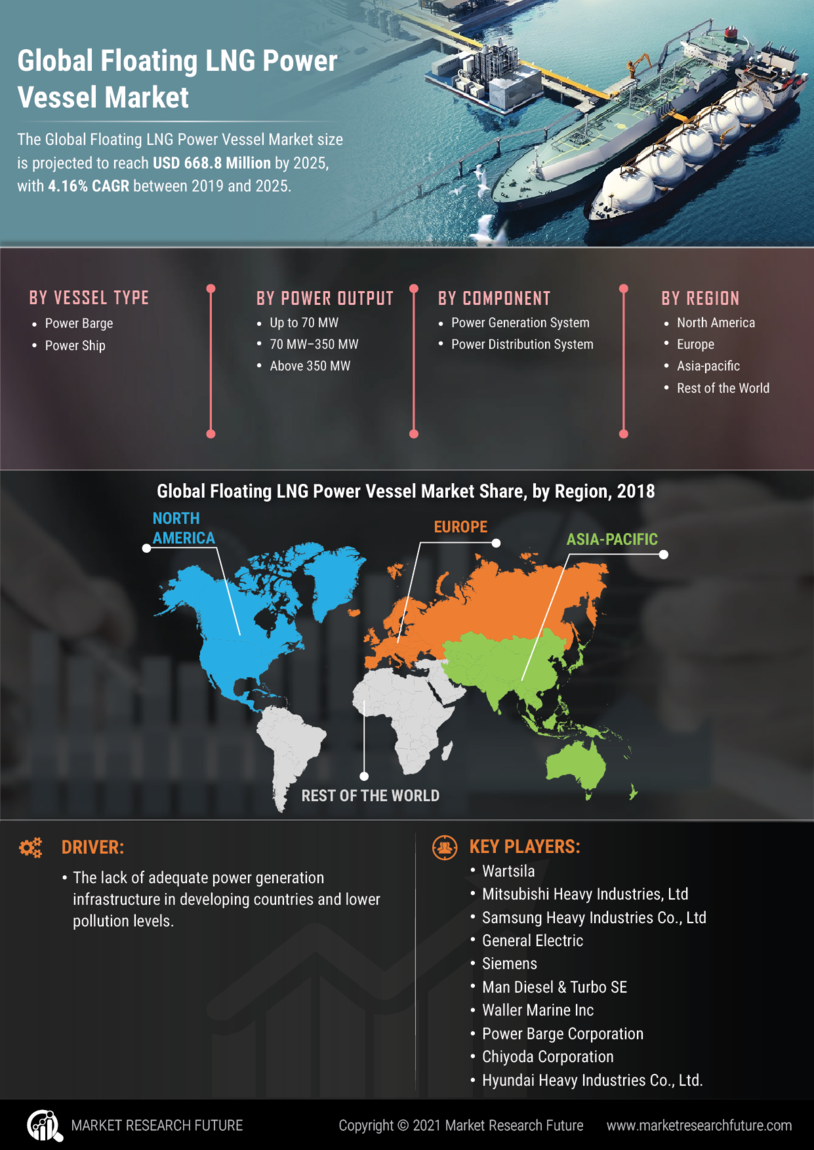
Floating LNG Power Vessel Market Research Report By Type (Power Barge, Power Ship), By Power Capacity (≤ 50 MW, 51–200 MW, 201–400 MW, ≥ 401 MW), By Application (Peak Power Supply, Base-Load Supply, Emergency/Disaster Relief), By End-User (Utilities & IPPs, Industrial, Commercial & Data-Centres) and By Regional (North America, Europe, South America, Asia Pacific, Middle East and Africa) - Growth & Industry Forecast to 2035
Floating LNG Power Vessel Market
Market Size
Forecast Period2026-2035
CAGR (2026-2035)4.74%
2025 Market SizeUSD 672.4 Million
2035 Market SizeUSD 1,065.7 Million
Key Players
Karpowership
Wärtsilä
Wison Offshore & Marine
Mitsubishi Heavy Industries
Excelerate Energy
GE Vernova
Opportunities
  • Behind-the-Meter Digital Infrastructure Power
  • Emerging-Market Fleet Leasing
  • Retrofit and Life-Extension Services
  1. 1 Market Summary |
    1. 1.1 Study Assumptions & Market Definition |
    2. 1.2 Scope of the Study |
    3. 1.3 Research Methodology
  2. 2 Key Report Takeaways |
    1. 2.1 By Type |
    2. 2.2 By Sector |
    3. 2.3 By Geography
  3. 3 Market Size & Forecast (2021–2035) |
    1. 3.1 Historical Market Size (2021–2025) |
    2. 3.2 Current & Forecast Market Size (2026–2035) |
    3. 3.3 Year-over-Year Growth Analysis
  4. 4 Driver Impact Analysis |
    1. 4.1 Fuel Cost Arbitrage Remains the Commercial Engine |
    2. 4.2 Regulatory Pressure on Marine Emissions |
    3. 4.3 Interconnection Queues Create a New Buyer Class |
    4. 4.4 Sovereign Gas Monetisation
  5. 5 Restraints Impact Analysis |
    1. 5.1 Fuel Price Exposure Undermines Tariff Certainty |
    2. 5.2 Counterparty Credit Constrains Financing |
    3. 5.3 Competing Clean Alternatives
  6. 6 Opportunities |
    1. 6.1 Behind-the-Meter Digital Infrastructure Power |
    2. 6.2 Emerging-Market Fleet Leasing |
    3. 6.3 Retrofit and Life-Extension Services |
    4. 6.4 Data Monetisation Through Performance Contracting |
    5. 6.5 Disaster-Resilience Reserve Contracts
  7. 7 Regional Market Share & Country-Level Analysis |
    1. 7.1 North America | |
      1. 7.1.1 US | |
      2. 7.1.2 Canada | |
      3. 7.1.3 Mexico |
    2. 7.2 Europe | |
      1. 7.2.1 Germany | |
      2. 7.2.2 UK | |
      3. 7.2.3 France | |
      4. 7.2.4 Italy | |
      5. 7.2.5 Spain | |
      6. 7.2.6 Nordic Countries | |
      7. 7.2.7 Russia | |
      8. 7.2.8 Rest of Europe |
    3. 7.3 Asia-Pacific | |
      1. 7.3.1 China | |
      2. 7.3.2 India | |
      3. 7.3.3 Japan | |
      4. 7.3.4 South Korea | |
      5. 7.3.5 ASEAN | |
      6. 7.3.6 Rest of Asia-Pacific |
    4. 7.4 South America | |
      1. 7.4.1 Brazil | |
      2. 7.4.2 Argentina | |
      3. 7.4.3 Rest of South America |
    5. 7.5 Middle East & Africa | |
      1. 7.5.1 Saudi Arabia | |
      2. 7.5.2 UAE | |
      3. 7.5.3 South Africa | |
      4. 7.5.4 Egypt | |
      5. 7.5.5 Rest of Middle East & Africa
  8. 8 Future Outlook (2026–2035) |
    1. 8.1 Autonomous and Remote Operations |
    2. 8.2 Power-as-a-Service Platform Economics |
    3. 8.3 Fuel Transition Optionality |
    4. 8.4 Emissions Accounting and Disclosure
  9. 9 Market Segmentation Analysis |
    1. 9.1 By Type | |
      1. 9.1.1 Power Barge | |
      2. 9.1.2 Power Ship |
    2. 9.2 By Power Capacity | |
      1. 9.2.1 ≤ 50 MW | |
      2. 9.2.2 51–200 MW | |
      3. 9.2.3 201–400 MW | |
      4. 9.2.4 ≥ 401 MW |
    3. 9.3 By Application | |
      1. 9.3.1 Peak Power Supply | |
      2. 9.3.2 Base-Load Supply | |
      3. 9.3.3 Emergency/Disaster Relief |
    4. 9.4 By End-User | |
      1. 9.4.1 Utilities & IPPs | |
      2. 9.4.2 Industrial | |
      3. 9.4.3 Commercial & Data-Centres
  10. 10 Competitive Landscape |
    1. 10.1 Market Concentration Analysis (2026) |
    2. 10.2 Competitive Benchmarking Matrix |
    3. 10.3 Company Profiles
  11. 11 Recent News & Developments
  12. 12 Report Scope & Methodology
  13. 13 Detailed Sources & Citations
  14. 14 Frequently Asked Questions
  15. 15 LIST OF TABLES |
  16. TABLE 1 Global Floating LNG Power Vessel Market Size & Forecast, by Revenue (USD Million), 2021–2035 |
  17. TABLE 2 Global Market – Year-over-Year Growth Analysis, 2021–2035 |
  18. TABLE 3 Driver Impact Analysis Matrix, 2026–2035 |
  19. TABLE 4 Restraint Impact Analysis Matrix, 2026–2035 |
  20. TABLE 5 Regional Market Summary (USD Million / Share / CAGR), 2025–2035 |
  21. TABLE 6 North America Market Size, by Country, 2021–2035 (USD Million) |
  22. TABLE 7 Europe Market Size, by Country, 2021–2035 (USD Million) |
  23. TABLE 8 Asia-Pacific Market Size, by Country, 2021–2035 (USD Million) |
  24. TABLE 9 South America Market Size, by Country, 2021–2035 (USD Million) |
  25. TABLE 10 Middle East & Africa Market Size, by Country, 2021–2035 (USD Million) |
  26. TABLE 11 Global Market Size, by Type, 2021–2035 (USD Million) |
  27. TABLE 12 Global Market Size, by Power Capacity, 2021–2035 (USD Million) |
  28. TABLE 13 Global Market Size, by Application, 2021–2035 (USD Million) |
  29. TABLE 14 Global Market Size, by End-User, 2021–2035 (USD Million) |
  30. TABLE 15 Competitive Benchmarking Matrix, 2026 |
  31. TABLE 16 Company Profiles – Key Players |
  32. TABLE 17 Recent Developments & Strategic Announcements, 2023–2025 |
  33. TABLE 18 Report Scope & Methodology Summary |
  34. TABLE 19 Detailed Sources & Citations Index
  35. 16 LIST OF FIGURES |
  36. FIGURE 1 Market Dynamics – Drivers, Restraints, Opportunities & Challenges |
  37. FIGURE 2 Industry Value Chain Analysis |
  38. FIGURE 3 Porter's Five Forces Analysis |
  39. FIGURE 4 Global Market Size Trend & Forecast (USD Million), 2021–2035 |
  40. FIGURE 5 Year-over-Year Growth Trajectory, 2022–2035 |
  41. FIGURE 6 Market Share by Type, 2025 vs 2035 |
  42. FIGURE 7 Market Share by Power Capacity, 2025 vs 2035 |
  43. FIGURE 8 Market Share by Application, 2025 vs 2035 |
  44. FIGURE 9 Market Share by End-User, 2025 vs 2035 |
  45. FIGURE 10 Regional Revenue Share Distribution, 2025 |
  46. FIGURE 11 Regional CAGR Comparison, 2026–2035 |
  47. FIGURE 12 Country-Level Contribution Heat Map, 2025 |
  48. FIGURE 13 Competitive Landscape – Estimated Revenue Share Bands, 2026 |
  49. FIGURE 14 Strategic Positioning Matrix – Operators vs Equipment Suppliers |
  50. FIGURE 15 Fuel Cost Differential – Gas vs Diesel Delivered Cost

Segmentation Quick Reference

DimensionSub-SegmentsDominant SegmentFastest Growing Segment
By TypePower Barge; Power ShipPower BargePower Ship
By Power Capacity≤ 50 MW; 51–200 MW; 201–400 MW; ≥ 401 MW51–200 MW≥ 401 MW
By ApplicationPeak Power Supply; Base-Load Supply; Emergency/Disaster ReliefBase-Load SupplyEmergency/Disaster Relief
By End-UserUtilities & IPPs; Industrial; Commercial & Data-CentresUtilities & IPPsCommercial & Data-Centres
By GeographyNorth America; Europe; Asia-Pacific; South America; Middle East & AfricaAsia-PacificMiddle East & Africa


Market Segmentation Overview

By Type

Sub-SegmentKey Trend
Power BargeStandardised hull designs compressing yard delivery cycles
Power ShipSelf-propulsion premium rising as redeployment frequency increases


Barges remain the volume choice for fixed long-term moorings where capital efficiency outweighs mobility. Ships command higher day rates because they convert contract expiry from a stranding risk into a routing decision.

By Power Capacity

Sub-SegmentKey Trend
≤ 50 MWModular skid packages targeting small island and mining loads
51–200 MWStandard financing envelope for national grid reinforcement
201–400 MWCombined-cycle configurations improving heat rate
≥ 401 MWLarge single-site campus offtake emerging as a distinct buyer class


Capacity demand is barbell-shaped. The mid-range holds its position on financing simplicity, while the largest band grows fastest as digital infrastructure buyers enter with utility-scale single-site requirements.

By Application

Sub-SegmentKey Trend
Peak Power SupplyFast-start machinery displacing liquid-fuel peakers
Base-Load SupplyLong-tenor diesel replacement contracts anchoring fleet utilisation
Emergency/Disaster ReliefRetainer-based standby models monetising idle capacity


Base-load duty still generates most revenue because it supports the longest contracts. Emergency and relief work grows faster as governments institutionalise pre-positioned generation within disaster budgets.

By End-User

Sub-SegmentKey Trend
Utilities & IPPsMultilateral guarantees enabling procurement in credit-constrained markets
IndustrialCaptive power replacing unreliable grid supply at mines and refineries
Commercial & Data-CentresBilateral contracting prioritising schedule certainty over energy price


Utility procurement sets the market's baseline volume and its risk profile. Commercial and data-centre demand is smaller but reprices the asset class, because those buyers value speed to power far above marginal cost.

By Region

Sub-SegmentKey Trend
North AmericaInterconnection bypass driving coastal siting studies
EuropeTerminal-adjacent deployment leveraging existing regasification infrastructure
Asia-PacificIsland diesel displacement programs sustaining tender volume
South AmericaHydrology-linked thermal demand creating episodic procurement
Middle East & AfricaConcessional finance unlocking gas-to-power access projects


Regional demand converges on one theme with five expressions: wherever transmission cannot arrive in time, floating generation arrives instead. That logic holds in a Virginia data-centre corridor and a Guinean coastal grid alike.


Download PDF ×

We do not share your information with anyone. However, we may send you emails based on your report interest from time to time. You may contact us at any time to opt-out.