×
Request Free Sample ×

Kindly complete the form below to receive a free sample of this Report

* Please use a valid business email

Leading companies partner with us for data-driven Insights

clients tt-cursor
Hero Background
English
Chinese
French
Japanese
Korean
German
Spanish

Flat Rolled Stainless Steel Market Trends

ID: MRFR/CnM/6690-HCR
140 Pages
Anshula Mandaokar
October 2025

Flat-Rolled Stainless Steel Market Research Report Information by Product Type (Hot/Cold-Rolled Coil, Hot/Cold-Rolled Strips, Hot/Cold-Rolled Sheets, Plates and others), Application (Construction, Automotive, Capital & Consumer Goods, Marine, Medical and others) and Region (North America, Europe, Asia-Pacific, Latin America and Middle East & Africa) - Global Forecast till 2035

Share:
Download PDF ×

We do not share your information with anyone. However, we may send you emails based on your report interest from time to time. You may contact us at any time to opt-out.

Flat Rolled Stainless Steel Market Infographic
×
Flat Rolled Stainless Steel Market Infographic Full View
Purchase Options

Market Trends

Key Emerging Trends in the Flat Rolled Stainless Steel Market

Flat-rolled stainless steel is created via a method of melting and rolling, with two major kinds of rolling: warm and cold. This flexible cloth is available in exclusive shapes and sizes, such as cold and warm sheets, coils, strips, and plates. What makes Flat-rolled stainless steel stand out are its superb functions, such as high flexibility, resistance to corrosion, an attractive look, and low protection requirements. These superior features make Flat-rolled stainless steel the favored choice over other flat-rolled materials. Its programs span a variety of industries, such as water warmers, car components, boilers, medical gadgets, production, compressor valves, marine components, kitchen necessities, and chemical processing gadgets. In the Asia-Pacific region, which contains countries like China, Japan, India, and South Korea, the market for flat-rolled stainless steel holds the most important proportion globally. The location is predicted to see a strong Compound Annual Growth Rate (CAGR) at some point in the overview length. The pressure behind this boom is the improved investment in residential and business production sports within the Asia-Pacific area. Furthermore, the growing demand for flat-rolled stainless steel in the manufacturing of capital and customer items is ready to make appreciable contributions to the regional market's growth. The method of producing flat-rolled stainless steel includes melting and rolling, with the rolling phase categorized as warm or cold. This is reflected in numerous styles of flat-rolled stainless steel, which includes sheets, coils, strips, and plates. These products have emerged as preferred over different flat-rolled substances due to their wonderful residences, which consist of corrosion resistance, high flexibility, an appealing look, and simplicity of renovation. Flat-rolled stainless steel has determined software in a wide variety of industries, serving purposes together within water heaters, boilers, automobile components, clinical devices, production projects, meals processing gadgets, marine equipment, kitchen necessities, compressor valves, and chemical substances processing gadgets. The Asia-Pacific location, including countries like China, Japan, India, and South Korea, is at the leading edge of the global Flat-rolled stainless-steel market, preserving the biggest percentage. The region is expected to enjoy a noteworthy Compound Annual Growth Rate (CAGR) through the overview duration. This boom is, in most cases, fueled by heightened investments in residential and industrial creation projects across the Asia-Pacific location. Additionally, the increasing demand for Flat-rolled stainless steel in the manufacturing of capital and customer goods is anticipated to be a substantial catalyst for the nearby market's enlargement.


Author
Anshula Mandaokar
Team Lead - Research

Anshula Mandaokar holds an academic degree in Chemical Engineering and has been contributing to the field for more than 5 years. She has expertise in Market Research and Business Consulting and serves as a Team Lead for a reputed Market Research firm under the Chemicals and Materials domain spectrum. She has worked on multiple projects, generating explicit results in a quick turnaround time. Her understanding of data interpretation justifies her role as a leader.

Leave a Comment

FAQs

What would be the flat-rolled stainless steel market valuation by 2035?

The flat-rolled stainless steel market valuation would be USD 150 billion.

What are the major flat-rolled stainless steel market factors?

Major factors are widespread use in kitchen essentials, automobile parts, and heavy machinery.

What is the largest major flat-rolled stainless steel market?

The largest major flat-rolled stainless steel market is the Asia Pacific region.

What are the applications discussed about the flat-rolled stainless steel market in the report?

The applications are medical, automotive, construction, marine, capital & consumer goods, and others.

What are the product types included in the discussion?

The product types included are hot/cold-rolled sheets, plates, hot/cold-rolled strips, hot/cold-rolled coils, and others.

Market Summary

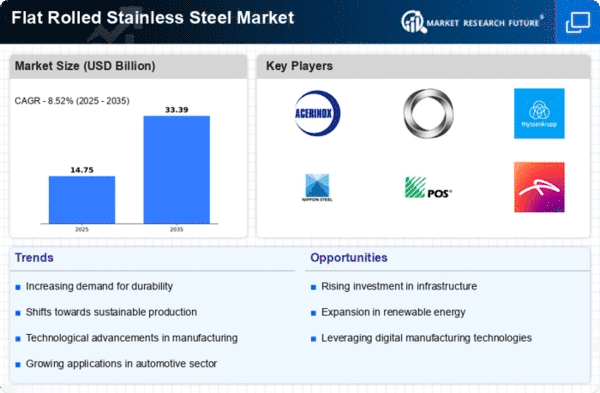
As per MRFR analysis, the Flat Rolled Stainless Steel Market Size was estimated at 13.59 USD Billion in 2024. The Flat Rolled Stainless Steel industry is projected to grow from 14.74 USD Billion in 2025 to 33.39 USD Billion by 2035, exhibiting a compound annual growth rate (CAGR) of 8.52 during the forecast period 2025 - 2035.

Key Market Trends & Highlights

The Flat Rolled Stainless Steel Market is experiencing robust growth driven by sustainability and technological advancements.

  • North America remains the largest market for flat rolled stainless steel, driven by strong demand in the automotive sector.
  • Asia-Pacific is the fastest-growing region, with increasing investments in infrastructure and construction.
  • The automotive segment leads in market size, while the aerospace segment is witnessing rapid growth due to technological innovations.
  • Key market drivers include rising demand from the automotive sector and a growing focus on sustainability initiatives.

Market Size & Forecast

2024 Market Size 13.59 (USD Billion)
2035 Market Size 33.39 (USD Billion)
CAGR (2025 - 2035) 8.52%
Largest Regional Market Share in 2024 Asia-Pacific

Major Players

Acerinox (ES), Outokumpu (FI), Thyssenkrupp (DE), Nippon Steel Corporation (JP), POSCO (KR), ArcelorMittal (LU), Jindal Stainless (IN), Allegheny Technologies Incorporated (US), Baosteel Group (CN)

Market Trends

The Flat Rolled Stainless Steel Market is currently experiencing a dynamic phase characterized by evolving consumer preferences and technological advancements. The demand for flat rolled stainless steel products is driven by their versatility and durability, making them suitable for various applications, including automotive, construction, and food processing industries. As sustainability becomes a focal point for manufacturers and consumers alike, the market is witnessing a shift towards eco-friendly production methods and materials. This trend is likely to influence the competitive landscape, prompting companies to innovate and adapt to changing market conditions. In addition, the Flat Rolled Stainless Steel Market is seeing increased investment in research and development, aimed at enhancing product quality and performance. Companies are exploring advanced manufacturing techniques, such as automation and digitalization, to improve efficiency and reduce costs. Furthermore, the global push for infrastructure development is expected to bolster demand for flat rolled stainless steel products, particularly in emerging economies. Overall, the market appears poised for growth, driven by a combination of technological innovation and shifting consumer demands.

Sustainability Initiatives

The Flat Rolled Stainless Steel Market is increasingly influenced by sustainability initiatives. Manufacturers are adopting eco-friendly practices, focusing on reducing carbon footprints and utilizing recycled materials. This trend reflects a broader commitment to environmental responsibility, appealing to consumers who prioritize sustainable products.

Technological Advancements

Technological advancements are reshaping the Flat Rolled Stainless Steel Market. Innovations in manufacturing processes, such as automation and digitalization, enhance production efficiency and product quality. These developments enable companies to meet the evolving demands of various industries more effectively.

Infrastructure Development

Infrastructure development is a key driver in the Flat Rolled Stainless Steel Market. As global economies invest in construction and renovation projects, the demand for flat rolled stainless steel products is expected to rise. This trend is particularly pronounced in emerging markets, where urbanization is accelerating.

Flat Rolled Stainless Steel Market Market Drivers

Market Trends and Growth Projections

The Global Flat-rolled Steel Market Industry is characterized by several trends and growth projections that reflect its dynamic nature. The market is currently valued at 73 USD Billion in 2024, with expectations of reaching 191.4 USD Billion by 2035. This growth trajectory suggests a compound annual growth rate of 9.16% from 2025 to 2035. Key trends influencing this growth include increased demand from the automotive and construction sectors, technological advancements in production, and a shift towards sustainable practices. These factors collectively shape the market landscape, indicating a promising future for the Global Flat-rolled Steel Market Industry.

Rising Demand from Automotive Sector

The Global Flat-rolled Steel Market Industry experiences a robust demand surge from the automotive sector, which is increasingly adopting flat-rolled steel for vehicle manufacturing. This material is favored for its lightweight yet durable properties, contributing to enhanced fuel efficiency and safety. In 2024, the market is valued at approximately 73 USD Billion, with projections indicating a significant growth trajectory. As automotive manufacturers prioritize sustainability, the use of flat-rolled steel aligns with their goals, potentially driving the market further. The automotive sector's shift towards electric vehicles also necessitates advanced materials, thereby bolstering the demand for flat-rolled steel in the Global Flat-rolled Steel Market Industry.

Infrastructure Development Initiatives

Infrastructure development initiatives across various regions are pivotal drivers of the Global Flat-rolled Steel Market Industry. Governments are investing heavily in infrastructure projects, including roads, bridges, and railways, which require substantial quantities of flat-rolled steel. For instance, the ongoing urbanization trends in developing countries necessitate the construction of new infrastructure, thereby increasing the demand for flat-rolled steel. This sector is expected to witness a compound annual growth rate of 9.16% from 2025 to 2035, reflecting the critical role of flat-rolled steel in supporting global infrastructure needs. Such initiatives not only stimulate economic growth but also enhance the overall market dynamics of the Global Flat-rolled Steel Market Industry.

Technological Advancements in Production

Technological advancements in the production processes of flat-rolled steel are transforming the Global Flat-rolled Steel Market Industry. Innovations such as automation and advanced manufacturing techniques are enhancing efficiency and reducing production costs. These improvements enable manufacturers to produce high-quality flat-rolled steel products that meet stringent industry standards. As a result, the market is likely to expand, with an anticipated valuation of 191.4 USD Billion by 2035. The integration of smart technologies in production lines also facilitates better resource management and sustainability, appealing to environmentally conscious consumers and industries. Thus, technological progress plays a crucial role in shaping the future landscape of the Global Flat-rolled Steel Market Industry.

Growing Demand for Energy-efficient Solutions

The increasing emphasis on energy-efficient solutions across various industries is a notable driver of the Global Flat-rolled Steel Market Industry. Industries such as construction and manufacturing are seeking materials that contribute to energy savings and reduced carbon footprints. Flat-rolled steel, known for its recyclability and energy-efficient properties, is becoming a preferred choice. This trend is particularly evident in the construction of energy-efficient buildings and infrastructure, where flat-rolled steel is utilized for roofing, siding, and structural components. As global regulations tighten around energy consumption, the demand for flat-rolled steel is expected to rise, further solidifying its importance in the Global Flat-rolled Steel Market Industry.

Market Diversification and Product Innovation

Market diversification and product innovation are essential factors influencing the Global Flat-rolled Steel Market Industry. Manufacturers are increasingly focusing on developing specialized flat-rolled steel products tailored to specific applications, such as high-strength steel for automotive and construction sectors. This innovation not only meets the evolving needs of various industries but also enhances competitiveness in the market. As companies strive to differentiate their offerings, the introduction of new grades and coatings of flat-rolled steel is likely to attract a broader customer base. Consequently, this trend may contribute to the overall growth of the market, with projections indicating a valuation of 191.4 USD Billion by 2035.

Market Segment Insights

By Application: Automotive (Largest) vs. Aerospace (Fastest-Growing)

In the Flat Rolled Stainless Steel Market, the automotive sector emerges as the largest application, holding a significant portion of the overall share. This dominance can be attributed to the increasing demand for lightweight materials that offer strength and durability in vehicle manufacturing. The construction and food processing sectors also contribute considerably, reflecting evolving consumer preferences and regulatory standards that favor stainless steel for its corrosion resistance and longevity.

Automotive (Dominant) vs. Aerospace (Emerging)

The automotive sector stands out for its robust demand for flat rolled stainless steel, driven by its applications in exhaust systems, body panels, and structural components. This segment is characterized by a focus on efficiency, safety, and design flexibility. Conversely, the aerospace industry represents an emerging segment with rapidly growing prospects, spurred by technological advancements and a shift towards high-performance materials. Aerospace applications prioritize weight-saving solutions and corrosion resistance, making flat rolled stainless steel an increasingly attractive option for aircraft manufacturers.

By End Use: Building and Construction (Largest) vs. Medical Devices (Fastest-Growing)

In the Flat Rolled Stainless Steel Market, the 'Building and Construction' segment holds the largest market share, driven by the booming demand for residential and commercial infrastructure development. This segment benefits from the robust characteristics of stainless steel, such as corrosion resistance and durability, making it ideal for structural applications. Following closely, 'Transportation' and 'Industrial Equipment' also contribute significantly to the overall market, reflecting diverse applications where stainless steel is favored for its strength and longevity. On the other hand, the 'Medical Devices' segment is recognized as the fastest-growing segment in the Flat Rolled Stainless Steel Market. This growth is primarily fueled by rising healthcare expenditures and the increasing emphasis on advanced medical technologies requiring high-quality materials. Shifting consumer preferences towards minimally invasive surgical devices and the need for reliable, hygienic materials in medical applications are propelling this segment's rapid growth trajectory.

Building and Construction: (Dominant) vs. Medical Devices (Emerging)

The 'Building and Construction' segment dominates the Flat Rolled Stainless Steel Market due to its extensive use in structural components, roofing, and architectural applications. The strength and corrosion resistance of stainless steel make it an ideal choice for both aesthetic and functional elements in construction. Conversely, the 'Medical Devices' segment is emerging prominently, driven by technological advancements in healthcare. Stainless steel is revered for its biocompatibility and ease of sterilization, making it essential in the manufacturing of surgical instruments and implants. While the construction industry leans heavily on the material's durability, the medical devices sector is rapidly adapting to innovative designs and heightened hygiene requirements, indicating a dynamic shift in market focus.

By Product Type: Cold Rolled (Largest) vs. Hot Rolled (Fastest-Growing)

The flat rolled stainless steel market is primarily segmented into Hot Rolled, Cold Rolled, Galvanized, Electrolytic, and Polished types. Among these, Cold Rolled stainless steel holds the largest market share due to its superior finish and tolerance. This segment serves various applications such as automotive and construction, enabling industries to utilize Cold Rolled products extensively. In contrast, Hot Rolled stainless steel has witnessed rapid growth owing to its broad applicability in manufacturing processes requiring high strength and flexibility, enhancing the segment’s reputation and market presence. Currently, the growth trends within the Flat Rolled Stainless Steel Market are being driven by the increasing demand for lightweight yet robust material alternatives. Cold Rolled stainless steel continues to dominate due to its ability to resist corrosion and wear, appealing to quality-focused industries. Meanwhile, the adoption of Hot Rolled stainless steel is being catalyzed by innovations in processing techniques, leading to improved efficiency and performance in demanding applications.

Cold Rolled (Dominant) vs. Galvanized (Emerging)

Cold Rolled stainless steel is characterized by its enhanced strength and superior surface finish, making it a preferred choice for many industries, especially where structural integrity and aesthetic appeal are crucial. With a significant dominance in the market, this segment caters to sectors such as automotive and appliances, underpinning its widespread acceptance. In contrast, Galvanized stainless steel, known for its corrosion-resistant properties due to the zinc coating, is emerging rapidly due to the rising demand in construction and environmental applications. This segment is gaining traction as manufacturers look for protective solutions in harsh environments, positioning it as a vital alternative, especially in geographical areas prone to moisture and corrosion.

By Thickness: Thin Gauge (Largest) vs. Ultra-Thin (Fastest-Growing)

In the Flat Rolled Stainless Steel Market, the 'Thin Gauge' segment holds a significant share, driven by its widespread applications in various industries, particularly in manufacturing and construction. Its versatile properties make it a preferred choice for many end-users, ensuring consistent demand. Meanwhile, the 'Ultra-Thin' category, while smaller in market share, is rapidly gaining traction due to its growing use in innovative applications such as electronics and precision engineering, showing potential for robust future growth.

Thin Gauge (Dominant) vs. Ultra-Thin (Emerging)

The 'Thin Gauge' segment is characterized by its flexible and lightweight nature, allowing for easy handling and versatile applications in sectors such as automotive and architectural design. This segment's dominance is largely attributed to its ability to meet various industry standards while maintaining cost-effectiveness. Conversely, the 'Ultra-Thin' segment is emerging as a significant player in specialized fields where precision and material efficiency are crucial. Its unique properties cater to high-tech applications, fostering innovation and setting the stage for increased adoption in the coming years.

By Surface Finish: Brushed (Largest) vs. Mirror (Fastest-Growing)

The Flat Rolled Stainless Steel Market showcases a diverse range of surface finishes, with the brushed finish currently holding the largest market share. Its popularity stems from its ability to provide an aesthetically pleasing look while also offering resistance to scratches and fingerprints. On the other hand, the mirror finish is rapidly gaining traction as the fastest-growing segment, appealing particularly to high-end applications that require a sleek and polished appearance. As consumer preferences evolve towards premium finishes, the market dynamics are shifting significantly. In terms of growth trends, the brushed segment's dominance is driven by its versatility in various applications, including architecture and kitchenware. Conversely, the mirror finish is being propelled by the increasing demand in sectors like luxury automotive and premium appliances, where visual appeal and reflective quality are paramount. The continuous innovation in finishing techniques is further enhancing the product offerings across these segments, contributing to their distinct growth trajectories.

Brushed (Dominant) vs. Mirror (Emerging)

The brushed finish remains dominant in the Flat Rolled Stainless Steel Market due to its functional benefits and widespread application. It offers excellent resistance to corrosion and wear, which makes it a preferred choice in diverse settings, including construction, furnishings, and kitchen tools. Its textured appearance minimizes the visibility of scratches, making it ideal for high-traffic areas. In contrast, the mirror finish is an emerging choice, driven by its luxurious appearance and suitability for high-end products. This finish finds extensive use in the automotive industry, designer appliances, and high-fashion applications. The growing trend towards bespoke and visually stunning products aligns well with the market entry of mirror finish stainless steel, highlighting a shift towards aesthetics in industrial design.

Get more detailed insights about Flat-Rolled Stainless Steel Market Research Report - Global Forecast till 2035

Regional Insights

North America : Stable Growth Environment

The Flat Rolled Stainless Steel Market in North America is projected to reach $2.72 billion by December 2025. Key growth drivers include increasing demand from the automotive and construction sectors, alongside stringent regulations promoting sustainable practices. The region's market share reflects a stable growth environment, with a focus on innovation and quality standards that align with environmental regulations. Leading countries such as the US and Canada dominate the market, with major players like Allegheny Technologies Incorporated and Acerinox establishing a strong presence. The competitive landscape is characterized by technological advancements and strategic partnerships aimed at enhancing production efficiency. The focus on recycling and sustainability further strengthens the market position of North American manufacturers.

Europe : Innovation and Sustainability Focus

Europe's Flat Rolled Stainless Steel Market is expected to reach $3.83 billion by December 2025, driven by a robust demand for high-quality materials in various industries, including aerospace and energy. Regulatory frameworks emphasizing sustainability and recycling are pivotal in shaping market dynamics, contributing to a significant market share. The region's commitment to reducing carbon emissions is a key catalyst for growth. Germany, France, and Italy are leading countries in this market, with major players like Thyssenkrupp and Outokumpu at the forefront. The competitive landscape is marked by innovation, with companies investing in advanced manufacturing technologies. The presence of a skilled workforce and strong R&D capabilities further enhance Europe's position in the global market.

Asia-Pacific : Dominant Market Leader

The Asia-Pacific region is the largest market for Flat Rolled Stainless Steel, projected to reach $6.79 billion by December 2025. This growth is fueled by rapid industrialization, urbanization, and increasing demand from sectors such as construction and automotive. The region's market share reflects its dominant position, supported by favorable government policies and investments in infrastructure development. China, Japan, and India are the leading countries, with key players like Baosteel Group and Nippon Steel Corporation driving competition. The market is characterized by a mix of local and international companies, fostering a competitive environment. The focus on innovation and cost-effective production methods positions Asia-Pacific as a powerhouse in The Flat Rolled Stainless Steel.

Middle East and Africa : Emerging Market Potential

The Flat Rolled Stainless Steel Market in the Middle East and Africa is projected to reach $0.25 billion by December 2025, reflecting emerging market potential. Key growth drivers include increasing investments in infrastructure and construction projects, alongside a growing demand for stainless steel in various applications. Regulatory support for industrial growth is also a significant factor contributing to market dynamics. Countries like South Africa and the UAE are leading the market, with a focus on enhancing local production capabilities. The competitive landscape is evolving, with both regional and international players seeking to capitalize on growth opportunities. The presence of key players is gradually increasing, indicating a positive outlook for the region's stainless steel market.

Key Players and Competitive Insights

The Flat Rolled Stainless Steel Market is characterized by a competitive landscape that is increasingly shaped by innovation, sustainability, and strategic partnerships. Key players such as Acerinox (ES), Outokumpu (FI), and Thyssenkrupp (DE) are actively pursuing strategies that emphasize technological advancements and operational efficiencies. For instance, Acerinox (ES) has focused on enhancing its production capabilities through investments in advanced manufacturing technologies, which positions the company favorably in terms of cost efficiency and product quality. Similarly, Outokumpu (FI) has been concentrating on sustainability initiatives, aiming to reduce its carbon footprint, which resonates well with the growing demand for environmentally friendly products. Thyssenkrupp (DE), on the other hand, is leveraging digital transformation to optimize its supply chain and improve customer engagement, thereby enhancing its competitive edge in the market.The business tactics employed by these companies reflect a broader trend towards localizing manufacturing and optimizing supply chains to respond swiftly to market demands. The competitive structure of the Flat Rolled Stainless Steel Market appears moderately fragmented, with several key players exerting influence over pricing and product offerings. This fragmentation allows for a diverse range of products and services, catering to various customer needs while fostering healthy competition among manufacturers.

In November Nippon Steel Corporation (JP) announced a strategic partnership with a leading technology firm to develop AI-driven solutions for its production processes. This collaboration is expected to enhance operational efficiency and reduce waste, aligning with the company's commitment to sustainability. The integration of AI technologies could potentially revolutionize Nippon Steel's manufacturing capabilities, allowing for more precise control over production variables and improved product quality.

In October POSCO (KR) unveiled its new eco-friendly stainless steel product line, which utilizes recycled materials and innovative production techniques. This move not only addresses the increasing consumer demand for sustainable products but also positions POSCO as a leader in the green steel initiative. The introduction of this product line is likely to attract environmentally conscious customers and strengthen POSCO's market position.

In September Allegheny Technologies Incorporated (US) completed the acquisition of a smaller competitor, enhancing its product portfolio and market reach. This acquisition is strategically significant as it allows Allegheny Technologies to expand its manufacturing capabilities and diversify its offerings, thereby increasing its competitiveness in the Flat Rolled Stainless Steel Market. The consolidation of resources and expertise from the acquired company may lead to improved operational efficiencies and innovation.

As of December the competitive trends in the Flat Rolled Stainless Steel Market are increasingly defined by digitalization, sustainability, and the integration of advanced technologies. Strategic alliances among key players are shaping the landscape, fostering innovation and enhancing supply chain reliability. The shift from price-based competition to a focus on technological advancements and sustainable practices is evident, suggesting that future competitive differentiation will hinge on the ability to innovate and adapt to changing market dynamics.

Key Companies in the Flat Rolled Stainless Steel Market include

Industry Developments

Future Outlook

Flat Rolled Stainless Steel Market Future Outlook

The Flat Rolled Stainless Steel Market is projected to grow at an 8.52% CAGR from 2025 to 2035, driven by increasing demand in automotive, construction, and consumer goods sectors.

New opportunities lie in:

  • Expansion into emerging markets with tailored product offerings.
  • Investment in advanced manufacturing technologies for cost efficiency.
  • Development of eco-friendly stainless steel solutions to meet sustainability demands.

By 2035, the market is expected to solidify its position as a leader in the global materials industry.

Market Segmentation

Flat Rolled Stainless Steel Market End Use Outlook

  • Building and Construction
  • Transportation
  • Industrial Equipment
  • Consumer Goods
  • Medical Devices

Flat Rolled Stainless Steel Market Thickness Outlook

  • Thin Gauge
  • Medium Gauge
  • Thick Gauge
  • Ultra-Thin
  • Ultra-Thick

Flat Rolled Stainless Steel Market Application Outlook

  • Automotive
  • Construction
  • Aerospace
  • Food Processing
  • Chemical Processing

Flat Rolled Stainless Steel Market Product Type Outlook

  • Hot Rolled
  • Cold Rolled
  • Galvanized
  • Electrolytic
  • Polished

Flat Rolled Stainless Steel Market Surface Finish Outlook

  • Brushed
  • Mirror
  • Matte
  • Embossed
  • Patterned

Report Scope

MARKET SIZE 202413.59(USD Billion)
MARKET SIZE 202514.74(USD Billion)
MARKET SIZE 203533.39(USD Billion)
COMPOUND ANNUAL GROWTH RATE (CAGR)8.52% (2025 - 2035)
REPORT COVERAGERevenue Forecast, Competitive Landscape, Growth Factors, and Trends
BASE YEAR2024
Market Forecast Period2025 - 2035
Historical Data2019 - 2024
Market Forecast UnitsUSD Billion
Key Companies ProfiledAcerinox (ES), Outokumpu (FI), Thyssenkrupp (DE), Nippon Steel Corporation (JP), POSCO (KR), ArcelorMittal (LU), Jindal Stainless (IN), Allegheny Technologies Incorporated (US), Baosteel Group (CN)
Segments CoveredApplication, End Use, Product Type, Thickness, Surface Finish
Key Market OpportunitiesGrowing demand for lightweight, corrosion-resistant materials in automotive and construction sectors drives Flat Rolled Stainless Steel Market.
Key Market DynamicsRising demand for lightweight materials drives innovation and competition in the flat rolled stainless steel sector.
Countries CoveredNorth America, Europe, APAC, South America, MEA

FAQs

What would be the flat-rolled stainless steel market valuation by 2035?

The flat-rolled stainless steel market valuation would be USD 150 billion.

What are the major flat-rolled stainless steel market factors?

Major factors are widespread use in kitchen essentials, automobile parts, and heavy machinery.

What is the largest major flat-rolled stainless steel market?

The largest major flat-rolled stainless steel market is the Asia Pacific region.

What are the applications discussed about the flat-rolled stainless steel market in the report?

The applications are medical, automotive, construction, marine, capital & consumer goods, and others.

What are the product types included in the discussion?

The product types included are hot/cold-rolled sheets, plates, hot/cold-rolled strips, hot/cold-rolled coils, and others.

  1. SECTION I: EXECUTIVE SUMMARY AND KEY HIGHLIGHTS
    1. | 1.1 EXECUTIVE SUMMARY
    2. | 1.1.1 Market Overview
    3. | 1.1.2 Key Findings
    4. | 1.1.3 Market Segmentation
    5. | 1.1.4 Competitive Landscape
    6. | 1.1.5 Challenges and Opportunities
    7. | 1.1.6 Future Outlook
  2. SECTION II: SCOPING, METHODOLOGY AND MARKET STRUCTURE
    1. | 2.1 MARKET INTRODUCTION
    2. | 2.1.1 Definition
    3. | 2.1.2 Scope of the study
    4. |-- 2.1.2.1 Research Objective
    5. |-- 2.1.2.2 Assumption
    6. |-- 2.1.2.3 Limitations
    7. | 2.2 RESEARCH METHODOLOGY
    8. | 2.2.1 Overview
    9. | 2.2.2 Data Mining
    10. | 2.2.3 Secondary Research
    11. | 2.2.4 Primary Research
    12. |-- 2.2.4.1 Primary Interviews and Information Gathering Process
    13. |-- 2.2.4.2 Breakdown of Primary Respondents
    14. | 2.2.5 Forecasting Model
    15. | 2.2.6 Market Size Estimation
    16. |-- 2.2.6.1 Bottom-Up Approach
    17. |-- 2.2.6.2 Top-Down Approach
    18. | 2.2.7 Data Triangulation
    19. | 2.2.8 Validation
  3. SECTION III: QUALITATIVE ANALYSIS
    1. | 3.1 MARKET DYNAMICS
    2. | 3.1.1 Overview
    3. | 3.1.2 Drivers
    4. | 3.1.3 Restraints
    5. | 3.1.4 Opportunities
    6. | 3.2 MARKET FACTOR ANALYSIS
    7. | 3.2.1 Value chain Analysis
    8. | 3.2.2 Porter's Five Forces Analysis
    9. |-- 3.2.2.1 Bargaining Power of Suppliers
    10. |-- 3.2.2.2 Bargaining Power of Buyers
    11. |-- 3.2.2.3 Threat of New Entrants
    12. |-- 3.2.2.4 Threat of Substitutes
    13. |-- 3.2.2.5 Intensity of Rivalry
    14. | 3.2.3 COVID-19 Impact Analysis
    15. |-- 3.2.3.1 Market Impact Analysis
    16. |-- 3.2.3.2 Regional Impact
    17. |-- 3.2.3.3 Opportunity and Threat Analysis
  4. SECTION IV: QUANTITATIVE ANALYSIS
    1. | 4.1 Chemicals and Materials, BY Application (USD Billion)
    2. | 4.1.1 Automotive
    3. | 4.1.2 Construction
    4. | 4.1.3 Aerospace
    5. | 4.1.4 Food Processing
    6. | 4.1.5 Chemical Processing
    7. | 4.2 Chemicals and Materials, BY End Use (USD Billion)
    8. | 4.2.1 Building and Construction
    9. | 4.2.2 Transportation
    10. | 4.2.3 Industrial Equipment
    11. | 4.2.4 Consumer Goods
    12. | 4.2.5 Medical Devices
    13. | 4.3 Chemicals and Materials, BY Product Type (USD Billion)
    14. | 4.3.1 Hot Rolled
    15. | 4.3.2 Cold Rolled
    16. | 4.3.3 Galvanized
    17. | 4.3.4 Electrolytic
    18. | 4.3.5 Polished
    19. | 4.4 Chemicals and Materials, BY Thickness (USD Billion)
    20. | 4.4.1 Thin Gauge
    21. | 4.4.2 Medium Gauge
    22. | 4.4.3 Thick Gauge
    23. | 4.4.4 Ultra-Thin
    24. | 4.4.5 Ultra-Thick
    25. | 4.5 Chemicals and Materials, BY Surface Finish (USD Billion)
    26. | 4.5.1 Brushed
    27. | 4.5.2 Mirror
    28. | 4.5.3 Matte
    29. | 4.5.4 Embossed
    30. | 4.5.5 Patterned
    31. | 4.6 Chemicals and Materials, BY Region (USD Billion)
    32. | 4.6.1 North America
    33. |-- 4.6.1.1 US
    34. |-- 4.6.1.2 Canada
    35. | 4.6.2 Europe
    36. |-- 4.6.2.1 Germany
    37. |-- 4.6.2.2 UK
    38. |-- 4.6.2.3 France
    39. |-- 4.6.2.4 Russia
    40. |-- 4.6.2.5 Italy
    41. |-- 4.6.2.6 Spain
    42. |-- 4.6.2.7 Rest of Europe
    43. | 4.6.3 APAC
    44. |-- 4.6.3.1 China
    45. |-- 4.6.3.2 India
    46. |-- 4.6.3.3 Japan
    47. |-- 4.6.3.4 South Korea
    48. |-- 4.6.3.5 Malaysia
    49. |-- 4.6.3.6 Thailand
    50. |-- 4.6.3.7 Indonesia
    51. |-- 4.6.3.8 Rest of APAC
    52. | 4.6.4 South America
    53. |-- 4.6.4.1 Brazil
    54. |-- 4.6.4.2 Mexico
    55. |-- 4.6.4.3 Argentina
    56. |-- 4.6.4.4 Rest of South America
    57. | 4.6.5 MEA
    58. |-- 4.6.5.1 GCC Countries
    59. |-- 4.6.5.2 South Africa
    60. |-- 4.6.5.3 Rest of MEA
  5. SECTION V: COMPETITIVE ANALYSIS
    1. | 5.1 Competitive Landscape
    2. | 5.1.1 Overview
    3. | 5.1.2 Competitive Analysis
    4. | 5.1.3 Market share Analysis
    5. | 5.1.4 Major Growth Strategy in the Chemicals and Materials
    6. | 5.1.5 Competitive Benchmarking
    7. | 5.1.6 Leading Players in Terms of Number of Developments in the Chemicals and Materials
    8. | 5.1.7 Key developments and growth strategies
    9. |-- 5.1.7.1 New Product Launch/Service Deployment
    10. |-- 5.1.7.2 Merger & Acquisitions
    11. |-- 5.1.7.3 Joint Ventures
    12. | 5.1.8 Major Players Financial Matrix
    13. |-- 5.1.8.1 Sales and Operating Income
    14. |-- 5.1.8.2 Major Players R&D Expenditure. 2023
    15. | 5.2 Company Profiles
    16. | 5.2.1 Acerinox (ES)
    17. |-- 5.2.1.1 Financial Overview
    18. |-- 5.2.1.2 Products Offered
    19. |-- 5.2.1.3 Key Developments
    20. |-- 5.2.1.4 SWOT Analysis
    21. |-- 5.2.1.5 Key Strategies
    22. | 5.2.2 Outokumpu (FI)
    23. |-- 5.2.2.1 Financial Overview
    24. |-- 5.2.2.2 Products Offered
    25. |-- 5.2.2.3 Key Developments
    26. |-- 5.2.2.4 SWOT Analysis
    27. |-- 5.2.2.5 Key Strategies
    28. | 5.2.3 Thyssenkrupp (DE)
    29. |-- 5.2.3.1 Financial Overview
    30. |-- 5.2.3.2 Products Offered
    31. |-- 5.2.3.3 Key Developments
    32. |-- 5.2.3.4 SWOT Analysis
    33. |-- 5.2.3.5 Key Strategies
    34. | 5.2.4 Nippon Steel Corporation (JP)
    35. |-- 5.2.4.1 Financial Overview
    36. |-- 5.2.4.2 Products Offered
    37. |-- 5.2.4.3 Key Developments
    38. |-- 5.2.4.4 SWOT Analysis
    39. |-- 5.2.4.5 Key Strategies
    40. | 5.2.5 POSCO (KR)
    41. |-- 5.2.5.1 Financial Overview
    42. |-- 5.2.5.2 Products Offered
    43. |-- 5.2.5.3 Key Developments
    44. |-- 5.2.5.4 SWOT Analysis
    45. |-- 5.2.5.5 Key Strategies
    46. | 5.2.6 ArcelorMittal (LU)
    47. |-- 5.2.6.1 Financial Overview
    48. |-- 5.2.6.2 Products Offered
    49. |-- 5.2.6.3 Key Developments
    50. |-- 5.2.6.4 SWOT Analysis
    51. |-- 5.2.6.5 Key Strategies
    52. | 5.2.7 Jindal Stainless (IN)
    53. |-- 5.2.7.1 Financial Overview
    54. |-- 5.2.7.2 Products Offered
    55. |-- 5.2.7.3 Key Developments
    56. |-- 5.2.7.4 SWOT Analysis
    57. |-- 5.2.7.5 Key Strategies
    58. | 5.2.8 Allegheny Technologies Incorporated (US)
    59. |-- 5.2.8.1 Financial Overview
    60. |-- 5.2.8.2 Products Offered
    61. |-- 5.2.8.3 Key Developments
    62. |-- 5.2.8.4 SWOT Analysis
    63. |-- 5.2.8.5 Key Strategies
    64. | 5.2.9 Baosteel Group (CN)
    65. |-- 5.2.9.1 Financial Overview
    66. |-- 5.2.9.2 Products Offered
    67. |-- 5.2.9.3 Key Developments
    68. |-- 5.2.9.4 SWOT Analysis
    69. |-- 5.2.9.5 Key Strategies
    70. | 5.3 Appendix
    71. | 5.3.1 References
    72. | 5.3.2 Related Reports

Chemicals and Materials Market Segmentation

Chemicals and Materials By Application (USD Billion, 2025-2035)

  • Automotive
  • Construction
  • Aerospace
  • Food Processing
  • Chemical Processing

Chemicals and Materials By End Use (USD Billion, 2025-2035)

  • Building and Construction
  • Transportation
  • Industrial Equipment
  • Consumer Goods
  • Medical Devices

Chemicals and Materials By Product Type (USD Billion, 2025-2035)

  • Hot Rolled
  • Cold Rolled
  • Galvanized
  • Electrolytic
  • Polished

Chemicals and Materials By Thickness (USD Billion, 2025-2035)

  • Thin Gauge
  • Medium Gauge
  • Thick Gauge
  • Ultra-Thin
  • Ultra-Thick

Chemicals and Materials By Surface Finish (USD Billion, 2025-2035)

  • Brushed
  • Mirror
  • Matte
  • Embossed
  • Patterned
Infographic

Free Sample Request

Kindly complete the form below to receive a free sample of this Report

Get Free Sample

Customer Strories

Compare Licence

×
Features License Type
Single User Multiuser License Enterprise User
Price $4,950 $5,950 $7,250
Maximum User Access Limit 1 User Upto 10 Users Unrestricted Access Throughout the Organization
Free Customization
Direct Access to Analyst
Deliverable Format
Platform Access
Discount on Next Purchase 10% 15% 15%
Printable Versions