×
Request Free Sample ×

Kindly complete the form below to receive a free sample of this Report

* Please use a valid business email

Leading companies partner with us for data-driven Insights

clients tt-cursor
Hero Background
English
Chinese
French
Japanese
Korean
German
Spanish

Fixed Tilt Solar PV Market Analysis

ID: MRFR/EnP/8873-HCR
111 Pages
Anshula Mandaokar
October 2025

Fixed Tilt Solar PV Market Research Report By Technology (Single Axis Tracking, Fixed Tilt, Concentrated Solar Power), By Installation Type (Ground Mounted, Roof Mounted, Building Integrated), By End Use (Residential, Commercial, Industrial), By Component (Solar Panels, Inverters, Mounting Structures) and By Regional (North America, Europe, South America, Asia Pacific, Middle East and Africa) - Forecast to 2035

Share:
Download PDF ×

We do not share your information with anyone. However, we may send you emails based on your report interest from time to time. You may contact us at any time to opt-out.

Fixed Tilt Solar PV Market Infographic
×
Fixed Tilt Solar PV Market Infographic Full View
Purchase Options

Market Analysis

In-depth Analysis of Fixed Tilt Solar PV Market Industry Landscape

The global Fixed tilt solar PV market has been segmented based on technology and application. Several technologies can be used in Fixed tilt solar PV installations, including crystalline silicon thin film, among others. Crystalline Silicone will hold the largest share of the market throughout the forecast period due to increased installations of residential solar equipment. At the same time, thin film is expected to grow at a faster rate as a result of price reduction and high efficiency. Various factors influence the development of the Fixed tilt solar PV market. One of these prime movers is the global transition to renewable energy, with particular emphasis on solar energy sources. Solar PV technology advancements are very important for its development within fixed-tilt projects, which is also known as "Fixed-tilt solar PV." Continuous research and development aim to improve the efficiency, durability, and cost-effectiveness of solar panels used in fixed systems. Policies and incentives by governments facilitating the uptake of solar energy promote demand for Fixed-tilt solar PV installations. As such, regulations, subsidies, or feed-in tariffs are implemented in many countries/regions for solar project development. The economy also plays a significant role here as it determines certain aspects like prices for electricity. The general cost-effectiveness of flat solar photovoltaic panels has decreased over time as well because manufacturing costs have reduced significantly. Fixed-tilt solar PV systems offer scalability and adaptability that make them compatible with multiple applications or locations. The adoption of fixed-tilt solar PV systems is driven by environmental concerns and a desire to reduce carbon footprints. To mitigate the impact of climate change, sustainability has become increasingly important for organizations, businesses, and individuals who are searching for clean and renewable energy sources. Competitive factors such as market consolidation, partnerships, and technological collaborations shape the Fixed tilt solar PV market. The Grid integration challenges are also affecting the Fixed-tilt solar PV market through the demand for energy storage solutions. Intermittent power generation is one of the challenges that grid operators face as solar energy penetration increases. In conclusion, there are various reasons why businesses embrace Fixed tilt solar PV systems, including transitions to a global renewable energy policy framework, improved technologies, government incentives/subsidies for solar installations in some countries, considerations on its costs vis-à-vis other types of PV installations (especially single-axis tracking); need to address climate change issues; awareness of environmental impacts linked to fixed tilt system applications.


Author
Anshula Mandaokar
Team Lead - Research

Anshula Mandaokar holds an academic degree in Chemical Engineering and has been contributing to the field for more than 5 years. She has expertise in Market Research and Business Consulting and serves as a Team Lead for a reputed Market Research firm under the Chemicals and Materials domain spectrum. She has worked on multiple projects, generating explicit results in a quick turnaround time. Her understanding of data interpretation justifies her role as a leader.

Leave a Comment

FAQs

What is the expected market size of the Fixed Tilt Solar PV Market by 2032?

The Fixed Tilt Solar PV Market is expected to reach a value of 100.0 billion USD by 2032.

What is the anticipated CAGR for the Fixed Tilt Solar PV Market during the forecast period?

The market is projected to grow at a CAGR of 7.2% from 2024 to 2032.

Which region is expected to dominate the Fixed Tilt Solar PV Market by 2032?

North America is anticipated to hold the largest market share, reaching 30.0 billion USD by 2032.

What is the market value of the Fixed Tilt segment in 2023?

The Fixed Tilt segment is valued at 30.0 billion USD in 2023.

What are the expected market values for the Single Axis Tracking technology by 2032?

The Single Axis Tracking technology is expected to attain a market value of 28.0 billion USD by 2032.

Which key players are significant in the Fixed Tilt Solar PV Market?

Major players include Enphase Energy, JinkoSolar, Canadian Solar, and LONGi Green Energy, among others.

What is the market size of the Concentrated Solar Power segment in 2023?

The Concentrated Solar Power segment is valued at 8.49 billion USD in 2023.

What is the projected market value for Europe by 2032?

Europe's market value is expected to reach 22.0 billion USD by 2032.

What growth opportunities exist for the Fixed Tilt Solar PV Market?

The increasing demand for renewable energy solutions presents significant growth opportunities in the market.

What is the expected market value for the APAC region by 2032?

The APAC region is projected to reach a market value of 30.0 billion USD by 2032.

Market Summary

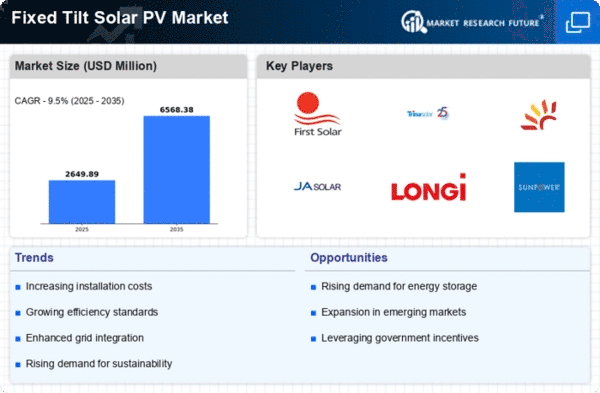
As per MRFR analysis, the Fixed Tilt Solar PV Market Size was estimated at 2419.99 USD Million in 2024. The Fixed Tilt Solar PV industry is projected to grow from 2649.94 in 2025 to 6568.38 by 2035, exhibiting a compound annual growth rate (CAGR) of 9.5 during the forecast period 2025 - 2035.

Key Market Trends & Highlights

The Fixed Tilt Solar PV Market is experiencing robust growth driven by technological advancements and increasing sustainability demands.

  • North America remains the largest market for fixed tilt solar PV systems, driven by substantial investments in renewable energy.
  • The Asia-Pacific region is emerging as the fastest-growing market, fueled by rapid industrialization and energy demand.
  • Utility scale installations dominate the market, while the commercial segment is witnessing the fastest growth due to rising energy costs.
  • Cost-effectiveness of fixed tilt systems and government incentives are key drivers propelling market expansion.

Market Size & Forecast

2024 Market Size 2419.99 (USD Million)
2035 Market Size 6568.38 (USD Million)
CAGR (2025 - 2035) 9.5%
Largest Regional Market Share in 2024 Asia-Pacific

Major Players

First Solar (US), Trina Solar (CN), Canadian Solar (CA), JA Solar (CN), LONGi Green Energy (CN), SunPower (US), JinkoSolar (CN), Risen Energy (CN)

Market Trends

The Fixed Tilt Solar PV Market is currently experiencing a notable transformation, driven by a combination of technological advancements and increasing demand for renewable energy solutions. This market segment, characterized by its simplicity and cost-effectiveness, appears to be gaining traction among various stakeholders, including residential, commercial, and utility-scale applications. The growing emphasis on sustainability and energy independence is likely propelling investments in fixed tilt systems, which are perceived as reliable and efficient for harnessing solar energy. Furthermore, the integration of innovative materials and designs may enhance the overall performance and longevity of these installations, thereby attracting more users. In addition to technological improvements, regulatory frameworks and government incentives are playing a crucial role in shaping the Fixed Tilt Solar PV Market. Policymakers are increasingly recognizing the importance of solar energy in achieving climate goals, which may lead to favorable conditions for market expansion. As countries strive to reduce their carbon footprints, the adoption of fixed tilt solar systems could become a strategic priority. This evolving landscape suggests that the Fixed Tilt Solar PV Market is poised for growth, with potential opportunities for new entrants and established players alike to capitalize on emerging trends and consumer preferences.

Technological Advancements

Recent innovations in materials and design are enhancing the efficiency and durability of fixed tilt solar systems. These advancements may lead to improved energy output and reduced maintenance costs, making these systems more appealing to a broader audience.

Regulatory Support

Government policies and incentives are increasingly favoring renewable energy sources, including fixed tilt solar installations. This regulatory backing could stimulate market growth by providing financial support and creating a more favorable investment climate.

Increased Demand for Sustainability

As awareness of climate change rises, there is a growing consumer preference for sustainable energy solutions. This trend may drive the adoption of fixed tilt solar systems, as they offer a practical and environmentally friendly option for energy generation.

Fixed Tilt Solar PV Market Market Drivers

Increasing Energy Costs

Rising energy costs are prompting consumers and businesses to seek alternative energy solutions, thereby driving the Global Fixed Tilt Solar PV Market Industry. As traditional energy prices fluctuate, solar energy presents a stable and cost-effective alternative. The fixed tilt solar PV systems offer a reliable source of energy that can mitigate the impact of rising utility bills. This trend is particularly evident in regions with high electricity prices, where solar PV systems are becoming increasingly attractive. The market's growth is further supported by the long-term savings associated with solar energy, making it a viable option for energy independence.

Market Growth Projections

The Global Fixed Tilt Solar PV Market Industry is projected to experience robust growth over the coming years. With a market value of 2.42 USD Billion in 2024, it is anticipated to reach 6.57 USD Billion by 2035, indicating a substantial increase. The compound annual growth rate (CAGR) of 9.5% from 2025 to 2035 suggests a strong upward trajectory. This growth is likely fueled by various factors, including technological advancements, government incentives, and increasing energy costs. The market's expansion reflects the global shift towards renewable energy and the critical role of fixed tilt solar PV systems in achieving energy sustainability.

Government Incentives and Policies

Supportive government policies and incentives are pivotal in driving the Global Fixed Tilt Solar PV Market Industry. Many countries are implementing tax credits, grants, and feed-in tariffs to encourage the adoption of solar energy. These initiatives lower the financial barriers for consumers and businesses, making solar PV systems more accessible. As a result, the market is expected to grow at a compound annual growth rate (CAGR) of 9.5% from 2025 to 2035. Such favorable regulatory environments are likely to stimulate investments in solar infrastructure, further solidifying the role of fixed tilt solar PV systems in the global energy mix.

Growing Demand for Renewable Energy

The Global Fixed Tilt Solar PV Market Industry is experiencing a surge in demand as nations strive to transition towards renewable energy sources. This shift is driven by increasing awareness of climate change and the need for sustainable energy solutions. In 2024, the market is valued at approximately 2.42 USD Billion, reflecting a growing commitment to reducing carbon emissions. Governments worldwide are implementing policies and incentives to promote solar energy adoption, further fueling market growth. As the global energy landscape evolves, the fixed tilt solar PV systems are positioned to play a crucial role in meeting energy needs sustainably.

Technological Advancements in Solar PV

Technological innovations are significantly enhancing the efficiency and affordability of fixed tilt solar PV systems. The Global Fixed Tilt Solar PV Market Industry benefits from advancements in photovoltaic materials, inverter technologies, and energy storage solutions. These developments not only improve energy conversion rates but also reduce installation and maintenance costs. As a result, the market is poised for substantial growth, with projections indicating a market value of 6.57 USD Billion by 2035. The continuous evolution of technology is likely to attract investments and encourage wider adoption of solar PV systems across various sectors.

Environmental Sustainability Initiatives

The Global Fixed Tilt Solar PV Market Industry is bolstered by a growing emphasis on environmental sustainability. Organizations and governments are increasingly prioritizing eco-friendly practices, leading to a heightened demand for renewable energy solutions. Fixed tilt solar PV systems align with sustainability goals by providing clean energy and reducing greenhouse gas emissions. As businesses adopt corporate social responsibility initiatives, the integration of solar energy into their operations is becoming more prevalent. This trend not only enhances brand reputation but also contributes to a more sustainable future, thus driving the market forward.

Market Segment Insights

By Application: Utility Scale (Largest) vs. Commercial (Fastest-Growing)

The Fixed Tilt Solar PV Market is divided into four major application segments: Utility Scale, Commercial, Residential, and Agricultural. Among these, the Utility Scale segment represents the largest share, owing to significant investments in large solar farms and supportive government policies. The Commercial segment is gaining traction, attributed to rising energy costs and the growing adoption of renewable energy by businesses to reduce carbon footprints and enhance sustainability initiatives.

Utility Scale (Dominant) vs. Commercial (Emerging)

The Utility Scale segment dominates the Fixed Tilt Solar PV Market, primarily due to its ability to generate vast amounts of energy through large installations, making it a preferred choice for utility companies. This segment benefits from economies of scale, enabling lower per-unit energy costs and making it attractive for significant energy demands. In contrast, the Commercial segment is emerging rapidly as businesses increasingly seek to integrate solar PV solutions into their operations. Factors such as energy independence, cost savings, and corporate sustainability goals drive its growth, with companies leveraging solar installations to reduce their reliance on fossil fuels and achieve long-term energy savings.

By Technology Type: Monocrystalline (Largest) vs. Thin Film (Fastest-Growing)

In the Fixed Tilt Solar PV Market, Monocrystalline technology holds the largest share, benefiting from its high efficiency and space-saving attributes. Polycrystalline follows as a viable alternative, offering a balance between cost and performance, but lacks the efficiency levels of its monocrystalline counterpart. Thin Film technology, although currently less dominant, is gaining traction due to its lightweight characteristics and flexibility, making it suitable for a broader range of applications in this evolving market.

Technology: Monocrystalline (Dominant) vs. Thin Film (Emerging)

Monocrystalline solar panels are regarded as the dominant technology in the Fixed Tilt Solar PV Market due to their superior efficiency and performance in space-constrained environments. Their high power output makes them ideal for residential and commercial installations. Conversely, Thin Film technology is emerging as a flexible alternative that appeals to specific applications where weight and surface adaptability are crucial. It may not match monocrystalline's efficiency, but its lower cost and ease of installation position it well in niche markets, catering to customers looking for versatile and lightweight solar solutions.

By Installation Type: Ground Mounted (Largest) vs. Rooftop Mounted (Fastest-Growing)

In the Fixed Tilt Solar PV Market, the installation type segment is dominated by Ground Mounted systems, which hold the largest share due to their capacity to accommodate larger solar arrays and optimize land use. Ground Mounted systems are often preferred for utility-scale projects, facilitating significant energy generation and providing a stable return on investment. Conversely, Rooftop Mounted systems are experiencing rapid growth, driven by urbanization and the increasing trend of self-consumption of energy in residential and commercial buildings. Their ability to save on energy costs and reduce carbon footprints resonates well with environmentally-conscious consumers. The growth trends in this segment highlight the transition towards more sustainable energy solutions. Rooftop Mounted installations are becoming increasingly popular among homeowners and businesses alike, stimulated by government incentives and advancements in solar technology. Innovative financing options and the heightened awareness of renewable energy benefits contribute to the growth of Rooftop Mounted systems. Meanwhile, Ground Mounted systems continue to thrive due to their versatility in various geographical locations and the growing investments in renewable energy infrastructure, making them a favorable choice for larger-scale energy production.

Ground Mounted (Dominant) vs. Rooftop Mounted (Emerging)

Ground Mounted systems are the dominant installation type in the Fixed Tilt Solar PV Market, favored for their ability to be scaled according to project requirements and optimize land use. These systems typically feature robust structural designs that are engineered to withstand harsh weather conditions, ensuring longevity and performance. They are primarily utilized in large-scale projects due to the expansive land areas necessary for installation. On the other hand, Rooftop Mounted systems represent the emerging trend within the market, showcasing flexibility and convenience for residential and commercial applications. They use existing building structures for installation, thus minimizing land use while providing direct energy savings to the property owner. The rising adoption of Rooftop Mounted systems is indicative of a shift towards decentralized energy generation, appealing to consumers seeking self-sufficiency and lower energy costs.

By System Size: Large Scale (Largest) vs. Medium Scale (Fastest-Growing)

In the Fixed Tilt Solar PV Market, the distribution of system sizes is characterized by a significant share held by the Large Scale segment, which has consistently proven its dominance in deployment due to economies of scale and efficiency. The Medium Scale segment is rapidly gaining traction, appealing to a diverse customer base that seeks flexibility and manageable investments in solar technology. Together, these segments account for a substantial portion of the market, reflecting varied preferences across different user demographics.

System Size: Large Scale (Dominant) vs. Medium Scale (Emerging)

The Large Scale segment in the Fixed Tilt Solar PV Market is known for its considerable capacity to produce energy, making it a go-to choice for utility companies and large-scale developers. This segment benefits from significant investments and streamlined deployment processes that lead to lower costs per watt. Conversely, the Medium Scale segment is emerging as a flexible option catering to commercial and residential users seeking to harness renewable energy without committing to extensive infrastructures. This segment is characterized by innovative financing options and partnership frameworks, enabling widespread adoption and deployment across various geographic areas.

By End User: Government (Largest) vs. Private Sector (Fastest-Growing)

In the Fixed Tilt Solar PV Market, the government sector holds the largest share, leveraging significant investments in renewable energy projects and public policy incentives. With an increasing focus on sustainability and energy independence, government initiatives play a critical role in advancing solar technology. The private sector, while smaller in comparison, is experiencing rapid growth, driven by corporate sustainability goals and advancements in solar technology that lower installation costs. The growth trends within these segments reveal a dynamic landscape. While government projects set the pace, private sector investment is surging as companies seek to capitalize on the regulatory environment and consumer demand for renewable energy. Non-profit organizations are playing a vital role as well, driving initiatives that align with community values and further contributing to market expansion.

Government (Dominant) vs. Private Sector (Emerging)

The government segment in the Fixed Tilt Solar PV Market is characterized by substantial initiatives aimed at fostering clean energy usage. Policies and subsidies designed to support energy transitions position this segment as a dominant force. In contrast, the private sector, marked by agility and innovation, represents an emerging opportunity. Companies are increasingly investing in solar technology as they recognize the financial and environmental advantages, spurred on by consumer demand and competitive energy pricing. This flourishing private sector not only complements government efforts but also catalyzes advancements in solar PV technology, thereby enhancing overall market growth.

Get more detailed insights about Fixed Tilt Solar PV Market Research Report - Global Forecast till 2035

Regional Insights

North America : Growing Renewable Energy Sector

The North American Fixed Tilt Solar PV market is projected to reach $600.0 million by December 2025, driven by increasing demand for renewable energy and supportive government policies. The region is witnessing a surge in solar installations, fueled by incentives and tax credits aimed at reducing carbon emissions. Regulatory frameworks are evolving to promote solar energy adoption, enhancing market growth prospects. Leading countries in this region include the US and Canada, where major players like First Solar and SunPower are making significant contributions. The competitive landscape is characterized by innovation and technological advancements, with companies focusing on efficiency and cost reduction. The presence of established firms and new entrants is intensifying competition, ensuring a robust market environment.

Europe : Sustainable Energy Transition

Europe's Fixed Tilt Solar PV market is expected to reach $700.0 million by December 2025, driven by ambitious renewable energy targets and regulatory support. The European Union's commitment to achieving climate neutrality by 2050 is a significant catalyst for growth, with various member states implementing policies to enhance solar energy adoption. The region is witnessing a shift towards sustainable energy solutions, further boosting market demand. Germany, France, and Spain are leading countries in this market, with a strong presence of key players like Trina Solar and Canadian Solar. The competitive landscape is marked by collaboration between governments and private sectors, fostering innovation and investment. The increasing focus on energy independence and sustainability is shaping the market dynamics, ensuring a favorable environment for solar PV technologies.

Asia-Pacific : Dominant Market Leader

The Asia-Pacific region is the largest market for Fixed Tilt Solar PV, projected to reach $1,000.0 million by December 2025. This growth is driven by rapid industrialization, urbanization, and government initiatives promoting renewable energy. Countries in this region are increasingly investing in solar infrastructure to meet rising energy demands and reduce reliance on fossil fuels. Regulatory frameworks are being strengthened to support solar energy projects, enhancing market attractiveness. China, India, and Japan are the leading countries in this market, with significant contributions from key players like JA Solar and LONGi Green Energy. The competitive landscape is characterized by aggressive pricing strategies and technological advancements, ensuring a dynamic market environment. The presence of numerous manufacturers and suppliers is intensifying competition, driving innovation and efficiency in solar PV technologies.

Middle East and Africa : Emerging Solar Market

The Middle East and Africa region is witnessing a burgeoning Fixed Tilt Solar PV market, projected to reach $119.99 million by December 2025. This growth is fueled by increasing energy demands and a strong push towards renewable energy sources. Governments in this region are implementing policies to diversify energy portfolios and reduce carbon footprints, creating a favorable environment for solar energy investments. Leading countries include South Africa and the UAE, where significant projects are underway to harness solar energy. The competitive landscape is evolving, with both local and international players entering the market. Companies like JinkoSolar and Risen Energy are establishing a presence, contributing to the region's solar market growth. The focus on sustainability and energy security is driving innovation and investment in solar technologies.

Key Players and Competitive Insights

The Fixed Tilt Solar PV Market is currently characterized by a dynamic competitive landscape, driven by increasing demand for renewable energy solutions and advancements in solar technology. Key players such as First Solar (US), Trina Solar (CN), and Canadian Solar (CA) are strategically positioned to leverage their technological expertise and market presence. First Solar (US) focuses on innovation in thin-film technology, which enhances efficiency and reduces costs, while Trina Solar (CN) emphasizes global expansion and partnerships to strengthen its supply chain. Canadian Solar (CA) is actively pursuing vertical integration to optimize production and reduce dependency on external suppliers, thereby enhancing its competitive edge. Collectively, these strategies contribute to a moderately fragmented market structure, where competition is intensifying as companies seek to differentiate themselves through technological advancements and operational efficiencies.In terms of business tactics, localization of manufacturing and supply chain optimization are pivotal. Companies are increasingly establishing production facilities closer to key markets to mitigate logistical challenges and reduce costs. This trend is indicative of a broader shift towards a more localized supply chain, which is essential for maintaining competitiveness in a rapidly evolving market. The competitive structure remains moderately fragmented, with several players vying for market share, yet the influence of major companies is significant in shaping industry standards and practices.

In November First Solar (US) announced a strategic partnership with a leading energy provider to develop a large-scale solar project in the southwestern United States. This collaboration is expected to enhance First Solar's market position by expanding its project portfolio and demonstrating its commitment to sustainable energy solutions. The partnership underscores the importance of strategic alliances in driving growth and innovation within the sector.

In October Trina Solar (CN) unveiled a new line of high-efficiency solar panels designed for residential applications, which are anticipated to increase energy output by 20% compared to previous models. This product launch reflects Trina's focus on innovation and its intent to capture a larger share of the residential market, which is experiencing robust growth. The introduction of advanced technology not only positions Trina as a leader in efficiency but also aligns with the growing consumer demand for sustainable energy solutions.

In September Canadian Solar (CA) completed the acquisition of a solar project development firm, thereby enhancing its capabilities in project execution and management. This acquisition is strategically significant as it allows Canadian Solar to streamline its operations and expand its footprint in key markets. By integrating project development with manufacturing, the company aims to create a more cohesive operational model that can respond swiftly to market demands.

As of December the Fixed Tilt Solar PV Market is witnessing trends such as digitalization, sustainability, and the integration of AI technologies. These trends are reshaping competitive dynamics, as companies increasingly focus on leveraging data analytics to optimize performance and enhance customer engagement. Strategic alliances are becoming more prevalent, facilitating knowledge sharing and resource pooling among industry players. Looking ahead, competitive differentiation is likely to evolve from traditional price-based competition towards a focus on innovation, technological advancements, and supply chain reliability, as companies strive to meet the growing demand for efficient and sustainable energy solutions.

Key Companies in the Fixed Tilt Solar PV Market include

Industry Developments

In recent developments within the Fixed Tilt Solar PV Market, companies like Enphase Energy and Canadian Solar have reported significant advancements in their product offerings and competitive positioning. JinkoSolar and LONGi Green Energy are seeing increased demand for their high-efficiency solar panels as global energy policies shift towards renewable sources. Talesun Solar and Trina Solar are collaborating with various governments on projects aimed at enhancing solar capacity in underserved regions, indicating a trend in public-private partnerships fueling market growth.

Meanwhile, Q CELLS and Sungrow Power Supply are expanding their operations to leverage advancements in energy storage technologies, further diversifying their portfolios.

Notably, First Solar and GCLPoly Energy are focusing on sustainability initiatives and eco-friendly manufacturing processes, aligning with consumer demand for greener products. There have also been discussions around mergers and acquisitions, particularly in the case of SunPower and REC Solar, which could reshape competitive dynamics in the market as they aim to consolidate their market positions. The overall valuation of the Fixed Tilt Solar PV Market is expected to grow significantly, driven by technological innovations and increased investments in renewable energy infrastructure, leading to improved market sentiment and investment prospects.

Future Outlook

Fixed Tilt Solar PV Market Future Outlook

The Fixed Tilt Solar PV Market is projected to grow at a 9.5% CAGR from 2025 to 2035, driven by technological advancements, increasing energy demand, and supportive government policies.

New opportunities lie in:

  • Expansion into emerging markets with tailored financing solutions.
  • Development of integrated solar-plus-storage systems for enhanced energy reliability.
  • Partnerships with construction firms for solar installations in new developments.

By 2035, the Fixed Tilt Solar PV Market is expected to achieve substantial growth and market penetration.

Market Segmentation

Fixed Tilt Solar PV Market End User Outlook

  • Government
  • Private Sector
  • Non-Profit Organizations

Fixed Tilt Solar PV Market Application Outlook

  • Utility Scale
  • Commercial
  • Residential
  • Agricultural

Fixed Tilt Solar PV Market System Size Outlook

  • Small Scale
  • Medium Scale
  • Large Scale

Fixed Tilt Solar PV Market Technology Type Outlook

  • Monocrystalline
  • Polycrystalline
  • Thin Film

Fixed Tilt Solar PV Market Installation Type Outlook

  • Ground Mounted
  • Rooftop Mounted
  • Building Integrated

Report Scope

MARKET SIZE 20242419.99(USD Million)
MARKET SIZE 20252649.94(USD Million)
MARKET SIZE 20356568.38(USD Million)
COMPOUND ANNUAL GROWTH RATE (CAGR)9.5% (2025 - 2035)
REPORT COVERAGERevenue Forecast, Competitive Landscape, Growth Factors, and Trends
BASE YEAR2024
Market Forecast Period2025 - 2035
Historical Data2019 - 2024
Market Forecast UnitsUSD Million
Key Companies ProfiledFirst Solar (US), Trina Solar (CN), Canadian Solar (CA), JA Solar (CN), LONGi Green Energy (CN), SunPower (US), JinkoSolar (CN), Risen Energy (CN)
Segments CoveredApplication, Technology Type, Installation Type, System Size, End User
Key Market OpportunitiesIntegration of advanced materials enhances efficiency in the Fixed Tilt Solar PV Market.
Key Market DynamicsRising demand for renewable energy drives competition and innovation in the Fixed Tilt Solar Photovoltaic Market.
Countries CoveredNorth America, Europe, APAC, South America, MEA

FAQs

What is the expected market size of the Fixed Tilt Solar PV Market by 2032?

The Fixed Tilt Solar PV Market is expected to reach a value of 100.0 billion USD by 2032.

What is the anticipated CAGR for the Fixed Tilt Solar PV Market during the forecast period?

The market is projected to grow at a CAGR of 7.2% from 2024 to 2032.

Which region is expected to dominate the Fixed Tilt Solar PV Market by 2032?

North America is anticipated to hold the largest market share, reaching 30.0 billion USD by 2032.

What is the market value of the Fixed Tilt segment in 2023?

The Fixed Tilt segment is valued at 30.0 billion USD in 2023.

What are the expected market values for the Single Axis Tracking technology by 2032?

The Single Axis Tracking technology is expected to attain a market value of 28.0 billion USD by 2032.

Which key players are significant in the Fixed Tilt Solar PV Market?

Major players include Enphase Energy, JinkoSolar, Canadian Solar, and LONGi Green Energy, among others.

What is the market size of the Concentrated Solar Power segment in 2023?

The Concentrated Solar Power segment is valued at 8.49 billion USD in 2023.

What is the projected market value for Europe by 2032?

Europe's market value is expected to reach 22.0 billion USD by 2032.

What growth opportunities exist for the Fixed Tilt Solar PV Market?

The increasing demand for renewable energy solutions presents significant growth opportunities in the market.

What is the expected market value for the APAC region by 2032?

The APAC region is projected to reach a market value of 30.0 billion USD by 2032.

  1. SECTION I: EXECUTIVE SUMMARY AND KEY HIGHLIGHTS
    1. | 1.1 EXECUTIVE SUMMARY
    2. | 1.1.1 Market Overview
    3. | 1.1.2 Key Findings
    4. | 1.1.3 Market Segmentation
    5. | 1.1.4 Competitive Landscape
    6. | 1.1.5 Challenges and Opportunities
    7. | 1.1.6 Future Outlook
  2. SECTION II: SCOPING, METHODOLOGY AND MARKET STRUCTURE
    1. | 2.1 MARKET INTRODUCTION
    2. | 2.1.1 Definition
    3. | 2.1.2 Scope of the study
    4. |-- 2.1.2.1 Research Objective
    5. |-- 2.1.2.2 Assumption
    6. |-- 2.1.2.3 Limitations
    7. | 2.2 RESEARCH METHODOLOGY
    8. | 2.2.1 Overview
    9. | 2.2.2 Data Mining
    10. | 2.2.3 Secondary Research
    11. | 2.2.4 Primary Research
    12. |-- 2.2.4.1 Primary Interviews and Information Gathering Process
    13. |-- 2.2.4.2 Breakdown of Primary Respondents
    14. | 2.2.5 Forecasting Model
    15. | 2.2.6 Market Size Estimation
    16. |-- 2.2.6.1 Bottom-Up Approach
    17. |-- 2.2.6.2 Top-Down Approach
    18. | 2.2.7 Data Triangulation
    19. | 2.2.8 Validation
  3. SECTION III: QUALITATIVE ANALYSIS
    1. | 3.1 MARKET DYNAMICS
    2. | 3.1.1 Overview
    3. | 3.1.2 Drivers
    4. | 3.1.3 Restraints
    5. | 3.1.4 Opportunities
    6. | 3.2 MARKET FACTOR ANALYSIS
    7. | 3.2.1 Value chain Analysis
    8. | 3.2.2 Porter's Five Forces Analysis
    9. |-- 3.2.2.1 Bargaining Power of Suppliers
    10. |-- 3.2.2.2 Bargaining Power of Buyers
    11. |-- 3.2.2.3 Threat of New Entrants
    12. |-- 3.2.2.4 Threat of Substitutes
    13. |-- 3.2.2.5 Intensity of Rivalry
    14. | 3.2.3 COVID-19 Impact Analysis
    15. |-- 3.2.3.1 Market Impact Analysis
    16. |-- 3.2.3.2 Regional Impact
    17. |-- 3.2.3.3 Opportunity and Threat Analysis
  4. SECTION IV: QUANTITATIVE ANALYSIS
    1. | 4.1 Energy & Power, BY Application (USD Million)
    2. | 4.1.1 Utility Scale
    3. | 4.1.2 Commercial
    4. | 4.1.3 Residential
    5. | 4.1.4 Agricultural
    6. | 4.2 Energy & Power, BY Technology Type (USD Million)
    7. | 4.2.1 Monocrystalline
    8. | 4.2.2 Polycrystalline
    9. | 4.2.3 Thin Film
    10. | 4.3 Energy & Power, BY Installation Type (USD Million)
    11. | 4.3.1 Ground Mounted
    12. | 4.3.2 Rooftop Mounted
    13. | 4.3.3 Building Integrated
    14. | 4.4 Energy & Power, BY System Size (USD Million)
    15. | 4.4.1 Small Scale
    16. | 4.4.2 Medium Scale
    17. | 4.4.3 Large Scale
    18. | 4.5 Energy & Power, BY End User (USD Million)
    19. | 4.5.1 Government
    20. | 4.5.2 Private Sector
    21. | 4.5.3 Non-Profit Organizations
    22. | 4.6 Energy & Power, BY Region (USD Million)
    23. | 4.6.1 North America
    24. |-- 4.6.1.1 US
    25. |-- 4.6.1.2 Canada
    26. | 4.6.2 Europe
    27. |-- 4.6.2.1 Germany
    28. |-- 4.6.2.2 UK
    29. |-- 4.6.2.3 France
    30. |-- 4.6.2.4 Russia
    31. |-- 4.6.2.5 Italy
    32. |-- 4.6.2.6 Spain
    33. |-- 4.6.2.7 Rest of Europe
    34. | 4.6.3 APAC
    35. |-- 4.6.3.1 China
    36. |-- 4.6.3.2 India
    37. |-- 4.6.3.3 Japan
    38. |-- 4.6.3.4 South Korea
    39. |-- 4.6.3.5 Malaysia
    40. |-- 4.6.3.6 Thailand
    41. |-- 4.6.3.7 Indonesia
    42. |-- 4.6.3.8 Rest of APAC
    43. | 4.6.4 South America
    44. |-- 4.6.4.1 Brazil
    45. |-- 4.6.4.2 Mexico
    46. |-- 4.6.4.3 Argentina
    47. |-- 4.6.4.4 Rest of South America
    48. | 4.6.5 MEA
    49. |-- 4.6.5.1 GCC Countries
    50. |-- 4.6.5.2 South Africa
    51. |-- 4.6.5.3 Rest of MEA
  5. SECTION V: COMPETITIVE ANALYSIS
    1. | 5.1 Competitive Landscape
    2. | 5.1.1 Overview
    3. | 5.1.2 Competitive Analysis
    4. | 5.1.3 Market share Analysis
    5. | 5.1.4 Major Growth Strategy in the Energy & Power
    6. | 5.1.5 Competitive Benchmarking
    7. | 5.1.6 Leading Players in Terms of Number of Developments in the Energy & Power
    8. | 5.1.7 Key developments and growth strategies
    9. |-- 5.1.7.1 New Product Launch/Service Deployment
    10. |-- 5.1.7.2 Merger & Acquisitions
    11. |-- 5.1.7.3 Joint Ventures
    12. | 5.1.8 Major Players Financial Matrix
    13. |-- 5.1.8.1 Sales and Operating Income
    14. |-- 5.1.8.2 Major Players R&D Expenditure. 2023
    15. | 5.2 Company Profiles
    16. | 5.2.1 First Solar (US)
    17. |-- 5.2.1.1 Financial Overview
    18. |-- 5.2.1.2 Products Offered
    19. |-- 5.2.1.3 Key Developments
    20. |-- 5.2.1.4 SWOT Analysis
    21. |-- 5.2.1.5 Key Strategies
    22. | 5.2.2 Trina Solar (CN)
    23. |-- 5.2.2.1 Financial Overview
    24. |-- 5.2.2.2 Products Offered
    25. |-- 5.2.2.3 Key Developments
    26. |-- 5.2.2.4 SWOT Analysis
    27. |-- 5.2.2.5 Key Strategies
    28. | 5.2.3 Canadian Solar (CA)
    29. |-- 5.2.3.1 Financial Overview
    30. |-- 5.2.3.2 Products Offered
    31. |-- 5.2.3.3 Key Developments
    32. |-- 5.2.3.4 SWOT Analysis
    33. |-- 5.2.3.5 Key Strategies
    34. | 5.2.4 JA Solar (CN)
    35. |-- 5.2.4.1 Financial Overview
    36. |-- 5.2.4.2 Products Offered
    37. |-- 5.2.4.3 Key Developments
    38. |-- 5.2.4.4 SWOT Analysis
    39. |-- 5.2.4.5 Key Strategies
    40. | 5.2.5 LONGi Green Energy (CN)
    41. |-- 5.2.5.1 Financial Overview
    42. |-- 5.2.5.2 Products Offered
    43. |-- 5.2.5.3 Key Developments
    44. |-- 5.2.5.4 SWOT Analysis
    45. |-- 5.2.5.5 Key Strategies
    46. | 5.2.6 SunPower (US)
    47. |-- 5.2.6.1 Financial Overview
    48. |-- 5.2.6.2 Products Offered
    49. |-- 5.2.6.3 Key Developments
    50. |-- 5.2.6.4 SWOT Analysis
    51. |-- 5.2.6.5 Key Strategies
    52. | 5.2.7 JinkoSolar (CN)
    53. |-- 5.2.7.1 Financial Overview
    54. |-- 5.2.7.2 Products Offered
    55. |-- 5.2.7.3 Key Developments
    56. |-- 5.2.7.4 SWOT Analysis
    57. |-- 5.2.7.5 Key Strategies
    58. | 5.2.8 Risen Energy (CN)
    59. |-- 5.2.8.1 Financial Overview
    60. |-- 5.2.8.2 Products Offered
    61. |-- 5.2.8.3 Key Developments
    62. |-- 5.2.8.4 SWOT Analysis
    63. |-- 5.2.8.5 Key Strategies
    64. | 5.3 Appendix
    65. | 5.3.1 References
    66. | 5.3.2 Related Reports

Energy & Power Market Segmentation

Energy & Power By Application (USD Million, 2025-2035)

  • Utility Scale
  • Commercial
  • Residential
  • Agricultural

Energy & Power By Technology Type (USD Million, 2025-2035)

  • Monocrystalline
  • Polycrystalline
  • Thin Film

Energy & Power By Installation Type (USD Million, 2025-2035)

  • Ground Mounted
  • Rooftop Mounted
  • Building Integrated

Energy & Power By System Size (USD Million, 2025-2035)

  • Small Scale
  • Medium Scale
  • Large Scale

Energy & Power By End User (USD Million, 2025-2035)

  • Government
  • Private Sector
  • Non-Profit Organizations
Infographic

Free Sample Request

Kindly complete the form below to receive a free sample of this Report

Get Free Sample

Customer Strories

Compare Licence

×
Features License Type
Single User Multiuser License Enterprise User
Price $4,950 $5,950 $7,250
Maximum User Access Limit 1 User Upto 10 Users Unrestricted Access Throughout the Organization
Free Customization
Direct Access to Analyst
Deliverable Format
Platform Access
Discount on Next Purchase 10% 15% 15%
Printable Versions