×
Hero Background
English
Chinese
French
Japanese
Korean
German
Spanish

Fiber Optic Connector Market Analysis

ID: MRFR/SEM/4297-HCR
100 Pages
Aarti Dhapte
October 2025

Fiber Optic Connector Market Size, Share & Industry Analysis: By Type (Lucent Connector, Fiber Connector, Straight Tip, Master Unit, Push on/Pull Off, Subscriber Connector, Multi-Fiber Termination, Fiber Distributed Data Interface, Sub-Multi-Assembly), By Application (Datacenter, Telecommunication, Inter-Building, And Security Systems), By Industries (Automotive, IT & Telecom, And Consumer Electronics), And By Region (North America, Europe, Asia-Pacific, And Rest Of The World) –Market Forecast Till 2035

Share:
Download PDF ×

We do not share your information with anyone. However, we may send you emails based on your report interest from time to time. You may contact us at any time to opt-out.

Fiber Optic Connector Market Infographic
Purchase Options

Market Analysis

Fiber Optic Connector Market (Global, 2024)

Introduction

The fibre-optic connection market is expected to experience a considerable growth, as the need for high-speed data transmission continues to grow across several industries, such as telecommunications, data centres, and enterprise networks. With more and more companies relying on a robust and reliable network, the role of the fibre-optic connection in ensuring seamless and optimum performance becomes more and more important. In recent years, there have been many innovations in connection technology, which are based on the need for higher speed and lower latency. The cloud, the Internet of Things, and smart city initiatives are also driving the fibre-optic solutions market. This report analyses the key trends, developments, and opportunities in the fibre-optic connection market.

PESTLE Analysis

Political
The fiber-optics market will be influenced by political factors in 2024, including government initiatives to improve digital infrastructure. The US government, for example, has allocated $ 65 billion under the Broadband Development Act to increase access to high-speed Internet, which will directly affect the demand for fiber-optics. In addition, international trade policies and tariffs on imported components will affect the supply chain. The US imposes tariffs of up to 25 percent on some imported products, including optical fibers, which may lead to higher costs for manufacturers.
Economic
The year 2024. A brisk market for optical fibers. Telecommunications and data centers are growing. The telecommunications sector is expected to earn $1.7 trl., Much of this money will go into the modernization of existing networks. The unemployment rate in the technology sector is expected to be 3.5%. A stable labor market that encourages innovation and the production of optical fibers. This economic stability encourages investment in new technology and the development of new tools.
Social
In 2024, the public is clamoring for high-speed Internet and reliable connections, which is driving the demand for fiber-optic solutions. Surveys indicate that approximately 75% of consumers rate Internet speed and reliability as the most important factors in choosing their Internet service provider. This is resulting in increased investment in fiber-optic networks. Furthermore, the growing trend of remote work and distance learning is putting further pressure on the Internet, and thus on the demand for fiber-optic connections. Both households and businesses are looking to enhance their Internet connections.
Technological
A new fiber-optics market is on the way. Several innovations, such as the development of advanced plug-in connections, such as MTP and MPO, have increased the speed of data transmission and shortened the installation time. The 5G market is experiencing rapid growth, with an estimated 1.5 billion 5G connections worldwide by 2024. This will require the use of high-speed fiber-optic connections to cope with the increasing traffic. Smart technology is also boosting the efficiency of fiber-optic networks.
Legal
Legal factors affecting the fiber-optic connection market in 2024 include the compliance of telecommunications equipment with international standards and regulations. The International Telecommunications Union (ITU) has set specific standards for fiber-optic connections that manufacturers must comply with in order to ensure the safety and interoperability of their products. In addition, data protection laws, such as the General Data Protection Regulation (GDPR) in Europe, impose strict requirements on the management and confidentiality of data, which affects the design and implementation of fiber-optic networks to ensure compliance.
Environmental
In the year 2024, the market for fiber-optic cables will be characterized by a growing emphasis on environmentalism and eco-friendliness. Production of cables and fittings is subject to a number of regulations designed to reduce carbon dioxide emissions, and the European Union has set a goal of reducing greenhouse gas emissions by a total of 55 per cent by the year 2030. Furthermore, manufacturers are increasingly adopting eco-friendly materials and production processes, and an estimated 30 per cent of new fiber-optic products are now made from materials that are fully re-cyclable.

Porter's Five Forces

Threat of New Entrants
The market for fiber-optic connections has a medium barrier to entry, as it requires significant capital investment in both technology and manufacturing. The existing operators enjoy economies of scale and brand loyalty, which act as a deterrent to new entrants. However, technological advances and growing demand for high-speed Internet access could attract new companies looking to exploit growth opportunities.
Bargaining Power of Suppliers
Suppliers’ bargaining power in the fiber-optics market is relatively low. There are numerous suppliers of both components and materials, which leads to a highly competitive market. Suppliers can easily be replaced if prices rise or quality decreases, which weakens their bargaining power. Furthermore, the availability of alternative materials and technologies reduces suppliers’ bargaining power even further.
Bargaining Power of Buyers
The buyer in the fiber-optic cable market has considerable negotiating power due to the presence of several suppliers and the availability of various products. Large telecommunications operators and data centers can usually negotiate better prices and terms of trade because they often purchase in large quantities. And the growing demand for high-speed data connections also gives them the power to bargain for the best prices.
Threat of Substitutes
The threat of substitution in the market for fibre-optic connections is moderate. In spite of their superiority in terms of speed and bandwidth, alternative products such as copper cables and wireless solutions can be used in certain applications. However, as the demand for high-speed data transmission increases, the advantages of fibre-optic connections will probably limit the impact of substitutes.
Competitive Rivalry
Competition is intense in the market for fiber-optic cables, and many manufacturers are vying for a share of the market. Competition is based on price, quality, and technological innovation. The speed of technological change and the growing demand for connection solutions are also putting further pressure on competition. To maintain their competitive edge, companies must keep improving and innovating.

SWOT Analysis

Strengths

  • High data transmission speeds and bandwidth capabilities.
  • Growing demand for high-speed internet and telecommunications.
  • Durability and resistance to electromagnetic interference.
  • Increasing adoption in various industries such as healthcare, IT, and telecommunications.

Weaknesses

  • Higher initial installation costs compared to traditional copper connectors.
  • Fragility of fiber optic cables can lead to higher maintenance costs.
  • Limited availability of skilled technicians for installation and maintenance.
  • Complexity in handling and installation may deter some users.

Opportunities

  • Expansion of 5G networks driving demand for fiber optic solutions.
  • Emerging markets showing increased investment in telecommunications infrastructure.
  • Technological advancements leading to more efficient and cost-effective products.
  • Growing trend of smart cities and IoT applications requiring robust connectivity.

Threats

  • Intense competition from alternative technologies such as wireless solutions.
  • Economic downturns affecting capital expenditure in infrastructure projects.
  • Supply chain disruptions impacting availability of raw materials.
  • Regulatory challenges and standards compliance in different regions.

Summary

The fibre-optic market in 2024 will be characterized by its strengths in high-speed data transmission and the growing demand from industries, but also by its weaknesses in high installation costs and a lack of skilled labor. Opportunities are provided by the expansion of 5G networks and technological development, while threats are competition and economic conditions. In this dynamic environment, strategic focus on innovation and market development is key.


Author
Aarti Dhapte
Team Lead - Research

She holds an experience of about 6+ years in Market Research and Business Consulting, working under the spectrum of Information Communication Technology, Telecommunications and Semiconductor domains. Aarti conceptualizes and implements a scalable business strategy and provides strategic leadership to the clients. Her expertise lies in market estimation, competitive intelligence, pipeline analysis, customer assessment, etc.

Leave a Comment

FAQs

What is the projected market valuation of the Fiber Optic Connector Market by 2035?

The Fiber Optic Connector Market is projected to reach a valuation of 10.6 USD Billion by 2035.

What was the market valuation of the Fiber Optic Connector Market in 2024?

In 2024, the Fiber Optic Connector Market was valued at 4.1 USD Billion.

What is the expected CAGR for the Fiber Optic Connector Market during the forecast period 2025 - 2035?

The expected CAGR for the Fiber Optic Connector Market during the forecast period 2025 - 2035 is 9.02%.

Which companies are considered key players in the Fiber Optic Connector Market?

Key players in the Fiber Optic Connector Market include Corning, Amphenol, TE Connectivity, Molex, Fujikura, Sumitomo Electric, Nexans, Prysmian Group, and 3M.

What segment of the Fiber Optic Connector Market is projected to have the highest growth?

The IT & Telecom industry segment is projected to grow from 2.5 USD Billion to 6.5 USD Billion by 2035.

How much is the Datacenter application segment expected to grow by 2035?

The Datacenter application segment is expected to grow from 1.5 USD Billion to 3.8 USD Billion by 2035.

Market Summary

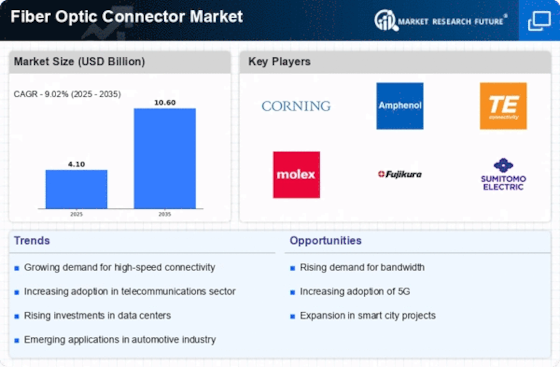
As per MRFR analysis, the Fiber Optic Connector Market Size was estimated at 4.1 USD Billion in 2024. The Fiber Optic Connector industry is projected to grow from 4.47 USD Billion in 2025 to 10.6 USD Billion by 2035, exhibiting a compound annual growth rate (CAGR) of 9.02 during the forecast period 2025 - 2035.

Key Market Trends & Highlights

The Fiber Optic Connector Market is experiencing robust growth driven by technological advancements and increasing demand for high-speed connectivity.

  • North America remains the largest market for fiber optic connectors, driven by extensive telecommunications infrastructure.
  • The Asia-Pacific region is emerging as the fastest-growing market, fueled by rapid urbanization and technological adoption.
  • Lucent Connectors dominate the market, while Fiber Connectors are witnessing the fastest growth due to their versatility in applications.
  • Key market drivers include increasing data traffic and the rising adoption of fiber optic solutions in data centers and smart cities.

Market Size & Forecast

2024 Market Size 4.1 (USD Billion)
2035 Market Size 10.6 (USD Billion)
CAGR (2025 - 2035) 9.02%
Largest Regional Market Share in 2024 North America

Major Players

<p>Corning (US), Amphenol (US), TE Connectivity (CH), Molex (US), Fujikura (JP), Sumitomo Electric (JP), Nexans (FR), Prysmian Group (IT), 3M (US)</p>

Market Trends

The Fiber Optic Connector Market is currently experiencing a transformative phase, driven by the increasing demand for high-speed data transmission and the expansion of telecommunications infrastructure. As organizations and consumers alike seek faster and more reliable internet connectivity, the adoption of fiber optic technology is becoming more prevalent. This shift is further fueled by advancements in technology, which enhance the performance and efficiency of fiber optic connectors. Additionally, the growing trend towards smart cities and the Internet of Things (IoT) is likely to propel the market forward, as these developments necessitate robust and high-capacity communication networks. Moreover, the Fiber Optic Connector Market is witnessing a diversification of applications across various sectors, including healthcare, automotive, and industrial automation. This broadening scope indicates a potential for growth as industries increasingly recognize the advantages of fiber optics over traditional copper solutions. Furthermore, environmental considerations are prompting manufacturers to innovate and develop sustainable products, which may influence purchasing decisions. As the market evolves, it appears that the focus will remain on enhancing connectivity solutions while addressing the challenges posed by installation and maintenance complexities.

Rising Demand for High-Speed Connectivity

The Fiber Optic Connector Market is likely to benefit from the escalating need for high-speed internet access. As digital consumption increases, both residential and commercial sectors are prioritizing faster data transmission capabilities. This trend suggests a sustained growth trajectory for fiber optic solutions.

Expansion in Diverse Applications

The market is experiencing a notable expansion into various sectors, including healthcare and automotive. This diversification indicates that fiber optic connectors are becoming integral to a wide range of applications, enhancing their relevance and potential for growth.

Focus on Sustainable Solutions

There is a growing emphasis on sustainability within the Fiber Optic Connector Market. Manufacturers are increasingly developing eco-friendly products, which may influence consumer preferences and drive innovation in the industry.

Fiber Optic Connector Market Market Drivers

Increasing Data Traffic

The Fiber Optic Connector Market is experiencing a surge in demand due to the exponential growth of data traffic. As more devices connect to the internet and data consumption rises, the need for high-capacity fiber optic networks becomes paramount. Reports indicate that global internet traffic is projected to reach 4.8 zettabytes per year by 2022, necessitating robust infrastructure. Fiber optic connectors play a crucial role in ensuring efficient data transmission, thereby supporting the backbone of modern communication networks. This increasing data traffic is likely to drive investments in fiber optic technologies, further propelling the Fiber Optic Connector Market.

Emergence of Smart Cities

The concept of smart cities is gaining traction, which is likely to impact the Fiber Optic Connector Market positively. As urban areas evolve to incorporate smart technologies, the demand for reliable and high-speed communication networks increases. Fiber optic connectors are integral to the infrastructure that supports smart city initiatives, including traffic management, public safety, and energy efficiency. The Fiber Optic Connector Market is anticipated to reach USD 2.57 trillion by 2025, indicating a substantial opportunity for fiber optic technologies. This trend suggests that the Fiber Optic Connector Market will play a pivotal role in the development of smart urban environments.

Technological Advancements

Technological innovations are significantly influencing the Fiber Optic Connector Market. The development of advanced connectors, such as LC, SC, and MPO, enhances performance and reliability in various applications. These advancements facilitate faster data transmission rates and improved signal integrity, which are essential for meeting the demands of contemporary communication systems. Furthermore, the integration of automation and smart technologies in fiber optic networks is expected to streamline installation and maintenance processes. As a result, the Fiber Optic Connector Market is likely to benefit from these technological enhancements, fostering growth and efficiency.

Growing Demand in Data Centers

The Fiber Optic Connector Market is significantly influenced by the expanding data center sector. As organizations increasingly rely on cloud computing and big data analytics, the need for efficient data management and storage solutions intensifies. Fiber optic connectors are essential for ensuring high-speed connectivity within data centers, facilitating rapid data transfer and minimizing latency. The data center market is projected to grow at a CAGR of 12% from 2021 to 2026, which suggests a corresponding increase in the demand for fiber optic connectors. This growth trajectory highlights the importance of fiber optics in supporting the infrastructure of modern data centers.

Rising Adoption in Telecommunications

The telecommunications sector is a primary driver of the Fiber Optic Connector Market. With the ongoing rollout of 5G networks, there is an increasing need for high-performance fiber optic connectors to support the infrastructure. The transition from traditional copper-based systems to fiber optics is becoming more prevalent, as fiber optics offer superior bandwidth and lower latency. Market data suggests that The Fiber Optic Connector Market is expected to grow at a CAGR of 10.5% from 2021 to 2026, indicating a robust demand for fiber optic connectors. This trend underscores the critical role of fiber optic technology in modern telecommunications.

Market Segment Insights

By Type: Lucent Connector (Largest) vs. Fiber Connector (Fastest-Growing)

<p>The Fiber Optic Connector Market showcases a diverse array of types, each contributing uniquely to the overall market dynamics. Among these, the Lucent Connector stands out as the largest segment, capturing significant market share due to its widespread application in telecom environments. It is known for its reliability and ease of use, making it the preferred choice for many developers and installers. In contrast, the Fiber Connector is rapidly emerging as the fastest-growing segment, driven by advancements in fiber optic technologies and the increasing demand for high-speed broadband connections, particularly in urban and suburban areas. Growth trends in the Fiber Optic Connector Market are largely influenced by the surge in internet data traffic and the growing reliance on cloud services, pushing companies to adopt advanced connectivity solutions. The demand for efficient, high-performance connectors has enabled segments such as Push On/Pull Off and Subscriber Connectors to gain traction. As industries continue to evolve, establishing a solid foundation of fiber optic infrastructure is paramount, making it imperative for manufacturers to innovate while staying cost-effective to meet the market requirements.</p>

<p>Lucent Connector (Dominant) vs. Fiber Connector (Emerging)</p>

<p>The Lucent Connector is a cornerstone in the Fiber Optic Connector Market, known for its robust design and ease of installation, making it highly favored in telecommunications. With its reliable performance and compatibility with various optical networks, it dominates the market and continues to attract long-standing industry partnerships. On the other hand, the Fiber Connector represents an emerging segment characterized by rapidly increasing adoption, driven by evolving connectivity needs. Its design caters to high-density environments, allowing for efficient, space-saving solutions that are essential for modern data centers. Both connectors serve distinct functionalities, with Lucent being preferred for established systems and Fiber Connectors gaining traction in new and evolving telecom settings.</p>

By Application: Datacenter (Largest) vs. Telecommunication (Fastest-Growing)

<p>In the Fiber Optic Connector Market, the application segment is dominated by Datacenter solutions, which have captured the largest share due to the increasing demand for high-speed data processing and storage solutions. Telecommunication applications, while slightly lower in overall market share, are rapidly gaining traction, primarily driven by the ongoing rollout of 5G infrastructure and the increasing demand for high-bandwidth connectivity solutions.</p>

<p>Datacenter (Dominant) vs. Telecommunication (Emerging)</p>

<p>The Datacenter segment is characterized by its extensive use of fiber optic connectors in server farms and cloud computing environments, emphasizing performance and reliability. Due to the growing digital landscape, this segment enjoys dominant market positioning, with companies prioritizing efficient data transfer. In contrast, the Telecommunications segment is marked by emerging technologies like 5G, which are prompting innovative fiber optic connector designs. As telecommunication networks evolve, the focus on reliable and high-capacity connections makes this segment increasingly relevant and poised for rapid growth.</p>

By Industries: IT & Telecom (Largest) vs. Automotive (Fastest-Growing)

<p>The Fiber Optic Connector Market is predominantly led by the IT & Telecom industry, which capitalizes on the growing demand for high-speed internet and data transmission. This segment accounts for a significant portion of the connectivity solutions due to the digital transformation across various sectors. In contrast, the Automotive industry is rapidly emerging as a key player, driven by the technological advancements in electric and autonomous vehicles that necessitate high-performance connectivity solutions.</p>

<p>IT & Telecom: Fiber Optic Connectors (Dominant) vs. Automotive (Emerging)</p>

<p>Within the Fiber Optic Connector Market, the IT & Telecom segment is recognized as the dominant force, having established a robust infrastructure for data communication. This segment thrives on innovations in network technology and the ever-increasing need for bandwidth. On the other hand, the Automotive segment, while currently classified as emerging, is witnessing unprecedented growth fueled by the integration of optical networks within vehicles for improved safety and connectivity. As automotive technologies advance, particularly towards electric and self-driving vehicles, the requirement for reliable and high-speed fiber optic connections is intensifying, positioning this segment for significant development.</p>

Get more detailed insights about Fiber Optic Connector Market Research Report - Forecast to 2035

Regional Insights

North America : Innovation and Demand Surge

North America is the largest market for fiber optic connectors, holding approximately 40% of the global market share. The region's growth is driven by increasing demand for high-speed internet, advancements in telecommunications, and government initiatives promoting broadband expansion. Regulatory support, such as the Federal Communications Commission's efforts to enhance broadband access, further catalyzes market growth. The United States dominates the North American market, with key players like Corning, Amphenol, and 3M leading the competitive landscape. The presence of advanced manufacturing facilities and a strong focus on R&D contribute to the region's innovation. Canada also plays a significant role, with increasing investments in fiber optic infrastructure, enhancing connectivity across urban and rural areas.

Europe : Growing Connectivity Initiatives

Europe is witnessing significant growth in the fiber optic connector market, accounting for approximately 30% of the global share. The region's expansion is fueled by increasing investments in digital infrastructure, government policies promoting high-speed internet access, and the rise of smart cities. The European Union's Digital Single Market strategy aims to enhance connectivity, further driving demand for fiber optic solutions. Leading countries in this region include Germany, France, and the UK, where major players like Nexans and Prysmian Group are actively involved. The competitive landscape is characterized by a mix of established companies and innovative startups, focusing on sustainable and efficient fiber optic technologies. The presence of stringent regulations ensures high-quality standards in manufacturing and installation processes.

Asia-Pacific : Emerging Market Potential

Asia-Pacific is rapidly emerging as a key player in the fiber optic connector market, holding around 25% of the global market share. The region's growth is driven by increasing urbanization, rising internet penetration, and government initiatives to enhance digital infrastructure. Countries like China and India are leading the charge, with substantial investments in telecommunications and broadband expansion, supported by favorable regulatory frameworks. China is the largest market in the region, with significant contributions from companies like Fujikura and Sumitomo Electric. The competitive landscape is marked by a mix of local and international players, focusing on innovation and cost-effective solutions. As demand for high-speed connectivity continues to rise, the region is poised for sustained growth in the fiber optic sector, driven by technological advancements and increasing consumer expectations.

Middle East and Africa : Infrastructure Development Focus

The Middle East and Africa region is gradually developing its fiber optic connector market, currently holding about 5% of the global share. The growth is primarily driven by increasing investments in telecommunications infrastructure, government initiatives to improve connectivity, and the rising demand for high-speed internet services. Countries like South Africa and the UAE are leading the market, with various projects aimed at enhancing digital connectivity across urban and rural areas. In this region, the competitive landscape is evolving, with both local and international players entering the market. Key players are focusing on establishing partnerships and collaborations to expand their reach. The presence of regulatory bodies is crucial in ensuring quality standards and promoting the adoption of fiber optic technologies, which are essential for supporting the region's digital transformation efforts.

Key Players and Competitive Insights

The Fiber Optic Connector Market is currently characterized by a dynamic competitive landscape, driven by increasing demand for high-speed data transmission and the expansion of telecommunications infrastructure. Key players such as Corning (US), Amphenol (US), and TE Connectivity (CH) are strategically positioned to leverage their technological expertise and extensive product portfolios. Corning (US) focuses on innovation in optical fiber technology, while Amphenol (US) emphasizes partnerships to enhance its market reach. TE Connectivity (CH) is investing in digital transformation initiatives to streamline operations and improve customer engagement. Collectively, these strategies contribute to a competitive environment that is increasingly centered around technological advancement and customer-centric solutions.

In terms of business tactics, companies are localizing manufacturing to reduce lead times and optimize supply chains, which is particularly crucial in a market that is moderately fragmented. The competitive structure allows for both established players and emerging companies to coexist, with larger firms often acquiring smaller innovators to enhance their capabilities. This trend indicates a collective influence where key players are not only competing on product quality but also on operational efficiency and responsiveness to market demands.

In August 2025, Corning (US) announced the launch of its latest line of high-density fiber optic connectors, which are designed to meet the growing needs of data centers. This strategic move is significant as it positions Corning to capture a larger share of the rapidly expanding data center market, where demand for efficient and high-performance connectivity solutions is surging. The introduction of these connectors is expected to enhance data transmission speeds while reducing space requirements, thereby appealing to a broad range of customers.

In September 2025, Amphenol (US) entered into a strategic partnership with a leading cloud service provider to develop customized fiber optic solutions tailored for cloud infrastructure. This collaboration is indicative of Amphenol's commitment to innovation and responsiveness to the evolving needs of the digital landscape. By aligning with a major player in the cloud sector, Amphenol is likely to enhance its competitive positioning and drive growth through tailored solutions that address specific customer requirements.

In July 2025, TE Connectivity (CH) expanded its manufacturing capabilities in Asia to better serve the growing demand for fiber optic connectors in the region. This expansion is crucial as it not only increases production capacity but also reduces shipping times, thereby enhancing supply chain reliability. TE Connectivity's proactive approach to scaling operations in key markets reflects a broader trend among industry leaders to localize production in response to regional demand fluctuations.

As of October 2025, the Fiber Optic Connector Market is witnessing trends that emphasize digitalization, sustainability, and the integration of artificial intelligence in manufacturing processes. Strategic alliances are increasingly shaping the competitive landscape, allowing companies to pool resources and expertise to drive innovation. Looking ahead, it appears that competitive differentiation will evolve from traditional price-based competition to a focus on technological innovation, supply chain reliability, and sustainable practices. This shift suggests that companies that prioritize these aspects are likely to gain a competitive edge in the market.

Key Companies in the Fiber Optic Connector Market market include

Industry Developments

  • Q2 2024: Molex Expands Fiber Optic Connector Market Portfolio with New MXC and MPO Solutions for Data Centers Molex announced the launch of new MXC and MPO fiber optic connectors designed to support high-density data center applications, aiming to meet growing demand for faster and more reliable connectivity.
  • Q2 2024: Corning Opens New Optical Cable Manufacturing Facility in Poland Corning Incorporated inaugurated a new manufacturing facility in Mszczonów, Poland, to expand its production capacity for fiber optic cables and connectors, supporting the rapid growth of broadband infrastructure in Europe.
  • Q2 2024: Amphenol Acquires Fiberon Technologies to Strengthen Fiber Optic Connector Market Business Amphenol Corporation completed the acquisition of Fiberon Technologies, a manufacturer of fiber optic connectors, to enhance its product offerings and expand its presence in the global fiber connectivity market.
  • Q3 2024: TE Connectivity Launches Next-Generation LC Uniboot Fiber Optic Connector Market TE Connectivity introduced its next-generation LC Uniboot fiber optic connector, designed for high-density data center and enterprise network applications, featuring improved cable management and reduced footprint.
  • Q3 2024: Sumitomo Electric Wins Major Fiber Optic Connector Market Supply Contract for 5G Rollout in Japan Sumitomo Electric Industries secured a significant contract to supply fiber optic connectors for a nationwide 5G infrastructure deployment project in Japan, supporting the country's next-generation mobile network expansion.
  • Q4 2024: HUBER+SUHNER Announces Partnership with Nokia for Fiber Optic Connector Market Solutions HUBER+SUHNER entered into a partnership with Nokia to provide advanced fiber optic connector solutions for Nokia's global telecommunications projects, aiming to enhance network performance and reliability.
  • Q4 2024: Belden Appoints New Vice President to Lead Fiber Optic Connectivity Division Belden Inc. announced the appointment of a new Vice President to oversee its fiber optic connectivity division, focusing on driving innovation and growth in the sector.
  • Q1 2025: Panduit Launches Field-Installable Fiber Optic Connector Market for Enterprise Networks Panduit introduced a new field-installable fiber optic connector designed to simplify installation and reduce deployment time for enterprise network infrastructure projects.
  • Q1 2025: Furukawa Electric Opens New R&D Center for Fiber Optic Connector Market Technologies Furukawa Electric Co., Ltd. opened a new research and development center dedicated to advancing fiber optic connector technologies, aiming to accelerate innovation for next-generation communication networks.
  • Q2 2025: CommScope Secures Multi-Year Fiber Optic Connector Market Supply Agreement with Major US Telecom Operator CommScope signed a multi-year agreement to supply fiber optic connectors to a leading US telecommunications operator, supporting the expansion of high-speed broadband networks across the country.
  • Q2 2025: Rosenberger Launches Expanded Beam Fiber Optic Connector Market Series for Harsh Environments Rosenberger introduced a new series of expanded beam fiber optic connectors designed for use in harsh industrial and military environments, offering enhanced durability and performance.
  • Q2 2025: AFL Receives UL Certification for New Fiber Optic Connector Market Product Line AFL announced that its latest fiber optic connector product line has received UL certification, validating its compliance with stringent safety and performance standards.

Future Outlook

Fiber Optic Connector Market Future Outlook

<p>The Fiber Optic Connector Market is projected to grow at a 9.02% CAGR from 2024 to 2035, driven by increasing demand for high-speed data transmission and expanding telecommunications infrastructure.</p>

New opportunities lie in:

  • <p>Development of advanced multi-fiber connectors for data centers.</p>
  • <p>Expansion into emerging markets with tailored fiber solutions.</p>
  • <p>Integration of smart technology in fiber optic systems for enhanced performance.</p>

<p>By 2035, the Fiber Optic Connector Market is expected to achieve robust growth and innovation.</p>

Market Segmentation

Fiber Optic Connector Market Type Outlook

  • Lucent Connector
  • Fiber Connector
  • Straight Tip
  • Master Unit
  • Push On/Pull Off
  • Subscriber Connector
  • Multi-Fiber Termination
  • Fiber Distributed Data Interface
  • Sub-Multi-Assembly

Fiber Optic Connector Market Industries Outlook

  • Automotive
  • IT & Telecom
  • Consumer Electronics

Fiber Optic Connector Market Application Outlook

  • Datacenter
  • Telecommunication
  • Inter-Building
  • Security System

Report Scope

MARKET SIZE 20244.1(USD Billion)
MARKET SIZE 20254.47(USD Billion)
MARKET SIZE 203510.6(USD Billion)
COMPOUND ANNUAL GROWTH RATE (CAGR)9.02% (2024 - 2035)
REPORT COVERAGERevenue Forecast, Competitive Landscape, Growth Factors, and Trends
BASE YEAR2024
Market Forecast Period2025 - 2035
Historical Data2019 - 2024
Market Forecast UnitsUSD Billion
Key Companies ProfiledMarket analysis in progress
Segments CoveredMarket segmentation analysis in progress
Key Market OpportunitiesGrowing demand for high-speed internet drives innovation in the Fiber Optic Connector Market.
Key Market DynamicsRising demand for high-speed internet drives innovation and competition in the fiber optic connector market.
Countries CoveredNorth America, Europe, APAC, South America, MEA

FAQs

What is the projected market valuation of the Fiber Optic Connector Market by 2035?

The Fiber Optic Connector Market is projected to reach a valuation of 10.6 USD Billion by 2035.

What was the market valuation of the Fiber Optic Connector Market in 2024?

In 2024, the Fiber Optic Connector Market was valued at 4.1 USD Billion.

What is the expected CAGR for the Fiber Optic Connector Market during the forecast period 2025 - 2035?

The expected CAGR for the Fiber Optic Connector Market during the forecast period 2025 - 2035 is 9.02%.

Which companies are considered key players in the Fiber Optic Connector Market?

Key players in the Fiber Optic Connector Market include Corning, Amphenol, TE Connectivity, Molex, Fujikura, Sumitomo Electric, Nexans, Prysmian Group, and 3M.

What segment of the Fiber Optic Connector Market is projected to have the highest growth?

The IT & Telecom industry segment is projected to grow from 2.5 USD Billion to 6.5 USD Billion by 2035.

How much is the Datacenter application segment expected to grow by 2035?

The Datacenter application segment is expected to grow from 1.5 USD Billion to 3.8 USD Billion by 2035.

  1. SECTION I: EXECUTIVE SUMMARY AND KEY HIGHLIGHTS
    1. EXECUTIVE SUMMARY
      1. Market Overview
      2. Key Findings
      3. Market Segmentation
      4. Competitive Landscape
      5. Challenges and Opportunities
      6. Future Outlook
  2. SECTION II: SCOPING, METHODOLOGY AND MARKET STRUCTURE
    1. MARKET INTRODUCTION
      1. Definition
      2. Scope of the study
    2. RESEARCH METHODOLOGY
      1. Overview
      2. Data Mining
      3. Secondary Research
      4. Primary Research
      5. Forecasting Model
      6. Market Size Estimation
      7. Data Triangulation
      8. Validation
  3. SECTION III: QUALITATIVE ANALYSIS
    1. MARKET DYNAMICS
      1. Overview
      2. Drivers
      3. Restraints
      4. Opportunities
    2. MARKET FACTOR ANALYSIS
      1. Value chain Analysis
      2. Porter's Five Forces Analysis
      3. COVID-19 Impact Analysis
  4. SECTION IV: QUANTITATIVE ANALYSIS
    1. Semiconductor & Electronics, BY Type (USD Billion)
      1. Lucent Connector
      2. Fiber Connector
      3. Straight Tip
      4. Master Unit
      5. Push On/Pull Off
      6. Subscriber Connector
      7. Multi-Fiber Termination
      8. Fiber Distributed Data Interface
      9. Sub-Multi-Assembly
    2. Semiconductor & Electronics, BY Application (USD Billion)
      1. Datacenter
      2. Telecommunication
      3. Inter-Building
      4. Security System
    3. Semiconductor & Electronics, BY Industries (USD Billion)
      1. Automotive
      2. IT & Telecom
      3. Consumer Electronics
    4. Semiconductor & Electronics, BY Region (USD Billion)
      1. North America
      2. Europe
      3. APAC
      4. South America
      5. MEA
  5. SECTION V: COMPETITIVE ANALYSIS
    1. Competitive Landscape
      1. Overview
      2. Competitive Analysis
      3. Market share Analysis
      4. Major Growth Strategy in the Semiconductor & Electronics
      5. Competitive Benchmarking
      6. Leading Players in Terms of Number of Developments in the Semiconductor & Electronics
      7. Key developments and growth strategies
      8. Major Players Financial Matrix
    2. Company Profiles
      1. Corning (US)
      2. Amphenol (US)
      3. TE Connectivity (CH)
      4. Molex (US)
      5. Fujikura (JP)
      6. Sumitomo Electric (JP)
      7. Nexans (FR)
      8. Prysmian Group (IT)
      9. 3M (US)
    3. Appendix
      1. References
      2. Related Reports
  6. LIST OF FIGURES
    1. MARKET SYNOPSIS
    2. NORTH AMERICA MARKET ANALYSIS
    3. US MARKET ANALYSIS BY TYPE
    4. US MARKET ANALYSIS BY APPLICATION
    5. US MARKET ANALYSIS BY INDUSTRIES
    6. CANADA MARKET ANALYSIS BY TYPE
    7. CANADA MARKET ANALYSIS BY APPLICATION
    8. CANADA MARKET ANALYSIS BY INDUSTRIES
    9. EUROPE MARKET ANALYSIS
    10. GERMANY MARKET ANALYSIS BY TYPE
    11. GERMANY MARKET ANALYSIS BY APPLICATION
    12. GERMANY MARKET ANALYSIS BY INDUSTRIES
    13. UK MARKET ANALYSIS BY TYPE
    14. UK MARKET ANALYSIS BY APPLICATION
    15. UK MARKET ANALYSIS BY INDUSTRIES
    16. FRANCE MARKET ANALYSIS BY TYPE
    17. FRANCE MARKET ANALYSIS BY APPLICATION
    18. FRANCE MARKET ANALYSIS BY INDUSTRIES
    19. RUSSIA MARKET ANALYSIS BY TYPE
    20. RUSSIA MARKET ANALYSIS BY APPLICATION
    21. RUSSIA MARKET ANALYSIS BY INDUSTRIES
    22. ITALY MARKET ANALYSIS BY TYPE
    23. ITALY MARKET ANALYSIS BY APPLICATION
    24. ITALY MARKET ANALYSIS BY INDUSTRIES
    25. SPAIN MARKET ANALYSIS BY TYPE
    26. SPAIN MARKET ANALYSIS BY APPLICATION
    27. SPAIN MARKET ANALYSIS BY INDUSTRIES
    28. REST OF EUROPE MARKET ANALYSIS BY TYPE
    29. REST OF EUROPE MARKET ANALYSIS BY APPLICATION
    30. REST OF EUROPE MARKET ANALYSIS BY INDUSTRIES
    31. APAC MARKET ANALYSIS
    32. CHINA MARKET ANALYSIS BY TYPE
    33. CHINA MARKET ANALYSIS BY APPLICATION
    34. CHINA MARKET ANALYSIS BY INDUSTRIES
    35. INDIA MARKET ANALYSIS BY TYPE
    36. INDIA MARKET ANALYSIS BY APPLICATION
    37. INDIA MARKET ANALYSIS BY INDUSTRIES
    38. JAPAN MARKET ANALYSIS BY TYPE
    39. JAPAN MARKET ANALYSIS BY APPLICATION
    40. JAPAN MARKET ANALYSIS BY INDUSTRIES
    41. SOUTH KOREA MARKET ANALYSIS BY TYPE
    42. SOUTH KOREA MARKET ANALYSIS BY APPLICATION
    43. SOUTH KOREA MARKET ANALYSIS BY INDUSTRIES
    44. MALAYSIA MARKET ANALYSIS BY TYPE
    45. MALAYSIA MARKET ANALYSIS BY APPLICATION
    46. MALAYSIA MARKET ANALYSIS BY INDUSTRIES
    47. THAILAND MARKET ANALYSIS BY TYPE
    48. THAILAND MARKET ANALYSIS BY APPLICATION
    49. THAILAND MARKET ANALYSIS BY INDUSTRIES
    50. INDONESIA MARKET ANALYSIS BY TYPE
    51. INDONESIA MARKET ANALYSIS BY APPLICATION
    52. INDONESIA MARKET ANALYSIS BY INDUSTRIES
    53. REST OF APAC MARKET ANALYSIS BY TYPE
    54. REST OF APAC MARKET ANALYSIS BY APPLICATION
    55. REST OF APAC MARKET ANALYSIS BY INDUSTRIES
    56. SOUTH AMERICA MARKET ANALYSIS
    57. BRAZIL MARKET ANALYSIS BY TYPE
    58. BRAZIL MARKET ANALYSIS BY APPLICATION
    59. BRAZIL MARKET ANALYSIS BY INDUSTRIES
    60. MEXICO MARKET ANALYSIS BY TYPE
    61. MEXICO MARKET ANALYSIS BY APPLICATION
    62. MEXICO MARKET ANALYSIS BY INDUSTRIES
    63. ARGENTINA MARKET ANALYSIS BY TYPE
    64. ARGENTINA MARKET ANALYSIS BY APPLICATION
    65. ARGENTINA MARKET ANALYSIS BY INDUSTRIES
    66. REST OF SOUTH AMERICA MARKET ANALYSIS BY TYPE
    67. REST OF SOUTH AMERICA MARKET ANALYSIS BY APPLICATION
    68. REST OF SOUTH AMERICA MARKET ANALYSIS BY INDUSTRIES
    69. MEA MARKET ANALYSIS
    70. GCC COUNTRIES MARKET ANALYSIS BY TYPE
    71. GCC COUNTRIES MARKET ANALYSIS BY APPLICATION
    72. GCC COUNTRIES MARKET ANALYSIS BY INDUSTRIES
    73. SOUTH AFRICA MARKET ANALYSIS BY TYPE
    74. SOUTH AFRICA MARKET ANALYSIS BY APPLICATION
    75. SOUTH AFRICA MARKET ANALYSIS BY INDUSTRIES
    76. REST OF MEA MARKET ANALYSIS BY TYPE
    77. REST OF MEA MARKET ANALYSIS BY APPLICATION
    78. REST OF MEA MARKET ANALYSIS BY INDUSTRIES
    79. KEY BUYING CRITERIA OF SEMICONDUCTOR & ELECTRONICS
    80. RESEARCH PROCESS OF MRFR
    81. DRO ANALYSIS OF SEMICONDUCTOR & ELECTRONICS
    82. DRIVERS IMPACT ANALYSIS: SEMICONDUCTOR & ELECTRONICS
    83. RESTRAINTS IMPACT ANALYSIS: SEMICONDUCTOR & ELECTRONICS
    84. SUPPLY / VALUE CHAIN: SEMICONDUCTOR & ELECTRONICS
    85. SEMICONDUCTOR & ELECTRONICS, BY TYPE, 2024 (% SHARE)
    86. SEMICONDUCTOR & ELECTRONICS, BY TYPE, 2024 TO 2035 (USD Billion)
    87. SEMICONDUCTOR & ELECTRONICS, BY APPLICATION, 2024 (% SHARE)
    88. SEMICONDUCTOR & ELECTRONICS, BY APPLICATION, 2024 TO 2035 (USD Billion)
    89. SEMICONDUCTOR & ELECTRONICS, BY INDUSTRIES, 2024 (% SHARE)
    90. SEMICONDUCTOR & ELECTRONICS, BY INDUSTRIES, 2024 TO 2035 (USD Billion)
    91. BENCHMARKING OF MAJOR COMPETITORS
  7. LIST OF TABLES
    1. LIST OF ASSUMPTIONS
    2. North America MARKET SIZE ESTIMATES; FORECAST
      1. BY TYPE, 2025-2035 (USD Billion)
      2. BY APPLICATION, 2025-2035 (USD Billion)
      3. BY INDUSTRIES, 2025-2035 (USD Billion)
    3. US MARKET SIZE ESTIMATES; FORECAST
      1. BY TYPE, 2025-2035 (USD Billion)
      2. BY APPLICATION, 2025-2035 (USD Billion)
      3. BY INDUSTRIES, 2025-2035 (USD Billion)
    4. Canada MARKET SIZE ESTIMATES; FORECAST
      1. BY TYPE, 2025-2035 (USD Billion)
      2. BY APPLICATION, 2025-2035 (USD Billion)
      3. BY INDUSTRIES, 2025-2035 (USD Billion)
    5. Europe MARKET SIZE ESTIMATES; FORECAST
      1. BY TYPE, 2025-2035 (USD Billion)
      2. BY APPLICATION, 2025-2035 (USD Billion)
      3. BY INDUSTRIES, 2025-2035 (USD Billion)
    6. Germany MARKET SIZE ESTIMATES; FORECAST
      1. BY TYPE, 2025-2035 (USD Billion)
      2. BY APPLICATION, 2025-2035 (USD Billion)
      3. BY INDUSTRIES, 2025-2035 (USD Billion)
    7. UK MARKET SIZE ESTIMATES; FORECAST
      1. BY TYPE, 2025-2035 (USD Billion)
      2. BY APPLICATION, 2025-2035 (USD Billion)
      3. BY INDUSTRIES, 2025-2035 (USD Billion)
    8. France MARKET SIZE ESTIMATES; FORECAST
      1. BY TYPE, 2025-2035 (USD Billion)
      2. BY APPLICATION, 2025-2035 (USD Billion)
      3. BY INDUSTRIES, 2025-2035 (USD Billion)
    9. Russia MARKET SIZE ESTIMATES; FORECAST
      1. BY TYPE, 2025-2035 (USD Billion)
      2. BY APPLICATION, 2025-2035 (USD Billion)
      3. BY INDUSTRIES, 2025-2035 (USD Billion)
    10. Italy MARKET SIZE ESTIMATES; FORECAST
      1. BY TYPE, 2025-2035 (USD Billion)
      2. BY APPLICATION, 2025-2035 (USD Billion)
      3. BY INDUSTRIES, 2025-2035 (USD Billion)
    11. Spain MARKET SIZE ESTIMATES; FORECAST
      1. BY TYPE, 2025-2035 (USD Billion)
      2. BY APPLICATION, 2025-2035 (USD Billion)
      3. BY INDUSTRIES, 2025-2035 (USD Billion)
    12. Rest of Europe MARKET SIZE ESTIMATES; FORECAST
      1. BY TYPE, 2025-2035 (USD Billion)
      2. BY APPLICATION, 2025-2035 (USD Billion)
      3. BY INDUSTRIES, 2025-2035 (USD Billion)
    13. APAC MARKET SIZE ESTIMATES; FORECAST
      1. BY TYPE, 2025-2035 (USD Billion)
      2. BY APPLICATION, 2025-2035 (USD Billion)
      3. BY INDUSTRIES, 2025-2035 (USD Billion)
    14. China MARKET SIZE ESTIMATES; FORECAST
      1. BY TYPE, 2025-2035 (USD Billion)
      2. BY APPLICATION, 2025-2035 (USD Billion)
      3. BY INDUSTRIES, 2025-2035 (USD Billion)
    15. India MARKET SIZE ESTIMATES; FORECAST
      1. BY TYPE, 2025-2035 (USD Billion)
      2. BY APPLICATION, 2025-2035 (USD Billion)
      3. BY INDUSTRIES, 2025-2035 (USD Billion)
    16. Japan MARKET SIZE ESTIMATES; FORECAST
      1. BY TYPE, 2025-2035 (USD Billion)
      2. BY APPLICATION, 2025-2035 (USD Billion)
      3. BY INDUSTRIES, 2025-2035 (USD Billion)
    17. South Korea MARKET SIZE ESTIMATES; FORECAST
      1. BY TYPE, 2025-2035 (USD Billion)
      2. BY APPLICATION, 2025-2035 (USD Billion)
      3. BY INDUSTRIES, 2025-2035 (USD Billion)
    18. Malaysia MARKET SIZE ESTIMATES; FORECAST
      1. BY TYPE, 2025-2035 (USD Billion)
      2. BY APPLICATION, 2025-2035 (USD Billion)
      3. BY INDUSTRIES, 2025-2035 (USD Billion)
    19. Thailand MARKET SIZE ESTIMATES; FORECAST
      1. BY TYPE, 2025-2035 (USD Billion)
      2. BY APPLICATION, 2025-2035 (USD Billion)
      3. BY INDUSTRIES, 2025-2035 (USD Billion)
    20. Indonesia MARKET SIZE ESTIMATES; FORECAST
      1. BY TYPE, 2025-2035 (USD Billion)
      2. BY APPLICATION, 2025-2035 (USD Billion)
      3. BY INDUSTRIES, 2025-2035 (USD Billion)
    21. Rest of APAC MARKET SIZE ESTIMATES; FORECAST
      1. BY TYPE, 2025-2035 (USD Billion)
      2. BY APPLICATION, 2025-2035 (USD Billion)
      3. BY INDUSTRIES, 2025-2035 (USD Billion)
    22. South America MARKET SIZE ESTIMATES; FORECAST
      1. BY TYPE, 2025-2035 (USD Billion)
      2. BY APPLICATION, 2025-2035 (USD Billion)
      3. BY INDUSTRIES, 2025-2035 (USD Billion)
    23. Brazil MARKET SIZE ESTIMATES; FORECAST
      1. BY TYPE, 2025-2035 (USD Billion)
      2. BY APPLICATION, 2025-2035 (USD Billion)
      3. BY INDUSTRIES, 2025-2035 (USD Billion)
    24. Mexico MARKET SIZE ESTIMATES; FORECAST
      1. BY TYPE, 2025-2035 (USD Billion)
      2. BY APPLICATION, 2025-2035 (USD Billion)
      3. BY INDUSTRIES, 2025-2035 (USD Billion)
    25. Argentina MARKET SIZE ESTIMATES; FORECAST
      1. BY TYPE, 2025-2035 (USD Billion)
      2. BY APPLICATION, 2025-2035 (USD Billion)
      3. BY INDUSTRIES, 2025-2035 (USD Billion)
    26. Rest of South America MARKET SIZE ESTIMATES; FORECAST
      1. BY TYPE, 2025-2035 (USD Billion)
      2. BY APPLICATION, 2025-2035 (USD Billion)
      3. BY INDUSTRIES, 2025-2035 (USD Billion)
    27. MEA MARKET SIZE ESTIMATES; FORECAST
      1. BY TYPE, 2025-2035 (USD Billion)
      2. BY APPLICATION, 2025-2035 (USD Billion)
      3. BY INDUSTRIES, 2025-2035 (USD Billion)
    28. GCC Countries MARKET SIZE ESTIMATES; FORECAST
      1. BY TYPE, 2025-2035 (USD Billion)
      2. BY APPLICATION, 2025-2035 (USD Billion)
      3. BY INDUSTRIES, 2025-2035 (USD Billion)
    29. South Africa MARKET SIZE ESTIMATES; FORECAST
      1. BY TYPE, 2025-2035 (USD Billion)
      2. BY APPLICATION, 2025-2035 (USD Billion)
      3. BY INDUSTRIES, 2025-2035 (USD Billion)
    30. Rest of MEA MARKET SIZE ESTIMATES; FORECAST
      1. BY TYPE, 2025-2035 (USD Billion)
      2. BY APPLICATION, 2025-2035 (USD Billion)
      3. BY INDUSTRIES, 2025-2035 (USD Billion)
    31. PRODUCT LAUNCH/PRODUCT DEVELOPMENT/APPROVAL
    32. ACQUISITION/PARTNERSHIP

Fiber Optic Connector Market Segmentation Tab

Fiber Optic Connector Type Outlook (USD Billion, 2018-2032)

Lucent Connector

Fiber Connector

Straight Tip

Master Unit

Push On/Pull Off

Subscriber Connector

Multi-Fiber Termination

Fiber Distributed Data Interface

Sub-Multi-Assembly

Fiber Optic Connector Application Outlook (USD Billion, 2018-2032)

Datacenter

Telecommunication

Inter-Building

Security Systems

Fiber Optic Connector Industries Outlook (USD Billion, 2018-2032)

Automotive

IT & Telecom

Consumer Electronics

Fiber Optic Connector Regional Outlook (USD Billion, 2018-2032)

North America Outlook (USD Billion, 2018-2032)

North America Fiber Optic Connector by Type

Lucent Connector

Fiber Connector

Straight Tip

Master Unit

Push On/Pull Off

Subscriber Connector

Multi-Fiber Termination

Fiber Distributed Data Interface

Sub-Multi-Assembly

North America Fiber Optic Connector by Application

Datacenter

Telecommunication

Inter-Building

Security Systems

North America Fiber Optic Connector by Industries

Automotive

IT & Telecom

Consumer Electronics

US Outlook (USD Billion, 2018-2032)

US Fiber Optic Connector by Type

Lucent Connector

Fiber Connector

Straight Tip

Master Unit

Push On/Pull Off

Subscriber Connector

Multi-Fiber Termination

Fiber Distributed Data Interface

Sub-Multi-Assembly

US Fiber Optic Connector by Application

Datacenter

Telecommunication

Inter-Building

Security Systems

US Fiber Optic Connector by Industries

Automotive

IT & Telecom

Consumer Electronics

CANADA Outlook (USD Billion, 2018-2032)

CANADA Fiber Optic Connector by Type

Lucent Connector

Fiber Connector

Straight Tip

Master Unit

Push On/Pull Off

Subscriber Connector

Multi-Fiber Termination

Fiber Distributed Data Interface

Sub-Multi-Assembly

CANADA Fiber Optic Connector by Application

Datacenter

Telecommunication

Inter-Building

Security Systems

CANADA Fiber Optic Connector by Industries

Automotive

IT & Telecom

Consumer Electronics

Europe Outlook (USD Billion, 2018-2032)

Europe Fiber Optic Connector by Type

Lucent Connector

Fiber Connector

Straight Tip

Master Unit

Push On/Pull Off

Subscriber Connector

Multi-Fiber Termination

Fiber Distributed Data Interface

Sub-Multi-Assembly

Europe Fiber Optic Connector by Application

Datacenter

Telecommunication

Inter-Building

Security Systems

Europe Fiber Optic Connector by Industries

Automotive

IT & Telecom

Consumer Electronics

Germany Outlook (USD Billion, 2018-2032)

Germany Fiber Optic Connector by Type

Lucent Connector

Fiber Connector

Straight Tip

Master Unit

Push On/Pull Off

Subscriber Connector

Multi-Fiber Termination Fiber

Distributed Data Interface

Sub-Multi-Assembly

Germany Fiber Optic Connector by Application

Datacenter

Telecommunication

Inter-Building

Security Systems

Germany Fiber Optic Connector by Industries

Automotive

IT & Telecom

Consumer Electronics

France Outlook (USD Billion, 2018-2032)

France Fiber Optic Connector by Type

Lucent Connector

Fiber Connector

Straight Tip

Master Unit

Push On/Pull Off

Subscriber Connector

Multi-Fiber Termination

Fiber Distributed Data Interface

Sub-Multi-Assembly

France Fiber Optic Connector by Application

Datacenter

Telecommunication

Inter-Building

Security Systems

France Fiber Optic Connector by Industries

Automotive

IT & Telecom

Consumer Electronics

UK Outlook (USD Billion, 2018-2032)

UK Fiber Optic Connector by Type

Lucent Connector

Fiber Connector

Straight Tip

Master Unit

Push On/Pull Off

Subscriber Connector

Multi-Fiber Termination

Fiber Distributed Data Interface

Sub-Multi-Assembly

UK Fiber Optic Connector by Application

Datacenter

Telecommunication

Inter-Building

Security Systems

UK Fiber Optic Connector by Industries

Automotive

IT & Telecom

Consumer Electronics

ITALY Outlook (USD Billion, 2018-2032)

ITALY Fiber Optic Connector by Type

Lucent Connector

Fiber Connector

Straight Tip

Master Unit

Push On/Pull Off

Subscriber Connector

Multi-Fiber Termination

Fiber Distributed Data Interface

Sub-Multi-Assembly

ITALY Fiber Optic Connector by Application

Datacenter

Telecommunication

Inter-Building

Security Systems

ITALY Fiber Optic Connector by Industries

Automotive

IT & Telecom

Consumer Electronics

SPAIN Outlook (USD Billion, 2018-2032)

Spain Fiber Optic Connector by Type

Lucent Connector

Fiber Connector

Straight Tip

Master Unit

Push On/Pull Off

Subscriber Connector

Multi-Fiber Termination

Fiber Distributed Data Interface

Sub-Multi-Assembly

Spain Fiber Optic Connector by Application

Datacenter

Telecommunication

Inter-Building

Security Systems

Spain Fiber Optic Connector by Industries

Automotive

IT & Telecom

Consumer Electronics

Rest Of Europe Outlook (USD Billion, 2018-2032)

Rest Of Europe Fiber Optic Connector by Type

Lucent Connector

Fiber Connector

Straight Tip

Master Unit

Push On/Pull Off

Subscriber Connector

Multi-Fiber Termination

Fiber Distributed

Data Interface

Sub-Multi-Assembly

Rest of Europe Fiber Optic Connector by Application

Datacenter

Telecommunication

Inter-Building

Security Systems

REST OF EUROPE Fiber Optic Connector by Industries

Automotive

IT & Telecom

Consumer Electronics

Asia-Pacific Outlook (USD Billion, 2018-2032)

Asia-Pacific Fiber Optic Connector by Type

Lucent Connector

Fiber Connector

Straight Tip

Master Unit

Push On/Pull Off

Subscriber Connector

Multi-Fiber Termination

Fiber Distributed Data Interface

Sub-Multi-Assembly

Asia-Pacific Fiber Optic Connector by Application

Datacenter

Telecommunication

Inter-Building

Security Systems

Asia-Pacific Fiber Optic Connector by Industries

Automotive

IT & Telecom

Consumer Electronics

China Outlook (USD Billion, 2018-2032)

China Fiber Optic Connector by Type

Lucent Connector

Fiber Connector

Straight Tip

Master Unit

Push On/Pull Off

Subscriber Connector

Multi-Fiber Termination

Fiber Distributed Data Interface

Sub-Multi-Assembly

China Fiber Optic Connector by Application

Datacenter

Telecommunication

Inter-Building

Security Systems

China Fiber Optic Connector by Industries

Automotive

IT & Telecom

Consumer Electronics

Japan Outlook (USD Billion, 2018-2032)

Japan Fiber Optic Connector by Type

Lucent Connector

Fiber Connector

Straight Tip

Master Unit

Push On/Pull Off

Subscriber Connector

Multi-Fiber Termination

Fiber Distributed Data Interface

Sub-Multi-Assembly

Japan Fiber Optic Connector by Application

Datacenter

Telecommunication

Inter-Building

Security Systems

Japan Fiber Optic Connector by Industries

Automotive

IT & Telecom

Consumer Electronics

India Outlook (USD Billion, 2018-2032)

India Fiber Optic Connector by Type

Lucent Connector

Fiber Connector

Straight Tip

Master Unit

Push On/Pull Off

Subscriber Connector

Multi-Fiber Termination

Fiber Distributed Data Interface

Sub-Multi-Assembly

India Fiber Optic Connector by Application

Datacenter

Telecommunication

Inter-Building

Security Systems

India Fiber Optic Connector by Industries

Automotive

IT & Telecom

Consumer Electronics

Australia Outlook (USD Billion, 2018-2032)

Australia Fiber Optic Connector by Type

Lucent Connector

Fiber Connector

Straight Tip

Master Unit

Push On/Pull Off

Subscriber Connector

Multi-Fiber Termination

Fiber Distributed Data Interface

Sub-Multi-Assembly

Australia Fiber Optic Connector by Application

Datacenter

Telecommunication

Inter-Building

Security Systems

Australia Fiber Optic Connector by Industries

Automotive

IT & Telecom

Consumer Electronics

Rest of Asia-Pacific Outlook (USD Billion, 2018-2032)

Rest of Asia-Pacific Fiber Optic Connector by Type

Lucent Connector

Fiber Connector

Straight Tip

Master Unit

Push On/Pull Off

Subscriber Connector

Multi-Fiber Termination

Fiber Distributed Data Interface

Sub-Multi-Assembly

Rest of Asia-Pacific Fiber Optic Connector by Application

Datacenter

Telecommunication

Inter-Building

Security Systems

Rest of Asia-Pacific Fiber Optic Connector by Industries

Automotive

IT & Telecom

Consumer Electronics

Rest of the World Outlook (USD Billion, 2018-2032)

Rest of the World Fiber Optic Connector by Type

Lucent Connector

Fiber Connector

Straight Tip

Master Unit

Push On/Pull Off

Subscriber Connector

Multi-Fiber Termination

Fiber Distributed Data Interface

Sub-Multi-Assembly

Rest of the World Fiber Optic Connector by Application

Datacenter

Telecommunication

Inter-Building

Security Systems

Rest of the World Fiber Optic Connector by Industries

Automotive

IT & Telecom

Consumer Electronics

Middle East Outlook (USD Billion, 2018-2032)

Middle East Fiber Optic Connector by Type

Lucent Connector

Fiber Connector

Straight Tip

Master Unit

Push On/Pull Off

Subscriber Connector

Multi-Fiber Termination

Fiber Distributed Data Interface

Sub-Multi-Assembly

Middle East Fiber Optic Connector by Application

Datacenter

Telecommunication

Inter-Building

Security Systems

Middle East Fiber Optic Connector by Industries

Automotive

IT & Telecom

Consumer Electronics

Africa Outlook (USD Billion, 2018-2032)

Africa Fiber Optic Connector by Type

Lucent Connector

Fiber Connector

Straight Tip

Master Unit

Push On/Pull Off

Subscriber Connector

Multi-Fiber Termination

Fiber Distributed Data Interface

Sub-Multi-Assembly

Africa Fiber Optic Connector by Application

Datacenter

Telecommunication

Inter-Building

Security Systems

Africa Fiber Optic Connector by Industries

Automotive

IT & Telecom

Consumer Electronics

Latin America Outlook (USD Billion, 2018-2032)

Latin America Fiber Optic Connector by Type

Lucent Connector

Fiber Connector

Straight Tip

Master Unit

Push On/Pull Off

Subscriber Connector

Multi-Fiber Termination

Fiber Distributed Data Interface

Sub-Multi-Assembly

Latin America Fiber Optic Connector by Application

Datacenter

Telecommunication

Inter-Building

Security Systems

Latin America Fiber Optic Connector by Industries

Automotive

IT & Telecom

Consumer Electronics

Infographic

Free Sample Request

Kindly complete the form below to receive a free sample of this Report

Get Free Sample

Customer Strories

Compare Licence

×
Features License Type
Single User Multiuser License Enterprise User
Price $4,950 $5,950 $7,250
Maximum User Access Limit 1 User Upto 10 Users Unrestricted Access Throughout the Organization
Free Customization
Direct Access to Analyst
Deliverable Format
Platform Access
Discount on Next Purchase 10% 15% 15%
Printable Versions