Request Free Sample ×

Kindly complete the form below to receive a free sample of this Report

* Please use a valid business email

Leading companies partner with us for data-driven Insights

clients tt-cursor
Hero Background
English
Chinese
French
Japanese
Korean
German
Spanish

Feed Binders Market Share

ID: MRFR/Agri/3888-HCR
128 Pages
Snehal Singh
April 2026

Feed Binders Market Size, Share, Industry Trend & Analysis Research Report Information by Type (Starches, Clay, Hydrocolloids, Gelatin, Molasses, Wheat Gluten), Livestock (Poultry, Swine, Ruminants, Aquatic), by Region (North America, Europe, Asia Pacific, and RoW) Forecast till 2035

Share:
Download PDF ×

We do not share your information with anyone. However, we may send you emails based on your report interest from time to time. You may contact us at any time to opt-out.

Feed Binders Market Infographic
Purchase Options

Market Share

Introduction: Navigating Competitive Dynamics in the Feed Binders Market

The Feed Binders Market is witnessing a transformative shift driven by rapid technology adoption, evolving regulatory landscapes, and heightened consumer expectations for sustainability and quality. Key players, including traditional feed manufacturers, innovative biotech firms, and emerging startups, are fiercely competing for market leadership by leveraging advanced solutions such as AI-based analytics and IoT-enabled monitoring systems. These technology-driven differentiators not only enhance product efficacy but also streamline supply chain operations, thereby influencing market positioning. Additionally, regional growth opportunities are emerging, particularly in Asia-Pacific and Latin America, where increasing livestock production and a shift towards organic farming practices are creating demand for high-performance feed binders. Strategic deployment trends for 2024–2025 will focus on integrating green infrastructure and automation to meet both regulatory requirements and consumer preferences, setting the stage for a dynamic competitive landscape.

Competitive Positioning

Full-Suite Integrators

These vendors offer comprehensive solutions across multiple segments of the feed binders market.

Vendor Competitive Edge Solution Focus Regional Focus
E. I. du Pont de Nemours and Company (U.S.) Strong R&D capabilities Innovative feed binder solutions North America, Europe
Archer-Daniels-Midland Company (U.S.) Extensive supply chain network Diverse agricultural products Global
J.M. Huber Corporation (U.S.) Specialized product formulations Functional ingredients North America, Europe

Specialized Technology Vendors

These companies focus on niche technologies and innovative solutions tailored for specific applications in feed binders.

Vendor Competitive Edge Solution Focus Regional Focus
CP Kelco U.S., Inc. (U.S.) Expertise in hydrocolloids Gelling agents and stabilizers North America, Europe, Asia
FMC Corporation (U.S.) Advanced biopolymer technology Natural feed additives Global
Gelita AG (Germany) High-quality gelatin products Gelatin and collagen peptides Europe, Asia, Americas

Infrastructure & Equipment Providers

These vendors supply essential infrastructure and equipment that support the production and application of feed binders.

Vendor Competitive Edge Solution Focus Regional Focus
Darling Ingredients Inc. (U.S.) Sustainable sourcing practices Animal by-products processing North America, Europe
Roquette Freres S.A. (France) Focus on plant-based solutions Starch and protein products Global
Emsland-Starke GmbH (Germany) Expertise in potato starch Starch-based feed binders Europe, Asia
Avebe U.A. (the Netherlands) Innovative potato-based products Starch and protein solutions Europe, Asia

Emerging Players & Regional Champions

  • NutraBlend (USA): Specializes in natural feed binders derived from plant sources, recently secured a contract with a major poultry producer to enhance feed efficiency, challenging established players by focusing on sustainability and clean label products.
  • BindTech Solutions (Germany): Offers innovative synthetic binders with enhanced moisture retention properties, recently implemented a pilot project with a leading aquaculture firm, complementing traditional vendors by providing advanced formulations that improve feed stability.
  • AgriBind (Brazil): Focuses on locally sourced organic binders, recently partnered with regional livestock farms to promote sustainable practices, positioning itself as a regional champion by addressing local market needs and competing with global brands on price and availability.
  • FeedWell Innovations (India): Develops customized feed binder solutions for small to medium-sized enterprises, recently launched a new product line tailored for dairy farmers, challenging larger companies by offering flexible and affordable options.

Regional Trends: The Feed Binders Market is witnessing a shift towards sustainable and organic solutions, particularly in North America and Europe, where consumers demand cleaner labels. In Asia-Pacific, there is a growing trend towards customized solutions to cater to diverse livestock needs, while Latin America is focusing on cost-effective and locally sourced products. Technology specialization is leaning towards bio-based binders and innovative formulations that enhance feed efficiency and stability.

Collaborations & M&A Movements

  • Cargill and ADM entered into a partnership to develop innovative feed binder solutions aimed at improving animal nutrition and reducing waste, enhancing their competitive positioning in the sustainable feed market.
  • BASF acquired the feed binder division of Evonik Industries to strengthen its portfolio in animal nutrition and expand its market share in the feed additives sector.
  • Nutreco and DSM collaborated to create a new line of feed binders that utilize bio-based materials, responding to increasing regulatory pressures for sustainable practices in the feed industry.

Competitive Summary Table

Capability Leading Players Remarks
Sustainability Cargill, BASF Cargill has implemented sustainable sourcing practices for its feed binders, focusing on reducing carbon footprints. BASF has developed bio-based feed binders that enhance animal nutrition while minimizing environmental impact, as evidenced by their recent product launch in Europe.
Product Innovation ADM, Evonik ADM has introduced innovative feed binder formulations that improve feed efficiency and animal health, supported by recent trials showing enhanced growth rates in livestock. Evonik's focus on amino acid-based binders has led to significant advancements in nutritional profiles, as demonstrated in their latest research publications.
Regulatory Compliance Nutreco, Alltech Nutreco has established a robust compliance framework to meet global feed safety standards, ensuring their products are accepted in diverse markets. Alltech has actively engaged in regulatory discussions, positioning itself as a thought leader in feed binder safety and efficacy.
Market Reach BASF, Cargill BASF has expanded its global distribution network, allowing for better market penetration in Asia and South America. Cargill's extensive supply chain capabilities enable it to serve a wide range of customers, from small farms to large agribusinesses, enhancing its market presence.
Customer Support and Service Nutreco, Alltech Nutreco offers comprehensive technical support and training for its customers, ensuring effective use of their feed binders. Alltech has developed a customer-centric approach, providing tailored solutions and ongoing support, which has been well-received in the market.

Conclusion: Navigating the Feed Binders Landscape

The Feed Binders Market is characterized by intense competitive dynamics and fragmentation, with both legacy and emerging players vying for market share. Regional trends indicate a growing demand for sustainable and innovative solutions, prompting vendors to adapt their strategies accordingly. Legacy players are leveraging established distribution networks and brand loyalty, while emerging companies are focusing on agility and technological advancements. Key capabilities such as AI integration, automation of production processes, sustainability initiatives, and operational flexibility will be critical in determining market leadership. As decision-makers navigate this evolving landscape, understanding these dynamics will be essential for crafting effective strategies that align with market demands and capitalize on emerging opportunities.


Author
Author Profile
Snehal Singh
Manager - Research

High acumen in analyzing complex macro & micro markets with more than 6 years of work experience in the field of market research. By implementing her analytical skills in forecasting and estimation into market research reports, she has expertise in Packaging, Construction, and Equipment domains. She handles a team size of 20-25 resources and ensures smooth running of the projects, associated marketing activities, and client servicing.

Leave a Comment

FAQs

What is the current valuation of the Feed Binders Market as of 2024?

<p>The Feed Binders Market was valued at approximately 4865.82 USD Million in 2024.</p>

What is the projected market size for the Feed Binders Market by 2035?

<p>The market is expected to reach a valuation of around 8871.47 USD Million by 2035.</p>

What is the expected CAGR for the Feed Binders Market during the forecast period 2025 - 2035?

<p>The anticipated CAGR for the Feed Binders Market during the forecast period 2025 - 2035 is 5.57%.</p>

Which companies are considered key players in the Feed Binders Market?

<p>Key players in the market include Cargill, Archer Daniels Midland, BASF, Evonik Industries, Nutreco, Alltech, Kemin Industries, Pancosma, and Lallemand.</p>

What are the main applications of feed binders in the market?

<p>The primary applications of feed binders include Animal Feed, Pet Food, Aquaculture, Poultry, and Ruminants, with valuations ranging from 515.82 to 2700.0 USD Million.</p>

How do natural and synthetic feed binders compare in terms of market valuation?

In 2024, natural feed binders were valued at 1000.0 USD Million, while synthetic feed binders reached 1500.0 USD Million.

What forms do feed binders take in the market?

Feed binders are available in various forms, including Powder, Granules, Liquid, and Pellets, with valuations from 1032.07 to 2630.0 USD Million.

What sources are utilized for feed binders in the market?

The sources for feed binders include Plant-Based, Animal-Based, and Mineral-Based, with market valuations ranging from 1365.82 to 3500.0 USD Million.

What functionalities do feed binders serve in animal nutrition?

Feed binders serve various functionalities such as Binding, Thickening, Stabilizing, and Emulsifying, with valuations from 1100.0 to 2400.0 USD Million.

How does the Feed Binders Market's growth potential appear in the coming years?

The growth potential of the Feed Binders Market appears promising, with a projected increase in valuation from 4865.82 USD Million in 2024 to 8871.47 USD Million by 2035.

Market Summary

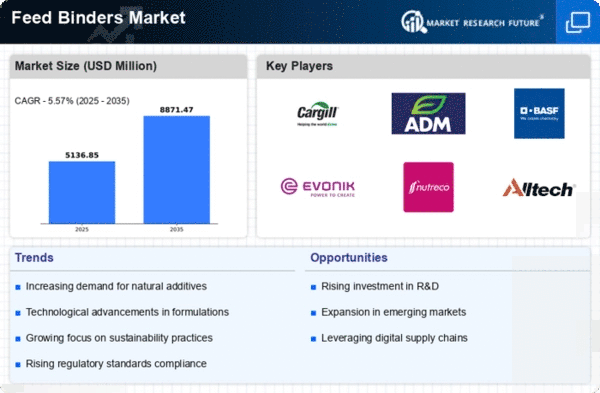
As per MRFR analysis, the Feed Binders Market Size was estimated at 4865.82 USD Million in 2024. The Feed Binders industry is projected to grow from 5192.6 USD Million in 2025 to 8871.47 USD Million by 2035, exhibiting a compound annual growth rate (CAGR) of 5.57% during the forecast period 2025 - 2035.

Key Market Trends & Highlights

The Feed Binders Market is experiencing a dynamic shift towards natural ingredients and technological advancements.

  • The market is witnessing a notable shift towards natural ingredients, particularly in the North American region. Technological advancements in binder formulation are enhancing product efficacy, especially in the fastest-growing Asia-Pacific market. The animal feed segment remains the largest, while the pet food segment is rapidly gaining traction due to changing consumer preferences. Rising demand for animal protein and increasing focus on animal health and welfare are driving market growth.

Market Size & Forecast

2024 Market Size 4865.82 (USD Million)
2035 Market Size 8871.47 (USD Million)
CAGR (2025 - 2035) 5.57%
Largest Regional Market Share in 2024 North America

Major Players

Cargill (US), Archer Daniels Midland (US), BASF (DE), Evonik Industries (DE), Nutreco (NL), Alltech (US), Kemin Industries (US), Beneo (DE), CP Kelco (US), Tate &amp; Lyle (GB)

Market Trends

The Feed Binders Market is currently experiencing a dynamic evolution, driven by the increasing demand for high-quality animal feed and the need for improved feed efficiency. As livestock producers seek to enhance the nutritional value of feed, the role of binders becomes crucial in ensuring optimal feed formulation. These substances not only improve the physical properties of feed but also contribute to the overall health and growth of animals. The market appears to be influenced by various factors, including advancements in binder technology and a growing awareness of animal welfare. Furthermore, the rising trend towards sustainable and organic farming practices is likely to shape the future landscape of this sector. In addition, the Feed Binders Market is witnessing a shift towards natural and plant-based binders, as consumers increasingly prefer products that align with their health and environmental values. This transition may lead to the development of innovative binding agents derived from renewable resources. Moreover, regulatory frameworks surrounding animal feed are becoming more stringent, prompting manufacturers to adapt their offerings to comply with new standards. Overall, the Feed Binders Market seems poised for growth, with opportunities emerging from both technological advancements and changing consumer preferences.

Shift Towards Natural Ingredients

There is a noticeable trend in the Feed Binders Market towards the use of natural and plant-based ingredients. This shift is largely driven by consumer preferences for sustainable and organic products, prompting manufacturers to explore alternatives to synthetic binders. Natural binders are perceived as healthier options, potentially enhancing the appeal of animal feed in the marketplace.

Technological Advancements in Binder Formulation

The Feed Binders Market is experiencing significant technological advancements in binder formulation. Innovations in processing techniques and the development of new binding agents are enhancing the efficiency and effectiveness of feed. These advancements may lead to improved feed quality and better animal performance, thereby attracting more producers to invest in advanced binding solutions.

Regulatory Compliance and Standards

The evolving regulatory landscape surrounding animal feed is influencing the Feed Binders Market. Stricter regulations regarding feed safety and quality are prompting manufacturers to ensure compliance with new standards. This trend may drive innovation as companies seek to develop binders that meet regulatory requirements while maintaining product efficacy.

Feed Binders Market Market Drivers

Market Growth Projections

The Global Feed Binders Industry is projected to experience substantial growth, with estimates indicating a market value of 12.5 USD Billion in 2024 and a potential increase to 20.3 USD Billion by 2035. This growth trajectory reflects a compound annual growth rate of 4.51% from 2025 to 2035, driven by various factors including rising demand for animal protein, technological advancements, and regulatory support. The market dynamics suggest a robust future for feed binders, as they play a crucial role in enhancing feed quality and supporting the livestock sector.

Rising Demand for Animal Protein

The Global Feed Binders Industry experiences a notable surge in demand for animal protein, driven by the increasing global population and changing dietary preferences. As consumers shift towards protein-rich diets, livestock production intensifies, necessitating efficient feed formulations. This trend is projected to elevate the market value to approximately 12.5 USD Billion in 2024. Feed binders play a crucial role in enhancing feed quality and digestibility, thereby supporting the growing livestock sector. The need for sustainable and nutritious animal feed further propels the adoption of feed binders, indicating a robust growth trajectory for the industry.

Expansion of Livestock Farming Practices

The expansion of livestock farming practices across various regions contributes to the growth of the Global Feed Binders Industry. As developing economies invest in livestock production to meet rising food demands, the need for efficient feed solutions becomes paramount. Feed binders facilitate the formulation of balanced diets, ensuring that livestock receive essential nutrients for optimal growth. This trend is particularly evident in regions experiencing rapid agricultural development, where the market is poised for substantial growth. The increasing scale of livestock operations underscores the importance of feed binders in supporting sustainable farming practices.

Regulatory Support for Feed Quality Standards

Regulatory frameworks promoting feed quality standards are pivotal for the Global Feed Binders Industry. Governments worldwide are increasingly implementing stringent regulations to ensure the safety and nutritional adequacy of animal feed. Such regulations encourage the use of high-quality feed binders that comply with safety standards, thereby enhancing consumer confidence in animal products. This regulatory support is likely to drive market growth, as manufacturers invest in compliant feed binder solutions. The emphasis on quality assurance aligns with the projected market value of 20.3 USD Billion by 2035, reflecting the industry's adaptation to regulatory demands.

Technological Advancements in Feed Production

Technological innovations in feed production significantly influence the Global Feed Binders Industry. Advanced processing techniques and formulations enhance the efficacy of feed binders, improving their binding properties and nutritional profiles. Innovations such as extrusion and pelleting technologies contribute to better feed efficiency and reduced waste. As the industry embraces these advancements, the market is expected to witness a compound annual growth rate of 4.51% from 2025 to 2035. This growth is indicative of the industry's commitment to optimizing feed production processes, ensuring that feed binders meet the evolving needs of livestock nutrition.

Growing Awareness of Animal Health and Nutrition

The Global Feed Binders Industry is significantly impacted by the rising awareness of animal health and nutrition among livestock producers. As farmers increasingly recognize the importance of high-quality feed in promoting animal well-being and productivity, the demand for effective feed binders escalates. These binders not only improve feed palatability but also enhance nutrient absorption, contributing to healthier livestock. This growing focus on animal health is likely to sustain market growth, as producers seek innovative solutions to optimize feed formulations and ensure the overall health of their animals.

Market Segment Insights

By Application: Animal Feed (Largest) vs. Aquaculture (Fastest-Growing)

<p>In the Feed Binders Market, the application segment is primarily dominated by the Animal Feed category, which holds the largest market share. This segment's significance stems from the increasing demand for high-quality animal nutrition and efficiency in feed production. Following closely, Pet Food also contributes substantially, while Aquaculture emerges as a niche yet rapidly growing segment. The reliance on specific binding agents is critical for enhancing feed quality across diverse applications.</p>

<p>Animal Feed (Dominant) vs. Aquaculture (Emerging)</p>

<p>Within the Feed Binders Market, Animal Feed stands out as the dominant application, driven by the need for livestock to have optimal nutrition for growth and productivity. It is characterized by the use of various binders that improve feed palatability and nutrient delivery. Conversely, Aquaculture is an emerging segment, experiencing growth due to the rising global demand for seafood. This segment utilizes specialized binders to improve growth rates and feed conversion efficiencies in aquatic species. As both segments evolve, innovation in binder formulations will be key to meeting the specific nutritional requirements of both terrestrial and aquatic species.</p>

By Type: Natural Feed Binders (Largest) vs. Synthetic Feed Binders (Fastest-Growing)

The Feed Binders Market is segmented into four primary types: Natural, Synthetic, Organic, and Inorganic Feed Binders. Among these, Natural Feed Binders hold the largest market share, benefiting from the increasing demand for organic and natural products in animal nutrition. This segment has gained significant traction due to the preference of livestock producers for natural products that enhance animal health and performance. In contrast, Synthetic Feed Binders are emerging as the fastest-growing segment in the market. This growth is driven by advancements in technology and the increasing acceptance of synthetic solutions that offer improved efficiency and cost-effectiveness in feed formulations. Additionally, the rising demand for high-performance feeds among livestock producers is fueling this trend.

Natural Feed Binders (Dominant) vs. Synthetic Feed Binders (Emerging)

Natural Feed Binders are characterized by their origin from plant and animal sources, which makes them highly desirable in the animal husbandry industry. They not only provide essential nutrients but also improve the texture and palatability of feed, making them a dominant choice among producers. Common types include gums, starches, and proteins derived from natural sources. On the other hand, Synthetic Feed Binders are formulated through chemical processes, and they have become an emerging alternative. They often exhibit superior binding properties and can be tailored for specific applications, resulting in increased adoption across various livestock sectors. While Natural Feed Binders prioritize health and sustainability, Synthetic Feed Binders focus on performance and cost-efficient solutions.

By Form: Powder (Largest) vs. Pellets (Fastest-Growing)

In the Feed Binders Market, the distribution of market share among the 'Form' segment reveals that Powder holds a significant portion of the market, primarily due to its widespread application across various animal feed types. Granules and Liquid forms follow, catering to specific nutritional needs and preferences among feed manufacturers. On the other hand, Pellets have been gaining traction, reflecting a growing preference for ease of use and efficiency in feed formulation, which is driving interest from livestock producers.

Powder (Dominant) vs. Pellets (Emerging)

Powder form is the dominant player in the Feed Binders Market, valued for its versatility and compatibility with a range of feed types. It allows for easy mixing and enhances the feed's nutrient absorption rate. With applications in numerous feed formulations, Powder enjoys consistent demand. In contrast, Pellets are recognized as an emerging segment, offering advantages such as reduced dust and ease of handling. Their compact nature facilitates efficient storage and transport, making them increasingly appealing to manufacturers aiming for optimized feed processes. As producers seek innovative solutions for animal nutrition, Pellets are expected to see accelerated growth in the coming years.

By Source: Plant-Based (Largest) vs. Animal-Based (Fastest-Growing)

The Feed Binders Market is characterized by a diverse source segment, where plant-based materials hold the largest market share. This dominance is attributed to the increasing demand for natural and sustainable feed ingredients driven by consumer preferences for health and sustainability. Meanwhile, animal-based binders, while currently smaller in market share, are identified as the fastest-growing segment, fueled by advancements in livestock nutrition and feed formulation that enhance animal health and productivity.

Feed Binders: Plant-Based (Dominant) vs. Animal-Based (Emerging)

Plant-based feed binders, derived from sources like cellulose and starch, play a dominant role in the market due to their eco-friendly profile and favorable nutritional attributes. They offer excellent binding properties, enhancing feed consistency and digestibility. On the other hand, animal-based binders, which comprise materials such as gelatin and collagen, are emerging swiftly as a premium option, driven by their ability to improve energy efficiency and nutrient absorption in livestock. This growth is influenced by the rising global meat consumption and the increasing focus on optimizing animal feed for better health outcomes.

By Functionality: Binding (Largest) vs. Emulsifying (Fastest-Growing)

<p>In the Feed Binders Market, the functionality segment is characterized by distinct values such as Binding, Thickening, Stabilizing, and Emulsifying. Binding currently holds the largest market share, driven by its essential role in improving feed texture and handling in livestock feed. Emulsifying, while smaller in share, is rapidly gaining traction as it is increasingly adopted in the production of high-performance animal feeds, catering to a market that demands enhanced nutritional profiles.</p>

<p>Binding (Dominant) vs. Emulsifying (Emerging)</p>

<p>Binding, as the dominant value in the Feed Binders Market, plays a crucial role in improving the overall quality and manufacturability of animal feed. It ensures particle cohesion, enhancing feed stability and reducing segregation during storage and handling. In contrast, Emulsifying is an emerging value that is witnessing accelerated growth, driven by innovations in feed formulation. This segment is crucial for creating stable mixtures of fats and oils, thereby enhancing the palatability and digestibility of animal feed. As the industry leans towards more balanced and nutrient-rich formulations, both Binding and Emulsifying are expected to shape the future landscape of the market.</p>

Get more detailed insights about Feed Binders Market Research Report- Forecast till 2035

Regional Insights

North America : Market Leader in Feed Binders

North America is poised to maintain its leadership in the Feed Binders market, holding a significant share of 2439.0. The region's growth is driven by increasing livestock production, rising demand for high-quality animal feed, and stringent regulations promoting feed safety and quality. Additionally, advancements in feed technology and a focus on sustainable practices are further propelling market expansion. The United States stands out as the primary contributor, with major players like Cargill, Archer Daniels Midland, and Alltech leading the competitive landscape. These companies are investing in innovative solutions to enhance feed efficiency and nutritional value. The presence of robust agricultural infrastructure and research institutions also supports the growth of the Feed Binders market in this region.

Europe : Emerging Innovations in Feed Binders

Europe's Feed Binders market, valued at 1450.0, is characterized by a strong emphasis on innovation and sustainability. The region is witnessing a shift towards natural and organic feed binders, driven by consumer demand for healthier livestock products and regulatory frameworks promoting environmentally friendly practices. The European Union's stringent regulations on feed additives are also catalyzing the adoption of safer and more effective feed binder solutions. Leading countries such as Germany, France, and the Netherlands are at the forefront of this transformation, with key players like BASF and Evonik Industries investing heavily in R&D. The competitive landscape is marked by collaborations between industry and academia, fostering advancements in feed technology. This dynamic environment positions Europe as a hub for innovative feed binder solutions.

Asia-Pacific : Rapid Growth in Feed Binders

The Asia-Pacific region, with a market size of 850.0, is experiencing rapid growth in the Feed Binders sector. This surge is primarily driven by increasing meat consumption, urbanization, and rising disposable incomes. Additionally, government initiatives aimed at enhancing livestock productivity and food security are further stimulating demand for effective feed binders. The region's diverse agricultural landscape also supports a wide range of feed binder applications. Countries like China and India are leading the charge, with significant investments in livestock farming and feed production. The competitive landscape features both local and international players, including Nutreco and Kemin Industries, who are focusing on product innovation and strategic partnerships to capture market share. This dynamic environment is expected to continue driving growth in the Feed Binders market across Asia-Pacific.

Middle East and Africa : Untapped Potential in Feed Binders

The Middle East and Africa region, with a market size of 126.82, presents untapped potential in the Feed Binders market. The growth is driven by increasing livestock farming and a rising demand for animal protein. Additionally, government initiatives aimed at improving food security and agricultural productivity are creating favorable conditions for feed binder adoption. The region's diverse climatic conditions also necessitate tailored feed solutions to enhance livestock health and productivity. Countries such as South Africa and Nigeria are emerging as key players in this market, with local companies and international firms exploring opportunities for growth. The competitive landscape is evolving, with a focus on developing cost-effective and efficient feed binder solutions. This presents significant opportunities for investment and innovation in the Feed Binders market in the Middle East and Africa.

Key Players and Competitive Insights

The Feed Binders Market is currently characterized by a dynamic competitive landscape, driven by increasing demand for high-quality animal feed and the need for sustainable agricultural practices. Key players such as Cargill (US), Archer Daniels Midland (US), and BASF (DE) are strategically positioned to leverage innovation and sustainability in their operations. Cargill (US) focuses on enhancing its product portfolio through research and development, while Archer Daniels Midland (US) emphasizes strategic partnerships to expand its market reach. BASF (DE) is investing in digital transformation initiatives to optimize its supply chain and improve product efficacy, collectively shaping a competitive environment that prioritizes quality and sustainability.In terms of business tactics, companies are increasingly localizing manufacturing to reduce transportation costs and enhance supply chain efficiency. The market appears moderately fragmented, with a mix of large multinational corporations and smaller regional players. This structure allows for a diverse range of products and innovations, although the influence of key players remains substantial in setting industry standards and trends.
In November Cargill (US) announced a partnership with a leading agricultural technology firm to develop advanced feed binder solutions that enhance nutrient absorption in livestock. This strategic move is likely to bolster Cargill's position in the market by addressing the growing demand for efficient feed solutions that contribute to animal health and productivity. The collaboration underscores the importance of innovation in maintaining competitive advantage.
In October Archer Daniels Midland (US) launched a new line of organic feed binders aimed at the growing market for organic livestock products. This initiative not only aligns with consumer trends towards organic food but also positions the company as a leader in sustainable feed solutions. The introduction of these products may enhance customer loyalty and expand market share in a niche segment.
In September BASF (DE) unveiled a digital platform designed to provide real-time data analytics for feed formulation, enabling farmers to optimize their feed strategies. This technological advancement reflects a broader trend towards digitalization in the industry, allowing for more precise and efficient feed management. Such innovations are likely to redefine competitive dynamics by emphasizing data-driven decision-making.
As of December the Feed Binders Market is witnessing significant trends towards digitalization, sustainability, and the integration of artificial intelligence in product development. Strategic alliances are increasingly shaping the competitive landscape, fostering innovation and enhancing supply chain reliability. Moving forward, the emphasis appears to be shifting from price-based competition to a focus on technological advancements and sustainable practices, suggesting that companies that prioritize innovation and reliability will likely emerge as leaders in this evolving market.

Key Companies in the Feed Binders Market include

Industry Developments

  • Rising Demand for Animal Protein: Global meat consumption is on the rise, according to the USDA, leading to increased demand for efficient animal feed production. Feed binders play a crucial role in improving feed quality and animal health, contributing to this growth.
  • Focus on Aquaculture: The aquaculture industry is experiencing significant expansion, with fish feed production growing rapidly. Feed binders are essential for maintaining pellet integrity and nutrient availability in fish feed .
  • Mycotoxin Mitigation: Mycotoxins are harmful fungi that can contaminate feed and harm animals. The demand for mycotoxin binders, a specific type of feed binder, is expected to see strong growth as producers look to mitigate these risks
  • Q3 2024: Bentoli announces launch of new natural feed binder to enhance pellet durability Bentoli introduced a new natural feed binder in August 2024, specifically designed to improve pellet durability and reduce feed wastage, targeting the growing demand for sustainable animal nutrition solutions.

Intended Audience

  • Feed binder manufacturers
  • Feed industry
  • Livestock industry
  • Raw material suppliers
  • Retailers and wholesaler
  • Traders, importers, and exporters

The global feed binders market is segmented into the following regions

North America

  • The U.S.
  • Canada
  • Mexico 

Europe

  • Germany
  • France
  • Italy
  • Spain
  • U.K
  • Rest of Europe

Asia Pacific

  • China
  • India
  • Australia
  • Japan
  • Rest of Asia Pacific

Rest of the world

  • Brazil
  • Argentina
  • South Africa
  • Others

The report for global feed binders market of Market Research Future comprises of extensive primary research along with the detailed analysis of qualitative as well as quantitative aspects by various industry experts, key opinion leaders to gain the deeper insight of the market and industry performance. The report gives a clear picture of current market scenario which includes historical and projected market size in terms of value and volume, technological advancement, macroeconomic and governing factors in the market. The report provides detailed information and strategies of the top key players in the industry.

The report also gives a broad study of the different market segments and regions.

Future Outlook

Feed Binders Market Future Outlook

The Feed Binders Market is projected to grow at a 5.57% CAGR from 2025 to 2035, driven by increasing demand for animal nutrition and sustainable feed solutions.

New opportunities lie in:

  • <p>Development of bio-based feed binders to meet sustainability goals. Expansion into emerging markets with tailored product offerings. Investment in R&amp;D for innovative binding agents enhancing feed efficiency.</p>

By 2035, the Feed Binders Market is expected to achieve robust growth, reflecting evolving industry demands.

Market Segmentation

Feed Binders Market Form Outlook

  • Powder
  • Granules
  • Liquid
  • Pellets

Feed Binders Market Type Outlook

  • Natural Feed Binders
  • Synthetic Feed Binders
  • Organic Feed Binders
  • Inorganic Feed Binders

Feed Binders Market Source Outlook

  • Plant-Based
  • Animal-Based
  • Mineral-Based

Feed Binders Market Application Outlook

  • Animal Feed
  • Pet Food
  • Aquaculture
  • Poultry
  • Ruminants

Feed Binders Market Functionality Outlook

  • Nutritional Enhancement
  • Texture Improvement
  • Moisture Retention
  • Binding Agent

Report Scope

MARKET SIZE 2024 4865.82(USD Million)
MARKET SIZE 2025 5192.6(USD Million)
MARKET SIZE 2035 8871.47(USD Million)
COMPOUND ANNUAL GROWTH RATE (CAGR) 5.57% (2025 - 2035)
REPORT COVERAGE Revenue Forecast, Competitive Landscape, Growth Factors, and Trends
BASE YEAR 2024
Market Forecast Period 2025 - 2035
Historical Data 2019 - 2024
Market Forecast Units USD Million
Key Companies Profiled Cargill (US), Archer Daniels Midland (US), BASF (DE), Evonik Industries (DE), Nutreco (NL), Alltech (US), Kemin Industries (US), Beneo (DE), CP Kelco (US), Tate & Lyle (GB)
Segments Covered Application, Type, Form, Source, Functionality
Key Market Opportunities Growing demand for natural feed binders driven by consumer preference for sustainable livestock practices.
Key Market Dynamics Rising demand for sustainable feed solutions drives innovation and competition in the Feed Binders Market.
Countries Covered North America, Europe, APAC, South America, MEA

FAQs

What is the current valuation of the Feed Binders Market as of 2024?

<p>The Feed Binders Market was valued at approximately 4865.82 USD Million in 2024.</p>

What is the projected market size for the Feed Binders Market by 2035?

<p>The market is expected to reach a valuation of around 8871.47 USD Million by 2035.</p>

What is the expected CAGR for the Feed Binders Market during the forecast period 2025 - 2035?

<p>The anticipated CAGR for the Feed Binders Market during the forecast period 2025 - 2035 is 5.57%.</p>

Which companies are considered key players in the Feed Binders Market?

<p>Key players in the market include Cargill, Archer Daniels Midland, BASF, Evonik Industries, Nutreco, Alltech, Kemin Industries, Pancosma, and Lallemand.</p>

What are the main applications of feed binders in the market?

<p>The primary applications of feed binders include Animal Feed, Pet Food, Aquaculture, Poultry, and Ruminants, with valuations ranging from 515.82 to 2700.0 USD Million.</p>

How do natural and synthetic feed binders compare in terms of market valuation?

In 2024, natural feed binders were valued at 1000.0 USD Million, while synthetic feed binders reached 1500.0 USD Million.

What forms do feed binders take in the market?

Feed binders are available in various forms, including Powder, Granules, Liquid, and Pellets, with valuations from 1032.07 to 2630.0 USD Million.

What sources are utilized for feed binders in the market?

The sources for feed binders include Plant-Based, Animal-Based, and Mineral-Based, with market valuations ranging from 1365.82 to 3500.0 USD Million.

What functionalities do feed binders serve in animal nutrition?

Feed binders serve various functionalities such as Binding, Thickening, Stabilizing, and Emulsifying, with valuations from 1100.0 to 2400.0 USD Million.

How does the Feed Binders Market's growth potential appear in the coming years?

The growth potential of the Feed Binders Market appears promising, with a projected increase in valuation from 4865.82 USD Million in 2024 to 8871.47 USD Million by 2035.

  1. SECTION I: EXECUTIVE SUMMARY AND KEY HIGHLIGHTS
    1. | 1.1 EXECUTIVE SUMMARY
    2. | | 1.1.1 Market Overview
    3. | | 1.1.2 Key Findings
    4. | | 1.1.3 Market Segmentation
    5. | | 1.1.4 Competitive Landscape
    6. | | 1.1.5 Challenges and Opportunities
    7. | | 1.1.6 Future Outlook
  2. SECTION II: SCOPING, METHODOLOGY AND MARKET STRUCTURE
    1. | 2.1 MARKET INTRODUCTION
    2. | | 2.1.1 Definition
    3. | | 2.1.2 Scope of the study
    4. | | | 2.1.2.1 Research Objective
    5. | | | 2.1.2.2 Assumption
    6. | | | 2.1.2.3 Limitations
    7. | 2.2 RESEARCH METHODOLOGY
    8. | | 2.2.1 Overview
    9. | | 2.2.2 Data Mining
    10. | | 2.2.3 Secondary Research
    11. | | 2.2.4 Primary Research
    12. | | | 2.2.4.1 Primary Interviews and Information Gathering Process
    13. | | | 2.2.4.2 Breakdown of Primary Respondents
    14. | | 2.2.5 Forecasting Model
    15. | | 2.2.6 Market Size Estimation
    16. | | | 2.2.6.1 Bottom-Up Approach
    17. | | | 2.2.6.2 Top-Down Approach
    18. | | 2.2.7 Data Triangulation
    19. | | 2.2.8 Validation
  3. SECTION III: QUALITATIVE ANALYSIS
    1. | 3.1 MARKET DYNAMICS
    2. | | 3.1.1 Overview
    3. | | 3.1.2 Drivers
    4. | | 3.1.3 Restraints
    5. | | 3.1.4 Opportunities
    6. | 3.2 MARKET FACTOR ANALYSIS
    7. | | 3.2.1 Value chain Analysis
    8. | | 3.2.2 Porter's Five Forces Analysis
    9. | | | 3.2.2.1 Bargaining Power of Suppliers
    10. | | | 3.2.2.2 Bargaining Power of Buyers
    11. | | | 3.2.2.3 Threat of New Entrants
    12. | | | 3.2.2.4 Threat of Substitutes
    13. | | | 3.2.2.5 Intensity of Rivalry
    14. | | 3.2.3 COVID-19 Impact Analysis
    15. | | | 3.2.3.1 Market Impact Analysis
    16. | | | 3.2.3.2 Regional Impact
    17. | | | 3.2.3.3 Opportunity and Threat Analysis
  4. SECTION IV: QUANTITATIVE ANALYSIS
    1. | 4.1 Chemicals and Materials, BY Application (USD Million)
    2. | | 4.1.1 Animal Feed
    3. | | 4.1.2 Pet Food
    4. | | 4.1.3 Aquaculture
    5. | | 4.1.4 Poultry
    6. | | 4.1.5 Ruminants
    7. | 4.2 Chemicals and Materials, BY Type (USD Million)
    8. | | 4.2.1 Natural Feed Binders
    9. | | 4.2.2 Synthetic Feed Binders
    10. | | 4.2.3 Organic Feed Binders
    11. | | 4.2.4 Inorganic Feed Binders
    12. | 4.3 Chemicals and Materials, BY Form (USD Million)
    13. | | 4.3.1 Powder
    14. | | 4.3.2 Granules
    15. | | 4.3.3 Liquid
    16. | | 4.3.4 Pellets
    17. | 4.4 Chemicals and Materials, BY Source (USD Million)
    18. | | 4.4.1 Plant-Based
    19. | | 4.4.2 Animal-Based
    20. | | 4.4.3 Mineral-Based
    21. | 4.5 Chemicals and Materials, BY Functionality (USD Million)
    22. | | 4.5.1 Binding
    23. | | 4.5.2 Thickening
    24. | | 4.5.3 Stabilizing
    25. | | 4.5.4 Emulsifying
    26. | 4.6 Chemicals and Materials, BY Region (USD Million)
    27. | | 4.6.1 North America
    28. | | | 4.6.1.1 US
    29. | | | 4.6.1.2 Canada
    30. | | 4.6.2 Europe
    31. | | | 4.6.2.1 Germany
    32. | | | 4.6.2.2 UK
    33. | | | 4.6.2.3 France
    34. | | | 4.6.2.4 Russia
    35. | | | 4.6.2.5 Italy
    36. | | | 4.6.2.6 Spain
    37. | | | 4.6.2.7 Rest of Europe
    38. | | 4.6.3 APAC
    39. | | | 4.6.3.1 China
    40. | | | 4.6.3.2 India
    41. | | | 4.6.3.3 Japan
    42. | | | 4.6.3.4 South Korea
    43. | | | 4.6.3.5 Malaysia
    44. | | | 4.6.3.6 Thailand
    45. | | | 4.6.3.7 Indonesia
    46. | | | 4.6.3.8 Rest of APAC
    47. | | 4.6.4 South America
    48. | | | 4.6.4.1 Brazil
    49. | | | 4.6.4.2 Mexico
    50. | | | 4.6.4.3 Argentina
    51. | | | 4.6.4.4 Rest of South America
    52. | | 4.6.5 MEA
    53. | | | 4.6.5.1 GCC Countries
    54. | | | 4.6.5.2 South Africa
    55. | | | 4.6.5.3 Rest of MEA
  5. SECTION V: COMPETITIVE ANALYSIS
    1. | 5.1 Competitive Landscape
    2. | | 5.1.1 Overview
    3. | | 5.1.2 Competitive Analysis
    4. | | 5.1.3 Market share Analysis
    5. | | 5.1.4 Major Growth Strategy in the Chemicals and Materials
    6. | | 5.1.5 Competitive Benchmarking
    7. | | 5.1.6 Leading Players in Terms of Number of Developments in the Chemicals and Materials
    8. | | 5.1.7 Key developments and growth strategies
    9. | | | 5.1.7.1 New Product Launch/Service Deployment
    10. | | | 5.1.7.2 Merger & Acquisitions
    11. | | | 5.1.7.3 Joint Ventures
    12. | | 5.1.8 Major Players Financial Matrix
    13. | | | 5.1.8.1 Sales and Operating Income
    14. | | | 5.1.8.2 Major Players R&D Expenditure. 2023
    15. | 5.2 Company Profiles
    16. | | 5.2.1 Cargill (US)
    17. | | | 5.2.1.1 Financial Overview
    18. | | | 5.2.1.2 Products Offered
    19. | | | 5.2.1.3 Key Developments
    20. | | | 5.2.1.4 SWOT Analysis
    21. | | | 5.2.1.5 Key Strategies
    22. | | 5.2.2 Archer Daniels Midland (US)
    23. | | | 5.2.2.1 Financial Overview
    24. | | | 5.2.2.2 Products Offered
    25. | | | 5.2.2.3 Key Developments
    26. | | | 5.2.2.4 SWOT Analysis
    27. | | | 5.2.2.5 Key Strategies
    28. | | 5.2.3 BASF (DE)
    29. | | | 5.2.3.1 Financial Overview
    30. | | | 5.2.3.2 Products Offered
    31. | | | 5.2.3.3 Key Developments
    32. | | | 5.2.3.4 SWOT Analysis
    33. | | | 5.2.3.5 Key Strategies
    34. | | 5.2.4 Evonik Industries (DE)
    35. | | | 5.2.4.1 Financial Overview
    36. | | | 5.2.4.2 Products Offered
    37. | | | 5.2.4.3 Key Developments
    38. | | | 5.2.4.4 SWOT Analysis
    39. | | | 5.2.4.5 Key Strategies
    40. | | 5.2.5 Nutreco (NL)
    41. | | | 5.2.5.1 Financial Overview
    42. | | | 5.2.5.2 Products Offered
    43. | | | 5.2.5.3 Key Developments
    44. | | | 5.2.5.4 SWOT Analysis
    45. | | | 5.2.5.5 Key Strategies
    46. | | 5.2.6 Alltech (US)
    47. | | | 5.2.6.1 Financial Overview
    48. | | | 5.2.6.2 Products Offered
    49. | | | 5.2.6.3 Key Developments
    50. | | | 5.2.6.4 SWOT Analysis
    51. | | | 5.2.6.5 Key Strategies
    52. | | 5.2.7 Kemin Industries (US)
    53. | | | 5.2.7.1 Financial Overview
    54. | | | 5.2.7.2 Products Offered
    55. | | | 5.2.7.3 Key Developments
    56. | | | 5.2.7.4 SWOT Analysis
    57. | | | 5.2.7.5 Key Strategies
    58. | | 5.2.8 Pancosma (CH)
    59. | | | 5.2.8.1 Financial Overview
    60. | | | 5.2.8.2 Products Offered
    61. | | | 5.2.8.3 Key Developments
    62. | | | 5.2.8.4 SWOT Analysis
    63. | | | 5.2.8.5 Key Strategies
    64. | | 5.2.9 Lallemand (CA)
    65. | | | 5.2.9.1 Financial Overview
    66. | | | 5.2.9.2 Products Offered
    67. | | | 5.2.9.3 Key Developments
    68. | | | 5.2.9.4 SWOT Analysis
    69. | | | 5.2.9.5 Key Strategies
    70. | 5.3 Appendix
    71. | | 5.3.1 References
    72. | | 5.3.2 Related Reports
  6. LIST OF FIGURES
    1. | 6.1 MARKET SYNOPSIS
    2. | 6.2 NORTH AMERICA MARKET ANALYSIS
    3. | 6.3 US MARKET ANALYSIS BY APPLICATION
    4. | 6.4 US MARKET ANALYSIS BY TYPE
    5. | 6.5 US MARKET ANALYSIS BY FORM
    6. | 6.6 US MARKET ANALYSIS BY SOURCE
    7. | 6.7 US MARKET ANALYSIS BY FUNCTIONALITY
    8. | 6.8 CANADA MARKET ANALYSIS BY APPLICATION
    9. | 6.9 CANADA MARKET ANALYSIS BY TYPE
    10. | 6.10 CANADA MARKET ANALYSIS BY FORM
    11. | 6.11 CANADA MARKET ANALYSIS BY SOURCE
    12. | 6.12 CANADA MARKET ANALYSIS BY FUNCTIONALITY
    13. | 6.13 EUROPE MARKET ANALYSIS
    14. | 6.14 GERMANY MARKET ANALYSIS BY APPLICATION
    15. | 6.15 GERMANY MARKET ANALYSIS BY TYPE
    16. | 6.16 GERMANY MARKET ANALYSIS BY FORM
    17. | 6.17 GERMANY MARKET ANALYSIS BY SOURCE
    18. | 6.18 GERMANY MARKET ANALYSIS BY FUNCTIONALITY
    19. | 6.19 UK MARKET ANALYSIS BY APPLICATION
    20. | 6.20 UK MARKET ANALYSIS BY TYPE
    21. | 6.21 UK MARKET ANALYSIS BY FORM
    22. | 6.22 UK MARKET ANALYSIS BY SOURCE
    23. | 6.23 UK MARKET ANALYSIS BY FUNCTIONALITY
    24. | 6.24 FRANCE MARKET ANALYSIS BY APPLICATION
    25. | 6.25 FRANCE MARKET ANALYSIS BY TYPE
    26. | 6.26 FRANCE MARKET ANALYSIS BY FORM
    27. | 6.27 FRANCE MARKET ANALYSIS BY SOURCE
    28. | 6.28 FRANCE MARKET ANALYSIS BY FUNCTIONALITY
    29. | 6.29 RUSSIA MARKET ANALYSIS BY APPLICATION
    30. | 6.30 RUSSIA MARKET ANALYSIS BY TYPE
    31. | 6.31 RUSSIA MARKET ANALYSIS BY FORM
    32. | 6.32 RUSSIA MARKET ANALYSIS BY SOURCE
    33. | 6.33 RUSSIA MARKET ANALYSIS BY FUNCTIONALITY
    34. | 6.34 ITALY MARKET ANALYSIS BY APPLICATION
    35. | 6.35 ITALY MARKET ANALYSIS BY TYPE
    36. | 6.36 ITALY MARKET ANALYSIS BY FORM
    37. | 6.37 ITALY MARKET ANALYSIS BY SOURCE
    38. | 6.38 ITALY MARKET ANALYSIS BY FUNCTIONALITY
    39. | 6.39 SPAIN MARKET ANALYSIS BY APPLICATION
    40. | 6.40 SPAIN MARKET ANALYSIS BY TYPE
    41. | 6.41 SPAIN MARKET ANALYSIS BY FORM
    42. | 6.42 SPAIN MARKET ANALYSIS BY SOURCE
    43. | 6.43 SPAIN MARKET ANALYSIS BY FUNCTIONALITY
    44. | 6.44 REST OF EUROPE MARKET ANALYSIS BY APPLICATION
    45. | 6.45 REST OF EUROPE MARKET ANALYSIS BY TYPE
    46. | 6.46 REST OF EUROPE MARKET ANALYSIS BY FORM
    47. | 6.47 REST OF EUROPE MARKET ANALYSIS BY SOURCE
    48. | 6.48 REST OF EUROPE MARKET ANALYSIS BY FUNCTIONALITY
    49. | 6.49 APAC MARKET ANALYSIS
    50. | 6.50 CHINA MARKET ANALYSIS BY APPLICATION
    51. | 6.51 CHINA MARKET ANALYSIS BY TYPE
    52. | 6.52 CHINA MARKET ANALYSIS BY FORM
    53. | 6.53 CHINA MARKET ANALYSIS BY SOURCE
    54. | 6.54 CHINA MARKET ANALYSIS BY FUNCTIONALITY
    55. | 6.55 INDIA MARKET ANALYSIS BY APPLICATION
    56. | 6.56 INDIA MARKET ANALYSIS BY TYPE
    57. | 6.57 INDIA MARKET ANALYSIS BY FORM
    58. | 6.58 INDIA MARKET ANALYSIS BY SOURCE
    59. | 6.59 INDIA MARKET ANALYSIS BY FUNCTIONALITY
    60. | 6.60 JAPAN MARKET ANALYSIS BY APPLICATION
    61. | 6.61 JAPAN MARKET ANALYSIS BY TYPE
    62. | 6.62 JAPAN MARKET ANALYSIS BY FORM
    63. | 6.63 JAPAN MARKET ANALYSIS BY SOURCE
    64. | 6.64 JAPAN MARKET ANALYSIS BY FUNCTIONALITY
    65. | 6.65 SOUTH KOREA MARKET ANALYSIS BY APPLICATION
    66. | 6.66 SOUTH KOREA MARKET ANALYSIS BY TYPE
    67. | 6.67 SOUTH KOREA MARKET ANALYSIS BY FORM
    68. | 6.68 SOUTH KOREA MARKET ANALYSIS BY SOURCE
    69. | 6.69 SOUTH KOREA MARKET ANALYSIS BY FUNCTIONALITY
    70. | 6.70 MALAYSIA MARKET ANALYSIS BY APPLICATION
    71. | 6.71 MALAYSIA MARKET ANALYSIS BY TYPE
    72. | 6.72 MALAYSIA MARKET ANALYSIS BY FORM
    73. | 6.73 MALAYSIA MARKET ANALYSIS BY SOURCE
    74. | 6.74 MALAYSIA MARKET ANALYSIS BY FUNCTIONALITY
    75. | 6.75 THAILAND MARKET ANALYSIS BY APPLICATION
    76. | 6.76 THAILAND MARKET ANALYSIS BY TYPE
    77. | 6.77 THAILAND MARKET ANALYSIS BY FORM
    78. | 6.78 THAILAND MARKET ANALYSIS BY SOURCE
    79. | 6.79 THAILAND MARKET ANALYSIS BY FUNCTIONALITY
    80. | 6.80 INDONESIA MARKET ANALYSIS BY APPLICATION
    81. | 6.81 INDONESIA MARKET ANALYSIS BY TYPE
    82. | 6.82 INDONESIA MARKET ANALYSIS BY FORM
    83. | 6.83 INDONESIA MARKET ANALYSIS BY SOURCE
    84. | 6.84 INDONESIA MARKET ANALYSIS BY FUNCTIONALITY
    85. | 6.85 REST OF APAC MARKET ANALYSIS BY APPLICATION
    86. | 6.86 REST OF APAC MARKET ANALYSIS BY TYPE
    87. | 6.87 REST OF APAC MARKET ANALYSIS BY FORM
    88. | 6.88 REST OF APAC MARKET ANALYSIS BY SOURCE
    89. | 6.89 REST OF APAC MARKET ANALYSIS BY FUNCTIONALITY
    90. | 6.90 SOUTH AMERICA MARKET ANALYSIS
    91. | 6.91 BRAZIL MARKET ANALYSIS BY APPLICATION
    92. | 6.92 BRAZIL MARKET ANALYSIS BY TYPE
    93. | 6.93 BRAZIL MARKET ANALYSIS BY FORM
    94. | 6.94 BRAZIL MARKET ANALYSIS BY SOURCE
    95. | 6.95 BRAZIL MARKET ANALYSIS BY FUNCTIONALITY
    96. | 6.96 MEXICO MARKET ANALYSIS BY APPLICATION
    97. | 6.97 MEXICO MARKET ANALYSIS BY TYPE
    98. | 6.98 MEXICO MARKET ANALYSIS BY FORM
    99. | 6.99 MEXICO MARKET ANALYSIS BY SOURCE
    100. | 6.100 MEXICO MARKET ANALYSIS BY FUNCTIONALITY
    101. | 6.101 ARGENTINA MARKET ANALYSIS BY APPLICATION
    102. | 6.102 ARGENTINA MARKET ANALYSIS BY TYPE
    103. | 6.103 ARGENTINA MARKET ANALYSIS BY FORM
    104. | 6.104 ARGENTINA MARKET ANALYSIS BY SOURCE
    105. | 6.105 ARGENTINA MARKET ANALYSIS BY FUNCTIONALITY
    106. | 6.106 REST OF SOUTH AMERICA MARKET ANALYSIS BY APPLICATION
    107. | 6.107 REST OF SOUTH AMERICA MARKET ANALYSIS BY TYPE
    108. | 6.108 REST OF SOUTH AMERICA MARKET ANALYSIS BY FORM
    109. | 6.109 REST OF SOUTH AMERICA MARKET ANALYSIS BY SOURCE
    110. | 6.110 REST OF SOUTH AMERICA MARKET ANALYSIS BY FUNCTIONALITY
    111. | 6.111 MEA MARKET ANALYSIS
    112. | 6.112 GCC COUNTRIES MARKET ANALYSIS BY APPLICATION
    113. | 6.113 GCC COUNTRIES MARKET ANALYSIS BY TYPE
    114. | 6.114 GCC COUNTRIES MARKET ANALYSIS BY FORM
    115. | 6.115 GCC COUNTRIES MARKET ANALYSIS BY SOURCE
    116. | 6.116 GCC COUNTRIES MARKET ANALYSIS BY FUNCTIONALITY
    117. | 6.117 SOUTH AFRICA MARKET ANALYSIS BY APPLICATION
    118. | 6.118 SOUTH AFRICA MARKET ANALYSIS BY TYPE
    119. | 6.119 SOUTH AFRICA MARKET ANALYSIS BY FORM
    120. | 6.120 SOUTH AFRICA MARKET ANALYSIS BY SOURCE
    121. | 6.121 SOUTH AFRICA MARKET ANALYSIS BY FUNCTIONALITY
    122. | 6.122 REST OF MEA MARKET ANALYSIS BY APPLICATION
    123. | 6.123 REST OF MEA MARKET ANALYSIS BY TYPE
    124. | 6.124 REST OF MEA MARKET ANALYSIS BY FORM
    125. | 6.125 REST OF MEA MARKET ANALYSIS BY SOURCE
    126. | 6.126 REST OF MEA MARKET ANALYSIS BY FUNCTIONALITY
    127. | 6.127 KEY BUYING CRITERIA OF CHEMICALS AND MATERIALS
    128. | 6.128 RESEARCH PROCESS OF MRFR
    129. | 6.129 DRO ANALYSIS OF CHEMICALS AND MATERIALS
    130. | 6.130 DRIVERS IMPACT ANALYSIS: CHEMICALS AND MATERIALS
    131. | 6.131 RESTRAINTS IMPACT ANALYSIS: CHEMICALS AND MATERIALS
    132. | 6.132 SUPPLY / VALUE CHAIN: CHEMICALS AND MATERIALS
    133. | 6.133 CHEMICALS AND MATERIALS, BY APPLICATION, 2024 (% SHARE)
    134. | 6.134 CHEMICALS AND MATERIALS, BY APPLICATION, 2024 TO 2035 (USD Million)
    135. | 6.135 CHEMICALS AND MATERIALS, BY TYPE, 2024 (% SHARE)
    136. | 6.136 CHEMICALS AND MATERIALS, BY TYPE, 2024 TO 2035 (USD Million)
    137. | 6.137 CHEMICALS AND MATERIALS, BY FORM, 2024 (% SHARE)
    138. | 6.138 CHEMICALS AND MATERIALS, BY FORM, 2024 TO 2035 (USD Million)
    139. | 6.139 CHEMICALS AND MATERIALS, BY SOURCE, 2024 (% SHARE)
    140. | 6.140 CHEMICALS AND MATERIALS, BY SOURCE, 2024 TO 2035 (USD Million)
    141. | 6.141 CHEMICALS AND MATERIALS, BY FUNCTIONALITY, 2024 (% SHARE)
    142. | 6.142 CHEMICALS AND MATERIALS, BY FUNCTIONALITY, 2024 TO 2035 (USD Million)
    143. | 6.143 BENCHMARKING OF MAJOR COMPETITORS
  7. LIST OF TABLES
    1. | 7.1 LIST OF ASSUMPTIONS
    2. | | 7.1.1
    3. | 7.2 North America MARKET SIZE ESTIMATES; FORECAST
    4. | | 7.2.1 BY APPLICATION, 2025-2035 (USD Million)
    5. | | 7.2.2 BY TYPE, 2025-2035 (USD Million)
    6. | | 7.2.3 BY FORM, 2025-2035 (USD Million)
    7. | | 7.2.4 BY SOURCE, 2025-2035 (USD Million)
    8. | | 7.2.5 BY FUNCTIONALITY, 2025-2035 (USD Million)
    9. | 7.3 US MARKET SIZE ESTIMATES; FORECAST
    10. | | 7.3.1 BY APPLICATION, 2025-2035 (USD Million)
    11. | | 7.3.2 BY TYPE, 2025-2035 (USD Million)
    12. | | 7.3.3 BY FORM, 2025-2035 (USD Million)
    13. | | 7.3.4 BY SOURCE, 2025-2035 (USD Million)
    14. | | 7.3.5 BY FUNCTIONALITY, 2025-2035 (USD Million)
    15. | 7.4 Canada MARKET SIZE ESTIMATES; FORECAST
    16. | | 7.4.1 BY APPLICATION, 2025-2035 (USD Million)
    17. | | 7.4.2 BY TYPE, 2025-2035 (USD Million)
    18. | | 7.4.3 BY FORM, 2025-2035 (USD Million)
    19. | | 7.4.4 BY SOURCE, 2025-2035 (USD Million)
    20. | | 7.4.5 BY FUNCTIONALITY, 2025-2035 (USD Million)
    21. | 7.5 Europe MARKET SIZE ESTIMATES; FORECAST
    22. | | 7.5.1 BY APPLICATION, 2025-2035 (USD Million)
    23. | | 7.5.2 BY TYPE, 2025-2035 (USD Million)
    24. | | 7.5.3 BY FORM, 2025-2035 (USD Million)
    25. | | 7.5.4 BY SOURCE, 2025-2035 (USD Million)
    26. | | 7.5.5 BY FUNCTIONALITY, 2025-2035 (USD Million)
    27. | 7.6 Germany MARKET SIZE ESTIMATES; FORECAST
    28. | | 7.6.1 BY APPLICATION, 2025-2035 (USD Million)
    29. | | 7.6.2 BY TYPE, 2025-2035 (USD Million)
    30. | | 7.6.3 BY FORM, 2025-2035 (USD Million)
    31. | | 7.6.4 BY SOURCE, 2025-2035 (USD Million)
    32. | | 7.6.5 BY FUNCTIONALITY, 2025-2035 (USD Million)
    33. | 7.7 UK MARKET SIZE ESTIMATES; FORECAST
    34. | | 7.7.1 BY APPLICATION, 2025-2035 (USD Million)
    35. | | 7.7.2 BY TYPE, 2025-2035 (USD Million)
    36. | | 7.7.3 BY FORM, 2025-2035 (USD Million)
    37. | | 7.7.4 BY SOURCE, 2025-2035 (USD Million)
    38. | | 7.7.5 BY FUNCTIONALITY, 2025-2035 (USD Million)
    39. | 7.8 France MARKET SIZE ESTIMATES; FORECAST
    40. | | 7.8.1 BY APPLICATION, 2025-2035 (USD Million)
    41. | | 7.8.2 BY TYPE, 2025-2035 (USD Million)
    42. | | 7.8.3 BY FORM, 2025-2035 (USD Million)
    43. | | 7.8.4 BY SOURCE, 2025-2035 (USD Million)
    44. | | 7.8.5 BY FUNCTIONALITY, 2025-2035 (USD Million)
    45. | 7.9 Russia MARKET SIZE ESTIMATES; FORECAST
    46. | | 7.9.1 BY APPLICATION, 2025-2035 (USD Million)
    47. | | 7.9.2 BY TYPE, 2025-2035 (USD Million)
    48. | | 7.9.3 BY FORM, 2025-2035 (USD Million)
    49. | | 7.9.4 BY SOURCE, 2025-2035 (USD Million)
    50. | | 7.9.5 BY FUNCTIONALITY, 2025-2035 (USD Million)
    51. | 7.10 Italy MARKET SIZE ESTIMATES; FORECAST
    52. | | 7.10.1 BY APPLICATION, 2025-2035 (USD Million)
    53. | | 7.10.2 BY TYPE, 2025-2035 (USD Million)
    54. | | 7.10.3 BY FORM, 2025-2035 (USD Million)
    55. | | 7.10.4 BY SOURCE, 2025-2035 (USD Million)
    56. | | 7.10.5 BY FUNCTIONALITY, 2025-2035 (USD Million)
    57. | 7.11 Spain MARKET SIZE ESTIMATES; FORECAST
    58. | | 7.11.1 BY APPLICATION, 2025-2035 (USD Million)
    59. | | 7.11.2 BY TYPE, 2025-2035 (USD Million)
    60. | | 7.11.3 BY FORM, 2025-2035 (USD Million)
    61. | | 7.11.4 BY SOURCE, 2025-2035 (USD Million)
    62. | | 7.11.5 BY FUNCTIONALITY, 2025-2035 (USD Million)
    63. | 7.12 Rest of Europe MARKET SIZE ESTIMATES; FORECAST
    64. | | 7.12.1 BY APPLICATION, 2025-2035 (USD Million)
    65. | | 7.12.2 BY TYPE, 2025-2035 (USD Million)
    66. | | 7.12.3 BY FORM, 2025-2035 (USD Million)
    67. | | 7.12.4 BY SOURCE, 2025-2035 (USD Million)
    68. | | 7.12.5 BY FUNCTIONALITY, 2025-2035 (USD Million)
    69. | 7.13 APAC MARKET SIZE ESTIMATES; FORECAST
    70. | | 7.13.1 BY APPLICATION, 2025-2035 (USD Million)
    71. | | 7.13.2 BY TYPE, 2025-2035 (USD Million)
    72. | | 7.13.3 BY FORM, 2025-2035 (USD Million)
    73. | | 7.13.4 BY SOURCE, 2025-2035 (USD Million)
    74. | | 7.13.5 BY FUNCTIONALITY, 2025-2035 (USD Million)
    75. | 7.14 China MARKET SIZE ESTIMATES; FORECAST
    76. | | 7.14.1 BY APPLICATION, 2025-2035 (USD Million)
    77. | | 7.14.2 BY TYPE, 2025-2035 (USD Million)
    78. | | 7.14.3 BY FORM, 2025-2035 (USD Million)
    79. | | 7.14.4 BY SOURCE, 2025-2035 (USD Million)
    80. | | 7.14.5 BY FUNCTIONALITY, 2025-2035 (USD Million)
    81. | 7.15 India MARKET SIZE ESTIMATES; FORECAST
    82. | | 7.15.1 BY APPLICATION, 2025-2035 (USD Million)
    83. | | 7.15.2 BY TYPE, 2025-2035 (USD Million)
    84. | | 7.15.3 BY FORM, 2025-2035 (USD Million)
    85. | | 7.15.4 BY SOURCE, 2025-2035 (USD Million)
    86. | | 7.15.5 BY FUNCTIONALITY, 2025-2035 (USD Million)
    87. | 7.16 Japan MARKET SIZE ESTIMATES; FORECAST
    88. | | 7.16.1 BY APPLICATION, 2025-2035 (USD Million)
    89. | | 7.16.2 BY TYPE, 2025-2035 (USD Million)
    90. | | 7.16.3 BY FORM, 2025-2035 (USD Million)
    91. | | 7.16.4 BY SOURCE, 2025-2035 (USD Million)
    92. | | 7.16.5 BY FUNCTIONALITY, 2025-2035 (USD Million)
    93. | 7.17 South Korea MARKET SIZE ESTIMATES; FORECAST
    94. | | 7.17.1 BY APPLICATION, 2025-2035 (USD Million)
    95. | | 7.17.2 BY TYPE, 2025-2035 (USD Million)
    96. | | 7.17.3 BY FORM, 2025-2035 (USD Million)
    97. | | 7.17.4 BY SOURCE, 2025-2035 (USD Million)
    98. | | 7.17.5 BY FUNCTIONALITY, 2025-2035 (USD Million)
    99. | 7.18 Malaysia MARKET SIZE ESTIMATES; FORECAST
    100. | | 7.18.1 BY APPLICATION, 2025-2035 (USD Million)
    101. | | 7.18.2 BY TYPE, 2025-2035 (USD Million)
    102. | | 7.18.3 BY FORM, 2025-2035 (USD Million)
    103. | | 7.18.4 BY SOURCE, 2025-2035 (USD Million)
    104. | | 7.18.5 BY FUNCTIONALITY, 2025-2035 (USD Million)
    105. | 7.19 Thailand MARKET SIZE ESTIMATES; FORECAST
    106. | | 7.19.1 BY APPLICATION, 2025-2035 (USD Million)
    107. | | 7.19.2 BY TYPE, 2025-2035 (USD Million)
    108. | | 7.19.3 BY FORM, 2025-2035 (USD Million)
    109. | | 7.19.4 BY SOURCE, 2025-2035 (USD Million)
    110. | | 7.19.5 BY FUNCTIONALITY, 2025-2035 (USD Million)
    111. | 7.20 Indonesia MARKET SIZE ESTIMATES; FORECAST
    112. | | 7.20.1 BY APPLICATION, 2025-2035 (USD Million)
    113. | | 7.20.2 BY TYPE, 2025-2035 (USD Million)
    114. | | 7.20.3 BY FORM, 2025-2035 (USD Million)
    115. | | 7.20.4 BY SOURCE, 2025-2035 (USD Million)
    116. | | 7.20.5 BY FUNCTIONALITY, 2025-2035 (USD Million)
    117. | 7.21 Rest of APAC MARKET SIZE ESTIMATES; FORECAST
    118. | | 7.21.1 BY APPLICATION, 2025-2035 (USD Million)
    119. | | 7.21.2 BY TYPE, 2025-2035 (USD Million)
    120. | | 7.21.3 BY FORM, 2025-2035 (USD Million)
    121. | | 7.21.4 BY SOURCE, 2025-2035 (USD Million)
    122. | | 7.21.5 BY FUNCTIONALITY, 2025-2035 (USD Million)
    123. | 7.22 South America MARKET SIZE ESTIMATES; FORECAST
    124. | | 7.22.1 BY APPLICATION, 2025-2035 (USD Million)
    125. | | 7.22.2 BY TYPE, 2025-2035 (USD Million)
    126. | | 7.22.3 BY FORM, 2025-2035 (USD Million)
    127. | | 7.22.4 BY SOURCE, 2025-2035 (USD Million)
    128. | | 7.22.5 BY FUNCTIONALITY, 2025-2035 (USD Million)
    129. | 7.23 Brazil MARKET SIZE ESTIMATES; FORECAST
    130. | | 7.23.1 BY APPLICATION, 2025-2035 (USD Million)
    131. | | 7.23.2 BY TYPE, 2025-2035 (USD Million)
    132. | | 7.23.3 BY FORM, 2025-2035 (USD Million)
    133. | | 7.23.4 BY SOURCE, 2025-2035 (USD Million)
    134. | | 7.23.5 BY FUNCTIONALITY, 2025-2035 (USD Million)
    135. | 7.24 Mexico MARKET SIZE ESTIMATES; FORECAST
    136. | | 7.24.1 BY APPLICATION, 2025-2035 (USD Million)
    137. | | 7.24.2 BY TYPE, 2025-2035 (USD Million)
    138. | | 7.24.3 BY FORM, 2025-2035 (USD Million)
    139. | | 7.24.4 BY SOURCE, 2025-2035 (USD Million)
    140. | | 7.24.5 BY FUNCTIONALITY, 2025-2035 (USD Million)
    141. | 7.25 Argentina MARKET SIZE ESTIMATES; FORECAST
    142. | | 7.25.1 BY APPLICATION, 2025-2035 (USD Million)
    143. | | 7.25.2 BY TYPE, 2025-2035 (USD Million)
    144. | | 7.25.3 BY FORM, 2025-2035 (USD Million)
    145. | | 7.25.4 BY SOURCE, 2025-2035 (USD Million)
    146. | | 7.25.5 BY FUNCTIONALITY, 2025-2035 (USD Million)
    147. | 7.26 Rest of South America MARKET SIZE ESTIMATES; FORECAST
    148. | | 7.26.1 BY APPLICATION, 2025-2035 (USD Million)
    149. | | 7.26.2 BY TYPE, 2025-2035 (USD Million)
    150. | | 7.26.3 BY FORM, 2025-2035 (USD Million)
    151. | | 7.26.4 BY SOURCE, 2025-2035 (USD Million)
    152. | | 7.26.5 BY FUNCTIONALITY, 2025-2035 (USD Million)
    153. | 7.27 MEA MARKET SIZE ESTIMATES; FORECAST
    154. | | 7.27.1 BY APPLICATION, 2025-2035 (USD Million)
    155. | | 7.27.2 BY TYPE, 2025-2035 (USD Million)
    156. | | 7.27.3 BY FORM, 2025-2035 (USD Million)
    157. | | 7.27.4 BY SOURCE, 2025-2035 (USD Million)
    158. | | 7.27.5 BY FUNCTIONALITY, 2025-2035 (USD Million)
    159. | 7.28 GCC Countries MARKET SIZE ESTIMATES; FORECAST
    160. | | 7.28.1 BY APPLICATION, 2025-2035 (USD Million)
    161. | | 7.28.2 BY TYPE, 2025-2035 (USD Million)
    162. | | 7.28.3 BY FORM, 2025-2035 (USD Million)
    163. | | 7.28.4 BY SOURCE, 2025-2035 (USD Million)
    164. | | 7.28.5 BY FUNCTIONALITY, 2025-2035 (USD Million)
    165. | 7.29 South Africa MARKET SIZE ESTIMATES; FORECAST
    166. | | 7.29.1 BY APPLICATION, 2025-2035 (USD Million)
    167. | | 7.29.2 BY TYPE, 2025-2035 (USD Million)
    168. | | 7.29.3 BY FORM, 2025-2035 (USD Million)
    169. | | 7.29.4 BY SOURCE, 2025-2035 (USD Million)
    170. | | 7.29.5 BY FUNCTIONALITY, 2025-2035 (USD Million)
    171. | 7.30 Rest of MEA MARKET SIZE ESTIMATES; FORECAST
    172. | | 7.30.1 BY APPLICATION, 2025-2035 (USD Million)
    173. | | 7.30.2 BY TYPE, 2025-2035 (USD Million)
    174. | | 7.30.3 BY FORM, 2025-2035 (USD Million)
    175. | | 7.30.4 BY SOURCE, 2025-2035 (USD Million)
    176. | | 7.30.5 BY FUNCTIONALITY, 2025-2035 (USD Million)
    177. | 7.31 PRODUCT LAUNCH/PRODUCT DEVELOPMENT/APPROVAL
    178. | | 7.31.1
    179. | 7.32 ACQUISITION/PARTNERSHIP
    180. | | 7.32.1

Chemicals and Materials Market Segmentation

Chemicals and Materials By Application (USD Million, 2025-2035)

  • Animal Feed
  • Pet Food
  • Aquaculture
  • Poultry
  • Ruminants

Chemicals and Materials By Type (USD Million, 2025-2035)

  • Natural Feed Binders
  • Synthetic Feed Binders
  • Organic Feed Binders
  • Inorganic Feed Binders

Chemicals and Materials By Form (USD Million, 2025-2035)

  • Powder
  • Granules
  • Liquid
  • Pellets

Chemicals and Materials By Source (USD Million, 2025-2035)

  • Plant-Based
  • Animal-Based
  • Mineral-Based

Chemicals and Materials By Functionality (USD Million, 2025-2035)

  • Binding
  • Thickening
  • Stabilizing
  • Emulsifying
Infographic

Free Sample Request

Kindly complete the form below to receive a free sample of this Report

Get Free Sample

Customer Strories

Compare Licence

×
Features License Type
Single User Multiuser License Enterprise User
Price $4,950 $5,950 $7,250
Maximum User Access Limit 1 User Upto 10 Users Unrestricted Access Throughout the Organization
Free Customization
Direct Access to Analyst
Deliverable Format
Platform Access
Discount on Next Purchase 10% 15% 15%
Printable Versions