×
Hero Background
English
Chinese
French
Japanese
Korean
German
Spanish

Feed Binders Market Analysis

ID: MRFR/Agri/3888-HCR
128 Pages
Pradeep Nandi
October 2025

Feed Binders Market Research Report Information by Type (Starches, Clay, Hydrocolloids, Gelatin, Molasses, Wheat Gluten), Livestock (Poultry, Swine, Ruminants, Aquatic), by Region (North America, Europe, Asia Pacific, and RoW) Forecast till 2035

Share:
Download PDF ×

We do not share your information with anyone. However, we may send you emails based on your report interest from time to time. You may contact us at any time to opt-out.

Feed Binders Market Infographic
Purchase Options

Market Analysis

Feed Binders Market (Global, 2026)

Introduction

The Feed Binders Market is poised to play a crucial role in the evolving landscape of animal nutrition and feed formulation, driven by the increasing demand for high-quality livestock products and the need for efficient feed management solutions. As the global population continues to rise, the pressure on the agricultural sector to enhance productivity while ensuring sustainability has never been more pronounced. Feed binders, which serve to improve the physical and nutritional properties of animal feed, are becoming increasingly important in addressing these challenges. The market is characterized by a diverse range of products, including natural and synthetic binders, each offering unique benefits that cater to the specific needs of various livestock species. Additionally, the growing awareness of animal health and welfare, coupled with stringent regulations regarding feed quality, is further propelling the adoption of advanced feed binder solutions. As stakeholders across the supply chain seek to optimize feed efficiency and reduce waste, the Feed Binders Market is expected to witness significant innovations and developments, shaping the future of animal husbandry and feed production.

PESTLE Analysis

Political
In 2026, the Feed Binders Market is influenced by various political factors, including government regulations on animal feed safety. The European Union has implemented strict regulations, such as the Feed Hygiene Regulation (EC) No. 183/2005, which mandates that all feed products must meet specific safety standards. This regulation affects approximately 500,000 feed businesses across the EU, ensuring that feed binders used in animal nutrition comply with these safety protocols. Additionally, trade policies and tariffs on agricultural products can impact the availability and pricing of feed binders, particularly in regions reliant on imports.
Economic
The economic landscape for the Feed Binders Market in 2026 is shaped by fluctuations in commodity prices and the overall health of the agricultural sector. In 2024, the average price of key feed ingredients, such as corn and soybean meal, was reported at $5.50 and $13.00 per bushel, respectively. These prices directly influence the cost of feed production, including binders, as they are often used in conjunction with these ingredients. Furthermore, the global economic recovery post-pandemic has led to an increase in livestock production, with an estimated 1.5 billion livestock units projected to be in production by 2026, driving demand for feed binders.
Social
Social trends in 2026 indicate a growing consumer preference for sustainably sourced animal products, which is influencing the Feed Binders Market. A survey conducted in 2025 revealed that 68% of consumers are willing to pay a premium for products that are certified organic or sustainably produced. This shift in consumer behavior is prompting feed manufacturers to seek out natural and organic feed binders, which are perceived as healthier and more environmentally friendly. Additionally, the increasing awareness of animal welfare standards is pushing producers to adopt better practices, further impacting the types of binders used in feed formulations.
Technological
Technological advancements are playing a crucial role in the Feed Binders Market as of 2026. Innovations in biotechnology have led to the development of new, more efficient feed binders that enhance nutrient absorption and improve feed efficiency. For instance, the introduction of enzyme-based binders has shown to increase feed conversion rates by up to 15%, according to recent studies. Furthermore, the integration of digital technologies, such as precision agriculture and data analytics, is enabling feed manufacturers to optimize their formulations and reduce waste, thereby improving overall production efficiency.
Legal
Legal factors affecting the Feed Binders Market in 2026 include compliance with international food safety standards and regulations. The Codex Alimentarius, which sets international food standards, has established guidelines that impact the formulation and labeling of feed products. In 2025, over 100 countries adopted these guidelines, which require transparency in ingredient sourcing and safety testing. Additionally, intellectual property laws surrounding the development of proprietary feed binder formulations are becoming increasingly stringent, necessitating that companies invest in legal protections for their innovations.
Environmental
Environmental considerations are becoming increasingly important in the Feed Binders Market as of 2026. The global push for sustainability has led to the implementation of stricter environmental regulations regarding waste management and emissions from feed production facilities. In 2024, the Environmental Protection Agency (EPA) reported that agricultural operations contributed to approximately 10% of total greenhouse gas emissions in the U.S. This has prompted feed manufacturers to adopt more sustainable practices, such as utilizing by-products from food processing as feed binders, which can reduce waste and lower the carbon footprint associated with feed production.

Porter's Five Forces

Threat of New Entrants
Medium - The Feed Binders Market in 2026 is expected to have moderate barriers to entry. While the capital investment required for production facilities and compliance with regulatory standards can be significant, the growing demand for feed binders may attract new players. Established companies may have brand loyalty and distribution networks that could deter new entrants, but innovative startups with unique formulations could find opportunities.
Bargaining Power of Suppliers
Low - Suppliers in the Feed Binders Market are likely to have low bargaining power due to the availability of multiple raw materials and alternative sources. The market is characterized by a wide range of suppliers, which diminishes the influence any single supplier can exert. Additionally, companies can switch suppliers without significant costs, further reducing supplier power.
Bargaining Power of Buyers
High - Buyers in the Feed Binders Market will have high bargaining power in 2026, driven by the increasing availability of various products and the price sensitivity of end-users. As more options become available, buyers can negotiate better prices and terms. Additionally, large-scale buyers, such as feed manufacturers, can leverage their purchasing volume to demand discounts and favorable conditions.
Threat of Substitutes
Medium - The threat of substitutes in the Feed Binders Market is expected to be medium. While there are alternative binding agents available, the specific properties and functionalities of feed binders make them essential for certain applications. However, advancements in technology may lead to the development of new substitutes that could challenge traditional feed binders, keeping the threat at a moderate level.
Competitive Rivalry
High - Competitive rivalry in the Feed Binders Market is anticipated to be high in 2026. The market is likely to see numerous players competing for market share, leading to aggressive pricing strategies and marketing efforts. Companies will need to differentiate their products through innovation, quality, and customer service to maintain a competitive edge, resulting in a highly competitive landscape.

SWOT Analysis

Strengths

  • High demand for animal feed products driving the need for effective binders.
  • Technological advancements improving the efficiency and effectiveness of feed binders.
  • Diverse applications across various livestock sectors enhancing market stability.

Weaknesses

  • Dependence on raw material availability which can affect production costs.
  • Limited awareness among smaller producers about the benefits of using feed binders.
  • Potential regulatory challenges related to ingredient safety and quality.

Opportunities

  • Growing trend towards organic and natural feed products creating new market segments.
  • Expansion into emerging markets with increasing livestock production.
  • Innovations in binder formulations that can enhance nutritional value and feed efficiency.

Threats

  • Fluctuations in raw material prices impacting profitability.
  • Intense competition from alternative feed additives and binders.
  • Changing regulations and standards that may affect market dynamics.

Summary

The Feed Binders Market in 2026 is characterized by strong demand driven by the livestock sector, supported by technological advancements. However, challenges such as raw material dependency and regulatory hurdles persist. Opportunities lie in the growing organic feed trend and market expansion in developing regions, while competition and price fluctuations pose significant threats. Strategic focus on innovation and market education will be crucial for stakeholders to navigate this evolving landscape.

Author
Pradeep Nandi
Senior Research Analyst

I have a bachelor's degree in mechanical engineering and an MBA. I have more than two years of expertise in the retail, food, and beverage, chemical, and material industries, and hence have developed a sound cross-domain expertise. A firm believer in lifelong learning and sharing of knowledge. Having a proclivity for hatching ideas and trying to absorb as much information as possible in a short amount of time. Introducing corporates to the data and insight, which enables them to move from probability to possibility, has been my key areas of interest. 

Leave a Comment

FAQs

At what CAGR is the global feed binders market projected to grow in the forecast period (2025-2035)?

feed binders market is projected to grow at approximately 4.51% CAGR during the assessment period (2025-2035).

Which are the largest segments in the global feed binders market?

On the basis of type, the clay segment and on the basis of livestock, the poultry segment, accounts for the major shares in the global feed binders market.

What are the major tailwinds pushing the growth of the global feed binders market?

Augmenting demand for animal feed products with high protein content led by the growing consumer awareness about the protein content, rising meat consumption, and industrialization of livestock, are major tailwinds pushing the growth of the global feed binders market.

Which region holds the largest share in the global feed binders market?

Asia Pacific holds the largest share in the global feed binders market, followed by North America and Europe, respectively.

Who are the top players in the global feed binders market?

E. I. du Pont de Nemours and Company (U.S.), J.M. Huber Corporation (U.S.), Archer-Daniels-Midland Company (U.S.), CP Kelco U.S., Inc. (U.S.), Roquette Freres S.A. (France), Darling Ingredients Inc. (U.S.), Emsland-Starke GmbH (Germany), Gelita AG (Germany), FMC Corporation (U.S.), and Avebe U.A. (the Netherlands), are some of the top players operating in the global feed binders market.

Market Summary

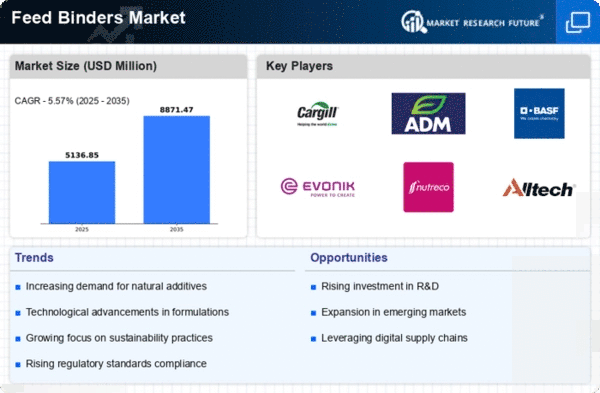
As per MRFR analysis, the Feed Binders Market Size was estimated at 4865.82 USD Million in 2024. The Feed Binders industry is projected to grow from 5192.6 USD Million in 2025 to 8871.47 USD Million by 2035, exhibiting a compound annual growth rate (CAGR) of 5.57 during the forecast period 2025 - 2035.

Key Market Trends & Highlights

The Feed Binders Market is experiencing a dynamic shift towards natural ingredients and innovative technologies.

  • The market is witnessing a notable shift towards natural feed binders, driven by consumer preferences for cleaner labels.
  • Technological advancements in feed formulation are enhancing the efficiency and effectiveness of feed binders, particularly in North America.
  • Asia-Pacific is emerging as the fastest-growing region, with increasing investments in aquaculture and sustainable practices.
  • Rising demand for animal protein and a focus on animal health and welfare are key drivers propelling market growth.

Market Size & Forecast

2024 Market Size 4865.82 (USD Million)
2035 Market Size 8871.47 (USD Million)
CAGR (2025 - 2035) 5.57%
Largest Regional Market Share in 2024 North America

Major Players

<p>Cargill (US), Archer Daniels Midland (US), BASF (DE), Evonik Industries (DE), Nutreco (NL), Alltech (US), Kemin Industries (US), Pancosma (CH), Lallemand (CA)</p>

Market Trends

The Feed Binders Market is currently experiencing a dynamic evolution, driven by various factors that influence the agricultural and livestock sectors. The increasing demand for high-quality animal feed, coupled with the need for improved feed efficiency, appears to be propelling the growth of this market. Feed binders play a crucial role in enhancing the nutritional value of feed, ensuring better digestibility and absorption of nutrients. As livestock producers seek to optimize their operations, the adoption of innovative feed binder solutions is likely to rise, reflecting a shift towards more sustainable and efficient feeding practices. Moreover, the Feed Binders Market seems to be influenced by the growing awareness of animal health and welfare. Stakeholders are increasingly recognizing the importance of using natural and organic binders, which may contribute to the overall well-being of livestock. This trend indicates a potential shift in consumer preferences, as end-users become more discerning about the ingredients in animal feed. Consequently, manufacturers are likely to invest in research and development to create advanced feed binder formulations that align with these evolving market demands, thereby enhancing their competitive edge in the industry.

Shift Towards Natural Ingredients

There is a noticeable trend in the Feed Binders Market towards the use of natural and organic ingredients. This shift is driven by consumer preferences for healthier and more sustainable animal products. As awareness of the benefits of natural feed binders grows, manufacturers are increasingly formulating products that align with these values, potentially enhancing the market's appeal.

Technological Advancements in Feed Formulation

The Feed Binders Market is witnessing significant technological advancements that facilitate improved feed formulation processes. Innovations in binder technology may lead to enhanced nutrient absorption and feed efficiency, which could be crucial for livestock producers aiming to maximize productivity while minimizing waste.

Regulatory Influences on Feed Ingredients

Regulatory frameworks surrounding animal feed ingredients are evolving, impacting the Feed Binders Market. Stricter regulations regarding feed safety and quality may compel manufacturers to adapt their formulations and practices, potentially leading to a more standardized and reliable market environment.

Feed Binders Market Market Drivers

Market Growth Projections

The Global Feed Binders Industry is projected to experience substantial growth, with estimates indicating a market value of 12.5 USD Billion in 2024 and a potential increase to 20.3 USD Billion by 2035. This growth trajectory reflects a compound annual growth rate of 4.51% from 2025 to 2035, driven by various factors including rising demand for animal protein, technological advancements, and regulatory support. The market dynamics suggest a robust future for feed binders, as they play a crucial role in enhancing feed quality and supporting the livestock sector.

Rising Demand for Animal Protein

The Global Feed Binders Industry experiences a notable surge in demand for animal protein, driven by the increasing global population and changing dietary preferences. As consumers shift towards protein-rich diets, livestock production intensifies, necessitating efficient feed formulations. This trend is projected to elevate the market value to approximately 12.5 USD Billion in 2024. Feed binders play a crucial role in enhancing feed quality and digestibility, thereby supporting the growing livestock sector. The need for sustainable and nutritious animal feed further propels the adoption of feed binders, indicating a robust growth trajectory for the industry.

Expansion of Livestock Farming Practices

The expansion of livestock farming practices across various regions contributes to the growth of the Global Feed Binders Industry. As developing economies invest in livestock production to meet rising food demands, the need for efficient feed solutions becomes paramount. Feed binders facilitate the formulation of balanced diets, ensuring that livestock receive essential nutrients for optimal growth. This trend is particularly evident in regions experiencing rapid agricultural development, where the market is poised for substantial growth. The increasing scale of livestock operations underscores the importance of feed binders in supporting sustainable farming practices.

Regulatory Support for Feed Quality Standards

Regulatory frameworks promoting feed quality standards are pivotal for the Global Feed Binders Industry. Governments worldwide are increasingly implementing stringent regulations to ensure the safety and nutritional adequacy of animal feed. Such regulations encourage the use of high-quality feed binders that comply with safety standards, thereby enhancing consumer confidence in animal products. This regulatory support is likely to drive market growth, as manufacturers invest in compliant feed binder solutions. The emphasis on quality assurance aligns with the projected market value of 20.3 USD Billion by 2035, reflecting the industry's adaptation to regulatory demands.

Technological Advancements in Feed Production

Technological innovations in feed production significantly influence the Global Feed Binders Industry. Advanced processing techniques and formulations enhance the efficacy of feed binders, improving their binding properties and nutritional profiles. Innovations such as extrusion and pelleting technologies contribute to better feed efficiency and reduced waste. As the industry embraces these advancements, the market is expected to witness a compound annual growth rate of 4.51% from 2025 to 2035. This growth is indicative of the industry's commitment to optimizing feed production processes, ensuring that feed binders meet the evolving needs of livestock nutrition.

Growing Awareness of Animal Health and Nutrition

The Global Feed Binders Industry is significantly impacted by the rising awareness of animal health and nutrition among livestock producers. As farmers increasingly recognize the importance of high-quality feed in promoting animal well-being and productivity, the demand for effective feed binders escalates. These binders not only improve feed palatability but also enhance nutrient absorption, contributing to healthier livestock. This growing focus on animal health is likely to sustain market growth, as producers seek innovative solutions to optimize feed formulations and ensure the overall health of their animals.

Market Segment Insights

By Application: Animal Feed (Largest) vs. Aquaculture (Fastest-Growing)

<p>In the Feed Binders Market, the application segment is primarily dominated by the Animal Feed category, which holds the largest market share. This segment's significance stems from the increasing demand for high-quality animal nutrition and efficiency in feed production. Following closely, Pet Food also contributes substantially, while Aquaculture emerges as a niche yet rapidly growing segment. The reliance on specific binding agents is critical for enhancing feed quality across diverse applications.</p>

<p>Animal Feed (Dominant) vs. Aquaculture (Emerging)</p>

<p>Within the Feed Binders Market, Animal Feed stands out as the dominant application, driven by the need for livestock to have optimal nutrition for growth and productivity. It is characterized by the use of various binders that improve feed palatability and nutrient delivery. Conversely, Aquaculture is an emerging segment, experiencing growth due to the rising global demand for seafood. This segment utilizes specialized binders to improve growth rates and feed conversion efficiencies in aquatic species. As both segments evolve, innovation in binder formulations will be key to meeting the specific nutritional requirements of both terrestrial and aquatic species.</p>

By Type: Natural Feed Binders (Largest) vs. Synthetic Feed Binders (Fastest-Growing)

<p>In the Feed Binders Market, Natural Feed Binders hold the largest market share, driven by their increasing demand among livestock producers focused on using safe and sustainable additives. These binders are favored for their ability to enhance feed quality and promote animal health. Conversely, Synthetic Feed Binders are witnessing the fastest growth due to advancements in technology and formulation, appealing to manufacturers seeking cost-effective and highly efficient solutions for optimizing animal nutrition and feed stability.</p>

<p>Natural Feed Binders (Dominant) vs. Synthetic Feed Binders (Emerging)</p>

<p>Natural Feed Binders are characterized by their organic composition, including ingredients like gums, starches, and proteins, which are beneficial for animal health and feed palatability. They are seen as a sustainable choice that meets growing consumer demands for natural products. On the other hand, Synthetic Feed Binders offer tailored solutions through advanced chemical formulations, which can improve feed processing and reduce wastage. While Natural Binders dominate in traditional markets, Synthetic Binders are emerging strongly due to their adaptability and efficiency in modern feed manufacturing, capturing interest for their innovative applications.</p>

By Form: Powder (Largest) vs. Pellets (Fastest-Growing)

<p>In the Feed Binders Market, the 'Form' segment showcases a nuanced distribution among its various segment values, namely Powder, Granules, Liquid, and Pellets. Each form appeals to different processing characteristics and end-user requirements. Currently, Powder remains the largest form, leveraged for its solubility and ease of mixing, which caters effectively to feed manufacturers. Conversely, Granules and Liquid forms hold substantial shares, catering to niche demands, but are less dominant compared to Powder. Pellets, although smaller in market share, are gaining traction rapidly due to their efficiency in transportation and feeding processes.</p>

<p>Powder (Dominant) vs. Pellets (Emerging)</p>

<p>Powder is recognized as the dominant form in the Feed Binders Market, primarily due to its versatility and superior blending capabilities with various feed components. Its fine texture allows for seamless incorporation into feed formulations, ensuring consistent distribution of nutrients. On the other hand, Pellets are emerging as a significant force, showing increased popularity among livestock producers for their ease of handling and enhanced feed efficiency. Pelleted forms reduce feed wastage and allow for better nutritional uptake, catering particularly to the burgeoning aquaculture and poultry sectors. As feed technology evolves, Pellets are anticipated to capitalize on these advantages, further solidifying their market position.</p>

By Source: Plant-Based (Largest) vs. Animal-Based (Fastest-Growing)

<p>The Feed Binders Market exhibits diverse sourcing options, with plant-based binders capturing the largest share due to their sustainability and eco-friendly appeal. They leverage natural ingredients such as starches and gums, making them favorable among consumers increasingly aware of environmental impacts. Animal-based binders, while historically significant in this market, have seen a resurgence in interest, especially in regions where meat and dairy products are heavily consumed. Growth trends in the Feed Binders Market are primarily driven by the shift towards sustainable practices in animal feed production. The increasing demand for organic and natural feed among livestock growers is promoting the adoption of plant-based solutions. In contrast, animal-based binders are gaining traction due to their nutritional benefits, thus creating a competitive landscape where both segments are experiencing growth, albeit at different rates.</p>

<p>Plant-Based (Dominant) vs. Animal-Based (Emerging)</p>

<p>Plant-based binders are at the forefront of the Feed Binders Market, characterized by their reliance on renewable resources. They offer significant advantages in terms of biodegradability, appealing to environmentally conscious consumers. With increasing regulations on animal-based products, these binders are becoming essential for producers looking to enhance feed quality while adhering to sustainability standards. In contrast, animal-based binders, while still relevant, are experiencing a renewed interest driven by their performance and nutritional properties. They are largely derived from by-products of the meat and dairy industries, providing essential nutrients that enhance the palatability and digestibility of feeds. The dual focus on plant-based sustainability and the functional attributes of animal-based products illustrates the dynamic nature of this segment.</p>

By Functionality: Binding (Largest) vs. Emulsifying (Fastest-Growing)

<p>In the Feed Binders Market, the functionality segment is characterized by distinct values such as Binding, Thickening, Stabilizing, and Emulsifying. Binding currently holds the largest market share, driven by its essential role in improving feed texture and handling in livestock feed. Emulsifying, while smaller in share, is rapidly gaining traction as it is increasingly adopted in the production of high-performance animal feeds, catering to a market that demands enhanced nutritional profiles.</p>

<p>Binding (Dominant) vs. Emulsifying (Emerging)</p>

<p>Binding, as the dominant value in the Feed Binders Market, plays a crucial role in improving the overall quality and manufacturability of animal feed. It ensures particle cohesion, enhancing feed stability and reducing segregation during storage and handling. In contrast, Emulsifying is an emerging value that is witnessing accelerated growth, driven by innovations in feed formulation. This segment is crucial for creating stable mixtures of fats and oils, thereby enhancing the palatability and digestibility of animal feed. As the industry leans towards more balanced and nutrient-rich formulations, both Binding and Emulsifying are expected to shape the future landscape of the market.</p>

Get more detailed insights about Feed Binders Market Research Report- Forecast till 2035

Regional Insights

North America : Market Leader in Feed Binders

North America is poised to maintain its leadership in the Feed Binders Market, holding a significant market share of $2439.0M in 2024. The region's growth is driven by increasing livestock production, rising demand for high-quality animal feed, and stringent regulations promoting feed safety and quality. Additionally, advancements in feed binder technology and a focus on sustainable practices are further propelling market expansion. The competitive landscape in North America is characterized by the presence of major players such as Cargill, Archer Daniels Midland, and Alltech. These companies are investing in R&D to innovate and enhance product offerings. The U.S. and Canada are the leading countries in this market, supported by robust agricultural sectors and a growing emphasis on animal health and nutrition. This dynamic environment fosters a strong market for feed binders, ensuring continued growth and innovation.

Europe : Emerging Market with Growth Potential

Europe's Feed Binders Market is projected to grow significantly, with a market size of $1450.0M. The region benefits from increasing consumer awareness regarding animal welfare and nutrition, alongside regulatory frameworks that emphasize feed quality and safety. The European Union's stringent regulations on feed additives and sustainability initiatives are key drivers for market growth, encouraging the adoption of innovative feed binder solutions. Leading countries in this market include Germany, France, and the Netherlands, where major players like BASF and Evonik Industries are actively involved. The competitive landscape is marked by collaborations and partnerships aimed at enhancing product offerings. The presence of established companies and a focus on research and development contribute to a vibrant market environment, positioning Europe as a significant player in the global feed binders sector.

Asia-Pacific : Rapid Growth in Feed Binders

The Asia-Pacific region is witnessing rapid growth in the Feed Binders Market, with a market size of $850.0M. This growth is fueled by increasing meat consumption, rising disposable incomes, and a growing awareness of animal nutrition. Additionally, government initiatives aimed at enhancing livestock productivity and food security are acting as catalysts for market expansion. The region's diverse agricultural landscape further supports the demand for effective feed binders. Countries like China, India, and Australia are leading the charge in this market, with key players such as Kemin Industries and Nutreco making significant investments. The competitive landscape is evolving, with a mix of local and international companies striving to capture market share. The focus on sustainable practices and innovative solutions is expected to drive further growth in the Asia-Pacific feed binders market, making it a key area for investment and development.

Middle East and Africa : Emerging Market with Unique Challenges

The Middle East and Africa (MEA) region is gradually emerging in the Feed Binders Market, with a market size of $126.82M. The growth is driven by increasing livestock farming and a rising demand for quality animal feed. However, challenges such as limited infrastructure and varying regulatory standards across countries can hinder market growth. Nevertheless, initiatives to improve agricultural practices and food security are paving the way for future expansion in this sector. Leading countries in the MEA region include South Africa and the UAE, where local players are beginning to establish a foothold. The competitive landscape is characterized by a mix of regional and international companies, with a focus on adapting products to meet local needs. As the market matures, the presence of key players and investment in technology will be crucial for driving growth in the feed binders market.

Key Players and Competitive Insights

The Feed Binders Market is currently characterized by a dynamic competitive landscape, driven by increasing demand for high-quality animal feed and the need for enhanced feed efficiency. Key players such as Cargill (US), Archer Daniels Midland (US), and BASF (DE) are strategically positioned to leverage their extensive research and development capabilities, focusing on innovation and sustainability. These companies are actively pursuing partnerships and acquisitions to enhance their product offerings and expand their market reach, thereby shaping a competitive environment that emphasizes quality and performance.

In terms of business tactics, companies are increasingly localizing manufacturing to reduce costs and optimize supply chains. The market appears moderately fragmented, with several players vying for market share. However, the collective influence of major companies like Evonik Industries (DE) and Nutreco (NL) is notable, as they implement strategies that enhance their operational efficiencies and market presence.

In November 2025, Cargill (US) announced a strategic partnership with a leading biotechnology firm to develop innovative feed binder solutions aimed at improving livestock health and productivity. This collaboration is expected to enhance Cargill's product portfolio and position it as a leader in sustainable feed solutions, reflecting a broader trend towards integrating biotechnology in feed production.

In October 2025, Archer Daniels Midland (US) expanded its production capacity for feed binders in Europe, responding to the growing demand for high-quality animal nutrition products. This expansion not only strengthens ADM's market position but also underscores its commitment to meeting regional needs, thereby enhancing supply chain reliability and customer satisfaction.

In September 2025, BASF (DE) launched a new line of feed binders that utilize advanced polymer technology to improve feed efficiency and reduce waste. This innovation is indicative of the company's focus on sustainability and reflects a growing trend in the industry towards environmentally friendly solutions. Such advancements are likely to attract environmentally conscious consumers and strengthen BASF's competitive edge.

As of December 2025, the Feed Binders Market is witnessing trends such as digitalization and AI integration, which are reshaping competitive dynamics. Strategic alliances are becoming increasingly important, as companies seek to enhance their technological capabilities and market responsiveness. The shift from price-based competition to a focus on innovation, technology, and supply chain reliability is evident, suggesting that future competitive differentiation will hinge on the ability to deliver high-quality, sustainable products that meet evolving consumer demands.

Key Companies in the Feed Binders Market market include

Industry Developments

  • Rising Demand for Animal Protein: Global meat consumption is on the rise, according to the USDA, leading to increased demand for efficient animal feed production. Feed binders play a crucial role in improving feed quality and animal health, contributing to this growth.
  • Focus on Aquaculture: The aquaculture industry is experiencing significant expansion, with fish feed production growing rapidly. Feed binders are essential for maintaining pellet integrity and nutrient availability in fish feed .
  • Mycotoxin Mitigation: Mycotoxins are harmful fungi that can contaminate feed and harm animals. The demand for mycotoxin binders, a specific type of feed binder, is expected to see strong growth as producers look to mitigate these risks
  • Q3 2024: Bentoli announces launch of new natural feed binder to enhance pellet durability Bentoli introduced a new natural feed binder in August 2024, specifically designed to improve pellet durability and reduce feed wastage, targeting the growing demand for sustainable animal nutrition solutions.

Intended Audience

  • Feed binder manufacturers
  • Feed industry
  • Livestock industry
  • Raw material suppliers
  • Retailers and wholesaler
  • Traders, importers, and exporters

The global feed binders market is segmented into the following regions

North America

  • The U.S.
  • Canada
  • Mexico 

Europe

  • Germany
  • France
  • Italy
  • Spain
  • U.K
  • Rest of Europe

Asia Pacific

  • China
  • India
  • Australia
  • Japan
  • Rest of Asia Pacific

Rest of the world

  • Brazil
  • Argentina
  • South Africa
  • Others

The report for global feed binders market of Market Research Future comprises of extensive primary research along with the detailed analysis of qualitative as well as quantitative aspects by various industry experts, key opinion leaders to gain the deeper insight of the market and industry performance. The report gives a clear picture of current market scenario which includes historical and projected market size in terms of value and volume, technological advancement, macroeconomic and governing factors in the market. The report provides detailed information and strategies of the top key players in the industry.

The report also gives a broad study of the different market segments and regions.

Future Outlook

Feed Binders Market Future Outlook

<p>The Feed Binders Market is projected to grow at a 5.57% CAGR from 2024 to 2035, driven by increasing demand for animal nutrition and sustainable feed solutions.</p>

New opportunities lie in:

  • <p>Development of bio-based feed binders to meet sustainability goals.</p>
  • <p>Expansion into emerging markets with tailored product offerings.</p>
  • <p>Investment in R&D for innovative binder formulations enhancing feed efficiency.</p>

<p>By 2035, the Feed Binders Market is expected to achieve robust growth, reflecting evolving industry demands.</p>

Market Segmentation

Feed Binders Market Form Outlook

  • Powder
  • Granules
  • Liquid
  • Pellets

Feed Binders Market Type Outlook

  • Natural Feed Binders
  • Synthetic Feed Binders
  • Organic Feed Binders
  • Inorganic Feed Binders

Feed Binders Market Source Outlook

  • Plant-Based
  • Animal-Based
  • Mineral-Based

Feed Binders Market Application Outlook

  • Animal Feed
  • Pet Food
  • Aquaculture
  • Poultry
  • Ruminants

Feed Binders Market Functionality Outlook

  • Binding
  • Thickening
  • Stabilizing
  • Emulsifying

Report Scope

MARKET SIZE 20244865.82(USD Million)
MARKET SIZE 20255192.6(USD Million)
MARKET SIZE 20358871.47(USD Million)
COMPOUND ANNUAL GROWTH RATE (CAGR)5.57% (2024 - 2035)
REPORT COVERAGERevenue Forecast, Competitive Landscape, Growth Factors, and Trends
BASE YEAR2024
Market Forecast Period2025 - 2035
Historical Data2019 - 2024
Market Forecast UnitsUSD Million
Key Companies ProfiledCargill (US), Archer Daniels Midland (US), BASF (DE), Evonik Industries (DE), Nutreco (NL), Alltech (US), Kemin Industries (US), Pancosma (CH), Lallemand (CA)
Segments CoveredApplication, Type, Form, Source, Functionality
Key Market OpportunitiesGrowing demand for natural feed binders driven by consumer preference for sustainable livestock practices.
Key Market DynamicsRising demand for sustainable feed solutions drives innovation and competition in the feed binders market.
Countries CoveredNorth America, Europe, APAC, South America, MEA

FAQs

At what CAGR is the global feed binders market projected to grow in the forecast period (2025-2035)?

feed binders market is projected to grow at approximately 4.51% CAGR during the assessment period (2025-2035).

Which are the largest segments in the global feed binders market?

On the basis of type, the clay segment and on the basis of livestock, the poultry segment, accounts for the major shares in the global feed binders market.

What are the major tailwinds pushing the growth of the global feed binders market?

Augmenting demand for animal feed products with high protein content led by the growing consumer awareness about the protein content, rising meat consumption, and industrialization of livestock, are major tailwinds pushing the growth of the global feed binders market.

Which region holds the largest share in the global feed binders market?

Asia Pacific holds the largest share in the global feed binders market, followed by North America and Europe, respectively.

Who are the top players in the global feed binders market?

E. I. du Pont de Nemours and Company (U.S.), J.M. Huber Corporation (U.S.), Archer-Daniels-Midland Company (U.S.), CP Kelco U.S., Inc. (U.S.), Roquette Freres S.A. (France), Darling Ingredients Inc. (U.S.), Emsland-Starke GmbH (Germany), Gelita AG (Germany), FMC Corporation (U.S.), and Avebe U.A. (the Netherlands), are some of the top players operating in the global feed binders market.

  1. Research Methodology
  2. Initial Data Exploration
  3. Statistical Modelling and Forecast
  4. Industry Insights and Validation
    1. Data Sources
    2. Feed Binders Market Synopsis, 2024-2032
      1. Business Trends
      2. Product Type Trends
      3. Product Livestock Trends
    3. Industry Segmentation
    4. Industry Size and Forecast
    5. Industry Ecosystem Analysis
    6. Industry Impact forces
      1. Growth Drivers
      2. Industry Pitfalls & Challenges
    7. Growth Potential Analysis
    8. Company Market Share Analysis, 2016
    9. Porter’s Analysis
    10. PESTEL Analysis
    11. Global Feed Binders Market Volume Share by Type, 2024-2032
      1. Gums & Starches
      2. Hydrocolloids
      3. Clay
      4. Gelatin
      5. Molasses
      6. Wheat Gluten
      7. Others
    12. Global Feed Binders Market Volume Share by Livestock, 2020 & 2027
      1. Poultry
      2. Swine
      3. Ruminants
      4. Aquatic
      5. Others
    13. Feed Binders Market Volume Share by Region, 2020 & 2027.
    14. North America
    15. A Market Estimates & Forecast, 2024-2032
    16. B Market Estimates & Forecast, by Type, 2024-2032
    17. C Market Estimates & Forecast, by Livestock, 2024-2032
      1. U.S.
      2. Canada
      3. Mexico
    18. Europe
    19. A Market Estimates & Forecast, 2024-2032
    20. B Market Estimates & Forecast, by Type, 2024-2032
    21. C Market Estimates & Forecast, by Livestock, 2024-2032
      1. Germany
      2. U.K
      3. France
      4. Italy
    22. Asia Pacific
    23. A Market Estimates & Forecast, 2024-2032
    24. B Market Estimates & Forecast, by Type, 2024-2032
    25. C Market Estimates & Forecast, by Livestock, 2024-2032
      1. China
      2. India
      3. Japan
    26. RoW
      1. Market Estimates & Forecast, 2024-2032
      2. Market Estimates & Forecast, by Type, 2024-2032
      3. Market Estimates & Forecast, by Livestock, 2024-2032
    27. E. I. du Pont de Nemours and Company (U.S.)
      1. Business Overview
      2. Financial Data
      3. Product Landscape
      4. Key Developments
      5. Business Strategy
      6. SWOT Analysis
    28. Archer-Daniels-Midland Company (U.S.)
      1. Business Overview
      2. Financial Data
      3. Product Landscape
      4. Key Developments
      5. Business Strategy
      6. SWOT Analysis
    29. J.M. Huber Corporation (U.S.)
      1. Business Overview
      2. Financial Data
      3. Product Landscape
      4. Key Developments
      5. Business Strategy
      6. SWOT Analysis
    30. CP Kelco U.S., Inc. (U.S.)
      1. Business Overview
      2. Financial Data
      3. Product Landscape
      4. Key Developments
      5. Business Strategy
      6. SWOT Analysis
    31. Darling Ingredients Inc. (U.S.)
      1. Business Overview
      2. Financial Data
      3. Product Landscape
      4. Key Developments
      5. Business Strategy
      6. SWOT Analysis
    32. Roquette Freres S.A. (France)
      1. Business Overview
      2. Financial Data
      3. Product Landscape
      4. Key Developments
      5. Business Strategy
      6. SWOT Analysis
    33. Emsland-Starke GmbH (Germany)
      1. Business Overview
      2. Financial Data
      3. Product Landscape
      4. Key Developments
      5. Business Strategy
      6. SWOT Analysis
    34. FMC Corporation (U.S.)
      1. Business Overview
      2. Financial Data
      3. Product Landscape
      4. Key Developments
      5. Business Strategy
      6. SWOT Analysis
    35. Gelita AG (Germany)
      1. Business Overview
      2. Financial Data
      3. Product Landscape
      4. Key Developments
      5. Business Strategy
      6. SWOT Analysis
    36. Avebe U.A. (the Netherlands)
      1. Business Overview
      2. Financial Data
      3. Product Landscape
      4. Key Developments
      5. Business Strategy
      6. SWOT Analysis
  5. PESTLE ANALYSIS – U.S.
  6. PESTLE ANALYSIS- CANADA
  7. PESTLE ANALYSIS- CHINA
  8. PESTLE ANALYSIS- FRANCE
  9. PESTLE ANALYSIS- U.K.
  10. KEY SUPPLIERS OF FEED BINDERS
  11. GLOBAL MARKET FOR FEED BINDERS, BY TYPE, (2024-2032), USD MILLION
  12. GLOBAL MARKET FOR FEED BINDERS, BY LIVESTOCK, (2024-2032), USD MILLION
  13. GLOBAL FEED BINDERS SALES AND GROWTH RATE (2024-2032) USD MILLION
  14. GLOBAL MARKET FOR FEED BINDERS TOP 5 COUNTRIES
  15. GLOBAL MARKET FOR FEED BINDERS TOP COMPANIES-USD MILLION
  16. NORTH AMERICAN MARKET FOR FEED BINDERS, BY TYPE, (2024-2032) USD MILLION
  17. NORTH AMERICAN MARKET FOR FEED BINDERS, BY LIVESTOCK, (2024-2032), USD MILLION
  18. EUROPEAN MARKET FOR FEED BINDERS, BY TYPE, (2024-2032) USD MILLION
  19. EUROPEAN MARKET FOR FEED BINDERS, BY LIVESTOCK, (2024-2032), USD MILLION
  20. APAC MARKET FOR FEED BINDERS, BY TYPE, (2024-2032) USD MILLION
  21. APAC MARKET FOR FEED BINDERS, BY LIVESTOCK, (2024-2032), USD MILLION
  22. REST OF THE WORLD MARKET FOR FEED BINDERS, BY TYPE, (2024-2032) USD MILLION
  23. REST OF THE WORLD MARKET FOR FEED BINDERS, BY LIVESTOCK, (2024-2032), USD MILLION
  24. COMPETITIVE LANDSCAPING BASED ON FINACIALS DURING THE YEAR 2016 
    1. Charts & Figures
  25. LIST OF FIGURES
  26. RESEARCH METHODOLOGY
  27. PRIMARY DATA ANALYSIS APPROACH
  28. SECONDARY DATA ANALYSIS APPROACH
  29. TRENDS IN FEED BINDERS IMPORTS 2020
  30. GROWTH RATE IN FEED BINDERS IMPORTS 2020
  31. FEED BINDERS IMPORTS MARKET SHARE BY TOP 5 IMPORTERS (2020)
  32. TRENDS IN FEED BINDERS EXPORTS 2020
  33. GROWTH RATE FEED BINDERS EXPORTS 2020
  34. FEED BINDERS EXPORTS MARKET SHARE BY TOP 5 EXPORTERS (2020)
  35. VALUE CHAIN ANALYSIS
  36. COST ANALYSIS: FEED BINDERS
  37. PORTER’S FIVE FORCES ANALYSIS
  38. GLOBAL MARKET FOR FEED BINDERS TRENDS BY TYPE
  39. GLOBAL MARKET FOR FEED BINDERS TRENDS BY LIVESTOCK
  40. FINANCIALS

Feed Binders Market Segmentation

Market Segmentation Overview

  • Detailed segmentation data will be available in the full report
  • Comprehensive analysis by multiple parameters
  • Regional and country-level breakdowns
  • Market size forecasts by segment
Infographic

Free Sample Request

Kindly complete the form below to receive a free sample of this Report

Get Free Sample

Customer Strories

Compare Licence

×
Features License Type
Single User Multiuser License Enterprise User
Price $4,950 $5,950 $7,250
Maximum User Access Limit 1 User Upto 10 Users Unrestricted Access Throughout the Organization
Free Customization
Direct Access to Analyst
Deliverable Format
Platform Access
Discount on Next Purchase 10% 15% 15%
Printable Versions