
×
Request Free Sample ×

Kindly complete the form below to receive a free sample of this Report

* Please use a valid business email

Leading companies partner with us for data-driven Insights

clients tt-cursor
Hero Background
English
Chinese
French
Japanese
Korean
German
Spanish

Fast Attack Craft Market Trends

ID: MRFR/AD/3181-HCR
111 Pages
Sejal Akre
February 2026

Fast Attack Craft Market Size, Share, Industry Trend & Analysis Research Report Information By Application (Missile armed FAC and Non-missile armed FAC), by End User (National Defense, Fighting, and Others), and Region (North America, Europe, Asia-Pacific, Middle East and Africa, and Latin America)-Forecast till 2035

Share:
Download PDF ×

We do not share your information with anyone. However, we may send you emails based on your report interest from time to time. You may contact us at any time to opt-out.

Fast Attack Craft Market Infographic
Purchase Options

Market Trends

Key Emerging Trends in the Fast Attack Craft Market

The fast attack craft (FAC) market is changing as naval forces worldwide adjust to new security threats and technology. Littoral warfare, coastal defense, and anti-access/area denial methods depend on these agile vessels. The FAC market is demanding faster, more maneuverable, and more powerful boats. Nations are buying or modernizing fast assault ships to respond quickly to littoral threats. Fast Attack Craft industry developments provide manufacturers and leaders significant chances. This is due to rising maritime security concerns and global demand for fast assault vessels.

The FAC market is being driven by modular and multi-mission capabilities. Modern fast attack craft can carry many mission modules to meet operational needs. This modular architecture lets navies optimize their fleets for anti-surface, anti-submarine, mine countermeasures, and maritime interdiction. Modular design meets the requirement for cost-effective, flexible maritime solutions.

Another fast attack craft development is the use of improved sensor and communication technology. Improved situational awareness, communication, and sensor suites make these vessels successful in littoral conditions. Fast attack vessels can operate effectively in congested coastal seas where the threat environment is dynamic and unexpected thanks to the utilization of radar systems, electronic warfare equipment, and superior navigation systems.

Autonomy and unmanned systems are also influencing fast attack vessels. Unmanned surface vessels (USVs) are enhancing manned fast assault ships. Unmanned systems can undertake reconnaissance, surveillance, and mine countermeasures without endangering humans. The fast attack craft market is likely to integrate more autonomous systems as technology advances, improving operating efficiency and reducing labor needs.

Market developments in the fast attack craft sector are also affected by geopolitics. Nations invest in naval capabilities to defend coastal waterways, protect maritime interests, and govern important areas. The demand for fast assault vessels is particularly strong in areas with contested maritime boundaries as governments want to increase their marine presence and deter prospective rivals. This has promoted fast attack craft acquisition, modernization, and coordination to solve regional security challenges.

The fast attack craft sector is also emphasizing affordability and cost-effectiveness. Nations are seeking cost-effective military options due to financial restrictions. This has evolved to smaller, more nimble boats that balance capabilities and affordability. Modular design, component standardization, and efficient maintenance are stressed to keep fast attack craft cost-effective throughout their operating lives.

Author
Sejal Akre
Senior Research Analyst

She has over 5 years of rich experience, in market research and consulting providing valuable market insights to client. Hands on expertise in management consulting, and extensive knowledge in domain including ICT, Automotive & Transportation and Aerospace & Defense. She is skilled in Go-to market strategy, industry analysis, market sizing, in depth company profiling, competitive intelligence & benchmarking and value chain amongst others.

Leave a Comment

FAQs

What is the current valuation of the Fast Attack Craft Market?

<p>The Fast Attack Craft Market was valued at 3.2 USD Million in 2024.</p>

What is the projected market valuation for the Fast Attack Craft Market in 2035?

<p>The market is projected to reach a valuation of 8.2 USD Million by 2035.</p>

What is the expected CAGR for the Fast Attack Craft Market during the forecast period?

<p>The expected CAGR for the Fast Attack Craft Market from 2025 to 2035 is 8.89%.</p>

Which companies are considered key players in the Fast Attack Craft Market?

<p>Key players include Lockheed Martin, Northrop Grumman, BAE Systems, and ThyssenKrupp Marine Systems.</p>

What are the primary applications of Fast Attack Crafts?

<p>The primary applications include Naval Warfare, Coastal Patrol, Counter-Terrorism, Search and Rescue, and Surveillance.</p>

How does the market segment by end use for Fast Attack Crafts?

The market segments by end use include Military, Paramilitary, Coast Guard, Private Security, and Research Institutions.

What propulsion types are utilized in Fast Attack Crafts?

Propulsion types include Internal Combustion Engine, Gas Turbine, Hybrid Propulsion, Electric Propulsion, and Nuclear Propulsion.

What materials are commonly used in the construction of Fast Attack Crafts?

Common materials include Aluminum, Steel, Composite Materials, Fiberglass, and Carbon Fiber.

How is the Fast Attack Craft Market segmented by size class?

The market is segmented by size class into Small, Medium, Large, Extra Large, and Micro.

What was the valuation of the Naval Warfare segment in 2024?

The Naval Warfare segment was valued at 1.2 USD Million in 2024.

Market Summary

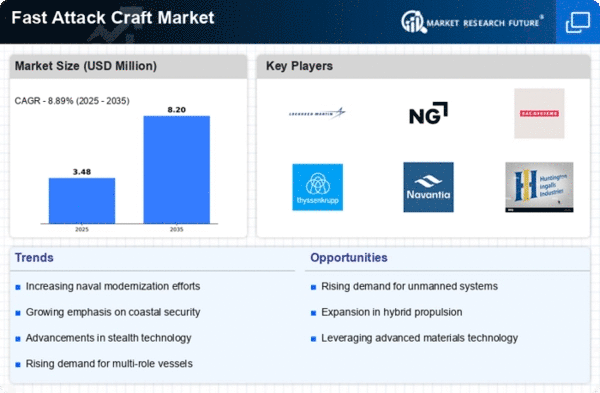
As per MRFR analysis, the Fast Attack Craft Market Size was estimated at 3.2 USD Million in 2024. The Fast Attack Craft industry is projected to grow from 3.5 in 2025 to 8.2 by 2035, exhibiting a compound annual growth rate (CAGR) of 8.89% during the forecast period 2025 - 2035.

Key Market Trends & Highlights

The Fast Attack Craft Market is poised for substantial growth driven by technological advancements and increasing maritime security concerns.

  • Technological advancements are reshaping the capabilities of fast attack crafts, enhancing their operational effectiveness.
  • North America remains the largest market, while the Asia-Pacific region is emerging as the fastest-growing area for fast attack craft.
  • The naval warfare segment dominates the market, whereas the coastal patrol segment is witnessing rapid growth due to evolving security needs.
  • Increasing maritime security concerns and rising defense budgets are key drivers propelling the market forward.

Market Size & Forecast

2024 Market Size 3.2 (USD Million)
2035 Market Size 8.2 (USD Million)
CAGR (2025 - 2035) 8.89%
Largest Regional Market Share in 2024 Asia-Pacific

Major Players

Lockheed Martin (US), Northrop Grumman (US), BAE Systems (GB), ThyssenKrupp Marine Systems (DE), Navantia (ES), Huntington Ingalls Industries (US), Lürssen (DE), Fincantieri (IT), DCNS (FR)

Market Trends

defense

Fast Attack Craft Market Market Drivers

Market Growth Projections

The Global fast attack craft Industry is projected to experience substantial growth over the coming years. With a market value anticipated to reach 12.5 USD Billion in 2024 and further increase to 20.3 USD Billion by 2035, the industry is poised for a robust expansion. This growth trajectory is supported by various factors, including rising defense budgets, technological advancements, and geopolitical tensions. The compound annual growth rate of 4.51% from 2025 to 2035 underscores the increasing demand for fast attack crafts as nations prioritize maritime security and modernize their naval fleets. This upward trend reflects the evolving landscape of naval warfare and the strategic importance of fast attack crafts.

Increasing Naval Defense Budgets

The Global fast attack craft Industry is experiencing a surge in demand due to rising naval defense budgets across various nations. Countries are prioritizing maritime security, leading to increased investments in naval capabilities. For instance, nations like India and the United States have significantly boosted their defense spending, which is projected to reach 12.5 USD Billion in 2024. This trend indicates a growing recognition of the importance of fast attack craft in modern naval warfare, as these vessels provide agility and speed in coastal defense operations. Consequently, the Global Fast Attack Craft Industry is likely to benefit from these enhanced budgets.

Geopolitical Tensions and Maritime Security

The Global Fast Attack Craft Industry is significantly influenced by geopolitical tensions and the need for enhanced maritime security. Ongoing territorial disputes in regions such as the South China Sea and the Arctic have prompted nations to bolster their naval forces. Fast attack crafts play a crucial role in asserting territorial claims and conducting surveillance operations. As nations respond to these challenges, the demand for fast attack crafts is expected to rise, driven by the need for rapid response capabilities. This dynamic environment suggests that the Global Fast Attack Craft Industry will continue to expand in response to evolving security threats.

Technological Advancements in Naval Warfare

Technological innovations are reshaping the Global Fast Attack Craft Industry, enhancing the capabilities of these vessels. Advancements in stealth technology, weapon systems, and communication systems are making fast attack crafts more effective in combat scenarios. For example, the integration of advanced radar and missile systems allows for precision strikes and improved situational awareness. As nations seek to modernize their fleets, the demand for technologically advanced fast attack crafts is expected to rise. This trend is likely to contribute to the market's growth, with projections indicating a market value of 20.3 USD Billion by 2035, reflecting the increasing reliance on sophisticated naval assets.

Emerging Markets and Regional Naval Developments

Emerging markets are playing a pivotal role in the Global Fast Attack Craft Industry, as nations in Asia, the Middle East, and Africa invest in their naval capabilities. Countries such as Vietnam and Saudi Arabia are expanding their fleets, recognizing the strategic importance of fast attack crafts in regional security. This trend is expected to contribute to a compound annual growth rate of 4.51% from 2025 to 2035, as these nations seek to modernize their naval forces. The growing interest in fast attack crafts among emerging economies indicates a shift in global naval dynamics, further propelling the market's expansion.

Growing Demand for Asymmetric Warfare Capabilities

The Global Fast Attack Craft Industry is witnessing an increased focus on asymmetric warfare capabilities, which are essential for modern naval operations. Fast attack crafts are particularly suited for unconventional warfare, allowing smaller nations to challenge larger naval forces effectively. This trend is evident in regions where smaller states are investing in fast attack crafts to enhance their maritime defense strategies. The ability of these vessels to conduct hit-and-run tactics and engage in guerrilla warfare makes them valuable assets. As a result, the market is likely to see sustained growth, driven by the strategic advantages offered by fast attack crafts.

Market Segment Insights

By Application: Naval Warfare (Largest) vs. Search and Rescue (Fastest-Growing)

<p>The Fast Attack Craft Market is significantly shaped by various applications, each with unique contributions to the overall landscape. Among these applications, Naval Warfare stands out as the largest segment, commanding a substantial share. Comparatively, the Search and Rescue segment is emerging as the fastest-growing area, driven by an increasing need for rapid response during emergencies and disasters. Coastal Patrol, Counter-Terrorism, and Surveillance follow as important contributors, evolving to meet the diverse challenges in the maritime domain.</p>

<p>Naval Warfare: Dominant vs. Search and Rescue: Emerging</p>

<p>Naval Warfare remains the dominant application within the Fast Attack Craft Market, characterized by advanced combat capabilities and strategic importance in maritime defense. These vessels are optimized for speed and agility, allowing for quick strike operations against threats. Conversely, the Search and Rescue segment, while emerging, is gaining momentum due to rising maritime activity and heightened awareness of safety and rescue operations. Fast Attack Crafts designed for this purpose are equipped with sonar, medical facilities, and rapid deployment features, making them essential for saving lives at sea. This growing recognition of the need for emergency response capabilities propels Search and Rescue into a prominent position.</p>

By End Use: Military (Largest) vs. Coast Guard (Fastest-Growing)

The Fast Attack Craft Market is segmented into five key end-use categories: Military, Paramilitary, Coast Guard, Private Security, and Research Institutions. Among these, the Military segment commands the largest share, underscoring its critical role in national defense and maritime security. The Coast Guard segment, while smaller, is rapidly expanding, driven by increasing government investments and the need for enhanced coastal patrol capabilities.

Military (Dominant) vs. Coast Guard (Emerging)

The Military segment dominates the Fast Attack Craft Market, primarily due to the sustained focus on enhancing naval capabilities amidst rising geopolitical tensions. Military fast attack crafts are designed for versatility, speed, and maneuverability, making them instrumental in various naval operations. On the other hand, the Coast Guard segment is emerging as a significant player, fueled by a growing emphasis on maritime security and environmental protection. Coast Guard fast attack crafts are tailored for surveillance, law enforcement, and search-and-rescue operations, reflecting their dual role in national security and humanitarian efforts.

By Propulsion Type: Internal Combustion Engine (Largest) vs. Gas Turbine (Fastest-Growing)

<p>The propulsion type segment in the Fast Attack Craft Market is characterized by diverse technologies, with Internal Combustion Engine (ICE) systems holding the largest market share. This dominance is attributed to their reliability, efficiency, and long-standing presence in military operations. Gas Turbines, while less common, have garnered a notable share due to their high power-to-weight ratio and application in modern naval vessels, thus reflecting a growing trend towards this propulsion method. The trend in propulsion technologies indicates a progressive shift towards more advanced systems. Gas Turbines are recognized as the fastest-growing segment, driven by advancements in design and efficiency, making them suitable for high-speed operations and responsive maneuvers. Furthermore, the introduction and integration of Hybrid and Electric Propulsion systems signifies the industry's focus on reducing emissions and achieving greater operational flexibility, reshaping the market landscape.</p>

<p>Gas Turbine (Dominant) vs. Hybrid Propulsion (Emerging)</p>

<p>Gas Turbine propulsion systems currently exhibit dominance in the Fast Attack Craft Market due to their unparalleled speed and agility in naval warfare. Their advanced engineering allows for rapid acceleration and high maneuverability, factors essential for tactical operations. In contrast, Hybrid Propulsion systems represent an emerging segment, offering a blend of traditional and modern technology. These systems are gaining traction due to their operational versatility and reduced environmental impact, making them appealing for future naval contracts. As energy efficiency becomes increasingly relevant, Hybrid systems are gradually being favored for missions requiring stealth and reduced operational costs, enhancing their attractiveness in the competitive market.</p>

By Material Type: Aluminum (Largest) vs. Composite Materials (Fastest-Growing)

<p>The Fast Attack Craft Market shows a multifaceted distribution of material types, with aluminum taking the lead as the largest segment. Renowned for its lightweight yet robust characteristics, aluminum is preferred for many manufacturers looking to enhance speed and agility. Meanwhile, composite materials are emerging with significant momentum, attracting attention due to their advanced properties such as resistance to corrosion and reduced weight. This shift towards composites points to evolving preferences in naval engineering aimed at optimizing performance in challenging maritime conditions. Growth trends within the material type segment are driven by innovations in manufacturing processes and material science. The increasing emphasis on fuel efficiency and sustainability is steering manufacturers toward high-performance composite materials. Additionally, advancements in technology have enabled the production of composites that meet stringent military standards, making them an appealing choice for fast attack crafts. The dynamic interplay between traditional materials like aluminum and modern composites is shaping the future landscape of this market.</p>

<p>Aluminum (Dominant) vs. Steel (Emerging)</p>

<p>Aluminum holds a significant position as the dominant material in the Fast Attack Craft Market, attributed to its favorable strength-to-weight ratio, which significantly enhances speed and operational efficiency. Its resistance to marine corrosion adds to its longevity and reduces maintenance costs, making it a cost-effective choice for naval architecture. Conversely, steel is viewed as an emerging option due to its durability and ease of repair, appealing to military applications where robustness is critical. While it may not provide the same weight advantages as aluminum, innovations in steel technology, such as high-strength variants, are gaining traction. This makes the comparison interesting as both materials vie for market share amidst evolving naval demands.</p>

By Size Class: Small (Largest) vs. Medium (Fastest-Growing)

<p>In the Fast Attack Craft Market, the distribution of size class segments reveals that the Small size class holds the largest market share, owing to its versatility and operational efficiency. Small craft are predominantly utilized in coastal defense and asymmetric warfare, capturing a significant portion of procurement budgets. Meanwhile, the Medium size class is rapidly gaining traction, reflecting a growing inclination towards crafts that balance firepower, maneuverability, and range. This segment is particularly appealing to navies modernizing their fleets and seeking effective solutions for extended operational capabilities.</p>

<p>Small (Dominant) vs. Medium (Emerging)</p>

<p>The Small size class of fast attack crafts is characterized by its agility and ease of deployment, making it a favored choice for patrol and surveillance missions. These crafts are often equipped with advanced weaponry and surveillance systems, enabling them to adapt swiftly to various operational demands. Conversely, the Medium size class represents an emerging segment, steadily rising in popularity due to its enhanced capabilities. Medium crafts typically offer better armament, increased crew capacity, and extended operational range compared to their smaller counterparts, appealing to a broader range of naval operations, including anti-surface and anti-air roles.</p>

Get more detailed insights about Fast Attack Craft Market Research Report Information - Forecast to 2025

Regional Insights

North America : Defense Innovation and Investment

The North American Fast Attack Craft market is poised for growth, driven by increased defense budgets and a focus on naval capabilities. With a market size of $0.64 billion, the region is witnessing a surge in demand for advanced maritime security solutions. Regulatory support and government initiatives are further catalyzing this growth, as nations prioritize modernization of their naval fleets to address emerging threats. The United States leads the North American market, with key players like Lockheed Martin and Northrop Grumman at the forefront. The competitive landscape is characterized by significant investments in R&D and technological advancements. As the region continues to enhance its naval capabilities, partnerships between government and industry are expected to strengthen, ensuring a robust market presence for Fast Attack Craft manufacturers.

Europe : Strategic Naval Developments

Europe's Fast Attack Craft market, valued at $0.96 billion, is experiencing growth driven by geopolitical tensions and the need for enhanced maritime security. Countries are investing in modern naval platforms to safeguard their interests, with a focus on collaborative defense initiatives. Regulatory frameworks are evolving to support innovation and procurement processes, ensuring that European nations remain competitive in the global defense landscape. Leading countries such as the UK, Germany, and France are at the forefront of this market, with key players like BAE Systems and ThyssenKrupp Marine Systems actively participating. The competitive environment is marked by a push for advanced technologies and sustainable solutions. As European nations enhance their naval capabilities, the demand for Fast Attack Craft is expected to rise, supported by strategic partnerships and joint ventures.

Asia-Pacific : Emerging Powerhouse in Defense

The Asia-Pacific region is the largest market for Fast Attack Craft, with a market size of $1.6 billion. This growth is fueled by rising defense expenditures, territorial disputes, and a focus on enhancing naval capabilities. Countries in this region are increasingly investing in advanced maritime technologies, supported by government initiatives aimed at strengthening national security and regional stability. China, India, and Japan are leading the charge in this competitive landscape, with significant contributions from local and international players. Companies like Lürssen and Fincantieri are expanding their presence in the region, capitalizing on the growing demand for advanced naval vessels. The strategic importance of maritime security in Asia-Pacific is driving innovation and collaboration among defense contractors, ensuring a robust market for Fast Attack Craft.

Middle East and Africa : Untapped Potential in Defense

The Middle East and Africa region currently shows minimal activity in the Fast Attack Craft market, with a market size of $0.0 billion. However, there is potential for growth as nations in this region begin to recognize the importance of maritime security. Factors such as geopolitical tensions and the need for enhanced naval capabilities could drive future investments in Fast Attack Craft, supported by government initiatives and international partnerships. Countries like the UAE and South Africa are exploring opportunities to modernize their naval fleets, although the competitive landscape remains underdeveloped. Key players are beginning to take notice of this emerging market, and as regional governments prioritize defense spending, the Fast Attack Craft market may see gradual growth in the coming years. The focus will likely be on building local capabilities and fostering international collaborations.

Key Players and Competitive Insights

The Fast Attack Craft Market is characterized by a dynamic competitive landscape, driven by technological advancements, increasing defense budgets, and the rising need for maritime security. Key players such as Lockheed Martin (US), Northrop Grumman (US), and BAE Systems (GB) are strategically positioned to leverage innovation and partnerships to enhance their operational capabilities. Lockheed Martin (US) focuses on integrating advanced technologies into its craft, while Northrop Grumman (US) emphasizes digital transformation and cybersecurity in its offerings. BAE Systems (GB) is actively pursuing regional expansion and collaborations to strengthen its market presence, collectively shaping a competitive environment that is increasingly reliant on technological prowess and strategic alliances.In terms of business tactics, companies are localizing manufacturing and optimizing supply chains to enhance efficiency and responsiveness to market demands. The market appears moderately fragmented, with several key players exerting influence through strategic initiatives. This structure allows for a diverse range of offerings, catering to various naval requirements across different regions, while also fostering competition that drives innovation.

In November Lockheed Martin (US) announced a partnership with a leading technology firm to develop next-generation combat systems for fast attack craft. This collaboration is poised to enhance the operational capabilities of their vessels, integrating cutting-edge technologies such as artificial intelligence and advanced sensor systems. The strategic importance of this move lies in Lockheed Martin's commitment to maintaining a competitive edge through innovation, which is crucial in an evolving defense landscape.

In October Northrop Grumman (US) secured a contract with a European navy for the supply of advanced fast attack craft, emphasizing its focus on international markets. This contract not only reinforces Northrop Grumman's position in the global market but also highlights the growing demand for sophisticated naval solutions. The strategic significance of this development is underscored by the company's ability to adapt to regional needs while expanding its footprint in Europe, a key area for naval defense.

In September BAE Systems (GB) unveiled a new fast attack craft prototype designed for enhanced stealth and agility. This initiative reflects BAE's commitment to innovation and responsiveness to emerging threats in maritime security. The introduction of this prototype is strategically important as it positions BAE Systems to meet the evolving demands of modern naval warfare, potentially attracting interest from various international clients seeking advanced capabilities.

As of December current competitive trends in the Fast Attack Craft Market are increasingly defined by digitalization, sustainability, and the integration of AI technologies. Strategic alliances are becoming pivotal in shaping the landscape, allowing companies to pool resources and expertise to drive innovation. Looking ahead, competitive differentiation is likely to evolve from traditional price-based competition to a focus on technological advancement, reliability in supply chains, and the ability to deliver innovative solutions that meet the complex demands of modern naval operations.

Key Companies in the Fast Attack Craft Market include

Industry Developments

  • On 29 August 2012, KRIKlewang (model number X3K) was launched by PT Lundin for the Indonesian Navy.

Future Outlook

Fast Attack Craft Market Future Outlook

The Fast Attack Craft Market is projected to grow at an 8.89% CAGR from 2025 to 2035, driven by technological advancements, increasing defense budgets, and rising maritime threats.

New opportunities lie in:

  • Development of advanced stealth technologies for enhanced operational capabilities.
  • Integration of unmanned systems for improved reconnaissance and combat efficiency.
  • Expansion into emerging markets with tailored fast attack craft solutions.

By 2035, the Fast Attack Craft Market is expected to be robust, reflecting substantial growth and innovation.

Market Segmentation

Fast Attack Craft Market Size Outlook

  • Small
  • Medium
  • Large
  • Extra Large

Fast Attack Craft Market End Use Outlook

  • Military
  • Paramilitary
  • Coast Guard
  • Private Security
  • Research Institutions

Fast Attack Craft Market Material Outlook

  • Aluminum
  • Steel
  • Composite Materials
  • Fiberglass

Fast Attack Craft Market Application Outlook

  • Naval Warfare
  • Coastal Patrol
  • Counter-Terrorism
  • Search and Rescue
  • Surveillance

Fast Attack Craft Market Propulsion Type Outlook

  • Internal Combustion Engine
  • Gas Turbine
  • Hybrid Propulsion
  • Electric Propulsion
  • Diesel Engine

Report Scope

MARKET SIZE 2024 3.2(USD Million)
MARKET SIZE 2025 3.5(USD Million)
MARKET SIZE 2035 8.2(USD Million)
COMPOUND ANNUAL GROWTH RATE (CAGR) 8.89% (2025 - 2035)
REPORT COVERAGE Revenue Forecast, Competitive Landscape, Growth Factors, and Trends
BASE YEAR 2024
Market Forecast Period 2025 - 2035
Historical Data 2019 - 2024
Market Forecast Units USD Million
Key Companies Profiled Lockheed Martin (US), Northrop Grumman (US), BAE Systems (GB), ThyssenKrupp Marine Systems (DE), Navantia (ES), Huntington Ingalls Industries (US), Lürssen (DE), Fincantieri (IT), DCNS (FR)
Segments Covered Application, End Use, Propulsion Type, Size, Material
Key Market Opportunities Integration of advanced surveillance systems enhances operational capabilities in the Fast Attack Craft Market.
Key Market Dynamics Rising demand for advanced naval capabilities drives innovation and competition in the Fast Attack Craft Market.
Countries Covered North America, Europe, APAC, South America, MEA

FAQs

What is the current valuation of the Fast Attack Craft Market?

<p>The Fast Attack Craft Market was valued at 3.2 USD Million in 2024.</p>

What is the projected market valuation for the Fast Attack Craft Market in 2035?

<p>The market is projected to reach a valuation of 8.2 USD Million by 2035.</p>

What is the expected CAGR for the Fast Attack Craft Market during the forecast period?

<p>The expected CAGR for the Fast Attack Craft Market from 2025 to 2035 is 8.89%.</p>

Which companies are considered key players in the Fast Attack Craft Market?

<p>Key players include Lockheed Martin, Northrop Grumman, BAE Systems, and ThyssenKrupp Marine Systems.</p>

What are the primary applications of Fast Attack Crafts?

<p>The primary applications include Naval Warfare, Coastal Patrol, Counter-Terrorism, Search and Rescue, and Surveillance.</p>

How does the market segment by end use for Fast Attack Crafts?

The market segments by end use include Military, Paramilitary, Coast Guard, Private Security, and Research Institutions.

What propulsion types are utilized in Fast Attack Crafts?

Propulsion types include Internal Combustion Engine, Gas Turbine, Hybrid Propulsion, Electric Propulsion, and Nuclear Propulsion.

What materials are commonly used in the construction of Fast Attack Crafts?

Common materials include Aluminum, Steel, Composite Materials, Fiberglass, and Carbon Fiber.

How is the Fast Attack Craft Market segmented by size class?

The market is segmented by size class into Small, Medium, Large, Extra Large, and Micro.

What was the valuation of the Naval Warfare segment in 2024?

The Naval Warfare segment was valued at 1.2 USD Million in 2024.

  1. SECTION I: EXECUTIVE SUMMARY AND KEY HIGHLIGHTS
    1. | 1.1 EXECUTIVE SUMMARY
    2. | | 1.1.1 Market Overview
    3. | | 1.1.2 Key Findings
    4. | | 1.1.3 Market Segmentation
    5. | | 1.1.4 Competitive Landscape
    6. | | 1.1.5 Challenges and Opportunities
    7. | | 1.1.6 Future Outlook
  2. SECTION II: SCOPING, METHODOLOGY AND MARKET STRUCTURE
    1. | 2.1 MARKET INTRODUCTION
    2. | | 2.1.1 Definition
    3. | | 2.1.2 Scope of the study
    4. | | | 2.1.2.1 Research Objective
    5. | | | 2.1.2.2 Assumption
    6. | | | 2.1.2.3 Limitations
    7. | 2.2 RESEARCH METHODOLOGY
    8. | | 2.2.1 Overview
    9. | | 2.2.2 Data Mining
    10. | | 2.2.3 Secondary Research
    11. | | 2.2.4 Primary Research
    12. | | | 2.2.4.1 Primary Interviews and Information Gathering Process
    13. | | | 2.2.4.2 Breakdown of Primary Respondents
    14. | | 2.2.5 Forecasting Model
    15. | | 2.2.6 Market Size Estimation
    16. | | | 2.2.6.1 Bottom-Up Approach
    17. | | | 2.2.6.2 Top-Down Approach
    18. | | 2.2.7 Data Triangulation
    19. | | 2.2.8 Validation
  3. SECTION III: QUALITATIVE ANALYSIS
    1. | 3.1 MARKET DYNAMICS
    2. | | 3.1.1 Overview
    3. | | 3.1.2 Drivers
    4. | | 3.1.3 Restraints
    5. | | 3.1.4 Opportunities
    6. | 3.2 MARKET FACTOR ANALYSIS
    7. | | 3.2.1 Value chain Analysis
    8. | | 3.2.2 Porter's Five Forces Analysis
    9. | | | 3.2.2.1 Bargaining Power of Suppliers
    10. | | | 3.2.2.2 Bargaining Power of Buyers
    11. | | | 3.2.2.3 Threat of New Entrants
    12. | | | 3.2.2.4 Threat of Substitutes
    13. | | | 3.2.2.5 Intensity of Rivalry
    14. | | 3.2.3 COVID-19 Impact Analysis
    15. | | | 3.2.3.1 Market Impact Analysis
    16. | | | 3.2.3.2 Regional Impact
    17. | | | 3.2.3.3 Opportunity and Threat Analysis
  4. SECTION IV: QUANTITATIVE ANALYSIS
    1. | 4.1 Aerospace & Defense, BY Application (USD Million)
    2. | | 4.1.1 Naval Warfare
    3. | | 4.1.2 Coastal Patrol
    4. | | 4.1.3 Counter-Terrorism
    5. | | 4.1.4 Search and Rescue
    6. | | 4.1.5 Surveillance
    7. | 4.2 Aerospace & Defense, BY End Use (USD Million)
    8. | | 4.2.1 Military
    9. | | 4.2.2 Paramilitary
    10. | | 4.2.3 Coast Guard
    11. | | 4.2.4 Private Security
    12. | | 4.2.5 Research Institutions
    13. | 4.3 Aerospace & Defense, BY Propulsion Type (USD Million)
    14. | | 4.3.1 Internal Combustion Engine
    15. | | 4.3.2 Gas Turbine
    16. | | 4.3.3 Hybrid Propulsion
    17. | | 4.3.4 Electric Propulsion
    18. | | 4.3.5 Nuclear Propulsion
    19. | 4.4 Aerospace & Defense, BY Material Type (USD Million)
    20. | | 4.4.1 Aluminum
    21. | | 4.4.2 Steel
    22. | | 4.4.3 Composite Materials
    23. | | 4.4.4 Fiberglass
    24. | | 4.4.5 Carbon Fiber
    25. | 4.5 Aerospace & Defense, BY Size Class (USD Million)
    26. | | 4.5.1 Small
    27. | | 4.5.2 Medium
    28. | | 4.5.3 Large
    29. | | 4.5.4 Extra Large
    30. | | 4.5.5 Micro
    31. | 4.6 Aerospace & Defense, BY Region (USD Million)
    32. | | 4.6.1 North America
    33. | | | 4.6.1.1 US
    34. | | | 4.6.1.2 Canada
    35. | | 4.6.2 Europe
    36. | | | 4.6.2.1 Germany
    37. | | | 4.6.2.2 UK
    38. | | | 4.6.2.3 France
    39. | | | 4.6.2.4 Russia
    40. | | | 4.6.2.5 Italy
    41. | | | 4.6.2.6 Spain
    42. | | | 4.6.2.7 Rest of Europe
    43. | | 4.6.3 APAC
    44. | | | 4.6.3.1 China
    45. | | | 4.6.3.2 India
    46. | | | 4.6.3.3 Japan
    47. | | | 4.6.3.4 South Korea
    48. | | | 4.6.3.5 Malaysia
    49. | | | 4.6.3.6 Thailand
    50. | | | 4.6.3.7 Indonesia
    51. | | | 4.6.3.8 Rest of APAC
    52. | | 4.6.4 South America
    53. | | | 4.6.4.1 Brazil
    54. | | | 4.6.4.2 Mexico
    55. | | | 4.6.4.3 Argentina
    56. | | | 4.6.4.4 Rest of South America
    57. | | 4.6.5 MEA
    58. | | | 4.6.5.1 GCC Countries
    59. | | | 4.6.5.2 South Africa
    60. | | | 4.6.5.3 Rest of MEA
  5. SECTION V: COMPETITIVE ANALYSIS
    1. | 5.1 Competitive Landscape
    2. | | 5.1.1 Overview
    3. | | 5.1.2 Competitive Analysis
    4. | | 5.1.3 Market share Analysis
    5. | | 5.1.4 Major Growth Strategy in the Aerospace & Defense
    6. | | 5.1.5 Competitive Benchmarking
    7. | | 5.1.6 Leading Players in Terms of Number of Developments in the Aerospace & Defense
    8. | | 5.1.7 Key developments and growth strategies
    9. | | | 5.1.7.1 New Product Launch/Service Deployment
    10. | | | 5.1.7.2 Merger & Acquisitions
    11. | | | 5.1.7.3 Joint Ventures
    12. | | 5.1.8 Major Players Financial Matrix
    13. | | | 5.1.8.1 Sales and Operating Income
    14. | | | 5.1.8.2 Major Players R&D Expenditure. 2023
    15. | 5.2 Company Profiles
    16. | | 5.2.1 Lockheed Martin (US)
    17. | | | 5.2.1.1 Financial Overview
    18. | | | 5.2.1.2 Products Offered
    19. | | | 5.2.1.3 Key Developments
    20. | | | 5.2.1.4 SWOT Analysis
    21. | | | 5.2.1.5 Key Strategies
    22. | | 5.2.2 Northrop Grumman (US)
    23. | | | 5.2.2.1 Financial Overview
    24. | | | 5.2.2.2 Products Offered
    25. | | | 5.2.2.3 Key Developments
    26. | | | 5.2.2.4 SWOT Analysis
    27. | | | 5.2.2.5 Key Strategies
    28. | | 5.2.3 BAE Systems (GB)
    29. | | | 5.2.3.1 Financial Overview
    30. | | | 5.2.3.2 Products Offered
    31. | | | 5.2.3.3 Key Developments
    32. | | | 5.2.3.4 SWOT Analysis
    33. | | | 5.2.3.5 Key Strategies
    34. | | 5.2.4 ThyssenKrupp Marine Systems (DE)
    35. | | | 5.2.4.1 Financial Overview
    36. | | | 5.2.4.2 Products Offered
    37. | | | 5.2.4.3 Key Developments
    38. | | | 5.2.4.4 SWOT Analysis
    39. | | | 5.2.4.5 Key Strategies
    40. | | 5.2.5 Navantia (ES)
    41. | | | 5.2.5.1 Financial Overview
    42. | | | 5.2.5.2 Products Offered
    43. | | | 5.2.5.3 Key Developments
    44. | | | 5.2.5.4 SWOT Analysis
    45. | | | 5.2.5.5 Key Strategies
    46. | | 5.2.6 Huntington Ingalls Industries (US)
    47. | | | 5.2.6.1 Financial Overview
    48. | | | 5.2.6.2 Products Offered
    49. | | | 5.2.6.3 Key Developments
    50. | | | 5.2.6.4 SWOT Analysis
    51. | | | 5.2.6.5 Key Strategies
    52. | | 5.2.7 Lürssen (DE)
    53. | | | 5.2.7.1 Financial Overview
    54. | | | 5.2.7.2 Products Offered
    55. | | | 5.2.7.3 Key Developments
    56. | | | 5.2.7.4 SWOT Analysis
    57. | | | 5.2.7.5 Key Strategies
    58. | | 5.2.8 Fincantieri (IT)
    59. | | | 5.2.8.1 Financial Overview
    60. | | | 5.2.8.2 Products Offered
    61. | | | 5.2.8.3 Key Developments
    62. | | | 5.2.8.4 SWOT Analysis
    63. | | | 5.2.8.5 Key Strategies
    64. | | 5.2.9 DCNS (FR)
    65. | | | 5.2.9.1 Financial Overview
    66. | | | 5.2.9.2 Products Offered
    67. | | | 5.2.9.3 Key Developments
    68. | | | 5.2.9.4 SWOT Analysis
    69. | | | 5.2.9.5 Key Strategies
    70. | 5.3 Appendix
    71. | | 5.3.1 References
    72. | | 5.3.2 Related Reports
  6. LIST OF FIGURES
    1. | 6.1 MARKET SYNOPSIS
    2. | 6.2 NORTH AMERICA MARKET ANALYSIS
    3. | 6.3 US MARKET ANALYSIS BY APPLICATION
    4. | 6.4 US MARKET ANALYSIS BY END USE
    5. | 6.5 US MARKET ANALYSIS BY PROPULSION TYPE
    6. | 6.6 US MARKET ANALYSIS BY MATERIAL TYPE
    7. | 6.7 US MARKET ANALYSIS BY SIZE CLASS
    8. | 6.8 CANADA MARKET ANALYSIS BY APPLICATION
    9. | 6.9 CANADA MARKET ANALYSIS BY END USE
    10. | 6.10 CANADA MARKET ANALYSIS BY PROPULSION TYPE
    11. | 6.11 CANADA MARKET ANALYSIS BY MATERIAL TYPE
    12. | 6.12 CANADA MARKET ANALYSIS BY SIZE CLASS
    13. | 6.13 EUROPE MARKET ANALYSIS
    14. | 6.14 GERMANY MARKET ANALYSIS BY APPLICATION
    15. | 6.15 GERMANY MARKET ANALYSIS BY END USE
    16. | 6.16 GERMANY MARKET ANALYSIS BY PROPULSION TYPE
    17. | 6.17 GERMANY MARKET ANALYSIS BY MATERIAL TYPE
    18. | 6.18 GERMANY MARKET ANALYSIS BY SIZE CLASS
    19. | 6.19 UK MARKET ANALYSIS BY APPLICATION
    20. | 6.20 UK MARKET ANALYSIS BY END USE
    21. | 6.21 UK MARKET ANALYSIS BY PROPULSION TYPE
    22. | 6.22 UK MARKET ANALYSIS BY MATERIAL TYPE
    23. | 6.23 UK MARKET ANALYSIS BY SIZE CLASS
    24. | 6.24 FRANCE MARKET ANALYSIS BY APPLICATION
    25. | 6.25 FRANCE MARKET ANALYSIS BY END USE
    26. | 6.26 FRANCE MARKET ANALYSIS BY PROPULSION TYPE
    27. | 6.27 FRANCE MARKET ANALYSIS BY MATERIAL TYPE
    28. | 6.28 FRANCE MARKET ANALYSIS BY SIZE CLASS
    29. | 6.29 RUSSIA MARKET ANALYSIS BY APPLICATION
    30. | 6.30 RUSSIA MARKET ANALYSIS BY END USE
    31. | 6.31 RUSSIA MARKET ANALYSIS BY PROPULSION TYPE
    32. | 6.32 RUSSIA MARKET ANALYSIS BY MATERIAL TYPE
    33. | 6.33 RUSSIA MARKET ANALYSIS BY SIZE CLASS
    34. | 6.34 ITALY MARKET ANALYSIS BY APPLICATION
    35. | 6.35 ITALY MARKET ANALYSIS BY END USE
    36. | 6.36 ITALY MARKET ANALYSIS BY PROPULSION TYPE
    37. | 6.37 ITALY MARKET ANALYSIS BY MATERIAL TYPE
    38. | 6.38 ITALY MARKET ANALYSIS BY SIZE CLASS
    39. | 6.39 SPAIN MARKET ANALYSIS BY APPLICATION
    40. | 6.40 SPAIN MARKET ANALYSIS BY END USE
    41. | 6.41 SPAIN MARKET ANALYSIS BY PROPULSION TYPE
    42. | 6.42 SPAIN MARKET ANALYSIS BY MATERIAL TYPE
    43. | 6.43 SPAIN MARKET ANALYSIS BY SIZE CLASS
    44. | 6.44 REST OF EUROPE MARKET ANALYSIS BY APPLICATION
    45. | 6.45 REST OF EUROPE MARKET ANALYSIS BY END USE
    46. | 6.46 REST OF EUROPE MARKET ANALYSIS BY PROPULSION TYPE
    47. | 6.47 REST OF EUROPE MARKET ANALYSIS BY MATERIAL TYPE
    48. | 6.48 REST OF EUROPE MARKET ANALYSIS BY SIZE CLASS
    49. | 6.49 APAC MARKET ANALYSIS
    50. | 6.50 CHINA MARKET ANALYSIS BY APPLICATION
    51. | 6.51 CHINA MARKET ANALYSIS BY END USE
    52. | 6.52 CHINA MARKET ANALYSIS BY PROPULSION TYPE
    53. | 6.53 CHINA MARKET ANALYSIS BY MATERIAL TYPE
    54. | 6.54 CHINA MARKET ANALYSIS BY SIZE CLASS
    55. | 6.55 INDIA MARKET ANALYSIS BY APPLICATION
    56. | 6.56 INDIA MARKET ANALYSIS BY END USE
    57. | 6.57 INDIA MARKET ANALYSIS BY PROPULSION TYPE
    58. | 6.58 INDIA MARKET ANALYSIS BY MATERIAL TYPE
    59. | 6.59 INDIA MARKET ANALYSIS BY SIZE CLASS
    60. | 6.60 JAPAN MARKET ANALYSIS BY APPLICATION
    61. | 6.61 JAPAN MARKET ANALYSIS BY END USE
    62. | 6.62 JAPAN MARKET ANALYSIS BY PROPULSION TYPE
    63. | 6.63 JAPAN MARKET ANALYSIS BY MATERIAL TYPE
    64. | 6.64 JAPAN MARKET ANALYSIS BY SIZE CLASS
    65. | 6.65 SOUTH KOREA MARKET ANALYSIS BY APPLICATION
    66. | 6.66 SOUTH KOREA MARKET ANALYSIS BY END USE
    67. | 6.67 SOUTH KOREA MARKET ANALYSIS BY PROPULSION TYPE
    68. | 6.68 SOUTH KOREA MARKET ANALYSIS BY MATERIAL TYPE
    69. | 6.69 SOUTH KOREA MARKET ANALYSIS BY SIZE CLASS
    70. | 6.70 MALAYSIA MARKET ANALYSIS BY APPLICATION
    71. | 6.71 MALAYSIA MARKET ANALYSIS BY END USE
    72. | 6.72 MALAYSIA MARKET ANALYSIS BY PROPULSION TYPE
    73. | 6.73 MALAYSIA MARKET ANALYSIS BY MATERIAL TYPE
    74. | 6.74 MALAYSIA MARKET ANALYSIS BY SIZE CLASS
    75. | 6.75 THAILAND MARKET ANALYSIS BY APPLICATION
    76. | 6.76 THAILAND MARKET ANALYSIS BY END USE
    77. | 6.77 THAILAND MARKET ANALYSIS BY PROPULSION TYPE
    78. | 6.78 THAILAND MARKET ANALYSIS BY MATERIAL TYPE
    79. | 6.79 THAILAND MARKET ANALYSIS BY SIZE CLASS
    80. | 6.80 INDONESIA MARKET ANALYSIS BY APPLICATION
    81. | 6.81 INDONESIA MARKET ANALYSIS BY END USE
    82. | 6.82 INDONESIA MARKET ANALYSIS BY PROPULSION TYPE
    83. | 6.83 INDONESIA MARKET ANALYSIS BY MATERIAL TYPE
    84. | 6.84 INDONESIA MARKET ANALYSIS BY SIZE CLASS
    85. | 6.85 REST OF APAC MARKET ANALYSIS BY APPLICATION
    86. | 6.86 REST OF APAC MARKET ANALYSIS BY END USE
    87. | 6.87 REST OF APAC MARKET ANALYSIS BY PROPULSION TYPE
    88. | 6.88 REST OF APAC MARKET ANALYSIS BY MATERIAL TYPE
    89. | 6.89 REST OF APAC MARKET ANALYSIS BY SIZE CLASS
    90. | 6.90 SOUTH AMERICA MARKET ANALYSIS
    91. | 6.91 BRAZIL MARKET ANALYSIS BY APPLICATION
    92. | 6.92 BRAZIL MARKET ANALYSIS BY END USE
    93. | 6.93 BRAZIL MARKET ANALYSIS BY PROPULSION TYPE
    94. | 6.94 BRAZIL MARKET ANALYSIS BY MATERIAL TYPE
    95. | 6.95 BRAZIL MARKET ANALYSIS BY SIZE CLASS
    96. | 6.96 MEXICO MARKET ANALYSIS BY APPLICATION
    97. | 6.97 MEXICO MARKET ANALYSIS BY END USE
    98. | 6.98 MEXICO MARKET ANALYSIS BY PROPULSION TYPE
    99. | 6.99 MEXICO MARKET ANALYSIS BY MATERIAL TYPE
    100. | 6.100 MEXICO MARKET ANALYSIS BY SIZE CLASS
    101. | 6.101 ARGENTINA MARKET ANALYSIS BY APPLICATION
    102. | 6.102 ARGENTINA MARKET ANALYSIS BY END USE
    103. | 6.103 ARGENTINA MARKET ANALYSIS BY PROPULSION TYPE
    104. | 6.104 ARGENTINA MARKET ANALYSIS BY MATERIAL TYPE
    105. | 6.105 ARGENTINA MARKET ANALYSIS BY SIZE CLASS
    106. | 6.106 REST OF SOUTH AMERICA MARKET ANALYSIS BY APPLICATION
    107. | 6.107 REST OF SOUTH AMERICA MARKET ANALYSIS BY END USE
    108. | 6.108 REST OF SOUTH AMERICA MARKET ANALYSIS BY PROPULSION TYPE
    109. | 6.109 REST OF SOUTH AMERICA MARKET ANALYSIS BY MATERIAL TYPE
    110. | 6.110 REST OF SOUTH AMERICA MARKET ANALYSIS BY SIZE CLASS
    111. | 6.111 MEA MARKET ANALYSIS
    112. | 6.112 GCC COUNTRIES MARKET ANALYSIS BY APPLICATION
    113. | 6.113 GCC COUNTRIES MARKET ANALYSIS BY END USE
    114. | 6.114 GCC COUNTRIES MARKET ANALYSIS BY PROPULSION TYPE
    115. | 6.115 GCC COUNTRIES MARKET ANALYSIS BY MATERIAL TYPE
    116. | 6.116 GCC COUNTRIES MARKET ANALYSIS BY SIZE CLASS
    117. | 6.117 SOUTH AFRICA MARKET ANALYSIS BY APPLICATION
    118. | 6.118 SOUTH AFRICA MARKET ANALYSIS BY END USE
    119. | 6.119 SOUTH AFRICA MARKET ANALYSIS BY PROPULSION TYPE
    120. | 6.120 SOUTH AFRICA MARKET ANALYSIS BY MATERIAL TYPE
    121. | 6.121 SOUTH AFRICA MARKET ANALYSIS BY SIZE CLASS
    122. | 6.122 REST OF MEA MARKET ANALYSIS BY APPLICATION
    123. | 6.123 REST OF MEA MARKET ANALYSIS BY END USE
    124. | 6.124 REST OF MEA MARKET ANALYSIS BY PROPULSION TYPE
    125. | 6.125 REST OF MEA MARKET ANALYSIS BY MATERIAL TYPE
    126. | 6.126 REST OF MEA MARKET ANALYSIS BY SIZE CLASS
    127. | 6.127 KEY BUYING CRITERIA OF AEROSPACE & DEFENSE
    128. | 6.128 RESEARCH PROCESS OF MRFR
    129. | 6.129 DRO ANALYSIS OF AEROSPACE & DEFENSE
    130. | 6.130 DRIVERS IMPACT ANALYSIS: AEROSPACE & DEFENSE
    131. | 6.131 RESTRAINTS IMPACT ANALYSIS: AEROSPACE & DEFENSE
    132. | 6.132 SUPPLY / VALUE CHAIN: AEROSPACE & DEFENSE
    133. | 6.133 AEROSPACE & DEFENSE, BY APPLICATION, 2024 (% SHARE)
    134. | 6.134 AEROSPACE & DEFENSE, BY APPLICATION, 2024 TO 2035 (USD Million)
    135. | 6.135 AEROSPACE & DEFENSE, BY END USE, 2024 (% SHARE)
    136. | 6.136 AEROSPACE & DEFENSE, BY END USE, 2024 TO 2035 (USD Million)
    137. | 6.137 AEROSPACE & DEFENSE, BY PROPULSION TYPE, 2024 (% SHARE)
    138. | 6.138 AEROSPACE & DEFENSE, BY PROPULSION TYPE, 2024 TO 2035 (USD Million)
    139. | 6.139 AEROSPACE & DEFENSE, BY MATERIAL TYPE, 2024 (% SHARE)
    140. | 6.140 AEROSPACE & DEFENSE, BY MATERIAL TYPE, 2024 TO 2035 (USD Million)
    141. | 6.141 AEROSPACE & DEFENSE, BY SIZE CLASS, 2024 (% SHARE)
    142. | 6.142 AEROSPACE & DEFENSE, BY SIZE CLASS, 2024 TO 2035 (USD Million)
    143. | 6.143 BENCHMARKING OF MAJOR COMPETITORS
  7. LIST OF TABLES
    1. | 7.1 LIST OF ASSUMPTIONS
    2. | | 7.1.1
    3. | 7.2 North America MARKET SIZE ESTIMATES; FORECAST
    4. | | 7.2.1 BY APPLICATION, 2025-2035 (USD Million)
    5. | | 7.2.2 BY END USE, 2025-2035 (USD Million)
    6. | | 7.2.3 BY PROPULSION TYPE, 2025-2035 (USD Million)
    7. | | 7.2.4 BY MATERIAL TYPE, 2025-2035 (USD Million)
    8. | | 7.2.5 BY SIZE CLASS, 2025-2035 (USD Million)
    9. | 7.3 US MARKET SIZE ESTIMATES; FORECAST
    10. | | 7.3.1 BY APPLICATION, 2025-2035 (USD Million)
    11. | | 7.3.2 BY END USE, 2025-2035 (USD Million)
    12. | | 7.3.3 BY PROPULSION TYPE, 2025-2035 (USD Million)
    13. | | 7.3.4 BY MATERIAL TYPE, 2025-2035 (USD Million)
    14. | | 7.3.5 BY SIZE CLASS, 2025-2035 (USD Million)
    15. | 7.4 Canada MARKET SIZE ESTIMATES; FORECAST
    16. | | 7.4.1 BY APPLICATION, 2025-2035 (USD Million)
    17. | | 7.4.2 BY END USE, 2025-2035 (USD Million)
    18. | | 7.4.3 BY PROPULSION TYPE, 2025-2035 (USD Million)
    19. | | 7.4.4 BY MATERIAL TYPE, 2025-2035 (USD Million)
    20. | | 7.4.5 BY SIZE CLASS, 2025-2035 (USD Million)
    21. | 7.5 Europe MARKET SIZE ESTIMATES; FORECAST
    22. | | 7.5.1 BY APPLICATION, 2025-2035 (USD Million)
    23. | | 7.5.2 BY END USE, 2025-2035 (USD Million)
    24. | | 7.5.3 BY PROPULSION TYPE, 2025-2035 (USD Million)
    25. | | 7.5.4 BY MATERIAL TYPE, 2025-2035 (USD Million)
    26. | | 7.5.5 BY SIZE CLASS, 2025-2035 (USD Million)
    27. | 7.6 Germany MARKET SIZE ESTIMATES; FORECAST
    28. | | 7.6.1 BY APPLICATION, 2025-2035 (USD Million)
    29. | | 7.6.2 BY END USE, 2025-2035 (USD Million)
    30. | | 7.6.3 BY PROPULSION TYPE, 2025-2035 (USD Million)
    31. | | 7.6.4 BY MATERIAL TYPE, 2025-2035 (USD Million)
    32. | | 7.6.5 BY SIZE CLASS, 2025-2035 (USD Million)
    33. | 7.7 UK MARKET SIZE ESTIMATES; FORECAST
    34. | | 7.7.1 BY APPLICATION, 2025-2035 (USD Million)
    35. | | 7.7.2 BY END USE, 2025-2035 (USD Million)
    36. | | 7.7.3 BY PROPULSION TYPE, 2025-2035 (USD Million)
    37. | | 7.7.4 BY MATERIAL TYPE, 2025-2035 (USD Million)
    38. | | 7.7.5 BY SIZE CLASS, 2025-2035 (USD Million)
    39. | 7.8 France MARKET SIZE ESTIMATES; FORECAST
    40. | | 7.8.1 BY APPLICATION, 2025-2035 (USD Million)
    41. | | 7.8.2 BY END USE, 2025-2035 (USD Million)
    42. | | 7.8.3 BY PROPULSION TYPE, 2025-2035 (USD Million)
    43. | | 7.8.4 BY MATERIAL TYPE, 2025-2035 (USD Million)
    44. | | 7.8.5 BY SIZE CLASS, 2025-2035 (USD Million)
    45. | 7.9 Russia MARKET SIZE ESTIMATES; FORECAST
    46. | | 7.9.1 BY APPLICATION, 2025-2035 (USD Million)
    47. | | 7.9.2 BY END USE, 2025-2035 (USD Million)
    48. | | 7.9.3 BY PROPULSION TYPE, 2025-2035 (USD Million)
    49. | | 7.9.4 BY MATERIAL TYPE, 2025-2035 (USD Million)
    50. | | 7.9.5 BY SIZE CLASS, 2025-2035 (USD Million)
    51. | 7.10 Italy MARKET SIZE ESTIMATES; FORECAST
    52. | | 7.10.1 BY APPLICATION, 2025-2035 (USD Million)
    53. | | 7.10.2 BY END USE, 2025-2035 (USD Million)
    54. | | 7.10.3 BY PROPULSION TYPE, 2025-2035 (USD Million)
    55. | | 7.10.4 BY MATERIAL TYPE, 2025-2035 (USD Million)
    56. | | 7.10.5 BY SIZE CLASS, 2025-2035 (USD Million)
    57. | 7.11 Spain MARKET SIZE ESTIMATES; FORECAST
    58. | | 7.11.1 BY APPLICATION, 2025-2035 (USD Million)
    59. | | 7.11.2 BY END USE, 2025-2035 (USD Million)
    60. | | 7.11.3 BY PROPULSION TYPE, 2025-2035 (USD Million)
    61. | | 7.11.4 BY MATERIAL TYPE, 2025-2035 (USD Million)
    62. | | 7.11.5 BY SIZE CLASS, 2025-2035 (USD Million)
    63. | 7.12 Rest of Europe MARKET SIZE ESTIMATES; FORECAST
    64. | | 7.12.1 BY APPLICATION, 2025-2035 (USD Million)
    65. | | 7.12.2 BY END USE, 2025-2035 (USD Million)
    66. | | 7.12.3 BY PROPULSION TYPE, 2025-2035 (USD Million)
    67. | | 7.12.4 BY MATERIAL TYPE, 2025-2035 (USD Million)
    68. | | 7.12.5 BY SIZE CLASS, 2025-2035 (USD Million)
    69. | 7.13 APAC MARKET SIZE ESTIMATES; FORECAST
    70. | | 7.13.1 BY APPLICATION, 2025-2035 (USD Million)
    71. | | 7.13.2 BY END USE, 2025-2035 (USD Million)
    72. | | 7.13.3 BY PROPULSION TYPE, 2025-2035 (USD Million)
    73. | | 7.13.4 BY MATERIAL TYPE, 2025-2035 (USD Million)
    74. | | 7.13.5 BY SIZE CLASS, 2025-2035 (USD Million)
    75. | 7.14 China MARKET SIZE ESTIMATES; FORECAST
    76. | | 7.14.1 BY APPLICATION, 2025-2035 (USD Million)
    77. | | 7.14.2 BY END USE, 2025-2035 (USD Million)
    78. | | 7.14.3 BY PROPULSION TYPE, 2025-2035 (USD Million)
    79. | | 7.14.4 BY MATERIAL TYPE, 2025-2035 (USD Million)
    80. | | 7.14.5 BY SIZE CLASS, 2025-2035 (USD Million)
    81. | 7.15 India MARKET SIZE ESTIMATES; FORECAST
    82. | | 7.15.1 BY APPLICATION, 2025-2035 (USD Million)
    83. | | 7.15.2 BY END USE, 2025-2035 (USD Million)
    84. | | 7.15.3 BY PROPULSION TYPE, 2025-2035 (USD Million)
    85. | | 7.15.4 BY MATERIAL TYPE, 2025-2035 (USD Million)
    86. | | 7.15.5 BY SIZE CLASS, 2025-2035 (USD Million)
    87. | 7.16 Japan MARKET SIZE ESTIMATES; FORECAST
    88. | | 7.16.1 BY APPLICATION, 2025-2035 (USD Million)
    89. | | 7.16.2 BY END USE, 2025-2035 (USD Million)
    90. | | 7.16.3 BY PROPULSION TYPE, 2025-2035 (USD Million)
    91. | | 7.16.4 BY MATERIAL TYPE, 2025-2035 (USD Million)
    92. | | 7.16.5 BY SIZE CLASS, 2025-2035 (USD Million)
    93. | 7.17 South Korea MARKET SIZE ESTIMATES; FORECAST
    94. | | 7.17.1 BY APPLICATION, 2025-2035 (USD Million)
    95. | | 7.17.2 BY END USE, 2025-2035 (USD Million)
    96. | | 7.17.3 BY PROPULSION TYPE, 2025-2035 (USD Million)
    97. | | 7.17.4 BY MATERIAL TYPE, 2025-2035 (USD Million)
    98. | | 7.17.5 BY SIZE CLASS, 2025-2035 (USD Million)
    99. | 7.18 Malaysia MARKET SIZE ESTIMATES; FORECAST
    100. | | 7.18.1 BY APPLICATION, 2025-2035 (USD Million)
    101. | | 7.18.2 BY END USE, 2025-2035 (USD Million)
    102. | | 7.18.3 BY PROPULSION TYPE, 2025-2035 (USD Million)
    103. | | 7.18.4 BY MATERIAL TYPE, 2025-2035 (USD Million)
    104. | | 7.18.5 BY SIZE CLASS, 2025-2035 (USD Million)
    105. | 7.19 Thailand MARKET SIZE ESTIMATES; FORECAST
    106. | | 7.19.1 BY APPLICATION, 2025-2035 (USD Million)
    107. | | 7.19.2 BY END USE, 2025-2035 (USD Million)
    108. | | 7.19.3 BY PROPULSION TYPE, 2025-2035 (USD Million)
    109. | | 7.19.4 BY MATERIAL TYPE, 2025-2035 (USD Million)
    110. | | 7.19.5 BY SIZE CLASS, 2025-2035 (USD Million)
    111. | 7.20 Indonesia MARKET SIZE ESTIMATES; FORECAST
    112. | | 7.20.1 BY APPLICATION, 2025-2035 (USD Million)
    113. | | 7.20.2 BY END USE, 2025-2035 (USD Million)
    114. | | 7.20.3 BY PROPULSION TYPE, 2025-2035 (USD Million)
    115. | | 7.20.4 BY MATERIAL TYPE, 2025-2035 (USD Million)
    116. | | 7.20.5 BY SIZE CLASS, 2025-2035 (USD Million)
    117. | 7.21 Rest of APAC MARKET SIZE ESTIMATES; FORECAST
    118. | | 7.21.1 BY APPLICATION, 2025-2035 (USD Million)
    119. | | 7.21.2 BY END USE, 2025-2035 (USD Million)
    120. | | 7.21.3 BY PROPULSION TYPE, 2025-2035 (USD Million)
    121. | | 7.21.4 BY MATERIAL TYPE, 2025-2035 (USD Million)
    122. | | 7.21.5 BY SIZE CLASS, 2025-2035 (USD Million)
    123. | 7.22 South America MARKET SIZE ESTIMATES; FORECAST
    124. | | 7.22.1 BY APPLICATION, 2025-2035 (USD Million)
    125. | | 7.22.2 BY END USE, 2025-2035 (USD Million)
    126. | | 7.22.3 BY PROPULSION TYPE, 2025-2035 (USD Million)
    127. | | 7.22.4 BY MATERIAL TYPE, 2025-2035 (USD Million)
    128. | | 7.22.5 BY SIZE CLASS, 2025-2035 (USD Million)
    129. | 7.23 Brazil MARKET SIZE ESTIMATES; FORECAST
    130. | | 7.23.1 BY APPLICATION, 2025-2035 (USD Million)
    131. | | 7.23.2 BY END USE, 2025-2035 (USD Million)
    132. | | 7.23.3 BY PROPULSION TYPE, 2025-2035 (USD Million)
    133. | | 7.23.4 BY MATERIAL TYPE, 2025-2035 (USD Million)
    134. | | 7.23.5 BY SIZE CLASS, 2025-2035 (USD Million)
    135. | 7.24 Mexico MARKET SIZE ESTIMATES; FORECAST
    136. | | 7.24.1 BY APPLICATION, 2025-2035 (USD Million)
    137. | | 7.24.2 BY END USE, 2025-2035 (USD Million)
    138. | | 7.24.3 BY PROPULSION TYPE, 2025-2035 (USD Million)
    139. | | 7.24.4 BY MATERIAL TYPE, 2025-2035 (USD Million)
    140. | | 7.24.5 BY SIZE CLASS, 2025-2035 (USD Million)
    141. | 7.25 Argentina MARKET SIZE ESTIMATES; FORECAST
    142. | | 7.25.1 BY APPLICATION, 2025-2035 (USD Million)
    143. | | 7.25.2 BY END USE, 2025-2035 (USD Million)
    144. | | 7.25.3 BY PROPULSION TYPE, 2025-2035 (USD Million)
    145. | | 7.25.4 BY MATERIAL TYPE, 2025-2035 (USD Million)
    146. | | 7.25.5 BY SIZE CLASS, 2025-2035 (USD Million)
    147. | 7.26 Rest of South America MARKET SIZE ESTIMATES; FORECAST
    148. | | 7.26.1 BY APPLICATION, 2025-2035 (USD Million)
    149. | | 7.26.2 BY END USE, 2025-2035 (USD Million)
    150. | | 7.26.3 BY PROPULSION TYPE, 2025-2035 (USD Million)
    151. | | 7.26.4 BY MATERIAL TYPE, 2025-2035 (USD Million)
    152. | | 7.26.5 BY SIZE CLASS, 2025-2035 (USD Million)
    153. | 7.27 MEA MARKET SIZE ESTIMATES; FORECAST
    154. | | 7.27.1 BY APPLICATION, 2025-2035 (USD Million)
    155. | | 7.27.2 BY END USE, 2025-2035 (USD Million)
    156. | | 7.27.3 BY PROPULSION TYPE, 2025-2035 (USD Million)
    157. | | 7.27.4 BY MATERIAL TYPE, 2025-2035 (USD Million)
    158. | | 7.27.5 BY SIZE CLASS, 2025-2035 (USD Million)
    159. | 7.28 GCC Countries MARKET SIZE ESTIMATES; FORECAST
    160. | | 7.28.1 BY APPLICATION, 2025-2035 (USD Million)
    161. | | 7.28.2 BY END USE, 2025-2035 (USD Million)
    162. | | 7.28.3 BY PROPULSION TYPE, 2025-2035 (USD Million)
    163. | | 7.28.4 BY MATERIAL TYPE, 2025-2035 (USD Million)
    164. | | 7.28.5 BY SIZE CLASS, 2025-2035 (USD Million)
    165. | 7.29 South Africa MARKET SIZE ESTIMATES; FORECAST
    166. | | 7.29.1 BY APPLICATION, 2025-2035 (USD Million)
    167. | | 7.29.2 BY END USE, 2025-2035 (USD Million)
    168. | | 7.29.3 BY PROPULSION TYPE, 2025-2035 (USD Million)
    169. | | 7.29.4 BY MATERIAL TYPE, 2025-2035 (USD Million)
    170. | | 7.29.5 BY SIZE CLASS, 2025-2035 (USD Million)
    171. | 7.30 Rest of MEA MARKET SIZE ESTIMATES; FORECAST
    172. | | 7.30.1 BY APPLICATION, 2025-2035 (USD Million)
    173. | | 7.30.2 BY END USE, 2025-2035 (USD Million)
    174. | | 7.30.3 BY PROPULSION TYPE, 2025-2035 (USD Million)
    175. | | 7.30.4 BY MATERIAL TYPE, 2025-2035 (USD Million)
    176. | | 7.30.5 BY SIZE CLASS, 2025-2035 (USD Million)
    177. | 7.31 PRODUCT LAUNCH/PRODUCT DEVELOPMENT/APPROVAL
    178. | | 7.31.1
    179. | 7.32 ACQUISITION/PARTNERSHIP
    180. | | 7.32.1

Aerospace & Defense Market Segmentation

Aerospace & Defense By Application (USD Million, 2025-2035)

  • Naval Warfare
  • Coastal Patrol
  • Counter-Terrorism
  • Search and Rescue
  • Surveillance

Aerospace & Defense By End Use (USD Million, 2025-2035)

  • Military
  • Paramilitary
  • Coast Guard
  • Private Security
  • Research Institutions

Aerospace & Defense By Propulsion Type (USD Million, 2025-2035)

  • Internal Combustion Engine
  • Gas Turbine
  • Hybrid Propulsion
  • Electric Propulsion
  • Nuclear Propulsion

Aerospace & Defense By Material Type (USD Million, 2025-2035)

  • Aluminum
  • Steel
  • Composite Materials
  • Fiberglass
  • Carbon Fiber

Aerospace & Defense By Size Class (USD Million, 2025-2035)

  • Small
  • Medium
  • Large
  • Extra Large
  • Micro
Infographic

Free Sample Request

Kindly complete the form below to receive a free sample of this Report

Get Free Sample

Customer Strories

Compare Licence

×
Features License Type
Single User Multiuser License Enterprise User
Price $4,950 $5,950 $7,250
Maximum User Access Limit 1 User Upto 10 Users Unrestricted Access Throughout the Organization
Free Customization
Direct Access to Analyst
Deliverable Format
Platform Access
Discount on Next Purchase 10% 15% 15%
Printable Versions