
×
Request Free Sample ×

Kindly complete the form below to receive a free sample of this Report

* Please use a valid business email

Leading companies partner with us for data-driven Insights

clients tt-cursor
Hero Background
English
Chinese
French
Japanese
Korean
German
Spanish

Far Field Speech and Voice Recognition Market Trends

ID: MRFR/SEM/6492-HCR
111 Pages
Ankit Gupta
February 2026

Far-Field Speech and Voice Recognition Market Size, Share and Research Report By Component (Microphones, Digital Signal Processor, and Software), By Application (In-Vehicle Infotainment Systems, Smart TV, Smart Speakers, Robotics, Smart Thermostats, Smart Lighting, and Others), By Microphone Solution (Signal Microphone, Linear Arrays, and Circular Arrays) And By Region (North America, Europe, Asia-Pacific, And Rest Of The World) –Industry Forecast Till 2035

Share:
Download PDF ×

We do not share your information with anyone. However, we may send you emails based on your report interest from time to time. You may contact us at any time to opt-out.

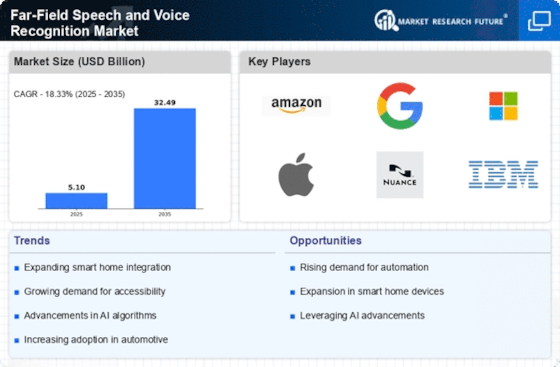
Far Field Speech and Voice Recognition Market Infographic
Purchase Options

Market Trends

Key Emerging Trends in the Far Field Speech and Voice Recognition Market

The Far-Field Speech and Voice Recognition market has witnessed a significant surge in recent years, reflecting the growing integration of voice-activated technologies into various aspects of our daily lives. This market segment is also characterized by the accuracy of devices in capturing and analyzing commands from a long distance, removing direct interaction. A key market trend is far-field voice recognition in smart home devices. Consumers find the convenience of controlling their environment via vocal commands from across a room irresistible and this approach is already being reflected in products ranging from smart speakers to thermostats, home security systems. Another interesting tendency is the development of far-field speech technology beyond traditional smart homes. Advanced voice recognition systems integrated into automobiles allow drivers to manage infotainment system, calling and control several functions inside the car without necessarily holding on hands. This tendency corresponds to the trend observed in the entire industry aimed at improving general customer experience and safety on roads. In addition, the constant development of natural language processing algorithms alongside integration with artificial intelligence has contributed heavily towards perfecting far-field speech and voice recognition traits. These developments improve accuracy and timeliness, leading to a more natural interaction between people using the devices. Consequently, businesses started implementing far-field voice recognition in customer service applications to improve the efficacy and productivity associated with speaking interactions within call centers as well as virtual assistants. Smart appliances and IoT have also powered the growth of far-field speech recognition. A number of voice-controlled functionality is needed for connected appliances used by consumers, from refrigerators to washing machines. This trend is representative of a wider consumer demand for hands-free and natural interfaces, prompting manufacturers to offer far-field voice recognition in an increasing number of products. Other than consumer electronics, the medical field is also trying to capitalize on far-field speech recognition in enhancing patient care. Voice-activated systems are introduced in hospitals and clinics to automate administrative operations, including electronic health records updates and appointment scheduling allowing healthcare providers to spend more time on treating patients. This shows that far-field speech technology is not only used for entertainment and convenience but also in a variety of other applications. Nevertheless, issues that persist in the market include privacy concerns and security risks surrounding voice-activated gadgets. As the adoption of far-field speech and voice recognition technology expands, manufacturers and developers must prioritize robust security measures and transparent data practices to build and maintain user trust.


Author
Ankit Gupta
Team Lead - Research

Ankit Gupta is a seasoned market intelligence and strategic research professional with over six plus years of experience in the ICT and Semiconductor industries. With academic roots in Telecom, Marketing, and Electronics, he blends technical insight with business strategy. Ankit has led 200+ projects, including work for Fortune 500 clients like Microsoft and Rio Tinto, covering market sizing, tech forecasting, and go-to-market strategies. Known for bridging engineering and enterprise decision-making, his insights support growth, innovation, and investment planning across diverse technology markets.

Leave a Comment

FAQs

What is the current valuation of the Far-Field Speech and Voice Recognition Market?

<p>The market valuation stands at 5.1 USD Billion in 2024.</p>

What is the projected market size for the Far-Field Speech and Voice Recognition Market by 2035?

<p>The market is expected to reach 32.49 USD Billion by 2035.</p>

What is the expected CAGR for the Far-Field Speech and Voice Recognition Market during the forecast period?

<p>The market is projected to grow at a CAGR of 18.33% from 2025 to 2035.</p>

Which companies are considered key players in the Far-Field Speech and Voice Recognition Market?

<p>Key players include Amazon, Google, Microsoft, Apple, Nuance Communications, IBM, Sonos, Baidu, and Samsung.</p>

What are the main components contributing to the Far-Field Speech and Voice Recognition Market?

<p>The main components include Microphones, Digital Signal Processors, and Software, with valuations of 9.75, 7.68, and 15.06 USD Billion respectively by 2035.</p>

How do microphone solutions segment the Far-Field Speech and Voice Recognition Market?

<p>Microphone solutions are segmented into Signal Microphones, Linear Arrays, and Circular Arrays, with projected valuations of 12.99, 9.75, and 9.75 USD Billion respectively by 2035.</p>

What applications are driving growth in the Far-Field Speech and Voice Recognition Market?

<p>Key applications include In-Vehicle Infotainment Systems, Smart TVs, Smart Speakers, and Robotics, with projected valuations of 5.25, 4.5, 8.0, and 3.5 USD Billion respectively by 2035.</p>

What role do smart speakers play in the Far-Field Speech and Voice Recognition Market?

Smart speakers are projected to reach a valuation of 8.0 USD Billion by 2035, indicating their significant role in the market.

How does the growth of the Far-Field Speech and Voice Recognition Market compare across different segments?

The market shows varied growth across segments, with Software expected to lead at 15.06 USD Billion by 2035, followed by Microphones and Digital Signal Processors.

What trends are influencing the Far-Field Speech and Voice Recognition Market in 2025?

Trends include advancements in technology and increasing adoption of voice recognition in consumer electronics, which are likely to drive market growth.

Market Summary

As per Market Research Future analysis, the Far-Field Speech and Voice Recognition Market Size was estimated at 5.1 USD Billion in 2024. The Far-Field Speech and Voice Recognition industry is projected to grow from 6.035 USD Billion in 2025 to 32.49 USD Billion by 2035, exhibiting a compound annual growth rate (CAGR) of 18.33% during the forecast period 2025 - 2035

Key Market Trends & Highlights

The Far-Field Speech and Voice Recognition Market is experiencing robust growth driven by technological advancements and increasing consumer demand.

  • The market is witnessing increased adoption in smart home devices, particularly in North America, which remains the largest market. Expansion in automotive applications is notable, especially in the Asia-Pacific region, recognized as the fastest-growing market. There is a growing focus on multilingual capabilities to cater to diverse consumer bases across different regions. Key market drivers include the rising demand for voice-activated assistants and advancements in artificial intelligence, particularly influencing the microphones and digital signal processor segments.

Market Size & Forecast

2024 Market Size 5.1 (USD Billion)
2035 Market Size 32.49 (USD Billion)
CAGR (2025 - 2035) 18.33%
Largest Regional Market Share in 2024 North America

Major Players

Amazon (US), Google (US), Microsoft (US), Apple (US), Nuance Communications (US), IBM (US), Sonos (US), Baidu (CN), Samsung (KR)

Market Trends

The Far-Field Speech and Voice Recognition Market is currently experiencing a transformative phase, driven by advancements in artificial intelligence and machine learning technologies. These innovations enhance the accuracy and efficiency of voice recognition systems, allowing for seamless interaction in various environments. As consumers increasingly adopt smart devices, the demand for far-field capabilities grows, enabling users to engage with technology from a distance. This trend is particularly evident in smart home applications, automotive systems, and personal assistants, where hands-free operation is becoming a standard expectation. Moreover, the integration of voice recognition technology into diverse sectors, such as healthcare, education, and customer service, indicates a broader acceptance of this technology. Organizations are recognizing the potential of voice interfaces to improve user experience and operational efficiency. As the market evolves, challenges related to privacy and data security remain pertinent, prompting stakeholders to prioritize robust security measures. Overall, the Far-Field Speech and Voice Recognition Market appears poised for sustained growth, with ongoing innovations likely to shape its future landscape.

Increased Adoption in Smart Home Devices

The trend towards smart home automation is significantly influencing the Far-Field Speech and Voice Recognition Market. Consumers are increasingly seeking devices that offer hands-free control, leading to a surge in demand for voice-activated systems. This shift not only enhances user convenience but also promotes energy efficiency and security within homes.

Expansion in Automotive Applications

The automotive sector is witnessing a notable integration of far-field voice recognition technologies. As vehicles become more connected, the ability to control navigation, entertainment, and communication systems through voice commands is becoming essential. This trend reflects a growing emphasis on driver safety and user experience.

Focus on Multilingual Capabilities

As globalization continues to shape markets, there is a rising need for multilingual support in voice recognition systems. The Far-Field Speech and Voice Recognition Market is adapting to this demand by developing technologies that can understand and process multiple languages, thereby broadening accessibility and enhancing user engagement.

Far Field Speech and Voice Recognition Market Market Drivers

Integration in Automotive Systems

The integration of far-field speech and voice recognition technology in automotive systems is emerging as a significant driver for the Far-Field Speech and Voice Recognition Market. As vehicles become increasingly connected and automated, the demand for intuitive voice interfaces is rising. Recent statistics indicate that a considerable percentage of new vehicles are being equipped with voice recognition capabilities, allowing drivers to control navigation, music, and communication systems hands-free. This trend not only enhances safety but also improves the overall driving experience. Consequently, the Far-Field Speech and Voice Recognition Market is poised for growth as automotive manufacturers prioritize the incorporation of advanced voice technologies in their vehicles.

Advancements in Artificial Intelligence

Advancements in artificial intelligence (AI) are significantly influencing the Far-Field Speech and Voice Recognition Market. The integration of AI algorithms enhances the ability of voice recognition systems to understand and process natural language, leading to improved user experiences. Recent developments indicate that AI-driven models can achieve higher accuracy rates, even in noisy environments, which is crucial for far-field applications. The market is witnessing a surge in investments aimed at refining these technologies, with projections suggesting a robust growth trajectory. As AI continues to evolve, it is likely to unlock new applications and functionalities within the Far-Field Speech and Voice Recognition Market, further driving adoption across various sectors, including healthcare, automotive, and consumer electronics.

Increased Focus on Accessibility Features

The increased focus on accessibility features is a crucial driver of the Far-Field Speech and Voice Recognition Market. As organizations and developers strive to create inclusive products, the demand for voice recognition technology that accommodates individuals with disabilities is growing. This trend is reflected in various sectors, including education, healthcare, and public services, where voice-activated systems can significantly enhance user interaction. Market analysis indicates that the push for compliance with accessibility standards is prompting companies to invest in far-field speech recognition solutions. As a result, the Far-Field Speech and Voice Recognition Market is likely to expand, driven by the need for technologies that facilitate communication and interaction for all users.

Growth in Voice-Enabled Consumer Electronics

The growth in voice-enabled consumer electronics is a notable driver of the Far-Field Speech and Voice Recognition Market. With the proliferation of smart speakers, televisions, and wearables, consumers are increasingly inclined to utilize voice commands for interaction. Market data suggests that the sales of voice-enabled devices have seen a remarkable increase, indicating a shift in consumer preferences towards hands-free technology. This trend is not only enhancing user convenience but also driving manufacturers to innovate and improve the capabilities of their voice recognition systems. As a result, the Far-Field Speech and Voice Recognition Market is likely to experience sustained growth, as more devices incorporate advanced voice recognition features to meet consumer demands.

Rising Demand for Voice-Activated Assistants

The increasing demand for voice-activated assistants is a primary driver of the Far-Field Speech and Voice Recognition Market. As consumers seek more convenient and hands-free solutions, the integration of voice recognition technology into various devices has surged. According to recent estimates, the market for voice-activated assistants is projected to reach substantial figures, reflecting a compound annual growth rate that underscores the technology's growing acceptance. This trend is particularly evident in smart home devices, where users prefer voice commands for controlling appliances, lighting, and security systems. The Far-Field Speech and Voice Recognition Market is thus positioned to benefit from this shift, as manufacturers strive to enhance the accuracy and responsiveness of their voice recognition systems to meet consumer expectations.

Market Segment Insights

By Component: Microphones (Largest) vs. Digital Signal Processor (Fastest-Growing)

The Far-Field Speech and Voice Recognition Market exhibits a diverse composition in its component segment, prominently featuring Microphones, Digital Signal Processors (DSP), and Software solutions. <a href="https://www.marketresearchfuture.com/reports/microphones-market-12383">Microphones</a> command a significant portion of the market share due to their critical role in capturing audio input, enabling superior speech recognition capabilities in various applications. Meanwhile, Digital Signal Processors are increasingly recognized for their ability to enhance audio data processing, contributing to a shift in competitive dynamics as they grow rapidly in market share.

Microphones (Dominant) vs. Digital Signal Processor (Emerging)

Microphones hold a dominant position in the Far-Field Speech and Voice Recognition Market, primarily due to their essential function in voice acquisition within a wide-ranging field. They are engineered to filter ambient noise and improve clarity, making them integral for applications across consumer electronics, smart home devices, and automotive systems. On the other hand, Digital Signal Processors are emerging as a pivotal technology in the market, driving innovations in sound processing and enabling more efficient voice recognition algorithms. Their rapid adoption is fueled by advancements in machine learning and artificial intelligence, positioning them as vital components in enhancing the accuracy and responsiveness of speech interfaces.

By Microphone Solution: Signal Microphone (Largest) vs. Linear Arrays (Fastest-Growing)

In the Far-Field Speech and Voice Recognition Market, the market share is led by Signal Microphones, which dominate due to their superior ability to capture audio from considerable distances without significant distortion. Linear Arrays follow as a promising segment, increasingly favored in advanced applications that require multiple microphones for refined sound capture and noise reduction. Circular Arrays are also present, but they hold a smaller portion of the market as they are typically used in specific applications rather than mainstream solutions.

Microphone Solutions: Signal Microphone (Dominant) vs. Linear Arrays (Emerging)

Signal Microphones are integral to the Far-Field Speech and Voice Recognition Market, offering robust performance in isolating voice signals even in noisy environments. They are typically preferred in consumer electronics and smart home devices where clear sound capture is essential. In contrast, Linear Arrays are emerging as an innovative solution, designed to enhance sound directionality and accuracy. Their growing adoption in professional audio and conferencing systems showcases their potential in providing immersive sound experiences. As technology progresses, both segments are likely to evolve, with Linear Arrays expected to gain traction due to the trend toward multi-directional audio capture.

By Application: Smart Speakers (Largest) vs. In-Vehicle Infotainment Systems (Fastest-Growing)

The Far-Field Speech and Voice Recognition Market exhibits diverse applications, with Smart Speakers emerging as the largest segment, commanding a significant portion of market share. Following closely, In-Vehicle Infotainment Systems are gaining traction, prompted by the demand for enhanced user experiences in vehicles. Other segments, including Smart TVs and Smart Thermostats, also contribute to the overall market, albeit to a lesser degree. As consumers increasingly integrate voice recognition technologies into their daily lives, these applications are expected to witness varying levels of adoption and growth.

Smart Speakers (Dominant) vs. In-Vehicle Infotainment Systems (Emerging)

Smart Speakers stand at the forefront of the Far-Field Speech and Voice Recognition Market, representing a dominant force characterized by widespread consumer acceptance and continuous innovation in voice technology. Their ability to facilitate seamless interactions through commands has made them a household favorite. In contrast, In-Vehicle Infotainment Systems are emerging rapidly, driven by modernization in automotive technology and consumer demand for integrated voice-activated controls. These systems enhance driving experiences by allowing hands-free, safer operation of functions, thus catering to an increasingly tech-savvy audience. While Smart Speakers capitalize on home automation, In-Vehicle Infotainment Systems are poised to grow significantly as automotive manufacturers adopt advanced voice recognition features.

Get more detailed insights about Far-Field Speech and Voice Recognition Market Research Report - Global Forecast till 2035

Regional Insights

By region, the study provides market insights into North America, Europe, Asia-Pacific, and the Rest of the World. The North American far-field speech and voice recognition market will dominate, owing to the existence of early adopters and key smart speaker providers. The willingness of consumers to accept and use new technologies has also encouraged manufacturers to develop new and advanced products that will boost market growth in this region.

Further, the US far-field speech and voice recognition market held the largest market share, and the Canadian far-field speech and voice recognition market was the fastest-growing market in the North American region.

Further, the major countries studied in the market report are The US, Canada, German, France, the UK, Italy, Spain, China, Japan, India, Australia, South Korea, and Brazil.

Figure 2: Far-Field Speech and Voice Recognition Market SHARE BY REGION 2022 (USD Billion)

Europe's far-field speech and voice recognition market accounts for the second-largest market share due to the increasing deployment of far-field voice recognition systems in smart home devices, and in-vehicle infotainment systems provide major growth opportunities in this region. Further, the German far-field speech and voice recognition market held the largest market share, and the UK far-field speech and voice recognition market was the fastest-growing market in the European region.

The Asia-Pacific far-field speech and voice recognition market is expected to grow at the fastest CAGR from 2023 to 2032. This is due to a surge in the adoption of AI technologies across various industries in this region. Moreover, China’s far-field speech and voice recognition market held the largest market share, and the Indian far-field speech and voice recognition market was the fastest-growing market in the Asia-Pacific region.

Key Players and Competitive Insights

Leading market players are investing heavily in research and development to expand their product lines, which will help the far-field speech and voice recognition market grow even more. Market participants are also undertaking various strategic activities to expand their global footprint, with important market developments including new product launches, contractual agreements, mergers and acquisitions, higher investments, and collaboration with other organizations. To expand and survive in a more competitive and rising market climate, the far-field speech and voice recognition industry must offer cost-effective items.Manufacturing locally to minimize operational costs is one of the key business tactics manufacturers use in the global far-field speech and voice recognition industry to benefit clients and increase the market sector. Major players in the far-field speech and voice recognition market, including Synaptics Incorporated, Texas Incorporated Instruments, Andrea Electronics, Cirrus Logic, Inc., Microsemi, DSP GROUP, Qualcomm Technologies, Inc, Sensory Inc., and others, are attempting to increase market demand by investing in research and development operations.iFlytek Co Ltd is an information technology company that develops speech technology, software, and chip products and services. The company's product portfolio comprises Jarvisen translator, Jingle Magic, a global Chinese learning platform, and an artificial intelligence outbound system. iFlytek provides payment and stolen card inquiries, self-study solutions, and internet system infrastructure solutions. It conducts technological research in speech and languages, machine learning, natural language understanding, machine reasoning, and adaptive learning.

In August iFlytek launched multilingual Al subtitling solutions and translation and transcription services for live and video streams.The solution enabled machine translation between Chinese and 168 languages and speech and voice recognition for 70 languages.RWS Holdings PLC provides intellectual property support services based in the UK. The company's service offerings include life science language services, intellectual property services, consulting services, infrastructure, cloud services, the Internet of Things (IoT), and data services for AI. RWS caters to manufacturing, energy, chemical, media, retail and e-commerce, telecom, managed care, insurance, legal, finance, marketing communications, medical device documentation, automotive and training, and e-learning industries.

In June RWS, the world's leading supplier of technology-enabled language, content management, and intellectual property services, announced a new partnership and the launch of a live subtitling and captioning solution for online meetings and events with CEDAT85, the innovators in speech recognition technology.

Key Companies in the Far Field Speech and Voice Recognition Market include

Industry Developments

  • Q2 2024: Synaptics Launches Triple-Array Far-Field Voice Solution for Smart Home Devices Synaptics announced the launch of a new triple-microphone far-field voice solution designed to improve voice recognition accuracy in smart home devices, targeting OEMs in the consumer electronics sector.
  • Q2 2024: Knowles Corporation Expands Far-Field Voice Processing Portfolio with New AI-Enabled Audio Processor Knowles Corporation introduced a new AI-enabled audio processor aimed at enhancing far-field voice recognition in automotive and smart speaker applications.
  • Q3 2024: Alango Technologies Announces Partnership with DSP Group to Advance Far-Field Voice Solutions Alango Technologies and DSP Group entered a partnership to jointly develop advanced far-field voice processing solutions for integration into next-generation smart devices.
  • Q3 2024: Vesper Technologies Raises $18 Million Series C to Accelerate MEMS Microphone Innovation Vesper Technologies secured $18 million in Series C funding to expand its MEMS microphone product line, with a focus on far-field voice recognition applications in consumer electronics.
  • Q4 2024: Sensory Inc. Launches TrulyHandsfree 7.0 with Enhanced Far-Field Voice Capabilities Sensory Inc. released TrulyHandsfree 7.0, the latest version of its wake word and speech recognition platform, featuring improved far-field performance for use in smart home and automotive devices.
  • Q4 2024: Fortemedia Unveils New Far-Field Voice Processor for Automotive Infotainment Systems Fortemedia launched a new far-field voice processor designed specifically for automotive infotainment systems, aiming to improve voice command accuracy in noisy environments.
  • Q1 2025: Matrix Labs Announces Strategic Partnership with Meeami Technologies for Far-Field Voice Solutions Matrix Labs and Meeami Technologies formed a strategic partnership to co-develop far-field voice recognition modules for integration into smart speakers and conferencing systems.
  • Q1 2025: Andrea Electronics Appoints New CEO to Drive Growth in Far-Field Voice Recognition Market Andrea Electronics announced the appointment of a new CEO, with a mandate to expand the company's presence in the far-field voice recognition sector.
  • Q2 2025: VOCAL Technologies Launches Far-Field Voice SDK for Embedded Systems VOCAL Technologies introduced a new software development kit (SDK) enabling far-field voice recognition capabilities for embedded system developers.
  • Q2 2025: Microsemi Corporation Debuts Secure Far-Field Voice Platform for Enterprise Conferencing Microsemi Corporation launched a secure far-field voice recognition platform tailored for enterprise conferencing solutions, emphasizing privacy and data protection.

Future Outlook

Far Field Speech and Voice Recognition Market Future Outlook

The Far-Field Speech and Voice Recognition Market is projected to grow at an 18.33% CAGR from 2025 to 2035, driven by advancements in AI, increased demand for smart devices, and enhanced user experience.

New opportunities lie in:

  • Integration of voice recognition in automotive systems for hands-free operation.</p><p>Development of customized voice assistants for healthcare applications.</p><p>Expansion of voice-controlled smart home devices to enhance user convenience.

By 2035, the market is expected to be robust, reflecting substantial growth and innovation.

Market Segmentation

Far Field Speech and Voice Recognition Market Component Outlook

  • Microphones
  • Digital Signal Processor
  • Software

Far Field Speech and Voice Recognition Market Application Outlook

  • In-Vehicle Infotainment Systems
  • Smart TV
  • Smart Speakers
  • Robotics
  • Smart Thermostats
  • Smart Lighting
  • Others

Far Field Speech and Voice Recognition Market Microphone Solution Outlook

  • Signal Microphone
  • Linear Arrays
  • Circular Arrays

Report Scope

MARKET SIZE 2024 5.1(USD Billion)
MARKET SIZE 2025 6.035(USD Billion)
MARKET SIZE 2035 32.49(USD Billion)
COMPOUND ANNUAL GROWTH RATE (CAGR) 18.33% (2025 - 2035)
REPORT COVERAGE Revenue Forecast, Competitive Landscape, Growth Factors, and Trends
BASE YEAR 2024
Market Forecast Period 2025 - 2035
Historical Data 2019 - 2024
Market Forecast Units USD Billion
Key Companies Profiled Amazon (US), Google (US), Microsoft (US), Apple (US), Nuance Communications (US), IBM (US), Sonos (US), Baidu (CN), Samsung (KR)
Segments Covered Component, Application, Microphone Solution, Region
Key Market Opportunities Integration of artificial intelligence enhances accuracy and user experience in the Far-Field Speech and Voice Recognition Market.
Key Market Dynamics Rising demand for smart home devices drives innovation in far-field speech and voice recognition technologies.
Countries Covered North America, Europe, APAC, South America, MEA

FAQs

What is the current valuation of the Far-Field Speech and Voice Recognition Market?

<p>The market valuation stands at 5.1 USD Billion in 2024.</p>

What is the projected market size for the Far-Field Speech and Voice Recognition Market by 2035?

<p>The market is expected to reach 32.49 USD Billion by 2035.</p>

What is the expected CAGR for the Far-Field Speech and Voice Recognition Market during the forecast period?

<p>The market is projected to grow at a CAGR of 18.33% from 2025 to 2035.</p>

Which companies are considered key players in the Far-Field Speech and Voice Recognition Market?

<p>Key players include Amazon, Google, Microsoft, Apple, Nuance Communications, IBM, Sonos, Baidu, and Samsung.</p>

What are the main components contributing to the Far-Field Speech and Voice Recognition Market?

<p>The main components include Microphones, Digital Signal Processors, and Software, with valuations of 9.75, 7.68, and 15.06 USD Billion respectively by 2035.</p>

How do microphone solutions segment the Far-Field Speech and Voice Recognition Market?

<p>Microphone solutions are segmented into Signal Microphones, Linear Arrays, and Circular Arrays, with projected valuations of 12.99, 9.75, and 9.75 USD Billion respectively by 2035.</p>

What applications are driving growth in the Far-Field Speech and Voice Recognition Market?

<p>Key applications include In-Vehicle Infotainment Systems, Smart TVs, Smart Speakers, and Robotics, with projected valuations of 5.25, 4.5, 8.0, and 3.5 USD Billion respectively by 2035.</p>

What role do smart speakers play in the Far-Field Speech and Voice Recognition Market?

Smart speakers are projected to reach a valuation of 8.0 USD Billion by 2035, indicating their significant role in the market.

How does the growth of the Far-Field Speech and Voice Recognition Market compare across different segments?

The market shows varied growth across segments, with Software expected to lead at 15.06 USD Billion by 2035, followed by Microphones and Digital Signal Processors.

What trends are influencing the Far-Field Speech and Voice Recognition Market in 2025?

Trends include advancements in technology and increasing adoption of voice recognition in consumer electronics, which are likely to drive market growth.

  1. SECTION I: EXECUTIVE SUMMARY AND KEY HIGHLIGHTS
    1. | 1.1 EXECUTIVE SUMMARY
    2. | | 1.1.1 Market Overview
    3. | | 1.1.2 Key Findings
    4. | | 1.1.3 Market Segmentation
    5. | | 1.1.4 Competitive Landscape
    6. | | 1.1.5 Challenges and Opportunities
    7. | | 1.1.6 Future Outlook
  2. SECTION II: SCOPING, METHODOLOGY AND MARKET STRUCTURE
    1. | 2.1 MARKET INTRODUCTION
    2. | | 2.1.1 Definition
    3. | | 2.1.2 Scope of the study
    4. | | | 2.1.2.1 Research Objective
    5. | | | 2.1.2.2 Assumption
    6. | | | 2.1.2.3 Limitations
    7. | 2.2 RESEARCH METHODOLOGY
    8. | | 2.2.1 Overview
    9. | | 2.2.2 Data Mining
    10. | | 2.2.3 Secondary Research
    11. | | 2.2.4 Primary Research
    12. | | | 2.2.4.1 Primary Interviews and Information Gathering Process
    13. | | | 2.2.4.2 Breakdown of Primary Respondents
    14. | | 2.2.5 Forecasting Model
    15. | | 2.2.6 Market Size Estimation
    16. | | | 2.2.6.1 Bottom-Up Approach
    17. | | | 2.2.6.2 Top-Down Approach
    18. | | 2.2.7 Data Triangulation
    19. | | 2.2.8 Validation
  3. SECTION III: QUALITATIVE ANALYSIS
    1. | 3.1 MARKET DYNAMICS
    2. | | 3.1.1 Overview
    3. | | 3.1.2 Drivers
    4. | | 3.1.3 Restraints
    5. | | 3.1.4 Opportunities
    6. | 3.2 MARKET FACTOR ANALYSIS
    7. | | 3.2.1 Value chain Analysis
    8. | | 3.2.2 Porter's Five Forces Analysis
    9. | | | 3.2.2.1 Bargaining Power of Suppliers
    10. | | | 3.2.2.2 Bargaining Power of Buyers
    11. | | | 3.2.2.3 Threat of New Entrants
    12. | | | 3.2.2.4 Threat of Substitutes
    13. | | | 3.2.2.5 Intensity of Rivalry
    14. | | 3.2.3 COVID-19 Impact Analysis
    15. | | | 3.2.3.1 Market Impact Analysis
    16. | | | 3.2.3.2 Regional Impact
    17. | | | 3.2.3.3 Opportunity and Threat Analysis
  4. SECTION IV: QUANTITATIVE ANALYSIS
    1. | 4.1 Semiconductor & Electronics, BY Component (USD Billion)
    2. | | 4.1.1 Microphones
    3. | | 4.1.2 Digital Signal Processor
    4. | | 4.1.3 Software
    5. | 4.2 Semiconductor & Electronics, BY Microphone Solution (USD Billion)
    6. | | 4.2.1 Signal Microphone
    7. | | 4.2.2 Linear Arrays
    8. | | 4.2.3 Circular Arrays
    9. | 4.3 Semiconductor & Electronics, BY Application (USD Billion)
    10. | | 4.3.1 In-Vehicle Infotainment Systems
    11. | | 4.3.2 Smart TV
    12. | | 4.3.3 Smart Speakers
    13. | | 4.3.4 Robotics
    14. | | 4.3.5 Smart Thermostats
    15. | | 4.3.6 Smart Lighting
    16. | | 4.3.7 Others
    17. | 4.4 Semiconductor & Electronics, BY Region (USD Billion)
    18. | | 4.4.1 North America
    19. | | | 4.4.1.1 US
    20. | | | 4.4.1.2 Canada
    21. | | 4.4.2 Europe
    22. | | | 4.4.2.1 Germany
    23. | | | 4.4.2.2 UK
    24. | | | 4.4.2.3 France
    25. | | | 4.4.2.4 Russia
    26. | | | 4.4.2.5 Italy
    27. | | | 4.4.2.6 Spain
    28. | | | 4.4.2.7 Rest of Europe
    29. | | 4.4.3 APAC
    30. | | | 4.4.3.1 China
    31. | | | 4.4.3.2 India
    32. | | | 4.4.3.3 Japan
    33. | | | 4.4.3.4 South Korea
    34. | | | 4.4.3.5 Malaysia
    35. | | | 4.4.3.6 Thailand
    36. | | | 4.4.3.7 Indonesia
    37. | | | 4.4.3.8 Rest of APAC
    38. | | 4.4.4 South America
    39. | | | 4.4.4.1 Brazil
    40. | | | 4.4.4.2 Mexico
    41. | | | 4.4.4.3 Argentina
    42. | | | 4.4.4.4 Rest of South America
    43. | | 4.4.5 MEA
    44. | | | 4.4.5.1 GCC Countries
    45. | | | 4.4.5.2 South Africa
    46. | | | 4.4.5.3 Rest of MEA
  5. SECTION V: COMPETITIVE ANALYSIS
    1. | 5.1 Competitive Landscape
    2. | | 5.1.1 Overview
    3. | | 5.1.2 Competitive Analysis
    4. | | 5.1.3 Market share Analysis
    5. | | 5.1.4 Major Growth Strategy in the Semiconductor & Electronics
    6. | | 5.1.5 Competitive Benchmarking
    7. | | 5.1.6 Leading Players in Terms of Number of Developments in the Semiconductor & Electronics
    8. | | 5.1.7 Key developments and growth strategies
    9. | | | 5.1.7.1 New Product Launch/Service Deployment
    10. | | | 5.1.7.2 Merger & Acquisitions
    11. | | | 5.1.7.3 Joint Ventures
    12. | | 5.1.8 Major Players Financial Matrix
    13. | | | 5.1.8.1 Sales and Operating Income
    14. | | | 5.1.8.2 Major Players R&D Expenditure. 2023
    15. | 5.2 Company Profiles
    16. | | 5.2.1 Amazon (US)
    17. | | | 5.2.1.1 Financial Overview
    18. | | | 5.2.1.2 Products Offered
    19. | | | 5.2.1.3 Key Developments
    20. | | | 5.2.1.4 SWOT Analysis
    21. | | | 5.2.1.5 Key Strategies
    22. | | 5.2.2 Google (US)
    23. | | | 5.2.2.1 Financial Overview
    24. | | | 5.2.2.2 Products Offered
    25. | | | 5.2.2.3 Key Developments
    26. | | | 5.2.2.4 SWOT Analysis
    27. | | | 5.2.2.5 Key Strategies
    28. | | 5.2.3 Microsoft (US)
    29. | | | 5.2.3.1 Financial Overview
    30. | | | 5.2.3.2 Products Offered
    31. | | | 5.2.3.3 Key Developments
    32. | | | 5.2.3.4 SWOT Analysis
    33. | | | 5.2.3.5 Key Strategies
    34. | | 5.2.4 Apple (US)
    35. | | | 5.2.4.1 Financial Overview
    36. | | | 5.2.4.2 Products Offered
    37. | | | 5.2.4.3 Key Developments
    38. | | | 5.2.4.4 SWOT Analysis
    39. | | | 5.2.4.5 Key Strategies
    40. | | 5.2.5 Nuance Communications (US)
    41. | | | 5.2.5.1 Financial Overview
    42. | | | 5.2.5.2 Products Offered
    43. | | | 5.2.5.3 Key Developments
    44. | | | 5.2.5.4 SWOT Analysis
    45. | | | 5.2.5.5 Key Strategies
    46. | | 5.2.6 IBM (US)
    47. | | | 5.2.6.1 Financial Overview
    48. | | | 5.2.6.2 Products Offered
    49. | | | 5.2.6.3 Key Developments
    50. | | | 5.2.6.4 SWOT Analysis
    51. | | | 5.2.6.5 Key Strategies
    52. | | 5.2.7 Sonos (US)
    53. | | | 5.2.7.1 Financial Overview
    54. | | | 5.2.7.2 Products Offered
    55. | | | 5.2.7.3 Key Developments
    56. | | | 5.2.7.4 SWOT Analysis
    57. | | | 5.2.7.5 Key Strategies
    58. | | 5.2.8 Baidu (CN)
    59. | | | 5.2.8.1 Financial Overview
    60. | | | 5.2.8.2 Products Offered
    61. | | | 5.2.8.3 Key Developments
    62. | | | 5.2.8.4 SWOT Analysis
    63. | | | 5.2.8.5 Key Strategies
    64. | | 5.2.9 Samsung (KR)
    65. | | | 5.2.9.1 Financial Overview
    66. | | | 5.2.9.2 Products Offered
    67. | | | 5.2.9.3 Key Developments
    68. | | | 5.2.9.4 SWOT Analysis
    69. | | | 5.2.9.5 Key Strategies
    70. | 5.3 Appendix
    71. | | 5.3.1 References
    72. | | 5.3.2 Related Reports
  6. LIST OF FIGURES
    1. | 6.1 MARKET SYNOPSIS
    2. | 6.2 NORTH AMERICA MARKET ANALYSIS
    3. | 6.3 US MARKET ANALYSIS BY COMPONENT
    4. | 6.4 US MARKET ANALYSIS BY MICROPHONE SOLUTION
    5. | 6.5 US MARKET ANALYSIS BY APPLICATION
    6. | 6.6 CANADA MARKET ANALYSIS BY COMPONENT
    7. | 6.7 CANADA MARKET ANALYSIS BY MICROPHONE SOLUTION
    8. | 6.8 CANADA MARKET ANALYSIS BY APPLICATION
    9. | 6.9 EUROPE MARKET ANALYSIS
    10. | 6.10 GERMANY MARKET ANALYSIS BY COMPONENT
    11. | 6.11 GERMANY MARKET ANALYSIS BY MICROPHONE SOLUTION
    12. | 6.12 GERMANY MARKET ANALYSIS BY APPLICATION
    13. | 6.13 UK MARKET ANALYSIS BY COMPONENT
    14. | 6.14 UK MARKET ANALYSIS BY MICROPHONE SOLUTION
    15. | 6.15 UK MARKET ANALYSIS BY APPLICATION
    16. | 6.16 FRANCE MARKET ANALYSIS BY COMPONENT
    17. | 6.17 FRANCE MARKET ANALYSIS BY MICROPHONE SOLUTION
    18. | 6.18 FRANCE MARKET ANALYSIS BY APPLICATION
    19. | 6.19 RUSSIA MARKET ANALYSIS BY COMPONENT
    20. | 6.20 RUSSIA MARKET ANALYSIS BY MICROPHONE SOLUTION
    21. | 6.21 RUSSIA MARKET ANALYSIS BY APPLICATION
    22. | 6.22 ITALY MARKET ANALYSIS BY COMPONENT
    23. | 6.23 ITALY MARKET ANALYSIS BY MICROPHONE SOLUTION
    24. | 6.24 ITALY MARKET ANALYSIS BY APPLICATION
    25. | 6.25 SPAIN MARKET ANALYSIS BY COMPONENT
    26. | 6.26 SPAIN MARKET ANALYSIS BY MICROPHONE SOLUTION
    27. | 6.27 SPAIN MARKET ANALYSIS BY APPLICATION
    28. | 6.28 REST OF EUROPE MARKET ANALYSIS BY COMPONENT
    29. | 6.29 REST OF EUROPE MARKET ANALYSIS BY MICROPHONE SOLUTION
    30. | 6.30 REST OF EUROPE MARKET ANALYSIS BY APPLICATION
    31. | 6.31 APAC MARKET ANALYSIS
    32. | 6.32 CHINA MARKET ANALYSIS BY COMPONENT
    33. | 6.33 CHINA MARKET ANALYSIS BY MICROPHONE SOLUTION
    34. | 6.34 CHINA MARKET ANALYSIS BY APPLICATION
    35. | 6.35 INDIA MARKET ANALYSIS BY COMPONENT
    36. | 6.36 INDIA MARKET ANALYSIS BY MICROPHONE SOLUTION
    37. | 6.37 INDIA MARKET ANALYSIS BY APPLICATION
    38. | 6.38 JAPAN MARKET ANALYSIS BY COMPONENT
    39. | 6.39 JAPAN MARKET ANALYSIS BY MICROPHONE SOLUTION
    40. | 6.40 JAPAN MARKET ANALYSIS BY APPLICATION
    41. | 6.41 SOUTH KOREA MARKET ANALYSIS BY COMPONENT
    42. | 6.42 SOUTH KOREA MARKET ANALYSIS BY MICROPHONE SOLUTION
    43. | 6.43 SOUTH KOREA MARKET ANALYSIS BY APPLICATION
    44. | 6.44 MALAYSIA MARKET ANALYSIS BY COMPONENT
    45. | 6.45 MALAYSIA MARKET ANALYSIS BY MICROPHONE SOLUTION
    46. | 6.46 MALAYSIA MARKET ANALYSIS BY APPLICATION
    47. | 6.47 THAILAND MARKET ANALYSIS BY COMPONENT
    48. | 6.48 THAILAND MARKET ANALYSIS BY MICROPHONE SOLUTION
    49. | 6.49 THAILAND MARKET ANALYSIS BY APPLICATION
    50. | 6.50 INDONESIA MARKET ANALYSIS BY COMPONENT
    51. | 6.51 INDONESIA MARKET ANALYSIS BY MICROPHONE SOLUTION
    52. | 6.52 INDONESIA MARKET ANALYSIS BY APPLICATION
    53. | 6.53 REST OF APAC MARKET ANALYSIS BY COMPONENT
    54. | 6.54 REST OF APAC MARKET ANALYSIS BY MICROPHONE SOLUTION
    55. | 6.55 REST OF APAC MARKET ANALYSIS BY APPLICATION
    56. | 6.56 SOUTH AMERICA MARKET ANALYSIS
    57. | 6.57 BRAZIL MARKET ANALYSIS BY COMPONENT
    58. | 6.58 BRAZIL MARKET ANALYSIS BY MICROPHONE SOLUTION
    59. | 6.59 BRAZIL MARKET ANALYSIS BY APPLICATION
    60. | 6.60 MEXICO MARKET ANALYSIS BY COMPONENT
    61. | 6.61 MEXICO MARKET ANALYSIS BY MICROPHONE SOLUTION
    62. | 6.62 MEXICO MARKET ANALYSIS BY APPLICATION
    63. | 6.63 ARGENTINA MARKET ANALYSIS BY COMPONENT
    64. | 6.64 ARGENTINA MARKET ANALYSIS BY MICROPHONE SOLUTION
    65. | 6.65 ARGENTINA MARKET ANALYSIS BY APPLICATION
    66. | 6.66 REST OF SOUTH AMERICA MARKET ANALYSIS BY COMPONENT
    67. | 6.67 REST OF SOUTH AMERICA MARKET ANALYSIS BY MICROPHONE SOLUTION
    68. | 6.68 REST OF SOUTH AMERICA MARKET ANALYSIS BY APPLICATION
    69. | 6.69 MEA MARKET ANALYSIS
    70. | 6.70 GCC COUNTRIES MARKET ANALYSIS BY COMPONENT
    71. | 6.71 GCC COUNTRIES MARKET ANALYSIS BY MICROPHONE SOLUTION
    72. | 6.72 GCC COUNTRIES MARKET ANALYSIS BY APPLICATION
    73. | 6.73 SOUTH AFRICA MARKET ANALYSIS BY COMPONENT
    74. | 6.74 SOUTH AFRICA MARKET ANALYSIS BY MICROPHONE SOLUTION
    75. | 6.75 SOUTH AFRICA MARKET ANALYSIS BY APPLICATION
    76. | 6.76 REST OF MEA MARKET ANALYSIS BY COMPONENT
    77. | 6.77 REST OF MEA MARKET ANALYSIS BY MICROPHONE SOLUTION
    78. | 6.78 REST OF MEA MARKET ANALYSIS BY APPLICATION
    79. | 6.79 KEY BUYING CRITERIA OF SEMICONDUCTOR & ELECTRONICS
    80. | 6.80 RESEARCH PROCESS OF MRFR
    81. | 6.81 DRO ANALYSIS OF SEMICONDUCTOR & ELECTRONICS
    82. | 6.82 DRIVERS IMPACT ANALYSIS: SEMICONDUCTOR & ELECTRONICS
    83. | 6.83 RESTRAINTS IMPACT ANALYSIS: SEMICONDUCTOR & ELECTRONICS
    84. | 6.84 SUPPLY / VALUE CHAIN: SEMICONDUCTOR & ELECTRONICS
    85. | 6.85 SEMICONDUCTOR & ELECTRONICS, BY COMPONENT, 2024 (% SHARE)
    86. | 6.86 SEMICONDUCTOR & ELECTRONICS, BY COMPONENT, 2024 TO 2035 (USD Billion)
    87. | 6.87 SEMICONDUCTOR & ELECTRONICS, BY MICROPHONE SOLUTION, 2024 (% SHARE)
    88. | 6.88 SEMICONDUCTOR & ELECTRONICS, BY MICROPHONE SOLUTION, 2024 TO 2035 (USD Billion)
    89. | 6.89 SEMICONDUCTOR & ELECTRONICS, BY APPLICATION, 2024 (% SHARE)
    90. | 6.90 SEMICONDUCTOR & ELECTRONICS, BY APPLICATION, 2024 TO 2035 (USD Billion)
    91. | 6.91 BENCHMARKING OF MAJOR COMPETITORS
  7. LIST OF TABLES
    1. | 7.1 LIST OF ASSUMPTIONS
    2. | | 7.1.1
    3. | 7.2 North America MARKET SIZE ESTIMATES; FORECAST
    4. | | 7.2.1 BY COMPONENT, 2025-2035 (USD Billion)
    5. | | 7.2.2 BY MICROPHONE SOLUTION, 2025-2035 (USD Billion)
    6. | | 7.2.3 BY APPLICATION, 2025-2035 (USD Billion)
    7. | 7.3 US MARKET SIZE ESTIMATES; FORECAST
    8. | | 7.3.1 BY COMPONENT, 2025-2035 (USD Billion)
    9. | | 7.3.2 BY MICROPHONE SOLUTION, 2025-2035 (USD Billion)
    10. | | 7.3.3 BY APPLICATION, 2025-2035 (USD Billion)
    11. | 7.4 Canada MARKET SIZE ESTIMATES; FORECAST
    12. | | 7.4.1 BY COMPONENT, 2025-2035 (USD Billion)
    13. | | 7.4.2 BY MICROPHONE SOLUTION, 2025-2035 (USD Billion)
    14. | | 7.4.3 BY APPLICATION, 2025-2035 (USD Billion)
    15. | 7.5 Europe MARKET SIZE ESTIMATES; FORECAST
    16. | | 7.5.1 BY COMPONENT, 2025-2035 (USD Billion)
    17. | | 7.5.2 BY MICROPHONE SOLUTION, 2025-2035 (USD Billion)
    18. | | 7.5.3 BY APPLICATION, 2025-2035 (USD Billion)
    19. | 7.6 Germany MARKET SIZE ESTIMATES; FORECAST
    20. | | 7.6.1 BY COMPONENT, 2025-2035 (USD Billion)
    21. | | 7.6.2 BY MICROPHONE SOLUTION, 2025-2035 (USD Billion)
    22. | | 7.6.3 BY APPLICATION, 2025-2035 (USD Billion)
    23. | 7.7 UK MARKET SIZE ESTIMATES; FORECAST
    24. | | 7.7.1 BY COMPONENT, 2025-2035 (USD Billion)
    25. | | 7.7.2 BY MICROPHONE SOLUTION, 2025-2035 (USD Billion)
    26. | | 7.7.3 BY APPLICATION, 2025-2035 (USD Billion)
    27. | 7.8 France MARKET SIZE ESTIMATES; FORECAST
    28. | | 7.8.1 BY COMPONENT, 2025-2035 (USD Billion)
    29. | | 7.8.2 BY MICROPHONE SOLUTION, 2025-2035 (USD Billion)
    30. | | 7.8.3 BY APPLICATION, 2025-2035 (USD Billion)
    31. | 7.9 Russia MARKET SIZE ESTIMATES; FORECAST
    32. | | 7.9.1 BY COMPONENT, 2025-2035 (USD Billion)
    33. | | 7.9.2 BY MICROPHONE SOLUTION, 2025-2035 (USD Billion)
    34. | | 7.9.3 BY APPLICATION, 2025-2035 (USD Billion)
    35. | 7.10 Italy MARKET SIZE ESTIMATES; FORECAST
    36. | | 7.10.1 BY COMPONENT, 2025-2035 (USD Billion)
    37. | | 7.10.2 BY MICROPHONE SOLUTION, 2025-2035 (USD Billion)
    38. | | 7.10.3 BY APPLICATION, 2025-2035 (USD Billion)
    39. | 7.11 Spain MARKET SIZE ESTIMATES; FORECAST
    40. | | 7.11.1 BY COMPONENT, 2025-2035 (USD Billion)
    41. | | 7.11.2 BY MICROPHONE SOLUTION, 2025-2035 (USD Billion)
    42. | | 7.11.3 BY APPLICATION, 2025-2035 (USD Billion)
    43. | 7.12 Rest of Europe MARKET SIZE ESTIMATES; FORECAST
    44. | | 7.12.1 BY COMPONENT, 2025-2035 (USD Billion)
    45. | | 7.12.2 BY MICROPHONE SOLUTION, 2025-2035 (USD Billion)
    46. | | 7.12.3 BY APPLICATION, 2025-2035 (USD Billion)
    47. | 7.13 APAC MARKET SIZE ESTIMATES; FORECAST
    48. | | 7.13.1 BY COMPONENT, 2025-2035 (USD Billion)
    49. | | 7.13.2 BY MICROPHONE SOLUTION, 2025-2035 (USD Billion)
    50. | | 7.13.3 BY APPLICATION, 2025-2035 (USD Billion)
    51. | 7.14 China MARKET SIZE ESTIMATES; FORECAST
    52. | | 7.14.1 BY COMPONENT, 2025-2035 (USD Billion)
    53. | | 7.14.2 BY MICROPHONE SOLUTION, 2025-2035 (USD Billion)
    54. | | 7.14.3 BY APPLICATION, 2025-2035 (USD Billion)
    55. | 7.15 India MARKET SIZE ESTIMATES; FORECAST
    56. | | 7.15.1 BY COMPONENT, 2025-2035 (USD Billion)
    57. | | 7.15.2 BY MICROPHONE SOLUTION, 2025-2035 (USD Billion)
    58. | | 7.15.3 BY APPLICATION, 2025-2035 (USD Billion)
    59. | 7.16 Japan MARKET SIZE ESTIMATES; FORECAST
    60. | | 7.16.1 BY COMPONENT, 2025-2035 (USD Billion)
    61. | | 7.16.2 BY MICROPHONE SOLUTION, 2025-2035 (USD Billion)
    62. | | 7.16.3 BY APPLICATION, 2025-2035 (USD Billion)
    63. | 7.17 South Korea MARKET SIZE ESTIMATES; FORECAST
    64. | | 7.17.1 BY COMPONENT, 2025-2035 (USD Billion)
    65. | | 7.17.2 BY MICROPHONE SOLUTION, 2025-2035 (USD Billion)
    66. | | 7.17.3 BY APPLICATION, 2025-2035 (USD Billion)
    67. | 7.18 Malaysia MARKET SIZE ESTIMATES; FORECAST
    68. | | 7.18.1 BY COMPONENT, 2025-2035 (USD Billion)
    69. | | 7.18.2 BY MICROPHONE SOLUTION, 2025-2035 (USD Billion)
    70. | | 7.18.3 BY APPLICATION, 2025-2035 (USD Billion)
    71. | 7.19 Thailand MARKET SIZE ESTIMATES; FORECAST
    72. | | 7.19.1 BY COMPONENT, 2025-2035 (USD Billion)
    73. | | 7.19.2 BY MICROPHONE SOLUTION, 2025-2035 (USD Billion)
    74. | | 7.19.3 BY APPLICATION, 2025-2035 (USD Billion)
    75. | 7.20 Indonesia MARKET SIZE ESTIMATES; FORECAST
    76. | | 7.20.1 BY COMPONENT, 2025-2035 (USD Billion)
    77. | | 7.20.2 BY MICROPHONE SOLUTION, 2025-2035 (USD Billion)
    78. | | 7.20.3 BY APPLICATION, 2025-2035 (USD Billion)
    79. | 7.21 Rest of APAC MARKET SIZE ESTIMATES; FORECAST
    80. | | 7.21.1 BY COMPONENT, 2025-2035 (USD Billion)
    81. | | 7.21.2 BY MICROPHONE SOLUTION, 2025-2035 (USD Billion)
    82. | | 7.21.3 BY APPLICATION, 2025-2035 (USD Billion)
    83. | 7.22 South America MARKET SIZE ESTIMATES; FORECAST
    84. | | 7.22.1 BY COMPONENT, 2025-2035 (USD Billion)
    85. | | 7.22.2 BY MICROPHONE SOLUTION, 2025-2035 (USD Billion)
    86. | | 7.22.3 BY APPLICATION, 2025-2035 (USD Billion)
    87. | 7.23 Brazil MARKET SIZE ESTIMATES; FORECAST
    88. | | 7.23.1 BY COMPONENT, 2025-2035 (USD Billion)
    89. | | 7.23.2 BY MICROPHONE SOLUTION, 2025-2035 (USD Billion)
    90. | | 7.23.3 BY APPLICATION, 2025-2035 (USD Billion)
    91. | 7.24 Mexico MARKET SIZE ESTIMATES; FORECAST
    92. | | 7.24.1 BY COMPONENT, 2025-2035 (USD Billion)
    93. | | 7.24.2 BY MICROPHONE SOLUTION, 2025-2035 (USD Billion)
    94. | | 7.24.3 BY APPLICATION, 2025-2035 (USD Billion)
    95. | 7.25 Argentina MARKET SIZE ESTIMATES; FORECAST
    96. | | 7.25.1 BY COMPONENT, 2025-2035 (USD Billion)
    97. | | 7.25.2 BY MICROPHONE SOLUTION, 2025-2035 (USD Billion)
    98. | | 7.25.3 BY APPLICATION, 2025-2035 (USD Billion)
    99. | 7.26 Rest of South America MARKET SIZE ESTIMATES; FORECAST
    100. | | 7.26.1 BY COMPONENT, 2025-2035 (USD Billion)
    101. | | 7.26.2 BY MICROPHONE SOLUTION, 2025-2035 (USD Billion)
    102. | | 7.26.3 BY APPLICATION, 2025-2035 (USD Billion)
    103. | 7.27 MEA MARKET SIZE ESTIMATES; FORECAST
    104. | | 7.27.1 BY COMPONENT, 2025-2035 (USD Billion)
    105. | | 7.27.2 BY MICROPHONE SOLUTION, 2025-2035 (USD Billion)
    106. | | 7.27.3 BY APPLICATION, 2025-2035 (USD Billion)
    107. | 7.28 GCC Countries MARKET SIZE ESTIMATES; FORECAST
    108. | | 7.28.1 BY COMPONENT, 2025-2035 (USD Billion)
    109. | | 7.28.2 BY MICROPHONE SOLUTION, 2025-2035 (USD Billion)
    110. | | 7.28.3 BY APPLICATION, 2025-2035 (USD Billion)
    111. | 7.29 South Africa MARKET SIZE ESTIMATES; FORECAST
    112. | | 7.29.1 BY COMPONENT, 2025-2035 (USD Billion)
    113. | | 7.29.2 BY MICROPHONE SOLUTION, 2025-2035 (USD Billion)
    114. | | 7.29.3 BY APPLICATION, 2025-2035 (USD Billion)
    115. | 7.30 Rest of MEA MARKET SIZE ESTIMATES; FORECAST
    116. | | 7.30.1 BY COMPONENT, 2025-2035 (USD Billion)
    117. | | 7.30.2 BY MICROPHONE SOLUTION, 2025-2035 (USD Billion)
    118. | | 7.30.3 BY APPLICATION, 2025-2035 (USD Billion)
    119. | 7.31 PRODUCT LAUNCH/PRODUCT DEVELOPMENT/APPROVAL
    120. | | 7.31.1
    121. | 7.32 ACQUISITION/PARTNERSHIP
    122. | | 7.32.1

Semiconductor & Electronics Market Segmentation

Semiconductor & Electronics By Component (USD Billion, 2025-2035)

  • Microphones
  • Digital Signal Processor
  • Software

Semiconductor & Electronics By Microphone Solution (USD Billion, 2025-2035)

  • Signal Microphone
  • Linear Arrays
  • Circular Arrays

Semiconductor & Electronics By Application (USD Billion, 2025-2035)

  • In-Vehicle Infotainment Systems
  • Smart TV
  • Smart Speakers
  • Robotics
  • Smart Thermostats
  • Smart Lighting
  • Others
Infographic

Free Sample Request

Kindly complete the form below to receive a free sample of this Report

Get Free Sample

Customer Strories

Compare Licence

×
Features License Type
Single User Multiuser License Enterprise User
Price $4,950 $5,950 $7,250
Maximum User Access Limit 1 User Upto 10 Users Unrestricted Access Throughout the Organization
Free Customization
Direct Access to Analyst
Deliverable Format
Platform Access
Discount on Next Purchase 10% 15% 15%
Printable Versions