Request Free Sample ×

Kindly complete the form below to receive a free sample of this Report

* Please use a valid business email

Leading companies partner with us for data-driven Insights

clients tt-cursor
Hero Background
English
Chinese
French
Japanese
Korean
German
Spanish

Eyewear Market Trends

ID: MRFR/CG/6527-HCR
128 Pages
Pradeep Nandi
March 2026

Eyewear Market Size, Share, Industry Trend & Analysis Research Report By Product Type (Prescription Glasses, Sunglasses, Reading Glasses, Contact Lenses, Safety Glasses), By Material (Plastic, Metal, Glass, Composite, Wood), By End User (Men, Women, Children, Unisex), By Distribution Channel (Online Retail, Offline Retail, Optical Stores, Department Stores) andBy Regional (North America, Europe, South America, Asia Pacific, Middle East and Africa)- Forecast to 2035

Share:
Download PDF ×

We do not share your information with anyone. However, we may send you emails based on your report interest from time to time. You may contact us at any time to opt-out.

Eyewear Market Infographic
Purchase Options

Market Trends

Key Emerging Trends in the Eyewear Market

The Dynamics of Strong Product Demand in Altering Aesthetic Appearance (Cosmetic Lenses) Cosmetic lenses serve as transformative tools aimed at enhancing one's appearance, and their increasing demand stems from various influential factors. This burgeoning demand is primarily driven by their widespread usage in the entertainment industry, coupled with a growing awareness among the younger population regarding the utilization of cosmetic enhancement devices. Additionally, the online accessibility of these lenses and the regulatory approvals for their non-prescription sales contribute significantly to their burgeoning adoption. The Emergence of Novel "Toric Lenses" and Their Impact The market has witnessed the introduction of innovative "Toric lenses" that are meticulously designed to seamlessly rotate in proper alignment with the cornea, ensuring clear and precise vision. The surge in the popularity of cosmetic contact lenses, coupled with the increasing prevalence of astigmatism, has propelled a substantial rise in demand for toric cosmetic contact lenses. This demand surge is a result of the growing inclination towards aesthetic enhancement coupled with the need for corrective lenses catering specifically to astigmatism. Recent Developments in Europe and the Introduction of Plano Cosmetic Contact Lenses In regions like Europe, particularly in the UK, recent introductions include Plano cosmetic contact lenses. These lenses, biocompatible in nature, are distributed under the supervision of registered optometrists or medical practitioners. This introduction showcases a growing trend toward regulatory compliance and emphasizes the importance of responsible dispensing and usage of cosmetic lenses in the European market. Anticipated Growth in Latin America and the Middle East & Africa Regions Projections suggest that Latin America and the Middle East & Africa regions will witness the most substantial growth rates in the cosmetic lenses market. Factors attributing to this anticipated growth include the increasing prevalence of ophthalmic disorders, rising disposable incomes, and the presence of major destinations for cosmetic surgery in these regions, fostering a burgeoning demand for cosmetic lenses. Innovative Solutions Addressing Ocular Trauma and Eye Conditions Ocular trauma often leads to complications such as irregular pupil openings or permanent dilation, resulting in discomfort and light sensitivity. In response, several companies have developed prosthetic iris lenses meticulously crafted to replicate a normal pupil size, effectively mitigating conditions like Photophobia and Diplopia. These specialized cosmetic contact lenses offer an alternative to conventional eye patches and occluder lenses, aiding in the elimination of diplopia and providing relief from light sensitivity. Key Industry Players Shaping the Market Several noteworthy market players significantly contribute to the development and advancement of cosmetic lenses. Industry leaders such as Alcon, Johnson & Johnson, Bausch & Lomb, Nidek, Hoya, Iridex, Carl Zeiss, and Blanchard are at the forefront, innovating and offering a diverse range of cosmetic lenses, thereby shaping and influencing the trajectory of the market. The surging demand for cosmetic lenses is multifaceted, driven by factors such as their widespread usage in entertainment, increased awareness among the younger demographic, online accessibility, and regulatory approvals. The market's evolution sees the emergence of specialized lenses catering to astigmatism, regulatory advancements in Europe, and anticipated growth in Latin America and the Middle East & Africa. Additionally, innovative solutions addressing ocular trauma and conditions like Photophobia and Diplopia showcase the industry's commitment to providing transformative solutions for aesthetic enhancement and ocular health.


Author
Author Profile
Pradeep Nandi
Senior Research Analyst

I have a bachelor's degree in mechanical engineering and an MBA. I have more than two years of expertise in the retail, food, and beverage, chemical, and material industries, and hence have developed a sound cross-domain expertise. A firm believer in lifelong learning and sharing of knowledge. Having a proclivity for hatching ideas and trying to absorb as much information as possible in a short amount of time. Introducing corporates to the data and insight, which enables them to move from probability to possibility, has been my key areas of interest. 

Leave a Comment

FAQs

What is the projected market valuation of The Global Eyewear by 2035?

<p>The Global Eyewear is projected to reach a valuation of approximately 440.58 USD Billion by 2035.</p>

What was the market valuation of The Global Eyewear in 2024?

In 2024, The Global Eyewear was valued at 211.22 USD Billion.

What is the expected CAGR for The Global Eyewear during the forecast period 2025 - 2035?

The expected CAGR for The Global Eyewear during the forecast period 2025 - 2035 is 6.91%.

Which segment of eyewear is projected to have the highest valuation by 2035?

Prescription glasses are projected to reach a valuation of 130.0 USD Billion by 2035, making it the highest segment.

How do the valuations of sunglasses compare to those of contact lenses by 2035?

By 2035, sunglasses are expected to reach 90.0 USD Billion, while contact lenses are projected to reach 100.0 USD Billion.

What materials are expected to dominate The Global Eyewear by 2035?

Plastic is anticipated to dominate the market, with a projected valuation of 180.0 USD Billion by 2035.

What is the expected market size for men's eyewear by 2035?

Men's eyewear is projected to reach a market size of 170.0 USD Billion by 2035.

Which distribution channel is expected to generate the highest revenue by 2035?

Optical stores are expected to generate the highest revenue, with a projected valuation of 150.0 USD Billion by 2035.

Who are the key players in The Global Eyewear?

Key players in The Global Eyewear include Luxottica, Essilor, Safilo Group, and Warby Parker, among others.

What is the projected valuation for children's eyewear by 2035?

Children's eyewear is projected to reach a valuation of approximately 60.0 USD Billion by 2035.

Market Summary

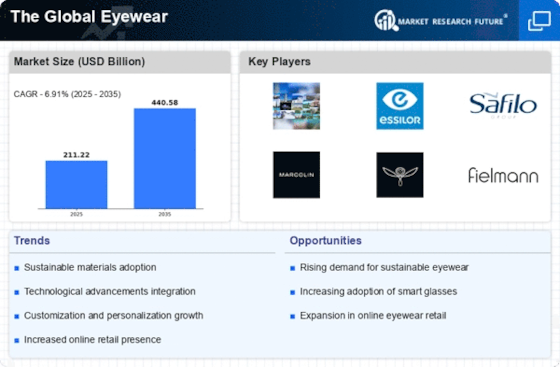
As per Market Research Future analysis, The Global Eyewear Market Size was estimated at 211.22 USD Billion in 2024. The eyewear industry is projected to grow from 225.82 USD Billion in 2025 to 440.58 USD Billion by 2035, exhibiting a compound annual growth rate (CAGR) of 6.91% during the forecast period 2025 - 2035

Key Market Trends & Highlights

The Global Eyewear Market is experiencing dynamic growth driven by innovation and changing consumer preferences.

  • The rise of smart eyewear is reshaping consumer expectations and product offerings in the market. Sustainability initiatives are increasingly influencing purchasing decisions, particularly among environmentally conscious consumers. Customization and personalization are becoming essential as brands seek to cater to individual preferences and styles. Increasing vision impairment awareness and technological advancements in eyewear are key drivers propelling market expansion, especially in North America and the Asia-Pacific region.

Market Size & Forecast

2024 Market Size 211.22 (USD Billion)
2035 Market Size 440.58 (USD Billion)
CAGR (2025 - 2035) 6.91%
Largest Regional Market Share in 2024 North America

Major Players

<p>Luxottica (IT), Essilor (FR), <a href="https://www.safilogroup.com/">Safilo Group (IT)</a>, Marcolin (IT), Kering (FR), Fielmann AG (DE), Marchon Eyewear (US), Maui Jim (US), Warby Parker (US)</p>

Market Trends

The Global Eyewear Market is currently experiencing a dynamic transformation, driven by evolving consumer preferences and technological advancements. As individuals increasingly prioritize eye health and fashion, the demand for diverse eyewear options is on the rise. The Eyewear Market encompasses a wide range of products, including prescription glasses, sunglasses, and contact lenses, catering to various demographics and lifestyles. The integration of innovative materials and designs is reshaping the landscape, allowing brands to offer products that not only enhance vision but also serve as fashion statements. Furthermore, the growing awareness of UV protection and digital eye strain is influencing purchasing decisions, leading to a surge in specialized eyewear designed to mitigate these concerns. The rapid expansion of the e commerce eyewear market is transforming consumer purchasing behavior, with online platforms offering convenience, wider product selection, and competitive pricing. In addition to health and style considerations, sustainability is becoming a pivotal factor in The Global Eyewear Market. Consumers are increasingly seeking eco-friendly options, prompting manufacturers to explore sustainable materials and ethical production practices. This shift towards sustainability reflects a broader trend in consumer behavior, where individuals are more inclined to support brands that align with their values. As the Eyewear Market continues to evolve, it appears that the interplay between fashion, functionality, and sustainability will shape the future of eyewear, creating opportunities for innovation and growth across the industry. Growing consumer preference for premium fashion accessories is strengthening the luxury eyewear market, particularly among affluent and style-conscious consumers.

Rise of Smart Eyewear Market

The emergence of smart eyewear is reshaping The Global Eyewear Market. These technologically advanced products integrate features such as augmented reality and health monitoring, appealing to tech-savvy consumers. As functionality merges with style, smart eyewear is likely to attract a broader audience, enhancing user experience and engagement.

Sustainability Initiatives

Sustainability is increasingly influencing consumer choices within The Global Eyewear Market. Brands are adopting eco-friendly materials and ethical manufacturing processes to meet the growing demand for environmentally responsible products. This trend not only addresses consumer concerns but also positions companies favorably in a competitive landscape.

Customization and Personalization

The trend towards customization in eyewear is gaining momentum. Consumers are seeking personalized options that reflect their unique styles and preferences. This shift encourages brands to offer tailored solutions, enhancing customer satisfaction and loyalty while differentiating themselves in a crowded Eyewear Market.

Eyewear Market Market Drivers

Rising Health Consciousness

The increasing focus on health and wellness is significantly influencing The Global Eyewear Industry. Consumers are becoming more health-conscious, leading to a greater emphasis on protective eyewear that shields against harmful environmental factors. For instance, the demand for sunglasses with UV protection and blue light filtering capabilities is on the rise, as individuals seek to mitigate the adverse effects of prolonged screen exposure and sun damage. Market Research Future indicates that the protective eyewear segment is expected to witness substantial growth, driven by heightened awareness of eye health. Additionally, the integration of health-related features in eyewear, such as anti-fatigue lenses, is appealing to consumers who prioritize both style and functionality. This trend underscores the potential for eyewear brands to capitalize on the health-conscious consumer base, thereby driving market expansion.

Technological Advancements in Eyewear

Technological innovations in eyewear are transforming the landscape of The Global Eyewear Industry. The advent of smart eyewear, which integrates augmented reality and health-monitoring features, is capturing consumer interest. For instance, smart glasses equipped with heads-up displays and fitness tracking capabilities are gaining traction among tech-savvy consumers. Additionally, advancements in lens technology, such as blue light blocking and photochromic lenses, are addressing modern lifestyle needs, particularly among digital device users. The market for smart eyewear is projected to grow significantly, with estimates suggesting a compound annual growth rate of over 20% in the coming years. These technological enhancements not only improve functionality but also appeal to a younger demographic, thereby expanding the consumer base and driving overall market growth.

E-commerce Growth and Online Retailing

The e-commerce eyewear market is revolutionizing how consumers purchase vision correction and fashion eyewear products. With advanced virtual try-on technologies and AI-powered recommendation systems, the e-commerce eyewear market has eliminated traditional barriers associated with online eyewear purchases. Industry projections indicate that the e-commerce eyewear market will account for over 35% of total eyewear sales by 2030, driven by enhanced customer experience, competitive pricing, and doorstep delivery convenience. This digital transformation is particularly prominent among millennial and Gen-Z consumers who prefer the seamless shopping experience offered by e-commerce platforms.

Increasing Vision Impairment Awareness

The rising awareness regarding vision impairment and its impact on quality of life appears to be a pivotal driver in The Global Eyewear Industry. As populations age, the prevalence of vision-related issues such as myopia, hyperopia, and presbyopia is likely to increase. Reports indicate that by 2050, nearly half of the global population may be affected by myopia, necessitating corrective eyewear. This growing concern has led to heightened demand for prescription glasses and contact lenses, thereby propelling market growth. Furthermore, educational campaigns aimed at promoting regular eye examinations are fostering a culture of proactive eye care, which could further stimulate the eyewear market. Consequently, the increasing incidence of vision impairment is expected to significantly influence consumer purchasing behavior, driving sales in the eyewear sector.

Fashion Trends and Eyewear as Accessories

The evolving perception of eyewear as a fashion statement rather than merely a functional item is a notable driver in The Global Eyewear Industry. Consumers increasingly view eyewear as an essential accessory that complements their personal style. This trend is particularly pronounced among younger demographics, who are more inclined to experiment with various styles, colors, and brands. The rise of social media influencers and celebrity endorsements has further amplified this trend, as consumers seek to emulate the styles of their favorite personalities. Market data suggests that the eyewear segment, particularly sunglasses, is experiencing robust growth, with sales projected to reach several billion dollars in the next few years. This shift towards fashion-oriented eyewear is likely to encourage brands to innovate and diversify their product offerings, thereby enhancing market competitiveness.

Market Segment Insights

By Type: Prescription Glasses (Largest) vs. Sunglasses (Fastest-Growing)

<p>In The Global Eyewear, Prescription Glasses represent the largest segment, commanding a significant proportion of the Eyewear Market share. Sunglasses follow closely, marked by a robust demand driven by fashion trends and growing awareness of UV protection. Other segments like Reading Glasses, <a href="https://www.marketresearchfuture.com/reports/contact-lenses-market-6210">Contact Lenses</a>, and Safety Glasses are relevant but hold smaller portions of the overall market. The different consumer needs and preferences lead to a varied distribution of Eyewear Market share across these eyewear types, influencing industry dynamics.</p>

<p>Prescription Glasses (Dominant) vs. Contact Lenses (Emerging)</p>

<p>Prescription Glasses continue to be the dominant type in The Global Eyewear, catering to a wide range of vision correction needs. With a blend of functional benefits and style, they appeal to diverse demographics. In contrast, Contact Lenses have emerged as a rapidly growing preference for many consumers seeking comfort and convenience, particularly among younger audiences. They allow for a natural look and are increasingly supported by advancements in technology allowing for improved wearability. The competition between these segments stems from their distinct attributes, leading to targeted marketing strategies and innovations.</p>

By Material: Plastic (Largest) vs. Metal (Fastest-Growing)

<p>In The Global Eyewear, the material segment is characterized by a diverse distribution among its key components. Plastic frames hold the largest Eyewear Market share due to their lightweight and versatile nature, appealing to a broad consumer base. Metal frames, on the other hand, have been gaining traction and are notable for their premium quality and durability, reflecting a significant portion of the Eyewear Market in recent years. Growth trends in the material segment are primarily driven by changing consumer preferences towards stylish and durable eyewear options. While plastic remains dominant, the rising interest in metal frames signifies a shift towards more sophisticated designs, particularly among fashion-conscious consumers. Innovations such as anti-reflective coatings and flexible metal alloys are further propelling this growth, allowing brands to cater to both aesthetic and functional demands.</p>

<p>Plastic (Dominant) vs. Metal (Emerging)</p>

<p>Plastic frames are recognized as the dominant force in The Global Eyewear, largely due to their affordability, versatility in design, and availability in numerous colors and styles. They cater to a wide demographic, making them a preferred choice for both everyday and luxury eyewear. Meanwhile, metal frames are emerging with unique capabilities to combine strength with an upscale aesthetic appeal. Although they generally carry a higher price point, consumers are appreciating their durability and sophisticated look. Recent advancements such as lightweight metals and customizable designs are enhancing their market position, attracting consumers who prioritize both function and fashion.</p>

By End User: Women (Largest) vs. Children (Fastest-Growing)

<p>In The Global Eyewear, women represent the largest segment, driven by a combination of fashion, functionality, and awareness of eye health needs. This segment benefits from a variety of designs, brands, and styles tailored specifically for women, making them the predominant consumers of eyewear. Conversely, the children’s segment is rapidly growing, largely due to increasing awareness among parents about the importance of protecting children’s eyesight and the rising prevalence of vision problems in young populations. The growth of the children’s eyewear segment is significantly influenced by trends in pediatric eye care, advancements in eyewear technology, and the introduction of stylish and durable frames. Moreover, marketing efforts targeting both parents and children have led to a heightened interest in eyewear as a fashion accessory for kids. This push, combined with rising screen time among youth, is propelling the demand for children’s eyewear, making it a viable and expanding segment in the Eyewear Market.</p>

<p>Women (Dominant) vs. Children (Emerging)</p>

<p>In The Global Eyewear, the women's segment stands out as the dominant player due to its extensive variety and appeal across numerous subcategories such as prescription glasses, <a href="https://www.marketresearchfuture.com/reports/sunglasses-market-1857">sunglasses</a>, and fashion eyewear. Women gravitate towards eyewear that not only offers visual correction but also complements their personal style and fashion sense. Trends emphasize the importance of brand loyalty, as many women prefer established names known for quality and design. In contrast, the children’s segment emerges as a significant up-and-comer, driven by an increasing parental focus on children's eye health and the expansion of fashionable frames for younger users. Unlike traditional eyewear which may prioritize function over form, children’s eyewear increasingly incorporates fun designs and vibrant colors, making it attractive to both children and parents. This dual appeal signifies its rapid ascent within the Eyewear Market.</p>

By Distribution Channel: Online Retail (Largest) vs. Optical Stores (Fastest-Growing)

<p>In The Global Eyewear, distribution channels play a pivotal role in shaping consumer purchasing behaviors. The market is predominantly driven by the <a href="https://www.marketresearchfuture.com/reports/e-retail-market-41602">Online Retail </a>segment, which has captured a significant share primarily due to the convenience offered by e-commerce platforms. This channel enables customers to access a wide range of eyewear products from the comfort of their homes, leading to a steady increase in online sales. In contrast, Optical Stores continue to hold their ground as a vital segment, providing personalized service and expert advice, thus retaining customers who value tailored experiences. Growth trends indicate a dynamic shift in consumer behavior, especially with the rise of digitalization and changing shopping habits. While Online Retail is expected to grow steadily, Optical Stores are emerging as the fastest-growing segment due to the growing demand for personalized eyewear fitting and services. Additionally, traditional Offline Retail, including Department Stores, is facing challenges in adapting to the digital transition, further accentuating the growth potential of Optical Stores. These trends underline the need for retailers to innovate and enhance their services to meet evolving consumer expectations.</p>

<p>Online Retail (Dominant) vs. Offline Retail (Emerging)</p>

<p>Online Retail has become the dominant distribution channel in The Global Eyewear, driven by advancements in technology and increasing consumer reliance on e-commerce. This segment offers unparalleled convenience, a broader selection of eyewear products, and competitive pricing. In contrast, Offline Retail, while still significant, is emerging as a channel adapting to the changing landscape by embracing omnichannel strategies to integrate physical and digital experiences. Retailers in this segment prioritize in-store experiences, offering personalized consultations and fittings, which cater to a segment of consumers who still prefer the tactile experience of purchasing eyewear. As both channels evolve, the competitive dynamics will shape the overall market landscape.</p>

Luxury and Premium Eyewear: The High-Value Segment

<p>The luxury eyewear market represents a high-margin segment within the broader eyewear market size, characterized by premium pricing, exclusive designs, and heritage brand positioning. Major fashion houses and luxury conglomerates have recognized eyewear as a strategic category, with the luxury eyewear market contributing significantly to overall eyewear market share despite representing a smaller volume segment. The e-commerce eyewear market has disrupted traditional luxury retail models, with authenticated online platforms now offering luxury eyewear alongside personalized concierge services and virtual styling consultations. Interestingly, the luxury eyewear market in emerging economies like India is expanding rapidly, with the eyewear market size in India's premium segment growing faster than mass-market categories. Consumers are increasingly viewing luxury eyewear as investment pieces and status symbols, driving brands to innovate with limited editions, sustainable luxury materials, and artisanal craftsmanship. The competitive landscape for eyewear market share in the luxury segment remains concentrated among established players like Luxottica and Kering, though independent luxury eyewear brands are gradually carving niche positions through distinctive design philosophies and direct-to-consumer strategies.</p>

Get more detailed insights about Eyewear Market Research Report - Forecast till 2035

Regional Insights

North America : Market Leader in Eyewear Market

North America stands as the largest market for eyewear, accounting for approximately 40% of the global share. The region's growth is driven by increasing awareness of eye health, a rise in digital device usage, and a growing aging population requiring vision correction. Regulatory support for vision care and eyewear accessibility further fuels demand, making it a robust market for both prescription and fashion eyewear. The competitive landscape in North America is characterized by the presence of major players such as Luxottica, Marchon Eyewear Market, and Warby Parker. The U.S. leads the market, followed by Canada, with a strong emphasis on innovative designs and sustainable practices. The market is also witnessing a surge in online sales channels, enhancing accessibility and convenience for consumers.

Europe : Emerging Trends in Eyewear Market

Europe is the second-largest market for eyewear, holding around 30% of the global market share. The region is witnessing a shift towards sustainable eyewear solutions, driven by consumer demand for eco-friendly products and stringent regulations on plastic use. Countries like Germany and France are at the forefront, promoting initiatives that encourage recycling and sustainable manufacturing practices, which are pivotal in shaping market dynamics. Leading countries in Europe include Germany, France, and Italy, with key players such as Essilor and Safilo Group dominating the landscape. The competitive environment is marked by a blend of traditional craftsmanship and modern technology, fostering innovation in eyewear design. The region's regulatory frameworks support the growth of sustainable practices, enhancing the appeal of eco-conscious brands.

Asia-Pacific : Rapid Growth and Demand

Asia-Pacific is rapidly emerging as a significant player in The Global Eyewear Market, accounting for approximately 25% of the total market share. The region's growth is propelled by rising disposable incomes, increasing urbanization, and a growing awareness of eye health. Countries like China and India are witnessing a surge in demand for both prescription and fashion eyewear, supported by favorable government initiatives promoting vision care. India is emerging as a high-growth market within Asia-Pacific, with the eyewear market size in India expanding rapidly due to rising disposable incomes, increasing screen time, and growing awareness of eye health. China leads the market in the Asia-Pacific region, followed by Japan and India, with a competitive landscape featuring both local and international brands. Key players such as Maui Jim and Marcolin are expanding their presence, focusing on innovative designs and technology integration. The region's diverse consumer base is driving trends towards customization and personalization in eyewear products, enhancing market dynamics.

Middle East and Africa : Untapped Market Potential

The Middle East and Africa represent an emerging market for eyewear, holding about 5% of the global share. The region's growth is driven by increasing urbanization, a rising middle class, and growing awareness of eye health. Regulatory initiatives aimed at improving healthcare access are also contributing to market expansion, particularly in countries like South Africa and the UAE, where demand for eyewear is on the rise. Leading countries in this region include South Africa, the UAE, and Nigeria, with a competitive landscape that is gradually evolving. Key players are beginning to establish a foothold, focusing on affordable eyewear solutions to cater to the growing population. The market is characterized by a mix of local and international brands, with opportunities for growth in both prescription and fashion eyewear segments.

Key Players and Competitive Insights

The Global Eyewear is currently characterized by a dynamic competitive landscape, driven by innovation, sustainability, and digital transformation. Major players such as Luxottica (IT), Essilor (FR), and Warby Parker (US) are at the forefront, each adopting distinct strategies to enhance their market positioning. Luxottica (IT) continues to leverage its extensive retail network and brand portfolio, focusing on premium eyewear segments. Meanwhile, Essilor (FR) emphasizes technological advancements in lens manufacturing, aiming to integrate smart eyewear solutions. Warby Parker (US) is notable for its direct-to-consumer model, which not only disrupts traditional retail but also enhances customer engagement through digital platforms. Collectively, these strategies contribute to a competitive environment that is increasingly focused on consumer-centric innovations and sustainability initiatives. In terms of business tactics, companies are increasingly localizing manufacturing to mitigate supply chain disruptions and optimize logistics. This trend is particularly evident in the eyewear sector, where brands are investing in regional production facilities to enhance responsiveness to market demands. The market structure appears moderately fragmented, with a mix of established players and emerging brands vying for market share. The collective influence of key players shapes competitive dynamics, as they engage in strategic partnerships and collaborations to bolster their market presence.

In August Luxottica (IT) announced a strategic partnership with a leading tech firm to develop augmented reality (AR) eyewear. This collaboration is poised to enhance Luxottica's product offerings, aligning with the growing consumer interest in smart eyewear solutions. The integration of AR technology is likely to position Luxottica as a leader in the innovative eyewear segment, potentially attracting a tech-savvy demographic.

In September Essilor (FR) launched a new line of eco-friendly lenses made from recycled materials. This initiative underscores the company's commitment to sustainability, responding to increasing consumer demand for environmentally responsible products. By prioritizing sustainable practices, Essilor not only enhances its brand image but also aligns with global trends towards eco-conscious consumption, which may drive customer loyalty and market growth.

In July Warby Parker (US) expanded its international footprint by entering the European market, specifically targeting the UK and Germany. This strategic move reflects the company's ambition to capitalize on the growing demand for affordable eyewear solutions in these regions. By leveraging its successful direct-to-consumer model, Warby Parker aims to disrupt traditional retail paradigms in Europe, potentially reshaping the competitive landscape.

As of October current trends in The Global Eyewear indicate a pronounced shift towards digitalization, sustainability, and the integration of artificial intelligence (AI) in product development. Strategic alliances are increasingly shaping the competitive landscape, as companies collaborate to enhance technological capabilities and market reach. Looking ahead, competitive differentiation is likely to evolve, with a greater emphasis on innovation and technology rather than solely on price. The focus on supply chain reliability and sustainable practices will further redefine competitive strategies, positioning companies to better meet the evolving needs of consumers.

Key Companies in the Eyewear Market include

Industry Developments

Recent developments in the Global Eyewear Market indicate a significant expansion fueled by increasing demand for designer eyewear and advancements in technology. Companies such as Luxottica and Safilo Group reported growth in their market valuations, enhancing their presence in high-end fashion eyewear. As of October 2023, Oakley and Nike launched innovative lines focusing on sport and outdoor activities, appealing to a broader consumer base. In September 2022, Dior introduced a new collection that blends luxury with sustainability, reflecting a shift in consumer preferences.

Furthermore, a noteworthy merger occurred in July 2023 when Essilor acquired a strategic stake in a technology firm, boosting its Research and Development capabilities, which is expected to shape the future of optical solutions. The market has seen increasing collaboration among brands, with Gucci and Fendi collaborating on special edition eyewear pieces aimed at the luxury segment. Overall, the Global Eyewear Market remains dynamic, with companies adapting to trends such as sustainability, technology integration, and changing consumer behaviors, ensuring strong growth potential moving forward.

Future Outlook

Eyewear Market Future Outlook

<p>The Global Eyewear Market is projected to grow at a 6.91% CAGR from 2025 to 2035, driven by technological advancements, increasing health awareness, and rising fashion trends.</p>

New opportunities lie in:

  • <p>Expansion of online custom eyewear platforms Development of smart eyewear integrating AR technology Partnerships with health professionals for vision care services</p>

<p>By 2035, the market is expected to achieve robust growth, solidifying its position as a dynamic industry.</p>

Market Segmentation

Eyewear Market Type Outlook

  • Prescription Glasses
  • Sunglasses
  • Reading Glasses
  • Contact Lenses
  • Safety Glasses

Eyewear Market End User Outlook

  • Men
  • Women
  • Children
  • Unisex

Eyewear Market Material Outlook

  • Plastic
  • Metal
  • Glass
  • Composite
  • Wood

Eyewear Market Distribution Channel Outlook

  • Online Retail
  • Offline Retail
  • Optical Stores
  • Department Stores

Report Scope

MARKET SIZE 2024 211.22(USD Billion)
MARKET SIZE 2025 225.82(USD Billion)
MARKET SIZE 2035 440.58(USD Billion)
COMPOUND ANNUAL GROWTH RATE (CAGR) 6.91% (2025 - 2035)
REPORT COVERAGE Revenue Forecast, Competitive Landscape, Growth Factors, and Trends
BASE YEAR 2024
Market Forecast Period 2025 - 2035
Historical Data 2019 - 2024
Market Forecast Units USD Billion
Key Companies Profiled Luxottica (IT), Essilor (FR), Safilo Group (IT), Marcolin (IT), Kering (FR), Fielmann AG (DE), Marchon Eyewear (US), Maui Jim (US), Warby Parker (US)
Segments Covered Product Type, Material, End User, Distribution Channel, Regional
Key Market Opportunities Integration of smart technology in eyewear enhances functionality and attracts tech-savvy consumers.
Key Market Dynamics Rising consumer demand for sustainable eyewear drives innovation and competition among manufacturers in the market.
Countries Covered North America, Europe, APAC, South America, MEA

FAQs

What is the projected market valuation of The Global Eyewear by 2035?

<p>The Global Eyewear is projected to reach a valuation of approximately 440.58 USD Billion by 2035.</p>

What was the market valuation of The Global Eyewear in 2024?

In 2024, The Global Eyewear was valued at 211.22 USD Billion.

What is the expected CAGR for The Global Eyewear during the forecast period 2025 - 2035?

The expected CAGR for The Global Eyewear during the forecast period 2025 - 2035 is 6.91%.

Which segment of eyewear is projected to have the highest valuation by 2035?

Prescription glasses are projected to reach a valuation of 130.0 USD Billion by 2035, making it the highest segment.

How do the valuations of sunglasses compare to those of contact lenses by 2035?

By 2035, sunglasses are expected to reach 90.0 USD Billion, while contact lenses are projected to reach 100.0 USD Billion.

What materials are expected to dominate The Global Eyewear by 2035?

Plastic is anticipated to dominate the market, with a projected valuation of 180.0 USD Billion by 2035.

What is the expected market size for men's eyewear by 2035?

Men's eyewear is projected to reach a market size of 170.0 USD Billion by 2035.

Which distribution channel is expected to generate the highest revenue by 2035?

Optical stores are expected to generate the highest revenue, with a projected valuation of 150.0 USD Billion by 2035.

Who are the key players in The Global Eyewear?

Key players in The Global Eyewear include Luxottica, Essilor, Safilo Group, and Warby Parker, among others.

What is the projected valuation for children's eyewear by 2035?

Children's eyewear is projected to reach a valuation of approximately 60.0 USD Billion by 2035.

  1. SECTION I: EXECUTIVE SUMMARY AND KEY HIGHLIGHTS
    1. | 1.1 EXECUTIVE SUMMARY
    2. | | 1.1.1 Market Overview
    3. | | 1.1.2 Key Findings
    4. | | 1.1.3 Market Segmentation
    5. | | 1.1.4 Competitive Landscape
    6. | | 1.1.5 Challenges and Opportunities
    7. | | 1.1.6 Future Outlook
  2. SECTION II: SCOPING, METHODOLOGY AND MARKET STRUCTURE
    1. | 2.1 MARKET INTRODUCTION
    2. | | 2.1.1 Definition
    3. | | 2.1.2 Scope of the study
    4. | | | 2.1.2.1 Research Objective
    5. | | | 2.1.2.2 Assumption
    6. | | | 2.1.2.3 Limitations
    7. | 2.2 RESEARCH METHODOLOGY
    8. | | 2.2.1 Overview
    9. | | 2.2.2 Data Mining
    10. | | 2.2.3 Secondary Research
    11. | | 2.2.4 Primary Research
    12. | | | 2.2.4.1 Primary Interviews and Information Gathering Process
    13. | | | 2.2.4.2 Breakdown of Primary Respondents
    14. | | 2.2.5 Forecasting Model
    15. | | 2.2.6 Market Size Estimation
    16. | | | 2.2.6.1 Bottom-Up Approach
    17. | | | 2.2.6.2 Top-Down Approach
    18. | | 2.2.7 Data Triangulation
    19. | | 2.2.8 Validation
  3. SECTION III: QUALITATIVE ANALYSIS
    1. | 3.1 MARKET DYNAMICS
    2. | | 3.1.1 Overview
    3. | | 3.1.2 Drivers
    4. | | 3.1.3 Restraints
    5. | | 3.1.4 Opportunities
    6. | 3.2 MARKET FACTOR ANALYSIS
    7. | | 3.2.1 Value chain Analysis
    8. | | 3.2.2 Porter's Five Forces Analysis
    9. | | | 3.2.2.1 Bargaining Power of Suppliers
    10. | | | 3.2.2.2 Bargaining Power of Buyers
    11. | | | 3.2.2.3 Threat of New Entrants
    12. | | | 3.2.2.4 Threat of Substitutes
    13. | | | 3.2.2.5 Intensity of Rivalry
    14. | | 3.2.3 COVID-19 Impact Analysis
    15. | | | 3.2.3.1 Market Impact Analysis
    16. | | | 3.2.3.2 Regional Impact
    17. | | | 3.2.3.3 Opportunity and Threat Analysis
  4. SECTION IV: QUANTITATIVE ANALYSIS
    1. | 4.1 Consumer and Retail, BY Type (USD Billion)
    2. | | 4.1.1 Prescription Glasses
    3. | | 4.1.2 Sunglasses
    4. | | 4.1.3 Reading Glasses
    5. | | 4.1.4 Contact Lenses
    6. | | 4.1.5 Safety Glasses
    7. | 4.2 Consumer and Retail, BY Material (USD Billion)
    8. | | 4.2.1 Plastic
    9. | | 4.2.2 Metal
    10. | | 4.2.3 Glass
    11. | | 4.2.4 Composite
    12. | | 4.2.5 Wood
    13. | 4.3 Consumer and Retail, BY End User (USD Billion)
    14. | | 4.3.1 Men
    15. | | 4.3.2 Women
    16. | | 4.3.3 Children
    17. | | 4.3.4 Unisex
    18. | 4.4 Consumer and Retail, BY Distribution Channel (USD Billion)
    19. | | 4.4.1 Online Retail
    20. | | 4.4.2 Offline Retail
    21. | | 4.4.3 Optical Stores
    22. | | 4.4.4 Department Stores
    23. | 4.5 Consumer and Retail, BY Region (USD Billion)
    24. | | 4.5.1 North America
    25. | | | 4.5.1.1 US
    26. | | | 4.5.1.2 Canada
    27. | | 4.5.2 Europe
    28. | | | 4.5.2.1 Germany
    29. | | | 4.5.2.2 UK
    30. | | | 4.5.2.3 France
    31. | | | 4.5.2.4 Russia
    32. | | | 4.5.2.5 Italy
    33. | | | 4.5.2.6 Spain
    34. | | | 4.5.2.7 Rest of Europe
    35. | | 4.5.3 APAC
    36. | | | 4.5.3.1 China
    37. | | | 4.5.3.2 India
    38. | | | 4.5.3.3 Japan
    39. | | | 4.5.3.4 South Korea
    40. | | | 4.5.3.5 Malaysia
    41. | | | 4.5.3.6 Thailand
    42. | | | 4.5.3.7 Indonesia
    43. | | | 4.5.3.8 Rest of APAC
    44. | | 4.5.4 South America
    45. | | | 4.5.4.1 Brazil
    46. | | | 4.5.4.2 Mexico
    47. | | | 4.5.4.3 Argentina
    48. | | | 4.5.4.4 Rest of South America
    49. | | 4.5.5 MEA
    50. | | | 4.5.5.1 GCC Countries
    51. | | | 4.5.5.2 South Africa
    52. | | | 4.5.5.3 Rest of MEA
  5. SECTION V: COMPETITIVE ANALYSIS
    1. | 5.1 Competitive Landscape
    2. | | 5.1.1 Overview
    3. | | 5.1.2 Competitive Analysis
    4. | | 5.1.3 Market share Analysis
    5. | | 5.1.4 Major Growth Strategy in the Consumer and Retail
    6. | | 5.1.5 Competitive Benchmarking
    7. | | 5.1.6 Leading Players in Terms of Number of Developments in the Consumer and Retail
    8. | | 5.1.7 Key developments and growth strategies
    9. | | | 5.1.7.1 New Product Launch/Service Deployment
    10. | | | 5.1.7.2 Merger & Acquisitions
    11. | | | 5.1.7.3 Joint Ventures
    12. | | 5.1.8 Major Players Financial Matrix
    13. | | | 5.1.8.1 Sales and Operating Income
    14. | | | 5.1.8.2 Major Players R&D Expenditure. 2023
    15. | 5.2 Company Profiles
    16. | | 5.2.1 Luxottica (IT)
    17. | | | 5.2.1.1 Financial Overview
    18. | | | 5.2.1.2 Products Offered
    19. | | | 5.2.1.3 Key Developments
    20. | | | 5.2.1.4 SWOT Analysis
    21. | | | 5.2.1.5 Key Strategies
    22. | | 5.2.2 Essilor (FR)
    23. | | | 5.2.2.1 Financial Overview
    24. | | | 5.2.2.2 Products Offered
    25. | | | 5.2.2.3 Key Developments
    26. | | | 5.2.2.4 SWOT Analysis
    27. | | | 5.2.2.5 Key Strategies
    28. | | 5.2.3 Safilo Group (IT)
    29. | | | 5.2.3.1 Financial Overview
    30. | | | 5.2.3.2 Products Offered
    31. | | | 5.2.3.3 Key Developments
    32. | | | 5.2.3.4 SWOT Analysis
    33. | | | 5.2.3.5 Key Strategies
    34. | | 5.2.4 Marcolin (IT)
    35. | | | 5.2.4.1 Financial Overview
    36. | | | 5.2.4.2 Products Offered
    37. | | | 5.2.4.3 Key Developments
    38. | | | 5.2.4.4 SWOT Analysis
    39. | | | 5.2.4.5 Key Strategies
    40. | | 5.2.5 Kering (FR)
    41. | | | 5.2.5.1 Financial Overview
    42. | | | 5.2.5.2 Products Offered
    43. | | | 5.2.5.3 Key Developments
    44. | | | 5.2.5.4 SWOT Analysis
    45. | | | 5.2.5.5 Key Strategies
    46. | | 5.2.6 Fielmann AG (DE)
    47. | | | 5.2.6.1 Financial Overview
    48. | | | 5.2.6.2 Products Offered
    49. | | | 5.2.6.3 Key Developments
    50. | | | 5.2.6.4 SWOT Analysis
    51. | | | 5.2.6.5 Key Strategies
    52. | | 5.2.7 Marchon Eyewear (US)
    53. | | | 5.2.7.1 Financial Overview
    54. | | | 5.2.7.2 Products Offered
    55. | | | 5.2.7.3 Key Developments
    56. | | | 5.2.7.4 SWOT Analysis
    57. | | | 5.2.7.5 Key Strategies
    58. | | 5.2.8 Maui Jim (US)
    59. | | | 5.2.8.1 Financial Overview
    60. | | | 5.2.8.2 Products Offered
    61. | | | 5.2.8.3 Key Developments
    62. | | | 5.2.8.4 SWOT Analysis
    63. | | | 5.2.8.5 Key Strategies
    64. | | 5.2.9 Warby Parker (US)
    65. | | | 5.2.9.1 Financial Overview
    66. | | | 5.2.9.2 Products Offered
    67. | | | 5.2.9.3 Key Developments
    68. | | | 5.2.9.4 SWOT Analysis
    69. | | | 5.2.9.5 Key Strategies
    70. | 5.3 Appendix
    71. | | 5.3.1 References
    72. | | 5.3.2 Related Reports
  6. LIST OF FIGURES
    1. | 6.1 MARKET SYNOPSIS
    2. | 6.2 NORTH AMERICA MARKET ANALYSIS
    3. | 6.3 US MARKET ANALYSIS BY TYPE
    4. | 6.4 US MARKET ANALYSIS BY MATERIAL
    5. | 6.5 US MARKET ANALYSIS BY END USER
    6. | 6.6 US MARKET ANALYSIS BY DISTRIBUTION CHANNEL
    7. | 6.7 CANADA MARKET ANALYSIS BY TYPE
    8. | 6.8 CANADA MARKET ANALYSIS BY MATERIAL
    9. | 6.9 CANADA MARKET ANALYSIS BY END USER
    10. | 6.10 CANADA MARKET ANALYSIS BY DISTRIBUTION CHANNEL
    11. | 6.11 EUROPE MARKET ANALYSIS
    12. | 6.12 GERMANY MARKET ANALYSIS BY TYPE
    13. | 6.13 GERMANY MARKET ANALYSIS BY MATERIAL
    14. | 6.14 GERMANY MARKET ANALYSIS BY END USER
    15. | 6.15 GERMANY MARKET ANALYSIS BY DISTRIBUTION CHANNEL
    16. | 6.16 UK MARKET ANALYSIS BY TYPE
    17. | 6.17 UK MARKET ANALYSIS BY MATERIAL
    18. | 6.18 UK MARKET ANALYSIS BY END USER
    19. | 6.19 UK MARKET ANALYSIS BY DISTRIBUTION CHANNEL
    20. | 6.20 FRANCE MARKET ANALYSIS BY TYPE
    21. | 6.21 FRANCE MARKET ANALYSIS BY MATERIAL
    22. | 6.22 FRANCE MARKET ANALYSIS BY END USER
    23. | 6.23 FRANCE MARKET ANALYSIS BY DISTRIBUTION CHANNEL
    24. | 6.24 RUSSIA MARKET ANALYSIS BY TYPE
    25. | 6.25 RUSSIA MARKET ANALYSIS BY MATERIAL
    26. | 6.26 RUSSIA MARKET ANALYSIS BY END USER
    27. | 6.27 RUSSIA MARKET ANALYSIS BY DISTRIBUTION CHANNEL
    28. | 6.28 ITALY MARKET ANALYSIS BY TYPE
    29. | 6.29 ITALY MARKET ANALYSIS BY MATERIAL
    30. | 6.30 ITALY MARKET ANALYSIS BY END USER
    31. | 6.31 ITALY MARKET ANALYSIS BY DISTRIBUTION CHANNEL
    32. | 6.32 SPAIN MARKET ANALYSIS BY TYPE
    33. | 6.33 SPAIN MARKET ANALYSIS BY MATERIAL
    34. | 6.34 SPAIN MARKET ANALYSIS BY END USER
    35. | 6.35 SPAIN MARKET ANALYSIS BY DISTRIBUTION CHANNEL
    36. | 6.36 REST OF EUROPE MARKET ANALYSIS BY TYPE
    37. | 6.37 REST OF EUROPE MARKET ANALYSIS BY MATERIAL
    38. | 6.38 REST OF EUROPE MARKET ANALYSIS BY END USER
    39. | 6.39 REST OF EUROPE MARKET ANALYSIS BY DISTRIBUTION CHANNEL
    40. | 6.40 APAC MARKET ANALYSIS
    41. | 6.41 CHINA MARKET ANALYSIS BY TYPE
    42. | 6.42 CHINA MARKET ANALYSIS BY MATERIAL
    43. | 6.43 CHINA MARKET ANALYSIS BY END USER
    44. | 6.44 CHINA MARKET ANALYSIS BY DISTRIBUTION CHANNEL
    45. | 6.45 INDIA MARKET ANALYSIS BY TYPE
    46. | 6.46 INDIA MARKET ANALYSIS BY MATERIAL
    47. | 6.47 INDIA MARKET ANALYSIS BY END USER
    48. | 6.48 INDIA MARKET ANALYSIS BY DISTRIBUTION CHANNEL
    49. | 6.49 JAPAN MARKET ANALYSIS BY TYPE
    50. | 6.50 JAPAN MARKET ANALYSIS BY MATERIAL
    51. | 6.51 JAPAN MARKET ANALYSIS BY END USER
    52. | 6.52 JAPAN MARKET ANALYSIS BY DISTRIBUTION CHANNEL
    53. | 6.53 SOUTH KOREA MARKET ANALYSIS BY TYPE
    54. | 6.54 SOUTH KOREA MARKET ANALYSIS BY MATERIAL
    55. | 6.55 SOUTH KOREA MARKET ANALYSIS BY END USER
    56. | 6.56 SOUTH KOREA MARKET ANALYSIS BY DISTRIBUTION CHANNEL
    57. | 6.57 MALAYSIA MARKET ANALYSIS BY TYPE
    58. | 6.58 MALAYSIA MARKET ANALYSIS BY MATERIAL
    59. | 6.59 MALAYSIA MARKET ANALYSIS BY END USER
    60. | 6.60 MALAYSIA MARKET ANALYSIS BY DISTRIBUTION CHANNEL
    61. | 6.61 THAILAND MARKET ANALYSIS BY TYPE
    62. | 6.62 THAILAND MARKET ANALYSIS BY MATERIAL
    63. | 6.63 THAILAND MARKET ANALYSIS BY END USER
    64. | 6.64 THAILAND MARKET ANALYSIS BY DISTRIBUTION CHANNEL
    65. | 6.65 INDONESIA MARKET ANALYSIS BY TYPE
    66. | 6.66 INDONESIA MARKET ANALYSIS BY MATERIAL
    67. | 6.67 INDONESIA MARKET ANALYSIS BY END USER
    68. | 6.68 INDONESIA MARKET ANALYSIS BY DISTRIBUTION CHANNEL
    69. | 6.69 REST OF APAC MARKET ANALYSIS BY TYPE
    70. | 6.70 REST OF APAC MARKET ANALYSIS BY MATERIAL
    71. | 6.71 REST OF APAC MARKET ANALYSIS BY END USER
    72. | 6.72 REST OF APAC MARKET ANALYSIS BY DISTRIBUTION CHANNEL
    73. | 6.73 SOUTH AMERICA MARKET ANALYSIS
    74. | 6.74 BRAZIL MARKET ANALYSIS BY TYPE
    75. | 6.75 BRAZIL MARKET ANALYSIS BY MATERIAL
    76. | 6.76 BRAZIL MARKET ANALYSIS BY END USER
    77. | 6.77 BRAZIL MARKET ANALYSIS BY DISTRIBUTION CHANNEL
    78. | 6.78 MEXICO MARKET ANALYSIS BY TYPE
    79. | 6.79 MEXICO MARKET ANALYSIS BY MATERIAL
    80. | 6.80 MEXICO MARKET ANALYSIS BY END USER
    81. | 6.81 MEXICO MARKET ANALYSIS BY DISTRIBUTION CHANNEL
    82. | 6.82 ARGENTINA MARKET ANALYSIS BY TYPE
    83. | 6.83 ARGENTINA MARKET ANALYSIS BY MATERIAL
    84. | 6.84 ARGENTINA MARKET ANALYSIS BY END USER
    85. | 6.85 ARGENTINA MARKET ANALYSIS BY DISTRIBUTION CHANNEL
    86. | 6.86 REST OF SOUTH AMERICA MARKET ANALYSIS BY TYPE
    87. | 6.87 REST OF SOUTH AMERICA MARKET ANALYSIS BY MATERIAL
    88. | 6.88 REST OF SOUTH AMERICA MARKET ANALYSIS BY END USER
    89. | 6.89 REST OF SOUTH AMERICA MARKET ANALYSIS BY DISTRIBUTION CHANNEL
    90. | 6.90 MEA MARKET ANALYSIS
    91. | 6.91 GCC COUNTRIES MARKET ANALYSIS BY TYPE
    92. | 6.92 GCC COUNTRIES MARKET ANALYSIS BY MATERIAL
    93. | 6.93 GCC COUNTRIES MARKET ANALYSIS BY END USER
    94. | 6.94 GCC COUNTRIES MARKET ANALYSIS BY DISTRIBUTION CHANNEL
    95. | 6.95 SOUTH AFRICA MARKET ANALYSIS BY TYPE
    96. | 6.96 SOUTH AFRICA MARKET ANALYSIS BY MATERIAL
    97. | 6.97 SOUTH AFRICA MARKET ANALYSIS BY END USER
    98. | 6.98 SOUTH AFRICA MARKET ANALYSIS BY DISTRIBUTION CHANNEL
    99. | 6.99 REST OF MEA MARKET ANALYSIS BY TYPE
    100. | 6.100 REST OF MEA MARKET ANALYSIS BY MATERIAL
    101. | 6.101 REST OF MEA MARKET ANALYSIS BY END USER
    102. | 6.102 REST OF MEA MARKET ANALYSIS BY DISTRIBUTION CHANNEL
    103. | 6.103 KEY BUYING CRITERIA OF CONSUMER AND RETAIL
    104. | 6.104 RESEARCH PROCESS OF MRFR
    105. | 6.105 DRO ANALYSIS OF CONSUMER AND RETAIL
    106. | 6.106 DRIVERS IMPACT ANALYSIS: CONSUMER AND RETAIL
    107. | 6.107 RESTRAINTS IMPACT ANALYSIS: CONSUMER AND RETAIL
    108. | 6.108 SUPPLY / VALUE CHAIN: CONSUMER AND RETAIL
    109. | 6.109 CONSUMER AND RETAIL, BY TYPE, 2024 (% SHARE)
    110. | 6.110 CONSUMER AND RETAIL, BY TYPE, 2024 TO 2035 (USD Billion)
    111. | 6.111 CONSUMER AND RETAIL, BY MATERIAL, 2024 (% SHARE)
    112. | 6.112 CONSUMER AND RETAIL, BY MATERIAL, 2024 TO 2035 (USD Billion)
    113. | 6.113 CONSUMER AND RETAIL, BY END USER, 2024 (% SHARE)
    114. | 6.114 CONSUMER AND RETAIL, BY END USER, 2024 TO 2035 (USD Billion)
    115. | 6.115 CONSUMER AND RETAIL, BY DISTRIBUTION CHANNEL, 2024 (% SHARE)
    116. | 6.116 CONSUMER AND RETAIL, BY DISTRIBUTION CHANNEL, 2024 TO 2035 (USD Billion)
    117. | 6.117 BENCHMARKING OF MAJOR COMPETITORS
  7. LIST OF TABLES
    1. | 7.1 LIST OF ASSUMPTIONS
    2. | | 7.1.1
    3. | 7.2 North America MARKET SIZE ESTIMATES; FORECAST
    4. | | 7.2.1 BY TYPE, 2025-2035 (USD Billion)
    5. | | 7.2.2 BY MATERIAL, 2025-2035 (USD Billion)
    6. | | 7.2.3 BY END USER, 2025-2035 (USD Billion)
    7. | | 7.2.4 BY DISTRIBUTION CHANNEL, 2025-2035 (USD Billion)
    8. | 7.3 US MARKET SIZE ESTIMATES; FORECAST
    9. | | 7.3.1 BY TYPE, 2025-2035 (USD Billion)
    10. | | 7.3.2 BY MATERIAL, 2025-2035 (USD Billion)
    11. | | 7.3.3 BY END USER, 2025-2035 (USD Billion)
    12. | | 7.3.4 BY DISTRIBUTION CHANNEL, 2025-2035 (USD Billion)
    13. | 7.4 Canada MARKET SIZE ESTIMATES; FORECAST
    14. | | 7.4.1 BY TYPE, 2025-2035 (USD Billion)
    15. | | 7.4.2 BY MATERIAL, 2025-2035 (USD Billion)
    16. | | 7.4.3 BY END USER, 2025-2035 (USD Billion)
    17. | | 7.4.4 BY DISTRIBUTION CHANNEL, 2025-2035 (USD Billion)
    18. | 7.5 Europe MARKET SIZE ESTIMATES; FORECAST
    19. | | 7.5.1 BY TYPE, 2025-2035 (USD Billion)
    20. | | 7.5.2 BY MATERIAL, 2025-2035 (USD Billion)
    21. | | 7.5.3 BY END USER, 2025-2035 (USD Billion)
    22. | | 7.5.4 BY DISTRIBUTION CHANNEL, 2025-2035 (USD Billion)
    23. | 7.6 Germany MARKET SIZE ESTIMATES; FORECAST
    24. | | 7.6.1 BY TYPE, 2025-2035 (USD Billion)
    25. | | 7.6.2 BY MATERIAL, 2025-2035 (USD Billion)
    26. | | 7.6.3 BY END USER, 2025-2035 (USD Billion)
    27. | | 7.6.4 BY DISTRIBUTION CHANNEL, 2025-2035 (USD Billion)
    28. | 7.7 UK MARKET SIZE ESTIMATES; FORECAST
    29. | | 7.7.1 BY TYPE, 2025-2035 (USD Billion)
    30. | | 7.7.2 BY MATERIAL, 2025-2035 (USD Billion)
    31. | | 7.7.3 BY END USER, 2025-2035 (USD Billion)
    32. | | 7.7.4 BY DISTRIBUTION CHANNEL, 2025-2035 (USD Billion)
    33. | 7.8 France MARKET SIZE ESTIMATES; FORECAST
    34. | | 7.8.1 BY TYPE, 2025-2035 (USD Billion)
    35. | | 7.8.2 BY MATERIAL, 2025-2035 (USD Billion)
    36. | | 7.8.3 BY END USER, 2025-2035 (USD Billion)
    37. | | 7.8.4 BY DISTRIBUTION CHANNEL, 2025-2035 (USD Billion)
    38. | 7.9 Russia MARKET SIZE ESTIMATES; FORECAST
    39. | | 7.9.1 BY TYPE, 2025-2035 (USD Billion)
    40. | | 7.9.2 BY MATERIAL, 2025-2035 (USD Billion)
    41. | | 7.9.3 BY END USER, 2025-2035 (USD Billion)
    42. | | 7.9.4 BY DISTRIBUTION CHANNEL, 2025-2035 (USD Billion)
    43. | 7.10 Italy MARKET SIZE ESTIMATES; FORECAST
    44. | | 7.10.1 BY TYPE, 2025-2035 (USD Billion)
    45. | | 7.10.2 BY MATERIAL, 2025-2035 (USD Billion)
    46. | | 7.10.3 BY END USER, 2025-2035 (USD Billion)
    47. | | 7.10.4 BY DISTRIBUTION CHANNEL, 2025-2035 (USD Billion)
    48. | 7.11 Spain MARKET SIZE ESTIMATES; FORECAST
    49. | | 7.11.1 BY TYPE, 2025-2035 (USD Billion)
    50. | | 7.11.2 BY MATERIAL, 2025-2035 (USD Billion)
    51. | | 7.11.3 BY END USER, 2025-2035 (USD Billion)
    52. | | 7.11.4 BY DISTRIBUTION CHANNEL, 2025-2035 (USD Billion)
    53. | 7.12 Rest of Europe MARKET SIZE ESTIMATES; FORECAST
    54. | | 7.12.1 BY TYPE, 2025-2035 (USD Billion)
    55. | | 7.12.2 BY MATERIAL, 2025-2035 (USD Billion)
    56. | | 7.12.3 BY END USER, 2025-2035 (USD Billion)
    57. | | 7.12.4 BY DISTRIBUTION CHANNEL, 2025-2035 (USD Billion)
    58. | 7.13 APAC MARKET SIZE ESTIMATES; FORECAST
    59. | | 7.13.1 BY TYPE, 2025-2035 (USD Billion)
    60. | | 7.13.2 BY MATERIAL, 2025-2035 (USD Billion)
    61. | | 7.13.3 BY END USER, 2025-2035 (USD Billion)
    62. | | 7.13.4 BY DISTRIBUTION CHANNEL, 2025-2035 (USD Billion)
    63. | 7.14 China MARKET SIZE ESTIMATES; FORECAST
    64. | | 7.14.1 BY TYPE, 2025-2035 (USD Billion)
    65. | | 7.14.2 BY MATERIAL, 2025-2035 (USD Billion)
    66. | | 7.14.3 BY END USER, 2025-2035 (USD Billion)
    67. | | 7.14.4 BY DISTRIBUTION CHANNEL, 2025-2035 (USD Billion)
    68. | 7.15 India MARKET SIZE ESTIMATES; FORECAST
    69. | | 7.15.1 BY TYPE, 2025-2035 (USD Billion)
    70. | | 7.15.2 BY MATERIAL, 2025-2035 (USD Billion)
    71. | | 7.15.3 BY END USER, 2025-2035 (USD Billion)
    72. | | 7.15.4 BY DISTRIBUTION CHANNEL, 2025-2035 (USD Billion)
    73. | 7.16 Japan MARKET SIZE ESTIMATES; FORECAST
    74. | | 7.16.1 BY TYPE, 2025-2035 (USD Billion)
    75. | | 7.16.2 BY MATERIAL, 2025-2035 (USD Billion)
    76. | | 7.16.3 BY END USER, 2025-2035 (USD Billion)
    77. | | 7.16.4 BY DISTRIBUTION CHANNEL, 2025-2035 (USD Billion)
    78. | 7.17 South Korea MARKET SIZE ESTIMATES; FORECAST
    79. | | 7.17.1 BY TYPE, 2025-2035 (USD Billion)
    80. | | 7.17.2 BY MATERIAL, 2025-2035 (USD Billion)
    81. | | 7.17.3 BY END USER, 2025-2035 (USD Billion)
    82. | | 7.17.4 BY DISTRIBUTION CHANNEL, 2025-2035 (USD Billion)
    83. | 7.18 Malaysia MARKET SIZE ESTIMATES; FORECAST
    84. | | 7.18.1 BY TYPE, 2025-2035 (USD Billion)
    85. | | 7.18.2 BY MATERIAL, 2025-2035 (USD Billion)
    86. | | 7.18.3 BY END USER, 2025-2035 (USD Billion)
    87. | | 7.18.4 BY DISTRIBUTION CHANNEL, 2025-2035 (USD Billion)
    88. | 7.19 Thailand MARKET SIZE ESTIMATES; FORECAST
    89. | | 7.19.1 BY TYPE, 2025-2035 (USD Billion)
    90. | | 7.19.2 BY MATERIAL, 2025-2035 (USD Billion)
    91. | | 7.19.3 BY END USER, 2025-2035 (USD Billion)
    92. | | 7.19.4 BY DISTRIBUTION CHANNEL, 2025-2035 (USD Billion)
    93. | 7.20 Indonesia MARKET SIZE ESTIMATES; FORECAST
    94. | | 7.20.1 BY TYPE, 2025-2035 (USD Billion)
    95. | | 7.20.2 BY MATERIAL, 2025-2035 (USD Billion)
    96. | | 7.20.3 BY END USER, 2025-2035 (USD Billion)
    97. | | 7.20.4 BY DISTRIBUTION CHANNEL, 2025-2035 (USD Billion)
    98. | 7.21 Rest of APAC MARKET SIZE ESTIMATES; FORECAST
    99. | | 7.21.1 BY TYPE, 2025-2035 (USD Billion)
    100. | | 7.21.2 BY MATERIAL, 2025-2035 (USD Billion)
    101. | | 7.21.3 BY END USER, 2025-2035 (USD Billion)
    102. | | 7.21.4 BY DISTRIBUTION CHANNEL, 2025-2035 (USD Billion)
    103. | 7.22 South America MARKET SIZE ESTIMATES; FORECAST
    104. | | 7.22.1 BY TYPE, 2025-2035 (USD Billion)
    105. | | 7.22.2 BY MATERIAL, 2025-2035 (USD Billion)
    106. | | 7.22.3 BY END USER, 2025-2035 (USD Billion)
    107. | | 7.22.4 BY DISTRIBUTION CHANNEL, 2025-2035 (USD Billion)
    108. | 7.23 Brazil MARKET SIZE ESTIMATES; FORECAST
    109. | | 7.23.1 BY TYPE, 2025-2035 (USD Billion)
    110. | | 7.23.2 BY MATERIAL, 2025-2035 (USD Billion)
    111. | | 7.23.3 BY END USER, 2025-2035 (USD Billion)
    112. | | 7.23.4 BY DISTRIBUTION CHANNEL, 2025-2035 (USD Billion)
    113. | 7.24 Mexico MARKET SIZE ESTIMATES; FORECAST
    114. | | 7.24.1 BY TYPE, 2025-2035 (USD Billion)
    115. | | 7.24.2 BY MATERIAL, 2025-2035 (USD Billion)
    116. | | 7.24.3 BY END USER, 2025-2035 (USD Billion)
    117. | | 7.24.4 BY DISTRIBUTION CHANNEL, 2025-2035 (USD Billion)
    118. | 7.25 Argentina MARKET SIZE ESTIMATES; FORECAST
    119. | | 7.25.1 BY TYPE, 2025-2035 (USD Billion)
    120. | | 7.25.2 BY MATERIAL, 2025-2035 (USD Billion)
    121. | | 7.25.3 BY END USER, 2025-2035 (USD Billion)
    122. | | 7.25.4 BY DISTRIBUTION CHANNEL, 2025-2035 (USD Billion)
    123. | 7.26 Rest of South America MARKET SIZE ESTIMATES; FORECAST
    124. | | 7.26.1 BY TYPE, 2025-2035 (USD Billion)
    125. | | 7.26.2 BY MATERIAL, 2025-2035 (USD Billion)
    126. | | 7.26.3 BY END USER, 2025-2035 (USD Billion)
    127. | | 7.26.4 BY DISTRIBUTION CHANNEL, 2025-2035 (USD Billion)
    128. | 7.27 MEA MARKET SIZE ESTIMATES; FORECAST
    129. | | 7.27.1 BY TYPE, 2025-2035 (USD Billion)
    130. | | 7.27.2 BY MATERIAL, 2025-2035 (USD Billion)
    131. | | 7.27.3 BY END USER, 2025-2035 (USD Billion)
    132. | | 7.27.4 BY DISTRIBUTION CHANNEL, 2025-2035 (USD Billion)
    133. | 7.28 GCC Countries MARKET SIZE ESTIMATES; FORECAST
    134. | | 7.28.1 BY TYPE, 2025-2035 (USD Billion)
    135. | | 7.28.2 BY MATERIAL, 2025-2035 (USD Billion)
    136. | | 7.28.3 BY END USER, 2025-2035 (USD Billion)
    137. | | 7.28.4 BY DISTRIBUTION CHANNEL, 2025-2035 (USD Billion)
    138. | 7.29 South Africa MARKET SIZE ESTIMATES; FORECAST
    139. | | 7.29.1 BY TYPE, 2025-2035 (USD Billion)
    140. | | 7.29.2 BY MATERIAL, 2025-2035 (USD Billion)
    141. | | 7.29.3 BY END USER, 2025-2035 (USD Billion)
    142. | | 7.29.4 BY DISTRIBUTION CHANNEL, 2025-2035 (USD Billion)
    143. | 7.30 Rest of MEA MARKET SIZE ESTIMATES; FORECAST
    144. | | 7.30.1 BY TYPE, 2025-2035 (USD Billion)
    145. | | 7.30.2 BY MATERIAL, 2025-2035 (USD Billion)
    146. | | 7.30.3 BY END USER, 2025-2035 (USD Billion)
    147. | | 7.30.4 BY DISTRIBUTION CHANNEL, 2025-2035 (USD Billion)
    148. | 7.31 PRODUCT LAUNCH/PRODUCT DEVELOPMENT/APPROVAL
    149. | | 7.31.1
    150. | 7.32 ACQUISITION/PARTNERSHIP
    151. | | 7.32.1

Consumer and Retail Market Segmentation

Consumer and Retail By Type (USD Billion, 2025-2035)

  • Prescription Glasses
  • Sunglasses
  • Reading Glasses
  • Contact Lenses
  • Safety Glasses

Consumer and Retail By Material (USD Billion, 2025-2035)

  • Plastic
  • Metal
  • Glass
  • Composite
  • Wood

Consumer and Retail By End User (USD Billion, 2025-2035)

  • Men
  • Women
  • Children
  • Unisex

Consumer and Retail By Distribution Channel (USD Billion, 2025-2035)

  • Online Retail
  • Offline Retail
  • Optical Stores
  • Department Stores
Infographic

Free Sample Request

Kindly complete the form below to receive a free sample of this Report

Get Free Sample

Customer Strories

Compare Licence

×
Features License Type
Single User Multiuser License Enterprise User
Price $4,950 $5,950 $7,250
Maximum User Access Limit 1 User Upto 10 Users Unrestricted Access Throughout the Organization
Free Customization
Direct Access to Analyst
Deliverable Format
Platform Access
Discount on Next Purchase 10% 15% 15%
Printable Versions