Request Free Sample ×

Kindly complete the form below to receive a free sample of this Report

* Please use a valid business email

Leading companies partner with us for data-driven Insights

clients tt-cursor
Hero Background
English
Chinese
French
Japanese
Korean
German
Spanish

Eye Makeup Market Trends

ID: MRFR/CG/7006-HCR
100 Pages
Snehal Singh
Last Updated: April 06, 2026

Eye Makeup Market Size, Share, Industry Trend & Analysis Research Report By Product Type (Eyeliner, Eyeshadow, Mascara, Eyebrow Products, Eye Primer), By Formulation (Liquid, Cream, Powder, Gel, Pencil), By Distribution Channel (Online, Offline, Specialty Stores, Department Stores), By End User (Professional, Personal, Creative) and By Regional (North America, Europe, South America, Asia Pacific, Middle East and Africa) - Forecast to 2035

Share:
Download PDF ×

We do not share your information with anyone. However, we may send you emails based on your report interest from time to time. You may contact us at any time to opt-out.

Eye Makeup Market Infographic
Purchase Options

Market Trends

Key Emerging Trends in the Eye Makeup Market

The shift in consumer spending behavior has been significantly influenced by the surge in per capita disposable income. This alteration has notably impacted the global mascara market, with the prevalence of premium and high-end brands playing a pivotal role in augmenting market share. The burgeoning demand for mascara has created a positive ripple effect on its trade worldwide. Interestingly, consumers from both developed and developing economies exhibit a heightened propensity toward embracing a modern lifestyle, which includes substantial expenditure on high-quality beauty and cosmetic products. This inclination towards modernization stands as a major driving force behind the flourishing mascara market. Furthermore, the escalating middle-class population in emerging markets like the Asia-Pacific and Latin America regions has amplified customer expectations. This surge in expectations has prompted a recalibration of strategic imperatives for industrial manufacturers operating within these burgeoning markets. The annual GDP growth trajectory signals a consistent upswing in economies worldwide, consequently contributing to an increase in disposable incomes on a global scale. The rise in per capita disposable income has played a pivotal role in reshaping consumer habits, especially in their spending patterns. As individuals experience higher levels of disposable income, their preferences for premium and high-quality products have seen a substantial uptick. In the realm of cosmetics, particularly mascara, this shift is noticeable, with the market witnessing a surge in demand for premium and high-end brands. This surge in demand has led to an increased market share for mascara globally. The impact of this heightened demand is not only confined to market expansion but has also brought about a positive influence on the trade of mascara products. Consequently, manufacturers and stakeholders within the cosmetic industry are closely monitoring and adapting to these changing consumer dynamics to capitalize on the burgeoning market potential. The inclination towards embracing modern lifestyles encompasses a significant facet of consumer behavior. Irrespective of geographical location or economic status, consumers are displaying a penchant for adopting contemporary living standards. Within this paradigm shift, the beauty and cosmetics sector has emerged as a notable beneficiary. Consumers are more inclined than ever to allocate a significant portion of their increased disposable income towards quality beauty products, including mascara. Moreover, the burgeoning middle-class populace in emerging economies, such as those in the Asia-Pacific and Latin American regions, has contributed substantially to this shift in consumer behavior. As these populations witness a rise in their standard of living and purchasing power, their expectations concerning product quality and diversity have heightened significantly. This phenomenon has not only bolstered the demand for mascara but has also prompted manufacturers in these regions to reassess their strategies and operational imperatives to cater to evolving consumer preferences. The consistent upward trajectory of annual GDP growth globally serves as a testament to the overall economic upliftment across various regions. This growth has resulted in a substantial increase in disposable income levels on a global scale. As disposable incomes continue to rise, consumers' inclination towards investing in quality beauty and cosmetic products, such as mascara, is expected to persist, further driving the growth and expansion of the market. In conclusion, the interplay between rising disposable incomes, shifting consumer preferences towards premium products, the global inclination towards modern lifestyles, and the growth of middle-class populations in emerging markets has created a fertile ground for the thriving mascara market. Manufacturers and industry players are keenly observing these trends and adapting their strategies to cater to the evolving demands of consumers, thus fueling the growth and expansion of the cosmetics industry.


Author
Author Profile
Snehal Singh
Manager - Research

High acumen in analyzing complex macro & micro markets with more than 6 years of work experience in the field of market research. By implementing her analytical skills in forecasting and estimation into market research reports, she has expertise in Packaging, Construction, and Equipment domains. She handles a team size of 20-25 resources and ensures smooth running of the projects, associated marketing activities, and client servicing.

Leave a Comment

FAQs

What is the current valuation of the eye makeup market as of 2024?

<p>The eye makeup market was valued at 50.0 USD Billion in 2024.</p>

What is the projected market size for the eye makeup industry by 2035?

<p>The eye makeup market is projected to reach 75.0 USD Billion by 2035.</p>

What is the expected CAGR for the eye makeup market during the forecast period 2025 - 2035?

<p>The expected CAGR for the eye makeup market during the forecast period 2025 - 2035 is 3.75%.</p>

Which companies are considered key players in the eye makeup market?

<p>Key players in the eye makeup market include L'Oreal, Estée Lauder, Procter & Gamble, Revlon, Shiseido, Coty, Mary Kay, Avon, and Make Up For Ever.</p>

How does the eye shadow segment perform in terms of market valuation?

<p>The eye shadow segment is valued between 10.0 and 15.0 USD Billion.</p>

What is the market valuation for mascara products in the eye makeup segment?

<p>The mascara segment is valued between 12.0 and 18.0 USD Billion.</p>

What are the projected valuations for different product types in the eye makeup market?

<p>Liquid products are projected to be valued between 15.0 and 22.5 USD Billion, while gel products range from 10.0 to 15.0 USD Billion.</p>

How do consumer demographics influence the eye makeup market?

<p>The eye makeup market valuation by consumer demographics indicates values between 10.0 and 15.0 USD Billion for age group and 12.0 to 18.0 USD Billion for gender.</p>

What distribution channels are most significant for the eye makeup market?

<p>Department stores are projected to have a market valuation between 15.0 and 20.0 USD Billion, making them a significant distribution channel.</p>

What is the valuation range for eyebrow products in the eye makeup market?

<p>Eyebrow products are valued between 7.0 and 10.0 USD Billion.</p>

Market Summary

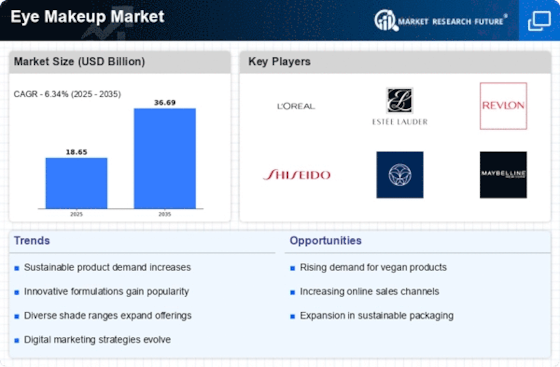
As per MRFR analysis, the Eye Makeup market was estimated at 50.0 USD Billion in 2024. The eye makeup industry is projected to grow from 51.88 USD Billion in 2025 to 75.0 USD Billion by 2035, exhibiting a compound annual growth rate (CAGR) of 3.75% during the forecast period 2025 - 2035.

Key Market Trends & Highlights

The eye makeup market is experiencing a dynamic shift towards clean beauty and multifunctional products, driven by consumer preferences and technological advancements.

  • The North American market remains the largest, characterized by a strong demand for innovative eye makeup solutions. In the Asia-Pacific region, the eye makeup market is the fastest-growing, fueled by increasing disposable incomes and changing beauty standards. Eye shadow continues to dominate as the largest segment, while eyeliner is emerging as the fastest-growing category in the market. The rise of e-commerce platforms and the influence of celebrity endorsements are key drivers propelling market growth.

Market Size & Forecast

2024 Market Size 50.0 (USD Billion)
2035 Market Size 75.0 (USD Billion)
CAGR (2025 - 2035) 3.75%
Largest Regional Market Share in 2024 North America

Major Players

<a href="https://www.loreal-paris.fr/">L'Oreal (FR)</a>, Estée Lauder (US), Revlon (US), Shiseido (JP), Coty (US), <a href="https://www.maybelline.com/">Maybelline (US)</a>, Lancôme (FR), Dior (FR), Urban Decay (US), NARS (US)

Market Trends

The Eye Makeup Market is currently experiencing a dynamic evolution, driven by shifting consumer preferences and the increasing influence of social media. As individuals seek to express their unique identities, the demand for diverse and innovative products has surged. This market encompasses a wide array of items, including eyeliners, mascaras, eyeshadows, and brow products, each designed to enhance the eyes' natural beauty. The rise of clean beauty trends has also prompted brands to reformulate their offerings, focusing on ingredients that are both effective and safe for consumers. Furthermore, the Eye Makeup Market is witnessing a growing emphasis on sustainability, with companies striving to adopt eco-friendly practices in their packaging and production processes. In addition to these trends, the Eye Makeup Market is characterized by a notable increase in online shopping, as consumers gravitate towards the convenience and variety offered by e-commerce platforms.

This shift has encouraged brands to enhance their digital presence and engage with customers through social media channels. The influence of beauty influencers and makeup artists on platforms like Instagram and TikTok has further propelled product visibility and consumer interest, reflecting evolving eye makeup market trends and emerging eyeshadow trends. As the Eye Makeup Market continues to evolve, it appears poised for further growth, driven by innovation, sustainability, and the ever-changing landscape of consumer behavior.

Rise of Clean Beauty

The eye makeup market is increasingly influenced by the clean beauty movement, which emphasizes the use of non-toxic, natural ingredients. Consumers are becoming more aware of the potential harmful effects of certain chemicals, leading brands to reformulate products to meet these demands. This trend not only addresses health concerns but also aligns with a broader commitment to sustainability, as eco-friendly packaging becomes a priority.

Multifunctional Products

There is a growing trend towards multifunctional eye makeup products that offer convenience and efficiency. Items such as tinted brow gels and eyeshadow palettes with built-in applicators are gaining popularity. This shift reflects consumers' desire for products that simplify their beauty routines while still delivering high-quality results, indicating a potential shift in how makeup is perceived and utilized.

Influence of Social Media

Social media platforms are playing a crucial role in shaping trends within the Eye Makeup Market. The rise of beauty influencers has led to increased product visibility, driving consumer engagement and encouraging purchases through online channels. Questions such as is eye shadow out of style are often driven by viral beauty discussions and trend cycles, highlighting continued relevance of eye eyeshadow styles across demographics.

Eye Makeup Market Market Drivers

Rise of E-commerce Platforms

The Eye Makeup Market is experiencing a notable transformation due to the rise of e-commerce platforms. With the increasing penetration of the internet and mobile devices, consumers are increasingly turning to online shopping for their beauty needs. Data indicates that e-commerce sales in the beauty sector have seen a significant uptick, with eye makeup products being among the top-selling categories. This shift is not only convenient for consumers but also allows brands to reach a wider audience without the constraints of physical retail locations. The Eye Makeup Market is adapting to this trend by enhancing their online presence and offering exclusive online promotions. As e-commerce continues to grow, it is likely to play a pivotal role in shaping the future of the Eye Makeup Market.

Growing Interest in Eye Health

The Eye Makeup Market is increasingly intersecting with the growing interest in eye health among consumers. As awareness of the potential effects of makeup on eye health rises, brands are responding by developing products that prioritize safety and wellness. This includes the formulation of hypoallergenic and ophthalmologist-tested eye makeup products. Data indicates that a significant portion of consumers is now seeking products that not only enhance their appearance but also ensure the health of their eyes. This trend is prompting brands within the Eye Makeup Market to emphasize the safety and quality of their ingredients, thereby appealing to health-conscious consumers. As the focus on eye health continues to grow, it is likely to shape product development and marketing strategies within the Eye Makeup Market.

Emergence of Customizable Products

The Eye Makeup Market is witnessing the emergence of customizable products, allowing consumers to tailor their makeup to their individual preferences. This trend reflects a broader movement towards personalization in the beauty sector, where consumers seek products that resonate with their unique identities. Brands are increasingly offering customizable options, such as mix-and-match palettes and personalized shades, which enhance the consumer experience. Data suggests that customizable beauty products are gaining traction, with a notable percentage of consumers expressing interest in creating their own eye makeup looks. This shift towards personalization is likely to drive innovation within the Eye Makeup Market, as brands strive to meet the diverse needs of their customers. As the demand for customizable products continues to rise, it may redefine the landscape of the Eye Makeup Market.

Influence of Celebrity Endorsements

The Eye Makeup Market is significantly influenced by celebrity endorsements, which play a crucial role in shaping consumer preferences. High-profile celebrities and influencers often collaborate with makeup brands to promote their products, leading to increased visibility and desirability. This trend is particularly evident in the eye makeup segment, where celebrities frequently showcase their favorite products on social media platforms. Data suggests that products endorsed by celebrities tend to experience a spike in sales, as consumers are often inspired by their beauty routines. The Eye Makeup Market is leveraging this influence by forming strategic partnerships with well-known figures, thereby enhancing brand recognition and driving sales. As the impact of celebrity endorsements continues to grow, it is likely to remain a key driver in the Eye Makeup Market.

Increasing Demand for Innovative Products

The Eye Makeup Market is witnessing a surge in demand for innovative products that cater to diverse consumer preferences. This trend is driven by the desire for unique formulations, such as waterproof and long-lasting eye makeup. According to recent data, the market for eye makeup is projected to grow at a compound annual growth rate of approximately 5.5% over the next few years. Consumers are increasingly seeking products that not only enhance their appearance but also offer functional benefits. This shift towards innovation is prompting brands to invest in research and development, leading to the introduction of new and exciting products that appeal to a broader audience. As a result, the Eye Makeup Market is evolving rapidly, with companies striving to meet the changing demands of consumers.

Market Segment Insights

By Application: Eye Shadow (Largest) vs. Eyeliner (Fastest-Growing)

<p>The eye makeup market is predominantly driven by <a href="https://www.marketresearchfuture.com/reports/eye-shadow-market-33265" target="_blank" title="eye shadow">Eye Shadow</a>, which holds the largest market share among application segments. <a href="https://www.marketresearchfuture.com/reports/eyeliner-market-7693" target="_blank" title="eyeliner">Eyeliner</a> follows closely, leveraging its popularity among consumers seeking versatility in their makeup routines. Mascara and Eyebrow Products are also significant players, contributing to the diverse offerings available in the market. Eye Primer, although essential, occupies a smaller share but plays a crucial role in enhancing the performance of other eye makeup products.</p>

<p>Eye Shadow (Dominant) vs. Eyeliner (Emerging)</p>

<p>Eye Shadow has established itself as a dominant force in the makeup market, appealing to a wide range of consumers due to its versatility in color and application techniques. It is utilized by both casual users and professional makeup artists alike, which further bolsters its market position. In contrast, Eyeliner is emerging as a fast-growing segment, driven by innovations in formulas and application methods, including liquid, gel, and pencil forms. Its popularity stems from its ability to create a variety of looks, from subtle to dramatic, making it a staple in consumers' makeup bags. Together, these segments illustrate the dynamic nature of the eye makeup market.</p>

By Product Type: Liquid (Largest) vs. Gel (Fastest-Growing)

<p>In the eye makeup market, the product type segment is dominated by Liquid formulations, which capture the largest market share. This category is favored by consumers due to its versatility and ease of application, often used for eyeliners and eyeshadows. Gel products are gaining traction, particularly among younger demographics, thanks to their long-wear performance and lightweight texture, making them increasingly popular in the fast-paced beauty industry.</p>

<p>Liquid (Dominant) vs. Gel (Emerging)</p>

<p>Liquid eye makeup products are distinguished by their smooth application and vibrant pigmentation, which appeals to a broad audience seeking bold looks. They are commonly used in eyeliners and eyeshadows, known for their staying power and variety of finishes. Conversely, Gel formulations are emerging as a strong contender, characterized by their unique blend of creaminess and smoothness. Gels offer excellent adhesion and longevity, making them ideal for consumers who desire a natural look without sacrificing performance. The rising trend towards minimalist makeup routines is positioning gels favorably in the market, as they provide a lightweight alternative.</p>

By Consumer Demographics: Age Group (Largest) vs. Gender (Fastest-Growing)

<p>In the eye makeup market, the distribution among consumer demographics reveals that the largest segment is formed by different age groups, particularly those aged 18-24. This group holds a significant sway in purchasing decisions, driving trends toward vibrant colors and experimental products. Gender also plays a crucial role, with female consumers dominating traditional eye makeup purchases, while male consumers are increasingly participating, resulting in rapid market growth within this segment. The evolving preferences of these demographics are shaping product offerings significantly.</p>

<p>Age Group: 18-24 (Dominant) vs. Gender: Male (Emerging)</p>

<p>The 18-24 age group remains a dominant force in the eye makeup market due to their affinity for bold styles and acceptance of innovative formulations. This demographic tends to prioritize brands that resonate with their values, such as sustainability and inclusivity. On the other hand, the male segment is emerging as an important market driver, with a growing acceptance of eye makeup products. This trend points towards a shift in beauty norms, with brands catering to evolving consumer needs, emphasizing a diverse range of eye makeup options that appeal to younger male consumers.</p>

By Distribution Channel: Online Retail (Largest) vs. Department Stores (Fastest-Growing)

<p>The eye makeup market is increasingly influenced by various distribution channels, with online retail commanding the largest share. This channel's convenience and accessibility have attracted a significant segment of consumers, especially among tech-savvy younger demographics. In contrast, <a href="https://www.marketresearchfuture.com/reports/department-store-market-41461" target="_blank" title="department store">department stores</a> have emerged as the fastest-growing segment, capitalizing on in-store experiences and exclusive product offerings that appeal to customers looking for personalized shopping experiences. Growth trends within this segment are driven by changing consumer preferences towards online shopping. The surge in beauty e-commerce platforms and the increasing use of social media for beauty product discovery are major contributors to online retail's dominance. Meanwhile, the resurgence of department stores, bolstered by experiential retail strategies, enhances customer engagement and loyalty, thus positioning them as key players in the market.</p>

<p>Online Retail (Dominant) vs. Specialty Stores (Emerging)</p>

<p>Online retail in the eye makeup market is characterized by its robust growth and broad consumer base, offering convenience and a wide range of products. It allows customers to compare prices easily and indulge in the rising trend of beauty subscription boxes. This segment thrives on digital marketing strategies, influencer collaborations, and social media engagements that drive sales. On the other hand, specialty stores are emerging as intriguing competitors; they focus on high-quality, niche products that cater to specific customer needs. These stores often provide expert advice and curated selections, enhancing the shopping experience. As consumers increasingly seek authenticity and specialized options, specialty stores are carving out a notable position within the eye makeup market.</p>

Get more detailed insights about Eye Makeup Market Research Report - Global Forecast till 2035

Regional Insights

North America : Market Leader in Eye Makeup

North America continues to lead the eye makeup market, holding a significant share of 25.0% in 2024. The growth is driven by increasing consumer demand for innovative products, particularly among millennials and Gen Z. Regulatory support for cosmetic safety and sustainability initiatives further fuels market expansion. The region's strong retail infrastructure and e-commerce growth also contribute to its market dominance. The competitive landscape is characterized by major players such as Estée Lauder, Revlon, and Maybelline, which are continuously innovating to meet consumer preferences. The U.S. remains the largest market, with Canada and Mexico also showing promising growth. The presence of luxury brands like Dior and Lancôme enhances the market's appeal, catering to diverse consumer segments.

Europe : Emerging Trends in Cosmetics

Europe's eye makeup market is valued at €15.0 billion, reflecting a growing trend towards natural and organic products. The demand for cruelty-free and sustainable cosmetics is driving innovation and regulatory changes across the region. Countries like France and Germany are at the forefront, with stringent regulations ensuring product safety and quality, which enhances consumer trust and market growth. Leading brands such as L'Oreal and Lancôme dominate the market, supported by a robust retail network. The competitive landscape is evolving, with new entrants focusing on niche markets. The UK, despite recent regulatory changes post-Brexit, remains a key player, while Eastern European countries are emerging as significant markets due to rising disposable incomes and changing beauty standards.

Asia-Pacific : Rapid Growth in Emerging Markets

The Asia-Pacific eye makeup market, valued at $8.0 billion, is experiencing rapid growth driven by increasing urbanization and changing beauty standards. Countries like China and India are witnessing a surge in demand for eye makeup products, particularly among younger consumers. The rise of social media influencers and beauty tutorials is also shaping consumer preferences, leading to a shift towards premium products. Key players such as Shiseido and Coty are expanding their presence in the region, focusing on innovative product offerings tailored to local tastes. The competitive landscape is becoming increasingly dynamic, with both The eye makeup market share. Regulatory frameworks are evolving to ensure product safety, further boosting consumer confidence in the market.

Middle East and Africa : Emerging Market Potential

The Middle East and Africa (MEA) eye makeup market, valued at $2.0 billion, is on the rise, driven by increasing disposable incomes and a growing interest in beauty products. The region is witnessing a shift in consumer behavior, with more individuals seeking high-quality and luxury cosmetics. Regulatory frameworks are gradually improving, promoting product safety and quality, which is essential for market growth. Countries like the UAE and South Africa are leading the market, with a strong presence of international brands. Local players are also emerging, catering to specific regional preferences. The competitive landscape is characterized by a mix of established brands and new entrants, creating a vibrant market environment. The increasing influence of social media is further driving demand for eye makeup products.

Key Players and Competitive Insights

The eye makeup market is currently characterized by a dynamic competitive landscape, driven by innovation, consumer preferences for sustainability, and the increasing influence of digital channels. Major players such as L'Oreal (FR), Estée Lauder (US), and Coty (US) are actively shaping the market through strategic initiatives that emphasize product differentiation and brand loyalty. L'Oreal (FR) has positioned itself as a leader in sustainability, focusing on eco-friendly formulations and packaging, which resonates with environmentally conscious consumers. Meanwhile, Estée Lauder (US) continues to leverage its strong brand equity by investing in digital marketing and e-commerce platforms, enhancing customer engagement and accessibility. Coty (US), on the other hand, has been pursuing strategic partnerships to expand its product offerings and reach new demographics, thereby intensifying competition within the sector.In terms of business tactics, companies are increasingly localizing manufacturing to reduce lead times and enhance supply chain efficiency. This approach not only mitigates risks associated with global supply chain disruptions but also allows for quicker responses to changing consumer demands. The market structure appears moderately fragmented, with a mix of established brands and emerging players vying for market share. The collective influence of key players fosters a competitive environment where innovation and brand loyalty are paramount.
In November L'Oreal (FR) announced the launch of its new line of vegan eye makeup products, which aims to cater to the growing demand for cruelty-free cosmetics. This strategic move not only aligns with current consumer trends but also reinforces L'Oreal's commitment to sustainability, potentially attracting a broader customer base. The introduction of this product line is likely to enhance L'Oreal's competitive positioning in the market, as consumers increasingly prioritize ethical considerations in their purchasing decisions.
In October Estée Lauder (US) unveiled a partnership with a leading tech company to integrate augmented reality (AR) features into its online shopping experience. This initiative allows customers to virtually try on eye makeup products before purchasing, thereby enhancing the online shopping experience. The strategic importance of this move lies in its potential to increase conversion rates and customer satisfaction, as consumers are more likely to purchase products they can visualize on themselves.
In September Coty (US) expanded its collaboration with a popular influencer to promote its latest eye makeup collection through social media platforms. This partnership aims to tap into the influencer's extensive follower base, thereby increasing brand visibility and engagement. The strategic significance of this collaboration is evident in its ability to reach younger demographics who are heavily influenced by social media trends, thus driving sales and brand loyalty.
As of December current trends in the eye makeup market are increasingly defined by digitalization, sustainability, and the integration of advanced technologies such as AI. Strategic alliances are becoming more prevalent, as companies seek to enhance their competitive edge through collaborative efforts. Looking ahead, it is anticipated that competitive differentiation will evolve, shifting from traditional price-based competition to a focus on innovation, technological advancements, and supply chain reliability. This transition underscores the importance of adapting to consumer preferences and market dynamics in order to maintain a competitive advantage.

Key Companies in the Eye Makeup Market include

Industry Developments

Recent developments in the Eye Makeup Market are notable, with significant activity among prominent brands. Estée Lauder has been focusing on enhancing its North American market presence through innovative product launches, while Urban Decay continues to expand its portfolio by introducing bold new shades catered to younger consumers. Avon is adapting its marketing strategies to better reach diverse audience segments. Meanwhile, Procter & Gamble is exploring sustainable options in its eye makeup products, reflecting the increasing consumer demand for eco-friendly cosmetics.

Coty has announced a partnership with influential beauty influencers to drive sales for its eye makeup line, enhancing brand visibility. Anastasia Beverly Hills remains a trendsetter in brow products, recently unveiling a new range that emphasizes inclusivity. Numerous mergers and acquisitions in the sector are being observed, such as Shiseido's acquisition of a smaller, innovative makeup brand to broaden its eye makeup offerings. With L'Oréal investing in technological advancements to improve product performance, the overall market dynamics are experiencing growth due to these developments.

The surge in demand for eye makeup, particularly during seasonal events, continues to drive revenue and market expansion across these companies.


Future Outlook

Eye Makeup Market Future Outlook

The eye makeup market is projected to grow at a 3.75% CAGR from 2025 to 2035, driven by innovation, sustainability, and increasing consumer demand for diverse products.

New opportunities lie in:

  • <p>Expansion of e-commerce platforms for direct-to-consumer sales. Development of eco-friendly packaging solutions to attract environmentally conscious consumers. Introduction of personalized eye makeup products using AI technology for tailored customer experiences.</p>

By 2035, the eye makeup market is expected to be robust, reflecting evolving consumer preferences and innovative product offerings.

Market Segmentation

Eye Makeup Market Application Outlook

  • Eye Shadow
  • Eyeliner
  • Mascara
  • Eyebrow Products
  • Eye Primer

Eye Makeup Market Formulation Outlook

  • Liquid
  • Cream
  • Powder
  • Gel
  • Pencil

Eye Makeup Market Distribution Channel Outlook

  • Online Retail
  • Department Stores
  • Specialty Stores
  • Pharmacies
  • Direct Sales

Eye Makeup Market Consumer Demographics Outlook

  • Age Group
  • Gender
  • Income Level
  • Lifestyle
  • Skin Type

Report Scope

MARKET SIZE 2024 50.0(USD Billion)
MARKET SIZE 2025 51.88(USD Billion)
MARKET SIZE 2035 75.0(USD Billion)
COMPOUND ANNUAL GROWTH RATE (CAGR) 3.75% (2025 - 2035)
REPORT COVERAGE Revenue Forecast, Competitive Landscape, Growth Factors, and Trends
BASE YEAR 2024
Market Forecast Period 2025 - 2035
Historical Data 2019 - 2024
Market Forecast Units USD Billion
Key Companies Profiled L'Oreal (FR), Estée Lauder (US), Revlon (US), Shiseido (JP), Coty (US), Maybelline (US), Lancôme (FR), Dior (FR), Urban Decay (US), NARS (US)
Segments Covered Application, Formulation, Consumer Demographics, Distribution Channel
Key Market Opportunities Growing demand for clean and sustainable formulations in the eye makeup market presents significant opportunities.
Key Market Dynamics Rising consumer demand for innovative eye makeup products drives competition and influences market trends.
Countries Covered North America, Europe, APAC, South America, MEA

FAQs

What is the current valuation of the eye makeup market as of 2024?

<p>The eye makeup market was valued at 50.0 USD Billion in 2024.</p>

What is the projected market size for the eye makeup industry by 2035?

<p>The eye makeup market is projected to reach 75.0 USD Billion by 2035.</p>

What is the expected CAGR for the eye makeup market during the forecast period 2025 - 2035?

<p>The expected CAGR for the eye makeup market during the forecast period 2025 - 2035 is 3.75%.</p>

Which companies are considered key players in the eye makeup market?

<p>Key players in the eye makeup market include L'Oreal, Estée Lauder, Procter & Gamble, Revlon, Shiseido, Coty, Mary Kay, Avon, and Make Up For Ever.</p>

How does the eye shadow segment perform in terms of market valuation?

<p>The eye shadow segment is valued between 10.0 and 15.0 USD Billion.</p>

What is the market valuation for mascara products in the eye makeup segment?

<p>The mascara segment is valued between 12.0 and 18.0 USD Billion.</p>

What are the projected valuations for different product types in the eye makeup market?

<p>Liquid products are projected to be valued between 15.0 and 22.5 USD Billion, while gel products range from 10.0 to 15.0 USD Billion.</p>

How do consumer demographics influence the eye makeup market?

<p>The eye makeup market valuation by consumer demographics indicates values between 10.0 and 15.0 USD Billion for age group and 12.0 to 18.0 USD Billion for gender.</p>

What distribution channels are most significant for the eye makeup market?

<p>Department stores are projected to have a market valuation between 15.0 and 20.0 USD Billion, making them a significant distribution channel.</p>

What is the valuation range for eyebrow products in the eye makeup market?

<p>Eyebrow products are valued between 7.0 and 10.0 USD Billion.</p>

  1. SECTION I: EXECUTIVE SUMMARY AND KEY HIGHLIGHTS
    1. | 1.1 EXECUTIVE SUMMARY
    2. | | 1.1.1 Market Overview
    3. | | 1.1.2 Key Findings
    4. | | 1.1.3 Market Segmentation
    5. | | 1.1.4 Competitive Landscape
    6. | | 1.1.5 Challenges and Opportunities
    7. | | 1.1.6 Future Outlook
  2. SECTION II: SCOPING, METHODOLOGY AND MARKET STRUCTURE
    1. | 2.1 MARKET INTRODUCTION
    2. | | 2.1.1 Definition
    3. | | 2.1.2 Scope of the study
    4. | | | 2.1.2.1 Research Objective
    5. | | | 2.1.2.2 Assumption
    6. | | | 2.1.2.3 Limitations
    7. | 2.2 RESEARCH METHODOLOGY
    8. | | 2.2.1 Overview
    9. | | 2.2.2 Data Mining
    10. | | 2.2.3 Secondary Research
    11. | | 2.2.4 Primary Research
    12. | | | 2.2.4.1 Primary Interviews and Information Gathering Process
    13. | | | 2.2.4.2 Breakdown of Primary Respondents
    14. | | 2.2.5 Forecasting Model
    15. | | 2.2.6 Market Size Estimation
    16. | | | 2.2.6.1 Bottom-Up Approach
    17. | | | 2.2.6.2 Top-Down Approach
    18. | | 2.2.7 Data Triangulation
    19. | | 2.2.8 Validation
  3. SECTION III: QUALITATIVE ANALYSIS
    1. | 3.1 MARKET DYNAMICS
    2. | | 3.1.1 Overview
    3. | | 3.1.2 Drivers
    4. | | 3.1.3 Restraints
    5. | | 3.1.4 Opportunities
    6. | 3.2 MARKET FACTOR ANALYSIS
    7. | | 3.2.1 Value chain Analysis
    8. | | 3.2.2 Porter's Five Forces Analysis
    9. | | | 3.2.2.1 Bargaining Power of Suppliers
    10. | | | 3.2.2.2 Bargaining Power of Buyers
    11. | | | 3.2.2.3 Threat of New Entrants
    12. | | | 3.2.2.4 Threat of Substitutes
    13. | | | 3.2.2.5 Intensity of Rivalry
    14. | | 3.2.3 COVID-19 Impact Analysis
    15. | | | 3.2.3.1 Market Impact Analysis
    16. | | | 3.2.3.2 Regional Impact
    17. | | | 3.2.3.3 Opportunity and Threat Analysis
  4. SECTION IV: QUANTITATIVE ANALYSIS
    1. | 4.1 Consumer and Retail, BY Application (USD Billion)
    2. | | 4.1.1 Eye Shadow
    3. | | 4.1.2 Eyeliner
    4. | | 4.1.3 Mascara
    5. | | 4.1.4 Eyebrow Products
    6. | | 4.1.5 Eye Primer
    7. | 4.2 Consumer and Retail, BY Product Type (USD Billion)
    8. | | 4.2.1 Liquid
    9. | | 4.2.2 Gel
    10. | | 4.2.3 Pencil
    11. | | 4.2.4 Cream
    12. | | 4.2.5 Powder
    13. | 4.3 Consumer and Retail, BY Consumer Demographics (USD Billion)
    14. | | 4.3.1 Age Group
    15. | | 4.3.2 Gender
    16. | | 4.3.3 Income Level
    17. | | 4.3.4 Lifestyle
    18. | | 4.3.5 Beauty Preferences
    19. | 4.4 Consumer and Retail, BY Distribution Channel (USD Billion)
    20. | | 4.4.1 Online Retail
    21. | | 4.4.2 Department Stores
    22. | | 4.4.3 Specialty Stores
    23. | | 4.4.4 Pharmacies
    24. | | 4.4.5 Direct Sales
    25. | 4.5 Consumer and Retail, BY Region (USD Billion)
    26. | | 4.5.1 North America
    27. | | | 4.5.1.1 US
    28. | | | 4.5.1.2 Canada
    29. | | 4.5.2 Europe
    30. | | | 4.5.2.1 Germany
    31. | | | 4.5.2.2 UK
    32. | | | 4.5.2.3 France
    33. | | | 4.5.2.4 Russia
    34. | | | 4.5.2.5 Italy
    35. | | | 4.5.2.6 Spain
    36. | | | 4.5.2.7 Rest of Europe
    37. | | 4.5.3 APAC
    38. | | | 4.5.3.1 China
    39. | | | 4.5.3.2 India
    40. | | | 4.5.3.3 Japan
    41. | | | 4.5.3.4 South Korea
    42. | | | 4.5.3.5 Malaysia
    43. | | | 4.5.3.6 Thailand
    44. | | | 4.5.3.7 Indonesia
    45. | | | 4.5.3.8 Rest of APAC
    46. | | 4.5.4 South America
    47. | | | 4.5.4.1 Brazil
    48. | | | 4.5.4.2 Mexico
    49. | | | 4.5.4.3 Argentina
    50. | | | 4.5.4.4 Rest of South America
    51. | | 4.5.5 MEA
    52. | | | 4.5.5.1 GCC Countries
    53. | | | 4.5.5.2 South Africa
    54. | | | 4.5.5.3 Rest of MEA
  5. SECTION V: COMPETITIVE ANALYSIS
    1. | 5.1 Competitive Landscape
    2. | | 5.1.1 Overview
    3. | | 5.1.2 Competitive Analysis
    4. | | 5.1.3 Market share Analysis
    5. | | 5.1.4 Major Growth Strategy in the Consumer and Retail
    6. | | 5.1.5 Competitive Benchmarking
    7. | | 5.1.6 Leading Players in Terms of Number of Developments in the Consumer and Retail
    8. | | 5.1.7 Key developments and growth strategies
    9. | | | 5.1.7.1 New Product Launch/Service Deployment
    10. | | | 5.1.7.2 Merger & Acquisitions
    11. | | | 5.1.7.3 Joint Ventures
    12. | | 5.1.8 Major Players Financial Matrix
    13. | | | 5.1.8.1 Sales and Operating Income
    14. | | | 5.1.8.2 Major Players R&D Expenditure. 2023
    15. | 5.2 Company Profiles
    16. | | 5.2.1 L'Oreal (FR)
    17. | | | 5.2.1.1 Financial Overview
    18. | | | 5.2.1.2 Products Offered
    19. | | | 5.2.1.3 Key Developments
    20. | | | 5.2.1.4 SWOT Analysis
    21. | | | 5.2.1.5 Key Strategies
    22. | | 5.2.2 Estée Lauder (US)
    23. | | | 5.2.2.1 Financial Overview
    24. | | | 5.2.2.2 Products Offered
    25. | | | 5.2.2.3 Key Developments
    26. | | | 5.2.2.4 SWOT Analysis
    27. | | | 5.2.2.5 Key Strategies
    28. | | 5.2.3 Procter & Gamble (US)
    29. | | | 5.2.3.1 Financial Overview
    30. | | | 5.2.3.2 Products Offered
    31. | | | 5.2.3.3 Key Developments
    32. | | | 5.2.3.4 SWOT Analysis
    33. | | | 5.2.3.5 Key Strategies
    34. | | 5.2.4 Revlon (US)
    35. | | | 5.2.4.1 Financial Overview
    36. | | | 5.2.4.2 Products Offered
    37. | | | 5.2.4.3 Key Developments
    38. | | | 5.2.4.4 SWOT Analysis
    39. | | | 5.2.4.5 Key Strategies
    40. | | 5.2.5 Shiseido (JP)
    41. | | | 5.2.5.1 Financial Overview
    42. | | | 5.2.5.2 Products Offered
    43. | | | 5.2.5.3 Key Developments
    44. | | | 5.2.5.4 SWOT Analysis
    45. | | | 5.2.5.5 Key Strategies
    46. | | 5.2.6 Coty (US)
    47. | | | 5.2.6.1 Financial Overview
    48. | | | 5.2.6.2 Products Offered
    49. | | | 5.2.6.3 Key Developments
    50. | | | 5.2.6.4 SWOT Analysis
    51. | | | 5.2.6.5 Key Strategies
    52. | | 5.2.7 Mary Kay (US)
    53. | | | 5.2.7.1 Financial Overview
    54. | | | 5.2.7.2 Products Offered
    55. | | | 5.2.7.3 Key Developments
    56. | | | 5.2.7.4 SWOT Analysis
    57. | | | 5.2.7.5 Key Strategies
    58. | | 5.2.8 Avon (GB)
    59. | | | 5.2.8.1 Financial Overview
    60. | | | 5.2.8.2 Products Offered
    61. | | | 5.2.8.3 Key Developments
    62. | | | 5.2.8.4 SWOT Analysis
    63. | | | 5.2.8.5 Key Strategies
    64. | | 5.2.9 Make Up For Ever (FR)
    65. | | | 5.2.9.1 Financial Overview
    66. | | | 5.2.9.2 Products Offered
    67. | | | 5.2.9.3 Key Developments
    68. | | | 5.2.9.4 SWOT Analysis
    69. | | | 5.2.9.5 Key Strategies
    70. | 5.3 Appendix
    71. | | 5.3.1 References
    72. | | 5.3.2 Related Reports
  6. LIST OF FIGURES
    1. | 6.1 MARKET SYNOPSIS
    2. | 6.2 NORTH AMERICA MARKET ANALYSIS
    3. | 6.3 US MARKET ANALYSIS BY APPLICATION
    4. | 6.4 US MARKET ANALYSIS BY PRODUCT TYPE
    5. | 6.5 US MARKET ANALYSIS BY CONSUMER DEMOGRAPHICS
    6. | 6.6 US MARKET ANALYSIS BY DISTRIBUTION CHANNEL
    7. | 6.7 CANADA MARKET ANALYSIS BY APPLICATION
    8. | 6.8 CANADA MARKET ANALYSIS BY PRODUCT TYPE
    9. | 6.9 CANADA MARKET ANALYSIS BY CONSUMER DEMOGRAPHICS
    10. | 6.10 CANADA MARKET ANALYSIS BY DISTRIBUTION CHANNEL
    11. | 6.11 EUROPE MARKET ANALYSIS
    12. | 6.12 GERMANY MARKET ANALYSIS BY APPLICATION
    13. | 6.13 GERMANY MARKET ANALYSIS BY PRODUCT TYPE
    14. | 6.14 GERMANY MARKET ANALYSIS BY CONSUMER DEMOGRAPHICS
    15. | 6.15 GERMANY MARKET ANALYSIS BY DISTRIBUTION CHANNEL
    16. | 6.16 UK MARKET ANALYSIS BY APPLICATION
    17. | 6.17 UK MARKET ANALYSIS BY PRODUCT TYPE
    18. | 6.18 UK MARKET ANALYSIS BY CONSUMER DEMOGRAPHICS
    19. | 6.19 UK MARKET ANALYSIS BY DISTRIBUTION CHANNEL
    20. | 6.20 FRANCE MARKET ANALYSIS BY APPLICATION
    21. | 6.21 FRANCE MARKET ANALYSIS BY PRODUCT TYPE
    22. | 6.22 FRANCE MARKET ANALYSIS BY CONSUMER DEMOGRAPHICS
    23. | 6.23 FRANCE MARKET ANALYSIS BY DISTRIBUTION CHANNEL
    24. | 6.24 RUSSIA MARKET ANALYSIS BY APPLICATION
    25. | 6.25 RUSSIA MARKET ANALYSIS BY PRODUCT TYPE
    26. | 6.26 RUSSIA MARKET ANALYSIS BY CONSUMER DEMOGRAPHICS
    27. | 6.27 RUSSIA MARKET ANALYSIS BY DISTRIBUTION CHANNEL
    28. | 6.28 ITALY MARKET ANALYSIS BY APPLICATION
    29. | 6.29 ITALY MARKET ANALYSIS BY PRODUCT TYPE
    30. | 6.30 ITALY MARKET ANALYSIS BY CONSUMER DEMOGRAPHICS
    31. | 6.31 ITALY MARKET ANALYSIS BY DISTRIBUTION CHANNEL
    32. | 6.32 SPAIN MARKET ANALYSIS BY APPLICATION
    33. | 6.33 SPAIN MARKET ANALYSIS BY PRODUCT TYPE
    34. | 6.34 SPAIN MARKET ANALYSIS BY CONSUMER DEMOGRAPHICS
    35. | 6.35 SPAIN MARKET ANALYSIS BY DISTRIBUTION CHANNEL
    36. | 6.36 REST OF EUROPE MARKET ANALYSIS BY APPLICATION
    37. | 6.37 REST OF EUROPE MARKET ANALYSIS BY PRODUCT TYPE
    38. | 6.38 REST OF EUROPE MARKET ANALYSIS BY CONSUMER DEMOGRAPHICS
    39. | 6.39 REST OF EUROPE MARKET ANALYSIS BY DISTRIBUTION CHANNEL
    40. | 6.40 APAC MARKET ANALYSIS
    41. | 6.41 CHINA MARKET ANALYSIS BY APPLICATION
    42. | 6.42 CHINA MARKET ANALYSIS BY PRODUCT TYPE
    43. | 6.43 CHINA MARKET ANALYSIS BY CONSUMER DEMOGRAPHICS
    44. | 6.44 CHINA MARKET ANALYSIS BY DISTRIBUTION CHANNEL
    45. | 6.45 INDIA MARKET ANALYSIS BY APPLICATION
    46. | 6.46 INDIA MARKET ANALYSIS BY PRODUCT TYPE
    47. | 6.47 INDIA MARKET ANALYSIS BY CONSUMER DEMOGRAPHICS
    48. | 6.48 INDIA MARKET ANALYSIS BY DISTRIBUTION CHANNEL
    49. | 6.49 JAPAN MARKET ANALYSIS BY APPLICATION
    50. | 6.50 JAPAN MARKET ANALYSIS BY PRODUCT TYPE
    51. | 6.51 JAPAN MARKET ANALYSIS BY CONSUMER DEMOGRAPHICS
    52. | 6.52 JAPAN MARKET ANALYSIS BY DISTRIBUTION CHANNEL
    53. | 6.53 SOUTH KOREA MARKET ANALYSIS BY APPLICATION
    54. | 6.54 SOUTH KOREA MARKET ANALYSIS BY PRODUCT TYPE
    55. | 6.55 SOUTH KOREA MARKET ANALYSIS BY CONSUMER DEMOGRAPHICS
    56. | 6.56 SOUTH KOREA MARKET ANALYSIS BY DISTRIBUTION CHANNEL
    57. | 6.57 MALAYSIA MARKET ANALYSIS BY APPLICATION
    58. | 6.58 MALAYSIA MARKET ANALYSIS BY PRODUCT TYPE
    59. | 6.59 MALAYSIA MARKET ANALYSIS BY CONSUMER DEMOGRAPHICS
    60. | 6.60 MALAYSIA MARKET ANALYSIS BY DISTRIBUTION CHANNEL
    61. | 6.61 THAILAND MARKET ANALYSIS BY APPLICATION
    62. | 6.62 THAILAND MARKET ANALYSIS BY PRODUCT TYPE
    63. | 6.63 THAILAND MARKET ANALYSIS BY CONSUMER DEMOGRAPHICS
    64. | 6.64 THAILAND MARKET ANALYSIS BY DISTRIBUTION CHANNEL
    65. | 6.65 INDONESIA MARKET ANALYSIS BY APPLICATION
    66. | 6.66 INDONESIA MARKET ANALYSIS BY PRODUCT TYPE
    67. | 6.67 INDONESIA MARKET ANALYSIS BY CONSUMER DEMOGRAPHICS
    68. | 6.68 INDONESIA MARKET ANALYSIS BY DISTRIBUTION CHANNEL
    69. | 6.69 REST OF APAC MARKET ANALYSIS BY APPLICATION
    70. | 6.70 REST OF APAC MARKET ANALYSIS BY PRODUCT TYPE
    71. | 6.71 REST OF APAC MARKET ANALYSIS BY CONSUMER DEMOGRAPHICS
    72. | 6.72 REST OF APAC MARKET ANALYSIS BY DISTRIBUTION CHANNEL
    73. | 6.73 SOUTH AMERICA MARKET ANALYSIS
    74. | 6.74 BRAZIL MARKET ANALYSIS BY APPLICATION
    75. | 6.75 BRAZIL MARKET ANALYSIS BY PRODUCT TYPE
    76. | 6.76 BRAZIL MARKET ANALYSIS BY CONSUMER DEMOGRAPHICS
    77. | 6.77 BRAZIL MARKET ANALYSIS BY DISTRIBUTION CHANNEL
    78. | 6.78 MEXICO MARKET ANALYSIS BY APPLICATION
    79. | 6.79 MEXICO MARKET ANALYSIS BY PRODUCT TYPE
    80. | 6.80 MEXICO MARKET ANALYSIS BY CONSUMER DEMOGRAPHICS
    81. | 6.81 MEXICO MARKET ANALYSIS BY DISTRIBUTION CHANNEL
    82. | 6.82 ARGENTINA MARKET ANALYSIS BY APPLICATION
    83. | 6.83 ARGENTINA MARKET ANALYSIS BY PRODUCT TYPE
    84. | 6.84 ARGENTINA MARKET ANALYSIS BY CONSUMER DEMOGRAPHICS
    85. | 6.85 ARGENTINA MARKET ANALYSIS BY DISTRIBUTION CHANNEL
    86. | 6.86 REST OF SOUTH AMERICA MARKET ANALYSIS BY APPLICATION
    87. | 6.87 REST OF SOUTH AMERICA MARKET ANALYSIS BY PRODUCT TYPE
    88. | 6.88 REST OF SOUTH AMERICA MARKET ANALYSIS BY CONSUMER DEMOGRAPHICS
    89. | 6.89 REST OF SOUTH AMERICA MARKET ANALYSIS BY DISTRIBUTION CHANNEL
    90. | 6.90 MEA MARKET ANALYSIS
    91. | 6.91 GCC COUNTRIES MARKET ANALYSIS BY APPLICATION
    92. | 6.92 GCC COUNTRIES MARKET ANALYSIS BY PRODUCT TYPE
    93. | 6.93 GCC COUNTRIES MARKET ANALYSIS BY CONSUMER DEMOGRAPHICS
    94. | 6.94 GCC COUNTRIES MARKET ANALYSIS BY DISTRIBUTION CHANNEL
    95. | 6.95 SOUTH AFRICA MARKET ANALYSIS BY APPLICATION
    96. | 6.96 SOUTH AFRICA MARKET ANALYSIS BY PRODUCT TYPE
    97. | 6.97 SOUTH AFRICA MARKET ANALYSIS BY CONSUMER DEMOGRAPHICS
    98. | 6.98 SOUTH AFRICA MARKET ANALYSIS BY DISTRIBUTION CHANNEL
    99. | 6.99 REST OF MEA MARKET ANALYSIS BY APPLICATION
    100. | 6.100 REST OF MEA MARKET ANALYSIS BY PRODUCT TYPE
    101. | 6.101 REST OF MEA MARKET ANALYSIS BY CONSUMER DEMOGRAPHICS
    102. | 6.102 REST OF MEA MARKET ANALYSIS BY DISTRIBUTION CHANNEL
    103. | 6.103 KEY BUYING CRITERIA OF CONSUMER AND RETAIL
    104. | 6.104 RESEARCH PROCESS OF MRFR
    105. | 6.105 DRO ANALYSIS OF CONSUMER AND RETAIL
    106. | 6.106 DRIVERS IMPACT ANALYSIS: CONSUMER AND RETAIL
    107. | 6.107 RESTRAINTS IMPACT ANALYSIS: CONSUMER AND RETAIL
    108. | 6.108 SUPPLY / VALUE CHAIN: CONSUMER AND RETAIL
    109. | 6.109 CONSUMER AND RETAIL, BY APPLICATION, 2024 (% SHARE)
    110. | 6.110 CONSUMER AND RETAIL, BY APPLICATION, 2024 TO 2035 (USD Billion)
    111. | 6.111 CONSUMER AND RETAIL, BY PRODUCT TYPE, 2024 (% SHARE)
    112. | 6.112 CONSUMER AND RETAIL, BY PRODUCT TYPE, 2024 TO 2035 (USD Billion)
    113. | 6.113 CONSUMER AND RETAIL, BY CONSUMER DEMOGRAPHICS, 2024 (% SHARE)
    114. | 6.114 CONSUMER AND RETAIL, BY CONSUMER DEMOGRAPHICS, 2024 TO 2035 (USD Billion)
    115. | 6.115 CONSUMER AND RETAIL, BY DISTRIBUTION CHANNEL, 2024 (% SHARE)
    116. | 6.116 CONSUMER AND RETAIL, BY DISTRIBUTION CHANNEL, 2024 TO 2035 (USD Billion)
    117. | 6.117 BENCHMARKING OF MAJOR COMPETITORS
  7. LIST OF TABLES
    1. | 7.1 LIST OF ASSUMPTIONS
    2. | | 7.1.1
    3. | 7.2 North America MARKET SIZE ESTIMATES; FORECAST
    4. | | 7.2.1 BY APPLICATION, 2025-2035 (USD Billion)
    5. | | 7.2.2 BY PRODUCT TYPE, 2025-2035 (USD Billion)
    6. | | 7.2.3 BY CONSUMER DEMOGRAPHICS, 2025-2035 (USD Billion)
    7. | | 7.2.4 BY DISTRIBUTION CHANNEL, 2025-2035 (USD Billion)
    8. | 7.3 US MARKET SIZE ESTIMATES; FORECAST
    9. | | 7.3.1 BY APPLICATION, 2025-2035 (USD Billion)
    10. | | 7.3.2 BY PRODUCT TYPE, 2025-2035 (USD Billion)
    11. | | 7.3.3 BY CONSUMER DEMOGRAPHICS, 2025-2035 (USD Billion)
    12. | | 7.3.4 BY DISTRIBUTION CHANNEL, 2025-2035 (USD Billion)
    13. | 7.4 Canada MARKET SIZE ESTIMATES; FORECAST
    14. | | 7.4.1 BY APPLICATION, 2025-2035 (USD Billion)
    15. | | 7.4.2 BY PRODUCT TYPE, 2025-2035 (USD Billion)
    16. | | 7.4.3 BY CONSUMER DEMOGRAPHICS, 2025-2035 (USD Billion)
    17. | | 7.4.4 BY DISTRIBUTION CHANNEL, 2025-2035 (USD Billion)
    18. | 7.5 Europe MARKET SIZE ESTIMATES; FORECAST
    19. | | 7.5.1 BY APPLICATION, 2025-2035 (USD Billion)
    20. | | 7.5.2 BY PRODUCT TYPE, 2025-2035 (USD Billion)
    21. | | 7.5.3 BY CONSUMER DEMOGRAPHICS, 2025-2035 (USD Billion)
    22. | | 7.5.4 BY DISTRIBUTION CHANNEL, 2025-2035 (USD Billion)
    23. | 7.6 Germany MARKET SIZE ESTIMATES; FORECAST
    24. | | 7.6.1 BY APPLICATION, 2025-2035 (USD Billion)
    25. | | 7.6.2 BY PRODUCT TYPE, 2025-2035 (USD Billion)
    26. | | 7.6.3 BY CONSUMER DEMOGRAPHICS, 2025-2035 (USD Billion)
    27. | | 7.6.4 BY DISTRIBUTION CHANNEL, 2025-2035 (USD Billion)
    28. | 7.7 UK MARKET SIZE ESTIMATES; FORECAST
    29. | | 7.7.1 BY APPLICATION, 2025-2035 (USD Billion)
    30. | | 7.7.2 BY PRODUCT TYPE, 2025-2035 (USD Billion)
    31. | | 7.7.3 BY CONSUMER DEMOGRAPHICS, 2025-2035 (USD Billion)
    32. | | 7.7.4 BY DISTRIBUTION CHANNEL, 2025-2035 (USD Billion)
    33. | 7.8 France MARKET SIZE ESTIMATES; FORECAST
    34. | | 7.8.1 BY APPLICATION, 2025-2035 (USD Billion)
    35. | | 7.8.2 BY PRODUCT TYPE, 2025-2035 (USD Billion)
    36. | | 7.8.3 BY CONSUMER DEMOGRAPHICS, 2025-2035 (USD Billion)
    37. | | 7.8.4 BY DISTRIBUTION CHANNEL, 2025-2035 (USD Billion)
    38. | 7.9 Russia MARKET SIZE ESTIMATES; FORECAST
    39. | | 7.9.1 BY APPLICATION, 2025-2035 (USD Billion)
    40. | | 7.9.2 BY PRODUCT TYPE, 2025-2035 (USD Billion)
    41. | | 7.9.3 BY CONSUMER DEMOGRAPHICS, 2025-2035 (USD Billion)
    42. | | 7.9.4 BY DISTRIBUTION CHANNEL, 2025-2035 (USD Billion)
    43. | 7.10 Italy MARKET SIZE ESTIMATES; FORECAST
    44. | | 7.10.1 BY APPLICATION, 2025-2035 (USD Billion)
    45. | | 7.10.2 BY PRODUCT TYPE, 2025-2035 (USD Billion)
    46. | | 7.10.3 BY CONSUMER DEMOGRAPHICS, 2025-2035 (USD Billion)
    47. | | 7.10.4 BY DISTRIBUTION CHANNEL, 2025-2035 (USD Billion)
    48. | 7.11 Spain MARKET SIZE ESTIMATES; FORECAST
    49. | | 7.11.1 BY APPLICATION, 2025-2035 (USD Billion)
    50. | | 7.11.2 BY PRODUCT TYPE, 2025-2035 (USD Billion)
    51. | | 7.11.3 BY CONSUMER DEMOGRAPHICS, 2025-2035 (USD Billion)
    52. | | 7.11.4 BY DISTRIBUTION CHANNEL, 2025-2035 (USD Billion)
    53. | 7.12 Rest of Europe MARKET SIZE ESTIMATES; FORECAST
    54. | | 7.12.1 BY APPLICATION, 2025-2035 (USD Billion)
    55. | | 7.12.2 BY PRODUCT TYPE, 2025-2035 (USD Billion)
    56. | | 7.12.3 BY CONSUMER DEMOGRAPHICS, 2025-2035 (USD Billion)
    57. | | 7.12.4 BY DISTRIBUTION CHANNEL, 2025-2035 (USD Billion)
    58. | 7.13 APAC MARKET SIZE ESTIMATES; FORECAST
    59. | | 7.13.1 BY APPLICATION, 2025-2035 (USD Billion)
    60. | | 7.13.2 BY PRODUCT TYPE, 2025-2035 (USD Billion)
    61. | | 7.13.3 BY CONSUMER DEMOGRAPHICS, 2025-2035 (USD Billion)
    62. | | 7.13.4 BY DISTRIBUTION CHANNEL, 2025-2035 (USD Billion)
    63. | 7.14 China MARKET SIZE ESTIMATES; FORECAST
    64. | | 7.14.1 BY APPLICATION, 2025-2035 (USD Billion)
    65. | | 7.14.2 BY PRODUCT TYPE, 2025-2035 (USD Billion)
    66. | | 7.14.3 BY CONSUMER DEMOGRAPHICS, 2025-2035 (USD Billion)
    67. | | 7.14.4 BY DISTRIBUTION CHANNEL, 2025-2035 (USD Billion)
    68. | 7.15 India MARKET SIZE ESTIMATES; FORECAST
    69. | | 7.15.1 BY APPLICATION, 2025-2035 (USD Billion)
    70. | | 7.15.2 BY PRODUCT TYPE, 2025-2035 (USD Billion)
    71. | | 7.15.3 BY CONSUMER DEMOGRAPHICS, 2025-2035 (USD Billion)
    72. | | 7.15.4 BY DISTRIBUTION CHANNEL, 2025-2035 (USD Billion)
    73. | 7.16 Japan MARKET SIZE ESTIMATES; FORECAST
    74. | | 7.16.1 BY APPLICATION, 2025-2035 (USD Billion)
    75. | | 7.16.2 BY PRODUCT TYPE, 2025-2035 (USD Billion)
    76. | | 7.16.3 BY CONSUMER DEMOGRAPHICS, 2025-2035 (USD Billion)
    77. | | 7.16.4 BY DISTRIBUTION CHANNEL, 2025-2035 (USD Billion)
    78. | 7.17 South Korea MARKET SIZE ESTIMATES; FORECAST
    79. | | 7.17.1 BY APPLICATION, 2025-2035 (USD Billion)
    80. | | 7.17.2 BY PRODUCT TYPE, 2025-2035 (USD Billion)
    81. | | 7.17.3 BY CONSUMER DEMOGRAPHICS, 2025-2035 (USD Billion)
    82. | | 7.17.4 BY DISTRIBUTION CHANNEL, 2025-2035 (USD Billion)
    83. | 7.18 Malaysia MARKET SIZE ESTIMATES; FORECAST
    84. | | 7.18.1 BY APPLICATION, 2025-2035 (USD Billion)
    85. | | 7.18.2 BY PRODUCT TYPE, 2025-2035 (USD Billion)
    86. | | 7.18.3 BY CONSUMER DEMOGRAPHICS, 2025-2035 (USD Billion)
    87. | | 7.18.4 BY DISTRIBUTION CHANNEL, 2025-2035 (USD Billion)
    88. | 7.19 Thailand MARKET SIZE ESTIMATES; FORECAST
    89. | | 7.19.1 BY APPLICATION, 2025-2035 (USD Billion)
    90. | | 7.19.2 BY PRODUCT TYPE, 2025-2035 (USD Billion)
    91. | | 7.19.3 BY CONSUMER DEMOGRAPHICS, 2025-2035 (USD Billion)
    92. | | 7.19.4 BY DISTRIBUTION CHANNEL, 2025-2035 (USD Billion)
    93. | 7.20 Indonesia MARKET SIZE ESTIMATES; FORECAST
    94. | | 7.20.1 BY APPLICATION, 2025-2035 (USD Billion)
    95. | | 7.20.2 BY PRODUCT TYPE, 2025-2035 (USD Billion)
    96. | | 7.20.3 BY CONSUMER DEMOGRAPHICS, 2025-2035 (USD Billion)
    97. | | 7.20.4 BY DISTRIBUTION CHANNEL, 2025-2035 (USD Billion)
    98. | 7.21 Rest of APAC MARKET SIZE ESTIMATES; FORECAST
    99. | | 7.21.1 BY APPLICATION, 2025-2035 (USD Billion)
    100. | | 7.21.2 BY PRODUCT TYPE, 2025-2035 (USD Billion)
    101. | | 7.21.3 BY CONSUMER DEMOGRAPHICS, 2025-2035 (USD Billion)
    102. | | 7.21.4 BY DISTRIBUTION CHANNEL, 2025-2035 (USD Billion)
    103. | 7.22 South America MARKET SIZE ESTIMATES; FORECAST
    104. | | 7.22.1 BY APPLICATION, 2025-2035 (USD Billion)
    105. | | 7.22.2 BY PRODUCT TYPE, 2025-2035 (USD Billion)
    106. | | 7.22.3 BY CONSUMER DEMOGRAPHICS, 2025-2035 (USD Billion)
    107. | | 7.22.4 BY DISTRIBUTION CHANNEL, 2025-2035 (USD Billion)
    108. | 7.23 Brazil MARKET SIZE ESTIMATES; FORECAST
    109. | | 7.23.1 BY APPLICATION, 2025-2035 (USD Billion)
    110. | | 7.23.2 BY PRODUCT TYPE, 2025-2035 (USD Billion)
    111. | | 7.23.3 BY CONSUMER DEMOGRAPHICS, 2025-2035 (USD Billion)
    112. | | 7.23.4 BY DISTRIBUTION CHANNEL, 2025-2035 (USD Billion)
    113. | 7.24 Mexico MARKET SIZE ESTIMATES; FORECAST
    114. | | 7.24.1 BY APPLICATION, 2025-2035 (USD Billion)
    115. | | 7.24.2 BY PRODUCT TYPE, 2025-2035 (USD Billion)
    116. | | 7.24.3 BY CONSUMER DEMOGRAPHICS, 2025-2035 (USD Billion)
    117. | | 7.24.4 BY DISTRIBUTION CHANNEL, 2025-2035 (USD Billion)
    118. | 7.25 Argentina MARKET SIZE ESTIMATES; FORECAST
    119. | | 7.25.1 BY APPLICATION, 2025-2035 (USD Billion)
    120. | | 7.25.2 BY PRODUCT TYPE, 2025-2035 (USD Billion)
    121. | | 7.25.3 BY CONSUMER DEMOGRAPHICS, 2025-2035 (USD Billion)
    122. | | 7.25.4 BY DISTRIBUTION CHANNEL, 2025-2035 (USD Billion)
    123. | 7.26 Rest of South America MARKET SIZE ESTIMATES; FORECAST
    124. | | 7.26.1 BY APPLICATION, 2025-2035 (USD Billion)
    125. | | 7.26.2 BY PRODUCT TYPE, 2025-2035 (USD Billion)
    126. | | 7.26.3 BY CONSUMER DEMOGRAPHICS, 2025-2035 (USD Billion)
    127. | | 7.26.4 BY DISTRIBUTION CHANNEL, 2025-2035 (USD Billion)
    128. | 7.27 MEA MARKET SIZE ESTIMATES; FORECAST
    129. | | 7.27.1 BY APPLICATION, 2025-2035 (USD Billion)
    130. | | 7.27.2 BY PRODUCT TYPE, 2025-2035 (USD Billion)
    131. | | 7.27.3 BY CONSUMER DEMOGRAPHICS, 2025-2035 (USD Billion)
    132. | | 7.27.4 BY DISTRIBUTION CHANNEL, 2025-2035 (USD Billion)
    133. | 7.28 GCC Countries MARKET SIZE ESTIMATES; FORECAST
    134. | | 7.28.1 BY APPLICATION, 2025-2035 (USD Billion)
    135. | | 7.28.2 BY PRODUCT TYPE, 2025-2035 (USD Billion)
    136. | | 7.28.3 BY CONSUMER DEMOGRAPHICS, 2025-2035 (USD Billion)
    137. | | 7.28.4 BY DISTRIBUTION CHANNEL, 2025-2035 (USD Billion)
    138. | 7.29 South Africa MARKET SIZE ESTIMATES; FORECAST
    139. | | 7.29.1 BY APPLICATION, 2025-2035 (USD Billion)
    140. | | 7.29.2 BY PRODUCT TYPE, 2025-2035 (USD Billion)
    141. | | 7.29.3 BY CONSUMER DEMOGRAPHICS, 2025-2035 (USD Billion)
    142. | | 7.29.4 BY DISTRIBUTION CHANNEL, 2025-2035 (USD Billion)
    143. | 7.30 Rest of MEA MARKET SIZE ESTIMATES; FORECAST
    144. | | 7.30.1 BY APPLICATION, 2025-2035 (USD Billion)
    145. | | 7.30.2 BY PRODUCT TYPE, 2025-2035 (USD Billion)
    146. | | 7.30.3 BY CONSUMER DEMOGRAPHICS, 2025-2035 (USD Billion)
    147. | | 7.30.4 BY DISTRIBUTION CHANNEL, 2025-2035 (USD Billion)
    148. | 7.31 PRODUCT LAUNCH/PRODUCT DEVELOPMENT/APPROVAL
    149. | | 7.31.1
    150. | 7.32 ACQUISITION/PARTNERSHIP
    151. | | 7.32.1

Consumer and Retail Market Segmentation

Consumer and Retail By Application (USD Billion, 2025-2035)

  • Eye Shadow
  • Eyeliner
  • Mascara
  • Eyebrow Products
  • Eye Primer

Consumer and Retail By Product Type (USD Billion, 2025-2035)

  • Liquid
  • Gel
  • Pencil
  • Cream
  • Powder

Consumer and Retail By Consumer Demographics (USD Billion, 2025-2035)

  • Age Group
  • Gender
  • Income Level
  • Lifestyle
  • Beauty Preferences

Consumer and Retail By Distribution Channel (USD Billion, 2025-2035)

  • Online Retail
  • Department Stores
  • Specialty Stores
  • Pharmacies
  • Direct Sales
Infographic

Free Sample Request

Kindly complete the form below to receive a free sample of this Report

Get Free Sample

Customer Strories

Compare Licence

×
Features License Type
Single User Multiuser License Enterprise User
Price $4,950 $5,950 $7,250
Maximum User Access Limit 1 User Upto 10 Users Unrestricted Access Throughout the Organization
Free Customization
Direct Access to Analyst
Deliverable Format
Platform Access
Discount on Next Purchase 10% 15% 15%
Printable Versions