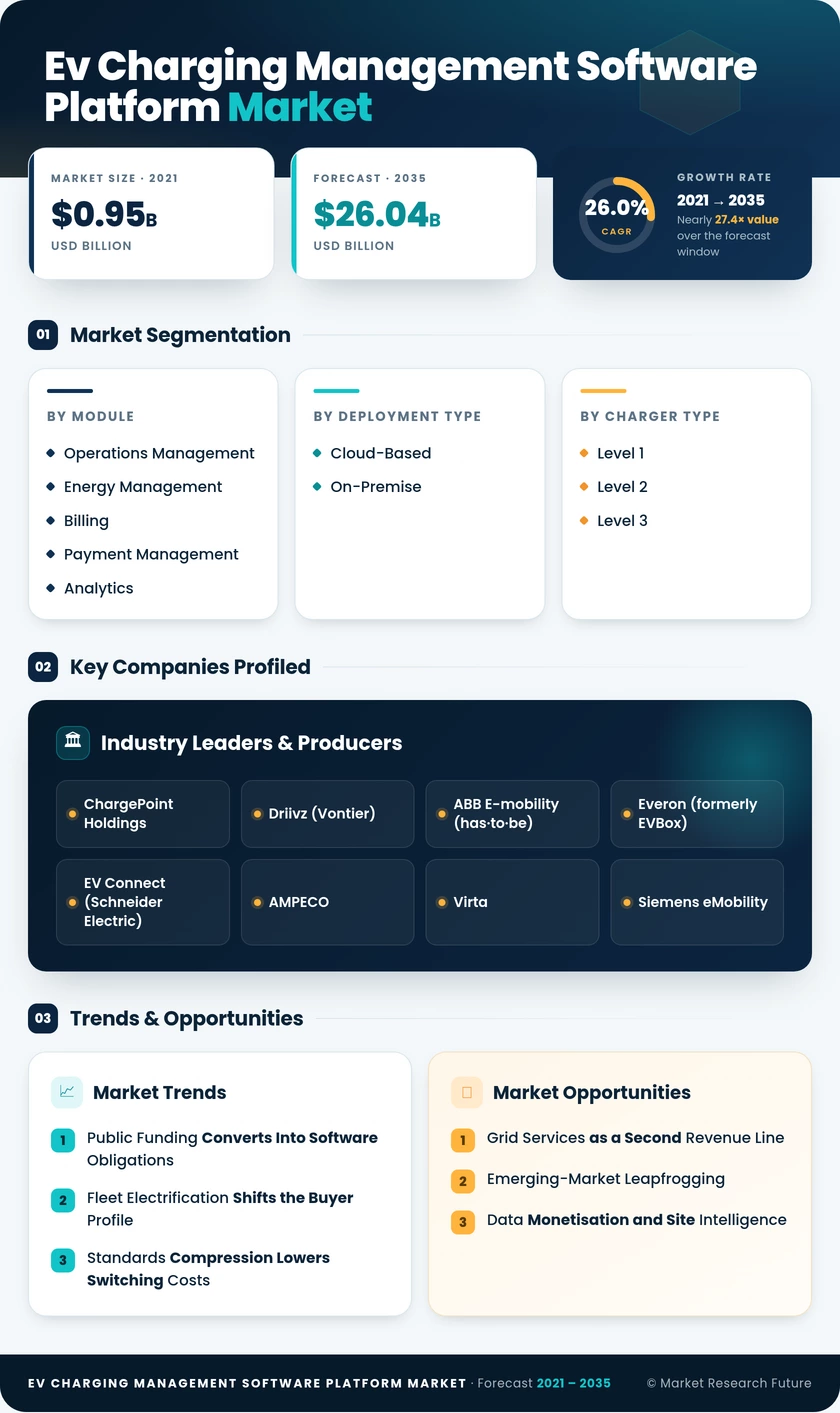
Segmentation Quick Reference
| Dimension | Sub-Segments | Dominant Segment | Fastest Growing Segment |
| By Module | Operations Management; Energy Management; Billing and Payment Management; Analytics and Reporting; Customer and Driver Management; Others | Operations Management | Analytics and Reporting |
| By Deployment Type | Cloud-Based; On-Premise | Cloud-Based | Cloud-Based |
| By Charger Type | Level 1; Level 2; Level 3 | Level 2 | Level 3 |
| By Charging Site | Public Charging Infrastructure; Private Charging Infrastructure | Public Charging Infrastructure | Private Charging Infrastructure |
| By End User | Charge Point Operators; Fleet Operators; Utilities and Energy Providers; Automotive OEMs; Retail and Hospitality Site Hosts | Charge Point Operators | Fleet Operators |
| By Region | North America; Europe; Asia-Pacific; South America; Middle East & Africa | North America | Asia-Pacific |
Market Segmentation Overview
By Module
| Sub-Segment | Key Trend |
| Operations Management | Remote diagnostics and firmware orchestration become contractual uptime obligations |
| Energy Management | Load balancing extends to on-site storage and solar co-optimisation |
| Billing and Payment Management | Regulated price transparency forces per-kWh display and open card acceptance |
| Analytics and Reporting | Session-level intelligence shifts from optional add-on to renewal prerequisite |
| Customer and Driver Management | Plug and Charge authentication replaces app-based session initiation |
| Others (Maintenance, Field Service) | Predictive dispatch reduces truck rolls on distributed estates |
Module purchasing follows a maturity ladder. Operators buy control first, then energy optimisation once demand charges bite, and finally analytics once utilisation rather than coverage determines returns. Vendors that price modules separately capture expansion revenue as customers ascend this ladder.
By Deployment Type
| Sub-Segment | Key Trend |
| Cloud-Based | Multi-tenant architectures absorb irregular connector growth tied to funding cycles |
| On-Premise | Retained mainly for data-residency mandates in utility, defence and sovereign programmes |
Deployment choice increasingly reflects regulation rather than IT preference. Sovereign data-residency requirements in the Gulf and parts of Asia sustain on-premise demand that would otherwise have disappeared entirely.
By Charger Type
| Sub-Segment | Key Trend |
| Level 1 | Residential integration through utility-managed charging programmes |
| Level 2 | Workplace and multi-family reimbursement workflows drive feature depth |
| Level 3 | Thermal, payment, and grid-coordination complexity raises software content per unit |
Power level determines software intensity. A Level 3 site generates more telemetry, more payment events, and more grid interaction than a dozen Level 2 connectors, which is why revenue per connector rises steeply with charging speed.
By Charging Site
| Sub-Segment | Key Trend |
| Public Charging Infrastructure | Roaming settlement and mandated reliability reporting dominate requirements |
| Private Charging Infrastructure | Depot scheduling and demand-charge avoidance define the value case |
Site type splits the vendor landscape more cleanly than any other dimension. Public networks need roaming and payments; private depots need scheduling and telematics reconciliation, and few platforms excel at both.
By End User
| Sub-Segment | Key Trend |
| Charge Point Operators | Consolidation pressures push toward larger, roaming-connected estates |
| Fleet Operators | Route-aware charge sequencing becomes a core logistics planning input |
| Utilities and Energy Providers | Managed-charging programmes convert chargers into flexible grid assets |
| Automotive OEMs | Branded charging experiences licensed rather than built in-house |
| Retail and Hospitality Site Hosts | Dwell-time analytics justify charging as a customer-acquisition expense |
Buyer sophistication varies widely across this dimension. Charge point operators negotiate on unit economics and roaming reach, whereas fleet and retail buyers evaluate charging software against operational savings and footfall data — a framing that supports premium pricing.


 Noah Malgeri
Co-Founder

 Peter Groot koerkamp
Account and Business Manager

 Younghwan Choi
Senior Retail Manager

 Mark Irwin
Management Consultant

 Akif Moroglu
Strategy & Business Development Director

 Guilherme Gomes Martins
Product Management Director

 Joseph Aguayo
Sales Operations & Pricing Manager

 La Terria Dodd
Program Support Specialist

 Rob Kooiker
Group Product Manager HVAC & Fire Protection GMA