
×
Hero Background
English
Chinese
French
Japanese
Korean
German
Spanish

Equipment Monitoring Market Analysis

ID: MRFR/SEM/6008-HCR
100 Pages
Ankit Gupta
October 2025

Equipment Monitoring Market Research Report Information By Monitoring Type (Vibration Monitoring, Thermal Monitoring, Lubricant Monitoring, Corrosion Monitoring, Motor Current Monitoring, Noise & Alarm Monitoring, and GPS Monitoring), By Deployment Type (Cloud, On-Premise), By End-Users (Oil & Gas, Power, Automotive, Aerospace & Defense, Metals & Mining, Food & Beverages, Chemicals, and Others), And By Region (North America, Europe, Asia-Pacific, And Rest Of The World) –Market Forecast Till 2035.

Share:
Download PDF ×

We do not share your information with anyone. However, we may send you emails based on your report interest from time to time. You may contact us at any time to opt-out.

Equipment Monitoring Market Infographic
Purchase Options

Market Analysis

In-depth Analysis of Equipment Monitoring Market Industry Landscape

The Equipment Monitoring Market is dynamically shaped by a range of factors that influence its growth, trends, and overall ecosystem. One of the primary market dynamics is the increasing demand for real-time data and insights. As businesses across industries strive for operational efficiency, the need to monitor equipment in real-time has become paramount. Equipment monitoring solutions provide timely information on the health, performance, and usage patterns of machinery, enabling organizations to make informed decisions, prevent downtime, and optimize their overall operational processes.

Technological advancements play a pivotal role in driving market dynamics within the Equipment Monitoring Market. The integration of advanced technologies such as IoT sensors, artificial intelligence, and machine learning has transformed traditional monitoring systems. These technologies enhance the capabilities of equipment monitoring solutions, allowing for predictive maintenance, anomaly detection, and data-driven decision-making. As technology continues to evolve, the market dynamics are shaped by the ongoing quest for more sophisticated and efficient monitoring solutions.

The emphasis on predictive maintenance is another significant dynamic influencing the Equipment Monitoring Market. Organizations recognize the value of proactive maintenance strategies in preventing equipment failures and minimizing disruptions. Equipment monitoring solutions provide predictive insights into potential issues, enabling businesses to schedule maintenance activities strategically. This shift from reactive to proactive maintenance is reshaping the market dynamics as businesses prioritize solutions that contribute to increased reliability and reduced operational downtime.

Globalization and the expansion of supply chains contribute to the evolving dynamics of the Equipment Monitoring Market. Companies with operations spanning multiple geographical locations require robust monitoring systems to ensure uniformity in equipment performance. The challenge of managing equipment across diverse locations has led to an increased demand for scalable and centralized monitoring solutions, driving market dynamics towards solutions that can cater to the complexities of global supply chains.

Regulatory compliance is a crucial dynamic that significantly influences the Equipment Monitoring Market. Governments worldwide are imposing stringent regulations related to safety, emissions, and environmental standards. Industries are compelled to invest in equipment monitoring solutions to adhere to these regulations and avoid penalties. This dynamic creates a growing market for solutions that not only provide equipment insights but also help businesses meet regulatory requirements and maintain a responsible operational approach.

Cost considerations also play a pivotal role in shaping market dynamics within the Equipment Monitoring Market. While businesses recognize the long-term cost savings associated with reduced downtime and improved operational efficiency, the initial investment in monitoring solutions remains a key consideration. Market dynamics are influenced by the ongoing effort of companies to offer cost-effective solutions without compromising on quality, addressing the balance between affordability and performance.

The transition towards cloud-based solutions is another dynamic trend within the Equipment Monitoring Market. Cloud technology offers scalability, flexibility, and accessibility, making it easier for organizations to deploy and manage monitoring systems. The shift towards cloud-based solutions aligns with the broader trend of digital transformation, and market dynamics are evolving as businesses increasingly prefer solutions that leverage the benefits of cloud infrastructure.

The competitive landscape and market consolidation are dynamic aspects of the Equipment Monitoring Market. As the market matures, companies engage in mergers, acquisitions, and partnerships to strengthen their market position. The dynamics are shaped by strategic alliances and collaborations that aim to enhance product offerings, access new markets, and achieve a competitive edge. Market dynamics reflect the ongoing efforts of companies to adapt to industry trends, customer demands, and emerging technologies to maintain and improve their competitive standing.


Author
Ankit Gupta
Senior Research Analyst

Ankit Gupta is an analyst in market research industry in ICT and SEMI industry. With post-graduation in "Telecom and Marketing Management" and graduation in "Electronics and Telecommunication" vertical he is well versed with recent development in ICT industry as a whole. Having worked on more than 150+ reports including consultation for fortune 500 companies such as Microsoft and Rio Tinto in identifying solutions with respect to business problems his opinions are inclined towards mixture of technical and managerial aspects.

Leave a Comment

FAQs

What is the projected market valuation of the Equipment Monitoring Market by 2035?

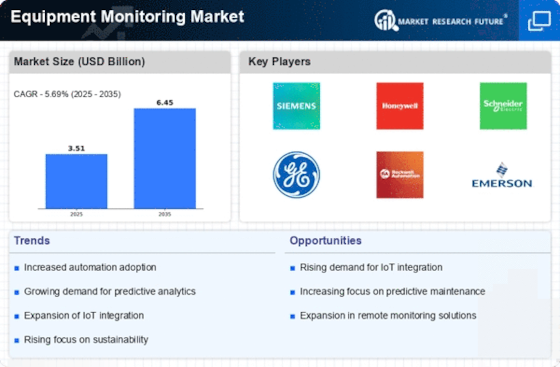
The Equipment Monitoring Market is projected to reach a valuation of 6.453 USD Billion by 2035.

What was the market valuation of the Equipment Monitoring Market in 2024?

In 2024, the Equipment Monitoring Market was valued at 3.51 USD Billion.

What is the expected CAGR for the Equipment Monitoring Market during the forecast period 2025 - 2035?

The expected CAGR for the Equipment Monitoring Market during the forecast period 2025 - 2035 is 5.69%.

Which companies are considered key players in the Equipment Monitoring Market?

Key players in the Equipment Monitoring Market include Siemens, Honeywell, Schneider Electric, General Electric, Rockwell Automation, Emerson Electric, ABB, Cisco Systems, and IBM.

What are the main segments of the Equipment Monitoring Market?

The main segments of the Equipment Monitoring Market include Monitoring Type, Deployment Type, and End-User.

What is the valuation range for Vibration Monitoring in the Equipment Monitoring Market?

The valuation range for Vibration Monitoring in the Equipment Monitoring Market is between 0.75 and 1.25 USD Billion.

Market Summary

As per MRFR analysis, the Equipment Monitoring Market Size was estimated at 3.51 USD Billion in 2024. The Equipment Monitoring industry is projected to grow from 3.71 USD Billion in 2025 to 6.453 USD Billion by 2035, exhibiting a compound annual growth rate (CAGR) of 5.69 during the forecast period 2025 - 2035.

Key Market Trends & Highlights

The Equipment Monitoring Market is experiencing robust growth driven by technological advancements and increasing operational efficiency demands.

  • The rise of predictive maintenance is reshaping operational strategies across various industries. Integration of IoT technologies is enhancing real-time data collection and analysis capabilities. Vibration monitoring remains the largest segment, while thermal monitoring is emerging as the fastest-growing segment. Increasing demand for operational efficiency and regulatory compliance are key drivers propelling market expansion.

Market Size & Forecast

2024 Market Size 3.51 (USD Billion)
2035 Market Size 6.453 (USD Billion)
CAGR (2025 - 2035) 5.69%
Largest Regional Market Share in 2024 North America

Major Players

<p>Siemens (DE), Honeywell (US), Schneider Electric (FR), General Electric (US), Rockwell Automation (US), Emerson Electric (US), ABB (CH), Cisco Systems (US), IBM (US)</p>

Market Trends

The Equipment Monitoring Market is currently experiencing a transformative phase, driven by advancements in technology and increasing demand for operational efficiency. Organizations across various sectors are increasingly adopting sophisticated monitoring solutions to enhance equipment performance, reduce downtime, and optimize maintenance schedules. This trend is largely influenced by the growing emphasis on predictive maintenance, which allows companies to anticipate equipment failures before they occur. As a result, businesses are investing in IoT-enabled devices and analytics platforms that provide real-time insights into equipment health and performance metrics. Moreover, the integration of artificial intelligence and machine learning into monitoring systems is reshaping the landscape of the Equipment Monitoring Market. These technologies facilitate the analysis of vast amounts of data, enabling organizations to make informed decisions regarding asset management. Additionally, the rising awareness of sustainability and energy efficiency is prompting companies to seek solutions that not only improve productivity but also minimize environmental impact. Consequently, the Equipment Monitoring Market is poised for continued growth, as stakeholders recognize the value of leveraging technology to enhance operational capabilities and drive competitive advantage.

Rise of Predictive Maintenance

The Equipment Monitoring Market is witnessing a notable shift towards predictive maintenance strategies. Organizations are increasingly utilizing advanced analytics to forecast equipment failures, thereby reducing unplanned downtime and maintenance costs. This proactive approach enhances operational efficiency and extends the lifespan of assets.

Integration of IoT Technologies

The incorporation of Internet of Things (IoT) technologies is significantly influencing the Equipment Monitoring Market. By connecting equipment to the internet, businesses can gather real-time data, enabling them to monitor performance and make data-driven decisions. This connectivity fosters improved asset management and operational transparency.

Adoption of AI and Machine Learning

Artificial intelligence and machine learning are becoming integral to the Equipment Monitoring Market. These technologies facilitate the analysis of complex data sets, allowing organizations to identify patterns and anomalies in equipment behavior. This capability enhances decision-making processes and supports more effective maintenance strategies.

Equipment Monitoring Market Market Drivers

Growth of Remote Monitoring Capabilities

The Equipment Monitoring Market is experiencing a significant shift towards remote monitoring capabilities, driven by advancements in connectivity and communication technologies. The ability to monitor equipment from remote locations allows organizations to respond swiftly to potential issues, thereby minimizing downtime and maintenance costs. Recent market data reveals that remote monitoring solutions are expected to grow at a compound annual growth rate of 15% over the next five years. This trend is particularly relevant in industries where equipment is located in hard-to-reach areas. As remote monitoring becomes more prevalent, the Equipment Monitoring Market is likely to expand, offering innovative solutions that enhance operational resilience.

Regulatory Compliance and Safety Standards

The Equipment Monitoring Market is significantly influenced by the need for compliance with stringent regulatory frameworks and safety standards. Industries such as manufacturing, energy, and transportation are subject to regulations that mandate regular equipment inspections and maintenance. Non-compliance can lead to severe penalties and operational disruptions. Consequently, organizations are increasingly investing in monitoring solutions that ensure adherence to these regulations. The market data indicates that the demand for compliance-driven monitoring systems is expected to grow by approximately 25% over the next few years. This trend underscores the critical role of the Equipment Monitoring Market in facilitating safe and compliant operations.

Increasing Demand for Operational Efficiency

The Equipment Monitoring Market experiences a notable surge in demand for operational efficiency across various sectors. Organizations are increasingly recognizing the value of real-time monitoring systems that enhance productivity and reduce downtime. According to recent data, companies that implement equipment monitoring solutions can achieve up to a 30% increase in operational efficiency. This trend is driven by the need to optimize resource allocation and minimize maintenance costs. As industries strive to maintain competitiveness, the adoption of advanced monitoring technologies becomes essential. The Equipment Monitoring Market is thus poised for growth as businesses seek to leverage these solutions to streamline operations and improve overall performance.

Technological Advancements in Monitoring Solutions

The Equipment Monitoring Market is propelled by rapid technological advancements that enhance the capabilities of monitoring solutions. Innovations such as cloud computing, big data analytics, and machine learning are transforming how equipment performance is tracked and analyzed. These technologies enable predictive maintenance, allowing organizations to anticipate equipment failures before they occur. Market data suggests that the integration of these advanced technologies could reduce maintenance costs by up to 40%. As industries increasingly adopt these sophisticated monitoring solutions, the Equipment Monitoring Market is likely to witness substantial growth, driven by the demand for smarter and more efficient operational practices.

Rising Focus on Sustainability and Environmental Impact

The Equipment Monitoring Market is increasingly shaped by a rising focus on sustainability and minimizing environmental impact. Organizations are under pressure to adopt practices that reduce their carbon footprint and enhance energy efficiency. Equipment monitoring solutions play a pivotal role in achieving these sustainability goals by providing insights into energy consumption and operational efficiency. Data indicates that companies utilizing monitoring systems can reduce energy usage by as much as 20%. This trend reflects a broader commitment to environmental stewardship, positioning the Equipment Monitoring Market as a key player in the transition towards more sustainable industrial practices.

Market Segment Insights

Equipment Monitoring Market Monitoring Type Insights

<p>The Equipment Monitoring Market segmentation, based on monitoring type includes vibration monitoring, thermal monitoring, lubrication monitoring, corrosion monitoring, motor current monitoring, noise &amp; alarm monitoring, and GPS monitoring. In 2022, the vibration monitoring market had the highest revenue share. The high share can be attributed to the rising demand to detect wear, imbalances, and misalignments. The increasing use of vibration monitoring has been crucial in providing information about spotting flaws early on. The reduction of operational, integration, and maintenance complexity has increased for vibration monitoring solutions.</p>

<p>Players in the industry have increased their investments in equipment that is constantly being monitored, including gearboxes for cooling towers, boiler feed pumps, steam turbines, and gas.</p>

Equipment Monitoring Market Deployment Type Insights

<p>Based on deployment type, the Equipment Monitoring Market segment includes cloud and on-premises. In 2022, the on-premises segment dominated the market and accounted for the largest share of global revenue. On-premises is frequently managed or self-hosted, guarantees that organizations fulfill certain market needs, and empowers teams to manage their workload and build highly customizable environments. Engineers must be able to track and monitor the state of the machines and make it simple for teams to identify long-running or inefficient machines to guarantee that they are working properly. The cloud market will experience rapid expansion over the next few years.</p>

<p>This may be ascribed to several things, including cost-effectiveness, scalability, adaptability, security, and privacy.</p>

<p>Figure 1: Equipment Monitoring Market, by Deployment Type, 2022 &amp; 2032 (USD Billion)</p>

Source: Secondary Research, Primary Research, MRFR Database, and Analyst Review

Equipment Monitoring Market End-User Insights

<p>Based on end-user, the Equipment Monitoring Market segmentation includes oil &amp; gas, power, automotive, aerospace &amp; defense, metals &amp; mining, food &amp; beverages, chemicals, and others. One of the important subsectors of the manufacturing industry is the automotive industry. Automotive are growing increasingly sophisticated as a result of the rapid advancements in technology. The potential production mistakes caused by this heightened complexity are driving up the need for solutions for continuous machine status monitoring. The motor voltage pattern analysis method contributes to a decrease in machine failures and an increase in machine longevity.</p>

<p>For instance, 365,900 vehicles were produced during the third quarter of 2022 by Tesla Inc. In the third quarter of 2022, Tesla's manufacturing level increased by almost 53.9% annually, or more than 41.5% quarterly.</p>

Get more detailed insights about Equipment Monitoring Market Research Report – Global Forecast till 2035

Regional Insights

North America : Technological Innovation Leader

North America is the largest market for equipment monitoring, holding approximately 40% of the global share. The region's growth is driven by rapid technological advancements, increasing demand for predictive maintenance, and stringent regulatory standards aimed at enhancing operational efficiency. The presence of major players and a robust industrial base further catalyze market expansion, with significant investments in IoT and AI technologies. The United States and Canada are the leading countries in this region, with the U.S. accounting for the majority of the market share. Key players such as Siemens, Honeywell, and General Electric dominate the landscape, leveraging their technological expertise to offer innovative solutions. The competitive environment is characterized by continuous product development and strategic partnerships, ensuring a strong foothold in the market.

Europe : Sustainability and Compliance Focus

Europe is the second-largest market for equipment monitoring, capturing around 30% of the global share. The region's growth is significantly influenced by stringent environmental regulations and a strong emphasis on sustainability. The European Union's initiatives to promote energy efficiency and reduce carbon emissions are key drivers, pushing industries to adopt advanced monitoring solutions for compliance and operational efficiency. Germany, France, and the UK are the leading countries in this market, with Germany being the largest contributor. The competitive landscape features major players like Schneider Electric and ABB, who are actively involved in developing innovative solutions tailored to meet regulatory requirements. The presence of a well-established industrial sector and a focus on digital transformation further enhance market opportunities.

Asia-Pacific : Emerging Market Potential

Asia-Pacific is witnessing rapid growth in the equipment monitoring market, holding approximately 25% of the global share. The region's expansion is driven by increasing industrialization, urbanization, and the adoption of smart technologies. Countries like China and India are investing heavily in infrastructure development, which is expected to boost demand for advanced monitoring solutions to enhance operational efficiency and reduce downtime. China and Japan are the leading countries in this region, with China being the largest market. The competitive landscape is evolving, with both The Equipment Monitoring Market share. Companies like Rockwell Automation and Emerson Electric are expanding their presence, focusing on innovative solutions that cater to the unique needs of the region's diverse industries. The growing emphasis on IoT and AI technologies is also shaping the competitive dynamics.

Middle East and Africa : Resource-Rich Opportunities

The Middle East and Africa region is emerging as a significant player in the equipment monitoring market, accounting for about 5% of the global share. The growth is primarily driven by increasing investments in oil and gas, mining, and manufacturing sectors. Governments are also implementing regulations to enhance operational efficiency and safety, which is further propelling the demand for advanced monitoring solutions. Countries like the UAE and South Africa are at the forefront of this market, with the UAE leading in terms of investments in smart technologies. The competitive landscape includes both international and regional players, with companies like Cisco Systems and IBM making strides in offering innovative solutions tailored to local needs. The focus on digital transformation and smart infrastructure is expected to drive future growth in the region.

Key Players and Competitive Insights

Leading market players are investing heavily in research and development to expand their product lines, which will help the advanced authentication market, grow even more. Market participants are also engaging in various strategic measures to grow their businesses, and global footprint, with important market developments including contractual agreements, new product launches, mergers and acquisitions, higher investments, and collaboration with other organizations. The equipment monitoring industry must offer cost-effective items to expand and survive in a more competitive and rising market climate.

Manufacturing locally to minimize operational costs is one of the key business tactics manufacturers use in the global equipment monitoring industry to benefit clients and increase the market sector. In recent years, the equipment monitoring industry has offered some of the most significant advantages to medicine. Major players in the advanced authentication market, including SKF, Emerson Electric, General Electric, Honeywell International, National Instruments, Parker Hannifin Corporation, Rockwell Automation, Inc., Schaeffler AG, ABB, Fortive Corporation, ALS Limited, Schneider Electric Co., and others, are attempting to increase market demand by investing in research and development operations.

BB may offer systems that use sensors to continuously monitor key parameters of industrial equipment, such as motors, pumps, and generators. These parameters could include temperature, vibration, pressure, and other critical data. ABB might provide remote monitoring capabilities, allowing users to access equipment data and status from a centralized location or through cloud-based platforms. For instance, in September 2022, to provide improved condition monitoring services, ABB and Samotics, a high-growth scaleup company in the Netherlands and a well-known supplier of ESA technology, established a long-term strategic partnership.

The technique will make use of each company's advantages to offer additional information about the health and power effectiveness of the equipment.

SKF provides various condition monitoring systems that use sensors to measure parameters such as vibration, temperature, pressure, and lubrication conditions of industrial equipment. These systems continuously monitor the health of critical machinery and components, providing real-time data to detect potential issues and anomalies. For instance, in January 2021, SKF engaged with Solvang to maintain its fleet of tankers and make a purchase of a new system for detecting vibration and light.

Key Companies in the Equipment Monitoring Market market include

Industry Developments

February 2021: For instance, ABB announced the installation of asset condition software in a Chinese coal mine. It may make it possible for the mining firm to cut expenses, simplify maintenance, and increase capacity. Leading organizations have been inspired to expand their footprint as a result of the growing footprint of AI-powered technology.

Future Outlook

Equipment Monitoring Market Future Outlook

<p>The Equipment Monitoring Market is projected to grow at a 5.69% CAGR from 2024 to 2035, driven by advancements in IoT, predictive analytics, and increased demand for operational efficiency.</p>

New opportunities lie in:

  • <p>Integration of AI-driven predictive maintenance solutions</p>
  • <p>Development of mobile monitoring applications for real-time data access</p>
  • <p>Expansion of cloud-based monitoring platforms for scalability and flexibility</p>

<p>By 2035, the Equipment Monitoring Market is expected to achieve robust growth, reflecting evolving technological advancements.</p>

Market Segmentation

Equipment Monitoring Market End-User Outlook

  • Oil & Gas
  • Power
  • Automotive
  • Aerospace & Defense
  • Metals & Mining
  • Food & Beverages
  • Chemicals
  • Others

Equipment Monitoring Market Deployment Type Outlook

  • Cloud
  • On-Premise

Equipment Monitoring Market Monitoring Type Outlook

  • Vibration Monitoring
  • Thermal Monitoring
  • Lubrication Monitoring
  • Corrosion Monitoring
  • Motor Current Monitoring
  • Noise & Alarm Monitoring
  • GPS Monitoring

Report Scope

MARKET SIZE 2024 3.51(USD Billion)
MARKET SIZE 2025 3.71(USD Billion)
MARKET SIZE 2035 6.453(USD Billion)
COMPOUND ANNUAL GROWTH RATE (CAGR) 5.69% (2024 - 2035)
REPORT COVERAGE Revenue Forecast, Competitive Landscape, Growth Factors, and Trends
BASE YEAR 2024
Market Forecast Period 2025 - 2035
Historical Data 2019 - 2024
Market Forecast Units USD Billion
Key Companies Profiled Market analysis in progress
Segments Covered Market segmentation analysis in progress
Key Market Opportunities Integration of Internet of Things (IoT) technologies enhances real-time monitoring capabilities in the Equipment Monitoring Market.
Key Market Dynamics Rising demand for real-time data analytics drives innovation in equipment monitoring technologies and competitive market dynamics.
Countries Covered North America, Europe, APAC, South America, MEA

FAQs

What is the projected market valuation of the Equipment Monitoring Market by 2035?

The Equipment Monitoring Market is projected to reach a valuation of 6.453 USD Billion by 2035.

What was the market valuation of the Equipment Monitoring Market in 2024?

In 2024, the Equipment Monitoring Market was valued at 3.51 USD Billion.

What is the expected CAGR for the Equipment Monitoring Market during the forecast period 2025 - 2035?

The expected CAGR for the Equipment Monitoring Market during the forecast period 2025 - 2035 is 5.69%.

Which companies are considered key players in the Equipment Monitoring Market?

Key players in the Equipment Monitoring Market include Siemens, Honeywell, Schneider Electric, General Electric, Rockwell Automation, Emerson Electric, ABB, Cisco Systems, and IBM.

What are the main segments of the Equipment Monitoring Market?

The main segments of the Equipment Monitoring Market include Monitoring Type, Deployment Type, and End-User.

What is the valuation range for Vibration Monitoring in the Equipment Monitoring Market?

The valuation range for Vibration Monitoring in the Equipment Monitoring Market is between 0.75 and 1.25 USD Billion.

  1. SECTION I: EXECUTIVE SUMMARY AND KEY HIGHLIGHTS
    1. EXECUTIVE SUMMARY
      1. Market Overview
      2. Key Findings
      3. Market Segmentation
      4. Competitive Landscape
      5. Challenges and Opportunities
      6. Future Outlook 2
  2. SECTION II: SCOPING, METHODOLOGY AND MARKET STRUCTURE
    1. MARKET INTRODUCTION
      1. Definition
      2. Scope of the study
    2. RESEARCH METHODOLOGY
      1. Overview
      2. Data Mining
      3. Secondary Research
      4. Primary Research
      5. Forecasting Model
      6. Market Size Estimation
      7. Data Triangulation
      8. Validation 3
  3. SECTION III: QUALITATIVE ANALYSIS
    1. MARKET DYNAMICS
      1. Overview
      2. Drivers
      3. Restraints
      4. Opportunities
    2. MARKET FACTOR ANALYSIS
      1. Value chain Analysis
      2. Porter's Five Forces Analysis
      3. COVID-19 Impact Analysis
  4. SECTION IV: QUANTITATIVE ANALYSIS
    1. Semiconductor & Electronics, BY Monitoring Type (USD Billion)
      1. Vibration Monitoring
      2. Thermal Monitoring
      3. Lubrication Monitoring
      4. Corrosion Monitoring
      5. Motor Current Monitoring
      6. Noise & Alarm Monitoring
      7. GPS Monitoring
    2. Semiconductor & Electronics, BY Deployment Type (USD Billion)
      1. Cloud
      2. On-Premise
    3. Semiconductor & Electronics, BY End-User (USD Billion)
      1. Oil & Gas
      2. Power
      3. Automotive
      4. Aerospace & Defense
      5. Metals & Mining
      6. Food & Beverages
      7. Chemicals
      8. Others
    4. Semiconductor & Electronics, BY Region (USD Billion)
      1. North America
      2. Europe
      3. APAC
      4. South America
      5. MEA
  5. SECTION V: COMPETITIVE ANALYSIS
    1. Competitive Landscape
      1. Overview
      2. Competitive Analysis
      3. Market share Analysis
      4. Major Growth Strategy in the Semiconductor & Electronics
      5. Competitive Benchmarking
      6. Leading Players in Terms of Number of Developments in the Semiconductor & Electronics
      7. Key developments and growth strategies
      8. Major Players Financial Matrix
    2. Company Profiles
      1. Siemens (DE)
      2. Honeywell (US)
      3. Schneider Electric (FR)
      4. General Electric (US)
      5. Rockwell Automation (US)
      6. Emerson Electric (US)
      7. ABB (CH)
      8. Cisco Systems (US)
      9. IBM (US)
    3. Appendix
      1. References
      2. Related Reports 6 LIST OF FIGURES
    4. MARKET SYNOPSIS
    5. NORTH AMERICA MARKET ANALYSIS
    6. US MARKET ANALYSIS BY MONITORING TYPE
    7. US MARKET ANALYSIS BY DEPLOYMENT TYPE
    8. US MARKET ANALYSIS BY END-USER
    9. CANADA MARKET ANALYSIS BY MONITORING TYPE
    10. CANADA MARKET ANALYSIS BY DEPLOYMENT TYPE
    11. CANADA MARKET ANALYSIS BY END-USER
    12. EUROPE MARKET ANALYSIS
    13. GERMANY MARKET ANALYSIS BY MONITORING TYPE
    14. GERMANY MARKET ANALYSIS BY DEPLOYMENT TYPE
    15. GERMANY MARKET ANALYSIS BY END-USER
    16. UK MARKET ANALYSIS BY MONITORING TYPE
    17. UK MARKET ANALYSIS BY DEPLOYMENT TYPE
    18. UK MARKET ANALYSIS BY END-USER
    19. FRANCE MARKET ANALYSIS BY MONITORING TYPE
    20. FRANCE MARKET ANALYSIS BY DEPLOYMENT TYPE
    21. FRANCE MARKET ANALYSIS BY END-USER
    22. RUSSIA MARKET ANALYSIS BY MONITORING TYPE
    23. RUSSIA MARKET ANALYSIS BY DEPLOYMENT TYPE
    24. RUSSIA MARKET ANALYSIS BY END-USER
    25. ITALY MARKET ANALYSIS BY MONITORING TYPE
    26. ITALY MARKET ANALYSIS BY DEPLOYMENT TYPE
    27. ITALY MARKET ANALYSIS BY END-USER
    28. SPAIN MARKET ANALYSIS BY MONITORING TYPE
    29. SPAIN MARKET ANALYSIS BY DEPLOYMENT TYPE
    30. SPAIN MARKET ANALYSIS BY END-USER
    31. REST OF EUROPE MARKET ANALYSIS BY MONITORING TYPE
    32. REST OF EUROPE MARKET ANALYSIS BY DEPLOYMENT TYPE
    33. REST OF EUROPE MARKET ANALYSIS BY END-USER
    34. APAC MARKET ANALYSIS
    35. CHINA MARKET ANALYSIS BY MONITORING TYPE
    36. CHINA MARKET ANALYSIS BY DEPLOYMENT TYPE
    37. CHINA MARKET ANALYSIS BY END-USER
    38. INDIA MARKET ANALYSIS BY MONITORING TYPE
    39. INDIA MARKET ANALYSIS BY DEPLOYMENT TYPE
    40. INDIA MARKET ANALYSIS BY END-USER
    41. JAPAN MARKET ANALYSIS BY MONITORING TYPE
    42. JAPAN MARKET ANALYSIS BY DEPLOYMENT TYPE
    43. JAPAN MARKET ANALYSIS BY END-USER
    44. SOUTH KOREA MARKET ANALYSIS BY MONITORING TYPE
    45. SOUTH KOREA MARKET ANALYSIS BY DEPLOYMENT TYPE
    46. SOUTH KOREA MARKET ANALYSIS BY END-USER
    47. MALAYSIA MARKET ANALYSIS BY MONITORING TYPE
    48. MALAYSIA MARKET ANALYSIS BY DEPLOYMENT TYPE
    49. MALAYSIA MARKET ANALYSIS BY END-USER
    50. THAILAND MARKET ANALYSIS BY MONITORING TYPE
    51. THAILAND MARKET ANALYSIS BY DEPLOYMENT TYPE
    52. THAILAND MARKET ANALYSIS BY END-USER
    53. INDONESIA MARKET ANALYSIS BY MONITORING TYPE
    54. INDONESIA MARKET ANALYSIS BY DEPLOYMENT TYPE
    55. INDONESIA MARKET ANALYSIS BY END-USER
    56. REST OF APAC MARKET ANALYSIS BY MONITORING TYPE
    57. REST OF APAC MARKET ANALYSIS BY DEPLOYMENT TYPE
    58. REST OF APAC MARKET ANALYSIS BY END-USER
    59. SOUTH AMERICA MARKET ANALYSIS
    60. BRAZIL MARKET ANALYSIS BY MONITORING TYPE
    61. BRAZIL MARKET ANALYSIS BY DEPLOYMENT TYPE
    62. BRAZIL MARKET ANALYSIS BY END-USER
    63. MEXICO MARKET ANALYSIS BY MONITORING TYPE
    64. MEXICO MARKET ANALYSIS BY DEPLOYMENT TYPE
    65. MEXICO MARKET ANALYSIS BY END-USER
    66. ARGENTINA MARKET ANALYSIS BY MONITORING TYPE
    67. ARGENTINA MARKET ANALYSIS BY DEPLOYMENT TYPE
    68. ARGENTINA MARKET ANALYSIS BY END-USER
    69. REST OF SOUTH AMERICA MARKET ANALYSIS BY MONITORING TYPE
    70. REST OF SOUTH AMERICA MARKET ANALYSIS BY DEPLOYMENT TYPE
    71. REST OF SOUTH AMERICA MARKET ANALYSIS BY END-USER
    72. MEA MARKET ANALYSIS
    73. GCC COUNTRIES MARKET ANALYSIS BY MONITORING TYPE
    74. GCC COUNTRIES MARKET ANALYSIS BY DEPLOYMENT TYPE
    75. GCC COUNTRIES MARKET ANALYSIS BY END-USER
    76. SOUTH AFRICA MARKET ANALYSIS BY MONITORING TYPE
    77. SOUTH AFRICA MARKET ANALYSIS BY DEPLOYMENT TYPE
    78. SOUTH AFRICA MARKET ANALYSIS BY END-USER
    79. REST OF MEA MARKET ANALYSIS BY MONITORING TYPE
    80. REST OF MEA MARKET ANALYSIS BY DEPLOYMENT TYPE
    81. REST OF MEA MARKET ANALYSIS BY END-USER
    82. KEY BUYING CRITERIA OF SEMICONDUCTOR & ELECTRONICS
    83. RESEARCH PROCESS OF MRFR
    84. DRO ANALYSIS OF SEMICONDUCTOR & ELECTRONICS
    85. DRIVERS IMPACT ANALYSIS: SEMICONDUCTOR & ELECTRONICS
    86. RESTRAINTS IMPACT ANALYSIS: SEMICONDUCTOR & ELECTRONICS
    87. SUPPLY / VALUE CHAIN: SEMICONDUCTOR & ELECTRONICS
    88. SEMICONDUCTOR & ELECTRONICS, BY MONITORING TYPE, 2024 (% SHARE)
    89. SEMICONDUCTOR & ELECTRONICS, BY MONITORING TYPE, 2024 TO 2035 (USD Billion)
    90. SEMICONDUCTOR & ELECTRONICS, BY DEPLOYMENT TYPE, 2024 (% SHARE)
    91. SEMICONDUCTOR & ELECTRONICS, BY DEPLOYMENT TYPE, 2024 TO 2035 (USD Billion)
    92. SEMICONDUCTOR & ELECTRONICS, BY END-USER, 2024 (% SHARE)
    93. SEMICONDUCTOR & ELECTRONICS, BY END-USER, 2024 TO 2035 (USD Billion)
    94. BENCHMARKING OF MAJOR COMPETITORS 7 LIST OF TABLES
    95. LIST OF ASSUMPTIONS
    96. North America MARKET SIZE ESTIMATES; FORECAST
      1. BY MONITORING TYPE, 2025-2035 (USD Billion)
      2. BY DEPLOYMENT TYPE, 2025-2035 (USD Billion)
      3. BY END-USER, 2025-2035 (USD Billion)
    97. US MARKET SIZE ESTIMATES; FORECAST
      1. BY MONITORING TYPE, 2025-2035 (USD Billion)
      2. BY DEPLOYMENT TYPE, 2025-2035 (USD Billion)
      3. BY END-USER, 2025-2035 (USD Billion)
    98. Canada MARKET SIZE ESTIMATES; FORECAST
      1. BY MONITORING TYPE, 2025-2035 (USD Billion)
      2. BY DEPLOYMENT TYPE, 2025-2035 (USD Billion)
      3. BY END-USER, 2025-2035 (USD Billion)
    99. Europe MARKET SIZE ESTIMATES; FORECAST
      1. BY MONITORING TYPE, 2025-2035 (USD Billion)
      2. BY DEPLOYMENT TYPE, 2025-2035 (USD Billion)
      3. BY END-USER, 2025-2035 (USD Billion)
    100. Germany MARKET SIZE ESTIMATES; FORECAST
      1. BY MONITORING TYPE, 2025-2035 (USD Billion)
      2. BY DEPLOYMENT TYPE, 2025-2035 (USD Billion)
      3. BY END-USER, 2025-2035 (USD Billion)
    101. UK MARKET SIZE ESTIMATES; FORECAST
      1. BY MONITORING TYPE, 2025-2035 (USD Billion)
      2. BY DEPLOYMENT TYPE, 2025-2035 (USD Billion)
      3. BY END-USER, 2025-2035 (USD Billion)
    102. France MARKET SIZE ESTIMATES; FORECAST
      1. BY MONITORING TYPE, 2025-2035 (USD Billion)
      2. BY DEPLOYMENT TYPE, 2025-2035 (USD Billion)
      3. BY END-USER, 2025-2035 (USD Billion)
    103. Russia MARKET SIZE ESTIMATES; FORECAST
      1. BY MONITORING TYPE, 2025-2035 (USD Billion)
      2. BY DEPLOYMENT TYPE, 2025-2035 (USD Billion)
      3. BY END-USER, 2025-2035 (USD Billion)
    104. Italy MARKET SIZE ESTIMATES; FORECAST
      1. BY MONITORING TYPE, 2025-2035 (USD Billion)
      2. BY DEPLOYMENT TYPE, 2025-2035 (USD Billion)
      3. BY END-USER, 2025-2035 (USD Billion)
    105. Spain MARKET SIZE ESTIMATES; FORECAST
      1. BY MONITORING TYPE, 2025-2035 (USD Billion)
      2. BY DEPLOYMENT TYPE, 2025-2035 (USD Billion)
      3. BY END-USER, 2025-2035 (USD Billion)
    106. Rest of Europe MARKET SIZE ESTIMATES; FORECAST
      1. BY MONITORING TYPE, 2025-2035 (USD Billion)
      2. BY DEPLOYMENT TYPE, 2025-2035 (USD Billion)
      3. BY END-USER, 2025-2035 (USD Billion)
    107. APAC MARKET SIZE ESTIMATES; FORECAST
      1. BY MONITORING TYPE, 2025-2035 (USD Billion)
      2. BY DEPLOYMENT TYPE, 2025-2035 (USD Billion)
      3. BY END-USER, 2025-2035 (USD Billion)
    108. China MARKET SIZE ESTIMATES; FORECAST
      1. BY MONITORING TYPE, 2025-2035 (USD Billion)
      2. BY DEPLOYMENT TYPE, 2025-2035 (USD Billion)
      3. BY END-USER, 2025-2035 (USD Billion)
    109. India MARKET SIZE ESTIMATES; FORECAST
      1. BY MONITORING TYPE, 2025-2035 (USD Billion)
      2. BY DEPLOYMENT TYPE, 2025-2035 (USD Billion)
      3. BY END-USER, 2025-2035 (USD Billion)
    110. Japan MARKET SIZE ESTIMATES; FORECAST
      1. BY MONITORING TYPE, 2025-2035 (USD Billion)
      2. BY DEPLOYMENT TYPE, 2025-2035 (USD Billion)
      3. BY END-USER, 2025-2035 (USD Billion)
    111. South Korea MARKET SIZE ESTIMATES; FORECAST
      1. BY MONITORING TYPE, 2025-2035 (USD Billion)
      2. BY DEPLOYMENT TYPE, 2025-2035 (USD Billion)
      3. BY END-USER, 2025-2035 (USD Billion)
    112. Malaysia MARKET SIZE ESTIMATES; FORECAST
      1. BY MONITORING TYPE, 2025-2035 (USD Billion)
      2. BY DEPLOYMENT TYPE, 2025-2035 (USD Billion)
      3. BY END-USER, 2025-2035 (USD Billion)
    113. Thailand MARKET SIZE ESTIMATES; FORECAST
      1. BY MONITORING TYPE, 2025-2035 (USD Billion)
      2. BY DEPLOYMENT TYPE, 2025-2035 (USD Billion)
      3. BY END-USER, 2025-2035 (USD Billion)
    114. Indonesia MARKET SIZE ESTIMATES; FORECAST
      1. BY MONITORING TYPE, 2025-2035 (USD Billion)
      2. BY DEPLOYMENT TYPE, 2025-2035 (USD Billion)
      3. BY END-USER, 2025-2035 (USD Billion)
    115. Rest of APAC MARKET SIZE ESTIMATES; FORECAST
      1. BY MONITORING TYPE, 2025-2035 (USD Billion)
      2. BY DEPLOYMENT TYPE, 2025-2035 (USD Billion)
      3. BY END-USER, 2025-2035 (USD Billion)
    116. South America MARKET SIZE ESTIMATES; FORECAST
      1. BY MONITORING TYPE, 2025-2035 (USD Billion)
      2. BY DEPLOYMENT TYPE, 2025-2035 (USD Billion)
      3. BY END-USER, 2025-2035 (USD Billion)
    117. Brazil MARKET SIZE ESTIMATES; FORECAST
      1. BY MONITORING TYPE, 2025-2035 (USD Billion)
      2. BY DEPLOYMENT TYPE, 2025-2035 (USD Billion)
      3. BY END-USER, 2025-2035 (USD Billion)
    118. Mexico MARKET SIZE ESTIMATES; FORECAST
      1. BY MONITORING TYPE, 2025-2035 (USD Billion)
      2. BY DEPLOYMENT TYPE, 2025-2035 (USD Billion)
      3. BY END-USER, 2025-2035 (USD Billion)
    119. Argentina MARKET SIZE ESTIMATES; FORECAST
      1. BY MONITORING TYPE, 2025-2035 (USD Billion)
      2. BY DEPLOYMENT TYPE, 2025-2035 (USD Billion)
      3. BY END-USER, 2025-2035 (USD Billion)
    120. Rest of South America MARKET SIZE ESTIMATES; FORECAST
      1. BY MONITORING TYPE, 2025-2035 (USD Billion)
      2. BY DEPLOYMENT TYPE, 2025-2035 (USD Billion)
      3. BY END-USER, 2025-2035 (USD Billion)
    121. MEA MARKET SIZE ESTIMATES; FORECAST
      1. BY MONITORING TYPE, 2025-2035 (USD Billion)
      2. BY DEPLOYMENT TYPE, 2025-2035 (USD Billion)
      3. BY END-USER, 2025-2035 (USD Billion)
    122. GCC Countries MARKET SIZE ESTIMATES; FORECAST
      1. BY MONITORING TYPE, 2025-2035 (USD Billion)
      2. BY DEPLOYMENT TYPE, 2025-2035 (USD Billion)
      3. BY END-USER, 2025-2035 (USD Billion)
    123. South Africa MARKET SIZE ESTIMATES; FORECAST
      1. BY MONITORING TYPE, 2025-2035 (USD Billion)
      2. BY DEPLOYMENT TYPE, 2025-2035 (USD Billion)
      3. BY END-USER, 2025-2035 (USD Billion)
    124. Rest of MEA MARKET SIZE ESTIMATES; FORECAST
      1. BY MONITORING TYPE, 2025-2035 (USD Billion)
      2. BY DEPLOYMENT TYPE, 2025-2035 (USD Billion)
      3. BY END-USER, 2025-2035 (USD Billion)
    125. PRODUCT LAUNCH/PRODUCT DEVELOPMENT/APPROVAL
    126. ACQUISITION/PARTNERSHIP

Equipment Monitoring Market Segmentation

Equipment Monitoring Monitoring Type Outlook (USD Billion, 2018-2032)

  • Vibration Monitoring
  • Thermal Monitoring
  • Lubrication Monitoring
  • Corrosion Monitoring
  • Motor Current Monitoring
  • Noise & Alarm Monitoring
  • GPS Monitoring

Equipment Monitoring Deployment Type Outlook (USD Billion, 2018-2032)

  • Cloud
  • On-Premise

Equipment Monitoring End-User Outlook (USD Billion, 2018-2032)

  • Oil & Gas
  • Power
  • Automotive
  • Aerospace & Defense
  • Metals & Mining
  • Food & Beverages
  • Chemicals
  • Others

Equipment Monitoring Regional Outlook (USD Billion, 2018-2032)

  • North America Outlook (USD Billion, 2018-2032)

    • North America Equipment Monitoring by Monitoring Type
      • Vibration Monitoring
      • Thermal Monitoring
      • Lubrication Monitoring
      • Corrosion Monitoring
      • Motor Current Monitoring
      • Noise & Alarm Monitoring
      • GPS Monitoring
    • North America Equipment Monitoring by Deployment Type
      • Cloud
      • On-Premise
    • North America Equipment Monitoring by End-User
      • Oil & Gas
      • Power
      • Automotive
      • Aerospace & Defense
      • Metals & Mining
      • Food & Beverages
      • Chemicals
      • Others
    • US Outlook (USD Billion, 2018-2032)

    • US Equipment Monitoring by Monitoring Type
      • Vibration Monitoring
      • Thermal Monitoring
      • Lubrication Monitoring
      • Corrosion Monitoring
      • Motor Current Monitoring
      • Noise & Alarm Monitoring
      • GPS Monitoring
    • US Equipment Monitoring by Deployment Type
      • Cloud
      • On-Premise
    • US Equipment Monitoring by End-User
      • Oil & Gas
      • Power
      • Automotive
      • Aerospace & Defense
      • Metals & Mining
      • Food & Beverages
      • Chemicals
      • Others
    • CANADA Outlook (USD Billion, 2018-2032)

    • CANADA Equipment Monitoring by Fusion Monitoring Type
      • Vibration Monitoring
      • Thermal Monitoring
      • Lubrication Monitoring
      • Corrosion Monitoring
      • Motor Current Monitoring
      • Noise & Alarm Monitoring
      • GPS Monitoring
    • CANADA Equipment Monitoring by Deployment Type
      • Cloud
      • On-Premise
    • CANADA Equipment Monitoring by End-User
      • Oil & Gas
      • Power
      • Automotive
      • Aerospace & Defense
      • Metals & Mining
      • Food & Beverages
      • Chemicals
      • Others
  • Europe Outlook (GERMANYD Million, 2018-2032)

    • Europe Equipment Monitoring by Monitoring Type
      • Vibration Monitoring
      • Thermal Monitoring
      • Lubrication Monitoring
      • Corrosion Monitoring
      • Motor Current Monitoring
      • Noise & Alarm Monitoring
      • GPS Monitoring
    • Europe Equipment Monitoring by Deployment Type
      • Cloud
      • On-Premise
    • Europe Equipment Monitoring by End-User
      • Oil & Gas
      • Power
      • Automotive
      • Aerospace & Defense
      • Metals & Mining
      • Food & Beverages
      • Chemicals
      • Others
    • GERMANY Outlook (USD Billion, 2018-2032)

    • GERMANY Equipment Monitoring by Monitoring Type
      • Vibration Monitoring
      • Thermal Monitoring
      • Lubrication Monitoring
      • Corrosion Monitoring
      • Motor Current Monitoring
      • Noise & Alarm Monitoring
      • GPS Monitoring
    • GERMANY Equipment Monitoring by Deployment Type
      • Cloud
      • On-Premise
    • GERMANY Equipment Monitoring by End-User
      • Oil & Gas
      • Power
      • Automotive
      • Aerospace & Defense
      • Metals & Mining
      • Food & Beverages
      • Chemicals
      • Others
    • FRANCE Outlook (USD Billion, 2018-2032)

    • FRANCE Equipment Monitoring by Monitoring Type
      • Vibration Monitoring
      • Thermal Monitoring
      • Lubrication Monitoring
      • Corrosion Monitoring
      • Motor Current Monitoring
      • Noise & Alarm Monitoring
      • GPS Monitoring
    • FRANCE Equipment Monitoring by Deployment Type
      • Cloud
      • On-Premise
    • FRANCE Equipment Monitoring by End-User
      • Oil & Gas
      • Power
      • Automotive
      • Aerospace & Defense
      • Metals & Mining
      • Food & Beverages
      • Chemicals
      • Others
    • UK Outlook (USD Billion, 2018-2032)

    • UK Equipment Monitoring by Monitoring Type
      • Vibration Monitoring
      • Thermal Monitoring
      • Lubrication Monitoring
      • Corrosion Monitoring
      • Motor Current Monitoring
      • Noise & Alarm Monitoring
      • GPS Monitoring
    • UK Equipment Monitoring by Deployment Type
      • Cloud
      • On-Premise
    • UK Equipment Monitoring by End-User
      • Oil & Gas
      • Power
      • Automotive
      • Aerospace & Defense
      • Metals & Mining
      • Food & Beverages
      • Chemicals
      • Others
    • ITALY Outlook (USD Billion, 2018-2032)

    • ITALY Equipment Monitoring by Monitoring Type
      • Vibration Monitoring
      • Thermal Monitoring
      • Lubrication Monitoring
      • Corrosion Monitoring
      • Motor Current Monitoring
      • Noise & Alarm Monitoring
      • GPS Monitoring
    • ITALY Equipment Monitoring by Deployment Type
      • Cloud
      • On-Premise
    • ITALY Equipment Monitoring by End-User
      • Oil & Gas
      • Power
      • Automotive
      • Aerospace & Defense
      • Metals & Mining
      • Food & Beverages
      • Chemicals
      • Others
    • SPAIN Outlook (USD Billion, 2018-2032)

    • SPAIN Equipment Monitoring by Fusion Monitoring Type
      • Vibration Monitoring
      • Thermal Monitoring
      • Lubrication Monitoring
      • Corrosion Monitoring
      • Motor Current Monitoring
      • Noise & Alarm Monitoring
      • GPS Monitoring
    • SPAIN Equipment Monitoring by Deployment Type
      • Cloud
      • On-Premise
    • SPAIN Equipment Monitoring by End-User
      • Oil & Gas
      • Power
      • Automotive
      • Aerospace & Defense
      • Metals & Mining
      • Food & Beverages
      • Chemicals
      • Others
    • Rest of Europe Outlook (USD Billion, 2018-2032)

    • Rest of Europe Equipment Monitoring by Monitoring Type
      • Vibration Monitoring
      • Thermal Monitoring
      • Lubrication Monitoring
      • Corrosion Monitoring
      • Motor Current Monitoring
      • Noise & Alarm Monitoring
      • GPS Monitoring
    • Rest of Europe Equipment Monitoring by Deployment Type
      • Cloud
      • On-Premise
    • Rest of Europe Equipment Monitoring by End-User
      • Oil & Gas
      • Power
      • Automotive
      • Aerospace & Defense
      • Metals & Mining
      • Food & Beverages
      • Chemicals
      • Others
  • Asia Pacific Outlook (USD Billion, 2018-2032)

    • Asia Pacific Equipment Monitoring by Monitoring Type
      • Vibration Monitoring
      • Thermal Monitoring
      • Lubrication Monitoring
      • Corrosion Monitoring
      • Motor Current Monitoring
      • Noise & Alarm Monitoring
      • GPS Monitoring
    • Asia Pacific Equipment Monitoring by Deployment Type
      • Cloud
      • On-Premise
    • Asia Pacific Equipment Monitoring by End-User
      • Oil & Gas
      • Power
      • Automotive
      • Aerospace & Defense
      • Metals & Mining
      • Food & Beverages
      • Chemicals
      • Others
    • China Outlook (USD Billion, 2018-2032)

    • China Equipment Monitoring by Monitoring Type
      • Vibration Monitoring
      • Thermal Monitoring
      • Lubrication Monitoring
      • Corrosion Monitoring
      • Motor Current Monitoring
      • Noise & Alarm Monitoring
      • GPS Monitoring
    • China Equipment Monitoring by Deployment Type
      • Cloud
      • On-Premise
    • China Equipment Monitoring by End-User
      • Oil & Gas
      • Power
      • Automotive
      • Aerospace & Defense
      • Metals & Mining
      • Food & Beverages
      • Chemicals
      • Others
    • Japan Outlook (USD Billion, 2018-2032)

    • Japan Equipment Monitoring by Fusion Monitoring Type
      • Vibration Monitoring
      • Thermal Monitoring
      • Lubrication Monitoring
      • Corrosion Monitoring
      • Motor Current Monitoring
      • Noise & Alarm Monitoring
      • GPS Monitoring
    • Japan Equipment Monitoring by Deployment Type
      • Cloud
      • On-Premise
    • Japan Equipment Monitoring by End-User
      • Oil & Gas
      • Power
      • Automotive
      • Aerospace & Defense
      • Metals & Mining
      • Food & Beverages
      • Chemicals
      • Others
    • India Outlook (USD Billion, 2018-2032)

    • India Equipment Monitoring by Monitoring Type
      • Vibration Monitoring
      • Thermal Monitoring
      • Lubrication Monitoring
      • Corrosion Monitoring
      • Motor Current Monitoring
      • Noise & Alarm Monitoring
      • GPS Monitoring
    • India Equipment Monitoring by Deployment Type
      • Cloud
      • On-Premise
    • India Equipment Monitoring by End-User
      • Oil & Gas
      • Power
      • Automotive
      • Aerospace & Defense
      • Metals & Mining
      • Food & Beverages
      • Chemicals
      • Others
    • Australia Outlook (USD Billion, 2018-2032)

    • Australia Equipment Monitoring by Fusion Monitoring Type
      • Vibration Monitoring
      • Thermal Monitoring
      • Lubrication Monitoring
      • Corrosion Monitoring
      • Motor Current Monitoring
      • Noise & Alarm Monitoring
      • GPS Monitoring
    • Australia Equipment Monitoring by Deployment Type
      • Cloud
      • On-Premise
    • Australia Equipment Monitoring by End-User
      • Oil & Gas
      • Power
      • Automotive
      • Aerospace & Defense
      • Metals & Mining
      • Food & Beverages
      • Chemicals
      • Others
    • Rest of Asia Pacific Outlook (USD Billion, 2018-2032)

    • Rest of Asia Pacific Equipment Monitoring by Monitoring Type
      • Vibration Monitoring
      • Thermal Monitoring
      • Lubrication Monitoring
      • Corrosion Monitoring
      • Motor Current Monitoring
      • Noise & Alarm Monitoring
      • GPS Monitoring
    • Rest of Asia Pacific Equipment Monitoring by Deployment Type
      • Cloud
      • On-Premise
    • Rest of Asia Pacific Equipment Monitoring by End-User
      • Oil & Gas
      • Power
      • Automotive
      • Aerospace & Defense
      • Metals & Mining
      • Food & Beverages
      • Chemicals
      • Others
  • Rest of World Outlook (USD Billion, 2018-2032)

    • Rest of World Equipment Monitoring by Monitoring Type
      • Vibration Monitoring
      • Thermal Monitoring
      • Lubrication Monitoring
      • Corrosion Monitoring
      • Motor Current Monitoring
      • Noise & Alarm Monitoring
      • GPS Monitoring
    • Rest of World Equipment Monitoring by Deployment Type
      • Cloud
      • On-Premise
    • Rest of World Equipment Monitoring by End-User
      • Oil & Gas
      • Power
      • Automotive
      • Aerospace & Defense
      • Metals & Mining
      • Food & Beverages
      • Chemicals
      • Others
    • Middle East Outlook (USD Billion, 2018-2032)

    • Middle East Equipment Monitoring by Monitoring Type
      • Vibration Monitoring
      • Thermal Monitoring
      • Lubrication Monitoring
      • Corrosion Monitoring
      • Motor Current Monitoring
      • Noise & Alarm Monitoring
      • GPS Monitoring
    • Middle East Equipment Monitoring by Deployment Type
      • Cloud
      • On-Premise
    • Middle East Equipment Monitoring by End-User
      • Oil & Gas
      • Power
      • Automotive
      • Aerospace & Defense
      • Metals & Mining
      • Food & Beverages
      • Chemicals
      • Others
    • Africa Outlook (USD Billion, 2018-2032)

    • Africa Equipment Monitoring by Monitoring Type
      • Vibration Monitoring
      • Thermal Monitoring
      • Lubrication Monitoring
      • Corrosion Monitoring
      • Motor Current Monitoring
      • Noise & Alarm Monitoring
      • GPS Monitoring
    • Africa Equipment Monitoring by Deployment Type
      • Cloud
      • On-Premise
    • Africa Equipment Monitoring by End-User
      • Oil & Gas
      • Power
      • Automotive
      • Aerospace & Defense
      • Metals & Mining
      • Food & Beverages
      • Chemicals
      • Others
    • Latin America Outlook (USD Billion, 2018-2032)

    • Latin America Equipment Monitoring by Monitoring Type
      • Vibration Monitoring
      • Thermal Monitoring
      • Lubrication Monitoring
      • Corrosion Monitoring
      • Motor Current Monitoring
      • Noise & Alarm Monitoring
      • GPS Monitoring
    • Latin America Equipment Monitoring by Deployment Type
      • Cloud
      • On-Premise
    • Latin America Equipment Monitoring by End-User
      • Oil & Gas
      • Power
      • Automotive
      • Aerospace & Defense
      • Metals & Mining
      • Food & Beverages
      • Chemicals
      • Others
Infographic

Free Sample Request

Kindly complete the form below to receive a free sample of this Report

Get Free Sample

Customer Strories

Compare Licence

×
Features License Type
Single User Multiuser License Enterprise User
Price $4,950 $5,950 $7,250
Maximum User Access Limit 1 User Upto 10 Users Unrestricted Access Throughout the Organization
Free Customization
Direct Access to Analyst
Deliverable Format
Platform Access
Discount on Next Purchase 10% 15% 15%
Printable Versions