×
Hero Background
English
Chinese
French
Japanese
Korean
German
Spanish

Enteral Feeding Devices Market Trends

ID: MRFR/HC/6357-HCR
90 Pages
Rahul Gotadki
October 2025

Global Enteral Feeding Devices Market Size, Growth Research Report By Device Type (Enteral Feeding Pumps, Enteral Feed Bags, Enteral Feeding Tubes, Accessories), By Application (Oncology, Gastroenterology, Neurological Disorders, Critical Care), By End User (Hospitals, Home Care Settings, Nursing Facilities, Ambulatory Surgical Centers), By Material (Plastic, Polymer, Silicone) and By Regional (North America, Europe, South America, Asia Pacific, Middle East and Africa) - Competitor Industry Analysis and Trends Forecast Till 2035

Share:
Download PDF ×

We do not share your information with anyone. However, we may send you emails based on your report interest from time to time. You may contact us at any time to opt-out.

Enteral Feeding Devices Market Infographic
Purchase Options

Market Trends

Key Emerging Trends in the Enteral Feeding Devices Market

Notable changes in the enteral feeding device industry are changing the face of medical nutrition delivery. The rise in chronic illness and disorders requiring enteral nutrition is a major element influencing market trends. Enteral feeding systems are becoming more and more popular as the world's population ages and illnesses like neurological impairments and gastrointestinal problems become more common. There is a current trend in the industry towards enteral feeding devices that are higher tech and more complex. Advancements in feeding sets, tubing, and pump technology are improving the accuracy and security of enteral nutrition administration. These developments are not only enhancing the patient experience but also giving medical personnel more dependable and effective instruments for delivering medical nutrition therapy. The emergence of enteral feeding systems that are easy to use has led to a notable trend in home enteral nutrition. In response, the market for enteral feeding devices is developing gadgets that are user-friendly and appropriate for use at home, following the larger trend towards patient-centric treatment. Enteral feeding systems are increasingly being equipped with smart technology. Real-time monitoring, programmable pumps, and interaction with healthcare systems are examples of digital technologies that are improving enteral nutrition management overall. By providing useful information on patient compliance, nutritional status, and possible problems, these smart gadgets enable healthcare providers to deliver more proactive and individualised treatment. Reducing problems and enhancing patient safety is a prominent trend in the enteral feeding systems industry. Manufacturers are increasingly taking into account design advancements that seek to reduce infections, avoid tube dislodgment, and improve the overall safety profile of enteral feeding systems. This indicates a dedication to maximizing patient outcomes and reducing unfavorable events related to the administration of enteral nutrition. The demands of pediatric patients are being catered to through the advancement of enteral feeding systems. Devices with features that are age-appropriate, smaller tube widths, and adjustable flow rates—all designed to meet the special needs of children—are becoming more and more common. This pediatric-focused approach acknowledges the unique difficulties and factors that must be taken into account while giving enteral nutrition to pediatric patients. Market consolidation and strategic partnerships are shaping the competitive landscape of the enteral feeding devices market. Companies are engaging in mergers and acquisitions to expand their product portfolios, enhance market presence, and capitalize on synergies. These strategic collaborations contribute to a more diversified and robust market, fostering innovation and providing healthcare providers with a broader array of enteral feeding options. However, challenges such as reimbursement issues and the high cost associated with enteral feeding devices remain.


Author
Rahul Gotadki
Assistant Manager

He holds an experience of about 7+ years in Market Research and Business Consulting, working under the spectrum of Life Sciences and Healthcare domains. Rahul conceptualizes and implements a scalable business strategy and provides strategic leadership to the clients. His expertise lies in market estimation, competitive intelligence, pipeline analysis, customer assessment, etc. In addition to the above, his other responsibility includes strategic tracking of high growth markets & advising clients on the potential areas of focus they could direct their business initiatives

Leave a Comment

FAQs

What is the projected market valuation of the Enteral Feeding Devices Market by 2035?

The Enteral Feeding Devices Market is projected to reach approximately 7.006 USD Billion by 2035.

What was the market valuation of the Enteral Feeding Devices Market in 2024?

In 2024, the Enteral Feeding Devices Market was valued at 4.2 USD Billion.

What is the expected CAGR for the Enteral Feeding Devices Market during the forecast period 2025 - 2035?

The expected CAGR for the Enteral Feeding Devices Market during the forecast period 2025 - 2035 is 4.76%.

Which companies are considered key players in the Enteral Feeding Devices Market?

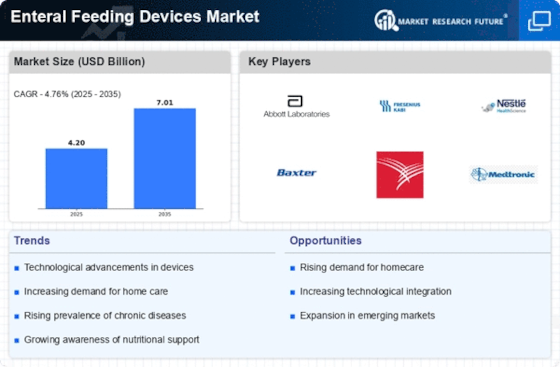
Key players in the Enteral Feeding Devices Market include Abbott, Fresenius Kabi, Nestle Health Science, Baxter International, and Cardinal Health.

What are the projected valuations for Enteral Feeding Pumps from 2024 to 2035?

The valuation for Enteral Feeding Pumps is expected to grow from 1.2 USD Billion in 2024 to 2.0 USD Billion by 2035.

How does the market for Enteral Feed Bags evolve from 2024 to 2035?

The market for Enteral Feed Bags is anticipated to increase from 0.9 USD Billion in 2024 to 1.5 USD Billion by 2035.

What is the expected growth in the Gastroenterology application segment by 2035?

The Gastroenterology application segment is projected to grow from 1.26 USD Billion in 2024 to 2.1 USD Billion by 2035.

What is the anticipated market size for Home Care Settings in 2035?

The market size for Home Care Settings is expected to reach approximately 2.12 USD Billion by 2035.

What materials are primarily used in the production of Enteral Feeding Devices?

The primary materials used in the production of Enteral Feeding Devices include Plastic, Polymer, and Silicone.

What is the projected valuation for Enteral Feeding Tubes from 2024 to 2035?

The valuation for Enteral Feeding Tubes is expected to rise from 1.5 USD Billion in 2024 to 2.5 USD Billion by 2035.

Market Summary

As per MRFR analysis, the Enteral Feeding Devices Market Size was estimated at 4.2 USD Billion in 2024. The Enteral Feeding Devices industry is projected to grow from 4.4 in 2025 to 7.006 by 2035, exhibiting a compound annual growth rate (CAGR) of 4.76 during the forecast period 2025 - 2035.

Key Market Trends & Highlights

The Enteral Feeding Devices Market is poised for substantial growth driven by technological advancements and increasing patient-centric designs.

  • North America remains the largest market for enteral feeding devices, reflecting a robust healthcare infrastructure and high demand. The Asia-Pacific region is emerging as the fastest-growing market, fueled by rising healthcare investments and a growing population. Enteral feeding pumps dominate the market, while enteral feed bags are experiencing rapid growth due to their convenience and cost-effectiveness. Key market drivers include the rising prevalence of chronic diseases and the aging population, which heighten the need for effective nutritional support.

Market Size & Forecast

2024 Market Size 4.2 (USD Billion)
2035 Market Size 7.006 (USD Billion)
CAGR (2025 - 2035) 4.76%
Largest Regional Market Share in 2024 North America

Major Players

<p><a href="https://www.proconnect.abbott/au/en/home/tube-feeds/products.html">Abbott (US),</a> Fresenius Kabi (DE), Nestle Health Science (CH),<a href="https://www.baxter.com/healthcare-professionals/our-products-services"> Baxter International (US</a>), Cardinal Health (US), Medtronic (IE), Halyard Health (US), B. Braun Melsungen AG (DE), Cook Medical (US)</p>

Market Trends

The Enteral Feeding Devices Market is currently experiencing a notable transformation, driven by advancements in technology and an increasing awareness of nutritional needs among patients with swallowing difficulties. The rise in chronic diseases, coupled with an aging population, has led to a greater demand for enteral feeding solutions. Manufacturers are focusing on developing innovative products that enhance patient comfort and improve the efficiency of feeding processes. This shift towards patient-centric designs appears to be a key factor influencing market dynamics. Furthermore, the integration of smart technologies into enteral feeding devices is likely to enhance monitoring capabilities, thereby improving patient outcomes and safety. In addition to technological advancements, the Enteral Feeding Devices Market is also witnessing a growing emphasis on regulatory compliance and quality assurance. Healthcare providers are increasingly prioritizing the use of devices that meet stringent safety standards, which may lead to a consolidation of market players. As competition intensifies, companies are expected to invest in research and development to create more effective and user-friendly products. Overall, the market seems poised for growth, driven by a combination of innovation, regulatory pressures, and an evolving understanding of patient needs.

Technological Advancements

The Enteral Feeding Devices Market is seeing a surge in technological innovations, particularly with the introduction of smart devices that facilitate real-time monitoring and data collection. These advancements are likely to enhance the overall efficiency of enteral feeding, allowing healthcare providers to tailor nutritional plans more effectively.

Patient-Centric Designs

There is a noticeable trend towards designing enteral feeding devices that prioritize patient comfort and usability. This shift may lead to improved adherence to feeding regimens, as devices become easier to use and more aligned with the needs of patients, particularly those with chronic conditions.

Regulatory Compliance and Quality Assurance

As the Enteral Feeding Devices Market evolves, there is an increasing focus on regulatory compliance and quality assurance. Manufacturers are expected to align their products with stringent safety standards, which could result in a more competitive landscape as companies strive to meet these requirements.

Enteral Feeding Devices Market Market Drivers

Rising Prevalence of Chronic Diseases

The increasing prevalence of chronic diseases such as cancer, diabetes, and neurological disorders is a primary driver for the Enteral Feeding Devices Market. These conditions often necessitate long-term nutritional support, leading to a heightened demand for enteral feeding solutions. According to recent estimates, the number of individuals requiring enteral nutrition is projected to rise significantly, with millions affected by conditions that impair their ability to consume food orally. This trend underscores the critical role of enteral feeding devices in managing patient care, thereby propelling market growth. As healthcare systems adapt to these rising needs, the Enteral Feeding Devices Market is likely to expand, driven by innovations aimed at improving patient outcomes and enhancing the quality of life for those reliant on enteral nutrition.

Technological Innovations in Feeding Devices

Technological advancements in enteral feeding devices are transforming the Enteral Feeding Devices Market. Innovations such as smart feeding pumps, which allow for precise control and monitoring of nutritional delivery, are becoming increasingly prevalent. These devices not only enhance patient safety but also improve the efficiency of nutritional administration. The integration of digital health technologies, including mobile applications for tracking nutritional intake, is also gaining traction. As a result, the market is witnessing a surge in demand for devices that offer enhanced functionality and user-friendliness. The continuous evolution of technology in this sector suggests a promising future for the Enteral Feeding Devices Market, as manufacturers strive to meet the growing expectations of healthcare providers and patients alike.

Regulatory Support and Reimbursement Policies

Regulatory support and favorable reimbursement policies are crucial drivers for the Enteral Feeding Devices Market. Governments and health organizations are increasingly recognizing the importance of enteral nutrition in patient care, leading to the establishment of supportive regulations and reimbursement frameworks. These policies facilitate access to enteral feeding devices, making them more affordable for patients and healthcare providers. As reimbursement for enteral nutrition becomes more standardized, the market is likely to experience growth, as financial barriers are reduced. This regulatory environment not only encourages innovation among manufacturers but also enhances the overall accessibility of enteral feeding solutions, thereby contributing to the expansion of the Enteral Feeding Devices Market.

Aging Population and Increased Nutritional Needs

The aging population is a significant factor influencing the Enteral Feeding Devices Market. As individuals age, they often experience a decline in their ability to consume food orally due to various health issues, including dysphagia and other age-related conditions. This demographic shift is leading to an increased demand for enteral feeding solutions that cater to the nutritional needs of older adults. Projections indicate that the global population aged 65 and older will double by 2050, further amplifying the need for effective enteral nutrition. Consequently, the Enteral Feeding Devices Market is expected to grow as healthcare providers seek to address the unique challenges associated with aging patients, ensuring they receive adequate nutrition through enteral feeding methods.

Growing Awareness and Acceptance of Enteral Nutrition

There is a growing awareness and acceptance of enteral nutrition among healthcare professionals and patients, which is positively impacting the Enteral Feeding Devices Market. Educational initiatives and clinical guidelines are increasingly emphasizing the importance of enteral feeding in managing malnutrition and supporting recovery in various patient populations. This shift in perception is leading to more healthcare providers recommending enteral feeding as a viable option for patients who cannot meet their nutritional needs through oral intake. As awareness continues to spread, the demand for enteral feeding devices is likely to increase, driving market growth. The Enteral Feeding Devices Market stands to benefit from this trend as more patients and caregivers recognize the advantages of enteral nutrition.

Market Segment Insights

By Device Type: Enteral Feeding Pumps (Largest) vs. Enteral Feed Bags (Fastest-Growing)

<p>The Enteral Feeding Devices Market is primarily composed of four segments: Enteral Feeding Pumps, Enteral Feed Bags, Enteral Feeding Tubes, and Accessories. Among these, Enteral Feeding Pumps hold the largest market share, reflecting their critical role in delivering nutrition efficiently and accurately to patients. Conversely, Enteral Feed Bags are identified as the fastest-growing segment, especially due to the increased adoption of home care and outpatient settings that emphasize convenience and cost-effectiveness of feeding methods.</p>

<p>Enteral Feeding Pumps (Dominant) vs. Enteral Feed Bags (Emerging)</p>

<p>Enteral Feeding Pumps are established as the dominant segment within the enteral feeding devices market, given their crucial function in ensuring precise and controlled nutrient delivery. These pumps are favored by healthcare providers for their reliability and the advanced technology that allows for customizable feeding protocols. On the other hand, Enteral Feed Bags are gaining traction as an emerging solution, driven by the convenience they offer in outpatient care and home settings. Their lightweight design and easy-to-use features cater to a growing demographic of patients requiring sustained nutrition, significantly increasing their demand in the competitive landscape.</p>

By Application: Gastroenterology (Largest) vs. Oncology (Fastest-Growing)

<p>In the Enteral Feeding Devices Market, gastroenterology represents the largest segment, holding a significant proportion of the overall market share. This area predominantly comprises devices used for nutritional support in patients suffering from various gastrointestinal disorders. Following closely is the oncology segment, which is emerging rapidly due to the increasing prevalence of cancer and the growing need for nutritional interventions in cancer patients. Both segments are crucial, but their market dynamics differ, reflecting varying medical needs and patient demographics.</p>

<p>Gastroenterology: Dominant vs. Oncology: Emerging</p>

<p>The gastroenterology segment remains dominant within the Enteral Feeding Devices Market due to a higher rate of gastrointestinal diseases and a strong adoption of enteral feeding methods in clinical settings. This segment is characterized by a wide variety of products tailored to meet the nutritional requirements of patients with disorders such as Crohn's disease, irritable bowel syndrome, and others. In contrast, the oncology segment, while currently smaller, is the fastest-growing segment, driven by an increasing population of cancer patients requiring specialized nutritional support during their treatment. As holistic cancer care gains prominence, innovations in enteral feeding devices specifically designed for oncology patients are expected to surge, providing new opportunities and driving the segment's growth.</p>

By End User: Hospitals (Largest) vs. Home Care Settings (Fastest-Growing)

<p>In the Enteral Feeding Devices Market, hospitals hold the largest share of the end user segment, attributed to the high influx of patients requiring enteral nutrition due to critical illnesses, surgeries, and long-term care needs. Home care settings are rapidly gaining traction as they cater to the growing population of patients needing at-home therapy, primarily driven by technological innovations and the rising preference for in-home care solutions. Growth trends indicate a significant shift towards home care settings, projected to be the fastest-growing segment. Factors such as an aging population, increasing prevalence of <a href="https://www.marketresearchfuture.com/reports/chronic-disease-management-market-981">chronic diseases</a>, and efforts to reduce healthcare costs by shifting care from hospitals to home environments are propelling this change. The rise in remote monitoring and telehealth services further supports the expansion of enteral feeding solutions in the home care market.</p>

<p>Hospitals (Dominant) vs. Ambulatory Surgical Centers (Emerging)</p>

<p>Hospitals are currently the dominant end user in the Enteral Feeding Devices Market, primarily due to their extensive resources and the variety of patients they serve, including those with critical injuries, chronic illnesses, and post-operative needs. Hospitals utilize a wide array of enteral feeding devices, ensuring effective patient care and nutritional support in critical situations. On the other hand, ambulatory surgical centers are considered an emerging segment, leveraging their capabilities in short-term surgical procedures and outpatient care. The growth in this segment is driven by increased patient volume in outpatient settings, where enteral feeding may be necessary for post-operative patients. The focus on minimally invasive procedures and rapid recovery models in ambulatory settings has consequently spurred interest in enteral nutrition solutions.</p>

By Material: Plastic (Largest) vs. Silicone (Fastest-Growing)

<p>In the Enteral Feeding Devices Market, the materials segment sees notable distribution with Plastic holding the largest share due to its light weight, cost-effectiveness, and durability. This segment is widely used in various types of feeding devices, providing manufacturers with a reliable option that meets stringent healthcare standards. In contrast, Silicone, while smaller in market share, is rapidly gaining traction, especially in pediatric and home care environments, owing to its safety, flexibility, and biocompatibility.</p>

<p>Material: Plastic (Dominant) vs. Silicone (Emerging)</p>

<p>Plastic remains the dominant material in enteral feeding devices due to its established performance and affordability. It is favored for making feeding tubes and containers, providing efficient solutions while minimizing production costs. Conversely, Silicone, identified as an emerging material, is preferred for applications requiring greater flexibility and improved patient comfort. Its hypoallergenic properties and increased biocompatibility make it ideal for long-term use in sensitive patient populations. The growing trend toward home healthcare is propelling the use of Silicone, positioning it as an innovative alternative in a traditionally plastic-dominated market.</p>

Get more detailed insights about Enteral Feeding Devices Market Research Report - Forecast till 2035

Regional Insights

North America : Market Leader in Innovation

North America is the largest market for enteral feeding devices, holding approximately 45% of the global market share. The growth is driven by an increasing prevalence of chronic diseases, an aging population, and advancements in technology. Regulatory support from agencies like the FDA has also catalyzed innovation and safety in product development, enhancing market demand. The region's robust healthcare infrastructure further supports this growth trajectory. The United States is the leading country in this market, followed by Canada. Major players such as Abbott, Baxter International, and Cardinal Health dominate the competitive landscape, offering a wide range of products. The presence of these key players, along with ongoing research and development initiatives, ensures a dynamic market environment. The focus on improving patient outcomes and the integration of smart technologies are expected to drive future growth.

Europe : Emerging Market with Growth Potential

Europe is the second-largest market for enteral feeding devices, accounting for approximately 30% of the global market share. The growth is fueled by increasing awareness of nutritional support in healthcare settings, along with rising incidences of malnutrition among the elderly. Regulatory frameworks, such as the European Medical Device Regulation (MDR), are enhancing product safety and efficacy, thereby boosting market confidence and demand. Germany and France are the leading countries in this region, with a strong presence of key players like Fresenius Kabi and B. Braun Melsungen AG. The competitive landscape is characterized by a mix of established companies and innovative startups, focusing on advanced technologies and patient-centric solutions. The emphasis on home healthcare and outpatient services is also driving the demand for enteral feeding devices, making Europe a vibrant market for growth.

Asia-Pacific : Rapidly Growing Healthcare Sector

Asia-Pacific is witnessing rapid growth in the enteral feeding devices market, holding about 15% of the global market share. The region's growth is driven by increasing healthcare expenditure, a rising geriatric population, and a growing awareness of nutritional support in clinical settings. Additionally, government initiatives aimed at improving healthcare infrastructure are acting as catalysts for market expansion, making it a key area for investment and development. China and Japan are the leading countries in this market, with significant contributions from local manufacturers and international players. The competitive landscape is evolving, with companies like Medtronic and Nestle Health Science expanding their presence. The focus on innovative solutions and cost-effective products is expected to enhance market penetration, catering to the diverse needs of patients across the region.

Middle East and Africa : Untapped Market with Opportunities

The Middle East and Africa region represents a growing market for enteral feeding devices, accounting for approximately 10% of the global market share. The growth is driven by increasing healthcare investments, rising awareness of nutritional needs, and a growing prevalence of chronic diseases. Regulatory bodies are beginning to establish frameworks that support the safe use of medical devices, which is expected to further stimulate market growth in the coming years. Countries like South Africa and the UAE are leading the market, with a mix of local and international players entering the space. The competitive landscape is characterized by a focus on affordability and accessibility, with companies looking to tailor their products to meet regional needs. The emphasis on improving healthcare services and patient outcomes is driving demand for enteral feeding devices, making this region a promising area for future growth.

Key Players and Competitive Insights

The Enteral Feeding Devices Market is currently characterized by a dynamic competitive landscape, driven by increasing demand for nutritional support in various healthcare settings. Key players such as Abbott (US), Fresenius Kabi (DE), and Baxter International (US) are strategically positioned to leverage innovation and expand their market presence. Abbott (US) focuses on enhancing its product portfolio through technological advancements, while Fresenius Kabi (DE) emphasizes regional expansion and partnerships to strengthen its distribution channels. Baxter International (US) is actively pursuing mergers and acquisitions to diversify its offerings, which collectively shapes a competitive environment that is increasingly reliant on innovation and strategic collaborations.

The market structure appears moderately fragmented, with several players vying for market share. Key business tactics include localizing manufacturing to reduce costs and optimize supply chains, which is particularly relevant in the context of rising global logistics challenges. The collective influence of these major players fosters a competitive atmosphere where agility and responsiveness to market demands are paramount.

In August 2025, Abbott (US) announced the launch of a new enteral feeding pump designed to enhance patient safety and ease of use. This strategic move is significant as it not only reinforces Abbott's commitment to innovation but also addresses the growing need for user-friendly devices in clinical settings. The introduction of this pump is likely to strengthen Abbott's market position by appealing to healthcare providers seeking reliable and efficient solutions.

In September 2025, Fresenius Kabi (DE) expanded its product line by introducing a new range of enteral nutrition formulas tailored for specific patient needs. This initiative underscores Fresenius Kabi's focus on personalized nutrition, which is becoming increasingly important in the healthcare landscape. By diversifying its offerings, the company aims to capture a larger share of the market and respond effectively to the evolving demands of healthcare professionals.

In July 2025, Baxter International (US) completed the acquisition of a smaller enteral feeding device manufacturer, enhancing its technological capabilities and product range. This acquisition is strategically important as it allows Baxter to integrate innovative technologies into its existing portfolio, thereby improving its competitive edge. The move reflects a broader trend in the industry where companies seek to bolster their capabilities through strategic acquisitions, ensuring they remain at the forefront of technological advancements.

As of October 2025, the Enteral Feeding Devices Market is witnessing trends such as digitalization, sustainability, and the integration of artificial intelligence in product development. Strategic alliances are increasingly shaping the competitive landscape, enabling companies to pool resources and expertise. Looking ahead, competitive differentiation is likely to evolve from traditional price-based competition to a focus on innovation, technological advancements, and supply chain reliability, as companies strive to meet the complex needs of healthcare providers and patients.

Key Companies in the Enteral Feeding Devices Market market include

Industry Developments

Recent developments in the Global Enteral Feeding Devices Market have shown significant growth, driven by an increasing patient population requiring nutritional therapy due to chronic illnesses. Abbott Laboratories and Fresenius Kabi have reported advancements in innovative feeding tube technologies and enteral nutrition solutions.

In October 2023, Baxter International launched an enhanced enteral delivery system, demonstrating its commitment to improving clinical outcomes and patient safety. Additionally, Terumo Corporation has expanded its product line with new enteral feeding devices designed to cater to diverse patient needs. In terms of mergers and acquisitions, in September 2023, Medtronic acquired a small private firm specializing in enteral feeding devices, aiming to enhance its product portfolio and market reach. Such strategic moves are reshaping the competitive landscape and encouraging innovation.

The market valuation for companies like Amsino International and Danone is also witnessing an increase due to heightened demand across global healthcare institutions. Over the past two years, the market has evolved dramatically, with key players focusing on Research and Development to introduce cutting-edge technology, aligning with global healthcare trends of improving patient care efficiency and safety.

Future Outlook

Enteral Feeding Devices Market Future Outlook

<p>The Enteral Feeding Devices Market is projected to grow at a 4.76% CAGR from 2024 to 2035, driven by technological advancements, increasing prevalence of chronic diseases, and rising geriatric population.</p>

New opportunities lie in:

  • <p>Development of smart enteral feeding pumps with IoT integration.</p><p>Expansion into emerging markets with tailored product offerings.</p><p>Partnerships with healthcare providers for integrated feeding solutions.</p>

<p>By 2035, the Enteral Feeding Devices Market is expected to achieve substantial growth and innovation.</p>

Market Segmentation

Enteral Feeding Devices Market End User Outlook

  • Hospitals
  • Home Care Settings
  • Nursing Facilities
  • Ambulatory Surgical Centers

Enteral Feeding Devices Market Material Outlook

  • Plastic
  • Polymer
  • Silicone

Enteral Feeding Devices Market Application Outlook

  • Oncology
  • Gastroenterology
  • Neurological Disorders
  • Critical Care

Enteral Feeding Devices Market Device Type Outlook

  • Enteral Feeding Pumps
  • Enteral Feed Bags
  • Enteral Feeding Tubes
  • Accessories

Report Scope

MARKET SIZE 20244.2(USD Billion)
MARKET SIZE 20254.4(USD Billion)
MARKET SIZE 20357.006(USD Billion)
COMPOUND ANNUAL GROWTH RATE (CAGR)4.76% (2024 - 2035)
REPORT COVERAGERevenue Forecast, Competitive Landscape, Growth Factors, and Trends
BASE YEAR2024
Market Forecast Period2025 - 2035
Historical Data2019 - 2024
Market Forecast UnitsUSD Billion
Key Companies ProfiledMarket analysis in progress
Segments CoveredMarket segmentation analysis in progress
Key Market OpportunitiesIntegration of smart technology in Enteral Feeding Devices enhances patient monitoring and compliance.
Key Market DynamicsRising demand for enteral feeding devices driven by technological advancements and increasing prevalence of chronic diseases.
Countries CoveredNorth America, Europe, APAC, South America, MEA

FAQs

What is the projected market valuation of the Enteral Feeding Devices Market by 2035?

The Enteral Feeding Devices Market is projected to reach approximately 7.006 USD Billion by 2035.

What was the market valuation of the Enteral Feeding Devices Market in 2024?

In 2024, the Enteral Feeding Devices Market was valued at 4.2 USD Billion.

What is the expected CAGR for the Enteral Feeding Devices Market during the forecast period 2025 - 2035?

The expected CAGR for the Enteral Feeding Devices Market during the forecast period 2025 - 2035 is 4.76%.

Which companies are considered key players in the Enteral Feeding Devices Market?

Key players in the Enteral Feeding Devices Market include Abbott, Fresenius Kabi, Nestle Health Science, Baxter International, and Cardinal Health.

What are the projected valuations for Enteral Feeding Pumps from 2024 to 2035?

The valuation for Enteral Feeding Pumps is expected to grow from 1.2 USD Billion in 2024 to 2.0 USD Billion by 2035.

How does the market for Enteral Feed Bags evolve from 2024 to 2035?

The market for Enteral Feed Bags is anticipated to increase from 0.9 USD Billion in 2024 to 1.5 USD Billion by 2035.

What is the expected growth in the Gastroenterology application segment by 2035?

The Gastroenterology application segment is projected to grow from 1.26 USD Billion in 2024 to 2.1 USD Billion by 2035.

What is the anticipated market size for Home Care Settings in 2035?

The market size for Home Care Settings is expected to reach approximately 2.12 USD Billion by 2035.

What materials are primarily used in the production of Enteral Feeding Devices?

The primary materials used in the production of Enteral Feeding Devices include Plastic, Polymer, and Silicone.

What is the projected valuation for Enteral Feeding Tubes from 2024 to 2035?

The valuation for Enteral Feeding Tubes is expected to rise from 1.5 USD Billion in 2024 to 2.5 USD Billion by 2035.

  1. SECTION I: EXECUTIVE SUMMARY AND KEY HIGHLIGHTS
    1. EXECUTIVE SUMMARY
      1. Market Overview
      2. Key Findings
      3. Market Segmentation
      4. Competitive Landscape
      5. Challenges and Opportunities
      6. Future Outlook
  2. SECTION II: SCOPING, METHODOLOGY AND MARKET STRUCTURE
    1. MARKET INTRODUCTION
      1. Definition
      2. Scope of the study
    2. RESEARCH METHODOLOGY
      1. Overview
      2. Data Mining
      3. Secondary Research
      4. Primary Research
      5. Forecasting Model
      6. Market Size Estimation
      7. Data Triangulation
      8. Validation
  3. SECTION III: QUALITATIVE ANALYSIS
    1. MARKET DYNAMICS
      1. Overview
      2. Drivers
      3. Restraints
      4. Opportunities
    2. MARKET FACTOR ANALYSIS
      1. Value chain Analysis
      2. Porter's Five Forces Analysis
      3. COVID-19 Impact Analysis
  4. SECTION IV: QUANTITATIVE ANALYSIS
    1. Healthcare, BY Device Type (USD Billion)
      1. Enteral Feeding Pumps
      2. Enteral Feed Bags
      3. Enteral Feeding Tubes
      4. Accessories
    2. Healthcare, BY Application (USD Billion)
      1. Oncology
      2. Gastroenterology
      3. Neurological Disorders
      4. Critical Care
    3. Healthcare, BY End User (USD Billion)
      1. Hospitals
      2. Home Care Settings
      3. Nursing Facilities
      4. Ambulatory Surgical Centers
    4. Healthcare, BY Material (USD Billion)
      1. Plastic
      2. Polymer
      3. Silicone
    5. Healthcare, BY Region (USD Billion)
      1. North America
      2. Europe
      3. APAC
      4. South America
      5. MEA
  5. SECTION V: COMPETITIVE ANALYSIS
    1. Competitive Landscape
      1. Overview
      2. Competitive Analysis
      3. Market share Analysis
      4. Major Growth Strategy in the Healthcare
      5. Competitive Benchmarking
      6. Leading Players in Terms of Number of Developments in the Healthcare
      7. Key developments and growth strategies
      8. Major Players Financial Matrix
    2. Company Profiles
      1. Abbott (US)
      2. Fresenius Kabi (DE)
      3. Nestle Health Science (CH)
      4. Baxter International (US)
      5. Cardinal Health (US)
      6. Medtronic (IE)
      7. Halyard Health (US)
      8. B. Braun Melsungen AG (DE)
      9. Cook Medical (US)
    3. Appendix
      1. References
      2. Related Reports
  6. LIST OF FIGURES
    1. MARKET SYNOPSIS
    2. NORTH AMERICA MARKET ANALYSIS
    3. US MARKET ANALYSIS BY DEVICE TYPE
    4. US MARKET ANALYSIS BY APPLICATION
    5. US MARKET ANALYSIS BY END USER
    6. US MARKET ANALYSIS BY MATERIAL
    7. CANADA MARKET ANALYSIS BY DEVICE TYPE
    8. CANADA MARKET ANALYSIS BY APPLICATION
    9. CANADA MARKET ANALYSIS BY END USER
    10. CANADA MARKET ANALYSIS BY MATERIAL
    11. EUROPE MARKET ANALYSIS
    12. GERMANY MARKET ANALYSIS BY DEVICE TYPE
    13. GERMANY MARKET ANALYSIS BY APPLICATION
    14. GERMANY MARKET ANALYSIS BY END USER
    15. GERMANY MARKET ANALYSIS BY MATERIAL
    16. UK MARKET ANALYSIS BY DEVICE TYPE
    17. UK MARKET ANALYSIS BY APPLICATION
    18. UK MARKET ANALYSIS BY END USER
    19. UK MARKET ANALYSIS BY MATERIAL
    20. FRANCE MARKET ANALYSIS BY DEVICE TYPE
    21. FRANCE MARKET ANALYSIS BY APPLICATION
    22. FRANCE MARKET ANALYSIS BY END USER
    23. FRANCE MARKET ANALYSIS BY MATERIAL
    24. RUSSIA MARKET ANALYSIS BY DEVICE TYPE
    25. RUSSIA MARKET ANALYSIS BY APPLICATION
    26. RUSSIA MARKET ANALYSIS BY END USER
    27. RUSSIA MARKET ANALYSIS BY MATERIAL
    28. ITALY MARKET ANALYSIS BY DEVICE TYPE
    29. ITALY MARKET ANALYSIS BY APPLICATION
    30. ITALY MARKET ANALYSIS BY END USER
    31. ITALY MARKET ANALYSIS BY MATERIAL
    32. SPAIN MARKET ANALYSIS BY DEVICE TYPE
    33. SPAIN MARKET ANALYSIS BY APPLICATION
    34. SPAIN MARKET ANALYSIS BY END USER
    35. SPAIN MARKET ANALYSIS BY MATERIAL
    36. REST OF EUROPE MARKET ANALYSIS BY DEVICE TYPE
    37. REST OF EUROPE MARKET ANALYSIS BY APPLICATION
    38. REST OF EUROPE MARKET ANALYSIS BY END USER
    39. REST OF EUROPE MARKET ANALYSIS BY MATERIAL
    40. APAC MARKET ANALYSIS
    41. CHINA MARKET ANALYSIS BY DEVICE TYPE
    42. CHINA MARKET ANALYSIS BY APPLICATION
    43. CHINA MARKET ANALYSIS BY END USER
    44. CHINA MARKET ANALYSIS BY MATERIAL
    45. INDIA MARKET ANALYSIS BY DEVICE TYPE
    46. INDIA MARKET ANALYSIS BY APPLICATION
    47. INDIA MARKET ANALYSIS BY END USER
    48. INDIA MARKET ANALYSIS BY MATERIAL
    49. JAPAN MARKET ANALYSIS BY DEVICE TYPE
    50. JAPAN MARKET ANALYSIS BY APPLICATION
    51. JAPAN MARKET ANALYSIS BY END USER
    52. JAPAN MARKET ANALYSIS BY MATERIAL
    53. SOUTH KOREA MARKET ANALYSIS BY DEVICE TYPE
    54. SOUTH KOREA MARKET ANALYSIS BY APPLICATION
    55. SOUTH KOREA MARKET ANALYSIS BY END USER
    56. SOUTH KOREA MARKET ANALYSIS BY MATERIAL
    57. MALAYSIA MARKET ANALYSIS BY DEVICE TYPE
    58. MALAYSIA MARKET ANALYSIS BY APPLICATION
    59. MALAYSIA MARKET ANALYSIS BY END USER
    60. MALAYSIA MARKET ANALYSIS BY MATERIAL
    61. THAILAND MARKET ANALYSIS BY DEVICE TYPE
    62. THAILAND MARKET ANALYSIS BY APPLICATION
    63. THAILAND MARKET ANALYSIS BY END USER
    64. THAILAND MARKET ANALYSIS BY MATERIAL
    65. INDONESIA MARKET ANALYSIS BY DEVICE TYPE
    66. INDONESIA MARKET ANALYSIS BY APPLICATION
    67. INDONESIA MARKET ANALYSIS BY END USER
    68. INDONESIA MARKET ANALYSIS BY MATERIAL
    69. REST OF APAC MARKET ANALYSIS BY DEVICE TYPE
    70. REST OF APAC MARKET ANALYSIS BY APPLICATION
    71. REST OF APAC MARKET ANALYSIS BY END USER
    72. REST OF APAC MARKET ANALYSIS BY MATERIAL
    73. SOUTH AMERICA MARKET ANALYSIS
    74. BRAZIL MARKET ANALYSIS BY DEVICE TYPE
    75. BRAZIL MARKET ANALYSIS BY APPLICATION
    76. BRAZIL MARKET ANALYSIS BY END USER
    77. BRAZIL MARKET ANALYSIS BY MATERIAL
    78. MEXICO MARKET ANALYSIS BY DEVICE TYPE
    79. MEXICO MARKET ANALYSIS BY APPLICATION
    80. MEXICO MARKET ANALYSIS BY END USER
    81. MEXICO MARKET ANALYSIS BY MATERIAL
    82. ARGENTINA MARKET ANALYSIS BY DEVICE TYPE
    83. ARGENTINA MARKET ANALYSIS BY APPLICATION
    84. ARGENTINA MARKET ANALYSIS BY END USER
    85. ARGENTINA MARKET ANALYSIS BY MATERIAL
    86. REST OF SOUTH AMERICA MARKET ANALYSIS BY DEVICE TYPE
    87. REST OF SOUTH AMERICA MARKET ANALYSIS BY APPLICATION
    88. REST OF SOUTH AMERICA MARKET ANALYSIS BY END USER
    89. REST OF SOUTH AMERICA MARKET ANALYSIS BY MATERIAL
    90. MEA MARKET ANALYSIS
    91. GCC COUNTRIES MARKET ANALYSIS BY DEVICE TYPE
    92. GCC COUNTRIES MARKET ANALYSIS BY APPLICATION
    93. GCC COUNTRIES MARKET ANALYSIS BY END USER
    94. GCC COUNTRIES MARKET ANALYSIS BY MATERIAL
    95. SOUTH AFRICA MARKET ANALYSIS BY DEVICE TYPE
    96. SOUTH AFRICA MARKET ANALYSIS BY APPLICATION
    97. SOUTH AFRICA MARKET ANALYSIS BY END USER
    98. SOUTH AFRICA MARKET ANALYSIS BY MATERIAL
    99. REST OF MEA MARKET ANALYSIS BY DEVICE TYPE
    100. REST OF MEA MARKET ANALYSIS BY APPLICATION
    101. REST OF MEA MARKET ANALYSIS BY END USER
    102. REST OF MEA MARKET ANALYSIS BY MATERIAL
    103. KEY BUYING CRITERIA OF HEALTHCARE
    104. RESEARCH PROCESS OF MRFR
    105. DRO ANALYSIS OF HEALTHCARE
    106. DRIVERS IMPACT ANALYSIS: HEALTHCARE
    107. RESTRAINTS IMPACT ANALYSIS: HEALTHCARE
    108. SUPPLY / VALUE CHAIN: HEALTHCARE
    109. HEALTHCARE, BY DEVICE TYPE, 2024 (% SHARE)
    110. HEALTHCARE, BY DEVICE TYPE, 2024 TO 2035 (USD Billion)
    111. HEALTHCARE, BY APPLICATION, 2024 (% SHARE)
    112. HEALTHCARE, BY APPLICATION, 2024 TO 2035 (USD Billion)
    113. HEALTHCARE, BY END USER, 2024 (% SHARE)
    114. HEALTHCARE, BY END USER, 2024 TO 2035 (USD Billion)
    115. HEALTHCARE, BY MATERIAL, 2024 (% SHARE)
    116. HEALTHCARE, BY MATERIAL, 2024 TO 2035 (USD Billion)
    117. BENCHMARKING OF MAJOR COMPETITORS
  7. LIST OF TABLES
    1. LIST OF ASSUMPTIONS
    2. North America MARKET SIZE ESTIMATES; FORECAST
      1. BY DEVICE TYPE, 2025-2035 (USD Billion)
      2. BY APPLICATION, 2025-2035 (USD Billion)
      3. BY END USER, 2025-2035 (USD Billion)
      4. BY MATERIAL, 2025-2035 (USD Billion)
    3. US MARKET SIZE ESTIMATES; FORECAST
      1. BY DEVICE TYPE, 2025-2035 (USD Billion)
      2. BY APPLICATION, 2025-2035 (USD Billion)
      3. BY END USER, 2025-2035 (USD Billion)
      4. BY MATERIAL, 2025-2035 (USD Billion)
    4. Canada MARKET SIZE ESTIMATES; FORECAST
      1. BY DEVICE TYPE, 2025-2035 (USD Billion)
      2. BY APPLICATION, 2025-2035 (USD Billion)
      3. BY END USER, 2025-2035 (USD Billion)
      4. BY MATERIAL, 2025-2035 (USD Billion)
    5. Europe MARKET SIZE ESTIMATES; FORECAST
      1. BY DEVICE TYPE, 2025-2035 (USD Billion)
      2. BY APPLICATION, 2025-2035 (USD Billion)
      3. BY END USER, 2025-2035 (USD Billion)
      4. BY MATERIAL, 2025-2035 (USD Billion)
    6. Germany MARKET SIZE ESTIMATES; FORECAST
      1. BY DEVICE TYPE, 2025-2035 (USD Billion)
      2. BY APPLICATION, 2025-2035 (USD Billion)
      3. BY END USER, 2025-2035 (USD Billion)
      4. BY MATERIAL, 2025-2035 (USD Billion)
    7. UK MARKET SIZE ESTIMATES; FORECAST
      1. BY DEVICE TYPE, 2025-2035 (USD Billion)
      2. BY APPLICATION, 2025-2035 (USD Billion)
      3. BY END USER, 2025-2035 (USD Billion)
      4. BY MATERIAL, 2025-2035 (USD Billion)
    8. France MARKET SIZE ESTIMATES; FORECAST
      1. BY DEVICE TYPE, 2025-2035 (USD Billion)
      2. BY APPLICATION, 2025-2035 (USD Billion)
      3. BY END USER, 2025-2035 (USD Billion)
      4. BY MATERIAL, 2025-2035 (USD Billion)
    9. Russia MARKET SIZE ESTIMATES; FORECAST
      1. BY DEVICE TYPE, 2025-2035 (USD Billion)
      2. BY APPLICATION, 2025-2035 (USD Billion)
      3. BY END USER, 2025-2035 (USD Billion)
      4. BY MATERIAL, 2025-2035 (USD Billion)
    10. Italy MARKET SIZE ESTIMATES; FORECAST
      1. BY DEVICE TYPE, 2025-2035 (USD Billion)
      2. BY APPLICATION, 2025-2035 (USD Billion)
      3. BY END USER, 2025-2035 (USD Billion)
      4. BY MATERIAL, 2025-2035 (USD Billion)
    11. Spain MARKET SIZE ESTIMATES; FORECAST
      1. BY DEVICE TYPE, 2025-2035 (USD Billion)
      2. BY APPLICATION, 2025-2035 (USD Billion)
      3. BY END USER, 2025-2035 (USD Billion)
      4. BY MATERIAL, 2025-2035 (USD Billion)
    12. Rest of Europe MARKET SIZE ESTIMATES; FORECAST
      1. BY DEVICE TYPE, 2025-2035 (USD Billion)
      2. BY APPLICATION, 2025-2035 (USD Billion)
      3. BY END USER, 2025-2035 (USD Billion)
      4. BY MATERIAL, 2025-2035 (USD Billion)
    13. APAC MARKET SIZE ESTIMATES; FORECAST
      1. BY DEVICE TYPE, 2025-2035 (USD Billion)
      2. BY APPLICATION, 2025-2035 (USD Billion)
      3. BY END USER, 2025-2035 (USD Billion)
      4. BY MATERIAL, 2025-2035 (USD Billion)
    14. China MARKET SIZE ESTIMATES; FORECAST
      1. BY DEVICE TYPE, 2025-2035 (USD Billion)
      2. BY APPLICATION, 2025-2035 (USD Billion)
      3. BY END USER, 2025-2035 (USD Billion)
      4. BY MATERIAL, 2025-2035 (USD Billion)
    15. India MARKET SIZE ESTIMATES; FORECAST
      1. BY DEVICE TYPE, 2025-2035 (USD Billion)
      2. BY APPLICATION, 2025-2035 (USD Billion)
      3. BY END USER, 2025-2035 (USD Billion)
      4. BY MATERIAL, 2025-2035 (USD Billion)
    16. Japan MARKET SIZE ESTIMATES; FORECAST
      1. BY DEVICE TYPE, 2025-2035 (USD Billion)
      2. BY APPLICATION, 2025-2035 (USD Billion)
      3. BY END USER, 2025-2035 (USD Billion)
      4. BY MATERIAL, 2025-2035 (USD Billion)
    17. South Korea MARKET SIZE ESTIMATES; FORECAST
      1. BY DEVICE TYPE, 2025-2035 (USD Billion)
      2. BY APPLICATION, 2025-2035 (USD Billion)
      3. BY END USER, 2025-2035 (USD Billion)
      4. BY MATERIAL, 2025-2035 (USD Billion)
    18. Malaysia MARKET SIZE ESTIMATES; FORECAST
      1. BY DEVICE TYPE, 2025-2035 (USD Billion)
      2. BY APPLICATION, 2025-2035 (USD Billion)
      3. BY END USER, 2025-2035 (USD Billion)
      4. BY MATERIAL, 2025-2035 (USD Billion)
    19. Thailand MARKET SIZE ESTIMATES; FORECAST
      1. BY DEVICE TYPE, 2025-2035 (USD Billion)
      2. BY APPLICATION, 2025-2035 (USD Billion)
      3. BY END USER, 2025-2035 (USD Billion)
      4. BY MATERIAL, 2025-2035 (USD Billion)
    20. Indonesia MARKET SIZE ESTIMATES; FORECAST
      1. BY DEVICE TYPE, 2025-2035 (USD Billion)
      2. BY APPLICATION, 2025-2035 (USD Billion)
      3. BY END USER, 2025-2035 (USD Billion)
      4. BY MATERIAL, 2025-2035 (USD Billion)
    21. Rest of APAC MARKET SIZE ESTIMATES; FORECAST
      1. BY DEVICE TYPE, 2025-2035 (USD Billion)
      2. BY APPLICATION, 2025-2035 (USD Billion)
      3. BY END USER, 2025-2035 (USD Billion)
      4. BY MATERIAL, 2025-2035 (USD Billion)
    22. South America MARKET SIZE ESTIMATES; FORECAST
      1. BY DEVICE TYPE, 2025-2035 (USD Billion)
      2. BY APPLICATION, 2025-2035 (USD Billion)
      3. BY END USER, 2025-2035 (USD Billion)
      4. BY MATERIAL, 2025-2035 (USD Billion)
    23. Brazil MARKET SIZE ESTIMATES; FORECAST
      1. BY DEVICE TYPE, 2025-2035 (USD Billion)
      2. BY APPLICATION, 2025-2035 (USD Billion)
      3. BY END USER, 2025-2035 (USD Billion)
      4. BY MATERIAL, 2025-2035 (USD Billion)
    24. Mexico MARKET SIZE ESTIMATES; FORECAST
      1. BY DEVICE TYPE, 2025-2035 (USD Billion)
      2. BY APPLICATION, 2025-2035 (USD Billion)
      3. BY END USER, 2025-2035 (USD Billion)
      4. BY MATERIAL, 2025-2035 (USD Billion)
    25. Argentina MARKET SIZE ESTIMATES; FORECAST
      1. BY DEVICE TYPE, 2025-2035 (USD Billion)
      2. BY APPLICATION, 2025-2035 (USD Billion)
      3. BY END USER, 2025-2035 (USD Billion)
      4. BY MATERIAL, 2025-2035 (USD Billion)
    26. Rest of South America MARKET SIZE ESTIMATES; FORECAST
      1. BY DEVICE TYPE, 2025-2035 (USD Billion)
      2. BY APPLICATION, 2025-2035 (USD Billion)
      3. BY END USER, 2025-2035 (USD Billion)
      4. BY MATERIAL, 2025-2035 (USD Billion)
    27. MEA MARKET SIZE ESTIMATES; FORECAST
      1. BY DEVICE TYPE, 2025-2035 (USD Billion)
      2. BY APPLICATION, 2025-2035 (USD Billion)
      3. BY END USER, 2025-2035 (USD Billion)
      4. BY MATERIAL, 2025-2035 (USD Billion)
    28. GCC Countries MARKET SIZE ESTIMATES; FORECAST
      1. BY DEVICE TYPE, 2025-2035 (USD Billion)
      2. BY APPLICATION, 2025-2035 (USD Billion)
      3. BY END USER, 2025-2035 (USD Billion)
      4. BY MATERIAL, 2025-2035 (USD Billion)
    29. South Africa MARKET SIZE ESTIMATES; FORECAST
      1. BY DEVICE TYPE, 2025-2035 (USD Billion)
      2. BY APPLICATION, 2025-2035 (USD Billion)
      3. BY END USER, 2025-2035 (USD Billion)
      4. BY MATERIAL, 2025-2035 (USD Billion)
    30. Rest of MEA MARKET SIZE ESTIMATES; FORECAST
      1. BY DEVICE TYPE, 2025-2035 (USD Billion)
      2. BY APPLICATION, 2025-2035 (USD Billion)
      3. BY END USER, 2025-2035 (USD Billion)
      4. BY MATERIAL, 2025-2035 (USD Billion)
    31. PRODUCT LAUNCH/PRODUCT DEVELOPMENT/APPROVAL
    32. ACQUISITION/PARTNERSHIP

Enteral Feeding Devices Market Segmentation

Enteral Feeding Devices Market By Device Type (USD Billion, 2019-2035)

Enteral Feeding Pumps

Enteral Feed Bags

Enteral Feeding Tubes

Accessories

Enteral Feeding Devices Market By Application (USD Billion, 2019-2035)

Oncology

Gastroenterology

Neurological Disorders

Critical Care

Enteral Feeding Devices Market By End User (USD Billion, 2019-2035)

Hospitals

Home Care Settings

Nursing Facilities

Ambulatory Surgical Centers

Enteral Feeding Devices Market By Material (USD Billion, 2019-2035)

Plastic

Polymer

Silicone

Enteral Feeding Devices Market By Regional (USD Billion, 2019-2035)

North America

Europe

South America

Asia Pacific

Middle East and Africa

Enteral Feeding Devices Market Regional Outlook (USD Billion, 2019-2035)

North America Outlook (USD Billion, 2019-2035)

North America Enteral Feeding Devices Market by Device Type

Enteral Feeding Pumps

Enteral Feed Bags

Enteral Feeding Tubes

Accessories

North America Enteral Feeding Devices Market by Application Type

Oncology

Gastroenterology

Neurological Disorders

Critical Care

North America Enteral Feeding Devices Market by End User Type

Hospitals

Home Care Settings

Nursing Facilities

Ambulatory Surgical Centers

North America Enteral Feeding Devices Market by Material Type

Plastic

Polymer

Silicone

North America Enteral Feeding Devices Market by Regional Type

US

Canada

US Outlook (USD Billion, 2019-2035)

US Enteral Feeding Devices Market by Device Type

Enteral Feeding Pumps

Enteral Feed Bags

Enteral Feeding Tubes

Accessories

US Enteral Feeding Devices Market by Application Type

Oncology

Gastroenterology

Neurological Disorders

Critical Care

US Enteral Feeding Devices Market by End User Type

Hospitals

Home Care Settings

Nursing Facilities

Ambulatory Surgical Centers

US Enteral Feeding Devices Market by Material Type

Plastic

Polymer

Silicone

CANADA Outlook (USD Billion, 2019-2035)

CANADA Enteral Feeding Devices Market by Device Type

Enteral Feeding Pumps

Enteral Feed Bags

Enteral Feeding Tubes

Accessories

CANADA Enteral Feeding Devices Market by Application Type

Oncology

Gastroenterology

Neurological Disorders

Critical Care

CANADA Enteral Feeding Devices Market by End User Type

Hospitals

Home Care Settings

Nursing Facilities

Ambulatory Surgical Centers

CANADA Enteral Feeding Devices Market by Material Type

Plastic

Polymer

Silicone

Europe Outlook (USD Billion, 2019-2035)

Europe Enteral Feeding Devices Market by Device Type

Enteral Feeding Pumps

Enteral Feed Bags

Enteral Feeding Tubes

Accessories

Europe Enteral Feeding Devices Market by Application Type

Oncology

Gastroenterology

Neurological Disorders

Critical Care

Europe Enteral Feeding Devices Market by End User Type

Hospitals

Home Care Settings

Nursing Facilities

Ambulatory Surgical Centers

Europe Enteral Feeding Devices Market by Material Type

Plastic

Polymer

Silicone

Europe Enteral Feeding Devices Market by Regional Type

Germany

UK

France

Russia

Italy

Spain

Rest of Europe

GERMANY Outlook (USD Billion, 2019-2035)

GERMANY Enteral Feeding Devices Market by Device Type

Enteral Feeding Pumps

Enteral Feed Bags

Enteral Feeding Tubes

Accessories

GERMANY Enteral Feeding Devices Market by Application Type

Oncology

Gastroenterology

Neurological Disorders

Critical Care

GERMANY Enteral Feeding Devices Market by End User Type

Hospitals

Home Care Settings

Nursing Facilities

Ambulatory Surgical Centers

GERMANY Enteral Feeding Devices Market by Material Type

Plastic

Polymer

Silicone

UK Outlook (USD Billion, 2019-2035)

UK Enteral Feeding Devices Market by Device Type

Enteral Feeding Pumps

Enteral Feed Bags

Enteral Feeding Tubes

Accessories

UK Enteral Feeding Devices Market by Application Type

Oncology

Gastroenterology

Neurological Disorders

Critical Care

UK Enteral Feeding Devices Market by End User Type

Hospitals

Home Care Settings

Nursing Facilities

Ambulatory Surgical Centers

UK Enteral Feeding Devices Market by Material Type

Plastic

Polymer

Silicone

FRANCE Outlook (USD Billion, 2019-2035)

FRANCE Enteral Feeding Devices Market by Device Type

Enteral Feeding Pumps

Enteral Feed Bags

Enteral Feeding Tubes

Accessories

FRANCE Enteral Feeding Devices Market by Application Type

Oncology

Gastroenterology

Neurological Disorders

Critical Care

FRANCE Enteral Feeding Devices Market by End User Type

Hospitals

Home Care Settings

Nursing Facilities

Ambulatory Surgical Centers

FRANCE Enteral Feeding Devices Market by Material Type

Plastic

Polymer

Silicone

RUSSIA Outlook (USD Billion, 2019-2035)

RUSSIA Enteral Feeding Devices Market by Device Type

Enteral Feeding Pumps

Enteral Feed Bags

Enteral Feeding Tubes

Accessories

RUSSIA Enteral Feeding Devices Market by Application Type

Oncology

Gastroenterology

Neurological Disorders

Critical Care

RUSSIA Enteral Feeding Devices Market by End User Type

Hospitals

Home Care Settings

Nursing Facilities

Ambulatory Surgical Centers

RUSSIA Enteral Feeding Devices Market by Material Type

Plastic

Polymer

Silicone

ITALY Outlook (USD Billion, 2019-2035)

ITALY Enteral Feeding Devices Market by Device Type

Enteral Feeding Pumps

Enteral Feed Bags

Enteral Feeding Tubes

Accessories

ITALY Enteral Feeding Devices Market by Application Type

Oncology

Gastroenterology

Neurological Disorders

Critical Care

ITALY Enteral Feeding Devices Market by End User Type

Hospitals

Home Care Settings

Nursing Facilities

Ambulatory Surgical Centers

ITALY Enteral Feeding Devices Market by Material Type

Plastic

Polymer

Silicone

SPAIN Outlook (USD Billion, 2019-2035)

SPAIN Enteral Feeding Devices Market by Device Type

Enteral Feeding Pumps

Enteral Feed Bags

Enteral Feeding Tubes

Accessories

SPAIN Enteral Feeding Devices Market by Application Type

Oncology

Gastroenterology

Neurological Disorders

Critical Care

SPAIN Enteral Feeding Devices Market by End User Type

Hospitals

Home Care Settings

Nursing Facilities

Ambulatory Surgical Centers

SPAIN Enteral Feeding Devices Market by Material Type

Plastic

Polymer

Silicone

REST OF EUROPE Outlook (USD Billion, 2019-2035)

REST OF EUROPE Enteral Feeding Devices Market by Device Type

Enteral Feeding Pumps

Enteral Feed Bags

Enteral Feeding Tubes

Accessories

REST OF EUROPE Enteral Feeding Devices Market by Application Type

Oncology

Gastroenterology

Neurological Disorders

Critical Care

REST OF EUROPE Enteral Feeding Devices Market by End User Type

Hospitals

Home Care Settings

Nursing Facilities

Ambulatory Surgical Centers

REST OF EUROPE Enteral Feeding Devices Market by Material Type

Plastic

Polymer

Silicone

APAC Outlook (USD Billion, 2019-2035)

APAC Enteral Feeding Devices Market by Device Type

Enteral Feeding Pumps

Enteral Feed Bags

Enteral Feeding Tubes

Accessories

APAC Enteral Feeding Devices Market by Application Type

Oncology

Gastroenterology

Neurological Disorders

Critical Care

APAC Enteral Feeding Devices Market by End User Type

Hospitals

Home Care Settings

Nursing Facilities

Ambulatory Surgical Centers

APAC Enteral Feeding Devices Market by Material Type

Plastic

Polymer

Silicone

APAC Enteral Feeding Devices Market by Regional Type

China

India

Japan

South Korea

Malaysia

Thailand

Indonesia

Rest of APAC

CHINA Outlook (USD Billion, 2019-2035)

CHINA Enteral Feeding Devices Market by Device Type

Enteral Feeding Pumps

Enteral Feed Bags

Enteral Feeding Tubes

Accessories

CHINA Enteral Feeding Devices Market by Application Type

Oncology

Gastroenterology

Neurological Disorders

Critical Care

CHINA Enteral Feeding Devices Market by End User Type

Hospitals

Home Care Settings

Nursing Facilities

Ambulatory Surgical Centers

CHINA Enteral Feeding Devices Market by Material Type

Plastic

Polymer

Silicone

INDIA Outlook (USD Billion, 2019-2035)

INDIA Enteral Feeding Devices Market by Device Type

Enteral Feeding Pumps

Enteral Feed Bags

Enteral Feeding Tubes

Accessories

INDIA Enteral Feeding Devices Market by Application Type

Oncology

Gastroenterology

Neurological Disorders

Critical Care

INDIA Enteral Feeding Devices Market by End User Type

Hospitals

Home Care Settings

Nursing Facilities

Ambulatory Surgical Centers

INDIA Enteral Feeding Devices Market by Material Type

Plastic

Polymer

Silicone

JAPAN Outlook (USD Billion, 2019-2035)

JAPAN Enteral Feeding Devices Market by Device Type

Enteral Feeding Pumps

Enteral Feed Bags

Enteral Feeding Tubes

Accessories

JAPAN Enteral Feeding Devices Market by Application Type

Oncology

Gastroenterology

Neurological Disorders

Critical Care

JAPAN Enteral Feeding Devices Market by End User Type

Hospitals

Home Care Settings

Nursing Facilities

Ambulatory Surgical Centers

JAPAN Enteral Feeding Devices Market by Material Type

Plastic

Polymer

Silicone

SOUTH KOREA Outlook (USD Billion, 2019-2035)

SOUTH KOREA Enteral Feeding Devices Market by Device Type

Enteral Feeding Pumps

Enteral Feed Bags

Enteral Feeding Tubes

Accessories

SOUTH KOREA Enteral Feeding Devices Market by Application Type

Oncology

Gastroenterology

Neurological Disorders

Critical Care

SOUTH KOREA Enteral Feeding Devices Market by End User Type

Hospitals

Home Care Settings

Nursing Facilities

Ambulatory Surgical Centers

SOUTH KOREA Enteral Feeding Devices Market by Material Type

Plastic

Polymer

Silicone

MALAYSIA Outlook (USD Billion, 2019-2035)

MALAYSIA Enteral Feeding Devices Market by Device Type

Enteral Feeding Pumps

Enteral Feed Bags

Enteral Feeding Tubes

Accessories

MALAYSIA Enteral Feeding Devices Market by Application Type

Oncology

Gastroenterology

Neurological Disorders

Critical Care

MALAYSIA Enteral Feeding Devices Market by End User Type

Hospitals

Home Care Settings

Nursing Facilities

Ambulatory Surgical Centers

MALAYSIA Enteral Feeding Devices Market by Material Type

Plastic

Polymer

Silicone

THAILAND Outlook (USD Billion, 2019-2035)

THAILAND Enteral Feeding Devices Market by Device Type

Enteral Feeding Pumps

Enteral Feed Bags

Enteral Feeding Tubes

Accessories

THAILAND Enteral Feeding Devices Market by Application Type

Oncology

Gastroenterology

Neurological Disorders

Critical Care

THAILAND Enteral Feeding Devices Market by End User Type

Hospitals

Home Care Settings

Nursing Facilities

Ambulatory Surgical Centers

THAILAND Enteral Feeding Devices Market by Material Type

Plastic

Polymer

Silicone

INDONESIA Outlook (USD Billion, 2019-2035)

INDONESIA Enteral Feeding Devices Market by Device Type

Enteral Feeding Pumps

Enteral Feed Bags

Enteral Feeding Tubes

Accessories

INDONESIA Enteral Feeding Devices Market by Application Type

Oncology

Gastroenterology

Neurological Disorders

Critical Care

INDONESIA Enteral Feeding Devices Market by End User Type

Hospitals

Home Care Settings

Nursing Facilities

Ambulatory Surgical Centers

INDONESIA Enteral Feeding Devices Market by Material Type

Plastic

Polymer

Silicone

REST OF APAC Outlook (USD Billion, 2019-2035)

REST OF APAC Enteral Feeding Devices Market by Device Type

Enteral Feeding Pumps

Enteral Feed Bags

Enteral Feeding Tubes

Accessories

REST OF APAC Enteral Feeding Devices Market by Application Type

Oncology

Gastroenterology

Neurological Disorders

Critical Care

REST OF APAC Enteral Feeding Devices Market by End User Type

Hospitals

Home Care Settings

Nursing Facilities

Ambulatory Surgical Centers

REST OF APAC Enteral Feeding Devices Market by Material Type

Plastic

Polymer

Silicone

South America Outlook (USD Billion, 2019-2035)

South America Enteral Feeding Devices Market by Device Type

Enteral Feeding Pumps

Enteral Feed Bags

Enteral Feeding Tubes

Accessories

South America Enteral Feeding Devices Market by Application Type

Oncology

Gastroenterology

Neurological Disorders

Critical Care

South America Enteral Feeding Devices Market by End User Type

Hospitals

Home Care Settings

Nursing Facilities

Ambulatory Surgical Centers

South America Enteral Feeding Devices Market by Material Type

Plastic

Polymer

Silicone

South America Enteral Feeding Devices Market by Regional Type

Brazil

Mexico

Argentina

Rest of South America

BRAZIL Outlook (USD Billion, 2019-2035)

BRAZIL Enteral Feeding Devices Market by Device Type

Enteral Feeding Pumps

Enteral Feed Bags

Enteral Feeding Tubes

Accessories

BRAZIL Enteral Feeding Devices Market by Application Type

Oncology

Gastroenterology

Neurological Disorders

Critical Care

BRAZIL Enteral Feeding Devices Market by End User Type

Hospitals

Home Care Settings

Nursing Facilities

Ambulatory Surgical Centers

BRAZIL Enteral Feeding Devices Market by Material Type

Plastic

Polymer

Silicone

MEXICO Outlook (USD Billion, 2019-2035)

MEXICO Enteral Feeding Devices Market by Device Type

Enteral Feeding Pumps

Enteral Feed Bags

Enteral Feeding Tubes

Accessories

MEXICO Enteral Feeding Devices Market by Application Type

Oncology

Gastroenterology

Neurological Disorders

Critical Care

MEXICO Enteral Feeding Devices Market by End User Type

Hospitals

Home Care Settings

Nursing Facilities

Ambulatory Surgical Centers

MEXICO Enteral Feeding Devices Market by Material Type

Plastic

Polymer

Silicone

ARGENTINA Outlook (USD Billion, 2019-2035)

ARGENTINA Enteral Feeding Devices Market by Device Type

Enteral Feeding Pumps

Enteral Feed Bags

Enteral Feeding Tubes

Accessories

ARGENTINA Enteral Feeding Devices Market by Application Type

Oncology

Gastroenterology

Neurological Disorders

Critical Care

ARGENTINA Enteral Feeding Devices Market by End User Type

Hospitals

Home Care Settings

Nursing Facilities

Ambulatory Surgical Centers

ARGENTINA Enteral Feeding Devices Market by Material Type

Plastic

Polymer

Silicone

REST OF SOUTH AMERICA Outlook (USD Billion, 2019-2035)

REST OF SOUTH AMERICA Enteral Feeding Devices Market by Device Type

Enteral Feeding Pumps

Enteral Feed Bags

Enteral Feeding Tubes

Accessories

REST OF SOUTH AMERICA Enteral Feeding Devices Market by Application Type

Oncology

Gastroenterology

Neurological Disorders

Critical Care

REST OF SOUTH AMERICA Enteral Feeding Devices Market by End User Type

Hospitals

Home Care Settings

Nursing Facilities

Ambulatory Surgical Centers

REST OF SOUTH AMERICA Enteral Feeding Devices Market by Material Type

Plastic

Polymer

Silicone

MEA Outlook (USD Billion, 2019-2035)

MEA Enteral Feeding Devices Market by Device Type

Enteral Feeding Pumps

Enteral Feed Bags

Enteral Feeding Tubes

Accessories

MEA Enteral Feeding Devices Market by Application Type

Oncology

Gastroenterology

Neurological Disorders

Critical Care

MEA Enteral Feeding Devices Market by End User Type

Hospitals

Home Care Settings

Nursing Facilities

Ambulatory Surgical Centers

MEA Enteral Feeding Devices Market by Material Type

Plastic

Polymer

Silicone

MEA Enteral Feeding Devices Market by Regional Type

GCC Countries

South Africa

Rest of MEA

GCC COUNTRIES Outlook (USD Billion, 2019-2035)

GCC COUNTRIES Enteral Feeding Devices Market by Device Type

Enteral Feeding Pumps

Enteral Feed Bags

Enteral Feeding Tubes

Accessories

GCC COUNTRIES Enteral Feeding Devices Market by Application Type

Oncology

Gastroenterology

Neurological Disorders

Critical Care

GCC COUNTRIES Enteral Feeding Devices Market by End User Type

Hospitals

Home Care Settings

Nursing Facilities

Ambulatory Surgical Centers

GCC COUNTRIES Enteral Feeding Devices Market by Material Type

Plastic

Polymer

Silicone

SOUTH AFRICA Outlook (USD Billion, 2019-2035)

SOUTH AFRICA Enteral Feeding Devices Market by Device Type

Enteral Feeding Pumps

Enteral Feed Bags

Enteral Feeding Tubes

Accessories

SOUTH AFRICA Enteral Feeding Devices Market by Application Type

Oncology

Gastroenterology

Neurological Disorders

Critical Care

SOUTH AFRICA Enteral Feeding Devices Market by End User Type

Hospitals

Home Care Settings

Nursing Facilities

Ambulatory Surgical Centers

SOUTH AFRICA Enteral Feeding Devices Market by Material Type

Plastic

Polymer

Silicone

REST OF MEA Outlook (USD Billion, 2019-2035)

REST OF MEA Enteral Feeding Devices Market by Device Type

Enteral Feeding Pumps

Enteral Feed Bags

Enteral Feeding Tubes

Accessories

REST OF MEA Enteral Feeding Devices Market by Application Type

Oncology

Gastroenterology

Neurological Disorders

Critical Care

REST OF MEA Enteral Feeding Devices Market by End User Type

Hospitals

Home Care Settings

Nursing Facilities

Ambulatory Surgical Centers

REST OF MEA Enteral Feeding Devices Market by Material Type

Plastic

Polymer

Silicone


Infographic

Free Sample Request

Kindly complete the form below to receive a free sample of this Report

Get Free Sample

Customer Strories

Compare Licence

×
Features License Type
Single User Multiuser License Enterprise User
Price $4,950 $5,950 $7,250
Maximum User Access Limit 1 User Upto 10 Users Unrestricted Access Throughout the Organization
Free Customization
Direct Access to Analyst
Deliverable Format
Platform Access
Discount on Next Purchase 10% 15% 15%
Printable Versions