Request Free Sample ×

Kindly complete the form below to receive a free sample of this Report

* Please use a valid business email

Leading companies partner with us for data-driven Insights

clients tt-cursor
Hero Background
English
Chinese
French
Japanese
Korean
German
Spanish

ENT Treatment Market Trends

ID: MRFR/HC/10333-HCR
128 Pages
Vikita Thakur
April 2026

ENT Treatment Market Research Report Information By Devices (Hearing Aid Devices, Voice Prosthesis, Nasal Splints, Hearing Implants, Endoscopes, and Others), By Drug Type (Antibiotics, Antihistamines, Steroids, Anti-Inflammatory Drugs, and Others), By Organ Type (Ear, Nose, and Throat), By End User (Hospitals, Clinics, Ambulatory Surgical Centers, Home Care Settings, and Others), and By Region (North America, Europe, Asia-Pacific, and Rest Of The World) - Growth & Industry Forecast 2025 To 2035

Share:
Download PDF ×

We do not share your information with anyone. However, we may send you emails based on your report interest from time to time. You may contact us at any time to opt-out.

ENT Treatment Market Infographic
Purchase Options

Market Trends

Key Emerging Trends in the ENT Treatment Market

The coordination of information investigation and advanced wellbeing skill is changing the market for ENT medicines, redesigning medical care conveyance, expanding patient commitment, and enhancing therapy results. Endoscopic sinus medical procedure, expand sinuplasty, and laser-helped medical procedures are negligibly obtrusive ENT strategies that are obtaining prominence because of their ability to decrease patient inconvenience, abbreviate recuperation times, and increment useful productivity. Advanced mechanics are changing ENT methods by giving specialists upgraded accuracy and capability. The previously mentioned design, which is appeared in headways in careful advances, further develops results in complicated strategies while diminishing obtrusiveness; this mirrors the constant improvements in ENT medicines. Discussions and subsequent meetups with ENTs are being changed by telemedicine and virtual medical services, which increments patient wellbeing and guarantees persistent consideration. This pattern has been advanced quickly by the Coronavirus infection, which has expanded the meaning of these arrangements. Ecological factors and changes in way of life are affecting the ENT treatment market as unfavourably susceptible rhinitis and sinusitis expansion in commonness. This highlights the requirement for comprehensive methodologies, including clinical medicines and negligibly intrusive methodology. A rising number of ENT medicines are embracing patient-driven approaches, which focus on individualized plans, redid drug, and shared decision-production among patients and medical services suppliers. This mirrors a more extensive comprehension of the remarkable requirements of every patient. Listening devices and cochlear inserts are developing medicines for hearing misfortune couple with mechanical progressions like Bluetooth, computerized reasoning, and battery-powered batteries with an end goal to work on the personal satisfaction for those with hearing misfortune. As methods for tissue fix and recovery are revealed and tissue designing foundational microorganism treatments secure footing, there is a developing catalyst for examination into recharging prescriptions for ENT medicines. Medical care establishments and clinical gadget makers are teaming up to work on understanding results through the progression of examination, the trading of information, and the advancement of novel ENT therapy modalities. The effect of ecological elements, including allergen openness and air contamination, on ENT conditions has brought about an increased spotlight on preventive measures and general wellbeing drives. Security principles and administrative consistence are critical in the ENT treatment market, as they ensure makers' market acknowledgment, certainty, and patients' prosperity.


Author
Author Profile
Vikita Thakur
Senior Research Analyst

She holds an experience of about 5+ years in market research and business consulting projects for sectors such as life sciences, medical devices, and healthcare IT. She possesses a robust background in data analysis, market estimation, competitive intelligence, pipeline analysis market trend identification, and consumer behavior insights. Her expertise lies in technical Sales support, client interaction and project management, designing and implementing market research studies, conducting competitive analysis, and synthesizing complex data into actionable recommendations that drive business growth.

Leave a Comment

FAQs

What is the current valuation of the ENT Treatment Market in 2025?

<p>The ENT Treatment Market is valued at approximately 18.85 USD Billion in 2024.</p>

What is the projected market size for the ENT Treatment Market by 2035?

<p>The market is projected to reach around 37.69 USD Billion by 2035.</p>

What is the expected CAGR for the ENT Treatment Market during the forecast period 2025 - 2035?

<p>The expected CAGR for the ENT Treatment Market during the forecast period 2025 - 2035 is 6.5%.</p>

Which segments are included in the ENT Treatment Market?

<p>The market includes segments such as Devices, Drug Type, Organ Type, and End User.</p>

What are the key players in the ENT Treatment Market?

<p>Key players include Medtronic, Johnson & Johnson, Stryker, Siemens Healthineers, and Cochlear Limited.</p>

How much is the Hearing Aid Devices segment projected to grow by 2035?

<p>The Hearing Aid Devices segment is projected to grow from 5.0 USD Billion to 10.0 USD Billion by 2035.</p>

What is the expected growth for the Antibiotics segment in the ENT Treatment Market?

The Antibiotics segment is expected to grow from 3.77 USD Billion to 7.54 USD Billion by 2035.

Which end user segment is anticipated to have the highest valuation by 2035?

The Hospitals segment is anticipated to have the highest valuation, growing from 7.55 USD Billion to 14.85 USD Billion by 2035.

What is the projected growth for the Throat organ type segment?

The Throat organ type segment is projected to grow from 6.85 USD Billion to 13.69 USD Billion by 2035.

How does the market for Hearing Implants compare to other device segments?

The Hearing Implants segment is expected to grow from 3.0 USD Billion to 6.0 USD Billion, indicating robust demand compared to other device segments.

Market Summary

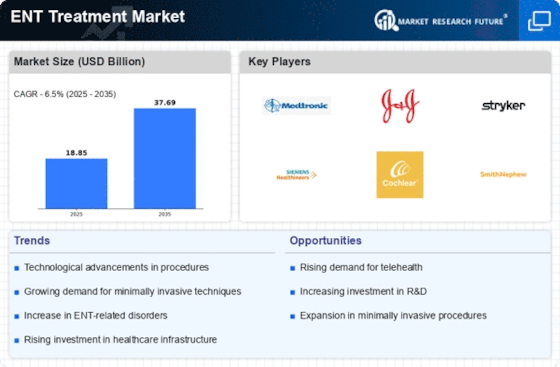
As per Market Research Future analysis, the ENT Treatment Market Size was estimated at 18.85 USD Billion in 2024. The ENT industry is projected to grow from 20.08 USD Billion in 2025 to 37.69 USD Billion by 2035, exhibiting a compound annual growth rate (CAGR) of 6.5% during the forecast period 2025 - 2035

Key Market Trends & Highlights

The ENT Treatment Market is experiencing robust growth driven by technological advancements and increasing patient awareness.

  • Technological advancements are revolutionizing treatment options in the ENT sector, particularly in North America. Increased patient awareness is leading to higher demand for hearing aid devices, which remain the largest segment in the market. The Asia-Pacific region is emerging as the fastest-growing market, particularly in the hearing implants segment. Rising incidence of ENT disorders and an aging population are key drivers propelling market expansion.

Market Size & Forecast

2024 Market Size 18.85 (USD Billion)
2035 Market Size 37.69 (USD Billion)
CAGR (2025 - 2035) 6.5%
Largest Regional Market Share in 2024 Asia Pacific

Major Players

<a href="https://www.medtronic.com/in-en/healthcare-professionals/therapies-procedures/ear-nose-throat.html">Medtronic</a> (US), <a href="https://www.jnj.com/healthcare-products">Johnson &amp; Johnson</a> (US), Stryker (US), Siemens Healthineers (DE), Cochlear Limited (AU), Smith &amp; Nephew (GB), Hearing Life (US), Oticon (DK), Amplifon (IT)

Market Trends

The ENT Treatment Market is currently experiencing a dynamic evolution, driven by advancements in technology and an increasing prevalence of ear, nose, and throat disorders. Innovations in minimally invasive surgical techniques and the development of sophisticated diagnostic tools appear to enhance patient outcomes significantly. Furthermore, the growing awareness of ENT health among the general population seems to contribute to a rising demand for specialized treatments. This heightened focus on early diagnosis and intervention may lead to an expansion of service offerings within the market, as healthcare providers strive to meet the needs of patients more effectively. In addition, the integration of telemedicine into the ENT Treatment Market is likely to reshape how care is delivered. Remote consultations and digital health platforms may facilitate access to specialists, particularly in underserved regions. This trend suggests a potential shift towards more patient-centered care, where convenience and accessibility are prioritized. As the market continues to evolve, stakeholders must remain vigilant to emerging trends and adapt their strategies accordingly to capitalize on new opportunities and address challenges that may arise.

Technological Advancements

The ENT Treatment Market is witnessing a surge in technological innovations, particularly in surgical instruments and diagnostic equipment. These advancements are likely to improve precision in procedures and enhance the overall patient experience.

Increased Patient Awareness

There appears to be a growing awareness regarding ENT health among the public, which may lead to higher demand for treatments. This trend suggests that educational initiatives could play a crucial role in promoting early intervention.

Telemedicine Integration

The incorporation of telemedicine into the ENT Treatment Market is transforming patient care delivery. Remote consultations may provide greater access to specialists, particularly for individuals in remote or underserved areas.

ENT Treatment Market Market Drivers

Aging Population

The demographic shift towards an aging population is significantly influencing the ENT Treatment Market. As individuals age, they become more susceptible to various ENT disorders, including hearing loss, voice disorders, and chronic sinus issues. Data indicates that nearly 30% of older adults experience some form of hearing impairment, necessitating advanced treatment solutions. This demographic trend is prompting healthcare systems to allocate more resources towards ENT care, including specialized clinics and rehabilitation programs. The growing need for tailored treatments for age-related ENT conditions is expected to drive innovation and investment in the ENT Treatment Market, fostering a more robust healthcare landscape.

Increased Healthcare Expenditure

Rising healthcare expenditure across various regions is a crucial driver for the ENT Treatment Market. Governments and private sectors are investing more in healthcare infrastructure, leading to improved access to ENT services. Reports indicate that healthcare spending is expected to grow by approximately 5% annually, facilitating the development of specialized ENT clinics and enhancing the availability of advanced treatment options. This increase in funding allows for better diagnostic tools, treatment modalities, and patient education programs, which are essential for managing ENT disorders effectively. As a result, the ENT Treatment Market is likely to experience substantial growth, driven by enhanced service delivery and patient care.

Rising Incidence of ENT Disorders

The increasing prevalence of ear, nose, and throat disorders is a primary driver of the ENT Treatment Market. Conditions such as sinusitis, otitis media, and allergic rhinitis are becoming more common, affecting millions worldwide. According to recent health statistics, the incidence of chronic sinusitis alone affects approximately 12% of the population, leading to a heightened demand for effective treatment options. This trend is likely to continue as urbanization and environmental factors contribute to the rise in these disorders. Consequently, healthcare providers are focusing on developing innovative therapies and surgical techniques to address these conditions, thereby propelling the growth of the ENT Treatment Market.

Advancements in Surgical Techniques

Innovations in surgical techniques and technologies are transforming the ENT Treatment Market. Minimally invasive procedures, such as endoscopic sinus surgery and laser treatments, are gaining traction due to their effectiveness and reduced recovery times. The introduction of robotic-assisted surgeries is also enhancing precision in complex ENT procedures. Market data suggests that the adoption of these advanced surgical methods is increasing, with a projected growth rate of over 10% in the next few years. This trend not only improves patient outcomes but also encourages healthcare providers to invest in state-of-the-art equipment and training, further stimulating the ENT Treatment Market.

Growing Demand for Non-Invasive Treatments

The shift towards non-invasive treatment options is reshaping the ENT Treatment Market. Patients increasingly prefer treatments that minimize discomfort and recovery time, leading to a surge in demand for non-surgical interventions. Options such as allergy immunotherapy, nasal sprays, and other pharmacological treatments are becoming more popular. Market analysis indicates that the non-invasive segment is expected to witness a growth rate of around 8% over the next few years. This trend is prompting pharmaceutical companies and healthcare providers to focus on developing innovative non-invasive therapies, thereby expanding the range of options available to patients and enhancing the overall landscape of the ENT Treatment Market.

Market Segment Insights

By Devices: Hearing Aid Devices (Largest) vs. Hearing Implants (Fastest-Growing)

In the ENT Treatment Market, the Devices segment is characterized by a variety of products catering to different audiological and otolaryngological needs. Among these, Hearing Aid Devices hold the largest market share, reflecting their widespread adoption and established role in improving the quality of life for individuals with hearing impairments. Following closely are Hearing Implants, which, while accounting for a smaller share, demonstrate significant potential for growth as advancements in technology enhance their efficacy and acceptance. The market for Devices within the ENT Treatment Market landscape is evolving rapidly, driven by technological innovations and increasing awareness of ENT disorders. Emerging trends indicate a shift towards personalized treatment solutions, with Hearing Implants leading as the fastest-growing segment due to their ability to address complex hearing issues. Additionally, awareness programs and an aging population are propelling demand for Hearing Aids, ensuring they remain a dominant force in the market. These factors are collectively shaping the future landscape of the Devices segment in ENT treatments.

Hearing Aid Devices (Dominant) vs. Voice Prosthesis (Emerging)

Hearing Aid Devices dominate the Devices segment of the ENT Treatment Market, reflecting broad acceptance and longstanding reliance for addressing hearing loss. These devices have evolved significantly, incorporating advanced technologies such as digital signal processing and wireless connectivity, which enhance user experience and adaptability. On the other hand, Voice Prosthesis represents an emerging category marked by its rising relevance among patients who have undergone laryngectomy. These devices are essential for restoring verbal communication, and as innovative materials and design efficiencies emerge, they are becoming more accessible. The contrast between the established presence of Hearing Aids and the growing recognition of Voice Prosthesis exemplifies the dynamic landscape of the ENT treatment sector, underscoring ongoing advancements in device technology.

By Drug Type: Antibiotics (Largest) vs. Antihistamines (Fastest-Growing)

The ENT Treatment Market demonstrates a diverse distribution among various drug types, with antibiotics holding the largest market share. Their wide usage in treating bacterial infections in the ear, nose, and throat boosts their dominance in the sector. Antihistamines come in a close second, catering to the rising prevalence of allergies affecting the ENT region, which enhances their market presence significantly. As awareness of ENT conditions grows among the population, the sales for these drugs are increasing steadily. In recent years, the growth trajectory of the ENT Treatment Market has been propelled by the rising incidence of respiratory infections and allergic reactions. This has led to an increased demand for effective treatments, with antihistamines gaining traction as the fastest-growing segment. Furthermore, innovations in drug formulation and targeted therapies aimed at improving efficacy and patient compliance are contributing to the expansion of the analgesics and anti-inflammatory drugs market, thus reshaping the segment landscape comprehensively.

Antibiotics (Dominant) vs. Antihistamines (Emerging)

Antibiotics are considered the dominant force within the ENT Treatment Market, primarily due to their effectiveness against bacterial infections. They play a crucial role in managing conditions such as sinusitis and otitis media, making them the go-to option for healthcare providers. On the other hand, antihistamines are emerging players that have seen a significant increase in demand due to the rise in allergic disorders impacting the ENT system. Their effectiveness in relieving symptoms related to allergies makes them an attractive choice for patients, thus facilitating their growth. This juxtaposition highlights the established market position of antibiotics against the rising popularity of antihistamines, showcasing a dynamic shift in treatment preferences.

By Organ Type: Ear (Largest) vs. Nose (Fastest-Growing)

In the ENT Treatment Market, the distribution of market share among the organ types reveals that ear treatments hold the largest segment share, significantly outweighing others. Ear disorders, including hearing loss and otitis media, drive a substantial demand for innovative treatment solutions. Conversely, the nose segment is gaining momentum due to increasing awareness of nasal-related issues and advancements in minimally invasive surgical techniques that cater to conditions like sinusitis and nasal obstructions.

Ear (Dominant) vs. Nose (Emerging)

The ear segment is established as the dominant force in the ENT Treatment Market, characterized by a broad spectrum of conditions necessitating treatment, from hearing impairments to infections. Advanced technologies, such as <a href="https://www.marketresearchfuture.com/reports/cochlear-implants-market-5256">cochlear implants</a> and hearing aids, continually enhance patient outcomes, making ear treatments a clinical priority. In contrast, the nose segment is emerging rapidly, driven by evolving healthcare practices and the growing prevalence of allergic rhinitis and chronic sinusitis. This segment benefits from innovative therapies and increasing patient education on nasal health, positioning it as a vital focus area for stakeholders in the ENT market.

By End User: Hospitals (Largest) vs. Clinics (Fastest-Growing)

The ENT treatment market is significantly driven by hospitals, which represent the largest share of the end-user segment. Hospitals typically provide a wide range of services, including complex surgeries and specialized treatments, attracting a larger patient base. Clinics, while having a smaller share, are catching up quickly due to their accessibility and the rise of outpatient procedures. This dynamic distribution indicates a competitive landscape where hospitals remain pivotal in ENT treatment, but clinics are rapidly increasing their market presence.

Hospitals (Dominant) vs. Clinics (Emerging)

Hospitals have solidified their position as the dominant end-user in the ENT treatment market, primarily due to their comprehensive facilities and range of specialist services. They cater to a broad spectrum of ENT disorders, allowing for surgeries, diagnostics, and follow-up care in a single setting. On the other hand, clinics are emerging as an important player in this market. They offer outpatient services, shorter wait times, and increased convenience for patients. The growth of clinics is bolstered by advancements in technology and a shift towards more outpatient-based ENT treatments that provide effective care in a cost-efficient manner.

Get more detailed insights about ENT Treatment Market Research Report—Global Forecast till 2035

Regional Insights

North America : Leading Market for ENT Solutions

North America is the largest market for ENT treatments, accounting for approximately 45% of the global market share. The growth is driven by increasing prevalence of ENT disorders, advancements in medical technology, and a robust healthcare infrastructure. Regulatory support from agencies like the FDA further catalyzes innovation and product approvals, enhancing market dynamics. The demand for minimally invasive procedures is also on the rise, contributing to market expansion. The United States is the primary contributor, with significant investments in research and development from key players such as Medtronic, Johnson & Johnson, and Stryker. The competitive landscape is characterized by a mix of established companies and emerging startups, focusing on innovative solutions for hearing loss and sinus issues. The presence of advanced healthcare facilities and a high rate of healthcare expenditure further solidifies North America's position in the ENT treatment market.

Europe : Emerging Innovations in ENT Care

Europe is a significant player in the ENT treatment market, holding approximately 30% of the global share. The region benefits from a strong regulatory framework that encourages innovation and ensures high-quality standards in medical devices. Countries like Germany and the UK are at the forefront, with increasing investments in healthcare technology and a growing elderly population driving demand for ENT solutions. The European market is also witnessing a shift towards personalized medicine and advanced surgical techniques. Germany leads the market, supported by key players such as Siemens Healthineers and Oticon. The competitive landscape is marked by collaborations between manufacturers and healthcare providers to enhance service delivery. Additionally, the presence of various regulatory bodies ensures compliance and safety, fostering consumer trust. The European market is poised for growth as it adapts to new technologies and patient needs.

Asia-Pacific : Rapid Growth in Emerging Markets

Asia-Pacific is an emerging powerhouse in the ENT treatment market, accounting for about 20% of the global share. The region is experiencing rapid growth due to increasing healthcare expenditure, rising awareness of ENT disorders, and a growing aging population. Countries like China and India are leading this growth, supported by government initiatives aimed at improving healthcare access and infrastructure. The demand for affordable and effective ENT solutions is driving market expansion in these countries. China is the largest market in the region, with significant contributions from local manufacturers and international players like Cochlear Limited and Amplifon. The competitive landscape is evolving, with a focus on innovative products and services tailored to local needs. As healthcare systems improve, the Asia-Pacific region is expected to see a surge in demand for advanced ENT treatments, further enhancing its market position.

Middle East and Africa : Untapped Potential in Healthcare

The Middle East and Africa (MEA) region is gradually emerging in the ENT treatment market, holding approximately 5% of the global share. The growth is primarily driven by increasing healthcare investments, rising awareness of ENT disorders, and a growing population. Countries like South Africa and the UAE are witnessing improvements in healthcare infrastructure, which is facilitating better access to ENT treatments. Government initiatives aimed at enhancing healthcare services are also contributing to market growth. South Africa is a key player in the region, with a mix of local and international companies operating in the market. The competitive landscape is characterized by a focus on affordable solutions and partnerships with healthcare providers to improve service delivery. As the region continues to develop, the demand for advanced ENT treatments is expected to rise, presenting significant opportunities for market players.

Key Players and Competitive Insights

The ENT Treatment Market is currently characterized by a dynamic competitive landscape, driven by technological advancements, increasing prevalence of ENT disorders, and a growing demand for innovative treatment solutions. Major players such as Medtronic (US), Johnson & Johnson (US), and Cochlear Limited (AU) are strategically positioned to leverage these growth drivers. Medtronic (US) focuses on innovation in minimally invasive surgical technologies, while Johnson & Johnson (US) emphasizes a broad portfolio of ENT products, including surgical instruments and implants. Cochlear Limited (AU) is dedicated to enhancing hearing solutions through advanced cochlear implant technologies. Collectively, these strategies foster a competitive environment that prioritizes innovation and patient-centric solutions.Key business tactics within the ENT Treatment Market include localizing manufacturing and optimizing supply chains to enhance operational efficiency. The market appears moderately fragmented, with several key players exerting influence over specific segments. This fragmentation allows for niche players to thrive, while larger companies consolidate their market positions through strategic partnerships and acquisitions, thereby shaping the overall competitive structure.

In August Medtronic (US) announced the launch of a new line of advanced ENT surgical instruments designed to improve precision in procedures. This strategic move is likely to enhance Medtronic's market share by addressing the growing demand for minimally invasive surgical options, thereby positioning the company as a leader in surgical innovation within the ENT sector. The introduction of these instruments may also facilitate better patient outcomes, further solidifying Medtronic's reputation in the market.

In September Johnson & Johnson (US) expanded its ENT product line by acquiring a small but innovative company specializing in digital health solutions for hearing loss. This acquisition appears to be a strategic effort to integrate digital technologies into their existing product offerings, potentially enhancing patient engagement and treatment adherence. By embracing digital health, Johnson & Johnson (US) is likely to strengthen its competitive edge in a market increasingly focused on technology-driven solutions.

In July Cochlear Limited (AU) launched a new software platform aimed at improving the user experience for cochlear implant recipients. This initiative seems to reflect a growing trend towards personalized healthcare solutions, as it allows for tailored adjustments based on individual patient needs. By investing in software development, Cochlear Limited (AU) is not only enhancing its product offerings but also reinforcing its commitment to patient-centered care, which could lead to increased customer loyalty and market penetration.

As of October the ENT Treatment Market is witnessing significant trends such as digitalization, sustainability, and the integration of artificial intelligence in treatment solutions. Strategic alliances among key players are shaping the competitive landscape, fostering innovation and collaboration. Looking ahead, it appears that competitive differentiation will increasingly hinge on technological advancements and supply chain reliability, rather than solely on price. Companies that prioritize innovation and patient-centric approaches are likely to thrive in this evolving market.

Key Companies in the ENT Treatment Market include

Industry Developments

January 2022 Acclarent Inc., a subsidiary of Johnson & Johnson Medical Devices Companies, unveiled the industry's first ENT technology powered by artificial intelligence (AI) that is intended to streamline surgical planning and offer real-time feedback throughout ENT navigation procedures.

Future Outlook

ENT Treatment Market Future Outlook

The ENT Treatment Market is projected to grow at a 6.5% CAGR from 2025 to 2035, driven by technological advancements, increasing prevalence of ENT disorders, and rising healthcare expenditure.

New opportunities lie in:

  • Development of telehealth platforms for remote ENT consultations.</p><p>Investment in AI-driven diagnostic tools for early detection.</p><p>Expansion of minimally invasive surgical techniques in outpatient settings.

By 2035, the ENT Treatment Market is expected to achieve substantial growth, reflecting evolving healthcare dynamics.

Market Segmentation

ENT Treatment Market Devices Outlook

  • Hearing Aid Devices
  • Voice Prosthesis
  • Nasal Splints
  • Hearing Implants
  • Endoscopes
  • Others

ENT Treatment Market End User Outlook

  • Hospitals
  • Clinics
  • Ambulatory Surgical Centers
  • Home Care Settings
  • Others

ENT Treatment Market Drug Type Outlook

  • Antibiotics
  • Antihistamines
  • Steroids
  • Anti-inflammatory Drugs
  • Others

ENT Treatment Market Organ Type Outlook

  • Ear
  • Nose
  • Throat

Report Scope

MARKET SIZE 2024 18.85(USD Billion)
MARKET SIZE 2025 20.08(USD Billion)
MARKET SIZE 2035 37.69(USD Billion)
COMPOUND ANNUAL GROWTH RATE (CAGR) 6.5% (2025 - 2035)
REPORT COVERAGE Revenue Forecast, Competitive Landscape, Growth Factors, and Trends
BASE YEAR 2024
Market Forecast Period 2025 - 2035
Historical Data 2019 - 2024
Market Forecast Units USD Billion
Key Companies Profiled Medtronic (US), Johnson & Johnson (US), Stryker (US), Siemens Healthineers (DE), Cochlear Limited (AU), Smith & Nephew (GB), Hearing Life (US), Oticon (DK), Amplifon (IT)
Segments Covered Devices, Drug Type, Organ Type, End User, Region
Key Market Opportunities Integration of telemedicine and digital health solutions in the ENT Treatment Market.
Key Market Dynamics Technological advancements and regulatory changes are reshaping competitive dynamics in the ENT treatment market.
Countries Covered North America, Europe, APAC, South America, MEA

FAQs

What is the current valuation of the ENT Treatment Market in 2025?

<p>The ENT Treatment Market is valued at approximately 18.85 USD Billion in 2024.</p>

What is the projected market size for the ENT Treatment Market by 2035?

<p>The market is projected to reach around 37.69 USD Billion by 2035.</p>

What is the expected CAGR for the ENT Treatment Market during the forecast period 2025 - 2035?

<p>The expected CAGR for the ENT Treatment Market during the forecast period 2025 - 2035 is 6.5%.</p>

Which segments are included in the ENT Treatment Market?

<p>The market includes segments such as Devices, Drug Type, Organ Type, and End User.</p>

What are the key players in the ENT Treatment Market?

<p>Key players include Medtronic, Johnson & Johnson, Stryker, Siemens Healthineers, and Cochlear Limited.</p>

How much is the Hearing Aid Devices segment projected to grow by 2035?

<p>The Hearing Aid Devices segment is projected to grow from 5.0 USD Billion to 10.0 USD Billion by 2035.</p>

What is the expected growth for the Antibiotics segment in the ENT Treatment Market?

The Antibiotics segment is expected to grow from 3.77 USD Billion to 7.54 USD Billion by 2035.

Which end user segment is anticipated to have the highest valuation by 2035?

The Hospitals segment is anticipated to have the highest valuation, growing from 7.55 USD Billion to 14.85 USD Billion by 2035.

What is the projected growth for the Throat organ type segment?

The Throat organ type segment is projected to grow from 6.85 USD Billion to 13.69 USD Billion by 2035.

How does the market for Hearing Implants compare to other device segments?

The Hearing Implants segment is expected to grow from 3.0 USD Billion to 6.0 USD Billion, indicating robust demand compared to other device segments.

  1. SECTION I: EXECUTIVE SUMMARY AND KEY HIGHLIGHTS
    1. | 1.1 EXECUTIVE SUMMARY
    2. | | 1.1.1 Market Overview
    3. | | 1.1.2 Key Findings
    4. | | 1.1.3 Market Segmentation
    5. | | 1.1.4 Competitive Landscape
    6. | | 1.1.5 Challenges and Opportunities
    7. | | 1.1.6 Future Outlook
  2. SECTION II: SCOPING, METHODOLOGY AND MARKET STRUCTURE
    1. | 2.1 MARKET INTRODUCTION
    2. | | 2.1.1 Definition
    3. | | 2.1.2 Scope of the study
    4. | | | 2.1.2.1 Research Objective
    5. | | | 2.1.2.2 Assumption
    6. | | | 2.1.2.3 Limitations
    7. | 2.2 RESEARCH METHODOLOGY
    8. | | 2.2.1 Overview
    9. | | 2.2.2 Data Mining
    10. | | 2.2.3 Secondary Research
    11. | | 2.2.4 Primary Research
    12. | | | 2.2.4.1 Primary Interviews and Information Gathering Process
    13. | | | 2.2.4.2 Breakdown of Primary Respondents
    14. | | 2.2.5 Forecasting Model
    15. | | 2.2.6 Market Size Estimation
    16. | | | 2.2.6.1 Bottom-Up Approach
    17. | | | 2.2.6.2 Top-Down Approach
    18. | | 2.2.7 Data Triangulation
    19. | | 2.2.8 Validation
  3. SECTION III: QUALITATIVE ANALYSIS
    1. | 3.1 MARKET DYNAMICS
    2. | | 3.1.1 Overview
    3. | | 3.1.2 Drivers
    4. | | 3.1.3 Restraints
    5. | | 3.1.4 Opportunities
    6. | 3.2 MARKET FACTOR ANALYSIS
    7. | | 3.2.1 Value chain Analysis
    8. | | 3.2.2 Porter's Five Forces Analysis
    9. | | | 3.2.2.1 Bargaining Power of Suppliers
    10. | | | 3.2.2.2 Bargaining Power of Buyers
    11. | | | 3.2.2.3 Threat of New Entrants
    12. | | | 3.2.2.4 Threat of Substitutes
    13. | | | 3.2.2.5 Intensity of Rivalry
    14. | | 3.2.3 COVID-19 Impact Analysis
    15. | | | 3.2.3.1 Market Impact Analysis
    16. | | | 3.2.3.2 Regional Impact
    17. | | | 3.2.3.3 Opportunity and Threat Analysis
  4. SECTION IV: QUANTITATIVE ANALYSIS
    1. | 4.1 Healthcare, BY Devices (USD Billion)
    2. | | 4.1.1 Hearing Aid Devices
    3. | | 4.1.2 Voice Prosthesis
    4. | | 4.1.3 Nasal Splints
    5. | | 4.1.4 Hearing Implants
    6. | | 4.1.5 Endoscopes
    7. | | 4.1.6 Others
    8. | 4.2 Healthcare, BY Drug Type (USD Billion)
    9. | | 4.2.1 Antibiotics
    10. | | 4.2.2 Antihistamines
    11. | | 4.2.3 Steroids
    12. | | 4.2.4 Anti-inflammatory Drugs
    13. | | 4.2.5 Others
    14. | 4.3 Healthcare, BY Organ Type (USD Billion)
    15. | | 4.3.1 Ear
    16. | | 4.3.2 Nose
    17. | | 4.3.3 Throat
    18. | 4.4 Healthcare, BY End User (USD Billion)
    19. | | 4.4.1 Hospitals
    20. | | 4.4.2 Clinics
    21. | | 4.4.3 Ambulatory Surgical Centers
    22. | | 4.4.4 Home Care Settings
    23. | | 4.4.5 Others
    24. | 4.5 Healthcare, BY Region (USD Billion)
    25. | | 4.5.1 North America
    26. | | | 4.5.1.1 US
    27. | | | 4.5.1.2 Canada
    28. | | 4.5.2 Europe
    29. | | | 4.5.2.1 Germany
    30. | | | 4.5.2.2 UK
    31. | | | 4.5.2.3 France
    32. | | | 4.5.2.4 Russia
    33. | | | 4.5.2.5 Italy
    34. | | | 4.5.2.6 Spain
    35. | | | 4.5.2.7 Rest of Europe
    36. | | 4.5.3 APAC
    37. | | | 4.5.3.1 China
    38. | | | 4.5.3.2 India
    39. | | | 4.5.3.3 Japan
    40. | | | 4.5.3.4 South Korea
    41. | | | 4.5.3.5 Malaysia
    42. | | | 4.5.3.6 Thailand
    43. | | | 4.5.3.7 Indonesia
    44. | | | 4.5.3.8 Rest of APAC
    45. | | 4.5.4 South America
    46. | | | 4.5.4.1 Brazil
    47. | | | 4.5.4.2 Mexico
    48. | | | 4.5.4.3 Argentina
    49. | | | 4.5.4.4 Rest of South America
    50. | | 4.5.5 MEA
    51. | | | 4.5.5.1 GCC Countries
    52. | | | 4.5.5.2 South Africa
    53. | | | 4.5.5.3 Rest of MEA
  5. SECTION V: COMPETITIVE ANALYSIS
    1. | 5.1 Competitive Landscape
    2. | | 5.1.1 Overview
    3. | | 5.1.2 Competitive Analysis
    4. | | 5.1.3 Market share Analysis
    5. | | 5.1.4 Major Growth Strategy in the Healthcare
    6. | | 5.1.5 Competitive Benchmarking
    7. | | 5.1.6 Leading Players in Terms of Number of Developments in the Healthcare
    8. | | 5.1.7 Key developments and growth strategies
    9. | | | 5.1.7.1 New Product Launch/Service Deployment
    10. | | | 5.1.7.2 Merger & Acquisitions
    11. | | | 5.1.7.3 Joint Ventures
    12. | | 5.1.8 Major Players Financial Matrix
    13. | | | 5.1.8.1 Sales and Operating Income
    14. | | | 5.1.8.2 Major Players R&D Expenditure. 2023
    15. | 5.2 Company Profiles
    16. | | 5.2.1 Medtronic (US)
    17. | | | 5.2.1.1 Financial Overview
    18. | | | 5.2.1.2 Products Offered
    19. | | | 5.2.1.3 Key Developments
    20. | | | 5.2.1.4 SWOT Analysis
    21. | | | 5.2.1.5 Key Strategies
    22. | | 5.2.2 Johnson & Johnson (US)
    23. | | | 5.2.2.1 Financial Overview
    24. | | | 5.2.2.2 Products Offered
    25. | | | 5.2.2.3 Key Developments
    26. | | | 5.2.2.4 SWOT Analysis
    27. | | | 5.2.2.5 Key Strategies
    28. | | 5.2.3 Stryker (US)
    29. | | | 5.2.3.1 Financial Overview
    30. | | | 5.2.3.2 Products Offered
    31. | | | 5.2.3.3 Key Developments
    32. | | | 5.2.3.4 SWOT Analysis
    33. | | | 5.2.3.5 Key Strategies
    34. | | 5.2.4 Siemens Healthineers (DE)
    35. | | | 5.2.4.1 Financial Overview
    36. | | | 5.2.4.2 Products Offered
    37. | | | 5.2.4.3 Key Developments
    38. | | | 5.2.4.4 SWOT Analysis
    39. | | | 5.2.4.5 Key Strategies
    40. | | 5.2.5 Cochlear Limited (AU)
    41. | | | 5.2.5.1 Financial Overview
    42. | | | 5.2.5.2 Products Offered
    43. | | | 5.2.5.3 Key Developments
    44. | | | 5.2.5.4 SWOT Analysis
    45. | | | 5.2.5.5 Key Strategies
    46. | | 5.2.6 Smith & Nephew (GB)
    47. | | | 5.2.6.1 Financial Overview
    48. | | | 5.2.6.2 Products Offered
    49. | | | 5.2.6.3 Key Developments
    50. | | | 5.2.6.4 SWOT Analysis
    51. | | | 5.2.6.5 Key Strategies
    52. | | 5.2.7 Hearing Life (US)
    53. | | | 5.2.7.1 Financial Overview
    54. | | | 5.2.7.2 Products Offered
    55. | | | 5.2.7.3 Key Developments
    56. | | | 5.2.7.4 SWOT Analysis
    57. | | | 5.2.7.5 Key Strategies
    58. | | 5.2.8 Oticon (DK)
    59. | | | 5.2.8.1 Financial Overview
    60. | | | 5.2.8.2 Products Offered
    61. | | | 5.2.8.3 Key Developments
    62. | | | 5.2.8.4 SWOT Analysis
    63. | | | 5.2.8.5 Key Strategies
    64. | | 5.2.9 Amplifon (IT)
    65. | | | 5.2.9.1 Financial Overview
    66. | | | 5.2.9.2 Products Offered
    67. | | | 5.2.9.3 Key Developments
    68. | | | 5.2.9.4 SWOT Analysis
    69. | | | 5.2.9.5 Key Strategies
    70. | 5.3 Appendix
    71. | | 5.3.1 References
    72. | | 5.3.2 Related Reports
  6. LIST OF FIGURES
    1. | 6.1 MARKET SYNOPSIS
    2. | 6.2 NORTH AMERICA MARKET ANALYSIS
    3. | 6.3 US MARKET ANALYSIS BY DEVICES
    4. | 6.4 US MARKET ANALYSIS BY DRUG TYPE
    5. | 6.5 US MARKET ANALYSIS BY ORGAN TYPE
    6. | 6.6 US MARKET ANALYSIS BY END USER
    7. | 6.7 CANADA MARKET ANALYSIS BY DEVICES
    8. | 6.8 CANADA MARKET ANALYSIS BY DRUG TYPE
    9. | 6.9 CANADA MARKET ANALYSIS BY ORGAN TYPE
    10. | 6.10 CANADA MARKET ANALYSIS BY END USER
    11. | 6.11 EUROPE MARKET ANALYSIS
    12. | 6.12 GERMANY MARKET ANALYSIS BY DEVICES
    13. | 6.13 GERMANY MARKET ANALYSIS BY DRUG TYPE
    14. | 6.14 GERMANY MARKET ANALYSIS BY ORGAN TYPE
    15. | 6.15 GERMANY MARKET ANALYSIS BY END USER
    16. | 6.16 UK MARKET ANALYSIS BY DEVICES
    17. | 6.17 UK MARKET ANALYSIS BY DRUG TYPE
    18. | 6.18 UK MARKET ANALYSIS BY ORGAN TYPE
    19. | 6.19 UK MARKET ANALYSIS BY END USER
    20. | 6.20 FRANCE MARKET ANALYSIS BY DEVICES
    21. | 6.21 FRANCE MARKET ANALYSIS BY DRUG TYPE
    22. | 6.22 FRANCE MARKET ANALYSIS BY ORGAN TYPE
    23. | 6.23 FRANCE MARKET ANALYSIS BY END USER
    24. | 6.24 RUSSIA MARKET ANALYSIS BY DEVICES
    25. | 6.25 RUSSIA MARKET ANALYSIS BY DRUG TYPE
    26. | 6.26 RUSSIA MARKET ANALYSIS BY ORGAN TYPE
    27. | 6.27 RUSSIA MARKET ANALYSIS BY END USER
    28. | 6.28 ITALY MARKET ANALYSIS BY DEVICES
    29. | 6.29 ITALY MARKET ANALYSIS BY DRUG TYPE
    30. | 6.30 ITALY MARKET ANALYSIS BY ORGAN TYPE
    31. | 6.31 ITALY MARKET ANALYSIS BY END USER
    32. | 6.32 SPAIN MARKET ANALYSIS BY DEVICES
    33. | 6.33 SPAIN MARKET ANALYSIS BY DRUG TYPE
    34. | 6.34 SPAIN MARKET ANALYSIS BY ORGAN TYPE
    35. | 6.35 SPAIN MARKET ANALYSIS BY END USER
    36. | 6.36 REST OF EUROPE MARKET ANALYSIS BY DEVICES
    37. | 6.37 REST OF EUROPE MARKET ANALYSIS BY DRUG TYPE
    38. | 6.38 REST OF EUROPE MARKET ANALYSIS BY ORGAN TYPE
    39. | 6.39 REST OF EUROPE MARKET ANALYSIS BY END USER
    40. | 6.40 APAC MARKET ANALYSIS
    41. | 6.41 CHINA MARKET ANALYSIS BY DEVICES
    42. | 6.42 CHINA MARKET ANALYSIS BY DRUG TYPE
    43. | 6.43 CHINA MARKET ANALYSIS BY ORGAN TYPE
    44. | 6.44 CHINA MARKET ANALYSIS BY END USER
    45. | 6.45 INDIA MARKET ANALYSIS BY DEVICES
    46. | 6.46 INDIA MARKET ANALYSIS BY DRUG TYPE
    47. | 6.47 INDIA MARKET ANALYSIS BY ORGAN TYPE
    48. | 6.48 INDIA MARKET ANALYSIS BY END USER
    49. | 6.49 JAPAN MARKET ANALYSIS BY DEVICES
    50. | 6.50 JAPAN MARKET ANALYSIS BY DRUG TYPE
    51. | 6.51 JAPAN MARKET ANALYSIS BY ORGAN TYPE
    52. | 6.52 JAPAN MARKET ANALYSIS BY END USER
    53. | 6.53 SOUTH KOREA MARKET ANALYSIS BY DEVICES
    54. | 6.54 SOUTH KOREA MARKET ANALYSIS BY DRUG TYPE
    55. | 6.55 SOUTH KOREA MARKET ANALYSIS BY ORGAN TYPE
    56. | 6.56 SOUTH KOREA MARKET ANALYSIS BY END USER
    57. | 6.57 MALAYSIA MARKET ANALYSIS BY DEVICES
    58. | 6.58 MALAYSIA MARKET ANALYSIS BY DRUG TYPE
    59. | 6.59 MALAYSIA MARKET ANALYSIS BY ORGAN TYPE
    60. | 6.60 MALAYSIA MARKET ANALYSIS BY END USER
    61. | 6.61 THAILAND MARKET ANALYSIS BY DEVICES
    62. | 6.62 THAILAND MARKET ANALYSIS BY DRUG TYPE
    63. | 6.63 THAILAND MARKET ANALYSIS BY ORGAN TYPE
    64. | 6.64 THAILAND MARKET ANALYSIS BY END USER
    65. | 6.65 INDONESIA MARKET ANALYSIS BY DEVICES
    66. | 6.66 INDONESIA MARKET ANALYSIS BY DRUG TYPE
    67. | 6.67 INDONESIA MARKET ANALYSIS BY ORGAN TYPE
    68. | 6.68 INDONESIA MARKET ANALYSIS BY END USER
    69. | 6.69 REST OF APAC MARKET ANALYSIS BY DEVICES
    70. | 6.70 REST OF APAC MARKET ANALYSIS BY DRUG TYPE
    71. | 6.71 REST OF APAC MARKET ANALYSIS BY ORGAN TYPE
    72. | 6.72 REST OF APAC MARKET ANALYSIS BY END USER
    73. | 6.73 SOUTH AMERICA MARKET ANALYSIS
    74. | 6.74 BRAZIL MARKET ANALYSIS BY DEVICES
    75. | 6.75 BRAZIL MARKET ANALYSIS BY DRUG TYPE
    76. | 6.76 BRAZIL MARKET ANALYSIS BY ORGAN TYPE
    77. | 6.77 BRAZIL MARKET ANALYSIS BY END USER
    78. | 6.78 MEXICO MARKET ANALYSIS BY DEVICES
    79. | 6.79 MEXICO MARKET ANALYSIS BY DRUG TYPE
    80. | 6.80 MEXICO MARKET ANALYSIS BY ORGAN TYPE
    81. | 6.81 MEXICO MARKET ANALYSIS BY END USER
    82. | 6.82 ARGENTINA MARKET ANALYSIS BY DEVICES
    83. | 6.83 ARGENTINA MARKET ANALYSIS BY DRUG TYPE
    84. | 6.84 ARGENTINA MARKET ANALYSIS BY ORGAN TYPE
    85. | 6.85 ARGENTINA MARKET ANALYSIS BY END USER
    86. | 6.86 REST OF SOUTH AMERICA MARKET ANALYSIS BY DEVICES
    87. | 6.87 REST OF SOUTH AMERICA MARKET ANALYSIS BY DRUG TYPE
    88. | 6.88 REST OF SOUTH AMERICA MARKET ANALYSIS BY ORGAN TYPE
    89. | 6.89 REST OF SOUTH AMERICA MARKET ANALYSIS BY END USER
    90. | 6.90 MEA MARKET ANALYSIS
    91. | 6.91 GCC COUNTRIES MARKET ANALYSIS BY DEVICES
    92. | 6.92 GCC COUNTRIES MARKET ANALYSIS BY DRUG TYPE
    93. | 6.93 GCC COUNTRIES MARKET ANALYSIS BY ORGAN TYPE
    94. | 6.94 GCC COUNTRIES MARKET ANALYSIS BY END USER
    95. | 6.95 SOUTH AFRICA MARKET ANALYSIS BY DEVICES
    96. | 6.96 SOUTH AFRICA MARKET ANALYSIS BY DRUG TYPE
    97. | 6.97 SOUTH AFRICA MARKET ANALYSIS BY ORGAN TYPE
    98. | 6.98 SOUTH AFRICA MARKET ANALYSIS BY END USER
    99. | 6.99 REST OF MEA MARKET ANALYSIS BY DEVICES
    100. | 6.100 REST OF MEA MARKET ANALYSIS BY DRUG TYPE
    101. | 6.101 REST OF MEA MARKET ANALYSIS BY ORGAN TYPE
    102. | 6.102 REST OF MEA MARKET ANALYSIS BY END USER
    103. | 6.103 KEY BUYING CRITERIA OF HEALTHCARE
    104. | 6.104 RESEARCH PROCESS OF MRFR
    105. | 6.105 DRO ANALYSIS OF HEALTHCARE
    106. | 6.106 DRIVERS IMPACT ANALYSIS: HEALTHCARE
    107. | 6.107 RESTRAINTS IMPACT ANALYSIS: HEALTHCARE
    108. | 6.108 SUPPLY / VALUE CHAIN: HEALTHCARE
    109. | 6.109 HEALTHCARE, BY DEVICES, 2024 (% SHARE)
    110. | 6.110 HEALTHCARE, BY DEVICES, 2024 TO 2035 (USD Billion)
    111. | 6.111 HEALTHCARE, BY DRUG TYPE, 2024 (% SHARE)
    112. | 6.112 HEALTHCARE, BY DRUG TYPE, 2024 TO 2035 (USD Billion)
    113. | 6.113 HEALTHCARE, BY ORGAN TYPE, 2024 (% SHARE)
    114. | 6.114 HEALTHCARE, BY ORGAN TYPE, 2024 TO 2035 (USD Billion)
    115. | 6.115 HEALTHCARE, BY END USER, 2024 (% SHARE)
    116. | 6.116 HEALTHCARE, BY END USER, 2024 TO 2035 (USD Billion)
    117. | 6.117 BENCHMARKING OF MAJOR COMPETITORS
  7. LIST OF TABLES
    1. | 7.1 LIST OF ASSUMPTIONS
    2. | | 7.1.1
    3. | 7.2 North America MARKET SIZE ESTIMATES; FORECAST
    4. | | 7.2.1 BY DEVICES, 2025-2035 (USD Billion)
    5. | | 7.2.2 BY DRUG TYPE, 2025-2035 (USD Billion)
    6. | | 7.2.3 BY ORGAN TYPE, 2025-2035 (USD Billion)
    7. | | 7.2.4 BY END USER, 2025-2035 (USD Billion)
    8. | 7.3 US MARKET SIZE ESTIMATES; FORECAST
    9. | | 7.3.1 BY DEVICES, 2025-2035 (USD Billion)
    10. | | 7.3.2 BY DRUG TYPE, 2025-2035 (USD Billion)
    11. | | 7.3.3 BY ORGAN TYPE, 2025-2035 (USD Billion)
    12. | | 7.3.4 BY END USER, 2025-2035 (USD Billion)
    13. | 7.4 Canada MARKET SIZE ESTIMATES; FORECAST
    14. | | 7.4.1 BY DEVICES, 2025-2035 (USD Billion)
    15. | | 7.4.2 BY DRUG TYPE, 2025-2035 (USD Billion)
    16. | | 7.4.3 BY ORGAN TYPE, 2025-2035 (USD Billion)
    17. | | 7.4.4 BY END USER, 2025-2035 (USD Billion)
    18. | 7.5 Europe MARKET SIZE ESTIMATES; FORECAST
    19. | | 7.5.1 BY DEVICES, 2025-2035 (USD Billion)
    20. | | 7.5.2 BY DRUG TYPE, 2025-2035 (USD Billion)
    21. | | 7.5.3 BY ORGAN TYPE, 2025-2035 (USD Billion)
    22. | | 7.5.4 BY END USER, 2025-2035 (USD Billion)
    23. | 7.6 Germany MARKET SIZE ESTIMATES; FORECAST
    24. | | 7.6.1 BY DEVICES, 2025-2035 (USD Billion)
    25. | | 7.6.2 BY DRUG TYPE, 2025-2035 (USD Billion)
    26. | | 7.6.3 BY ORGAN TYPE, 2025-2035 (USD Billion)
    27. | | 7.6.4 BY END USER, 2025-2035 (USD Billion)
    28. | 7.7 UK MARKET SIZE ESTIMATES; FORECAST
    29. | | 7.7.1 BY DEVICES, 2025-2035 (USD Billion)
    30. | | 7.7.2 BY DRUG TYPE, 2025-2035 (USD Billion)
    31. | | 7.7.3 BY ORGAN TYPE, 2025-2035 (USD Billion)
    32. | | 7.7.4 BY END USER, 2025-2035 (USD Billion)
    33. | 7.8 France MARKET SIZE ESTIMATES; FORECAST
    34. | | 7.8.1 BY DEVICES, 2025-2035 (USD Billion)
    35. | | 7.8.2 BY DRUG TYPE, 2025-2035 (USD Billion)
    36. | | 7.8.3 BY ORGAN TYPE, 2025-2035 (USD Billion)
    37. | | 7.8.4 BY END USER, 2025-2035 (USD Billion)
    38. | 7.9 Russia MARKET SIZE ESTIMATES; FORECAST
    39. | | 7.9.1 BY DEVICES, 2025-2035 (USD Billion)
    40. | | 7.9.2 BY DRUG TYPE, 2025-2035 (USD Billion)
    41. | | 7.9.3 BY ORGAN TYPE, 2025-2035 (USD Billion)
    42. | | 7.9.4 BY END USER, 2025-2035 (USD Billion)
    43. | 7.10 Italy MARKET SIZE ESTIMATES; FORECAST
    44. | | 7.10.1 BY DEVICES, 2025-2035 (USD Billion)
    45. | | 7.10.2 BY DRUG TYPE, 2025-2035 (USD Billion)
    46. | | 7.10.3 BY ORGAN TYPE, 2025-2035 (USD Billion)
    47. | | 7.10.4 BY END USER, 2025-2035 (USD Billion)
    48. | 7.11 Spain MARKET SIZE ESTIMATES; FORECAST
    49. | | 7.11.1 BY DEVICES, 2025-2035 (USD Billion)
    50. | | 7.11.2 BY DRUG TYPE, 2025-2035 (USD Billion)
    51. | | 7.11.3 BY ORGAN TYPE, 2025-2035 (USD Billion)
    52. | | 7.11.4 BY END USER, 2025-2035 (USD Billion)
    53. | 7.12 Rest of Europe MARKET SIZE ESTIMATES; FORECAST
    54. | | 7.12.1 BY DEVICES, 2025-2035 (USD Billion)
    55. | | 7.12.2 BY DRUG TYPE, 2025-2035 (USD Billion)
    56. | | 7.12.3 BY ORGAN TYPE, 2025-2035 (USD Billion)
    57. | | 7.12.4 BY END USER, 2025-2035 (USD Billion)
    58. | 7.13 APAC MARKET SIZE ESTIMATES; FORECAST
    59. | | 7.13.1 BY DEVICES, 2025-2035 (USD Billion)
    60. | | 7.13.2 BY DRUG TYPE, 2025-2035 (USD Billion)
    61. | | 7.13.3 BY ORGAN TYPE, 2025-2035 (USD Billion)
    62. | | 7.13.4 BY END USER, 2025-2035 (USD Billion)
    63. | 7.14 China MARKET SIZE ESTIMATES; FORECAST
    64. | | 7.14.1 BY DEVICES, 2025-2035 (USD Billion)
    65. | | 7.14.2 BY DRUG TYPE, 2025-2035 (USD Billion)
    66. | | 7.14.3 BY ORGAN TYPE, 2025-2035 (USD Billion)
    67. | | 7.14.4 BY END USER, 2025-2035 (USD Billion)
    68. | 7.15 India MARKET SIZE ESTIMATES; FORECAST
    69. | | 7.15.1 BY DEVICES, 2025-2035 (USD Billion)
    70. | | 7.15.2 BY DRUG TYPE, 2025-2035 (USD Billion)
    71. | | 7.15.3 BY ORGAN TYPE, 2025-2035 (USD Billion)
    72. | | 7.15.4 BY END USER, 2025-2035 (USD Billion)
    73. | 7.16 Japan MARKET SIZE ESTIMATES; FORECAST
    74. | | 7.16.1 BY DEVICES, 2025-2035 (USD Billion)
    75. | | 7.16.2 BY DRUG TYPE, 2025-2035 (USD Billion)
    76. | | 7.16.3 BY ORGAN TYPE, 2025-2035 (USD Billion)
    77. | | 7.16.4 BY END USER, 2025-2035 (USD Billion)
    78. | 7.17 South Korea MARKET SIZE ESTIMATES; FORECAST
    79. | | 7.17.1 BY DEVICES, 2025-2035 (USD Billion)
    80. | | 7.17.2 BY DRUG TYPE, 2025-2035 (USD Billion)
    81. | | 7.17.3 BY ORGAN TYPE, 2025-2035 (USD Billion)
    82. | | 7.17.4 BY END USER, 2025-2035 (USD Billion)
    83. | 7.18 Malaysia MARKET SIZE ESTIMATES; FORECAST
    84. | | 7.18.1 BY DEVICES, 2025-2035 (USD Billion)
    85. | | 7.18.2 BY DRUG TYPE, 2025-2035 (USD Billion)
    86. | | 7.18.3 BY ORGAN TYPE, 2025-2035 (USD Billion)
    87. | | 7.18.4 BY END USER, 2025-2035 (USD Billion)
    88. | 7.19 Thailand MARKET SIZE ESTIMATES; FORECAST
    89. | | 7.19.1 BY DEVICES, 2025-2035 (USD Billion)
    90. | | 7.19.2 BY DRUG TYPE, 2025-2035 (USD Billion)
    91. | | 7.19.3 BY ORGAN TYPE, 2025-2035 (USD Billion)
    92. | | 7.19.4 BY END USER, 2025-2035 (USD Billion)
    93. | 7.20 Indonesia MARKET SIZE ESTIMATES; FORECAST
    94. | | 7.20.1 BY DEVICES, 2025-2035 (USD Billion)
    95. | | 7.20.2 BY DRUG TYPE, 2025-2035 (USD Billion)
    96. | | 7.20.3 BY ORGAN TYPE, 2025-2035 (USD Billion)
    97. | | 7.20.4 BY END USER, 2025-2035 (USD Billion)
    98. | 7.21 Rest of APAC MARKET SIZE ESTIMATES; FORECAST
    99. | | 7.21.1 BY DEVICES, 2025-2035 (USD Billion)
    100. | | 7.21.2 BY DRUG TYPE, 2025-2035 (USD Billion)
    101. | | 7.21.3 BY ORGAN TYPE, 2025-2035 (USD Billion)
    102. | | 7.21.4 BY END USER, 2025-2035 (USD Billion)
    103. | 7.22 South America MARKET SIZE ESTIMATES; FORECAST
    104. | | 7.22.1 BY DEVICES, 2025-2035 (USD Billion)
    105. | | 7.22.2 BY DRUG TYPE, 2025-2035 (USD Billion)
    106. | | 7.22.3 BY ORGAN TYPE, 2025-2035 (USD Billion)
    107. | | 7.22.4 BY END USER, 2025-2035 (USD Billion)
    108. | 7.23 Brazil MARKET SIZE ESTIMATES; FORECAST
    109. | | 7.23.1 BY DEVICES, 2025-2035 (USD Billion)
    110. | | 7.23.2 BY DRUG TYPE, 2025-2035 (USD Billion)
    111. | | 7.23.3 BY ORGAN TYPE, 2025-2035 (USD Billion)
    112. | | 7.23.4 BY END USER, 2025-2035 (USD Billion)
    113. | 7.24 Mexico MARKET SIZE ESTIMATES; FORECAST
    114. | | 7.24.1 BY DEVICES, 2025-2035 (USD Billion)
    115. | | 7.24.2 BY DRUG TYPE, 2025-2035 (USD Billion)
    116. | | 7.24.3 BY ORGAN TYPE, 2025-2035 (USD Billion)
    117. | | 7.24.4 BY END USER, 2025-2035 (USD Billion)
    118. | 7.25 Argentina MARKET SIZE ESTIMATES; FORECAST
    119. | | 7.25.1 BY DEVICES, 2025-2035 (USD Billion)
    120. | | 7.25.2 BY DRUG TYPE, 2025-2035 (USD Billion)
    121. | | 7.25.3 BY ORGAN TYPE, 2025-2035 (USD Billion)
    122. | | 7.25.4 BY END USER, 2025-2035 (USD Billion)
    123. | 7.26 Rest of South America MARKET SIZE ESTIMATES; FORECAST
    124. | | 7.26.1 BY DEVICES, 2025-2035 (USD Billion)
    125. | | 7.26.2 BY DRUG TYPE, 2025-2035 (USD Billion)
    126. | | 7.26.3 BY ORGAN TYPE, 2025-2035 (USD Billion)
    127. | | 7.26.4 BY END USER, 2025-2035 (USD Billion)
    128. | 7.27 MEA MARKET SIZE ESTIMATES; FORECAST
    129. | | 7.27.1 BY DEVICES, 2025-2035 (USD Billion)
    130. | | 7.27.2 BY DRUG TYPE, 2025-2035 (USD Billion)
    131. | | 7.27.3 BY ORGAN TYPE, 2025-2035 (USD Billion)
    132. | | 7.27.4 BY END USER, 2025-2035 (USD Billion)
    133. | 7.28 GCC Countries MARKET SIZE ESTIMATES; FORECAST
    134. | | 7.28.1 BY DEVICES, 2025-2035 (USD Billion)
    135. | | 7.28.2 BY DRUG TYPE, 2025-2035 (USD Billion)
    136. | | 7.28.3 BY ORGAN TYPE, 2025-2035 (USD Billion)
    137. | | 7.28.4 BY END USER, 2025-2035 (USD Billion)
    138. | 7.29 South Africa MARKET SIZE ESTIMATES; FORECAST
    139. | | 7.29.1 BY DEVICES, 2025-2035 (USD Billion)
    140. | | 7.29.2 BY DRUG TYPE, 2025-2035 (USD Billion)
    141. | | 7.29.3 BY ORGAN TYPE, 2025-2035 (USD Billion)
    142. | | 7.29.4 BY END USER, 2025-2035 (USD Billion)
    143. | 7.30 Rest of MEA MARKET SIZE ESTIMATES; FORECAST
    144. | | 7.30.1 BY DEVICES, 2025-2035 (USD Billion)
    145. | | 7.30.2 BY DRUG TYPE, 2025-2035 (USD Billion)
    146. | | 7.30.3 BY ORGAN TYPE, 2025-2035 (USD Billion)
    147. | | 7.30.4 BY END USER, 2025-2035 (USD Billion)
    148. | 7.31 PRODUCT LAUNCH/PRODUCT DEVELOPMENT/APPROVAL
    149. | | 7.31.1
    150. | 7.32 ACQUISITION/PARTNERSHIP
    151. | | 7.32.1

Healthcare Market Segmentation

Healthcare By Devices (USD Billion, 2025-2035)

  • Hearing Aid Devices
  • Voice Prosthesis
  • Nasal Splints
  • Hearing Implants
  • Endoscopes
  • Others

Healthcare By Drug Type (USD Billion, 2025-2035)

  • Antibiotics
  • Antihistamines
  • Steroids
  • Anti-inflammatory Drugs
  • Others

Healthcare By Organ Type (USD Billion, 2025-2035)

  • Ear
  • Nose
  • Throat

Healthcare By End User (USD Billion, 2025-2035)

  • Hospitals
  • Clinics
  • Ambulatory Surgical Centers
  • Home Care Settings
  • Others
Infographic

Free Sample Request

Kindly complete the form below to receive a free sample of this Report

Get Free Sample

Customer Strories

Compare Licence

×
Features License Type
Single User Multiuser License Enterprise User
Price $4,950 $5,950 $7,250
Maximum User Access Limit 1 User Upto 10 Users Unrestricted Access Throughout the Organization
Free Customization
Direct Access to Analyst
Deliverable Format
Platform Access
Discount on Next Purchase 10% 15% 15%
Printable Versions