×
Request Free Sample ×

Kindly complete the form below to receive a free sample of this Report

* Please use a valid business email

Leading companies partner with us for data-driven Insights

clients tt-cursor
Hero Background
English
Chinese
French
Japanese
Korean
German
Spanish

Energy as a Service Market Share

ID: MRFR/ICT/5146-HCR
200 Pages
Aarti Dhapte
October 2025

Energy as a Service (EaaS) Market Size, Share and Trends Analysis Report By Service Type (Energy Management Services, Demand Response Services, Distributed Energy Resource Management Services, Energy Supply Services), By End User (Residential, Commercial, Industrial, Government), By Energy Source (Renewable Energy, Conventional Energy, Hybrid Energy), By Solution Type (Software Solutions, Hardware Solutions, Integrated Solutions) and By Regional (North America, Europe, South America, Asia Pacific, Middle East and Africa) - Forecast to 2035 \n

Share:
Download PDF ×

We do not share your information with anyone. However, we may send you emails based on your report interest from time to time. You may contact us at any time to opt-out.

Energy as a Service Market Infographic
Purchase Options

Market Share

Energy as a Service Market Share Analysis

In the competitive landscape of the Energy as a Service (EaaS) market, effective market share positioning strategies play a pivotal role in determining the success and prominence of service providers. A well-known method uses unique services to stand out. EaaS companies work hard to stand out by providing a lot of services that go beyond normal energy supply. People who offer complete solutions like advice on using energy well, putting clean power sources in use and high-level data work. They set themselves as all-round helpers for companies looking to manage their total energy needs easily.

This difference lets sellers get more of the market by meeting different and changing customer wants. Also, concentrating on being green and taking care of the environment is a strong plan for winning customers in the EaaS market. Businesses that want to be green are looking for sellers who focus on reducing carbon, using energy from the sun and doing good things with money. These help companies reach goals they have set up around being environmentally friendly. Providing EaaS services that help reduce pollution, save energy and use green power resources makes the company partners in their clients' larger eco-friendly projects.

This attracts businesses who care about saving the environment. Investment ways are important for where you stand in the market of Services as a Product. People who give out loans that can be changed, like deals based on doing well or saving energy power agreements make it easier for more businesses to use their services. This money freedom deals with the capital limits often connected to green energy investments.

It opens up chances for EaaS suppliers to grab a bigger part of the market by fitting different kinds of financial choices and restrictions. Additionally, taking action to follow the rules is a smart way of arranging your place in the market. EaaS providers who understand hard rules and know about changing energy laws put themselves as partners you can trust for businesses looking to follow green regulations. They also take use of offers that help them be kinder on the environment. By following the rules and being honest, providers can gain more trust. This helps businesses make better choices and get a big share of the market


Author
Aarti Dhapte
Team Lead - Research

She holds an experience of about 6+ years in Market Research and Business Consulting, working under the spectrum of Information Communication Technology, Telecommunications and Semiconductor domains. Aarti conceptualizes and implements a scalable business strategy and provides strategic leadership to the clients. Her expertise lies in market estimation, competitive intelligence, pipeline analysis, customer assessment, etc.

Leave a Comment

FAQs

What is the expected market size of the Energy as a Service (EaaS) Market in 2024?

The Energy as a Service (EaaS) Market is expected to be valued at 46.26 USD Billion in 2024.

How fast is the Energy as a Service (EaaS) Market expected to grow from 2025 to 2035?

The market is expected to grow at a compound annual growth rate (CAGR) of 9.05% from 2025 to 2035.

What is the projected market value for the Energy as a Service (EaaS) Market by 2035?

The market is projected to reach a value of 120.0 USD Billion by 2035.

Which region is projected to hold the largest market share in the Energy as a Service (EaaS) Market by 2035?

North America is projected to hold the largest market share, valued at 52.8 USD Billion by 2035.

What are the expected market values for Energy Management Services in 2024 and 2035?

Energy Management Services are expected to be valued at 18.0 USD Billion in 2024 and 46.0 USD Billion by 2035.

What are the key players in the Energy as a Service (EaaS) Market?

Key players include NextEra Energy, RWE, General Electric, EDP Renewables, and Siemens among others.

What is the projected market value for Demand Response Services in 2035?

Demand Response Services are projected to be valued at 27.0 USD Billion in 2035.

How much is the Energy as a Service (EaaS) Market expected to be valued in Europe by 2035?

The market in Europe is expected to be valued at 39.6 USD Billion by 2035.

What is the estimated market value for Distributed Energy Resource Management Services in 2024?

Distributed Energy Resource Management Services are expected to be valued at 9.0 USD Billion in 2024.

What market size is anticipated for the Asia Pacific region in the Energy as a Service (EaaS) Market by 2035?

The Asia Pacific region is anticipated to reach a market size of USD Billion by 2035.

Market Summary

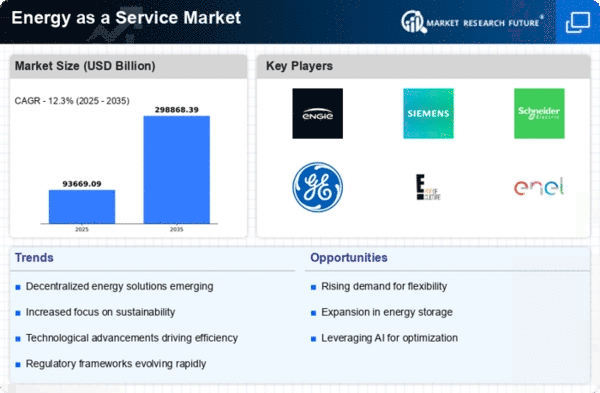
As per MRFR analysis, the Energy as a Service Market Size was estimated at 83409.7 USD Billion in 2024. The Energy as a Service industry is projected to grow from 93670.78 in 2025 to 298868.39 by 2035, exhibiting a compound annual growth rate (CAGR) of 12.3 during the forecast period 2025 - 2035.

Key Market Trends & Highlights

The Energy as a Service Market is experiencing robust growth driven by technological advancements and a shift towards sustainable solutions.

  • The market is witnessing increased adoption of renewable energy sources, particularly in North America. Integration of smart technologies is becoming prevalent, enhancing energy management capabilities across various sectors. There is a growing focus on energy efficiency and cost reduction, especially within the residential segment. Rising demand for sustainable solutions and regulatory support are key drivers propelling the market forward, particularly in the industrial and energy management segments.

Market Size & Forecast

2024 Market Size 83409.7 (USD Billion)
2035 Market Size 298868.39 (USD Billion)
CAGR (2025 - 2035) 12.3%
Largest Regional Market Share in 2024 North America

Major Players

Engie (FR), Siemens (DE), Schneider Electric (FR), General Electric (US), E.ON (DE), Enel (IT), Iberdrola (ES), NextEra Energy (US), Duke Energy (US)

Market Trends

The Energy as a Service Market is currently experiencing a transformative phase, driven by the increasing demand for sustainable energy solutions and the need for businesses to optimize their energy consumption. This energy industry report provides a comprehensive analysis of trends, growth drivers, and competitive dynamics shaping the Energy as a Service market.

This market model allows organizations to access energy services without the burden of ownership, thereby promoting efficiency and reducing operational costs. As companies seek to enhance their sustainability profiles, the Energy as a Service Market appears to be a viable alternative, offering flexibility and scalability in energy management. Furthermore, advancements in technology, such as smart grids and energy storage systems, are likely to play a pivotal role in shaping the future landscape of this market.

The energy-as-a-service model is transforming how organizations procure, manage, and optimize energy without owning physical infrastructure. The global energy as a service EaaS market is witnessing rapid expansion, driven by sustainability goals and digital energy management adoption. The energy as a service model enables organizations to access integrated energy solutions through subscription-based or performance-linked contracts. The growing adoption of energy management as a service is driving demand for automated monitoring, analytics, and optimization solutions across enterprises.

In addition, regulatory frameworks and government incentives are fostering a conducive environment for the growth of the Energy as a Service Market. Policymakers are increasingly recognizing the importance of energy efficiency and renewable energy integration, which may lead to more favorable conditions for service providers. As organizations continue to prioritize sustainability and cost-effectiveness, the Energy as a Service Market is poised for significant expansion. The convergence of technological innovation and supportive regulations suggests a promising outlook for stakeholders in this evolving sector.

The growing adoption of EaaS energy solutions reflects a shift toward flexible, service-based energy procurement models. The adoption of efficiency-as-a-service in energy management is helping organizations reduce costs while achieving sustainability and performance targets. Several energy efficiencies as a service companies are expanding their offerings to include analytics-driven optimization and performance-based contracts. The rise of electricity as a service is enabling customers to access reliable power supply through flexible, outcome-based service agreements.

Increased Adoption of Renewable Energy Sources

The Energy as a Service Market is witnessing a notable shift towards renewable energy sources. Organizations are increasingly opting for solar, wind, and other sustainable options to meet their energy needs. This trend reflects a broader commitment to reducing carbon footprints and enhancing energy resilience.

The power as a service model is gaining traction among industrial and commercial users seeking predictable energy costs and improved efficiency. The Energy as a Service sector forms a key component of the broader energy services market, driven by digitalization and renewable integration. The energy services industry is undergoing rapid transformation as service-based energy delivery models replace traditional utility frameworks. 

Integration of Smart Technologies

The incorporation of smart technologies into energy management systems is becoming more prevalent. These innovations enable real-time monitoring and optimization of energy usage, which can lead to improved efficiency and cost savings for businesses utilizing Energy as a Service.

Focus on Energy Efficiency and Cost Reduction

Organizations are placing a heightened emphasis on energy efficiency as a means to reduce operational costs. The Energy as a Service model supports this focus by providing tailored solutions that align with specific energy consumption patterns, ultimately driving down expenses.

The evolving energy services business is increasingly focused on long-term contracts, digital platforms, and sustainability-driven solutions. These energy market insights highlight the accelerating shift toward service-based energy procurement and renewable integration. The expansion of the Energy as a Service sector is supported by the rising global energy market size and increasing investment in sustainable infrastructure.

Energy as a Service Market Market Drivers

Regulatory Support and Incentives

Government policies and regulatory frameworks significantly influence the Global Energy as a Service Market (EaaS) Market Industry. Many governments are implementing supportive regulations and incentives to promote the adoption of EaaS solutions. For instance, tax credits and subsidies for renewable energy projects encourage businesses to invest in EaaS offerings. Additionally, stringent emissions regulations compel companies to seek cleaner energy alternatives. This regulatory landscape fosters a conducive environment for EaaS growth, as organizations increasingly turn to these services to comply with regulations while enhancing their sustainability profiles.

Decentralization of Energy Systems

The decentralization of energy systems is emerging as a key driver in the Global Energy as a Service Market (EaaS) Market Industry. With the rise of distributed energy resources, such as rooftop solar panels and local energy storage, consumers are increasingly seeking control over their energy supply. This shift towards decentralized energy generation is fostering demand for EaaS solutions that facilitate the management and optimization of these resources. As more individuals and businesses adopt decentralized energy systems, the EaaS market is expected to grow, aligning with the broader trend of energy independence and resilience.

Rising Demand for Renewable Energy

The Global Energy as a Service Market (EaaS) Market Industry is experiencing a notable surge in demand for renewable energy solutions. As countries strive to meet their climate goals, the transition to renewable energy sources becomes imperative. For instance, the International Renewable Energy Agency reports that renewable energy capacity is expected to grow significantly, with solar and wind leading the charge. This shift not only aligns with global sustainability efforts but also drives investment in EaaS solutions, which facilitate the integration of renewables into energy systems. The market is projected to reach 46.3 USD Billion in 2024, reflecting the increasing reliance on clean energy sources.

Increasing Energy Efficiency Awareness

There is a growing awareness regarding energy efficiency among consumers and businesses, which is driving the Global Energy as a Service Market (EaaS) Market Industry. Organizations are recognizing the financial and environmental benefits of adopting energy-efficient practices. This awareness is prompting investments in EaaS solutions that provide tailored energy management services. For instance, energy audits and efficiency upgrades are becoming common practices as companies seek to reduce operational costs and carbon footprints. As this trend continues, the EaaS market is likely to expand, reflecting the collective push towards more sustainable energy consumption.

Technological Advancements in Energy Management

Technological innovations play a pivotal role in shaping the Global Energy as a Service Market (EaaS) Market Industry. Advanced energy management systems, including IoT and AI-driven analytics, enhance operational efficiency and optimize energy consumption. These technologies enable businesses to monitor energy usage in real-time, leading to cost savings and improved sustainability. For example, smart grids and energy storage solutions are becoming integral components of EaaS offerings. As these technologies evolve, they are likely to attract more investments, contributing to the anticipated market growth to 120 USD Billion by 2035, with a CAGR of 9.05% from 2025 to 2035.

Market Segment Insights

By Application: Residential (Largest) vs. Industrial (Fastest-Growing)

The Energy as a Service market exhibits a diverse application landscape with notable shares allocated to various segments. Residential applications lead the market, benefitting from increased consumer interest in energy efficiency and sustainable solutions. In contrast, industrial applications are witnessing robust growth, driven by rising energy costs and the need for optimized energy management. This fragmentation allows tailored energy services to cater to distinct customer needs across segments.

Energy Service Applications: Residential (Dominant) vs. Commercial (Emerging)

In the Energy as a Service market, the residential segment stands out as the dominant force, leveraging a shift toward home automation and smart energy solutions. Consumers are increasingly adopting technologies that enhance energy efficiency and reduce costs. Conversely, the commercial segment is emerging rapidly, spurred by businesses striving for sustainability and regulatory compliance. Both segments are characterized by their unique energy consumption patterns, with residential sectors focusing on convenience and affordability, while commercial enterprises prioritize scalability and performance-driven solutions.

By Service Type: Energy Management (Largest) vs. Demand Response (Fastest-Growing)

In the Energy as a Service Market, Energy Management holds the largest market share, driven by the increasing demand for efficient energy use among businesses and consumers. Demand Response is emerging rapidly as organizations seek ways to optimize energy consumption and reduce costs. Other segments like Renewable Energy Integration and Energy Storage Solutions also contribute to market dynamics but are not as dominant as Energy Management and Demand Response.

Demand Response (Emerging) vs. Renewable Energy Integration (Dominant)

Demand Response is rapidly gaining traction as an emerging solution, enabling consumers to adjust their energy consumption based on availability and pricing, thus leading to lower costs and enhanced grid reliability. In contrast, Renewable Energy Integration plays a dominant role by facilitating the adoption of sustainable energy sources, crucial for meeting regulatory mandates and consumer preferences. Both segments are increasingly important within the Energy as a Service Market, with Demand Response focusing on immediate responses to energy supply changes, while Renewable Energy Integration provides a long-term strategy for sustainability. Their synergy is vital for achieving a reliable and efficient energy system.

By End Use: Heating (Largest) vs. Electric Mobility (Fastest-Growing)

In the Energy as a Service Market, the distribution of end-use segments reveals that Heating holds the largest market share due to its widespread adoption in residential and industrial sectors. This segment includes various technologies and services aimed at enhancing energy efficiency in heating applications. Electric Mobility, while currently smaller in share, is rapidly gaining traction as the global shift towards sustainable transportation intensifies, signaling a significant change in energy consumption patterns. The growth trends for these segments highlight a pivotal transformation in how energy is consumed. The rise in Heating can be attributed to the increasing demand for energy-efficient solutions and regulatory incentives to reduce carbon emissions. In contrast, Electric Mobility is experiencing the fastest growth as advancements in battery technology and electric infrastructure support a broader adoption of electric vehicles, positioning it as a key driver of energy service innovations.

Heating (Dominant) vs. Electric Mobility (Emerging)

Heating is characterized by its dominant position in the Energy as a Service Market, primarily driven by the substantial demand for reducing energy consumption costs in residential, commercial, and industrial applications. This segment encompasses services that provide energy management solutions, optimizing consumption while ensuring comfort. Conversely, Electric Mobility, though currently emerging, is marked by rapid technological advancements and increased consumer preference for electric vehicles, which has been bolstered by environmental regulations and the push for renewable energy. This segment not only signifies a shift in energy usage patterns but also represents a broader transformation towards sustainable energy solutions, appealing to both consumers and businesses prioritizing eco-friendliness in their energy consumption.

Get more detailed insights about Energy as a Service (EaaS) Market Research Report- Forecast 2035

Regional Insights

North America : Market Leader in Energy Services

North America is poised to maintain its leadership in the Energy as a Service market, with a projected market size of $41,700M by December 2025. Key growth drivers include increasing demand for renewable energy solutions, regulatory support for sustainable practices, and advancements in smart grid technologies. The region's commitment to reducing carbon emissions is further catalyzing investments in energy efficiency and innovative service models. The competitive landscape is robust, with the U.S. leading the charge, followed by Canada. Major players such as General Electric, NextEra Energy, and Duke Energy are at the forefront, driving innovation and market expansion. The presence of established firms and a favorable regulatory environment are critical in shaping the market dynamics, ensuring North America remains a pivotal player in the global energy transition.

Europe : Emerging Hub for Sustainability

Europe is rapidly evolving into a hub for Energy as a Service, with a market size of $25,000M anticipated by December 2025. The region's growth is driven by stringent EU regulations aimed at reducing greenhouse gas emissions and promoting renewable energy adoption. Countries are increasingly investing in energy efficiency and smart technologies, supported by government incentives and funding programs that encourage sustainable practices. Leading countries such as Germany, France, and the UK are spearheading this transformation, with key players like Siemens and Schneider Electric playing significant roles. The competitive landscape is characterized by a mix of established firms and innovative startups, all vying to capture market share in this dynamic environment. The European market is expected to continue its upward trajectory as it aligns with global sustainability goals.

Asia-Pacific : Rapidly Growing Energy Market

Asia-Pacific is witnessing a significant surge in the Energy as a Service market, projected to reach $15,000M by December 2025. The region's growth is fueled by increasing energy demands, urbanization, and government initiatives promoting renewable energy sources. Countries are focusing on energy security and sustainability, leading to a rise in investments in energy efficiency and innovative service models that cater to diverse consumer needs. China and India are the leading countries in this market, with substantial investments in renewable energy infrastructure. The competitive landscape features both local and international players, including Enel and E.ON, who are adapting to the unique market dynamics. As the region continues to embrace energy transition strategies, the Energy as a Service market is expected to flourish, driven by technological advancements and regulatory support.

Middle East and Africa : Emerging Energy Landscape

The Middle East and Africa region is gradually emerging in the Energy as a Service market, with a projected size of $3,709.7M by December 2025. The growth is primarily driven by increasing energy demands, urbanization, and a shift towards renewable energy sources. Governments are implementing policies to diversify energy portfolios and enhance energy efficiency, creating a conducive environment for market expansion. Leading countries such as South Africa and the UAE are at the forefront of this transition, with investments in renewable energy projects and infrastructure. The competitive landscape is evolving, with both local and international players seeking to establish a foothold in this burgeoning market. As the region continues to develop its energy capabilities, the Energy as a Service market is expected to gain momentum, supported by favorable regulations and investment opportunities.

Key Players and Competitive Insights

The Energy as a Service Market is currently characterized by a dynamic competitive landscape, driven by the increasing demand for sustainable energy solutions and the integration of advanced technologies. Leading energy as a service companies such as Schneider Electric, Siemens, and Engie are driving innovation through smart energy platforms and renewable integration. Key EaaS companies are expanding their portfolios through partnerships, digital platforms, and renewable energy solutions.
Key players such as Engie (FR), Siemens (DE), and Schneider Electric (FR) are strategically positioning themselves through innovation and partnerships. Engie (FR) focuses on renewable energy projects and digital solutions, while Siemens (DE) emphasizes smart infrastructure and energy efficiency. Schneider Electric (FR) is leveraging its expertise in energy management and automation to enhance service offerings. Collectively, these strategies foster a competitive environment that prioritizes sustainability and technological advancement. In terms of business tactics, companies are increasingly localizing manufacturing and optimizing supply chains to enhance operational efficiency. The market structure appears moderately fragmented, with several key players exerting considerable influence. This fragmentation allows for diverse service offerings, yet the collective actions of major companies like General Electric (US) and E.ON (DE) are pivotal in shaping market trends and consumer preferences.
In November 2025, General Electric (US) announced a strategic partnership with a leading technology firm to develop AI-driven energy management solutions. This collaboration aims to enhance predictive maintenance and optimize energy consumption for industrial clients. The strategic importance of this move lies in its potential to position General Electric (US) as a frontrunner in the digital transformation of energy services, thereby attracting a broader client base seeking innovative solutions.
In October 2025, E.ON (DE) launched a new subscription-based energy service model targeting small and medium-sized enterprises (SMEs). This initiative is designed to simplify energy procurement and management for SMEs, allowing them to focus on core business activities. The significance of this model is that it not only addresses the unique needs of SMEs but also expands E.ON's market reach, potentially increasing its customer base in a competitive landscape. 
In September 2025, Siemens (DE) unveiled a comprehensive energy-as-a-service platform that integrates renewable energy sources with smart grid technology. This platform aims to provide customers with real-time energy management capabilities, enhancing efficiency and sustainability. The strategic relevance of this development is profound, as it positions Siemens (DE) at the forefront of the energy transition, appealing to clients increasingly focused on sustainability and operational efficiency.
As of December 2025, current competitive trends in the Energy as a Service Market are heavily influenced by digitalization, sustainability, and the integration of AI technologies. Strategic alliances are becoming increasingly vital, as companies seek to enhance their service offerings and technological capabilities. Looking ahead, competitive differentiation is likely to evolve from traditional price-based competition to a focus on innovation, technology, and supply chain reliability. This shift underscores the importance of adaptability and forward-thinking strategies in a rapidly changing market.

Key Companies in the Energy as a Service Market include

Industry Developments

  • Q2 2024: Siemens deploys over 9,200 digital twins for on-site microturbines and batteries across corporate campuses By July 2024, Siemens reported deploying more than 9,200 virtual replicas (digital twins) of on-site microturbines and batteries for corporate clients, aiming to optimize service performance and reduce commissioning time by an average of 27 engineering days.

Future Outlook

Energy as a Service Market Future Outlook

The Energy as a Service Market is projected to grow at a 12.3% CAGR from 2025 to 2035, driven by increasing demand for renewable energy and technological advancements.

New opportunities lie in:

  • <p>Development of integrated energy management platforms Expansion of subscription-based energy solutions Investment in smart grid technologies for enhanced efficiency</p>

By 2035, the market is expected to be robust, driven by innovation and sustainable practices.

Market Segmentation

Energy as a Service Market End Use Outlook

  • Heating
  • Cooling
  • Lighting
  • Power Supply
  • Electric Mobility

Energy as a Service Market Application Outlook

  • Residential
  • Commercial
  • Industrial
  • Utility
  • Transportation

Energy as a Service Market Service Type Outlook

  • Energy Management
  • Demand Response
  • Renewable Energy Integration
  • Energy Storage Solutions
  • Electric Vehicle Charging

Report Scope

MARKET SIZE 2024 83409.7(USD Billion)
MARKET SIZE 2025 93670.78(USD Billion)
MARKET SIZE 2035 298868.39(USD Billion)
COMPOUND ANNUAL GROWTH RATE (CAGR) 12.3% (2025 - 2035)
REPORT COVERAGE Revenue Forecast, Competitive Landscape, Growth Factors, and Trends
BASE YEAR 2024
Market Forecast Period 2025 - 2035
Historical Data 2019 - 2024
Market Forecast Units USD Billion
Key Companies Profiled Engie (FR), Siemens (DE), Schneider Electric (FR), General Electric (US), E.ON (DE), Enel (IT), Iberdrola (ES), NextEra Energy (US), Duke Energy (US)
Segments Covered Application, Service Type, End Use
Key Market Opportunities Integration of renewable energy sources enhances flexibility in the Energy as a Service Market.
Key Market Dynamics Rising demand for renewable energy solutions drives innovation and competition in the Energy as a Service Market.
Countries Covered North America, Europe, APAC, South America, MEA

FAQs

What is the expected market size of the Energy as a Service (EaaS) Market in 2024?

The Energy as a Service (EaaS) Market is expected to be valued at 46.26 USD Billion in 2024.

How fast is the Energy as a Service (EaaS) Market expected to grow from 2025 to 2035?

The market is expected to grow at a compound annual growth rate (CAGR) of 9.05% from 2025 to 2035.

What is the projected market value for the Energy as a Service (EaaS) Market by 2035?

The market is projected to reach a value of 120.0 USD Billion by 2035.

Which region is projected to hold the largest market share in the Energy as a Service (EaaS) Market by 2035?

North America is projected to hold the largest market share, valued at 52.8 USD Billion by 2035.

What are the expected market values for Energy Management Services in 2024 and 2035?

Energy Management Services are expected to be valued at 18.0 USD Billion in 2024 and 46.0 USD Billion by 2035.

What are the key players in the Energy as a Service (EaaS) Market?

Key players include NextEra Energy, RWE, General Electric, EDP Renewables, and Siemens among others.

What is the projected market value for Demand Response Services in 2035?

Demand Response Services are projected to be valued at 27.0 USD Billion in 2035.

How much is the Energy as a Service (EaaS) Market expected to be valued in Europe by 2035?

The market in Europe is expected to be valued at 39.6 USD Billion by 2035.

What is the estimated market value for Distributed Energy Resource Management Services in 2024?

Distributed Energy Resource Management Services are expected to be valued at 9.0 USD Billion in 2024.

What market size is anticipated for the Asia Pacific region in the Energy as a Service (EaaS) Market by 2035?

The Asia Pacific region is anticipated to reach a market size of USD Billion by 2035.

  1. SECTION I: EXECUTIVE SUMMARY AND KEY HIGHLIGHTS |
    1. EXECUTIVE SUMMARY |
      1. Market Overview |
      2. Key Findings |
      3. Market Segmentation |
      4. Competitive Landscape |
      5. Challenges and Opportunities |
      6. Future Outlook 2
  2. SECTION II: SCOPING, METHODOLOGY AND MARKET STRUCTURE |
    1. MARKET INTRODUCTION |
      1. Definition |
      2. Scope of the study |--
    2. RESEARCH METHODOLOGY |
      1. Overview |
      2. Data Mining |
      3. Secondary Research |
      4. Primary Research |--
      5. Forecasting Model |
      6. Market Size Estimation |--
      7. Data Triangulation |
      8. Validation 3
  3. SECTION III: QUALITATIVE ANALYSIS |
    1. MARKET DYNAMICS |
      1. Overview |
      2. Drivers |
      3. Restraints |
      4. Opportunities |
    2. MARKET FACTOR ANALYSIS |
      1. Value chain Analysis |
      2. Porter's Five Forces Analysis |--
      3. COVID-19 Impact Analysis |--
  4. SECTION IV: QUANTITATIVE ANALYSIS |
    1. Information and Communications Technology, BY Application (USD Billion) |
      1. Residential |
      2. Commercial |
      3. Industrial |
      4. Utility |
      5. Transportation |
    2. Information and Communications Technology, BY Service Type (USD Billion) |
      1. Energy Management |
      2. Demand Response |
      3. Renewable Energy Integration |
      4. Energy Storage Solutions |
      5. Electric Vehicle Charging |
    3. Information and Communications Technology, BY End Use (USD Billion) |
      1. Heating |
      2. Cooling |
      3. Lighting |
      4. Power Supply |
      5. Electric Mobility |
    4. Information and Communications Technology, BY Region (USD Billion) |
      1. North America |--
      2. Europe |--
      3. APAC |--
      4. South America |--
      5. MEA |--
  5. SECTION V: COMPETITIVE ANALYSIS |
    1. Competitive Landscape |
      1. Overview |
      2. Competitive Analysis |
      3. Market share Analysis |
      4. Major Growth Strategy in the Information and Communications Technology |
      5. Competitive Benchmarking |
      6. Leading Players in Terms of Number of Developments in the Information and Communications Technology |
      7. Key developments and growth strategies |--
      8. Major Players Financial Matrix |--
    2. Company Profiles |
      1. Engie (FR) |--
      2. Siemens (DE) |--
      3. Schneider Electric (FR) |--
      4. General Electric (US) |--
      5. E.ON (DE) |--
      6. Enel (IT) |--
      7. Iberdrola (ES) |--
      8. NextEra Energy (US) |--
      9. Duke Energy (US) |--
    3. Appendix |
      1. References |
      2. Related Reports

Information and Communications Technology Market Segmentation

Information and Communications Technology By Application (USD Billion, 2025-2035)

  • Residential
  • Commercial
  • Industrial
  • Utility
  • Transportation

Information and Communications Technology By Service Type (USD Billion, 2025-2035)

  • Energy Management
  • Demand Response
  • Renewable Energy Integration
  • Energy Storage Solutions
  • Electric Vehicle Charging

Information and Communications Technology By End Use (USD Billion, 2025-2035)

  • Heating
  • Cooling
  • Lighting
  • Power Supply
  • Electric Mobility
Infographic

Free Sample Request

Kindly complete the form below to receive a free sample of this Report

Get Free Sample

Customer Strories

Compare Licence

×
Features License Type
Single User Multiuser License Enterprise User
Price $4,950 $5,950 $7,250
Maximum User Access Limit 1 User Upto 10 Users Unrestricted Access Throughout the Organization
Free Customization
Direct Access to Analyst
Deliverable Format
Platform Access
Discount on Next Purchase 10% 15% 15%
Printable Versions