Request Free Sample ×

Kindly complete the form below to receive a free sample of this Report

* Please use a valid business email

Leading companies partner with us for data-driven Insights

clients tt-cursor
Hero Background

Energy as a Service Market

ID: MRFR/ICT/5146-HCR
200 Pages
Nirmit Biswas
Last Updated: May 22, 2026

Energy as a Service (EaaS) Market Size, Share and Research Report: By Service Type (Energy Management Services, Demand Response Services, Distributed Energy Resource Management Services, Energy Supply Services), By End User (Residential, Commercial, Industrial, Government), By Energy Source (Renewable Energy, Conventional Energy, Hybrid Energy), By Solution Type (Software Solutions, Hardware Solutions, Integrated Solutions) and By Regional (North America, Europe, South America, Asia Pacific, Middle East and Africa) - Industry Forecast to 2035

Share:
Download PDF ×

We do not share your information with anyone. However, we may send you emails based on your report interest from time to time. You may contact us at any time to opt-out.

  1. 1 Market Overview |
    1. 1.1 Study Assumptions & Market Definition |
    2. 1.2 Scope of the Study |
    3. 1.3 Research Methodology
  2. 2 Market Summary & Key Takeaways
  3. 3 Market Dynamics |
    1. 3.1 Market Drivers Analysis | |
      1. 3.1.1 Corporate Net-Zero Mandates | |
      2. 3.1.2 Tax-Credit Stacking (IRA, EU Green Deal) | |
      3. 3.1.3 Battery Storage Cost Decline | |
      4. 3.1.4 Grid-Reliability and Resilience Concerns | |
      5. 3.1.5 AI-Driven Energy Analytics Adoption | |
      6. 3.1.6 Fleet Electrification and EV-Charging Demand | |
      7. 3.1.7 Emerging-Market Urbanization |
    2. 3.2 Market Restraints Analysis | |
      1. 3.2.1 Complex Multi-Party Contract Structures | |
      2. 3.2.2 Utility-Franchise and Regulatory Barriers | |
      3. 3.2.3 Counterparty Credit Risk for Long-Term PPAs | |
      4. 3.2.4 Interconnection Queue Delays | |
      5. 3.2.5 Technology Performance Uncertainty in Nascent Solutions |
    3. 3.3 Market Opportunity Analysis | |
      1. 3.3.1 AI-Optimized Energy Management Platforms | |
      2. 3.3.2 Emerging-Market Electrification via EaaS | |
      3. 3.3.3 Data Monetization and Carbon-Credit Aggregation | |
      4. 3.3.4 Fleet Electrification and Charging-as-a-Service | |
      5. 3.3.5 Resilience-as-a-Service for Critical Infrastructure |
    4. 3.4 Industry Value Chain Analysis |
    5. 3.5 Porter's Five Forces Analysis
  4. 4 Global Energy as a Service Market Size & Forecast (2021–2035) |
    1. 4.1 Historical Market Size (2021–2025) |
    2. 4.2 Current & Forecast Market Size (2026–2035) |
    3. 4.3 Market Size by Revenue (USD Billion) |
    4. 4.4 Year-over-Year Growth Analysis
  5. 5 Segmentation Analysis |
    1. 5.1 By Service Type | |
      1. 5.1.1 Energy Supply Services | |
      2. 5.1.2 Microgrid-as-a-Service | |
      3. 5.1.3 Energy Infrastructure Services | |
      4. 5.1.4 Other Service Types |
    2. 5.2 By Service-Delivery Model | |
      1. 5.2.1 Pay-for-Service | |
      2. 5.2.2 Leasing and Rental Models | |
      3. 5.2.3 Other Models |
    3. 5.3 By Technology | |
      1. 5.3.1 Distributed Generation | |
      2. 5.3.2 EV-Charging Infrastructure | |
      3. 5.3.3 Other Technologies |
    4. 5.4 By End User | |
      1. 5.4.1 Commercial | |
      2. 5.4.2 Industrial
  6. 6 Regional Analysis |
    1. 6.1 North America | |
      1. 6.1.1 United States | |
      2. 6.1.2 Canada | |
      3. 6.1.3 Mexico |
    2. 6.2 Europe | |
      1. 6.2.1 Germany | |
      2. 6.2.2 United Kingdom | |
      3. 6.2.3 France | |
      4. 6.2.4 Italy | |
      5. 6.2.5 Spain | |
      6. 6.2.6 Nordic Countries | |
      7. 6.2.7 Russia | |
      8. 6.2.8 Rest of Europe |
    3. 6.3 Asia-Pacific | |
      1. 6.3.1 China | |
      2. 6.3.2 India | |
      3. 6.3.3 Japan | |
      4. 6.3.4 South Korea | |
      5. 6.3.5 ASEAN | |
      6. 6.3.6 Rest of Asia-Pacific |
    4. 6.4 South America | |
      1. 6.4.1 Brazil | |
      2. 6.4.2 Argentina | |
      3. 6.4.3 Rest of South America |
    5. 6.5 Middle East & Africa | |
      1. 6.5.1 Saudi Arabia | |
      2. 6.5.2 UAE | |
      3. 6.5.3 South Africa | |
      4. 6.5.4 Egypt | |
      5. 6.5.5 Rest of MEA
  7. 7 Competitive Landscape |
    1. 7.1 Market Share Analysis (2025) |
    2. 7.2 Competitive Benchmarking Matrix |
    3. 7.3 Company Profiles | |
      1. 7.3.1 Schneider Electric | |
      2. 7.3.2 Enel X (Enel Group) | |
      3. 7.3.3 ENGIE Impact | |
      4. 7.3.4 Honeywell | |
      5. 7.3.5 Siemens Energy | |
      6. 7.3.6 Centrica Business Solutions | |
      7. 7.3.7 Ameresco | |
      8. 7.3.8 Budderfly | |
      9. 7.3.9 GridPoint | |
      10. 7.3.10 Sparkfund
  8. 8 Future Outlook & Strategic Recommendations (2026–2035) |
    1. 8.1 AI-Autonomous Energy Optimization |
    2. 8.2 Platform Economics and Ecosystem Aggregation |
    3. 8.3 Electrification Supercycle and Sector Coupling |
    4. 8.4 ESG Reporting and Verified Carbon Disclosure
  9. 9 Recent Developments & News
  10. 10 Frequently Asked Questions (FAQs)
  11. 11 Report Scope & Methodology |
    1. 11.1 Study Period & Base Year |
    2. 11.2 Data Sources & Citations |
    3. 11.3 Abbreviations ---
  12. 12 LIST OF TABLES |
  13. TABLE 1 Global Energy as a Service Market Size & Forecast, by Revenue (USD Billion), 2021–2035 |
  14. TABLE 2 Global Energy as a Service Market — Year-over-Year Growth Analysis, 2021–2035 |
  15. TABLE 3 Global Energy as a Service Market — Driver Impact Analysis |
  16. TABLE 4 Global Energy as a Service Market — Restraint Impact Analysis |
  17. TABLE 5 Global Energy as a Service Market Size, by Service Type, 2021–2035 (USD Billion) |
  18. TABLE 6 Global Energy as a Service Market Size, by Service-Delivery Model, 2021–2035 (USD Billion) |
  19. TABLE 7 Global Energy as a Service Market Size, by Technology, 2021–2035 (USD Billion) |
  20. TABLE 8 Global Energy as a Service Market Size, by End User, 2021–2035 (USD Billion) |
  21. TABLE 9 Global Energy as a Service Market Size, by Region, 2021–2035 (USD Billion) |
  22. TABLE 10 North America Energy as a Service Market Size, by Country, 2021–2035 (USD Billion) |
  23. TABLE 11 Europe Energy as a Service Market Size, by Country, 2021–2035 (USD Billion) |
  24. TABLE 12 Asia-Pacific Energy as a Service Market Size, by Country, 2021–2035 (USD Billion) |
  25. TABLE 13 South America Energy as a Service Market Size, by Country, 2021–2035 (USD Billion) |
  26. TABLE 14 Middle East & Africa Energy as a Service Market Size, by Country, 2021–2035 (USD Billion) |
  27. TABLE 15 Competitive Benchmarking Matrix — Global Energy as a Service Market, 2025 |
  28. TABLE 16 Company Profiles — Key Players, Global Energy as a Service Market |
  29. TABLE 17 Recent Developments & Strategic Announcements, 2023–2025 |
  30. TABLE 18 Report Scope & Methodology Summary |
  31. TABLE 19 Detailed Sources and Citations ---
  32. 13 LIST OF FIGURES |
  33. FIGURE 1 Energy as a Service Market Dynamics — Drivers, Restraints, and Opportunities |
  34. FIGURE 2 Industry Value Chain Analysis — Energy as a Service Market |
  35. FIGURE 3 Porter's Five Forces Analysis — Energy as a Service Market |
  36. FIGURE 4 Global Energy as a Service Market Size Trend (USD Billion), 2021–2035 |
  37. FIGURE 5 Energy as a Service Market Share, by Service Type, 2025 |
  38. FIGURE 6 Energy as a Service Market Share, by Service-Delivery Model, 2025 |
  39. FIGURE 7 Energy as a Service Market Share, by Technology, 2025 |
  40. FIGURE 8 Energy as a Service Market Share, by End User, 2025 |
  41. FIGURE 9 Energy as a Service Market Share, by Region, 2025 |
  42. FIGURE 10 North America Energy as a Service Market Share, by Country, 2025 |
  43. FIGURE 11 Europe Energy as a Service Market Share, by Country, 2025 |
  44. FIGURE 12 Asia-Pacific Energy as a Service Market Share, by Country, 2025 |
  45. FIGURE 13 South America Energy as a Service Market Share, by Country, 2025 |
  46. FIGURE 14 Middle East & Africa Energy as a Service Market Share, by Country, 2025 |
  47. FIGURE 15 Competitive Landscape — Market Share Analysis, 2025 ---

Segmentation Quick Reference

DimensionSub-SegmentsDominant SegmentFastest Growing Segment
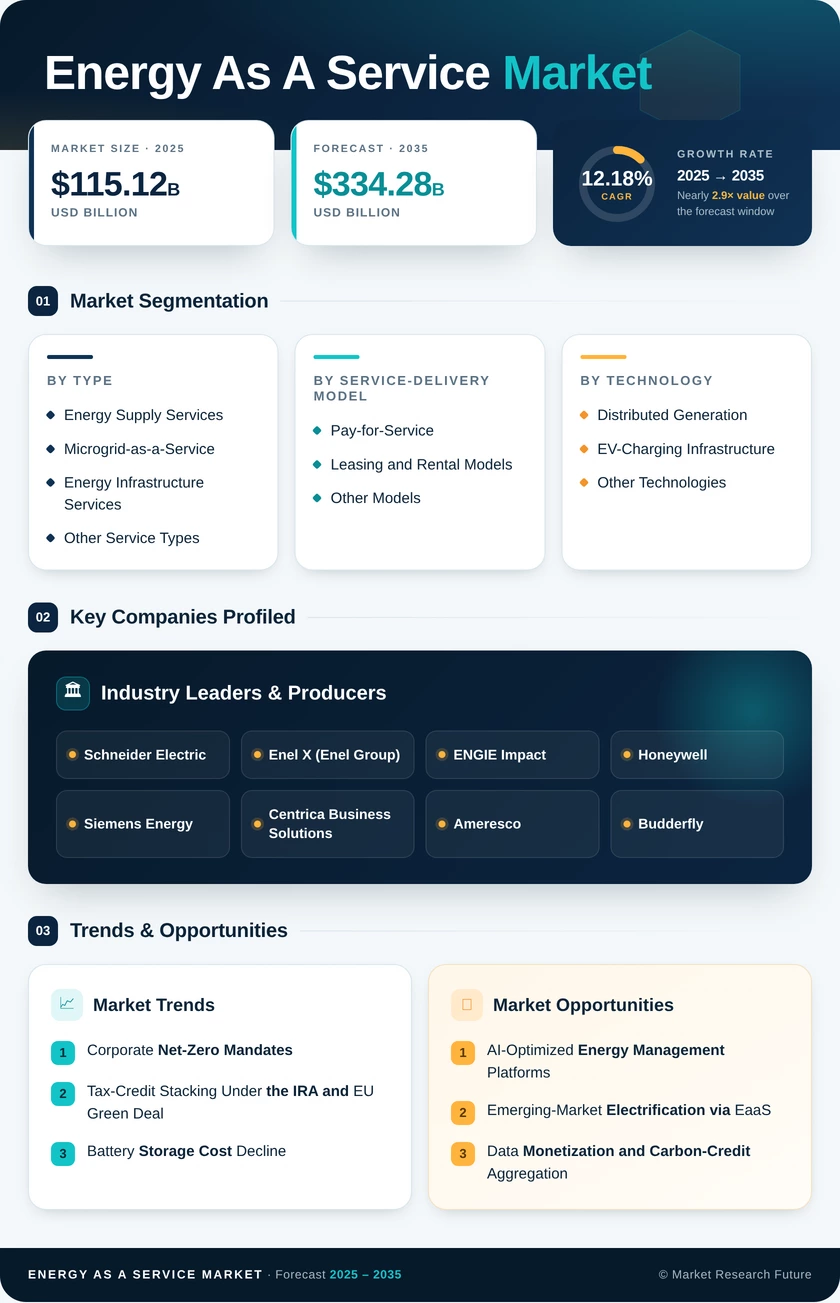
Service TypeEnergy Supply Services, Microgrid-as-a-Service, Energy Infrastructure Services, OtherEnergy Supply ServicesMicrogrid-as-a-Service
Service-Delivery ModelPay-for-Service, Leasing and Rental Models, OtherPay-for-ServiceLeasing and Rental Models
TechnologyDistributed Generation, EV-Charging Infrastructure, OtherDistributed GenerationEV-Charging Infrastructure
End UserCommercial, IndustrialCommercialIndustrial
GeographyNorth America, Europe, Asia-Pacific, South America, Middle East & AfricaNorth AmericaAsia-Pacific


  • --

By Service Type

Sub-SegmentKey Trend
Energy Supply ServicesRising corporate PPA volumes; shift from unbundled RECs to contracted clean energy
Microgrid-as-a-ServiceResilience-first procurement among hospitals, data centers, and military facilities
Energy Infrastructure ServicesDeep-retrofit financing for HVAC, building envelope, and LED lighting upgrades
Other Service TypesEnergy auditing, consulting, and carbon-accounting advisory services


Energy Supply Services remain the revenue backbone of the Energy as a Service Market, driven by multinational corporations replacing spot-market electricity exposure with long-term contracted renewable supply. Microgrid-as-a-Service is accelerating as climate-related grid disruptions compel facility operators to invest in islanding-capable systems.

By Service-Delivery Model

Sub-SegmentKey Trend
Pay-for-ServiceOutcome-linked pricing tied to energy savings or uptime guarantees
Leasing and Rental ModelsAsset-light access to rooftop solar, batteries, and EV chargers
Other ModelsShared-savings, managed-energy, and performance-contracting hybrids


Pay-for-Service contracts dominate because they transfer performance risk from the customer to the provider. Leasing and Rental models are expanding most rapidly, opening the Energy as a Service Market to tenants with limited capital-expenditure authority.

By Technology

Sub-SegmentKey Trend
Distributed GenerationRooftop solar PV and combined heat-and-power installations
EV-Charging InfrastructureDepot-level fleet charging integrated with building energy management
Other TechnologiesBattery storage, demand response, smart controls, and IoT platforms


Distributed Generation forms the technology foundation of most EaaS contracts, while EV-Charging Infrastructure is the fastest-growing segment as commercial fleets electrify at scale.

By End User

Sub-SegmentKey Trend
CommercialOffice, retail, healthcare, and hospitality energy procurement
IndustrialProcess-heat electrification, carbon-border compliance, and heavy-load management


Commercial facilities account for the majority of EaaS revenue due to immediate decarbonization pressure and multi-site portfolio optimization needs. Industrial adoption is accelerating as manufacturers seek alternatives to fossil-fired process energy.

By Geography

Sub-SegmentKey Trend
North AmericaIRA incentives; state-level renewable mandates; corporate PPA leadership
EuropeEU Green Deal; EPBD renovation wave; offshore wind integration
Asia-PacificIndia PLI scheme; China carbon ETS; ASEAN grid interconnection
South AmericaBrazil distributed-solar boom; Chile green-hydrogen corridor
Middle East & AfricaGulf solar PPAs; Sub-Saharan mini-grid electrification


North America commands the largest share of the Energy as a Service Market, while Asia-Pacific is growing fastest. Europe maintains a strong second position anchored by regulatory mandates driving energy efficiency financing through EaaS models across the building stock.


Compare Licence

×
Features License Type
Single User Multiuser License Enterprise User
Price $4,950 $5,950 $7,250
Maximum User Access Limit 1 User Upto 10 Users Unrestricted Access Throughout the Organization
Free Customization
Direct Access to Analyst
Deliverable Format
Platform Access
Discount on Next Purchase 10% 15% 15%
Printable Versions