×
Request Free Sample ×

Kindly complete the form below to receive a free sample of this Report

* Please use a valid business email

Leading companies partner with us for data-driven Insights

clients tt-cursor
Hero Background

Endocavity Transducer Market

ID: MRFR/HC/36832-HCR
100 Pages
Rahul Gotadki
October 2025

Endocavity Transducer Market Research Report By Application (Diagnostic Imaging, Therapeutic Procedures, Surgical Assistance), By Technology (Ultrasound, Magnetic Resonance Imaging, Computed Tomography), By End Use (Hospitals, Diagnostic Centers, Research Laboratories), By Product Type (Probes, Transducers, Accessories) and By Regional (North America, Europe, South America, Asia Pacific, Middle East and Africa) - Growth & Industry Forecast 2025 To 2035

Share:
Download PDF ×

We do not share your information with anyone. However, we may send you emails based on your report interest from time to time. You may contact us at any time to opt-out.

Endocavity Transducer Market Infographic
×
Endocavity Transducer Market Infographic Full View
Purchase Options

Endocavity Transducer Market Summary

As per Market Research Future analysis, the Endocavity Transducer Market Size was estimated at 3.653 USD Billion in 2024. The Endocavity Transducer industry is projected to grow from USD 3.842 Billion in 2025 to USD 6.361 Billion by 2035, exhibiting a compound annual growth rate (CAGR) of 5.17% during the forecast period 2025 - 2035

Key Market Trends & Highlights

The Endocavity Transducer Market is poised for substantial growth driven by technological advancements and evolving healthcare needs.

  • Technological advancements are enhancing the capabilities of endocavity transducers, leading to improved diagnostic accuracy.
  • North America remains the largest market, while the Asia-Pacific region is emerging as the fastest-growing area for endocavity transducers.
  • The diagnostic imaging segment dominates the market, whereas the surgical assistance segment is witnessing rapid growth.
  • Rising demand for diagnostic imaging and increasing adoption of telemedicine are key drivers propelling market expansion.

Market Size & Forecast

2024 Market Size 3.653 (USD Billion)
2035 Market Size 6.361 (USD Billion)
CAGR (2025 - 2035) 5.17%

Major Players

GE Healthcare (US), Philips (NL), Siemens Healthineers (DE), Canon Medical Systems (JP), Fujifilm (JP), Hitachi Medical Systems (JP), Mindray (CN), Samsung Medison (KR), Esaote (IT)

Endocavity Transducer Market Trends

The Endocavity Transducer Market is currently experiencing a notable evolution, driven by advancements in medical imaging technologies and an increasing demand for minimally invasive procedures. This market encompasses a variety of transducers designed for internal examinations, which are essential in fields such as gynecology, urology, and gastroenterology. The growing emphasis on patient comfort and diagnostic accuracy is propelling innovations in design and functionality, leading to enhanced imaging capabilities. Furthermore, the integration of artificial intelligence and machine learning into imaging systems is likely to improve diagnostic precision, thereby influencing the overall market dynamics. In addition, the Endocavity Transducer Market is witnessing a shift towards portable and user-friendly devices, which may facilitate broader access to advanced diagnostic tools in various healthcare settings. As healthcare providers increasingly prioritize efficiency and patient-centered care, the demand for versatile and adaptable transducers is expected to rise. This trend suggests a potential for growth in emerging markets, where healthcare infrastructure is developing rapidly. Overall, the Endocavity Transducer Market appears poised for continued expansion, driven by technological advancements and evolving healthcare needs.

Technological Advancements

The Endocavity Transducer Market is significantly influenced by ongoing technological advancements. Innovations in imaging technology, such as high-resolution ultrasound and 3D imaging, are enhancing diagnostic capabilities. These developments not only improve the accuracy of examinations but also contribute to better patient outcomes, thereby driving market growth.

Shift Towards Minimally Invasive Procedures

There is a noticeable trend towards minimally invasive procedures within the Endocavity Transducer Market. As healthcare providers seek to reduce patient recovery times and improve overall experiences, the demand for transducers that facilitate such procedures is increasing. This shift is likely to reshape the market landscape, emphasizing the need for advanced, user-friendly devices.

Integration of AI and Machine Learning

The integration of artificial intelligence and machine learning technologies into endocavity imaging systems is emerging as a transformative trend. These technologies have the potential to enhance diagnostic accuracy and efficiency, allowing for quicker and more reliable assessments. As these innovations become more prevalent, they may redefine operational standards within the Endocavity Transducer Market.

Endocavity Transducer Market Drivers

Increasing Adoption of Telemedicine

The rise of telemedicine is emerging as a pivotal driver for the Endocavity Transducer Market. As healthcare systems adapt to the changing landscape, the demand for remote diagnostic tools is escalating. Endocavity transducers, equipped with advanced imaging capabilities, are being integrated into telehealth platforms, allowing for remote consultations and diagnostics. This shift is particularly beneficial in rural and underserved areas where access to specialized care is limited. Data suggests that the telemedicine market is projected to grow significantly, which in turn is likely to boost the demand for endocavity transducers. By facilitating remote patient monitoring and consultations, these devices are becoming integral to modern healthcare delivery, thereby enhancing their market presence.

Rising Demand for Diagnostic Imaging

The Endocavity Transducer Market is experiencing a notable increase in demand for diagnostic imaging solutions. This surge is primarily driven by the growing prevalence of chronic diseases and the need for early detection. According to recent data, the incidence of conditions such as cancer and cardiovascular diseases has risen, necessitating advanced imaging techniques. Endocavity transducers, known for their precision and ability to provide detailed images, are becoming essential tools in various medical fields. As healthcare providers seek to enhance diagnostic accuracy, the adoption of these transducers is likely to expand, thereby propelling market growth. Furthermore, the increasing awareness among patients regarding the importance of regular health check-ups is expected to further stimulate demand for endocavity imaging solutions.

Expansion of Healthcare Infrastructure

The expansion of healthcare infrastructure is a critical driver for the Endocavity Transducer Market. As countries invest in enhancing their healthcare systems, the demand for advanced medical equipment, including endocavity transducers, is on the rise. New hospitals and diagnostic centers are being established, particularly in emerging markets, which is likely to create a substantial demand for these devices. Additionally, existing healthcare facilities are upgrading their equipment to incorporate the latest technologies, further fueling market growth. The increasing number of healthcare professionals trained in the use of endocavity transducers is also contributing to this trend, as more practitioners recognize the benefits of these devices in improving patient outcomes. This expansion is expected to sustain the momentum of the endocavity transducer market in the coming years.

Growing Focus on Patient Safety and Comfort

The Endocavity Transducer Market is increasingly influenced by the heightened emphasis on patient safety and comfort during medical procedures. Healthcare providers are prioritizing technologies that minimize patient discomfort while ensuring accurate diagnostics. Endocavity transducers, designed with patient-centric features, are gaining traction as they offer less invasive options compared to traditional methods. This focus on patient experience is driving the adoption of these devices, as they are perceived to enhance overall satisfaction and reduce anxiety associated with medical examinations. Furthermore, regulatory bodies are advocating for improved safety standards in medical devices, which is likely to encourage manufacturers to innovate and enhance the safety profiles of their products. Consequently, this trend is expected to contribute positively to the growth of the endocavity transducer market.

Technological Innovations in Transducer Design

Innovations in the design and functionality of endocavity transducers are significantly influencing the Endocavity Transducer Market. Recent advancements have led to the development of high-resolution imaging capabilities and improved ergonomics, which enhance the user experience for healthcare professionals. For instance, the introduction of 3D and 4D imaging technologies has revolutionized the way clinicians visualize internal structures, providing more comprehensive assessments. Additionally, the integration of wireless technology is facilitating greater mobility and ease of use in clinical settings. These technological enhancements not only improve diagnostic outcomes but also increase the efficiency of procedures, making endocavity transducers more appealing to healthcare facilities. As a result, the market is likely to witness sustained growth driven by continuous innovation.

Market Segment Insights

By Application: Diagnostic Imaging (Largest) vs. Surgical Assistance (Fastest-Growing)

In the Endocavity Transducer Market, the application segment is dominated by Diagnostic Imaging, which is the largest market contributor. This segment represents a significant portion of overall market share due to its crucial role in the accurate diagnosis of medical conditions through high-resolution imaging techniques. Following closely is the Surgical Assistance segment, which is experiencing rapid growth as advancements in technology enhance its capabilities. These two segments cater to critical aspects of patient care and surgical efficiency, creating a dynamic market environment. As healthcare continues to evolve, the growth trends within the Endocavity Transducer Market are influenced by advancements in imaging technology, improving patient outcomes and procedural efficiency. The demand for minimally invasive procedures is on the rise, driving therapeutic procedures and surgical assistance into the spotlight. The increasing emphasis on diagnostic accuracy, along with the aging population and rising chronic disease prevalence, are expected to propel these segments further, solidifying their importance in the overall market landscape.

Diagnostic Imaging (Dominant) vs. Therapeutic Procedures (Emerging)

Diagnostic Imaging stands as the dominant segment in the Endocavity Transducer Market, primarily due to its established applications in patient diagnostics. This segment benefits from ongoing innovations that enhance imaging techniques, translating to higher accuracy and better patient outcomes. Conversely, Therapeutic Procedures are emerging as a key player, supported by technological advancements that facilitate less invasive treatment options. This growth has been fueled by a shift towards patient-centric care models and the increasing prevalence of conditions that require such interventions. Understanding patient needs, alongside regulatory support for innovative therapeutic techniques, positions this segment as an evolving component of the market landscape.

By Technology: Ultrasound (Largest) vs. Magnetic Resonance Imaging (Fastest-Growing)

The Endocavity Transducer Market is characterized by a diverse distribution of technologies. Among them, Ultrasound holds the largest share due to its widespread applications, ease of use, and cost-effectiveness in diagnostic procedures. Magnetic Resonance Imaging (MRI) is emerging as a competitive alternative, driven by its ability to provide high-resolution images and detailed soft tissue contrast. Computed Tomography (CT) also plays a significant role, but it lags behind in overall adoption compared to the other two technologies.

Technology: Ultrasound (Dominant) vs. Magnetic Resonance Imaging (Emerging)

Ultrasound technology is currently the dominant player in the Endocavity Transducer Market, celebrated for its non-invasive nature and real-time imaging capabilities. Its advantages make it the preferred choice in various clinical settings. In contrast, Magnetic Resonance Imaging is rapidly emerging, particularly for specific applications requiring detailed visualization of soft tissues. MRI's advancements in technology and equipment are enhancing its applicability, thus contributing to a faster growth trajectory. Although Ultrasound maintains a strong foothold, MRI is gaining traction as healthcare providers increasingly recognize its value in diagnostic accuracy and patient outcomes.

By End Use: Hospitals (Largest) vs. Diagnostic Centers (Fastest-Growing)

In the Endocavity Transducer Market, hospitals dominate the end-use segment significantly. They are the primary consumers due to their extensive infrastructure, which allows for sophisticated diagnostic and treatment capabilities. Diagnostic centers, on the other hand, are increasingly gaining share in the market. Their growth is driven by the rising demand for outpatient services and the convenience these centers provide to patients seeking specialized tests. The growth trends in this segment indicate a remarkable shift towards enhanced diagnostic tools, especially in diagnostic centers, which are becoming the fastest-growing end users. This growth is fueled by technological advancements and a greater emphasis on early diagnosis of medical conditions, leading to an increased adoption of endocavity transducers in various healthcare settings. Research laboratories play a crucial role too, mainly supporting innovation and development, but their demand growth is not as rapid as that of diagnostic centers.

Hospitals: Dominant vs. Diagnostic Centers: Emerging

Hospitals remain the dominant end-use segment in the Endocavity Transducer Market, primarily due to their extensive patient throughput and comprehensive medical services. They employ advanced transducer technology to conduct a wide array of diagnostic procedures, enabling effective patient management. In contrast, diagnostic centers are increasingly being recognized as an emerging segment. With their focused approach and specialized services, they cater to the rising demand for quick and accurate diagnoses. This shift is largely attributed to changes in patient preferences towards outpatient care and convenience. Consequently, diagnostic centers are continuously adapting their offerings, thus expanding their market presence and impacting the overall landscape of the endocavity transducer market.

By Product Type: Probes (Largest) vs. Transducers (Fastest-Growing)

In the Endocavity Transducer Market, the product type segmentation reveals that probes hold the largest market share, reflecting their critical role in diagnostics and treatment. Probes are in high demand among healthcare providers, owing to their versatility, ease of use, and essential contributions to endocavity imaging. In contrast, transducers, although currently holding a smaller share, are experiencing substantial growth as technological advancements enhance their capabilities and application in complex medical procedures. Growth within the product type segment is significantly driven by the increasing prevalence of minimally invasive surgeries and the rising demand for precision in medical imaging. Transducers, in particular, are witnessing rapid expansion due to innovations in their design and functionality, which are appealing to healthcare professionals and institutions. Furthermore, a growing aging population and rising chronic diseases are contributing to the heightened need for effective diagnostic tools, thereby spurring growth in both probes and transducers.

Probes (Dominant) vs. Accessories (Emerging)

Probes are recognized as the dominant force in the Endocavity Transducer Market due to their integral role in various diagnostic and therapeutic procedures. Their advanced technology facilitates improved resolution and sensitivity, making them essential equipment for healthcare settings. On the other hand, accessories are an emerging segment that is gaining traction thanks to their supportive functions in enhancing the overall effectiveness and user experience of transducers and probes. Accessories, including coupling gels and protective covers, are becoming increasingly important as they offer solutions that optimize the performance of the primary instruments. This synergy among product types underscores the growth potential of both probes and accessories, reflecting a trend where complementary technologies are eluding significant attention.

Get more detailed insights about Endocavity Transducer Market

Regional Insights

North America : Innovation and Market Leadership

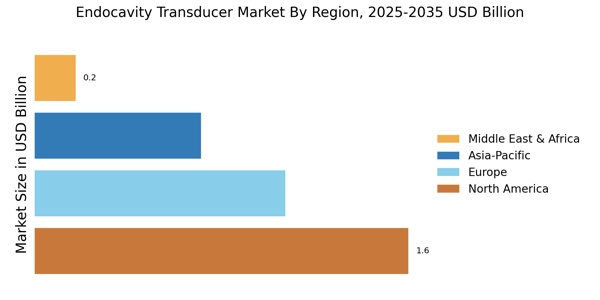
North America is the largest market for endocavity transducers, holding approximately 45% of the global market share. The region's growth is driven by advanced healthcare infrastructure, increasing prevalence of chronic diseases, and rising demand for minimally invasive procedures. Regulatory support from agencies like the FDA further catalyzes innovation and adoption of new technologies, ensuring high standards in medical devices. The United States leads the market, with significant contributions from Canada. Key players such as GE Healthcare, Philips, and Siemens Healthineers dominate the competitive landscape, leveraging their technological advancements and extensive distribution networks. The presence of these major companies fosters a robust environment for research and development, enhancing the overall market dynamics.

Europe : Regulatory Support and Growth

Europe is the second-largest market for endocavity transducers, accounting for around 30% of the global share. The region benefits from stringent regulatory frameworks that ensure high-quality medical devices, alongside increasing investments in healthcare technology. Countries like Germany and France are at the forefront, driving demand through advanced healthcare systems and rising awareness of diagnostic imaging technologies. Germany is the leading country in this market, followed closely by France and the UK. The competitive landscape features key players such as Siemens Healthineers and Philips, which are actively involved in innovation and partnerships. The European market is characterized by a strong emphasis on research and development, supported by government initiatives aimed at enhancing healthcare delivery.

Asia-Pacific : Rapid Growth and Adoption

Asia-Pacific is witnessing rapid growth in the endocavity transducer market, holding approximately 20% of the global share. The region's expansion is fueled by increasing healthcare expenditure, a growing aging population, and rising awareness of advanced diagnostic technologies. Countries like China and Japan are leading this growth, supported by favorable government policies and investments in healthcare infrastructure. China is the largest market in the region, with Japan following closely. The competitive landscape is becoming increasingly dynamic, with local players like Mindray and Samsung Medison emerging alongside established global companies. This competitive environment fosters innovation and enhances the availability of advanced medical technologies, contributing to the overall market growth.

Middle East and Africa : Untapped Potential and Growth

The Middle East and Africa represent an emerging market for endocavity transducers, holding about 5% of the global share. The region's growth is driven by increasing healthcare investments, rising awareness of advanced medical technologies, and a growing demand for quality healthcare services. Countries like South Africa and the UAE are leading the way, supported by government initiatives aimed at improving healthcare access and quality. South Africa is the largest market in this region, with the UAE showing significant growth potential. The competitive landscape is characterized by a mix of local and international players, with companies like Canon Medical Systems and Fujifilm expanding their presence. The region's untapped potential presents opportunities for innovation and market entry, making it an attractive area for investment.

Endocavity Transducer Market Regional Image

Key Players and Competitive Insights

The competitive insights of the Endocavity Transducer Market reveal a dynamic environment characterized by rapid technological advancements and an increasing demand for minimally invasive diagnostic procedures. This market is driven by the rising prevalence of chronic diseases and the need for early and accurate diagnosis through high-resolution imaging. Competitors in this space are focusing on innovation, quality, and cost-effectiveness to capture a larger share of the market. Collaboration between manufacturers, healthcare providers, and research entities is essential to enhance product offerings and meet the specific needs of healthcare professionals and patients.

As the landscape evolves, companies are leveraging technological breakthroughs in transducer designs and applications to maintain a competitive edge, contributing to overall growth in the endocavity imaging sector.Canon Medical Systems is recognized for its robust presence in the Endocavity Transducer Market thanks to its commitment to delivering high-quality imaging solutions. The company's strength lies in its advanced technological capabilities, which enable the development of state-of-the-art transducers that enhance diagnostic accuracy. Canon Medical Systems has built a reputation for reliability and efficiency, making it a preferred choice among healthcare providers.

With strong research and development initiatives, the company continuously innovates, introducing new products that address the changing needs of endocavity imaging. Its comprehensive support and training programs for healthcare professionals also reinforce its position in the market, ensuring users are well-equipped to utilize their products effectively.Mindray, a prominent player in the Endocavity Transducer Market, demonstrates significant strengths through its focus on innovation and accessibility. The company has developed a range of advanced endocavity transducers that not only meet but exceed industry standards, thereby enhancing image quality and diagnostic capabilities.

Mindray's solutions are characterized by user-friendly designs, which facilitate ease of use in clinical settings. By prioritizing affordability alongside high performance, Mindray effectively caters to a diverse spectrum of healthcare institutions, from large hospitals to smaller clinics. The company's strategic partnerships and expansive distribution networks further bolster its market presence, enabling it to reach a wider audience and solidify its position within the highly competitive landscape of endocavity imaging solutions.

Key Companies in the Endocavity Transducer Market include

Industry Developments

Recent developments in the Endocavity Transducer Market have shown significant activity among key players such as Canon Medical Systems, Mindray, Hologic, Fujifilm Holdings, Philips Healthcare, and GE Healthcare. The demand for innovative imaging technologies is on the rise, leading to enhancements in product offerings. Companies like Samsung Medison and Siemens Healthineers are focusing on integrating AI technologies to improve diagnostic accuracy and operational efficiency.Moreover, recent acquisition trends have been noteworthy; for example, significant mergers in the healthcare sector are aligning with strategies to streamline operations and enhance service capacities.

While specific mergers involving companies like Boston Scientific and Medtronic are under evaluation, they suggest a trend of consolidation aimed at market expansion. Additionally, the market is witnessing robust growth, driven by advancements in medical imaging practices, with companies such as Hitachi Medical Systems and Nihon Kohden adapting to the evolving requirements. This evolution is indicative of a transformative phase that is reshaping the competitive landscape as firms strive to leverage cutting-edge technology and improve patient outcomes. Consequently, the market dynamics reflect a fertile ground for investment and innovation across the sector.


Future Outlook

Endocavity Transducer Market Future Outlook

The Endocavity Transducer Market is projected to grow at a 5.17% CAGR from 2024 to 2035, driven by technological advancements, increasing demand for minimally invasive procedures, and rising healthcare expenditure.

New opportunities lie in:

  • Development of AI-integrated imaging systems for enhanced diagnostic accuracy.
  • Expansion into emerging markets with tailored product offerings.
  • Partnerships with telemedicine platforms for remote diagnostic solutions.

By 2035, the Endocavity Transducer Market is expected to achieve substantial growth and innovation.

Market Segmentation

Endocavity Transducer Market End Use Outlook

  • Hospitals
  • Diagnostic Centers
  • Research Laboratories

Endocavity Transducer Market Technology Outlook

  • Ultrasound
  • Magnetic Resonance Imaging
  • Computed Tomography

Endocavity Transducer Market Application Outlook

  • Diagnostic Imaging
  • Therapeutic Procedures
  • Surgical Assistance

Endocavity Transducer Market Product Type Outlook

  • Probes
  • Transducers
  • Accessories

Report Scope

MARKET SIZE 20243.653(USD Billion)
MARKET SIZE 20253.842(USD Billion)
MARKET SIZE 20356.361(USD Billion)
COMPOUND ANNUAL GROWTH RATE (CAGR)5.17% (2024 - 2035)
REPORT COVERAGERevenue Forecast, Competitive Landscape, Growth Factors, and Trends
BASE YEAR2024
Market Forecast Period2025 - 2035
Historical Data2019 - 2024
Market Forecast UnitsUSD Billion
Key Companies ProfiledGE Healthcare (US), Philips (NL), Siemens Healthineers (DE), Canon Medical Systems (JP), Fujifilm (JP), Hitachi Medical Systems (JP), Mindray (CN), Samsung Medison (KR), Esaote (IT)
Segments CoveredApplication, Technology, End Use, Product Type, Regional
Key Market OpportunitiesAdvancements in imaging technology enhance diagnostic accuracy in the Endocavity Transducer Market.
Key Market DynamicsTechnological advancements and regulatory changes drive innovation and competition in the Endocavity Transducer Market.
Countries CoveredNorth America, Europe, APAC, South America, MEA

Leave a Comment

FAQs

What is the projected market valuation of the Endocavity Transducer Market by 2035?

The Endocavity Transducer Market is projected to reach a valuation of 6.361 USD Billion by 2035.

What was the market valuation of the Endocavity Transducer Market in 2024?

In 2024, the market valuation of the Endocavity Transducer Market was 3.653 USD Billion.

What is the expected CAGR for the Endocavity Transducer Market during the forecast period 2025 - 2035?

The expected CAGR for the Endocavity Transducer Market during the forecast period 2025 - 2035 is 5.17%.

Which companies are considered key players in the Endocavity Transducer Market?

Key players in the Endocavity Transducer Market include GE Healthcare, Philips, Siemens Healthineers, Canon Medical Systems, and Fujifilm.

What are the main application segments of the Endocavity Transducer Market?

The main application segments include Diagnostic Imaging, Therapeutic Procedures, and Surgical Assistance.

How much is the Diagnostic Imaging segment expected to grow by 2035?

The Diagnostic Imaging segment is expected to grow from 1.5 USD Billion in 2024 to 2.5 USD Billion by 2035.

What is the projected growth for the Ultrasound technology segment by 2035?

The Ultrasound technology segment is projected to increase from 1.5 USD Billion in 2024 to 2.5 USD Billion by 2035.

Which end-use segment is anticipated to have the highest valuation by 2035?

The Hospitals end-use segment is anticipated to have the highest valuation, growing from 1.8265 USD Billion in 2024 to 3.0865 USD Billion by 2035.

What is the expected growth for the Transducers product type segment by 2035?

The Transducers product type segment is expected to grow from 1.8 USD Billion in 2024 to 3.0 USD Billion by 2035.

How does the Endocavity Transducer Market's growth compare across different segments?

The Endocavity Transducer Market's growth varies, with segments like Transducers and Diagnostic Imaging showing robust increases, indicating diverse opportunities.

Download Free Sample

Kindly complete the form below to receive a free sample of this Report

Compare Licence

×
Features License Type
Single User Multiuser License Enterprise User
Price $4,950 $5,950 $7,250
Maximum User Access Limit 1 User Upto 10 Users Unrestricted Access Throughout the Organization
Free Customization
Direct Access to Analyst
Deliverable Format
Platform Access
Discount on Next Purchase 10% 15% 15%
Printable Versions