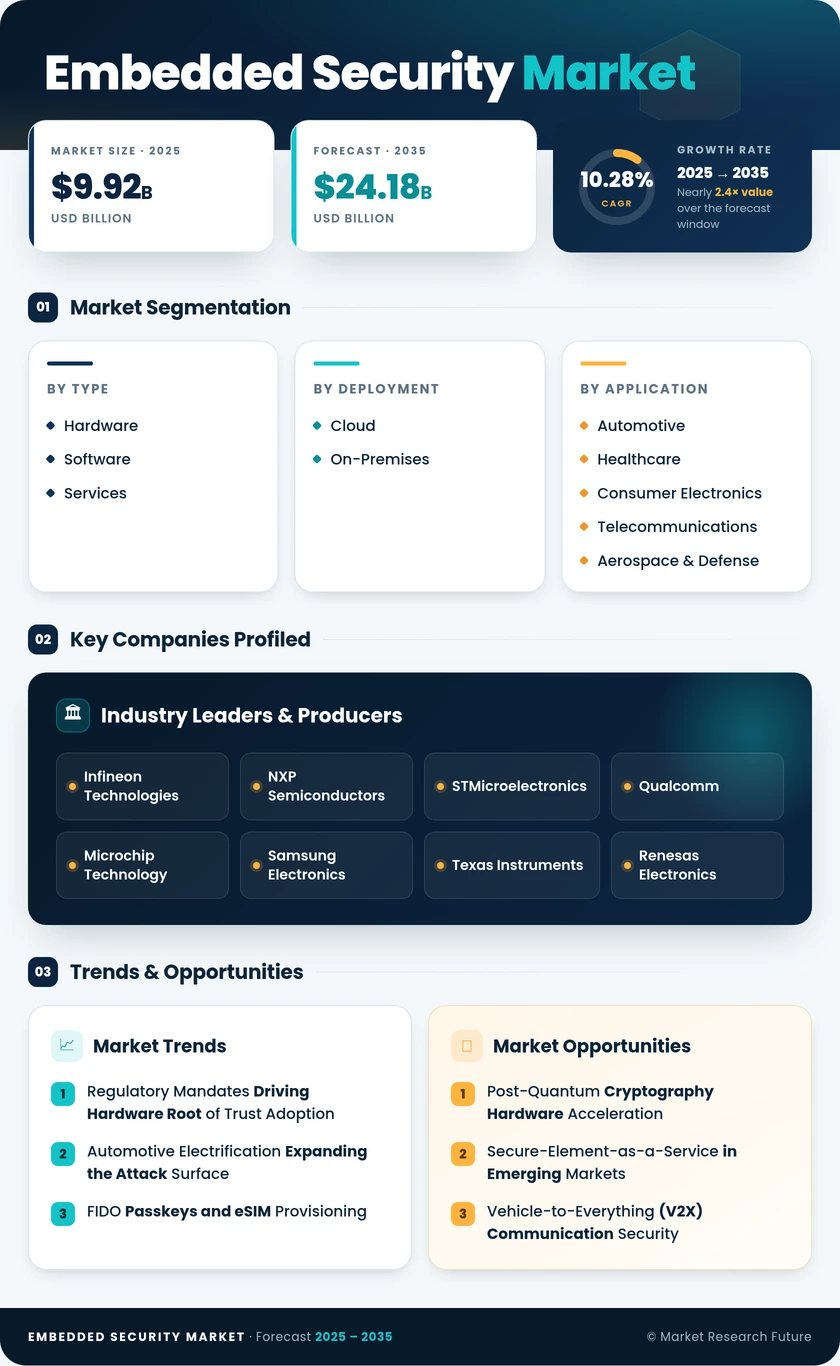
Embedded Security Market

ID: MRFR/SEM/32944-HCR
100 Pages
Nirmit Biswas
Last Updated: June 24, 2026
Embedded Security Market Size, Share and Research Report By Component Type (Hardware, Software, Services), By Deployment (Cloud, On-Premises), By Application (Payment, Authentication, Content Protection, Others), By End-User Industry (Automotive, Healthcare, Consumer Electronics, Telecommunications, Aerospace & Defense, Others) and By Regional (North America, Europe, South America, Asia Pacific, Middle East and Africa) - Industry Forecast to 2035.
Download PDF ×

We do not share your information with anyone. However, we may send you emails based on your report interest from time to time. You may contact us at any time to opt-out.

Embedded Security Market

Market Size

Forecast Period2026-2035
CAGR (2026-2035)10.28%
2025 Market SizeUSD 9.92 Billion
2035 Market SizeUSD 24.18 Billion

Key Players

Infineon Technologies
NXP Semiconductors
STMicroelectronics
Qualcomm
Microchip Technology
Samsung Electronics
Opportunities
  • Post-Quantum Cryptography Hardware Acceleration
  • Secure-Element-as-a-Service in Emerging Markets
  • Vehicle-to-Everything (V2X) Communication Security
  1. 1 Market Overview |
    1. 1.1 Study Assumptions & Market Definition |
    2. 1.2 Scope of the Study |
    3. 1.3 Research Methodology
  2. 2 Market Summary & Key Takeaways
  3. 3 Market Dynamics |
    1. 3.1 Market Drivers Analysis | |
      1. 3.1.1 Regulatory Mandates Driving Hardware Root of Trust Adoption | |
      2. 3.1.2 Automotive Electrification Expanding the Attack Surface | |
      3. 3.1.3 FIDO Passkeys and eSIM Provisioning | |
      4. 3.1.4 Post-Quantum Cryptography Readiness | |
      5. 3.1.5 Cloud HSM & Elastic Security Infrastructure | |
      6. 3.1.6 Smart-City & Industrial IoT Deployments | |
      7. 3.1.7 Edge AI & On-Device Inference Security |
    2. 3.2 Market Restraints Analysis | |
      1. 3.2.1 Semiconductor Supply-Chain Concentration | |
      2. 3.2.2 Legacy System Retrofit Complexity | |
      3. 3.2.3 Fragmented Global Certification Regimes | |
      4. 3.2.4 Cost Sensitivity in Consumer IoT | |
      5. 3.2.5 Talent Shortage in Embedded Security Engineering |
    3. 3.3 Market Opportunity Analysis | |
      1. 3.3.1 Post-Quantum Cryptography Hardware Acceleration | |
      2. 3.3.2 Secure-Element-as-a-Service in Emerging Markets | |
      3. 3.3.3 Vehicle-to-Everything (V2X) Communication Security | |
      4. 3.3.4 Data Monetization Through Secure Enclaves | |
      5. 3.3.5 Smart-City Infrastructure in the Middle East |
    4. 3.4 Industry Value Chain Analysis |
    5. 3.5 Porter's Five Forces Analysis
  4. 4 Global Embedded Security Market Size & Forecast (2021–2035) |
    1. 4.1 Historical Market Size (2021–2025) |
    2. 4.2 Current & Forecast Market Size (2026–2035) |
    3. 4.3 Market Size by Revenue (USD Billion) |
    4. 4.4 Year-over-Year Growth Analysis
  5. 5 Segmentation Analysis |
    1. 5.1 By Component Type | |
      1. 5.1.1 Hardware | |
      2. 5.1.2 Software | |
      3. 5.1.3 Services |
    2. 5.2 By Deployment | |
      1. 5.2.1 Cloud | |
      2. 5.2.2 On-Premises |
    3. 5.3 By Application | |
      1. 5.3.1 Payment | |
      2. 5.3.2 Authentication | |
      3. 5.3.3 Content Protection | |
      4. 5.3.4 Others |
    4. 5.4 By End-User Industry | |
      1. 5.4.1 Automotive | |
      2. 5.4.2 Healthcare | |
      3. 5.4.3 Consumer Electronics | |
      4. 5.4.4 Telecommunications | |
      5. 5.4.5 Aerospace & Defense | |
      6. 5.4.6 Others
  6. 6 Regional Analysis |
    1. 6.1 North America | |
      1. 6.1.1 United States | |
      2. 6.1.2 Canada | |
      3. 6.1.3 Mexico |
    2. 6.2 Europe | |
      1. 6.2.1 Germany | |
      2. 6.2.2 United Kingdom | |
      3. 6.2.3 France | |
      4. 6.2.4 Italy | |
      5. 6.2.5 Spain | |
      6. 6.2.6 Nordic Countries | |
      7. 6.2.7 Russia | |
      8. 6.2.8 Rest of Europe |
    3. 6.3 Asia-Pacific | |
      1. 6.3.1 China | |
      2. 6.3.2 India | |
      3. 6.3.3 Japan | |
      4. 6.3.4 South Korea | |
      5. 6.3.5 ASEAN | |
      6. 6.3.6 Rest of Asia-Pacific |
    4. 6.4 South America | |
      1. 6.4.1 Brazil | |
      2. 6.4.2 Argentina | |
      3. 6.4.3 Rest of South America |
    5. 6.5 Middle East & Africa | |
      1. 6.5.1 Saudi Arabia | |
      2. 6.5.2 UAE | |
      3. 6.5.3 South Africa | |
      4. 6.5.4 Egypt | |
      5. 6.5.5 Rest of MEA
  7. 7 Competitive Landscape |
    1. 7.1 Market Share Analysis (2025) |
    2. 7.2 Competitive Benchmarking Matrix |
    3. 7.3 Company Profiles | |
      1. 7.3.1 Infineon Technologies | |
      2. 7.3.2 NXP Semiconductors | |
      3. 7.3.3 STMicroelectronics | |
      4. 7.3.4 Qualcomm | |
      5. 7.3.5 Microchip Technology | |
      6. 7.3.6 Samsung Electronics | |
      7. 7.3.7 Texas Instruments | |
      8. 7.3.8 Renesas Electronics | |
      9. 7.3.9 Thales (Gemalto) | |
      10. 7.3.10 IDEMIA
  8. 8 Future Outlook & Strategic Recommendations (2026–2035) |
    1. 8.1 AI-Driven Threat Detection at the Edge |
    2. 8.2 Platform Economics and Security-as-a-Service |
    3. 8.3 Automotive Electrification and Software-Defined Vehicles |
    4. 8.4 Sustainability and Secure Supply-Chain Traceability
  9. 9 Recent Developments & News
  10. 10 Frequently Asked Questions (FAQs)
  11. 11 Report Scope & Methodology |
    1. 11.1 Study Period & Base Year |
    2. 11.2 Data Sources & Citations |
    3. 11.3 Abbreviations
  12. 12 LIST OF TABLES |
  13. TABLE 1 Global Embedded Security Market Size & Forecast, by Revenue (USD Billion), 2021–2035 |
  14. TABLE 2 Global Embedded Security Market – Year-over-Year Growth Analysis, 2021–2035 |
  15. TABLE 3 Driver Impact Analysis – Embedded Security Market, 2026–2035 |
  16. TABLE 4 Restraint Impact Analysis – Embedded Security Market, 2026–2035 |
  17. TABLE 5 Regional Summary – Embedded Security Market, 2025 |
  18. TABLE 6 North America Embedded Security Market, by Country, 2021–2035 |
  19. TABLE 7 Europe Embedded Security Market, by Country, 2021–2035 |
  20. TABLE 8 Asia-Pacific Embedded Security Market, by Country, 2021–2035 |
  21. TABLE 9 South America Embedded Security Market, by Country, 2021–2035 |
  22. TABLE 10 Middle East & Africa Embedded Security Market, by Country, 2021–2035 |
  23. TABLE 11 Global Embedded Security Market Size, by Component Type, 2021–2035 (USD Billion) |
  24. TABLE 12 Global Embedded Security Market Size, by Deployment, 2021–2035 (USD Billion) |
  25. TABLE 13 Global Embedded Security Market Size, by Application, 2021–2035 (USD Billion) |
  26. TABLE 14 Global Embedded Security Market Size, by End-User Industry, 2021–2035 (USD Billion) |
  27. TABLE 15 Competitive Benchmarking Matrix – Embedded Security Market, 2025 |
  28. TABLE 16 Company Profiles – Key Players, Embedded Security Market |
  29. TABLE 17 Recent Developments & Strategic Announcements, 2023–2025 |
  30. TABLE 18 Report Scope & Methodology Summary |
  31. TABLE 19 Detailed Sources and Citations |
  32. TABLE 20 North America Embedded Security Market Size, by Component Type, 2021–2035 (USD Billion) |
  33. TABLE 21 North America Embedded Security Market Size, by Deployment, 2021–2035 (USD Billion) |
  34. TABLE 22 North America Embedded Security Market Size, by Application, 2021–2035 (USD Billion) |
  35. TABLE 23 North America Embedded Security Market Size, by End-User Industry, 2021–2035 (USD Billion) |
  36. TABLE 24 Europe Embedded Security Market Size, by Component Type, 2021–2035 (USD Billion) |
  37. TABLE 25 Europe Embedded Security Market Size, by Deployment, 2021–2035 (USD Billion) |
  38. TABLE 26 Europe Embedded Security Market Size, by Application, 2021–2035 (USD Billion) |
  39. TABLE 27 Europe Embedded Security Market Size, by End-User Industry, 2021–2035 (USD Billion) |
  40. TABLE 28 Asia-Pacific Embedded Security Market Size, by Component Type, 2021–2035 (USD Billion) |
  41. TABLE 29 Asia-Pacific Embedded Security Market Size, by Deployment, 2021–2035 (USD Billion) |
  42. TABLE 30 Asia-Pacific Embedded Security Market Size, by Application, 2021–2035 (USD Billion) |
  43. TABLE 31 Asia-Pacific Embedded Security Market Size, by End-User Industry, 2021–2035 (USD Billion) |
  44. TABLE 32 South America Embedded Security Market Size, by Component Type, 2021–2035 (USD Billion) |
  45. TABLE 33 South America Embedded Security Market Size, by Deployment, 2021–2035 (USD Billion) |
  46. TABLE 34 South America Embedded Security Market Size, by Application, 2021–2035 (USD Billion) |
  47. TABLE 35 South America Embedded Security Market Size, by End-User Industry, 2021–2035 (USD Billion) |
  48. TABLE 36 Middle East & Africa Embedded Security Market Size, by Component Type, 2021–2035 (USD Billion) |
  49. TABLE 37 Middle East & Africa Embedded Security Market Size, by Deployment, 2021–2035 (USD Billion) |
  50. TABLE 38 Middle East & Africa Embedded Security Market Size, by Application, 2021–2035 (USD Billion) |
  51. TABLE 39 Middle East & Africa Embedded Security Market Size, by End-User Industry, 2021–2035 (USD Billion)
  52. 13 LIST OF FIGURES |
  53. FIGURE 1 Embedded Security Market Dynamics — Drivers, Restraints & Opportunities |
  54. FIGURE 2 Embedded Security Market — Industry Value Chain Analysis |
  55. FIGURE 3 Embedded Security Market — Porter's Five Forces Analysis |
  56. FIGURE 4 Global Embedded Security Market Size Trend (USD Billion), 2021–2035 |
  57. FIGURE 5 Embedded Security Market Share, by Component Type (2025) |
  58. FIGURE 6 Embedded Security Market Share, by Deployment (2025) |
  59. FIGURE 7 Embedded Security Market Share, by Application (2025) |
  60. FIGURE 8 Embedded Security Market Share, by End-User Industry (2025) |
  61. FIGURE 9 Embedded Security Market Share, by Region (2025) |
  62. FIGURE 10 North America Embedded Security Market Revenue Trend, 2021–2035 |
  63. FIGURE 11 Europe Embedded Security Market Revenue Trend, 2021–2035 |
  64. FIGURE 12 Asia-Pacific Embedded Security Market Revenue Trend, 2021–2035 |
  65. FIGURE 13 South America Embedded Security Market Revenue Trend, 2021–2035 |
  66. FIGURE 14 Middle East & Africa Embedded Security Market Revenue Trend, 2021–2035 |
  67. FIGURE 15 Embedded Security Market — Competitive Landscape Heat Map, 2025

Segmentation Quick Reference

DimensionSub-SegmentsDominant SegmentFastest Growing Segment
Component TypeHardware, Software, ServicesHardware (53.1% share, 2025)Services (CAGR 12.34%)
DeploymentCloud, On-PremisesCloud (USD 6.24B, 2025)Cloud (CAGR 13.62%)
ApplicationPayment, Authentication, Content Protection, OthersPayment (39.4% share, 2025)Authentication (CAGR 11.49%)
End-User IndustryAutomotive, Healthcare, Consumer Electronics, Telecommunications, Aerospace & Defense, OthersAutomotive (34.7% share, 2025)Healthcare (CAGR 11.02%)
GeographyNorth America, Europe, Asia-Pacific, South America, Middle East & AfricaAsia-Pacific (43.6% share, 2025)Middle East & Africa (CAGR 12.44%)


Market Segmentation Overview

By Component Type

Sub-SegmentKey Trend
HardwareSecure elements and TPMs mandated by EU CRA and UNECE R155; PQC-ready silicon in development
SoftwareFirmware integrity suites and key management platforms are gaining traction with SaaS delivery
ServicesManaged provisioning, compliance auditing, and lifecycle management, driving recurring revenue


Hardware accounts for the majority of the embedded security market revenue as regulatory mandates require physical tamper resistance. Services represent the fastest-growing component as OEMs increasingly outsource complex cryptographic lifecycle management to specialist providers.

By Deployment

Sub-SegmentKey Trend
CloudElastic HSM instances scaling with enterprise workloads; multi-tenant key management adoption
On-PremisesData-localization laws in India, Brazil, and Russia are sustaining demand for local secure infrastructure


Cloud deployment dominates due to lower upfront costs and operational flexibility, while on-premises retains a substantial share driven by regulatory requirements for local key residency.

By Application

Sub-SegmentKey Trend
PaymenteSIM provisioning, FIDO passkeys, and contactless POS driving volume
AuthenticationZero-trust mandates expanding hardware-backed identity verification
Content ProtectionDRM and conditional-access systems for streaming platforms
OthersSmart metering, supply-chain traceability, and industrial IoT credential management


Payment is the largest application segment, while authentication is growing fastest as zero-trust frameworks extend hardware-backed identity from enterprise IT to operational-technology environments.

By End-User Industry

Sub-SegmentKey Trend
AutomotiveV2X security, OTA update integrity, UNECE R155, and ISO/SAE 21434 compliance
HealthcareFDA cybersecurity guidance mandating secure elements in Class II/III devices
Consumer ElectronicsSmartphone secure enclaves, wearable authentication, smart-home device identity
Telecommunications5G RAN security, eSIM infrastructure, network-function virtualization protection
Aerospace & DefenseClassified communication, ITAR-compliant supply-chain security
OthersEnergy, industrial automation, and retail IoT applications


Automotive holds the largest share due to regulatory intensity and high ECU counts per vehicle. Healthcare is expanding rapidly as connected medical device security transitions from voluntary guidance to enforceable mandates.