
Request Free Sample ×

Kindly complete the form below to receive a free sample of this Report

* Please use a valid business email

Leading companies partner with us for data-driven Insights

clients tt-cursor
Hero Background
English
Chinese
French
Japanese
Korean
German
Spanish

Electronic Data Interchange (EDI) Software Market Share

ID: MRFR/ICT/10017-HCR
128 Pages
Ankit Gupta
April 2026

Electronic Data Interchange (EDI) Software Market Size, Share and Research Report: By Component (Solution and Services), By Type (Direct EDI, EDI via AS2, EDI via VAN, Mobile EDI, Web EDI, EDI Outsourcing, and Others), By Industry (Retail and Consumer Goods, BFSI, Healthcare, IT and Telecommunication, Transportation and Logistics, and Others) And By Region (North America, Europe, Asia-Pacific, And Rest Of The World) –Market Forecast Till 2035

Share:
Download PDF ×

We do not share your information with anyone. However, we may send you emails based on your report interest from time to time. You may contact us at any time to opt-out.

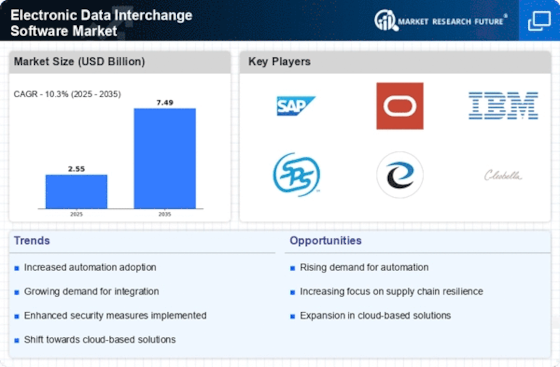
Electronic Data Interchange EDI Software Market Infographic
Purchase Options

Market Share

Electronic Data Interchange EDI Software Market Share Analysis

In the rapidly evolving landscape of the Electronic Data Interchange (EDI) Software market, companies employ various strategies to establish and enhance their market share. A prevalent approach is differentiation, where firms aim to distinguish their EDI solutions by offering unique features, advanced integration capabilities, or specialized industry-specific functionalities. This strategy allows companies to cater to specific needs within the market, attracting clients who value streamlined data exchange, compliance with industry standards, or seamless integration with other business systems.

Cost leadership is another significant strategy in the EDI Software market, with companies striving to provide cost-effective solutions without compromising on quality and security. This approach is particularly effective in appealing to businesses and enterprises looking to optimize their data exchange processes within budget constraints. By optimizing software development processes and leveraging cloud-based solutions, companies can offer competitive pricing, potentially capturing a larger market share and reaching a broader customer base.

Market penetration is a common strategy employed by companies aiming to deepen their market share within existing markets. This involves targeted marketing efforts, partnerships with business software providers, and expanding the functionality of EDI solutions. Leveraging existing customer relationships and offering comprehensive EDI services, such as data mapping, document translation, and real-time monitoring, can lead to increased adoption of EDI Software among businesses in various industries.

On the other hand, market development focuses on exploring new segments or untapped geographical regions. Companies adopting this strategy aim to expand their market share by introducing EDI Software solutions to markets that may not have fully embraced these technologies. Successful market development requires a keen understanding of local business requirements, regulatory environments, and emerging trends. However, entering new markets can lead to substantial growth for companies willing to pioneer EDI adoption in diverse business settings.

Collaborative strategies are gaining prominence in the EDI Software market, with companies forming partnerships, alliances, or consortia to enhance their market presence. Collaborative ventures enable firms to combine resources, share expertise, and collectively address industry challenges. This is particularly relevant in an industry where interoperability and compatibility with different business systems are crucial. By fostering collaboration, companies can provide more comprehensive EDI Software solutions, attracting a broader customer base and addressing complex data exchange requirements.

Customer-centric approaches are integral to market share positioning in the EDI Software market. Understanding the specific needs of businesses in different industries enables companies to tailor their solutions accordingly. Offering excellent customer support, user-friendly interfaces, and customization options contribute to customer satisfaction, fostering brand loyalty and increasing market share.

As the demand for efficient and standardized data exchange continues to grow, companies must stay agile and adapt to evolving market trends. Flexibility, innovation, and the ability to address specific industry requirements are crucial for successful market share positioning in the competitive EDI Software landscape. Companies need to anticipate the changing needs of their target audience, providing solutions that not only address current data exchange challenges but also offer scalability for future EDI applications.


Author
Author Profile
Ankit Gupta
Team Lead - Research

Ankit Gupta is a seasoned market intelligence and strategic research professional with over six plus years of experience in the ICT and Semiconductor industries. With academic roots in Telecom, Marketing, and Electronics, he blends technical insight with business strategy. Ankit has led 200+ projects, including work for Fortune 500 clients like Microsoft and Rio Tinto, covering market sizing, tech forecasting, and go-to-market strategies. Known for bridging engineering and enterprise decision-making, his insights support growth, innovation, and investment planning across diverse technology markets.

Leave a Comment

FAQs

What is the current valuation of the Electronic Data Interchange Software Market?

<p>The market valuation was 2.548 USD Billion in 2024.</p>

What is the projected market size for the Electronic Data Interchange Software Market by 2035?

<p>The market is projected to reach 7.492 USD Billion by 2035.</p>

What is the expected CAGR for the Electronic Data Interchange Software Market during the forecast period 2025 - 2035?

<p>The expected CAGR is 10.3% during the forecast period 2025 - 2035.</p>

Which companies are considered key players in the Electronic Data Interchange Software Market?

<p>Key players include SAP, Oracle, IBM, SPS Commerce, TrueCommerce, B2BGateway, Cleo, DiCentral, and Kewill.</p>

What are the main components of the Electronic Data Interchange Software Market?

<p>The main components are Solutions, valued at 4.496 USD Billion, and Services, valued at 2.996 USD Billion.</p>

What types of EDI are included in the Electronic Data Interchange Software Market?

<p>Types include Direct EDI, EDI via AS2, EDI via VAN, Mobile EDI, Web EDI, EDI Outsourcing, and Others.</p>

Which industry segments are driving growth in the Electronic Data Interchange Software Market?

Key industry segments include Retail and Consumer Goods, BFSI, Healthcare, IT and Telecommunication, and Transportation and Logistics.

What was the valuation of the Retail and Consumer Goods segment in 2024?

The Retail and Consumer Goods segment was valued at 0.764 USD Billion in 2024.

How much is the EDI via AS2 segment projected to grow by 2035?

The EDI via AS2 segment is projected to grow to 1.469 USD Billion by 2035.

What does the future hold for the Electronic Data Interchange Software Market?

The market is likely to experience robust growth, reaching 7.492 USD Billion by 2035.

Market Summary

As per Market Research Future analysis, the Electronic Data Interchange Software Market Size was estimated at 2.548 USD Billion in 2024. The Electronic Data Interchange Software industry is projected to grow from USD 2.81 Billion in 2025 to USD 7.492 Billion by 2035, exhibiting a compound annual growth rate (CAGR) of 10.3% during the forecast period 2025 - 2035

Key Market Trends & Highlights

The Electronic Data Interchange Software Market is experiencing robust growth driven by technological advancements and increasing demand for automation.

  • North America remains the largest market for Electronic Data Interchange Software, driven by its advanced technological infrastructure. Asia-Pacific is emerging as the fastest-growing region, fueled by rapid digital transformation and e-commerce expansion. Solutions segment dominates the market, while Services segment is witnessing the fastest growth due to increasing demand for tailored offerings. Key market drivers include the rising demand for automation and enhanced supply chain management, which are pivotal in shaping market dynamics.

Market Size & Forecast

2024 Market Size 2.548 (USD Billion)
2035 Market Size 7.492 (USD Billion)
CAGR (2025 - 2035) 10.3%
Largest Regional Market Share in 2024 North America

Major Players

<a href="https://news.sap.com/2025/11/sap-snowflake-new-data-fabric-innovations-sap-bdc-sap-hana-cloud/">SAP</a> (DE), Oracle (US), IBM (US), SPS Commerce (US), TrueCommerce (US), B2BGateway (US), Cleo (US), DiCentral (US), <a href="https://www.theguardian.com/sustainable-business/blog/five-trends-corporate-social-responsbility-global-movement">Kewill</a> (GB)

Market Trends

The Electronic Data Interchange Software Market is currently experiencing a transformative phase, driven by the increasing need for streamlined business processes and enhanced operational efficiency. Organizations across various sectors are recognizing the value of automating data exchange, which not only reduces manual errors but also accelerates transaction speeds. As digital transformation continues to gain momentum, the demand for robust EDI solutions is likely to rise, enabling companies to integrate their supply chains more effectively. The adoption of electronic data interchange (EDI) enables businesses to automate document exchange, reduce errors, and improve operational efficiency. Small businesses are increasingly leveraging EDI software for small business to simplify transactions and integrate with larger enterprise supply chains.

Furthermore, the growing emphasis on compliance and regulatory standards is pushing businesses to adopt EDI systems that ensure secure and accurate data transmission. In addition, the market appears to be influenced by advancements in cloud technology, which facilitate easier access to EDI solutions. This shift towards cloud-based platforms allows for greater scalability and flexibility, catering to the diverse needs of businesses. Moreover, the integration of artificial intelligence and machine learning into EDI software is expected to enhance data analytics capabilities, providing organizations with valuable insights. As the Electronic Data Interchange Software Market evolves, it seems poised for continued growth, driven by innovation and the increasing necessity for efficient data management solutions.

The healthcare sector is witnessing rapid adoption of EDI healthcare software to streamline patient data exchange, improve procurement processes, and maintain compliance with regulatory standards. Automotive manufacturers are implementing automotive EDI software to enhance parts supply chain management and ensure real-time data accuracy.

Cloud Adoption

The trend towards cloud-based Electronic Data Interchange Software is gaining traction, as organizations seek scalable and flexible solutions. This shift allows businesses to access EDI systems remotely, facilitating easier integration with existing processes. The Workgroup for Electronic Data Interchange (WEDI) has been instrumental in developing standards to ensure interoperability across healthcare and other industries.

AI Integration

The incorporation of artificial intelligence into EDI software is emerging as a key trend. This integration enhances data processing capabilities, enabling organizations to derive actionable insights and improve decision-making. Many organizations are turning to EDI outsourcing providers to manage complex integrations and ensure compliance with trading partner requirements. Advanced EDI management software and EDI processing software help enterprises automate workflows, while EDI tools for programmers enable custom integration with legacy systems. 

Regulatory Compliance

As regulatory requirements become more stringent, the demand for Electronic Data Interchange Software that ensures compliance is increasing. Businesses are prioritizing solutions that facilitate secure and accurate data exchange to meet these standards.

Electronic Data Interchange EDI Software Market Market Drivers

Rising E-commerce Activities

The Electronic Data Interchange Software Market is significantly influenced by the rise in e-commerce activities. As online shopping becomes more prevalent, businesses are compelled to adopt EDI solutions to manage the increased volume of transactions efficiently. EDI software enables seamless communication between trading partners, ensuring that orders, invoices, and shipping notices are exchanged promptly. Recent statistics indicate that e-commerce sales have seen a substantial increase, with projections suggesting continued growth in the coming years. This trend necessitates robust EDI systems that can handle the complexities of e-commerce transactions, thereby driving the demand for EDI software in various sectors, including retail and logistics.

Increased Demand for Automation

The Electronic Data Interchange Software Market is experiencing a surge in demand for automation solutions. Businesses are increasingly recognizing the need to streamline operations and reduce manual errors. Automation through EDI software facilitates faster processing of transactions, which can lead to improved efficiency and cost savings. According to recent data, companies that implement EDI solutions can reduce order processing time by up to 80%. This trend is particularly evident in sectors such as retail and manufacturing, where timely data exchange is critical. As organizations strive for operational excellence, the adoption of EDI software is likely to continue growing, driven by the need for enhanced productivity and reduced operational costs.

Enhanced Supply Chain Management

The Electronic Data Interchange Software Market is benefiting from the growing emphasis on enhanced supply chain management. Companies are increasingly adopting EDI solutions to improve visibility and coordination across their supply chains. EDI software facilitates real-time data exchange, allowing businesses to respond swiftly to market changes and customer demands. This capability is particularly crucial in industries such as automotive and pharmaceuticals, where supply chain efficiency can significantly impact profitability. Data suggests that organizations utilizing EDI can achieve a reduction in supply chain costs by up to 30%. As businesses seek to optimize their supply chains, the demand for EDI software is expected to rise, reflecting a broader trend towards integrated supply chain solutions.

Focus on Data Security and Compliance

The Electronic Data Interchange Software Market is increasingly shaped by the focus on data security and compliance. With the rise in cyber threats and stringent regulatory requirements, businesses are prioritizing secure data exchange methods. EDI software provides robust security features, including encryption and authentication, which are essential for protecting sensitive information. Moreover, compliance with regulations such as GDPR and HIPAA is becoming a critical concern for organizations. As companies strive to meet these compliance standards, the demand for secure EDI solutions is likely to grow. This trend underscores the importance of integrating security measures within EDI software, ensuring that businesses can operate confidently in a complex regulatory landscape.

Integration with Advanced Technologies

The Electronic Data Interchange Software Market is witnessing a trend towards integration with advanced technologies such as artificial intelligence and blockchain. These technologies enhance the capabilities of EDI software, enabling smarter data processing and improved transaction transparency. For instance, AI can analyze transaction patterns to optimize supply chain decisions, while blockchain can provide an immutable record of transactions, enhancing trust among trading partners. As businesses seek to leverage these technologies for competitive advantage, the demand for EDI solutions that incorporate such innovations is likely to increase. This integration not only streamlines operations but also positions companies to adapt to future technological advancements.

Market Segment Insights

By Component: Solutions (Largest) vs. Services (Fastest-Growing)

<p>In the Electronic Data Interchange Software Market, the component segment shows a clear distinction in market share between solutions and services. Solutions are the largest component, characterized by their integral role in facilitating transactions between trading partners. By providing automated data exchange, these solutions epitomize efficiency and reliability within businesses. On the other hand, services constitute a significant and emerging part of the market, addressing the increasing demand for customization and ongoing support in EDI implementations. The growth trends within the component segment are shaped by technological advancements and evolving enterprise needs. The increasing reliance on automated and electronic processes has driven higher adoption rates of EDI solutions among businesses across various industries. Additionally, the growth of services can be attributed to organizations seeking flexible, tailored solutions and expert guidance to navigate the complexities of EDI integration. As companies prioritize agility and efficiency, the demand for innovative service offerings in EDI continues to expand, signaling a dynamic shift in the market landscape.</p>

<p>Solutions (Dominant) vs. Services (Emerging)</p>

<p>The Solutions component stands as a dominant force in the Electronic Data Interchange Software Market due to its extensive range of functionalities designed to streamline communication between businesses. These solutions offer a variety of capabilities, such as data mapping, validation, and real-time tracking, which enhance operational efficiency and reduce errors in data exchange. As businesses increasingly adopt digital solutions, the demand for robust and comprehensive EDI software continues to grow. In contrast, Services have emerged as an essential complement to solutions, offering tailored assistance that caters to the unique needs of different organizations. These services encompass integration support, training, and ongoing maintenance, allowing businesses to maximize the benefits of their EDI investments. With the rise of e-commerce and global trade, the role of services is becoming increasingly pivotal as organizations seek expert support to optimize their EDI operations.</p>

By Type: Direct EDI (Largest) vs. Mobile EDI (Fastest-Growing)

<p>In the Electronic Data Interchange Software Market, segment distribution reveals that Direct EDI holds the largest market share. This method has been widely adopted due to its efficiency in enabling businesses to exchange documents directly over the internet, minimizing delays associated with traditional communication methods. Following this, other segments such as EDI via AS2 and EDI via VAN maintain significant positions, reflecting the varied requirements of different business operations. Meanwhile, Mobile EDI, while currently smaller in share, is showing promising growth as businesses increasingly look to enhance their mobility and operational efficiency. The growth trends in this segment are driven by the evolving demands for faster and more reliable data interchange solutions. Companies are adopting mobile solutions for their ability to provide accessibility and flexibility, appealing to the rise in remote work and mobile workforces. Furthermore, the integration of advanced technologies such as cloud computing and the Internet of Things (IoT) is fostering innovative EDI solutions that cater to the specific needs of various industries, thereby supporting the overall growth of the segment.</p>

<p>Direct EDI (Dominant) vs. Mobile EDI (Emerging)</p>

<p>Direct EDI stands out as the dominant method in the Electronic Data Interchange Software market due to its direct document exchanges, offering speed and reliability that businesses prioritize. It allows organizations to implement streamlined processes and improve operational efficiencies, making it a go-to choice for many enterprises. In contrast, Mobile EDI is rapidly emerging as a flexible alternative, adapting to the growing need for mobility within organizations. This segment capitalizes on the increasing reliance on smartphones and tablets, enabling users to manage transactions on the go. As the digital landscape evolves, Mobile EDI offers unique features that appeal to businesses looking to harness additional agility and responsiveness in their operations, setting the stage for significant future growth.</p>

By Industry: Retail and Consumer Goods (Largest) vs. BFSI (Fastest-Growing)

<p>The Electronic Data Interchange (EDI) Software Market witnesses a diverse distribution of market share across its various industry segments. Among these, the Retail and Consumer Goods segment emerges as the largest, attributed to the extensive adoption of EDI systems for efficient supply chain management and streamlined operations. The BFSI segment follows closely behind as the fastest-growing sector, driven by the increasing need for secure and efficient data handling in financial transactions.</p>

<p>Retail and Consumer Goods (Dominant) vs. BFSI (Emerging)</p>

<p>The Retail and Consumer Goods segment represents a dominant force within the Electronic Data Interchange Software Market, primarily due to its vital role in automating communication between suppliers and retailers. Companies in this sector leverage EDI systems to enhance order accuracy, reduce processing times, and improve inventory management. On the other hand, the BFSI segment is rapidly emerging, fueled by the growing focus on digital transformation and regulatory compliance. Financial institutions increasingly adopt EDI to streamline operations, mitigate risks, and enhance customer experience, further pushing the sector's growth.</p>

By Integration Type: API Integration (Largest) vs. EDI Integration (Fastest-Growing)

<p>The electronic data interchange (EDI) software market has diverse integration types, with API Integration leading the segment in market share. This share reflects the increasing preference for real-time data exchange and enhanced connectivity among businesses. API Integration facilitates automated communication between applications, which is crucial for modern enterprises looking to streamline operations and improve efficiency. EDI Integration, while not as dominant, is rapidly gaining traction, particularly among large organizations that require robust data interchange capabilities for managing supply chains effectively.</p>

<p>EDI Integration (Dominant) vs. Web Services Integration (Emerging)</p>

<p>EDI Integration dominates the electronic data interchange landscape by providing structured communication between businesses. Its enhanced security protocols and compliance features make it favorable for industries like retail and manufacturing. On the other hand, Web Services Integration is emerging as a flexible solution, allowing for integration over the internet using standardized protocols such as SOAP and REST. This approach facilitates real-time data sharing, catering to businesses aiming to adopt modern cloud solutions. As companies migrate to more agile systems, Web Services Integration is set to gain competitive ground, positioning itself as an essential complement to traditional EDI solutions.</p>

By Industry: Retail (Largest) vs. Healthcare (Fastest-Growing)

<p>The electronic data interchange (EDI) software market is characterized by varied contributions from several industries. In this segment, Retail has emerged as the largest market player, capturing significant market share due to its extensive reliance on electronic transactions for supply chain efficiency. Following closely, the Healthcare sector is experiencing rapid adoption of EDI solutions, especially as healthcare providers seek to streamline billing and claims processing, improving overall patient care and administrative workflows.</p>

<p>Retail: Dominant vs. Healthcare: Emerging</p>

<p>Retail plays a dominant role in the EDI software market as businesses leverage electronic data interchange to enhance supply chain operations, reduce costs, and improve transactional efficiencies. Major retailers utilize EDI to automate ordering processes, inventory management, and enhance communication with suppliers. In contrast, the Healthcare sector represents an emerging force, with increasing demand for secure and efficient data exchanges for patient records, billing, and compliance with regulations such as HIPAA. As healthcare organizations modernize their systems, the demand for EDI solutions is anticipated to rise, reflecting the industry's fast growth trajectory.</p>

Get more detailed insights about Electronic Data Interchange Software Market Research Report—Global Forecast till 2035

Regional Insights

By region, the study provides market insights into North America, Europe, Asia-Pacific, and the Rest of the World. The North American Electronic Data Interchange (EDI) Software market area will dominate this market in 2022. The region's growing manufacturing, retail, healthcare, and automobile industries are increasing the demand for data interchange solutions. Due to increased digital business-to-business transactions, the U.S. will likely acquire the largest market share over the forecast period.

Further, the major countries studied in the market report are The U.S., Canada, German, France, the UK, Italy, Spain, China, Japan, India, Australia, South Korea, and Brazil.

Figure 3: ELECTRONIC DATA INTERCHANGE (EDI) SOFTWARE MARKET SHARE BY REGION 2022 (%)

Europe’s Electronic Data Interchange (EDI) Software market is the second-largest.  Due to many data exchange solutions and instrument manufacturers, Europe is anticipated to grow at a significant CAGR rate. In addition, the European United Nations have adopted the ISO 9735 standard for electronic data transfer to standardize and regulate electronic data interchange operations. Further, the German Electronic Data Interchange (EDI) Software market held the largest market share, and the UK Electronic Data Interchange (EDI) Software market was the fastest-growing market in the European region

The Asia-Pacific Electronic Data Interchange (EDI) Software Market is anticipated to grow at the fastest CAGR from 2023 to 2032. Increasing investment and industry-wide adoption of digitalized technology are anticipated to drive the adoption of EDI solutions. In addition, policy reforms, economic growth, and the expansion of the IT industry are anticipated to drive the market in the Asia-Pacific region. Moreover, China’s Electronic Data Interchange (EDI) Software market held the largest market share. The Indian Electronic Data Interchange (EDI) Software market was the fastest-growing market in the Asia-Pacific region.

Key Players and Competitive Insights

Leading market players are implementing strategic initiatives, such as product launches/development, regional expansion, and partnerships. Collaborations and, mergers & acquisitions are other market development strategies companies adopt. Electronic Data Interchange (EDI) Software industry must offer cost-effective items to expand and survive in a competitive market.
Companies are increasingly adopting electronic data interchange solutions to streamline supply chain operations and ensure secure data exchange across industries. Leading electronic data interchange providers like SAP, Oracle, and TrueCommerce continue to innovate and expand their offerings in the global market.
Previously paper-based business operations are transforming and boosting the global Electronic Data Interchange (EDI) Software industry. In recent years, large market participants quickly employed EDI platforms and integrated advanced technologies into their processes. Major players in the Electronic Data Interchange (EDI) Software market include Cleo, Comarch SA, Crossinx GmbH, Data Masons Software LLC, EDICOM, IBM Corporation, InterTrade Systems, Inc, Mulesoft, LLC, SPS Commerce, Inc., The Descartes Systems Group Inc., and TrueCommerce Inc., among others. Cleo Communications LLC, also known as Cleo, was founded in 1976 as a privately held software corporation.
The Company is best known for its Cleo Integration Cloud with the RADAR ecosystem integration platform. Cleo Integration Cloud (CIC) is an ecosystem integration platform that unifies API, EDI, and non-EDI integration visibility. Technical and business users gain the confidence to rapidly onboard trading partners, facilitate application integration, and accelerate revenue-generating business processes with CIC. ComArch SA creates, develops, and distributes contemporary information systems. The Company's systems consist of computer and network hardware and software. Additionally, ComArch provides implementation, training, and operational services. Comarch invests twelve percent of its annual revenue in innovative initiatives. Since 1999, the Company has been listed on the Warsaw Stock Exchange. Comarch generated 244 million euros in revenue in 2014. It employs over 5,000 specialists in 71 offices and 24 countries, from Asia to Chile via Europe and Europe.

Key Companies in the Electronic Data Interchange EDI Software Market include

Industry Developments

  • Q2 2024: Boomi Announces Strategic Partnership with Google Cloud to Accelerate Digital Transformation Boomi, a leading provider of cloud-based integration and EDI solutions, announced a strategic partnership with Google Cloud to deliver enhanced integration and automation capabilities for enterprise customers, including expanded EDI support.
  • Q2 2024: TrueCommerce Launches Next-Generation EDI Platform with AI-Driven Automation TrueCommerce unveiled its new EDI platform featuring AI-driven automation tools designed to streamline supply chain transactions and improve data accuracy for businesses across retail, manufacturing, and logistics sectors.
  • Q2 2024: Epicor Expands EDI Capabilities with Acquisition of Data Interchange Epicor, a global provider of industry-specific enterprise software, announced the acquisition of Data Interchange, a UK-based EDI software provider, to strengthen its EDI offerings and expand its presence in the European market.
  • Q3 2024: OpenText Introduces Cloud EDI Solution for Healthcare Sector OpenText launched a new cloud-based EDI solution tailored for the healthcare industry, aiming to improve interoperability and compliance with evolving regulatory requirements.
  • Q3 2024: SPS Commerce Appoints New Chief Technology Officer SPS Commerce, a leading EDI and supply chain integration provider, announced the appointment of a new Chief Technology Officer to drive innovation in its EDI and cloud integration platforms.
  • Q3 2024: Cleo Secures $50 Million Series C Funding to Accelerate EDI Platform Development Cleo, a provider of ecosystem integration and EDI solutions, raised $50 million in Series C funding to expand its product development and global market reach.
  • Q4 2024: Comarch Launches EDI-as-a-Service Platform for Global Retailers Comarch introduced a new EDI-as-a-Service platform designed to help global retailers automate document exchange and streamline supply chain operations.
  • Q4 2024: IBM and Maersk Expand Blockchain-Enabled EDI Integration for Global Shipping IBM and Maersk announced the expansion of their blockchain-enabled EDI integration, aiming to enhance transparency and efficiency in global shipping and logistics.
  • Q1 2025: Oracle Unveils Enhanced EDI Capabilities in Oracle Cloud SCM Oracle announced new EDI features in its Oracle Cloud Supply Chain Management suite, enabling faster onboarding of trading partners and improved compliance with global standards.
  • Q1 2025: MuleSoft Launches API-Driven EDI Integration Toolkit MuleSoft released a new toolkit for API-driven EDI integration, allowing enterprises to modernize legacy EDI workflows and connect with cloud-native applications.
  • Q2 2025: EDICOM Receives European Certification for EDI Compliance in Public Procurement EDICOM, a global EDI provider, received official European certification for its EDI solutions, enabling public sector organizations to meet new e-invoicing and procurement regulations.
  • Q2 2025: Rocket Software Opens New EDI Innovation Center in Austin, Texas Rocket Software inaugurated a new EDI innovation center in Austin, Texas, focused on developing next-generation EDI and B2B integration technologies.

Future Outlook

Electronic Data Interchange EDI Software Market Future Outlook

The Electronic Data Interchange Software Market is projected to grow at a 10.3% CAGR from 2025 to 2035, driven by increasing automation, demand for real-time data exchange, and enhanced supply chain efficiency.

New opportunities lie in:

  • <p>Integration of AI-driven analytics for predictive supply chain management. Development of industry-specific EDI solutions for healthcare and finance. Expansion into emerging markets with tailored EDI platforms.</p>

By 2035, the market is expected to be robust, reflecting substantial growth and innovation.

Market Segmentation

Electronic Data Interchange EDI Software Market Type Outlook

  • Direct EDI
  • EDI via AS2
  • EDI via VAN
  • Mobile EDI
  • Web EDI
  • EDI Outsourcing
  • Others

Electronic Data Interchange EDI Software Market Industry Outlook

  • Retail and Consumer Goods
  • BFSI
  • Healthcare
  • IT and Telecommunication
  • Transportation and Logistics
  • Others

Electronic Data Interchange EDI Software Market Component Outlook

  • Solutions
  • Services

Report Scope

MARKET SIZE 2024 2.548(USD Billion)
MARKET SIZE 2025 2.81(USD Billion)
MARKET SIZE 2035 7.492(USD Billion)
COMPOUND ANNUAL GROWTH RATE (CAGR) 10.3% (2025 - 2035)
REPORT COVERAGE Revenue Forecast, Competitive Landscape, Growth Factors, and Trends
BASE YEAR 2024
Market Forecast Period 2025 - 2035
Historical Data 2019 - 2024
Market Forecast Units USD Billion
Key Companies Profiled SAP (DE), Oracle (US), IBM (US), SPS Commerce (US), TrueCommerce (US), B2BGateway (US), Cleo (US), DiCentral (US), Kewill (GB)
Segments Covered Component, Type, Industry, Region
Key Market Opportunities Integration of artificial intelligence enhances efficiency in the Electronic Data Interchange Software Market.
Key Market Dynamics Rising demand for seamless integration and automation drives innovation in Electronic Data Interchange Software solutions.
Countries Covered North America, Europe, APAC, South America, MEA

FAQs

What is the current valuation of the Electronic Data Interchange Software Market?

<p>The market valuation was 2.548 USD Billion in 2024.</p>

What is the projected market size for the Electronic Data Interchange Software Market by 2035?

<p>The market is projected to reach 7.492 USD Billion by 2035.</p>

What is the expected CAGR for the Electronic Data Interchange Software Market during the forecast period 2025 - 2035?

<p>The expected CAGR is 10.3% during the forecast period 2025 - 2035.</p>

Which companies are considered key players in the Electronic Data Interchange Software Market?

<p>Key players include SAP, Oracle, IBM, SPS Commerce, TrueCommerce, B2BGateway, Cleo, DiCentral, and Kewill.</p>

What are the main components of the Electronic Data Interchange Software Market?

<p>The main components are Solutions, valued at 4.496 USD Billion, and Services, valued at 2.996 USD Billion.</p>

What types of EDI are included in the Electronic Data Interchange Software Market?

<p>Types include Direct EDI, EDI via AS2, EDI via VAN, Mobile EDI, Web EDI, EDI Outsourcing, and Others.</p>

Which industry segments are driving growth in the Electronic Data Interchange Software Market?

Key industry segments include Retail and Consumer Goods, BFSI, Healthcare, IT and Telecommunication, and Transportation and Logistics.

What was the valuation of the Retail and Consumer Goods segment in 2024?

The Retail and Consumer Goods segment was valued at 0.764 USD Billion in 2024.

How much is the EDI via AS2 segment projected to grow by 2035?

The EDI via AS2 segment is projected to grow to 1.469 USD Billion by 2035.

What does the future hold for the Electronic Data Interchange Software Market?

The market is likely to experience robust growth, reaching 7.492 USD Billion by 2035.

  1. SECTION I: EXECUTIVE SUMMARY AND KEY HIGHLIGHTS
    1. | 1.1 EXECUTIVE SUMMARY
    2. | | 1.1.1 Market Overview
    3. | | 1.1.2 Key Findings
    4. | | 1.1.3 Market Segmentation
    5. | | 1.1.4 Competitive Landscape
    6. | | 1.1.5 Challenges and Opportunities
    7. | | 1.1.6 Future Outlook
  2. SECTION II: SCOPING, METHODOLOGY AND MARKET STRUCTURE
    1. | 2.1 MARKET INTRODUCTION
    2. | | 2.1.1 Definition
    3. | | 2.1.2 Scope of the study
    4. | | | 2.1.2.1 Research Objective
    5. | | | 2.1.2.2 Assumption
    6. | | | 2.1.2.3 Limitations
    7. | 2.2 RESEARCH METHODOLOGY
    8. | | 2.2.1 Overview
    9. | | 2.2.2 Data Mining
    10. | | 2.2.3 Secondary Research
    11. | | 2.2.4 Primary Research
    12. | | | 2.2.4.1 Primary Interviews and Information Gathering Process
    13. | | | 2.2.4.2 Breakdown of Primary Respondents
    14. | | 2.2.5 Forecasting Model
    15. | | 2.2.6 Market Size Estimation
    16. | | | 2.2.6.1 Bottom-Up Approach
    17. | | | 2.2.6.2 Top-Down Approach
    18. | | 2.2.7 Data Triangulation
    19. | | 2.2.8 Validation
  3. SECTION III: QUALITATIVE ANALYSIS
    1. | 3.1 MARKET DYNAMICS
    2. | | 3.1.1 Overview
    3. | | 3.1.2 Drivers
    4. | | 3.1.3 Restraints
    5. | | 3.1.4 Opportunities
    6. | 3.2 MARKET FACTOR ANALYSIS
    7. | | 3.2.1 Value chain Analysis
    8. | | 3.2.2 Porter's Five Forces Analysis
    9. | | | 3.2.2.1 Bargaining Power of Suppliers
    10. | | | 3.2.2.2 Bargaining Power of Buyers
    11. | | | 3.2.2.3 Threat of New Entrants
    12. | | | 3.2.2.4 Threat of Substitutes
    13. | | | 3.2.2.5 Intensity of Rivalry
    14. | | 3.2.3 COVID-19 Impact Analysis
    15. | | | 3.2.3.1 Market Impact Analysis
    16. | | | 3.2.3.2 Regional Impact
    17. | | | 3.2.3.3 Opportunity and Threat Analysis
  4. SECTION IV: QUANTITATIVE ANALYSIS
    1. | 4.1 Information and Communications Technology, BY Component (USD Billion)
    2. | | 4.1.1 Solutions
    3. | | 4.1.2 Services
    4. | 4.2 Information and Communications Technology, BY Type (USD Billion)
    5. | | 4.2.1 Direct EDI
    6. | | 4.2.2 EDI via AS2
    7. | | 4.2.3 EDI via VAN
    8. | | 4.2.4 Mobile EDI
    9. | | 4.2.5 Web EDI
    10. | | 4.2.6 EDI Outsourcing
    11. | | 4.2.7 Others
    12. | 4.3 Information and Communications Technology, BY Industry (USD Billion)
    13. | | 4.3.1 Retail and Consumer Goods
    14. | | 4.3.2 BFSI
    15. | | 4.3.3 Healthcare
    16. | | 4.3.4 IT and Telecommunication
    17. | | 4.3.5 Transportation and Logistics
    18. | | 4.3.6 Others
    19. | 4.4 Information and Communications Technology, BY Region (USD Billion)
    20. | | 4.4.1 North America
    21. | | | 4.4.1.1 US
    22. | | | 4.4.1.2 Canada
    23. | | 4.4.2 Europe
    24. | | | 4.4.2.1 Germany
    25. | | | 4.4.2.2 UK
    26. | | | 4.4.2.3 France
    27. | | | 4.4.2.4 Russia
    28. | | | 4.4.2.5 Italy
    29. | | | 4.4.2.6 Spain
    30. | | | 4.4.2.7 Rest of Europe
    31. | | 4.4.3 APAC
    32. | | | 4.4.3.1 China
    33. | | | 4.4.3.2 India
    34. | | | 4.4.3.3 Japan
    35. | | | 4.4.3.4 South Korea
    36. | | | 4.4.3.5 Malaysia
    37. | | | 4.4.3.6 Thailand
    38. | | | 4.4.3.7 Indonesia
    39. | | | 4.4.3.8 Rest of APAC
    40. | | 4.4.4 South America
    41. | | | 4.4.4.1 Brazil
    42. | | | 4.4.4.2 Mexico
    43. | | | 4.4.4.3 Argentina
    44. | | | 4.4.4.4 Rest of South America
    45. | | 4.4.5 MEA
    46. | | | 4.4.5.1 GCC Countries
    47. | | | 4.4.5.2 South Africa
    48. | | | 4.4.5.3 Rest of MEA
  5. SECTION V: COMPETITIVE ANALYSIS
    1. | 5.1 Competitive Landscape
    2. | | 5.1.1 Overview
    3. | | 5.1.2 Competitive Analysis
    4. | | 5.1.3 Market share Analysis
    5. | | 5.1.4 Major Growth Strategy in the Information and Communications Technology
    6. | | 5.1.5 Competitive Benchmarking
    7. | | 5.1.6 Leading Players in Terms of Number of Developments in the Information and Communications Technology
    8. | | 5.1.7 Key developments and growth strategies
    9. | | | 5.1.7.1 New Product Launch/Service Deployment
    10. | | | 5.1.7.2 Merger & Acquisitions
    11. | | | 5.1.7.3 Joint Ventures
    12. | | 5.1.8 Major Players Financial Matrix
    13. | | | 5.1.8.1 Sales and Operating Income
    14. | | | 5.1.8.2 Major Players R&D Expenditure. 2023
    15. | 5.2 Company Profiles
    16. | | 5.2.1 SAP (DE)
    17. | | | 5.2.1.1 Financial Overview
    18. | | | 5.2.1.2 Products Offered
    19. | | | 5.2.1.3 Key Developments
    20. | | | 5.2.1.4 SWOT Analysis
    21. | | | 5.2.1.5 Key Strategies
    22. | | 5.2.2 Oracle (US)
    23. | | | 5.2.2.1 Financial Overview
    24. | | | 5.2.2.2 Products Offered
    25. | | | 5.2.2.3 Key Developments
    26. | | | 5.2.2.4 SWOT Analysis
    27. | | | 5.2.2.5 Key Strategies
    28. | | 5.2.3 IBM (US)
    29. | | | 5.2.3.1 Financial Overview
    30. | | | 5.2.3.2 Products Offered
    31. | | | 5.2.3.3 Key Developments
    32. | | | 5.2.3.4 SWOT Analysis
    33. | | | 5.2.3.5 Key Strategies
    34. | | 5.2.4 SPS Commerce (US)
    35. | | | 5.2.4.1 Financial Overview
    36. | | | 5.2.4.2 Products Offered
    37. | | | 5.2.4.3 Key Developments
    38. | | | 5.2.4.4 SWOT Analysis
    39. | | | 5.2.4.5 Key Strategies
    40. | | 5.2.5 TrueCommerce (US)
    41. | | | 5.2.5.1 Financial Overview
    42. | | | 5.2.5.2 Products Offered
    43. | | | 5.2.5.3 Key Developments
    44. | | | 5.2.5.4 SWOT Analysis
    45. | | | 5.2.5.5 Key Strategies
    46. | | 5.2.6 B2BGateway (US)
    47. | | | 5.2.6.1 Financial Overview
    48. | | | 5.2.6.2 Products Offered
    49. | | | 5.2.6.3 Key Developments
    50. | | | 5.2.6.4 SWOT Analysis
    51. | | | 5.2.6.5 Key Strategies
    52. | | 5.2.7 Cleo (US)
    53. | | | 5.2.7.1 Financial Overview
    54. | | | 5.2.7.2 Products Offered
    55. | | | 5.2.7.3 Key Developments
    56. | | | 5.2.7.4 SWOT Analysis
    57. | | | 5.2.7.5 Key Strategies
    58. | | 5.2.8 DiCentral (US)
    59. | | | 5.2.8.1 Financial Overview
    60. | | | 5.2.8.2 Products Offered
    61. | | | 5.2.8.3 Key Developments
    62. | | | 5.2.8.4 SWOT Analysis
    63. | | | 5.2.8.5 Key Strategies
    64. | | 5.2.9 Kewill (GB)
    65. | | | 5.2.9.1 Financial Overview
    66. | | | 5.2.9.2 Products Offered
    67. | | | 5.2.9.3 Key Developments
    68. | | | 5.2.9.4 SWOT Analysis
    69. | | | 5.2.9.5 Key Strategies
    70. | 5.3 Appendix
    71. | | 5.3.1 References
    72. | | 5.3.2 Related Reports
  6. LIST OF FIGURES
    1. | 6.1 MARKET SYNOPSIS
    2. | 6.2 NORTH AMERICA MARKET ANALYSIS
    3. | 6.3 US MARKET ANALYSIS BY COMPONENT
    4. | 6.4 US MARKET ANALYSIS BY TYPE
    5. | 6.5 US MARKET ANALYSIS BY INDUSTRY
    6. | 6.6 CANADA MARKET ANALYSIS BY COMPONENT
    7. | 6.7 CANADA MARKET ANALYSIS BY TYPE
    8. | 6.8 CANADA MARKET ANALYSIS BY INDUSTRY
    9. | 6.9 EUROPE MARKET ANALYSIS
    10. | 6.10 GERMANY MARKET ANALYSIS BY COMPONENT
    11. | 6.11 GERMANY MARKET ANALYSIS BY TYPE
    12. | 6.12 GERMANY MARKET ANALYSIS BY INDUSTRY
    13. | 6.13 UK MARKET ANALYSIS BY COMPONENT
    14. | 6.14 UK MARKET ANALYSIS BY TYPE
    15. | 6.15 UK MARKET ANALYSIS BY INDUSTRY
    16. | 6.16 FRANCE MARKET ANALYSIS BY COMPONENT
    17. | 6.17 FRANCE MARKET ANALYSIS BY TYPE
    18. | 6.18 FRANCE MARKET ANALYSIS BY INDUSTRY
    19. | 6.19 RUSSIA MARKET ANALYSIS BY COMPONENT
    20. | 6.20 RUSSIA MARKET ANALYSIS BY TYPE
    21. | 6.21 RUSSIA MARKET ANALYSIS BY INDUSTRY
    22. | 6.22 ITALY MARKET ANALYSIS BY COMPONENT
    23. | 6.23 ITALY MARKET ANALYSIS BY TYPE
    24. | 6.24 ITALY MARKET ANALYSIS BY INDUSTRY
    25. | 6.25 SPAIN MARKET ANALYSIS BY COMPONENT
    26. | 6.26 SPAIN MARKET ANALYSIS BY TYPE
    27. | 6.27 SPAIN MARKET ANALYSIS BY INDUSTRY
    28. | 6.28 REST OF EUROPE MARKET ANALYSIS BY COMPONENT
    29. | 6.29 REST OF EUROPE MARKET ANALYSIS BY TYPE
    30. | 6.30 REST OF EUROPE MARKET ANALYSIS BY INDUSTRY
    31. | 6.31 APAC MARKET ANALYSIS
    32. | 6.32 CHINA MARKET ANALYSIS BY COMPONENT
    33. | 6.33 CHINA MARKET ANALYSIS BY TYPE
    34. | 6.34 CHINA MARKET ANALYSIS BY INDUSTRY
    35. | 6.35 INDIA MARKET ANALYSIS BY COMPONENT
    36. | 6.36 INDIA MARKET ANALYSIS BY TYPE
    37. | 6.37 INDIA MARKET ANALYSIS BY INDUSTRY
    38. | 6.38 JAPAN MARKET ANALYSIS BY COMPONENT
    39. | 6.39 JAPAN MARKET ANALYSIS BY TYPE
    40. | 6.40 JAPAN MARKET ANALYSIS BY INDUSTRY
    41. | 6.41 SOUTH KOREA MARKET ANALYSIS BY COMPONENT
    42. | 6.42 SOUTH KOREA MARKET ANALYSIS BY TYPE
    43. | 6.43 SOUTH KOREA MARKET ANALYSIS BY INDUSTRY
    44. | 6.44 MALAYSIA MARKET ANALYSIS BY COMPONENT
    45. | 6.45 MALAYSIA MARKET ANALYSIS BY TYPE
    46. | 6.46 MALAYSIA MARKET ANALYSIS BY INDUSTRY
    47. | 6.47 THAILAND MARKET ANALYSIS BY COMPONENT
    48. | 6.48 THAILAND MARKET ANALYSIS BY TYPE
    49. | 6.49 THAILAND MARKET ANALYSIS BY INDUSTRY
    50. | 6.50 INDONESIA MARKET ANALYSIS BY COMPONENT
    51. | 6.51 INDONESIA MARKET ANALYSIS BY TYPE
    52. | 6.52 INDONESIA MARKET ANALYSIS BY INDUSTRY
    53. | 6.53 REST OF APAC MARKET ANALYSIS BY COMPONENT
    54. | 6.54 REST OF APAC MARKET ANALYSIS BY TYPE
    55. | 6.55 REST OF APAC MARKET ANALYSIS BY INDUSTRY
    56. | 6.56 SOUTH AMERICA MARKET ANALYSIS
    57. | 6.57 BRAZIL MARKET ANALYSIS BY COMPONENT
    58. | 6.58 BRAZIL MARKET ANALYSIS BY TYPE
    59. | 6.59 BRAZIL MARKET ANALYSIS BY INDUSTRY
    60. | 6.60 MEXICO MARKET ANALYSIS BY COMPONENT
    61. | 6.61 MEXICO MARKET ANALYSIS BY TYPE
    62. | 6.62 MEXICO MARKET ANALYSIS BY INDUSTRY
    63. | 6.63 ARGENTINA MARKET ANALYSIS BY COMPONENT
    64. | 6.64 ARGENTINA MARKET ANALYSIS BY TYPE
    65. | 6.65 ARGENTINA MARKET ANALYSIS BY INDUSTRY
    66. | 6.66 REST OF SOUTH AMERICA MARKET ANALYSIS BY COMPONENT
    67. | 6.67 REST OF SOUTH AMERICA MARKET ANALYSIS BY TYPE
    68. | 6.68 REST OF SOUTH AMERICA MARKET ANALYSIS BY INDUSTRY
    69. | 6.69 MEA MARKET ANALYSIS
    70. | 6.70 GCC COUNTRIES MARKET ANALYSIS BY COMPONENT
    71. | 6.71 GCC COUNTRIES MARKET ANALYSIS BY TYPE
    72. | 6.72 GCC COUNTRIES MARKET ANALYSIS BY INDUSTRY
    73. | 6.73 SOUTH AFRICA MARKET ANALYSIS BY COMPONENT
    74. | 6.74 SOUTH AFRICA MARKET ANALYSIS BY TYPE
    75. | 6.75 SOUTH AFRICA MARKET ANALYSIS BY INDUSTRY
    76. | 6.76 REST OF MEA MARKET ANALYSIS BY COMPONENT
    77. | 6.77 REST OF MEA MARKET ANALYSIS BY TYPE
    78. | 6.78 REST OF MEA MARKET ANALYSIS BY INDUSTRY
    79. | 6.79 KEY BUYING CRITERIA OF INFORMATION AND COMMUNICATIONS TECHNOLOGY
    80. | 6.80 RESEARCH PROCESS OF MRFR
    81. | 6.81 DRO ANALYSIS OF INFORMATION AND COMMUNICATIONS TECHNOLOGY
    82. | 6.82 DRIVERS IMPACT ANALYSIS: INFORMATION AND COMMUNICATIONS TECHNOLOGY
    83. | 6.83 RESTRAINTS IMPACT ANALYSIS: INFORMATION AND COMMUNICATIONS TECHNOLOGY
    84. | 6.84 SUPPLY / VALUE CHAIN: INFORMATION AND COMMUNICATIONS TECHNOLOGY
    85. | 6.85 INFORMATION AND COMMUNICATIONS TECHNOLOGY, BY COMPONENT, 2024 (% SHARE)
    86. | 6.86 INFORMATION AND COMMUNICATIONS TECHNOLOGY, BY COMPONENT, 2024 TO 2035 (USD Billion)
    87. | 6.87 INFORMATION AND COMMUNICATIONS TECHNOLOGY, BY TYPE, 2024 (% SHARE)
    88. | 6.88 INFORMATION AND COMMUNICATIONS TECHNOLOGY, BY TYPE, 2024 TO 2035 (USD Billion)
    89. | 6.89 INFORMATION AND COMMUNICATIONS TECHNOLOGY, BY INDUSTRY, 2024 (% SHARE)
    90. | 6.90 INFORMATION AND COMMUNICATIONS TECHNOLOGY, BY INDUSTRY, 2024 TO 2035 (USD Billion)
    91. | 6.91 BENCHMARKING OF MAJOR COMPETITORS
  7. LIST OF TABLES
    1. | 7.1 LIST OF ASSUMPTIONS
    2. | | 7.1.1
    3. | 7.2 North America MARKET SIZE ESTIMATES; FORECAST
    4. | | 7.2.1 BY COMPONENT, 2025-2035 (USD Billion)
    5. | | 7.2.2 BY TYPE, 2025-2035 (USD Billion)
    6. | | 7.2.3 BY INDUSTRY, 2025-2035 (USD Billion)
    7. | 7.3 US MARKET SIZE ESTIMATES; FORECAST
    8. | | 7.3.1 BY COMPONENT, 2025-2035 (USD Billion)
    9. | | 7.3.2 BY TYPE, 2025-2035 (USD Billion)
    10. | | 7.3.3 BY INDUSTRY, 2025-2035 (USD Billion)
    11. | 7.4 Canada MARKET SIZE ESTIMATES; FORECAST
    12. | | 7.4.1 BY COMPONENT, 2025-2035 (USD Billion)
    13. | | 7.4.2 BY TYPE, 2025-2035 (USD Billion)
    14. | | 7.4.3 BY INDUSTRY, 2025-2035 (USD Billion)
    15. | 7.5 Europe MARKET SIZE ESTIMATES; FORECAST
    16. | | 7.5.1 BY COMPONENT, 2025-2035 (USD Billion)
    17. | | 7.5.2 BY TYPE, 2025-2035 (USD Billion)
    18. | | 7.5.3 BY INDUSTRY, 2025-2035 (USD Billion)
    19. | 7.6 Germany MARKET SIZE ESTIMATES; FORECAST
    20. | | 7.6.1 BY COMPONENT, 2025-2035 (USD Billion)
    21. | | 7.6.2 BY TYPE, 2025-2035 (USD Billion)
    22. | | 7.6.3 BY INDUSTRY, 2025-2035 (USD Billion)
    23. | 7.7 UK MARKET SIZE ESTIMATES; FORECAST
    24. | | 7.7.1 BY COMPONENT, 2025-2035 (USD Billion)
    25. | | 7.7.2 BY TYPE, 2025-2035 (USD Billion)
    26. | | 7.7.3 BY INDUSTRY, 2025-2035 (USD Billion)
    27. | 7.8 France MARKET SIZE ESTIMATES; FORECAST
    28. | | 7.8.1 BY COMPONENT, 2025-2035 (USD Billion)
    29. | | 7.8.2 BY TYPE, 2025-2035 (USD Billion)
    30. | | 7.8.3 BY INDUSTRY, 2025-2035 (USD Billion)
    31. | 7.9 Russia MARKET SIZE ESTIMATES; FORECAST
    32. | | 7.9.1 BY COMPONENT, 2025-2035 (USD Billion)
    33. | | 7.9.2 BY TYPE, 2025-2035 (USD Billion)
    34. | | 7.9.3 BY INDUSTRY, 2025-2035 (USD Billion)
    35. | 7.10 Italy MARKET SIZE ESTIMATES; FORECAST
    36. | | 7.10.1 BY COMPONENT, 2025-2035 (USD Billion)
    37. | | 7.10.2 BY TYPE, 2025-2035 (USD Billion)
    38. | | 7.10.3 BY INDUSTRY, 2025-2035 (USD Billion)
    39. | 7.11 Spain MARKET SIZE ESTIMATES; FORECAST
    40. | | 7.11.1 BY COMPONENT, 2025-2035 (USD Billion)
    41. | | 7.11.2 BY TYPE, 2025-2035 (USD Billion)
    42. | | 7.11.3 BY INDUSTRY, 2025-2035 (USD Billion)
    43. | 7.12 Rest of Europe MARKET SIZE ESTIMATES; FORECAST
    44. | | 7.12.1 BY COMPONENT, 2025-2035 (USD Billion)
    45. | | 7.12.2 BY TYPE, 2025-2035 (USD Billion)
    46. | | 7.12.3 BY INDUSTRY, 2025-2035 (USD Billion)
    47. | 7.13 APAC MARKET SIZE ESTIMATES; FORECAST
    48. | | 7.13.1 BY COMPONENT, 2025-2035 (USD Billion)
    49. | | 7.13.2 BY TYPE, 2025-2035 (USD Billion)
    50. | | 7.13.3 BY INDUSTRY, 2025-2035 (USD Billion)
    51. | 7.14 China MARKET SIZE ESTIMATES; FORECAST
    52. | | 7.14.1 BY COMPONENT, 2025-2035 (USD Billion)
    53. | | 7.14.2 BY TYPE, 2025-2035 (USD Billion)
    54. | | 7.14.3 BY INDUSTRY, 2025-2035 (USD Billion)
    55. | 7.15 India MARKET SIZE ESTIMATES; FORECAST
    56. | | 7.15.1 BY COMPONENT, 2025-2035 (USD Billion)
    57. | | 7.15.2 BY TYPE, 2025-2035 (USD Billion)
    58. | | 7.15.3 BY INDUSTRY, 2025-2035 (USD Billion)
    59. | 7.16 Japan MARKET SIZE ESTIMATES; FORECAST
    60. | | 7.16.1 BY COMPONENT, 2025-2035 (USD Billion)
    61. | | 7.16.2 BY TYPE, 2025-2035 (USD Billion)
    62. | | 7.16.3 BY INDUSTRY, 2025-2035 (USD Billion)
    63. | 7.17 South Korea MARKET SIZE ESTIMATES; FORECAST
    64. | | 7.17.1 BY COMPONENT, 2025-2035 (USD Billion)
    65. | | 7.17.2 BY TYPE, 2025-2035 (USD Billion)
    66. | | 7.17.3 BY INDUSTRY, 2025-2035 (USD Billion)
    67. | 7.18 Malaysia MARKET SIZE ESTIMATES; FORECAST
    68. | | 7.18.1 BY COMPONENT, 2025-2035 (USD Billion)
    69. | | 7.18.2 BY TYPE, 2025-2035 (USD Billion)
    70. | | 7.18.3 BY INDUSTRY, 2025-2035 (USD Billion)
    71. | 7.19 Thailand MARKET SIZE ESTIMATES; FORECAST
    72. | | 7.19.1 BY COMPONENT, 2025-2035 (USD Billion)
    73. | | 7.19.2 BY TYPE, 2025-2035 (USD Billion)
    74. | | 7.19.3 BY INDUSTRY, 2025-2035 (USD Billion)
    75. | 7.20 Indonesia MARKET SIZE ESTIMATES; FORECAST
    76. | | 7.20.1 BY COMPONENT, 2025-2035 (USD Billion)
    77. | | 7.20.2 BY TYPE, 2025-2035 (USD Billion)
    78. | | 7.20.3 BY INDUSTRY, 2025-2035 (USD Billion)
    79. | 7.21 Rest of APAC MARKET SIZE ESTIMATES; FORECAST
    80. | | 7.21.1 BY COMPONENT, 2025-2035 (USD Billion)
    81. | | 7.21.2 BY TYPE, 2025-2035 (USD Billion)
    82. | | 7.21.3 BY INDUSTRY, 2025-2035 (USD Billion)
    83. | 7.22 South America MARKET SIZE ESTIMATES; FORECAST
    84. | | 7.22.1 BY COMPONENT, 2025-2035 (USD Billion)
    85. | | 7.22.2 BY TYPE, 2025-2035 (USD Billion)
    86. | | 7.22.3 BY INDUSTRY, 2025-2035 (USD Billion)
    87. | 7.23 Brazil MARKET SIZE ESTIMATES; FORECAST
    88. | | 7.23.1 BY COMPONENT, 2025-2035 (USD Billion)
    89. | | 7.23.2 BY TYPE, 2025-2035 (USD Billion)
    90. | | 7.23.3 BY INDUSTRY, 2025-2035 (USD Billion)
    91. | 7.24 Mexico MARKET SIZE ESTIMATES; FORECAST
    92. | | 7.24.1 BY COMPONENT, 2025-2035 (USD Billion)
    93. | | 7.24.2 BY TYPE, 2025-2035 (USD Billion)
    94. | | 7.24.3 BY INDUSTRY, 2025-2035 (USD Billion)
    95. | 7.25 Argentina MARKET SIZE ESTIMATES; FORECAST
    96. | | 7.25.1 BY COMPONENT, 2025-2035 (USD Billion)
    97. | | 7.25.2 BY TYPE, 2025-2035 (USD Billion)
    98. | | 7.25.3 BY INDUSTRY, 2025-2035 (USD Billion)
    99. | 7.26 Rest of South America MARKET SIZE ESTIMATES; FORECAST
    100. | | 7.26.1 BY COMPONENT, 2025-2035 (USD Billion)
    101. | | 7.26.2 BY TYPE, 2025-2035 (USD Billion)
    102. | | 7.26.3 BY INDUSTRY, 2025-2035 (USD Billion)
    103. | 7.27 MEA MARKET SIZE ESTIMATES; FORECAST
    104. | | 7.27.1 BY COMPONENT, 2025-2035 (USD Billion)
    105. | | 7.27.2 BY TYPE, 2025-2035 (USD Billion)
    106. | | 7.27.3 BY INDUSTRY, 2025-2035 (USD Billion)
    107. | 7.28 GCC Countries MARKET SIZE ESTIMATES; FORECAST
    108. | | 7.28.1 BY COMPONENT, 2025-2035 (USD Billion)
    109. | | 7.28.2 BY TYPE, 2025-2035 (USD Billion)
    110. | | 7.28.3 BY INDUSTRY, 2025-2035 (USD Billion)
    111. | 7.29 South Africa MARKET SIZE ESTIMATES; FORECAST
    112. | | 7.29.1 BY COMPONENT, 2025-2035 (USD Billion)
    113. | | 7.29.2 BY TYPE, 2025-2035 (USD Billion)
    114. | | 7.29.3 BY INDUSTRY, 2025-2035 (USD Billion)
    115. | 7.30 Rest of MEA MARKET SIZE ESTIMATES; FORECAST
    116. | | 7.30.1 BY COMPONENT, 2025-2035 (USD Billion)
    117. | | 7.30.2 BY TYPE, 2025-2035 (USD Billion)
    118. | | 7.30.3 BY INDUSTRY, 2025-2035 (USD Billion)
    119. | 7.31 PRODUCT LAUNCH/PRODUCT DEVELOPMENT/APPROVAL
    120. | | 7.31.1
    121. | 7.32 ACQUISITION/PARTNERSHIP
    122. | | 7.32.1

Information and Communications Technology Market Segmentation

Information and Communications Technology By Component (USD Billion, 2025-2035)

  • Solutions
  • Services

Information and Communications Technology By Type (USD Billion, 2025-2035)

  • Direct EDI
  • EDI via AS2
  • EDI via VAN
  • Mobile EDI
  • Web EDI
  • EDI Outsourcing
  • Others

Information and Communications Technology By Industry (USD Billion, 2025-2035)

  • Retail and Consumer Goods
  • BFSI
  • Healthcare
  • IT and Telecommunication
  • Transportation and Logistics
  • Others
Infographic

Free Sample Request

Kindly complete the form below to receive a free sample of this Report

Get Free Sample

Customer Strories

Compare Licence

×
Features License Type
Single User Multiuser License Enterprise User
Price $4,950 $5,950 $7,250
Maximum User Access Limit 1 User Upto 10 Users Unrestricted Access Throughout the Organization
Free Customization
Direct Access to Analyst
Deliverable Format
Platform Access
Discount on Next Purchase 10% 15% 15%
Printable Versions
%>