×
Request Free Sample ×

Kindly complete the form below to receive a free sample of this Report

* Please use a valid business email

Leading companies partner with us for data-driven Insights

clients tt-cursor
Hero Background
English
Chinese
French
Japanese
Korean
German
Spanish

Electrical Bushing Market Trends

ID: MRFR/EnP/5346-HCR
111 Pages
Anshula Mandaokar
October 2025

Electrical Bushing Market Size, Share & Growth Analysis Report By Voltage Type (Low Voltage Bushings and High Voltage Bushings), By End-User (Utilities, Industries and Others), By Installation Type (Liquid-insulated Bushing, Oil-impregnated Paper Bushing, Combined Insulation Bushing and Gas-impregnated Bushing), And By Region (North America, Europe, Asia-Pacific, And Rest Of The World) – Trends & Industry Forecast to 2035

Share:
Download PDF ×

We do not share your information with anyone. However, we may send you emails based on your report interest from time to time. You may contact us at any time to opt-out.

Electrical bushing Market Infographic
×
Electrical bushing Market Infographic Full View
Purchase Options

Market Trends

Introduction

In this study, we have investigated the factors that influence the development of the electrical bushing market in 2025. The main reasons for this are technological development, especially in the field of material science and manufacturing. These developments are enhancing the performance of electrical insulators. At the same time, regulatory pressures to improve energy efficiency and reduce the impact on the environment are driving manufacturers to adapt and innovate. Also, changes in customer behavior, with a focus on sustainable and reliable products, are reshaping demand and product development. These developments are of strategic importance to the industry, as they not only shape the competition but also inform the investment decisions and long-term planning in the rapidly changing market.

Top Trends

  1. Increased Demand for Renewable Energy Solutions
    A shift towards renewable energy is bringing the demand for electrical bushings, especially for wind and solar energy, to the fore. Germany and Denmark, for example, are investing heavily in offshore wind power, which requires the most advanced electrical bushing technology. This trend is expected to improve operational efficiency and reduce maintenance costs. With the growing expansion of the renewable energy sector, the need for reliable electrical components will be a key factor in market development.
  2. Technological Advancements in Insulation Materials
    The electric bushings are now being improved by new insulating materials such as silicon rubber and polymer composites. These materials are being more and more widely used by the industry in order to reduce the heat losses and to improve the environment. For example, General Electric has developed a new kind of bushing with an advanced insulating material which can withstand extreme conditions. This will probably lead to longer life of the products and fewer failures, which will improve the reliability of the operation.
  3. Regulatory Push for Enhanced Safety Standards
    In all countries, governments are imposing stricter regulations on the use of electrical components, including bushings. In the United States, for example, the Department of Energy has established new standards with the aim of improving the safety and reliability of the electrical grid. These regulations are a strong incentive for manufacturers to develop new designs and to improve the performance of their products. At first, this trend is likely to increase the operating costs of electrical systems, but it will ultimately result in more reliable and safer grids.
  4. Growing Focus on Smart Grid Technologies
    Smart grid technology is transforming the electrical bushing market by requiring the installation of advanced monitoring and control systems. Siemens is developing bushings with built-in sensors to provide real-time information about their performance. This trend will improve grid reliability and efficiency by enabling better management of electricity loads. Consequently, as the number of smart grids increases, so will the demand for smart bushings.
  5. Expansion of Electric Vehicle Infrastructure
    Electric cars, which are rapidly gaining in popularity, are opening up new opportunities for electrical insulators, which are being used at charging stations and grid connections. Governments are investing in the electric mobility of their citizens. The European Green Deal is promoting the development of charging networks. This trend is expected to lead to a higher demand for high-performance insulators that can handle the increased electrical loads. The market for specialized insulators will grow significantly as the use of electric cars increases.
  6. Sustainability and Eco-Friendly Practices
    The market for electrical insulators is putting more and more emphasis on sustainable production practices. Companies are concentrating on reducing their carbon footprint and making use of recycled materials in their production. For example, Eaton has committed to reducing its waste and emissions. This trend is likely to attract the interest of consumers who are concerned about the environment and strengthen brand loyalty.
  7. Increased Investment in Infrastructure Development
    Development projects are boosting the demand for electrical insulators, especially in emerging economies. Brazil and India are spending a lot of money on a grid that will support their economic growth. This trend is expected to create a great deal of opportunity for the suppliers of high-quality insulators. Competition is also likely to increase as the projects move forward.
  8. Rising Adoption of High Voltage Direct Current (HVDC) Systems
    High-voltage direct current is being used more and more for the transmission of power over long distances. In order to support this system, which is of vital importance to the integration of renewable energies, special insulators are being developed. ABB, for example, has developed high-voltage bushings which enhance the system’s reliability. In the future, this trend is expected to foster technological progress and open up new market segments focusing on HVDC applications.
  9. Digital Transformation and Industry 4.0
    The market for electrical insulators is undergoing a digital transformation, with the use of Industry 4.0 technology in both production and maintenance. In production, the goal is to optimize the process and improve the quality of the products through automation and data analysis. In addition, the companies want to reduce their operating costs and increase their ability to respond to market needs. In the long term, the digitalization of the market will make it more competitive.
  10. Collaborations and Strategic Partnerships
    Strategic associations between manufacturers, suppliers and technology suppliers are becoming more common in the market for electrical bushings. In these collaborations, the aim is to enhance the product range and the market penetration. Companies work together to develop new, industry-specific solutions that meet the needs of the industry. This development is expected to boost innovation and accelerate the development of advanced technology, and thus shape the future of the market.

Conclusion: Navigating the Electrical Bushing Landscape

As we approach 2025, the global electrical bushing market is highly fragmented, with both established and new companies competing for market share. Regional trends towards the adoption of sustainable manufacturing and smart manufacturing practices are driving continuous innovation among manufacturers. The leading players in the market are focusing on establishing a strong reputation and extensive distribution networks, while the newcomers are focusing on agility and new technology. Artificial intelligence, automation, and the ability to combine sustainable practices will be key to success. Suppliers will have to be flexible in order to meet the changing demands of customers and regulatory environments, and to ensure their competitiveness in a rapidly changing environment.


Author
Anshula Mandaokar
Team Lead - Research

Anshula Mandaokar holds an academic degree in Chemical Engineering and has been contributing to the field for more than 5 years. She has expertise in Market Research and Business Consulting and serves as a Team Lead for a reputed Market Research firm under the Chemicals and Materials domain spectrum. She has worked on multiple projects, generating explicit results in a quick turnaround time. Her understanding of data interpretation justifies her role as a leader.

Leave a Comment

FAQs

How much is the electrical bushing market?

The Electrical Bushing Market size was valued at USD 3.44 Billion in 2024.

What is the growth rate of the electrical bushing market?

The global market is projected to grow at a CAGR of 3.50% during the forecast period, 2025-2034.

Which region held the largest market share in the electrical bushing market?

North America had the largest share in the global market.

Who are the key players in the electrical bushing market?

The key players in the market are ABB Group, TRENCH Group (SIEMENS), General Electric, Eaton, Elliot Industries,Gipro GMBH, RHM International, Toshiba, Webster-Wilkinson, Siemens (Germany) and Nexans (France).

Which voltage type led the electrical bushing market?

The low voltage bushings category dominated the market in 2022.

Which end-user had the largest market share in the electrical bushing market?

The utilities category had the largest share in the global market.

Market Summary

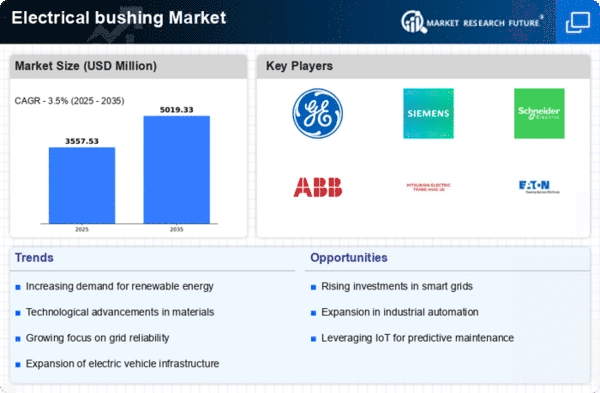
As per MRFR analysis, the Electrical bushing Market Size was estimated at 3437.23 USD Million in 2024. The Electrical bushing industry is projected to grow from 3557.6 USD Million in 2025 to 5019.33 USD Million by 2035, exhibiting a compound annual growth rate (CAGR) of 3.5% during the forecast period 2025 - 2035.

Key Market Trends & Highlights

The Electrical Bushing Market is poised for growth driven by technological advancements and sustainability initiatives.

  • Technological advancements are enhancing the performance and reliability of electrical bushings across various applications. North America remains the largest market for electrical bushings, while Asia-Pacific is emerging as the fastest-growing region. The power generation segment holds the largest share, whereas the renewable energy segment is experiencing rapid growth. Rising demand for renewable energy and infrastructure development projects are key drivers propelling market expansion.

Market Size & Forecast

2024 Market Size 3437.23 (USD Million)
2035 Market Size 5019.33 (USD Million)
CAGR (2025 - 2035) 3.5%
Largest Regional Market Share in 2024 North America

Major Players

<a href="https://www.gevernova.com/grid-solutions/equipment/bushings-surge-arresters/bushings">General Electric</a> (US), Siemens (DE), Schneider Electric (FR), ABB (CH), Mitsubishi Electric (JP), <a href="https://www.eaton.com/in/en-us/catalog/fittings/insulating-and-throat-bushings---rigid-imc-.html">Eaton</a> (US), Nexans (FR), Toshiba (JP), Hitachi (JP)

Market Trends

The Electrical bushing Market is currently experiencing a transformative phase, driven by advancements in technology and increasing demand for efficient energy transmission solutions. As industries evolve, the need for reliable electrical components becomes paramount. This market encompasses a variety of products designed to facilitate the safe and effective transfer of electrical energy, ensuring minimal loss and maximum performance. The integration of smart technologies and automation in electrical systems is reshaping the landscape, prompting manufacturers to innovate and enhance their offerings. Moreover, sustainability concerns are influencing the Electrical bushing Market, as stakeholders seek environmentally friendly materials and processes. The shift towards renewable energy sources is also contributing to the growth of this sector, as new applications emerge in wind and solar energy systems. As the market adapts to these changes, it appears poised for continued expansion, with opportunities for both established players and new entrants. The interplay of technological advancements and environmental considerations is likely to shape the future trajectory of the Electrical bushing Market, making it a focal point for investment and development in the coming years.

Technological Advancements

The Electrical bushing Market is witnessing a surge in technological innovations, particularly in materials and design. Manufacturers are increasingly adopting advanced materials that enhance durability and performance, which may lead to longer product lifespans and reduced maintenance costs. Furthermore, the integration of smart technologies is enabling real-time monitoring and diagnostics, thereby improving operational efficiency.

Sustainability Initiatives

There is a growing emphasis on sustainability within the Electrical bushing Market, as companies strive to reduce their environmental footprint. This trend is characterized by the development of eco-friendly materials and manufacturing processes. Stakeholders are increasingly prioritizing products that align with global sustainability goals, which could drive demand for greener alternatives.

Renewable Energy Integration

The rise of renewable energy sources is significantly impacting the Electrical bushing Market. As wind and solar energy systems become more prevalent, the demand for specialized electrical components that can withstand varying environmental conditions is increasing. This trend suggests a shift in focus towards products that cater specifically to the needs of renewable energy applications.

Electrical bushing Market Market Drivers

Rising Demand for Renewable Energy

The Global Electrical Bushing Market is experiencing a surge in demand due to the increasing focus on renewable energy sources. As countries strive to meet their energy needs sustainably, the integration of wind and solar power systems necessitates the use of high-quality electrical bushings. These components are critical for ensuring the reliability and efficiency of energy transmission. For instance, the global shift towards renewable energy is projected to drive the market value to 3.44 USD Billion in 2024, with expectations of reaching 5.02 USD Billion by 2035. This growth reflects a compound annual growth rate of 3.5% from 2025 to 2035.

Infrastructure Development Initiatives

Infrastructure development initiatives across various regions are significantly influencing the Electrical Bushing Industry. Governments are investing heavily in upgrading and expanding electrical grids to accommodate growing urban populations and industrial demands. For example, the construction of new power plants and substations requires reliable electrical bushings to ensure efficient energy distribution. This trend is likely to contribute to the market's expansion, as enhanced infrastructure is essential for maintaining energy security and reliability. The anticipated growth in infrastructure spending is expected to bolster the market, aligning with the projected increase in market value to 5.02 USD Billion by 2035.

Growing Industrialization and Urbanization

The rapid pace of industrialization and urbanization is a key driver of the Electrical Bushing Market. As economies develop, there is a corresponding increase in energy consumption, necessitating the expansion of electrical infrastructure. Industries such as manufacturing, construction, and transportation are major consumers of electrical energy, thereby increasing the demand for reliable electrical bushings. Urban areas, in particular, require robust electrical systems to support their growing populations and infrastructure needs. This trend is expected to sustain the market's growth trajectory, contributing to the projected market value increase to 3.44 USD Billion in 2024.

Regulatory Standards and Safety Compliance

Regulatory standards and safety compliance are becoming increasingly stringent, impacting the Electrical Bushing Market. Governments and regulatory bodies are implementing guidelines to ensure the safety and reliability of electrical systems. Compliance with these standards often necessitates the use of high-quality electrical bushings that meet specific performance criteria. As industries strive to adhere to these regulations, the demand for compliant electrical components is likely to rise. This trend not only enhances safety but also drives innovation in the manufacturing of electrical bushings, positioning the market for sustained growth in the future.

Technological Advancements in Electrical Components

Technological advancements in electrical components are reshaping the Electrical Bushing Market. Innovations in materials and manufacturing processes are leading to the development of bushings that offer improved performance, durability, and efficiency. For instance, the introduction of composite materials has enhanced the electrical insulation properties of bushings, making them suitable for high-voltage applications. These advancements not only improve the reliability of electrical systems but also reduce maintenance costs. As technology continues to evolve, the market is likely to benefit from increased adoption of advanced electrical bushings, further driving growth in the coming years.

Market Segment Insights

By Application: Power Generation (Largest) vs. Renewable Energy (Fastest-Growing)

The Electrical bushing market is segmented into various applications, with Power Generation holding the largest market share. This segment benefits from the continued investment in traditional energy sources and infrastructure upgrades worldwide. Transmission and Distribution also play critical roles, capturing significant shares as the global demand for reliable energy supply intensifies. Additionally, the growing emphasis on modernizing grid systems positively influences these applications, establishing a competitive landscape that fosters market growth. Renewable Energy stands out as the fastest-growing segment, driven by increased governmental and private investments in sustainable resources. As countries strive to meet carbon neutrality goals, the adoption of innovative technologies in the renewable sector accelerates, supported by consumer demand for greener solutions. Industrial applications also contribute to market dynamics, showcasing a diversified growth trajectory as sectors pivot to more energy-efficient practices.

Power Generation (Dominant) vs. Renewable Energy (Emerging)

The <a href="https://www.marketresearchfuture.com/reports/captive-power-generation-market-10446">Power Generation</a> segment in the Electrical bushing market is characterized by its steady dominance due to the extensive reliance on conventional energy systems. This established market leverages existing infrastructures, facilitating continuous demand for reliable bushings that can withstand high voltage applications. In comparison, the Renewable Energy segment is emerging rapidly, driven by technological advancements and shifting global energy policies targeting sustainability. This segment focuses on innovative solutions that cater to solar, wind, and other forms of renewable generation. The increasing integration of renewable resources into existing energy frameworks significantly bolsters the demand for specialized electrical bushings, creating a competitive advantage for manufacturers that adapt and innovate in this space.

By End Use: Utilities (Largest) vs. Manufacturing (Fastest-Growing)

In the Electrical Bushing Market, the 'Utilities' sector holds a significant share, dominating the landscape due to the increasing demand for sustainable energy solutions and the ongoing maintenance and expansion of electrical infrastructure. This sector's robustness is underscored by its reliance on advanced electrical components to ensure reliable performance in substations and power plants. Additionally, the 'Manufacturing' segment is experiencing rapid growth, driven by rising industrialization and technological advancements in production processes. As industries strive for efficiency and reliability, the need for high-quality electrical bushings is surging, making this sector one of the fastest-growing in the market.

Utilities (Dominant) vs. Manufacturing (Emerging)

The Utilities segment is characterized by its strong reliance on high-performance electrical bushings to support the transmission and distribution of electricity, ensuring operational reliability across extensive networks. This sector benefits from established infrastructures and increasing investment in renewable energy resources. Conversely, the Manufacturing segment is emerging as a notable player, fueled by innovations in machinery and a growing emphasis on energy efficiency. Manufacturers seek advanced electrical bushings to enhance performance and durability in their operations, driving demand for specialized products that meet their evolving needs. As technological advancements continue, both segments are likely to experience significant shifts, but Utilities will remain the cornerstone of the Electrical Bushing Market.

By Material Type: Porcelain (Largest) vs. Composite (Fastest-Growing)

In the Electrical bushing Market, the segmentation by material type reveals that porcelain components dominate the market share due to their robust insulating properties and traditional usage. Porcelain bushings have established a strong presence, particularly in high-voltage applications where reliability is paramount. Composite bushings are gaining traction, indicated by an increasing share, as they are lighter and offer improved mechanical strength compared to conventional materials. As this market segment evolves, the emphasis on safety and performance drives a notable diversification in material choices. The growth trends within the material type segment highlight a shifting landscape influenced by technological advancements and changing consumer preferences. Composite bushings are quickly emerging as the fastest-growing segment, fueled by their ability to optimize weight and thermal performance in modern applications. Polymer and glass bushings also show prospective growth, particularly in specialized applications that demand insulation combined with environmental resistance. Manufacturers are investing in innovative material technologies, enhancing the overall product offerings in the electrical bushing arena.

Porcelain (Dominant) vs. Polymer (Emerging)

Porcelain bushings represent the dominant force in the Electrical bushing Market, revered for their exceptional electrical insulation capabilities and long service life. They are particularly favored in high-voltage environments, where reliability and durability are of utmost importance. The resistance to environmental factors makes porcelain a choice material for utility companies. Conversely, polymer bushings are emerging as a viable option, driven by their lightweight nature and flexibility in design. As technology evolves, polymer bushings are being increasingly utilized in various applications due to their corrosion resistance and reduced maintenance needs. Their adaptability in design allows for enhanced performance in specific applications, leading to a growing interest from industry stakeholders looking for innovative solutions in electrical insulation.

By Voltage Rating: Low Voltage (Largest) vs. Medium Voltage (Fastest-Growing)

In the Electrical Bushing Market, voltage rating segments showcase varied distribution, with Low Voltage components dominating the market. This segment caters to end-users requiring less than 1 kV of voltage, finding extensive use in residential and commercial applications. In contrast, the Medium Voltage segment serves a niche market, typically ranging from 1 kV to 36 kV, balancing significant utility and industrial requirements. Together, these segments form a critical part of the overall bushing landscape, each playing pivotal roles in current electrical infrastructures. Growth trends indicate that while Low Voltage remains the largest market segment, Medium Voltage is emerging as the fastest-growing category. Driven by increasing industrialization and a rising demand for renewable energy sources, Medium Voltage bushings are gaining traction. Innovations in energy-efficient technology and standards compliance further bolster this trend, indicating a shift in preference towards Medium Voltage solutions as industries transition to smarter energy management systems.

Low Voltage (Dominant) vs. Medium Voltage (Emerging)

The Low Voltage segment is characterized by its widespread application across various sectors, including commercial and residential settings. Its dominance is attributed to the high demand for equipment that operates at lower voltages, which is essential for safe energy distribution. Conversely, the Medium Voltage segment, while emerging, caters to more specialized applications, powering medium-scale industrial operations and utilities. Recent advancements in technology are enabling Medium Voltage bushings to become more efficient and reliable, thereby increasing their appeal in new energy projects and smart grids. As energy systems evolve, the roles of these segments are likely to shift, with Medium Voltage bushings gaining significance in meeting modern electrical demands.

Get more detailed insights about Electrical Bushing Market Research Report- Forecast till 2035

Regional Insights

North America : Market Leader in Innovation

North America is poised to maintain its leadership in the electrical bushing market, holding a significant share of 1710.0 million in 2024. The region's growth is driven by increasing investments in renewable energy and infrastructure upgrades, alongside stringent regulatory frameworks promoting safety and efficiency. The demand for advanced electrical components is further fueled by the transition to smart grids and electric vehicles, enhancing the market's potential. The United States and Canada are the leading countries in this region, with major players like General Electric and Eaton driving innovation and competition. The presence of established companies ensures a robust supply chain and technological advancements. As the market evolves, partnerships and collaborations among key players are expected to enhance product offerings and expand market reach, solidifying North America's position as a hub for electrical bushing technology.

Europe : Emerging Market with Growth Potential

Europe's electrical bushing market is experiencing significant growth, with a market size of 1020.0 million. The region benefits from a strong regulatory environment focused on sustainability and energy efficiency, which drives demand for high-quality electrical components. The European Union's commitment to reducing carbon emissions and enhancing energy infrastructure is a key catalyst for market expansion, encouraging investments in innovative technologies. Germany, France, and the UK are the leading countries in this market, hosting major players like Siemens and Schneider Electric. The competitive landscape is characterized by a mix of established firms and emerging startups, fostering innovation and collaboration. As the market matures, the focus on smart grid technologies and renewable energy solutions will likely shape the future of electrical bushings in Europe.

Asia-Pacific : Rapid Growth in Emerging Economies

The Asia-Pacific region is witnessing rapid growth in the electrical bushing market, with a market size of 600.0 million. This growth is driven by increasing urbanization, industrialization, and the rising demand for electricity in developing countries. Government initiatives aimed at enhancing power infrastructure and promoting renewable energy sources are also significant contributors to market expansion, creating a favorable environment for investment and innovation. China, Japan, and India are the leading countries in this region, with key players like Mitsubishi Electric and Toshiba actively participating in the market. The competitive landscape is evolving, with both domestic and international companies vying for market share. As the region continues to invest in energy infrastructure, the demand for advanced electrical components, including bushings, is expected to rise significantly, positioning Asia-Pacific as a critical player in the global market.

Middle East and Africa : Emerging Market with Unique Challenges

The Middle East and Africa region is gradually emerging in the electrical bushing market, with a market size of 107.23 million. The growth is primarily driven by increasing investments in energy infrastructure and the need for reliable power supply in various sectors. Additionally, government initiatives aimed at enhancing energy efficiency and sustainability are fostering demand for advanced electrical components, including bushings, in the region. Countries like South Africa and the UAE are leading the market, with a growing presence of international players. The competitive landscape is characterized by a mix of local and global companies, which are focusing on innovation and quality to meet the unique challenges of the region. As the market develops, the emphasis on renewable energy projects and infrastructure upgrades will likely shape the future of electrical bushings in the Middle East and Africa.

Key Players and Competitive Insights

The Electrical bushing Market is currently characterized by a dynamic competitive landscape, driven by increasing demand for reliable electrical infrastructure and the ongoing transition towards renewable energy sources. Key players such as General Electric (US), Siemens (DE), and ABB (CH) are strategically positioned to leverage their technological expertise and extensive product portfolios. General Electric (US) focuses on innovation in high-voltage applications, while Siemens (DE) emphasizes digital transformation and smart grid solutions. ABB (CH) is actively pursuing partnerships to enhance its sustainability initiatives, collectively shaping a competitive environment that prioritizes technological advancement and operational efficiency.
In terms of business tactics, companies are increasingly localizing manufacturing to reduce lead times and optimize supply chains. The market appears moderately fragmented, with a mix of established players and emerging companies vying for market share. The collective influence of these key players is significant, as they drive industry standards and foster competition through innovation and strategic collaborations.
In November 2025, Siemens (DE) announced a major investment in a new manufacturing facility in Germany, aimed at enhancing its production capabilities for high-performance electrical bushings. This strategic move is expected to bolster Siemens' position in the European market, allowing for quicker response times to customer demands and reinforcing its commitment to sustainability through localized production.
In October 2025, ABB (CH) launched a new line of eco-friendly electrical bushings designed to minimize environmental impact. This initiative aligns with global sustainability trends and positions ABB as a leader in environmentally conscious manufacturing. The introduction of these products is likely to attract customers who prioritize sustainability in their procurement processes, thereby enhancing ABB's competitive edge.
In September 2025, General Electric (US) entered into a strategic partnership with a leading renewable energy firm to develop advanced electrical bushing solutions tailored for wind and solar applications. This collaboration not only expands GE's product offerings but also reinforces its commitment to supporting the renewable energy sector, which is expected to grow significantly in the coming years.
As of December 2025, the Electrical bushing Market is witnessing trends such as digitalization, sustainability, and AI integration, which are reshaping competitive dynamics. Strategic alliances are becoming increasingly important, as companies seek to enhance their technological capabilities and market reach. The shift from price-based competition to a focus on innovation, technology, and supply chain reliability is evident, suggesting that future competitive differentiation will hinge on the ability to adapt to these evolving trends.

Key Companies in the Electrical bushing Market include

Industry Developments

  • Q2 2024: Hitachi Energy inaugurates new transformer components factory in India Hitachi Energy announced the opening of a new manufacturing facility for transformer components, including electrical bushings, in Chennai, India. The facility aims to support growing demand for grid modernization and renewable energy integration in the region.
  • Q2 2024: ABB expands transformer bushing production capacity in Poland ABB revealed an expansion of its transformer bushing manufacturing plant in Lodz, Poland, to meet increased European demand for high-voltage bushings used in power transmission and renewable energy projects.
  • Q3 2024: GE Vernova secures contract to supply bushings for major UK grid upgrade GE Vernova was awarded a contract to supply high-voltage electrical bushings for a National Grid project in the United Kingdom, supporting the country's ongoing grid modernization and renewable integration efforts.
  • Q3 2024: Siemens Energy launches new generation of composite electrical bushings Siemens Energy introduced a new line of composite electrical bushings designed for improved performance and reliability in harsh environments, targeting both traditional and renewable energy applications.
  • Q4 2024: Eaton acquires Italian bushing manufacturer for $120 million Eaton completed the acquisition of an Italian company specializing in high-voltage electrical bushings, expanding its product portfolio and European market presence.
  • Q4 2024: Hubbell Power Systems opens new R&D center for bushing technology in the US Hubbell Power Systems inaugurated a research and development center focused on advancing electrical bushing technology, with an emphasis on smart grid and renewable energy applications.
  • Q1 2025: Maschinenfabrik Reinhausen announces partnership with Korean utility for bushing supply Maschinenfabrik Reinhausen entered into a strategic partnership with a major South Korean utility to supply advanced electrical bushings for grid expansion projects.
  • Q1 2025: CG Power wins contract to supply bushings for African transmission project CG Power and Industrial Solutions secured a contract to deliver high-voltage bushings for a large-scale transmission infrastructure project in West Africa.
  • Q2 2025: GE Vernova appoints new head of global bushing business GE Vernova announced the appointment of a new executive to lead its global electrical bushing division, aiming to accelerate innovation and market growth.
  • Q2 2025: GIPRO unveils eco-friendly bushing product line at Hannover Messe 2025 GIPRO launched a new range of environmentally friendly electrical bushings at Hannover Messe 2025, featuring recyclable materials and reduced carbon footprint.
  • Q3 2025: Barberi Rubinetterie Industriali S.r.l. secures funding for bushing production expansion Barberi Rubinetterie Industriali S.r.l. raised new capital to expand its manufacturing capacity for electrical bushings, targeting increased demand in Europe and Asia.
  • Q3 2025: Elliot Industries opens new facility for high-voltage bushing manufacturing in Texas Elliot Industries inaugurated a new plant in Texas dedicated to the production of high-voltage electrical bushings for the North American power grid.

Future Outlook

Electrical bushing Market Future Outlook

The Electrical Bushing Market is projected to grow at a 3.5% CAGR from 2024 to 2035, driven by increasing demand for renewable energy and infrastructure modernization.

New opportunities lie in:

  • Expansion into smart grid technologies for enhanced efficiency.
  • Development of eco-friendly insulating materials to meet sustainability goals.
  • Strategic partnerships with renewable energy firms to capture emerging markets.

By 2035, the Electrical Bushing Market is expected to achieve robust growth, reflecting evolving industry demands.

Market Segmentation

Electrical bushing Market End Use Outlook

  • Utilities
  • Manufacturing
  • Transportation
  • Construction

Electrical bushing Market Application Outlook

  • Power Generation
  • Transmission
  • Distribution
  • Renewable Energy
  • Industrial

Electrical bushing Market Material Type Outlook

  • Porcelain
  • Composite
  • Polymer
  • Glass
  • Metal

Electrical bushing Market Voltage Rating Outlook

  • Low Voltage
  • Medium Voltage
  • High Voltage

Report Scope

MARKET SIZE 2024 3437.23(USD Million)
MARKET SIZE 2025 3557.6(USD Million)
MARKET SIZE 2035 5019.33(USD Million)
COMPOUND ANNUAL GROWTH RATE (CAGR) 3.5% (2025 - 2035)
REPORT COVERAGE Revenue Forecast, Competitive Landscape, Growth Factors, and Trends
BASE YEAR 2024
Market Forecast Period 2025 - 2035
Historical Data 2019 - 2024
Market Forecast Units USD Million
Key Companies Profiled General Electric (US), Siemens (DE), Schneider Electric (FR), ABB (CH), Mitsubishi Electric (JP), Eaton (US), Nexans (FR), Toshiba (JP), Hitachi (JP)
Segments Covered Application, End Use, Material Type, Voltage Rating
Key Market Opportunities Integration of smart grid technologies enhances demand for advanced Electrical bushing solutions.
Key Market Dynamics Technological advancements and regulatory changes drive innovation and competition in the electrical bushing market.
Countries Covered North America, Europe, APAC, South America, MEA

FAQs

How much is the electrical bushing market?

The Electrical Bushing Market size was valued at USD 3.44 Billion in 2024.

What is the growth rate of the electrical bushing market?

The global market is projected to grow at a CAGR of 3.50% during the forecast period, 2025-2034.

Which region held the largest market share in the electrical bushing market?

North America had the largest share in the global market.

Who are the key players in the electrical bushing market?

The key players in the market are ABB Group, TRENCH Group (SIEMENS), General Electric, Eaton, Elliot Industries,Gipro GMBH, RHM International, Toshiba, Webster-Wilkinson, Siemens (Germany) and Nexans (France).

Which voltage type led the electrical bushing market?

The low voltage bushings category dominated the market in 2022.

Which end-user had the largest market share in the electrical bushing market?

The utilities category had the largest share in the global market.

  1. SECTION I: EXECUTIVE SUMMARY AND KEY HIGHLIGHTS
    1. | 1.1 EXECUTIVE SUMMARY
  2. SECTION II: SCOPING, METHODOLOGY AND MARKET STRUCTURE
    1. | 2.1 MARKET INTRODUCTION
    2. | 2.2 RESEARCH METHODOLOGY
  3. SECTION III: QUALITATIVE ANALYSIS
    1. | 3.1 MARKET DYNAMICS
    2. | 3.2 MARKET FACTOR ANALYSIS
  4. SECTION IV: QUANTITATIVE ANALYSIS
    1. | 4.1 Energy & Power, BY Application (USD Million)
    2. | 4.2 Energy & Power, BY End Use (USD Million)
    3. | 4.3 Energy & Power, BY Material Type (USD Million)
    4. | 4.4 Energy & Power, BY Voltage Rating (USD Million)
    5. | 4.5 Energy & Power, BY Region (USD Million)
  5. SECTION V: COMPETITIVE ANALYSIS
    1. | 5.1 Competitive Landscape
    2. | 5.2 Company Profiles
    3. | 5.3 Appendix

Electrical Bushing Market Segmentation

Market Segmentation Overview

  • Detailed segmentation data will be available in the full report
  • Comprehensive analysis by multiple parameters
  • Regional and country-level breakdowns
  • Market size forecasts by segment
Infographic

Free Sample Request

Kindly complete the form below to receive a free sample of this Report

Get Free Sample

Customer Strories

Compare Licence

×
Features License Type
Single User Multiuser License Enterprise User
Price $4,950 $5,950 $7,250
Maximum User Access Limit 1 User Upto 10 Users Unrestricted Access Throughout the Organization
Free Customization
Direct Access to Analyst
Deliverable Format
Platform Access
Discount on Next Purchase 10% 15% 15%
Printable Versions