×
Hero Background
English
Chinese
French
Japanese
Korean
German
Spanish

Electric Vehicle Inverter Market Analysis

ID: MRFR/AT/12367-CR
128 Pages
Sejal Akre
March 2024

Electric Vehicle Inverter Market Research Report By Inverter (SiC and IGBT.), by Power (Up to 100 kW, 101-300 kW, 301-600 kW and 601 kW & above), by Vehicle Propulsion (BEVs, HEVs, PHEVs and FCEVs), by Vehicle Category (Passenger Cars and Commercial Vehicles) and By Region (North America, Europe, Asia-Pacific, Middle East and Africa, South America) –Market Forecast Till 2035

Share:
Download PDF ×

We do not share your information with anyone. However, we may send you emails based on your report interest from time to time. You may contact us at any time to opt-out.

Electric Vehicle Inverter Market Infographic
Purchase Options

Market Analysis

In-depth Analysis of Electric Vehicle Inverter Market Industry Landscape

The electric vehicle inverter market is set to reach US$ 22.3 BN by 2032, at a 23.20% CAGR between years 2023-2032. The market trends of EV inverter make for a radical change in the automotive industry chiefly because the world is rapidly changing its ways towards environmentally friendly means of transport. Electric vehicles have a vital piece called an inverter that changes direct current (DC) produced by the battery to alternating current (AC) for the motor. Since the demand for electric cars increases, the market stands dynamic and transformative with each other day to cater to the needs of EV inverters. A prominent demand driver that is impacting the market trend is rising trends in acceptance of electric vehicles on a global scale. Policy-makers and consumers alike are embracing the move to green; the pressure coming from environmental side, as well as a need to reduce dependence on traditional petroleum products is significant.

The increasing EV adoption leads directly to the increase of demand for high-quality inverters, which in turn changes the competition on the market into a race toward improvement by innovating and achieving efficiency. The dynamics of market impacts that drive the technology development in electric automobile inverters are highly dependent on advances in technology. Manufacturers spend money on improving research on inverters for higher usability and power density that would lead to more range of the EV as well.

Inverters are gaining ground as the emergence of new applications blurring boundaries between broad and narrow solutions, which demands more compact, lightweight, and cost-effective inverters by automakers who seek viable solutions that can foster the broader quest for such ease. The dynamic market dynamics are also motivated by the regulatory milieu. Governments across the globe are making and strict requirements about emissions levels as well as compensating with various incentives for manufacturers to progressively produce electric vehicles. Where as in some areas on the other hand there are certain regulatory requirements which have to be met by manufacturers and these efficiency levels mandated may demand high standards that a manufacturer has to achieve plus surpass in order to survive in an ever-changing market.

Policy and practice dynamics determine how innovation progresses or the course of growth in a new market. Electric vehicle inverter market sends several dynamics and partnerships as crucial aspects. There was a strategic collaboration between manufacturers and suppliers in an effort to get such critical components like semiconductors and power modules easily and cheaply. Further, automotive manufacturers are collaborating with inverter producers to align their production based on the needs of an electric car platform that should not be separate from the vehicle design and functioning. These alliances enable effective scaled production as well as unified components that specify across various models for vehicles.


Author
Sejal Akre
Senior Research Analyst

She has over 5 years of rich experience, in market research and consulting providing valuable market insights to client. Hands on expertise in management consulting, and extensive knowledge in domain including ICT, Automotive & Transportation and Aerospace & Defense. She is skilled in Go-to market strategy, industry analysis, market sizing, in depth company profiling, competitive intelligence & benchmarking and value chain amongst others.

Leave a Comment

FAQs

What is the projected market valuation of the Electric Vehicle Inverter Market by 2035?

The Electric Vehicle Inverter Market is projected to reach a valuation of 32,642.2 USD Million by 2035.

What was the market valuation of the Electric Vehicle Inverter Market in 2024?

In 2024, the market valuation of the Electric Vehicle Inverter Market was 6,676.38 USD Million.

What is the expected CAGR for the Electric Vehicle Inverter Market during the forecast period 2025 - 2035?

The expected CAGR for the Electric Vehicle Inverter Market during the forecast period 2025 - 2035 is 15.52%.

Which companies are considered key players in the Electric Vehicle Inverter Market?

Key players in the Electric Vehicle Inverter Market include Infineon Technologies, NXP Semiconductors, Texas Instruments, and others.

What are the different types of inverters in the Electric Vehicle Inverter Market?

The Electric Vehicle Inverter Market includes SiC and IGBT as the primary inverter types, with valuations ranging from 2,000.0 to 22,642.2 USD Million.

Market Summary

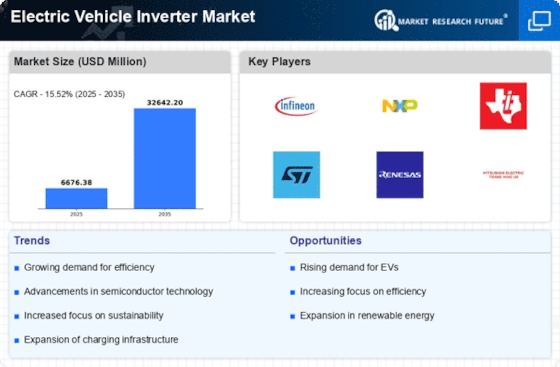
As per MRFR analysis, the Electric Vehicle Inverter Market Size was estimated at 6676.38 USD Million in 2024. The Electric Vehicle Inverter industry is projected to grow from 7712.57 USD Million in 2025 to 32642.2 USD Million by 2035, exhibiting a compound annual growth rate (CAGR) of 15.52 during the forecast period 2025 - 2035.

Key Market Trends & Highlights

The Electric Vehicle Inverter Market is poised for substantial growth driven by technological advancements and increasing demand for electric vehicles.

  • North America remains the largest market for electric vehicle inverters, reflecting a robust adoption of electric vehicles.
  • The Asia-Pacific region is emerging as the fastest-growing market, propelled by rapid urbanization and government initiatives.
  • Silicon Carbide (SiC) inverters dominate the market, while Insulated Gate Bipolar Transistor (IGBT) inverters are witnessing the fastest growth due to their efficiency.
  • Key market drivers include the growing demand for electric vehicles and regulatory support that incentivizes the development of charging infrastructure.

Market Size & Forecast

2024 Market Size 6676.38 (USD Million)
2035 Market Size 32642.2 (USD Million)
CAGR (2025 - 2035) 15.52%
Largest Regional Market Share in 2024 Asia Pacific

Major Players

<p>Infineon Technologies (DE), NXP Semiconductors (NL), Texas Instruments (US), STMicroelectronics (FR), Renesas Electronics (JP), Mitsubishi Electric (JP), Bosch (DE), Denso Corporation (JP), Toshiba (JP)</p>

Market Trends

The Electric Vehicle Inverter Market is currently experiencing a transformative phase, driven by the increasing adoption of electric vehicles across various regions. This shift is largely influenced by heightened environmental awareness and government initiatives aimed at reducing carbon emissions. As consumers become more conscious of their ecological footprint, the demand for efficient and reliable inverters is likely to rise. Furthermore, advancements in technology are enabling manufacturers to develop more compact and powerful inverters, which could enhance the overall performance of electric vehicles. In addition to technological innovations, the Electric Vehicle Inverter Market is also witnessing a surge in investments from both public and private sectors. This influx of capital is expected to facilitate research and development efforts, leading to the introduction of next-generation inverter solutions. Moreover, collaborations between automotive manufacturers and technology firms may further accelerate the pace of innovation. As the market evolves, it appears that the focus will increasingly shift towards enhancing energy efficiency and optimizing performance, which could ultimately benefit consumers and manufacturers alike.

Technological Advancements

The Electric Vehicle Inverter Market is seeing rapid technological advancements that enhance inverter efficiency and performance. Innovations in semiconductor materials and control algorithms are enabling the development of more compact and powerful inverters, which may improve the overall functionality of electric vehicles.

Increased Investment

There is a noticeable increase in investments directed towards the Electric Vehicle Inverter Market. Both public and private sectors are channeling funds into research and development, which could lead to the emergence of advanced inverter technologies and solutions.

Collaborative Efforts

Collaborations between automotive manufacturers and technology companies are becoming more prevalent in the Electric Vehicle Inverter Market. These partnerships may foster innovation and accelerate the development of cutting-edge inverter solutions, ultimately benefiting the industry as a whole.

Electric Vehicle Inverter Market Market Drivers

Rising Environmental Awareness

The growing awareness of environmental issues and the need for sustainable transportation solutions are pivotal drivers for the Electric Vehicle Inverter Market. Consumers are increasingly concerned about carbon emissions and climate change, leading to a shift towards electric vehicles as a cleaner alternative. In 2025, it is anticipated that over 50% of new vehicle sales will be electric, reflecting this heightened environmental consciousness. This trend not only boosts the demand for electric vehicles but also necessitates the development of efficient inverter technologies, thereby propelling the Electric Vehicle Inverter Market forward.

Regulatory Support and Incentives

Government regulations and incentives aimed at promoting electric vehicle adoption significantly influence the Electric Vehicle Inverter Market. Many countries have implemented stringent emissions standards and offer tax credits or rebates for EV purchases, which encourage consumers to opt for electric vehicles. For instance, in 2025, several regions are expected to enhance their support for EV infrastructure, including charging stations and inverter technology. This regulatory environment fosters innovation and investment in the Electric Vehicle Inverter Market, as manufacturers strive to meet evolving standards and consumer expectations.

Expansion of Charging Infrastructure

The expansion of electric vehicle charging infrastructure is a significant driver for the Electric Vehicle Inverter Market. As more charging stations are established, the need for efficient inverters that can handle varying power levels and charging speeds becomes increasingly important. In 2025, the number of public charging stations is expected to exceed 1 million globally, creating a substantial demand for advanced inverter solutions that can support fast charging and enhance user convenience. This infrastructure development not only facilitates EV adoption but also stimulates growth within the Electric Vehicle Inverter Market.

Growing Demand for Electric Vehicles

The increasing consumer preference for electric vehicles (EVs) is a primary driver for the Electric Vehicle Inverter Market. As more individuals and businesses recognize the environmental benefits and cost savings associated with EVs, the demand for efficient power conversion systems, such as inverters, rises. In 2025, the number of electric vehicles on the road is projected to surpass 30 million units, indicating a robust market for inverters that facilitate the transition from traditional combustion engines to electric powertrains. This shift not only enhances energy efficiency but also aligns with global sustainability goals, further propelling the Electric Vehicle Inverter Market.

Technological Innovations in Inverter Design

Technological advancements in inverter design and efficiency are crucial drivers for the Electric Vehicle Inverter Market. Innovations such as silicon carbide (SiC) and gallium nitride (GaN) technologies are enhancing the performance and reducing the size of inverters, making them more suitable for electric vehicles. These materials allow for higher switching frequencies and improved thermal management, which can lead to lighter and more compact inverter systems. As manufacturers adopt these cutting-edge technologies, the Electric Vehicle Inverter Market is likely to experience accelerated growth, with projections indicating a compound annual growth rate of over 20% in the coming years.

Market Segment Insights

By Inverter Type: SiC (Largest) vs. IGBT (Fastest-Growing)

<p>In the Electric Vehicle Inverter Market, the distribution among inverter types reveals a significant preference for Silicon Carbide (SiC) technology, which has established itself as the leading choice due to its superior efficiency and thermal performance. In contrast, Insulated Gate Bipolar Transistor (IGBT) technology remains a competitive second, appealing to manufacturers looking for cost-effective solutions while maintaining reliable performance. The growing demand for efficiency and sustainable mobility solutions is propelling SiC's dominance in this segment.</p>

<p>Inverter Type: SiC (Dominant) vs. IGBT (Emerging)</p>

<p>Silicon Carbide (SiC) inverters are known for their high efficiency, enabling longer driving ranges and faster charging times in electric vehicles. Their ability to withstand high temperatures and voltages makes them favorable for modern applications. As electric vehicle technology continues to evolve, SiC is positioned as the dominant technology due to its performance advantages. On the other hand, IGBT inverters are characterized by their robustness and cost-effectiveness, making them an attractive choice for manufacturers still transitioning to fully electric solutions. While they may lag in efficiency compared to SiC, their evolving technology and reduced costs render IGBT as an emerging player in the market.</p>

By Power: Up to 100 kW (Largest) vs. 601 kW & Above (Fastest-Growing)

<p>The Electric Vehicle Inverter Market exhibits a diverse power range, with the 'Up to 100 kW' segment holding the largest share. This segment is popular among smaller electric vehicles and is characterized by its affordability and accessibility for manufacturers. Conversely, the '601 kW & Above' segment is emerging rapidly, capturing the attention of manufacturers targeting commercial and high-performance electric vehicles, leading to an increase in demand for robust inverter technology. Growth trends indicate a significant shift towards higher power inverters due to the rising demand for electric trucks and buses. Technological advancements are driving innovation, allowing for more efficient power management systems that enhance vehicle performance. As the market adapts, there's a growing trend towards integrating higher kW inverters in mainstream vehicle models, driven by improved battery technologies and consumer preferences for larger and robust electric vehicles.</p>

<p>Power Ratings: Up to 100 kW (Dominant) vs. 601 kW & Above (Emerging)</p>

<p>The 'Up to 100 kW' segment dominates the market, primarily serving the compact electric vehicle segment where cost-efficiency is paramount. These inverters are designed for lower power requirements, making them ideal for urban commuting and entry-level electric vehicles. Features such as lightweight design and compact size are crucial for maintaining vehicle efficiency. In contrast, the '601 kW & Above' segment is characterized by high-performance inverters designed for larger electric vehicles, such as buses and trucks. This emerging segment focuses on advanced technologies like high voltage operation, allowing for rapid charging and increased range, indicating a significant shift as the industry moves towards electrification in commercial transportation.</p>

By Vehicle Propulsion: BEVs (Largest) vs. FCEVs (Fastest-Growing)

<p>The Electric Vehicle Inverter Market is significantly influenced by various vehicle propulsion types, with Battery Electric Vehicles (BEVs) leading the charge. This segment commands the largest portion of market share due to the rising consumer preference for fully electric vehicles. Hybrid Electric Vehicles (HEVs) and Plug-In Hybrid Electric Vehicles (PHEVs) also contribute substantially, but their market presence is overshadowed by BEVs. Fuel Cell Electric Vehicles (FCEVs), while smaller in comparison, showcase a growing trend that reflects their increasing adoption and technological advancements.</p>

<p>BEVs (Dominant) vs. FCEVs (Emerging)</p>

<p>Battery Electric Vehicles (BEVs) hold a dominant position in the Electric Vehicle Inverter Market, primarily due to advancements in battery technology and a strong shift towards sustainability. They offer superior efficiency, lower operating costs, and reduced emissions, making them highly attractive to eco-conscious consumers. Conversely, Fuel Cell Electric Vehicles (FCEVs) represent the emerging segment, gaining momentum through innovations in hydrogen fuel technology and government incentives for clean energy. While FCEVs currently occupy a smaller market share, their potential for faster refueling and longer ranges positions them as a formidable player in the future electric vehicle landscape.</p>

By Vehicle Category: Passenger Cars (Largest) vs. Commercial Vehicles (Fastest-Growing)

<p>In the Electric Vehicle Inverter Market, the distribution of market share reveals that passenger cars hold the largest segment, primarily due to the increasing demand for personal electric vehicles and the gradual shift in consumer preferences towards sustainable transportation solutions. This segment benefits from advancements in inverter technologies that enhance the performance and efficiency of electric drivetrains, making electric passenger cars more appealing to a broader audience. On the other hand, the commercial vehicles segment is recognized as the fastest-growing area in this market, driven by the electrification of transport fleets and increasing regulatory pressures to reduce carbon emissions. Innovations in inverter technology have enabled this segment to adopt electric solutions, facilitating better performance and cost-efficiency in logistics, public transport, and delivery services, leading to a significant surge in electric commercial vehicle adoption.</p>

<p>Vehicle Category: Passenger Cars (Dominant) vs. Commercial Vehicles (Emerging)</p>

<p>Passenger cars remain the dominant segment in the Electric Vehicle Inverter Market, benefiting from a strong consumer preference for personal electric mobility. The continual evolution of technologies, such as high-efficiency inverters, has led to improved vehicle range and performance, making these vehicles more attractive to consumers. In contrast, commercial vehicles are an emerging segment, experiencing rapid growth due to the global shift towards sustainable logistics and transportation. The electrification of these vehicles is supported by government incentives and increasing awareness of the environmental benefits, leading to significant advancements in inverter technology tailored for heavier applications. The competition to develop reliable, efficient, and cost-effective inverter solutions makes this segment particularly dynamic.</p>

Get more detailed insights about Electric Vehicle Inverter Market Research Report—Global Forecast till 2035

Regional Insights

North America : Innovation and Adoption Leader

North America is the largest market for electric vehicle inverters, holding approximately 40% of the global share. The region's growth is driven by stringent emissions regulations, government incentives for electric vehicles, and a growing consumer preference for sustainable transportation. The U.S. and Canada are at the forefront, with significant investments in EV infrastructure and technology, further propelling market demand. The competitive landscape is dominated by key players such as Texas Instruments and Infineon Technologies, which are investing heavily in R&D to enhance inverter efficiency and performance. The presence of established automotive manufacturers transitioning to electric models, alongside innovative startups, fosters a dynamic market environment. This competitive edge is crucial for meeting the increasing demand for electric vehicles in the region.

Europe : Sustainability and Innovation Hub

Europe is the second-largest market for electric vehicle inverters, accounting for around 30% of the global market share. The region's growth is fueled by ambitious climate goals, including the European Green Deal, which aims to make Europe climate-neutral by 2050. Countries like Germany and France are leading the charge, supported by robust government policies and incentives that promote electric vehicle adoption and infrastructure development. The competitive landscape features major players such as STMicroelectronics and Bosch, which are focusing on innovative inverter technologies to enhance vehicle performance. The presence of numerous automotive manufacturers, including Volkswagen and Renault, further strengthens the market. Additionally, collaborations between tech companies and automotive firms are driving advancements in inverter technology, ensuring Europe remains at the forefront of the electric vehicle revolution.

Asia-Pacific : Emerging Powerhouse in EVs

Asia-Pacific is witnessing rapid growth in the electric vehicle inverter market, holding approximately 25% of the global share. The region's expansion is driven by increasing urbanization, rising disposable incomes, and government initiatives promoting electric vehicles. China is the largest market, supported by substantial investments in EV infrastructure and technology, while Japan and South Korea are also significant players in the market, contributing to the region's growth. The competitive landscape is characterized by the presence of key players such as Mitsubishi Electric and Renesas Electronics, which are focusing on developing advanced inverter technologies. The region is also home to numerous automotive manufacturers, including BYD and Nissan, which are rapidly expanding their electric vehicle offerings. This competitive environment is crucial for meeting the growing demand for electric vehicles in Asia-Pacific.

Middle East and Africa : Resource-Rich Frontier

The Middle East and Africa are emerging as a significant market for electric vehicle inverters, holding about 5% of the global share. The growth in this region is driven by increasing awareness of environmental issues and government initiatives aimed at promoting electric vehicles. Countries like South Africa and the UAE are leading the way, with investments in EV infrastructure and incentives to encourage adoption, although the market is still in its nascent stages. The competitive landscape is evolving, with local and international players entering the market to capitalize on the growing demand. Key players are beginning to establish partnerships with automotive manufacturers to develop tailored inverter solutions. As the region continues to invest in renewable energy and sustainable transportation, the electric vehicle inverter market is expected to gain momentum in the coming years.

Key Players and Competitive Insights

The Electric Vehicle Inverter Market is currently characterized by a dynamic competitive landscape, driven by rapid technological advancements and increasing demand for electric vehicles (EVs). Key players such as Infineon Technologies (Germany), NXP Semiconductors (Netherlands), and Texas Instruments (United States) are strategically positioning themselves through innovation and partnerships. Infineon Technologies (Germany) focuses on enhancing the efficiency of its inverter solutions, while NXP Semiconductors (Netherlands) emphasizes the integration of advanced semiconductor technologies to improve performance. Texas Instruments (United States) is leveraging its extensive experience in power management to develop cutting-edge inverter solutions, thereby shaping a competitive environment that prioritizes technological superiority and operational excellence.

In terms of business tactics, companies are increasingly localizing manufacturing and optimizing supply chains to enhance responsiveness to market demands. The market structure appears moderately fragmented, with several players vying for market share. However, the collective influence of major companies like Bosch (Germany) and Denso Corporation (Japan) is notable, as they engage in strategic collaborations and investments to bolster their market positions.

In August 2025, Infineon Technologies (Germany) announced a partnership with a leading automotive manufacturer to co-develop next-generation inverter systems aimed at improving energy efficiency in electric vehicles. This collaboration is significant as it not only enhances Infineon's product offerings but also aligns with the automotive industry's shift towards more sustainable solutions, potentially setting a new benchmark in inverter technology.

In September 2025, NXP Semiconductors (Netherlands) unveiled a new family of high-performance inverters designed for electric vehicles, featuring advanced AI capabilities for real-time performance optimization. This launch is crucial as it positions NXP at the forefront of the digital transformation in the automotive sector, suggesting a shift towards smarter, more efficient inverter systems that could redefine industry standards.

In July 2025, Texas Instruments (United States) expanded its manufacturing capabilities in Asia to meet the growing demand for electric vehicle components. This strategic move is indicative of the company's commitment to enhancing supply chain reliability and responsiveness, which is essential in a market that is rapidly evolving and increasingly competitive.

As of October 2025, current trends in the Electric Vehicle Inverter Market are heavily influenced by digitalization, sustainability, and the integration of artificial intelligence. Strategic alliances among key players are shaping the competitive landscape, fostering innovation and collaboration. Looking ahead, it appears that competitive differentiation will increasingly hinge on technological advancements and supply chain resilience, rather than merely price competition. Companies that prioritize innovation and reliability in their offerings are likely to emerge as leaders in this evolving market.

Key Companies in the Electric Vehicle Inverter Market market include

Industry Developments

In May 2024, ABB acintroduced a cutting-edge package specifically designed for electric buses. This package includes the AMXE250 motor and HES580 inverter. The newly developed propulsion package represents a substantial advancement in cleaner and more sustainable transportation solutions. It has been meticulously designed to ensure optimal efficiency, reliability, and accessibility for the industry. The HES580, the first 3-level inverter available for electric buses, is known for its exceptional energy efficiency and power output. The HES580 inverter, when compared to traditional 2-level inverters, achieves a considerable reduction of up to 75 percent in motor harmonic losses.

This reduction greatly reduces heat dissipation and maximizes energy conservation.

In June 2024, Uno Minda, a major supplier of lighting, switching, acoustics, and seating solutions to global automobile companies, revealed that it has partnered with Suzhou lnovance Automotive to produce and sell specific high voltage electric vehicle products for passenger and commercial vehicles in India. The available electric car products include of the Charging Control Unit (CCU), EV inverter, EV motors, and advanced 3-in-1 electric drive systems (e-Axle) for the next generation.

Future Outlook

Electric Vehicle Inverter Market Future Outlook

<p>The Electric Vehicle Inverter Market is projected to grow at a 15.52% CAGR from 2024 to 2035, driven by technological advancements, increasing EV adoption, and regulatory support.</p>

New opportunities lie in:

  • <p>Development of high-efficiency inverters for commercial EVs</p>
  • <p>Integration of smart grid technology with inverter systems</p>
  • <p>Expansion into emerging markets with tailored inverter solutions</p>

<p>By 2035, the market is expected to be robust, driven by innovation and increased demand.</p>

Market Segmentation

Electric Vehicle Inverter Market Power Outlook

  • Up to 100 kW
  • 101-300 kW
  • 301-600 kW
  • 601 kW & Above

Electric Vehicle Inverter Market Inverter Type Outlook

  • SiC
  • IGBT

Electric Vehicle Inverter Market Vehicle Category Outlook

  • Passenger Cars
  • Commercial Vehicles

Electric Vehicle Inverter Market Vehicle Propulsion Outlook

  • BEVs
  • HEVs
  • PHEVs
  • FCEVs

Report Scope

MARKET SIZE 20246676.38(USD Million)
MARKET SIZE 20257712.57(USD Million)
MARKET SIZE 203532642.2(USD Million)
COMPOUND ANNUAL GROWTH RATE (CAGR)15.52% (2024 - 2035)
REPORT COVERAGERevenue Forecast, Competitive Landscape, Growth Factors, and Trends
BASE YEAR2024
Market Forecast Period2025 - 2035
Historical Data2019 - 2024
Market Forecast UnitsUSD Million
Key Companies ProfiledMarket analysis in progress
Segments CoveredMarket segmentation analysis in progress
Key Market OpportunitiesAdvancements in semiconductor technology enhance efficiency in the Electric Vehicle Inverter Market.
Key Market DynamicsRising demand for electric vehicles drives innovation and competition in the electric vehicle inverter market.
Countries CoveredNorth America, Europe, APAC, South America, MEA

FAQs

What is the projected market valuation of the Electric Vehicle Inverter Market by 2035?

The Electric Vehicle Inverter Market is projected to reach a valuation of 32,642.2 USD Million by 2035.

What was the market valuation of the Electric Vehicle Inverter Market in 2024?

In 2024, the market valuation of the Electric Vehicle Inverter Market was 6,676.38 USD Million.

What is the expected CAGR for the Electric Vehicle Inverter Market during the forecast period 2025 - 2035?

The expected CAGR for the Electric Vehicle Inverter Market during the forecast period 2025 - 2035 is 15.52%.

Which companies are considered key players in the Electric Vehicle Inverter Market?

Key players in the Electric Vehicle Inverter Market include Infineon Technologies, NXP Semiconductors, Texas Instruments, and others.

What are the different types of inverters in the Electric Vehicle Inverter Market?

The Electric Vehicle Inverter Market includes SiC and IGBT as the primary inverter types, with valuations ranging from 2,000.0 to 22,642.2 USD Million.

  1. SECTION I: EXECUTIVE SUMMARY AND KEY HIGHLIGHTS
    1. EXECUTIVE SUMMARY
      1. Market Overview
      2. Key Findings
      3. Market Segmentation
      4. Competitive Landscape
      5. Challenges and Opportunities
      6. Future Outlook
  2. SECTION II: SCOPING, METHODOLOGY AND MARKET STRUCTURE
    1. MARKET INTRODUCTION
      1. Definition
      2. Scope of the study
    2. RESEARCH METHODOLOGY
      1. Overview
      2. Data Mining
      3. Secondary Research
      4. Primary Research
      5. Forecasting Model
      6. Market Size Estimation
      7. Data Triangulation
      8. Validation
  3. SECTION III: QUALITATIVE ANALYSIS
    1. MARKET DYNAMICS
      1. Overview
      2. Drivers
      3. Restraints
      4. Opportunities
    2. MARKET FACTOR ANALYSIS
      1. Value chain Analysis
      2. Porter's Five Forces Analysis
      3. COVID-19 Impact Analysis
  4. SECTION IV: QUANTITATIVE ANALYSIS
    1. Automobile, BY Inverter Type (USD Million)
      1. SiC
      2. IGBT
    2. Automobile, BY Power (USD Million)
      1. Up to 100 kW
      2. 101-300 kW
      3. 301-600 kW
      4. 601 kW & Above
    3. Automobile, BY Vehicle Propulsion (USD Million)
      1. BEVs
      2. HEVs
      3. PHEVs
      4. FCEVs
    4. Automobile, BY Vehicle Category (USD Million)
      1. Passenger Cars
      2. Commercial Vehicles
    5. Automobile, BY Region (USD Million)
      1. North America
      2. Europe
      3. APAC
      4. South America
      5. MEA
  5. SECTION V: COMPETITIVE ANALYSIS
    1. Competitive Landscape
      1. Overview
      2. Competitive Analysis
      3. Market share Analysis
      4. Major Growth Strategy in the Automobile
      5. Competitive Benchmarking
      6. Leading Players in Terms of Number of Developments in the Automobile
      7. Key developments and growth strategies
      8. Major Players Financial Matrix
    2. Company Profiles
      1. Infineon Technologies (DE)
      2. NXP Semiconductors (NL)
      3. Texas Instruments (US)
      4. STMicroelectronics (FR)
      5. Renesas Electronics (JP)
      6. Mitsubishi Electric (JP)
      7. Bosch (DE)
      8. Denso Corporation (JP)
      9. Toshiba (JP)
    3. Appendix
      1. References
      2. Related Reports
  6. LIST OF FIGURES
    1. MARKET SYNOPSIS
    2. NORTH AMERICA MARKET ANALYSIS
    3. US MARKET ANALYSIS BY INVERTER TYPE
    4. US MARKET ANALYSIS BY POWER
    5. US MARKET ANALYSIS BY VEHICLE PROPULSION
    6. US MARKET ANALYSIS BY VEHICLE CATEGORY
    7. CANADA MARKET ANALYSIS BY INVERTER TYPE
    8. CANADA MARKET ANALYSIS BY POWER
    9. CANADA MARKET ANALYSIS BY VEHICLE PROPULSION
    10. CANADA MARKET ANALYSIS BY VEHICLE CATEGORY
    11. EUROPE MARKET ANALYSIS
    12. GERMANY MARKET ANALYSIS BY INVERTER TYPE
    13. GERMANY MARKET ANALYSIS BY POWER
    14. GERMANY MARKET ANALYSIS BY VEHICLE PROPULSION
    15. GERMANY MARKET ANALYSIS BY VEHICLE CATEGORY
    16. UK MARKET ANALYSIS BY INVERTER TYPE
    17. UK MARKET ANALYSIS BY POWER
    18. UK MARKET ANALYSIS BY VEHICLE PROPULSION
    19. UK MARKET ANALYSIS BY VEHICLE CATEGORY
    20. FRANCE MARKET ANALYSIS BY INVERTER TYPE
    21. FRANCE MARKET ANALYSIS BY POWER
    22. FRANCE MARKET ANALYSIS BY VEHICLE PROPULSION
    23. FRANCE MARKET ANALYSIS BY VEHICLE CATEGORY
    24. RUSSIA MARKET ANALYSIS BY INVERTER TYPE
    25. RUSSIA MARKET ANALYSIS BY POWER
    26. RUSSIA MARKET ANALYSIS BY VEHICLE PROPULSION
    27. RUSSIA MARKET ANALYSIS BY VEHICLE CATEGORY
    28. ITALY MARKET ANALYSIS BY INVERTER TYPE
    29. ITALY MARKET ANALYSIS BY POWER
    30. ITALY MARKET ANALYSIS BY VEHICLE PROPULSION
    31. ITALY MARKET ANALYSIS BY VEHICLE CATEGORY
    32. SPAIN MARKET ANALYSIS BY INVERTER TYPE
    33. SPAIN MARKET ANALYSIS BY POWER
    34. SPAIN MARKET ANALYSIS BY VEHICLE PROPULSION
    35. SPAIN MARKET ANALYSIS BY VEHICLE CATEGORY
    36. REST OF EUROPE MARKET ANALYSIS BY INVERTER TYPE
    37. REST OF EUROPE MARKET ANALYSIS BY POWER
    38. REST OF EUROPE MARKET ANALYSIS BY VEHICLE PROPULSION
    39. REST OF EUROPE MARKET ANALYSIS BY VEHICLE CATEGORY
    40. APAC MARKET ANALYSIS
    41. CHINA MARKET ANALYSIS BY INVERTER TYPE
    42. CHINA MARKET ANALYSIS BY POWER
    43. CHINA MARKET ANALYSIS BY VEHICLE PROPULSION
    44. CHINA MARKET ANALYSIS BY VEHICLE CATEGORY
    45. INDIA MARKET ANALYSIS BY INVERTER TYPE
    46. INDIA MARKET ANALYSIS BY POWER
    47. INDIA MARKET ANALYSIS BY VEHICLE PROPULSION
    48. INDIA MARKET ANALYSIS BY VEHICLE CATEGORY
    49. JAPAN MARKET ANALYSIS BY INVERTER TYPE
    50. JAPAN MARKET ANALYSIS BY POWER
    51. JAPAN MARKET ANALYSIS BY VEHICLE PROPULSION
    52. JAPAN MARKET ANALYSIS BY VEHICLE CATEGORY
    53. SOUTH KOREA MARKET ANALYSIS BY INVERTER TYPE
    54. SOUTH KOREA MARKET ANALYSIS BY POWER
    55. SOUTH KOREA MARKET ANALYSIS BY VEHICLE PROPULSION
    56. SOUTH KOREA MARKET ANALYSIS BY VEHICLE CATEGORY
    57. MALAYSIA MARKET ANALYSIS BY INVERTER TYPE
    58. MALAYSIA MARKET ANALYSIS BY POWER
    59. MALAYSIA MARKET ANALYSIS BY VEHICLE PROPULSION
    60. MALAYSIA MARKET ANALYSIS BY VEHICLE CATEGORY
    61. THAILAND MARKET ANALYSIS BY INVERTER TYPE
    62. THAILAND MARKET ANALYSIS BY POWER
    63. THAILAND MARKET ANALYSIS BY VEHICLE PROPULSION
    64. THAILAND MARKET ANALYSIS BY VEHICLE CATEGORY
    65. INDONESIA MARKET ANALYSIS BY INVERTER TYPE
    66. INDONESIA MARKET ANALYSIS BY POWER
    67. INDONESIA MARKET ANALYSIS BY VEHICLE PROPULSION
    68. INDONESIA MARKET ANALYSIS BY VEHICLE CATEGORY
    69. REST OF APAC MARKET ANALYSIS BY INVERTER TYPE
    70. REST OF APAC MARKET ANALYSIS BY POWER
    71. REST OF APAC MARKET ANALYSIS BY VEHICLE PROPULSION
    72. REST OF APAC MARKET ANALYSIS BY VEHICLE CATEGORY
    73. SOUTH AMERICA MARKET ANALYSIS
    74. BRAZIL MARKET ANALYSIS BY INVERTER TYPE
    75. BRAZIL MARKET ANALYSIS BY POWER
    76. BRAZIL MARKET ANALYSIS BY VEHICLE PROPULSION
    77. BRAZIL MARKET ANALYSIS BY VEHICLE CATEGORY
    78. MEXICO MARKET ANALYSIS BY INVERTER TYPE
    79. MEXICO MARKET ANALYSIS BY POWER
    80. MEXICO MARKET ANALYSIS BY VEHICLE PROPULSION
    81. MEXICO MARKET ANALYSIS BY VEHICLE CATEGORY
    82. ARGENTINA MARKET ANALYSIS BY INVERTER TYPE
    83. ARGENTINA MARKET ANALYSIS BY POWER
    84. ARGENTINA MARKET ANALYSIS BY VEHICLE PROPULSION
    85. ARGENTINA MARKET ANALYSIS BY VEHICLE CATEGORY
    86. REST OF SOUTH AMERICA MARKET ANALYSIS BY INVERTER TYPE
    87. REST OF SOUTH AMERICA MARKET ANALYSIS BY POWER
    88. REST OF SOUTH AMERICA MARKET ANALYSIS BY VEHICLE PROPULSION
    89. REST OF SOUTH AMERICA MARKET ANALYSIS BY VEHICLE CATEGORY
    90. MEA MARKET ANALYSIS
    91. GCC COUNTRIES MARKET ANALYSIS BY INVERTER TYPE
    92. GCC COUNTRIES MARKET ANALYSIS BY POWER
    93. GCC COUNTRIES MARKET ANALYSIS BY VEHICLE PROPULSION
    94. GCC COUNTRIES MARKET ANALYSIS BY VEHICLE CATEGORY
    95. SOUTH AFRICA MARKET ANALYSIS BY INVERTER TYPE
    96. SOUTH AFRICA MARKET ANALYSIS BY POWER
    97. SOUTH AFRICA MARKET ANALYSIS BY VEHICLE PROPULSION
    98. SOUTH AFRICA MARKET ANALYSIS BY VEHICLE CATEGORY
    99. REST OF MEA MARKET ANALYSIS BY INVERTER TYPE
    100. REST OF MEA MARKET ANALYSIS BY POWER
    101. REST OF MEA MARKET ANALYSIS BY VEHICLE PROPULSION
    102. REST OF MEA MARKET ANALYSIS BY VEHICLE CATEGORY
    103. KEY BUYING CRITERIA OF AUTOMOBILE
    104. RESEARCH PROCESS OF MRFR
    105. DRO ANALYSIS OF AUTOMOBILE
    106. DRIVERS IMPACT ANALYSIS: AUTOMOBILE
    107. RESTRAINTS IMPACT ANALYSIS: AUTOMOBILE
    108. SUPPLY / VALUE CHAIN: AUTOMOBILE
    109. AUTOMOBILE, BY INVERTER TYPE, 2024 (% SHARE)
    110. AUTOMOBILE, BY INVERTER TYPE, 2024 TO 2035 (USD Million)
    111. AUTOMOBILE, BY POWER, 2024 (% SHARE)
    112. AUTOMOBILE, BY POWER, 2024 TO 2035 (USD Million)
    113. AUTOMOBILE, BY VEHICLE PROPULSION, 2024 (% SHARE)
    114. AUTOMOBILE, BY VEHICLE PROPULSION, 2024 TO 2035 (USD Million)
    115. AUTOMOBILE, BY VEHICLE CATEGORY, 2024 (% SHARE)
    116. AUTOMOBILE, BY VEHICLE CATEGORY, 2024 TO 2035 (USD Million)
    117. BENCHMARKING OF MAJOR COMPETITORS
  7. LIST OF TABLES
    1. LIST OF ASSUMPTIONS
    2. North America MARKET SIZE ESTIMATES; FORECAST
      1. BY INVERTER TYPE, 2025-2035 (USD Million)
      2. BY POWER, 2025-2035 (USD Million)
      3. BY VEHICLE PROPULSION, 2025-2035 (USD Million)
      4. BY VEHICLE CATEGORY, 2025-2035 (USD Million)
    3. US MARKET SIZE ESTIMATES; FORECAST
      1. BY INVERTER TYPE, 2025-2035 (USD Million)
      2. BY POWER, 2025-2035 (USD Million)
      3. BY VEHICLE PROPULSION, 2025-2035 (USD Million)
      4. BY VEHICLE CATEGORY, 2025-2035 (USD Million)
    4. Canada MARKET SIZE ESTIMATES; FORECAST
      1. BY INVERTER TYPE, 2025-2035 (USD Million)
      2. BY POWER, 2025-2035 (USD Million)
      3. BY VEHICLE PROPULSION, 2025-2035 (USD Million)
      4. BY VEHICLE CATEGORY, 2025-2035 (USD Million)
    5. Europe MARKET SIZE ESTIMATES; FORECAST
      1. BY INVERTER TYPE, 2025-2035 (USD Million)
      2. BY POWER, 2025-2035 (USD Million)
      3. BY VEHICLE PROPULSION, 2025-2035 (USD Million)
      4. BY VEHICLE CATEGORY, 2025-2035 (USD Million)
    6. Germany MARKET SIZE ESTIMATES; FORECAST
      1. BY INVERTER TYPE, 2025-2035 (USD Million)
      2. BY POWER, 2025-2035 (USD Million)
      3. BY VEHICLE PROPULSION, 2025-2035 (USD Million)
      4. BY VEHICLE CATEGORY, 2025-2035 (USD Million)
    7. UK MARKET SIZE ESTIMATES; FORECAST
      1. BY INVERTER TYPE, 2025-2035 (USD Million)
      2. BY POWER, 2025-2035 (USD Million)
      3. BY VEHICLE PROPULSION, 2025-2035 (USD Million)
      4. BY VEHICLE CATEGORY, 2025-2035 (USD Million)
    8. France MARKET SIZE ESTIMATES; FORECAST
      1. BY INVERTER TYPE, 2025-2035 (USD Million)
      2. BY POWER, 2025-2035 (USD Million)
      3. BY VEHICLE PROPULSION, 2025-2035 (USD Million)
      4. BY VEHICLE CATEGORY, 2025-2035 (USD Million)
    9. Russia MARKET SIZE ESTIMATES; FORECAST
      1. BY INVERTER TYPE, 2025-2035 (USD Million)
      2. BY POWER, 2025-2035 (USD Million)
      3. BY VEHICLE PROPULSION, 2025-2035 (USD Million)
      4. BY VEHICLE CATEGORY, 2025-2035 (USD Million)
    10. Italy MARKET SIZE ESTIMATES; FORECAST
      1. BY INVERTER TYPE, 2025-2035 (USD Million)
      2. BY POWER, 2025-2035 (USD Million)
      3. BY VEHICLE PROPULSION, 2025-2035 (USD Million)
      4. BY VEHICLE CATEGORY, 2025-2035 (USD Million)
    11. Spain MARKET SIZE ESTIMATES; FORECAST
      1. BY INVERTER TYPE, 2025-2035 (USD Million)
      2. BY POWER, 2025-2035 (USD Million)
      3. BY VEHICLE PROPULSION, 2025-2035 (USD Million)
      4. BY VEHICLE CATEGORY, 2025-2035 (USD Million)
    12. Rest of Europe MARKET SIZE ESTIMATES; FORECAST
      1. BY INVERTER TYPE, 2025-2035 (USD Million)
      2. BY POWER, 2025-2035 (USD Million)
      3. BY VEHICLE PROPULSION, 2025-2035 (USD Million)
      4. BY VEHICLE CATEGORY, 2025-2035 (USD Million)
    13. APAC MARKET SIZE ESTIMATES; FORECAST
      1. BY INVERTER TYPE, 2025-2035 (USD Million)
      2. BY POWER, 2025-2035 (USD Million)
      3. BY VEHICLE PROPULSION, 2025-2035 (USD Million)
      4. BY VEHICLE CATEGORY, 2025-2035 (USD Million)
    14. China MARKET SIZE ESTIMATES; FORECAST
      1. BY INVERTER TYPE, 2025-2035 (USD Million)
      2. BY POWER, 2025-2035 (USD Million)
      3. BY VEHICLE PROPULSION, 2025-2035 (USD Million)
      4. BY VEHICLE CATEGORY, 2025-2035 (USD Million)
    15. India MARKET SIZE ESTIMATES; FORECAST
      1. BY INVERTER TYPE, 2025-2035 (USD Million)
      2. BY POWER, 2025-2035 (USD Million)
      3. BY VEHICLE PROPULSION, 2025-2035 (USD Million)
      4. BY VEHICLE CATEGORY, 2025-2035 (USD Million)
    16. Japan MARKET SIZE ESTIMATES; FORECAST
      1. BY INVERTER TYPE, 2025-2035 (USD Million)
      2. BY POWER, 2025-2035 (USD Million)
      3. BY VEHICLE PROPULSION, 2025-2035 (USD Million)
      4. BY VEHICLE CATEGORY, 2025-2035 (USD Million)
    17. South Korea MARKET SIZE ESTIMATES; FORECAST
      1. BY INVERTER TYPE, 2025-2035 (USD Million)
      2. BY POWER, 2025-2035 (USD Million)
      3. BY VEHICLE PROPULSION, 2025-2035 (USD Million)
      4. BY VEHICLE CATEGORY, 2025-2035 (USD Million)
    18. Malaysia MARKET SIZE ESTIMATES; FORECAST
      1. BY INVERTER TYPE, 2025-2035 (USD Million)
      2. BY POWER, 2025-2035 (USD Million)
      3. BY VEHICLE PROPULSION, 2025-2035 (USD Million)
      4. BY VEHICLE CATEGORY, 2025-2035 (USD Million)
    19. Thailand MARKET SIZE ESTIMATES; FORECAST
      1. BY INVERTER TYPE, 2025-2035 (USD Million)
      2. BY POWER, 2025-2035 (USD Million)
      3. BY VEHICLE PROPULSION, 2025-2035 (USD Million)
      4. BY VEHICLE CATEGORY, 2025-2035 (USD Million)
    20. Indonesia MARKET SIZE ESTIMATES; FORECAST
      1. BY INVERTER TYPE, 2025-2035 (USD Million)
      2. BY POWER, 2025-2035 (USD Million)
      3. BY VEHICLE PROPULSION, 2025-2035 (USD Million)
      4. BY VEHICLE CATEGORY, 2025-2035 (USD Million)
    21. Rest of APAC MARKET SIZE ESTIMATES; FORECAST
      1. BY INVERTER TYPE, 2025-2035 (USD Million)
      2. BY POWER, 2025-2035 (USD Million)
      3. BY VEHICLE PROPULSION, 2025-2035 (USD Million)
      4. BY VEHICLE CATEGORY, 2025-2035 (USD Million)
    22. South America MARKET SIZE ESTIMATES; FORECAST
      1. BY INVERTER TYPE, 2025-2035 (USD Million)
      2. BY POWER, 2025-2035 (USD Million)
      3. BY VEHICLE PROPULSION, 2025-2035 (USD Million)
      4. BY VEHICLE CATEGORY, 2025-2035 (USD Million)
    23. Brazil MARKET SIZE ESTIMATES; FORECAST
      1. BY INVERTER TYPE, 2025-2035 (USD Million)
      2. BY POWER, 2025-2035 (USD Million)
      3. BY VEHICLE PROPULSION, 2025-2035 (USD Million)
      4. BY VEHICLE CATEGORY, 2025-2035 (USD Million)
    24. Mexico MARKET SIZE ESTIMATES; FORECAST
      1. BY INVERTER TYPE, 2025-2035 (USD Million)
      2. BY POWER, 2025-2035 (USD Million)
      3. BY VEHICLE PROPULSION, 2025-2035 (USD Million)
      4. BY VEHICLE CATEGORY, 2025-2035 (USD Million)
    25. Argentina MARKET SIZE ESTIMATES; FORECAST
      1. BY INVERTER TYPE, 2025-2035 (USD Million)
      2. BY POWER, 2025-2035 (USD Million)
      3. BY VEHICLE PROPULSION, 2025-2035 (USD Million)
      4. BY VEHICLE CATEGORY, 2025-2035 (USD Million)
    26. Rest of South America MARKET SIZE ESTIMATES; FORECAST
      1. BY INVERTER TYPE, 2025-2035 (USD Million)
      2. BY POWER, 2025-2035 (USD Million)
      3. BY VEHICLE PROPULSION, 2025-2035 (USD Million)
      4. BY VEHICLE CATEGORY, 2025-2035 (USD Million)
    27. MEA MARKET SIZE ESTIMATES; FORECAST
      1. BY INVERTER TYPE, 2025-2035 (USD Million)
      2. BY POWER, 2025-2035 (USD Million)
      3. BY VEHICLE PROPULSION, 2025-2035 (USD Million)
      4. BY VEHICLE CATEGORY, 2025-2035 (USD Million)
    28. GCC Countries MARKET SIZE ESTIMATES; FORECAST
      1. BY INVERTER TYPE, 2025-2035 (USD Million)
      2. BY POWER, 2025-2035 (USD Million)
      3. BY VEHICLE PROPULSION, 2025-2035 (USD Million)
      4. BY VEHICLE CATEGORY, 2025-2035 (USD Million)
    29. South Africa MARKET SIZE ESTIMATES; FORECAST
      1. BY INVERTER TYPE, 2025-2035 (USD Million)
      2. BY POWER, 2025-2035 (USD Million)
      3. BY VEHICLE PROPULSION, 2025-2035 (USD Million)
      4. BY VEHICLE CATEGORY, 2025-2035 (USD Million)
    30. Rest of MEA MARKET SIZE ESTIMATES; FORECAST
      1. BY INVERTER TYPE, 2025-2035 (USD Million)
      2. BY POWER, 2025-2035 (USD Million)
      3. BY VEHICLE PROPULSION, 2025-2035 (USD Million)
      4. BY VEHICLE CATEGORY, 2025-2035 (USD Million)
    31. PRODUCT LAUNCH/PRODUCT DEVELOPMENT/APPROVAL
    32. ACQUISITION/PARTNERSHIP

Electric Vehicle Inverter Market Segmentation

Global Electric Vehicle Inverter Inverter Outlook (USD Million, 2019-2032)

  • SiC
  • IGBT

Global Electric Vehicle Inverter Power Outlook (USD Million, 2019-2032)

  • Up to 100 kW
  • 101-300 kW
  • 301-600 kW
  • 601 kW & Above

Global Electric Vehicle Inverter Vehicle Propulsion Outlook (USD Million, 2019-2032)

  • BEVs
  • HEVs
  • PHEVs
  • FCEVs

Global Electric Vehicle Inverter Vehicle Category Outlook (USD Million, 2019-2032)

  • Passenger Cars
  • Commercial Vehicles

Global Electric Vehicle Inverter Regional Outlook (USD Million, 2019-2032)

North America Electric Vehicle Inverter Inverter Outlook (USD Million, 2019-2032)

  • SiC
  • IGBT

North America Electric Vehicle Inverter Power Outlook (USD Million, 2019-2032)

  • Up to 100 kW
  • 101-300 kW
  • 301-600 kW
  • 601 kW & Above

North America Electric Vehicle Inverter Vehicle Propulsion Outlook (USD Million, 2019-2032)

  • BEVs
  • HEVs
  • PHEVs
  • FCEVs

North America Electric Vehicle Inverter Vehicle Category Outlook (USD Million, 2019-2032)

  • Passenger Cars
  • Commercial Vehicles

US Electric Vehicle Inverter Inverter Outlook (USD Million, 2019-2032)

  • SiC
  • IGBT

US Electric Vehicle Inverter Power Outlook (USD Million, 2019-2032)

  • Up to 100 kW
  • 101-300 kW
  • 301-600 kW
  • 601 kW & Above

US Electric Vehicle Inverter Vehicle Propulsion Outlook (USD Million, 2019-2032)

  • BEVs
  • HEVs
  • PHEVs
  • FCEVs

US Electric Vehicle Inverter Vehicle Category Outlook (USD Million, 2019-2032)

  • Passenger Cars
  • Commercial Vehicles

Canada Electric Vehicle Inverter Inverter Outlook (USD Million, 2019-2032)

  • SiC
  • IGBT

Canada Electric Vehicle Inverter Power Outlook (USD Million, 2019-2032)

  • Up to 100 kW
  • 101-300 kW
  • 301-600 kW
  • 601 kW & Above

Canada Electric Vehicle Inverter Vehicle Propulsion Outlook (USD Million, 2019-2032)

  • BEVs
  • HEVs
  • PHEVs
  • FCEVs

Canada Electric Vehicle Inverter Vehicle Category Outlook (USD Million, 2019-2032)

  • Passenger Cars
  • Commercial Vehicles

Mexico Electric Vehicle Inverter Inverter Outlook (USD Million, 2019-2032)

  • SiC
  • IGBT

Mexico Electric Vehicle Inverter Power Outlook (USD Million, 2019-2032)

  • Up to 100 kW
  • 101-300 kW
  • 301-600 kW
  • 601 kW & Above

Mexico Electric Vehicle Inverter Vehicle Propulsion Outlook (USD Million, 2019-2032)

  • BEVs
  • HEVs
  • PHEVs
  • FCEVs

Mexico Electric Vehicle Inverter Vehicle Category Outlook (USD Million, 2019-2032)

  • Passenger Cars
  • Commercial Vehicles

Europe Electric Vehicle Inverter Inverter Outlook (USD Million, 2019-2032)

  • SiC
  • IGBT

Europe Electric Vehicle Inverter Power Outlook (USD Million, 2019-2032)

  • Up to 100 kW
  • 101-300 kW
  • 301-600 kW
  • 601 kW & Above

Europe Electric Vehicle Inverter Vehicle Propulsion Outlook (USD Million, 2019-2032)

  • BEVs
  • HEVs
  • PHEVs
  • FCEVs

Europe Electric Vehicle Inverter Vehicle Category Outlook (USD Million, 2019-2032)

  • Passenger Cars
  • Commercial Vehicles

Germany Electric Vehicle Inverter Inverter Outlook (USD Million, 2019-2032)

  • SiC
  • IGBT

Germany Electric Vehicle Inverter Power Outlook (USD Million, 2019-2032)

  • Up to 100 kW
  • 101-300 kW
  • 301-600 kW
  • 601 kW & Above

Germany Electric Vehicle Inverter Vehicle Propulsion Outlook (USD Million, 2019-2032)

  • BEVs
  • HEVs
  • PHEVs
  • FCEVs

Germany Electric Vehicle Inverter Vehicle Category Outlook (USD Million, 2019-2032)

  • Passenger Cars
  • Commercial Vehicles

UK Electric Vehicle Inverter Inverter Outlook (USD Million, 2019-2032)

  • SiC
  • IGBT

UK Electric Vehicle Inverter Power Outlook (USD Million, 2019-2032)

  • Up to 100 kW
  • 101-300 kW
  • 301-600 kW
  • 601 kW & Above

UK Electric Vehicle Inverter Vehicle Propulsion Outlook (USD Million, 2019-2032)

  • BEVs
  • HEVs
  • PHEVs
  • FCEVs

UK Electric Vehicle Inverter Vehicle Category Outlook (USD Million, 2019-2032)

  • Passenger Cars
  • Commercial Vehicles

France Electric Vehicle Inverter Inverter Outlook (USD Million, 2019-2032)

  • SiC
  • IGBT

France Electric Vehicle Inverter Power Outlook (USD Million, 2019-2032)

  • Up to 100 kW
  • 101-300 kW
  • 301-600 kW
  • 601 kW & Above

France Electric Vehicle Inverter Vehicle Propulsion Outlook (USD Million, 2019-2032)

  • BEVs
  • HEVs
  • PHEVs
  • FCEVs

France Electric Vehicle Inverter Vehicle Category Outlook (USD Million, 2019-2032)

  • Passenger Cars
  • Commercial Vehicles

Italy Electric Vehicle Inverter Inverter Outlook (USD Million, 2019-2032)

  • SiC
  • IGBT

Italy Electric Vehicle Inverter Power Outlook (USD Million, 2019-2032)

  • Up to 100 kW
  • 101-300 kW
  • 301-600 kW
  • 601 kW & Above

Italy Electric Vehicle Inverter Vehicle Propulsion Outlook (USD Million, 2019-2032)

  • BEVs
  • HEVs
  • PHEVs
  • FCEVs

Italy Electric Vehicle Inverter Vehicle Category Outlook (USD Million, 2019-2032)

  • Passenger Cars
  • Commercial Vehicles

Spain Electric Vehicle Inverter Inverter Outlook (USD Million, 2019-2032)

  • SiC
  • IGBT

Spain Electric Vehicle Inverter Power Outlook (USD Million, 2019-2032)

  • Up to 100 kW
  • 101-300 kW
  • 301-600 kW
  • 601 kW & Above

Spain Electric Vehicle Inverter Vehicle Propulsion Outlook (USD Million, 2019-2032)

  • BEVs
  • HEVs
  • PHEVs
  • FCEVs

Spain Electric Vehicle Inverter Vehicle Category Outlook (USD Million, 2019-2032)

  • Passenger Cars
  • Commercial Vehicles

Rest of Europe Electric Vehicle Inverter Inverter Outlook (USD Million, 2019-2032)

  • SiC
  • IGBT

Rest of Europe Electric Vehicle Inverter Power Outlook (USD Million, 2019-2032)

  • Up to 100 kW
  • 101-300 kW
  • 301-600 kW
  • 601 kW & Above

Rest of Europe Electric Vehicle Inverter Vehicle Propulsion Outlook (USD Million, 2019-2032)

  • BEVs
  • HEVs
  • PHEVs
  • FCEVs

Rest of Europe Electric Vehicle Inverter Vehicle Category Outlook (USD Million, 2019-2032)

  • Passenger Cars
  • Commercial Vehicles

Asia Pacific Electric Vehicle Inverter Inverter Outlook (USD Million, 2019-2032)

  • SiC
  • IGBT

Asia Pacific Electric Vehicle Inverter Power Outlook (USD Million, 2019-2032)

  • Up to 100 kW
  • 101-300 kW
  • 301-600 kW
  • 601 kW & Above

Asia Pacific Electric Vehicle Inverter Vehicle Propulsion Outlook (USD Million, 2019-2032)

  • BEVs
  • HEVs
  • PHEVs
  • FCEVs

Asia Pacific Electric Vehicle Inverter Vehicle Category Outlook (USD Million, 2019-2032)

  • Passenger Cars
  • Commercial Vehicles

China Electric Vehicle Inverter Inverter Outlook (USD Million, 2019-2032)

  • SiC
  • IGBT

China Electric Vehicle Inverter Power Outlook (USD Million, 2019-2032)

  • Up to 100 kW
  • 101-300 kW
  • 301-600 kW
  • 601 kW & Above

China Electric Vehicle Inverter Vehicle Propulsion Outlook (USD Million, 2019-2032)

  • BEVs
  • HEVs
  • PHEVs
  • FCEVs

China Electric Vehicle Inverter Vehicle Category Outlook (USD Million, 2019-2032)

  • Passenger Cars
  • Commercial Vehicles

Japan Electric Vehicle Inverter Inverter Outlook (USD Million, 2019-2032)

  • SiC
  • IGBT

Japan Electric Vehicle Inverter Power Outlook (USD Million, 2019-2032)

  • Up to 100 kW
  • 101-300 kW
  • 301-600 kW
  • 601 kW & Above

Japan Electric Vehicle Inverter Vehicle Propulsion Outlook (USD Million, 2019-2032)

  • BEVs
  • HEVs
  • PHEVs
  • FCEVs

Japan Electric Vehicle Inverter Vehicle Category Outlook (USD Million, 2019-2032)

  • Passenger Cars
  • Commercial Vehicles

India Electric Vehicle Inverter Inverter Outlook (USD Million, 2019-2032)

  • SiC
  • IGBT

India Electric Vehicle Inverter Power Outlook (USD Million, 2019-2032)

  • Up to 100 kW
  • 101-300 kW
  • 301-600 kW
  • 601 kW & Above

India Electric Vehicle Inverter Vehicle Propulsion Outlook (USD Million, 2019-2032)

  • BEVs
  • HEVs
  • PHEVs
  • FCEVs

India Electric Vehicle Inverter Vehicle Category Outlook (USD Million, 2019-2032)

  • Passenger Cars
  • Commercial Vehicles

Rest of Asia Pacific Electric Vehicle Inverter Inverter Outlook (USD Million, 2019-2032)

  • SiC
  • IGBT

Rest of Asia Pacific Electric Vehicle Inverter Power Outlook (USD Million, 2019-2032)

  • Up to 100 kW
  • 101-300 kW
  • 301-600 kW
  • 601 kW & Above

Rest of Asia Pacific Electric Vehicle Inverter Vehicle Propulsion Outlook (USD Million, 2019-2032)

  • BEVs
  • HEVs
  • PHEVs
  • FCEVs

Rest of Asia Pacific Electric Vehicle Inverter Vehicle Category Outlook (USD Million, 2019-2032)

  • Passenger Cars
  • Commercial Vehicles

Middle East & Africa Electric Vehicle Inverter Inverter Outlook (USD Million, 2019-2032)

  • SiC
  • IGBT

Middle East & Africa Electric Vehicle Inverter Power Outlook (USD Million, 2019-2032)

  • Up to 100 kW
  • 101-300 kW
  • 301-600 kW
  • 601 kW & Above

Middle East & Africa Electric Vehicle Inverter Vehicle Propulsion Outlook (USD Million, 2019-2032)

  • BEVs
  • HEVs
  • PHEVs
  • FCEVs

Middle East & Africa Electric Vehicle Inverter Vehicle Category Outlook (USD Million, 2019-2032)

  • Passenger Cars
  • Commercial Vehicles

South America Electric Vehicle Inverter Inverter Outlook (USD Million, 2019-2032)

  • SiC
  • IGBT

South America Electric Vehicle Inverter Power Outlook (USD Million, 2019-2032)

  • Up to 100 kW
  • 101-300 kW
  • 301-600 kW
  • 601 kW & Above

South America Electric Vehicle Inverter Vehicle Propulsion Outlook (USD Million, 2019-2032)

  • BEVs
  • HEVs
  • PHEVs
  • FCEVs

South America Electric Vehicle Inverter Vehicle Category Outlook (USD Million, 2019-2032)

  • Passenger Cars
  • Commercial Vehicles
Infographic

Free Sample Request

Kindly complete the form below to receive a free sample of this Report

Get Free Sample

Customer Strories

Compare Licence

×
Features License Type
Single User Multiuser License Enterprise User
Price $4,950 $5,950 $7,250
Maximum User Access Limit 1 User Upto 10 Users Unrestricted Access Throughout the Organization
Free Customization
Direct Access to Analyst
Deliverable Format
Platform Access
Discount on Next Purchase 10% 15% 15%
Printable Versions