Request Free Sample ×

Kindly complete the form below to receive a free sample of this Report

* Please use a valid business email

Leading companies partner with us for data-driven Insights

clients tt-cursor
Hero Background
English
Chinese
French
Japanese
Korean
German
Spanish

E wallet Market Size

ID: MRFR/ICT/3212-HCR
100 Pages
Aarti Dhapte
March 2026

E-Wallet Market Research Report Information By Technology (Near Field Communication, QR Code, Text-based Service, and Digital Only), By Application (Retail & E-Commerce, Hospitality & Transportation, Banking, and Vending Machine), And By Region (North America, Europe, Asia-Pacific, And Rest Of The World) –Market Forecast Till 2035.

Share:
Download PDF ×

We do not share your information with anyone. However, we may send you emails based on your report interest from time to time. You may contact us at any time to opt-out.

E wallet Market Infographic
Purchase Options

E Wallet Size

E wallet Market Growth Projections and Opportunities

The rising digitization of payments is one important market factor. E-wallets are increasingly the preferred option for both consumers and businesses as societies throughout the world come to appreciate the simplicity of cashless transactions. The increasing use of smartphones and connectivity to the internet is speeding up the transition to digital payments and creating an atmosphere that is favorable for the adoption of e-wallets. Macroeconomic variables and state of the world economy have a larger overall impact on the E-Wallet market.

In order to reduce risks and take advantage of opportunities brought forth by shifting economic conditions, e-wallet providers need to manage these macroeconomic aspects. Security issues are a major factor influencing the E-Wallet market. Customers are realizing how important it is to have safe and dependable payment options. To win and keep users' trust, e-wallet providers need to make large investments in strong security features like encryption and multi-factor authentication. Market participants who can successfully handle security issues should experience a rise in client acceptance and loyalty, which will enhance their share of the market. E-wallet providers benefit from a supportive and transparent regulatory environment that promotes competitiveness and consumer protection.

On the other hand, restrictive or unclear rules can hinder market expansion by impeding entrance and inhibiting innovation. To be competitive and fulfill changing customer expectations, market participants need to invest in state-of-the-art solutions and stay up to date on technology advancements. Consumer choices and behavior have a major influence on the direction of the E-Wallet business.

Comprehending the requirements and inclinations of heterogeneous customer segments empowers E-Wallet providers to efficiently customize their products. Acquiring an edge over the competition involves variables such as transaction speed, user interface design, and the variety of acceptable payment options. Establishing strategic alliances with ecosystem participants helps E-Wallet providers maintain a competitive edge. Customer decisions are influenced by the need for loyalty programs, smooth and user-friendly interfaces, and added-value services. Companies in the market are more likely to succeed over the long run if they can adjust to changing customer expectations.
E wallet Market Size Graph
Author
Author Profile
Aarti Dhapte
AVP - Research

A consulting professional focused on helping businesses navigate complex markets through structured research and strategic insights. I partner with clients to solve high-impact business problems across market entry strategy, competitive intelligence, and opportunity assessment. Over the course of my experience, I have led and contributed to 100+ market research and consulting engagements, delivering insights across multiple industries and geographies, and supporting strategic decisions linked to $500M+ market opportunities. My core expertise lies in building robust market sizing, forecasting, and commercial models (top-down and bottom-up), alongside deep-dive competitive and industry analysis. I have played a key role in shaping go-to-market strategies, investment cases, and growth roadmaps, enabling clients to make confident, data-backed decisions in dynamic markets.

Leave a Comment

FAQs

What is the current valuation of the E-Wallet Market as of 2024?

<p>The E-Wallet Market was valued at 124.6 USD Billion in 2024.</p>

What is the projected market size for the E-Wallet Market in 2035?

<p>The E-Wallet Market is projected to reach 1120.65 USD Billion by 2035.</p>

What is the expected CAGR for the E-Wallet Market during the forecast period 2025 - 2035?

<p>The expected CAGR for the E-Wallet Market during 2025 - 2035 is 22.1%.</p>

Which technology segments are driving the E-Wallet Market?

<p>Key technology segments include Near Field Communication, QR Code, Text-based service, and Digital Only, with valuations ranging from 20.0 to 400.0 USD Billion.</p>

What are the primary applications of E-Wallets in the market?

<p>The primary applications include Retail & E-Commerce, Hospitality & Transportation, Banking, and Vending machines, with valuations from 12.52 to 440.32 USD Billion.</p>

Who are the leading players in the E-Wallet Market?

<p>Key players in the E-Wallet Market include PayPal, Alipay, WeChat Pay, Apple Pay, Google Pay, Samsung Pay, Venmo, Zelle, and Cash App.</p>

How does the E-Wallet Market's growth compare across different applications?

The Retail &amp; E-Commerce segment leads with a valuation of 440.32 USD Billion, followed by Banking at 330.24 USD Billion.

What is the valuation of the Near Field Communication segment in the E-Wallet Market?

The Near Field Communication segment was valued at 24.92 USD Billion in 2024 and is projected to grow significantly.

How does the E-Wallet Market's growth potential appear for the next decade?

The E-Wallet Market appears poised for substantial growth, with projections indicating a market size of over 1 trillion USD by 2035.

What factors might influence the E-Wallet Market's growth trajectory?

Factors influencing growth may include technological advancements, consumer adoption rates, and the expansion of digital payment infrastructures.

Market Summary

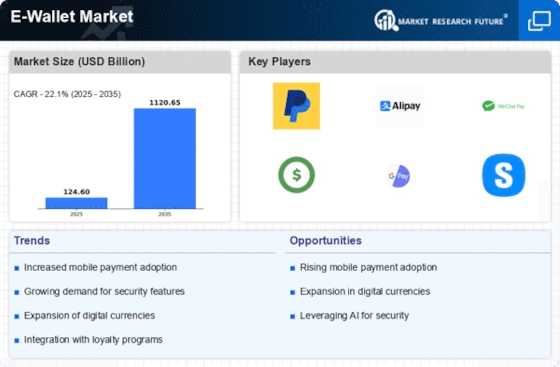
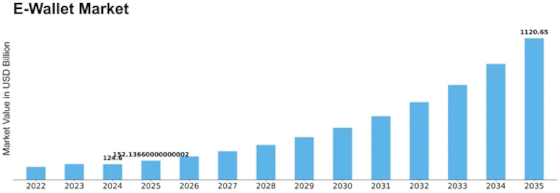
As per Market Research Future analysis, the E-Wallet Market Size was estimated at 124.6 USD Billion in 2024. The E-Wallet industry is projected to grow from 152.14 USD Billion in 2025 to 1120.65 USD Billion by 2035, exhibiting a compound annual growth rate (CAGR) of 22.1% during the forecast period 2025 - 2035

Key Market Trends & Highlights

The E-Wallet Market is experiencing robust growth driven by technological advancements and changing consumer preferences.

  • The rise of contactless payments is reshaping consumer behavior in North America, the largest market for e-wallets. Integration of loyalty programs is becoming increasingly prevalent, particularly in the retail and e-commerce segments. Enhanced security measures are a focal point for e-wallet providers, addressing consumer concerns in both North America and Asia-Pacific. The expansion of e-commerce platforms and increasing smartphone penetration are key drivers propelling the growth of the e-wallet market.

Market Size & Forecast

2024 Market Size 124.6 (USD Billion)
2035 Market Size 1120.65 (USD Billion)
CAGR (2025 - 2035) 22.1%
Largest Regional Market Share in 2024 North America

Major Players

PayPal (US), Alipay (CN), WeChat Pay (CN), Apple Pay (US), Google Pay (US), Samsung Pay (KR), Venmo (US), Zelle (US), Cash App (US)

Market Trends

The E-Wallet Market is currently experiencing a transformative phase characterized by rapid technological advancements and shifting consumer preferences. As digital transactions become increasingly prevalent, the demand for secure and efficient payment solutions is on the rise. This market appears to be driven by a growing inclination towards cashless transactions, with consumers seeking convenience and speed in their financial dealings. Furthermore, the integration of advanced security features, such as biometric authentication and encryption, seems to enhance user trust and adoption rates. The proliferation of smartphones and internet connectivity also plays a crucial role in expanding the reach of e-wallet services, making them accessible to a broader audience. In addition, the E-Wallet Market is witnessing a notable trend towards collaboration between financial institutions and technology companies. This synergy appears to foster innovation, leading to the development of new features and services that cater to diverse consumer needs. Moreover, the increasing acceptance of e-wallets by merchants and service providers indicates a shift in the retail landscape, where digital payment methods are becoming the norm. As the market evolves, it is likely that regulatory frameworks will adapt to ensure consumer protection and promote fair competition, further shaping the future of the E-Wallet Market.

Rise of Contactless Payments

The E-Wallet Market is seeing a significant shift towards contactless payment methods. This trend reflects a growing consumer preference for quick and seamless transactions, allowing users to make purchases with minimal physical interaction. As technology advances, the convenience of contactless payments is likely to drive further adoption among consumers and merchants alike.

Integration of Loyalty Programs

Another emerging trend within the E-Wallet Market is the integration of loyalty programs into digital wallets. This development appears to enhance customer engagement by offering rewards and incentives for frequent usage. As businesses seek to retain customers, the incorporation of loyalty features may become a standard offering in e-wallet services.

Focus on Enhanced Security Measures

The E-Wallet Market is increasingly prioritizing enhanced security measures to protect user data and transactions. With rising concerns over cyber threats, e-wallet providers are likely to invest in advanced security technologies, such as multi-factor authentication and real-time fraud detection. This focus on security may bolster consumer confidence and encourage wider adoption.

E wallet Market Market Drivers

Expansion of E-Commerce Platforms

The rapid expansion of e-commerce platforms is significantly impacting the E-Wallet Market. As online shopping continues to gain traction, e-wallets are becoming a preferred payment method due to their convenience and security features. Data indicates that e-commerce sales have increased by over 15% in recent years, with a substantial portion of these transactions being processed through e-wallets. This trend suggests that as more consumers engage in online shopping, the demand for e-wallet solutions will likely rise. Consequently, the E-Wallet Market is poised for growth, driven by the increasing integration of e-wallets into e-commerce platforms, enhancing the overall shopping experience.

Increasing Smartphone Penetration

The proliferation of smartphones has been a pivotal driver in the E-Wallet Market. As of October 2025, smartphone penetration rates have reached approximately 80% in many regions, facilitating easier access to digital payment solutions. This trend indicates that more consumers are likely to adopt e-wallets, as they provide a convenient and efficient means of conducting transactions. The integration of advanced features such as biometric authentication and user-friendly interfaces further enhances the appeal of e-wallets. Consequently, the E-Wallet Market is expected to witness substantial growth, as more individuals leverage their smartphones for everyday purchases, thereby transforming traditional payment methods.

Rising Demand for Digital Transactions

The shift towards digital transactions is markedly influencing the E-Wallet Market. Recent data suggests that digital payment transactions have surged, with estimates indicating a growth rate of over 20% annually. This trend is driven by consumer preferences for speed and convenience, as well as the increasing acceptance of e-wallets by merchants. As businesses recognize the benefits of digital payments, they are more likely to adopt e-wallet solutions, further propelling the market. The E-Wallet Market is thus positioned to expand, as both consumers and businesses embrace the efficiency of digital transactions, leading to a decline in cash usage.

Government Initiatives for Digital Payments

Government initiatives aimed at promoting digital payments are playing a crucial role in the E-Wallet Market. Various countries have implemented policies to encourage cashless transactions, including incentives for businesses that adopt digital payment solutions. These initiatives often include tax benefits and subsidies, which can stimulate the adoption of e-wallets among both consumers and merchants. As governments continue to advocate for digital payment systems, the E-Wallet Market is likely to experience accelerated growth. The support from regulatory bodies not only enhances consumer confidence but also fosters an environment conducive to the proliferation of e-wallet solutions.

Technological Advancements in Payment Solutions

Technological advancements are driving innovation within the E-Wallet Market. The introduction of features such as artificial intelligence, machine learning, and blockchain technology is enhancing the functionality and security of e-wallets. These technologies enable faster transaction processing, improved fraud detection, and personalized user experiences. As consumers become more tech-savvy, their expectations for payment solutions evolve, leading to increased demand for advanced e-wallet features. The E-Wallet Market is thus likely to benefit from ongoing technological developments, as companies strive to meet consumer demands for secure and efficient payment options.

Market Segment Insights

By Technology: Near Field Communication (Largest) vs. QR Code (Fastest-Growing)

<p>The E-Wallet Market shows a diverse distribution among its key technological segments, with Near Field Communication (NFC) leading as the most significant player. NFC technology provides seamless transaction capabilities, allowing users to complete payments by simply tapping their devices. QR Code technology follows closely, gaining traction among consumers who prefer scanning codes for quick and convenient transactions, especially in retail environments. Text-based services and digital-only solutions, while showing potential, currently represent a smaller portion of the market.</p>

<p>Technology: NFC (Dominant) vs. QR Code (Emerging)</p>

<p>NFC is considered the dominant player in the E-Wallet technology segment, notable for its ability to facilitate fast, secure transactions without the need for physical contact. This technology has gained recognition for its convenience, especially in urban areas where speed is critical. On the other hand, QR Code technology is emerging rapidly, driven by the increasing acceptance of digital payments among phone users. The simplicity of scanning codes makes it attractive for various payment scenarios, particularly among small businesses and during events. As digital literacy continues to improve, both NFC and QR Codes are poised to evolve, shaping the future landscape of the E-Wallet Market.</p>

By Application: Retail & E-Commerce (Largest) vs. Banking (Fastest-Growing)

<p>In the E-Wallet market, the distribution of application segments is led by Retail & E-Commerce, accounting for the largest share. This segment's popularity is driven by the increasing adoption of digital payment solutions by consumers and merchants alike. In contrast, sectors such as Banking are observing substantial growth as financial institutions invest in enhancing their digital offerings, resulting in a competitive landscape within the E-Wallet domain. The growth drivers within these segments are influenced by factors such as technological advancements, consumer preferences shifting towards contactless payments, and the need for convenience in transactions. E-Wallets in Retail & E-Commerce, for example, are fueled by the rise of online shopping, while Banks are leveraging their trusted brands to transition customers to mobile payment solutions, thus gaining a foothold in the E-Wallet market.</p>

<p>Retail & E-Commerce: Dominant vs. Banking: Emerging</p>

<p>The Retail & E-Commerce segment remains the dominant force in the E-Wallet market, primarily due to a surge in online shopping and convenience-oriented consumer behavior. With the increasing prevalence of smartphones and the ubiquity of internet access, retailers are rapidly adopting E-Wallet solutions to enhance customer experiences. Customers are drawn to seamless transactions, targeted promotions, and loyalty rewards. On the other hand, the Banking sector represents an emerging application within the market. Banks are integrating E-Wallet functionalities with their existing services to retain customers in an increasingly digital landscape. As trust is paramount in financial transactions, banks have the advantage of established relationships, which they are leveraging to innovate and attract users seeking secure and user-friendly digital payment methods.</p>

Get more detailed insights about E-Wallet Market Research Report - Global Forecast to 2035

Regional Insights

North America : Digital Payment Leaders

North America is witnessing a robust growth in the e-wallet market, driven by increasing smartphone penetration and a shift towards cashless transactions. The region holds approximately 40% of the global market share, with the United States being the largest market, followed by Canada. Regulatory support for digital payments and consumer demand for convenience are key growth drivers. The competitive landscape is dominated by major players such as PayPal, Apple Pay, and Google Pay. The presence of these established brands, along with emerging platforms like Venmo and Cash App, fosters innovation and enhances user experience. The U.S. government’s initiatives to promote digital payments further bolster market growth, making North America a pivotal region in the e-wallet sector.

Europe : Regulatory Framework and Innovation

Europe is rapidly evolving into a significant player in the e-wallet market, driven by regulatory frameworks that encourage digital payment solutions. The region accounts for approximately 30% of the global market share, with Germany and the UK being the largest markets. The European Union's PSD2 regulation has catalyzed innovation and competition among e-wallet providers, enhancing consumer trust and adoption. Leading countries like Germany, France, and the UK are witnessing a surge in e-wallet usage, supported by a strong infrastructure for digital payments. Key players such as PayPal and local solutions like Klarna are competing fiercely, offering diverse services to meet consumer needs. The competitive landscape is characterized by a mix of established and emerging players, driving further growth in the sector.

Asia-Pacific : Emerging Market Dynamics

The Asia-Pacific region is experiencing explosive growth in the e-wallet market, driven by high smartphone penetration and a tech-savvy population. This region holds around 25% of the global market share, with China and India leading the charge. The rapid adoption of digital payments is supported by government initiatives promoting cashless transactions and financial inclusion, making it a key area for market expansion. China is home to major players like Alipay and WeChat Pay, which dominate the market with innovative features and extensive user bases. India is also witnessing significant growth, with platforms like Paytm and PhonePe gaining traction. The competitive landscape is vibrant, with numerous local and international players vying for market share, further fueling the e-wallet revolution in the region.

Middle East and Africa : Untapped Potential and Growth

The Middle East and Africa (MEA) region is on the cusp of a digital payment revolution, with the e-wallet market poised for significant growth. Currently, the region holds about 5% of the global market share, with countries like South Africa and the UAE leading the way. The increasing smartphone adoption and a young population are key drivers, alongside government initiatives aimed at enhancing financial inclusion and digital literacy. In South Africa, platforms like SnapScan and Zapper are gaining popularity, while the UAE sees a rise in services like Etisalat Wallet. The competitive landscape is evolving, with both local startups and international players entering the market. This dynamic environment presents vast opportunities for growth, making MEA a region to watch in the e-wallet sector.

Key Players and Competitive Insights

The E-Wallet Market is currently characterized by a dynamic competitive landscape, driven by rapid technological advancements and shifting consumer preferences. Major players such as PayPal (US), Alipay (CN), and Apple Pay (US) are at the forefront, each adopting distinct strategies to enhance their market positioning. PayPal (US) continues to innovate its platform, focusing on integrating advanced security features and expanding its merchant partnerships, which appears to bolster its appeal among small and medium-sized enterprises. Alipay (CN), on the other hand, emphasizes its extensive ecosystem, leveraging its parent company Ant Group's resources to enhance user engagement through lifestyle services, thereby creating a comprehensive digital experience. Apple Pay (US) is strategically positioned within the Apple ecosystem, promoting seamless integration across its devices, which likely enhances user loyalty and retention.
The competitive structure of the E-Wallet Market is moderately fragmented, with a mix of established players and emerging fintech startups. Key business tactics include localizing services to cater to regional preferences and optimizing supply chains to ensure efficient transaction processing. This collective influence of major players shapes a competitive environment where innovation and user experience are paramount, as companies strive to differentiate themselves in a crowded marketplace.
In September 2025, PayPal (US) announced a partnership with a leading cryptocurrency exchange to facilitate crypto transactions directly through its platform. This strategic move is significant as it positions PayPal to capture the growing interest in digital currencies, potentially attracting a new demographic of tech-savvy users who prefer cryptocurrency transactions. Such an initiative not only enhances PayPal's service offerings but also reinforces its commitment to staying at the forefront of financial technology.
In August 2025, Alipay (CN) launched a new feature that allows users to make payments using facial recognition technology. This development is noteworthy as it reflects a broader trend towards biometric authentication in financial services, enhancing security and convenience for users. By adopting such cutting-edge technology, Alipay is likely to strengthen its competitive edge in the Chinese market, where consumer expectations for seamless payment experiences are continually evolving.
In July 2025, Apple Pay (US) expanded its services to include a loyalty rewards program in collaboration with several major retailers. This initiative is strategically important as it not only incentivizes users to engage more frequently with the platform but also fosters partnerships with retailers, creating a mutually beneficial ecosystem. Such loyalty programs may enhance customer retention and drive transaction volumes, further solidifying Apple Pay's position in the market.
As of October 2025, the E-Wallet Market is witnessing trends that emphasize digitalization, sustainability, and the integration of artificial intelligence. Strategic alliances among key players are increasingly shaping the competitive landscape, as companies seek to leverage each other's strengths to enhance service offerings. Looking ahead, competitive differentiation is likely to evolve from traditional price-based competition towards a focus on innovation, technological advancements, and supply chain reliability, as companies strive to meet the ever-changing demands of consumers.

Key Companies in the E wallet Market include

Industry Developments

The management of the digital wallet will fall under the purview of Early Warning Services (EWS), a bank-owned corporation that operates the money-transfer service Zelle. The wallet will continue to be separate from Zelle, and its name has not yet been chosen. The banks are still ironing out the smaller nuances of the client experience. Customers will probably need to provide their email on the checkout page of a retailer. EWS will launch the new service in the second half of 2023. The banks expect 150 million debit and credit cards to be supported when the wallet starts.

Customers from the US who have made on-time payments on their invoices, recently used their card online, and supplied an email address and phone number are eligible.

MOSIP is getting ready to introduce the Inji digital wallet, an identity verification tool, in 2023. Suite provides a complete open-source ID infrastructure that goes beyond basic ID.

In an effort to compete with PayPal and Apple Pay in 2023, some banks are apparently developing a digital wallet that connects with debit and credit cards. The Wall Street Journal said that Early Warning Services, a partnership between numerous banks that already manages Zelle, would oversee the digital wallet. When the new wallet first launches, Visa and Mastercard will be on board.

The first mobile wallet to provide digital assets, a search engine, and verified social media accounts in a single application was HUMBL®, according to HUMBL, Inc. in 2023.

June 2022:Samsung announced the Samsung wallet could be utilized by customers to store boarding passes, identification cards, and digital keys in one location, developed to allow the user to monitor their digital assets through cryptocurrencies' value.

September 2021:PayPal Holdings acquired Paidy, which helped increase the capabilities, relevance, and distribution of PayPal in domestic payments in Japan.

July 2017: The innovative Mobile Wallet Payment Service was launched by the KFH and MasterCard together. This was an innovatory platform that helped to transform any associated device into a commerce device to easily receive and make payments.

Future Outlook

E wallet Market Future Outlook

The E-Wallet Market is projected to grow at a 22.1% CAGR from 2025 to 2035, driven by increasing digital transactions, consumer demand for convenience, and technological advancements.

New opportunities lie in:

  • Integration of AI-driven fraud detection systems
  • Expansion into emerging markets with localized payment solutions
  • Partnerships with retail chains for seamless in-store transactions

By 2035, the E-Wallet Market is expected to be a dominant force in digital payments.

Market Segmentation

E wallet Market Technology Outlook

  • Near Field Communication
  • QR Code
  • Text-based service
  • Digital Only

E wallet Market Application Outlook

  • Retail & E-Commerce
  • Hospitality & Transportation
  • Banking
  • Vending machines

Report Scope

MARKET SIZE 2024 124.6(USD Billion)
MARKET SIZE 2025 152.14(USD Billion)
MARKET SIZE 2035 1120.65(USD Billion)
COMPOUND ANNUAL GROWTH RATE (CAGR) 22.1% (2025 - 2035)
REPORT COVERAGE Revenue Forecast, Competitive Landscape, Growth Factors, and Trends
BASE YEAR 2024
Market Forecast Period 2025 - 2035
Historical Data 2019 - 2024
Market Forecast Units USD Billion
Key Companies Profiled PayPal (US), Alipay (CN), WeChat Pay (CN), Apple Pay (US), Google Pay (US), Samsung Pay (KR), Venmo (US), Zelle (US), Cash App (US)
Segments Covered Technology, Application, Region
Key Market Opportunities Integration of advanced security features enhances consumer trust in the E-Wallet Market.
Key Market Dynamics Rising consumer preference for contactless payments drives innovation and competition in the E-Wallet market.
Countries Covered North America, Europe, APAC, South America, MEA

FAQs

What is the current valuation of the E-Wallet Market as of 2024?

<p>The E-Wallet Market was valued at 124.6 USD Billion in 2024.</p>

What is the projected market size for the E-Wallet Market in 2035?

<p>The E-Wallet Market is projected to reach 1120.65 USD Billion by 2035.</p>

What is the expected CAGR for the E-Wallet Market during the forecast period 2025 - 2035?

<p>The expected CAGR for the E-Wallet Market during 2025 - 2035 is 22.1%.</p>

Which technology segments are driving the E-Wallet Market?

<p>Key technology segments include Near Field Communication, QR Code, Text-based service, and Digital Only, with valuations ranging from 20.0 to 400.0 USD Billion.</p>

What are the primary applications of E-Wallets in the market?

<p>The primary applications include Retail & E-Commerce, Hospitality & Transportation, Banking, and Vending machines, with valuations from 12.52 to 440.32 USD Billion.</p>

Who are the leading players in the E-Wallet Market?

<p>Key players in the E-Wallet Market include PayPal, Alipay, WeChat Pay, Apple Pay, Google Pay, Samsung Pay, Venmo, Zelle, and Cash App.</p>

How does the E-Wallet Market's growth compare across different applications?

The Retail &amp; E-Commerce segment leads with a valuation of 440.32 USD Billion, followed by Banking at 330.24 USD Billion.

What is the valuation of the Near Field Communication segment in the E-Wallet Market?

The Near Field Communication segment was valued at 24.92 USD Billion in 2024 and is projected to grow significantly.

How does the E-Wallet Market's growth potential appear for the next decade?

The E-Wallet Market appears poised for substantial growth, with projections indicating a market size of over 1 trillion USD by 2035.

What factors might influence the E-Wallet Market's growth trajectory?

Factors influencing growth may include technological advancements, consumer adoption rates, and the expansion of digital payment infrastructures.

  1. SECTION I: EXECUTIVE SUMMARY AND KEY HIGHLIGHTS
    1. | 1.1 EXECUTIVE SUMMARY
    2. | | 1.1.1 Market Overview
    3. | | 1.1.2 Key Findings
    4. | | 1.1.3 Market Segmentation
    5. | | 1.1.4 Competitive Landscape
    6. | | 1.1.5 Challenges and Opportunities
    7. | | 1.1.6 Future Outlook
  2. SECTION II: SCOPING, METHODOLOGY AND MARKET STRUCTURE
    1. | 2.1 MARKET INTRODUCTION
    2. | | 2.1.1 Definition
    3. | | 2.1.2 Scope of the study
    4. | | | 2.1.2.1 Research Objective
    5. | | | 2.1.2.2 Assumption
    6. | | | 2.1.2.3 Limitations
    7. | 2.2 RESEARCH METHODOLOGY
    8. | | 2.2.1 Overview
    9. | | 2.2.2 Data Mining
    10. | | 2.2.3 Secondary Research
    11. | | 2.2.4 Primary Research
    12. | | | 2.2.4.1 Primary Interviews and Information Gathering Process
    13. | | | 2.2.4.2 Breakdown of Primary Respondents
    14. | | 2.2.5 Forecasting Model
    15. | | 2.2.6 Market Size Estimation
    16. | | | 2.2.6.1 Bottom-Up Approach
    17. | | | 2.2.6.2 Top-Down Approach
    18. | | 2.2.7 Data Triangulation
    19. | | 2.2.8 Validation
  3. SECTION III: QUALITATIVE ANALYSIS
    1. | 3.1 MARKET DYNAMICS
    2. | | 3.1.1 Overview
    3. | | 3.1.2 Drivers
    4. | | 3.1.3 Restraints
    5. | | 3.1.4 Opportunities
    6. | 3.2 MARKET FACTOR ANALYSIS
    7. | | 3.2.1 Value chain Analysis
    8. | | 3.2.2 Porter's Five Forces Analysis
    9. | | | 3.2.2.1 Bargaining Power of Suppliers
    10. | | | 3.2.2.2 Bargaining Power of Buyers
    11. | | | 3.2.2.3 Threat of New Entrants
    12. | | | 3.2.2.4 Threat of Substitutes
    13. | | | 3.2.2.5 Intensity of Rivalry
    14. | | 3.2.3 COVID-19 Impact Analysis
    15. | | | 3.2.3.1 Market Impact Analysis
    16. | | | 3.2.3.2 Regional Impact
    17. | | | 3.2.3.3 Opportunity and Threat Analysis
  4. SECTION IV: QUANTITATIVE ANALYSIS
    1. | 4.1 Information and Communications Technology, BY Technology (USD Billion)
    2. | | 4.1.1 Near Field Communication
    3. | | 4.1.2 QR Code
    4. | | 4.1.3 Text-based service
    5. | | 4.1.4 Digital Only
    6. | 4.2 Information and Communications Technology, BY Application (USD Billion)
    7. | | 4.2.1 Retail & E-Commerce
    8. | | 4.2.2 Hospitality & Transportation
    9. | | 4.2.3 Banking
    10. | | 4.2.4 Vending machines
    11. | 4.3 Information and Communications Technology, BY Region (USD Billion)
    12. | | 4.3.1 North America
    13. | | | 4.3.1.1 US
    14. | | | 4.3.1.2 Canada
    15. | | 4.3.2 Europe
    16. | | | 4.3.2.1 Germany
    17. | | | 4.3.2.2 UK
    18. | | | 4.3.2.3 France
    19. | | | 4.3.2.4 Russia
    20. | | | 4.3.2.5 Italy
    21. | | | 4.3.2.6 Spain
    22. | | | 4.3.2.7 Rest of Europe
    23. | | 4.3.3 APAC
    24. | | | 4.3.3.1 China
    25. | | | 4.3.3.2 India
    26. | | | 4.3.3.3 Japan
    27. | | | 4.3.3.4 South Korea
    28. | | | 4.3.3.5 Malaysia
    29. | | | 4.3.3.6 Thailand
    30. | | | 4.3.3.7 Indonesia
    31. | | | 4.3.3.8 Rest of APAC
    32. | | 4.3.4 South America
    33. | | | 4.3.4.1 Brazil
    34. | | | 4.3.4.2 Mexico
    35. | | | 4.3.4.3 Argentina
    36. | | | 4.3.4.4 Rest of South America
    37. | | 4.3.5 MEA
    38. | | | 4.3.5.1 GCC Countries
    39. | | | 4.3.5.2 South Africa
    40. | | | 4.3.5.3 Rest of MEA
  5. SECTION V: COMPETITIVE ANALYSIS
    1. | 5.1 Competitive Landscape
    2. | | 5.1.1 Overview
    3. | | 5.1.2 Competitive Analysis
    4. | | 5.1.3 Market share Analysis
    5. | | 5.1.4 Major Growth Strategy in the Information and Communications Technology
    6. | | 5.1.5 Competitive Benchmarking
    7. | | 5.1.6 Leading Players in Terms of Number of Developments in the Information and Communications Technology
    8. | | 5.1.7 Key developments and growth strategies
    9. | | | 5.1.7.1 New Product Launch/Service Deployment
    10. | | | 5.1.7.2 Merger & Acquisitions
    11. | | | 5.1.7.3 Joint Ventures
    12. | | 5.1.8 Major Players Financial Matrix
    13. | | | 5.1.8.1 Sales and Operating Income
    14. | | | 5.1.8.2 Major Players R&D Expenditure. 2023
    15. | 5.2 Company Profiles
    16. | | 5.2.1 PayPal (US)
    17. | | | 5.2.1.1 Financial Overview
    18. | | | 5.2.1.2 Products Offered
    19. | | | 5.2.1.3 Key Developments
    20. | | | 5.2.1.4 SWOT Analysis
    21. | | | 5.2.1.5 Key Strategies
    22. | | 5.2.2 Alipay (CN)
    23. | | | 5.2.2.1 Financial Overview
    24. | | | 5.2.2.2 Products Offered
    25. | | | 5.2.2.3 Key Developments
    26. | | | 5.2.2.4 SWOT Analysis
    27. | | | 5.2.2.5 Key Strategies
    28. | | 5.2.3 WeChat Pay (CN)
    29. | | | 5.2.3.1 Financial Overview
    30. | | | 5.2.3.2 Products Offered
    31. | | | 5.2.3.3 Key Developments
    32. | | | 5.2.3.4 SWOT Analysis
    33. | | | 5.2.3.5 Key Strategies
    34. | | 5.2.4 Apple Pay (US)
    35. | | | 5.2.4.1 Financial Overview
    36. | | | 5.2.4.2 Products Offered
    37. | | | 5.2.4.3 Key Developments
    38. | | | 5.2.4.4 SWOT Analysis
    39. | | | 5.2.4.5 Key Strategies
    40. | | 5.2.5 Google Pay (US)
    41. | | | 5.2.5.1 Financial Overview
    42. | | | 5.2.5.2 Products Offered
    43. | | | 5.2.5.3 Key Developments
    44. | | | 5.2.5.4 SWOT Analysis
    45. | | | 5.2.5.5 Key Strategies
    46. | | 5.2.6 Samsung Pay (KR)
    47. | | | 5.2.6.1 Financial Overview
    48. | | | 5.2.6.2 Products Offered
    49. | | | 5.2.6.3 Key Developments
    50. | | | 5.2.6.4 SWOT Analysis
    51. | | | 5.2.6.5 Key Strategies
    52. | | 5.2.7 Venmo (US)
    53. | | | 5.2.7.1 Financial Overview
    54. | | | 5.2.7.2 Products Offered
    55. | | | 5.2.7.3 Key Developments
    56. | | | 5.2.7.4 SWOT Analysis
    57. | | | 5.2.7.5 Key Strategies
    58. | | 5.2.8 Zelle (US)
    59. | | | 5.2.8.1 Financial Overview
    60. | | | 5.2.8.2 Products Offered
    61. | | | 5.2.8.3 Key Developments
    62. | | | 5.2.8.4 SWOT Analysis
    63. | | | 5.2.8.5 Key Strategies
    64. | | 5.2.9 Cash App (US)
    65. | | | 5.2.9.1 Financial Overview
    66. | | | 5.2.9.2 Products Offered
    67. | | | 5.2.9.3 Key Developments
    68. | | | 5.2.9.4 SWOT Analysis
    69. | | | 5.2.9.5 Key Strategies
    70. | 5.3 Appendix
    71. | | 5.3.1 References
    72. | | 5.3.2 Related Reports
  6. LIST OF FIGURES
    1. | 6.1 MARKET SYNOPSIS
    2. | 6.2 NORTH AMERICA MARKET ANALYSIS
    3. | 6.3 US MARKET ANALYSIS BY TECHNOLOGY
    4. | 6.4 US MARKET ANALYSIS BY APPLICATION
    5. | 6.5 CANADA MARKET ANALYSIS BY TECHNOLOGY
    6. | 6.6 CANADA MARKET ANALYSIS BY APPLICATION
    7. | 6.7 EUROPE MARKET ANALYSIS
    8. | 6.8 GERMANY MARKET ANALYSIS BY TECHNOLOGY
    9. | 6.9 GERMANY MARKET ANALYSIS BY APPLICATION
    10. | 6.10 UK MARKET ANALYSIS BY TECHNOLOGY
    11. | 6.11 UK MARKET ANALYSIS BY APPLICATION
    12. | 6.12 FRANCE MARKET ANALYSIS BY TECHNOLOGY
    13. | 6.13 FRANCE MARKET ANALYSIS BY APPLICATION
    14. | 6.14 RUSSIA MARKET ANALYSIS BY TECHNOLOGY
    15. | 6.15 RUSSIA MARKET ANALYSIS BY APPLICATION
    16. | 6.16 ITALY MARKET ANALYSIS BY TECHNOLOGY
    17. | 6.17 ITALY MARKET ANALYSIS BY APPLICATION
    18. | 6.18 SPAIN MARKET ANALYSIS BY TECHNOLOGY
    19. | 6.19 SPAIN MARKET ANALYSIS BY APPLICATION
    20. | 6.20 REST OF EUROPE MARKET ANALYSIS BY TECHNOLOGY
    21. | 6.21 REST OF EUROPE MARKET ANALYSIS BY APPLICATION
    22. | 6.22 APAC MARKET ANALYSIS
    23. | 6.23 CHINA MARKET ANALYSIS BY TECHNOLOGY
    24. | 6.24 CHINA MARKET ANALYSIS BY APPLICATION
    25. | 6.25 INDIA MARKET ANALYSIS BY TECHNOLOGY
    26. | 6.26 INDIA MARKET ANALYSIS BY APPLICATION
    27. | 6.27 JAPAN MARKET ANALYSIS BY TECHNOLOGY
    28. | 6.28 JAPAN MARKET ANALYSIS BY APPLICATION
    29. | 6.29 SOUTH KOREA MARKET ANALYSIS BY TECHNOLOGY
    30. | 6.30 SOUTH KOREA MARKET ANALYSIS BY APPLICATION
    31. | 6.31 MALAYSIA MARKET ANALYSIS BY TECHNOLOGY
    32. | 6.32 MALAYSIA MARKET ANALYSIS BY APPLICATION
    33. | 6.33 THAILAND MARKET ANALYSIS BY TECHNOLOGY
    34. | 6.34 THAILAND MARKET ANALYSIS BY APPLICATION
    35. | 6.35 INDONESIA MARKET ANALYSIS BY TECHNOLOGY
    36. | 6.36 INDONESIA MARKET ANALYSIS BY APPLICATION
    37. | 6.37 REST OF APAC MARKET ANALYSIS BY TECHNOLOGY
    38. | 6.38 REST OF APAC MARKET ANALYSIS BY APPLICATION
    39. | 6.39 SOUTH AMERICA MARKET ANALYSIS
    40. | 6.40 BRAZIL MARKET ANALYSIS BY TECHNOLOGY
    41. | 6.41 BRAZIL MARKET ANALYSIS BY APPLICATION
    42. | 6.42 MEXICO MARKET ANALYSIS BY TECHNOLOGY
    43. | 6.43 MEXICO MARKET ANALYSIS BY APPLICATION
    44. | 6.44 ARGENTINA MARKET ANALYSIS BY TECHNOLOGY
    45. | 6.45 ARGENTINA MARKET ANALYSIS BY APPLICATION
    46. | 6.46 REST OF SOUTH AMERICA MARKET ANALYSIS BY TECHNOLOGY
    47. | 6.47 REST OF SOUTH AMERICA MARKET ANALYSIS BY APPLICATION
    48. | 6.48 MEA MARKET ANALYSIS
    49. | 6.49 GCC COUNTRIES MARKET ANALYSIS BY TECHNOLOGY
    50. | 6.50 GCC COUNTRIES MARKET ANALYSIS BY APPLICATION
    51. | 6.51 SOUTH AFRICA MARKET ANALYSIS BY TECHNOLOGY
    52. | 6.52 SOUTH AFRICA MARKET ANALYSIS BY APPLICATION
    53. | 6.53 REST OF MEA MARKET ANALYSIS BY TECHNOLOGY
    54. | 6.54 REST OF MEA MARKET ANALYSIS BY APPLICATION
    55. | 6.55 KEY BUYING CRITERIA OF INFORMATION AND COMMUNICATIONS TECHNOLOGY
    56. | 6.56 RESEARCH PROCESS OF MRFR
    57. | 6.57 DRO ANALYSIS OF INFORMATION AND COMMUNICATIONS TECHNOLOGY
    58. | 6.58 DRIVERS IMPACT ANALYSIS: INFORMATION AND COMMUNICATIONS TECHNOLOGY
    59. | 6.59 RESTRAINTS IMPACT ANALYSIS: INFORMATION AND COMMUNICATIONS TECHNOLOGY
    60. | 6.60 SUPPLY / VALUE CHAIN: INFORMATION AND COMMUNICATIONS TECHNOLOGY
    61. | 6.61 INFORMATION AND COMMUNICATIONS TECHNOLOGY, BY TECHNOLOGY, 2024 (% SHARE)
    62. | 6.62 INFORMATION AND COMMUNICATIONS TECHNOLOGY, BY TECHNOLOGY, 2024 TO 2035 (USD Billion)
    63. | 6.63 INFORMATION AND COMMUNICATIONS TECHNOLOGY, BY APPLICATION, 2024 (% SHARE)
    64. | 6.64 INFORMATION AND COMMUNICATIONS TECHNOLOGY, BY APPLICATION, 2024 TO 2035 (USD Billion)
    65. | 6.65 BENCHMARKING OF MAJOR COMPETITORS
  7. LIST OF TABLES
    1. | 7.1 LIST OF ASSUMPTIONS
    2. | | 7.1.1
    3. | 7.2 North America MARKET SIZE ESTIMATES; FORECAST
    4. | | 7.2.1 BY TECHNOLOGY, 2025-2035 (USD Billion)
    5. | | 7.2.2 BY APPLICATION, 2025-2035 (USD Billion)
    6. | 7.3 US MARKET SIZE ESTIMATES; FORECAST
    7. | | 7.3.1 BY TECHNOLOGY, 2025-2035 (USD Billion)
    8. | | 7.3.2 BY APPLICATION, 2025-2035 (USD Billion)
    9. | 7.4 Canada MARKET SIZE ESTIMATES; FORECAST
    10. | | 7.4.1 BY TECHNOLOGY, 2025-2035 (USD Billion)
    11. | | 7.4.2 BY APPLICATION, 2025-2035 (USD Billion)
    12. | 7.5 Europe MARKET SIZE ESTIMATES; FORECAST
    13. | | 7.5.1 BY TECHNOLOGY, 2025-2035 (USD Billion)
    14. | | 7.5.2 BY APPLICATION, 2025-2035 (USD Billion)
    15. | 7.6 Germany MARKET SIZE ESTIMATES; FORECAST
    16. | | 7.6.1 BY TECHNOLOGY, 2025-2035 (USD Billion)
    17. | | 7.6.2 BY APPLICATION, 2025-2035 (USD Billion)
    18. | 7.7 UK MARKET SIZE ESTIMATES; FORECAST
    19. | | 7.7.1 BY TECHNOLOGY, 2025-2035 (USD Billion)
    20. | | 7.7.2 BY APPLICATION, 2025-2035 (USD Billion)
    21. | 7.8 France MARKET SIZE ESTIMATES; FORECAST
    22. | | 7.8.1 BY TECHNOLOGY, 2025-2035 (USD Billion)
    23. | | 7.8.2 BY APPLICATION, 2025-2035 (USD Billion)
    24. | 7.9 Russia MARKET SIZE ESTIMATES; FORECAST
    25. | | 7.9.1 BY TECHNOLOGY, 2025-2035 (USD Billion)
    26. | | 7.9.2 BY APPLICATION, 2025-2035 (USD Billion)
    27. | 7.10 Italy MARKET SIZE ESTIMATES; FORECAST
    28. | | 7.10.1 BY TECHNOLOGY, 2025-2035 (USD Billion)
    29. | | 7.10.2 BY APPLICATION, 2025-2035 (USD Billion)
    30. | 7.11 Spain MARKET SIZE ESTIMATES; FORECAST
    31. | | 7.11.1 BY TECHNOLOGY, 2025-2035 (USD Billion)
    32. | | 7.11.2 BY APPLICATION, 2025-2035 (USD Billion)
    33. | 7.12 Rest of Europe MARKET SIZE ESTIMATES; FORECAST
    34. | | 7.12.1 BY TECHNOLOGY, 2025-2035 (USD Billion)
    35. | | 7.12.2 BY APPLICATION, 2025-2035 (USD Billion)
    36. | 7.13 APAC MARKET SIZE ESTIMATES; FORECAST
    37. | | 7.13.1 BY TECHNOLOGY, 2025-2035 (USD Billion)
    38. | | 7.13.2 BY APPLICATION, 2025-2035 (USD Billion)
    39. | 7.14 China MARKET SIZE ESTIMATES; FORECAST
    40. | | 7.14.1 BY TECHNOLOGY, 2025-2035 (USD Billion)
    41. | | 7.14.2 BY APPLICATION, 2025-2035 (USD Billion)
    42. | 7.15 India MARKET SIZE ESTIMATES; FORECAST
    43. | | 7.15.1 BY TECHNOLOGY, 2025-2035 (USD Billion)
    44. | | 7.15.2 BY APPLICATION, 2025-2035 (USD Billion)
    45. | 7.16 Japan MARKET SIZE ESTIMATES; FORECAST
    46. | | 7.16.1 BY TECHNOLOGY, 2025-2035 (USD Billion)
    47. | | 7.16.2 BY APPLICATION, 2025-2035 (USD Billion)
    48. | 7.17 South Korea MARKET SIZE ESTIMATES; FORECAST
    49. | | 7.17.1 BY TECHNOLOGY, 2025-2035 (USD Billion)
    50. | | 7.17.2 BY APPLICATION, 2025-2035 (USD Billion)
    51. | 7.18 Malaysia MARKET SIZE ESTIMATES; FORECAST
    52. | | 7.18.1 BY TECHNOLOGY, 2025-2035 (USD Billion)
    53. | | 7.18.2 BY APPLICATION, 2025-2035 (USD Billion)
    54. | 7.19 Thailand MARKET SIZE ESTIMATES; FORECAST
    55. | | 7.19.1 BY TECHNOLOGY, 2025-2035 (USD Billion)
    56. | | 7.19.2 BY APPLICATION, 2025-2035 (USD Billion)
    57. | 7.20 Indonesia MARKET SIZE ESTIMATES; FORECAST
    58. | | 7.20.1 BY TECHNOLOGY, 2025-2035 (USD Billion)
    59. | | 7.20.2 BY APPLICATION, 2025-2035 (USD Billion)
    60. | 7.21 Rest of APAC MARKET SIZE ESTIMATES; FORECAST
    61. | | 7.21.1 BY TECHNOLOGY, 2025-2035 (USD Billion)
    62. | | 7.21.2 BY APPLICATION, 2025-2035 (USD Billion)
    63. | 7.22 South America MARKET SIZE ESTIMATES; FORECAST
    64. | | 7.22.1 BY TECHNOLOGY, 2025-2035 (USD Billion)
    65. | | 7.22.2 BY APPLICATION, 2025-2035 (USD Billion)
    66. | 7.23 Brazil MARKET SIZE ESTIMATES; FORECAST
    67. | | 7.23.1 BY TECHNOLOGY, 2025-2035 (USD Billion)
    68. | | 7.23.2 BY APPLICATION, 2025-2035 (USD Billion)
    69. | 7.24 Mexico MARKET SIZE ESTIMATES; FORECAST
    70. | | 7.24.1 BY TECHNOLOGY, 2025-2035 (USD Billion)
    71. | | 7.24.2 BY APPLICATION, 2025-2035 (USD Billion)
    72. | 7.25 Argentina MARKET SIZE ESTIMATES; FORECAST
    73. | | 7.25.1 BY TECHNOLOGY, 2025-2035 (USD Billion)
    74. | | 7.25.2 BY APPLICATION, 2025-2035 (USD Billion)
    75. | 7.26 Rest of South America MARKET SIZE ESTIMATES; FORECAST
    76. | | 7.26.1 BY TECHNOLOGY, 2025-2035 (USD Billion)
    77. | | 7.26.2 BY APPLICATION, 2025-2035 (USD Billion)
    78. | 7.27 MEA MARKET SIZE ESTIMATES; FORECAST
    79. | | 7.27.1 BY TECHNOLOGY, 2025-2035 (USD Billion)
    80. | | 7.27.2 BY APPLICATION, 2025-2035 (USD Billion)
    81. | 7.28 GCC Countries MARKET SIZE ESTIMATES; FORECAST
    82. | | 7.28.1 BY TECHNOLOGY, 2025-2035 (USD Billion)
    83. | | 7.28.2 BY APPLICATION, 2025-2035 (USD Billion)
    84. | 7.29 South Africa MARKET SIZE ESTIMATES; FORECAST
    85. | | 7.29.1 BY TECHNOLOGY, 2025-2035 (USD Billion)
    86. | | 7.29.2 BY APPLICATION, 2025-2035 (USD Billion)
    87. | 7.30 Rest of MEA MARKET SIZE ESTIMATES; FORECAST
    88. | | 7.30.1 BY TECHNOLOGY, 2025-2035 (USD Billion)
    89. | | 7.30.2 BY APPLICATION, 2025-2035 (USD Billion)
    90. | 7.31 PRODUCT LAUNCH/PRODUCT DEVELOPMENT/APPROVAL
    91. | | 7.31.1
    92. | 7.32 ACQUISITION/PARTNERSHIP
    93. | | 7.32.1

Information and Communications Technology Market Segmentation

Information and Communications Technology By Technology (USD Billion, 2025-2035)

  • Near Field Communication
  • QR Code
  • Text-based service
  • Digital Only

Information and Communications Technology By Application (USD Billion, 2025-2035)

  • Retail & E-Commerce
  • Hospitality & Transportation
  • Banking
  • Vending machines
Infographic

Free Sample Request

Kindly complete the form below to receive a free sample of this Report

Get Free Sample

Customer Strories

Compare Licence

×
Features License Type
Single User Multiuser License Enterprise User
Price $4,950 $5,950 $7,250
Maximum User Access Limit 1 User Upto 10 Users Unrestricted Access Throughout the Organization
Free Customization
Direct Access to Analyst
Deliverable Format
Platform Access
Discount on Next Purchase 10% 15% 15%
Printable Versions