
×
Hero Background
English
Chinese
French
Japanese
Korean
German
Spanish

Drones for Oil Gas Market Trends

ID: MRFR/AD/7336-HCR
111 Pages
Sejal Akre
October 2025

Drones for Oil and Gas Market Research Report Information By Type (Hybrid and Nano, Fixed-Wing, Multi-Rotor, Single Rotor), By Application (Inspection, Security & emergency response, Surveying & mapping), And By Region (North America, Europe, Asia-Pacific, And Rest Of The World) – Market Forecast Till 2035

Share:
Download PDF ×

We do not share your information with anyone. However, we may send you emails based on your report interest from time to time. You may contact us at any time to opt-out.

Drones for Oil Gas Market Infographic
Purchase Options

Market Trends

Key Emerging Trends in the Drones for Oil Gas Market

The Drones for Oil and Gas Market is experiencing transformative trends that are reshaping operations, enhancing safety, and optimizing efficiency within the energy sector.

One significant trend involves the increasing utilization of drones for inspection and monitoring purposes. Drones equipped with advanced sensors, cameras, LiDAR, and thermal imaging capabilities are revolutionizing the way oil and gas infrastructure is inspected. These unmanned aerial vehicles enable companies to conduct comprehensive aerial surveys of pipelines, rigs, storage tanks, and other critical assets. The high-resolution imaging and data collection capabilities of drones allow for more frequent and detailed inspections, facilitating proactive maintenance, identifying potential issues, and optimizing asset management.

Another prominent trend is the integration of drones for environmental monitoring and compliance. Oil and gas companies are deploying drones equipped with specialized sensors to detect gas leaks, monitor emissions, and assess environmental impact in remote or hazardous areas. These drones provide real-time data on air quality, vegetation health, and wildlife presence, enabling companies to mitigate environmental risks and ensure compliance with environmental regulations, contributing to sustainable and responsible operations.

Furthermore, the adoption of beyond-visual-line-of-sight (BVLOS) operations is gaining traction in the oil and gas sector. BVLOS capabilities allow drones to operate beyond the operator's visual range, covering larger areas and expanding their utility in monitoring extensive oil fields and remote infrastructure. Companies are exploring the development of autonomous drone fleets capable of conducting routine inspections, reducing human intervention, and increasing operational efficiency.

Data analytics and artificial intelligence (AI) are emerging trends shaping the use of drones in the oil and gas industry. The massive amounts of data collected by drones during inspections require advanced analytics to derive actionable insights. AI-powered algorithms process and analyze this data, identifying patterns, predicting maintenance needs, and optimizing operational decisions. Integrating AI-driven analytics enhances the efficiency of inspections, facilitates predictive maintenance, and enables data-driven decision-making for oil and gas companies.

Additionally, advancements in drone technology are facilitating the development of specialized drones tailored to meet the specific needs of the oil and gas sector. Companies are investing in drones with extended flight times, improved battery life, enhanced payload capacities, and rugged designs capable of operating in challenging environments. These specialized drones cater to the unique demands of the industry, such as inspecting offshore rigs, conducting surveys in harsh climates, and navigating complex terrain, improving operational capabilities.

However, challenges persist amidst these trends. Regulatory compliance remains a significant hurdle in fully integrating drones into oil and gas operations. Companies must navigate aviation regulations, airspace restrictions, and privacy laws to ensure compliance when deploying drones. Additionally, ensuring data security and privacy while managing the vast amounts of sensitive information collected by drones poses ongoing challenges for the industry.

In conclusion, the Drones for Oil and Gas Market is witnessing transformative trends driven by technological advancements, environmental monitoring needs, BVLOS operations, data analytics, AI integration, and specialized drone development. Adapting to these trends requires oil and gas companies to invest in cutting-edge drone technology, navigate regulatory complexities, and harness the potential of data analytics and AI. Successful integration of drones in oil and gas operations offers improved safety, enhanced efficiency, cost savings, and environmental stewardship, positioning drones as indispensable tools for the industry's future growth and sustainability.

Author
Sejal Akre
Senior Research Analyst

She has over 5 years of rich experience, in market research and consulting providing valuable market insights to client. Hands on expertise in management consulting, and extensive knowledge in domain including ICT, Automotive & Transportation and Aerospace & Defense. She is skilled in Go-to market strategy, industry analysis, market sizing, in depth company profiling, competitive intelligence & benchmarking and value chain amongst others.

Leave a Comment

FAQs

How much are the Drones for Oil and Gas market?

The Drones for Oil and Gas market size was valued at USD 856.65 Million in 2023.

What is the growth rate of the Drones for Oil and Gas market?

The market is projected to grow at a CAGR of 27.5% during the forecast period, 2024-2032.

Which region held the largest market share in the Drones for Oil and Gas market?

North America had the largest share of the Drones for Oil and Gas market.

Who are the key players in the Drones for Oil and Gas market?

The key players in the market are Cyberhawk Innovations Limited, PrecisionHawk, Delair, Airobotics, Airborne Drones, Terra Drone, Intel Corporation, AeroVironment Inc, Aerodyne Group, and Sky-Futures.

Which Drones for Oil and Gas type led the Drones for Oil and Gas market?

The Multi-rotor segment Drones for Oil and Gas category dominated the market in 2023.

Which Application had the largest market share in the market?

Inspection for Oil and Gas had the largest share in the market for Drones for Oil and Gas.

Market Summary

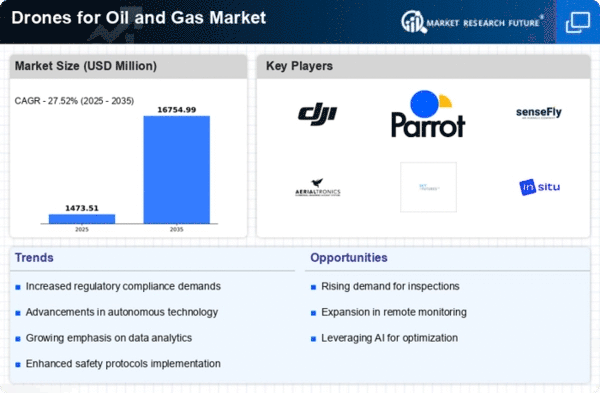
As per MRFR analysis, the Drones for Oil Gas Market Size was estimated at 1155.51 USD Million in 2024. The Drones for Oil Gas industry is projected to grow from 1473.51 in 2025 to 16754.99 by 2035, exhibiting a compound annual growth rate (CAGR) of 27.52 during the forecast period 2025 - 2035.

Key Market Trends & Highlights

The Drones for Oil Gas Market is experiencing robust growth driven by technological advancements and regulatory compliance.

  • The market is witnessing increased adoption of autonomous drones, particularly in North America, which remains the largest market.
  • Enhanced data analytics capabilities are becoming crucial for operational efficiency, especially in the inspection segment.
  • Regulatory developments are shaping compliance standards, influencing market dynamics across the Asia-Pacific region, the fastest-growing area.
  • Cost efficiency and improved safety are major drivers, propelling growth in both the upstream and midstream segments.

Market Size & Forecast

2024 Market Size 1155.51 (USD Million)
2035 Market Size 16754.99 (USD Million)
CAGR (2025 - 2035) 27.52%
Largest Regional Market Share in 2024 North America

Major Players

<p>DJI (CN), Parrot (FR), senseFly (CH), Airware (US), Skycatch (US), DroneDeploy (US), Aerialtronics (NL), Kespry (US), Flyability (CH)</p>

Market Trends

The Drones for Oil Gas Market is currently experiencing a transformative phase, driven by advancements in technology and increasing demand for efficient operations. The integration of drones into oil and gas operations enhances safety, reduces costs, and improves data collection processes. Companies are increasingly adopting these aerial vehicles for various applications, including pipeline inspections, environmental monitoring, and site surveying. This shift towards automation and remote monitoring is reshaping traditional practices, allowing for more precise and timely decision-making. As the industry evolves, regulatory frameworks are also adapting to accommodate the growing use of drones, which may further facilitate their integration into standard operational procedures. In addition to operational efficiency, the Drones for Oil Gas Market is witnessing a surge in interest due to environmental considerations. Drones offer a less invasive method for monitoring and inspecting infrastructure, which aligns with the industry's push towards sustainability. The ability to gather data without disrupting the surrounding environment is becoming increasingly valuable. Furthermore, as companies strive to meet regulatory requirements and public expectations regarding environmental stewardship, the role of drones is likely to expand. Overall, the Drones for Oil Gas Market appears poised for continued growth, driven by technological innovation and a commitment to sustainable practices.

Increased Adoption of Autonomous Drones

The trend towards autonomous drones is gaining traction within the Drones for Oil Gas Market. These unmanned aerial vehicles are equipped with advanced navigation systems, enabling them to operate independently. This autonomy reduces the need for human intervention, thereby minimizing risks associated with personnel exposure in hazardous environments. As technology continues to advance, the capabilities of these drones are expected to expand, allowing for more complex tasks to be performed with greater efficiency.

Enhanced Data Analytics Capabilities

The integration of sophisticated data analytics tools with drone technology is becoming increasingly prevalent. Drones are now capable of capturing high-resolution imagery and collecting vast amounts of data during inspections and surveys. This data can be analyzed in real-time, providing valuable insights that facilitate informed decision-making. As companies seek to optimize their operations, the ability to leverage data analytics in conjunction with drone technology is likely to become a critical component of operational strategies.

Regulatory Developments and Compliance

The evolving regulatory landscape surrounding drone usage in the oil and gas sector is a notable trend. Governments and regulatory bodies are establishing guidelines to ensure safe and responsible drone operations. Compliance with these regulations is essential for companies looking to integrate drones into their workflows. As regulations become more defined, organizations may find it easier to adopt drone technology, leading to increased utilization across various applications within the Drones for Oil Gas Market.

Drones for Oil Gas Market Market Drivers

Regulatory Support

Regulatory frameworks are increasingly supportive of drone integration within the Global Drones for Oil and Gas Market Industry. Governments worldwide are establishing guidelines that facilitate the safe operation of drones in oil and gas operations. For example, the Federal Aviation Administration in the United States has implemented regulations that streamline the approval process for commercial drone use. This regulatory environment encourages companies to adopt drone technology for tasks such as aerial surveying and monitoring, thereby enhancing operational efficiency and compliance. The anticipated growth in this sector is indicative of a broader acceptance of drone technology in regulated industries.

Enhanced Data Analytics

The integration of advanced data analytics with drone technology is transforming the Global Drones for Oil and Gas Market Industry. Drones equipped with sensors collect vast amounts of data, which can be analyzed to improve decision-making processes. For example, data from drone surveys can be used to create detailed 3D models of oil fields, facilitating better planning and resource allocation. This analytical capability is becoming increasingly vital as companies strive to optimize operations and reduce costs. The synergy between drones and data analytics is likely to propel market growth, reflecting the industry's shift towards data-driven strategies.

Environmental Monitoring

The increasing emphasis on environmental monitoring within the Global Drones for Oil and Gas Market Industry is driving demand for drone technology. Drones are utilized for monitoring emissions, detecting leaks, and assessing environmental impacts, which are crucial for compliance with environmental regulations. For instance, drones can cover vast areas quickly, providing real-time data that helps companies respond to environmental concerns more effectively. This capability not only aids in regulatory compliance but also enhances corporate responsibility, making drones an essential tool in the oil and gas sector's sustainability efforts.

Market Growth Projections

The Global Drones for Oil and Gas Market Industry is poised for substantial growth, with projections indicating an increase from 1.16 USD Billion in 2024 to 16.7 USD Billion by 2035. This remarkable growth trajectory suggests a compound annual growth rate of 27.47% from 2025 to 2035. Such figures highlight the increasing adoption of drone technology across various applications in the oil and gas sector, including exploration, monitoring, and maintenance. The anticipated expansion underscores the industry's recognition of drones as critical tools for enhancing operational efficiency and safety.

Cost Reduction Initiatives

Cost reduction is a primary driver in the Global Drones for Oil and Gas Market Industry, as companies seek to minimize operational expenses. Drones can significantly lower costs associated with inspections, maintenance, and monitoring by reducing the need for manned aircraft and ground crews. For example, using drones for pipeline inspections can decrease costs by up to 80% compared to traditional methods. This financial incentive is compelling, especially as the market is expected to grow from 1.16 USD Billion in 2024 to an estimated 16.7 USD Billion by 2035, with a CAGR of 27.47% from 2025 to 2035.

Technological Advancements

The Global Drones for Oil and Gas Market Industry is experiencing rapid technological advancements that enhance operational efficiency and safety. Innovations in drone technology, such as improved battery life, enhanced imaging capabilities, and autonomous flight systems, are driving adoption. For instance, drones equipped with thermal imaging can detect gas leaks and monitor pipeline integrity, reducing the need for manual inspections. As a result, the market is projected to reach 1.16 USD Billion in 2024, reflecting a growing reliance on these technologies to optimize resource management and minimize environmental impact.

Market Segment Insights

By Application: Inspection (Largest) vs. Surveying (Fastest-Growing)

<p>In the Drones for Oil Gas Market, the application segment reveals a diverse utilization landscape, with Inspection leading in market share. It encompasses routine checks and preventative maintenance amongst oil and gas assets. Following closely, Surveying is emerging as the fastest-growing segment, driven by the demand for efficient data capture in expansive oil fields. Monitoring, Mapping, and Data Collection also contribute significantly, together forming a robust application framework within the sector.</p>

<p>Inspection (Dominant) vs. Surveying (Emerging)</p>

<p>Inspection drones are vital in the oil and gas industry, ensuring asset integrity through consistent monitoring and fault detection. These drones, equipped with high-resolution cameras and sensors, facilitate inspections in hard-to-reach locations, thus reducing downtime and maintenance costs. In contrast, Surveying drones are witnessing rapid adoption due to their ability to generate precise topographical maps and models, essential for planning and development activities. Their ability to store and process large amounts of data makes them invaluable for real-time decision-making, enhancing operational efficiency and safety in the oil and gas sector.</p>

By End Use: Upstream (Largest) vs. Midstream (Fastest-Growing)

<p>In the Drones for Oil Gas Market, the distribution of market share is prominently led by the upstream segment, which engages in exploration and production activities. This sector extensively utilizes drones for surveillance, inspections, and operational efficiency, thereby solidifying its dominant position in the market. In contrast, the midstream segment, which involves the transportation of oil and gas, is rapidly gaining traction as an emerging sector in the drone market due to its increased efficiency and safety measures in monitoring pipelines and logistics. Growth trends within this segment reveal a clear shift towards automation and advanced technology integration. The increasing demand for operational efficiency and safety compliance is propelling the adoption of drones in the midstream segment. As companies strive for sustainability and cost-effectiveness, drones are being integrated into various operations to enhance data collection and monitoring capabilities, thus fostering growth in the midstream sector more rapidly than in upstream operations.</p>

<p>Upstream (Dominant) vs. Midstream (Emerging)</p>

<p>The upstream segment is a robust and established category characterized by its focus on exploration and production processes where drones play a crucial role in data collection, site monitoring, and asset inspection. This dominance is further enhanced by the complex nature of oil and gas extraction, which requires advanced technology for effective management. In contrast, the midstream segment is increasingly recognized for its innovative approaches to streamline operations within transportation and logistics. This emerging category's growth is supported by the need for enhanced safety and oversight, with drones enabling real-time monitoring of pipeline conditions, reducing risks associated with leak detection, and improving regulatory compliance. The synergy between these two segments signifies a broader trend toward utilizing drone technology to bridge operational gaps in the oil and gas industry.</p>

By Drone Type: Multirotor (Largest) vs. Fixed Wing (Fastest-Growing)

<p>In the Drones for Oil and Gas market, the Multirotor drones hold the largest market share due to their versatility and ease of use across various applications. These drones are favored for their ability to hover and perform detailed inspections and surveying tasks in challenging environments, making them indispensable in the industry. Fixed wing drones, while currently smaller in market share, are witnessing rapid adoption due to their capacity for long-distance flights and endurance, ideal for expansive territories often encountered in oil and gas operations.</p>

<p>Multirotor (Dominant) vs. Fixed Wing (Emerging)</p>

<p>Multirotor drones are characterized by their ability to take off and land vertically, allowing for operation in restricted spaces. Their dominant market position stems from applications like live monitoring and environmental assessments. In contrast, Fixed Wing drones represent an emerging segment in the oil and gas sector, offering greater flight times and covering broader areas, which is essential for pipeline inspections and surveying. As technological advancements continue, the functionality and reliability of Fixed Wing drones are improving, leading to increased acceptance among businesses looking for efficiency in their operations.</p>

By Technology: LiDAR (Largest) vs. Thermal Imaging (Fastest-Growing)

<p>In the Drones for Oil Gas Market, technology segments are crucial in enhancing operational efficiency. LiDAR technology holds the largest market share, owing to its capability in mapping and surveying oil and gas infrastructure with high precision. This is closely followed by Thermal Imaging and Visual Imaging, which significantly contribute to monitoring and inspection tasks, thereby supporting effective decision-making in the sector. Gas Detection, while essential, occupies a smaller portion compared to these advanced imaging technologies. As the sector embraces innovations, the growth trends reveal an increasing adoption of advanced imaging technologies, especially Thermal Imaging, which is recognized as the fastest-growing segment. The rise in need for safety and efficiency in oil and gas operations drives the demand for these technologies. Moreover, the push for reducing operational risks, coupled with regulatory compliance for environmental safety, bolsters market growth, making technology a pivotal aspect of the Drones for Oil Gas Market.</p>

<p>Technology: LiDAR (Dominant) vs. Thermal Imaging (Emerging)</p>

<p>LiDAR technology stands out as a dominant player in the Drones for Oil Gas Market due to its unparalleled precision in collecting data related to terrain and infrastructure. It significantly enhances the capabilities of drones, enabling detailed 3D mapping that is vital for large-scale oil and gas projects. Conversely, Thermal Imaging is an emerging technology that is gaining traction for its ability to detect heat signatures, making it invaluable for identifying leaks and monitoring equipment performance. While LiDAR is well-established, the rapid growth of Thermal Imaging showcases its increasing importance in ensuring operational safety and efficiency. These two technologies play complementary roles in advancing the capabilities of drones used in the oil and gas sector.</p>

By Payload Capacity: Medium (Largest) vs. Heavyweight (Fastest-Growing)

<p>The payload capacity segment in the Drones for Oil Gas Market is primarily dominated by medium capacity drones, which account for a significant proportion of market share. These drones are favored for their balance of weight and capability, making them ideal for a variety of oil and gas applications, such as pipeline inspections and site surveys. Lightweight drones, while useful for specific tasks requiring agility, have a smaller share of the market, catering to niche uses rather than heavy-duty applications. As the demand for efficiency and advanced operations grows, heavyweight drones are emerging as the fastest-growing segment within the payload capacity space. Their ability to carry larger equipment and support more extensive logistics operations meets the increasing needs of the oil and gas industry's shifting dynamics. As technological advancements improve their performance, heavyweight drones are poised to capture greater market share, reflecting a noticeable trend towards heavier payload capabilities in operations requiring robustness and reliability.</p>

<p>Medium: The Dominant vs. Heavyweight: The Emerging</p>

<p>In the Drones for Oil Gas Market, medium capacity drones dominate the payload capacity segment due to their versatile operational capabilities. These drones strike a perfect balance between payload and maneuverability, allowing them to execute a range of tasks such as monitoring infrastructure and conducting inspections efficiently. On the other hand, heavyweight drones are rapidly emerging as key players in the market, addressing the demand for larger payloads that facilitate more extensive equipment transport and data collection. This segment is gaining traction as oil and gas companies increasingly adopt these drones for their ability to handle complex logistics and improve operational efficiency. As both segments evolve, the competition for advancements in technology and applications continues to intensify.</p>

Get more detailed insights about Drones for Oil and Gas Market Research Report - Global Forecast till 2035

Regional Insights

North America : Market Leader in Drones

North America is poised to maintain its leadership in the Drones for Oil Gas market, holding a significant market share of 600.0. The region's growth is driven by increasing investments in oil and gas exploration, coupled with advancements in drone technology that enhance operational efficiency. Regulatory support from agencies like the FAA facilitates the integration of drones into various applications, further boosting demand. The United States stands out as the leading country, with major players such as DJI, Airware, and DroneDeploy actively participating in the market. The competitive landscape is characterized by innovation and strategic partnerships, enabling companies to offer tailored solutions for oil and gas operations. As the market evolves, the presence of established firms and emerging startups will continue to shape the industry's trajectory.

Europe : Emerging Market Potential

Europe is witnessing a burgeoning interest in the Drones for Oil Gas market, with a market size of 300.0. The region's growth is fueled by increasing regulatory clarity and a push towards sustainable energy practices. Countries are investing in drone technology to enhance safety and efficiency in oil and gas operations, aligning with EU regulations aimed at reducing environmental impact. Leading countries like Germany, France, and the UK are at the forefront of this transformation, with key players such as Parrot and senseFly making significant contributions. The competitive landscape is marked by collaborations between technology firms and energy companies, fostering innovation. As the market matures, Europe is expected to become a critical player in the global drone landscape, leveraging its technological expertise.

Asia-Pacific : Rapidly Growing Market

Asia-Pacific is emerging as a significant player in the Drones for Oil Gas market, with a market size of 200.0. The region's growth is driven by increasing demand for efficient monitoring and inspection solutions in oil and gas operations. Governments are actively promoting the use of drones to enhance safety and reduce operational costs, creating a favorable regulatory environment for adoption. Countries like China and Australia are leading the charge, with key players such as DJI and Kespry establishing a strong presence. The competitive landscape is evolving, with local startups entering the market and established firms expanding their offerings. As the region continues to invest in drone technology, it is set to play a crucial role in the global oil and gas sector.

Middle East and Africa : Emerging Opportunities

The Middle East and Africa region is gradually recognizing the potential of drones in the Oil Gas market, with a market size of 55.51. The growth is driven by the need for enhanced surveillance and monitoring in oil-rich countries. Regulatory bodies are beginning to establish frameworks that support the use of drones, which is crucial for the sector's development. Countries like the UAE and South Africa are leading the way, with local firms exploring drone applications for oil and gas operations. The competitive landscape is characterized by a mix of international players and regional startups, creating a dynamic environment. As the market matures, the region is expected to leverage drone technology to improve operational efficiency and safety.

Key Players and Competitive Insights

The Drones for Oil Gas Market is currently characterized by a dynamic competitive landscape, driven by technological advancements and increasing demand for operational efficiency. Key players such as DJI (CN), Parrot (FR), and DroneDeploy (US) are strategically positioning themselves through innovation and partnerships. DJI (CN) continues to lead with its cutting-edge drone technology, focusing on enhancing aerial data collection capabilities, while Parrot (FR) emphasizes sustainability in its product offerings, aligning with the industry's shift towards eco-friendly solutions. Meanwhile, DroneDeploy (US) is enhancing its software solutions to integrate AI, thereby improving data analytics for oil and gas operations. Collectively, these strategies are shaping a competitive environment that prioritizes technological innovation and operational efficiency.

In terms of business tactics, companies are increasingly localizing manufacturing to reduce costs and optimize supply chains. The market structure appears moderately fragmented, with several players vying for market share. This fragmentation allows for diverse offerings, yet the influence of key players like DJI (CN) and DroneDeploy (US) remains substantial, as they set benchmarks for technological advancements and operational standards.

In November 2025, DJI (CN) announced a partnership with a leading oil and gas company to develop specialized drones equipped with advanced thermal imaging capabilities. This strategic move is likely to enhance inspection processes, allowing for more efficient monitoring of pipelines and facilities. The integration of thermal imaging technology could significantly reduce operational risks and improve safety standards in the industry.

In October 2025, Parrot (FR) launched a new line of drones specifically designed for environmental monitoring in oil and gas operations. This initiative underscores Parrot's commitment to sustainability and positions the company as a leader in eco-friendly drone solutions. By focusing on environmental compliance, Parrot (FR) is likely to attract clients who prioritize sustainable practices, thereby enhancing its market presence.

In September 2025, DroneDeploy (US) introduced an AI-driven analytics platform that integrates seamlessly with its drone technology. This platform aims to provide real-time data insights for oil and gas operators, facilitating quicker decision-making processes. The strategic importance of this development lies in its potential to revolutionize data utilization in the sector, allowing companies to optimize their operations and reduce costs.

As of December 2025, the competitive trends in the Drones for Oil Gas Market are increasingly defined by digitalization, sustainability, and AI integration. Strategic alliances are becoming more prevalent, as companies recognize the value of collaboration in enhancing technological capabilities. Looking ahead, competitive differentiation is expected to evolve, shifting from price-based competition to a focus on innovation, technology, and supply chain reliability. This transition may redefine market dynamics, as companies that prioritize technological advancements and sustainable practices are likely to gain a competitive edge.

Key Companies in the Drones for Oil Gas Market market include

Industry Developments

  • Q2 2025: Terra Drone and MODEC Renew Joint R&D Agreement for FPSO Crude Oil Storage Tanks Inspections Terra Drone Corporation renewed its joint R&D agreement with MODEC to further develop and deploy drone-based non-destructive internal inspection technology for crude oil storage tanks on FPSOs, aiming to enhance safety and operational efficiency in offshore oil and gas operations.
  • Q3 2024: Terra Drone and MODEC Sign Joint R&D Contract for Offshore Engineering Drone Technology Terra Drone Corporation and MODEC entered a joint R&D contract to enhance drone technology for the inspection of offshore engineering, specifically focusing on floating production storage offloading (FPSO) systems in the oil and gas sector.

Future Outlook

Drones for Oil Gas Market Future Outlook

<p>The Drones for Oil Gas Market is projected to grow at a 27.52% CAGR from 2024 to 2035, driven by technological advancements, regulatory support, and increasing operational efficiency demands.</p>

New opportunities lie in:

  • <p>Integration of AI for predictive maintenance analytics</p>
  • <p>Development of specialized drones for pipeline inspections</p>
  • <p>Expansion of drone delivery services for remote site supplies</p>

<p>By 2035, the market is expected to be robust, driven by innovation and strategic partnerships.</p>

Market Segmentation

Drones for Oil Gas Market End Use Outlook

  • Upstream
  • Midstream
  • Downstream

Drones for Oil Gas Market Drone Type Outlook

  • Fixed Wing
  • Multirotor
  • Hybrid
  • Single Rotor

Drones for Oil Gas Market Technology Outlook

  • LiDAR
  • Thermal Imaging
  • Visual Imaging
  • Gas Detection

Drones for Oil Gas Market Application Outlook

  • Inspection
  • Surveying
  • Monitoring
  • Mapping
  • Data Collection

Drones for Oil Gas Market Payload Capacity Outlook

  • Lightweight
  • Medium
  • Heavyweight

Report Scope

MARKET SIZE 20241155.51(USD Million)
MARKET SIZE 20251473.51(USD Million)
MARKET SIZE 203516754.99(USD Million)
COMPOUND ANNUAL GROWTH RATE (CAGR)27.52% (2024 - 2035)
REPORT COVERAGERevenue Forecast, Competitive Landscape, Growth Factors, and Trends
BASE YEAR2024
Market Forecast Period2025 - 2035
Historical Data2019 - 2024
Market Forecast UnitsUSD Million
Key Companies ProfiledDJI (CN), Parrot (FR), senseFly (CH), Airware (US), Skycatch (US), DroneDeploy (US), Aerialtronics (NL), Kespry (US), Flyability (CH)
Segments CoveredApplication, End Use, Drone Type, Technology, Payload Capacity
Key Market OpportunitiesIntegration of advanced analytics and artificial intelligence in Drones for Oil Gas Market enhances operational efficiency.
Key Market DynamicsRising demand for aerial inspections drives technological advancements and regulatory adaptations in the Drones for Oil Gas Market.
Countries CoveredNorth America, Europe, APAC, South America, MEA

FAQs

How much are the Drones for Oil and Gas market?

The Drones for Oil and Gas market size was valued at USD 856.65 Million in 2023.

What is the growth rate of the Drones for Oil and Gas market?

The market is projected to grow at a CAGR of 27.5% during the forecast period, 2024-2032.

Which region held the largest market share in the Drones for Oil and Gas market?

North America had the largest share of the Drones for Oil and Gas market.

Who are the key players in the Drones for Oil and Gas market?

The key players in the market are Cyberhawk Innovations Limited, PrecisionHawk, Delair, Airobotics, Airborne Drones, Terra Drone, Intel Corporation, AeroVironment Inc, Aerodyne Group, and Sky-Futures.

Which Drones for Oil and Gas type led the Drones for Oil and Gas market?

The Multi-rotor segment Drones for Oil and Gas category dominated the market in 2023.

Which Application had the largest market share in the market?

Inspection for Oil and Gas had the largest share in the market for Drones for Oil and Gas.

  1. Executive Summary
  2. Market Introduction
    1. Market Definition
    2. Scope of the Study
    3. Market Structure
  3. Research Methodology
    1. Primary Research
    2. Secondary Research
    3. Market Type Estimation
    4. Forecast Model
    5. List of Assumptions
    6. Limitations of the Study
  4. Market Insights
  5. Market Dynamics
    1. Introduction
    2. Market Drivers
    3. Market Restraints
    4. Market Opportunities
    5. Porter’s Five Forces Analysis
      1. Threat of New Entrants
      2. Bargaining Power of Buyers
      3. Bargaining Power of Suppliers
      4. Threat of Substitutes
      5. Rivalry
    6. Value Chain/Supply Chain Analysis
  6. Global Drones for Oil & Gas Market, by Type
    1. Introduction
    2. Single-Rotor
      1. Market Estimates & Forecast, 2024-2030
      2. Market Estimates & Forecast, by Region, 2024-2030
    3. Multi-Rotor
      1. Market Estimates & Forecast, 2024-2030
      2. Market Estimates & Forecast, by Region, 2024-2030
    4. Fixed Wing
      1. Market Estimates & Forecast, 2024-2030
      2. Market Estimates & Forecast, by Region, 2024-2030
    5. Hybrid & Nano
      1. Market Estimates & Forecast, 2024-2030
      2. Market Estimates & Forecast, by Region, 2024-2030
  7. Global Drones for Oil & Gas Market, by Application
    1. Introduction
    2. Inspection
      1. Market Estimates & Forecast, 2024-2030
      2. Market Estimates & Forecast, by Region, 2024-2030
    3. Surveying & Mapping
      1. Market Estimates & Forecast, 2024-2030
      2. Market Estimates & Forecast, by Region, 2024-2030
    4. Security and Emergency Response
  8. Market Estimates & Forecast, 2024-2030
  9. Market Estimates & Forecast, by Region, 2024-2030
  10. Global Drones for Oil & Gas Market, by Region
    1. Introduction
    2. North America
      1. Market Estimates & Forecast, by Services, 2024-2030
      2. Market Estimates & Forecast, by Type, 2024-2030
      3. Market Estimates & Forecast, by Application, 2024-2030
      4. Market Estimates & Forecast, by Country, 2024-2030
      5. US
      6. Canada
      7. Mexico
    3. Europe
      1. Market Estimates & Forecast, by Services, 2024-2030
      2. Market Estimates & Forecast, by Type, 2024-2030
      3. Market Estimates & Forecast, by Application, 2024-2030
      4. Market Estimates & Forecast, by Country, 2024-2030
      5. Norway
      6. UK
      7. Denmark
      8. Rest of Europe
    4. Asia-Pacific
      1. Market Estimates & Forecast, by Services, 2024-2030
      2. Market Estimates & Forecast, by Type, 2024-2030
      3. Market Estimates & Forecast, by Application, 2024-2030
      4. Market Estimates & Forecast, by Country, 2024-2030
      5. China
      6. Japan
      7. Australia
      8. India
      9. Rest of Asia-Pacific
    5. Middle East & Africa
      1. Market Estimates & Forecast, by Services, 2024-2030
      2. Market Estimates & Forecast, by Type, 2024-2030
      3. Market Estimates & Forecast, by Application, 2024-2030
      4. Market Estimates & Forecast, by Country, 2024-2030
      5. Saudi Arabia
      6. UAE
      7. South Africa
      8. Rest of Middle East & Africa
    6. South America
      1. Market Estimates & Forecast, by Services, 2024-2030
      2. Market Estimates & Forecast, by Type, 2024-2030
      3. Market Estimates & Forecast, by Application, 2024-2030
      4. Market Estimates & Forecast, by Country, 2024-2030
      5. Argentina
      6. Brazil
      7. Rest of South America
  11. Competitive Landscape
    1. Competitive Scenario
    2. Competitive Benchmarking of the Global Drones for Oil & Gas Market
    3. Major Growth Key Strategies in the Global Drones for Oil & Gas Market
    4. Market Share Analysis: Global Drones for Oil & Gas Market
    5. XXXX: The Leading Player in Terms of Number of Developments in Global Drones for Oil & Gas Market
    6. Product Development in Global Drones for Oil & Gas Market
    7. Mergers and Acquisitions in Global Drones for Oil & Gas Market
    8. Contracts and Agreements in Global Drones for Oil & Gas Market
    9. Expansions and Investments in Global Drones for Oil & Gas Market
  12. Company Profile
    1. Cyberhawk Innovations Limited (Scotland)
      1. Company Overview
      2. Products/Services Offered
      3. Financial Overview
      4. Key Developments
      5. Key Strategies
      6. SWOT Analysis
    2. PrecisionHawk (US)
      1. Company Overview
      2. Products/Services Offered
      3. Financial Overview
      4. Key Developments
      5. Key Strategies
      6. SWOT Analysis
    3. Delair (Denmark)
      1. Company Overview
      2. Products/Services Offered
      3. Financial Overview
      4. Key Developments
      5. Key Strategies
      6. SWOT Analysis
    4. SkyScape Industries (US)
      1. Company Overview
      2. Products/Services Offered
      3. Financial Overview
      4. Key Developments
      5. Key Strategies
      6. SWOT Analysis
    5. Airobotics (US)
      1. Company Overview
      2. Products/Services Offered
      3. Financial Overview
      4. Key Developments
      5. Key Strategies
      6. SWOT Analysis
      7. SWOT Analysis
    6. Airborne Drones (South Africa)
      1. Company Overview
      2. Products/Services Offered
      3. Financial Overview
      4. Key Developments
      5. Key Strategies
      6. SWOT Analysis
    7. Sky Futures (UK)
      1. Company Overview
      2. Products/Services Offered
      3. Financial Overview
      4. Key Developments
      5. Key Strategies
      6. SWOT Analysis
    8. Terra Drone (Japan)
      1. Company Overview
      2. Products/Services Offered
      3. Financial Overview
      4. Key Developments
      5. Key Strategies
      6. SWOT Analysis
    9. Intel Corporation (US)
      1. Company Overview
      2. Products/Services Offered
      3. Financial Overview
      4. Key Developments
      5. Key Strategies
      6. SWOT Analysis
    10. AeroVironment, Inc (US)
      1. Company Overview
      2. Products/Services Offered
      3. Financial Overview
      4. Key Developments
      5. Key Strategies
      6. SWOT Analysis
    11. Aerodyne Group (Malaysia)
      1. Company Overview
      2. Products/Services Offered
      3. Financial Overview
      4. Key Developments
      5. Key Strategies
      6. SWOT Analysis
    12. Insitu Pacific Pty Ltd (Australia)
      1. Company Overview
      2. Products/Services Offered
      3. Financial Overview
      4. Key Developments
      5. Key Strategies
      6. SWOT Analysis
    13. Aerialtronics DV B.V. (the Netherlands)
      1. Company Overview
      2. Products/Services Offered
      3. Financial Overview
      4. Key Developments
      5. Key Strategies
      6. SWOT Analysis
    14. Flyability (Switzerland)
      1. Company Overview
      2. Products/Services Offered
      3. Financial Overview
      4. Key Developments
      5. Key Strategies
      6. SWOT Analysis
    15. ideaForge (India)
      1. Company Overview
      2. Products/Services Offered
      3. Financial Overview
      4. Key Developments
      5. Key Strategies
      6. SWOT Analysis
    16. List of Tables
  13. Global Drones for Oil & Gas Market, by Region, 2024-2030 (USD Million)
  14. North America Drones for Oil & Gas Market, by Country, 2024-2030 (USD Million)
  15. Europe Drones for Oil & Gas Market, by Country, 2024-2030 (USD Million)
  16. Asia-Pacific Drones for Oil & Gas Market, by Country, 2024-2030 (USD Million)
  17. Middle East & Africa Drones for Oil & Gas Market, by Country, 2024-2030 (USD Million)
  18. South America Drones for Oil & Gas Market, by Country, 2024-2030 (USD Million)
  19. Global Drones for Oil & Gas Market, by Type, 2024-2030 (USD Million)
  20. North America Drones for Oil & Gas Market, by Type, 2024-2030 (USD Million)
  21. Europe Drones for Oil & Gas Market, by Type, 2024-2030 (USD Million)
  22. Asia-Pacific Drones for Oil & Gas Market, by Type, 2024-2030 (USD Million)
  23. Middle East & Africa Drones for Oil & Gas Market, by Type, 2024-2030 (USD Million)
  24. South America Drones for Oil & Gas Market, by Type, 2024-2030 (USD Million)
  25. Global Drones for Oil & Gas Market, by Application, 2024-2030 (USD Million)
  26. North America Drones for Oil & Gas Market, by Application, 2024-2030 (USD Million)
  27. Europe Drones for Oil & Gas Market, by Application, 2024-2030 (USD Million)
  28. Asia-Pacific Drones for Oil & Gas Market, by Application, 2024-2030 (USD Million)
  29. Middle East & Africa Drones for Oil & Gas Market, by Application, 2024-2030 (USD Million)
  30. South America Drones for Oil & Gas Market, by Application, 2024-2030 (USD Million)
  31. US Drones for Oil & Gas Market, by Type, 2024-2030 (USD Million)
  32. US Drones for Oil & Gas Market, by Application, 2024-2030 (USD Million)
  33. Canada Drones for Oil & Gas Market, by Type, 2024-2030 (USD Million)
  34. Canada Drones for Oil & Gas Market, by Application, 2024-2030 (USD Million)
  35. Mexico Drones for Oil & Gas Market, by Type, 2024-2030 (USD Million)
  36. Mexico Drones for Oil & Gas Market, by Application, 2024-2030 (USD Million)
  37. Europe Drones for Oil & Gas Market, by Country, 2024-2030 (USD Million)
  38. Europe Drones for Oil & Gas Market, by Type, 2024-2030 (USD Million)
  39. Europe Drones for Oil & Gas Market, by Application, 2024-2030 (USD Million)
  40. Norway Drones for Oil & Gas Market, by Type, 2024-2030 (USD Million)
  41. Norway Drones for Oil & Gas Market, by Application, 2024-2030 (USD Million)
  42. UK Drones for Oil & Gas Market, by Type, 2024-2030 (USD Million)
  43. UK Drones for Oil & Gas Market, by Application, 2024-2030 (USD Million)
  44. Denmark Drones for Oil & Gas Market, by Type, 2024-2030 (USD Million)
  45. Denmark Drones for Oil & Gas Market, by Application, 2024-2030 (USD Million)
  46. Rest of Europe Drones for Oil & Gas Market, by Type, 2024-2030 (USD Million)
  47. Rest of Europe Drones for Oil & Gas Market, by Application, 2024-2030 (USD Million)
  48. Asia-Pacific Drones for Oil & Gas Market, by Country, 2024-2030 (USD Million)
  49. Asia-Pacific Drones for Oil & Gas Market, by Type, 2024-2030 (USD Million)
  50. Asia-Pacific Drones for Oil & Gas Market, by Application, 2024-2030 (USD Million)
  51. China Drones for Oil & Gas Market, by Type, 2024-2030 (USD Million)
  52. China Drones for Oil & Gas Market, by Application, 2024-2030 (USD Million)
  53. Japan Drones for Oil & Gas Market, by Type, 2024-2030 (USD Million)
  54. Japan Drones for Oil & Gas Market, by Application, 2024-2030 (USD Million)
  55. Australia Drones for Oil & Gas Market, by Type, 2024-2030 (USD Million)
  56. Australia Drones for Oil & Gas Market, by Application, 2024-2030 (USD Million)
  57. India Drones for Oil & Gas Market, by Type, 2024-2030 (USD Million)
  58. India Drones for Oil & Gas Market, by Application, 2024-2030 (USD Million)
  59. Rest of Asia-Pacific Drones for Oil & Gas Market, by Type, 2024-2030 (USD Million)
  60. Rest of Asia-Pacific Drones for Oil & Gas Market, by Application, 2024-2030 (USD Million)
  61. Middle East & Africa Drones for Oil & Gas Market, by Country, 2024-2030 (USD Million)
  62. Middle East & Africa Drones for Oil & Gas Market, by Type, 2024-2030 (USD Million)
  63. Middle East & Africa Drones for Oil & Gas Market, by Application, 2024-2030 (USD Million)
  64. Saudi Arabia Drones for Oil & Gas Market, by Type, 2024-2030 (USD Million)
  65. Saudi Arabia Drones for Oil & Gas Market, by Application, 2024-2030 (USD Million)
  66. UAE Drones for Oil & Gas Market, by Type, 2024-2030 (USD Million)
  67. UAE Drones for Oil & Gas Market, by Application, 2024-2030 (USD Million)
  68. South Africa Drones for Oil & Gas Market, by Type, 2024-2030 (USD Million)
  69. South Africa Drones for Oil & Gas Market, by Application, 2024-2030 (USD Million)
  70. Rest of Middle East & Africa Drones for Oil & Gas Market, by Type, 2024-2030 (USD Million)
  71. Rest of Middle East & Africa Drones for Oil & Gas Market, by Application, 2024-2030 (USD Million)
  72. South America Drones for Oil & Gas Market, by Type, 2024-2030 (USD Million)
  73. South America Drones for Oil & Gas Market, by Application, 2024-2030 (USD Million)
  74. Argentina Drones for Oil & Gas Market, by Type, 2024-2030 (USD Million)
  75. Argentina Drones for Oil & Gas Market, by Application, 2024-2030 (USD Million)
  76. Brazil Drones for Oil & Gas Market, by Type, 2024-2030 (USD Million)
  77. Brazil Drones for Oil & Gas Market, by Application, 2024-2030 (USD Million)
  78. Rest of South America Drones for Oil & Gas Market, by Type, 2024-2030 (USD Million)
  79. Rest of South America Drones for Oil & Gas Market, by Application, 2024-2030 (USD Million)
    1. List of Figures
  80. Research Process of MRFR
  81. Top-Down and Bottom-Up Approach
  82. Market Dynamics
  83. Impact Analysis: Market Drivers
  84. Impact Analysis: Market Restraints
  85. Porter’s Five Forces Analysis
  86. Value Chain Analysis
  87. Global Drones for Oil & Gas Market Share, by Type, 2022 (%)
  88. Global Drones for Oil & Gas Market, by Type, 2024-2030 (USD Million)
  89. Global Drones for Oil & Gas Market Share, by Application, 2022 (%)
  90. Global Drones for Oil & Gas Market, by Application, 2024-2030 (USD Million)
  91. North America Drones for Oil & Gas Market Share (%), 2022
  92. North America Drones for Oil & Gas Market, by Country, 2024-2030 (USD Million)
  93. Europe Drones for Oil & Gas Market Share (%), 2022
  94. Europe Drones for Oil & Gas Market, by Country, 2024-2030 (USD Million)
  95. Asia-Pacific Drones for Oil & Gas Market Share (%), 2022
  96. Asia-Pacific Drones for Oil & Gas Market, by Country, 2024-2030 (USD Million)
  97. Middle East & Africa Drones for Oil & Gas Market Share (%), 2022
  98. Middle East & Africa Drones for Oil & Gas Market, by Region, 2024-2030 (USD Million)
  99. South America Drones for Oil & Gas Market Share (%), 2022
  100. South America Drones for Oil & Gas Market, by Country, 2024-2030 (USD Million)

Market Segmentation

Drones for Oil and Gas Type Outlook (USD Million, 2018-2030)

  • Hybrid and nano
  • Fixed-wing
  • Multi-rotor
  • Single rotor

Drones for Oil and Gas Application Outlook (USD Million, 2018-2030)

  • Inspection
  • Security & emergency response
  • Surveying & mapping

Drones for Oil and Gas Regional Outlook (USD Million, 2018-2030)

  • North America Outlook (USD Million, 2018-2030)

    • North America Drones for Oil and Gas by Drones for Oil and Gas Type
      • Hybrid and nano
      • Fixed-wing
      • Multi-rotor
      • Single rotor
    • North America Drones for Oil and Gas by Application
      • Inspection
      • Security & emergency response
      • Surveying & mapping
    • US Outlook (USD Million, 2018-2030)

    • US Drones for Oil and Gas by Drones for Oil and Gas Type
      • Hybrid and nano
      • Fixed-wing
      • Multi-rotor
      • Single rotor
    • US Drones for Oil and Gas by Application
      • Inspection
      • Security & emergency response
      • Surveying & mapping
    • CANADA Outlook (USD Million, 2018-2030)

    • CANADA Drones for Oil and Gas by Drones for Oil and Gas Type
      • Hybrid and nano
      • Fixed-wing
      • Multi-rotor
      • Single rotor
    • CANADA Drones for Oil and Gas by Application
      • Inspection
      • Security & emergency response
      • Surveying & mapping
  • Europe Outlook (USD Million, 2018-2030)

    • Europe Drones for Oil and Gas by Drones for Oil and Gas Type
      • Hybrid and nano
      • Fixed-wing
      • Multi-rotor
      • Single rotor
    • Europe Drones for Oil and Gas by Application
      • Inspection
      • Security & emergency response
      • Surveying & mapping
    • Germany Outlook (USD Million, 2018-2030)

    • Germany Drones for Oil and Gas by Drones for Oil and Gas Type
      • Hybrid and nano
      • Fixed-wing
      • Multi-rotor
      • Single rotor
    • Germany Drones for Oil and Gas by Application
      • Inspection
      • Security & emergency response
      • Surveying & mapping
    • France Outlook (USD Million, 2018-2030)

    • France Drones for Oil and Gas by Drones for Oil and Gas Type
      • Hybrid and nano
      • Fixed-wing
      • Multi-rotor
      • Single rotor
    • France Drones for Oil and Gas by Application
      • Inspection
      • Security & emergency response
      • Surveying & mapping
    • UK Outlook (USD Million, 2018-2030)

    • UK Drones for Oil and Gas by Drones for Oil and Gas Type
      • Hybrid and nano
      • Fixed-wing
      • Multi-rotor
      • Single rotor
    • UK Drones for Oil and Gas by Application
      • Inspection
      • Security & emergency response
      • Surveying & mapping
    • ITALY Outlook (USD Million, 2018-2030)

    • ITALY Drones for Oil and Gas by Drones for Oil and Gas Type
      • Hybrid and nano
      • Fixed-wing
      • Multi-rotor
      • Single rotor
    • ITALY Drones for Oil and Gas by Application
      • Inspection
      • Security & emergency response
      • Surveying & mapping
    • SPAIN Outlook (USD Million, 2018-2030)

    • Spain Drones for Oil and Gas by Drones for Oil and Gas Type
      • Hybrid and nano
      • Fixed-wing
      • Multi-rotor
      • Single rotor
    • Spain Drones for Oil and Gas by Application
      • Inspection
      • Security & emergency response
      • Surveying & mapping
    • Rest Of Europe Outlook (USD Million, 2018-2030)

    • REST OF EUROPE Drones for Oil and Gas by Drones for Oil and Gas Type
      • Hybrid and nano
      • Fixed-wing
      • Multi-rotor
      • Single rotor
    • REST OF EUROPE Drones for Oil and Gas by Application
      • Inspection
      • Security & emergency response
      • Surveying & mapping
  • Asia-Pacific Outlook (USD Million, 2018-2030)

    • Asia-Pacific Drones for Oil and Gas by Drones for Oil and Gas Type
      • Hybrid and nano
      • Fixed-wing
      • Multi-rotor
      • Single rotor
    • Asia-Pacific Drones for Oil and Gas by Application
      • Inspection
      • Security & emergency response
      • Surveying & mapping
    • China Outlook (USD Million, 2018-2030)

    • China Drones for Oil and Gas by Drones for Oil and Gas Type
      • Hybrid and nano
      • Fixed-wing
      • Multi-rotor
      • Single rotor
    • China Drones for Oil and Gas by Application
      • Inspection
      • Security & emergency response
      • Surveying & mapping
    • Japan Outlook (USD Million, 2018-2030)

    • Japan Drones for Oil and Gas by Drones for Oil and Gas Type
      • Hybrid and nano
      • Fixed-wing
      • Multi-rotor
      • Single rotor
    • Japan Drones for Oil and Gas by Application
      • Inspection
      • Security & emergency response
      • Surveying & mapping
    • India Outlook (USD Million, 2018-2030)

    • India Drones for Oil and Gas by Drones for Oil and Gas Type
      • Hybrid and nano
      • Fixed-wing
      • Multi-rotor
      • Single rotor
    • India Drones for Oil and Gas by Application
      • Inspection
      • Security & emergency response
      • Surveying & mapping
    • Australia Outlook (USD Million, 2018-2030)

    • Australia Drones for Oil and Gas by Drones for Oil and Gas Type
      • Hybrid and nano
      • Fixed-wing
      • Multi-rotor
      • Single rotor
    • Australia Drones for Oil and Gas by Application
      • Inspection
      • Security & emergency response
      • Surveying & mapping
    • Rest of Asia-Pacific Outlook (USD Million, 2018-2030)

    • Rest of Asia-Pacific Drones for Oil and Gas by Drones for Oil and Gas Type
      • Hybrid and nano
      • Fixed-wing
      • Multi-rotor
      • Single rotor
    • Rest of Asia-Pacific Drones for Oil and Gas by Application
      • Inspection
      • Security & emergency response
      • Surveying & mapping
  • Rest of the World Outlook (USD Million, 2018-2030)

    • Rest of the World Drones for Oil and Gas by Drones for Oil and Gas Type
      • Hybrid and nano
      • Fixed-wing
      • Multi-rotor
      • Single rotor
    • Rest of the World Drones for Oil and Gas by Application
      • Inspection
      • Security & emergency response
      • Surveying & mapping
    • Middle East Outlook (USD Million, 2018-2030)

    • Middle East Drones for Oil and Gas by Drones for Oil and Gas Type
      • Hybrid and nano
      • Fixed-wing
      • Multi-rotor
      • Single rotor
    • Middle East Drones for Oil and Gas by Application
      • Inspection
      • Security & emergency response
      • Surveying & mapping
    • Africa Outlook (USD Million, 2018-2030)

    • Africa Drones for Oil and Gas by Drones for Oil and Gas Type
      • Hybrid and nano
      • Fixed-wing
      • Multi-rotor
      • Single rotor
    • Africa Drones for Oil and Gas by Application
      • Inspection
      • Security & emergency response
      • Surveying & mapping
    • Latin America Outlook (USD Million, 2018-2030)

    • Latin America Drones for Oil and Gas by Drones for Oil and Gas Type
      • Hybrid and nano
      • Fixed-wing
      • Multi-rotor
      • Single rotor
    • Latin America Drones for Oil and Gas by Application
      • Inspection
      • Security & emergency response
      • Surveying & mapping
Infographic

Free Sample Request

Kindly complete the form below to receive a free sample of this Report

Get Free Sample

Customer Strories

Compare Licence

×
Features License Type
Single User Multiuser License Enterprise User
Price $4,950 $5,950 $7,250
Maximum User Access Limit 1 User Upto 10 Users Unrestricted Access Throughout the Organization
Free Customization
Direct Access to Analyst
Deliverable Format
Platform Access
Discount on Next Purchase 10% 15% 15%
Printable Versions