
Request Free Sample ×

Kindly complete the form below to receive a free sample of this Report

* Please use a valid business email

Leading companies partner with us for data-driven Insights

clients tt-cursor
Hero Background
English
Chinese
French
Japanese
Korean
German
Spanish

Drive-by-wire Market Share

ID: MRFR/AT/4477-HCR
100 Pages
Triveni Bhoyar
April 2026

Drive By Wire Market Research Report Information By Application (Brake-By-Wire, Park-By-Wire, Shift-By-Wire, Steer-By-Wire, and Throttle-By-Wire), By Vehicle Type (Commercial Vehicle and Passenger Vehicle), By Component (Actuator, Electronic Control Unit, Electronic Throttle Control Module, Feedback Motor, and Others), By Sensor Type (Gear Shift Position Sensor, Throttle Pedal Sensor, Brake Pedal Sensor, Hand Wheel Angle Sensor, and Others), and By Region – Market Forecast Till 2035

Share:
Download PDF ×

We do not share your information with anyone. However, we may send you emails based on your report interest from time to time. You may contact us at any time to opt-out.

Drive-by-wire Market Infographic
Purchase Options

Market Share

Drive-by-wire Market Share Analysis

Cost leadership is a key strategy for Drive By Wire firms. Scale savings are crucial as the auto industry evolves. Companies optimize production techniques, acquire the finest supply, and leverage economies of scale to minimize production costs. They may provide affordable DBW systems, making them more appealing to more clients. Price-conscious people seek value-priced things. Businesses that adopt cost leadership tactics exploit this mindset. Effective partnerships and alliances are crucial for Drive By Wire market share. Through collaboration, automakers, technology businesses, and others may share resources, expertise, and market reach. Smart collaborations help companies enter new markets, share growth expenses, and become more competitive. An carmaker and a tech business may create a highly linked and efficient DBW system that provides reliability and innovative ideas. Market entrance is another common Drive By Wire Market entry method. You must sell harder, give more methods to purchase, and offer additional benefits to increase your market share. This strategy helps companies differentiate their brand and market position. They use aggressive marketing and clever delivery to steal clients from competitors and establish a strong market position. Customer-focused methods are also growing in the Drive By Wire Market. Understanding and meeting consumer demands is a great strategy to distinguish out. Businesses invest in market research to learn what consumers want, then adapt their DBW strategies. A customer-centered strategy ensures product acceptance, which increases market share. Customization, simple interfaces, and vehicle system integration may achieve this. In conclusion, the Drive By Wire Market is competitive, and companies use many methods to succeed. Each approach uses cutting-edge technology, cheap pricing, clever partnerships, market expansion, or consumer focus to gain market share. Drive By Wire companies must adapt and adopt successful market share positioning tactics to succeed as the automotive industry transforms.

Author
Author Profile
Triveni Bhoyar
Senior Research Analyst

Triveni Bhoyar has over 5 years of experience in the market research industry, specializing in the Automotive and Aerospace & Defense sectors. She has contributed to 200+ reports, including numerous custom projects for leading global companies, delivering solutions to complex business challenges. Renowned for her ability to generate valuable insights, Triveni excels in addressing unique market dynamics with precision and depth. Her expertise spans market sizing, competitive intelligence, and trend analysis, enabling clients to craft data-driven growth strategies. With strong analytical rigor and a client-centric approach, she plays a pivotal role in driving impactful, strategic decision-making.

Leave a Comment

FAQs

What is the projected market valuation of the Drive By Wire Market by 2035?

<p>The Drive By Wire Market is projected to reach a valuation of 38.07 USD Billion by 2035.</p>

What was the market valuation of the Drive By Wire Market in 2024?

<p>In 2024, the Drive By Wire Market had a valuation of 22.02 USD Billion.</p>

What is the expected CAGR for the Drive By Wire Market during the forecast period 2025 - 2035?

<p>The expected CAGR for the Drive By Wire Market during the forecast period 2025 - 2035 is 5.1%.</p>

Which segment is projected to have the highest valuation in the Drive By Wire Market by 2035?

<p>The Steer-By-Wire segment is projected to reach a valuation of 10.0 USD Billion by 2035.</p>

What are the key players in the Drive By Wire Market?

<p>Key players in the Drive By Wire Market include Bosch, Continental, Denso, and ZF Friedrichshafen.</p>

How does the valuation of Passenger Vehicles compare to Commercial Vehicles in the Drive By Wire Market?

<p>By 2035, the valuation for Passenger Vehicles is projected to be 30.07 USD Billion, compared to 8.0 USD Billion for Commercial Vehicles.</p>

What is the projected valuation for the Brake-By-Wire segment by 2035?

The Brake-By-Wire segment is projected to reach a valuation of 9.5 USD Billion by 2035.

Which component is expected to have the highest valuation in the Drive By Wire Market by 2035?

The Electronic Control Unit is expected to reach a valuation of 10.0 USD Billion by 2035.

What is the projected valuation for the Throttle-By-Wire segment by 2035?

The Throttle-By-Wire segment is projected to reach a valuation of 6.0 USD Billion by 2035.

What is the expected growth trend for the Drive By Wire Market in the coming years?

The Drive By Wire Market is expected to experience steady growth, reaching 38.07 USD Billion by 2035.

Market Summary

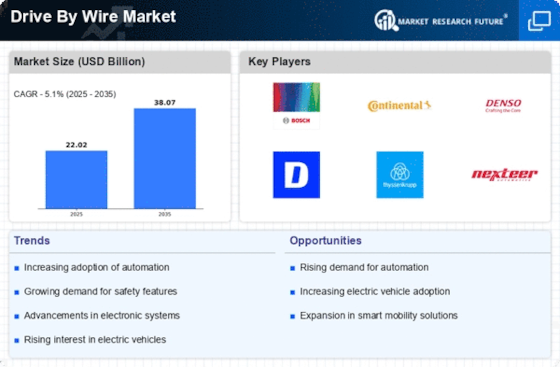
As per Market Research Future analysis, the Drive By Wire Market Size was estimated at 22.02 USD Billion in 2024. The Drive By Wire industry is projected to grow from 23.14 USD Billion in 2025 to 38.07 USD Billion by 2035, exhibiting a compound annual growth rate (CAGR) of 5.1% during the forecast period 2025 - 2035

Key Market Trends & Highlights

The Drive By Wire Market is poised for substantial growth driven by technological advancements and regulatory support.

  • North America remains the largest market for Drive By Wire systems, reflecting a strong demand for advanced automotive technologies. The Asia-Pacific region is currently the fastest-growing market, indicating a shift towards innovative vehicle solutions. Brake-By-Wire technology dominates the market, while Steer-By-Wire is emerging as the fastest-growing segment. Key market drivers include technological advancements and consumer demand for enhanced safety features, particularly in commercial vehicles.

Market Size & Forecast

2024 Market Size 22.02 (USD Billion)
2035 Market Size 38.07 (USD Billion)
CAGR (2025 - 2035) 5.1%
Largest Regional Market Share in 2024 North America

Major Players

Bosch (DE), Continental (DE), Denso (JP), Delphi Technologies (GB), Thyssenkrupp (DE), Nexteer Automotive (US), ZF Friedrichshafen (DE), Hitachi Astemo (JP), Mando Corporation (KR)

Market Trends

The Drive By Wire Market is currently experiencing a transformative phase, driven by advancements in automotive technology and increasing consumer demand for enhanced vehicle performance and safety. This drive by wire market , characterized by the replacement of traditional mechanical linkages with electronic controls, appears to be gaining traction as manufacturers seek to improve fuel efficiency and reduce emissions. The integration of sophisticated software and sensors into vehicles is likely to enhance the driving experience, offering features such as adaptive cruise control and automated parking. Furthermore, the growing emphasis on electric vehicles is expected to bolster the adoption of drive by wire systems, as these technologies align well with the requirements of modern electric drivetrains. In addition to technological advancements, regulatory frameworks are evolving to support the proliferation of drive by wire systems. Governments worldwide are increasingly focusing on safety standards and emissions regulations, which may further incentivize manufacturers to adopt these innovative solutions. The Drive By Wire Market seems poised for growth, as stakeholders recognize the potential benefits of improved vehicle dynamics and reduced mechanical complexity. As the automotive landscape continues to evolve, the drive by wire technology could play a pivotal role in shaping the future of transportation, making vehicles smarter and more efficient.

Technological Advancements

The Drive By Wire Market is witnessing rapid technological innovations, particularly in sensor and software development. These advancements facilitate enhanced vehicle control and responsiveness, which may lead to improved safety and performance.

Regulatory Support

Increasingly stringent safety and emissions regulations are likely to drive the adoption of drive by wire systems. Governments are promoting these technologies to meet environmental goals and enhance vehicle safety standards.

Electric Vehicle Integration

The rise of electric vehicles is expected to significantly influence the drive by wire market . As automakers transition to electric drivetrains, the compatibility of drive by wire systems with these technologies may become a key factor in vehicle design.

Drive-by-wire Market Market Drivers

Regulatory Support

Regulatory support plays a crucial role in the expansion of the Drive By Wire Market. Governments worldwide are implementing stringent safety and emissions regulations that encourage the adoption of advanced vehicle technologies. For example, regulations mandating the use of electronic stability control and other safety features are pushing manufacturers to integrate drive-by-wire systems into their vehicles. This regulatory landscape not only promotes safety but also aligns with environmental goals by facilitating the transition to electric and hybrid vehicles. As a result, the Drive By Wire Market is likely to benefit from increased investments in compliance and innovation. The anticipated growth in regulatory frameworks is expected to drive the market forward, with projections indicating a potential increase in market size by over 15% in the coming years.

Technological Advancements

The Drive By Wire Market is experiencing rapid technological advancements that enhance vehicle performance and safety. Innovations in electronic control systems, sensors, and software algorithms are transforming traditional mechanical systems into sophisticated electronic ones. For instance, the integration of advanced driver-assistance systems (ADAS) is becoming commonplace, which relies heavily on drive-by-wire technology. According to recent data, the market for drive-by-wire systems is projected to grow at a compound annual growth rate of approximately 10% over the next five years. This growth is driven by the increasing demand for automation and connectivity in vehicles, which necessitates the adoption of drive-by-wire systems. As manufacturers invest in research and development, the Drive By Wire Market is likely to witness further enhancements in system reliability and functionality.

Electric Vehicle Integration

The integration of electric vehicles (EVs) is significantly influencing the Drive By Wire Market. As the automotive sector shifts towards electrification, the demand for drive-by-wire systems is expected to rise. Electric vehicles require precise control systems to manage their unique powertrains, making drive-by-wire technology an ideal solution. Recent statistics suggest that the EV market is set to expand rapidly, with projections indicating that by 2030, electric vehicles could account for over 30% of total vehicle sales. This shift is likely to create substantial opportunities for the Drive By Wire Market, as manufacturers seek to enhance the performance and efficiency of electric vehicles through advanced electronic control systems. The synergy between EVs and drive-by-wire technology may redefine vehicle dynamics and user experience.

Increased Focus on Autonomous Vehicles

The increased focus on autonomous vehicles is reshaping the Drive By Wire Market. As automakers invest heavily in developing self-driving technologies, the need for reliable and responsive control systems becomes paramount. Drive-by-wire Market technology is essential for enabling the precise control required for autonomous operation. Industry forecasts suggest that the market for autonomous vehicles could reach a valuation of over 500 billion by 2030, creating a substantial demand for drive-by-wire systems. This trend indicates a shift in how vehicles are designed and operated, with drive-by-wire technology at the forefront of this transformation. The Drive By Wire Market is likely to see significant growth as manufacturers align their strategies with the evolving landscape of mobility.

Consumer Demand for Enhanced Safety Features

Consumer demand for enhanced safety features is a driving force behind the growth of the Drive By Wire Market. As awareness of vehicle safety increases, consumers are seeking vehicles equipped with advanced safety technologies. Drive-by-wire Market systems facilitate the implementation of features such as automatic emergency braking, lane-keeping assistance, and adaptive cruise control. These features rely on precise electronic control, which drive-by-wire technology provides. Market Research Future indicates that consumers are willing to pay a premium for vehicles that offer superior safety features, thereby incentivizing manufacturers to adopt drive-by-wire systems. This trend is likely to continue, as safety remains a top priority for consumers, further propelling the Drive By Wire Market forward.

Market Segment Insights

By Application: Brake-By-Wire (Largest) vs. Steer-By-Wire (Fastest-Growing)

<p>In the Drive By Wire Market, the application segment is led by Brake-By-Wire, which holds the highest market share. This technology is critical for enhancing vehicle safety and reliability, making it the preferred choice for many manufacturers. Following behind, Steer-By-Wire has emerged as a growing force due to advances in automation and consumer demand for innovative driving experiences. Together, these applications signify a pivotal shift in automotive technology towards more electronic systems and increased driving automation. The growth trends in this segment are driven by advancements in technology and increasing consumer preference for automated driving solutions. Brake-By-Wire benefits from stringent safety regulations and the push for electrification in vehicles, while Steer-By-Wire's rapid growth is attributed to innovations in vehicle dynamics and steering responsiveness, aligning with the rise of electric and autonomous vehicles. As manufacturers invest in these technologies, the market is expected to witness continual evolution in functionality and performance.</p>

<p>Brake-By-Wire (Dominant) vs. Steer-By-Wire (Emerging)</p>

<p>Brake-By-Wire technology is central to modern automotive advancements, offering enhanced braking responsiveness and improved vehicle safety. Its dominance stems from established benefits such as weight reduction and increased precision in braking control. As a result, automotive manufacturers are increasingly incorporating it into their designs as standard. In contrast, Steer-By-Wire represents an emerging trend that replaces traditional mechanical links with electronic systems for steering. This technology not only reduces weight but also allows for variable steering feedback depending on driving conditions. As the automotive industry pivots towards digital integration, both of these applications reflect a broader trend of enhanced vehicle performance and the potential for future innovations in driving experiences.</p>

By Vehicle Type: Commercial Vehicle (Largest) vs. Passenger Vehicle (Fastest-Growing)

<p>The Drive By Wire Market showcases a clear disparity in market share distribution between Commercial Vehicles and Passenger Vehicles. Commercial Vehicles hold the largest segment in the market, thanks to their integral role in logistics and transportation. They account for a significant portion of the market, driven by the demand for advanced technologies that improve fuel efficiency and reduce emissions. In contrast, Passenger Vehicles, which are rapidly gaining traction, are increasingly adopting drive-by-wire technology due to consumer preference for enhanced safety features and easy maneuverability.</p>

<p>Vehicle Type: Commercial Vehicle (Dominant) vs. Passenger Vehicle (Emerging)</p>

<p>Commercial Vehicles are widely recognized as the dominant segment within the Drive By Wire Market, primarily due to their established presence and essential function in various business operations. The adoption of drive-by-wire systems in these vehicles enhances performance, reduces weight, and integrates advanced driver assistance systems, which appeals to fleet operators seeking efficiency and reliability. Meanwhile, Passenger Vehicles represent an emerging segment, quickly gaining momentum in the market as technology advances and consumer preferences evolve. The incorporation of drive-by-wire systems offers innovative benefits such as improved driving comfort, increased safety through autonomous features, and customization options that attract modern consumers, making them a key focus for manufacturers in the near future.</p>

By Component: Electronic Control Unit (Largest) vs. Actuator (Fastest-Growing)

<p>In the Drive By Wire Market, the component segment consists of critical entities such as Actuator, Electronic Control Unit (ECU), Electronic Throttle Control Module, Feedback Motor, and Others. Among these, the ECU holds the largest market share, as it plays a pivotal role in controlling vehicle dynamics and operations. The ECU is crucial for the seamless interaction between various electronic systems within the vehicle, thus bolstering its dominance. On the other hand, the Actuator segment is experiencing the fastest growth, driven by advancements in automotive technologies and the increasing adoption of electric vehicles, which require precise control mechanisms.</p>

<p>Electronic Control Unit (Dominant) vs. Actuator (Emerging)</p>

<p>The Electronic Control Unit (ECU) serves as the backbone of the Drive By Wire Market, facilitating vital communication between different components to ensure optimal vehicle performance. It integrates various functionalities and maximizes efficiency, making it essential for modern automotive designs. Its dominant position is attributed to widespread integration across vehicle platforms. Conversely, the Actuator is emerging as a significant player in this market, mainly due to a shift towards electric powertrains and enhanced vehicle automation. This component translates electronic signals into mechanical actions, thus necessitating precision in driving performance. As the automotive landscape continues to evolve, both the ECU and Actuator will significantly shape future advancements in vehicle technology.</p>

By Sensor Type: Gear Shift Position Sensor (Largest) vs. Throttle Pedal Sensor (Fastest-Growing)

<p>In the Drive By Wire Market, the Gear Shift Position Sensor has emerged as the largest segment, showcasing significant adoption and integration in modern vehicles. This sensor plays a critical role in ensuring precise gear shifts, contributing to enhanced vehicle performance and safety. Meanwhile, the Throttle Pedal Sensor is gaining rapid traction as the fastest-growing segment, highlighting the increasing demand for improved engine response and efficiency in electrical vehicle systems.</p>

<p>Throttle Pedal Sensor (Dominant) vs. Brake Pedal Sensor (Emerging)</p>

<p>The Throttle Pedal Sensor holds a dominant position in the Drive By Wire Market due to its essential role in enabling responsive acceleration and overall drive performance. This sensor translates driver input into electronic signals, directly impacting engine performance and efficiency. Conversely, the Brake Pedal Sensor is emerging as a vital component in vehicle safety systems. As automakers focus on enhancing safety and automation features, this sensor's importance is growing, working in tandem with advanced driver-assistance systems to provide a better driving experience.</p>

Get more detailed insights about Drive By Wire Market Research Report – Forecast to 2035

Regional Insights

North America : Technological Innovation Leader

North America is the largest market for Drive By Wire technology, holding approximately 40% of the global market share. The region's growth is driven by increasing demand for advanced automotive technologies, stringent safety regulations, and a shift towards electric vehicles. Government initiatives promoting sustainable transportation further catalyze market expansion. The U.S. and Canada are the primary contributors, with significant investments in R&D and infrastructure supporting this transition. The competitive landscape in North America is robust, featuring key players like Bosch, Continental, and Nexteer Automotive. These companies are at the forefront of innovation, developing cutting-edge solutions that enhance vehicle performance and safety. The presence of major automotive manufacturers and a strong supply chain ecosystem further solidify North America's position as a leader in the Drive By Wire market.

Europe : Regulatory Compliance Focus

Europe is the second-largest market for Drive By Wire systems, accounting for approximately 30% of the global market share. The region's growth is propelled by stringent EU regulations aimed at enhancing vehicle safety and reducing emissions. The European Commission's Green Deal and initiatives for smart mobility are significant drivers, fostering innovation in automotive technologies. Countries like Germany and France lead the market, supported by favorable government policies and investments in electric mobility. The competitive landscape in Europe is characterized by established players such as ZF Friedrichshafen and Thyssenkrupp, alongside emerging startups focusing on innovative solutions. The presence of a strong automotive manufacturing base, coupled with a focus on sustainability, positions Europe as a key player in the Drive By Wire market. Collaboration between industry stakeholders and regulatory bodies further enhances the region's market dynamics.

Asia-Pacific : Emerging Market Potential

Asia-Pacific is witnessing rapid growth in the Drive By Wire market, holding approximately 25% of the global market share. The region's expansion is driven by increasing vehicle production, rising disposable incomes, and a growing demand for advanced automotive technologies. Countries like China and Japan are at the forefront, with government initiatives promoting electric vehicles and smart transportation systems. The region's dynamic automotive sector is a significant catalyst for market growth. The competitive landscape in Asia-Pacific is diverse, featuring key players such as Denso and Hitachi Astemo. The presence of numerous automotive manufacturers and a focus on innovation create a vibrant ecosystem for Drive By Wire technologies. Collaborations between local firms and global players are enhancing the region's capabilities, positioning Asia-Pacific as a critical market for future developments in automotive technology.

Middle East and Africa : Resource-Rich Opportunities

The Middle East and Africa region is gradually emerging in the Drive By Wire market, currently holding about 5% of the global market share. The growth is primarily driven by increasing investments in automotive infrastructure and a rising demand for modern vehicle technologies. Countries like South Africa and the UAE are leading the way, with government initiatives aimed at enhancing transportation systems and promoting electric vehicles. The region's untapped potential presents significant opportunities for market players. The competitive landscape in the Middle East and Africa is still developing, with a mix of local and international players. Companies are increasingly focusing on partnerships and collaborations to enhance their market presence. The region's unique challenges, such as varying regulatory environments and economic conditions, require tailored strategies for successful market penetration. As the automotive sector evolves, the Drive By Wire market is expected to gain traction in this region.

Key Players and Competitive Insights

Leading market players are investing heavily in research and development in order to expand their product lines, which will help the Drive By Wire market, grow even more. Market participants are also undertaking a variety of strategic activities to expand their global footprint, with important market developments including new product launches, contractual agreements, mergers and acquisitions, higher investments, and collaboration with other organizations. To expand and survive in a more competitive and rising market climate, Drive By Wire Industry must offer cost-effective items. Manufacturing locally to minimize operational costs is one of the key business tactics used by manufacturers in the global Drive By Wire Industry to benefit clients and increase the market sector. In recent years, the Drive By Wire Industry has offered some of the most significant advantages to medicine. Major players in the Drive By Wire market, including Robert Bosch GmbH, Continental AG, Curtiss Wright Corp., TRW Automotive, Nissan Motor Corporation, S.A Citroen, SKF Group, Mobil Elektronik GmbH, Hitachi, Automotive Systems, Ltd., Continental Group, Denso Corporation, ZF Friedrichshafen AG, Curtiss-Wright Corporation, and Infineon Group, are attempting to increase market demand by investing in research and development operations. Ford Motor Co. (Ford) is a manufacturer of automobiles that offers a full line of cars, trucks, sport utility vehicles, and electric vehicles. The business offers financing and leasing services for vehicles. Ford sells its goods through the Lincoln and Ford brand names. Africa, Asia Pacific, Europe, the Middle East, South America, and the Middle East are among the regions it serves. The business owns and runs engine, casting, metal stamping, gearbox, assembly and other component plants all over the world. Additionally, it runs globally in manufacturing facilities, engineering centres, parts delivery centres, and assembly facilities. The headquarters of Ford are in Dearborn, Michigan, in the US. Ford Motor Company, Bedrock, and Bosch worked together on a project using the Ford Escape in August 2020, and they showed off the test vehicles' ability to drive and park inside the Bedrock's Assembly Garage in Detroit on their own utilising the Bosch smart infrastructure. Drivetrain technologies are developed by Vitesco Technologies GmbH (Vitesco Technologies), originally a corporate unit of Continental AG. For the production of hybrid and battery-electric vehicles, the firm provides electrification solutions, power electronic equipment, and electric drives. Actuators, electrical controllers, sensors, and fuel and exhaust gas cleaning products are among its offerings. Two-wheeler management systems for injection engines are available from Vitesco Technologies. Its intelligent system solutions and parts are applicable to internal combustion, electric, and hybrid drivetrains. Production facilities for the corporation are located in Thailand, India, and China. The corporate headquarters of Vitesco Technologies are located in Regensburg, Bavaria. Over-molding control electronics, a new gearbox control component, was developed by Vitesco Technologies in October 2020. Because the system excels with about 45% less weight and more robustness, this technology has a cost benefit. Additionally, it has been seen that the production steps were reduced. 

Key Companies in the Drive-by-wire Market include

Industry Developments

Citroën (Stellantis Group)

Update: Citroën Unveils Next-Gen Drive-by-Wire Steering in 2025 ë-C3 Model

Details: Citroën announced the integration of an advanced steer-by-wire system in its 2025 ë-C3 electric vehicle, eliminating the mechanical steering column for enhanced cabin space and autonomous driving capabilities. The system features haptic feedback and ultra-low latency for improved driver control.

 SKF Group

Update: SKF Launches High-Reliability Drive-by-Wire Bearings for Autonomous Vehicles

Details: SKF introduced a new line of sensor-integrated bearings specifically designed for steer-by-wire and brake-by-wire systems, improving durability and precision in autonomous and electric vehicles. The bearings feature real-time load monitoring to enhance safety.

October 2020: The AKC active rear-axle steering system, introduced by ZF, is a cutting-edge technological advancement. This innovation has enhanced the steering angle of long-sized vehicles by up to 10 degrees and their agility. Additionally, the "steer-by-wire" technology has made it simpler to integrate the system with the autonomous driving feature.

Future Outlook

Drive-by-wire Market Future Outlook

The Drive By Wire Market is projected to grow at a 5.1% CAGR from 2025 to 2035, driven by advancements in automotive technology, increasing demand for electric vehicles, and enhanced safety features.

New opportunities lie in:

  • <p>Development of integrated software solutions for vehicle control systems. Expansion into emerging markets with tailored drive-by-wire solutions. Partnerships with electric vehicle manufacturers for customized drive systems.</p>

By 2035, the Drive By Wire Market is expected to be robust, reflecting substantial growth and innovation.

Market Segmentation

Drive-by-wire Market Component Outlook

  • Actuator
  • Electronic Control Unit
  • Electronic Throttle Control Module
  • Feedback Motor
  • Others

Drive-by-wire Market Application Outlook

  • Brake-By-Wire
  • Park-By-Wire
  • Shift-By-Wire
  • Steer-By-Wire
  • Throttle-By-Wire

Drive-by-wire Market Sensor Type Outlook

  • Gear Shift Position Sensor
  • Throttle Pedal Sensor
  • Brake Pedal Sensor
  • Hand Wheel Angle Sensor
  • Others

Drive-by-wire Market Vehicle Type Outlook

  • Commercial Vehicle
  • Passenger Vehicle

Report Scope

MARKET SIZE 2024 22.02(USD Billion)
MARKET SIZE 2025 23.14(USD Billion)
MARKET SIZE 2035 38.07(USD Billion)
COMPOUND ANNUAL GROWTH RATE (CAGR) 5.1% (2025 - 2035)
REPORT COVERAGE Revenue Forecast, Competitive Landscape, Growth Factors, and Trends
BASE YEAR 2024
Market Forecast Period 2025 - 2035
Historical Data 2019 - 2024
Market Forecast Units USD Billion
Key Companies Profiled Bosch (DE), Continental (DE), Denso (JP), Delphi Technologies (GB), Thyssenkrupp (DE), Nexteer Automotive (US), ZF Friedrichshafen (DE), Hitachi Astemo (JP), Mando Corporation (KR)
Segments Covered Wire Market Research Report Information By Application, Vehicle Type, Component, Sensor Type, Region – Market Forecast Till 2035
Key Market Opportunities Integration of advanced sensor technologies enhances safety and performance in the Drive By Wire Market.
Key Market Dynamics Rising demand for advanced driver assistance systems drives innovation in the Drive By Wire Market.
Countries Covered North America, Europe, APAC, South America, MEA

FAQs

What is the projected market valuation of the Drive By Wire Market by 2035?

<p>The Drive By Wire Market is projected to reach a valuation of 38.07 USD Billion by 2035.</p>

What was the market valuation of the Drive By Wire Market in 2024?

<p>In 2024, the Drive By Wire Market had a valuation of 22.02 USD Billion.</p>

What is the expected CAGR for the Drive By Wire Market during the forecast period 2025 - 2035?

<p>The expected CAGR for the Drive By Wire Market during the forecast period 2025 - 2035 is 5.1%.</p>

Which segment is projected to have the highest valuation in the Drive By Wire Market by 2035?

<p>The Steer-By-Wire segment is projected to reach a valuation of 10.0 USD Billion by 2035.</p>

What are the key players in the Drive By Wire Market?

<p>Key players in the Drive By Wire Market include Bosch, Continental, Denso, and ZF Friedrichshafen.</p>

How does the valuation of Passenger Vehicles compare to Commercial Vehicles in the Drive By Wire Market?

<p>By 2035, the valuation for Passenger Vehicles is projected to be 30.07 USD Billion, compared to 8.0 USD Billion for Commercial Vehicles.</p>

What is the projected valuation for the Brake-By-Wire segment by 2035?

The Brake-By-Wire segment is projected to reach a valuation of 9.5 USD Billion by 2035.

Which component is expected to have the highest valuation in the Drive By Wire Market by 2035?

The Electronic Control Unit is expected to reach a valuation of 10.0 USD Billion by 2035.

What is the projected valuation for the Throttle-By-Wire segment by 2035?

The Throttle-By-Wire segment is projected to reach a valuation of 6.0 USD Billion by 2035.

What is the expected growth trend for the Drive By Wire Market in the coming years?

The Drive By Wire Market is expected to experience steady growth, reaching 38.07 USD Billion by 2035.

  1. SECTION I: EXECUTIVE SUMMARY AND KEY HIGHLIGHTS
    1. | 1.1 EXECUTIVE SUMMARY
    2. | | 1.1.1 Market Overview
    3. | | 1.1.2 Key Findings
    4. | | 1.1.3 Market Segmentation
    5. | | 1.1.4 Competitive Landscape
    6. | | 1.1.5 Challenges and Opportunities
    7. | | 1.1.6 Future Outlook
  2. SECTION II: SCOPING, METHODOLOGY AND MARKET STRUCTURE
    1. | 2.1 MARKET INTRODUCTION
    2. | | 2.1.1 Definition
    3. | | 2.1.2 Scope of the study
    4. | | | 2.1.2.1 Research Objective
    5. | | | 2.1.2.2 Assumption
    6. | | | 2.1.2.3 Limitations
    7. | 2.2 RESEARCH METHODOLOGY
    8. | | 2.2.1 Overview
    9. | | 2.2.2 Data Mining
    10. | | 2.2.3 Secondary Research
    11. | | 2.2.4 Primary Research
    12. | | | 2.2.4.1 Primary Interviews and Information Gathering Process
    13. | | | 2.2.4.2 Breakdown of Primary Respondents
    14. | | 2.2.5 Forecasting Model
    15. | | 2.2.6 Market Size Estimation
    16. | | | 2.2.6.1 Bottom-Up Approach
    17. | | | 2.2.6.2 Top-Down Approach
    18. | | 2.2.7 Data Triangulation
    19. | | 2.2.8 Validation
  3. SECTION III: QUALITATIVE ANALYSIS
    1. | 3.1 MARKET DYNAMICS
    2. | | 3.1.1 Overview
    3. | | 3.1.2 Drivers
    4. | | 3.1.3 Restraints
    5. | | 3.1.4 Opportunities
    6. | 3.2 MARKET FACTOR ANALYSIS
    7. | | 3.2.1 Value chain Analysis
    8. | | 3.2.2 Porter's Five Forces Analysis
    9. | | | 3.2.2.1 Bargaining Power of Suppliers
    10. | | | 3.2.2.2 Bargaining Power of Buyers
    11. | | | 3.2.2.3 Threat of New Entrants
    12. | | | 3.2.2.4 Threat of Substitutes
    13. | | | 3.2.2.5 Intensity of Rivalry
    14. | | 3.2.3 COVID-19 Impact Analysis
    15. | | | 3.2.3.1 Market Impact Analysis
    16. | | | 3.2.3.2 Regional Impact
    17. | | | 3.2.3.3 Opportunity and Threat Analysis
  4. SECTION IV: QUANTITATIVE ANALYSIS
    1. | 4.1 Automobile, BY Application (USD Billion)
    2. | | 4.1.1 Brake-By-Wire
    3. | | 4.1.2 Park-By-Wire
    4. | | 4.1.3 Shift-By-Wire
    5. | | 4.1.4 Steer-By-Wire
    6. | | 4.1.5 Throttle-By-Wire
    7. | 4.2 Automobile, BY Vehicle Type (USD Billion)
    8. | | 4.2.1 Commercial Vehicle
    9. | | 4.2.2 Passenger Vehicle
    10. | 4.3 Automobile, BY Component (USD Billion)
    11. | | 4.3.1 Actuator
    12. | | 4.3.2 Electronic Control Unit
    13. | | 4.3.3 Electronic Throttle Control Module
    14. | | 4.3.4 Feedback Motor
    15. | | 4.3.5 Others
    16. | 4.4 Automobile, BY Sensor Type (USD Billion)
    17. | | 4.4.1 Gear Shift Position Sensor
    18. | | 4.4.2 Throttle Pedal Sensor
    19. | | 4.4.3 Brake Pedal Sensor
    20. | | 4.4.4 Hand Wheel Angle Sensor
    21. | | 4.4.5 Others
    22. | 4.5 Automobile, BY Region (USD Billion)
    23. | | 4.5.1 North America
    24. | | | 4.5.1.1 US
    25. | | | 4.5.1.2 Canada
    26. | | 4.5.2 Europe
    27. | | | 4.5.2.1 Germany
    28. | | | 4.5.2.2 UK
    29. | | | 4.5.2.3 France
    30. | | | 4.5.2.4 Russia
    31. | | | 4.5.2.5 Italy
    32. | | | 4.5.2.6 Spain
    33. | | | 4.5.2.7 Rest of Europe
    34. | | 4.5.3 APAC
    35. | | | 4.5.3.1 China
    36. | | | 4.5.3.2 India
    37. | | | 4.5.3.3 Japan
    38. | | | 4.5.3.4 South Korea
    39. | | | 4.5.3.5 Malaysia
    40. | | | 4.5.3.6 Thailand
    41. | | | 4.5.3.7 Indonesia
    42. | | | 4.5.3.8 Rest of APAC
    43. | | 4.5.4 South America
    44. | | | 4.5.4.1 Brazil
    45. | | | 4.5.4.2 Mexico
    46. | | | 4.5.4.3 Argentina
    47. | | | 4.5.4.4 Rest of South America
    48. | | 4.5.5 MEA
    49. | | | 4.5.5.1 GCC Countries
    50. | | | 4.5.5.2 South Africa
    51. | | | 4.5.5.3 Rest of MEA
  5. SECTION V: COMPETITIVE ANALYSIS
    1. | 5.1 Competitive Landscape
    2. | | 5.1.1 Overview
    3. | | 5.1.2 Competitive Analysis
    4. | | 5.1.3 Market share Analysis
    5. | | 5.1.4 Major Growth Strategy in the Automobile
    6. | | 5.1.5 Competitive Benchmarking
    7. | | 5.1.6 Leading Players in Terms of Number of Developments in the Automobile
    8. | | 5.1.7 Key developments and growth strategies
    9. | | | 5.1.7.1 New Product Launch/Service Deployment
    10. | | | 5.1.7.2 Merger & Acquisitions
    11. | | | 5.1.7.3 Joint Ventures
    12. | | 5.1.8 Major Players Financial Matrix
    13. | | | 5.1.8.1 Sales and Operating Income
    14. | | | 5.1.8.2 Major Players R&D Expenditure. 2023
    15. | 5.2 Company Profiles
    16. | | 5.2.1 Bosch (DE)
    17. | | | 5.2.1.1 Financial Overview
    18. | | | 5.2.1.2 Products Offered
    19. | | | 5.2.1.3 Key Developments
    20. | | | 5.2.1.4 SWOT Analysis
    21. | | | 5.2.1.5 Key Strategies
    22. | | 5.2.2 Continental (DE)
    23. | | | 5.2.2.1 Financial Overview
    24. | | | 5.2.2.2 Products Offered
    25. | | | 5.2.2.3 Key Developments
    26. | | | 5.2.2.4 SWOT Analysis
    27. | | | 5.2.2.5 Key Strategies
    28. | | 5.2.3 Denso (JP)
    29. | | | 5.2.3.1 Financial Overview
    30. | | | 5.2.3.2 Products Offered
    31. | | | 5.2.3.3 Key Developments
    32. | | | 5.2.3.4 SWOT Analysis
    33. | | | 5.2.3.5 Key Strategies
    34. | | 5.2.4 Delphi Technologies (GB)
    35. | | | 5.2.4.1 Financial Overview
    36. | | | 5.2.4.2 Products Offered
    37. | | | 5.2.4.3 Key Developments
    38. | | | 5.2.4.4 SWOT Analysis
    39. | | | 5.2.4.5 Key Strategies
    40. | | 5.2.5 Thyssenkrupp (DE)
    41. | | | 5.2.5.1 Financial Overview
    42. | | | 5.2.5.2 Products Offered
    43. | | | 5.2.5.3 Key Developments
    44. | | | 5.2.5.4 SWOT Analysis
    45. | | | 5.2.5.5 Key Strategies
    46. | | 5.2.6 Nexteer Automotive (US)
    47. | | | 5.2.6.1 Financial Overview
    48. | | | 5.2.6.2 Products Offered
    49. | | | 5.2.6.3 Key Developments
    50. | | | 5.2.6.4 SWOT Analysis
    51. | | | 5.2.6.5 Key Strategies
    52. | | 5.2.7 ZF Friedrichshafen (DE)
    53. | | | 5.2.7.1 Financial Overview
    54. | | | 5.2.7.2 Products Offered
    55. | | | 5.2.7.3 Key Developments
    56. | | | 5.2.7.4 SWOT Analysis
    57. | | | 5.2.7.5 Key Strategies
    58. | | 5.2.8 Hitachi Astemo (JP)
    59. | | | 5.2.8.1 Financial Overview
    60. | | | 5.2.8.2 Products Offered
    61. | | | 5.2.8.3 Key Developments
    62. | | | 5.2.8.4 SWOT Analysis
    63. | | | 5.2.8.5 Key Strategies
    64. | | 5.2.9 Mando Corporation (KR)
    65. | | | 5.2.9.1 Financial Overview
    66. | | | 5.2.9.2 Products Offered
    67. | | | 5.2.9.3 Key Developments
    68. | | | 5.2.9.4 SWOT Analysis
    69. | | | 5.2.9.5 Key Strategies
    70. | 5.3 Appendix
    71. | | 5.3.1 References
    72. | | 5.3.2 Related Reports
  6. LIST OF FIGURES
    1. | 6.1 MARKET SYNOPSIS
    2. | 6.2 NORTH AMERICA MARKET ANALYSIS
    3. | 6.3 US MARKET ANALYSIS BY APPLICATION
    4. | 6.4 US MARKET ANALYSIS BY VEHICLE TYPE
    5. | 6.5 US MARKET ANALYSIS BY COMPONENT
    6. | 6.6 US MARKET ANALYSIS BY SENSOR TYPE
    7. | 6.7 CANADA MARKET ANALYSIS BY APPLICATION
    8. | 6.8 CANADA MARKET ANALYSIS BY VEHICLE TYPE
    9. | 6.9 CANADA MARKET ANALYSIS BY COMPONENT
    10. | 6.10 CANADA MARKET ANALYSIS BY SENSOR TYPE
    11. | 6.11 EUROPE MARKET ANALYSIS
    12. | 6.12 GERMANY MARKET ANALYSIS BY APPLICATION
    13. | 6.13 GERMANY MARKET ANALYSIS BY VEHICLE TYPE
    14. | 6.14 GERMANY MARKET ANALYSIS BY COMPONENT
    15. | 6.15 GERMANY MARKET ANALYSIS BY SENSOR TYPE
    16. | 6.16 UK MARKET ANALYSIS BY APPLICATION
    17. | 6.17 UK MARKET ANALYSIS BY VEHICLE TYPE
    18. | 6.18 UK MARKET ANALYSIS BY COMPONENT
    19. | 6.19 UK MARKET ANALYSIS BY SENSOR TYPE
    20. | 6.20 FRANCE MARKET ANALYSIS BY APPLICATION
    21. | 6.21 FRANCE MARKET ANALYSIS BY VEHICLE TYPE
    22. | 6.22 FRANCE MARKET ANALYSIS BY COMPONENT
    23. | 6.23 FRANCE MARKET ANALYSIS BY SENSOR TYPE
    24. | 6.24 RUSSIA MARKET ANALYSIS BY APPLICATION
    25. | 6.25 RUSSIA MARKET ANALYSIS BY VEHICLE TYPE
    26. | 6.26 RUSSIA MARKET ANALYSIS BY COMPONENT
    27. | 6.27 RUSSIA MARKET ANALYSIS BY SENSOR TYPE
    28. | 6.28 ITALY MARKET ANALYSIS BY APPLICATION
    29. | 6.29 ITALY MARKET ANALYSIS BY VEHICLE TYPE
    30. | 6.30 ITALY MARKET ANALYSIS BY COMPONENT
    31. | 6.31 ITALY MARKET ANALYSIS BY SENSOR TYPE
    32. | 6.32 SPAIN MARKET ANALYSIS BY APPLICATION
    33. | 6.33 SPAIN MARKET ANALYSIS BY VEHICLE TYPE
    34. | 6.34 SPAIN MARKET ANALYSIS BY COMPONENT
    35. | 6.35 SPAIN MARKET ANALYSIS BY SENSOR TYPE
    36. | 6.36 REST OF EUROPE MARKET ANALYSIS BY APPLICATION
    37. | 6.37 REST OF EUROPE MARKET ANALYSIS BY VEHICLE TYPE
    38. | 6.38 REST OF EUROPE MARKET ANALYSIS BY COMPONENT
    39. | 6.39 REST OF EUROPE MARKET ANALYSIS BY SENSOR TYPE
    40. | 6.40 APAC MARKET ANALYSIS
    41. | 6.41 CHINA MARKET ANALYSIS BY APPLICATION
    42. | 6.42 CHINA MARKET ANALYSIS BY VEHICLE TYPE
    43. | 6.43 CHINA MARKET ANALYSIS BY COMPONENT
    44. | 6.44 CHINA MARKET ANALYSIS BY SENSOR TYPE
    45. | 6.45 INDIA MARKET ANALYSIS BY APPLICATION
    46. | 6.46 INDIA MARKET ANALYSIS BY VEHICLE TYPE
    47. | 6.47 INDIA MARKET ANALYSIS BY COMPONENT
    48. | 6.48 INDIA MARKET ANALYSIS BY SENSOR TYPE
    49. | 6.49 JAPAN MARKET ANALYSIS BY APPLICATION
    50. | 6.50 JAPAN MARKET ANALYSIS BY VEHICLE TYPE
    51. | 6.51 JAPAN MARKET ANALYSIS BY COMPONENT
    52. | 6.52 JAPAN MARKET ANALYSIS BY SENSOR TYPE
    53. | 6.53 SOUTH KOREA MARKET ANALYSIS BY APPLICATION
    54. | 6.54 SOUTH KOREA MARKET ANALYSIS BY VEHICLE TYPE
    55. | 6.55 SOUTH KOREA MARKET ANALYSIS BY COMPONENT
    56. | 6.56 SOUTH KOREA MARKET ANALYSIS BY SENSOR TYPE
    57. | 6.57 MALAYSIA MARKET ANALYSIS BY APPLICATION
    58. | 6.58 MALAYSIA MARKET ANALYSIS BY VEHICLE TYPE
    59. | 6.59 MALAYSIA MARKET ANALYSIS BY COMPONENT
    60. | 6.60 MALAYSIA MARKET ANALYSIS BY SENSOR TYPE
    61. | 6.61 THAILAND MARKET ANALYSIS BY APPLICATION
    62. | 6.62 THAILAND MARKET ANALYSIS BY VEHICLE TYPE
    63. | 6.63 THAILAND MARKET ANALYSIS BY COMPONENT
    64. | 6.64 THAILAND MARKET ANALYSIS BY SENSOR TYPE
    65. | 6.65 INDONESIA MARKET ANALYSIS BY APPLICATION
    66. | 6.66 INDONESIA MARKET ANALYSIS BY VEHICLE TYPE
    67. | 6.67 INDONESIA MARKET ANALYSIS BY COMPONENT
    68. | 6.68 INDONESIA MARKET ANALYSIS BY SENSOR TYPE
    69. | 6.69 REST OF APAC MARKET ANALYSIS BY APPLICATION
    70. | 6.70 REST OF APAC MARKET ANALYSIS BY VEHICLE TYPE
    71. | 6.71 REST OF APAC MARKET ANALYSIS BY COMPONENT
    72. | 6.72 REST OF APAC MARKET ANALYSIS BY SENSOR TYPE
    73. | 6.73 SOUTH AMERICA MARKET ANALYSIS
    74. | 6.74 BRAZIL MARKET ANALYSIS BY APPLICATION
    75. | 6.75 BRAZIL MARKET ANALYSIS BY VEHICLE TYPE
    76. | 6.76 BRAZIL MARKET ANALYSIS BY COMPONENT
    77. | 6.77 BRAZIL MARKET ANALYSIS BY SENSOR TYPE
    78. | 6.78 MEXICO MARKET ANALYSIS BY APPLICATION
    79. | 6.79 MEXICO MARKET ANALYSIS BY VEHICLE TYPE
    80. | 6.80 MEXICO MARKET ANALYSIS BY COMPONENT
    81. | 6.81 MEXICO MARKET ANALYSIS BY SENSOR TYPE
    82. | 6.82 ARGENTINA MARKET ANALYSIS BY APPLICATION
    83. | 6.83 ARGENTINA MARKET ANALYSIS BY VEHICLE TYPE
    84. | 6.84 ARGENTINA MARKET ANALYSIS BY COMPONENT
    85. | 6.85 ARGENTINA MARKET ANALYSIS BY SENSOR TYPE
    86. | 6.86 REST OF SOUTH AMERICA MARKET ANALYSIS BY APPLICATION
    87. | 6.87 REST OF SOUTH AMERICA MARKET ANALYSIS BY VEHICLE TYPE
    88. | 6.88 REST OF SOUTH AMERICA MARKET ANALYSIS BY COMPONENT
    89. | 6.89 REST OF SOUTH AMERICA MARKET ANALYSIS BY SENSOR TYPE
    90. | 6.90 MEA MARKET ANALYSIS
    91. | 6.91 GCC COUNTRIES MARKET ANALYSIS BY APPLICATION
    92. | 6.92 GCC COUNTRIES MARKET ANALYSIS BY VEHICLE TYPE
    93. | 6.93 GCC COUNTRIES MARKET ANALYSIS BY COMPONENT
    94. | 6.94 GCC COUNTRIES MARKET ANALYSIS BY SENSOR TYPE
    95. | 6.95 SOUTH AFRICA MARKET ANALYSIS BY APPLICATION
    96. | 6.96 SOUTH AFRICA MARKET ANALYSIS BY VEHICLE TYPE
    97. | 6.97 SOUTH AFRICA MARKET ANALYSIS BY COMPONENT
    98. | 6.98 SOUTH AFRICA MARKET ANALYSIS BY SENSOR TYPE
    99. | 6.99 REST OF MEA MARKET ANALYSIS BY APPLICATION
    100. | 6.100 REST OF MEA MARKET ANALYSIS BY VEHICLE TYPE
    101. | 6.101 REST OF MEA MARKET ANALYSIS BY COMPONENT
    102. | 6.102 REST OF MEA MARKET ANALYSIS BY SENSOR TYPE
    103. | 6.103 KEY BUYING CRITERIA OF AUTOMOBILE
    104. | 6.104 RESEARCH PROCESS OF MRFR
    105. | 6.105 DRO ANALYSIS OF AUTOMOBILE
    106. | 6.106 DRIVERS IMPACT ANALYSIS: AUTOMOBILE
    107. | 6.107 RESTRAINTS IMPACT ANALYSIS: AUTOMOBILE
    108. | 6.108 SUPPLY / VALUE CHAIN: AUTOMOBILE
    109. | 6.109 AUTOMOBILE, BY APPLICATION, 2024 (% SHARE)
    110. | 6.110 AUTOMOBILE, BY APPLICATION, 2024 TO 2035 (USD Billion)
    111. | 6.111 AUTOMOBILE, BY VEHICLE TYPE, 2024 (% SHARE)
    112. | 6.112 AUTOMOBILE, BY VEHICLE TYPE, 2024 TO 2035 (USD Billion)
    113. | 6.113 AUTOMOBILE, BY COMPONENT, 2024 (% SHARE)
    114. | 6.114 AUTOMOBILE, BY COMPONENT, 2024 TO 2035 (USD Billion)
    115. | 6.115 AUTOMOBILE, BY SENSOR TYPE, 2024 (% SHARE)
    116. | 6.116 AUTOMOBILE, BY SENSOR TYPE, 2024 TO 2035 (USD Billion)
    117. | 6.117 BENCHMARKING OF MAJOR COMPETITORS
  7. LIST OF TABLES
    1. | 7.1 LIST OF ASSUMPTIONS
    2. | | 7.1.1
    3. | 7.2 North America MARKET SIZE ESTIMATES; FORECAST
    4. | | 7.2.1 BY APPLICATION, 2025-2035 (USD Billion)
    5. | | 7.2.2 BY VEHICLE TYPE, 2025-2035 (USD Billion)
    6. | | 7.2.3 BY COMPONENT, 2025-2035 (USD Billion)
    7. | | 7.2.4 BY SENSOR TYPE, 2025-2035 (USD Billion)
    8. | 7.3 US MARKET SIZE ESTIMATES; FORECAST
    9. | | 7.3.1 BY APPLICATION, 2025-2035 (USD Billion)
    10. | | 7.3.2 BY VEHICLE TYPE, 2025-2035 (USD Billion)
    11. | | 7.3.3 BY COMPONENT, 2025-2035 (USD Billion)
    12. | | 7.3.4 BY SENSOR TYPE, 2025-2035 (USD Billion)
    13. | 7.4 Canada MARKET SIZE ESTIMATES; FORECAST
    14. | | 7.4.1 BY APPLICATION, 2025-2035 (USD Billion)
    15. | | 7.4.2 BY VEHICLE TYPE, 2025-2035 (USD Billion)
    16. | | 7.4.3 BY COMPONENT, 2025-2035 (USD Billion)
    17. | | 7.4.4 BY SENSOR TYPE, 2025-2035 (USD Billion)
    18. | 7.5 Europe MARKET SIZE ESTIMATES; FORECAST
    19. | | 7.5.1 BY APPLICATION, 2025-2035 (USD Billion)
    20. | | 7.5.2 BY VEHICLE TYPE, 2025-2035 (USD Billion)
    21. | | 7.5.3 BY COMPONENT, 2025-2035 (USD Billion)
    22. | | 7.5.4 BY SENSOR TYPE, 2025-2035 (USD Billion)
    23. | 7.6 Germany MARKET SIZE ESTIMATES; FORECAST
    24. | | 7.6.1 BY APPLICATION, 2025-2035 (USD Billion)
    25. | | 7.6.2 BY VEHICLE TYPE, 2025-2035 (USD Billion)
    26. | | 7.6.3 BY COMPONENT, 2025-2035 (USD Billion)
    27. | | 7.6.4 BY SENSOR TYPE, 2025-2035 (USD Billion)
    28. | 7.7 UK MARKET SIZE ESTIMATES; FORECAST
    29. | | 7.7.1 BY APPLICATION, 2025-2035 (USD Billion)
    30. | | 7.7.2 BY VEHICLE TYPE, 2025-2035 (USD Billion)
    31. | | 7.7.3 BY COMPONENT, 2025-2035 (USD Billion)
    32. | | 7.7.4 BY SENSOR TYPE, 2025-2035 (USD Billion)
    33. | 7.8 France MARKET SIZE ESTIMATES; FORECAST
    34. | | 7.8.1 BY APPLICATION, 2025-2035 (USD Billion)
    35. | | 7.8.2 BY VEHICLE TYPE, 2025-2035 (USD Billion)
    36. | | 7.8.3 BY COMPONENT, 2025-2035 (USD Billion)
    37. | | 7.8.4 BY SENSOR TYPE, 2025-2035 (USD Billion)
    38. | 7.9 Russia MARKET SIZE ESTIMATES; FORECAST
    39. | | 7.9.1 BY APPLICATION, 2025-2035 (USD Billion)
    40. | | 7.9.2 BY VEHICLE TYPE, 2025-2035 (USD Billion)
    41. | | 7.9.3 BY COMPONENT, 2025-2035 (USD Billion)
    42. | | 7.9.4 BY SENSOR TYPE, 2025-2035 (USD Billion)
    43. | 7.10 Italy MARKET SIZE ESTIMATES; FORECAST
    44. | | 7.10.1 BY APPLICATION, 2025-2035 (USD Billion)
    45. | | 7.10.2 BY VEHICLE TYPE, 2025-2035 (USD Billion)
    46. | | 7.10.3 BY COMPONENT, 2025-2035 (USD Billion)
    47. | | 7.10.4 BY SENSOR TYPE, 2025-2035 (USD Billion)
    48. | 7.11 Spain MARKET SIZE ESTIMATES; FORECAST
    49. | | 7.11.1 BY APPLICATION, 2025-2035 (USD Billion)
    50. | | 7.11.2 BY VEHICLE TYPE, 2025-2035 (USD Billion)
    51. | | 7.11.3 BY COMPONENT, 2025-2035 (USD Billion)
    52. | | 7.11.4 BY SENSOR TYPE, 2025-2035 (USD Billion)
    53. | 7.12 Rest of Europe MARKET SIZE ESTIMATES; FORECAST
    54. | | 7.12.1 BY APPLICATION, 2025-2035 (USD Billion)
    55. | | 7.12.2 BY VEHICLE TYPE, 2025-2035 (USD Billion)
    56. | | 7.12.3 BY COMPONENT, 2025-2035 (USD Billion)
    57. | | 7.12.4 BY SENSOR TYPE, 2025-2035 (USD Billion)
    58. | 7.13 APAC MARKET SIZE ESTIMATES; FORECAST
    59. | | 7.13.1 BY APPLICATION, 2025-2035 (USD Billion)
    60. | | 7.13.2 BY VEHICLE TYPE, 2025-2035 (USD Billion)
    61. | | 7.13.3 BY COMPONENT, 2025-2035 (USD Billion)
    62. | | 7.13.4 BY SENSOR TYPE, 2025-2035 (USD Billion)
    63. | 7.14 China MARKET SIZE ESTIMATES; FORECAST
    64. | | 7.14.1 BY APPLICATION, 2025-2035 (USD Billion)
    65. | | 7.14.2 BY VEHICLE TYPE, 2025-2035 (USD Billion)
    66. | | 7.14.3 BY COMPONENT, 2025-2035 (USD Billion)
    67. | | 7.14.4 BY SENSOR TYPE, 2025-2035 (USD Billion)
    68. | 7.15 India MARKET SIZE ESTIMATES; FORECAST
    69. | | 7.15.1 BY APPLICATION, 2025-2035 (USD Billion)
    70. | | 7.15.2 BY VEHICLE TYPE, 2025-2035 (USD Billion)
    71. | | 7.15.3 BY COMPONENT, 2025-2035 (USD Billion)
    72. | | 7.15.4 BY SENSOR TYPE, 2025-2035 (USD Billion)
    73. | 7.16 Japan MARKET SIZE ESTIMATES; FORECAST
    74. | | 7.16.1 BY APPLICATION, 2025-2035 (USD Billion)
    75. | | 7.16.2 BY VEHICLE TYPE, 2025-2035 (USD Billion)
    76. | | 7.16.3 BY COMPONENT, 2025-2035 (USD Billion)
    77. | | 7.16.4 BY SENSOR TYPE, 2025-2035 (USD Billion)
    78. | 7.17 South Korea MARKET SIZE ESTIMATES; FORECAST
    79. | | 7.17.1 BY APPLICATION, 2025-2035 (USD Billion)
    80. | | 7.17.2 BY VEHICLE TYPE, 2025-2035 (USD Billion)
    81. | | 7.17.3 BY COMPONENT, 2025-2035 (USD Billion)
    82. | | 7.17.4 BY SENSOR TYPE, 2025-2035 (USD Billion)
    83. | 7.18 Malaysia MARKET SIZE ESTIMATES; FORECAST
    84. | | 7.18.1 BY APPLICATION, 2025-2035 (USD Billion)
    85. | | 7.18.2 BY VEHICLE TYPE, 2025-2035 (USD Billion)
    86. | | 7.18.3 BY COMPONENT, 2025-2035 (USD Billion)
    87. | | 7.18.4 BY SENSOR TYPE, 2025-2035 (USD Billion)
    88. | 7.19 Thailand MARKET SIZE ESTIMATES; FORECAST
    89. | | 7.19.1 BY APPLICATION, 2025-2035 (USD Billion)
    90. | | 7.19.2 BY VEHICLE TYPE, 2025-2035 (USD Billion)
    91. | | 7.19.3 BY COMPONENT, 2025-2035 (USD Billion)
    92. | | 7.19.4 BY SENSOR TYPE, 2025-2035 (USD Billion)
    93. | 7.20 Indonesia MARKET SIZE ESTIMATES; FORECAST
    94. | | 7.20.1 BY APPLICATION, 2025-2035 (USD Billion)
    95. | | 7.20.2 BY VEHICLE TYPE, 2025-2035 (USD Billion)
    96. | | 7.20.3 BY COMPONENT, 2025-2035 (USD Billion)
    97. | | 7.20.4 BY SENSOR TYPE, 2025-2035 (USD Billion)
    98. | 7.21 Rest of APAC MARKET SIZE ESTIMATES; FORECAST
    99. | | 7.21.1 BY APPLICATION, 2025-2035 (USD Billion)
    100. | | 7.21.2 BY VEHICLE TYPE, 2025-2035 (USD Billion)
    101. | | 7.21.3 BY COMPONENT, 2025-2035 (USD Billion)
    102. | | 7.21.4 BY SENSOR TYPE, 2025-2035 (USD Billion)
    103. | 7.22 South America MARKET SIZE ESTIMATES; FORECAST
    104. | | 7.22.1 BY APPLICATION, 2025-2035 (USD Billion)
    105. | | 7.22.2 BY VEHICLE TYPE, 2025-2035 (USD Billion)
    106. | | 7.22.3 BY COMPONENT, 2025-2035 (USD Billion)
    107. | | 7.22.4 BY SENSOR TYPE, 2025-2035 (USD Billion)
    108. | 7.23 Brazil MARKET SIZE ESTIMATES; FORECAST
    109. | | 7.23.1 BY APPLICATION, 2025-2035 (USD Billion)
    110. | | 7.23.2 BY VEHICLE TYPE, 2025-2035 (USD Billion)
    111. | | 7.23.3 BY COMPONENT, 2025-2035 (USD Billion)
    112. | | 7.23.4 BY SENSOR TYPE, 2025-2035 (USD Billion)
    113. | 7.24 Mexico MARKET SIZE ESTIMATES; FORECAST
    114. | | 7.24.1 BY APPLICATION, 2025-2035 (USD Billion)
    115. | | 7.24.2 BY VEHICLE TYPE, 2025-2035 (USD Billion)
    116. | | 7.24.3 BY COMPONENT, 2025-2035 (USD Billion)
    117. | | 7.24.4 BY SENSOR TYPE, 2025-2035 (USD Billion)
    118. | 7.25 Argentina MARKET SIZE ESTIMATES; FORECAST
    119. | | 7.25.1 BY APPLICATION, 2025-2035 (USD Billion)
    120. | | 7.25.2 BY VEHICLE TYPE, 2025-2035 (USD Billion)
    121. | | 7.25.3 BY COMPONENT, 2025-2035 (USD Billion)
    122. | | 7.25.4 BY SENSOR TYPE, 2025-2035 (USD Billion)
    123. | 7.26 Rest of South America MARKET SIZE ESTIMATES; FORECAST
    124. | | 7.26.1 BY APPLICATION, 2025-2035 (USD Billion)
    125. | | 7.26.2 BY VEHICLE TYPE, 2025-2035 (USD Billion)
    126. | | 7.26.3 BY COMPONENT, 2025-2035 (USD Billion)
    127. | | 7.26.4 BY SENSOR TYPE, 2025-2035 (USD Billion)
    128. | 7.27 MEA MARKET SIZE ESTIMATES; FORECAST
    129. | | 7.27.1 BY APPLICATION, 2025-2035 (USD Billion)
    130. | | 7.27.2 BY VEHICLE TYPE, 2025-2035 (USD Billion)
    131. | | 7.27.3 BY COMPONENT, 2025-2035 (USD Billion)
    132. | | 7.27.4 BY SENSOR TYPE, 2025-2035 (USD Billion)
    133. | 7.28 GCC Countries MARKET SIZE ESTIMATES; FORECAST
    134. | | 7.28.1 BY APPLICATION, 2025-2035 (USD Billion)
    135. | | 7.28.2 BY VEHICLE TYPE, 2025-2035 (USD Billion)
    136. | | 7.28.3 BY COMPONENT, 2025-2035 (USD Billion)
    137. | | 7.28.4 BY SENSOR TYPE, 2025-2035 (USD Billion)
    138. | 7.29 South Africa MARKET SIZE ESTIMATES; FORECAST
    139. | | 7.29.1 BY APPLICATION, 2025-2035 (USD Billion)
    140. | | 7.29.2 BY VEHICLE TYPE, 2025-2035 (USD Billion)
    141. | | 7.29.3 BY COMPONENT, 2025-2035 (USD Billion)
    142. | | 7.29.4 BY SENSOR TYPE, 2025-2035 (USD Billion)
    143. | 7.30 Rest of MEA MARKET SIZE ESTIMATES; FORECAST
    144. | | 7.30.1 BY APPLICATION, 2025-2035 (USD Billion)
    145. | | 7.30.2 BY VEHICLE TYPE, 2025-2035 (USD Billion)
    146. | | 7.30.3 BY COMPONENT, 2025-2035 (USD Billion)
    147. | | 7.30.4 BY SENSOR TYPE, 2025-2035 (USD Billion)
    148. | 7.31 PRODUCT LAUNCH/PRODUCT DEVELOPMENT/APPROVAL
    149. | | 7.31.1
    150. | 7.32 ACQUISITION/PARTNERSHIP
    151. | | 7.32.1

Automobile Market Segmentation

Automobile By Application (USD Billion, 2025-2035)

  • Brake-By-Wire
  • Park-By-Wire
  • Shift-By-Wire
  • Steer-By-Wire
  • Throttle-By-Wire

Automobile By Vehicle Type (USD Billion, 2025-2035)

  • Commercial Vehicle
  • Passenger Vehicle

Automobile By Component (USD Billion, 2025-2035)

  • Actuator
  • Electronic Control Unit
  • Electronic Throttle Control Module
  • Feedback Motor
  • Others

Automobile By Sensor Type (USD Billion, 2025-2035)

  • Gear Shift Position Sensor
  • Throttle Pedal Sensor
  • Brake Pedal Sensor
  • Hand Wheel Angle Sensor
  • Others
Infographic

Free Sample Request

Kindly complete the form below to receive a free sample of this Report

Get Free Sample

Customer Strories

Compare Licence

×
Features License Type
Single User Multiuser License Enterprise User
Price $4,950 $5,950 $7,250
Maximum User Access Limit 1 User Upto 10 Users Unrestricted Access Throughout the Organization
Free Customization
Direct Access to Analyst
Deliverable Format
Platform Access
Discount on Next Purchase 10% 15% 15%
Printable Versions
%>