Request Free Sample ×

Kindly complete the form below to receive a free sample of this Report

* Please use a valid business email

Leading companies partner with us for data-driven Insights

clients tt-cursor
Hero Background
English
Chinese
French
Japanese
Korean
German
Spanish

Disposable Hygiene Products Market Trends

ID: MRFR/CG/10959-CR
128 Pages
Pradeep Nandi
November 2023

Disposable Hygiene Products Market Size, Share, Industry Trend & Analysis Research Report Information By Product Type (Wipes, Diapers and Feminine Hygiene Products), By Distribution Channel (Supermarkets/Hypermarkets, Pharmacy Stores, Online Stores, and Others) And By Region (North America, Europe, Asia-Pacific, And Rest Of The World) – Forecast Till 2035

Share:
Download PDF ×

We do not share your information with anyone. However, we may send you emails based on your report interest from time to time. You may contact us at any time to opt-out.

Disposable Hygiene Products Market Infographic
Purchase Options

Market Trends

Key Emerging Trends in the Disposable Hygiene Products Market

In the competitive landscape of disposable hygiene products, market share positioning strategies are vital for brands to differentiate themselves and capture a significant portion of the market. One of the primary strategies employed by companies in this industry is product innovation and differentiation. By developing unique features, such as enhanced absorbency, improved comfort, or eco-friendly materials, brands can distinguish themselves from competitors and attract consumers seeking specific benefits. For example, some brands focus on offering hypoallergenic materials or fragrance-free options to cater to sensitive skin needs, while others emphasize sustainability by using biodegradable materials or reducing packaging waste.

Strategic partnerships and collaborations also play a key role in market share positioning within the disposable hygiene products market. Brands often form alliances with healthcare professionals, maternity wards, or childcare facilities to gain credibility and access to targeted consumer segments. Additionally, partnerships with retailers, e-commerce platforms, or subscription services can expand distribution channels and increase brand visibility, making products more accessible to consumers. Collaborations with celebrities, influencers, or social media personalities can also help brands reach new audiences and create buzz around their products, driving brand awareness and market share.

Furthermore, effective branding and marketing strategies are essential for positioning disposable hygiene products in the market. Brands invest in comprehensive marketing campaigns that highlight product benefits, showcase consumer testimonials, and communicate brand values to resonate with target audiences. By creating compelling messaging and visual identities, brands can establish emotional connections with consumers and build brand loyalty over time. Packaging design, branding elements, and advertising messages all contribute to shaping consumer perceptions and influencing purchase decisions in the competitive disposable hygiene products market.

Price positioning is another crucial aspect of market share strategy for disposable hygiene products. Brands may adopt various pricing strategies, such as premium pricing for products positioned as high-quality or luxury options, or value pricing for budget-friendly alternatives. Pricing strategies often reflect the target market segment, with premium brands targeting affluent consumers willing to pay for superior quality and features, while value brands cater to price-sensitive consumers seeking affordable options without compromising on performance or reliability.

Moreover, distribution channel optimization is essential for maximizing market share in the disposable hygiene products market. Brands must ensure their products are available through a diverse range of channels, including supermarkets, pharmacies, specialty stores, and online retailers, to reach a broad customer base. Distribution partnerships with wholesalers, distributors, or logistics providers can streamline supply chain operations and improve product availability, reducing stockouts and enhancing customer satisfaction. Additionally, direct-to-consumer sales channels, such as e-commerce platforms or subscription services, offer brands opportunities to engage directly with consumers, gather feedback, and tailor marketing efforts to specific customer preferences.


Author
Author Profile
Pradeep Nandi
Senior Research Analyst

I have a bachelor's degree in mechanical engineering and an MBA. I have more than two years of expertise in the retail, food, and beverage, chemical, and material industries, and hence have developed a sound cross-domain expertise. A firm believer in lifelong learning and sharing of knowledge. Having a proclivity for hatching ideas and trying to absorb as much information as possible in a short amount of time. Introducing corporates to the data and insight, which enables them to move from probability to possibility, has been my key areas of interest. 

Leave a Comment

FAQs

What is the current valuation of The Global Disposable Hygiene Products?

<p>The market valuation reached 203.3 USD Billion in 2024.</p>

What is the projected market size for The Global Disposable Hygiene Products by 2035?

<p>The market is expected to grow to 455.17 USD Billion by 2035.</p>

What is the expected CAGR for The Global Disposable Hygiene Products during the forecast period 2025 - 2035?

<p>The market is projected to experience a CAGR of 7.6% from 2025 to 2035.</p>

Which segments are included in The Global Disposable Hygiene Products?

<p>Key segments include Wipes, Diapers, and Feminine Hygiene Products.</p>

What were the market values for Wipes, Diapers, and Feminine Hygiene Products in 2024?

<p>In 2024, Wipes were valued at 40.66 USD Billion, Diapers at 85.0 USD Billion, and Feminine Hygiene Products at 77.64 USD Billion.</p>

How do distribution channels impact The Global Disposable Hygiene Products?

<p>Distribution channels such as Supermarkets/Hypermarkets, Pharmacy Stores, and Online Stores significantly influence market accessibility and sales.</p>

What were the market values for different distribution channels in 2024?

In 2024, Supermarkets/Hypermarkets were valued at 60.99 USD Billion, Pharmacy Stores at 30.99 USD Billion, and Online Stores at 50.0 USD Billion.

Who are the key players in The Global Disposable Hygiene Products?

Prominent players include Procter &amp; Gamble, Kimberly-Clark, Unicharm, Essity, and Johnson &amp; Johnson.

What is the anticipated growth trend for the Wipes segment from 2024 to 2035?

The Wipes segment is projected to grow from 40.66 USD Billion in 2024 to 90.0 USD Billion by 2035.

How does the performance of the Diapers segment compare to other segments in the market?

The Diapers segment, valued at 85.0 USD Billion in 2024, is expected to show substantial growth, potentially reaching 200.0 USD Billion by 2035.

Market Summary

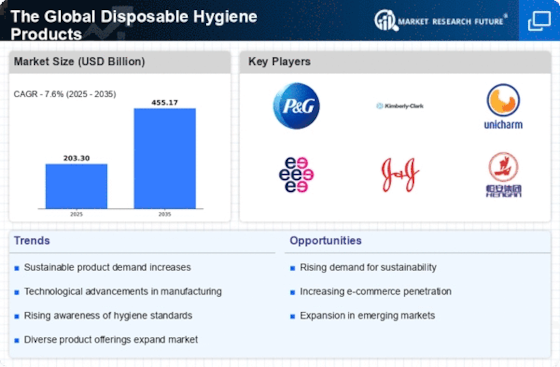
As per Market Research Future analysis, The Global Disposable Hygiene Products Market was estimated at 203.3 USD Billion in 2024. The market is projected to grow from 218.76 USD Billion in 2025 to 455.17 USD Billion by 2035, exhibiting a compound annual growth rate (CAGR) of 7.6% during the forecast period 2025 - 2035

Key Market Trends & Highlights

The Global Disposable Hygiene Products Market is experiencing robust growth driven by sustainability and technological advancements.

  • North America remains the largest market for disposable hygiene products, primarily due to high consumer demand and established retail channels. The Asia-Pacific region is identified as the fastest-growing market, fueled by increasing urbanization and rising disposable incomes. Diapers continue to dominate the market as the largest segment, while wipes are emerging as the fastest-growing category due to changing consumer preferences. Key market drivers include rising health awareness and innovations in product design, which are significantly influencing purchasing decisions.

Market Size & Forecast

2024 Market Size 203.3 (USD Billion)
2035 Market Size 455.17 (USD Billion)
CAGR (2025 - 2035) 7.6%
Largest Regional Market Share in 2024 North America

Major Players

<a href="https://in.pg.com/">Procter &amp; Gamble (US)</a>, Kimberly-Clark (US), Unicharm (JP), Essity (SE), <a href="https://www.jnj.com/">Johnson &amp; Johnson (US)</a>, Hengan International (CN), SCA Hygiene Products (SE), Ontex Group (BE), Pampers (US)

Market Trends

The Global Disposable Hygiene Products Market is currently experiencing a notable evolution, driven by various factors that influence consumer behavior and preferences. Increasing awareness regarding personal hygiene and health is prompting a shift towards disposable products, which are perceived as more convenient and sanitary. Additionally, the rise in disposable income in several regions appears to correlate with a growing demand for premium hygiene products, suggesting that consumers are willing to invest in quality items that enhance their daily routines. Furthermore, the expansion of e-commerce platforms facilitates easier access to a wide range of disposable hygiene products, thereby broadening market reach and consumer choice. Moreover, sustainability concerns are becoming increasingly prominent within The Global Disposable Hygiene Products Market. Manufacturers are exploring eco-friendly materials and production methods, indicating a potential shift towards biodegradable and recyclable options. This trend may reflect a growing consumer preference for products that align with environmental values. As the market continues to evolve, it seems likely that innovation will play a crucial role in shaping future offerings, with an emphasis on both functionality and sustainability. The interplay of these factors suggests a dynamic landscape that could redefine consumer expectations and industry standards in the coming years.

Sustainability Initiatives

There is a noticeable trend towards sustainability within The Global Disposable Hygiene Products Market. Companies are increasingly focusing on eco-friendly materials and production processes, aiming to reduce environmental impact. This shift may resonate with consumers who prioritize environmentally responsible choices.

Technological Advancements

Technological innovations are influencing product development in The Global Disposable Hygiene Products Market. Enhanced manufacturing techniques and smart product designs are emerging, potentially improving user experience and product efficiency. This trend indicates a commitment to meeting evolving consumer needs.

E-commerce Growth

The rise of e-commerce platforms is transforming The Global Disposable Hygiene Products Market. Online shopping offers consumers greater convenience and access to a diverse range of products. This trend suggests that digital channels will play a pivotal role in shaping purchasing behaviors.

Disposable Hygiene Products Market Market Drivers

E-commerce Expansion

The expansion of e-commerce platforms is transforming The Global Disposable Hygiene Products Industry. With the rise of online shopping, consumers now have greater access to a wide range of disposable hygiene products, often at competitive prices. E-commerce allows for discreet purchasing, which is particularly appealing for products that may be considered sensitive. Recent data indicates that online sales of hygiene products have surged, with e-commerce expected to account for a significant portion of total sales in the coming years. This shift towards online retail not only enhances consumer convenience but also provides manufacturers with new avenues for reaching their target audiences. As e-commerce continues to grow, it is likely to play a crucial role in shaping the future landscape of the disposable hygiene products market.

Rising Health Awareness

The increasing awareness regarding personal hygiene and health is a pivotal driver for The Global Disposable Hygiene Products Industry. Consumers are becoming more conscious of the importance of maintaining hygiene standards, particularly in urban areas where pollution and health risks are prevalent. This heightened awareness has led to a surge in demand for disposable hygiene products, such as sanitary pads, diapers, and wipes. Market data indicates that the hygiene products segment is projected to grow at a compound annual growth rate of approximately 5.5% over the next five years. This trend suggests that as health awareness continues to rise, the market for disposable hygiene products will likely expand, driven by consumer preferences for convenience and safety.

Innovations in Product Design

Innovations in product design and functionality are driving The Global Disposable Hygiene Products Industry forward. Manufacturers are increasingly focusing on developing products that offer enhanced comfort, absorbency, and eco-friendliness. For instance, the introduction of biodegradable materials and advanced absorbent technologies has attracted environmentally conscious consumers. Market data suggests that the demand for eco-friendly disposable hygiene products is on the rise, with a projected growth rate of 7% annually. This innovation not only meets consumer expectations but also aligns with broader sustainability goals, potentially positioning companies favorably in a competitive market. As product design continues to evolve, it is likely to influence purchasing decisions and drive market growth.

Population Growth and Urbanization

Population growth, coupled with rapid urbanization, serves as a significant driver for The Global Disposable Hygiene Products Industry. As more individuals migrate to urban centers, the demand for hygiene products increases due to higher population density and lifestyle changes. Urban areas often experience a greater need for disposable hygiene solutions, as residents seek convenient and efficient products to manage their hygiene needs. According to recent estimates, the urban population is expected to reach 68% by 2050, which could further amplify the demand for disposable hygiene products. This demographic shift indicates a potential market expansion, as manufacturers may need to adapt their offerings to cater to the evolving needs of urban consumers.

Increased Female Workforce Participation

The rise in female workforce participation is a notable driver for The Global Disposable Hygiene Products Industry. As more women enter the workforce, the demand for convenient hygiene solutions has escalated. Disposable hygiene products, such as tampons and panty liners, are increasingly viewed as essential items for working women, who often seek products that offer reliability and ease of use. Recent statistics indicate that female labor force participation has increased significantly in various regions, which correlates with a growing market for disposable hygiene products. This trend suggests that as women continue to balance professional and personal responsibilities, the demand for these products will likely remain robust, further propelling market growth.

Market Segment Insights

By Type: Diapers (Largest) vs. Wipes (Fastest-Growing)

In The Global Disposable Hygiene Products Market, the segment distribution reveals that diapers hold the largest share, signifying their essential role in personal care. They are a staple for households with infants and toddlers, driving consistent demand across various demographics. On the other hand, wipes have emerged as a strong contender, boasting significant popularity for their convenience and versatility, particularly among busy consumers and parents seeking quick solutions for cleanliness.

Diapers: Dominant vs. Wipes: Emerging

The diaper segment is characterized by its broad market acceptance and essentiality in daily care routines for infants, contributing to its dominant position. They come in various designs, catering to different consumer needs and preferences, ensuring a steady demand. Conversely, the wipes segment has seen exponential growth due to changing consumer lifestyles, which prioritize hygiene on-the-go. Wipes are often marketed as multi-purpose products, enhancing their appeal among parents, travelers, and professionals. This duality positions diapers as the foundational product while wipes capture the emerging, dynamic demand in the hygiene category.

By Distribution Channel: Supermarkets/Hypermarkets (Largest) vs. Online Stores (Fastest-Growing)

In The Global Disposable Hygiene Products Market, Supermarkets and Hypermarkets dominate the distribution landscape, holding a significant share due to their extensive reach and convenience. These retail giants offer a wide variety of disposable hygiene products under one roof, attracting a diverse customer base looking for convenience and competitive pricing. On the other hand, Online Stores are rapidly capturing market share, driven by the rise of e-commerce and increasing consumer preference for online shopping, especially in the post-pandemic era.

Supermarkets/Hypermarkets (Dominant) vs. Online Stores (Emerging)

Supermarkets and Hypermarkets serve as the dominant distribution channel in The Global Disposable Hygiene Products Market, prized for their ability to offer a wide array of products in an easily accessible manner. These brick-and-mortar establishments provide consumers with the experience of physically browsing and comparing products. In contrast, Online Stores represent an emerging force in this landscape, driven by technological advancements and a shift in shopping habits. The convenience and availability of online platforms are particularly appealing to younger demographics. As e-commerce continues to evolve, Online Stores are expected to grow rapidly, making them a formidable competitor to traditional retail formats.

Get more detailed insights about Disposable Hygiene Products Market Research Report – Forecast till 2035

Regional Insights

By region, the study provides the market insights into North America, Europe, Asia-Pacific and Rest of the World. The North American disposable hygiene products market area will dominate this market driven by the substantial demand for personal care items, such as wipes, diapers, razors, blades, and others, among the population of the United States and Canada. The U.S. Census Bureau, a federal government department in the United States, reported that in September 2021, sales at health and personal care retailers in the country totaled USD 4.3 million, an increase of 0.5% over August 2021.

Further, the major countries studied in the market report are the US, Canada, German, France, the UK, Italy, Spain, China, Japan, India, Australia, South Korea, and Brazil.

Figure 2:  DISPOSABLE HYGIENE PRODUCTS MARKET SHARE BY REGION 2022 (USD Billion)

Europe disposable hygiene products market accounts for the second-largest market share driven by the increased demand for flushable tissue paper products, including wipes, toilet paper, tampons, diapers, sanitary napkins, and menstrual management items, from a variety of away-from-home clients, including hospitals, hotels & restaurants, schools, and other institutions of higher learning. Additionally, the expansion of hospitals and hotels, along with rising hotel stays and visitor numbers, will probably increase the rate at which goods are consumed in the area.

Further, the German disposable hygiene products market held the largest market share, and the UK disposable hygiene products market was the fastest growing market in the European region.

The Asia-Pacific Disposable Hygiene Products Market is expected to grow at the fastest CAGR from 2023 to 2032. Due to the need for personal care items like diapers, toilet paper, wipes, and other items from the Chinese and Southeast Asian populations, Asia Pacific currently maintains the greatest market share. Additionally, rising purchasing power and awareness of hygiene and cleanliness are propelling market expansion in the area. Moreover, China’s disposable hygiene products market held the largest market share, and the Indian disposable hygiene products market was the fastest growing market in the Asia-Pacific region.

Key Players and Competitive Insights

Leading market players are investing heavily in research and development in order to expand their product lines, which will help the disposable hygiene products market grow even more. Market participants are also undertaking a variety of strategic activities to expand their footprint, with important market developments including new product launches, contractual agreements, mergers and acquisitions, higher investments, and collaboration with other organizations. To expand and survive in a more competitive and rising market climate, disposable hygiene products industry must offer cost-effective items.Manufacturing locally to minimize operational costs is one of the key business tactics used by manufacturers in the disposable hygiene products industry to benefit clients and increase the market sector. In recent years, the disposable hygiene products industry has offered some of the most significant advantages to medicine.Major players in the disposable hygiene products market are attempting to increase market demand by investing in research and development operations includes The Procter & Gamble Company (U.S.), Unicharm Corporation (Japan), Essity AB (Sweden), Kimberly-Clark Corporation (U.S.), Fujian Time and Tianhe Industrial Co., Ltd. (China), Hengan International Group Company Limited (China), DPL (Israel), Ontex BV (Belgium), The Edgewell Personal Care Company (U.S.), and Dispowear Sterite Company (India).A manufacturer based in Ohio; the Procter & Gamble Co. was founded in the United States. It began to exist in 1837. The company started off making soap and candles, but it has since broadened its range of products to meet a range of customer demands, including those for baby care, hair care, fabric care, grooming, home care, and oral care, among others. They market the products under some of their most well-known brands, such as Ariel, Tide, Pampers, Gillette, Head & Shoulders, and Safeguard, among others.
In May the Pampers Pure Protection Hybrid Diapers line of luxury fabric-based diapers that newborns can either discard or reuse was introduced by the Procter & Gamble Company. These goods have improved leakage protection features and very absorbent materials.Manufacturer, producer, and retailer of consumer tissue, personal care, and professional hygiene products is Essity AB (Essity), originally known as Essity Aktiebolag. The company's product line includes soaps, shampoos, lotions, baby oil, hand towels, wet wipes, napkins, kitchen rolls, handkerchiefs, facial tissues, and toilet paper. Additionally, the business sells orthopedic, compression treatment, and wound care goods.
In January a leading manufacturer of feminine care products, Essity, has introduced a line of washable and absorbent undergarments for women.

Key Companies in the Disposable Hygiene Products Market include

Industry Developments

  • Q2 2024: Kimberly-Clark appoints Deeptha Khanna as Chief Growth Officer Kimberly-Clark, a major player in the disposable hygiene products sector, announced the appointment of Deeptha Khanna as Chief Growth Officer, effective May 2024. The new executive role is aimed at accelerating the company’s innovation and global growth strategy.
  • Q2 2024: Essity inaugurates new sustainable production line for incontinence products in Germany Essity, a global hygiene and health company, opened a new production line for incontinence products at its plant in Mannheim, Germany. The facility features advanced energy-efficient technology to reduce environmental impact.
  • Q2 2024: P&G launches Always Cotton Protection pads in Europe Procter & Gamble expanded its feminine hygiene portfolio with the launch of Always Cotton Protection pads in several European markets, targeting consumers seeking products with organic cotton topsheets.
  • Q3 2024: Ontex Group sells Mexican personal hygiene business to Softys Ontex Group, a leading international provider of disposable hygiene products, completed the sale of its Mexican personal hygiene business to Softys, a hygiene company based in Chile, as part of its strategic portfolio optimization.
  • Q3 2024: Unicharm to open new diaper manufacturing facility in India Unicharm, a Japanese hygiene products manufacturer, announced plans to open a new diaper manufacturing facility in Gujarat, India, to meet growing demand in the South Asian market.
  • Q3 2024: Kimberly-Clark partners with TerraCycle to expand diaper recycling program in the UK Kimberly-Clark announced an expanded partnership with TerraCycle to increase the reach of its diaper recycling program in the United Kingdom, aiming to divert more used diapers from landfills.
  • Q4 2024: Essity acquires majority stake in Knix Wear Inc. Essity acquired a majority stake in Knix Wear Inc., a Canadian company specializing in leakproof underwear and period products, strengthening its position in the feminine hygiene and incontinence segments.
  • Q4 2024: Procter & Gamble invests $100 million in new diaper R&D center in Singapore Procter & Gamble announced a $100 million investment to establish a new research and development center in Singapore focused on innovation in baby and adult diaper technology.
  • Q1 2025: Hengan International launches biodegradable sanitary napkin line in China Hengan International, a leading Chinese hygiene products manufacturer, launched a new line of biodegradable sanitary napkins, responding to increasing consumer demand for sustainable disposable hygiene products.
  • Q1 2025: Ontex secures supply contract with major European supermarket chain Ontex Group announced it has secured a multi-year supply contract to provide private label baby diapers and adult incontinence products to a leading European supermarket chain.
  • Q2 2025: Kimberly-Clark invests $150 million to expand diaper production in Brazil Kimberly-Clark announced a $150 million investment to expand its diaper manufacturing capacity in Brazil, aiming to meet rising demand in Latin America.
  • Q2 2025: Essity launches TENA SmartCare, a digital incontinence care solution, in Europe Essity introduced TENA SmartCare, a digital solution for incontinence care, across several European countries. The product uses sensor technology to monitor moisture levels and improve care for elderly and disabled individuals.

Future Outlook

Disposable Hygiene Products Market Future Outlook

The Global Disposable Hygiene Products Market is projected to grow at a 7.6% CAGR from 2025 to 2035, driven by increasing consumer awareness and demand for convenience.

New opportunities lie in:

  • <p>Expansion into eco-friendly product lines Development of subscription-based delivery services Investment in smart hygiene technology solutions</p>

By 2035, the market is expected to achieve substantial growth, reflecting evolving consumer preferences and innovative product offerings.

Market Segmentation

Disposable Hygiene Products Market Type Outlook

  • Wipes
  • Diapers
  • Feminine Hygiene Products

Disposable Hygiene Products Market Distribution Channel Outlook

  • Supermarkets/Hypermarkets
  • Pharmacy Stores
  • Online Stores
  • Others

Report Scope

MARKET SIZE 2024 203.3(USD Billion)
MARKET SIZE 2025 218.76(USD Billion)
MARKET SIZE 2035 455.17(USD Billion)
COMPOUND ANNUAL GROWTH RATE (CAGR) 7.6% (2025 - 2035)
REPORT COVERAGE Revenue Forecast, Competitive Landscape, Growth Factors, and Trends
BASE YEAR 2024
Market Forecast Period 2025 - 2035
Historical Data 2019 - 2024
Market Forecast Units USD Billion
Key Companies Profiled Procter & Gamble (US), Kimberly-Clark (US), Unicharm (JP), Essity (SE), Johnson & Johnson (US), Hengan International (CN), SCA Hygiene Products (SE), Ontex Group (BE), Pampers (US)
Segments Covered Product Type, Distribution Channel, Region
Key Market Opportunities Growing demand for eco-friendly materials in The Global Disposable Hygiene Products presents significant opportunities.
Key Market Dynamics Rising consumer awareness drives demand for eco-friendly disposable hygiene products amid regulatory shifts and technological advancements.
Countries Covered North America, Europe, APAC, South America, MEA

FAQs

What is the current valuation of The Global Disposable Hygiene Products?

<p>The market valuation reached 203.3 USD Billion in 2024.</p>

What is the projected market size for The Global Disposable Hygiene Products by 2035?

<p>The market is expected to grow to 455.17 USD Billion by 2035.</p>

What is the expected CAGR for The Global Disposable Hygiene Products during the forecast period 2025 - 2035?

<p>The market is projected to experience a CAGR of 7.6% from 2025 to 2035.</p>

Which segments are included in The Global Disposable Hygiene Products?

<p>Key segments include Wipes, Diapers, and Feminine Hygiene Products.</p>

What were the market values for Wipes, Diapers, and Feminine Hygiene Products in 2024?

<p>In 2024, Wipes were valued at 40.66 USD Billion, Diapers at 85.0 USD Billion, and Feminine Hygiene Products at 77.64 USD Billion.</p>

How do distribution channels impact The Global Disposable Hygiene Products?

<p>Distribution channels such as Supermarkets/Hypermarkets, Pharmacy Stores, and Online Stores significantly influence market accessibility and sales.</p>

What were the market values for different distribution channels in 2024?

In 2024, Supermarkets/Hypermarkets were valued at 60.99 USD Billion, Pharmacy Stores at 30.99 USD Billion, and Online Stores at 50.0 USD Billion.

Who are the key players in The Global Disposable Hygiene Products?

Prominent players include Procter &amp; Gamble, Kimberly-Clark, Unicharm, Essity, and Johnson &amp; Johnson.

What is the anticipated growth trend for the Wipes segment from 2024 to 2035?

The Wipes segment is projected to grow from 40.66 USD Billion in 2024 to 90.0 USD Billion by 2035.

How does the performance of the Diapers segment compare to other segments in the market?

The Diapers segment, valued at 85.0 USD Billion in 2024, is expected to show substantial growth, potentially reaching 200.0 USD Billion by 2035.

  1. SECTION I: EXECUTIVE SUMMARY AND KEY HIGHLIGHTS
    1. | 1.1 EXECUTIVE SUMMARY
    2. | | 1.1.1 Market Overview
    3. | | 1.1.2 Key Findings
    4. | | 1.1.3 Market Segmentation
    5. | | 1.1.4 Competitive Landscape
    6. | | 1.1.5 Challenges and Opportunities
    7. | | 1.1.6 Future Outlook
  2. SECTION II: SCOPING, METHODOLOGY AND MARKET STRUCTURE
    1. | 2.1 MARKET INTRODUCTION
    2. | | 2.1.1 Definition
    3. | | 2.1.2 Scope of the study
    4. | | | 2.1.2.1 Research Objective
    5. | | | 2.1.2.2 Assumption
    6. | | | 2.1.2.3 Limitations
    7. | 2.2 RESEARCH METHODOLOGY
    8. | | 2.2.1 Overview
    9. | | 2.2.2 Data Mining
    10. | | 2.2.3 Secondary Research
    11. | | 2.2.4 Primary Research
    12. | | | 2.2.4.1 Primary Interviews and Information Gathering Process
    13. | | | 2.2.4.2 Breakdown of Primary Respondents
    14. | | 2.2.5 Forecasting Model
    15. | | 2.2.6 Market Size Estimation
    16. | | | 2.2.6.1 Bottom-Up Approach
    17. | | | 2.2.6.2 Top-Down Approach
    18. | | 2.2.7 Data Triangulation
    19. | | 2.2.8 Validation
  3. SECTION III: QUALITATIVE ANALYSIS
    1. | 3.1 MARKET DYNAMICS
    2. | | 3.1.1 Overview
    3. | | 3.1.2 Drivers
    4. | | 3.1.3 Restraints
    5. | | 3.1.4 Opportunities
    6. | 3.2 MARKET FACTOR ANALYSIS
    7. | | 3.2.1 Value chain Analysis
    8. | | 3.2.2 Porter's Five Forces Analysis
    9. | | | 3.2.2.1 Bargaining Power of Suppliers
    10. | | | 3.2.2.2 Bargaining Power of Buyers
    11. | | | 3.2.2.3 Threat of New Entrants
    12. | | | 3.2.2.4 Threat of Substitutes
    13. | | | 3.2.2.5 Intensity of Rivalry
    14. | | 3.2.3 COVID-19 Impact Analysis
    15. | | | 3.2.3.1 Market Impact Analysis
    16. | | | 3.2.3.2 Regional Impact
    17. | | | 3.2.3.3 Opportunity and Threat Analysis
  4. SECTION IV: QUANTITATIVE ANALYSIS
    1. | 4.1 Consumer and Retail, BY Type (USD Billion)
    2. | | 4.1.1 Wipes
    3. | | 4.1.2 Diapers
    4. | | 4.1.3 Feminine Hygiene Products
    5. | 4.2 Consumer and Retail, BY Distribution Channel (USD Billion)
    6. | | 4.2.1 Supermarkets/Hypermarkets
    7. | | 4.2.2 Pharmacy Stores
    8. | | 4.2.3 Online Stores
    9. | | 4.2.4 Others
    10. | 4.3 Consumer and Retail, BY Region (USD Billion)
    11. | | 4.3.1 North America
    12. | | | 4.3.1.1 US
    13. | | | 4.3.1.2 Canada
    14. | | 4.3.2 Europe
    15. | | | 4.3.2.1 Germany
    16. | | | 4.3.2.2 UK
    17. | | | 4.3.2.3 France
    18. | | | 4.3.2.4 Russia
    19. | | | 4.3.2.5 Italy
    20. | | | 4.3.2.6 Spain
    21. | | | 4.3.2.7 Rest of Europe
    22. | | 4.3.3 APAC
    23. | | | 4.3.3.1 China
    24. | | | 4.3.3.2 India
    25. | | | 4.3.3.3 Japan
    26. | | | 4.3.3.4 South Korea
    27. | | | 4.3.3.5 Malaysia
    28. | | | 4.3.3.6 Thailand
    29. | | | 4.3.3.7 Indonesia
    30. | | | 4.3.3.8 Rest of APAC
    31. | | 4.3.4 South America
    32. | | | 4.3.4.1 Brazil
    33. | | | 4.3.4.2 Mexico
    34. | | | 4.3.4.3 Argentina
    35. | | | 4.3.4.4 Rest of South America
    36. | | 4.3.5 MEA
    37. | | | 4.3.5.1 GCC Countries
    38. | | | 4.3.5.2 South Africa
    39. | | | 4.3.5.3 Rest of MEA
  5. SECTION V: COMPETITIVE ANALYSIS
    1. | 5.1 Competitive Landscape
    2. | | 5.1.1 Overview
    3. | | 5.1.2 Competitive Analysis
    4. | | 5.1.3 Market share Analysis
    5. | | 5.1.4 Major Growth Strategy in the Consumer and Retail
    6. | | 5.1.5 Competitive Benchmarking
    7. | | 5.1.6 Leading Players in Terms of Number of Developments in the Consumer and Retail
    8. | | 5.1.7 Key developments and growth strategies
    9. | | | 5.1.7.1 New Product Launch/Service Deployment
    10. | | | 5.1.7.2 Merger & Acquisitions
    11. | | | 5.1.7.3 Joint Ventures
    12. | | 5.1.8 Major Players Financial Matrix
    13. | | | 5.1.8.1 Sales and Operating Income
    14. | | | 5.1.8.2 Major Players R&D Expenditure. 2023
    15. | 5.2 Company Profiles
    16. | | 5.2.1 Procter & Gamble (US)
    17. | | | 5.2.1.1 Financial Overview
    18. | | | 5.2.1.2 Products Offered
    19. | | | 5.2.1.3 Key Developments
    20. | | | 5.2.1.4 SWOT Analysis
    21. | | | 5.2.1.5 Key Strategies
    22. | | 5.2.2 Kimberly-Clark (US)
    23. | | | 5.2.2.1 Financial Overview
    24. | | | 5.2.2.2 Products Offered
    25. | | | 5.2.2.3 Key Developments
    26. | | | 5.2.2.4 SWOT Analysis
    27. | | | 5.2.2.5 Key Strategies
    28. | | 5.2.3 Unicharm (JP)
    29. | | | 5.2.3.1 Financial Overview
    30. | | | 5.2.3.2 Products Offered
    31. | | | 5.2.3.3 Key Developments
    32. | | | 5.2.3.4 SWOT Analysis
    33. | | | 5.2.3.5 Key Strategies
    34. | | 5.2.4 Essity (SE)
    35. | | | 5.2.4.1 Financial Overview
    36. | | | 5.2.4.2 Products Offered
    37. | | | 5.2.4.3 Key Developments
    38. | | | 5.2.4.4 SWOT Analysis
    39. | | | 5.2.4.5 Key Strategies
    40. | | 5.2.5 Johnson & Johnson (US)
    41. | | | 5.2.5.1 Financial Overview
    42. | | | 5.2.5.2 Products Offered
    43. | | | 5.2.5.3 Key Developments
    44. | | | 5.2.5.4 SWOT Analysis
    45. | | | 5.2.5.5 Key Strategies
    46. | | 5.2.6 Hengan International (CN)
    47. | | | 5.2.6.1 Financial Overview
    48. | | | 5.2.6.2 Products Offered
    49. | | | 5.2.6.3 Key Developments
    50. | | | 5.2.6.4 SWOT Analysis
    51. | | | 5.2.6.5 Key Strategies
    52. | | 5.2.7 SCA Hygiene Products (SE)
    53. | | | 5.2.7.1 Financial Overview
    54. | | | 5.2.7.2 Products Offered
    55. | | | 5.2.7.3 Key Developments
    56. | | | 5.2.7.4 SWOT Analysis
    57. | | | 5.2.7.5 Key Strategies
    58. | | 5.2.8 Ontex Group (BE)
    59. | | | 5.2.8.1 Financial Overview
    60. | | | 5.2.8.2 Products Offered
    61. | | | 5.2.8.3 Key Developments
    62. | | | 5.2.8.4 SWOT Analysis
    63. | | | 5.2.8.5 Key Strategies
    64. | | 5.2.9 Pampers (US)
    65. | | | 5.2.9.1 Financial Overview
    66. | | | 5.2.9.2 Products Offered
    67. | | | 5.2.9.3 Key Developments
    68. | | | 5.2.9.4 SWOT Analysis
    69. | | | 5.2.9.5 Key Strategies
    70. | 5.3 Appendix
    71. | | 5.3.1 References
    72. | | 5.3.2 Related Reports
  6. LIST OF FIGURES
    1. | 6.1 MARKET SYNOPSIS
    2. | 6.2 NORTH AMERICA MARKET ANALYSIS
    3. | 6.3 US MARKET ANALYSIS BY TYPE
    4. | 6.4 US MARKET ANALYSIS BY DISTRIBUTION CHANNEL
    5. | 6.5 CANADA MARKET ANALYSIS BY TYPE
    6. | 6.6 CANADA MARKET ANALYSIS BY DISTRIBUTION CHANNEL
    7. | 6.7 EUROPE MARKET ANALYSIS
    8. | 6.8 GERMANY MARKET ANALYSIS BY TYPE
    9. | 6.9 GERMANY MARKET ANALYSIS BY DISTRIBUTION CHANNEL
    10. | 6.10 UK MARKET ANALYSIS BY TYPE
    11. | 6.11 UK MARKET ANALYSIS BY DISTRIBUTION CHANNEL
    12. | 6.12 FRANCE MARKET ANALYSIS BY TYPE
    13. | 6.13 FRANCE MARKET ANALYSIS BY DISTRIBUTION CHANNEL
    14. | 6.14 RUSSIA MARKET ANALYSIS BY TYPE
    15. | 6.15 RUSSIA MARKET ANALYSIS BY DISTRIBUTION CHANNEL
    16. | 6.16 ITALY MARKET ANALYSIS BY TYPE
    17. | 6.17 ITALY MARKET ANALYSIS BY DISTRIBUTION CHANNEL
    18. | 6.18 SPAIN MARKET ANALYSIS BY TYPE
    19. | 6.19 SPAIN MARKET ANALYSIS BY DISTRIBUTION CHANNEL
    20. | 6.20 REST OF EUROPE MARKET ANALYSIS BY TYPE
    21. | 6.21 REST OF EUROPE MARKET ANALYSIS BY DISTRIBUTION CHANNEL
    22. | 6.22 APAC MARKET ANALYSIS
    23. | 6.23 CHINA MARKET ANALYSIS BY TYPE
    24. | 6.24 CHINA MARKET ANALYSIS BY DISTRIBUTION CHANNEL
    25. | 6.25 INDIA MARKET ANALYSIS BY TYPE
    26. | 6.26 INDIA MARKET ANALYSIS BY DISTRIBUTION CHANNEL
    27. | 6.27 JAPAN MARKET ANALYSIS BY TYPE
    28. | 6.28 JAPAN MARKET ANALYSIS BY DISTRIBUTION CHANNEL
    29. | 6.29 SOUTH KOREA MARKET ANALYSIS BY TYPE
    30. | 6.30 SOUTH KOREA MARKET ANALYSIS BY DISTRIBUTION CHANNEL
    31. | 6.31 MALAYSIA MARKET ANALYSIS BY TYPE
    32. | 6.32 MALAYSIA MARKET ANALYSIS BY DISTRIBUTION CHANNEL
    33. | 6.33 THAILAND MARKET ANALYSIS BY TYPE
    34. | 6.34 THAILAND MARKET ANALYSIS BY DISTRIBUTION CHANNEL
    35. | 6.35 INDONESIA MARKET ANALYSIS BY TYPE
    36. | 6.36 INDONESIA MARKET ANALYSIS BY DISTRIBUTION CHANNEL
    37. | 6.37 REST OF APAC MARKET ANALYSIS BY TYPE
    38. | 6.38 REST OF APAC MARKET ANALYSIS BY DISTRIBUTION CHANNEL
    39. | 6.39 SOUTH AMERICA MARKET ANALYSIS
    40. | 6.40 BRAZIL MARKET ANALYSIS BY TYPE
    41. | 6.41 BRAZIL MARKET ANALYSIS BY DISTRIBUTION CHANNEL
    42. | 6.42 MEXICO MARKET ANALYSIS BY TYPE
    43. | 6.43 MEXICO MARKET ANALYSIS BY DISTRIBUTION CHANNEL
    44. | 6.44 ARGENTINA MARKET ANALYSIS BY TYPE
    45. | 6.45 ARGENTINA MARKET ANALYSIS BY DISTRIBUTION CHANNEL
    46. | 6.46 REST OF SOUTH AMERICA MARKET ANALYSIS BY TYPE
    47. | 6.47 REST OF SOUTH AMERICA MARKET ANALYSIS BY DISTRIBUTION CHANNEL
    48. | 6.48 MEA MARKET ANALYSIS
    49. | 6.49 GCC COUNTRIES MARKET ANALYSIS BY TYPE
    50. | 6.50 GCC COUNTRIES MARKET ANALYSIS BY DISTRIBUTION CHANNEL
    51. | 6.51 SOUTH AFRICA MARKET ANALYSIS BY TYPE
    52. | 6.52 SOUTH AFRICA MARKET ANALYSIS BY DISTRIBUTION CHANNEL
    53. | 6.53 REST OF MEA MARKET ANALYSIS BY TYPE
    54. | 6.54 REST OF MEA MARKET ANALYSIS BY DISTRIBUTION CHANNEL
    55. | 6.55 KEY BUYING CRITERIA OF CONSUMER AND RETAIL
    56. | 6.56 RESEARCH PROCESS OF MRFR
    57. | 6.57 DRO ANALYSIS OF CONSUMER AND RETAIL
    58. | 6.58 DRIVERS IMPACT ANALYSIS: CONSUMER AND RETAIL
    59. | 6.59 RESTRAINTS IMPACT ANALYSIS: CONSUMER AND RETAIL
    60. | 6.60 SUPPLY / VALUE CHAIN: CONSUMER AND RETAIL
    61. | 6.61 CONSUMER AND RETAIL, BY TYPE, 2024 (% SHARE)
    62. | 6.62 CONSUMER AND RETAIL, BY TYPE, 2024 TO 2035 (USD Billion)
    63. | 6.63 CONSUMER AND RETAIL, BY DISTRIBUTION CHANNEL, 2024 (% SHARE)
    64. | 6.64 CONSUMER AND RETAIL, BY DISTRIBUTION CHANNEL, 2024 TO 2035 (USD Billion)
    65. | 6.65 BENCHMARKING OF MAJOR COMPETITORS
  7. LIST OF TABLES
    1. | 7.1 LIST OF ASSUMPTIONS
    2. | | 7.1.1
    3. | 7.2 North America MARKET SIZE ESTIMATES; FORECAST
    4. | | 7.2.1 BY TYPE, 2025-2035 (USD Billion)
    5. | | 7.2.2 BY DISTRIBUTION CHANNEL, 2025-2035 (USD Billion)
    6. | 7.3 US MARKET SIZE ESTIMATES; FORECAST
    7. | | 7.3.1 BY TYPE, 2025-2035 (USD Billion)
    8. | | 7.3.2 BY DISTRIBUTION CHANNEL, 2025-2035 (USD Billion)
    9. | 7.4 Canada MARKET SIZE ESTIMATES; FORECAST
    10. | | 7.4.1 BY TYPE, 2025-2035 (USD Billion)
    11. | | 7.4.2 BY DISTRIBUTION CHANNEL, 2025-2035 (USD Billion)
    12. | 7.5 Europe MARKET SIZE ESTIMATES; FORECAST
    13. | | 7.5.1 BY TYPE, 2025-2035 (USD Billion)
    14. | | 7.5.2 BY DISTRIBUTION CHANNEL, 2025-2035 (USD Billion)
    15. | 7.6 Germany MARKET SIZE ESTIMATES; FORECAST
    16. | | 7.6.1 BY TYPE, 2025-2035 (USD Billion)
    17. | | 7.6.2 BY DISTRIBUTION CHANNEL, 2025-2035 (USD Billion)
    18. | 7.7 UK MARKET SIZE ESTIMATES; FORECAST
    19. | | 7.7.1 BY TYPE, 2025-2035 (USD Billion)
    20. | | 7.7.2 BY DISTRIBUTION CHANNEL, 2025-2035 (USD Billion)
    21. | 7.8 France MARKET SIZE ESTIMATES; FORECAST
    22. | | 7.8.1 BY TYPE, 2025-2035 (USD Billion)
    23. | | 7.8.2 BY DISTRIBUTION CHANNEL, 2025-2035 (USD Billion)
    24. | 7.9 Russia MARKET SIZE ESTIMATES; FORECAST
    25. | | 7.9.1 BY TYPE, 2025-2035 (USD Billion)
    26. | | 7.9.2 BY DISTRIBUTION CHANNEL, 2025-2035 (USD Billion)
    27. | 7.10 Italy MARKET SIZE ESTIMATES; FORECAST
    28. | | 7.10.1 BY TYPE, 2025-2035 (USD Billion)
    29. | | 7.10.2 BY DISTRIBUTION CHANNEL, 2025-2035 (USD Billion)
    30. | 7.11 Spain MARKET SIZE ESTIMATES; FORECAST
    31. | | 7.11.1 BY TYPE, 2025-2035 (USD Billion)
    32. | | 7.11.2 BY DISTRIBUTION CHANNEL, 2025-2035 (USD Billion)
    33. | 7.12 Rest of Europe MARKET SIZE ESTIMATES; FORECAST
    34. | | 7.12.1 BY TYPE, 2025-2035 (USD Billion)
    35. | | 7.12.2 BY DISTRIBUTION CHANNEL, 2025-2035 (USD Billion)
    36. | 7.13 APAC MARKET SIZE ESTIMATES; FORECAST
    37. | | 7.13.1 BY TYPE, 2025-2035 (USD Billion)
    38. | | 7.13.2 BY DISTRIBUTION CHANNEL, 2025-2035 (USD Billion)
    39. | 7.14 China MARKET SIZE ESTIMATES; FORECAST
    40. | | 7.14.1 BY TYPE, 2025-2035 (USD Billion)
    41. | | 7.14.2 BY DISTRIBUTION CHANNEL, 2025-2035 (USD Billion)
    42. | 7.15 India MARKET SIZE ESTIMATES; FORECAST
    43. | | 7.15.1 BY TYPE, 2025-2035 (USD Billion)
    44. | | 7.15.2 BY DISTRIBUTION CHANNEL, 2025-2035 (USD Billion)
    45. | 7.16 Japan MARKET SIZE ESTIMATES; FORECAST
    46. | | 7.16.1 BY TYPE, 2025-2035 (USD Billion)
    47. | | 7.16.2 BY DISTRIBUTION CHANNEL, 2025-2035 (USD Billion)
    48. | 7.17 South Korea MARKET SIZE ESTIMATES; FORECAST
    49. | | 7.17.1 BY TYPE, 2025-2035 (USD Billion)
    50. | | 7.17.2 BY DISTRIBUTION CHANNEL, 2025-2035 (USD Billion)
    51. | 7.18 Malaysia MARKET SIZE ESTIMATES; FORECAST
    52. | | 7.18.1 BY TYPE, 2025-2035 (USD Billion)
    53. | | 7.18.2 BY DISTRIBUTION CHANNEL, 2025-2035 (USD Billion)
    54. | 7.19 Thailand MARKET SIZE ESTIMATES; FORECAST
    55. | | 7.19.1 BY TYPE, 2025-2035 (USD Billion)
    56. | | 7.19.2 BY DISTRIBUTION CHANNEL, 2025-2035 (USD Billion)
    57. | 7.20 Indonesia MARKET SIZE ESTIMATES; FORECAST
    58. | | 7.20.1 BY TYPE, 2025-2035 (USD Billion)
    59. | | 7.20.2 BY DISTRIBUTION CHANNEL, 2025-2035 (USD Billion)
    60. | 7.21 Rest of APAC MARKET SIZE ESTIMATES; FORECAST
    61. | | 7.21.1 BY TYPE, 2025-2035 (USD Billion)
    62. | | 7.21.2 BY DISTRIBUTION CHANNEL, 2025-2035 (USD Billion)
    63. | 7.22 South America MARKET SIZE ESTIMATES; FORECAST
    64. | | 7.22.1 BY TYPE, 2025-2035 (USD Billion)
    65. | | 7.22.2 BY DISTRIBUTION CHANNEL, 2025-2035 (USD Billion)
    66. | 7.23 Brazil MARKET SIZE ESTIMATES; FORECAST
    67. | | 7.23.1 BY TYPE, 2025-2035 (USD Billion)
    68. | | 7.23.2 BY DISTRIBUTION CHANNEL, 2025-2035 (USD Billion)
    69. | 7.24 Mexico MARKET SIZE ESTIMATES; FORECAST
    70. | | 7.24.1 BY TYPE, 2025-2035 (USD Billion)
    71. | | 7.24.2 BY DISTRIBUTION CHANNEL, 2025-2035 (USD Billion)
    72. | 7.25 Argentina MARKET SIZE ESTIMATES; FORECAST
    73. | | 7.25.1 BY TYPE, 2025-2035 (USD Billion)
    74. | | 7.25.2 BY DISTRIBUTION CHANNEL, 2025-2035 (USD Billion)
    75. | 7.26 Rest of South America MARKET SIZE ESTIMATES; FORECAST
    76. | | 7.26.1 BY TYPE, 2025-2035 (USD Billion)
    77. | | 7.26.2 BY DISTRIBUTION CHANNEL, 2025-2035 (USD Billion)
    78. | 7.27 MEA MARKET SIZE ESTIMATES; FORECAST
    79. | | 7.27.1 BY TYPE, 2025-2035 (USD Billion)
    80. | | 7.27.2 BY DISTRIBUTION CHANNEL, 2025-2035 (USD Billion)
    81. | 7.28 GCC Countries MARKET SIZE ESTIMATES; FORECAST
    82. | | 7.28.1 BY TYPE, 2025-2035 (USD Billion)
    83. | | 7.28.2 BY DISTRIBUTION CHANNEL, 2025-2035 (USD Billion)
    84. | 7.29 South Africa MARKET SIZE ESTIMATES; FORECAST
    85. | | 7.29.1 BY TYPE, 2025-2035 (USD Billion)
    86. | | 7.29.2 BY DISTRIBUTION CHANNEL, 2025-2035 (USD Billion)
    87. | 7.30 Rest of MEA MARKET SIZE ESTIMATES; FORECAST
    88. | | 7.30.1 BY TYPE, 2025-2035 (USD Billion)
    89. | | 7.30.2 BY DISTRIBUTION CHANNEL, 2025-2035 (USD Billion)
    90. | 7.31 PRODUCT LAUNCH/PRODUCT DEVELOPMENT/APPROVAL
    91. | | 7.31.1
    92. | 7.32 ACQUISITION/PARTNERSHIP
    93. | | 7.32.1

Consumer and Retail Market Segmentation

Consumer and Retail By Type (USD Billion, 2025-2035)

  • Wipes
  • Diapers
  • Feminine Hygiene Products

Consumer and Retail By Distribution Channel (USD Billion, 2025-2035)

  • Supermarkets/Hypermarkets
  • Pharmacy Stores
  • Online Stores
  • Others
Infographic

Free Sample Request

Kindly complete the form below to receive a free sample of this Report

Get Free Sample

Customer Strories

Compare Licence

×
Features License Type
Single User Multiuser License Enterprise User
Price $4,950 $5,950 $7,250
Maximum User Access Limit 1 User Upto 10 Users Unrestricted Access Throughout the Organization
Free Customization
Direct Access to Analyst
Deliverable Format
Platform Access
Discount on Next Purchase 10% 15% 15%
Printable Versions
%>