
×
Request Free Sample ×

Kindly complete the form below to receive a free sample of this Report

* Please use a valid business email

Leading companies partner with us for data-driven Insights

clients tt-cursor
Hero Background
English
Chinese
French
Japanese
Korean
German
Spanish

Digital Workspace Market Trends

ID: MRFR/SEM/10420-CR
191 Pages
Ankit Gupta
July 2023

Digital Workspace Market Size, Share and Research Report By Component (Solution, Services), By Organization Size (SMEs, Large Enterprises), By Deployment Model (Cloud, On-premise), By Vertical (BFSI, IT & Telecommunications, Retail & E-Commerce, Healthcare, Manufacturing, Government & Public Sector, Others), Region (North America, Europe, Asia-Pacific, Middle East & Africa, and South America) - Industry Forecast Till 2035

Share:
Download PDF ×

We do not share your information with anyone. However, we may send you emails based on your report interest from time to time. You may contact us at any time to opt-out.

Digital Workspace Market Infographic
Purchase Options

Market Trends

Key Emerging Trends in the Digital Workspace Market

The digital workspace market is undergoing rapid evolution and transformation, driven by the increasing adoption of remote work, digital collaboration tools, and cloud-based technologies. A digital workspace encompasses a suite of software applications, communication tools, and productivity solutions that enable employees to access corporate resources, collaborate with colleagues, and perform their tasks from anywhere, using any device. As we explore the market trends of the digital workspace, several key factors emerge that are shaping its trajectory.

One prominent trend in the digital workspace market is the rising demand for flexible and agile work environments, fueled by the shift towards remote and hybrid work models. With the COVID-19 pandemic reshaping the way organizations operate and employees work, there is a growing need for digital solutions that facilitate seamless remote collaboration, communication, and productivity. Digital workspace platforms that offer features such as virtual desktop infrastructure (VDI), unified communication and collaboration (UCC), and secure remote access are in high demand, enabling businesses to support remote workforces effectively and maintain business continuity in a distributed work environment.

Moreover, the convergence of technologies such as cloud computing, artificial intelligence (AI), and mobile computing is driving innovation in the digital workspace market, enabling organizations to deliver personalized, context-aware experiences to employees. Cloud-based digital workspace solutions offer scalability, flexibility, and cost-effectiveness, allowing organizations to deploy and manage virtual desktops, applications, and data from centralized platforms. AI-powered analytics and automation capabilities enhance user experience, optimize resource utilization, and provide insights into user behavior and productivity patterns, enabling organizations to make data-driven decisions and improve operational efficiency.

Another significant trend shaping the digital workspace market is the increasing focus on cybersecurity and data protection in light of growing cyber threats and regulatory compliance requirements. As organizations embrace digital transformation and adopt cloud-based collaboration tools and mobile devices, they are faced with new security challenges related to data privacy, identity management, and endpoint security. Digital workspace providers are integrating advanced security features such as multifactor authentication (MFA), data encryption, and endpoint detection and response (EDR) into their platforms to safeguard sensitive information, prevent unauthorized access, and mitigate the risk of data breaches and cyber attacks.

Furthermore, the digital workspace market is witnessing a shift towards integrated, all-in-one solutions that consolidate disparate tools and applications into unified platforms, streamlining user experience and enhancing productivity. Modern digital workspace platforms offer seamless integration with third-party applications, business systems, and cloud services, enabling users to access and collaborate on documents, emails, calendars, and other resources from a single interface. By eliminating silos, reducing complexity, and improving interoperability, integrated digital workspace solutions empower employees to work more efficiently, collaborate more effectively, and adapt to changing work environments and business requirements.

Additionally, the COVID-19 pandemic has accelerated the adoption of digital workspace solutions as organizations seek to enable remote work, support distributed teams, and enhance employee productivity and engagement. With the shift towards remote and hybrid work models expected to persist in the post-pandemic era, the demand for digital workspace technologies that enable flexible work arrangements, virtual collaboration, and secure remote access is poised to continue growing. As organizations navigate the challenges of remote work and digital transformation, digital workspace providers are innovating and evolving their offerings to meet the evolving needs of customers and address emerging trends in the digital workplace.


Author
Ankit Gupta
Team Lead - Research

Ankit Gupta is a seasoned market intelligence and strategic research professional with over six plus years of experience in the ICT and Semiconductor industries. With academic roots in Telecom, Marketing, and Electronics, he blends technical insight with business strategy. Ankit has led 200+ projects, including work for Fortune 500 clients like Microsoft and Rio Tinto, covering market sizing, tech forecasting, and go-to-market strategies. Known for bridging engineering and enterprise decision-making, his insights support growth, innovation, and investment planning across diverse technology markets.

Leave a Comment

FAQs

What is the current valuation of the Digital Workspace Market as of 2024?

<p>The Digital Workspace Market was valued at 23957.01 USD Billion in 2024.</p>

What is the projected market size for the Digital Workspace Market by 2035?

<p>The market is projected to reach 125179.18 USD Billion by 2035.</p>

What is the expected CAGR for the Digital Workspace Market during the forecast period 2025 - 2035?

<p>The expected CAGR for the Digital Workspace Market during 2025 - 2035 is 16.22%.</p>

Which companies are considered key players in the Digital Workspace Market?

<p>Key players include Microsoft, Google, IBM, Cisco, Salesforce, VMware, Atlassian, Citrix, ServiceNow, and Zoho.</p>

How is the Digital Workspace Market segmented by organization size?

<p>The market is segmented into SMEs, valued at 7190.0 USD Billion, and Large Enterprises, valued at 16767.01 USD Billion.</p>

What are the primary deployment models in the Digital Workspace Market?

The primary deployment models are Cloud, valued at 14300.0 USD Billion, and On-premises, valued at 9657.01 USD Billion.

Which verticals are driving growth in the Digital Workspace Market?

Key verticals include BFSI, IT &amp; Telecommunications, Retail &amp; E-Commerce, Healthcare, Manufacturing, and Government &amp; Public Sector.

What was the valuation of the Digital Workspace Market for services in 2024?

The valuation for services in the Digital Workspace Market was 11978.51 USD Billion in 2024.

What is the projected growth for the IT & Telecommunications sector within the Digital Workspace Market?

The IT &amp; Telecommunications sector is projected to grow from 6000.0 USD Billion to 30000.0 USD Billion by 2035.

How does the Digital Workspace Market's performance compare across different verticals?

The BFSI sector leads with a valuation of 4000.0 USD Billion, while the Government &amp; Public Sector is valued at 2000.0 USD Billion.

Market Summary

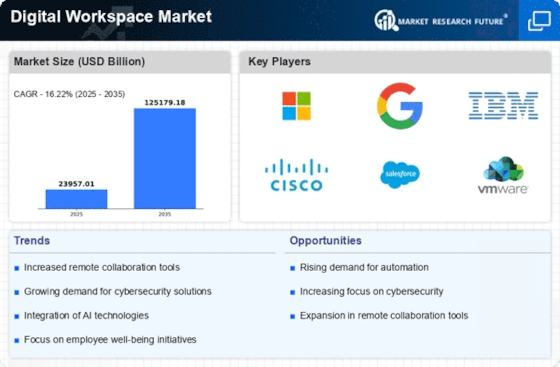
As per Market Research Future analysis, the Digital Workspace Market Size was estimated at 23957.01 USD Billion in 2024. The Digital Workspace industry is projected to grow from USD 27842.89 Billion in 2025 to USD 125179.18 Billion by 2035, exhibiting a compound annual growth rate (CAGR) of 16.22% during the forecast period 2025 - 2035

Key Market Trends & Highlights

The Digital Workspace Market is experiencing robust growth driven by technological advancements and evolving workplace dynamics.

  • The market witnesses increased adoption of cloud technologies, particularly in North America, which remains the largest market.
  • A pronounced focus on employee experience is shaping digital workspace strategies, especially among SMEs.
  • Integration of artificial intelligence is becoming a pivotal trend, enhancing productivity and operational efficiency.
  • The rise of remote work culture and growing demand for collaboration tools are key drivers propelling market expansion in both North America and Asia-Pacific.

Market Size & Forecast

2024 Market Size 23957.01 (USD Billion)
2035 Market Size 125179.18 (USD Billion)
CAGR (2025 - 2035) 16.22%
Largest Regional Market Share in 2024 North America

Major Players

Microsoft (US), Google (US), IBM (US), Cisco (US), Salesforce (US), VMware (US), Atlassian (AU), Citrix (US), ServiceNow (US), Zoho (IN)

Market Trends

The Digital Workspace Market is currently experiencing a transformative phase, characterized by the integration of advanced technologies and evolving work practices. Organizations are increasingly adopting digital solutions to enhance collaboration, streamline operations, and improve employee engagement. This shift is driven by the need for flexibility and efficiency in work environments, as businesses seek to adapt to changing demands and expectations. The rise of remote work and the growing reliance on cloud-based tools are reshaping how teams interact and perform tasks, suggesting a fundamental change in workplace dynamics. Moreover, the emphasis on user experience and accessibility is becoming paramount. Companies are investing in platforms that not only facilitate communication but also foster a sense of community among employees. This trend indicates a broader recognition of the importance of mental well-being and work-life balance in the modern workplace. As organizations continue to navigate this evolving landscape, the Digital Workspace Market is poised for further growth, driven by innovation and a commitment to enhancing productivity and satisfaction among the workforce.

Increased Adoption of Cloud Technologies

Organizations are increasingly leveraging cloud-based solutions to enhance their operational capabilities. This trend reflects a shift towards more flexible and scalable work environments, allowing teams to collaborate seamlessly regardless of their physical location.

Focus on Employee Experience

There is a growing emphasis on creating a positive employee experience within digital workspaces. Companies are prioritizing tools and platforms that promote engagement, collaboration, and well-being, recognizing that satisfied employees contribute to overall productivity.

Integration of Artificial Intelligence

The incorporation of Artificial Intelligence into digital workspaces is becoming more prevalent. AI technologies are being utilized to automate routine tasks, analyze data, and provide insights, thereby enabling employees to focus on more strategic initiatives.

Digital Workspace Market Market Drivers

Rise of Remote Work Culture

The Digital Workspace Market Industry is experiencing a notable rise in remote work culture, which has become a defining characteristic of modern employment. Organizations are increasingly adopting flexible work arrangements, allowing employees to work from various locations. This shift is driven by the need for enhanced work-life balance and the desire for greater autonomy among workers. According to recent data, approximately 30% of the workforce is now engaged in remote work, a trend that is likely to continue. This transformation necessitates robust digital workspace solutions that facilitate collaboration, communication, and productivity, thereby propelling the growth of the Digital Workspace Market Industry.

Integration of Advanced Analytics

The integration of advanced analytics into digital workspaces is becoming a pivotal driver for the Digital Workspace Market Industry. Organizations are increasingly leveraging data analytics to gain insights into employee performance, project management, and operational efficiency. By utilizing analytics tools, companies can make informed decisions that enhance productivity and streamline workflows. The analytics market is projected to grow significantly, with estimates suggesting it could reach USD 200 billion by 2025. This trend indicates that organizations are recognizing the value of data-driven decision-making, which is likely to shape the future landscape of the Digital Workspace Market Industry.

Emphasis on Cybersecurity Solutions

In the context of the Digital Workspace Market Industry, the emphasis on cybersecurity solutions is intensifying as organizations seek to protect sensitive data and maintain compliance with regulations. With the rise of remote work and digital collaboration, vulnerabilities to cyber threats have increased significantly. Organizations are investing in advanced cybersecurity measures, including encryption, multi-factor authentication, and threat detection systems. The cybersecurity market is expected to grow to USD 300 billion by 2024, indicating a strong correlation with the expansion of the Digital Workspace Market Industry. This focus on security not only safeguards organizational assets but also fosters trust among employees and clients.

Focus on Sustainability Initiatives

The Digital Workspace Market Industry is also influenced by a growing focus on sustainability initiatives. Organizations are increasingly adopting eco-friendly practices, which include reducing their carbon footprint through digital solutions. The shift towards remote work and digital collaboration tools is seen as a way to minimize travel-related emissions and resource consumption. Recent studies suggest that companies implementing sustainable practices can enhance their brand reputation and attract environmentally conscious consumers. This trend is likely to drive innovation within the Digital Workspace Market Industry, as organizations seek to align their operations with sustainability goals.

Growing Demand for Collaboration Tools

The Digital Workspace Market Industry is witnessing a growing demand for collaboration tools that enable seamless communication among distributed teams. As organizations expand their geographical reach, the need for effective collaboration becomes paramount. Tools such as video conferencing, project management software, and real-time document sharing are increasingly being integrated into digital workspaces. Recent statistics indicate that the market for collaboration tools is projected to reach USD 50 billion by 2026, reflecting a compound annual growth rate of over 15%. This surge in demand underscores the importance of collaboration in enhancing productivity and engagement within the Digital Workspace Market Industry.

Market Segment Insights

By Component: Solution (Largest) vs. Services (Fastest-Growing)

The Digital Workspace Market is predominantly driven by solutions, which hold the largest market share compared to services. Solutions encompass integrated platforms that facilitate collaboration and streamline workflow processes for organizations. These solutions have established a strong foothold in the market as they offer comprehensive tools that cater to various business needs, making them the preferred choice for many enterprises. On the other hand, services, while currently accounting for a smaller portion of the market, are gaining traction due to the growing need for customized approaches to digital transformation and remote work enhancement.

Service Model: Solution (Dominant) vs. Services (Emerging)

In the Digital Workspace Market, the solution model is considered dominant as it provides a broad array of applications integrated into a cohesive platform. Solutions are pivotal in enhancing productivity and collaboration within organizations, offering seamless integration and user-friendly interfaces. Conversely, services are emerging as a significant market force, driven by the demand for consultancy and support in implementing these solutions effectively. As remote work and digital collaboration become the norm, the importance of services that include training, customization, and ongoing support is escalating, allowing businesses to adapt their technological infrastructure to meet evolving needs.

By Organization Size: SMEs (Largest) vs. Large Enterprises (Fastest-Growing)

In the context of the Digital Workspace Market, the market share distribution indicates that SMEs hold the largest proportion, reflecting their adaptability and resourcefulness in adopting digital solutions. Their widespread adoption stems from the need for enhanced collaboration tools, remote accessibility, and cost-effective solutions. In contrast, large enterprises, while currently possessing a smaller share, are rapidly increasing their footprint within this market as they invest in comprehensive digital transformation strategies to maintain competitiveness and operational efficiency.

Digital Workspace Market Adoption: SMEs (Dominant) vs. Large Enterprises (Emerging)

The Digital Workspace Market comprises two significant segments: SMEs and Large Enterprises. SMEs dominate the market due to their agility and ability to quickly implement innovative digital solutions, which enhance productivity and collaboration. They often leverage cloud-based platforms that align with their flexible operational needs and budget constraints. Large Enterprises, on the other hand, represent an emerging segment experiencing rapid growth, driven by substantial investments in digital transformation initiatives. These organizations are increasingly adopting large-scale digital workspace solutions to optimize internal processes, improve workforce collaboration, and enable remote working strategies, thus transforming their organizational structure in the digital era.

By Deployment Model: Cloud (Largest) vs. On-premises (Fastest-Growing)

In the Digital Workspace Market, the deployment model segment showcases a clear distinction in market share between Cloud and On-premises solutions. Currently, Cloud dominates the landscape, reflecting a strong preference from organizations looking for scalability and flexibility in operations. In contrast, On-premises deployment is gaining traction, particularly among enterprises focusing on security and compliance, as they move to embrace digital transformation initiatives.

Cloud (Dominant) vs. On-premises (Emerging)

Cloud deployment models are primarily favored due to their ability to support remote and hybrid work environments seamlessly. Organizations benefit from reduced IT overhead and robust scalability options, making Cloud the dominant choice in the Digital Workspace Market. On the other hand, On-premises models are emerging rapidly as businesses prioritize data security and control, leading to increased investment in these solutions. Enterprises with stringent regulatory requirements find On-premises to be the most suitable option, providing them with the necessary infrastructure to adhere to compliance standards while transitioning to digital workspaces.

By Vertical: BFSI (Largest) vs. IT & Telecommunications (Fastest-Growing)

The Digital Workspace Market is closely tied to several verticals, with BFSI holding a dominant position due to its substantial adoption of digital tools for customer engagement and operational efficiency. This sector significantly influences the overall market share, ensuring a strong foundation for growth. Following closely is the IT & Telecommunications sector, which is leveraging digital workspace innovations to enhance collaboration and connectivity among teams, further solidifying its substantial presence in the market. The growth trends within the Digital Workspace Market are being driven by technological advancements and an increasing demand for flexibility in work arrangements. BFSI continues to expand its digital footprint as it adapts to shifting customer expectations and regulatory requirements. Meanwhile, the IT & Telecommunications sector is experiencing rapid growth, attributed to the rise of remote work and the need for robust digital infrastructure that supports interconnected work environments.

BFSI (Dominant) vs. Healthcare (Emerging)

In the Digital Workspace Market, BFSI stands out as the dominant vertical, characterized by its established frameworks for digital transformation and an emphasis on security and compliance. This sector is highly regulated, prompting ongoing investments in technologies that facilitate secure transactions and customer interactions. Conversely, Healthcare is emerging as a promising vertical, driven by a significant push towards telehealth solutions and digital record-keeping. The pandemic has accelerated the adoption of digital workspaces within healthcare, making it essential for enhancing patient care and operational efficiency. Both segments play crucial roles in the market, with BFSI leading in maturity and stability while Healthcare is on a rapid trajectory toward digital integration.

Get more detailed insights about Digital Workspace Market Research Report—Global Forecast till 2035

Regional Insights

Asia-Pacific : Rapid Growth and Adoption

Asia-Pacific is witnessing rapid growth in the digital workspace market, holding approximately 20% of the global share. The region's expansion is driven by increasing internet penetration, a growing workforce, and a shift towards remote work solutions. Countries like India and China are at the forefront, supported by favorable government policies that encourage digital innovation and infrastructure development. India, in particular, is emerging as a key player, with a burgeoning tech industry and a strong presence of companies like Zoho. The competitive landscape is characterized by a mix of established players and startups, fostering innovation and diverse offerings. As businesses increasingly adopt digital solutions, the region is poised for significant growth in the coming years, making it a vital market for digital workspace solutions.

Middle East and Africa : Untapped Potential and Growth

The Middle East and Africa region is gradually emerging in the digital workspace market, currently holding about 5% of the global share. The growth is driven by increasing investments in technology infrastructure and a rising demand for digital solutions among businesses. Governments in the region are also promoting digital transformation initiatives, which are expected to catalyze market growth in the coming years. Countries like South Africa and the UAE are leading the charge, with a growing number of companies adopting digital workspace solutions to enhance productivity and collaboration. The competitive landscape is evolving, with both local and international players entering the market. As awareness of digital solutions increases, the region is set to experience significant growth, making it an attractive market for investment and innovation.

Key Players and Competitive Insights

The Digital Workspace Market is currently characterized by a dynamic competitive landscape, driven by rapid technological advancements and an increasing demand for flexible work solutions. Major players such as Microsoft (US), Google (US), and IBM (US) are at the forefront, each adopting distinct strategies to enhance their market positioning. Microsoft (US) continues to innovate with its Microsoft 365 suite, focusing on integrating AI capabilities to streamline workflows and improve user experience. Google (US), on the other hand, emphasizes collaboration through its Google Workspace, leveraging its cloud infrastructure to facilitate seamless communication and project management. IBM (US) is strategically investing in hybrid cloud solutions, aiming to provide businesses with the flexibility to operate across various environments, thus enhancing operational efficiency. Collectively, these strategies not only intensify competition but also foster a culture of continuous improvement and adaptation within the market.In terms of business tactics, companies are increasingly localizing their operations and optimizing supply chains to respond to regional demands effectively. The Digital Workspace Market appears moderately fragmented, with a mix of established players and emerging startups vying for market share. The collective influence of key players is significant, as they set industry standards and drive innovation, thereby shaping the overall market structure.

In September Microsoft (US) announced a strategic partnership with a leading AI firm to enhance its productivity tools. This collaboration aims to integrate advanced AI features into Microsoft Teams, potentially revolutionizing how teams collaborate and communicate. The strategic importance of this move lies in Microsoft's commitment to maintaining its competitive edge by leveraging cutting-edge technology to meet evolving customer needs.

In August Google (US) launched a new initiative focused on sustainability within its Google Workspace offerings. This initiative includes tools designed to help organizations track and reduce their carbon footprints. The strategic significance of this development reflects a growing trend towards environmental responsibility, positioning Google as a leader in promoting sustainable business practices within the digital workspace.

In July IBM (US) unveiled a new hybrid cloud platform aimed at enhancing data security and compliance for enterprises. This platform is particularly relevant as businesses increasingly prioritize data protection in their digital transformation journeys. IBM's focus on security not only addresses a critical market need but also reinforces its reputation as a trusted provider in the digital workspace sector.

As of October current competitive trends in the Digital Workspace Market are heavily influenced by digitalization, sustainability, and the integration of AI technologies. Strategic alliances are becoming increasingly vital, as companies recognize the need to collaborate to enhance their offerings and address complex customer demands. Looking ahead, competitive differentiation is likely to evolve, shifting from traditional price-based competition to a focus on innovation, technological advancement, and supply chain reliability. This transition underscores the importance of agility and responsiveness in a rapidly changing market environment.

Key Companies in the Digital Workspace Market include

Industry Developments

May 2023: IBM launched IBM Hybrid Cloud Mesh, a SaaS product helps organizations manage their hybrid multicloud architecture. IBM Hybrid Cloud Mesh is intended to streamline the process, administration, and observability of application connectivity between public and private clouds, allowing modern businesses to efficiently manage their systems across hybrid multi-cloud and diverse environments.

March 2023: Hewlett Packard Enterprise acquired OpsRamp, an IT operations management (ITOM) company. By integrating OpsRamp's hybrid digitized operation management solution with the HPE GreenLake edge-to-cloud system along with assisting it with HPE services reduces the operational difficulty of multi-vendor and multi-cloud IT infrastructures in the public cloud, colocations, and on-premises.

March 2022: Microsoft Corporation published its second annual Work Trend Index report named as, "Great Expectations: Enabling Hybrid Work Work." The firm also unveiled new capabilities for Microsoft Teams, Microsoft 365, Surface Hub, and Microsoft Viva to enable hybrid work and fulfil employees' changing workplace expectations.

May 2021: Johnson Controls collaborated with DigiCert to deliver the next level of digital trust to smart building solutions. Their alliance accelerated smart building cybersecurity by streamlining the deployment and maintenance of public key infrastructure (PKI) and digital identities.

Intended Audience

  • Technology Investors
  • Regulatory Industries
  • Government Bodies
  • Defense industry

Future Outlook

Digital Workspace Market Future Outlook

The Digital Workspace Market is projected to grow at 16.22% CAGR from 2025 to 2035, driven by technological advancements, remote work trends, and increasing demand for collaboration tools.

New opportunities lie in:

  • Integration of AI-driven analytics for workspace optimization
  • Development of customizable virtual reality meeting environments
  • Expansion of cybersecurity solutions tailored for remote workforces

By 2035, the Digital Workspace Market is expected to be robust, reflecting substantial growth and innovation.

Market Segmentation

Digital Workspace Market Vertical Outlook

  • BFSI
  • IT & Telecommunications
  • Retail & E-Commerce
  • Healthcare
  • Manufacturing
  • Government & Public Sector
  • Others

Digital Workspace Market Component Outlook

  • Solution
  • Services

Digital Workspace Market Deployment Model Outlook

  • Cloud
  • On-premises

Digital Workspace Market Organization Size Outlook

  • SMEs
  • Large Enterprises

Report Scope

MARKET SIZE 2024 23957.01(USD Billion)
MARKET SIZE 2025 27842.89(USD Billion)
MARKET SIZE 2035 125179.18(USD Billion)
COMPOUND ANNUAL GROWTH RATE (CAGR) 16.22% (2025 - 2035)
REPORT COVERAGE Revenue Forecast, Competitive Landscape, Growth Factors, and Trends
BASE YEAR 2024
Market Forecast Period 2025 - 2035
Historical Data 2019 - 2024
Market Forecast Units USD Billion
Key Companies Profiled Microsoft (US), Google (US), IBM (US), Cisco (US), Salesforce (US), VMware (US), Atlassian (AU), Citrix (US), ServiceNow (US), Zoho (IN)
Segments Covered Component, Organization Size, Deployment Model, Vertical
Key Market Opportunities Integration of artificial intelligence and automation enhances productivity in the Digital Workspace Market.
Key Market Dynamics Rising demand for remote collaboration tools drives innovation and competition in the Digital Workspace Market.
Countries Covered North America, Europe, APAC, South America, MEA

FAQs

What is the current valuation of the Digital Workspace Market as of 2024?

<p>The Digital Workspace Market was valued at 23957.01 USD Billion in 2024.</p>

What is the projected market size for the Digital Workspace Market by 2035?

<p>The market is projected to reach 125179.18 USD Billion by 2035.</p>

What is the expected CAGR for the Digital Workspace Market during the forecast period 2025 - 2035?

<p>The expected CAGR for the Digital Workspace Market during 2025 - 2035 is 16.22%.</p>

Which companies are considered key players in the Digital Workspace Market?

<p>Key players include Microsoft, Google, IBM, Cisco, Salesforce, VMware, Atlassian, Citrix, ServiceNow, and Zoho.</p>

How is the Digital Workspace Market segmented by organization size?

<p>The market is segmented into SMEs, valued at 7190.0 USD Billion, and Large Enterprises, valued at 16767.01 USD Billion.</p>

What are the primary deployment models in the Digital Workspace Market?

The primary deployment models are Cloud, valued at 14300.0 USD Billion, and On-premises, valued at 9657.01 USD Billion.

Which verticals are driving growth in the Digital Workspace Market?

Key verticals include BFSI, IT &amp; Telecommunications, Retail &amp; E-Commerce, Healthcare, Manufacturing, and Government &amp; Public Sector.

What was the valuation of the Digital Workspace Market for services in 2024?

The valuation for services in the Digital Workspace Market was 11978.51 USD Billion in 2024.

What is the projected growth for the IT & Telecommunications sector within the Digital Workspace Market?

The IT &amp; Telecommunications sector is projected to grow from 6000.0 USD Billion to 30000.0 USD Billion by 2035.

How does the Digital Workspace Market's performance compare across different verticals?

The BFSI sector leads with a valuation of 4000.0 USD Billion, while the Government &amp; Public Sector is valued at 2000.0 USD Billion.

  1. SECTION I: EXECUTIVE SUMMARY AND KEY HIGHLIGHTS
    1. | 1.1 EXECUTIVE SUMMARY
    2. | | 1.1.1 Market Overview
    3. | | 1.1.2 Key Findings
    4. | | 1.1.3 Market Segmentation
    5. | | 1.1.4 Competitive Landscape
    6. | | 1.1.5 Challenges and Opportunities
    7. | | 1.1.6 Future Outlook
  2. SECTION II: SCOPING, METHODOLOGY AND MARKET STRUCTURE
    1. | 2.1 MARKET INTRODUCTION
    2. | | 2.1.1 Definition
    3. | | 2.1.2 Scope of the study
    4. | | | 2.1.2.1 Research Objective
    5. | | | 2.1.2.2 Assumption
    6. | | | 2.1.2.3 Limitations
    7. | 2.2 RESEARCH METHODOLOGY
    8. | | 2.2.1 Overview
    9. | | 2.2.2 Data Mining
    10. | | 2.2.3 Secondary Research
    11. | | 2.2.4 Primary Research
    12. | | | 2.2.4.1 Primary Interviews and Information Gathering Process
    13. | | | 2.2.4.2 Breakdown of Primary Respondents
    14. | | 2.2.5 Forecasting Model
    15. | | 2.2.6 Market Size Estimation
    16. | | | 2.2.6.1 Bottom-Up Approach
    17. | | | 2.2.6.2 Top-Down Approach
    18. | | 2.2.7 Data Triangulation
    19. | | 2.2.8 Validation
  3. SECTION III: QUALITATIVE ANALYSIS
    1. | 3.1 MARKET DYNAMICS
    2. | | 3.1.1 Overview
    3. | | 3.1.2 Drivers
    4. | | 3.1.3 Restraints
    5. | | 3.1.4 Opportunities
    6. | 3.2 MARKET FACTOR ANALYSIS
    7. | | 3.2.1 Value chain Analysis
    8. | | 3.2.2 Porter's Five Forces Analysis
    9. | | | 3.2.2.1 Bargaining Power of Suppliers
    10. | | | 3.2.2.2 Bargaining Power of Buyers
    11. | | | 3.2.2.3 Threat of New Entrants
    12. | | | 3.2.2.4 Threat of Substitutes
    13. | | | 3.2.2.5 Intensity of Rivalry
    14. | | 3.2.3 COVID-19 Impact Analysis
    15. | | | 3.2.3.1 Market Impact Analysis
    16. | | | 3.2.3.2 Regional Impact
    17. | | | 3.2.3.3 Opportunity and Threat Analysis
  4. SECTION IV: QUANTITATIVE ANALYSIS
    1. | 4.1 Semiconductor & Electronics, BY Component (USD Billion)
    2. | | 4.1.1 Solution
    3. | | 4.1.2 Services
    4. | 4.2 Semiconductor & Electronics, BY Organization Size (USD Billion)
    5. | | 4.2.1 SMEs
    6. | | 4.2.2 Large Enterprises
    7. | 4.3 Semiconductor & Electronics, BY Deployment Model (USD Billion)
    8. | | 4.3.1 Cloud
    9. | | 4.3.2 On-premises
    10. | 4.4 Semiconductor & Electronics, BY Vertical (USD Billion)
    11. | | 4.4.1 BFSI
    12. | | 4.4.2 IT & Telecommunications
    13. | | 4.4.3 Retail & E-Commerce
    14. | | 4.4.4 Healthcare
    15. | | 4.4.5 Manufacturing
    16. | | 4.4.6 Government & Public Sector
    17. | | 4.4.7 Others
    18. | 4.5 Semiconductor & Electronics, BY Region (USD Billion)
    19. | | 4.5.1 North America
    20. | | | 4.5.1.1 US
    21. | | | 4.5.1.2 Canada
    22. | | 4.5.2 Europe
    23. | | | 4.5.2.1 Germany
    24. | | | 4.5.2.2 UK
    25. | | | 4.5.2.3 France
    26. | | | 4.5.2.4 Russia
    27. | | | 4.5.2.5 Italy
    28. | | | 4.5.2.6 Spain
    29. | | | 4.5.2.7 Rest of Europe
    30. | | 4.5.3 APAC
    31. | | | 4.5.3.1 China
    32. | | | 4.5.3.2 India
    33. | | | 4.5.3.3 Japan
    34. | | | 4.5.3.4 South Korea
    35. | | | 4.5.3.5 Malaysia
    36. | | | 4.5.3.6 Thailand
    37. | | | 4.5.3.7 Indonesia
    38. | | | 4.5.3.8 Rest of APAC
    39. | | 4.5.4 South America
    40. | | | 4.5.4.1 Brazil
    41. | | | 4.5.4.2 Mexico
    42. | | | 4.5.4.3 Argentina
    43. | | | 4.5.4.4 Rest of South America
    44. | | 4.5.5 MEA
    45. | | | 4.5.5.1 GCC Countries
    46. | | | 4.5.5.2 South Africa
    47. | | | 4.5.5.3 Rest of MEA
  5. SECTION V: COMPETITIVE ANALYSIS
    1. | 5.1 Competitive Landscape
    2. | | 5.1.1 Overview
    3. | | 5.1.2 Competitive Analysis
    4. | | 5.1.3 Market share Analysis
    5. | | 5.1.4 Major Growth Strategy in the Semiconductor & Electronics
    6. | | 5.1.5 Competitive Benchmarking
    7. | | 5.1.6 Leading Players in Terms of Number of Developments in the Semiconductor & Electronics
    8. | | 5.1.7 Key developments and growth strategies
    9. | | | 5.1.7.1 New Product Launch/Service Deployment
    10. | | | 5.1.7.2 Merger & Acquisitions
    11. | | | 5.1.7.3 Joint Ventures
    12. | | 5.1.8 Major Players Financial Matrix
    13. | | | 5.1.8.1 Sales and Operating Income
    14. | | | 5.1.8.2 Major Players R&D Expenditure. 2023
    15. | 5.2 Company Profiles
    16. | | 5.2.1 Microsoft (US)
    17. | | | 5.2.1.1 Financial Overview
    18. | | | 5.2.1.2 Products Offered
    19. | | | 5.2.1.3 Key Developments
    20. | | | 5.2.1.4 SWOT Analysis
    21. | | | 5.2.1.5 Key Strategies
    22. | | 5.2.2 Google (US)
    23. | | | 5.2.2.1 Financial Overview
    24. | | | 5.2.2.2 Products Offered
    25. | | | 5.2.2.3 Key Developments
    26. | | | 5.2.2.4 SWOT Analysis
    27. | | | 5.2.2.5 Key Strategies
    28. | | 5.2.3 IBM (US)
    29. | | | 5.2.3.1 Financial Overview
    30. | | | 5.2.3.2 Products Offered
    31. | | | 5.2.3.3 Key Developments
    32. | | | 5.2.3.4 SWOT Analysis
    33. | | | 5.2.3.5 Key Strategies
    34. | | 5.2.4 Cisco (US)
    35. | | | 5.2.4.1 Financial Overview
    36. | | | 5.2.4.2 Products Offered
    37. | | | 5.2.4.3 Key Developments
    38. | | | 5.2.4.4 SWOT Analysis
    39. | | | 5.2.4.5 Key Strategies
    40. | | 5.2.5 Salesforce (US)
    41. | | | 5.2.5.1 Financial Overview
    42. | | | 5.2.5.2 Products Offered
    43. | | | 5.2.5.3 Key Developments
    44. | | | 5.2.5.4 SWOT Analysis
    45. | | | 5.2.5.5 Key Strategies
    46. | | 5.2.6 VMware (US)
    47. | | | 5.2.6.1 Financial Overview
    48. | | | 5.2.6.2 Products Offered
    49. | | | 5.2.6.3 Key Developments
    50. | | | 5.2.6.4 SWOT Analysis
    51. | | | 5.2.6.5 Key Strategies
    52. | | 5.2.7 Atlassian (AU)
    53. | | | 5.2.7.1 Financial Overview
    54. | | | 5.2.7.2 Products Offered
    55. | | | 5.2.7.3 Key Developments
    56. | | | 5.2.7.4 SWOT Analysis
    57. | | | 5.2.7.5 Key Strategies
    58. | | 5.2.8 Citrix (US)
    59. | | | 5.2.8.1 Financial Overview
    60. | | | 5.2.8.2 Products Offered
    61. | | | 5.2.8.3 Key Developments
    62. | | | 5.2.8.4 SWOT Analysis
    63. | | | 5.2.8.5 Key Strategies
    64. | | 5.2.9 ServiceNow (US)
    65. | | | 5.2.9.1 Financial Overview
    66. | | | 5.2.9.2 Products Offered
    67. | | | 5.2.9.3 Key Developments
    68. | | | 5.2.9.4 SWOT Analysis
    69. | | | 5.2.9.5 Key Strategies
    70. | | 5.2.10 Zoho (IN)
    71. | | | 5.2.10.1 Financial Overview
    72. | | | 5.2.10.2 Products Offered
    73. | | | 5.2.10.3 Key Developments
    74. | | | 5.2.10.4 SWOT Analysis
    75. | | | 5.2.10.5 Key Strategies
    76. | 5.3 Appendix
    77. | | 5.3.1 References
    78. | | 5.3.2 Related Reports
  6. LIST OF FIGURES
    1. | 6.1 MARKET SYNOPSIS
    2. | 6.2 NORTH AMERICA MARKET ANALYSIS
    3. | 6.3 US MARKET ANALYSIS BY COMPONENT
    4. | 6.4 US MARKET ANALYSIS BY ORGANIZATION SIZE
    5. | 6.5 US MARKET ANALYSIS BY DEPLOYMENT MODEL
    6. | 6.6 US MARKET ANALYSIS BY VERTICAL
    7. | 6.7 CANADA MARKET ANALYSIS BY COMPONENT
    8. | 6.8 CANADA MARKET ANALYSIS BY ORGANIZATION SIZE
    9. | 6.9 CANADA MARKET ANALYSIS BY DEPLOYMENT MODEL
    10. | 6.10 CANADA MARKET ANALYSIS BY VERTICAL
    11. | 6.11 EUROPE MARKET ANALYSIS
    12. | 6.12 GERMANY MARKET ANALYSIS BY COMPONENT
    13. | 6.13 GERMANY MARKET ANALYSIS BY ORGANIZATION SIZE
    14. | 6.14 GERMANY MARKET ANALYSIS BY DEPLOYMENT MODEL
    15. | 6.15 GERMANY MARKET ANALYSIS BY VERTICAL
    16. | 6.16 UK MARKET ANALYSIS BY COMPONENT
    17. | 6.17 UK MARKET ANALYSIS BY ORGANIZATION SIZE
    18. | 6.18 UK MARKET ANALYSIS BY DEPLOYMENT MODEL
    19. | 6.19 UK MARKET ANALYSIS BY VERTICAL
    20. | 6.20 FRANCE MARKET ANALYSIS BY COMPONENT
    21. | 6.21 FRANCE MARKET ANALYSIS BY ORGANIZATION SIZE
    22. | 6.22 FRANCE MARKET ANALYSIS BY DEPLOYMENT MODEL
    23. | 6.23 FRANCE MARKET ANALYSIS BY VERTICAL
    24. | 6.24 RUSSIA MARKET ANALYSIS BY COMPONENT
    25. | 6.25 RUSSIA MARKET ANALYSIS BY ORGANIZATION SIZE
    26. | 6.26 RUSSIA MARKET ANALYSIS BY DEPLOYMENT MODEL
    27. | 6.27 RUSSIA MARKET ANALYSIS BY VERTICAL
    28. | 6.28 ITALY MARKET ANALYSIS BY COMPONENT
    29. | 6.29 ITALY MARKET ANALYSIS BY ORGANIZATION SIZE
    30. | 6.30 ITALY MARKET ANALYSIS BY DEPLOYMENT MODEL
    31. | 6.31 ITALY MARKET ANALYSIS BY VERTICAL
    32. | 6.32 SPAIN MARKET ANALYSIS BY COMPONENT
    33. | 6.33 SPAIN MARKET ANALYSIS BY ORGANIZATION SIZE
    34. | 6.34 SPAIN MARKET ANALYSIS BY DEPLOYMENT MODEL
    35. | 6.35 SPAIN MARKET ANALYSIS BY VERTICAL
    36. | 6.36 REST OF EUROPE MARKET ANALYSIS BY COMPONENT
    37. | 6.37 REST OF EUROPE MARKET ANALYSIS BY ORGANIZATION SIZE
    38. | 6.38 REST OF EUROPE MARKET ANALYSIS BY DEPLOYMENT MODEL
    39. | 6.39 REST OF EUROPE MARKET ANALYSIS BY VERTICAL
    40. | 6.40 APAC MARKET ANALYSIS
    41. | 6.41 CHINA MARKET ANALYSIS BY COMPONENT
    42. | 6.42 CHINA MARKET ANALYSIS BY ORGANIZATION SIZE
    43. | 6.43 CHINA MARKET ANALYSIS BY DEPLOYMENT MODEL
    44. | 6.44 CHINA MARKET ANALYSIS BY VERTICAL
    45. | 6.45 INDIA MARKET ANALYSIS BY COMPONENT
    46. | 6.46 INDIA MARKET ANALYSIS BY ORGANIZATION SIZE
    47. | 6.47 INDIA MARKET ANALYSIS BY DEPLOYMENT MODEL
    48. | 6.48 INDIA MARKET ANALYSIS BY VERTICAL
    49. | 6.49 JAPAN MARKET ANALYSIS BY COMPONENT
    50. | 6.50 JAPAN MARKET ANALYSIS BY ORGANIZATION SIZE
    51. | 6.51 JAPAN MARKET ANALYSIS BY DEPLOYMENT MODEL
    52. | 6.52 JAPAN MARKET ANALYSIS BY VERTICAL
    53. | 6.53 SOUTH KOREA MARKET ANALYSIS BY COMPONENT
    54. | 6.54 SOUTH KOREA MARKET ANALYSIS BY ORGANIZATION SIZE
    55. | 6.55 SOUTH KOREA MARKET ANALYSIS BY DEPLOYMENT MODEL
    56. | 6.56 SOUTH KOREA MARKET ANALYSIS BY VERTICAL
    57. | 6.57 MALAYSIA MARKET ANALYSIS BY COMPONENT
    58. | 6.58 MALAYSIA MARKET ANALYSIS BY ORGANIZATION SIZE
    59. | 6.59 MALAYSIA MARKET ANALYSIS BY DEPLOYMENT MODEL
    60. | 6.60 MALAYSIA MARKET ANALYSIS BY VERTICAL
    61. | 6.61 THAILAND MARKET ANALYSIS BY COMPONENT
    62. | 6.62 THAILAND MARKET ANALYSIS BY ORGANIZATION SIZE
    63. | 6.63 THAILAND MARKET ANALYSIS BY DEPLOYMENT MODEL
    64. | 6.64 THAILAND MARKET ANALYSIS BY VERTICAL
    65. | 6.65 INDONESIA MARKET ANALYSIS BY COMPONENT
    66. | 6.66 INDONESIA MARKET ANALYSIS BY ORGANIZATION SIZE
    67. | 6.67 INDONESIA MARKET ANALYSIS BY DEPLOYMENT MODEL
    68. | 6.68 INDONESIA MARKET ANALYSIS BY VERTICAL
    69. | 6.69 REST OF APAC MARKET ANALYSIS BY COMPONENT
    70. | 6.70 REST OF APAC MARKET ANALYSIS BY ORGANIZATION SIZE
    71. | 6.71 REST OF APAC MARKET ANALYSIS BY DEPLOYMENT MODEL
    72. | 6.72 REST OF APAC MARKET ANALYSIS BY VERTICAL
    73. | 6.73 SOUTH AMERICA MARKET ANALYSIS
    74. | 6.74 BRAZIL MARKET ANALYSIS BY COMPONENT
    75. | 6.75 BRAZIL MARKET ANALYSIS BY ORGANIZATION SIZE
    76. | 6.76 BRAZIL MARKET ANALYSIS BY DEPLOYMENT MODEL
    77. | 6.77 BRAZIL MARKET ANALYSIS BY VERTICAL
    78. | 6.78 MEXICO MARKET ANALYSIS BY COMPONENT
    79. | 6.79 MEXICO MARKET ANALYSIS BY ORGANIZATION SIZE
    80. | 6.80 MEXICO MARKET ANALYSIS BY DEPLOYMENT MODEL
    81. | 6.81 MEXICO MARKET ANALYSIS BY VERTICAL
    82. | 6.82 ARGENTINA MARKET ANALYSIS BY COMPONENT
    83. | 6.83 ARGENTINA MARKET ANALYSIS BY ORGANIZATION SIZE
    84. | 6.84 ARGENTINA MARKET ANALYSIS BY DEPLOYMENT MODEL
    85. | 6.85 ARGENTINA MARKET ANALYSIS BY VERTICAL
    86. | 6.86 REST OF SOUTH AMERICA MARKET ANALYSIS BY COMPONENT
    87. | 6.87 REST OF SOUTH AMERICA MARKET ANALYSIS BY ORGANIZATION SIZE
    88. | 6.88 REST OF SOUTH AMERICA MARKET ANALYSIS BY DEPLOYMENT MODEL
    89. | 6.89 REST OF SOUTH AMERICA MARKET ANALYSIS BY VERTICAL
    90. | 6.90 MEA MARKET ANALYSIS
    91. | 6.91 GCC COUNTRIES MARKET ANALYSIS BY COMPONENT
    92. | 6.92 GCC COUNTRIES MARKET ANALYSIS BY ORGANIZATION SIZE
    93. | 6.93 GCC COUNTRIES MARKET ANALYSIS BY DEPLOYMENT MODEL
    94. | 6.94 GCC COUNTRIES MARKET ANALYSIS BY VERTICAL
    95. | 6.95 SOUTH AFRICA MARKET ANALYSIS BY COMPONENT
    96. | 6.96 SOUTH AFRICA MARKET ANALYSIS BY ORGANIZATION SIZE
    97. | 6.97 SOUTH AFRICA MARKET ANALYSIS BY DEPLOYMENT MODEL
    98. | 6.98 SOUTH AFRICA MARKET ANALYSIS BY VERTICAL
    99. | 6.99 REST OF MEA MARKET ANALYSIS BY COMPONENT
    100. | 6.100 REST OF MEA MARKET ANALYSIS BY ORGANIZATION SIZE
    101. | 6.101 REST OF MEA MARKET ANALYSIS BY DEPLOYMENT MODEL
    102. | 6.102 REST OF MEA MARKET ANALYSIS BY VERTICAL
    103. | 6.103 KEY BUYING CRITERIA OF SEMICONDUCTOR & ELECTRONICS
    104. | 6.104 RESEARCH PROCESS OF MRFR
    105. | 6.105 DRO ANALYSIS OF SEMICONDUCTOR & ELECTRONICS
    106. | 6.106 DRIVERS IMPACT ANALYSIS: SEMICONDUCTOR & ELECTRONICS
    107. | 6.107 RESTRAINTS IMPACT ANALYSIS: SEMICONDUCTOR & ELECTRONICS
    108. | 6.108 SUPPLY / VALUE CHAIN: SEMICONDUCTOR & ELECTRONICS
    109. | 6.109 SEMICONDUCTOR & ELECTRONICS, BY COMPONENT, 2024 (% SHARE)
    110. | 6.110 SEMICONDUCTOR & ELECTRONICS, BY COMPONENT, 2024 TO 2035 (USD Billion)
    111. | 6.111 SEMICONDUCTOR & ELECTRONICS, BY ORGANIZATION SIZE, 2024 (% SHARE)
    112. | 6.112 SEMICONDUCTOR & ELECTRONICS, BY ORGANIZATION SIZE, 2024 TO 2035 (USD Billion)
    113. | 6.113 SEMICONDUCTOR & ELECTRONICS, BY DEPLOYMENT MODEL, 2024 (% SHARE)
    114. | 6.114 SEMICONDUCTOR & ELECTRONICS, BY DEPLOYMENT MODEL, 2024 TO 2035 (USD Billion)
    115. | 6.115 SEMICONDUCTOR & ELECTRONICS, BY VERTICAL, 2024 (% SHARE)
    116. | 6.116 SEMICONDUCTOR & ELECTRONICS, BY VERTICAL, 2024 TO 2035 (USD Billion)
    117. | 6.117 BENCHMARKING OF MAJOR COMPETITORS
  7. LIST OF TABLES
    1. | 7.1 LIST OF ASSUMPTIONS
    2. | | 7.1.1
    3. | 7.2 North America MARKET SIZE ESTIMATES; FORECAST
    4. | | 7.2.1 BY COMPONENT, 2025-2035 (USD Billion)
    5. | | 7.2.2 BY ORGANIZATION SIZE, 2025-2035 (USD Billion)
    6. | | 7.2.3 BY DEPLOYMENT MODEL, 2025-2035 (USD Billion)
    7. | | 7.2.4 BY VERTICAL, 2025-2035 (USD Billion)
    8. | 7.3 US MARKET SIZE ESTIMATES; FORECAST
    9. | | 7.3.1 BY COMPONENT, 2025-2035 (USD Billion)
    10. | | 7.3.2 BY ORGANIZATION SIZE, 2025-2035 (USD Billion)
    11. | | 7.3.3 BY DEPLOYMENT MODEL, 2025-2035 (USD Billion)
    12. | | 7.3.4 BY VERTICAL, 2025-2035 (USD Billion)
    13. | 7.4 Canada MARKET SIZE ESTIMATES; FORECAST
    14. | | 7.4.1 BY COMPONENT, 2025-2035 (USD Billion)
    15. | | 7.4.2 BY ORGANIZATION SIZE, 2025-2035 (USD Billion)
    16. | | 7.4.3 BY DEPLOYMENT MODEL, 2025-2035 (USD Billion)
    17. | | 7.4.4 BY VERTICAL, 2025-2035 (USD Billion)
    18. | 7.5 Europe MARKET SIZE ESTIMATES; FORECAST
    19. | | 7.5.1 BY COMPONENT, 2025-2035 (USD Billion)
    20. | | 7.5.2 BY ORGANIZATION SIZE, 2025-2035 (USD Billion)
    21. | | 7.5.3 BY DEPLOYMENT MODEL, 2025-2035 (USD Billion)
    22. | | 7.5.4 BY VERTICAL, 2025-2035 (USD Billion)
    23. | 7.6 Germany MARKET SIZE ESTIMATES; FORECAST
    24. | | 7.6.1 BY COMPONENT, 2025-2035 (USD Billion)
    25. | | 7.6.2 BY ORGANIZATION SIZE, 2025-2035 (USD Billion)
    26. | | 7.6.3 BY DEPLOYMENT MODEL, 2025-2035 (USD Billion)
    27. | | 7.6.4 BY VERTICAL, 2025-2035 (USD Billion)
    28. | 7.7 UK MARKET SIZE ESTIMATES; FORECAST
    29. | | 7.7.1 BY COMPONENT, 2025-2035 (USD Billion)
    30. | | 7.7.2 BY ORGANIZATION SIZE, 2025-2035 (USD Billion)
    31. | | 7.7.3 BY DEPLOYMENT MODEL, 2025-2035 (USD Billion)
    32. | | 7.7.4 BY VERTICAL, 2025-2035 (USD Billion)
    33. | 7.8 France MARKET SIZE ESTIMATES; FORECAST
    34. | | 7.8.1 BY COMPONENT, 2025-2035 (USD Billion)
    35. | | 7.8.2 BY ORGANIZATION SIZE, 2025-2035 (USD Billion)
    36. | | 7.8.3 BY DEPLOYMENT MODEL, 2025-2035 (USD Billion)
    37. | | 7.8.4 BY VERTICAL, 2025-2035 (USD Billion)
    38. | 7.9 Russia MARKET SIZE ESTIMATES; FORECAST
    39. | | 7.9.1 BY COMPONENT, 2025-2035 (USD Billion)
    40. | | 7.9.2 BY ORGANIZATION SIZE, 2025-2035 (USD Billion)
    41. | | 7.9.3 BY DEPLOYMENT MODEL, 2025-2035 (USD Billion)
    42. | | 7.9.4 BY VERTICAL, 2025-2035 (USD Billion)
    43. | 7.10 Italy MARKET SIZE ESTIMATES; FORECAST
    44. | | 7.10.1 BY COMPONENT, 2025-2035 (USD Billion)
    45. | | 7.10.2 BY ORGANIZATION SIZE, 2025-2035 (USD Billion)
    46. | | 7.10.3 BY DEPLOYMENT MODEL, 2025-2035 (USD Billion)
    47. | | 7.10.4 BY VERTICAL, 2025-2035 (USD Billion)
    48. | 7.11 Spain MARKET SIZE ESTIMATES; FORECAST
    49. | | 7.11.1 BY COMPONENT, 2025-2035 (USD Billion)
    50. | | 7.11.2 BY ORGANIZATION SIZE, 2025-2035 (USD Billion)
    51. | | 7.11.3 BY DEPLOYMENT MODEL, 2025-2035 (USD Billion)
    52. | | 7.11.4 BY VERTICAL, 2025-2035 (USD Billion)
    53. | 7.12 Rest of Europe MARKET SIZE ESTIMATES; FORECAST
    54. | | 7.12.1 BY COMPONENT, 2025-2035 (USD Billion)
    55. | | 7.12.2 BY ORGANIZATION SIZE, 2025-2035 (USD Billion)
    56. | | 7.12.3 BY DEPLOYMENT MODEL, 2025-2035 (USD Billion)
    57. | | 7.12.4 BY VERTICAL, 2025-2035 (USD Billion)
    58. | 7.13 APAC MARKET SIZE ESTIMATES; FORECAST
    59. | | 7.13.1 BY COMPONENT, 2025-2035 (USD Billion)
    60. | | 7.13.2 BY ORGANIZATION SIZE, 2025-2035 (USD Billion)
    61. | | 7.13.3 BY DEPLOYMENT MODEL, 2025-2035 (USD Billion)
    62. | | 7.13.4 BY VERTICAL, 2025-2035 (USD Billion)
    63. | 7.14 China MARKET SIZE ESTIMATES; FORECAST
    64. | | 7.14.1 BY COMPONENT, 2025-2035 (USD Billion)
    65. | | 7.14.2 BY ORGANIZATION SIZE, 2025-2035 (USD Billion)
    66. | | 7.14.3 BY DEPLOYMENT MODEL, 2025-2035 (USD Billion)
    67. | | 7.14.4 BY VERTICAL, 2025-2035 (USD Billion)
    68. | 7.15 India MARKET SIZE ESTIMATES; FORECAST
    69. | | 7.15.1 BY COMPONENT, 2025-2035 (USD Billion)
    70. | | 7.15.2 BY ORGANIZATION SIZE, 2025-2035 (USD Billion)
    71. | | 7.15.3 BY DEPLOYMENT MODEL, 2025-2035 (USD Billion)
    72. | | 7.15.4 BY VERTICAL, 2025-2035 (USD Billion)
    73. | 7.16 Japan MARKET SIZE ESTIMATES; FORECAST
    74. | | 7.16.1 BY COMPONENT, 2025-2035 (USD Billion)
    75. | | 7.16.2 BY ORGANIZATION SIZE, 2025-2035 (USD Billion)
    76. | | 7.16.3 BY DEPLOYMENT MODEL, 2025-2035 (USD Billion)
    77. | | 7.16.4 BY VERTICAL, 2025-2035 (USD Billion)
    78. | 7.17 South Korea MARKET SIZE ESTIMATES; FORECAST
    79. | | 7.17.1 BY COMPONENT, 2025-2035 (USD Billion)
    80. | | 7.17.2 BY ORGANIZATION SIZE, 2025-2035 (USD Billion)
    81. | | 7.17.3 BY DEPLOYMENT MODEL, 2025-2035 (USD Billion)
    82. | | 7.17.4 BY VERTICAL, 2025-2035 (USD Billion)
    83. | 7.18 Malaysia MARKET SIZE ESTIMATES; FORECAST
    84. | | 7.18.1 BY COMPONENT, 2025-2035 (USD Billion)
    85. | | 7.18.2 BY ORGANIZATION SIZE, 2025-2035 (USD Billion)
    86. | | 7.18.3 BY DEPLOYMENT MODEL, 2025-2035 (USD Billion)
    87. | | 7.18.4 BY VERTICAL, 2025-2035 (USD Billion)
    88. | 7.19 Thailand MARKET SIZE ESTIMATES; FORECAST
    89. | | 7.19.1 BY COMPONENT, 2025-2035 (USD Billion)
    90. | | 7.19.2 BY ORGANIZATION SIZE, 2025-2035 (USD Billion)
    91. | | 7.19.3 BY DEPLOYMENT MODEL, 2025-2035 (USD Billion)
    92. | | 7.19.4 BY VERTICAL, 2025-2035 (USD Billion)
    93. | 7.20 Indonesia MARKET SIZE ESTIMATES; FORECAST
    94. | | 7.20.1 BY COMPONENT, 2025-2035 (USD Billion)
    95. | | 7.20.2 BY ORGANIZATION SIZE, 2025-2035 (USD Billion)
    96. | | 7.20.3 BY DEPLOYMENT MODEL, 2025-2035 (USD Billion)
    97. | | 7.20.4 BY VERTICAL, 2025-2035 (USD Billion)
    98. | 7.21 Rest of APAC MARKET SIZE ESTIMATES; FORECAST
    99. | | 7.21.1 BY COMPONENT, 2025-2035 (USD Billion)
    100. | | 7.21.2 BY ORGANIZATION SIZE, 2025-2035 (USD Billion)
    101. | | 7.21.3 BY DEPLOYMENT MODEL, 2025-2035 (USD Billion)
    102. | | 7.21.4 BY VERTICAL, 2025-2035 (USD Billion)
    103. | 7.22 South America MARKET SIZE ESTIMATES; FORECAST
    104. | | 7.22.1 BY COMPONENT, 2025-2035 (USD Billion)
    105. | | 7.22.2 BY ORGANIZATION SIZE, 2025-2035 (USD Billion)
    106. | | 7.22.3 BY DEPLOYMENT MODEL, 2025-2035 (USD Billion)
    107. | | 7.22.4 BY VERTICAL, 2025-2035 (USD Billion)
    108. | 7.23 Brazil MARKET SIZE ESTIMATES; FORECAST
    109. | | 7.23.1 BY COMPONENT, 2025-2035 (USD Billion)
    110. | | 7.23.2 BY ORGANIZATION SIZE, 2025-2035 (USD Billion)
    111. | | 7.23.3 BY DEPLOYMENT MODEL, 2025-2035 (USD Billion)
    112. | | 7.23.4 BY VERTICAL, 2025-2035 (USD Billion)
    113. | 7.24 Mexico MARKET SIZE ESTIMATES; FORECAST
    114. | | 7.24.1 BY COMPONENT, 2025-2035 (USD Billion)
    115. | | 7.24.2 BY ORGANIZATION SIZE, 2025-2035 (USD Billion)
    116. | | 7.24.3 BY DEPLOYMENT MODEL, 2025-2035 (USD Billion)
    117. | | 7.24.4 BY VERTICAL, 2025-2035 (USD Billion)
    118. | 7.25 Argentina MARKET SIZE ESTIMATES; FORECAST
    119. | | 7.25.1 BY COMPONENT, 2025-2035 (USD Billion)
    120. | | 7.25.2 BY ORGANIZATION SIZE, 2025-2035 (USD Billion)
    121. | | 7.25.3 BY DEPLOYMENT MODEL, 2025-2035 (USD Billion)
    122. | | 7.25.4 BY VERTICAL, 2025-2035 (USD Billion)
    123. | 7.26 Rest of South America MARKET SIZE ESTIMATES; FORECAST
    124. | | 7.26.1 BY COMPONENT, 2025-2035 (USD Billion)
    125. | | 7.26.2 BY ORGANIZATION SIZE, 2025-2035 (USD Billion)
    126. | | 7.26.3 BY DEPLOYMENT MODEL, 2025-2035 (USD Billion)
    127. | | 7.26.4 BY VERTICAL, 2025-2035 (USD Billion)
    128. | 7.27 MEA MARKET SIZE ESTIMATES; FORECAST
    129. | | 7.27.1 BY COMPONENT, 2025-2035 (USD Billion)
    130. | | 7.27.2 BY ORGANIZATION SIZE, 2025-2035 (USD Billion)
    131. | | 7.27.3 BY DEPLOYMENT MODEL, 2025-2035 (USD Billion)
    132. | | 7.27.4 BY VERTICAL, 2025-2035 (USD Billion)
    133. | 7.28 GCC Countries MARKET SIZE ESTIMATES; FORECAST
    134. | | 7.28.1 BY COMPONENT, 2025-2035 (USD Billion)
    135. | | 7.28.2 BY ORGANIZATION SIZE, 2025-2035 (USD Billion)
    136. | | 7.28.3 BY DEPLOYMENT MODEL, 2025-2035 (USD Billion)
    137. | | 7.28.4 BY VERTICAL, 2025-2035 (USD Billion)
    138. | 7.29 South Africa MARKET SIZE ESTIMATES; FORECAST
    139. | | 7.29.1 BY COMPONENT, 2025-2035 (USD Billion)
    140. | | 7.29.2 BY ORGANIZATION SIZE, 2025-2035 (USD Billion)
    141. | | 7.29.3 BY DEPLOYMENT MODEL, 2025-2035 (USD Billion)
    142. | | 7.29.4 BY VERTICAL, 2025-2035 (USD Billion)
    143. | 7.30 Rest of MEA MARKET SIZE ESTIMATES; FORECAST
    144. | | 7.30.1 BY COMPONENT, 2025-2035 (USD Billion)
    145. | | 7.30.2 BY ORGANIZATION SIZE, 2025-2035 (USD Billion)
    146. | | 7.30.3 BY DEPLOYMENT MODEL, 2025-2035 (USD Billion)
    147. | | 7.30.4 BY VERTICAL, 2025-2035 (USD Billion)
    148. | 7.31 PRODUCT LAUNCH/PRODUCT DEVELOPMENT/APPROVAL
    149. | | 7.31.1
    150. | 7.32 ACQUISITION/PARTNERSHIP
    151. | | 7.32.1

Semiconductor & Electronics Market Segmentation

Semiconductor & Electronics By Component (USD Billion, 2025-2035)

  • Solution
  • Services

Semiconductor & Electronics By Organization Size (USD Billion, 2025-2035)

  • SMEs
  • Large Enterprises

Semiconductor & Electronics By Deployment Model (USD Billion, 2025-2035)

  • Cloud
  • On-premises

Semiconductor & Electronics By Vertical (USD Billion, 2025-2035)

  • BFSI
  • IT & Telecommunications
  • Retail & E-Commerce
  • Healthcare
  • Manufacturing
  • Government & Public Sector
  • Others
Infographic

Free Sample Request

Kindly complete the form below to receive a free sample of this Report

Get Free Sample

Customer Strories

Compare Licence

×
Features License Type
Single User Multiuser License Enterprise User
Price $4,950 $5,950 $7,250
Maximum User Access Limit 1 User Upto 10 Users Unrestricted Access Throughout the Organization
Free Customization
Direct Access to Analyst
Deliverable Format
Platform Access
Discount on Next Purchase 10% 15% 15%
Printable Versions