
Request Free Sample ×

Kindly complete the form below to receive a free sample of this Report

* Please use a valid business email

Leading companies partner with us for data-driven Insights

clients tt-cursor
Hero Background
English
Chinese
French
Japanese
Korean
German
Spanish

Digital Human (AI Avatars) Market Trends

ID: MRFR/ICT/10703-HCR
215 Pages
Nirmit Biswas
March 2026

Digital Human (AI Avatars) Market Size, Share and Trends Analysis Report By Product Type (Interactive Digital Human Avatar and Non-Interactive Digital Human Avatar), Technology (3D Scanning, 3D Modelling, Natural Language Processing, Natural Language Generation, Artificial Intelligence (AI)), Application (Virtual Agents, Virtual Assistants, Virtual Influencers, Virtual Companions), Industry Vertical (Gaming, Retail, Entertainment, BFSI, IT & Telecommunications, Education, Health & Sports, Automotive, Advertisement), By Regions Forecast Till 2035

Share:
Download PDF ×

We do not share your information with anyone. However, we may send you emails based on your report interest from time to time. You may contact us at any time to opt-out.

Digital Human AI Avatars Market Infographic
Purchase Options

Market Trends

Key Emerging Trends in the Digital Human AI Avatars Market

The Digital Human market is experiencing fast growth with companies in this sector positioning themselves strategically for competitive advantage. For example, major strategies include developing life-like digital clones of people using advanced technologies such as artificial intelligence (AI), augmented reality (AR) and natural language processing (NLP). Companies therefore offer highly lifelike and interactive digital people who can be used across a variety of applications ranging from serving customers online to guiding children through virtual worlds. This strategy makes businesses ideal by providing flexible and interesting experiences to users with demand for customization and interactivity growing rapidly among many industries.

In the Digital Human sector, market share positioning depends on user experience and interface design. The organizations that adopt more intuitive and easy-to-use interfaces built for digital humans increase their access to this technology. User experience should be immersive and flawless so that the digital human application can be perceived in a positive light by most people who try it out. In order to appeal to users from a range of backgrounds and demographics, companies are embracing user-centric designs that encourage the adoption of technology.

Personalization and customization are necessary for positioning strategies in the digital human industry. There exist companies which deal with customized human robots appearance, behavior as well as other characteristics meant for different scenarios. Businesses have integrated avatars of customer service knowing well that they can use them for educational purposes or promote products using them or offer help to customers in need of customer services among other applications.Creating digital personae specific to the needs of various brands, industries or even purposes like education makes business look not only flexible but also responsive to varying requirements of these groups in terms of offering personalised solutions, hence positioning themselves as providers of adaptable tailored solutions. This approach recognizes the differences existing between industries thereby leading more widespread application of digital human systems.

Digital Human market shares position is deeply grounded on interactivity and responsiveness goals. Better user experiences result from developing dynamic virtual representatives who are aware of context such as in a face-to-face interactive talk between two persons where the audience is involved into conversational action. In virtual customer care fields, education sectors and entertainments, incorporation responsive avatars increases overall satisfaction among users while contributing toward success rate achieved by those applications concerning Digital Humans’ development.This strategy makes businesses leaders because they create lifelike emotive experiences when it comes to interactions done by computerized individuals that clearly distinguishes them from their peers within industry.

Digital Human market share positions can also be shaped through cross-industry collaboration efforts. Through partnerships with healthcare organizations, retailers, schools or colleges and media companies, businesses can come up with custom-designed human digital solutions aligned to the peculiar needs of these sectors. Through diverse partnerships in all areas, full-featured applications for this technology have been developed hence increasing its penetration into various markets. Cross-industry collaboration demonstrates that these firms are flexible problem-solvers who can tackle a range of issues affecting different industries.

The Digital Human market is increasingly influenced by ethical concerns and responsible use of AI. Companies that prioritize ethical AI design, data privacy, and transparent use of digital human technologies build trust among users and stakeholders. By addressing privacy concerns and security issues as well as considering ethical elements put on manufacturing realistic copies of people through computers, firms demonstrate their commitment to using technology responsibly. User trust is maintained while still highlighting corporate responsibility referring to moral practices observed during creation and implementation of computerized human beings.


Author
Author Profile
Nirmit Biswas
Senior Research Analyst

With 5+ years of expertise in Market Intelligence and Strategic Research, Nirmit Biswas specializes in ICT, Semiconductors, and BFSI. Backed by an MBA in Financial Services and a Computer Science foundation, Nirmit blends technical depth with business acumen. He has successfully led 100+ projects for global enterprises and startups, including Amazon, Cisco, L&T and Huawei, delivering market estimations, competitive benchmarking, and GTM strategies. His focus lies in transforming complex data into clear, actionable insights that drive growth, innovation, and investment decisions. Recognized for bridging engineering innovation with executive strategy, Nirmit helps businesses navigate dynamic markets with confidence.

Leave a Comment

FAQs

What is the current valuation of the Digital Human (AI Avatars) Market?

<p>As of 2024, the market valuation was 7.374 USD Billion.</p>

What is the projected market size for the Digital Human (AI Avatars) Market by 2035?

<p>The market is expected to reach a valuation of 155.29 USD Billion by 2035.</p>

What is the expected CAGR for the Digital Human (AI Avatars) Market during the forecast period?

<p>The market is projected to grow at a CAGR of 31.92% from 2025 to 2035.</p>

Which companies are considered key players in the Digital Human (AI Avatars) Market?

<p>Key players include NVIDIA, Meta Platforms, Microsoft, Google, IBM, Synthesia, Reallusion, D-ID, and Soul Machines.</p>

What are the two main product types in the Digital Human (AI Avatars) Market?

The two main product types are Interactive Digital Human Avatars and Non-Interactive Digital Human Avatars.

How much revenue is generated by the Interactive Digital Human Avatar segment?

The Interactive Digital Human Avatar segment generated 3.5 USD Billion in 2024 and is projected to reach 70.0 USD Billion by 2035.

What is the revenue potential of Natural Language Processing technology in this market?

Natural Language Processing technology is expected to grow from 2.0 USD Billion in 2024 to 40.0 USD Billion by 2035.

Which application segment is projected to generate the highest revenue in the Digital Human (AI Avatars) Market?

The Virtual Assistants application segment is anticipated to grow from 2.0 USD Billion in 2024 to 45.0 USD Billion by 2035.

What industry verticals are driving growth in the Digital Human (AI Avatars) Market?

Key industry verticals include Gaming, Entertainment, BFSI, IT &amp; Telecommunication, and Education.

What is the revenue forecast for the Gaming industry vertical in the Digital Human (AI Avatars) Market?

The Gaming industry vertical is expected to grow from 1.5 USD Billion in 2024 to 35.0 USD Billion by 2035.

Market Summary

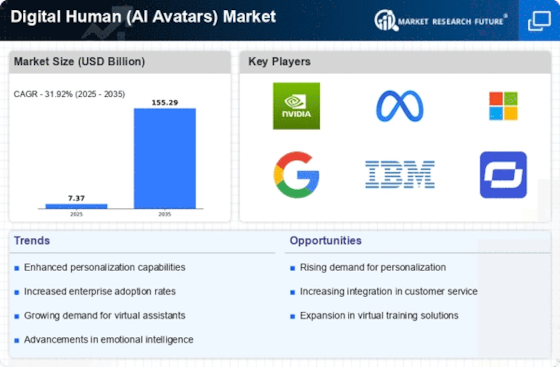
As per Market Research Future analysis, the Digital Human (AI Avatars) Market Size was estimated at 7.374 USD Billion in 2024. The Digital Human (AI Avatars) industry is projected to grow from 9.728 USD Billion in 2025 to 155.29 USD Billion by 2035, exhibiting a compound annual growth rate (CAGR) of 31.92% during the forecast period 2025 - 2035

Key Market Trends & Highlights

The Digital Human (AI Avatars) Market is experiencing robust growth driven by technological advancements and increasing demand across various sectors.

  • Enhanced realism in avatars is becoming a prominent trend, particularly in North America, where the market is largest. Integration with virtual environments is gaining traction, especially in the Asia-Pacific region, which is the fastest-growing market. Personalization and customization of digital humans are increasingly sought after, with interactive digital human avatars leading the segment. Advancements in AI technology and the growing demand for virtual customer service are key drivers propelling market expansion.

Market Size & Forecast

2024 Market Size 7.374 (USD Billion)
2035 Market Size 155.29 (USD Billion)
CAGR (2025 - 2035) 31.92%
Largest Regional Market Share in 2024 North America

Major Players

<a href="https://www.nvidia.com/en-in/use-cases/digital-humans/">NVIDIA </a>(US), Meta Platforms (US), Microsoft (US), Google (US), <a title="IBM" href="https://www.ibm.com/think/topics/generative-ai" target="_blank" rel="noopener">IBM</a> (US), Synthesia (GB), Reallusion (TW), D-ID (IL), Soul Machines (NZ)

Market Trends

The Digital Human (AI Avatars) Market is currently experiencing a transformative phase, characterized by rapid advancements in artificial intelligence and machine learning technologies. These innovations are enabling the creation of increasingly sophisticated avatars that can mimic human behavior and emotions with remarkable accuracy. As organizations across various sectors recognize the potential of these digital entities, applications are expanding beyond entertainment and gaming into areas such as customer service, education, and healthcare. This diversification suggests a growing acceptance and integration of AI avatars into everyday interactions, potentially reshaping how individuals engage with technology. Moreover, the rise of virtual and augmented reality platforms is further propelling the Digital Human (AI Avatars) Market. These immersive environments provide unique opportunities for avatars to enhance user experiences, making interactions more engaging and personalized. As consumers become more accustomed to these digital representations, the demand for realistic and relatable avatars is likely to increase. This trend indicates a shift towards a more human-centric approach in technology, where digital avatars serve not just as tools, but as companions and facilitators in various aspects of life, from social interactions to professional engagements.

Enhanced Realism in Avatars

The trend towards creating more lifelike digital humans is gaining momentum. Advances in graphics and animation technologies are enabling developers to produce avatars that closely resemble real individuals, both in appearance and behavior. This heightened realism is likely to improve user engagement and satisfaction, as people may feel more connected to avatars that exhibit human-like traits.

Integration with Virtual Environments

Digital humans are increasingly being integrated into virtual and augmented reality settings. This integration allows for more immersive experiences, where avatars can interact with users in real-time, enhancing the overall engagement. Such environments may facilitate new forms of communication and collaboration, particularly in professional and educational contexts.

Personalization and Customization

There is a growing emphasis on personalization within the Digital Human (AI Avatars) Market. Users are seeking avatars that reflect their individual preferences and identities. This trend suggests that companies may invest in technologies that allow for greater customization options, enabling users to create avatars that resonate with their personal or brand identities.

Digital Human AI Avatars Market Market Drivers

Advancements in AI Technology

The Digital Human (AI Avatars) Market is experiencing rapid advancements in artificial intelligence technology, which enhances the capabilities of avatars. Machine learning algorithms and natural language processing are becoming increasingly sophisticated, allowing avatars to engage in more realistic and meaningful interactions. This technological evolution is likely to drive demand, as businesses seek to leverage these advancements for customer engagement and support. According to recent estimates, the AI technology sector is projected to grow at a compound annual growth rate of over 40%, indicating a robust market environment for digital human applications. As AI continues to evolve, the potential for creating more lifelike and responsive avatars appears promising, thereby propelling the Digital Human (AI Avatars) Market forward.

Increased Investment in Digital Marketing

The Digital Human (AI Avatars) Market is benefiting from increased investment in digital marketing strategies. Businesses are recognizing the potential of AI avatars to create immersive and interactive marketing campaigns that resonate with consumers. By utilizing avatars in advertisements and social media, companies can enhance brand engagement and foster deeper connections with their audience. Recent statistics indicate that digital marketing expenditures are expected to reach over 500 billion dollars, highlighting the lucrative opportunities for digital human applications in marketing. As brands seek innovative ways to capture consumer attention, the integration of AI avatars into marketing efforts is likely to accelerate, driving growth in the Digital Human (AI Avatars) Market.

Growing Demand for Virtual Customer Service

The Digital Human (AI Avatars) Market is witnessing a surge in demand for virtual customer service solutions. Companies are increasingly adopting AI avatars to enhance customer interactions, providing 24/7 support and personalized experiences. This trend is particularly evident in sectors such as retail and finance, where customer service efficiency is paramount. Recent data suggests that businesses utilizing AI-driven customer service solutions can reduce operational costs by up to 30% while improving customer satisfaction rates. As organizations strive to meet the evolving expectations of consumers, the integration of digital humans into customer service frameworks is likely to become a standard practice, further driving growth in the Digital Human (AI Avatars) Market.

Expansion of Gaming and Entertainment Sectors

The Digital Human (AI Avatars) Market is experiencing growth due to the expansion of gaming and entertainment sectors. As the demand for immersive experiences increases, game developers and content creators are incorporating AI avatars to enhance storytelling and player engagement. The gaming industry alone is projected to surpass 200 billion dollars in revenue, indicating a substantial market for digital human applications. Furthermore, the integration of avatars in virtual reality and augmented reality experiences is becoming more prevalent, offering users a unique and interactive way to engage with content. This trend suggests that the Digital Human (AI Avatars) Market will continue to thrive as it aligns with the evolving preferences of consumers in entertainment.

Rise of Remote Work and Virtual Collaboration

The Digital Human (AI Avatars) Market is significantly influenced by the rise of remote work and virtual collaboration. As organizations adapt to flexible work environments, the need for effective communication tools has intensified. AI avatars are being utilized to facilitate virtual meetings, training sessions, and collaborative projects, providing a more engaging experience than traditional video conferencing. This shift is supported by data indicating that remote work has increased productivity levels by approximately 20% in various sectors. Consequently, the demand for digital human solutions that enhance remote interactions is likely to grow, positioning the Digital Human (AI Avatars) Market as a key player in the evolving workplace landscape.

Market Segment Insights

By Product Type: Interactive Digital Human Avatar (Largest) vs. Non-Interactive Digital Human Avatar (Fastest-Growing)

The Digital Human (AI Avatars) market exhibits a pronounced market share distribution, with Interactive Digital Human Avatars leading the segment as the largest contributor. This prominence can be attributed to their extensive adoption in sectors such as entertainment, customer engagement, and personalized digital experiences. In contrast, Non-Interactive Digital Human Avatars, while currently holding a smaller share, are rapidly gaining traction as businesses and consumer demands evolve towards more accessible AI technologies, driving value across numerous applications.

Digital Human Avatar: Interactive (Dominant) vs. Non-Interactive (Emerging)

Interactive Digital Human Avatars are characterized by their capacity to engage users dynamically, providing real-time responses and tailored interactions. They are widely utilized in customer service, gaming, and virtual presentations, fostering an immersive experience. Non-Interactive Digital Human Avatars, on the other hand, serve as a more static representation but are increasingly recognized for their utility in marketing and content creation. This segment is emerging rapidly, driven by advancements in <a href="https://www.marketresearchfuture.com/reports/artificial-intelligence-market-1139">AI technology</a> and an increased focus on enhanced user accessibility. As businesses look to automate and streamline processes, both avatars are positioned to play pivotal roles in shaVirtual Customer Serviceping the future of digital interaction.

By Technology: 3D Scanning (Largest) vs. Natural Language Processing (Fastest-Growing)

In the Digital Human (AI Avatars) Market, the distribution of market share among the technology segment values reveals a significant dominance of <a href="https://www.marketresearchfuture.com/reports/3d-scanner-market-2546">3D Scanning</a> technologies, which play a crucial role in creating lifelike avatars. Meanwhile, Natural Language Processing (NLP) is emerging as a vital component, showing robust growth as businesses increasingly prioritize interactive and realistic communication within virtual environments. The advancements in machine learning and AI integration have further complemented these technologies, thus enhancing their market relevance. The growth trends within the Technology segment are propelled by the increasing demand for digital humans across various sectors, including entertainment, customer service, and gaming. As organizations seek to elevate user engagement, the integration of AI-driven avatars equipped with Natural Language Generation and Processing capabilities is becoming central. Additionally, the continuous improvements in 3D Modelling tools are setting the stage for more realistic representations, while the overall adoption of AI technologies fosters innovation and improves functionality in avatar interactions.

Technology: 3D Scanning (Dominant) vs. Natural Language Generation (Emerging)

3D Scanning stands out as a dominant technology in the Digital Human (AI Avatars) Market, primarily due to its ability to capture intricate details and create highly realistic avatars. Its applications are widespread, from film production to virtual reality environments, making it essential for delivering immersive experiences. In contrast, Natural Language Generation is an emerging technology that is gradually gaining traction. By enabling AI avatars to produce human-like text and speech, it enhances interactions significantly. This capability is increasingly relevant for businesses looking for efficient customer support solutions, where engaging dialogues are paramount. As NLP continues to evolve, the combination of these technologies promises to enhance the realism and interactivity of digital avatars, positioning them as critical tools in various applications.

By Application: Virtual Agents (Largest) vs. Virtual Companions (Fastest-Growing)

In the Digital Human (AI Avatars) Market, Virtual Agents hold the largest market share, primarily driven by their integration into customer service and support functionalities across various industries. They offer businesses a cost-effective solution to enhance customer interaction while maintaining efficiency. Following them, Virtual Assistants are also significant players, widely adopted for personal and business productivity applications. Meanwhile, Virtual Influencers and Virtual Characters have carved out niche markets, but with comparatively smaller shares, signaling unique use-cases and audience engagement potential.

Virtual Agents (Dominant) vs. Virtual Companions (Emerging)

Virtual Agents are currently the dominant force in the application segment of the Digital Human (AI Avatars) Market, utilized by businesses to automate interactions and support processes. Their strength lies in their ability to provide instant responses and handle high volumes of queries, making them invaluable in sectors like e-commerce and telecommunications. Conversely, Virtual Companions are emerging as an exciting new trend, leveraging advanced AI to offer emotional support and companionship. They are gaining traction among users seeking connection, particularly in contexts such as mental health and wellness applications, resulting in a growing desire for personalized digital interaction.

By Industry Vertical: Gaming (Largest) vs. Entertainment (Fastest-Growing)

The Digital Human (AI Avatars) Market exhibits a diverse distribution of market share across various industry verticals. Gaming holds the largest share, driven by the integration of AI avatars into immersive gaming experiences, enhancing user engagement and interactive storytelling. Following closely is the entertainment sector, which is rapidly growing due to advancements in virtual reality and augmented reality applications, allowing for more personalized experiences for audiences. In terms of growth trends, the education and BFSI sectors are emerging as significant contributors to market expansion. The demand for AI avatars in human resources training, virtual classrooms, and customer service is increasingly prominent. Additionally, rapid technological advancements and the proliferation of high-speed internet across regions are driving the adoption of digital humans, particularly in entertainment and advertising, where audience connectivity is paramount.

Gaming: Dominant vs. Entertainment: Emerging

Gaming reigns as the dominant vertical in the Digital Human (AI Avatars) Market due to its unique capacity for immersive experiences that captivate players. This sector leverages AI avatars to create human-like interactions within virtual worlds, enhancing gameplay and replayability. On the other hand, the <a href="https://www.marketresearchfuture.com/reports/entertainment-and-media-market-7773">entertainment vertical </a>is emerging rapidly, fueled by innovations in content delivery and audience engagement strategies. Digital avatars are being used in films, music videos, and live performances, allowing for interactive and personalized viewer experiences. As both sectors continue to evolve, their interdependence reflects a burgeoning market, with gaming offering stability and entertainment representing dynamic growth.

Get more detailed insights about Digital Human (AI Avatars) Market Research Report - Global Forecast till 2035

Regional Insights

North America : Innovation and Leadership Hub

North America is the largest market for Digital Human (AI Avatars), holding approximately 45% of the global market share. The region's growth is driven by rapid technological advancements, increasing demand for virtual assistants, and significant investments in AI research and development. Regulatory support for AI innovation further catalyzes market expansion, with initiatives aimed at fostering a conducive environment for tech startups and established firms alike. The United States leads the market, with key players like NVIDIA, Meta Platforms, and Microsoft driving innovation. Canada also plays a significant role, focusing on ethical AI development and integration. The competitive landscape is characterized by a mix of established tech giants and emerging startups, all vying for market share in this rapidly evolving sector.

Europe : Emerging AI Avatar Market

Europe is the second-largest market for Digital Human (AI Avatars), accounting for approximately 30% of the global market share. The region's growth is propelled by increasing investments in AI technologies, a strong focus on digital transformation across industries, and supportive regulatory frameworks. The European Union's initiatives to promote AI ethics and innovation are pivotal in shaping the market landscape, encouraging collaboration among member states. Leading countries include the United Kingdom, Germany, and France, where companies like Synthesia and Reallusion are making significant strides. The competitive landscape is marked by a blend of established firms and innovative startups, all contributing to a vibrant ecosystem. The presence of key players and a strong emphasis on ethical AI development position Europe as a formidable player in the global market.

Asia-Pacific : Rapid Growth and Adoption

Asia-Pacific is witnessing rapid growth in the Digital Human (AI Avatars) market, holding approximately 20% of the global market share. The region's expansion is driven by increasing digitalization, a growing consumer base, and significant investments in AI technologies. Countries like China and India are at the forefront, with government initiatives aimed at promoting AI research and development, creating a favorable environment for market growth. China is the largest market in the region, with companies like D-ID and Soul Machines leading the charge. India is also emerging as a key player, focusing on AI-driven solutions for various sectors. The competitive landscape is characterized by a mix of local startups and international firms, all striving to capture the growing demand for AI avatars in diverse applications, from entertainment to customer service.

Middle East and Africa : Untapped Potential in AI

The Middle East and Africa represent an emerging market for Digital Human (AI Avatars), holding approximately 5% of the global market share. The region's growth is fueled by increasing investments in technology, a rising demand for digital solutions, and government initiatives aimed at fostering innovation. Countries like the UAE and South Africa are leading the charge, with a focus on integrating AI into various sectors, including healthcare and education. The competitive landscape is still developing, with a mix of local startups and international players exploring opportunities in the market. The presence of key players and a growing interest in AI technologies position the region as a potential hub for future growth in the digital human sector. As awareness and adoption increase, the market is expected to expand significantly in the coming years.

Key Players and Competitive Insights

The Digital Human (AI Avatars) market is a highly competitive industry making substantial investments in research and development to expand their product/service portfolios, contributing to the market's robust growth. The market is characterized by the presence of established and large Digital Human (AI Avatars) companies, as well as many smaller and emerging players such as Roblox Corporation, Wolf3D. Key developments include new product/service launches, mergers and acquisitions, contractual agreements, increased investments, and collaborations with other organizations. Given the competitive and evolving market landscape, competitors in the digital human (AI Avatars) industry are focusing on cost-effective offerings to thrive and expand. The competition in the Digital Human (AI Avatars) market is driven by various factors, including pricing, quality, delivery time, and the ability to offer customized solutions to customers. Moreover, partnerships and collaborations with other players in the industry, such as OEMs and suppliers, are crucial for companies to remain competitive in the market. Mergers and acquisitions are also common in the Digital Human (AI Avatars) market, as companies seek to expand their reach and capabilities.

Key Companies in the Digital Human AI Avatars Market include

Industry Developments

December 2021, Synthesia, a startup based in London, U.K. that is building AI-based video avatars of actual people, announced a USD 50 million funding round led by Silicon Valley venture capital companies Kleiner Perkins and GV, among others.

Future Outlook

Digital Human AI Avatars Market Future Outlook

The Digital Human (AI Avatars) Market is projected to grow at a 31.92% CAGR from 2025 to 2035, driven by advancements in AI technology, increased demand for virtual interactions, and enhanced user experiences.

New opportunities lie in:

  • <p>Development of customizable AI avatars for personalized marketing campaigns. Integration of AI avatars in customer service platforms to enhance user engagement. Creation of virtual training environments utilizing AI avatars for employee development.</p>

By 2035, the Digital Human (AI Avatars) Market is expected to be a pivotal component of digital interaction strategies.

Market Segmentation

Digital Human AI Avatars Market Technology Outlook

  • 3D Scanning
  • 3D Modelling
  • Natural Language Processing
  • Natural Language Generation
  • Artificial Intelligence (AI)

Digital Human AI Avatars Market Application Outlook

  • Virtual Agents
  • Virtual Assistants
  • Virtual Influencers
  • Virtual Companions
  • Virtual Characters

Digital Human AI Avatars Market Product Type Outlook

  • Interactive Digital Human Avatar
  • Non-Interactive Digital Human Avatar

Digital Human AI Avatars Market Industry Vertical Outlook

  • Gaming
  • Entertainment
  • BFSI
  • IT & Telecommunication
  • Education
  • Automotive
  • Advertisement
  • Health & Sports
  • Others

Report Scope

MARKET SIZE 2024 7.374(USD Billion)
MARKET SIZE 2025 9.728(USD Billion)
MARKET SIZE 2035 155.29(USD Billion)
COMPOUND ANNUAL GROWTH RATE (CAGR) 31.92% (2025 - 2035)
REPORT COVERAGE Revenue Forecast, Competitive Landscape, Growth Factors, and Trends
BASE YEAR 2024
Market Forecast Period 2025 - 2035
Historical Data 2019 - 2024
Market Forecast Units USD Billion
Key Companies Profiled NVIDIA (US), Meta Platforms (US), Microsoft (US), Google (US), IBM (US), Synthesia (GB), Reallusion (TW), D-ID (IL), Soul Machines (NZ)
Segments Covered Product Type, Regions Forecast Till 2035
Key Market Opportunities Integration of advanced machine learning enhances personalization in the Digital Human (AI Avatars) Market.
Key Market Dynamics Rising demand for personalized digital interactions drives innovation and competition in the Digital Human (AI Avatars) Market.
Countries Covered North America, Europe, APAC, South America, MEA

FAQs

What is the current valuation of the Digital Human (AI Avatars) Market?

<p>As of 2024, the market valuation was 7.374 USD Billion.</p>

What is the projected market size for the Digital Human (AI Avatars) Market by 2035?

<p>The market is expected to reach a valuation of 155.29 USD Billion by 2035.</p>

What is the expected CAGR for the Digital Human (AI Avatars) Market during the forecast period?

<p>The market is projected to grow at a CAGR of 31.92% from 2025 to 2035.</p>

Which companies are considered key players in the Digital Human (AI Avatars) Market?

<p>Key players include NVIDIA, Meta Platforms, Microsoft, Google, IBM, Synthesia, Reallusion, D-ID, and Soul Machines.</p>

What are the two main product types in the Digital Human (AI Avatars) Market?

The two main product types are Interactive Digital Human Avatars and Non-Interactive Digital Human Avatars.

How much revenue is generated by the Interactive Digital Human Avatar segment?

The Interactive Digital Human Avatar segment generated 3.5 USD Billion in 2024 and is projected to reach 70.0 USD Billion by 2035.

What is the revenue potential of Natural Language Processing technology in this market?

Natural Language Processing technology is expected to grow from 2.0 USD Billion in 2024 to 40.0 USD Billion by 2035.

Which application segment is projected to generate the highest revenue in the Digital Human (AI Avatars) Market?

The Virtual Assistants application segment is anticipated to grow from 2.0 USD Billion in 2024 to 45.0 USD Billion by 2035.

What industry verticals are driving growth in the Digital Human (AI Avatars) Market?

Key industry verticals include Gaming, Entertainment, BFSI, IT &amp; Telecommunication, and Education.

What is the revenue forecast for the Gaming industry vertical in the Digital Human (AI Avatars) Market?

The Gaming industry vertical is expected to grow from 1.5 USD Billion in 2024 to 35.0 USD Billion by 2035.

  1. SECTION I: EXECUTIVE SUMMARY AND KEY HIGHLIGHTS
    1. | 1.1 EXECUTIVE SUMMARY
    2. | | 1.1.1 Market Overview
    3. | | 1.1.2 Key Findings
    4. | | 1.1.3 Market Segmentation
    5. | | 1.1.4 Competitive Landscape
    6. | | 1.1.5 Challenges and Opportunities
    7. | | 1.1.6 Future Outlook
  2. SECTION II: SCOPING, METHODOLOGY AND MARKET STRUCTURE
    1. | 2.1 MARKET INTRODUCTION
    2. | | 2.1.1 Definition
    3. | | 2.1.2 Scope of the study
    4. | | | 2.1.2.1 Research Objective
    5. | | | 2.1.2.2 Assumption
    6. | | | 2.1.2.3 Limitations
    7. | 2.2 RESEARCH METHODOLOGY
    8. | | 2.2.1 Overview
    9. | | 2.2.2 Data Mining
    10. | | 2.2.3 Secondary Research
    11. | | 2.2.4 Primary Research
    12. | | | 2.2.4.1 Primary Interviews and Information Gathering Process
    13. | | | 2.2.4.2 Breakdown of Primary Respondents
    14. | | 2.2.5 Forecasting Model
    15. | | 2.2.6 Market Size Estimation
    16. | | | 2.2.6.1 Bottom-Up Approach
    17. | | | 2.2.6.2 Top-Down Approach
    18. | | 2.2.7 Data Triangulation
    19. | | 2.2.8 Validation
  3. SECTION III: QUALITATIVE ANALYSIS
    1. | 3.1 MARKET DYNAMICS
    2. | | 3.1.1 Overview
    3. | | 3.1.2 Drivers
    4. | | 3.1.3 Restraints
    5. | | 3.1.4 Opportunities
    6. | 3.2 MARKET FACTOR ANALYSIS
    7. | | 3.2.1 Value chain Analysis
    8. | | 3.2.2 Porter's Five Forces Analysis
    9. | | | 3.2.2.1 Bargaining Power of Suppliers
    10. | | | 3.2.2.2 Bargaining Power of Buyers
    11. | | | 3.2.2.3 Threat of New Entrants
    12. | | | 3.2.2.4 Threat of Substitutes
    13. | | | 3.2.2.5 Intensity of Rivalry
    14. | | 3.2.3 COVID-19 Impact Analysis
    15. | | | 3.2.3.1 Market Impact Analysis
    16. | | | 3.2.3.2 Regional Impact
    17. | | | 3.2.3.3 Opportunity and Threat Analysis
  4. SECTION IV: QUANTITATIVE ANALYSIS
    1. | 4.1 Information and Communications Technology, BY Product Type (USD Billion)
    2. | | 4.1.1 Interactive Digital Human Avatar
    3. | | 4.1.2 Non-Interactive Digital Human Avatar
    4. | 4.2 Information and Communications Technology, BY Technology (USD Billion)
    5. | | 4.2.1 3D Scanning
    6. | | 4.2.2 3D Modelling
    7. | | 4.2.3 Natural Language Processing
    8. | | 4.2.4 Natural Language Generation
    9. | | 4.2.5 Artificial Intelligence (AI)
    10. | 4.3 Information and Communications Technology, BY Application (USD Billion)
    11. | | 4.3.1 Virtual Agents
    12. | | 4.3.2 Virtual Assistants
    13. | | 4.3.3 Virtual Influencers
    14. | | 4.3.4 Virtual Companions
    15. | | 4.3.5 Virtual Characters
    16. | 4.4 Information and Communications Technology, BY Industry Vertical (USD Billion)
    17. | | 4.4.1 Gaming
    18. | | 4.4.2 Entertainment
    19. | | 4.4.3 BFSI
    20. | | 4.4.4 IT & Telecommunication
    21. | | 4.4.5 Education
    22. | | 4.4.6 Automotive
    23. | | 4.4.7 Advertisement
    24. | | 4.4.8 Health & Sports
    25. | | 4.4.9 Others
    26. | 4.5 Information and Communications Technology, BY Region (USD Billion)
    27. | | 4.5.1 North America
    28. | | | 4.5.1.1 US
    29. | | | 4.5.1.2 Canada
    30. | | 4.5.2 Europe
    31. | | | 4.5.2.1 Germany
    32. | | | 4.5.2.2 UK
    33. | | | 4.5.2.3 France
    34. | | | 4.5.2.4 Russia
    35. | | | 4.5.2.5 Italy
    36. | | | 4.5.2.6 Spain
    37. | | | 4.5.2.7 Rest of Europe
    38. | | 4.5.3 APAC
    39. | | | 4.5.3.1 China
    40. | | | 4.5.3.2 India
    41. | | | 4.5.3.3 Japan
    42. | | | 4.5.3.4 South Korea
    43. | | | 4.5.3.5 Malaysia
    44. | | | 4.5.3.6 Thailand
    45. | | | 4.5.3.7 Indonesia
    46. | | | 4.5.3.8 Rest of APAC
    47. | | 4.5.4 South America
    48. | | | 4.5.4.1 Brazil
    49. | | | 4.5.4.2 Mexico
    50. | | | 4.5.4.3 Argentina
    51. | | | 4.5.4.4 Rest of South America
    52. | | 4.5.5 MEA
    53. | | | 4.5.5.1 GCC Countries
    54. | | | 4.5.5.2 South Africa
    55. | | | 4.5.5.3 Rest of MEA
  5. SECTION V: COMPETITIVE ANALYSIS
    1. | 5.1 Competitive Landscape
    2. | | 5.1.1 Overview
    3. | | 5.1.2 Competitive Analysis
    4. | | 5.1.3 Market share Analysis
    5. | | 5.1.4 Major Growth Strategy in the Information and Communications Technology
    6. | | 5.1.5 Competitive Benchmarking
    7. | | 5.1.6 Leading Players in Terms of Number of Developments in the Information and Communications Technology
    8. | | 5.1.7 Key developments and growth strategies
    9. | | | 5.1.7.1 New Product Launch/Service Deployment
    10. | | | 5.1.7.2 Merger & Acquisitions
    11. | | | 5.1.7.3 Joint Ventures
    12. | | 5.1.8 Major Players Financial Matrix
    13. | | | 5.1.8.1 Sales and Operating Income
    14. | | | 5.1.8.2 Major Players R&D Expenditure. 2023
    15. | 5.2 Company Profiles
    16. | | 5.2.1 NVIDIA (US)
    17. | | | 5.2.1.1 Financial Overview
    18. | | | 5.2.1.2 Products Offered
    19. | | | 5.2.1.3 Key Developments
    20. | | | 5.2.1.4 SWOT Analysis
    21. | | | 5.2.1.5 Key Strategies
    22. | | 5.2.2 Meta Platforms (US)
    23. | | | 5.2.2.1 Financial Overview
    24. | | | 5.2.2.2 Products Offered
    25. | | | 5.2.2.3 Key Developments
    26. | | | 5.2.2.4 SWOT Analysis
    27. | | | 5.2.2.5 Key Strategies
    28. | | 5.2.3 Microsoft (US)
    29. | | | 5.2.3.1 Financial Overview
    30. | | | 5.2.3.2 Products Offered
    31. | | | 5.2.3.3 Key Developments
    32. | | | 5.2.3.4 SWOT Analysis
    33. | | | 5.2.3.5 Key Strategies
    34. | | 5.2.4 Google (US)
    35. | | | 5.2.4.1 Financial Overview
    36. | | | 5.2.4.2 Products Offered
    37. | | | 5.2.4.3 Key Developments
    38. | | | 5.2.4.4 SWOT Analysis
    39. | | | 5.2.4.5 Key Strategies
    40. | | 5.2.5 IBM (US)
    41. | | | 5.2.5.1 Financial Overview
    42. | | | 5.2.5.2 Products Offered
    43. | | | 5.2.5.3 Key Developments
    44. | | | 5.2.5.4 SWOT Analysis
    45. | | | 5.2.5.5 Key Strategies
    46. | | 5.2.6 Synthesia (GB)
    47. | | | 5.2.6.1 Financial Overview
    48. | | | 5.2.6.2 Products Offered
    49. | | | 5.2.6.3 Key Developments
    50. | | | 5.2.6.4 SWOT Analysis
    51. | | | 5.2.6.5 Key Strategies
    52. | | 5.2.7 Reallusion (TW)
    53. | | | 5.2.7.1 Financial Overview
    54. | | | 5.2.7.2 Products Offered
    55. | | | 5.2.7.3 Key Developments
    56. | | | 5.2.7.4 SWOT Analysis
    57. | | | 5.2.7.5 Key Strategies
    58. | | 5.2.8 D-ID (IL)
    59. | | | 5.2.8.1 Financial Overview
    60. | | | 5.2.8.2 Products Offered
    61. | | | 5.2.8.3 Key Developments
    62. | | | 5.2.8.4 SWOT Analysis
    63. | | | 5.2.8.5 Key Strategies
    64. | | 5.2.9 Soul Machines (NZ)
    65. | | | 5.2.9.1 Financial Overview
    66. | | | 5.2.9.2 Products Offered
    67. | | | 5.2.9.3 Key Developments
    68. | | | 5.2.9.4 SWOT Analysis
    69. | | | 5.2.9.5 Key Strategies
    70. | 5.3 Appendix
    71. | | 5.3.1 References
    72. | | 5.3.2 Related Reports
  6. LIST OF FIGURES
    1. | 6.1 MARKET SYNOPSIS
    2. | 6.2 NORTH AMERICA MARKET ANALYSIS
    3. | 6.3 US MARKET ANALYSIS BY PRODUCT TYPE
    4. | 6.4 US MARKET ANALYSIS BY TECHNOLOGY
    5. | 6.5 US MARKET ANALYSIS BY APPLICATION
    6. | 6.6 US MARKET ANALYSIS BY INDUSTRY VERTICAL
    7. | 6.7 CANADA MARKET ANALYSIS BY PRODUCT TYPE
    8. | 6.8 CANADA MARKET ANALYSIS BY TECHNOLOGY
    9. | 6.9 CANADA MARKET ANALYSIS BY APPLICATION
    10. | 6.10 CANADA MARKET ANALYSIS BY INDUSTRY VERTICAL
    11. | 6.11 EUROPE MARKET ANALYSIS
    12. | 6.12 GERMANY MARKET ANALYSIS BY PRODUCT TYPE
    13. | 6.13 GERMANY MARKET ANALYSIS BY TECHNOLOGY
    14. | 6.14 GERMANY MARKET ANALYSIS BY APPLICATION
    15. | 6.15 GERMANY MARKET ANALYSIS BY INDUSTRY VERTICAL
    16. | 6.16 UK MARKET ANALYSIS BY PRODUCT TYPE
    17. | 6.17 UK MARKET ANALYSIS BY TECHNOLOGY
    18. | 6.18 UK MARKET ANALYSIS BY APPLICATION
    19. | 6.19 UK MARKET ANALYSIS BY INDUSTRY VERTICAL
    20. | 6.20 FRANCE MARKET ANALYSIS BY PRODUCT TYPE
    21. | 6.21 FRANCE MARKET ANALYSIS BY TECHNOLOGY
    22. | 6.22 FRANCE MARKET ANALYSIS BY APPLICATION
    23. | 6.23 FRANCE MARKET ANALYSIS BY INDUSTRY VERTICAL
    24. | 6.24 RUSSIA MARKET ANALYSIS BY PRODUCT TYPE
    25. | 6.25 RUSSIA MARKET ANALYSIS BY TECHNOLOGY
    26. | 6.26 RUSSIA MARKET ANALYSIS BY APPLICATION
    27. | 6.27 RUSSIA MARKET ANALYSIS BY INDUSTRY VERTICAL
    28. | 6.28 ITALY MARKET ANALYSIS BY PRODUCT TYPE
    29. | 6.29 ITALY MARKET ANALYSIS BY TECHNOLOGY
    30. | 6.30 ITALY MARKET ANALYSIS BY APPLICATION
    31. | 6.31 ITALY MARKET ANALYSIS BY INDUSTRY VERTICAL
    32. | 6.32 SPAIN MARKET ANALYSIS BY PRODUCT TYPE
    33. | 6.33 SPAIN MARKET ANALYSIS BY TECHNOLOGY
    34. | 6.34 SPAIN MARKET ANALYSIS BY APPLICATION
    35. | 6.35 SPAIN MARKET ANALYSIS BY INDUSTRY VERTICAL
    36. | 6.36 REST OF EUROPE MARKET ANALYSIS BY PRODUCT TYPE
    37. | 6.37 REST OF EUROPE MARKET ANALYSIS BY TECHNOLOGY
    38. | 6.38 REST OF EUROPE MARKET ANALYSIS BY APPLICATION
    39. | 6.39 REST OF EUROPE MARKET ANALYSIS BY INDUSTRY VERTICAL
    40. | 6.40 APAC MARKET ANALYSIS
    41. | 6.41 CHINA MARKET ANALYSIS BY PRODUCT TYPE
    42. | 6.42 CHINA MARKET ANALYSIS BY TECHNOLOGY
    43. | 6.43 CHINA MARKET ANALYSIS BY APPLICATION
    44. | 6.44 CHINA MARKET ANALYSIS BY INDUSTRY VERTICAL
    45. | 6.45 INDIA MARKET ANALYSIS BY PRODUCT TYPE
    46. | 6.46 INDIA MARKET ANALYSIS BY TECHNOLOGY
    47. | 6.47 INDIA MARKET ANALYSIS BY APPLICATION
    48. | 6.48 INDIA MARKET ANALYSIS BY INDUSTRY VERTICAL
    49. | 6.49 JAPAN MARKET ANALYSIS BY PRODUCT TYPE
    50. | 6.50 JAPAN MARKET ANALYSIS BY TECHNOLOGY
    51. | 6.51 JAPAN MARKET ANALYSIS BY APPLICATION
    52. | 6.52 JAPAN MARKET ANALYSIS BY INDUSTRY VERTICAL
    53. | 6.53 SOUTH KOREA MARKET ANALYSIS BY PRODUCT TYPE
    54. | 6.54 SOUTH KOREA MARKET ANALYSIS BY TECHNOLOGY
    55. | 6.55 SOUTH KOREA MARKET ANALYSIS BY APPLICATION
    56. | 6.56 SOUTH KOREA MARKET ANALYSIS BY INDUSTRY VERTICAL
    57. | 6.57 MALAYSIA MARKET ANALYSIS BY PRODUCT TYPE
    58. | 6.58 MALAYSIA MARKET ANALYSIS BY TECHNOLOGY
    59. | 6.59 MALAYSIA MARKET ANALYSIS BY APPLICATION
    60. | 6.60 MALAYSIA MARKET ANALYSIS BY INDUSTRY VERTICAL
    61. | 6.61 THAILAND MARKET ANALYSIS BY PRODUCT TYPE
    62. | 6.62 THAILAND MARKET ANALYSIS BY TECHNOLOGY
    63. | 6.63 THAILAND MARKET ANALYSIS BY APPLICATION
    64. | 6.64 THAILAND MARKET ANALYSIS BY INDUSTRY VERTICAL
    65. | 6.65 INDONESIA MARKET ANALYSIS BY PRODUCT TYPE
    66. | 6.66 INDONESIA MARKET ANALYSIS BY TECHNOLOGY
    67. | 6.67 INDONESIA MARKET ANALYSIS BY APPLICATION
    68. | 6.68 INDONESIA MARKET ANALYSIS BY INDUSTRY VERTICAL
    69. | 6.69 REST OF APAC MARKET ANALYSIS BY PRODUCT TYPE
    70. | 6.70 REST OF APAC MARKET ANALYSIS BY TECHNOLOGY
    71. | 6.71 REST OF APAC MARKET ANALYSIS BY APPLICATION
    72. | 6.72 REST OF APAC MARKET ANALYSIS BY INDUSTRY VERTICAL
    73. | 6.73 SOUTH AMERICA MARKET ANALYSIS
    74. | 6.74 BRAZIL MARKET ANALYSIS BY PRODUCT TYPE
    75. | 6.75 BRAZIL MARKET ANALYSIS BY TECHNOLOGY
    76. | 6.76 BRAZIL MARKET ANALYSIS BY APPLICATION
    77. | 6.77 BRAZIL MARKET ANALYSIS BY INDUSTRY VERTICAL
    78. | 6.78 MEXICO MARKET ANALYSIS BY PRODUCT TYPE
    79. | 6.79 MEXICO MARKET ANALYSIS BY TECHNOLOGY
    80. | 6.80 MEXICO MARKET ANALYSIS BY APPLICATION
    81. | 6.81 MEXICO MARKET ANALYSIS BY INDUSTRY VERTICAL
    82. | 6.82 ARGENTINA MARKET ANALYSIS BY PRODUCT TYPE
    83. | 6.83 ARGENTINA MARKET ANALYSIS BY TECHNOLOGY
    84. | 6.84 ARGENTINA MARKET ANALYSIS BY APPLICATION
    85. | 6.85 ARGENTINA MARKET ANALYSIS BY INDUSTRY VERTICAL
    86. | 6.86 REST OF SOUTH AMERICA MARKET ANALYSIS BY PRODUCT TYPE
    87. | 6.87 REST OF SOUTH AMERICA MARKET ANALYSIS BY TECHNOLOGY
    88. | 6.88 REST OF SOUTH AMERICA MARKET ANALYSIS BY APPLICATION
    89. | 6.89 REST OF SOUTH AMERICA MARKET ANALYSIS BY INDUSTRY VERTICAL
    90. | 6.90 MEA MARKET ANALYSIS
    91. | 6.91 GCC COUNTRIES MARKET ANALYSIS BY PRODUCT TYPE
    92. | 6.92 GCC COUNTRIES MARKET ANALYSIS BY TECHNOLOGY
    93. | 6.93 GCC COUNTRIES MARKET ANALYSIS BY APPLICATION
    94. | 6.94 GCC COUNTRIES MARKET ANALYSIS BY INDUSTRY VERTICAL
    95. | 6.95 SOUTH AFRICA MARKET ANALYSIS BY PRODUCT TYPE
    96. | 6.96 SOUTH AFRICA MARKET ANALYSIS BY TECHNOLOGY
    97. | 6.97 SOUTH AFRICA MARKET ANALYSIS BY APPLICATION
    98. | 6.98 SOUTH AFRICA MARKET ANALYSIS BY INDUSTRY VERTICAL
    99. | 6.99 REST OF MEA MARKET ANALYSIS BY PRODUCT TYPE
    100. | 6.100 REST OF MEA MARKET ANALYSIS BY TECHNOLOGY
    101. | 6.101 REST OF MEA MARKET ANALYSIS BY APPLICATION
    102. | 6.102 REST OF MEA MARKET ANALYSIS BY INDUSTRY VERTICAL
    103. | 6.103 KEY BUYING CRITERIA OF INFORMATION AND COMMUNICATIONS TECHNOLOGY
    104. | 6.104 RESEARCH PROCESS OF MRFR
    105. | 6.105 DRO ANALYSIS OF INFORMATION AND COMMUNICATIONS TECHNOLOGY
    106. | 6.106 DRIVERS IMPACT ANALYSIS: INFORMATION AND COMMUNICATIONS TECHNOLOGY
    107. | 6.107 RESTRAINTS IMPACT ANALYSIS: INFORMATION AND COMMUNICATIONS TECHNOLOGY
    108. | 6.108 SUPPLY / VALUE CHAIN: INFORMATION AND COMMUNICATIONS TECHNOLOGY
    109. | 6.109 INFORMATION AND COMMUNICATIONS TECHNOLOGY, BY PRODUCT TYPE, 2024 (% SHARE)
    110. | 6.110 INFORMATION AND COMMUNICATIONS TECHNOLOGY, BY PRODUCT TYPE, 2024 TO 2035 (USD Billion)
    111. | 6.111 INFORMATION AND COMMUNICATIONS TECHNOLOGY, BY TECHNOLOGY, 2024 (% SHARE)
    112. | 6.112 INFORMATION AND COMMUNICATIONS TECHNOLOGY, BY TECHNOLOGY, 2024 TO 2035 (USD Billion)
    113. | 6.113 INFORMATION AND COMMUNICATIONS TECHNOLOGY, BY APPLICATION, 2024 (% SHARE)
    114. | 6.114 INFORMATION AND COMMUNICATIONS TECHNOLOGY, BY APPLICATION, 2024 TO 2035 (USD Billion)
    115. | 6.115 INFORMATION AND COMMUNICATIONS TECHNOLOGY, BY INDUSTRY VERTICAL, 2024 (% SHARE)
    116. | 6.116 INFORMATION AND COMMUNICATIONS TECHNOLOGY, BY INDUSTRY VERTICAL, 2024 TO 2035 (USD Billion)
    117. | 6.117 BENCHMARKING OF MAJOR COMPETITORS
  7. LIST OF TABLES
    1. | 7.1 LIST OF ASSUMPTIONS
    2. | | 7.1.1
    3. | 7.2 North America MARKET SIZE ESTIMATES; FORECAST
    4. | | 7.2.1 BY PRODUCT TYPE, 2025-2035 (USD Billion)
    5. | | 7.2.2 BY TECHNOLOGY, 2025-2035 (USD Billion)
    6. | | 7.2.3 BY APPLICATION, 2025-2035 (USD Billion)
    7. | | 7.2.4 BY INDUSTRY VERTICAL, 2025-2035 (USD Billion)
    8. | 7.3 US MARKET SIZE ESTIMATES; FORECAST
    9. | | 7.3.1 BY PRODUCT TYPE, 2025-2035 (USD Billion)
    10. | | 7.3.2 BY TECHNOLOGY, 2025-2035 (USD Billion)
    11. | | 7.3.3 BY APPLICATION, 2025-2035 (USD Billion)
    12. | | 7.3.4 BY INDUSTRY VERTICAL, 2025-2035 (USD Billion)
    13. | 7.4 Canada MARKET SIZE ESTIMATES; FORECAST
    14. | | 7.4.1 BY PRODUCT TYPE, 2025-2035 (USD Billion)
    15. | | 7.4.2 BY TECHNOLOGY, 2025-2035 (USD Billion)
    16. | | 7.4.3 BY APPLICATION, 2025-2035 (USD Billion)
    17. | | 7.4.4 BY INDUSTRY VERTICAL, 2025-2035 (USD Billion)
    18. | 7.5 Europe MARKET SIZE ESTIMATES; FORECAST
    19. | | 7.5.1 BY PRODUCT TYPE, 2025-2035 (USD Billion)
    20. | | 7.5.2 BY TECHNOLOGY, 2025-2035 (USD Billion)
    21. | | 7.5.3 BY APPLICATION, 2025-2035 (USD Billion)
    22. | | 7.5.4 BY INDUSTRY VERTICAL, 2025-2035 (USD Billion)
    23. | 7.6 Germany MARKET SIZE ESTIMATES; FORECAST
    24. | | 7.6.1 BY PRODUCT TYPE, 2025-2035 (USD Billion)
    25. | | 7.6.2 BY TECHNOLOGY, 2025-2035 (USD Billion)
    26. | | 7.6.3 BY APPLICATION, 2025-2035 (USD Billion)
    27. | | 7.6.4 BY INDUSTRY VERTICAL, 2025-2035 (USD Billion)
    28. | 7.7 UK MARKET SIZE ESTIMATES; FORECAST
    29. | | 7.7.1 BY PRODUCT TYPE, 2025-2035 (USD Billion)
    30. | | 7.7.2 BY TECHNOLOGY, 2025-2035 (USD Billion)
    31. | | 7.7.3 BY APPLICATION, 2025-2035 (USD Billion)
    32. | | 7.7.4 BY INDUSTRY VERTICAL, 2025-2035 (USD Billion)
    33. | 7.8 France MARKET SIZE ESTIMATES; FORECAST
    34. | | 7.8.1 BY PRODUCT TYPE, 2025-2035 (USD Billion)
    35. | | 7.8.2 BY TECHNOLOGY, 2025-2035 (USD Billion)
    36. | | 7.8.3 BY APPLICATION, 2025-2035 (USD Billion)
    37. | | 7.8.4 BY INDUSTRY VERTICAL, 2025-2035 (USD Billion)
    38. | 7.9 Russia MARKET SIZE ESTIMATES; FORECAST
    39. | | 7.9.1 BY PRODUCT TYPE, 2025-2035 (USD Billion)
    40. | | 7.9.2 BY TECHNOLOGY, 2025-2035 (USD Billion)
    41. | | 7.9.3 BY APPLICATION, 2025-2035 (USD Billion)
    42. | | 7.9.4 BY INDUSTRY VERTICAL, 2025-2035 (USD Billion)
    43. | 7.10 Italy MARKET SIZE ESTIMATES; FORECAST
    44. | | 7.10.1 BY PRODUCT TYPE, 2025-2035 (USD Billion)
    45. | | 7.10.2 BY TECHNOLOGY, 2025-2035 (USD Billion)
    46. | | 7.10.3 BY APPLICATION, 2025-2035 (USD Billion)
    47. | | 7.10.4 BY INDUSTRY VERTICAL, 2025-2035 (USD Billion)
    48. | 7.11 Spain MARKET SIZE ESTIMATES; FORECAST
    49. | | 7.11.1 BY PRODUCT TYPE, 2025-2035 (USD Billion)
    50. | | 7.11.2 BY TECHNOLOGY, 2025-2035 (USD Billion)
    51. | | 7.11.3 BY APPLICATION, 2025-2035 (USD Billion)
    52. | | 7.11.4 BY INDUSTRY VERTICAL, 2025-2035 (USD Billion)
    53. | 7.12 Rest of Europe MARKET SIZE ESTIMATES; FORECAST
    54. | | 7.12.1 BY PRODUCT TYPE, 2025-2035 (USD Billion)
    55. | | 7.12.2 BY TECHNOLOGY, 2025-2035 (USD Billion)
    56. | | 7.12.3 BY APPLICATION, 2025-2035 (USD Billion)
    57. | | 7.12.4 BY INDUSTRY VERTICAL, 2025-2035 (USD Billion)
    58. | 7.13 APAC MARKET SIZE ESTIMATES; FORECAST
    59. | | 7.13.1 BY PRODUCT TYPE, 2025-2035 (USD Billion)
    60. | | 7.13.2 BY TECHNOLOGY, 2025-2035 (USD Billion)
    61. | | 7.13.3 BY APPLICATION, 2025-2035 (USD Billion)
    62. | | 7.13.4 BY INDUSTRY VERTICAL, 2025-2035 (USD Billion)
    63. | 7.14 China MARKET SIZE ESTIMATES; FORECAST
    64. | | 7.14.1 BY PRODUCT TYPE, 2025-2035 (USD Billion)
    65. | | 7.14.2 BY TECHNOLOGY, 2025-2035 (USD Billion)
    66. | | 7.14.3 BY APPLICATION, 2025-2035 (USD Billion)
    67. | | 7.14.4 BY INDUSTRY VERTICAL, 2025-2035 (USD Billion)
    68. | 7.15 India MARKET SIZE ESTIMATES; FORECAST
    69. | | 7.15.1 BY PRODUCT TYPE, 2025-2035 (USD Billion)
    70. | | 7.15.2 BY TECHNOLOGY, 2025-2035 (USD Billion)
    71. | | 7.15.3 BY APPLICATION, 2025-2035 (USD Billion)
    72. | | 7.15.4 BY INDUSTRY VERTICAL, 2025-2035 (USD Billion)
    73. | 7.16 Japan MARKET SIZE ESTIMATES; FORECAST
    74. | | 7.16.1 BY PRODUCT TYPE, 2025-2035 (USD Billion)
    75. | | 7.16.2 BY TECHNOLOGY, 2025-2035 (USD Billion)
    76. | | 7.16.3 BY APPLICATION, 2025-2035 (USD Billion)
    77. | | 7.16.4 BY INDUSTRY VERTICAL, 2025-2035 (USD Billion)
    78. | 7.17 South Korea MARKET SIZE ESTIMATES; FORECAST
    79. | | 7.17.1 BY PRODUCT TYPE, 2025-2035 (USD Billion)
    80. | | 7.17.2 BY TECHNOLOGY, 2025-2035 (USD Billion)
    81. | | 7.17.3 BY APPLICATION, 2025-2035 (USD Billion)
    82. | | 7.17.4 BY INDUSTRY VERTICAL, 2025-2035 (USD Billion)
    83. | 7.18 Malaysia MARKET SIZE ESTIMATES; FORECAST
    84. | | 7.18.1 BY PRODUCT TYPE, 2025-2035 (USD Billion)
    85. | | 7.18.2 BY TECHNOLOGY, 2025-2035 (USD Billion)
    86. | | 7.18.3 BY APPLICATION, 2025-2035 (USD Billion)
    87. | | 7.18.4 BY INDUSTRY VERTICAL, 2025-2035 (USD Billion)
    88. | 7.19 Thailand MARKET SIZE ESTIMATES; FORECAST
    89. | | 7.19.1 BY PRODUCT TYPE, 2025-2035 (USD Billion)
    90. | | 7.19.2 BY TECHNOLOGY, 2025-2035 (USD Billion)
    91. | | 7.19.3 BY APPLICATION, 2025-2035 (USD Billion)
    92. | | 7.19.4 BY INDUSTRY VERTICAL, 2025-2035 (USD Billion)
    93. | 7.20 Indonesia MARKET SIZE ESTIMATES; FORECAST
    94. | | 7.20.1 BY PRODUCT TYPE, 2025-2035 (USD Billion)
    95. | | 7.20.2 BY TECHNOLOGY, 2025-2035 (USD Billion)
    96. | | 7.20.3 BY APPLICATION, 2025-2035 (USD Billion)
    97. | | 7.20.4 BY INDUSTRY VERTICAL, 2025-2035 (USD Billion)
    98. | 7.21 Rest of APAC MARKET SIZE ESTIMATES; FORECAST
    99. | | 7.21.1 BY PRODUCT TYPE, 2025-2035 (USD Billion)
    100. | | 7.21.2 BY TECHNOLOGY, 2025-2035 (USD Billion)
    101. | | 7.21.3 BY APPLICATION, 2025-2035 (USD Billion)
    102. | | 7.21.4 BY INDUSTRY VERTICAL, 2025-2035 (USD Billion)
    103. | 7.22 South America MARKET SIZE ESTIMATES; FORECAST
    104. | | 7.22.1 BY PRODUCT TYPE, 2025-2035 (USD Billion)
    105. | | 7.22.2 BY TECHNOLOGY, 2025-2035 (USD Billion)
    106. | | 7.22.3 BY APPLICATION, 2025-2035 (USD Billion)
    107. | | 7.22.4 BY INDUSTRY VERTICAL, 2025-2035 (USD Billion)
    108. | 7.23 Brazil MARKET SIZE ESTIMATES; FORECAST
    109. | | 7.23.1 BY PRODUCT TYPE, 2025-2035 (USD Billion)
    110. | | 7.23.2 BY TECHNOLOGY, 2025-2035 (USD Billion)
    111. | | 7.23.3 BY APPLICATION, 2025-2035 (USD Billion)
    112. | | 7.23.4 BY INDUSTRY VERTICAL, 2025-2035 (USD Billion)
    113. | 7.24 Mexico MARKET SIZE ESTIMATES; FORECAST
    114. | | 7.24.1 BY PRODUCT TYPE, 2025-2035 (USD Billion)
    115. | | 7.24.2 BY TECHNOLOGY, 2025-2035 (USD Billion)
    116. | | 7.24.3 BY APPLICATION, 2025-2035 (USD Billion)
    117. | | 7.24.4 BY INDUSTRY VERTICAL, 2025-2035 (USD Billion)
    118. | 7.25 Argentina MARKET SIZE ESTIMATES; FORECAST
    119. | | 7.25.1 BY PRODUCT TYPE, 2025-2035 (USD Billion)
    120. | | 7.25.2 BY TECHNOLOGY, 2025-2035 (USD Billion)
    121. | | 7.25.3 BY APPLICATION, 2025-2035 (USD Billion)
    122. | | 7.25.4 BY INDUSTRY VERTICAL, 2025-2035 (USD Billion)
    123. | 7.26 Rest of South America MARKET SIZE ESTIMATES; FORECAST
    124. | | 7.26.1 BY PRODUCT TYPE, 2025-2035 (USD Billion)
    125. | | 7.26.2 BY TECHNOLOGY, 2025-2035 (USD Billion)
    126. | | 7.26.3 BY APPLICATION, 2025-2035 (USD Billion)
    127. | | 7.26.4 BY INDUSTRY VERTICAL, 2025-2035 (USD Billion)
    128. | 7.27 MEA MARKET SIZE ESTIMATES; FORECAST
    129. | | 7.27.1 BY PRODUCT TYPE, 2025-2035 (USD Billion)
    130. | | 7.27.2 BY TECHNOLOGY, 2025-2035 (USD Billion)
    131. | | 7.27.3 BY APPLICATION, 2025-2035 (USD Billion)
    132. | | 7.27.4 BY INDUSTRY VERTICAL, 2025-2035 (USD Billion)
    133. | 7.28 GCC Countries MARKET SIZE ESTIMATES; FORECAST
    134. | | 7.28.1 BY PRODUCT TYPE, 2025-2035 (USD Billion)
    135. | | 7.28.2 BY TECHNOLOGY, 2025-2035 (USD Billion)
    136. | | 7.28.3 BY APPLICATION, 2025-2035 (USD Billion)
    137. | | 7.28.4 BY INDUSTRY VERTICAL, 2025-2035 (USD Billion)
    138. | 7.29 South Africa MARKET SIZE ESTIMATES; FORECAST
    139. | | 7.29.1 BY PRODUCT TYPE, 2025-2035 (USD Billion)
    140. | | 7.29.2 BY TECHNOLOGY, 2025-2035 (USD Billion)
    141. | | 7.29.3 BY APPLICATION, 2025-2035 (USD Billion)
    142. | | 7.29.4 BY INDUSTRY VERTICAL, 2025-2035 (USD Billion)
    143. | 7.30 Rest of MEA MARKET SIZE ESTIMATES; FORECAST
    144. | | 7.30.1 BY PRODUCT TYPE, 2025-2035 (USD Billion)
    145. | | 7.30.2 BY TECHNOLOGY, 2025-2035 (USD Billion)
    146. | | 7.30.3 BY APPLICATION, 2025-2035 (USD Billion)
    147. | | 7.30.4 BY INDUSTRY VERTICAL, 2025-2035 (USD Billion)
    148. | 7.31 PRODUCT LAUNCH/PRODUCT DEVELOPMENT/APPROVAL
    149. | | 7.31.1
    150. | 7.32 ACQUISITION/PARTNERSHIP
    151. | | 7.32.1

Information and Communications Technology Market Segmentation

Information and Communications Technology By Product Type (USD Billion, 2025-2035)

  • Interactive Digital Human Avatar
  • Non-Interactive Digital Human Avatar

Information and Communications Technology By Technology (USD Billion, 2025-2035)

  • 3D Scanning
  • 3D Modelling
  • Natural Language Processing
  • Natural Language Generation
  • Artificial Intelligence (AI)

Information and Communications Technology By Application (USD Billion, 2025-2035)

  • Virtual Agents
  • Virtual Assistants
  • Virtual Influencers
  • Virtual Companions
  • Virtual Characters

Information and Communications Technology By Industry Vertical (USD Billion, 2025-2035)

  • Gaming
  • Entertainment
  • BFSI
  • IT & Telecommunication
  • Education
  • Automotive
  • Advertisement
  • Health & Sports
  • Others
Infographic

Free Sample Request

Kindly complete the form below to receive a free sample of this Report

Get Free Sample

Customer Strories

Compare Licence

×
Features License Type
Single User Multiuser License Enterprise User
Price $4,950 $5,950 $7,250
Maximum User Access Limit 1 User Upto 10 Users Unrestricted Access Throughout the Organization
Free Customization
Direct Access to Analyst
Deliverable Format
Platform Access
Discount on Next Purchase 10% 15% 15%
Printable Versions