Digital Dentistry Market

Digital Dentistry Market Research Report: Size, Share, Trend Analysis By Technology (Intraoral Scanners, 3D Printing, Computer-Aided Design/Computer-Aided Manufacturing (CAD/CAM), Digital Imaging, Tele-dentistry), By Applications (Orthodontics, Restorative Dentistry, Oral Surgery, Periodontics, Implantology), By End Users (Dental Clinics, Dental Laboratories, Research Institutions, Hospitals), By Software Type (Practice Management Software, Dental Imaging Software, CAD/CAM Software, Patient Management Software), By Service Type (Consultation Services, Maintenance and Support Services, Training Services) and By Regional (North America, Europe, South America, Asia Pacific, Middle East and Africa) - Forecast to 2035
ID: MRFR/HC/30531-HCR 128 Pages Rahul Gotadki, Nidhi Mandole Last Updated: October 31, 2026
Digital Dentistry Market
Market Size
Forecast Period2025 - 2035
CAGR (2025 - 2035)9.16%
2024 Market Size$ 6.76 Billion
2025 Market Size$ 7.38 Billion
2035 Market Size$ 17.74 Billion
Key Players
Align Technology
Dentsply Sirona
3M
Henry Schein
Planmeca
Sirona Dental Systems
Opportunities
  • Rise of Preventive Dentistry
  • Advancements in 3D Printing Technology
  • Growing Demand for Aesthetic Dentistry

Digital Dentistry Market Summary

As per MRFR analysis, the Digital Dentistry Market size was valued at USD 6.764 Billion in 2024. The market is projected to grow from USD 7.384 Billion in 2025 to USD 17.74 Billion by 2035, exhibiting a CAGR of 9.16% during the forecast period 2025-2035. North America dominated the market with the largest revenue share of 45% in 2024.

Key Market Trends & Highlights

The market is experiencing robust growth driven by technological advancements and evolving patient needs.

  • The integration of advanced technologies is reshaping the landscape of digital dentistry, particularly in North America.
  • Tele-dentistry is gaining traction, especially in the Asia-Pacific region, as patients seek more accessible dental care solutions.
  • A focus on patient-centric solutions is becoming increasingly prevalent, influencing service delivery across various dental practices.
  • The growing demand for aesthetic dentistry and advancements in 3D printing technology are key drivers propelling market expansion.

Market Size & Forecast

2024 Market Size 6.764 (USD Billion)
2035 Market Size 17.74 (USD Billion)
CAGR (2025 - 2035) 9.16%

Major Players

Align Technology (US), Dentsply Sirona (US), 3M(US), Henry Schein (US), Planmeca (FI), Sirona Dental Systems (US), Carestream Dental (US), Straumann (CH), Nobel Biocare (CH)

Digital Dentistry Market Drivers

Rise of Preventive Dentistry

The rise of preventive dentistry is becoming a significant driver in the Digital Dentistry Market. There is a growing emphasis on proactive dental care, with patients seeking regular check-ups and early interventions to prevent dental issues. This shift is supported by advancements in digital diagnostic tools, such as intraoral cameras and digital radiography, which allow for early detection of potential problems.
 
Data suggests that preventive dental services are gaining traction, with an increasing number of patients opting for routine screenings and cleanings. As the focus on preventive care continues to grow, the market is likely to expand, driven by the demand for technologies that facilitate early intervention and enhance overall oral health.

Advancements in 3D Printing Technology

Advancements in 3D printing technology are reshaping the landscape of the market. This technology enables the rapid production of dental prosthetics, aligners, and surgical guides with high precision and customization. The ability to create tailored dental solutions on-demand not only enhances patient satisfaction but also reduces the time and costs associated with traditional manufacturing methods.
 
Market data indicates that the 3D printing segment in dentistry is expected to witness a growth rate exceeding 20% annually. As dental practices increasingly incorporate 3D printing into their workflows, the market is likely to benefit from increased efficiency and innovation, ultimately improving patient care.

Growing Demand for Aesthetic Dentistry

The rising demand for aesthetic dentistry is a notable driver in the market. Patients are increasingly seeking cosmetic dental procedures, such as teeth whitening, veneers, and orthodontics, to enhance their smiles. This trend is supported by a growing awareness of the importance of oral aesthetics in personal and professional settings.
 
According to recent data, the aesthetic dentistry segment is expected to account for a significant share of the overall dental market, with projections indicating a growth rate of approximately 25% over the next five years. As dental professionals adopt digital tools to provide more precise and efficient aesthetic solutions, the market is poised for expansion, catering to the evolving preferences of consumers.

Integration of Artificial Intelligence

The integration of artificial intelligence (AI) in the market appears to be a transformative force. AI technologies facilitate enhanced diagnostic accuracy and treatment planning, which may lead to improved patient outcomes. For instance, AI algorithms can analyze dental images with remarkable precision, identifying issues that may be overlooked by human practitioners.
 
This capability not only streamlines workflows but also reduces the time required for diagnosis. The market for AI in dentistry is projected to grow significantly, with estimates suggesting a compound annual growth rate of over 30% in the coming years. As dental practices increasingly adopt AI tools, the market is likely to experience substantial growth, driven by the demand for innovative solutions that enhance clinical efficiency.

Increased Investment in Dental Technology

Increased investment in dental technology is a pivotal driver in the market. Dental practices are allocating more resources towards adopting cutting-edge technologies, such as digital imaging, CAD/CAM systems, and practice management software. This trend is fueled by the need for enhanced operational efficiency and improved patient experiences.
 
Recent statistics indicate that dental technology spending is projected to rise significantly, with many practices recognizing the long-term benefits of investing in digital solutions. As more dental professionals embrace technological advancements, the market is expected to flourish, reflecting a broader commitment to innovation and quality in dental care.

Market Segment Insights

By Technology:

The Digital Dentistry Market is increasingly characterized by rapid technological advancements and a growing preference for digital solutions. Intraoral Scanners currently hold the largest share in this segment, thanks to their ability to streamline workflows, enhance patient experience, and improve accuracy in dental procedures. Meanwhile, 3D Printing is gaining traction rapidly, attributed to its versatility in dental applications, including the production of dental models, prosthetics, and customized aligners. Furthermore, Computer-Aided Design/Computer-Aided Manufacturing (CAD/CAM) and Digital Imaging are also significant contributors, collectively driving innovation and efficiency in the industry.

By Application:

The application segments are distinctly categorized, with Orthodontics holding the largest share due to its widespread adoption of digital tools for braces and aligners. Restorative Dentistry follows closely, reflecting the increasing demand for cosmetic enhancements and tooth restoration among patients. Meanwhile, Oral Surgery, Periodontics, and Implantology are also significant, with the latter two owning a smaller yet crucial market presence, making advancements in digital technologies that streamline procedures and improve patient outcomes.

By End User:

The digital dentistry market showcases a diverse array of end users, prominently featuring dental clinics, dental laboratories, research institutions, and hospitals. Among these, dental clinics hold the largest share, owing to their direct relation to patient care and treatments. Dental laboratories are quickly rising in prominence, driven by advancements in technology and increased demand for customized dental solutions, positioning them as a significant player in the market distribution.

By Software Type:

The market comprises various software types, with Practice Management Software capturing the largest segment share. This software serves as an integral tool for clinics, streamlining administrative tasks, scheduling, and patient records, making it essential for day-to-day operations. Following closely, Dental Imaging Software, which is witnessing significant gains in market interest, provides the vital capability of digital imaging services, enhancing patient diagnostics and treatment planning.

By Service Type:

The Consultation Services hold the largest share among the service types, due to the increasing demand for personalized dental care and the growing adoption of digital tools among practitioners. These services are pivotal in establishing patient relationships and optimizing treatment plans, making them a vital component of modern dental practices. Meanwhile, Maintenance and Support Services are experiencing rapid growth as practices increasingly rely on digital technologies that require ongoing support and updates. This trend reflects a shift towards integrated digital solutions in dental care, highlighting the growing dependency on technology within the sector.

Get more detailed insights about Digital Dentistry Market

Regional Insights

North America : Innovation and Market Leadership

North America accounted for the largest share of the global Digital Dentistry Market size, reaching USD 3 billion in 2024. The region's growth is driven by increasing adoption of advanced dental technologies, rising consumer awareness about oral health, and supportive regulatory frameworks. The demand for digital solutions is further fueled by the growing prevalence of dental disorders and the need for efficient treatment options.

The United States leads the market, followed by Canada, with key players like Align Technology, Dentsply Sirona, and 3M dominating the landscape. Dentsply Sirona implants north America are gaining attention, augmenting their market share. The competitive environment is characterized by continuous innovation and strategic partnerships among these companies, enhancing their product offerings and market reach. The presence of advanced healthcare infrastructure also supports the growth of digital dentistry in this region.

Europe : Emerging Trends and Regulations

Europe is the second-largest market for digital dentistry, accounting for approximately 30% of the global market share. The region's growth is propelled by increasing investments in dental technology, a rising geriatric population, and stringent regulations promoting digital solutions. Countries like Germany and the UK are at the forefront, with a growing emphasis on preventive care and digital diagnostics.

Germany is the leading market in Europe, followed by the UK and France. The competitive landscape features major players such as Straumann and Nobel Biocare, who are innovating to meet the evolving needs of dental professionals. The European market is also witnessing collaborations between technology firms and dental practices, enhancing the adoption of digital solutions across the region.

Asia-Pacific : Rapid Growth and Adoption

Asia-Pacific is witnessing rapid growth in the market, holding about 20% of the global share. The region's expansion is driven by increasing disposable incomes, a growing middle class, and rising awareness of dental health. Countries like China and India are experiencing significant demand for advanced dental solutions, supported by government initiatives promoting healthcare access.

China is the largest market in the region, followed by Japan and India. The competitive landscape is becoming increasingly dynamic, with local and international players like Carestream Dental and Planmeca expanding their presence. The region is also seeing a surge in dental tourism, further boosting the demand for digital dentistry solutions as patients seek high-quality care at competitive prices.

Middle East and Africa : Untapped Potential and Growth

The Middle East and Africa region is gradually emerging in the market, holding around 5% of the global share. The growth is driven by increasing investments in healthcare infrastructure, rising awareness of dental aesthetics, and a growing population. Countries like South Africa and the UAE are leading the way, with government initiatives aimed at improving healthcare services.

South Africa is the largest market in the region, followed by the UAE. The competitive landscape is characterized by a mix of local and international players, with companies like Henry Schein making significant inroads. The region's potential is further enhanced by the increasing number of dental professionals seeking advanced training in digital technologies, paving the way for future growth in the sector.
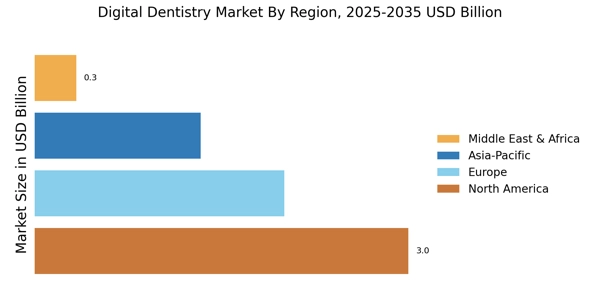
Digital Dentistry Market Regional Image

Key Players and Competitive Insights

The Digital Dentistry Market is currently characterized by a dynamic competitive landscape, driven by technological advancements and an increasing demand for efficient dental solutions. Key players such as Align Technology (US), Dentsply Sirona (US), and 3M (US) are at the forefront, each adopting distinct strategies to enhance their market positioning. Align Technology (US) focuses on innovation through its Invisalign system, which continues to evolve with advanced digital tools, while Dentsply Sirona (US) emphasizes a comprehensive portfolio of digital solutions, integrating imaging and CAD/CAM technologies.

Meanwhile, 3M (US) is leveraging its extensive research capabilities to develop new materials and products that cater to the growing trend of minimally invasive dentistry. Collectively, these strategies not only enhance their competitive edge but also contribute to a rapidly evolving market environment.In terms of business tactics, companies are increasingly localizing manufacturing and optimizing supply chains to respond swiftly to market demands. The market appears moderately fragmented, with a mix of established players and emerging startups. This fragmentation allows for diverse offerings, yet the influence of major companies remains substantial, as they set benchmarks for innovation and quality that smaller firms strive to meet.

In August Align Technology (US) announced a strategic partnership with a leading software developer to enhance its digital treatment planning capabilities. This collaboration is poised to streamline workflows for dental professionals, thereby improving patient outcomes and reinforcing Align's position as a leader in digital orthodontics. The integration of advanced software solutions into their existing platforms signifies a commitment to continuous improvement and customer satisfaction.

In September Dentsply Sirona (US) launched a new line of 3D printers specifically designed for dental applications, which is expected to revolutionize the production of dental prosthetics. This move not only showcases Dentsply's dedication to innovation but also positions the company to capitalize on the growing demand for customized dental solutions. The introduction of these printers could potentially reduce production times and costs, thereby enhancing operational efficiency for dental practices.

In July 3M (US) expanded its digital dentistry portfolio by acquiring a startup specializing in AI-driven diagnostic tools. This acquisition is likely to enhance 3M's capabilities in predictive analytics, allowing dental professionals to make more informed decisions based on data-driven insights. The integration of AI into their product offerings reflects a broader trend within the industry towards leveraging technology to improve clinical outcomes and operational efficiencies.

As of October the market is witnessing a shift towards digitalization, sustainability, and AI integration, which are defining current competitive trends. Strategic alliances among key players are increasingly shaping the landscape, fostering innovation and enhancing product offerings. Looking ahead, it is anticipated that competitive differentiation will evolve, with a pronounced shift from price-based competition to a focus on innovation, technological advancements, and supply chain reliability. This evolution underscores the importance of adaptability and forward-thinking strategies in maintaining a competitive edge in the digital dentistry arena.

Key Companies in the Digital Dentistry Market include

Recent Industry Developments

August 2026, Nobel Biocare becomes an official distributor of Formlabs' Form 4B and Form 4BL 3D printers, plus resins and accessories, in select markets. The release also promises integration with Nobel Biocare's digital workflows. It follows the June 2025 3Shape TRIOS scanner distribution deal, and Nobel Biocare is now selling third-party scanners and printers as part of a broader digital portfolio. (Source: nobelbiocare.com)

July 2026, Dentsply Sirona announced an expansion of its relationship with Medline Sinclair, effective September 1, 2026, under which Medline Sinclair will offer its technology portfolio across Canada, building on a relationship that had focused on consumables. Medline Sinclair will distribute the technology portfolio nationwide. The release describes it as the sixth dealer network enhancement Dentsply Sirona has announced in 2026, and it widens Canadian access to its CEREC and Primescan digital platform. (Source: globenewswire.com)

Future Outlook

Digital Dentistry Market Future Outlook

The Digital Dentistry Market is projected to grow at a 9.16% CAGR from 2025 to 2035, driven by technological advancements, increasing demand for cosmetic dentistry, and enhanced patient experience.

New opportunities lie in:

  • Integration of AI-driven diagnostic tools for personalized treatment plans.
  • Expansion of tele-dentistry platforms to reach underserved populations.
  • Development of 3D printing solutions for customized dental implants and prosthetics.

By 2035, the market is expected to be robust, driven by innovation and increased accessibility.

Market Segmentation

Digital Dentistry Market End User Outlook

  • Dental Clinics
  • Dental Laboratories
  • Research Institutions
  • Hospitals

Digital Dentistry Market Technology Outlook

  • Intraoral Scanners
  • 3D Printing
  • Computer-Aided Design/Computer-Aided Manufacturing (CAD/CAM)
  • Digital Imaging
  • Tele-dentistry

Digital Dentistry Market Application Outlook

  • Orthodontics
  • Restorative Dentistry
  • Oral Surgery
  • Periodontics
  • Implantology

Digital Dentistry Market Service Type Outlook

  • Consultation Services
  • Maintenance and Support Services
  • Training Services

Digital Dentistry Market Software Type Outlook

  • Practice Management Software
  • Dental Imaging Software
  • CAD/CAM Software
  • Patient Management Software

Report Scope

MARKET SIZE 2024 6.764(USD Billion)
MARKET SIZE 2025 7.384(USD Billion)
MARKET SIZE 2035 17.74(USD Billion)
COMPOUND ANNUAL GROWTH RATE (CAGR) 9.16% (2025 - 2035)
REPORT COVERAGE Revenue Forecast, Competitive Landscape, Growth Factors, and Trends
BASE YEAR 2024
Market Forecast Period 2025 - 2035
Historical Data 2019 - 2024
Market Forecast Units USD Billion
Key Companies Profiled Align Technology (US), Dentsply Sirona (US), 3M (US), Henry Schein (US), Planmeca (FI), Sirona Dental Systems (US), Carestream Dental (US), Straumann (CH), Nobel Biocare (CH)
Segments Covered Technology, Applications, End Users, Software Type, Service Type, Regional
Key Market Opportunities Integration of artificial intelligence in diagnostic and treatment planning within the market.
Key Market Dynamics Technological advancements drive competitive forces, reshaping consumer preferences and enhancing efficiency in the market.
Countries Covered North America, Europe, APAC, South America, MEA

Frequently Asked Questions

What is the current valuation of the Digital Dentistry Market as of 2024?
The market was valued at 6.764 USD Billion in 2024.
What is the projected market size for the market by 2035?
The market is projected to reach 17.74 USD Billion by 2035.
What is the expected CAGR for the market during the forecast period 2025 - 2035?
The expected CAGR for the market during 2025 - 2035 is 9.16%.
Which technology segment is anticipated to grow the most in the market?
The Computer-Aided Design/Computer-Aided Manufacturing (CAD/CAM) segment is expected to grow from 1.8 to 5.0 USD Billion.
How does the market for Digital Imaging compare to other technology segments?

The Digital Imaging segment is projected to grow from 1.5 to 4.0 USD Billion, indicating robust growth.

What are the key applications driving the Digital Dentistry Market?

Key applications include Restorative Dentistry, projected to grow from 2.0 to 5.5 USD Billion, and Orthodontics, from 1.5 to 4.0 USD Billion.

Which end user segment is expected to dominate the market?
Dental Clinics are anticipated to dominate, growing from 2.5 to 6.5 USD Billion.
What role do key players like Align Technology and Dentsply Sirona play in the market?

Key players such as Align Technology and Dentsply Sirona are instrumental in driving innovation and market growth.

What is the expected growth for the Training Services segment in the Digital Dentistry Market?

The Training Services segment is projected to grow from 2.764 to 7.27 USD Billion.

How does the market for Practice Management Software compare to other software types?
Practice Management Software is expected to grow from 1.5 to 4.0 USD Billion, reflecting a strong demand in the market.
Author
Author Author Profile Rahul Gotadki LinkedIn Research Manager
He holds an experience of about 9+ years in Market Research and Business Consulting, working under the spectrum of Life Sciences and Healthcare domains. Rahul conceptualizes and implements a scalable business strategy and provides strategic leadership to the clients. His expertise lies in market estimation, competitive intelligence, pipeline analysis, customer assessment, etc.
Co-Author Co-Author Profile Nidhi Mandole LinkedIn Senior Research Analyst
She is an extremely curious individual currently working in Healthcare and Medical Devices Domain. Nidhi is comfortably versed in data centric research backed by healthcare educational background. She leverages extensive data mining and analytics tools such as Primary and Secondary Research, Statistical Analysis, Machine Learning, Data Modelling. Her key role also involves Technical Sales Support, Client Interaction and Project management within the Healthcare team. Lastly, she showcases extensive affinity towards learning new skills and remain fascinated in implementing them.

Research Approach


Secondary Research

The secondary research process involved comprehensive analysis of regulatory databases, peer-reviewed dental journals, clinical publications, and authoritative health organizations. Key sources included the US Food & Drug Administration (FDA) Center for Devices and Radiological Health, European Medicines Agency (EMA) Medical Device Coordination Group, International Organization for Standardization (ISO/TC 106 Dentistry), American Dental Association (ADA), Academy of General Dentistry (AGD), International College of Dentists (ICD), National Institute of Dental and Craniofacial Research (NIDCR), National Center for Biotechnology Information (NCBI/PubMed), World Dental Federation (FDI), Centers for Disease Control and Prevention (CDC) Oral Health Division, World Health Organization (WHO) Oral Health Programme, European Dental Association (EDA), Health Canada Medical Devices Directorate, Therapeutic Goods Administration (TGA) Australia, Pharmaceuticals and Medical Devices Agency (PMDA) Japan, China National Medical Products Administration (NMPA), and national dental association reports from key markets. These sources were used to collect dental procedure statistics, medical device regulatory approval data (510(k) clearances, CE Mark certifications), clinical safety studies on intraoral scanners and CAD/CAM systems, dental workforce demographic trends, and market landscape analysis for intraoral scanners, 3D printing systems, CAD/CAM equipment, digital imaging technologies, and tele-dentistry platforms.


Primary Research

Qualitative and quantitative insights were obtained by interviewing supply-side and demand-side stakeholders during the primary research process. The supply-side sources consisted of CEOs, VPs of Product Development, regulatory affairs chiefs, and commercial directors from dental technology OEMs, dental software developers, 3D printing solution providers, and digital dentistry equipment manufacturers. Board-certified prosthodontists, oral surgeons, orthodontists, dental laboratory technicians, dental clinic owners, procurement leads from dental service organizations (DSOs), hospital dental department chiefs, and research institution directors comprised demand-side sources. Primary research has confirmed the product pipeline timelines for next-generation digital workflows, validated market segmentation across technology types (intraoral scanners, 3D printing, CAD/CAM, digital imaging, tele-dentistry), and gathered insights on clinical adoption patterns, software integration challenges, pricing strategies for capital equipment, and reimbursement dynamics for digital dental procedures.

Primary Respondent Breakdown:

By Designation: C-level Primaries (32%), Director Level (31%), Others (37%)

By Region: North America (38%), Europe (25%), Asia-Pacific (28%), Rest of World (9%)


Market Size Estimation

Global market valuation was derived through revenue mapping, equipment installation base analysis, and procedure volume analysis. The methodology included:

Identification of 50+ key manufacturers across North America, Europe, Asia-Pacific, Latin America, and Middle East & Africa

Product mapping across intraoral scanners, 3D printing systems, CAD/CAM milling units, digital imaging equipment (CBCT, intraoral cameras), tele-dentistry platforms, and supporting software solutions (practice management, dental imaging, CAD/CAM software)

Analysis of reported and modeled annual revenues specific to digital dentistry portfolios, including hardware sales, software licenses, and recurring service revenues

Coverage of manufacturers representing 75-80% of global market share in 2024

Extrapolation using bottom-up (equipment unit sales × ASP by country, software subscription volumes, service contracts) and top-down (manufacturer revenue validation, DSO procurement data) approaches to derive segment-specific valuations for dental clinics, dental laboratories, research institutions, and hospital end-users

Download Free Sample

Kindly complete the form below to receive a free sample of this Report

Download PDF ×

We do not share your information with anyone. However, we may send you emails based on your report interest from time to time. You may contact us at any time to opt-out.