Digitaler Zahnmedizinmarkt

Marktforschungsbericht zur digitalen Zahnmedizin: Größe, Anteil, Trendanalyse nach Technologie (Intraoralscanner, 3D-Druck, computerunterstütztes Design/computerunterstützte Fertigung (CAD/CAM), digitale Bildgebung, Tele-Zahnmedizin), nach Anwendungen (Kieferorthopädie, restaurative Zahnmedizin, orale Chirurgie, Parodontalmedizin, Implantologie), nach Endbenutzern (Zahnkliniken, Zahnlaboratorien, Forschungseinrichtungen, Krankenhäuser), nach Softwaretyp (Praxismanagement-Software, Software für die Zahnmedizinische Bildgebung, CAD/CAM-Software, Patientenmanagement-Software), nach Dienstleistungstyp (Beratungsdienste, Wartungs- und Unterstützungsdienste, Schulungsdienste) und nach regionalen Aspekten (Nordamerika, Europa, Südamerika, Asien-Pazifik, Naher Osten und Afrika) - Prognose bis 2035
ID: MRFR/HC/30531-HCR 128 Pages Rahul Gotadki, Nidhi Mandole Last Updated: September 30, 2026
Digital Dentistry Market
Market Size
Forecast Period2025 - 2035
CAGR (2025 - 2035)9.16%
2024 Market Size$ 6.76 Billion
2025 Market Size$ 7.38 Billion
2035 Market Size$ 17.74 Billion
Key Players
Align Technology
Dentsply Sirona
3M
Henry Schein
Planmeca
Sirona Dental Systems
Opportunities
  • Rise of Preventive Dentistry
  • Advancements in 3D Printing Technology
  • Growing Demand for Aesthetic Dentistry

Digitaler Zahnmedizinmarkt Zusammenfassung

Wichtige Markttrends & Highlights

Marktgröße & Prognose

CAGR (2025 - 2035) 9.16%

Hauptakteure

Align Technology (US), Dentsply Sirona (US), 3M(US), Henry Schein (US), Planmeca (FI), Sirona Dental Systems (US), Carestream Dental (US), Straumann (CH), Nobel Biocare (CH)

Digitaler Zahnmedizinmarkt Treiber

Rise of Preventive Dentistry

The rise of preventive dentistry is becoming a significant driver in the Digital Dentistry Market. There is a growing emphasis on proactive dental care, with patients seeking regular check-ups and early interventions to prevent dental issues. This shift is supported by advancements in digital diagnostic tools, such as intraoral cameras and digital radiography, which allow for early detection of potential problems.
 
Data suggests that preventive dental services are gaining traction, with an increasing number of patients opting for routine screenings and cleanings. As the focus on preventive care continues to grow, the market is likely to expand, driven by the demand for technologies that facilitate early intervention and enhance overall oral health.

Advancements in 3D Printing Technology

Advancements in 3D printing technology are reshaping the landscape of the market. This technology enables the rapid production of dental prosthetics, aligners, and surgical guides with high precision and customization. The ability to create tailored dental solutions on-demand not only enhances patient satisfaction but also reduces the time and costs associated with traditional manufacturing methods.
 
Market data indicates that the 3D printing segment in dentistry is expected to witness a growth rate exceeding 20% annually. As dental practices increasingly incorporate 3D printing into their workflows, the market is likely to benefit from increased efficiency and innovation, ultimately improving patient care.

Growing Demand for Aesthetic Dentistry

The rising demand for aesthetic dentistry is a notable driver in the market. Patients are increasingly seeking cosmetic dental procedures, such as teeth whitening, veneers, and orthodontics, to enhance their smiles. This trend is supported by a growing awareness of the importance of oral aesthetics in personal and professional settings.
 
According to recent data, the aesthetic dentistry segment is expected to account for a significant share of the overall dental market, with projections indicating a growth rate of approximately 25% over the next five years. As dental professionals adopt digital tools to provide more precise and efficient aesthetic solutions, the market is poised for expansion, catering to the evolving preferences of consumers.

Integration of Artificial Intelligence

The integration of artificial intelligence (AI) in the market appears to be a transformative force. AI technologies facilitate enhanced diagnostic accuracy and treatment planning, which may lead to improved patient outcomes. For instance, AI algorithms can analyze dental images with remarkable precision, identifying issues that may be overlooked by human practitioners.
 
This capability not only streamlines workflows but also reduces the time required for diagnosis. The market for AI in dentistry is projected to grow significantly, with estimates suggesting a compound annual growth rate of over 30% in the coming years. As dental practices increasingly adopt AI tools, the market is likely to experience substantial growth, driven by the demand for innovative solutions that enhance clinical efficiency.

Increased Investment in Dental Technology

Increased investment in dental technology is a pivotal driver in the market. Dental practices are allocating more resources towards adopting cutting-edge technologies, such as digital imaging, CAD/CAM systems, and practice management software. This trend is fueled by the need for enhanced operational efficiency and improved patient experiences.
 
Recent statistics indicate that dental technology spending is projected to rise significantly, with many practices recognizing the long-term benefits of investing in digital solutions. As more dental professionals embrace technological advancements, the market is expected to flourish, reflecting a broader commitment to innovation and quality in dental care.

Einblicke in Marktsegmente

The market comprises various software types, with Practice Management Software capturing the largest segment share. This software serves as an integral tool for clinics, streamlining administrative tasks, scheduling, and patient records, making it essential for day-to-day operations. Following closely, Dental Imaging Software, which is witnessing significant gains in market interest, provides the vital capability of digital imaging services, enhancing patient diagnostics and treatment planning.

Erhalten Sie detailliertere Einblicke zu Digitaler Zahnmedizinmarkt

Regionale Einblicke

North America : Innovation and Market Leadership

North America accounted for the largest share of the global Digital Dentistry Market size, reaching USD 3 billion in 2024. The region's growth is driven by increasing adoption of advanced dental technologies, rising consumer awareness about oral health, and supportive regulatory frameworks. The demand for digital solutions is further fueled by the growing prevalence of dental disorders and the need for efficient treatment options.

The United States leads the market, followed by Canada, with key players like Align Technology, Dentsply Sirona, and 3M dominating the landscape. Dentsply Sirona implants north America are gaining attention, augmenting their market share. The competitive environment is characterized by continuous innovation and strategic partnerships among these companies, enhancing their product offerings and market reach. The presence of advanced healthcare infrastructure also supports the growth of digital dentistry in this region.

Europe : Emerging Trends and Regulations

Europe is the second-largest market for digital dentistry, accounting for approximately 30% of the global market share. The region's growth is propelled by increasing investments in dental technology, a rising geriatric population, and stringent regulations promoting digital solutions. Countries like Germany and the UK are at the forefront, with a growing emphasis on preventive care and digital diagnostics.

Germany is the leading market in Europe, followed by the UK and France. The competitive landscape features major players such as Straumann and Nobel Biocare, who are innovating to meet the evolving needs of dental professionals. The European market is also witnessing collaborations between technology firms and dental practices, enhancing the adoption of digital solutions across the region.

Asia-Pacific : Rapid Growth and Adoption

Asia-Pacific is witnessing rapid growth in the market, holding about 20% of the global share. The region's expansion is driven by increasing disposable incomes, a growing middle class, and rising awareness of dental health. Countries like China and India are experiencing significant demand for advanced dental solutions, supported by government initiatives promoting healthcare access.

China is the largest market in the region, followed by Japan and India. The competitive landscape is becoming increasingly dynamic, with local and international players like Carestream Dental and Planmeca expanding their presence. The region is also seeing a surge in dental tourism, further boosting the demand for digital dentistry solutions as patients seek high-quality care at competitive prices.

Middle East and Africa : Untapped Potential and Growth

The Middle East and Africa region is gradually emerging in the market, holding around 5% of the global share. The growth is driven by increasing investments in healthcare infrastructure, rising awareness of dental aesthetics, and a growing population. Countries like South Africa and the UAE are leading the way, with government initiatives aimed at improving healthcare services.

South Africa is the largest market in the region, followed by the UAE. The competitive landscape is characterized by a mix of local and international players, with companies like Henry Schein making significant inroads. The region's potential is further enhanced by the increasing number of dental professionals seeking advanced training in digital technologies, paving the way for future growth in the sector.
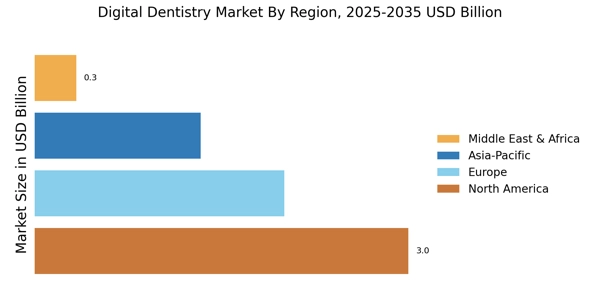
Digitaler Zahnmedizinmarkt Regional Image

Hauptakteure und Wettbewerbseinblicke

The Digital Dentistry Market is currently characterized by a dynamic competitive landscape, driven by technological advancements and an increasing demand for efficient dental solutions. Key players such as Align Technology (US), Dentsply Sirona (US), and 3M (US) are at the forefront, each adopting distinct strategies to enhance their market positioning. Align Technology (US) focuses on innovation through its Invisalign system, which continues to evolve with advanced digital tools, while Dentsply Sirona (US) emphasizes a comprehensive portfolio of digital solutions, integrating imaging and CAD/CAM technologies.
 
Meanwhile, 3M (US) is leveraging its extensive research capabilities to develop new materials and products that cater to the growing trend of minimally invasive dentistry. Collectively, these strategies not only enhance their competitive edge but also contribute to a rapidly evolving market environment.In terms of business tactics, companies are increasingly localizing manufacturing and optimizing supply chains to respond swiftly to market demands. The market appears moderately fragmented, with a mix of established players and emerging startups. This fragmentation allows for diverse offerings, yet the influence of major companies remains substantial, as they set benchmarks for innovation and quality that smaller firms strive to meet.
 
In August Align Technology (US) announced a strategic partnership with a leading software developer to enhance its digital treatment planning capabilities. This collaboration is poised to streamline workflows for dental professionals, thereby improving patient outcomes and reinforcing Align's position as a leader in digital orthodontics. The integration of advanced software solutions into their existing platforms signifies a commitment to continuous improvement and customer satisfaction.
 
In September Dentsply Sirona (US) launched a new line of 3D printers specifically designed for dental applications, which is expected to revolutionize the production of dental prosthetics. This move not only showcases Dentsply's dedication to innovation but also positions the company to capitalize on the growing demand for customized dental solutions. The introduction of these printers could potentially reduce production times and costs, thereby enhancing operational efficiency for dental practices.
 
In July 3M (US) expanded its digital dentistry portfolio by acquiring a startup specializing in AI-driven diagnostic tools. This acquisition is likely to enhance 3M's capabilities in predictive analytics, allowing dental professionals to make more informed decisions based on data-driven insights. The integration of AI into their product offerings reflects a broader trend within the industry towards leveraging technology to improve clinical outcomes and operational efficiencies.
 
As of October the market is witnessing a shift towards digitalization, sustainability, and AI integration, which are defining current competitive trends. Strategic alliances among key players are increasingly shaping the landscape, fostering innovation and enhancing product offerings. Looking ahead, it is anticipated that competitive differentiation will evolve, with a pronounced shift from price-based competition to a focus on innovation, technological advancements, and supply chain reliability. This evolution underscores the importance of adaptability and forward-thinking strategies in maintaining a competitive edge in the digital dentistry arena.

Zu den wichtigsten Unternehmen im Digitaler Zahnmedizinmarkt-Markt gehören

Recent Industry Developments

August 2026, Nobel Biocare becomes an official distributor of Formlabs' Form 4B and Form 4BL 3D printers, plus resins and accessories, in select markets. The release also promises integration with Nobel Biocare's digital workflows. It follows the June 2025 3Shape TRIOS scanner distribution deal, and Nobel Biocare is now selling third-party scanners and printers as part of a broader digital portfolio. (Source: nobelbiocare.com)

July 2026, Dentsply Sirona announced an expansion of its relationship with Medline Sinclair, effective September 1, 2026, under which Medline Sinclair will offer its technology portfolio across Canada, building on a relationship that had focused on consumables. Medline Sinclair will distribute the technology portfolio nationwide. The release describes it as the sixth dealer network enhancement Dentsply Sirona has announced in 2026, and it widens Canadian access to its CEREC and Primescan digital platform. (Source: globenewswire.com)

Zukunftsaussichten

Digitaler Zahnmedizinmarkt Zukunftsaussichten

Der Markt für digitale Zahnmedizin wird voraussichtlich von 2025 bis 2035 mit einer CAGR von 9,16 % wachsen, angetrieben durch technologische Fortschritte, steigende Nachfrage nach kosmetischer Zahnmedizin und verbesserte Patientenerfahrungen.

Neue Möglichkeiten liegen in:

  • Integration von KI-gesteuerten Diagnosetools für personalisierte Behandlungspläne.
  • Expansion von Telezahnmedizin-Plattformen zur Erreichung unterversorgter Bevölkerungsgruppen.
  • Entwicklung von 3D-Drucklösungen für maßgeschneiderte Zahnimplantate und Prothesen.

Bis 2035 wird der Markt für digitale Zahnmedizin voraussichtlich robust sein, angetrieben durch Innovation und erhöhte Zugänglichkeit.

Marktsegmentierung

Markt für digitale Zahnmedizin - Ausblick auf Endbenutzer

  • Zahnkliniken
  • Zahnlaboratorien
  • Forschungseinrichtungen
  • Krankenhäuser

Markt für digitale Zahnmedizin - Ausblick auf Technologien

  • Intraorale Scanner
  • 3D-Druck
  • Computerunterstütztes Design/Computerunterstützte Fertigung (CAD/CAM)
  • Digitale Bildgebung
  • Tele-Zahnmedizin

Markt für digitale Zahnmedizin - Ausblick auf Anwendungen

  • Kieferorthopädie
  • Restaurative Zahnmedizin
  • Oralchirurgie
  • Parodontalmedizin
  • Implantologie

Markt für digitale Zahnmedizin - Ausblick auf Dienstleistungsarten

  • Beratungsdienste
  • Wartungs- und Unterstützungsdienste
  • Schulungsdienste

Markt für digitale Zahnmedizin - Ausblick auf Softwaretypen

  • Praxismanagement-Software
  • Zahnmedizinische Bildgebungssoftware
  • CAD/CAM-Software
  • Patientenmanagement-Software

Berichtsumfang

MARKET SIZE 2024 6.764(USD Billion)
MARKET SIZE 2025 7.384(USD Billion)
MARKET SIZE 2035 17.74(USD Billion)
COMPOUND ANNUAL GROWTH RATE (CAGR) 9.16% (2025 - 2035)
REPORT COVERAGE Revenue Forecast, Competitive Landscape, Growth Factors, and Trends
BASE YEAR 2024
Market Forecast Period 2025 - 2035
Historical Data 2019 - 2024
Market Forecast Units USD Billion
Key Companies Profiled Align Technology (US), Dentsply Sirona (US), 3M (US), Henry Schein (US), Planmeca (FI), Sirona Dental Systems (US), Carestream Dental (US), Straumann (CH), Nobel Biocare (CH)
Segments Covered Technology, Applications, End Users, Software Type, Service Type, Regional
Key Market Opportunities Integration of artificial intelligence in diagnostic and treatment planning within the market.
Key Market Dynamics Technological advancements drive competitive forces, reshaping consumer preferences and enhancing efficiency in the market.
Countries Covered North America, Europe, APAC, South America, MEA

Frequently Asked Questions

Wie hoch ist die aktuelle Bewertung des Marktes für digitale Zahnmedizin im Jahr 2024?

Der Markt für digitale Zahnmedizin wurde im Jahr 2024 mit 6,764 Milliarden USD bewertet.

Wie groß wird die prognostizierte Marktgröße für den Markt für digitale Zahnmedizin bis 2035 sein?

Der Markt wird voraussichtlich bis 2035 17,74 Milliarden USD erreichen.

Wie hoch ist die erwartete CAGR für den Markt für digitale Zahnmedizin im Prognosezeitraum 2025 - 2035?

Die erwartete CAGR für den Markt für digitale Zahnmedizin im Zeitraum 2025 - 2035 beträgt 9,16 %.

Welches Technologiesegment wird voraussichtlich am stärksten im Markt für digitale Zahnmedizin wachsen?

Das Segment Computer-Aided Design/Computer-Aided Manufacturing (CAD/CAM) wird voraussichtlich von 1,8 auf 5,0 Milliarden USD wachsen.

Wie vergleicht sich der Markt für digitale Bildgebung mit anderen Technologiesegmenten?

Das Segment digitale Bildgebung wird voraussichtlich von 1,5 auf 4,0 Milliarden USD wachsen, was auf ein robustes Wachstum hinweist.

Welche Hauptanwendungen treiben den Markt für digitale Zahnmedizin an?

Zu den Hauptanwendungen gehören die restaurative Zahnmedizin, die voraussichtlich von 2,0 auf 5,5 Milliarden USD wachsen wird, und die Kieferorthopädie, von 1,5 auf 4,0 Milliarden USD.

Welches Endbenutzersegment wird voraussichtlich den Markt für digitale Zahnmedizin dominieren?

Zahnkliniken werden voraussichtlich dominieren und von 2,5 auf 6,5 Milliarden USD wachsen.

Welche Rolle spielen Schlüsselakteure wie Align Technology und Dentsply Sirona im Markt?

Schlüsselakteure wie Align Technology und Dentsply Sirona sind maßgeblich an der Förderung von Innovationen und dem Marktwachstum beteiligt.

Wie wird das erwartete Wachstum für das Segment Schulungsdienste im Markt für digitale Zahnmedizin aussehen?

Das Segment Schulungsdienste wird voraussichtlich von 2,764 auf 7,27 Milliarden USD wachsen.

Wie vergleicht sich der Markt für Praxismanagement-Software mit anderen Softwaretypen?
Die Praxismanagement-Software wird voraussichtlich von 1,5 auf 4,0 Milliarden USD wachsen, was eine starke Nachfrage auf dem Markt widerspiegelt.
Autor
Author Author Profile Rahul Gotadki LinkedIn Research Manager
He holds an experience of about 9+ years in Market Research and Business Consulting, working under the spectrum of Life Sciences and Healthcare domains. Rahul conceptualizes and implements a scalable business strategy and provides strategic leadership to the clients. His expertise lies in market estimation, competitive intelligence, pipeline analysis, customer assessment, etc.
Co-Author Co-Author Profile Nidhi Mandole LinkedIn Senior Research Analyst
She is an extremely curious individual currently working in Healthcare and Medical Devices Domain. Nidhi is comfortably versed in data centric research backed by healthcare educational background. She leverages extensive data mining and analytics tools such as Primary and Secondary Research, Statistical Analysis, Machine Learning, Data Modelling. Her key role also involves Technical Sales Support, Client Interaction and Project management within the Healthcare team. Lastly, she showcases extensive affinity towards learning new skills and remain fascinated in implementing them.

Research Approach


Secondary Research

The secondary research process involved comprehensive analysis of regulatory databases, peer-reviewed dental journals, clinical publications, and authoritative health organizations. Key sources included the US Food & Drug Administration (FDA) Center for Devices and Radiological Health, European Medicines Agency (EMA) Medical Device Coordination Group, International Organization for Standardization (ISO/TC 106 Dentistry), American Dental Association (ADA), Academy of General Dentistry (AGD), International College of Dentists (ICD), National Institute of Dental and Craniofacial Research (NIDCR), National Center for Biotechnology Information (NCBI/PubMed), World Dental Federation (FDI), Centers for Disease Control and Prevention (CDC) Oral Health Division, World Health Organization (WHO) Oral Health Programme, European Dental Association (EDA), Health Canada Medical Devices Directorate, Therapeutic Goods Administration (TGA) Australia, Pharmaceuticals and Medical Devices Agency (PMDA) Japan, China National Medical Products Administration (NMPA), and national dental association reports from key markets. These sources were used to collect dental procedure statistics, medical device regulatory approval data (510(k) clearances, CE Mark certifications), clinical safety studies on intraoral scanners and CAD/CAM systems, dental workforce demographic trends, and market landscape analysis for intraoral scanners, 3D printing systems, CAD/CAM equipment, digital imaging technologies, and tele-dentistry platforms.


Primary Research

Qualitative and quantitative insights were obtained by interviewing supply-side and demand-side stakeholders during the primary research process. The supply-side sources consisted of CEOs, VPs of Product Development, regulatory affairs chiefs, and commercial directors from dental technology OEMs, dental software developers, 3D printing solution providers, and digital dentistry equipment manufacturers. Board-certified prosthodontists, oral surgeons, orthodontists, dental laboratory technicians, dental clinic owners, procurement leads from dental service organizations (DSOs), hospital dental department chiefs, and research institution directors comprised demand-side sources. Primary research has confirmed the product pipeline timelines for next-generation digital workflows, validated market segmentation across technology types (intraoral scanners, 3D printing, CAD/CAM, digital imaging, tele-dentistry), and gathered insights on clinical adoption patterns, software integration challenges, pricing strategies for capital equipment, and reimbursement dynamics for digital dental procedures.

Primary Respondent Breakdown:

By Designation: C-level Primaries (32%), Director Level (31%), Others (37%)

By Region: North America (38%), Europe (25%), Asia-Pacific (28%), Rest of World (9%)


Market Size Estimation

Global market valuation was derived through revenue mapping, equipment installation base analysis, and procedure volume analysis. The methodology included:

Identification of 50+ key manufacturers across North America, Europe, Asia-Pacific, Latin America, and Middle East & Africa

Product mapping across intraoral scanners, 3D printing systems, CAD/CAM milling units, digital imaging equipment (CBCT, intraoral cameras), tele-dentistry platforms, and supporting software solutions (practice management, dental imaging, CAD/CAM software)

Analysis of reported and modeled annual revenues specific to digital dentistry portfolios, including hardware sales, software licenses, and recurring service revenues

Coverage of manufacturers representing 75-80% of global market share in 2024

Extrapolation using bottom-up (equipment unit sales × ASP by country, software subscription volumes, service contracts) and top-down (manufacturer revenue validation, DSO procurement data) approaches to derive segment-specific valuations for dental clinics, dental laboratories, research institutions, and hospital end-users

Kostenloses Muster herunterladen

Bitte füllen Sie das folgende Formular aus, um ein kostenloses Muster dieses Berichts zu erhalten

Download PDF ×

We do not share your information with anyone. However, we may send you emails based on your report interest from time to time. You may contact us at any time to opt-out.