×
Request Free Sample ×

Kindly complete the form below to receive a free sample of this Report

* Please use a valid business email

Leading companies partner with us for data-driven Insights

clients tt-cursor
Hero Background
English
Chinese
French
Japanese
Korean
German
Spanish

Digital Camera Market Trends

ID: MRFR/SEM/1701-HCR
200 Pages
Aarti Dhapte
October 2025

Digital Camera Market Size, Share and Research Report By Product Type (Single Reflex, Non-Reflex), By Lens Type (Fixed Lens, Interchangeable Lens), By Sensing Technology (CCD, CMOS), By Application (Personal, Professional) and By Regional (North America, Europe, South America, Asia Pacific, Middle East and Africa) - Industry Forecast Till 2035

Share:
Download PDF ×

We do not share your information with anyone. However, we may send you emails based on your report interest from time to time. You may contact us at any time to opt-out.

Digital Camera Market Infographic
×
Digital Camera Market Infographic Full View
Purchase Options

Market Trends

Introduction

The digital camera market in 2024 is undergoing a major transformation, a result of a number of macroeconomic factors. Advances in technology, especially in image sensors and image processing, are making digital cameras even more attractive to amateur and professional photographers. The pressure from governments to conform to the sustainable development guidelines is forcing manufacturers to adopt more eco-friendly processes and materials, and this is changing their development strategies. In addition, changes in consumer behavior, influenced by the rise of social media and content creation, are driving the demand for more flexible and higher quality solutions. The understanding of these trends is critical for the stakeholders who want to understand the prevailing conditions and seize the opportunities that will be offered.

Top Trends

  1. Rise of Mirrorless Cameras
    The mirrorless camera is gaining popularity, and the two best-known manufacturers, Sony and Canon, are putting their name to it. In 2023, the proportion of mirrorless camera sales to the entire camera market will be over 60%, indicating a change in consumer tastes. The compact size and advanced features are proving attractive to amateur and professional alike. As technology advances, we can expect to see further improvements in autofocus and image stabilization. The trend towards mirrorless is forcing the traditional makers of SLRs to rethink their product range.
  2. Integration of AI and Machine Learning
    Machine learning and artificial intelligence are increasingly being incorporated into digital cameras, which will improve image processing and enhance the user experience. Nikon and Fujifilm have already incorporated such AI features into their products, enabling them to better recognize scenes and make appropriate adjustments. According to a survey, 75% of photographers are willing to pay a premium for such AI features. It is likely that as this trend continues, the camera will become more intuitive, thereby enabling a wider range of users to take up photography. In addition, it is possible that the camera will be able to process images in real time and improve its anticipatory abilities.
  3. Sustainability and Eco-Friendly Practices
    Canon and Panasonic are two of the brands whose digital cameras are setting the standard for sustainability. Recent research shows that 68% of consumers are more likely to buy from brands that are doing their bit for the environment. This trend is influencing product design and packaging, and is encouraging companies to adopt more sustainable practices. Brands will be under pressure to invest in sustainable technology as legislation becomes more onerous. Brands will also benefit from a shift in brand loyalty from eco-conscious consumers.
  4. Enhanced Connectivity Features
    In the digital camera field, the demand for greater interactivity is reshaping the market. The arrival of Wi-Fi and Bluetooth has changed the landscape. Brands such as GoPro and DJI are now in the lead, enabling remote sharing and remote control. 80% of consumers now put interactivity at the top of their wish lists. The trend is driving manufacturers to develop new applications and cloud-based solutions. The next stage is integration with social media and smart devices.
  5. Growth of 360-Degree Cameras
    A great number of content creators and social media influencers are now using 360-degree cameras. Sales of Ricoh and Samsung have seen a 40 per cent increase over the last year. The trend is largely due to the rise of virtual reality and the development of immersive content. As the market grows, we can expect to see an increase in resolution and ease of use. The technology may also find applications in real estate and tourism.
  6. Focus on Video Capabilities
    The demand for high-quality filming is changing the digital camera market, with brands like Sony and Panasonic developing their filming capabilities. Recent research shows that 65% of consumers now place quality of filming as their number one priority when choosing a digital camera. The trend is driving manufacturers to develop a new generation of vlogging and filming-friendly cameras. Future developments may include 8K filming and more advanced stabilisation technology. This development is likely to broaden the market and attract new users.
  7. Adoption of Compact and Travel-Friendly Designs
    The demand for compact and travel-friendly cameras is steadily growing, driven by the need for portability. Olympus and Fujifilm, for example, are concentrating on small, lightweight models, without compromising on quality. According to market research, about 70% of travellers prefer the convenience of compacts. This trend is pushing the development of smaller and more flexible models. Multi-function devices combining photography with other travel essentials are expected to become commonplace in the future.
  8. Increased Customization Options
    Digital camera accessories are becoming more and more varied, allowing the camera to be adapted to the individual preferences of the owner. Leica and Canon offer a wide range of accessories, thus increasing the degree of customer involvement. A survey of photographers shows that 60 per cent of them appreciate the opportunity of changing settings and aesthetics. This trend to greater personalisation of the customer experience could lead to higher customer satisfaction. Modular design with easy upgradability could be a further development.
  9. Emergence of Subscription Models
    Subscriptions to camera equipment and services are now available, giving users flexible access to the latest gear. Kodak and Panasonic are exploring this business model, which appeals to budget-conscious consumers. Recent data show that 50% of camera users are open to using camera subscription services. This trend is transforming the traditional sales approach, with a new recurring revenue stream. Subscriptions to services can enhance the customer experience.
  10. Focus on User Education and Community Building
    The digital camera market is becoming more and more dependent on the formation of communities of use. This is a priority for the big manufacturers such as Canon and Nikon, who are investing in the provision of training and the Internet. According to research, 55% of new users seek out content to help them improve their skills. This trend is strengthening brand loyalty and encouraging the involvement of users. It will probably lead to the creation of more and more interactive platforms and to the creation of a partnership between the manufacturer and the influentials. This trend will probably increase the overall community of photography.

Conclusion: Navigating the Digital Camera Landscape

In 2024, the digital camera market is highly competitive and very fragmented, with both established brands and newcomers vying for market share. North America and Europe have a strong preference for advanced image technology, while the Asia-Pacific region is dominated by cheap but feature-rich models. Strategic positioning is crucial, with AI delivering improved image processing, automation enabling more efficient production and a commitment to sustainable development appealing to eco-conscious consumers. Product development must also be flexible, to meet changing preferences. As the market continues to evolve, those companies that can successfully combine these capabilities will prosper, while those that fail to keep up may struggle to survive.

Author
Aarti Dhapte
Team Lead - Research

She holds an experience of about 6+ years in Market Research and Business Consulting, working under the spectrum of Information Communication Technology, Telecommunications and Semiconductor domains. Aarti conceptualizes and implements a scalable business strategy and provides strategic leadership to the clients. Her expertise lies in market estimation, competitive intelligence, pipeline analysis, customer assessment, etc.

Leave a Comment

FAQs

What was the expected market size of the Digital Camera Market by 2024?

The Digital Camera Market was valued at 8.87 USD Billion by 2024.

What is the projected market size for the Digital Camera Market in 2035?

By 2035, the Digital Camera Market is anticipated to reach a value of 15.69 USD Billion.

What is the expected CAGR for the Digital Camera Market from 2025 to 2035?

The expected CAGR for the Digital Camera Market from 2025 to 2035 is 5.31%.

Which product type dominates the Digital Camera Market?

The Single Reflex product type dominated the market with a value of 5.2 USD Billion in 2024.

What was the market value of Non-Reflex cameras in 2024?

The market value for Non-Reflex cameras was 3.67 USD Billion in 2024.

Which region held the largest market share in 2024?

North America held the largest market share with a value of 2.65 USD Billion in 2024.

What is the projected market growth for the Asia Pacific region from 2024 to 2035?

The Asia Pacific region is projected to grow from 3.1 USD Billion in 2024 to 5.55 USD Billion by 2035.

What is the expected market size for Europe in 2035?

The expected market size for Europe in 2035 is 3.78 USD Billion.

Who are the key players in the Digital Camera Market?

Key players in the market include Leica, Nikon, Canon, Fujifilm, and Sony, among others.

What are the growth drivers for the Digital Camera Market going forward?

The growth drivers include advancements in technology and increasing demand for high-quality imaging systems.

Market Summary

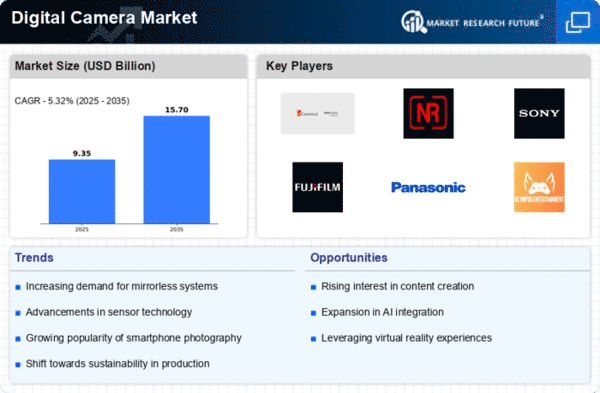
As per MRFR analysis, the Digital Camera Market Size was estimated at 8.88 USD Billion in 2024. The Digital Camera industry is projected to grow from 9.35 USD Billion in 2025 to 15.7 USD Billion by 2035, exhibiting a compound annual growth rate (CAGR) of 5.32 during the forecast period 2025 - 2035.

Key Market Trends & Highlights

The Digital Camera Market is experiencing a transformative shift towards advanced technologies and changing consumer preferences.

  • The rise of mirrorless cameras is reshaping the competitive landscape, particularly in North America. Integration with mobile technology is becoming increasingly prevalent, appealing to a broader audience in the Asia-Pacific region. Sustainability is gaining traction among consumers, influencing purchasing decisions across various demographics. Technological advancements in imaging and the increased demand for content creation are driving growth in both the photography and videography segments.

Market Size & Forecast

2024 Market Size 8.88 (USD Billion)
2035 Market Size 15.7 (USD Billion)
CAGR (2025 - 2035) 5.32%
Largest Regional Market Share in 2024 Asia-Pacific

Major Players

Canon (JP), Nikon (JP), Sony (JP), Fujifilm (JP), Panasonic (JP), Olympus (JP), GoPro (US), Ricoh (JP), Leica (DE)

Market Trends

The Digital Camera Market is currently experiencing a dynamic evolution, driven by advancements in technology and shifting consumer preferences. As photography becomes increasingly integrated with social media and digital sharing platforms, the demand for high-quality imaging devices continues to rise. Manufacturers are focusing on enhancing features such as image stabilization, low-light performance, and connectivity options, which appear to resonate well with both amateur and professional photographers. Furthermore, the emergence of mirrorless cameras has introduced a new level of versatility and compactness, appealing to a broader audience. In addition to technological innovations, sustainability is becoming a focal point within the Digital Camera Market. Consumers are increasingly aware of environmental impacts, prompting brands to adopt eco-friendly practices in production and packaging. This trend suggests a potential shift towards more sustainable materials and energy-efficient devices. As the market evolves, it seems likely that companies will continue to adapt to these changing consumer values, ensuring that their offerings align with the growing demand for responsible consumption.

Rise of Mirrorless Cameras

The Digital Camera Market is witnessing a notable shift towards mirrorless camera systems. These devices offer a compact design without compromising on image quality, making them appealing to both enthusiasts and professionals. Their lightweight nature and advanced features, such as faster autofocus and superior video capabilities, are likely to drive their popularity further.

Integration with Mobile Technology

As smartphones continue to dominate the photography landscape, the Digital Camera Market is adapting by integrating features that enhance connectivity with mobile devices. This trend includes Wi-Fi and Bluetooth capabilities, allowing users to easily share images and control cameras remotely, thereby bridging the gap between traditional photography and modern digital sharing.

Focus on Sustainability

Sustainability is emerging as a critical consideration in the Digital Camera Market. Brands are increasingly prioritizing eco-friendly materials and production processes, responding to consumer demand for environmentally responsible products. This trend indicates a potential shift in how cameras are designed, manufactured, and marketed, aligning with broader societal values.

Digital Camera Market Market Drivers

Technological Advancements

The Digital Camera Market Industry is experiencing rapid technological advancements, which significantly enhance the functionality and performance of digital cameras. Innovations such as improved sensor technology, higher resolution capabilities, and advanced image processing algorithms are driving consumer interest. For instance, the introduction of mirrorless cameras has revolutionized the market by offering compact designs without compromising on image quality. As a result, the market is projected to reach 8.87 USD Billion in 2024, reflecting the growing demand for high-performance imaging devices. These advancements not only cater to professional photographers but also appeal to amateur enthusiasts, thereby broadening the consumer base.

Integration of Smart Features

The integration of smart features into digital cameras is a notable driver within the Digital Camera Industry. Features such as Wi-Fi connectivity, Bluetooth pairing, and mobile app integration enhance user experience by allowing seamless sharing and editing of images. This trend aligns with the growing consumer expectation for convenience and connectivity in technology. As digital cameras become more user-friendly and versatile, they attract a wider audience, including casual users and tech-savvy individuals. This shift is likely to contribute to a compound annual growth rate of 5.32% from 2025 to 2035, indicating a robust growth trajectory for the industry.

Rising Popularity of Photography

The Global Digital Camera Industry is witnessing a surge in the popularity of photography as a hobby and profession. This trend is fueled by social media platforms that encourage users to share high-quality images, thus increasing the demand for advanced digital cameras. The proliferation of photography-related content has led to a growing community of enthusiasts who seek better equipment to enhance their skills. As a result, the market is expected to grow significantly, with projections indicating a value of 15.7 USD Billion by 2035. This increasing interest in photography not only drives sales but also fosters innovation within the industry, as manufacturers strive to meet evolving consumer needs.

Market Trends and Growth Projections

The Global Digital Camera Market Industry is characterized by various trends that indicate a positive growth trajectory. Current projections suggest that the market will reach 8.87 USD Billion in 2024, with a compound annual growth rate of 5.32% anticipated from 2025 to 2035. This growth is driven by factors such as technological advancements, rising photography popularity, and increased demand for content creation. Additionally, the expansion into emerging markets presents new opportunities for manufacturers to tap into a growing consumer base. These trends collectively suggest a robust future for the digital camera market, as it adapts to changing consumer preferences and technological innovations.

Increased Demand for Content Creation

The Global Digital Camera Industry is significantly influenced by the increasing demand for content creation across various platforms. With the rise of influencers, vloggers, and content creators, there is a heightened need for high-quality imaging equipment. Digital cameras are essential tools for producing professional-grade content, which drives consumer investment in advanced models. This trend is expected to sustain market growth, as more individuals and businesses recognize the value of high-quality visuals in digital marketing and social media engagement. Consequently, the market is projected to reach 8.87 USD Billion in 2024, reflecting the growing importance of visual content in communication strategies.

Emerging Markets and Consumer Base Expansion

The Global Digital Camera Market Industry is poised for growth due to the expansion of emerging markets. Regions such as Asia-Pacific and Latin America are witnessing an increase in disposable income, leading to greater consumer spending on photography equipment. As more individuals in these regions gain access to digital cameras, the market is likely to experience a significant boost. This trend is further supported by the increasing availability of affordable yet high-quality digital cameras, which cater to a broader audience. The anticipated growth in these markets is expected to contribute to the overall market value, with projections indicating a rise to 15.7 USD Billion by 2035.

Market Segment Insights

By Application: Photography (Largest) vs. Videography (Fastest-Growing)

The application segment of the digital camera market is characterized by diverse uses, including photography, videography, surveillance, scientific research, and industrial use. Photography remains the largest application, capturing a significant share of the market as it caters to both amateur and professional photographers. Meanwhile, videography is emerging as a strong contender, steadily gaining popularity due to the increasing demand for high-quality video content across various platforms.

Photography (Dominant) vs. Videography (Emerging)

Photography serves as the dominant application in the digital camera market, appealing to a vast range of users from casual hobbyists to professional photographers. The growth of social media and influencer culture has significantly fueled the appeal of photography. In contrast, videography is emerging rapidly, driven by the popularity of video content creation, vlogging, and the rise of platforms like YouTube and TikTok. This shift towards video consumption is pushing manufacturers to innovate and invest in features that enhance video capabilities, such as improved stabilization, high frame rates, and advanced autofocus systems.

By Camera Type: Digital Single-Lens Reflex (Largest) vs. Mirrorless (Fastest-Growing)

In the Digital Camera Market, the distribution of market share among different camera types reveals that Digital Single-Lens Reflex (DSLR) cameras continue to dominate, appealing to professional photographers and enthusiasts alike. These cameras hold a significant share due to their superior image quality and versatility. However, Mirrorless cameras are quickly becoming a popular alternative, as they offer similar quality in a more compact form factor and with advanced features, thus capturing a larger audience over time.

Camera Type: DSLR (Dominant) vs. Mirrorless (Emerging)

The Digital Single-Lens Reflex (DSLR) segment remains dominant in the Digital Camera Market due to its well-established technology and the trust it garners among professionals. DSLRs are known for their larger sensors, optical viewfinders, and extensive lens compatibility, making them ideal for various photographic genres. In contrast, the Mirrorless segment is emerging rapidly, appealing to a younger demographic seeking portability without compromising quality. With the advantage of electronic viewfinders, faster shooting speeds, and innovative features, Mirrorless cameras are attracting both amateur and professional photographers who value convenience and advanced functionalities.

By Sensor Type: Full-Frame (Largest) vs. APS-C (Fastest-Growing)

The Digital Camera Market has seen a diverse distribution in sensor types, with Full-Frame <a href="https://www.marketresearchfuture.com/reports/3d-sensor-market-1104">sensors </a>holding the largest market share due to their superior image quality and performance. Meanwhile, APS-C sensors have been rapidly gaining traction, appealing to a wide range of consumers from photography enthusiasts to professionals due to their balance of performance and price. The popularity of these sensor types indicates a broader trend towards versatility and portability in digital imaging.

Full-Frame (Dominant) vs. APS-C (Emerging)

Full-Frame sensors are defined by their larger physical size, which directly contributes to their exceptional performance in low-light conditions and wider dynamic range. This has made them a preferred choice for professional photographers aiming for the highest image quality. In contrast, the APS-C segment is emerging with significant momentum, offering a more affordable and lightweight alternative without sacrificing too much in terms of image quality. APS-C sensors are especially popular among amateur photographers and videographers, leading to a broader market appeal and fostering growth in this segment.

By Price Range: Entry-Level (Largest) vs. Luxury (Fastest-Growing)

In the Digital Camera Market, the price range segment showcases a diverse distribution among various value categories. The Entry-Level segment dominates the market, capturing a significant portion of the consumer base with its affordability and accessibility. Following closely are the Mid-Range and High-End segments, which target enthusiasts and serious photographers seeking enhanced features and performance. The Professional segment, while smaller, caters to a niche audience with specialized needs in photography.

Entry-Level (Dominant) vs. Luxury (Emerging)

The Entry-Level segment is characterized by its affordability, appealing to novice photographers and casual users who prioritize ease of use and basic functionality. This segment typically features compact designs, user-friendly interfaces, and decent image quality, making it an excellent choice for beginners. Conversely, the Luxury segment is an emerging force within the Digital Camera Market, attracting affluent consumers who seek premium quality, advanced features, and exclusivity. Luxury cameras often come equipped with cutting-edge technology, superior craftsmanship, and personalized options, positioning them as aspirational products. As the demand for high-end photography experiences grows, this segment is seeing rapid growth, driven by the increasing popularity of professional photography and vlogging.

By User Type: Enthusiast (Largest) vs. Professional (Fastest-Growing)

The Digital Camera Market exhibits a diverse segment distribution among different user types. The Enthusiast segment holds the largest market share, driven by a growing number of photography hobbyists seeking quality imaging solutions. In contrast, the Professional segment, though smaller, is rapidly expanding as more photographers and videographers adopt digital technologies for high-end projects. This shift towards professional-grade equipment is changing the dynamics of market share in favor of users seeking advanced features and superior quality.

Enthusiast: Dominant vs. Professional: Emerging

The Enthusiast segment in the Digital Camera Market represents dedicated hobbyists who prioritize quality and performance in their camera choices. Known for their passion and commitment, Enthusiasts often invest in high-quality lenses and accessories, resulting in significant brand loyalty and repeat purchases. On the other hand, the Professional segment is characterized by individuals who utilize cameras in commercial applications, such as photography and videography for events or marketing purposes. Professionals demand advanced technical specifications and reliability, which drives the development of high-performance cameras. As this market grows, manufacturers are focusing on meeting the specific needs of these users, enhancing features tailored for professionals.

Get more detailed insights about Digital Camera Market Research Report - Forecast 2035

Regional Insights

North America : Stable Market with Innovation

The North American digital camera market, valued at $2.66B, is driven by technological advancements and a growing interest in photography among consumers. The demand for high-quality imaging solutions is bolstered by the rise of social media and content creation. Regulatory support for electronic goods and environmental standards also plays a role in shaping market dynamics, ensuring sustainable practices in production and disposal. Leading the market are the U.S. and Canada, where major players like Canon, Nikon, and Sony dominate. The competitive landscape is characterized by continuous innovation, with companies investing heavily in R&D to enhance product features. The presence of established brands ensures a robust supply chain, catering to both amateur and professional photographers, thus maintaining a steady growth trajectory in the region.

Europe : Diverse Market with Strong Demand

Europe's digital camera market, also at $2.66B, is experiencing a resurgence driven by a renewed interest in photography and videography. The region benefits from a diverse consumer base, with increasing demand for high-end cameras among enthusiasts and professionals. Regulatory frameworks promoting sustainability and innovation are key growth catalysts, encouraging manufacturers to adopt eco-friendly practices and enhance product offerings. Germany, the UK, and France are leading markets, with strong competition among key players like Fujifilm, Panasonic, and Leica. The competitive landscape is marked by a blend of traditional and emerging brands, each vying for market share through innovative features and marketing strategies. The presence of a well-established retail network further supports the growth of the digital camera segment in Europe.

Asia-Pacific : Leading Market with High Growth

The Asia-Pacific region, holding the largest market share at $3.56B, is a powerhouse in the digital camera market, driven by rapid technological advancements and a growing middle class. The demand for high-quality imaging devices is fueled by the rise of social media influencers and content creators. Regulatory support for electronics manufacturing and trade policies further enhance market growth, making it a focal point for innovation and investment. Japan, China, and South Korea are the leading countries, with major players like Sony, Canon, and Nikon leading the charge. The competitive landscape is vibrant, with companies continuously innovating to meet consumer demands. The presence of a robust supply chain and a tech-savvy consumer base positions Asia-Pacific as a leader in The Digital Camera.

Middle East and Africa : Emerging Market with Potential

The Middle East and Africa (MEA) digital camera market, currently valued at $0.0B, presents significant growth opportunities as consumer interest in photography rises. Factors such as increasing disposable income and the proliferation of social media are driving demand for digital cameras. Regulatory initiatives aimed at boosting technology adoption and improving infrastructure are expected to catalyze market growth in the coming years. Countries like South Africa and the UAE are emerging as key players in the market, with a growing number of local and international brands entering the space. The competitive landscape is evolving, with companies focusing on affordability and accessibility to capture the interest of a broader consumer base. As the market matures, the presence of established brands will likely enhance competition and innovation.

Key Players and Competitive Insights

The Digital Camera Market is currently characterized by a dynamic competitive landscape, driven by technological advancements and evolving consumer preferences. Major players such as Canon (JP), Nikon (JP), and Sony (JP) are at the forefront, each adopting distinct strategies to maintain their market positions. Canon (JP) emphasizes innovation in imaging technology, focusing on high-performance mirrorless cameras, while Nikon (JP) has been enhancing its product line with a strong emphasis on user-friendly features and robust performance. Sony (JP), on the other hand, leverages its expertise in sensor technology to deliver superior image quality, thereby appealing to both amateur and professional photographers. Collectively, these strategies contribute to a competitive environment that is increasingly defined by innovation and technological prowess.
In terms of business tactics, companies are localizing manufacturing and optimizing supply chains to enhance efficiency and reduce costs. The market structure appears moderately fragmented, with several key players exerting influence over various segments. This fragmentation allows for niche players to thrive, while larger companies focus on consolidating their market share through strategic partnerships and acquisitions. The collective influence of these key players shapes the market dynamics, fostering an environment where innovation is paramount.
In November 2025, Canon (JP) announced the launch of its latest mirrorless camera, which integrates advanced AI features for enhanced image processing. This strategic move not only showcases Canon's commitment to innovation but also positions the company to capture a larger share of the growing market for AI-driven photography solutions. The introduction of such technology is likely to resonate with tech-savvy consumers seeking cutting-edge features in their photography equipment.
Similarly, in October 2025, Nikon (JP) unveiled a new line of compact cameras designed specifically for vlogging and content creation. This strategic pivot reflects Nikon's recognition of the burgeoning demand for portable, high-quality cameras among social media influencers and content creators. By targeting this niche market, Nikon aims to differentiate itself and expand its customer base, potentially leading to increased sales and brand loyalty.
In September 2025, Sony (JP) entered into a strategic partnership with a leading software company to enhance its camera's connectivity features. This collaboration aims to streamline the user experience by integrating cloud-based services for seamless photo sharing and editing. Such initiatives indicate Sony's proactive approach to adapting to consumer needs, particularly in an era where digital connectivity is increasingly vital for photographers.
As of December 2025, current trends in the Digital Camera Market are heavily influenced by digitalization, sustainability, and AI integration. The shift towards sustainable practices is becoming more pronounced, with companies exploring eco-friendly materials and production methods. Strategic alliances are also shaping the competitive landscape, as firms collaborate to enhance technological capabilities and market reach. Looking ahead, competitive differentiation is likely to evolve, with a pronounced shift from price-based competition to a focus on innovation, technology, and supply chain reliability. This evolution suggests that companies that prioritize these aspects will be better positioned to thrive in an increasingly competitive market.

Key Companies in the Digital Camera Market include

Industry Developments

  • Q3 2025: China Is the World's Largest Photography Market So Far in 2025 CIPA's year-to-date statistics for January through June 2025 show that China has become the largest market for digital camera purchases, surpassing the Americas, with a significant surge in camera shipments in April, May, and June driven by increased demand and anticipation of U.S. tariffs.
  • Q3 2025: 2025 is poised to be the best year for cameras since 2019 According to CIPA data released in August 2025, the first half of the year saw 4.3 million cameras shipped globally, with compact camera shipments reaching their highest levels since 2021 and overall shipments up 116.6% compared to the same period in 2024.

Future Outlook

Digital Camera Market Future Outlook

The Digital Camera Market is projected to grow at a 5.32% CAGR from 2024 to 2035, driven by technological advancements, increasing consumer demand, and the rise of content creation.

New opportunities lie in:

  • Development of AI-driven camera features for enhanced user experience.
  • Expansion into emerging markets with affordable product lines.
  • Partnerships with social media platforms for integrated sharing solutions.

By 2035, the Digital Camera Market is expected to achieve robust growth and innovation.

Market Segmentation

Digital Camera Market User Type Outlook

  • Amateur
  • Enthusiast
  • Professional
  • Commercial
  • Educational

Digital Camera Market Application Outlook

  • Photography
  • Videography
  • Surveillance
  • Scientific Research
  • Industrial Use

Digital Camera Market Camera Type Outlook

  • Digital Single-Lens Reflex
  • Mirrorless
  • Compact
  • Action
  • Instant

Digital Camera Market Price Range Outlook

  • Entry-Level
  • Mid-Range
  • High-End
  • Professional
  • Luxury

Digital Camera Market Sensor Type Outlook

  • Full-Frame
  • APS-C
  • Micro Four Thirds
  • 1-Inch
  • Medium Format

Report Scope

MARKET SIZE 2024 8.88(USD Billion)
MARKET SIZE 2025 9.35(USD Billion)
MARKET SIZE 2035 15.7(USD Billion)
COMPOUND ANNUAL GROWTH RATE (CAGR) 5.32% (2025 - 2035)
REPORT COVERAGE Revenue Forecast, Competitive Landscape, Growth Factors, and Trends
BASE YEAR 2024
Market Forecast Period 2025 - 2035
Historical Data 2019 - 2024
Market Forecast Units USD Billion
Key Companies Profiled Canon (JP), Nikon (JP), Sony (JP), Fujifilm (JP), Panasonic (JP), Olympus (JP), GoPro (US), Ricoh (JP), Leica (DE)
Segments Covered Application, Camera Type, Sensor Type, Price Range, User Type
Key Market Opportunities Integration of artificial intelligence in Digital Camera Market enhances user experience and image quality.
Key Market Dynamics Technological advancements and evolving consumer preferences drive competitive dynamics in the digital camera market.
Countries Covered North America, Europe, APAC, South America, MEA

FAQs

What was the expected market size of the Digital Camera Market by 2024?

The Digital Camera Market was valued at 8.87 USD Billion by 2024.

What is the projected market size for the Digital Camera Market in 2035?

By 2035, the Digital Camera Market is anticipated to reach a value of 15.69 USD Billion.

What is the expected CAGR for the Digital Camera Market from 2025 to 2035?

The expected CAGR for the Digital Camera Market from 2025 to 2035 is 5.31%.

Which product type dominates the Digital Camera Market?

The Single Reflex product type dominated the market with a value of 5.2 USD Billion in 2024.

What was the market value of Non-Reflex cameras in 2024?

The market value for Non-Reflex cameras was 3.67 USD Billion in 2024.

Which region held the largest market share in 2024?

North America held the largest market share with a value of 2.65 USD Billion in 2024.

What is the projected market growth for the Asia Pacific region from 2024 to 2035?

The Asia Pacific region is projected to grow from 3.1 USD Billion in 2024 to 5.55 USD Billion by 2035.

What is the expected market size for Europe in 2035?

The expected market size for Europe in 2035 is 3.78 USD Billion.

Who are the key players in the Digital Camera Market?

Key players in the market include Leica, Nikon, Canon, Fujifilm, and Sony, among others.

What are the growth drivers for the Digital Camera Market going forward?

The growth drivers include advancements in technology and increasing demand for high-quality imaging systems.

  1. SECTION I: EXECUTIVE SUMMARY AND KEY HIGHLIGHTS
    1. | 1.1 EXECUTIVE SUMMARY
  2. SECTION II: SCOPING, METHODOLOGY AND MARKET STRUCTURE
    1. | 2.1 MARKET INTRODUCTION
    2. | 2.2 RESEARCH METHODOLOGY
  3. SECTION III: QUALITATIVE ANALYSIS
    1. | 3.1 MARKET DYNAMICS
    2. | 3.2 MARKET FACTOR ANALYSIS
  4. SECTION IV: QUANTITATIVE ANALYSIS
    1. | 4.1 Semiconductor & Electronics, BY Application (USD Billion)
    2. | 4.2 Semiconductor & Electronics, BY Camera Type (USD Billion)
    3. | 4.3 Semiconductor & Electronics, BY Sensor Type (USD Billion)
    4. | 4.4 Semiconductor & Electronics, BY Price Range (USD Billion)
    5. | 4.5 Semiconductor & Electronics, BY User Type (USD Billion)
    6. | 4.6 Semiconductor & Electronics, BY Region (USD Billion)
  5. SECTION V: COMPETITIVE ANALYSIS
    1. | 5.1 Competitive Landscape
    2. | 5.2 Company Profiles
    3. | 5.3 Appendix

Digital Camera Market Segmentation

Market Segmentation Overview

  • Detailed segmentation data will be available in the full report
  • Comprehensive analysis by multiple parameters
  • Regional and country-level breakdowns
  • Market size forecasts by segment
Infographic

Free Sample Request

Kindly complete the form below to receive a free sample of this Report

Get Free Sample

Customer Strories

Compare Licence

×
Features License Type
Single User Multiuser License Enterprise User
Price $4,950 $5,950 $7,250
Maximum User Access Limit 1 User Upto 10 Users Unrestricted Access Throughout the Organization
Free Customization
Direct Access to Analyst
Deliverable Format
Platform Access
Discount on Next Purchase 10% 15% 15%
Printable Versions