
Request Free Sample ×

Kindly complete the form below to receive a free sample of this Report

* Please use a valid business email

Leading companies partner with us for data-driven Insights

clients tt-cursor
Hero Background
English
Chinese
French
Japanese
Korean
German
Spanish

Digital Camera Market Share

ID: MRFR/SEM/1701-HCR
200 Pages
Nirmit Biswas
March 2026

Digital Camera Market Size, Share and Research Report By Product Type (Single Reflex, Non-Reflex), By Lens Type (Fixed Lens, Interchangeable Lens), By Sensing Technology (CCD, CMOS), By Application (Personal, Professional) and By Regional (North America, Europe, South America, Asia Pacific, Middle East and Africa) - Industry Forecast Till 2035

Share:
Download PDF ×

We do not share your information with anyone. However, we may send you emails based on your report interest from time to time. You may contact us at any time to opt-out.

Digital Camera Market Infographic
Purchase Options

Market Share

Introduction: Navigating the Competitive Landscape of Digital Cameras

The digital camera market is in the midst of a profound transformation. It is undergoing a radical change, resulting from a rapid technological uptake, the emergence of new consumer expectations, and the changes in the regulatory framework. This has led to a new competition between the main players, who, in the case of the manufacturers, the IT companies, the new AI companies and the large retailers, are using advanced technologies such as machine learning, the Internet of Things and automation to improve the user experience and the operational efficiency. The manufacturers are focusing more and more on the development of sustainable and green products to meet the regulatory requirements and the demand for eco-friendly products. While the new entrants, with the help of biometric security and real-time image processing, are challenging the established players. The regional markets, especially in Asia-Pacific and North America, are presenting particular opportunities. Strategic deployment trends are essential for those wishing to take advantage of the evolving landscape in 2024 and 2025.

Competitive Positioning

Full-Suite Integrators

These vendors offer a comprehensive range of digital cameras and related technologies, catering to various consumer and professional needs.

Vendor Competitive Edge Solution Focus Regional Focus
Canon Strong brand loyalty and extensive product range DSLR and mirrorless cameras Global
Nikon Innovative imaging technology and optics DSLR and mirrorless cameras Global
Sony Leading sensor technology and video capabilities Mirrorless cameras and camcorders Global
Fujifilm Unique film simulation and retro design Mirrorless cameras and instant film Global
Panasonic Strong video performance and durability Mirrorless cameras and camcorders Global

Specialized Technology Vendors

These vendors focus on niche markets or specific technologies within the digital camera ecosystem.

Vendor Competitive Edge Solution Focus Regional Focus
GoPro Market leader in action cameras Action cameras and accessories Global
DJI Pioneering drone and aerial photography technology Drones and gimbals Global
Leica Heritage brand with premium craftsmanship High-end cameras and lenses Global
KODAK Iconic brand with a focus on instant photography Instant cameras and film Global
Polaroid Nostalgic instant photography experience Instant cameras and film Global

Infrastructure & Equipment Providers

These vendors provide essential components and accessories that enhance the digital camera experience.

Vendor Competitive Edge Solution Focus Regional Focus
Samsung Integration of advanced technology in compact designs Smart cameras and imaging technology Global
Ricoh Innovative compact camera solutions Compact cameras and 360-degree imaging Global
Olympus Expertise in compact and rugged cameras Mirrorless and compact cameras Global
Vivo Smartphone integration with camera technology Smartphone cameras Asia and Global
Xiaomi Affordable pricing with high-quality features Smartphone cameras Asia and Global

Emerging Players & Regional Champions

  • Z-CAM (China): The manufacturer of compact cinema cameras and 4K/6K solutions, it has a close relationship with independent film production, and is competing with established brands such as Canon and Sony. Its products are mainly used in filmmaking, and its products are more and more popular, and they are priced at a lower level than Canon and Sony.
  • Insta360 (China): specializes in developing and producing 360-degree cameras and other image products, and recently launched a new model that combines AI and human experience to meet the needs of content creators and social media influencers, complementing the traditional camera industry, focusing on content creators and social media influencers.
  • Fujifilm (Japan): This established company has recently pushed into digital medium-format cameras and instant photography, and is now a major regional player. It is a master of nostalgia and of high-quality images.
  • GO PRO (US): This company is still developing new features for the action cam market, recently signed a contract with a company in the adventure travel industry, and is taking on the big camera companies by offering rugged, portable solutions.

Regional Trends: In 2024, there is a notable trend towards compact, specialized, and specialized cameras for the niche markets of vlogging, extreme sports, and professional filmmaking. There is a strong need for content creation and social media interaction in Asia-Pacific. In addition, the integration of AI and smart features in the camera is a decisive differentiator that helps new entrants to gain market share against established players.

Collaborations & M&A Movements

  • Canon and Sony entered a partnership to co-develop advanced imaging sensors aimed at enhancing low-light performance in digital cameras, thereby strengthening their competitive positioning in the high-end market segment.
  • Nikon acquired a minority stake in a startup specializing in AI-driven image processing technology to integrate innovative features into their camera lineup, aiming to capture a larger share of the growing smart camera market.
  • Fujifilm and Adobe collaborated to create a seamless workflow for photographers by integrating Fujifilm's camera systems with Adobe's editing software, enhancing user experience and potentially increasing customer loyalty.

Competitive Summary Table

Capability Leading Players Remarks
Image Quality Canon, Nikon, Sony Canon's EOS R5 is famous for its 45-megapixel sensor and its advanced autofocus system. It is the professional's favorite. Nikon's Z9 has 8K video and low-light performance, and Sony's A7R4 has high resolution and high speed, and is favored by both photographers and videographers.
Connectivity Fujifilm, Olympus, Panasonic The X-T4 features Wi-Fi and Bluetooth for easy sharing, while the Olympus OM-D E-M1 Mark III allows remote shooting via your phone. The Panasonic GH5S II offers improved streaming capabilities for content creators.
User Interface Sony, Canon, Nikon Sony's A7 series has a very simple and intuitive touch screen, which allows you to make quick changes. Canon's menu is praised for its simplicity. The Nikon Z series is the most popular, with its redesigned controls, which makes it easier to change settings on the fly.
Video Capabilities Sony, Panasonic, Canon Sony's A7S III is renowned for its 4K filming quality and low-light performance, which makes it a favorite with film-makers. The GH5 is famed for its advanced movie features, such as V-log and high frame rates. Canon's EOS R also offers 8K filming and is popular with professional movie-makers.
Sustainability Nikon, Canon, Fujifilm This is a declaration of our commitment to reducing the carbon footprint of our products. Canon is working to develop more sustainable manufacturing processes, while Fujifilm is working to reduce the use of plastics in its product packaging.
Customer Support Canon, Nikon, Sony Canon offers a wealth of information on its web site, and a network of customer service centres. Nikon’s support is provided by a wide-ranging warranty programme and a range of educational resources. Sony offers a dedicated support app, which can help you to diagnose and fix problems with your equipment.

Conclusion: Navigating the Digital Camera Landscape

The digital camera market in 2024 will be characterized by a high degree of competition and considerable fragmentation, with a number of established and new competitors vying for market share. Brands with a long history and loyal customers will rely on their reputations, while newcomers will focus on new features and niche markets. The trends in the different regions will be very different: the Asia-Pacific region will focus on advancing the quality of its image capture solutions, while North America and Europe will emphasize the development of smart technology and the integration of smart and sustainable features. Those who wish to lead the market will have to focus on developing capabilities such as the use of AI, the automation of production processes, and the implementation of sustainable practices. Product and market flexibility will be essential to success in this fast-moving environment.

Author
Author Profile
Nirmit Biswas
Senior Research Analyst

With 5+ years of expertise in Market Intelligence and Strategic Research, Nirmit Biswas specializes in ICT, Semiconductors, and BFSI. Backed by an MBA in Financial Services and a Computer Science foundation, Nirmit blends technical depth with business acumen. He has successfully led 100+ projects for global enterprises and startups, including Amazon, Cisco, L&T and Huawei, delivering market estimations, competitive benchmarking, and GTM strategies. His focus lies in transforming complex data into clear, actionable insights that drive growth, innovation, and investment decisions. Recognized for bridging engineering innovation with executive strategy, Nirmit helps businesses navigate dynamic markets with confidence.

Leave a Comment

FAQs

What is the current valuation of the Digital Camera Market as of 2024?

<p>The Digital Camera Market was valued at 8.88 USD Billion in 2024.</p>

What is the projected market valuation for the Digital Camera Market in 2035?

<p>The market is projected to reach a valuation of 15.7 USD Billion by 2035.</p>

What is the expected CAGR for the Digital Camera Market during the forecast period 2025 - 2035?

<p>The expected CAGR for the Digital Camera Market during the forecast period 2025 - 2035 is 5.32%.</p>

Which companies are considered key players in the Digital Camera Market?

<p>Key players in the market include Canon, Nikon, Sony, Fujifilm, Panasonic, Olympus, GoPro, Ricoh, and Leica.</p>

How does the Photography segment perform in terms of market valuation?

<p>The Photography segment was valued at 2.66 USD Billion in 2024 and is projected to grow to 4.67 USD Billion by 2035.</p>

What is the market valuation for the Videography segment in 2024?

<p>The Videography segment was valued at 2.22 USD Billion in 2024 and is expected to reach 3.92 USD Billion by 2035.</p>

What are the projected valuations for the Digital Single-Lens Reflex camera type?

<p>The Digital Single-Lens Reflex camera type was valued at 2.66 USD Billion in 2024 and is projected to grow to 4.5 USD Billion by 2035.</p>

What is the market size for the Amateur end-user segment in 2024?

<p>The Amateur end-user segment was valued at 2.66 USD Billion in 2024 and is expected to reach 4.73 USD Billion by 2035.</p>

How does the CMOS sensor type perform in the market?

<p>The CMOS sensor type was valued at 3.54 USD Billion in 2024 and is projected to grow to 6.12 USD Billion by 2035.</p>

What is the expected growth for the Premium price range segment?

<p>The Premium price range segment was valued at 2.66 USD Billion in 2024 and is expected to reach 4.73 USD Billion by 2035.</p>

Market Summary

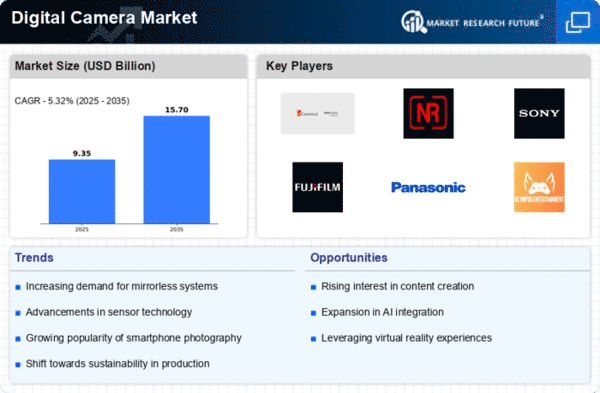
As per Market Research Future analysis, the Digital Camera Market Size was estimated at 8.88 USD Billion in 2024. The Digital Camera industry is projected to grow from 9.35 USD Billion in 2025 to 15.7 USD Billion by 2035, exhibiting a compound annual growth rate (CAGR) of 5.32% during the forecast period 2025 – 2035. This expansion reflects steady digital camera market growth, supported by evolving camera industry trends, increasing adoption across consumer and professional segments, and favorable digital camera industry statistics globally.

Key Market Trends & Highlights

The Digital Camera Market is experiencing a transformative shift towards advanced technologies and changing consumer preferences.

  • The rise of mirrorless cameras is reshaping the competitive landscape, particularly in North America. Integration with mobile technology is becoming increasingly prevalent, appealing to a broader audience in the Asia-Pacific region. Sustainability is gaining traction among consumers, influencing purchasing decisions across various demographics. Technological advancements in imaging and the increased demand for content creation are driving growth in both the photography and videography segments.

Market Size & Forecast

2024 Market Size 8.88 (USD Billion)
2035 Market Size 15.7 (USD Billion)
CAGR (2025 - 2035) 5.32%
Largest Regional Market Share in 2024 Asia-Pacific

Major Players

Canon (JP), Nikon (JP), Sony (JP), Fujifilm (JP), Panasonic (JP), Olympus (JP), GoPro (US), Ricoh (JP), Leica (DE). These companies play a pivotal role in shaping the digital camera business through innovation, pricing strategies, and global distribution, contributing significantly to overall digital camera sales figures and digital camera sales trends.

Market Trends

The Digital Camera Market is currently experiencing a dynamic evolution, driven by advancements in technology and shifting consumer preferences. As photography becomes increasingly integrated with social media and digital sharing platforms, demand continues to rise, reinforcing long-term digital camera market trends. Manufacturers are focusing on enhancing features such as image stabilization, low-light performance, and connectivity options, aligning with insights from ongoing digital camera industry analysis and broader camera industry analysis. Furthermore, the emergence of mirrorless cameras has introduced a new level of versatility and compactness, appealing to a broader audience and influencing digital camera demographics across age groups and professional categories.

In addition to technological innovations, sustainability is becoming a focal point within the digital camera industry. Consumers are increasingly aware of environmental impacts, prompting brands to adopt eco-friendly practices. This shift supports a comprehensive camera industry overview that emphasizes ethical manufacturing and responsible sourcing. As the market evolves, these factors are expected to play a crucial role in shaping future offerings and global digital camera market research outcomes.

Rise of Mirrorless Cameras

The transition from traditional DSLRs to mirrorless systems highlights key camera industry trends, as these cameras offer compact designs without compromising image quality. This evolution continues to influence digital camera market analysis and adoption patterns worldwide.

Integration with Mobile Technology

Digital cameras are increasingly incorporating features that enhance connectivity with smartphones and tablets. This integration supports digital camera marketing strategies by enabling seamless sharing and editing, appealing to tech-savvy users and content creators.

Focus on Sustainability

There is a noticeable shift towards environmentally friendly practices within the camera industry, reflecting growing consumer demand for eco-conscious products and long-term sustainability in the cameras industry.

Digital Camera Market Market Drivers

Technological Advancements

The Digital Camera Market Industry is experiencing rapid technological advancements, which significantly enhance the functionality and performance of digital cameras. Innovations such as improved sensor technology, higher resolution capabilities, and advanced image processing algorithms are driving consumer interest. For instance, the introduction of mirrorless cameras has revolutionized the market by offering compact designs without compromising on image quality. As a result, the market is projected to reach 8.87 USD Billion in 2024, reflecting the growing demand for high-performance imaging devices. These advancements not only cater to professional photographers but also appeal to amateur enthusiasts, thereby broadening the consumer base.

Integration of Smart Features

The integration of smart features into digital cameras is a notable driver within the Digital Camera Industry. Features such as Wi-Fi connectivity, Bluetooth pairing, and mobile app integration enhance user experience by allowing seamless sharing and editing of images. This trend aligns with the growing consumer expectation for convenience and connectivity in technology. As digital cameras become more user-friendly and versatile, they attract a wider audience, including casual users and tech-savvy individuals. This shift is likely to contribute to a compound annual growth rate of 5.32% from 2025 to 2035, indicating a robust growth trajectory for the industry.

Rising Popularity of Photography

The Global Digital Camera Industry is witnessing a surge in the popularity of photography as a hobby and profession. This trend is fueled by social media platforms that encourage users to share high-quality images, thus increasing the demand for advanced digital cameras. The proliferation of photography-related content has led to a growing community of enthusiasts who seek better equipment to enhance their skills. As a result, the market is expected to grow significantly, with projections indicating a value of 15.7 USD Billion by 2035. This increasing interest in photography not only drives sales but also fosters innovation within the industry, as manufacturers strive to meet evolving consumer needs.

Market Trends and Growth Projections

The Global Digital Camera Market Industry is characterized by various trends that indicate a positive growth trajectory. Current projections suggest that the market will reach 8.87 USD Billion in 2024, with a compound annual growth rate of 5.32% anticipated from 2025 to 2035. This growth is driven by factors such as technological advancements, rising photography popularity, and increased demand for content creation. Additionally, the expansion into emerging markets presents new opportunities for manufacturers to tap into a growing consumer base. These trends collectively suggest a robust future for the digital camera market, as it adapts to changing consumer preferences and technological innovations.

Increased Demand for Content Creation

The Global Digital Camera Industry is significantly influenced by the increasing demand for content creation across various platforms. With the rise of influencers, vloggers, and content creators, there is a heightened need for high-quality imaging equipment. Digital cameras are essential tools for producing professional-grade content, which drives consumer investment in advanced models. This trend is expected to sustain market growth, as more individuals and businesses recognize the value of high-quality visuals in digital marketing and social media engagement. Consequently, the market is projected to reach 8.87 USD Billion in 2024, reflecting the growing importance of visual content in communication strategies.

Emerging Markets and Consumer Base Expansion

The Global Digital Camera Market Industry is poised for growth due to the expansion of emerging markets. Regions such as Asia-Pacific and Latin America are witnessing an increase in disposable income, leading to greater consumer spending on photography equipment. As more individuals in these regions gain access to digital cameras, the market is likely to experience a significant boost. This trend is further supported by the increasing availability of affordable yet high-quality digital cameras, which cater to a broader audience. The anticipated growth in these markets is expected to contribute to the overall market value, with projections indicating a rise to 15.7 USD Billion by 2035.

Market Segment Insights

By Application: Photography (Largest) vs. Videography (Fastest-Growing)

In the Digital Camera Market, the application segment reveals a diverse landscape where Photography holds the largest share, while Videography continues to expand rapidly, driven by demand for video cameras for filming movies and professional content creation. This evolution aligns with broader digital camera market segmentation trends.

Photography (Dominant) vs. Videography (Emerging)

Photography remains dominant due to strong professional adoption, while videography is emerging as demand rises for advanced cameras for filming movies and high-definition recording capabilities. This segment benefits from high consumer investment in equipment and accessories, ensuring a robust market presence. Conversely, Videography is recognized as an emerging force, fueled by technological advancements in video capabilities, appealing to both hobbyists and professionals alike. As content consumption trends shift towards video, this segment is expected to see significant growth, supported by innovations in high-definition recording and streaming capabilities.

By Camera Type: Digital Single-Lens Reflex (Largest) vs. Mirrorless (Fastest-Growing)

In the Digital Camera Market, the distribution of market share among different camera types reveals that Digital Single-Lens Reflex (DSLR) cameras continue to dominate, appealing to professional photographers and enthusiasts alike. These cameras hold a significant share due to their superior image quality and versatility. However, Mirrorless cameras are quickly becoming a popular alternative, as they offer similar quality in a more compact form factor and with advanced features, thus capturing a larger audience over time.

Digital Single-Lens Reflex (Dominant) vs. Mirrorless (Emerging)

DSLR cameras retain a strong position, while mirrorless cameras reflect changing digital camera market trends driven by portability, smart features, and consumer convenience. Their dominance is supported by a loyal user base and a wealth of accessories, which enhances their functionality. Conversely, Mirrorless cameras represent an emerging segment, appealing to tech-savvy consumers looking for portability without sacrificing quality. With faster autofocus systems and superior video capabilities, they attract both amateur and professional photographers. Mirrorless technology is continuously evolving, offering advanced features that challenge traditional DSLRs, indicating a dynamic shift in consumer behavior within the digital camera market.

By End User: Professional (Largest) vs. Amateur (Fastest-Growing)

<p>In the Digital Camera Market, the end-user segmentation reveals that the Professional segment holds the largest share. Professionals, including photographers and videographers, drive a significant portion of demand due to their need for high-quality equipment. Meanwhile, the Amateur segment, which includes hobbyists and casual users, is rapidly gaining traction as more individuals embrace photography as a leisure activity. This growing popularity among amateurs reflects a broader trend of personalized content creation in the digital age. Growth trends for this segment show increasing smartphone camera capabilities often spur more interest in digital cameras for amateurs seeking advanced features. The expanding availability of user-friendly options, combined with a rise in social media platforms encouraging photography, propels the amateur segment as the fastest-growing group. Meanwhile, advancements in camera technology resonate with professional needs, ensuring steady demand in the Professional segment.</p>

<p>Photography: Professional (Dominant) vs. Amateur (Emerging)</p>

<p>The Professional segment in the Digital Camera Market is characterized by its demand for high-performance cameras that can withstand rigorous usage. Professionals prefer advanced features such as superior image quality, enhanced lens options, and robust build quality, which make these cameras ideal for varied shooting conditions. This segment is often driven by innovation and the latest trends in photography technology. In contrast, the Amateur segment is emerging rapidly, appealing to those who prefer easier-to-use cameras that still deliver quality results. This group favors compact and lightweight cameras, often incorporating automatic settings and digital connectivity features, making photography accessible for casual users. As both segments adapt to changing consumer behavior, they demonstrate distinct market positions in the evolving digital landscape.</p>

By Sensor Type: CMOS (Largest) vs. CCD (Fastest-Growing)

<p>The Digital Camera Market showcases a dynamic distribution of sensor types, with CMOS sensors leading the charge due to their superior performance and cost-effectiveness. As consumer demand for high-quality images and compact designs rises, CMOS has captured a significant share, primarily used in digital SLRs and mirrorless cameras. Conversely, CCD sensors, though traditionally popular for their image quality in professional settings, are witnessing renewed interest as manufacturers explore innovative uses and enhancements in low-light performance. In terms of growth trends, CMOS technology continues to dominate due to advancements in semiconductor technology, providing faster processing speeds and reduced power consumption. Meanwhile, CCD sensors are emerging as a fast-growing segment driven by niche applications in astronomy and scientific imaging, reflecting a resurgence fueled by advancements in imaging technology that cater to specific high-end needs.</p>

<p>Sensor Type: CMOS (Dominant) vs. CCD (Emerging)</p>

<p>CMOS sensors are established as the dominant force in the Digital Camera Market, renowned for their ability to integrate other components on the same chip, leading to compact designs and lower manufacturing costs. This technology also offers faster readout speeds and better battery efficiency, essential for modern photography that demands higher frame rates and longer shooting durations. CCD sensors, while once a standard in high-end cameras, are now viewed as emerging players primarily used in specialized applications where exceptional image quality is paramount. The rich color reproduction and low noise at high ISO levels make CCD attractive for professional and scientific use, suggesting that while their market presence is diminishing overall, specific sectors still value their unique advantages.</p>

By Price Range: Budget (Largest) vs. Premium (Fastest-Growing)

<p>The Digital Camera Market showcases a diverse distribution across various price segments. The Budget segment stands out with the largest market share, appealing to beginner photographers and casual users seeking affordability. On the other hand, the Premium segment is gaining traction, attracting enthusiasts and professionals who value advanced features and superior performance. As technology continues to evolve, both segments play vital roles in meeting the diverse needs of photographers worldwide.</p>

<p>Budget (Dominant) vs. Luxury (Emerging)</p>

<p>The Budget segment serves as the cornerstone of the Digital Camera Market, characterized by its accessibility and user-friendly features. It caters primarily to entry-level photographers, offering essential functionalities at competitive prices. Meanwhile, the Luxury segment is emerging, appealing to a niche market of affluent photography enthusiasts and professionals. Luxury cameras are distinguished by their high-quality materials, advanced technology, and unique features, which justify their premium pricing. As more consumers seek specialized gear to enhance their photography experience, the Luxury segment is poised for growth, albeit within its specific demographic.</p>

Get more detailed insights about Digital Camera Market Research Report - Forecast 2035

Regional Insights

North America : Stable Market with Innovation

North America continues to lead the digital camera market, holding a significant share of 3.55 billion in 2024. North America continues to lead the digital camera market, driven by strong consumer demand, innovation, and robust digital camera sales figures. The region's growth is driven by increasing consumer demand for high-quality imaging and advancements in technology. Regulatory support for digital innovation and environmental standards further catalyze market expansion. The rise of social media and content creation has also fueled demand for versatile camera systems, enhancing the market's growth trajectory.

The competitive landscape in North America is robust, featuring key players such as Canon, Nikon, and Sony, which dominate the market with innovative products. The U.S. remains the largest market, driven by a tech-savvy population and a strong photography culture. Companies are focusing on enhancing user experience through smart features and connectivity options, ensuring they meet the evolving needs of consumers. The presence of major brands and continuous product launches solidify North America's position as a digital camera powerhouse.

Europe : Diverse Market with Strong Demand

Europe's digital camera market, also at $2.66B, is experiencing a resurgence driven by a renewed interest in photography and videography. The region benefits from a diverse consumer base, with increasing demand for high-end cameras among enthusiasts and professionals. Regulatory frameworks promoting sustainability and innovation are key growth catalysts, encouraging manufacturers to adopt eco-friendly practices and enhance product offerings. Germany, the UK, and France are leading markets, with strong competition among key players like Fujifilm, Panasonic, and Leica. The competitive landscape is marked by a blend of traditional and emerging brands, each vying for market share through innovative features and marketing strategies. The presence of a well-established retail network further supports the growth of the digital camera segment in Europe.

Asia-Pacific : Leading Market with High Growth

Asia-Pacific demonstrates strong expansion, particularly in digital camera market in India and digital camera industry in India, where rising incomes and content creation drive demand. Increased availability of digital cameras in Indian market continues to strengthen regional performance. Countries like China and India are leading this growth, with a rising interest in photography and content creation. Regulatory initiatives aimed at promoting technological advancements and digital literacy are also contributing to market expansion, making high-quality cameras more accessible to consumers.

The competitive landscape is vibrant, with major players like Sony and Canon investing heavily in the region. Japan remains a key market, known for its technological innovations and high-quality products. The presence of local brands is also notable, as they cater to specific consumer needs and preferences. As the demand for digital content continues to rise, the Asia-Pacific market is set to become a significant player in the global digital camera industry.

Middle East and Africa : Emerging Market with Potential

The Middle East and Africa (MEA) digital camera market, currently valued at $0.0B, presents significant growth opportunities as consumer interest in photography rises. Factors such as increasing disposable income and the proliferation of social media are driving demand for digital cameras. Regulatory initiatives aimed at boosting technology adoption and improving infrastructure are expected to catalyze market growth in the coming years. Countries like South Africa and the UAE are emerging as key players in the market, with a growing number of local and international brands entering the space. The competitive landscape is evolving, with companies focusing on affordability and accessibility to capture the interest of a broader consumer base. As the market matures, the presence of established brands will likely enhance competition and innovation.

Key Players and Competitive Insights

The Digital Camera Market is currently characterized by a dynamic competitive landscape, driven by technological advancements and evolving consumer preferences. Major players influence global digital camera business dynamics through product launches and partnerships, reinforcing the long-term stability of the digital camera industry. Major players such as Canon (JP), Nikon (JP), and Sony (JP) are at the forefront, each adopting distinct strategies to maintain their market positions. Canon (JP) emphasizes innovation in imaging technology, focusing on high-performance mirrorless cameras, while Nikon (JP) has been enhancing its product line with a strong emphasis on user-friendly features and robust performance. Sony (JP), on the other hand, leverages its expertise in sensor technology to deliver superior image quality, thereby appealing to both amateur and professional photographers. Collectively, these strategies contribute to a competitive environment that is increasingly defined by innovation and technological prowess. In terms of business tactics, companies are localizing manufacturing and optimizing supply chains to enhance efficiency and reduce costs. The market structure appears moderately fragmented, with several key players exerting influence over various segments. This fragmentation allows for niche players to thrive, while larger companies focus on consolidating their market share through strategic partnerships and acquisitions. The collective influence of these key players shapes the market dynamics, fostering an environment where innovation is paramount. In November 2025, Canon (JP) announced the launch of its latest mirrorless camera, which integrates advanced AI features for enhanced image processing. This strategic move not only showcases Canon's commitment to innovation but also positions the company to capture a larger share of the growing market for AI-driven photography solutions. The introduction of such technology is likely to resonate with tech-savvy consumers seeking cutting-edge features in their photography equipment. Similarly, in October 2025, Nikon (JP) unveiled a new line of compact cameras designed specifically for vlogging and content creation. This strategic pivot reflects Nikon's recognition of the burgeoning demand for portable, high-quality cameras among social media influencers and content creators. By targeting this niche market, Nikon aims to differentiate itself and expand its customer base, potentially leading to increased sales and brand loyalty. In September 2025, Sony (JP) entered into a strategic partnership with a leading software company to enhance its camera's connectivity features. This collaboration aims to streamline the user experience by integrating cloud-based services for seamless photo sharing and editing. Such initiatives indicate Sony's proactive approach to adapting to consumer needs, particularly in an era where digital connectivity is increasingly vital for photographers. As of December 2025, current trends in the Digital Camera Market are heavily influenced by digitalization, sustainability, and AI integration. The shift towards sustainable practices is becoming more pronounced, with companies exploring eco-friendly materials and production methods. Strategic alliances are also shaping the competitive landscape, as firms collaborate to enhance technological capabilities and market reach. Looking ahead, competitive differentiation is likely to evolve, with a pronounced shift from price-based competition to a focus on innovation, technology, and supply chain reliability. This evolution suggests that companies that prioritize these aspects will be better positioned to thrive in an increasingly competitive market.

Key Companies in the Digital Camera Market include

Industry Developments

  • Q3 2025: China Is the World's Largest Photography Market So Far in 2025 CIPA's year-to-date statistics for January through June 2025 show that China has become the largest market for digital camera purchases, surpassing the Americas, with a significant surge in camera shipments in April, May, and June driven by increased demand and anticipation of U.S. tariffs.
  • Q3 2025: 2025 is poised to be the best year for cameras since 2019 According to CIPA data released in August 2025, the first half of the year saw 4.3 million cameras shipped globally, with compact camera shipments reaching their highest levels since 2021 and overall shipments up 116.6% compared to the same period in 2024.

Future Outlook

Digital Camera Market Future Outlook

The Digital Camera Market is projected to grow at a 5.32% CAGR from 2024 to 2035, driven by innovation, rising content creation, and expanding professional use cases such as cameras for filming movies and video cameras for filming movies. By 2035, the market is expected to demonstrate robust innovation and diversification across applications.

New opportunities lie in:

  • <p>Development of AI-driven camera features for enhanced user experience. Expansion into emerging markets with affordable product lines. Partnerships with social media platforms for integrated sharing solutions.</p>

By 2035, the Digital Camera Market is expected to achieve robust growth and innovation.

Market Segmentation

Digital Camera Market User Type Outlook

  • Amateur
  • Enthusiast
  • Professional
  • Commercial
  • Educational

Digital Camera Market Application Outlook

  • Photography
  • Videography
  • Surveillance
  • Scientific Research
  • Industrial Use

Digital Camera Market Camera Type Outlook

  • Digital Single-Lens Reflex
  • Mirrorless
  • Compact
  • Action
  • Instant

Digital Camera Market Price Range Outlook

  • Entry-Level
  • Mid-Range
  • High-End
  • Professional
  • Luxury

Digital Camera Market Sensor Type Outlook

  • Full-Frame
  • APS-C
  • Micro Four Thirds
  • 1-Inch
  • Medium Format

Report Scope

MARKET SIZE 2024 8.88(USD Billion)
MARKET SIZE 2025 9.35(USD Billion)
MARKET SIZE 2035 15.7(USD Billion)
COMPOUND ANNUAL GROWTH RATE (CAGR) 5.32% (2025 - 2035)
REPORT COVERAGE Revenue Forecast, Competitive Landscape, Growth Factors, and Trends
BASE YEAR 2024
Market Forecast Period 2025 - 2035
Historical Data 2019 - 2024
Market Forecast Units USD Billion
Key Companies Profiled Canon (JP), Nikon (JP), Sony (JP), Fujifilm (JP), Panasonic (JP), Olympus (JP), GoPro (US), Ricoh (JP), Leica (DE)
Segments Covered Application, Camera Type, Sensor Type, Price Range, User Type
Key Market Opportunities Integration of artificial intelligence in Digital Camera Market enhances user experience and image quality.
Key Market Dynamics Technological advancements and evolving consumer preferences drive competitive dynamics in the digital camera market.
Countries Covered North America, Europe, APAC, South America, MEA

FAQs

What is the current valuation of the Digital Camera Market as of 2024?

<p>The Digital Camera Market was valued at 8.88 USD Billion in 2024.</p>

What is the projected market valuation for the Digital Camera Market in 2035?

<p>The market is projected to reach a valuation of 15.7 USD Billion by 2035.</p>

What is the expected CAGR for the Digital Camera Market during the forecast period 2025 - 2035?

<p>The expected CAGR for the Digital Camera Market during the forecast period 2025 - 2035 is 5.32%.</p>

Which companies are considered key players in the Digital Camera Market?

<p>Key players in the market include Canon, Nikon, Sony, Fujifilm, Panasonic, Olympus, GoPro, Ricoh, and Leica.</p>

How does the Photography segment perform in terms of market valuation?

<p>The Photography segment was valued at 2.66 USD Billion in 2024 and is projected to grow to 4.67 USD Billion by 2035.</p>

What is the market valuation for the Videography segment in 2024?

<p>The Videography segment was valued at 2.22 USD Billion in 2024 and is expected to reach 3.92 USD Billion by 2035.</p>

What are the projected valuations for the Digital Single-Lens Reflex camera type?

<p>The Digital Single-Lens Reflex camera type was valued at 2.66 USD Billion in 2024 and is projected to grow to 4.5 USD Billion by 2035.</p>

What is the market size for the Amateur end-user segment in 2024?

<p>The Amateur end-user segment was valued at 2.66 USD Billion in 2024 and is expected to reach 4.73 USD Billion by 2035.</p>

How does the CMOS sensor type perform in the market?

<p>The CMOS sensor type was valued at 3.54 USD Billion in 2024 and is projected to grow to 6.12 USD Billion by 2035.</p>

What is the expected growth for the Premium price range segment?

<p>The Premium price range segment was valued at 2.66 USD Billion in 2024 and is expected to reach 4.73 USD Billion by 2035.</p>

  1. SECTION I: EXECUTIVE SUMMARY AND KEY HIGHLIGHTS
    1. | 1.1 EXECUTIVE SUMMARY
    2. | | 1.1.1 Market Overview
    3. | | 1.1.2 Key Findings
    4. | | 1.1.3 Market Segmentation
    5. | | 1.1.4 Competitive Landscape
    6. | | 1.1.5 Challenges and Opportunities
    7. | | 1.1.6 Future Outlook
  2. SECTION II: SCOPING, METHODOLOGY AND MARKET STRUCTURE
    1. | 2.1 MARKET INTRODUCTION
    2. | | 2.1.1 Definition
    3. | | 2.1.2 Scope of the study
    4. | | | 2.1.2.1 Research Objective
    5. | | | 2.1.2.2 Assumption
    6. | | | 2.1.2.3 Limitations
    7. | 2.2 RESEARCH METHODOLOGY
    8. | | 2.2.1 Overview
    9. | | 2.2.2 Data Mining
    10. | | 2.2.3 Secondary Research
    11. | | 2.2.4 Primary Research
    12. | | | 2.2.4.1 Primary Interviews and Information Gathering Process
    13. | | | 2.2.4.2 Breakdown of Primary Respondents
    14. | | 2.2.5 Forecasting Model
    15. | | 2.2.6 Market Size Estimation
    16. | | | 2.2.6.1 Bottom-Up Approach
    17. | | | 2.2.6.2 Top-Down Approach
    18. | | 2.2.7 Data Triangulation
    19. | | 2.2.8 Validation
  3. SECTION III: QUALITATIVE ANALYSIS
    1. | 3.1 MARKET DYNAMICS
    2. | | 3.1.1 Overview
    3. | | 3.1.2 Drivers
    4. | | 3.1.3 Restraints
    5. | | 3.1.4 Opportunities
    6. | 3.2 MARKET FACTOR ANALYSIS
    7. | | 3.2.1 Value chain Analysis
    8. | | 3.2.2 Porter's Five Forces Analysis
    9. | | | 3.2.2.1 Bargaining Power of Suppliers
    10. | | | 3.2.2.2 Bargaining Power of Buyers
    11. | | | 3.2.2.3 Threat of New Entrants
    12. | | | 3.2.2.4 Threat of Substitutes
    13. | | | 3.2.2.5 Intensity of Rivalry
    14. | | 3.2.3 COVID-19 Impact Analysis
    15. | | | 3.2.3.1 Market Impact Analysis
    16. | | | 3.2.3.2 Regional Impact
    17. | | | 3.2.3.3 Opportunity and Threat Analysis
  4. SECTION IV: QUANTITATIVE ANALYSIS
    1. | 4.1 Semiconductor & Electronics, BY Application (USD Billion)
    2. | | 4.1.1 Photography
    3. | | 4.1.2 Videography
    4. | | 4.1.3 Surveillance
    5. | | 4.1.4 Scientific Research
    6. | | 4.1.5 Industrial
    7. | 4.2 Semiconductor & Electronics, BY Camera Type (USD Billion)
    8. | | 4.2.1 Digital Single-Lens Reflex
    9. | | 4.2.2 Mirrorless
    10. | | 4.2.3 Compact
    11. | | 4.2.4 Action
    12. | | 4.2.5 Instant
    13. | 4.3 Semiconductor & Electronics, BY End User (USD Billion)
    14. | | 4.3.1 Professional
    15. | | 4.3.2 Amateur
    16. | | 4.3.3 Educational
    17. | | 4.3.4 Commercial
    18. | | 4.3.5 Government
    19. | 4.4 Semiconductor & Electronics, BY Sensor Type (USD Billion)
    20. | | 4.4.1 CMOS
    21. | | 4.4.2 CCD
    22. | | 4.4.3 Full Frame
    23. | | 4.4.4 Micro Four Thirds
    24. | | 4.4.5 Medium Format
    25. | 4.5 Semiconductor & Electronics, BY Price Range (USD Billion)
    26. | | 4.5.1 Budget
    27. | | 4.5.2 Mid-Range
    28. | | 4.5.3 Premium
    29. | | 4.5.4 Luxury
    30. | 4.6 Semiconductor & Electronics, BY Region (USD Billion)
    31. | | 4.6.1 North America
    32. | | | 4.6.1.1 US
    33. | | | 4.6.1.2 Canada
    34. | | 4.6.2 Europe
    35. | | | 4.6.2.1 Germany
    36. | | | 4.6.2.2 UK
    37. | | | 4.6.2.3 France
    38. | | | 4.6.2.4 Russia
    39. | | | 4.6.2.5 Italy
    40. | | | 4.6.2.6 Spain
    41. | | | 4.6.2.7 Rest of Europe
    42. | | 4.6.3 APAC
    43. | | | 4.6.3.1 China
    44. | | | 4.6.3.2 India
    45. | | | 4.6.3.3 Japan
    46. | | | 4.6.3.4 South Korea
    47. | | | 4.6.3.5 Malaysia
    48. | | | 4.6.3.6 Thailand
    49. | | | 4.6.3.7 Indonesia
    50. | | | 4.6.3.8 Rest of APAC
    51. | | 4.6.4 South America
    52. | | | 4.6.4.1 Brazil
    53. | | | 4.6.4.2 Mexico
    54. | | | 4.6.4.3 Argentina
    55. | | | 4.6.4.4 Rest of South America
    56. | | 4.6.5 MEA
    57. | | | 4.6.5.1 GCC Countries
    58. | | | 4.6.5.2 South Africa
    59. | | | 4.6.5.3 Rest of MEA
  5. SECTION V: COMPETITIVE ANALYSIS
    1. | 5.1 Competitive Landscape
    2. | | 5.1.1 Overview
    3. | | 5.1.2 Competitive Analysis
    4. | | 5.1.3 Market share Analysis
    5. | | 5.1.4 Major Growth Strategy in the Semiconductor & Electronics
    6. | | 5.1.5 Competitive Benchmarking
    7. | | 5.1.6 Leading Players in Terms of Number of Developments in the Semiconductor & Electronics
    8. | | 5.1.7 Key developments and growth strategies
    9. | | | 5.1.7.1 New Product Launch/Service Deployment
    10. | | | 5.1.7.2 Merger & Acquisitions
    11. | | | 5.1.7.3 Joint Ventures
    12. | | 5.1.8 Major Players Financial Matrix
    13. | | | 5.1.8.1 Sales and Operating Income
    14. | | | 5.1.8.2 Major Players R&D Expenditure. 2023
    15. | 5.2 Company Profiles
    16. | | 5.2.1 Canon (JP)
    17. | | | 5.2.1.1 Financial Overview
    18. | | | 5.2.1.2 Products Offered
    19. | | | 5.2.1.3 Key Developments
    20. | | | 5.2.1.4 SWOT Analysis
    21. | | | 5.2.1.5 Key Strategies
    22. | | 5.2.2 Nikon (JP)
    23. | | | 5.2.2.1 Financial Overview
    24. | | | 5.2.2.2 Products Offered
    25. | | | 5.2.2.3 Key Developments
    26. | | | 5.2.2.4 SWOT Analysis
    27. | | | 5.2.2.5 Key Strategies
    28. | | 5.2.3 Sony (JP)
    29. | | | 5.2.3.1 Financial Overview
    30. | | | 5.2.3.2 Products Offered
    31. | | | 5.2.3.3 Key Developments
    32. | | | 5.2.3.4 SWOT Analysis
    33. | | | 5.2.3.5 Key Strategies
    34. | | 5.2.4 Fujifilm (JP)
    35. | | | 5.2.4.1 Financial Overview
    36. | | | 5.2.4.2 Products Offered
    37. | | | 5.2.4.3 Key Developments
    38. | | | 5.2.4.4 SWOT Analysis
    39. | | | 5.2.4.5 Key Strategies
    40. | | 5.2.5 Panasonic (JP)
    41. | | | 5.2.5.1 Financial Overview
    42. | | | 5.2.5.2 Products Offered
    43. | | | 5.2.5.3 Key Developments
    44. | | | 5.2.5.4 SWOT Analysis
    45. | | | 5.2.5.5 Key Strategies
    46. | | 5.2.6 Olympus (JP)
    47. | | | 5.2.6.1 Financial Overview
    48. | | | 5.2.6.2 Products Offered
    49. | | | 5.2.6.3 Key Developments
    50. | | | 5.2.6.4 SWOT Analysis
    51. | | | 5.2.6.5 Key Strategies
    52. | | 5.2.7 GoPro (US)
    53. | | | 5.2.7.1 Financial Overview
    54. | | | 5.2.7.2 Products Offered
    55. | | | 5.2.7.3 Key Developments
    56. | | | 5.2.7.4 SWOT Analysis
    57. | | | 5.2.7.5 Key Strategies
    58. | | 5.2.8 Ricoh (JP)
    59. | | | 5.2.8.1 Financial Overview
    60. | | | 5.2.8.2 Products Offered
    61. | | | 5.2.8.3 Key Developments
    62. | | | 5.2.8.4 SWOT Analysis
    63. | | | 5.2.8.5 Key Strategies
    64. | | 5.2.9 Leica (DE)
    65. | | | 5.2.9.1 Financial Overview
    66. | | | 5.2.9.2 Products Offered
    67. | | | 5.2.9.3 Key Developments
    68. | | | 5.2.9.4 SWOT Analysis
    69. | | | 5.2.9.5 Key Strategies
    70. | 5.3 Appendix
    71. | | 5.3.1 References
    72. | | 5.3.2 Related Reports
  6. LIST OF FIGURES
    1. | 6.1 MARKET SYNOPSIS
    2. | 6.2 NORTH AMERICA MARKET ANALYSIS
    3. | 6.3 US MARKET ANALYSIS BY APPLICATION
    4. | 6.4 US MARKET ANALYSIS BY CAMERA TYPE
    5. | 6.5 US MARKET ANALYSIS BY END USER
    6. | 6.6 US MARKET ANALYSIS BY SENSOR TYPE
    7. | 6.7 US MARKET ANALYSIS BY PRICE RANGE
    8. | 6.8 CANADA MARKET ANALYSIS BY APPLICATION
    9. | 6.9 CANADA MARKET ANALYSIS BY CAMERA TYPE
    10. | 6.10 CANADA MARKET ANALYSIS BY END USER
    11. | 6.11 CANADA MARKET ANALYSIS BY SENSOR TYPE
    12. | 6.12 CANADA MARKET ANALYSIS BY PRICE RANGE
    13. | 6.13 EUROPE MARKET ANALYSIS
    14. | 6.14 GERMANY MARKET ANALYSIS BY APPLICATION
    15. | 6.15 GERMANY MARKET ANALYSIS BY CAMERA TYPE
    16. | 6.16 GERMANY MARKET ANALYSIS BY END USER
    17. | 6.17 GERMANY MARKET ANALYSIS BY SENSOR TYPE
    18. | 6.18 GERMANY MARKET ANALYSIS BY PRICE RANGE
    19. | 6.19 UK MARKET ANALYSIS BY APPLICATION
    20. | 6.20 UK MARKET ANALYSIS BY CAMERA TYPE
    21. | 6.21 UK MARKET ANALYSIS BY END USER
    22. | 6.22 UK MARKET ANALYSIS BY SENSOR TYPE
    23. | 6.23 UK MARKET ANALYSIS BY PRICE RANGE
    24. | 6.24 FRANCE MARKET ANALYSIS BY APPLICATION
    25. | 6.25 FRANCE MARKET ANALYSIS BY CAMERA TYPE
    26. | 6.26 FRANCE MARKET ANALYSIS BY END USER
    27. | 6.27 FRANCE MARKET ANALYSIS BY SENSOR TYPE
    28. | 6.28 FRANCE MARKET ANALYSIS BY PRICE RANGE
    29. | 6.29 RUSSIA MARKET ANALYSIS BY APPLICATION
    30. | 6.30 RUSSIA MARKET ANALYSIS BY CAMERA TYPE
    31. | 6.31 RUSSIA MARKET ANALYSIS BY END USER
    32. | 6.32 RUSSIA MARKET ANALYSIS BY SENSOR TYPE
    33. | 6.33 RUSSIA MARKET ANALYSIS BY PRICE RANGE
    34. | 6.34 ITALY MARKET ANALYSIS BY APPLICATION
    35. | 6.35 ITALY MARKET ANALYSIS BY CAMERA TYPE
    36. | 6.36 ITALY MARKET ANALYSIS BY END USER
    37. | 6.37 ITALY MARKET ANALYSIS BY SENSOR TYPE
    38. | 6.38 ITALY MARKET ANALYSIS BY PRICE RANGE
    39. | 6.39 SPAIN MARKET ANALYSIS BY APPLICATION
    40. | 6.40 SPAIN MARKET ANALYSIS BY CAMERA TYPE
    41. | 6.41 SPAIN MARKET ANALYSIS BY END USER
    42. | 6.42 SPAIN MARKET ANALYSIS BY SENSOR TYPE
    43. | 6.43 SPAIN MARKET ANALYSIS BY PRICE RANGE
    44. | 6.44 REST OF EUROPE MARKET ANALYSIS BY APPLICATION
    45. | 6.45 REST OF EUROPE MARKET ANALYSIS BY CAMERA TYPE
    46. | 6.46 REST OF EUROPE MARKET ANALYSIS BY END USER
    47. | 6.47 REST OF EUROPE MARKET ANALYSIS BY SENSOR TYPE
    48. | 6.48 REST OF EUROPE MARKET ANALYSIS BY PRICE RANGE
    49. | 6.49 APAC MARKET ANALYSIS
    50. | 6.50 CHINA MARKET ANALYSIS BY APPLICATION
    51. | 6.51 CHINA MARKET ANALYSIS BY CAMERA TYPE
    52. | 6.52 CHINA MARKET ANALYSIS BY END USER
    53. | 6.53 CHINA MARKET ANALYSIS BY SENSOR TYPE
    54. | 6.54 CHINA MARKET ANALYSIS BY PRICE RANGE
    55. | 6.55 INDIA MARKET ANALYSIS BY APPLICATION
    56. | 6.56 INDIA MARKET ANALYSIS BY CAMERA TYPE
    57. | 6.57 INDIA MARKET ANALYSIS BY END USER
    58. | 6.58 INDIA MARKET ANALYSIS BY SENSOR TYPE
    59. | 6.59 INDIA MARKET ANALYSIS BY PRICE RANGE
    60. | 6.60 JAPAN MARKET ANALYSIS BY APPLICATION
    61. | 6.61 JAPAN MARKET ANALYSIS BY CAMERA TYPE
    62. | 6.62 JAPAN MARKET ANALYSIS BY END USER
    63. | 6.63 JAPAN MARKET ANALYSIS BY SENSOR TYPE
    64. | 6.64 JAPAN MARKET ANALYSIS BY PRICE RANGE
    65. | 6.65 SOUTH KOREA MARKET ANALYSIS BY APPLICATION
    66. | 6.66 SOUTH KOREA MARKET ANALYSIS BY CAMERA TYPE
    67. | 6.67 SOUTH KOREA MARKET ANALYSIS BY END USER
    68. | 6.68 SOUTH KOREA MARKET ANALYSIS BY SENSOR TYPE
    69. | 6.69 SOUTH KOREA MARKET ANALYSIS BY PRICE RANGE
    70. | 6.70 MALAYSIA MARKET ANALYSIS BY APPLICATION
    71. | 6.71 MALAYSIA MARKET ANALYSIS BY CAMERA TYPE
    72. | 6.72 MALAYSIA MARKET ANALYSIS BY END USER
    73. | 6.73 MALAYSIA MARKET ANALYSIS BY SENSOR TYPE
    74. | 6.74 MALAYSIA MARKET ANALYSIS BY PRICE RANGE
    75. | 6.75 THAILAND MARKET ANALYSIS BY APPLICATION
    76. | 6.76 THAILAND MARKET ANALYSIS BY CAMERA TYPE
    77. | 6.77 THAILAND MARKET ANALYSIS BY END USER
    78. | 6.78 THAILAND MARKET ANALYSIS BY SENSOR TYPE
    79. | 6.79 THAILAND MARKET ANALYSIS BY PRICE RANGE
    80. | 6.80 INDONESIA MARKET ANALYSIS BY APPLICATION
    81. | 6.81 INDONESIA MARKET ANALYSIS BY CAMERA TYPE
    82. | 6.82 INDONESIA MARKET ANALYSIS BY END USER
    83. | 6.83 INDONESIA MARKET ANALYSIS BY SENSOR TYPE
    84. | 6.84 INDONESIA MARKET ANALYSIS BY PRICE RANGE
    85. | 6.85 REST OF APAC MARKET ANALYSIS BY APPLICATION
    86. | 6.86 REST OF APAC MARKET ANALYSIS BY CAMERA TYPE
    87. | 6.87 REST OF APAC MARKET ANALYSIS BY END USER
    88. | 6.88 REST OF APAC MARKET ANALYSIS BY SENSOR TYPE
    89. | 6.89 REST OF APAC MARKET ANALYSIS BY PRICE RANGE
    90. | 6.90 SOUTH AMERICA MARKET ANALYSIS
    91. | 6.91 BRAZIL MARKET ANALYSIS BY APPLICATION
    92. | 6.92 BRAZIL MARKET ANALYSIS BY CAMERA TYPE
    93. | 6.93 BRAZIL MARKET ANALYSIS BY END USER
    94. | 6.94 BRAZIL MARKET ANALYSIS BY SENSOR TYPE
    95. | 6.95 BRAZIL MARKET ANALYSIS BY PRICE RANGE
    96. | 6.96 MEXICO MARKET ANALYSIS BY APPLICATION
    97. | 6.97 MEXICO MARKET ANALYSIS BY CAMERA TYPE
    98. | 6.98 MEXICO MARKET ANALYSIS BY END USER
    99. | 6.99 MEXICO MARKET ANALYSIS BY SENSOR TYPE
    100. | 6.100 MEXICO MARKET ANALYSIS BY PRICE RANGE
    101. | 6.101 ARGENTINA MARKET ANALYSIS BY APPLICATION
    102. | 6.102 ARGENTINA MARKET ANALYSIS BY CAMERA TYPE
    103. | 6.103 ARGENTINA MARKET ANALYSIS BY END USER
    104. | 6.104 ARGENTINA MARKET ANALYSIS BY SENSOR TYPE
    105. | 6.105 ARGENTINA MARKET ANALYSIS BY PRICE RANGE
    106. | 6.106 REST OF SOUTH AMERICA MARKET ANALYSIS BY APPLICATION
    107. | 6.107 REST OF SOUTH AMERICA MARKET ANALYSIS BY CAMERA TYPE
    108. | 6.108 REST OF SOUTH AMERICA MARKET ANALYSIS BY END USER
    109. | 6.109 REST OF SOUTH AMERICA MARKET ANALYSIS BY SENSOR TYPE
    110. | 6.110 REST OF SOUTH AMERICA MARKET ANALYSIS BY PRICE RANGE
    111. | 6.111 MEA MARKET ANALYSIS
    112. | 6.112 GCC COUNTRIES MARKET ANALYSIS BY APPLICATION
    113. | 6.113 GCC COUNTRIES MARKET ANALYSIS BY CAMERA TYPE
    114. | 6.114 GCC COUNTRIES MARKET ANALYSIS BY END USER
    115. | 6.115 GCC COUNTRIES MARKET ANALYSIS BY SENSOR TYPE
    116. | 6.116 GCC COUNTRIES MARKET ANALYSIS BY PRICE RANGE
    117. | 6.117 SOUTH AFRICA MARKET ANALYSIS BY APPLICATION
    118. | 6.118 SOUTH AFRICA MARKET ANALYSIS BY CAMERA TYPE
    119. | 6.119 SOUTH AFRICA MARKET ANALYSIS BY END USER
    120. | 6.120 SOUTH AFRICA MARKET ANALYSIS BY SENSOR TYPE
    121. | 6.121 SOUTH AFRICA MARKET ANALYSIS BY PRICE RANGE
    122. | 6.122 REST OF MEA MARKET ANALYSIS BY APPLICATION
    123. | 6.123 REST OF MEA MARKET ANALYSIS BY CAMERA TYPE
    124. | 6.124 REST OF MEA MARKET ANALYSIS BY END USER
    125. | 6.125 REST OF MEA MARKET ANALYSIS BY SENSOR TYPE
    126. | 6.126 REST OF MEA MARKET ANALYSIS BY PRICE RANGE
    127. | 6.127 KEY BUYING CRITERIA OF SEMICONDUCTOR & ELECTRONICS
    128. | 6.128 RESEARCH PROCESS OF MRFR
    129. | 6.129 DRO ANALYSIS OF SEMICONDUCTOR & ELECTRONICS
    130. | 6.130 DRIVERS IMPACT ANALYSIS: SEMICONDUCTOR & ELECTRONICS
    131. | 6.131 RESTRAINTS IMPACT ANALYSIS: SEMICONDUCTOR & ELECTRONICS
    132. | 6.132 SUPPLY / VALUE CHAIN: SEMICONDUCTOR & ELECTRONICS
    133. | 6.133 SEMICONDUCTOR & ELECTRONICS, BY APPLICATION, 2024 (% SHARE)
    134. | 6.134 SEMICONDUCTOR & ELECTRONICS, BY APPLICATION, 2024 TO 2035 (USD Billion)
    135. | 6.135 SEMICONDUCTOR & ELECTRONICS, BY CAMERA TYPE, 2024 (% SHARE)
    136. | 6.136 SEMICONDUCTOR & ELECTRONICS, BY CAMERA TYPE, 2024 TO 2035 (USD Billion)
    137. | 6.137 SEMICONDUCTOR & ELECTRONICS, BY END USER, 2024 (% SHARE)
    138. | 6.138 SEMICONDUCTOR & ELECTRONICS, BY END USER, 2024 TO 2035 (USD Billion)
    139. | 6.139 SEMICONDUCTOR & ELECTRONICS, BY SENSOR TYPE, 2024 (% SHARE)
    140. | 6.140 SEMICONDUCTOR & ELECTRONICS, BY SENSOR TYPE, 2024 TO 2035 (USD Billion)
    141. | 6.141 SEMICONDUCTOR & ELECTRONICS, BY PRICE RANGE, 2024 (% SHARE)
    142. | 6.142 SEMICONDUCTOR & ELECTRONICS, BY PRICE RANGE, 2024 TO 2035 (USD Billion)
    143. | 6.143 BENCHMARKING OF MAJOR COMPETITORS
  7. LIST OF TABLES
    1. | 7.1 LIST OF ASSUMPTIONS
    2. | | 7.1.1
    3. | 7.2 North America MARKET SIZE ESTIMATES; FORECAST
    4. | | 7.2.1 BY APPLICATION, 2025-2035 (USD Billion)
    5. | | 7.2.2 BY CAMERA TYPE, 2025-2035 (USD Billion)
    6. | | 7.2.3 BY END USER, 2025-2035 (USD Billion)
    7. | | 7.2.4 BY SENSOR TYPE, 2025-2035 (USD Billion)
    8. | | 7.2.5 BY PRICE RANGE, 2025-2035 (USD Billion)
    9. | 7.3 US MARKET SIZE ESTIMATES; FORECAST
    10. | | 7.3.1 BY APPLICATION, 2025-2035 (USD Billion)
    11. | | 7.3.2 BY CAMERA TYPE, 2025-2035 (USD Billion)
    12. | | 7.3.3 BY END USER, 2025-2035 (USD Billion)
    13. | | 7.3.4 BY SENSOR TYPE, 2025-2035 (USD Billion)
    14. | | 7.3.5 BY PRICE RANGE, 2025-2035 (USD Billion)
    15. | 7.4 Canada MARKET SIZE ESTIMATES; FORECAST
    16. | | 7.4.1 BY APPLICATION, 2025-2035 (USD Billion)
    17. | | 7.4.2 BY CAMERA TYPE, 2025-2035 (USD Billion)
    18. | | 7.4.3 BY END USER, 2025-2035 (USD Billion)
    19. | | 7.4.4 BY SENSOR TYPE, 2025-2035 (USD Billion)
    20. | | 7.4.5 BY PRICE RANGE, 2025-2035 (USD Billion)
    21. | 7.5 Europe MARKET SIZE ESTIMATES; FORECAST
    22. | | 7.5.1 BY APPLICATION, 2025-2035 (USD Billion)
    23. | | 7.5.2 BY CAMERA TYPE, 2025-2035 (USD Billion)
    24. | | 7.5.3 BY END USER, 2025-2035 (USD Billion)
    25. | | 7.5.4 BY SENSOR TYPE, 2025-2035 (USD Billion)
    26. | | 7.5.5 BY PRICE RANGE, 2025-2035 (USD Billion)
    27. | 7.6 Germany MARKET SIZE ESTIMATES; FORECAST
    28. | | 7.6.1 BY APPLICATION, 2025-2035 (USD Billion)
    29. | | 7.6.2 BY CAMERA TYPE, 2025-2035 (USD Billion)
    30. | | 7.6.3 BY END USER, 2025-2035 (USD Billion)
    31. | | 7.6.4 BY SENSOR TYPE, 2025-2035 (USD Billion)
    32. | | 7.6.5 BY PRICE RANGE, 2025-2035 (USD Billion)
    33. | 7.7 UK MARKET SIZE ESTIMATES; FORECAST
    34. | | 7.7.1 BY APPLICATION, 2025-2035 (USD Billion)
    35. | | 7.7.2 BY CAMERA TYPE, 2025-2035 (USD Billion)
    36. | | 7.7.3 BY END USER, 2025-2035 (USD Billion)
    37. | | 7.7.4 BY SENSOR TYPE, 2025-2035 (USD Billion)
    38. | | 7.7.5 BY PRICE RANGE, 2025-2035 (USD Billion)
    39. | 7.8 France MARKET SIZE ESTIMATES; FORECAST
    40. | | 7.8.1 BY APPLICATION, 2025-2035 (USD Billion)
    41. | | 7.8.2 BY CAMERA TYPE, 2025-2035 (USD Billion)
    42. | | 7.8.3 BY END USER, 2025-2035 (USD Billion)
    43. | | 7.8.4 BY SENSOR TYPE, 2025-2035 (USD Billion)
    44. | | 7.8.5 BY PRICE RANGE, 2025-2035 (USD Billion)
    45. | 7.9 Russia MARKET SIZE ESTIMATES; FORECAST
    46. | | 7.9.1 BY APPLICATION, 2025-2035 (USD Billion)
    47. | | 7.9.2 BY CAMERA TYPE, 2025-2035 (USD Billion)
    48. | | 7.9.3 BY END USER, 2025-2035 (USD Billion)
    49. | | 7.9.4 BY SENSOR TYPE, 2025-2035 (USD Billion)
    50. | | 7.9.5 BY PRICE RANGE, 2025-2035 (USD Billion)
    51. | 7.10 Italy MARKET SIZE ESTIMATES; FORECAST
    52. | | 7.10.1 BY APPLICATION, 2025-2035 (USD Billion)
    53. | | 7.10.2 BY CAMERA TYPE, 2025-2035 (USD Billion)
    54. | | 7.10.3 BY END USER, 2025-2035 (USD Billion)
    55. | | 7.10.4 BY SENSOR TYPE, 2025-2035 (USD Billion)
    56. | | 7.10.5 BY PRICE RANGE, 2025-2035 (USD Billion)
    57. | 7.11 Spain MARKET SIZE ESTIMATES; FORECAST
    58. | | 7.11.1 BY APPLICATION, 2025-2035 (USD Billion)
    59. | | 7.11.2 BY CAMERA TYPE, 2025-2035 (USD Billion)
    60. | | 7.11.3 BY END USER, 2025-2035 (USD Billion)
    61. | | 7.11.4 BY SENSOR TYPE, 2025-2035 (USD Billion)
    62. | | 7.11.5 BY PRICE RANGE, 2025-2035 (USD Billion)
    63. | 7.12 Rest of Europe MARKET SIZE ESTIMATES; FORECAST
    64. | | 7.12.1 BY APPLICATION, 2025-2035 (USD Billion)
    65. | | 7.12.2 BY CAMERA TYPE, 2025-2035 (USD Billion)
    66. | | 7.12.3 BY END USER, 2025-2035 (USD Billion)
    67. | | 7.12.4 BY SENSOR TYPE, 2025-2035 (USD Billion)
    68. | | 7.12.5 BY PRICE RANGE, 2025-2035 (USD Billion)
    69. | 7.13 APAC MARKET SIZE ESTIMATES; FORECAST
    70. | | 7.13.1 BY APPLICATION, 2025-2035 (USD Billion)
    71. | | 7.13.2 BY CAMERA TYPE, 2025-2035 (USD Billion)
    72. | | 7.13.3 BY END USER, 2025-2035 (USD Billion)
    73. | | 7.13.4 BY SENSOR TYPE, 2025-2035 (USD Billion)
    74. | | 7.13.5 BY PRICE RANGE, 2025-2035 (USD Billion)
    75. | 7.14 China MARKET SIZE ESTIMATES; FORECAST
    76. | | 7.14.1 BY APPLICATION, 2025-2035 (USD Billion)
    77. | | 7.14.2 BY CAMERA TYPE, 2025-2035 (USD Billion)
    78. | | 7.14.3 BY END USER, 2025-2035 (USD Billion)
    79. | | 7.14.4 BY SENSOR TYPE, 2025-2035 (USD Billion)
    80. | | 7.14.5 BY PRICE RANGE, 2025-2035 (USD Billion)
    81. | 7.15 India MARKET SIZE ESTIMATES; FORECAST
    82. | | 7.15.1 BY APPLICATION, 2025-2035 (USD Billion)
    83. | | 7.15.2 BY CAMERA TYPE, 2025-2035 (USD Billion)
    84. | | 7.15.3 BY END USER, 2025-2035 (USD Billion)
    85. | | 7.15.4 BY SENSOR TYPE, 2025-2035 (USD Billion)
    86. | | 7.15.5 BY PRICE RANGE, 2025-2035 (USD Billion)
    87. | 7.16 Japan MARKET SIZE ESTIMATES; FORECAST
    88. | | 7.16.1 BY APPLICATION, 2025-2035 (USD Billion)
    89. | | 7.16.2 BY CAMERA TYPE, 2025-2035 (USD Billion)
    90. | | 7.16.3 BY END USER, 2025-2035 (USD Billion)
    91. | | 7.16.4 BY SENSOR TYPE, 2025-2035 (USD Billion)
    92. | | 7.16.5 BY PRICE RANGE, 2025-2035 (USD Billion)
    93. | 7.17 South Korea MARKET SIZE ESTIMATES; FORECAST
    94. | | 7.17.1 BY APPLICATION, 2025-2035 (USD Billion)
    95. | | 7.17.2 BY CAMERA TYPE, 2025-2035 (USD Billion)
    96. | | 7.17.3 BY END USER, 2025-2035 (USD Billion)
    97. | | 7.17.4 BY SENSOR TYPE, 2025-2035 (USD Billion)
    98. | | 7.17.5 BY PRICE RANGE, 2025-2035 (USD Billion)
    99. | 7.18 Malaysia MARKET SIZE ESTIMATES; FORECAST
    100. | | 7.18.1 BY APPLICATION, 2025-2035 (USD Billion)
    101. | | 7.18.2 BY CAMERA TYPE, 2025-2035 (USD Billion)
    102. | | 7.18.3 BY END USER, 2025-2035 (USD Billion)
    103. | | 7.18.4 BY SENSOR TYPE, 2025-2035 (USD Billion)
    104. | | 7.18.5 BY PRICE RANGE, 2025-2035 (USD Billion)
    105. | 7.19 Thailand MARKET SIZE ESTIMATES; FORECAST
    106. | | 7.19.1 BY APPLICATION, 2025-2035 (USD Billion)
    107. | | 7.19.2 BY CAMERA TYPE, 2025-2035 (USD Billion)
    108. | | 7.19.3 BY END USER, 2025-2035 (USD Billion)
    109. | | 7.19.4 BY SENSOR TYPE, 2025-2035 (USD Billion)
    110. | | 7.19.5 BY PRICE RANGE, 2025-2035 (USD Billion)
    111. | 7.20 Indonesia MARKET SIZE ESTIMATES; FORECAST
    112. | | 7.20.1 BY APPLICATION, 2025-2035 (USD Billion)
    113. | | 7.20.2 BY CAMERA TYPE, 2025-2035 (USD Billion)
    114. | | 7.20.3 BY END USER, 2025-2035 (USD Billion)
    115. | | 7.20.4 BY SENSOR TYPE, 2025-2035 (USD Billion)
    116. | | 7.20.5 BY PRICE RANGE, 2025-2035 (USD Billion)
    117. | 7.21 Rest of APAC MARKET SIZE ESTIMATES; FORECAST
    118. | | 7.21.1 BY APPLICATION, 2025-2035 (USD Billion)
    119. | | 7.21.2 BY CAMERA TYPE, 2025-2035 (USD Billion)
    120. | | 7.21.3 BY END USER, 2025-2035 (USD Billion)
    121. | | 7.21.4 BY SENSOR TYPE, 2025-2035 (USD Billion)
    122. | | 7.21.5 BY PRICE RANGE, 2025-2035 (USD Billion)
    123. | 7.22 South America MARKET SIZE ESTIMATES; FORECAST
    124. | | 7.22.1 BY APPLICATION, 2025-2035 (USD Billion)
    125. | | 7.22.2 BY CAMERA TYPE, 2025-2035 (USD Billion)
    126. | | 7.22.3 BY END USER, 2025-2035 (USD Billion)
    127. | | 7.22.4 BY SENSOR TYPE, 2025-2035 (USD Billion)
    128. | | 7.22.5 BY PRICE RANGE, 2025-2035 (USD Billion)
    129. | 7.23 Brazil MARKET SIZE ESTIMATES; FORECAST
    130. | | 7.23.1 BY APPLICATION, 2025-2035 (USD Billion)
    131. | | 7.23.2 BY CAMERA TYPE, 2025-2035 (USD Billion)
    132. | | 7.23.3 BY END USER, 2025-2035 (USD Billion)
    133. | | 7.23.4 BY SENSOR TYPE, 2025-2035 (USD Billion)
    134. | | 7.23.5 BY PRICE RANGE, 2025-2035 (USD Billion)
    135. | 7.24 Mexico MARKET SIZE ESTIMATES; FORECAST
    136. | | 7.24.1 BY APPLICATION, 2025-2035 (USD Billion)
    137. | | 7.24.2 BY CAMERA TYPE, 2025-2035 (USD Billion)
    138. | | 7.24.3 BY END USER, 2025-2035 (USD Billion)
    139. | | 7.24.4 BY SENSOR TYPE, 2025-2035 (USD Billion)
    140. | | 7.24.5 BY PRICE RANGE, 2025-2035 (USD Billion)
    141. | 7.25 Argentina MARKET SIZE ESTIMATES; FORECAST
    142. | | 7.25.1 BY APPLICATION, 2025-2035 (USD Billion)
    143. | | 7.25.2 BY CAMERA TYPE, 2025-2035 (USD Billion)
    144. | | 7.25.3 BY END USER, 2025-2035 (USD Billion)
    145. | | 7.25.4 BY SENSOR TYPE, 2025-2035 (USD Billion)
    146. | | 7.25.5 BY PRICE RANGE, 2025-2035 (USD Billion)
    147. | 7.26 Rest of South America MARKET SIZE ESTIMATES; FORECAST
    148. | | 7.26.1 BY APPLICATION, 2025-2035 (USD Billion)
    149. | | 7.26.2 BY CAMERA TYPE, 2025-2035 (USD Billion)
    150. | | 7.26.3 BY END USER, 2025-2035 (USD Billion)
    151. | | 7.26.4 BY SENSOR TYPE, 2025-2035 (USD Billion)
    152. | | 7.26.5 BY PRICE RANGE, 2025-2035 (USD Billion)
    153. | 7.27 MEA MARKET SIZE ESTIMATES; FORECAST
    154. | | 7.27.1 BY APPLICATION, 2025-2035 (USD Billion)
    155. | | 7.27.2 BY CAMERA TYPE, 2025-2035 (USD Billion)
    156. | | 7.27.3 BY END USER, 2025-2035 (USD Billion)
    157. | | 7.27.4 BY SENSOR TYPE, 2025-2035 (USD Billion)
    158. | | 7.27.5 BY PRICE RANGE, 2025-2035 (USD Billion)
    159. | 7.28 GCC Countries MARKET SIZE ESTIMATES; FORECAST
    160. | | 7.28.1 BY APPLICATION, 2025-2035 (USD Billion)
    161. | | 7.28.2 BY CAMERA TYPE, 2025-2035 (USD Billion)
    162. | | 7.28.3 BY END USER, 2025-2035 (USD Billion)
    163. | | 7.28.4 BY SENSOR TYPE, 2025-2035 (USD Billion)
    164. | | 7.28.5 BY PRICE RANGE, 2025-2035 (USD Billion)
    165. | 7.29 South Africa MARKET SIZE ESTIMATES; FORECAST
    166. | | 7.29.1 BY APPLICATION, 2025-2035 (USD Billion)
    167. | | 7.29.2 BY CAMERA TYPE, 2025-2035 (USD Billion)
    168. | | 7.29.3 BY END USER, 2025-2035 (USD Billion)
    169. | | 7.29.4 BY SENSOR TYPE, 2025-2035 (USD Billion)
    170. | | 7.29.5 BY PRICE RANGE, 2025-2035 (USD Billion)
    171. | 7.30 Rest of MEA MARKET SIZE ESTIMATES; FORECAST
    172. | | 7.30.1 BY APPLICATION, 2025-2035 (USD Billion)
    173. | | 7.30.2 BY CAMERA TYPE, 2025-2035 (USD Billion)
    174. | | 7.30.3 BY END USER, 2025-2035 (USD Billion)
    175. | | 7.30.4 BY SENSOR TYPE, 2025-2035 (USD Billion)
    176. | | 7.30.5 BY PRICE RANGE, 2025-2035 (USD Billion)
    177. | 7.31 PRODUCT LAUNCH/PRODUCT DEVELOPMENT/APPROVAL
    178. | | 7.31.1
    179. | 7.32 ACQUISITION/PARTNERSHIP
    180. | | 7.32.1

Semiconductor & Electronics Market Segmentation

Semiconductor & Electronics By Application (USD Billion, 2025-2035)

  • Photography
  • Videography
  • Surveillance
  • Scientific Research
  • Industrial

Semiconductor & Electronics By Camera Type (USD Billion, 2025-2035)

  • Digital Single-Lens Reflex
  • Mirrorless
  • Compact
  • Action
  • Instant

Semiconductor & Electronics By End User (USD Billion, 2025-2035)

  • Professional
  • Amateur
  • Educational
  • Commercial
  • Government

Semiconductor & Electronics By Sensor Type (USD Billion, 2025-2035)

  • CMOS
  • CCD
  • Full Frame
  • Micro Four Thirds
  • Medium Format

Semiconductor & Electronics By Price Range (USD Billion, 2025-2035)

  • Budget
  • Mid-Range
  • Premium
  • Luxury
Infographic

Free Sample Request

Kindly complete the form below to receive a free sample of this Report

Get Free Sample

Customer Strories

Compare Licence

×
Features License Type
Single User Multiuser License Enterprise User
Price $4,950 $5,950 $7,250
Maximum User Access Limit 1 User Upto 10 Users Unrestricted Access Throughout the Organization
Free Customization
Direct Access to Analyst
Deliverable Format
Platform Access
Discount on Next Purchase 10% 15% 15%
Printable Versions