Request Free Sample ×

Kindly complete the form below to receive a free sample of this Report

* Please use a valid business email

Leading companies partner with us for data-driven Insights

clients tt-cursor
Hero Background
English
Chinese
French
Japanese
Korean
German
Spanish

Digestive Health Products Market Trends

ID: MRFR/FnB/1879-HCR
110 Pages
Tejas Chaudhary
March 2026

Digestive Health Products Market Size, Share, Industry Trend & Analysis Research Report By Product-Type (Prebiotics, Probiotics, Multi-Vitamins, Lactase Nutritional Supplements, Digestive Nutritional Supplements), By Delivery Format (Capsules, Tablets, Chewable, Drops, Caplets, Sticks), By Application (Functional Foods, Functional Beverages, Breakfast Cereals, Supplements, Pharmaceuticals), and By Region (North America, Europe, Asia-Pacific, And Rest Of The World) – Forecast Till 2035

Share:
Download PDF ×

We do not share your information with anyone. However, we may send you emails based on your report interest from time to time. You may contact us at any time to opt-out.

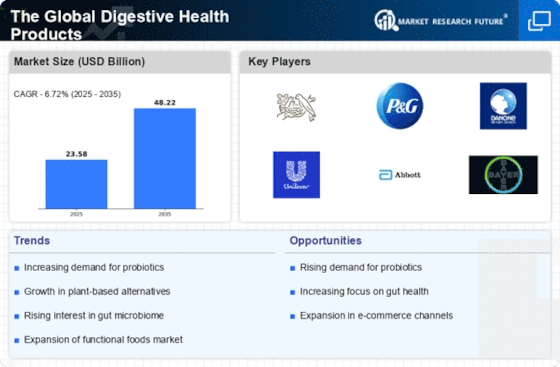
Digestive Health Products Market Infographic
Purchase Options

Market Trends

Key Emerging Trends in the Digestive Health Products Market

The digestive health products market is witnessing notable trends that reflect the evolving preferences and priorities of consumers in the pursuit of overall well-being. One prominent trend is the increasing demand for probiotics, fueled by a growing awareness of the importance of a balanced gut microbiome. Hybrid cultures, which consists of the good bacteria, are one of the reasons why people try to consume them, and it is because they have the potential to support the gut system and also strengthen the body’s immune system. With the increasing awareness among consumers of the connection between the health of their intestinal microbiome and their overall wellbeing, the demand for products containing probiotics with specific bacterial strains continues to rise.

Among the other noteworthy trends in the digestive health products market is the raise in the which activate probiotics. Prebiotics are non-digestible fiber compounds and they must be consumed to feed the favorable bacteria in the gut, thus enabling their multiplication and increase in activity. The latest studies link this phenomenon with a broader notion that providing the right nutrients to the existing good gut bacteria isn't as simple as using probiotics; it means to ensure that the body has the necessary components for these organisms to thrive. Consequently, foods that deliver prebiotics, in conjunction with probiotic or apart as separate supplants, are rising higher on the priority lists of the pertinent health-minded consumers.

Not just dietary supplements but also those that focus on particular digestion centered bother are having a noticeable increase in demand. Consumers ask for the products that help with some digestive problems which often include the bloating, gas, and irregular bowel movements. Dextrin supplements, which help split the nutrients and the digestion process, are one of the things which now are in trend. This trend represents the direction that personalized resolutions for digestive health are being taken considering that people are looking for exactly products matching their particular needs and concerns.

The clean-label movement in digestive health products segment of the market is significant now more than ever as people today are turning their back on complex additives and are leaning more toward products whose ingredient list is short and clear with immediate understanding. Natural products, free of artificial additives, preservatives or needlessly adding fillers to them are now your favourite option when it comes to healthy eating. The manufacturers who take this opportunity to develop digestive health products utilizing natural ingredients and also the same recognizable ingredient stand to capture the largest market share because of their ability to fulfill both the effectiveness and ingredient fairness aspects that the consumers give importance to.

Just as the alignment of digestive health with broader health maintenance is already a rippling trend. Consumers connect their gut health with overall well-being because they learn that. Finally various comprehensive strategy is the only solution. This is clearly the consumption of the functional foods and beverages with the strong probiotic. Consumer patterns commonly include purchase of products like yoghurt, kefir and other lactic cultures welling up organic probiotics. They comprise daily diet so as to capture digestive health.

Digital shopping has become a watershed moment for trending of the market transforming consumers into individuals who access and Buy functional food & beverage. Online media platforms give thousands of opportunities, where clients are able to make researches, compare reviews, and make fair buying decisions on couch or in office. The rise of e-commerce also facilitates direct-to-consumer marketing strategies, enabling manufacturers to engage with consumers and build brand loyalty through digital platforms.


Author
Author Profile
Tejas Chaudhary
Research Analyst Level II

I have a degree in Engineering (Civil), with masters in Business Administration (Marketing). With more than 4 years of experience in market research and consulting, I am involved in end-to-end process of market research, proposals, project kickoffs and delivery. I have research knowledge and expertise in consumer goods/packaging domain. Also I have worked for various other domains like construction & equipment. Effectively managed and delivered more than 60 report studies for regional as well as global clientele.

Leave a Comment

FAQs

What is the projected market valuation for The Global Digestive Health Products in 2035?

<p>The projected market valuation for The Global Digestive Health Products in 2035 is 48.22 USD Billion.</p>

What was the market valuation for The Global Digestive Health Products in 2024?

<p>The overall market valuation for The Global Digestive Health Products was 23.58 USD Billion in 2024.</p>

What is the expected CAGR for The Global Digestive Health Products from 2025 to 2035?

<p>The expected CAGR for The Global Digestive Health Products during the forecast period 2025 - 2035 is 6.72%.</p>

Which companies are considered key players in The Global Digestive Health Products?

<p>Key players in the market include Nestle, Procter & Gamble, Danone, Unilever, Abbott Laboratories, Bayer AG, Kraft Heinz, Reckitt Benckiser, and GSK.</p>

What are the projected values for the Prebiotics segment by 2035?

<p>The projected value for the Prebiotics segment is expected to reach 6.0 USD Billion by 2035.</p>

How does the market for Digestive Nutritional Supplements compare to other segments?

<p>The Digestive Nutritional Supplements segment had a valuation of 20.22 USD Billion projected for 2035, indicating strong market performance.</p>

What delivery format is expected to have the highest valuation in 2035?

The Tablets delivery format is projected to reach a valuation of 12.0 USD Billion by 2035, making it the highest among delivery formats.

What is the expected growth for Functional Foods in The Global Digestive Health Products?

The Functional Foods segment is projected to grow to 16.0 USD Billion by 2035, reflecting a robust demand.

What is the anticipated value of the Probiotics segment by 2035?

The Probiotics segment is anticipated to reach a value of 10.0 USD Billion by 2035.

How does the market for Pharmaceuticals in digestive health products compare to other applications?

The Pharmaceuticals application is projected to grow to 6.22 USD Billion by 2035, indicating a smaller yet significant market presence.

Market Summary

As per Market Research Future analysis, The Global Digestive Health Products Market was estimated at 55.235 USD Billion in 2024. The digestive health industry is projected to grow from 59.4 USD Billion in 2025 to 121.8 USD Billion by 2035, exhibiting a compound annual growth rate (CAGR) of 7.5% during the forecast period 2025 - 2035

Key Market Trends & Highlights

The Global Digestive Health Products Market is experiencing a dynamic shift towards innovative and personalized solutions.

  • The market witnesses a notable rise in plant-based products, reflecting changing consumer preferences. Personalization in digestive health solutions is becoming increasingly prevalent, catering to individual needs. Technology integration in health monitoring is enhancing consumer engagement and product effectiveness. Key drivers such as increasing health awareness and the aging population are propelling growth, particularly in the probiotics and chewable segments.

Market Size & Forecast

2024 Market Size 55.235 (USD Billion)
2035 Market Size 48.22 (USD Billion)
CAGR (2025 - 2035) 7.5%
Largest Regional Market Share in 2024 North America

Major Players

Nestle (CH), Procter &amp; Gamble (US), Danone (FR), Unilever (GB), Abbott Laboratories (US), <a href="https://www.bayer.com/en/products/products-from-A-to-Z">Bayer AG</a> (DE), Kraft Heinz (US), Reckitt Benckiser (GB), GSK (GB)

Market Trends

The global digestive health products market is currently experiencing a notable evolution, driven by increasing consumer awareness regarding gut health and its connection to overall well-being. This digestive health products market encompasses a diverse range of products, including probiotics, prebiotics, digestive enzymes, and dietary supplements, all aimed at enhancing digestive function and promoting a balanced microbiome. As individuals become more health-conscious, the demand for natural and organic options appears to be on the rise, reflecting key digestive health products market trends aligned with holistic health principles. Furthermore, the growing prevalence of digestive disorders may also contribute to the expansion of the digestive health products market, as consumers seek effective solutions to manage their conditions. In addition, the influence of digital platforms and social media on consumer behavior cannot be overlooked. These channels facilitate the dissemination of information regarding digestive health, thereby empowering consumers to make informed choices. As a result, brands are increasingly focusing on transparency and education in their marketing strategies. The global digestive health products market seems poised for continued growth, with innovations in product formulations and delivery methods likely to attract a broader audience. Overall, evolving digestive health products market trends, consumer preferences, and technological advancements indicate a dynamic landscape for digestive health products in the foreseeable future.

Rise of Plant-Based Products

There is a growing inclination towards plant-based digestive health products, as consumers increasingly seek natural alternatives. This trend reflects a broader movement towards sustainability and health-conscious choices, reinforcing long-term growth opportunities within the digestive health products market

Personalization in Digestive Health

The demand for personalized digestive health solutions is on the rise, as consumers seek products tailored to their specific needs. This trend highlights emerging digestive health products market trends centered on customization and targeted nutrition.

Integration of Technology in Health Monitoring

The integration of technology in health monitoring is becoming more prevalent, with consumers utilizing apps and devices to track their digestive health. This trend indicates a growing interest in data-driven approaches to wellness, allowing individuals to make informed decisions regarding their digestive health.

Digestive Health Products Market Market Drivers

Aging Population

The demographic shift towards an aging population is poised to significantly influence The Global Digestive Health Products Industry. As individuals age, they often experience various digestive issues, including constipation, irritable bowel syndrome, and other gastrointestinal disorders. This demographic trend suggests a growing need for products that address these specific health concerns. According to demographic data, the global population aged 60 and above is expected to reach 2.1 billion by 2050, which could lead to an increased demand for digestive health solutions. Companies are likely to respond by formulating products that cater specifically to the needs of older adults, thereby tapping into this expanding market segment and enhancing their product offerings.

E-commerce Growth

The rapid growth of e-commerce is transforming the retail landscape for The Global Digestive Health Products Industry. With the increasing preference for online shopping, consumers are now able to access a wider range of digestive health products from the comfort of their homes. E-commerce platforms provide convenience and often better pricing, which can drive higher sales volumes. Data suggests that online sales of health and wellness products are expected to grow significantly, with projections indicating that e-commerce could account for over 20% of total health product sales by 2025. This shift towards online purchasing is likely to encourage manufacturers to enhance their digital presence and marketing strategies, thereby expanding their reach and accessibility to consumers.

Increasing Health Awareness

The rising awareness regarding health and wellness among consumers appears to be a pivotal driver for The Global Digestive Health Products Industry. As individuals become more conscious of their dietary choices and the impact of gut health on overall well-being, the demand for digestive health products is likely to surge. Reports indicate that the market for probiotics alone is projected to reach approximately USD 70 billion by 2025, reflecting a growing inclination towards products that promote digestive health. This trend is further fueled by educational campaigns and the proliferation of information regarding the benefits of maintaining a healthy gut microbiome. Consequently, manufacturers are increasingly focusing on developing innovative products that cater to this heightened awareness, thereby expanding their market presence.

Innovation in Product Development

Innovation in product development is emerging as a significant driver for The Global Digestive Health Products Industry. Companies are increasingly investing in research and development to create advanced formulations that enhance digestive health. This includes the introduction of new probiotic strains, prebiotic fibers, and functional foods designed to support gut health. The market is witnessing a surge in products that combine traditional ingredients with modern science, appealing to health-conscious consumers. Furthermore, the integration of natural and organic ingredients is becoming a trend, as consumers seek cleaner labels and transparency in product formulations. This focus on innovation not only meets consumer demands but also positions companies competitively within the market.

Rising Incidence of Digestive Disorders

The increasing prevalence of digestive disorders is a critical driver for The Global Digestive Health Products Industry. Conditions such as irritable bowel syndrome, inflammatory bowel disease, and gastroesophageal reflux disease are becoming more common, prompting consumers to seek effective solutions. Recent studies indicate that approximately 60 to 70 million people in the United States alone are affected by digestive diseases, highlighting a substantial market opportunity. This growing incidence is likely to propel the demand for specialized digestive health products, including probiotics, prebiotics, and dietary supplements. As awareness of these disorders rises, consumers are expected to invest more in products that promise relief and improved digestive function, thereby driving market growth.

Market Segment Insights

By Type: Probiotics (Largest) vs. Prebiotics (Fastest-Growing)

Within The Global Digestive Health Products Market, the segmentation by type reveals an intriguing distribution of Digestive Health Products Market shares among various segments. Probiotics currently dominate the digestive health products market, while prebiotics are emerging rapidly, driven by growing awareness of gut microbiome health and evolving digestive health products market trends. Following closely, prebiotics have started capturing significant attention, driven by increasing consumer awareness about gut microbiome health and the role of dietary fibers in enhancing digestive health. Multi-vitamins, <a href="https://www.marketresearchfuture.com/reports/lactase-market-10401">lactase</a> nutritional supplements, and digestive nutritional supplements also contribute to the Digestive Health Products Market, providing diverse options for consumers seeking digestive wellness solutions. As the Digestive Health Products Market continues to evolve, growth trends show a promising trajectory, particularly for <a href="https://www.marketresearchfuture.com/reports/prebiotic-ingredients-market-5017">prebiotics</a>, which are emerging as the fastest-growing segment. This growth is attributed to a shift towards preventive health measures and the rising demand for natural ingredients in dietary supplements. Additionally, the increasing prevalence of digestive disorders and the growing popularity of personalized nutrition drive consumers towards products that offer tailored benefits. The ongoing research promoting the health benefits of gut health and the integral role of probiotics reinforces their dominance, while the evolving landscape presents new opportunities for prebiotics to gain Digestive Health Products Market  share in the coming years.

Probiotics (Dominant) vs. Lactase Nutritional Supplements (Emerging)

Probiotics hold a dominant position in The Global Digestive Health Products Market, supported by strong consumer trust and extensive research. Lactase nutritional supplements, while emerging, are gaining traction and contributing to the diversification of the digestive health products market. They are formulated with live beneficial bacteria, which aid in maintaining the natural balance in the gut microbiome. This segment is characterized by a wide variety of product forms, including capsules, powders, and fermented foods, making them accessible and appealing to a broad audience. On the other side, lactase nutritional supplements, though emerging, cater to a specific need for consumers with lactose intolerance, facilitating their ability to digest <a href="https://www.marketresearchfuture.com/reports/dairy-market-11483" target="_blank" rel="noopener">dairy</a> products comfortably. As awareness of lactose intolerance grows, these supplements are gaining traction, providing a significant opportunity for Digestive Health Products Market expansion.

By Delivery Format: Capsules (Largest) vs. Chewable (Fastest-Growing)

Capsules dominate the digestive health products market size due to convenience and targeted delivery. Chewable formats are emerging rapidly, reflecting changing consumer preferences and favorable digestive health products market trends among younger demographics. Capsules hold the largest share due to their convenience and targeted delivery, appealing to a broad consumer base. Chewable formats, although currently smaller in Digestive Health Products Market share, are rapidly gaining momentum, particularly among younger consumers favoring taste and ease of consumption.

Capsules (Dominant) vs. Chewable (Emerging)

Capsules dominate the delivery format segment of digestive health products, appealing to consumers seeking convenience and efficient nutrient absorption. They are often preferred for specific formulations, allowing for targeted dosage and reliable delivery. On the other hand, chewable products are emerging as a preferred choice, particularly among families and younger demographics. Their palatable flavors enhance consumer experience, making them an appealing option. The growth in the chewable segment is driven by an increasing focus on health awareness and the desire for more enjoyable, user-friendly health solutions.

By Application: Functional Foods (Largest) vs. Supplements (Fastest-Growing)

<a href="https://www.marketresearchfuture.com/reports/functional-food-ingredient-market-26908">Functional Foods</a> hold the largest share in the global digestive health products market, while Supplements are expanding rapidly as consumers seek targeted and preventive digestive health solutions. This segment encompasses a variety of food products fortified with probiotics, prebiotics, and other beneficial ingredients. In contrast, Supplements, including probiotics and digestive enzymes, are experiencing rapid growth, appealing to consumers seeking targeted solutions for digestive issues. This shift signifies a growing awareness of gut health and its connection to overall well-being.

Functional Foods: Dominant vs. Supplements: Emerging

Functional Foods, characterized by their enriched nutritional content, have established a dominant position in The Global Digestive Health Products Market. This segment includes yogurt, kefir, and fortified snacks that offer health benefits beyond basic nutrition. Consumer demand for transparency in food labeling and natural ingredients encourages product innovation in this category. On the other hand, Supplements are emerging strongly, particularly due to rising trends in preventive healthcare and self-medication. They appeal to consumers looking for convenient options to manage digestive health effectively. These emerging products, which often include innovative formulations based on scientific research, are meeting the needs of a health-conscious population seeking convenience and efficacy.

Get more detailed insights about Digestive Health Products Market Research Report - Forecast to 2035

Regional Insights

By region, the study provides the Digestive Health Products Market insights into North America, Europe, Asia-Pacific and Rest of the World. North America Digestive Health Products Market accounted for USD 10.121 billion in 2022 with a share of around 45.80% and is expected to exhibit a significant CAGR growth during the study period High market share in the region results from the region's leading players having a strong presence, government assistance for new product development, and technological improvement in the probiotic and prebiotic space.

Additionally, factors such as rising healthcare costs, modifications to food laws that affect label and product claims, quick advances in science and processing technologies, an increase in the number of geriatric people, and a growing interest in achieving wellness through diet are driving consumer interest in digestive health products in North America. New product development, partnerships, partnerships, expansions, mergers, and acquisitions are the main strategies used by the organisations in the Digestive Health Products Market.

Further, the major countries studied in the Digestive Health Products Market report are: The U.S, Canada, Germany, France, UK, Italy, Spain, China, Japan, India, Australia, South Korea, and Brazil.

Figure 3: DIGESTIVE HEALTH PRODUCTS MARKET SHARE BY REGION 2022 (%)

Europe Digestive Health Products Market accounts for the second-largest market share. Due to the maturity of the industries, the high demand for digestive health products in large markets like Germany and the U.K. will favorably impact the Digestive Health Products Market growth, albeit at a slower rate. Moreover, UK Digestive Health Products Market of digestive Hhealth products held the largest market share, and the Germany digestive health products industry was the fastest growing market in the region.

Asia Pacific Digestive Health Products Market is expected to grow at the fastest CAGR from 2022 to 2030. The widespread use of Digestive Health Products Market in nations like China, Australia, South Korea, and others can explain this. Due to the emergence of urban hydroponic farms, it is anticipated that the market in China and India will grow significantly during the projection period. Due to the many businesses present there, North America has a significant potential for growth.

Further, the China market of digestive health products held the largest market share, and the India Digestive Health Products Market was the fastest-growing market in the region.

Key Players and Competitive Insights

Major players are investing heavily in R&D to strengthen their presence in the digestive health products market. Strategic initiatives such as product launches, mergers, and collaborations are shaping competitive dynamics and supporting growth across the global digestive health products market. Market participants are also taking a range of strategic initiatives to grow their worldwide footprint, with key Digestive Health Products Market developments such as new product launches, mergers and acquisitions, contractual agreements, increased investments, and collaboration with other organizations. Competitors in the digestive health products industry must offer cost-effective items to expand and survive in an increasingly competitive and rising Digestive Health Products Market environment. One of the primary business strategies adopted by manufacturers in the digestive health products industry to benefit clients and expand the Digestive Health Products Market sector is to manufacture locally to reduce operating costs. In recent years, digestive health products industry has provided medicine with some of the most significant benefits. The Digestive Health Products Market major player such Danisco A/S, Danone S.A., Nestle S.A., Yakult Honsha Co. Ltd., Arla Foods Inc., BioGaia AB. An American company called International Flavors & Fragrances manufactures tastes, perfumes, and cosmetic ingredients sold worldwide. Its headquarters are in New York City, with production, sales, and creative sites spread over 44 nations. The business is a constituent of the S&P 500 Index. International Flavors and Fragrances Inc. (IFF) introduced Nurica, a new enzyme for dairy products, in the United States in June 2021. The foremost biotechnology and nutrition company, PanTheryx, is dedicated to internationally commercializing wellness products based on cow colostrum. The company is committed to using the power of nature's superfood to create ground-breaking methods for improving human and animal health. This includes everything from positioning ourselves as the top colostrum supplier in the world to advancing cutting-edge research and commercializing innovative solutions. PanTheryx Inc. declared in March 2021 that it had purchased the trademarks and the probiotic supplement brand TruBiotics from Bayer HealthCare LLC. A whole range of nutritional supplements that promote complete digestive and immunological health at all stages of life was created by combining the TruBiotics brand with PanTheryx's current brands and ingredient offerings, including Life's First Natural, dairy colostrum, and prebiotics.

Key Companies in the Digestive Health Products Market include

Industry Developments

February 2022: Daily pack supplements, which Organic India introduced, are portable supplements with whole herb formulae intended to address stress and mood swings, immunity, and cognitive and digestive health issues.

September 2021: Manuka Honey Digestive Gummies, Wedderspoon's newest product line, has just gone on sale. The product comes in two different formulas: Berry and Tropical. The Berry gummies are prepared with elderberry and DE111 probiotics for digestive and immunological support. In contrast, the Tropical gummies are made with a proprietary blend of prebiotics + DE111 probiotics plus premium chamomile and ginger.

Future Outlook

Digestive Health Products Market Future Outlook

The global digestive health products market is projected to grow at a 7.5% CAGR from 2025 to 2035, driven by increasing health awareness, rising digestive disorders, and innovative product development.

New opportunities lie in:

  • <p>Expansion into personalized probiotic formulations Development of subscription-based digestive health services Investment in digital health platforms for digestive wellness</p>

By 2035, the digestive health products market size is expected to achieve robust growth, reflecting evolving consumer preferences and innovative solutions.

Market Segmentation

Digestive Health Products Market Type Outlook

  • Prebiotics
  • Probiotics
  • Multi-Vitamins
  • Lactase Nutritional Supplements
  • Digestive Nutritional Supplements

Digestive Health Products Market Application Outlook

  • Functional Foods
  • Functional Beverages
  • Breakfast Cereals
  • Supplements
  • Pharmaceuticals

Digestive Health Products Market Delivery Format Outlook

  • Capsules
  • Tablets
  • Chewable
  • Drops
  • Caplets
  • Sticks

Report Scope

MARKET SIZE 2024 55.235(USD Billion)
MARKET SIZE 2025 59.4(USD Billion)
MARKET SIZE 2035 121.8(USD Billion)
COMPOUND ANNUAL GROWTH RATE (CAGR) 7.5% (2025 - 2035)
REPORT COVERAGE Revenue Forecast, Competitive Landscape, Growth Factors, and Trends
BASE YEAR 2024
Market Forecast Period 2025 - 2035
Historical Data 2019 - 2024
Market Forecast Units USD Billion
Key Companies Profiled Nestle (CH), Procter & Gamble (US), Danone (FR), Unilever (GB), Abbott Laboratories (US), Bayer AG (DE), Kraft Heinz (US), Reckitt Benckiser (GB), GSK (GB)
Segments Covered Product-Type, Delivery Format, Application, Region
Key Market Opportunities Rising consumer demand for natural and organic digestive health solutions presents growth opportunities in The Global Digestive Health Products.
Key Market Dynamics Rising consumer awareness of gut health drives demand for innovative digestive health products and supplements.
Countries Covered North America, Europe, APAC, South America, MEA

FAQs

What is the projected market valuation for The Global Digestive Health Products in 2035?

<p>The projected market valuation for The Global Digestive Health Products in 2035 is 48.22 USD Billion.</p>

What was the market valuation for The Global Digestive Health Products in 2024?

<p>The overall market valuation for The Global Digestive Health Products was 23.58 USD Billion in 2024.</p>

What is the expected CAGR for The Global Digestive Health Products from 2025 to 2035?

<p>The expected CAGR for The Global Digestive Health Products during the forecast period 2025 - 2035 is 6.72%.</p>

Which companies are considered key players in The Global Digestive Health Products?

<p>Key players in the market include Nestle, Procter & Gamble, Danone, Unilever, Abbott Laboratories, Bayer AG, Kraft Heinz, Reckitt Benckiser, and GSK.</p>

What are the projected values for the Prebiotics segment by 2035?

<p>The projected value for the Prebiotics segment is expected to reach 6.0 USD Billion by 2035.</p>

How does the market for Digestive Nutritional Supplements compare to other segments?

<p>The Digestive Nutritional Supplements segment had a valuation of 20.22 USD Billion projected for 2035, indicating strong market performance.</p>

What delivery format is expected to have the highest valuation in 2035?

The Tablets delivery format is projected to reach a valuation of 12.0 USD Billion by 2035, making it the highest among delivery formats.

What is the expected growth for Functional Foods in The Global Digestive Health Products?

The Functional Foods segment is projected to grow to 16.0 USD Billion by 2035, reflecting a robust demand.

What is the anticipated value of the Probiotics segment by 2035?

The Probiotics segment is anticipated to reach a value of 10.0 USD Billion by 2035.

How does the market for Pharmaceuticals in digestive health products compare to other applications?

The Pharmaceuticals application is projected to grow to 6.22 USD Billion by 2035, indicating a smaller yet significant market presence.

  1. SECTION I: EXECUTIVE SUMMARY AND KEY HIGHLIGHTS
    1. | 1.1 EXECUTIVE SUMMARY
    2. | | 1.1.1 Market Overview
    3. | | 1.1.2 Key Findings
    4. | | 1.1.3 Market Segmentation
    5. | | 1.1.4 Competitive Landscape
    6. | | 1.1.5 Challenges and Opportunities
    7. | | 1.1.6 Future Outlook
  2. SECTION II: SCOPING, METHODOLOGY AND MARKET STRUCTURE
    1. | 2.1 MARKET INTRODUCTION
    2. | | 2.1.1 Definition
    3. | | 2.1.2 Scope of the study
    4. | | | 2.1.2.1 Research Objective
    5. | | | 2.1.2.2 Assumption
    6. | | | 2.1.2.3 Limitations
    7. | 2.2 RESEARCH METHODOLOGY
    8. | | 2.2.1 Overview
    9. | | 2.2.2 Data Mining
    10. | | 2.2.3 Secondary Research
    11. | | 2.2.4 Primary Research
    12. | | | 2.2.4.1 Primary Interviews and Information Gathering Process
    13. | | | 2.2.4.2 Breakdown of Primary Respondents
    14. | | 2.2.5 Forecasting Model
    15. | | 2.2.6 Market Size Estimation
    16. | | | 2.2.6.1 Bottom-Up Approach
    17. | | | 2.2.6.2 Top-Down Approach
    18. | | 2.2.7 Data Triangulation
    19. | | 2.2.8 Validation
  3. SECTION III: QUALITATIVE ANALYSIS
    1. | 3.1 MARKET DYNAMICS
    2. | | 3.1.1 Overview
    3. | | 3.1.2 Drivers
    4. | | 3.1.3 Restraints
    5. | | 3.1.4 Opportunities
    6. | 3.2 MARKET FACTOR ANALYSIS
    7. | | 3.2.1 Value chain Analysis
    8. | | 3.2.2 Porter's Five Forces Analysis
    9. | | | 3.2.2.1 Bargaining Power of Suppliers
    10. | | | 3.2.2.2 Bargaining Power of Buyers
    11. | | | 3.2.2.3 Threat of New Entrants
    12. | | | 3.2.2.4 Threat of Substitutes
    13. | | | 3.2.2.5 Intensity of Rivalry
    14. | | 3.2.3 COVID-19 Impact Analysis
    15. | | | 3.2.3.1 Market Impact Analysis
    16. | | | 3.2.3.2 Regional Impact
    17. | | | 3.2.3.3 Opportunity and Threat Analysis
  4. SECTION IV: QUANTITATIVE ANALYSIS
    1. | 4.1 Food, Beverages & Nutrition, BY Type (USD Billion)
    2. | | 4.1.1 Prebiotics
    3. | | 4.1.2 Probiotics
    4. | | 4.1.3 Multi-Vitamins
    5. | | 4.1.4 Lactase Nutritional Supplements
    6. | | 4.1.5 Digestive Nutritional Supplements
    7. | 4.2 Food, Beverages & Nutrition, BY Delivery Format (USD Billion)
    8. | | 4.2.1 Capsules
    9. | | 4.2.2 Tablets
    10. | | 4.2.3 Chewable
    11. | | 4.2.4 Drops
    12. | | 4.2.5 Caplets
    13. | | 4.2.6 Sticks
    14. | 4.3 Food, Beverages & Nutrition, BY Application (USD Billion)
    15. | | 4.3.1 Functional Foods
    16. | | 4.3.2 Functional Beverages
    17. | | 4.3.3 Breakfast Cereals
    18. | | 4.3.4 Supplements
    19. | | 4.3.5 Pharmaceuticals
    20. | 4.4 Food, Beverages & Nutrition, BY Region (USD Billion)
    21. | | 4.4.1 North America
    22. | | | 4.4.1.1 US
    23. | | | 4.4.1.2 Canada
    24. | | 4.4.2 Europe
    25. | | | 4.4.2.1 Germany
    26. | | | 4.4.2.2 UK
    27. | | | 4.4.2.3 France
    28. | | | 4.4.2.4 Russia
    29. | | | 4.4.2.5 Italy
    30. | | | 4.4.2.6 Spain
    31. | | | 4.4.2.7 Rest of Europe
    32. | | 4.4.3 APAC
    33. | | | 4.4.3.1 China
    34. | | | 4.4.3.2 India
    35. | | | 4.4.3.3 Japan
    36. | | | 4.4.3.4 South Korea
    37. | | | 4.4.3.5 Malaysia
    38. | | | 4.4.3.6 Thailand
    39. | | | 4.4.3.7 Indonesia
    40. | | | 4.4.3.8 Rest of APAC
    41. | | 4.4.4 South America
    42. | | | 4.4.4.1 Brazil
    43. | | | 4.4.4.2 Mexico
    44. | | | 4.4.4.3 Argentina
    45. | | | 4.4.4.4 Rest of South America
    46. | | 4.4.5 MEA
    47. | | | 4.4.5.1 GCC Countries
    48. | | | 4.4.5.2 South Africa
    49. | | | 4.4.5.3 Rest of MEA
  5. SECTION V: COMPETITIVE ANALYSIS
    1. | 5.1 Competitive Landscape
    2. | | 5.1.1 Overview
    3. | | 5.1.2 Competitive Analysis
    4. | | 5.1.3 Market share Analysis
    5. | | 5.1.4 Major Growth Strategy in the Food, Beverages & Nutrition
    6. | | 5.1.5 Competitive Benchmarking
    7. | | 5.1.6 Leading Players in Terms of Number of Developments in the Food, Beverages & Nutrition
    8. | | 5.1.7 Key developments and growth strategies
    9. | | | 5.1.7.1 New Product Launch/Service Deployment
    10. | | | 5.1.7.2 Merger & Acquisitions
    11. | | | 5.1.7.3 Joint Ventures
    12. | | 5.1.8 Major Players Financial Matrix
    13. | | | 5.1.8.1 Sales and Operating Income
    14. | | | 5.1.8.2 Major Players R&D Expenditure. 2023
    15. | 5.2 Company Profiles
    16. | | 5.2.1 Nestle (CH)
    17. | | | 5.2.1.1 Financial Overview
    18. | | | 5.2.1.2 Products Offered
    19. | | | 5.2.1.3 Key Developments
    20. | | | 5.2.1.4 SWOT Analysis
    21. | | | 5.2.1.5 Key Strategies
    22. | | 5.2.2 Procter & Gamble (US)
    23. | | | 5.2.2.1 Financial Overview
    24. | | | 5.2.2.2 Products Offered
    25. | | | 5.2.2.3 Key Developments
    26. | | | 5.2.2.4 SWOT Analysis
    27. | | | 5.2.2.5 Key Strategies
    28. | | 5.2.3 Danone (FR)
    29. | | | 5.2.3.1 Financial Overview
    30. | | | 5.2.3.2 Products Offered
    31. | | | 5.2.3.3 Key Developments
    32. | | | 5.2.3.4 SWOT Analysis
    33. | | | 5.2.3.5 Key Strategies
    34. | | 5.2.4 Unilever (GB)
    35. | | | 5.2.4.1 Financial Overview
    36. | | | 5.2.4.2 Products Offered
    37. | | | 5.2.4.3 Key Developments
    38. | | | 5.2.4.4 SWOT Analysis
    39. | | | 5.2.4.5 Key Strategies
    40. | | 5.2.5 Abbott Laboratories (US)
    41. | | | 5.2.5.1 Financial Overview
    42. | | | 5.2.5.2 Products Offered
    43. | | | 5.2.5.3 Key Developments
    44. | | | 5.2.5.4 SWOT Analysis
    45. | | | 5.2.5.5 Key Strategies
    46. | | 5.2.6 Bayer AG (DE)
    47. | | | 5.2.6.1 Financial Overview
    48. | | | 5.2.6.2 Products Offered
    49. | | | 5.2.6.3 Key Developments
    50. | | | 5.2.6.4 SWOT Analysis
    51. | | | 5.2.6.5 Key Strategies
    52. | | 5.2.7 Kraft Heinz (US)
    53. | | | 5.2.7.1 Financial Overview
    54. | | | 5.2.7.2 Products Offered
    55. | | | 5.2.7.3 Key Developments
    56. | | | 5.2.7.4 SWOT Analysis
    57. | | | 5.2.7.5 Key Strategies
    58. | | 5.2.8 Reckitt Benckiser (GB)
    59. | | | 5.2.8.1 Financial Overview
    60. | | | 5.2.8.2 Products Offered
    61. | | | 5.2.8.3 Key Developments
    62. | | | 5.2.8.4 SWOT Analysis
    63. | | | 5.2.8.5 Key Strategies
    64. | | 5.2.9 GSK (GB)
    65. | | | 5.2.9.1 Financial Overview
    66. | | | 5.2.9.2 Products Offered
    67. | | | 5.2.9.3 Key Developments
    68. | | | 5.2.9.4 SWOT Analysis
    69. | | | 5.2.9.5 Key Strategies
    70. | 5.3 Appendix
    71. | | 5.3.1 References
    72. | | 5.3.2 Related Reports
  6. LIST OF FIGURES
    1. | 6.1 MARKET SYNOPSIS
    2. | 6.2 NORTH AMERICA MARKET ANALYSIS
    3. | 6.3 US MARKET ANALYSIS BY TYPE
    4. | 6.4 US MARKET ANALYSIS BY DELIVERY FORMAT
    5. | 6.5 US MARKET ANALYSIS BY APPLICATION
    6. | 6.6 CANADA MARKET ANALYSIS BY TYPE
    7. | 6.7 CANADA MARKET ANALYSIS BY DELIVERY FORMAT
    8. | 6.8 CANADA MARKET ANALYSIS BY APPLICATION
    9. | 6.9 EUROPE MARKET ANALYSIS
    10. | 6.10 GERMANY MARKET ANALYSIS BY TYPE
    11. | 6.11 GERMANY MARKET ANALYSIS BY DELIVERY FORMAT
    12. | 6.12 GERMANY MARKET ANALYSIS BY APPLICATION
    13. | 6.13 UK MARKET ANALYSIS BY TYPE
    14. | 6.14 UK MARKET ANALYSIS BY DELIVERY FORMAT
    15. | 6.15 UK MARKET ANALYSIS BY APPLICATION
    16. | 6.16 FRANCE MARKET ANALYSIS BY TYPE
    17. | 6.17 FRANCE MARKET ANALYSIS BY DELIVERY FORMAT
    18. | 6.18 FRANCE MARKET ANALYSIS BY APPLICATION
    19. | 6.19 RUSSIA MARKET ANALYSIS BY TYPE
    20. | 6.20 RUSSIA MARKET ANALYSIS BY DELIVERY FORMAT
    21. | 6.21 RUSSIA MARKET ANALYSIS BY APPLICATION
    22. | 6.22 ITALY MARKET ANALYSIS BY TYPE
    23. | 6.23 ITALY MARKET ANALYSIS BY DELIVERY FORMAT
    24. | 6.24 ITALY MARKET ANALYSIS BY APPLICATION
    25. | 6.25 SPAIN MARKET ANALYSIS BY TYPE
    26. | 6.26 SPAIN MARKET ANALYSIS BY DELIVERY FORMAT
    27. | 6.27 SPAIN MARKET ANALYSIS BY APPLICATION
    28. | 6.28 REST OF EUROPE MARKET ANALYSIS BY TYPE
    29. | 6.29 REST OF EUROPE MARKET ANALYSIS BY DELIVERY FORMAT
    30. | 6.30 REST OF EUROPE MARKET ANALYSIS BY APPLICATION
    31. | 6.31 APAC MARKET ANALYSIS
    32. | 6.32 CHINA MARKET ANALYSIS BY TYPE
    33. | 6.33 CHINA MARKET ANALYSIS BY DELIVERY FORMAT
    34. | 6.34 CHINA MARKET ANALYSIS BY APPLICATION
    35. | 6.35 INDIA MARKET ANALYSIS BY TYPE
    36. | 6.36 INDIA MARKET ANALYSIS BY DELIVERY FORMAT
    37. | 6.37 INDIA MARKET ANALYSIS BY APPLICATION
    38. | 6.38 JAPAN MARKET ANALYSIS BY TYPE
    39. | 6.39 JAPAN MARKET ANALYSIS BY DELIVERY FORMAT
    40. | 6.40 JAPAN MARKET ANALYSIS BY APPLICATION
    41. | 6.41 SOUTH KOREA MARKET ANALYSIS BY TYPE
    42. | 6.42 SOUTH KOREA MARKET ANALYSIS BY DELIVERY FORMAT
    43. | 6.43 SOUTH KOREA MARKET ANALYSIS BY APPLICATION
    44. | 6.44 MALAYSIA MARKET ANALYSIS BY TYPE
    45. | 6.45 MALAYSIA MARKET ANALYSIS BY DELIVERY FORMAT
    46. | 6.46 MALAYSIA MARKET ANALYSIS BY APPLICATION
    47. | 6.47 THAILAND MARKET ANALYSIS BY TYPE
    48. | 6.48 THAILAND MARKET ANALYSIS BY DELIVERY FORMAT
    49. | 6.49 THAILAND MARKET ANALYSIS BY APPLICATION
    50. | 6.50 INDONESIA MARKET ANALYSIS BY TYPE
    51. | 6.51 INDONESIA MARKET ANALYSIS BY DELIVERY FORMAT
    52. | 6.52 INDONESIA MARKET ANALYSIS BY APPLICATION
    53. | 6.53 REST OF APAC MARKET ANALYSIS BY TYPE
    54. | 6.54 REST OF APAC MARKET ANALYSIS BY DELIVERY FORMAT
    55. | 6.55 REST OF APAC MARKET ANALYSIS BY APPLICATION
    56. | 6.56 SOUTH AMERICA MARKET ANALYSIS
    57. | 6.57 BRAZIL MARKET ANALYSIS BY TYPE
    58. | 6.58 BRAZIL MARKET ANALYSIS BY DELIVERY FORMAT
    59. | 6.59 BRAZIL MARKET ANALYSIS BY APPLICATION
    60. | 6.60 MEXICO MARKET ANALYSIS BY TYPE
    61. | 6.61 MEXICO MARKET ANALYSIS BY DELIVERY FORMAT
    62. | 6.62 MEXICO MARKET ANALYSIS BY APPLICATION
    63. | 6.63 ARGENTINA MARKET ANALYSIS BY TYPE
    64. | 6.64 ARGENTINA MARKET ANALYSIS BY DELIVERY FORMAT
    65. | 6.65 ARGENTINA MARKET ANALYSIS BY APPLICATION
    66. | 6.66 REST OF SOUTH AMERICA MARKET ANALYSIS BY TYPE
    67. | 6.67 REST OF SOUTH AMERICA MARKET ANALYSIS BY DELIVERY FORMAT
    68. | 6.68 REST OF SOUTH AMERICA MARKET ANALYSIS BY APPLICATION
    69. | 6.69 MEA MARKET ANALYSIS
    70. | 6.70 GCC COUNTRIES MARKET ANALYSIS BY TYPE
    71. | 6.71 GCC COUNTRIES MARKET ANALYSIS BY DELIVERY FORMAT
    72. | 6.72 GCC COUNTRIES MARKET ANALYSIS BY APPLICATION
    73. | 6.73 SOUTH AFRICA MARKET ANALYSIS BY TYPE
    74. | 6.74 SOUTH AFRICA MARKET ANALYSIS BY DELIVERY FORMAT
    75. | 6.75 SOUTH AFRICA MARKET ANALYSIS BY APPLICATION
    76. | 6.76 REST OF MEA MARKET ANALYSIS BY TYPE
    77. | 6.77 REST OF MEA MARKET ANALYSIS BY DELIVERY FORMAT
    78. | 6.78 REST OF MEA MARKET ANALYSIS BY APPLICATION
    79. | 6.79 KEY BUYING CRITERIA OF FOOD, BEVERAGES & NUTRITION
    80. | 6.80 RESEARCH PROCESS OF MRFR
    81. | 6.81 DRO ANALYSIS OF FOOD, BEVERAGES & NUTRITION
    82. | 6.82 DRIVERS IMPACT ANALYSIS: FOOD, BEVERAGES & NUTRITION
    83. | 6.83 RESTRAINTS IMPACT ANALYSIS: FOOD, BEVERAGES & NUTRITION
    84. | 6.84 SUPPLY / VALUE CHAIN: FOOD, BEVERAGES & NUTRITION
    85. | 6.85 FOOD, BEVERAGES & NUTRITION, BY TYPE, 2024 (% SHARE)
    86. | 6.86 FOOD, BEVERAGES & NUTRITION, BY TYPE, 2024 TO 2035 (USD Billion)
    87. | 6.87 FOOD, BEVERAGES & NUTRITION, BY DELIVERY FORMAT, 2024 (% SHARE)
    88. | 6.88 FOOD, BEVERAGES & NUTRITION, BY DELIVERY FORMAT, 2024 TO 2035 (USD Billion)
    89. | 6.89 FOOD, BEVERAGES & NUTRITION, BY APPLICATION, 2024 (% SHARE)
    90. | 6.90 FOOD, BEVERAGES & NUTRITION, BY APPLICATION, 2024 TO 2035 (USD Billion)
    91. | 6.91 BENCHMARKING OF MAJOR COMPETITORS
  7. LIST OF TABLES
    1. | 7.1 LIST OF ASSUMPTIONS
    2. | | 7.1.1
    3. | 7.2 North America MARKET SIZE ESTIMATES; FORECAST
    4. | | 7.2.1 BY TYPE, 2025-2035 (USD Billion)
    5. | | 7.2.2 BY DELIVERY FORMAT, 2025-2035 (USD Billion)
    6. | | 7.2.3 BY APPLICATION, 2025-2035 (USD Billion)
    7. | 7.3 US MARKET SIZE ESTIMATES; FORECAST
    8. | | 7.3.1 BY TYPE, 2025-2035 (USD Billion)
    9. | | 7.3.2 BY DELIVERY FORMAT, 2025-2035 (USD Billion)
    10. | | 7.3.3 BY APPLICATION, 2025-2035 (USD Billion)
    11. | 7.4 Canada MARKET SIZE ESTIMATES; FORECAST
    12. | | 7.4.1 BY TYPE, 2025-2035 (USD Billion)
    13. | | 7.4.2 BY DELIVERY FORMAT, 2025-2035 (USD Billion)
    14. | | 7.4.3 BY APPLICATION, 2025-2035 (USD Billion)
    15. | 7.5 Europe MARKET SIZE ESTIMATES; FORECAST
    16. | | 7.5.1 BY TYPE, 2025-2035 (USD Billion)
    17. | | 7.5.2 BY DELIVERY FORMAT, 2025-2035 (USD Billion)
    18. | | 7.5.3 BY APPLICATION, 2025-2035 (USD Billion)
    19. | 7.6 Germany MARKET SIZE ESTIMATES; FORECAST
    20. | | 7.6.1 BY TYPE, 2025-2035 (USD Billion)
    21. | | 7.6.2 BY DELIVERY FORMAT, 2025-2035 (USD Billion)
    22. | | 7.6.3 BY APPLICATION, 2025-2035 (USD Billion)
    23. | 7.7 UK MARKET SIZE ESTIMATES; FORECAST
    24. | | 7.7.1 BY TYPE, 2025-2035 (USD Billion)
    25. | | 7.7.2 BY DELIVERY FORMAT, 2025-2035 (USD Billion)
    26. | | 7.7.3 BY APPLICATION, 2025-2035 (USD Billion)
    27. | 7.8 France MARKET SIZE ESTIMATES; FORECAST
    28. | | 7.8.1 BY TYPE, 2025-2035 (USD Billion)
    29. | | 7.8.2 BY DELIVERY FORMAT, 2025-2035 (USD Billion)
    30. | | 7.8.3 BY APPLICATION, 2025-2035 (USD Billion)
    31. | 7.9 Russia MARKET SIZE ESTIMATES; FORECAST
    32. | | 7.9.1 BY TYPE, 2025-2035 (USD Billion)
    33. | | 7.9.2 BY DELIVERY FORMAT, 2025-2035 (USD Billion)
    34. | | 7.9.3 BY APPLICATION, 2025-2035 (USD Billion)
    35. | 7.10 Italy MARKET SIZE ESTIMATES; FORECAST
    36. | | 7.10.1 BY TYPE, 2025-2035 (USD Billion)
    37. | | 7.10.2 BY DELIVERY FORMAT, 2025-2035 (USD Billion)
    38. | | 7.10.3 BY APPLICATION, 2025-2035 (USD Billion)
    39. | 7.11 Spain MARKET SIZE ESTIMATES; FORECAST
    40. | | 7.11.1 BY TYPE, 2025-2035 (USD Billion)
    41. | | 7.11.2 BY DELIVERY FORMAT, 2025-2035 (USD Billion)
    42. | | 7.11.3 BY APPLICATION, 2025-2035 (USD Billion)
    43. | 7.12 Rest of Europe MARKET SIZE ESTIMATES; FORECAST
    44. | | 7.12.1 BY TYPE, 2025-2035 (USD Billion)
    45. | | 7.12.2 BY DELIVERY FORMAT, 2025-2035 (USD Billion)
    46. | | 7.12.3 BY APPLICATION, 2025-2035 (USD Billion)
    47. | 7.13 APAC MARKET SIZE ESTIMATES; FORECAST
    48. | | 7.13.1 BY TYPE, 2025-2035 (USD Billion)
    49. | | 7.13.2 BY DELIVERY FORMAT, 2025-2035 (USD Billion)
    50. | | 7.13.3 BY APPLICATION, 2025-2035 (USD Billion)
    51. | 7.14 China MARKET SIZE ESTIMATES; FORECAST
    52. | | 7.14.1 BY TYPE, 2025-2035 (USD Billion)
    53. | | 7.14.2 BY DELIVERY FORMAT, 2025-2035 (USD Billion)
    54. | | 7.14.3 BY APPLICATION, 2025-2035 (USD Billion)
    55. | 7.15 India MARKET SIZE ESTIMATES; FORECAST
    56. | | 7.15.1 BY TYPE, 2025-2035 (USD Billion)
    57. | | 7.15.2 BY DELIVERY FORMAT, 2025-2035 (USD Billion)
    58. | | 7.15.3 BY APPLICATION, 2025-2035 (USD Billion)
    59. | 7.16 Japan MARKET SIZE ESTIMATES; FORECAST
    60. | | 7.16.1 BY TYPE, 2025-2035 (USD Billion)
    61. | | 7.16.2 BY DELIVERY FORMAT, 2025-2035 (USD Billion)
    62. | | 7.16.3 BY APPLICATION, 2025-2035 (USD Billion)
    63. | 7.17 South Korea MARKET SIZE ESTIMATES; FORECAST
    64. | | 7.17.1 BY TYPE, 2025-2035 (USD Billion)
    65. | | 7.17.2 BY DELIVERY FORMAT, 2025-2035 (USD Billion)
    66. | | 7.17.3 BY APPLICATION, 2025-2035 (USD Billion)
    67. | 7.18 Malaysia MARKET SIZE ESTIMATES; FORECAST
    68. | | 7.18.1 BY TYPE, 2025-2035 (USD Billion)
    69. | | 7.18.2 BY DELIVERY FORMAT, 2025-2035 (USD Billion)
    70. | | 7.18.3 BY APPLICATION, 2025-2035 (USD Billion)
    71. | 7.19 Thailand MARKET SIZE ESTIMATES; FORECAST
    72. | | 7.19.1 BY TYPE, 2025-2035 (USD Billion)
    73. | | 7.19.2 BY DELIVERY FORMAT, 2025-2035 (USD Billion)
    74. | | 7.19.3 BY APPLICATION, 2025-2035 (USD Billion)
    75. | 7.20 Indonesia MARKET SIZE ESTIMATES; FORECAST
    76. | | 7.20.1 BY TYPE, 2025-2035 (USD Billion)
    77. | | 7.20.2 BY DELIVERY FORMAT, 2025-2035 (USD Billion)
    78. | | 7.20.3 BY APPLICATION, 2025-2035 (USD Billion)
    79. | 7.21 Rest of APAC MARKET SIZE ESTIMATES; FORECAST
    80. | | 7.21.1 BY TYPE, 2025-2035 (USD Billion)
    81. | | 7.21.2 BY DELIVERY FORMAT, 2025-2035 (USD Billion)
    82. | | 7.21.3 BY APPLICATION, 2025-2035 (USD Billion)
    83. | 7.22 South America MARKET SIZE ESTIMATES; FORECAST
    84. | | 7.22.1 BY TYPE, 2025-2035 (USD Billion)
    85. | | 7.22.2 BY DELIVERY FORMAT, 2025-2035 (USD Billion)
    86. | | 7.22.3 BY APPLICATION, 2025-2035 (USD Billion)
    87. | 7.23 Brazil MARKET SIZE ESTIMATES; FORECAST
    88. | | 7.23.1 BY TYPE, 2025-2035 (USD Billion)
    89. | | 7.23.2 BY DELIVERY FORMAT, 2025-2035 (USD Billion)
    90. | | 7.23.3 BY APPLICATION, 2025-2035 (USD Billion)
    91. | 7.24 Mexico MARKET SIZE ESTIMATES; FORECAST
    92. | | 7.24.1 BY TYPE, 2025-2035 (USD Billion)
    93. | | 7.24.2 BY DELIVERY FORMAT, 2025-2035 (USD Billion)
    94. | | 7.24.3 BY APPLICATION, 2025-2035 (USD Billion)
    95. | 7.25 Argentina MARKET SIZE ESTIMATES; FORECAST
    96. | | 7.25.1 BY TYPE, 2025-2035 (USD Billion)
    97. | | 7.25.2 BY DELIVERY FORMAT, 2025-2035 (USD Billion)
    98. | | 7.25.3 BY APPLICATION, 2025-2035 (USD Billion)
    99. | 7.26 Rest of South America MARKET SIZE ESTIMATES; FORECAST
    100. | | 7.26.1 BY TYPE, 2025-2035 (USD Billion)
    101. | | 7.26.2 BY DELIVERY FORMAT, 2025-2035 (USD Billion)
    102. | | 7.26.3 BY APPLICATION, 2025-2035 (USD Billion)
    103. | 7.27 MEA MARKET SIZE ESTIMATES; FORECAST
    104. | | 7.27.1 BY TYPE, 2025-2035 (USD Billion)
    105. | | 7.27.2 BY DELIVERY FORMAT, 2025-2035 (USD Billion)
    106. | | 7.27.3 BY APPLICATION, 2025-2035 (USD Billion)
    107. | 7.28 GCC Countries MARKET SIZE ESTIMATES; FORECAST
    108. | | 7.28.1 BY TYPE, 2025-2035 (USD Billion)
    109. | | 7.28.2 BY DELIVERY FORMAT, 2025-2035 (USD Billion)
    110. | | 7.28.3 BY APPLICATION, 2025-2035 (USD Billion)
    111. | 7.29 South Africa MARKET SIZE ESTIMATES; FORECAST
    112. | | 7.29.1 BY TYPE, 2025-2035 (USD Billion)
    113. | | 7.29.2 BY DELIVERY FORMAT, 2025-2035 (USD Billion)
    114. | | 7.29.3 BY APPLICATION, 2025-2035 (USD Billion)
    115. | 7.30 Rest of MEA MARKET SIZE ESTIMATES; FORECAST
    116. | | 7.30.1 BY TYPE, 2025-2035 (USD Billion)
    117. | | 7.30.2 BY DELIVERY FORMAT, 2025-2035 (USD Billion)
    118. | | 7.30.3 BY APPLICATION, 2025-2035 (USD Billion)
    119. | 7.31 PRODUCT LAUNCH/PRODUCT DEVELOPMENT/APPROVAL
    120. | | 7.31.1
    121. | 7.32 ACQUISITION/PARTNERSHIP
    122. | | 7.32.1

Food, Beverages & Nutrition Market Segmentation

Food, Beverages & Nutrition By Type (USD Billion, 2025-2035)

  • Prebiotics
  • Probiotics
  • Multi-Vitamins
  • Lactase Nutritional Supplements
  • Digestive Nutritional Supplements

Food, Beverages & Nutrition By Delivery Format (USD Billion, 2025-2035)

  • Capsules
  • Tablets
  • Chewable
  • Drops
  • Caplets
  • Sticks

Food, Beverages & Nutrition By Application (USD Billion, 2025-2035)

  • Functional Foods
  • Functional Beverages
  • Breakfast Cereals
  • Supplements
  • Pharmaceuticals
Infographic

Free Sample Request

Kindly complete the form below to receive a free sample of this Report

Get Free Sample

Customer Strories

Compare Licence

×
Features License Type
Single User Multiuser License Enterprise User
Price $4,950 $5,950 $7,250
Maximum User Access Limit 1 User Upto 10 Users Unrestricted Access Throughout the Organization
Free Customization
Direct Access to Analyst
Deliverable Format
Platform Access
Discount on Next Purchase 10% 15% 15%
Printable Versions