×
  • Cat-intel
  • MedIntelliX
  • Resources
  • About Us
  • Hero Background
    English
    Chinese
    French
    Japanese
    Korean
    German
    Spanish

    Digestible Sensors Market Share

    ID: MRFR/MED/0370-HCR
    115 Pages
    Rahul Gotadki
    October 2025

    Digestible Sensors Market Research Report Information By Product (Strip Sensor, Ingestible Sensor, Invasive Sensors, Others), Application (Diagnostics, Patient Monitoring, Therapeutics), Technology (Image, Temperature, Others), End-User-Forecast Till 2035

    Share:
    Download PDF ×

    We do not share your information with anyone. However, we may send you emails based on your report interest from time to time. You may contact us at any time to opt-out.

    Digestible Sensors Market Infographic
    Purchase Options

    Market Share

    Digestible Sensors Market Share Analysis

    The digestible sensors market, a blossoming area in healthcare innovation, depends vigorously on successful market share situating techniques to explore its significant outlook. Prior to forming methodologies, a detailed comprehension of market elements is pivotal. Factors like mechanical progressions, administrative climate, and customer inclinations assume an essential part in forming market patterns. One unmistakable technique for market positioning is continuous development. Organizations inside the digestible sensors area endeavor to foster state of the art advancements, guaranteeing that their items stay at the very front of the market. Another powerful methodology includes focusing on specialty markets. By distinguishing specific ailments or socioeconomics that can benefit fundamentally from digestible sensors, organizations can fit their marketing and advancement endeavors to catch these specific portions. Accomplishing economies of scale through practical assembling processes is fundamental for market significance. Organizations that can deliver excellent digestible sensors at a competitive cost are better situated to catch a bigger market share. Organizations put resources into marketing endeavors to make awareness and convey the dependability and adequacy of their digestible sensors. Recognizing the different necessities of healthcare suppliers and buyers, organizations might embrace a methodology of customization and personalization. Offering digestible sensors with highlights that can be custom-made to explicit patient prerequisites can separate an organization in the market. The brilliant post-deals support and instructive assets improves the general client experience. Organizations might give preparing to healthcare professionals on the utilization of digestible sensors and offer continuous help to address any worries or issues. Routinely checking and adjusting to contender procedures is a continuous need. Staying up to date with market advancements permits organizations to change their situating techniques considering changing patterns and rising contest.

    Author
    Rahul Gotadki
    Assistant Manager

    He holds an experience of about 7+ years in Market Research and Business Consulting, working under the spectrum of Life Sciences and Healthcare domains. Rahul conceptualizes and implements a scalable business strategy and provides strategic leadership to the clients. His expertise lies in market estimation, competitive intelligence, pipeline analysis, customer assessment, etc. In addition to the above, his other responsibility includes strategic tracking of high growth markets & advising clients on the potential areas of focus they could direct their business initiatives

    Leave a Comment

    Market Summary

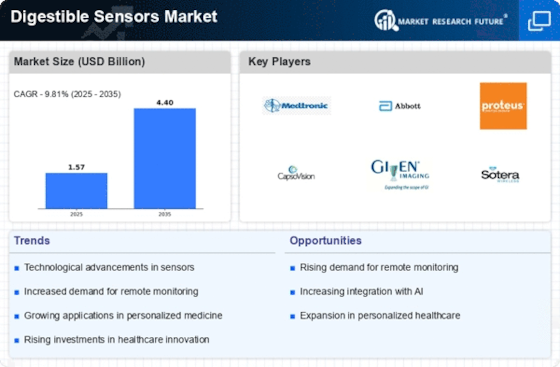
    The Global Digestible Sensors Market is projected to grow from 1.57 USD Billion in 2024 to 4.23 USD Billion by 2035, reflecting a robust growth trajectory.

    Key Market Trends & Highlights

    Digestible Sensors Key Trends and Highlights

    • The market is expected to expand at a compound annual growth rate of 9.81 percent from 2025 to 2035. By 2035, the market valuation is anticipated to reach 4.23 USD Billion, indicating strong demand for innovative health monitoring solutions. In 2024, the market is valued at 1.57 USD Billion, showcasing the increasing interest in digestible sensor technology. Growing adoption of digestible sensors due to the rising demand for remote patient monitoring is a major market driver.

    Market Size & Forecast

    2024 Market Size 1.57 (USD Billion)
    2035 Market Size 4.23 (USD Billion)
    CAGR (2025-2035) 9.81%
    Largest Regional Market Share in 2024 latin_america)

    Major Players

    <p>MC10, CapsoVision, Inc., Proteus Digital Health, Inc., HQ, Inc., Olympus Corporation, IntroMedic Co. Ltd, Medtronic PLC (Given Imaging, Inc.), JINSHAN Science &amp; Technology</p>

    Market Trends

    Digestible Sensors Market Market Drivers

    Market Growth Projections

    The Global Digestible Sensors Market Industry is poised for substantial growth, with projections indicating a market size of 1.57 USD Billion in 2024 and an anticipated increase to 4.23 USD Billion by 2035. This growth trajectory suggests a compound annual growth rate of 9.81% from 2025 to 2035. Factors contributing to this expansion include advancements in sensor technology, increasing demand for remote patient monitoring, and a growing focus on preventive healthcare. The market's evolution reflects broader trends in the healthcare sector, emphasizing the importance of innovative solutions for improving patient outcomes and enhancing the efficiency of healthcare delivery.

    Growing Focus on Preventive Healthcare

    The Global Digestible Sensors Market Industry is witnessing a paradigm shift towards preventive healthcare. As healthcare systems globally emphasize early detection and prevention of diseases, digestible sensors emerge as valuable tools for proactive health monitoring. These sensors facilitate the continuous assessment of physiological parameters, enabling individuals to make informed lifestyle choices. This trend aligns with the broader movement towards personalized medicine, where treatments are tailored to individual needs. The increasing awareness of health and wellness among consumers is expected to drive the adoption of digestible sensors, further expanding the market's potential.

    Rising Demand for Remote Patient Monitoring

    The Global Digestible Sensors Market Industry experiences a notable surge in demand for remote patient monitoring solutions. As healthcare systems increasingly prioritize patient-centric care, digestible sensors offer a non-invasive method to monitor vital health metrics in real-time. This trend is particularly relevant in chronic disease management, where continuous monitoring can lead to timely interventions. The market is projected to reach 1.57 USD Billion in 2024, reflecting a growing acceptance of these technologies. Furthermore, the integration of digestible sensors into telehealth platforms enhances patient engagement and adherence, potentially reducing healthcare costs and improving outcomes.

    Technological Advancements in Sensor Design

    Technological advancements play a pivotal role in shaping the Global Digestible Sensors Market Industry. Innovations in materials science and miniaturization techniques have led to the development of more sophisticated and reliable sensors. These advancements enable the creation of sensors that can transmit data wirelessly, providing healthcare professionals with immediate access to patient information. For instance, the introduction of biocompatible materials enhances the safety and efficacy of these devices. As a result, the market is expected to grow significantly, with projections indicating a rise to 4.23 USD Billion by 2035, driven by continuous improvements in sensor technology.

    Regulatory Support and Standardization Efforts

    Regulatory support and standardization efforts are crucial for the growth of the Global Digestible Sensors Market Industry. Governments and health organizations are increasingly recognizing the potential of digestible sensors in enhancing patient care. Initiatives aimed at establishing guidelines for the safe and effective use of these technologies foster confidence among healthcare providers and patients alike. Moreover, standardization efforts ensure interoperability between devices, facilitating data sharing and integration into existing healthcare systems. As regulatory frameworks evolve, they are likely to create a conducive environment for innovation and investment in the digestible sensors market.

    Increasing Prevalence of Gastrointestinal Disorders

    The Global Digestible Sensors Market Industry is significantly influenced by the rising prevalence of gastrointestinal disorders. Conditions such as irritable bowel syndrome and inflammatory bowel disease necessitate innovative diagnostic solutions. Digestible sensors provide a unique approach to monitor gastrointestinal health, offering insights into gut motility and microbiome activity. This capability is crucial for personalized treatment plans and improving patient outcomes. As healthcare providers seek effective tools for managing these disorders, the demand for digestible sensors is likely to increase, contributing to a projected compound annual growth rate of 9.81% from 2025 to 2035.

    Market Segment Insights

    Regional Insights

    Key Companies in the Digestible Sensors Market market include

    Industry Developments

    • The key players in the Asia Pacific are developing the advanced endoscope named power spiral. This device can effectively rotate and peen rate deep within the small intestine. This process can help to ingest digital sensors effectively.  
    • The key players are Europe is establishing plenty of partnerships. This partnership will lead to the launch cloud endoscopy. 

    Market overview

    • Market overview highlights 
    • Analysis based upon COVID 19
    • Explanation upon the Market Dynamics
    • Value chain analysis
    • Market segmentation overview
    • The regional analysis
    • Competitive landscape analysis
    • Recent Developments

    Future Outlook

    Digestible Sensors Market Future Outlook

    <p>The Global Digestible Sensors Market is projected to grow at a 9.81% CAGR from 2024 to 2035, driven by technological advancements, increasing health awareness, and rising demand for <a href="https://www.marketresearchfuture.com/reports/remote-patient-monitoring-market-10905">remote patient monitoring</a>.</p>

    New opportunities lie in:

    • <p>Develop partnerships with healthcare providers for integrated solutions. Invest in R&amp;D for next-generation sensors with enhanced capabilities. Expand market presence in emerging economies with tailored products.</p>

    <p>By 2035, the market is expected to achieve substantial growth, positioning itself as a leader in health technology.</p>

    Market Segmentation

    Digestible Sensors Market Segmentation

    • Market overview
    • Market overview highlights 
    • Analysis based upon COVID 19
    • Explanation upon the Market Dynamics
    • Value chain analysis
    • Market segmentation overview
    • The regional analysis
    • Competitive landscape analysis
    • Recent Developments
    • Recent developments 
    • The key players in the Asia Pacific are developing the advanced endoscope named power spiral. This device can effectively rotate and peen rate deep within the small intestine. This process can help to ingest digital sensors effectively.  
    • The key players are Europe is establishing plenty of partnerships. This partnership will lead to the launch cloud endoscopy. 
    • Digestible Sensors Market By product
    • Strip sensors 
    • Wearable sensors 
    • Implantable sensors 
    • Invasive sensors 
    • Ingestible sensors 
    • Digestible Sensors Market By region 
    • Europe 
    • North America 
    • Asia pacific 
    • Digestible Sensors Market By end-users 
    • Sports and fitness 
    • Consumer 
    • Pharmaceutical 
    • Healthcare providers 
    • Digestible Sensors Market By technology 
    • Sensor 
    • Accelerometer 
    • Temperature 
    • Image 
    • Pressure 
    • Digestible Sensors Market By application 
    • Therapeutics 
    • Diagnostics 
    • Patient monitoring 
    • The key players of the digestible sensors market are 
    • MC10
    • Proteus Digital Health
    • Inc.
    • HQ
    • Inc.
    • Olympus Corporation
    • IntroMedic Co. Ltd
    • Medtronic PLC (Given Imaging
    • Inc.)
    • JINSHAN Science & Technology

    Report Scope

    Attribute/MetricDetails
    Market Size 20231.43 (USD Billion)
    Market Size 20241.57 (USD Billion)
    Market Size 20354.4 (USD Billion)
    Compound Annual Growth Rate (CAGR)9.81 % (2024 - 2035)
    Report CoverageRevenue Forecast, Competitive Landscape, Growth Factors, and Trends
    Base Year2023
    Market Forecast Period2024 - 2035
    Historical Data2019 - 2023
    Geographies CoveredNorth America, Europe, Asia-Pacific, and Rest of the World (RoW)
      Key VendorsProteus Digital Health, Freescale Semiconductor, Inc., Philips Healthcare, STMicroelectronics, Analog Devices, Inc., GE Healthcare, Honeywell International, Measurement Specialties, Medtronic Plc, Sensirion AG, Smiths Medical
    Key Market OpportunitiesNew product launches and R&D Amongst major key Players
    Key Market DriversTechnical and Clinical complexities along with high cost associated with technologically advanced devices. Unawareness about the digestible sensors are some of the factors hindering the growth.

    FAQs

    1. SECTION I: EXECUTIVE SUMMARY AND KEY HIGHLIGHTS
      1. | 1.1 EXECUTIVE SUMMARY
      2. | | 1.1.1 Market Overview
      3. | | 1.1.2 Key Findings
      4. | | 1.1.3 Market Segmentation
      5. | | 1.1.4 Competitive Landscape
      6. | | 1.1.5 Challenges and Opportunities
      7. | | 1.1.6 Future Outlook
    2. SECTION II: SCOPING, METHODOLOGY AND MARKET STRUCTURE
      1. | 2.1 MARKET INTRODUCTION
      2. | | 2.1.1 Definition
      3. | | 2.1.2 Scope of the study
      4. | | | 2.1.2.1 Research Objective
      5. | | | 2.1.2.2 Assumption
      6. | | | 2.1.2.3 Limitations
      7. | 2.2 RESEARCH METHODOLOGY
      8. | | 2.2.1 Overview
      9. | | 2.2.2 Data Mining
      10. | | 2.2.3 Secondary Research
      11. | | 2.2.4 Primary Research
      12. | | | 2.2.4.1 Primary Interviews and Information Gathering Process
      13. | | | 2.2.4.2 Breakdown of Primary Respondents
      14. | | 2.2.5 Forecasting Model
      15. | | 2.2.6 Market Size Estimation
      16. | | | 2.2.6.1 Bottom-Up Approach
      17. | | | 2.2.6.2 Top-Down Approach
      18. | | 2.2.7 Data Triangulation
      19. | | 2.2.8 Validation
    3. SECTION III: QUALITATIVE ANALYSIS
      1. | 3.1 MARKET DYNAMICS
      2. | | 3.1.1 Overview
      3. | | 3.1.2 Drivers
      4. | | 3.1.3 Restraints
      5. | | 3.1.4 Opportunities
      6. | 3.2 MARKET FACTOR ANALYSIS
      7. | | 3.2.1 Value chain Analysis
      8. | | 3.2.2 Porter's Five Forces Analysis
      9. | | | 3.2.2.1 Bargaining Power of Suppliers
      10. | | | 3.2.2.2 Bargaining Power of Buyers
      11. | | | 3.2.2.3 Threat of New Entrants
      12. | | | 3.2.2.4 Threat of Substitutes
      13. | | | 3.2.2.5 Intensity of Rivalry
      14. | | 3.2.3 COVID-19 Impact Analysis
      15. | | | 3.2.3.1 Market Impact Analysis
      16. | | | 3.2.3.2 Regional Impact
      17. | | | 3.2.3.3 Opportunity and Threat Analysis
    4. SECTION IV: QUANTITATIVE ANALYSIS
      1. | 4.1 Healthcare, BY Product (USD Billion)
      2. | | 4.1.1 Strip sensors
      3. | | 4.1.2 Wearable sensors
      4. | | 4.1.3 Implantable sensors
      5. | | 4.1.4 Invasive sensors
      6. | | 4.1.5 Ingestible sensors
      7. | 4.2 Healthcare, BY Application (USD Billion)
      8. | | 4.2.1 Therapeutics
      9. | | 4.2.2 Diagnostics
      10. | | 4.2.3 Patient monitoring
      11. | 4.3 Healthcare, BY Technology (USD Billion)
      12. | | 4.3.1 Sensor
      13. | | 4.3.2 Accelerometer
      14. | | 4.3.3 Temperature
      15. | | 4.3.4 Image
      16. | | 4.3.5 Pressure
      17. | 4.4 Healthcare, BY End-Users (USD Billion)
      18. | | 4.4.1 Sports and fitness
      19. | | 4.4.2 Consumer
      20. | | 4.4.3 Pharmaceutical
      21. | | 4.4.4 Healthcare providers
      22. | 4.5 Healthcare, BY Region (USD Billion)
      23. | | 4.5.1 North America
      24. | | | 4.5.1.1 US
      25. | | | 4.5.1.2 Canada
      26. | | 4.5.2 Europe
      27. | | | 4.5.2.1 Germany
      28. | | | 4.5.2.2 UK
      29. | | | 4.5.2.3 France
      30. | | | 4.5.2.4 Russia
      31. | | | 4.5.2.5 Italy
      32. | | | 4.5.2.6 Spain
      33. | | | 4.5.2.7 Rest of Europe
      34. | | 4.5.3 APAC
      35. | | | 4.5.3.1 China
      36. | | | 4.5.3.2 India
      37. | | | 4.5.3.3 Japan
      38. | | | 4.5.3.4 South Korea
      39. | | | 4.5.3.5 Malaysia
      40. | | | 4.5.3.6 Thailand
      41. | | | 4.5.3.7 Indonesia
      42. | | | 4.5.3.8 Rest of APAC
      43. | | 4.5.4 South America
      44. | | | 4.5.4.1 Brazil
      45. | | | 4.5.4.2 Mexico
      46. | | | 4.5.4.3 Argentina
      47. | | | 4.5.4.4 Rest of South America
      48. | | 4.5.5 MEA
      49. | | | 4.5.5.1 GCC Countries
      50. | | | 4.5.5.2 South Africa
      51. | | | 4.5.5.3 Rest of MEA
    5. SECTION V: COMPETITIVE ANALYSIS
      1. | 5.1 Competitive Landscape
      2. | | 5.1.1 Overview
      3. | | 5.1.2 Competitive Analysis
      4. | | 5.1.3 Market share Analysis
      5. | | 5.1.4 Major Growth Strategy in the Healthcare
      6. | | 5.1.5 Competitive Benchmarking
      7. | | 5.1.6 Leading Players in Terms of Number of Developments in the Healthcare
      8. | | 5.1.7 Key developments and growth strategies
      9. | | | 5.1.7.1 New Product Launch/Service Deployment
      10. | | | 5.1.7.2 Merger & Acquisitions
      11. | | | 5.1.7.3 Joint Ventures
      12. | | 5.1.8 Major Players Financial Matrix
      13. | | | 5.1.8.1 Sales and Operating Income
      14. | | | 5.1.8.2 Major Players R&D Expenditure. 2023
      15. | 5.2 Company Profiles
      16. | | 5.2.1 Medtronic (US)
      17. | | | 5.2.1.1 Financial Overview
      18. | | | 5.2.1.2 Products Offered
      19. | | | 5.2.1.3 Key Developments
      20. | | | 5.2.1.4 SWOT Analysis
      21. | | | 5.2.1.5 Key Strategies
      22. | | 5.2.2 Abbott Laboratories (US)
      23. | | | 5.2.2.1 Financial Overview
      24. | | | 5.2.2.2 Products Offered
      25. | | | 5.2.2.3 Key Developments
      26. | | | 5.2.2.4 SWOT Analysis
      27. | | | 5.2.2.5 Key Strategies
      28. | | 5.2.3 Proteus Digital Health (US)
      29. | | | 5.2.3.1 Financial Overview
      30. | | | 5.2.3.2 Products Offered
      31. | | | 5.2.3.3 Key Developments
      32. | | | 5.2.3.4 SWOT Analysis
      33. | | | 5.2.3.5 Key Strategies
      34. | | 5.2.4 CapsoVision (US)
      35. | | | 5.2.4.1 Financial Overview
      36. | | | 5.2.4.2 Products Offered
      37. | | | 5.2.4.3 Key Developments
      38. | | | 5.2.4.4 SWOT Analysis
      39. | | | 5.2.4.5 Key Strategies
      40. | | 5.2.5 Given Imaging (IL)
      41. | | | 5.2.5.1 Financial Overview
      42. | | | 5.2.5.2 Products Offered
      43. | | | 5.2.5.3 Key Developments
      44. | | | 5.2.5.4 SWOT Analysis
      45. | | | 5.2.5.5 Key Strategies
      46. | | 5.2.6 Sotera Wireless (US)
      47. | | | 5.2.6.1 Financial Overview
      48. | | | 5.2.6.2 Products Offered
      49. | | | 5.2.6.3 Key Developments
      50. | | | 5.2.6.4 SWOT Analysis
      51. | | | 5.2.6.5 Key Strategies
      52. | | 5.2.7 Eccrine Systems (US)
      53. | | | 5.2.7.1 Financial Overview
      54. | | | 5.2.7.2 Products Offered
      55. | | | 5.2.7.3 Key Developments
      56. | | | 5.2.7.4 SWOT Analysis
      57. | | | 5.2.7.5 Key Strategies
      58. | | 5.2.8 Gastrointestinal Therapeutics (US)
      59. | | | 5.2.8.1 Financial Overview
      60. | | | 5.2.8.2 Products Offered
      61. | | | 5.2.8.3 Key Developments
      62. | | | 5.2.8.4 SWOT Analysis
      63. | | | 5.2.8.5 Key Strategies
      64. | 5.3 Appendix
      65. | | 5.3.1 References
      66. | | 5.3.2 Related Reports
    6. LIST OF FIGURES
      1. | 6.1 MARKET SYNOPSIS
      2. | 6.2 NORTH AMERICA MARKET ANALYSIS
      3. | 6.3 US MARKET ANALYSIS BY PRODUCT
      4. | 6.4 US MARKET ANALYSIS BY APPLICATION
      5. | 6.5 US MARKET ANALYSIS BY TECHNOLOGY
      6. | 6.6 US MARKET ANALYSIS BY END-USERS
      7. | 6.7 CANADA MARKET ANALYSIS BY PRODUCT
      8. | 6.8 CANADA MARKET ANALYSIS BY APPLICATION
      9. | 6.9 CANADA MARKET ANALYSIS BY TECHNOLOGY
      10. | 6.10 CANADA MARKET ANALYSIS BY END-USERS
      11. | 6.11 EUROPE MARKET ANALYSIS
      12. | 6.12 GERMANY MARKET ANALYSIS BY PRODUCT
      13. | 6.13 GERMANY MARKET ANALYSIS BY APPLICATION
      14. | 6.14 GERMANY MARKET ANALYSIS BY TECHNOLOGY
      15. | 6.15 GERMANY MARKET ANALYSIS BY END-USERS
      16. | 6.16 UK MARKET ANALYSIS BY PRODUCT
      17. | 6.17 UK MARKET ANALYSIS BY APPLICATION
      18. | 6.18 UK MARKET ANALYSIS BY TECHNOLOGY
      19. | 6.19 UK MARKET ANALYSIS BY END-USERS
      20. | 6.20 FRANCE MARKET ANALYSIS BY PRODUCT
      21. | 6.21 FRANCE MARKET ANALYSIS BY APPLICATION
      22. | 6.22 FRANCE MARKET ANALYSIS BY TECHNOLOGY
      23. | 6.23 FRANCE MARKET ANALYSIS BY END-USERS
      24. | 6.24 RUSSIA MARKET ANALYSIS BY PRODUCT
      25. | 6.25 RUSSIA MARKET ANALYSIS BY APPLICATION
      26. | 6.26 RUSSIA MARKET ANALYSIS BY TECHNOLOGY
      27. | 6.27 RUSSIA MARKET ANALYSIS BY END-USERS
      28. | 6.28 ITALY MARKET ANALYSIS BY PRODUCT
      29. | 6.29 ITALY MARKET ANALYSIS BY APPLICATION
      30. | 6.30 ITALY MARKET ANALYSIS BY TECHNOLOGY
      31. | 6.31 ITALY MARKET ANALYSIS BY END-USERS
      32. | 6.32 SPAIN MARKET ANALYSIS BY PRODUCT
      33. | 6.33 SPAIN MARKET ANALYSIS BY APPLICATION
      34. | 6.34 SPAIN MARKET ANALYSIS BY TECHNOLOGY
      35. | 6.35 SPAIN MARKET ANALYSIS BY END-USERS
      36. | 6.36 REST OF EUROPE MARKET ANALYSIS BY PRODUCT
      37. | 6.37 REST OF EUROPE MARKET ANALYSIS BY APPLICATION
      38. | 6.38 REST OF EUROPE MARKET ANALYSIS BY TECHNOLOGY
      39. | 6.39 REST OF EUROPE MARKET ANALYSIS BY END-USERS
      40. | 6.40 APAC MARKET ANALYSIS
      41. | 6.41 CHINA MARKET ANALYSIS BY PRODUCT
      42. | 6.42 CHINA MARKET ANALYSIS BY APPLICATION
      43. | 6.43 CHINA MARKET ANALYSIS BY TECHNOLOGY
      44. | 6.44 CHINA MARKET ANALYSIS BY END-USERS
      45. | 6.45 INDIA MARKET ANALYSIS BY PRODUCT
      46. | 6.46 INDIA MARKET ANALYSIS BY APPLICATION
      47. | 6.47 INDIA MARKET ANALYSIS BY TECHNOLOGY
      48. | 6.48 INDIA MARKET ANALYSIS BY END-USERS
      49. | 6.49 JAPAN MARKET ANALYSIS BY PRODUCT
      50. | 6.50 JAPAN MARKET ANALYSIS BY APPLICATION
      51. | 6.51 JAPAN MARKET ANALYSIS BY TECHNOLOGY
      52. | 6.52 JAPAN MARKET ANALYSIS BY END-USERS
      53. | 6.53 SOUTH KOREA MARKET ANALYSIS BY PRODUCT
      54. | 6.54 SOUTH KOREA MARKET ANALYSIS BY APPLICATION
      55. | 6.55 SOUTH KOREA MARKET ANALYSIS BY TECHNOLOGY
      56. | 6.56 SOUTH KOREA MARKET ANALYSIS BY END-USERS
      57. | 6.57 MALAYSIA MARKET ANALYSIS BY PRODUCT
      58. | 6.58 MALAYSIA MARKET ANALYSIS BY APPLICATION
      59. | 6.59 MALAYSIA MARKET ANALYSIS BY TECHNOLOGY
      60. | 6.60 MALAYSIA MARKET ANALYSIS BY END-USERS
      61. | 6.61 THAILAND MARKET ANALYSIS BY PRODUCT
      62. | 6.62 THAILAND MARKET ANALYSIS BY APPLICATION
      63. | 6.63 THAILAND MARKET ANALYSIS BY TECHNOLOGY
      64. | 6.64 THAILAND MARKET ANALYSIS BY END-USERS
      65. | 6.65 INDONESIA MARKET ANALYSIS BY PRODUCT
      66. | 6.66 INDONESIA MARKET ANALYSIS BY APPLICATION
      67. | 6.67 INDONESIA MARKET ANALYSIS BY TECHNOLOGY
      68. | 6.68 INDONESIA MARKET ANALYSIS BY END-USERS
      69. | 6.69 REST OF APAC MARKET ANALYSIS BY PRODUCT
      70. | 6.70 REST OF APAC MARKET ANALYSIS BY APPLICATION
      71. | 6.71 REST OF APAC MARKET ANALYSIS BY TECHNOLOGY
      72. | 6.72 REST OF APAC MARKET ANALYSIS BY END-USERS
      73. | 6.73 SOUTH AMERICA MARKET ANALYSIS
      74. | 6.74 BRAZIL MARKET ANALYSIS BY PRODUCT
      75. | 6.75 BRAZIL MARKET ANALYSIS BY APPLICATION
      76. | 6.76 BRAZIL MARKET ANALYSIS BY TECHNOLOGY
      77. | 6.77 BRAZIL MARKET ANALYSIS BY END-USERS
      78. | 6.78 MEXICO MARKET ANALYSIS BY PRODUCT
      79. | 6.79 MEXICO MARKET ANALYSIS BY APPLICATION
      80. | 6.80 MEXICO MARKET ANALYSIS BY TECHNOLOGY
      81. | 6.81 MEXICO MARKET ANALYSIS BY END-USERS
      82. | 6.82 ARGENTINA MARKET ANALYSIS BY PRODUCT
      83. | 6.83 ARGENTINA MARKET ANALYSIS BY APPLICATION
      84. | 6.84 ARGENTINA MARKET ANALYSIS BY TECHNOLOGY
      85. | 6.85 ARGENTINA MARKET ANALYSIS BY END-USERS
      86. | 6.86 REST OF SOUTH AMERICA MARKET ANALYSIS BY PRODUCT
      87. | 6.87 REST OF SOUTH AMERICA MARKET ANALYSIS BY APPLICATION
      88. | 6.88 REST OF SOUTH AMERICA MARKET ANALYSIS BY TECHNOLOGY
      89. | 6.89 REST OF SOUTH AMERICA MARKET ANALYSIS BY END-USERS
      90. | 6.90 MEA MARKET ANALYSIS
      91. | 6.91 GCC COUNTRIES MARKET ANALYSIS BY PRODUCT
      92. | 6.92 GCC COUNTRIES MARKET ANALYSIS BY APPLICATION
      93. | 6.93 GCC COUNTRIES MARKET ANALYSIS BY TECHNOLOGY
      94. | 6.94 GCC COUNTRIES MARKET ANALYSIS BY END-USERS
      95. | 6.95 SOUTH AFRICA MARKET ANALYSIS BY PRODUCT
      96. | 6.96 SOUTH AFRICA MARKET ANALYSIS BY APPLICATION
      97. | 6.97 SOUTH AFRICA MARKET ANALYSIS BY TECHNOLOGY
      98. | 6.98 SOUTH AFRICA MARKET ANALYSIS BY END-USERS
      99. | 6.99 REST OF MEA MARKET ANALYSIS BY PRODUCT
      100. | 6.100 REST OF MEA MARKET ANALYSIS BY APPLICATION
      101. | 6.101 REST OF MEA MARKET ANALYSIS BY TECHNOLOGY
      102. | 6.102 REST OF MEA MARKET ANALYSIS BY END-USERS
      103. | 6.103 KEY BUYING CRITERIA OF HEALTHCARE
      104. | 6.104 RESEARCH PROCESS OF MRFR
      105. | 6.105 DRO ANALYSIS OF HEALTHCARE
      106. | 6.106 DRIVERS IMPACT ANALYSIS: HEALTHCARE
      107. | 6.107 RESTRAINTS IMPACT ANALYSIS: HEALTHCARE
      108. | 6.108 SUPPLY / VALUE CHAIN: HEALTHCARE
      109. | 6.109 HEALTHCARE, BY PRODUCT, 2024 (% SHARE)
      110. | 6.110 HEALTHCARE, BY PRODUCT, 2024 TO 2035 (USD Billion)
      111. | 6.111 HEALTHCARE, BY APPLICATION, 2024 (% SHARE)
      112. | 6.112 HEALTHCARE, BY APPLICATION, 2024 TO 2035 (USD Billion)
      113. | 6.113 HEALTHCARE, BY TECHNOLOGY, 2024 (% SHARE)
      114. | 6.114 HEALTHCARE, BY TECHNOLOGY, 2024 TO 2035 (USD Billion)
      115. | 6.115 HEALTHCARE, BY END-USERS, 2024 (% SHARE)
      116. | 6.116 HEALTHCARE, BY END-USERS, 2024 TO 2035 (USD Billion)
      117. | 6.117 BENCHMARKING OF MAJOR COMPETITORS
    7. LIST OF TABLES
      1. | 7.1 LIST OF ASSUMPTIONS
      2. | | 7.1.1
      3. | 7.2 North America MARKET SIZE ESTIMATES; FORECAST
      4. | | 7.2.1 BY PRODUCT, 2025-2035 (USD Billion)
      5. | | 7.2.2 BY APPLICATION, 2025-2035 (USD Billion)
      6. | | 7.2.3 BY TECHNOLOGY, 2025-2035 (USD Billion)
      7. | | 7.2.4 BY END-USERS, 2025-2035 (USD Billion)
      8. | 7.3 US MARKET SIZE ESTIMATES; FORECAST
      9. | | 7.3.1 BY PRODUCT, 2025-2035 (USD Billion)
      10. | | 7.3.2 BY APPLICATION, 2025-2035 (USD Billion)
      11. | | 7.3.3 BY TECHNOLOGY, 2025-2035 (USD Billion)
      12. | | 7.3.4 BY END-USERS, 2025-2035 (USD Billion)
      13. | 7.4 Canada MARKET SIZE ESTIMATES; FORECAST
      14. | | 7.4.1 BY PRODUCT, 2025-2035 (USD Billion)
      15. | | 7.4.2 BY APPLICATION, 2025-2035 (USD Billion)
      16. | | 7.4.3 BY TECHNOLOGY, 2025-2035 (USD Billion)
      17. | | 7.4.4 BY END-USERS, 2025-2035 (USD Billion)
      18. | 7.5 Europe MARKET SIZE ESTIMATES; FORECAST
      19. | | 7.5.1 BY PRODUCT, 2025-2035 (USD Billion)
      20. | | 7.5.2 BY APPLICATION, 2025-2035 (USD Billion)
      21. | | 7.5.3 BY TECHNOLOGY, 2025-2035 (USD Billion)
      22. | | 7.5.4 BY END-USERS, 2025-2035 (USD Billion)
      23. | 7.6 Germany MARKET SIZE ESTIMATES; FORECAST
      24. | | 7.6.1 BY PRODUCT, 2025-2035 (USD Billion)
      25. | | 7.6.2 BY APPLICATION, 2025-2035 (USD Billion)
      26. | | 7.6.3 BY TECHNOLOGY, 2025-2035 (USD Billion)
      27. | | 7.6.4 BY END-USERS, 2025-2035 (USD Billion)
      28. | 7.7 UK MARKET SIZE ESTIMATES; FORECAST
      29. | | 7.7.1 BY PRODUCT, 2025-2035 (USD Billion)
      30. | | 7.7.2 BY APPLICATION, 2025-2035 (USD Billion)
      31. | | 7.7.3 BY TECHNOLOGY, 2025-2035 (USD Billion)
      32. | | 7.7.4 BY END-USERS, 2025-2035 (USD Billion)
      33. | 7.8 France MARKET SIZE ESTIMATES; FORECAST
      34. | | 7.8.1 BY PRODUCT, 2025-2035 (USD Billion)
      35. | | 7.8.2 BY APPLICATION, 2025-2035 (USD Billion)
      36. | | 7.8.3 BY TECHNOLOGY, 2025-2035 (USD Billion)
      37. | | 7.8.4 BY END-USERS, 2025-2035 (USD Billion)
      38. | 7.9 Russia MARKET SIZE ESTIMATES; FORECAST
      39. | | 7.9.1 BY PRODUCT, 2025-2035 (USD Billion)
      40. | | 7.9.2 BY APPLICATION, 2025-2035 (USD Billion)
      41. | | 7.9.3 BY TECHNOLOGY, 2025-2035 (USD Billion)
      42. | | 7.9.4 BY END-USERS, 2025-2035 (USD Billion)
      43. | 7.10 Italy MARKET SIZE ESTIMATES; FORECAST
      44. | | 7.10.1 BY PRODUCT, 2025-2035 (USD Billion)
      45. | | 7.10.2 BY APPLICATION, 2025-2035 (USD Billion)
      46. | | 7.10.3 BY TECHNOLOGY, 2025-2035 (USD Billion)
      47. | | 7.10.4 BY END-USERS, 2025-2035 (USD Billion)
      48. | 7.11 Spain MARKET SIZE ESTIMATES; FORECAST
      49. | | 7.11.1 BY PRODUCT, 2025-2035 (USD Billion)
      50. | | 7.11.2 BY APPLICATION, 2025-2035 (USD Billion)
      51. | | 7.11.3 BY TECHNOLOGY, 2025-2035 (USD Billion)
      52. | | 7.11.4 BY END-USERS, 2025-2035 (USD Billion)
      53. | 7.12 Rest of Europe MARKET SIZE ESTIMATES; FORECAST
      54. | | 7.12.1 BY PRODUCT, 2025-2035 (USD Billion)
      55. | | 7.12.2 BY APPLICATION, 2025-2035 (USD Billion)
      56. | | 7.12.3 BY TECHNOLOGY, 2025-2035 (USD Billion)
      57. | | 7.12.4 BY END-USERS, 2025-2035 (USD Billion)
      58. | 7.13 APAC MARKET SIZE ESTIMATES; FORECAST
      59. | | 7.13.1 BY PRODUCT, 2025-2035 (USD Billion)
      60. | | 7.13.2 BY APPLICATION, 2025-2035 (USD Billion)
      61. | | 7.13.3 BY TECHNOLOGY, 2025-2035 (USD Billion)
      62. | | 7.13.4 BY END-USERS, 2025-2035 (USD Billion)
      63. | 7.14 China MARKET SIZE ESTIMATES; FORECAST
      64. | | 7.14.1 BY PRODUCT, 2025-2035 (USD Billion)
      65. | | 7.14.2 BY APPLICATION, 2025-2035 (USD Billion)
      66. | | 7.14.3 BY TECHNOLOGY, 2025-2035 (USD Billion)
      67. | | 7.14.4 BY END-USERS, 2025-2035 (USD Billion)
      68. | 7.15 India MARKET SIZE ESTIMATES; FORECAST
      69. | | 7.15.1 BY PRODUCT, 2025-2035 (USD Billion)
      70. | | 7.15.2 BY APPLICATION, 2025-2035 (USD Billion)
      71. | | 7.15.3 BY TECHNOLOGY, 2025-2035 (USD Billion)
      72. | | 7.15.4 BY END-USERS, 2025-2035 (USD Billion)
      73. | 7.16 Japan MARKET SIZE ESTIMATES; FORECAST
      74. | | 7.16.1 BY PRODUCT, 2025-2035 (USD Billion)
      75. | | 7.16.2 BY APPLICATION, 2025-2035 (USD Billion)
      76. | | 7.16.3 BY TECHNOLOGY, 2025-2035 (USD Billion)
      77. | | 7.16.4 BY END-USERS, 2025-2035 (USD Billion)
      78. | 7.17 South Korea MARKET SIZE ESTIMATES; FORECAST
      79. | | 7.17.1 BY PRODUCT, 2025-2035 (USD Billion)
      80. | | 7.17.2 BY APPLICATION, 2025-2035 (USD Billion)
      81. | | 7.17.3 BY TECHNOLOGY, 2025-2035 (USD Billion)
      82. | | 7.17.4 BY END-USERS, 2025-2035 (USD Billion)
      83. | 7.18 Malaysia MARKET SIZE ESTIMATES; FORECAST
      84. | | 7.18.1 BY PRODUCT, 2025-2035 (USD Billion)
      85. | | 7.18.2 BY APPLICATION, 2025-2035 (USD Billion)
      86. | | 7.18.3 BY TECHNOLOGY, 2025-2035 (USD Billion)
      87. | | 7.18.4 BY END-USERS, 2025-2035 (USD Billion)
      88. | 7.19 Thailand MARKET SIZE ESTIMATES; FORECAST
      89. | | 7.19.1 BY PRODUCT, 2025-2035 (USD Billion)
      90. | | 7.19.2 BY APPLICATION, 2025-2035 (USD Billion)
      91. | | 7.19.3 BY TECHNOLOGY, 2025-2035 (USD Billion)
      92. | | 7.19.4 BY END-USERS, 2025-2035 (USD Billion)
      93. | 7.20 Indonesia MARKET SIZE ESTIMATES; FORECAST
      94. | | 7.20.1 BY PRODUCT, 2025-2035 (USD Billion)
      95. | | 7.20.2 BY APPLICATION, 2025-2035 (USD Billion)
      96. | | 7.20.3 BY TECHNOLOGY, 2025-2035 (USD Billion)
      97. | | 7.20.4 BY END-USERS, 2025-2035 (USD Billion)
      98. | 7.21 Rest of APAC MARKET SIZE ESTIMATES; FORECAST
      99. | | 7.21.1 BY PRODUCT, 2025-2035 (USD Billion)
      100. | | 7.21.2 BY APPLICATION, 2025-2035 (USD Billion)
      101. | | 7.21.3 BY TECHNOLOGY, 2025-2035 (USD Billion)
      102. | | 7.21.4 BY END-USERS, 2025-2035 (USD Billion)
      103. | 7.22 South America MARKET SIZE ESTIMATES; FORECAST
      104. | | 7.22.1 BY PRODUCT, 2025-2035 (USD Billion)
      105. | | 7.22.2 BY APPLICATION, 2025-2035 (USD Billion)
      106. | | 7.22.3 BY TECHNOLOGY, 2025-2035 (USD Billion)
      107. | | 7.22.4 BY END-USERS, 2025-2035 (USD Billion)
      108. | 7.23 Brazil MARKET SIZE ESTIMATES; FORECAST
      109. | | 7.23.1 BY PRODUCT, 2025-2035 (USD Billion)
      110. | | 7.23.2 BY APPLICATION, 2025-2035 (USD Billion)
      111. | | 7.23.3 BY TECHNOLOGY, 2025-2035 (USD Billion)
      112. | | 7.23.4 BY END-USERS, 2025-2035 (USD Billion)
      113. | 7.24 Mexico MARKET SIZE ESTIMATES; FORECAST
      114. | | 7.24.1 BY PRODUCT, 2025-2035 (USD Billion)
      115. | | 7.24.2 BY APPLICATION, 2025-2035 (USD Billion)
      116. | | 7.24.3 BY TECHNOLOGY, 2025-2035 (USD Billion)
      117. | | 7.24.4 BY END-USERS, 2025-2035 (USD Billion)
      118. | 7.25 Argentina MARKET SIZE ESTIMATES; FORECAST
      119. | | 7.25.1 BY PRODUCT, 2025-2035 (USD Billion)
      120. | | 7.25.2 BY APPLICATION, 2025-2035 (USD Billion)
      121. | | 7.25.3 BY TECHNOLOGY, 2025-2035 (USD Billion)
      122. | | 7.25.4 BY END-USERS, 2025-2035 (USD Billion)
      123. | 7.26 Rest of South America MARKET SIZE ESTIMATES; FORECAST
      124. | | 7.26.1 BY PRODUCT, 2025-2035 (USD Billion)
      125. | | 7.26.2 BY APPLICATION, 2025-2035 (USD Billion)
      126. | | 7.26.3 BY TECHNOLOGY, 2025-2035 (USD Billion)
      127. | | 7.26.4 BY END-USERS, 2025-2035 (USD Billion)
      128. | 7.27 MEA MARKET SIZE ESTIMATES; FORECAST
      129. | | 7.27.1 BY PRODUCT, 2025-2035 (USD Billion)
      130. | | 7.27.2 BY APPLICATION, 2025-2035 (USD Billion)
      131. | | 7.27.3 BY TECHNOLOGY, 2025-2035 (USD Billion)
      132. | | 7.27.4 BY END-USERS, 2025-2035 (USD Billion)
      133. | 7.28 GCC Countries MARKET SIZE ESTIMATES; FORECAST
      134. | | 7.28.1 BY PRODUCT, 2025-2035 (USD Billion)
      135. | | 7.28.2 BY APPLICATION, 2025-2035 (USD Billion)
      136. | | 7.28.3 BY TECHNOLOGY, 2025-2035 (USD Billion)
      137. | | 7.28.4 BY END-USERS, 2025-2035 (USD Billion)
      138. | 7.29 South Africa MARKET SIZE ESTIMATES; FORECAST
      139. | | 7.29.1 BY PRODUCT, 2025-2035 (USD Billion)
      140. | | 7.29.2 BY APPLICATION, 2025-2035 (USD Billion)
      141. | | 7.29.3 BY TECHNOLOGY, 2025-2035 (USD Billion)
      142. | | 7.29.4 BY END-USERS, 2025-2035 (USD Billion)
      143. | 7.30 Rest of MEA MARKET SIZE ESTIMATES; FORECAST
      144. | | 7.30.1 BY PRODUCT, 2025-2035 (USD Billion)
      145. | | 7.30.2 BY APPLICATION, 2025-2035 (USD Billion)
      146. | | 7.30.3 BY TECHNOLOGY, 2025-2035 (USD Billion)
      147. | | 7.30.4 BY END-USERS, 2025-2035 (USD Billion)
      148. | 7.31 PRODUCT LAUNCH/PRODUCT DEVELOPMENT/APPROVAL
      149. | | 7.31.1
      150. | 7.32 ACQUISITION/PARTNERSHIP
      151. | | 7.32.1

    Digestible Sensors Market Segmentation

    Market Segmentation Overview

    • Detailed segmentation data will be available in the full report
    • Comprehensive analysis by multiple parameters
    • Regional and country-level breakdowns
    • Market size forecasts by segment
    Infographic

    Free Sample Request

    Kindly complete the form below to receive a free sample of this Report

    Get Free Sample

    Customer Strories

    “I am very pleased with how market segments have been defined in a relevant way for my purposes (such as "Portable Freezers & refrigerators" and "last-mile"). In general the report is well structured. Thanks very much for your efforts.”

    Victoria Milne

    Founder
    Case Study
    Chemicals and Materials

    Compare Licence

    ×
    Features License Type
    Single User Multiuser License Enterprise User
    Price $4,950 $5,950 $7,250
    Maximum User Access Limit 1 User Upto 10 Users Unrestricted Access Throughout the Organization
    Free Customization
    Direct Access to Analyst
    Deliverable Format
    Platform Access
    Discount on Next Purchase 10% 15% 15%
    Printable Versions