×
Hero Background
English
Chinese
French
Japanese
Korean
German
Spanish

Detergent Alcohol Market Trends

ID: MRFR/CnM/0676-HCR
140 Pages
Priya Nagrale
October 2025

Detergent Alcohol Market Research Report Information by Source (Natural and Synthetic), Application (Domestic & Industrial Cleaning, Cosmetics & Personal Care, Pharmaceutical, Wastewater Treatment, Plasticizer and others) and Region (North America, Europe, Asia-Pacific, Latin America and the Middle East & Africa) - Forecast till 2035

Share:
Download PDF ×

We do not share your information with anyone. However, we may send you emails based on your report interest from time to time. You may contact us at any time to opt-out.

Detergent Alcohol Market Infographic
Purchase Options

Market Trends

Key Emerging Trends in the Detergent Alcohol Market

Detergent Alcohol Market has tremendous trends resulting from rising demand for hygiene products, increased focus on sustainable ingredients as well as growth in personal care sectors among other factors. Detergent alcohols (also known as fatty alcohols) are essential raw materials used in making detergents shampoos soaps among others cleansers. A key development is the ever-increasing need for detergent alcohols to be used in surfactant formulation for residential and industrial detergents usage . This is because there has been an upsurge in demand for laundering agents caused by consumers who highly value cleanliness and healthiness since they believe that they are necessary condition.

Market trends in the Detergent Alcohol Market are driven by an increasing focus on sustainable and eco-friendly ingredients. Manufactures have targeted developing detergent alcohols from renewable feedstock including palm oil and other plant based feedstocks thus going hand in hand with the industry’s commitment towards environmental sustainability. The use of sustainable detergent alcohols is being propelled by this trend towards green formulations within cleaning agents as well as personal care products.

Hair care products are one of those which commonly contain a large amount of detergent alcohols in their products that are necessary for a good performance. In formulating shampoos, conditioners, and lotions fatty alcohol is used as emollients, thickeners and stabilizers. Thus the demand for detergent alcohols has been increasing within personal care sector driven by the rising concerns of the end users with regard to skincare as well as personal grooming.

Market trends in Detergent Alcohol Market are influenced by technological progressions and search for high-performance ingredients. These companies aim at improving the efficiency of their detergent alcohol production process through research and development which accordingly leads to better quality final products that meet changing requirements in cleaning and personal care sectors.

Further notable trends can be observed from collaborations and partnerships between players in the industry. Companies manufacturing detergents alcohols have joined hands together to consolidate market positions, share technology know-how as well as exploit new opportunities. These alliances foster innovation, support growth of Detergent Alcohol Market overall through addressing particular needs of different end-use industries.

Also, international economic factors affect market trends. The demand for detergent alcohols is driven by economic conditions such as consumer spending, industrial growth, expansion of retails among others. Economic fluctuations may prompt manufacturers to adapt to emerging markets dynamics within this sector when there is a trend change.

Author
Priya Nagrale
Senior Research Analyst

With an experience of over five years in market research industry (Chemicals & Materials domain), I gather and analyze market data from diverse sources to produce results, which are then presented back to a client. Also, provide recommendations based on the findings. As a Senior Research Analyst, I perform quality checks (QC) for market estimations, QC for reports, and handle queries and work extensively on client customizations. Also, handle the responsibilities of client proposals, report planning, report finalization, and execution

Leave a Comment

FAQs

At what CAGR the detergent alcohol market is projected to grow during the forecast period?

The detergent alcohol market is projected to grow at a 6.30% CAGR between 2025-2035.

What will be the value of the detergent alcohol market during the forecast period?

The detergent alcohol market is predicted to touch USD 15 billion by 2035.

Which region is expected to have a major share in the detergent alcohol market?

The APAC region is expected to have a major share in the detergent alcohol market.

Which factors may limit the detergent alcohol market growth?

Fluctuations in raw material prices may limit market growth.

What are the key factors driving the growth of the detergent alcohol market?

Growing cosmetics & personal care industry and preference for liquid table detergents are boosting market growth.

Market Summary

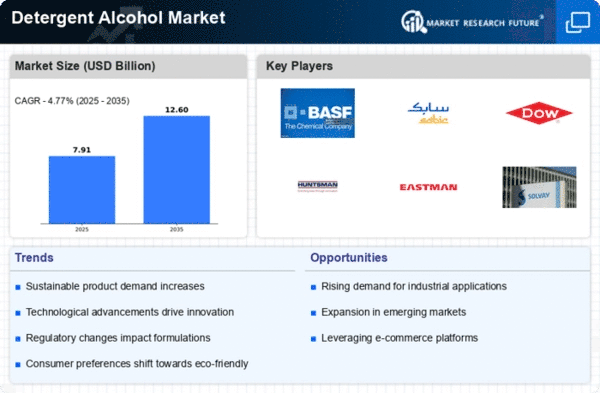
As per MRFR analysis, the Detergent Alcohol Market Size was estimated at 7.55 USD Billion in 2024. The Detergent Alcohol industry is projected to grow from 7.91 USD Billion in 2025 to 12.6 USD Billion by 2035, exhibiting a compound annual growth rate (CAGR) of 4.77 during the forecast period 2025 - 2035.

Key Market Trends & Highlights

The Detergent Alcohol Market is experiencing a shift towards sustainability and innovation, driven by consumer preferences and regulatory frameworks.

  • North America remains the largest market for detergent alcohol, reflecting a strong demand in the household cleaning segment.
  • The Asia-Pacific region is emerging as the fastest-growing market, particularly in the personal care segment.
  • Technological advancements in production processes are enhancing the efficiency and sustainability of detergent alcohol manufacturing.
  • Rising demand for eco-friendly products and increased awareness of hygiene practices are key drivers propelling market growth.

Market Size & Forecast

2024 Market Size 7.55 (USD Billion)
2035 Market Size 12.6 (USD Billion)
CAGR (2025 - 2035) 4.77%
Largest Regional Market Share in 2024 North America

Major Players

<p>BASF SE (DE), SABIC (SA), Dow Inc. (US), Eastman Chemical Company (US), Huntsman Corporation (US), Solvay SA (BE), Mitsubishi Chemical Corporation (JP), Oxiteno S.A. (BR), Kraton Corporation (US)</p>

Market Trends

The Detergent Alcohol Market is currently experiencing a notable transformation, driven by evolving consumer preferences and increasing environmental awareness. As sustainability becomes a focal point for many industries, manufacturers are exploring eco-friendly alternatives to traditional detergent alcohols. This shift is not merely a trend but appears to be a fundamental change in how products are formulated and marketed. The demand for biodegradable and renewable resources is likely to shape the future landscape of this market, as companies strive to align with consumer values and regulatory standards. Moreover, the Detergent Alcohol Market is witnessing advancements in technology that enhance product efficacy and safety. Innovations in production processes and formulations are enabling the development of more effective cleaning agents that are also less harmful to the environment. This dual focus on performance and sustainability suggests a promising trajectory for the market, as stakeholders seek to balance profitability with social responsibility. As the industry adapts to these changes, it seems poised for growth, with potential opportunities emerging in various sectors, including household cleaning, industrial applications, and personal care products.

Sustainability Initiatives

The Detergent Alcohol Market is increasingly influenced by sustainability initiatives. Manufacturers are prioritizing the development of eco-friendly products that minimize environmental impact. This trend reflects a broader commitment to reducing carbon footprints and utilizing renewable resources.

Technological Advancements

Technological advancements are reshaping the Detergent Alcohol Market. Innovations in formulation and production processes are leading to more effective and safer cleaning agents. These developments not only enhance product performance but also align with consumer demands for safer alternatives.

Regulatory Compliance

Regulatory compliance is becoming a critical factor in the Detergent Alcohol Market. Stricter regulations regarding chemical safety and environmental impact are prompting manufacturers to reformulate products. This trend indicates a shift towards greater accountability and transparency in product offerings.

Detergent Alcohol Market Market Drivers

Expansion of End-Use Industries

The Global Detergent Alcohol Market Industry is significantly influenced by the expansion of various end-use sectors, including household cleaning, personal care, and industrial applications. As urbanization continues to rise, the demand for cleaning products is expected to increase, driving the need for detergent alcohols. For instance, the personal care sector is projected to contribute substantially to market growth, as consumers seek effective and safe cleaning solutions. This expansion is anticipated to propel the market value to 18.0 USD Billion by 2035, indicating a robust growth potential driven by diverse applications across multiple industries.

Regulatory Support for Chemical Safety

Regulatory frameworks supporting chemical safety are significantly influencing the Global Detergent Alcohol Market Industry. Governments worldwide are implementing stricter regulations on chemical formulations, pushing manufacturers to adopt safer and more sustainable practices. This regulatory support not only enhances consumer confidence but also encourages innovation within the industry. As companies comply with these regulations, they are likely to develop new formulations that align with safety standards, thereby expanding their market presence. This trend is expected to contribute to the market's growth, with a projected value of 18.0 USD Billion by 2035.

Rising Demand for Eco-Friendly Products

The Global Detergent Alcohol Market Industry is experiencing a notable shift towards eco-friendly and sustainable products. Consumers are increasingly prioritizing environmentally safe cleaning agents, which has led to a surge in demand for biodegradable detergent alcohols. This trend is supported by regulatory frameworks promoting green chemistry and sustainable practices. As a result, manufacturers are innovating to develop products that meet these environmental standards, thereby expanding their market share. The industry's growth trajectory is expected to align with the projected market value of 10.6 USD Billion in 2024, reflecting the increasing consumer preference for sustainable options.

Technological Advancements in Production

Technological advancements in the production of detergent alcohols are playing a crucial role in shaping the Global Detergent Alcohol Market Industry. Innovations in manufacturing processes, such as the development of more efficient catalysts and greener synthesis methods, are enhancing product quality and reducing environmental impact. These advancements not only improve the performance of detergent alcohols but also lower production costs, making them more accessible to consumers. As a result, the market is likely to witness a compound annual growth rate of 4.98% from 2025 to 2035, reflecting the positive impact of technology on industry dynamics.

Increasing Awareness of Hygiene and Sanitation

The Global Detergent Alcohol Market Industry is benefiting from heightened awareness regarding hygiene and sanitation practices. As consumers become more conscious of cleanliness, particularly in residential and commercial spaces, the demand for effective cleaning agents is on the rise. This trend is further amplified by educational campaigns promoting the importance of hygiene, leading to increased sales of detergent alcohols. The market's growth is expected to be robust, with projections indicating a market value of 10.6 USD Billion in 2024, as consumers prioritize products that ensure cleanliness and safety in their environments.

Market Segment Insights

By Application: Household Cleaning (Largest) vs. Personal Care (Fastest-Growing)

<p>The detergent alcohol market is segmented into various applications, with household cleaning holding the largest share. This segment benefits from the increasing trend of cleanliness and hygiene among consumers, especially in the wake of global health crises. On the other hand, personal care is rapidly emerging as a significant segment, fueled by a rise in demand for personal hygiene products and cosmetics that utilize detergent alcohol as a key ingredient. Growth in the detergent alcohol market is driven by several factors, including heightened awareness about cleanliness and hygiene, especially in households and industries. As consumers pivot towards using formulated cleaning products for specific applications, the drive towards versatile, effective solutions is pushing personal care products to the forefront, positioning them as the fastest-growing segment. The ability of detergent alcohol to offer effective cleaning and emulsifying properties further supports this trend.</p>

<p>Household Cleaning: Dominant vs. Automotive Cleaning: Emerging</p>

<p>In the detergent alcohol market, household cleaning stands out as the dominant application, considerably shaped by rising consumer preferences for safer, eco-friendly cleaning alternatives. This segment's growth is attributed to its effectiveness in removing dirt and stains, thus fostering brand loyalty among consumers. Automotive cleaning represents an emerging segment, gaining traction due to the increasing demand for specialized cleaning products for vehicle maintenance. These products often feature formulations that enhance the shine and cleanliness of vehicles while ensuring surface safety. As automotive care culture escalates with more consumers taking DIY approaches to car maintenance, automotive cleaning is set to capture a more substantial market share.</p>

By End Use: Household (Largest) vs. Commercial (Fastest-Growing)

<p>The Detergent Alcohol Market is segmented into four main end-use categories: household, commercial, industrial, and institutional. The household segment holds the largest share, driven by the increasing demand for household cleaning products that utilize detergent alcohols as effective cleaning agents. This segment benefits from the rising awareness of hygiene and cleanliness, particularly in residential settings, where consumers are seeking high-quality cleaning solutions for their everyday needs. On the other hand, the commercial sector is rapidly gaining momentum, as businesses and institutions look for efficient cleaning solutions. This segment includes various applications such as hospitality and food services, contributing to its significance.</p>

<p>Household (Dominant) vs. Commercial (Emerging)</p>

<p>The household segment of the Detergent Alcohol Market is characterized by its broad customer base and dependence on consumer cleaning habits. The increasing disposable income and community hygiene awareness drive growth in this segment. On the other hand, the commercial segment is emerging as a critical player, especially due to the post-pandemic emphasis on hygiene in workplaces and public spaces. Businesses recognize the importance of maintaining cleanliness, thus propelling the demand for effective detergent alcohol products. The commercial segment is gaining traction as more companies invest in quality cleaning supplies, anticipating continued growth in line with evolving consumer expectations for sanitation across various industries.</p>

By Formulation Type: Liquid (Largest) vs. Powder (Fastest-Growing)

<p>In the Detergent Alcohol Market, formulation type plays a crucial role in determining consumer preferences and market share. Currently, liquid detergents dominate the market due to their convenience, ease of use, and versatility in various applications. They hold a considerable share compared to powder and granular forms. On the other hand, powder formulations have been experiencing rapid growth, attributed to their effectiveness in stain removal and suitability for bulk purchases, making them more appealing to cost-conscious consumers.</p>

<p>Liquid (Dominant) vs. Concentrated (Emerging)</p>

<p>Liquid detergent formulations are leading the detergent alcohol market, primarily due to their user-friendly nature and ease of formulation across diverse product lines. They are widely favored in household cleaning and industrial applications, offering excellent performance in grease-cutting and stain removal. Conversely, concentrated formulations are gaining traction as an emerging segment driven by the demand for eco-friendly products and efficient packaging solutions. These products require less material, providing consumers with a cleaner option that is both effective and environmentally sustainable. As awareness around sustainability grows, concentrated detergents are positioned to capture a significant share of the market with their innovative formulations.</p>

By Distribution Channel: Online (Largest) vs. Retail (Fastest-Growing)

<p>In the Detergent Alcohol Market, online distribution channels hold the largest market share, driven by the convenience and accessibility offered to consumers. Retail channels follow closely, capturing a significant portion of the market due to their wide reach and established presence. Wholesale and direct sales contribute to the diverse distribution landscape but currently represent smaller segments in comparison. As consumer preferences evolve, online platforms increasingly dominate market dynamics.</p>

<p>Retail (Dominant) vs. Wholesale (Emerging)</p>

<p>Retail channels remain a dominant force in the Detergent Alcohol Market, characterized by their ability to offer a variety of products to consumers in physical stores, enabling immediate purchase decisions. Desirable brand placement and promotional strategies further strengthen retail presence. In contrast, wholesale channels are emerging as a valuable segment, providing bulk purchasing options for businesses and retailers. The growth within this segment is fueled by increasing demand from eco-friendly product manufacturers who seek efficient distribution channels to reach larger markets. As more consumers gravitate towards certain brands, wholesalers are positioned to supply these brands strategically.</p>

By Consumer Type: Individual Consumers (Largest) vs. Businesses (Fastest-Growing)

<p>In the Detergent Alcohol Market, the Individual Consumers segment holds the largest share, highlighting the widespread usage of detergent alcohol in household cleaning products. This segment considerably outpaces other consumer types due to the growing demand for effective and versatile cleaning solutions among individual households. Meanwhile, the Businesses segment is experiencing rapid growth, driven by the increasing adoption of detergent alcohol for industrial cleaning and maintenance applications across various sectors.</p>

<p>Individual Consumers (Dominant) vs. Businesses (Emerging)</p>

<p>Individual consumers are a dominant segment in the detergent alcohol market, primarily utilizing these products for home cleaning and personal care. This consumer type favors convenience and effectiveness, driving innovations in packaging and product formulation tailored to meet their needs. In contrast, the businesses segment is emerging rapidly, leveraging detergent alcohol for a wide range of applications like cleaning, sanitization, and maintenance. This segment includes motels, hospitals, and manufacturing units, where bulk purchasing and high-efficiency cleaning solutions are essential, indicating a strong trend towards the professional use of detergent alcohol.</p>

Get more detailed insights about Detergent Alcohol Market Research Report Global Forecast - Till 2035

Regional Insights

North America : Market Leader in Detergent Alcohol

North America is poised to maintain its leadership in the detergent alcohol market, holding a significant share of 3.8 in 2024. The region's growth is driven by increasing demand for eco-friendly cleaning products and stringent regulations promoting sustainable practices. The rise in consumer awareness regarding health and environmental impacts further fuels this demand, making it a key market for manufacturers. The United States stands out as the leading country in this region, with major players like Dow Inc., BASF SE, and Eastman Chemical Company driving innovation and competition. The presence of advanced manufacturing facilities and a robust supply chain enhances the market's competitiveness. As companies invest in R&D to develop new formulations, North America is expected to continue its dominance in The Detergent Alcohol.

Europe : Emerging Market with Growth Potential

Europe's detergent alcohol market is characterized by a size of 2.2, reflecting a growing trend towards sustainable and biodegradable products. Regulatory frameworks, such as the EU's REACH regulations, are catalyzing the shift towards safer chemical alternatives, driving demand for detergent alcohols. The increasing focus on environmental sustainability and consumer preferences for green products are key growth drivers in this region. Germany, France, and the UK are leading countries in this market, with companies like Solvay SA and BASF SE playing pivotal roles. The competitive landscape is marked by innovation and collaboration among key players to meet regulatory standards and consumer expectations. As the market evolves, Europe is expected to see significant advancements in product offerings and sustainability initiatives.

Asia-Pacific : Rapidly Growing Detergent Alcohol Sector

The Asia-Pacific region, with a market size of 1.8, is witnessing rapid growth in the detergent alcohol sector. This growth is fueled by rising urbanization, increasing disposable incomes, and a growing awareness of hygiene and cleanliness. Additionally, government initiatives promoting the use of eco-friendly products are acting as catalysts for market expansion, making this region a focal point for manufacturers. Countries like China, Japan, and India are at the forefront of this growth, with key players such as Mitsubishi Chemical Corporation and Oxiteno S.A. establishing a strong presence. The competitive landscape is evolving, with local manufacturers increasingly focusing on innovation and sustainability to capture market share. As demand continues to rise, the Asia-Pacific region is set to become a significant player in The Detergent Alcohol.

Middle East and Africa : Emerging Market with Untapped Potential

The Middle East and Africa (MEA) region, with a market size of 0.75, presents significant growth opportunities in the detergent alcohol market. The increasing demand for cleaning and personal care products, coupled with a growing population, is driving market expansion. Additionally, government initiatives aimed at improving hygiene standards are further propelling the demand for detergent alcohols in this region. Countries like South Africa and the UAE are leading the market, with a focus on developing local manufacturing capabilities. The competitive landscape is characterized by a mix of local and international players, including Kraton Corporation. As the market matures, there is potential for increased investment in R&D and sustainable practices, positioning MEA as a future growth hub in the detergent alcohol sector.

Key Players and Competitive Insights

The Detergent Alcohol Market is currently characterized by a dynamic competitive landscape, driven by increasing demand for eco-friendly and high-performance cleaning agents. Key players are actively engaging in strategic initiatives to enhance their market presence and operational efficiency. For instance, BASF SE (DE) has been focusing on innovation in sustainable product development, which aligns with the growing consumer preference for environmentally friendly solutions. Similarly, Dow Inc. (US) is leveraging its extensive research capabilities to introduce advanced formulations that cater to diverse industrial applications, thereby strengthening its competitive positioning.

In terms of business tactics, companies are increasingly localizing manufacturing to reduce lead times and optimize supply chains. The market structure appears moderately fragmented, with several players vying for market share. However, the collective influence of major companies like SABIC (SA) and Eastman Chemical Company (US) is notable, as they continue to expand their operational footprints through strategic partnerships and acquisitions, thereby reshaping the competitive dynamics.

In November 2025, SABIC (SA) announced a strategic partnership with a leading technology firm to develop bio-based detergent alcohols. This collaboration is expected to enhance SABIC's product portfolio and cater to the rising demand for sustainable alternatives in the market. The strategic importance of this move lies in its potential to position SABIC as a frontrunner in the sustainable segment, appealing to environmentally conscious consumers and businesses alike.

In October 2025, Eastman Chemical Company (US) launched a new line of detergent alcohols derived from renewable resources. This initiative not only underscores Eastman's commitment to sustainability but also reflects a broader industry trend towards greener product offerings. The introduction of these products is likely to attract a new customer base, further solidifying Eastman's market position.

Moreover, in September 2025, Huntsman Corporation (US) expanded its production capacity for detergent alcohols in response to increasing global demand. This expansion is strategically significant as it enables Huntsman to meet the needs of its clients more effectively while enhancing its competitive edge in a rapidly evolving market. The ability to scale production is crucial in maintaining supply chain reliability and meeting customer expectations.

As of December 2025, the Detergent Alcohol Market is witnessing trends such as digitalization and sustainability becoming central to competitive strategies. Companies are increasingly forming strategic alliances to leverage technological advancements and enhance product offerings. The shift from price-based competition to a focus on innovation and supply chain reliability is evident, suggesting that future competitive differentiation will hinge on the ability to deliver high-quality, sustainable products that meet evolving consumer demands.

Key Companies in the Detergent Alcohol Market market include

Industry Developments

September 2021- ASU researchers published research on plastic pollution from detergent pods that discovered the pods not as earth-conscious as some brands boast, increasing environmental concerns and how corporations define environment-friendly. Laundry or dish detergent pods, digitally called forbidden fruits, are wrapped in a water-soluble plastic called polyvinyl alcohol (PVA). Started by an investigation and investment from cleaning solution brand, Blueland, the team of researchers from ASU working with non-profit Plastic Oceans International researched the environmental impacts of PVA from detergent pods.

AS PER THE RESEARCHERS ' STATEMENT, these PVA pods, usually marketed as biodegradable, do not have adequate research to back their environment-friendly claims. Their research focuses on holding advertisers responsible and saying things accurately, Rolsky, the director of science for Plastic Oceans, said.

May 2021- Smol, a laundry detergent DTC startup, has managed to raise USD34million (£24.1m) in a funding round. The business, established in 2018 by Paula Quazi and Nick Green, offers laundry capsules, fabric conditioners, dishwasher tablets, and surface sprays direct to customers' doors through a subscription service. The funding of USD34 million comes as the firm doubles the sales this year.

Intended Audience

    • Detergent alcohol manufacturers
    • Traders and distributors of detergent alcohol
    • Research and development institutes
    • Potential investors
    • Raw material suppliers
    • Nationalized laboratories

Future Outlook

Detergent Alcohol Market Future Outlook

<p>The Detergent Alcohol Market is projected to grow at a 4.77% CAGR from 2024 to 2035, driven by increasing demand for eco-friendly cleaning solutions and industrial applications.</p>

New opportunities lie in:

  • <p>Development of biodegradable detergent alcohol formulations</p>
  • <p>Expansion into emerging markets with tailored product lines</p>
  • <p>Investment in advanced manufacturing technologies for cost efficiency</p>

<p>By 2035, the market is expected to achieve robust growth, positioning itself as a leader in sustainable cleaning solutions.</p>

Market Segmentation

Detergent Alcohol Market End Use Outlook

  • Household
  • Commercial
  • Industrial
  • Institutional

Detergent Alcohol Market Application Outlook

  • Household Cleaning
  • Industrial Cleaning
  • Personal Care
  • Automotive Cleaning

Detergent Alcohol Market Consumer Type Outlook

  • Individual Consumers
  • Businesses
  • Institutions
  • Government

Detergent Alcohol Market Formulation Type Outlook

  • Liquid
  • Powder
  • Granular
  • Concentrated

Detergent Alcohol Market Distribution Channel Outlook

  • Online
  • Retail
  • Wholesale
  • Direct Sales

Report Scope

MARKET SIZE 20247.55(USD Billion)
MARKET SIZE 20257.91(USD Billion)
MARKET SIZE 203512.6(USD Billion)
COMPOUND ANNUAL GROWTH RATE (CAGR)4.77% (2024 - 2035)
REPORT COVERAGERevenue Forecast, Competitive Landscape, Growth Factors, and Trends
BASE YEAR2024
Market Forecast Period2025 - 2035
Historical Data2019 - 2024
Market Forecast UnitsUSD Billion
Key Companies ProfiledBASF SE (DE), SABIC (SA), Dow Inc. (US), Eastman Chemical Company (US), Huntsman Corporation (US), Solvay SA (BE), Mitsubishi Chemical Corporation (JP), Oxiteno S.A. (BR), Kraton Corporation (US)
Segments CoveredApplication, End Use, Formulation Type, Distribution Channel, Consumer Type
Key Market OpportunitiesGrowing demand for eco-friendly formulations drives innovation in the Detergent Alcohol Market.
Key Market DynamicsRising demand for eco-friendly cleaning agents drives innovation in detergent alcohol formulations and production processes.
Countries CoveredNorth America, Europe, APAC, South America, MEA

FAQs

At what CAGR the detergent alcohol market is projected to grow during the forecast period?

The detergent alcohol market is projected to grow at a 6.30% CAGR between 2025-2035.

What will be the value of the detergent alcohol market during the forecast period?

The detergent alcohol market is predicted to touch USD 15 billion by 2035.

Which region is expected to have a major share in the detergent alcohol market?

The APAC region is expected to have a major share in the detergent alcohol market.

Which factors may limit the detergent alcohol market growth?

Fluctuations in raw material prices may limit market growth.

What are the key factors driving the growth of the detergent alcohol market?

Growing cosmetics &amp; personal care industry and preference for liquid table detergents are boosting market growth.

  1. Executive Summary
  2. Scope of the Report
    1. Market Definition
    2. Scope of the
      1. Research Objectives
      2. Assumptions & Limitations
    3. Study
    4. Market Structure
  3. Market
    1. Research Methodology
    2. Research Process
    3. Secondary Research
    4. Primary Research
    5. Forecast Model
  4. Market Landscape
    1. Five Forces Analysis
    2. of New Entrants
    3. of Buyers
    4. Segment Rivalry
    5. Chain of Global Detergent Alcohol Market
  5. Threat
  6. Bargaining Power
  7. Bargaining Power of Suppliers
  8. Threat of Substitutes
    1. Value Chain/Supply
  9. Industry Overview
    1. of the Global Detergent Alcohol Market
    2. Introduction
    3. Growth Drivers
    4. Impact Analysis
    5. Market Challenges
  10. Market Trends
    1. Introduction
    2. Growth Trends
    3. Impact Analysis
  11. Global Detergent Alcohol Market, by Source
    1. Introduction
    2. Natural
      1. Market Estimates & Forecast, 2020–2027
      2. Market Estimates & Forecast by Region, 2020–2027
      3. Market Estimates & Forecast, 2020–2027
    3. Synthetic
    4. Market Estimates & Forecast by Region, 2020–2027
  12. Global
  13. Detergent Alcohol Market, by Application
    1. Introduction
    2. Domestic & Industrial Cleaning
      1. Market Estimates
      2. Market Estimates & Forecast by Region,
    3. & Forecast, 2020–2027
    4. Cosmetics & Personal Care
      1. Market Estimates &
    5. Market Estimates & Forecast, 2020–2027
    6. Forecast by Region, 2020–2027
    7. Pharmaceutical
      1. Market Estimates & Forecast, 2020–2027
      2. Market Estimates
    8. & Forecast by Region, 2020–2027
    9. Wastewater
      1. Market Estimates & Forecast, 2020–2027
      2. Market Estimates & Forecast, 2020–2027
      3. Market Estimates & Forecast by Region, 2020–2027
      4. Market Estimates & Forecast, 2020–2027
      5. Market Estimates & Forecast by Region, 2020–2027
    10. Treatment
    11. Market Estimates & Forecast by Region, 2020–2027
    12. Plasticizer
    13. Others
  14. Global Detergent Alcohol Market, by Region
    1. Introduction
    2. North America
      1. Market Estimates & Forecast,
      2. Market Estimates & Forecast, by Source, 2020–2027
      3. Market Estimates & Forecast, by Application, 2020–2027
    3. US
  15. Market Estimates & Forecast, by Source, 2020–2027
    1. Estimates & Forecast, by Application, 2020–2027
    2. Canada
  16. Market
  17. Market Estimates & Forecast, 2020–2027
  18. Market Estimates & Forecast, by Source, 2020–2027
    1. Estimates & Forecast, by Application, 2020–2027
    2. & Forecast, by Source, 2020–2027
    3. by Application, 2020–2027
    4. Market Estimates & Forecast, 2020–2027
    5. Forecast, by Source, 2020–2027
    6. by Application, 2020–2027
    7. Market Estimates & Forecast, 2020–2027
    8. Forecast, by Source, 2020–2027
    9. by Application, 2020–2027
    10. Market Estimates & Forecast, 2020–2027
    11. Forecast, by Source, 2020–2027
    12. by Application, 2020–2027
    13. Market Estimates & Forecast, 2020–2027
    14. Forecast, by Source, 2020–2027
    15. by Application, 2020–2027
    16. Estimates & Forecast, 2020–2027
    17. by Source, 2020–2027
    18. & Forecast, 2020–2027
    19. Source, 2020–2027
    20. & Forecast, 2020–2027
    21. Source, 2020–2027
    22. Estimates & Forecast, 2020–2027
    23. by Source, 2020–2027
    24. Estimates & Forecast, 2020–2027
    25. by Source, 2020–2027
    26. & Forecast, 2020–2027
    27. Source, 2020–2027
    28. & Forecast, 2020–2027
    29. Source, 2020–2027
    30. & Forecast, 2020–2027
    31. Source, 2020–2027
    32. Market Estimates & Forecast, 2020–2027
    33. Forecast, by Source, 2020–2027
    34. by Application, 2020–2027
    35. Market Estimates & Forecast, 2020–2027
    36. Forecast, by Source, 2020–2027
    37. by Application, 2020–2027
    38. Market Estimates & Forecast, 2020–2027
    39. Forecast, by Source, 2020–2027
    40. by Application, 2020–2027
    41. Market Estimates & Forecast, 2020–2027
    42. & Forecast, by Source, 2020–2027
    43. Forecast, by Application, 2020–2027
    44. Asia-Pacific
  19. Market
    1. Europe
      1. Market Estimates & Forecast, 2020–2027
      2. Market Estimates
      3. Market Estimates & Forecast,
      4. Germany
      5. France
      6. Italy
      7. Spain
      8. UK
      9. Russia
      10. Poland
      11. Rest of Europe
    2. Asia-Pacific
      1. Market
      2. Market Estimates & Forecast,
      3. Market Estimates & Forecast, by Application,
      4. China
      5. India
      6. Japan
      7. Australia & New Zealand
      8. Indonesia
      9. Thailand
      10. Malaysia
      11. Rest of
  20. Market Estimates & Forecast, by Source, 2020–2027
    1. Estimates & Forecast, by Application, 2020–2027
    2. East & Africa
    3. Estimates & Forecast, by Application, 2020–2027
    4. Market Estimates & Forecast, 2020–2027
    5. Forecast, by Source, 2020–2027
    6. by Application, 2020–2027
    7. & Forecast, 2020–2027
    8. Source, 2020–2027
    9. Forecast, 2020–2027
  21. Market
    1. Middle
      1. Market Estimates & Forecast, 2020–2027
      2. Market Estimates & Forecast, by Source, 2020–2027
      3. Market
      4. Turkey
      5. Israel
      6. North Africa
      7. GCC
  22. Market Estimates & Forecast, by Source, 2020–2027
    1. Estimates & Forecast, by Application, 2020–2027
    2. Middle East & Africa
  23. Market
  24. Rest of the
  25. Market Estimates & Forecast, 2020–2027
  26. Market Estimates & Forecast, by Source, 2020–2027
  27. Market Estimates & Forecast, by Application, 2020–2027
    1. Latin America
    2. Estimates & Forecast, by Application, 2020–2027
    3. & Forecast, by Source, 2020–2027
    4. by Application, 2020–2027
    5. & Forecast, 2020–2027
    6. Source, 2020–2027
    7. Rest of Latin America
  28. Market Estimates & Forecast, 2020–2027
  29. Market Estimates & Forecast, by Source, 2020–2027
  30. Market
  31. Brazil
  32. Market Estimates & Forecast, 2020–2027
  33. Market Estimates
  34. Market Estimates & Forecast,
  35. Argentina
  36. Market Estimates
  37. Market Estimates & Forecast, by
  38. Market Estimates & Forecast, by Application,
  39. Mexico
  40. Market Estimates & Forecast,
  41. Market Estimates & Forecast, by Source, 2020–2027
  42. Market Estimates & Forecast, by Application, 2020–2027
  43. Market Estimates & Forecast, 2020–2027
  44. Market Estimates & Forecast, by Source, 2020–2027
  45. Market Estimates & Forecast, by Application, 2020–2027
    1. Company Landscape
  46. Company Profiles
    1. SABIC
      1. Company Overview
      2. Source/Business Segment Overview
      3. Key Developments
      4. Company Overview
      5. Financial Updates
      6. Key Developments
    2. Financial Updates
    3. Kao Corporation
    4. Source/Business Segment Overview
    5. SASOL
      1. Company Overview
      2. Source/Business
      3. Financial Updates
    6. Segment Overview
    7. Key Developments
    8. Musim Mas Holdings
      1. Source/Business Segment Overview
      2. Financial Updates
      3. Key Developments
    9. Company Overview
    10. Univar Inc.
      1. Company Overview
      2. Source/Business Segment Overview
      3. Key Developments
      4. Company Overview
      5. Financial Updates
      6. Key Developments
    11. Financial Updates
    12. Ecogreen Oleochemicals
    13. Source/Business Segment Overview
    14. Emery Oleochemicals
      1. Company Overview
      2. Source/Business
      3. Financial Updates
    15. Segment Overview
    16. Key Developments
    17. Royal Dutch Shell PLC
      1. Source/Business Segment Overview
      2. Financial Updates
      3. Key Developments
    18. Company Overview
    19. BASF SE
      1. Source/Business Segment Overview
      2. Financial Updates
    20. Company Overview
    21. Key Developments
    22. KLK Oleo
      1. Company
      2. Source/Business Segment Overview
      3. Key Developments
      4. Company Overview
      5. Financial
      6. Key Developments
    23. Overview
    24. Financial Updates
    25. Procter & Gamble
    26. Source/Business Segment Overview
    27. Updates
    28. Godrej
      1. Company Overview
      2. Financial
      3. Key Developments
    29. Industries Ltd
    30. Source/Business Segment Overview
    31. Updates
    32. Wilmar
      1. Company Overview
      2. Financial
      3. Key Developments
    33. International Ltd
    34. Source/Business Segment Overview
    35. Updates
  47. Conclusion
  48. LIST OF TABLES
  49. World Population in
    1. Major Regions (2020–2027)
  50. Global Detergent
  51. Alcohol Market, by Region, 2020–2027
  52. North
  53. America: Detergent Alcohol Market, by Country, 2020–2027
    1. Table 4
  54. Europe: Detergent Alcohol Market, by Country, 2020–2027
    1. Table 5
  55. Asia-Pacific: Detergent Alcohol Market, by Country, 2020–2027
    1. Table
  56. Middle East & Africa: Detergent Alcohol Market, by Country,
  57. Latin America: Detergent Alcohol
  58. Market, by Country, 2020–2027
  59. Global Detergent
  60. Alcohol Source Market, by Region, 2020–2027
  61. North
  62. America: Detergent Alcohol Source Market, by Country, 2020–2027
    1. Table
  63. Europe: Detergent Alcohol Source Market, by Country, 2020–2027
  64. Table11 Asia-Pacific: Detergent Alcohol Source Market, by Country,
    1. Table13 Middle East & Africa: Detergent
  65. Alcohol Source Market, by Country, 2020–2027
    1. Table12 Latin
  66. America: Detergent Alcohol Source Market, by Country, 2020–2027
    1. Table14
  67. North America: Detergent Alcohol Application Market, by Country, 2020–2027
  68. Table13 Europe: Detergent Alcohol Application Market, by Country,
    1. Table14 Asia-Pacific: Detergent Alcohol Application
  69. Market, by Country, 2020–2027
    1. Table16 Middle East &
  70. Africa: Detergent Alcohol Application Market, by Country, 2020–2027
    1. Table15
  71. Latin America: Detergent Alcohol Application Market, by Country, 2020–2027
  72. Table23 Global Source Market, by Region, 2020–2027
  73. Table24 Global Application Market, by Region, 2020–2027
  74. Table25 North America: Detergent Alcohol Market, by Country,
    1. Table26 North America: Detergent Alcohol
  75. Market, by Source, 2020–2027
    1. Table27 North America:
  76. Detergent Alcohol Market, by Application, 2020–2027
    1. Table28
  77. Europe: Detergent Alcohol Market, by Country, 2020–2027
    1. Table29
  78. Europe: Detergent Alcohol Market, by Source, 2020–2027
  79. Table30 Europe: Detergent Alcohol Market, by Application, 2020–2027
    1. Table31 Asia-Pacific: Detergent Alcohol Market, by
    2. Country, 2020–2027
    3. Table32 Asia-Pacific: Detergent
  80. Alcohol Market, by Source, 2020–2027
    1. Table33
  81. Asia-Pacific: Detergent Alcohol Market, by Application, 2020–2027
    1. Table36 Middle East & Africa: Detergent Alcohol Market,
    2. by Country, 2020–2027
    3. Table37 Middle East &
  82. Africa Detergent Alcohol Market, by Source, 2020–2027
    1. Table33
  83. Middle East & Africa: Detergent Alcohol Market, by Application, 2020–2027
    1. Table34 Latin America: Detergent Alcohol Market,
    2. by Country, 2020–2027
    3. Table35 Latin America
  84. Detergent Alcohol Market, by Source, 2020–2027
    1. Table33
  85. Latin America: Detergent Alcohol Market, by Application, 2020–2027
  86. LIST OF FIGURES
  87. Global Detergent Alcohol Market Segmentation
  88. Forecast Methodology
  89. Five Forces Analysis of
    1. Global Detergent Alcohol Market
  90. Value Chain of Global Detergent
    1. Alcohol Market
  91. Share of Global Detergent Alcohol Market in
  92. Global Detergent Alcohol Market, 2020–2027,
  93. Sub-Segments of Source, 2020
  94. Global Detergent
  95. Alcohol Market Size, by Source, 2020
  96. Share of Global Detergent
  97. Alcohol Market, by Source, 2020–2027
  98. Sub-Segments of
    1. Application
  99. Global Detergent Alcohol Market Size, by Application,
  100. Share of Global Detergent Alcohol Market, by Application,

Detergent Alcohol Market Segmentation

Market Segmentation Overview

  • Detailed segmentation data will be available in the full report
  • Comprehensive analysis by multiple parameters
  • Regional and country-level breakdowns
  • Market size forecasts by segment
Infographic

Free Sample Request

Kindly complete the form below to receive a free sample of this Report

Get Free Sample

Customer Strories

Compare Licence

×
Features License Type
Single User Multiuser License Enterprise User
Price $4,950 $5,950 $7,250
Maximum User Access Limit 1 User Upto 10 Users Unrestricted Access Throughout the Organization
Free Customization
Direct Access to Analyst
Deliverable Format
Platform Access
Discount on Next Purchase 10% 15% 15%
Printable Versions