Request Free Sample ×

Kindly complete the form below to receive a free sample of this Report

* Please use a valid business email

Leading companies partner with us for data-driven Insights

clients tt-cursor
Hero Background
English
Chinese
French
Japanese
Korean
German
Spanish

Dental Equipment Market Analysis

ID: MRFR/HC/6753-HCR
90 Pages
Nidhi Mandole
April 2026

Dental Equipment Market Research Report: Size, Share, Trend Analysis By Equipment Type (Dental Radiology Equipment, Dental Chairs, Handpieces, Dental Lasers, Sterilization Equipment), By Applications (Orthodontics, Endodontics, Periodontics, Cosmetic Dentistry), By End Users (Dental Clinics, Hospitals, Dental Laboratories, Research Institutions), By Distribution Channel (Direct Sales, Online Sales, Distributors) and By Regional (North America, Europe, South America, Asia Pacific, Middle East and Africa) - Growth Outlook & Industry Forecast 2025 To 2035

Share:
Download PDF ×

We do not share your information with anyone. However, we may send you emails based on your report interest from time to time. You may contact us at any time to opt-out.

Dental Equipment Market Infographic
Purchase Options

Market Analysis

In-depth Analysis of Dental Equipment Market Industry Landscape

The dental equipment market encompasses a wide range of tools and devices used by dental professionals to diagnose, treat, and prevent oral health issues. This market plays a vital role in supporting dental practices and ensuring quality patient care. The global dental equipment market has experienced steady growth in recent years, fueled by factors such as increasing oral health awareness, rising demand for cosmetic dentistry, and technological advancements in dental technology. Projections indicate continued growth due to an aging population and expanding access to dental care. Advances in dental technology have transformed the industry, with innovations such as digital imaging systems, CAD/CAM systems, and laser dentistry revolutionizing dental procedures. These technologies enhance diagnostic accuracy, treatment efficiency, and patient comfort, driving market growth.

Patient expectations for high-quality dental care have risen, leading to increased demand for advanced dental equipment and procedures. This demand influences market dynamics by prompting dental practices to invest in modern equipment to meet patient needs and remain competitive. The dental equipment market is subject to stringent regulatory requirements aimed at ensuring product safety, efficacy, and quality. Compliance with regulations such as the FDA's approval process in the United States and CE marking in Europe impacts market dynamics by influencing product development, marketing strategies, and market access.

Emerging economies present significant growth opportunities for the dental equipment market due to rising disposable incomes, expanding healthcare infrastructure, and increasing awareness of oral health. Companies are increasingly targeting these markets through strategic partnerships, distribution agreements, and market expansion initiatives. The dental equipment market is characterized by consolidation, with mergers, acquisitions, and strategic alliances reshaping the competitive landscape. Larger companies seek to expand their product portfolios, geographic reach, and market presence through strategic collaborations, influencing market dynamics and competitive intensity.

Cost containment pressures in healthcare systems worldwide impact dental equipment purchasing decisions, with dental practices seeking cost-effective solutions without compromising quality. This trend drives market dynamics by fostering demand for innovative, value-based products and solutions. The rise of dental tourism, wherein patients travel abroad for dental procedures due to cost savings or access to advanced treatments, influences market dynamics by creating demand for dental equipment in popular dental tourism destinations. Dental practices in these regions invest in modern equipment to attract international patients and compete in the global market.

The growing preference for minimally invasive dental procedures, driven by patient demand for faster recovery times and reduced discomfort, impacts market dynamics by driving demand for specialized equipment such as dental lasers, ultrasonic scalers, and digital impression systems. Educational initiatives aimed at training dental professionals on the use of advanced equipment and techniques play a crucial role in shaping market dynamics. Continuing education programs, conferences, and workshops contribute to market growth by promoting the adoption of innovative dental technologies. Increasing awareness of environmental sustainability influences market dynamics by driving demand for eco-friendly dental equipment and materials. Dental practices are adopting environmentally responsible practices and products, leading to the development of sustainable dental equipment solutions.

Author
Author Profile
Nidhi Mandole
Senior Research Analyst

She is an extremely curious individual currently working in Healthcare and Medical Devices Domain. Nidhi is comfortably versed in data centric research backed by healthcare educational background. She leverages extensive data mining and analytics tools such as Primary and Secondary Research, Statistical Analysis, Machine Learning, Data Modelling. Her key role also involves Technical Sales Support, Client Interaction and Project management within the Healthcare team. Lastly, she showcases extensive affinity towards learning new skills and remain fascinated in implementing them.

Leave a Comment

FAQs

What is the current valuation of the dental equipment market as of 2024?

<p>The dental equipment market was valued at 9.5 USD Billion in 2024.</p>

What is the projected market valuation for the dental equipment sector in 2035?

<p>The dental equipment market is projected to reach 14.8 USD Billion by 2035.</p>

What is the expected CAGR for the dental equipment market during the forecast period 2025 - 2035?

<p>The expected CAGR for the dental equipment market during the forecast period 2025 - 2035 is 4.11%.</p>

Which segments are included in the dental equipment market by application?

<p>The dental equipment market includes segments such as Orthodontics, Endodontics, Periodontics, Oral Surgery, and Prosthodontics.</p>

What was the market size for orthodontics in 2024, and what is it projected to be in 2035?

<p>The orthodontics segment was valued at 1.5 USD Billion in 2024 and is projected to reach 2.3 USD Billion by 2035.</p>

How does the dental chairs segment perform in terms of market valuation?

<p>The dental chairs segment was valued at 2.5 USD Billion in 2024 and is expected to grow to 3.8 USD Billion by 2035.</p>

What are the key players in the dental equipment market?

<p>Key players in the dental equipment market include Dentsply Sirona, Align Technology, Henry Schein, Danaher Corporation, and 3M.</p>

What is the projected growth for dental laboratories in the dental equipment market?

<p>The dental laboratories segment was valued at 1.5 USD Billion in 2024 and is projected to grow to 2.3 USD Billion by 2035.</p>

What equipment types are included in the dental equipment market?

<p>The dental equipment market includes types such as Dental Chairs, X-ray Equipment, Sterilization Equipment, Dental Lasers, and Handpieces.</p>

What is the expected market size for dental clinics by 2035?

<p>The dental clinics segment was valued at 3.8 USD Billion in 2024 and is expected to reach 5.9 USD Billion by 2035.</p>

Market Summary

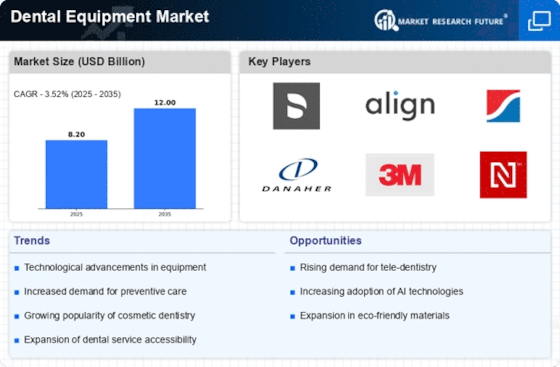
According to MRFR analysis, the Dental Equipment Market Size was valued at USD 8.2 Billion in 2024. The market is projected to grow from USD 8.489 Billion in 2025 to USD 12.0 Billion by 2035, registering a CAGR of 3.52% during the forecast 2025–2035. North America led the market with over 40.24% share, generating around USD 3.30 billion in revenue.    
Growth in the dental equipment market is driven by increasing prevalence of dental disorders, rising demand for cosmetic dentistry, and growing awareness of oral health. Key trends include digital dentistry solutions, CAD/CAM systems, 3D imaging technologies, and minimally invasive dental procedures, improving diagnostic accuracy, treatment efficiency, and patient outcomes across dental care settings.

Key Market Trends & Highlights

The Dental Equipment Market is experiencing robust growth driven by technological advancements and increasing consumer awareness.

  • Technological advancements are revolutionizing dental equipment, enhancing efficiency and patient outcomes. The demand for cosmetic dentistry is surging, particularly in North America, as consumers seek aesthetic improvements. Preventive care is gaining traction, with dental professionals emphasizing regular check-ups and early intervention. Key market drivers include technological advancements in dental equipment and the rising awareness of oral health among the geriatric population.

Market Size & Forecast

2024 Market Size 8.2 (USD Billion)
2035 Market Size 12.0 (USD Billion)
CAGR (2025 - 2035) 3.52%
Largest Regional Market Share in 2024 North America

Major Players

Companies such as <a href="https://www.dentsplysirona.com/en-us/shop">Dentsply Sirona </a>(US), Align Technology (US), Henry Schein (US), Danaher Corporation (US), 3M (US), Nobel Biocare (CH), Straumann (CH), KaVo Kerr (DE), Planmeca (FI) are some of the major participants in the Global dental equipment market.

Market Trends

The Dental Equipment Market is currently experiencing a dynamic evolution, driven by advancements in technology and increasing consumer awareness regarding oral health within the dental market.. Innovations in dental machines, dental tools and dental medical instruments  are enhancing the efficiency and effectiveness of dental procedures, thereby improving patient outcomes. Moreover, the rising prevalence of dental disorders and the growing demand for cosmetic dentistry are propelling the market forward.

As dental practices increasingly collaborate with manufacturers of dental equipment and adopt more sophisticated equipment, the overall quality of care is likely to improve, fostering a more competitive landscape among providers The availability of dental supplies for the public is also expanding access to basic oral care solutions.. In addition, the integration of digital technologies, such as CAD/CAM systems and 3D printing, is reshaping the Dental Equipment Market. These technologies not only streamline workflows but also enable personalized treatment options for patients. Furthermore, the emphasis on preventive care and regular dental check-ups is encouraging patients to seek dental services more frequently. This trend suggests a robust future for the market, as both practitioners and patients increasingly recognize the value of advanced dental equipment in achieving optimal oral health.

Technological Advancements

The Dental Equipment Market is witnessing rapid technological advancements that enhance the precision and efficiency of dental procedures. Innovations such as digital imaging, laser dentistry, and robotic-assisted surgeries are becoming more prevalent, allowing practitioners to deliver superior care. These advancements not only improve treatment outcomes but also reduce patient discomfort, thereby increasing patient satisfaction.

Growing Demand for Cosmetic Dentistry

There is a noticeable increase in the demand for cosmetic dentistry services, which is significantly influencing the Dental Equipment Market. Patients are increasingly seeking aesthetic enhancements, such as teeth whitening and orthodontic treatments. This trend is prompting dental professionals to invest in advanced equipment that caters to these cosmetic procedures, thereby expanding their service offerings.

Focus on Preventive Care

The emphasis on preventive care is reshaping the Dental Equipment Market, as more individuals prioritize regular dental check-ups and maintenance. This shift is leading to an increased demand for diagnostic tools and preventive equipment, such as digital radiography and intraoral cameras. As awareness of oral health continues to grow, dental practices are likely to adapt by incorporating more preventive solutions into their services.

Dental Equipment Market Market Drivers

Growth of Dental Tourism

The rise of dental tourism is emerging as a noteworthy factor in the Dental Equipment Market. Patients are increasingly seeking dental care abroad due to lower costs and access to advanced technologies. Countries known for dental tourism are investing in state-of-the-art dental equipment to attract international patients, thereby enhancing their service offerings.
 
This trend is likely to drive the demand for high-quality dental equipment as practices aim to provide competitive services. Market analysis indicates that dental tourism could contribute to a 5% increase in the demand for dental equipment in the coming years, as practices strive to meet the expectations of a diverse patient base.

Rising Geriatric Population

The growing geriatric population is a critical driver for the Dental Equipment Market. As the global population ages, the prevalence of dental issues such as periodontal disease and tooth loss increases, necessitating advanced dental care solutions.
 
By 2030, it is estimated that the number of individuals aged 65 and older will surpass 1 billion, creating a substantial demand for dental services and, consequently, dental equipment. This demographic shift is prompting dental practices to upgrade their equipment to cater to the specific needs of older patients, who often require more complex treatments. The market for dental equipment tailored for geriatric care is projected to expand significantly, reflecting the urgent need for innovative solutions.

Government Initiatives and Funding

Government initiatives and funding play a pivotal role in shaping the Dental Equipment Market. Many governments are recognizing the importance of oral health and are implementing policies to improve dental care access. Funding for dental clinics, especially in underserved areas, is likely to increase the demand for modern dental equipment.
 
Programs aimed at enhancing preventive care and education are also contributing to this growth. Recent statistics indicate that government spending on dental health initiatives is projected to rise by 4% annually, which could lead to a corresponding increase in the procurement of advanced dental equipment. This support is essential for ensuring that dental practices can provide high-quality care to their communities.

Increasing Awareness of Oral Health

The rising awareness of oral health is significantly influencing the Dental Equipment Market. As individuals become more informed about the importance of dental hygiene and regular check-ups, the demand for advanced dental equipment is likely to increase.
 
Educational campaigns and initiatives by health organizations have contributed to a cultural shift towards preventive care, which in turn boosts the need for high-quality dental tools and technologies. Market data suggests that the preventive dental care segment is expected to grow at a rate of 6% annually, indicating a robust demand for equipment that supports these practices. This trend underscores the necessity for dental professionals to invest in state-of-the-art equipment to meet patient expectations.

Technological Advancements in Dental Equipment

The Dental Equipment Market is experiencing a notable transformation due to rapid technological advancements. Innovations such as digital imaging, CAD/CAM systems, and laser dentistry are enhancing diagnostic accuracy and treatment efficiency. For instance, the integration of 3D printing technology is revolutionizing the production of dental prosthetics, allowing for customized solutions that improve patient outcomes.
 
According to recent data, the market for dental imaging equipment alone is projected to reach approximately 3 billion USD by 2026, reflecting a compound annual growth rate of around 7%. These advancements not only streamline dental procedures but also reduce patient discomfort, thereby driving the demand for modern dental equipment.

Market Segment Insights

By Application: Orthodontics (Largest) vs. Endodontics (Fastest-Growing)

<p>The dental equipment market segmented by application showcases significant diversity, with orthodontics holding the largest share. This segment is driven by the rising prevalence of malocclusion and a growing awareness of dental aesthetics. Following closely is the endodontics segment, which focuses on root canal procedures, displaying strong growth due to an increase in the number of dental procedures performed globally. The proportional representation across segments highlights the sustained demand for orthodontic solutions while signifying the emergent potential of endodontics as dental health awareness rises. Growth trends within the dental applications are shaped by technological advancements and an increasing number of dental professionals specializing in specific fields. Notably, the growing adoption of minimally invasive techniques is fueling the rapid expansion of endodontics. Additionally, the rise in dental tourism and a shift towards preventive care practices are expected to bolster the growth trajectory across all segments. These trends reflect an evolving landscape in the dental equipment market, driven by both innovation and changing consumer preferences.</p>

<p>Orthodontics (Dominant) vs. Prosthodontics (Emerging)</p>

<p>In the dental equipment market, orthodontics stands out as the dominant segment due to its established market presence and extensive patient base. It encompasses a wide range of products including braces, aligners, and other orthodontic appliances designed to align teeth and jaws properly. The growth of orthodontics is supported by a robust demand for aesthetic treatment options, particularly among adolescents and adults seeking cosmetic improvements. In contrast, prosthodontics, focusing on restoring and replacing teeth, is classified as an emerging segment. It includes dental implants, crowns, and dentures that cater to a growing geriatric population and those with dental issues. The emergence of advanced materials and digital technologies in prosthodontics is enhancing its appeal and accessibility, positioning it for significant growth in the coming years.</p>

By Equipment Type: Dental Chairs (Largest) vs. Dental Lasers (Fastest-Growing)

<p>The dental equipment market showcases a diverse landscape of equipment types, where Dental Chairs hold the largest share, driven by their essential role in dental treatments. X-ray Equipment and Handpieces also command significant portions of the market, reflecting their importance in diagnostic and operational procedures respectively. Sterilization Equipment is crucial for ensuring patient safety and is increasingly recognized in practice settings. The segmentation illustrates a well-distributed market, emphasizing the multifunctional capabilities of these essential tools.</p>

<p>Dental Chairs (Dominant) vs. Dental Lasers (Emerging)</p>

<p>Dental Chairs, as the dominant segment, are fundamental in any dental practice, designed for functionality, patient comfort, and technological integration. They support a variety of procedures, creating a significant demand in both private and public dental sectors. On the other hand, Dental Lasers represent an emerging shift in treatment methodologies. Known for their precision and minimal invasiveness, they are rapidly gaining traction, especially for procedures like soft tissue surgeries and teeth whitening. The increasing focus on patient comfort and reduced recovery times is catalyzing the growth of dental lasers, establishing them as a cornerstone of modern dental procedures.</p>

By End User: Dental Clinics (Largest) vs. Hospitals (Fastest-Growing)

In the Dental Equipment Market, the end user segment is primarily dominated by dental clinics, which account for the largest market share. Dental clinics are crucial as they cater directly to patients, utilizing various dental equipment to provide comprehensive care. On the other hand, hospitals constitute a significant portion of this market, particularly as they expand their dental departments and integrated care. The combined contribution of <a title="dental laboratories" href="https://www.marketresearchfuture.com/reports/dental-laboratories-market-9282" target="_blank" rel="noopener">dental laboratories</a> and research institutions to this sector, while notable, is comparatively smaller, highlighting the prominence of clinics and hospitals in driving market dynamics. The growth trends in this segment are propelled by increasing oral health awareness and the rising demand for cosmetic dentistry. Dental clinics are evolving into multi-specialty practices, offering a broader range of services, enhancing their market stature. Hospitals are increasingly investing in advanced dental technologies and practices, establishing them as the fastest-growing segment. The expansion of dental laboratories also contributes to this growth through better accessibility and service integration, while research institutions fuel innovation, creating a synergistic relationship among all end user categories.

Dental Clinics (Dominant) vs. Research Institutions (Emerging)

Dental clinics remain the dominant force in the Dental Equipment Market due to their direct engagement with patients and a wide range of dental services provided. These clinics are equipped with advanced tools and technology, catering to preventive care, diagnostics, and various treatments. The clinics are often the first point of contact for patients seeking dental care, thus generating substantial demand for dental equipment. Conversely, research institutions are emerging as pivotal players, focusing on innovation and development in dental technologies. These institutions often collaborate with dental manufacturers to refine existing technologies and introduce groundbreaking solutions, thereby playing a significant role in shaping future market trends. Their research not only impacts the efficacy of dental procedures but also addresses evolving consumer needs, making them a vital component of the market landscape.

By Distribution Channel: Direct Sales (Largest) vs. Online Sales (Fastest-Growing)

In the dental equipment market, distribution channels are diverse, with each segment playing a crucial role in reaching dental professionals. Direct sales hold the largest market share, allowing manufacturers to maintain close relationships with their customers and provide tailored solutions. This method ensures quality control and direct feedback, but is limited by geographic reach. On the other hand, online sales have emerged as a significant channel, driven by the increasing adoption of digital technologies and ecommerce platforms, appealing particularly to newer dental practices and small clinics seeking convenience and cost-effectiveness. Growth trends in the dental equipment market are heavily influenced by advancements in technology and changing purchasing behaviors among dental practitioners. Online sales, in particular, are witnessing rapid growth due to the enhanced accessibility and range of products catered to various dental needs. The ongoing investment in digital marketing and user-friendly ecommerce platforms further propels this trend, making online sales the fastest-growing distribution channel. This shift towards digital solutions reflects broader consumer behavior, where convenience and efficiency are paramount in purchasing decisions.

Direct Sales (Dominant) vs. Online Sales (Emerging)

Direct sales continue to dominate the dental equipment market, characterized by strong manufacturer-customer relationships that facilitate personalized service and product education. This approach allows manufacturers to directly influence the purchasing decisions of dental clinics and professionals, assuring a clear understanding of customer needs. In contrast, online sales are emerging as a vital segment, appealing particularly to smaller practices that prefer the flexibility and variety that ecommerce offers. The convenience of online purchasing is becoming increasingly attractive, with dental practitioners able to compare products, read reviews, and make informed decisions without the constraints of traditional purchasing methods. As the market evolves, the balance between these two channels will likely shift, highlighting the need for manufacturers to adapt their strategies accordingly.

Get more detailed insights about Dental Equipment Market Research Report - Forecast till 2035

Regional Insights

The Dental Equipment Market showcases a diverse regional landscape, with significant variations in market valuation and growth potential across major regions. North America accounted for the largest share of the global Dental Equipment Market size, reaching USD 3.3 billion in 2024, projected to grow to 5.2 USD billion by 2035, reflecting the region's strong healthcare infrastructure and high spending on dental care, which dominates the global market.

Europe follows with a current valuation of 2.6 USD Billion in 2024, anticipated to reach 3.7 USD Billion in 2035, benefiting from advanced technology adoption and increasing demand for cosmetic dentistry services. South America displays a modest valuation of 0.7 USD Billion in 2024, expected to rise to 1.0 USD billion by 2035, with emerging markets gradually embracing dental advancements. including the UK dental lasers market.

The Asia Pacific region holds a 1.6 USD billion valuation in 2024 and is projected to grow to 2.4 USD billion by 2035, driven by rapid urbanization, increasing disposable income, expanding dental suppliers in India, and strong momentum in the China dental lasers market, supported by rising awareness of oral health. Lastly, the Middle East and Africa have an estimated valuation of 0.7 USD Billion in 2024, reaching 0.9 USD Billion in 2035, with growing investments in healthcare infrastructure contributing to market expansion. Understanding these regional dynamics is crucial for stakeholders, as they highlight varying growth drivers and opportunities in the Dental Equipment Market landscape.

Key Players and Competitive Insights

The Dental Equipment Market is characterized by a dynamic and competitive landscape, driven by rapid technological advancements and increasing demand for dental care services worldwide. The market comprises a wide array of products, including dental chairs, imaging systems, handpieces, and dental instruments, which cater to both cosmetic and restorative dentistry practices. As dental professionals seek to enhance patient care and streamline operational efficiencies, companies within this sector are continually striving to innovate and differentiate their offerings.
 
Companies are focusing not only on product development but also on forging strategic partnerships and collaborations to expand their market reach and bolster their competitive positioning. Ivoclar Vivadent has established a robust presence in the Dental Equipment Market, known for its commitment to innovation and quality. The company specializes in dental solutions that enhance the aesthetics and functionality of dental restorations, offering a range of high-quality materials and equipment aimed at dental professionals.
 
One of Ivoclar Vivadent's notable strengths lies in its research and development capabilities, allowing the company to consistently launch advanced products that meet the evolving needs of the market. Additionally, the brand has garnered a strong reputation among dental practitioners for providing comprehensive training and support, which contributes significantly to customer loyalty and trust. Nobel Biocare, a prominent player in the Dental Equipment Market, focuses primarily on implant dentistry and restorative solutions. It offers a comprehensive range of products, including dental implants, prosthetics, and biomaterials, which are designed to provide long-lasting and reliable results for patients.
 
Nobel Biocare's strengths are rooted in its continuous investment in research and development, which allows the company to stay at the forefront of innovation in dental technologies. Furthermore, the company has expanded its global footprint through strategic mergers and acquisitions, enhancing its service offering and presence in various markets. Their commitment to education and training ensures that dental professionals are well-equipped to utilize their products, thus reinforcing their market position and fostering strong relationships within the dental community.

Key Companies in the Dental Equipment Market include

Industry Developments

In recent months, the Dental Equipment Market has seen significant developments, particularly with the launch of new innovative products and advancements in technology. Companies like Align Technology and Dentsply Sirona have been at the forefront, unveiling cutting-edge equipment aimed at improving patient outcomes.

Planmeca unveiled its next-generation digital dental equipment at IDS 2025 in March 2025. The equipment includes new CBCT devices (Viso G1, Viso 2D Pro/Classic), the wireless Onyx™ intraoral scanner, the Creo® X 3D printer, Pro50™/Pro40™ dental units with AI-driven software, and Romexis® 7, which features integrated AI and VR tools.

In March 2025, Planmeca introduced the Pro50™ dental unit, which features a touchscreen interface, ultra-comfort upholstery, and built-in infection control. The unit also offers ambidextrous delivery.

In June 2023, A-dec introduced the Digitally Connected A-dec 500 Pro and 300 Pro delivery systems. These systems are equipped with dynamic touchscreens and IoT connectivity, which enables software updates and predictive maintenance.

Future Outlook

Dental Equipment Market Future Outlook

The Dental Equipment Market size is projected to reach USD 12.0 Billion by 2035, growing at a CAGR of 3.52%.

New opportunities lie in:

  • <p>Integration of AI-driven diagnostic tools in dental practices. Expansion of tele-dentistry platforms for remote consultations. Development of eco-friendly dental equipment to meet sustainability demands.</p>

By 2035, the market is expected to exhibit robust growth, reflecting evolving consumer needs and technological innovations.

Market Segmentation

Dental Equipment Market Type Outlook

  • Dental Radiology Equipment
  • Dental Chairs
  • Handpieces
  • Dental Lasers
  • Sterilization Equipment

Dental Equipment Market End User Outlook

  • Dental Clinics
  • Hospitals
  • Dental Laboratories
  • Research Institutions

Dental Equipment Market Application Outlook

  • Orthodontics
  • Endodontics
  • Periodontics
  • Cosmetic Dentistry

Dental Equipment Market Distribution Channel Outlook

  • Direct Sales
  • Online Sales
  • Distributors

Report Scope

MARKET SIZE 2024 8.2(USD Billion)
MARKET SIZE 2025 8.489(USD Billion)
MARKET SIZE 2035 12.0(USD Billion)
COMPOUND ANNUAL GROWTH RATE (CAGR) 3.52% (2025 - 2035)
REPORT COVERAGE Revenue Forecast, Competitive Landscape, Growth Factors, and Trends
BASE YEAR 2024
Market Forecast Period 2025 - 2035
Historical Data 2019 - 2024
Market Forecast Units USD Billion
Key Companies Profiled Dentsply Sirona (US), Align Technology (US), Henry Schein (US), Danaher Corporation (US), 3M (US), Nobel Biocare (CH), Straumann (CH), KaVo Kerr (DE), Planmeca (FI)
Segments Covered Equipment Type, Applications, End Users, Distribution Channel, Regional
Key Market Opportunities Integration of advanced digital technologies enhances efficiency in the Dental Equipment Market.
Key Market Dynamics Technological advancements and regulatory changes drive innovation and competition in the Dental Equipment Market.
Countries Covered North America, Europe, APAC, South America, MEA

FAQs

What is the current valuation of the dental equipment market as of 2024?

<p>The dental equipment market was valued at 9.5 USD Billion in 2024.</p>

What is the projected market valuation for the dental equipment sector in 2035?

<p>The dental equipment market is projected to reach 14.8 USD Billion by 2035.</p>

What is the expected CAGR for the dental equipment market during the forecast period 2025 - 2035?

<p>The expected CAGR for the dental equipment market during the forecast period 2025 - 2035 is 4.11%.</p>

Which segments are included in the dental equipment market by application?

<p>The dental equipment market includes segments such as Orthodontics, Endodontics, Periodontics, Oral Surgery, and Prosthodontics.</p>

What was the market size for orthodontics in 2024, and what is it projected to be in 2035?

<p>The orthodontics segment was valued at 1.5 USD Billion in 2024 and is projected to reach 2.3 USD Billion by 2035.</p>

How does the dental chairs segment perform in terms of market valuation?

<p>The dental chairs segment was valued at 2.5 USD Billion in 2024 and is expected to grow to 3.8 USD Billion by 2035.</p>

What are the key players in the dental equipment market?

<p>Key players in the dental equipment market include Dentsply Sirona, Align Technology, Henry Schein, Danaher Corporation, and 3M.</p>

What is the projected growth for dental laboratories in the dental equipment market?

<p>The dental laboratories segment was valued at 1.5 USD Billion in 2024 and is projected to grow to 2.3 USD Billion by 2035.</p>

What equipment types are included in the dental equipment market?

<p>The dental equipment market includes types such as Dental Chairs, X-ray Equipment, Sterilization Equipment, Dental Lasers, and Handpieces.</p>

What is the expected market size for dental clinics by 2035?

<p>The dental clinics segment was valued at 3.8 USD Billion in 2024 and is expected to reach 5.9 USD Billion by 2035.</p>

  1. SECTION I: EXECUTIVE SUMMARY AND KEY HIGHLIGHTS
    1. | 1.1 EXECUTIVE SUMMARY
    2. | | 1.1.1 Market Overview
    3. | | 1.1.2 Key Findings
    4. | | 1.1.3 Market Segmentation
    5. | | 1.1.4 Competitive Landscape
    6. | | 1.1.5 Challenges and Opportunities
    7. | | 1.1.6 Future Outlook
  2. SECTION II: SCOPING, METHODOLOGY AND MARKET STRUCTURE
    1. | 2.1 MARKET INTRODUCTION
    2. | | 2.1.1 Definition
    3. | | 2.1.2 Scope of the study
    4. | | | 2.1.2.1 Research Objective
    5. | | | 2.1.2.2 Assumption
    6. | | | 2.1.2.3 Limitations
    7. | 2.2 RESEARCH METHODOLOGY
    8. | | 2.2.1 Overview
    9. | | 2.2.2 Data Mining
    10. | | 2.2.3 Secondary Research
    11. | | 2.2.4 Primary Research
    12. | | | 2.2.4.1 Primary Interviews and Information Gathering Process
    13. | | | 2.2.4.2 Breakdown of Primary Respondents
    14. | | 2.2.5 Forecasting Model
    15. | | 2.2.6 Market Size Estimation
    16. | | | 2.2.6.1 Bottom-Up Approach
    17. | | | 2.2.6.2 Top-Down Approach
    18. | | 2.2.7 Data Triangulation
    19. | | 2.2.8 Validation
  3. SECTION III: QUALITATIVE ANALYSIS
    1. | 3.1 MARKET DYNAMICS
    2. | | 3.1.1 Overview
    3. | | 3.1.2 Drivers
    4. | | 3.1.3 Restraints
    5. | | 3.1.4 Opportunities
    6. | 3.2 MARKET FACTOR ANALYSIS
    7. | | 3.2.1 Value chain Analysis
    8. | | 3.2.2 Porter's Five Forces Analysis
    9. | | | 3.2.2.1 Bargaining Power of Suppliers
    10. | | | 3.2.2.2 Bargaining Power of Buyers
    11. | | | 3.2.2.3 Threat of New Entrants
    12. | | | 3.2.2.4 Threat of Substitutes
    13. | | | 3.2.2.5 Intensity of Rivalry
    14. | | 3.2.3 COVID-19 Impact Analysis
    15. | | | 3.2.3.1 Market Impact Analysis
    16. | | | 3.2.3.2 Regional Impact
    17. | | | 3.2.3.3 Opportunity and Threat Analysis
  4. SECTION IV: QUANTITATIVE ANALYSIS
    1. | 4.1 Healthcare, BY Type (USD Billion)
    2. | | 4.1.1 Dental Radiology Equipment
    3. | | 4.1.2 Dental Chairs
    4. | | 4.1.3 Handpieces
    5. | | 4.1.4 Dental Lasers
    6. | | 4.1.5 Sterilization Equipment
    7. | 4.2 Healthcare, BY Application (USD Billion)
    8. | | 4.2.1 Orthodontics
    9. | | 4.2.2 Endodontics
    10. | | 4.2.3 Periodontics
    11. | | 4.2.4 Cosmetic Dentistry
    12. | 4.3 Healthcare, BY End User (USD Billion)
    13. | | 4.3.1 Dental Clinics
    14. | | 4.3.2 Hospitals
    15. | | 4.3.3 Dental Laboratories
    16. | | 4.3.4 Research Institutions
    17. | 4.4 Healthcare, BY Distribution Channel (USD Billion)
    18. | | 4.4.1 Direct Sales
    19. | | 4.4.2 Online Sales
    20. | | 4.4.3 Distributors
    21. | 4.5 Healthcare, BY Region (USD Billion)
    22. | | 4.5.1 North America
    23. | | | 4.5.1.1 US
    24. | | | 4.5.1.2 Canada
    25. | | 4.5.2 Europe
    26. | | | 4.5.2.1 Germany
    27. | | | 4.5.2.2 UK
    28. | | | 4.5.2.3 France
    29. | | | 4.5.2.4 Russia
    30. | | | 4.5.2.5 Italy
    31. | | | 4.5.2.6 Spain
    32. | | | 4.5.2.7 Rest of Europe
    33. | | 4.5.3 APAC
    34. | | | 4.5.3.1 China
    35. | | | 4.5.3.2 India
    36. | | | 4.5.3.3 Japan
    37. | | | 4.5.3.4 South Korea
    38. | | | 4.5.3.5 Malaysia
    39. | | | 4.5.3.6 Thailand
    40. | | | 4.5.3.7 Indonesia
    41. | | | 4.5.3.8 Rest of APAC
    42. | | 4.5.4 South America
    43. | | | 4.5.4.1 Brazil
    44. | | | 4.5.4.2 Mexico
    45. | | | 4.5.4.3 Argentina
    46. | | | 4.5.4.4 Rest of South America
    47. | | 4.5.5 MEA
    48. | | | 4.5.5.1 GCC Countries
    49. | | | 4.5.5.2 South Africa
    50. | | | 4.5.5.3 Rest of MEA
  5. SECTION V: COMPETITIVE ANALYSIS
    1. | 5.1 Competitive Landscape
    2. | | 5.1.1 Overview
    3. | | 5.1.2 Competitive Analysis
    4. | | 5.1.3 Market share Analysis
    5. | | 5.1.4 Major Growth Strategy in the Healthcare
    6. | | 5.1.5 Competitive Benchmarking
    7. | | 5.1.6 Leading Players in Terms of Number of Developments in the Healthcare
    8. | | 5.1.7 Key developments and growth strategies
    9. | | | 5.1.7.1 New Product Launch/Service Deployment
    10. | | | 5.1.7.2 Merger & Acquisitions
    11. | | | 5.1.7.3 Joint Ventures
    12. | | 5.1.8 Major Players Financial Matrix
    13. | | | 5.1.8.1 Sales and Operating Income
    14. | | | 5.1.8.2 Major Players R&D Expenditure. 2023
    15. | 5.2 Company Profiles
    16. | | 5.2.1 Dentsply Sirona (US)
    17. | | | 5.2.1.1 Financial Overview
    18. | | | 5.2.1.2 Products Offered
    19. | | | 5.2.1.3 Key Developments
    20. | | | 5.2.1.4 SWOT Analysis
    21. | | | 5.2.1.5 Key Strategies
    22. | | 5.2.2 Align Technology (US)
    23. | | | 5.2.2.1 Financial Overview
    24. | | | 5.2.2.2 Products Offered
    25. | | | 5.2.2.3 Key Developments
    26. | | | 5.2.2.4 SWOT Analysis
    27. | | | 5.2.2.5 Key Strategies
    28. | | 5.2.3 Henry Schein (US)
    29. | | | 5.2.3.1 Financial Overview
    30. | | | 5.2.3.2 Products Offered
    31. | | | 5.2.3.3 Key Developments
    32. | | | 5.2.3.4 SWOT Analysis
    33. | | | 5.2.3.5 Key Strategies
    34. | | 5.2.4 Danaher Corporation (US)
    35. | | | 5.2.4.1 Financial Overview
    36. | | | 5.2.4.2 Products Offered
    37. | | | 5.2.4.3 Key Developments
    38. | | | 5.2.4.4 SWOT Analysis
    39. | | | 5.2.4.5 Key Strategies
    40. | | 5.2.5 3M (US)
    41. | | | 5.2.5.1 Financial Overview
    42. | | | 5.2.5.2 Products Offered
    43. | | | 5.2.5.3 Key Developments
    44. | | | 5.2.5.4 SWOT Analysis
    45. | | | 5.2.5.5 Key Strategies
    46. | | 5.2.6 Nobel Biocare (CH)
    47. | | | 5.2.6.1 Financial Overview
    48. | | | 5.2.6.2 Products Offered
    49. | | | 5.2.6.3 Key Developments
    50. | | | 5.2.6.4 SWOT Analysis
    51. | | | 5.2.6.5 Key Strategies
    52. | | 5.2.7 Straumann (CH)
    53. | | | 5.2.7.1 Financial Overview
    54. | | | 5.2.7.2 Products Offered
    55. | | | 5.2.7.3 Key Developments
    56. | | | 5.2.7.4 SWOT Analysis
    57. | | | 5.2.7.5 Key Strategies
    58. | | 5.2.8 KaVo Kerr (DE)
    59. | | | 5.2.8.1 Financial Overview
    60. | | | 5.2.8.2 Products Offered
    61. | | | 5.2.8.3 Key Developments
    62. | | | 5.2.8.4 SWOT Analysis
    63. | | | 5.2.8.5 Key Strategies
    64. | | 5.2.9 Planmeca (FI)
    65. | | | 5.2.9.1 Financial Overview
    66. | | | 5.2.9.2 Products Offered
    67. | | | 5.2.9.3 Key Developments
    68. | | | 5.2.9.4 SWOT Analysis
    69. | | | 5.2.9.5 Key Strategies
    70. | 5.3 Appendix
    71. | | 5.3.1 References
    72. | | 5.3.2 Related Reports
  6. LIST OF FIGURES
    1. | 6.1 MARKET SYNOPSIS
    2. | 6.2 NORTH AMERICA MARKET ANALYSIS
    3. | 6.3 US MARKET ANALYSIS BY TYPE
    4. | 6.4 US MARKET ANALYSIS BY APPLICATION
    5. | 6.5 US MARKET ANALYSIS BY END USER
    6. | 6.6 US MARKET ANALYSIS BY DISTRIBUTION CHANNEL
    7. | 6.7 CANADA MARKET ANALYSIS BY TYPE
    8. | 6.8 CANADA MARKET ANALYSIS BY APPLICATION
    9. | 6.9 CANADA MARKET ANALYSIS BY END USER
    10. | 6.10 CANADA MARKET ANALYSIS BY DISTRIBUTION CHANNEL
    11. | 6.11 EUROPE MARKET ANALYSIS
    12. | 6.12 GERMANY MARKET ANALYSIS BY TYPE
    13. | 6.13 GERMANY MARKET ANALYSIS BY APPLICATION
    14. | 6.14 GERMANY MARKET ANALYSIS BY END USER
    15. | 6.15 GERMANY MARKET ANALYSIS BY DISTRIBUTION CHANNEL
    16. | 6.16 UK MARKET ANALYSIS BY TYPE
    17. | 6.17 UK MARKET ANALYSIS BY APPLICATION
    18. | 6.18 UK MARKET ANALYSIS BY END USER
    19. | 6.19 UK MARKET ANALYSIS BY DISTRIBUTION CHANNEL
    20. | 6.20 FRANCE MARKET ANALYSIS BY TYPE
    21. | 6.21 FRANCE MARKET ANALYSIS BY APPLICATION
    22. | 6.22 FRANCE MARKET ANALYSIS BY END USER
    23. | 6.23 FRANCE MARKET ANALYSIS BY DISTRIBUTION CHANNEL
    24. | 6.24 RUSSIA MARKET ANALYSIS BY TYPE
    25. | 6.25 RUSSIA MARKET ANALYSIS BY APPLICATION
    26. | 6.26 RUSSIA MARKET ANALYSIS BY END USER
    27. | 6.27 RUSSIA MARKET ANALYSIS BY DISTRIBUTION CHANNEL
    28. | 6.28 ITALY MARKET ANALYSIS BY TYPE
    29. | 6.29 ITALY MARKET ANALYSIS BY APPLICATION
    30. | 6.30 ITALY MARKET ANALYSIS BY END USER
    31. | 6.31 ITALY MARKET ANALYSIS BY DISTRIBUTION CHANNEL
    32. | 6.32 SPAIN MARKET ANALYSIS BY TYPE
    33. | 6.33 SPAIN MARKET ANALYSIS BY APPLICATION
    34. | 6.34 SPAIN MARKET ANALYSIS BY END USER
    35. | 6.35 SPAIN MARKET ANALYSIS BY DISTRIBUTION CHANNEL
    36. | 6.36 REST OF EUROPE MARKET ANALYSIS BY TYPE
    37. | 6.37 REST OF EUROPE MARKET ANALYSIS BY APPLICATION
    38. | 6.38 REST OF EUROPE MARKET ANALYSIS BY END USER
    39. | 6.39 REST OF EUROPE MARKET ANALYSIS BY DISTRIBUTION CHANNEL
    40. | 6.40 APAC MARKET ANALYSIS
    41. | 6.41 CHINA MARKET ANALYSIS BY TYPE
    42. | 6.42 CHINA MARKET ANALYSIS BY APPLICATION
    43. | 6.43 CHINA MARKET ANALYSIS BY END USER
    44. | 6.44 CHINA MARKET ANALYSIS BY DISTRIBUTION CHANNEL
    45. | 6.45 INDIA MARKET ANALYSIS BY TYPE
    46. | 6.46 INDIA MARKET ANALYSIS BY APPLICATION
    47. | 6.47 INDIA MARKET ANALYSIS BY END USER
    48. | 6.48 INDIA MARKET ANALYSIS BY DISTRIBUTION CHANNEL
    49. | 6.49 JAPAN MARKET ANALYSIS BY TYPE
    50. | 6.50 JAPAN MARKET ANALYSIS BY APPLICATION
    51. | 6.51 JAPAN MARKET ANALYSIS BY END USER
    52. | 6.52 JAPAN MARKET ANALYSIS BY DISTRIBUTION CHANNEL
    53. | 6.53 SOUTH KOREA MARKET ANALYSIS BY TYPE
    54. | 6.54 SOUTH KOREA MARKET ANALYSIS BY APPLICATION
    55. | 6.55 SOUTH KOREA MARKET ANALYSIS BY END USER
    56. | 6.56 SOUTH KOREA MARKET ANALYSIS BY DISTRIBUTION CHANNEL
    57. | 6.57 MALAYSIA MARKET ANALYSIS BY TYPE
    58. | 6.58 MALAYSIA MARKET ANALYSIS BY APPLICATION
    59. | 6.59 MALAYSIA MARKET ANALYSIS BY END USER
    60. | 6.60 MALAYSIA MARKET ANALYSIS BY DISTRIBUTION CHANNEL
    61. | 6.61 THAILAND MARKET ANALYSIS BY TYPE
    62. | 6.62 THAILAND MARKET ANALYSIS BY APPLICATION
    63. | 6.63 THAILAND MARKET ANALYSIS BY END USER
    64. | 6.64 THAILAND MARKET ANALYSIS BY DISTRIBUTION CHANNEL
    65. | 6.65 INDONESIA MARKET ANALYSIS BY TYPE
    66. | 6.66 INDONESIA MARKET ANALYSIS BY APPLICATION
    67. | 6.67 INDONESIA MARKET ANALYSIS BY END USER
    68. | 6.68 INDONESIA MARKET ANALYSIS BY DISTRIBUTION CHANNEL
    69. | 6.69 REST OF APAC MARKET ANALYSIS BY TYPE
    70. | 6.70 REST OF APAC MARKET ANALYSIS BY APPLICATION
    71. | 6.71 REST OF APAC MARKET ANALYSIS BY END USER
    72. | 6.72 REST OF APAC MARKET ANALYSIS BY DISTRIBUTION CHANNEL
    73. | 6.73 SOUTH AMERICA MARKET ANALYSIS
    74. | 6.74 BRAZIL MARKET ANALYSIS BY TYPE
    75. | 6.75 BRAZIL MARKET ANALYSIS BY APPLICATION
    76. | 6.76 BRAZIL MARKET ANALYSIS BY END USER
    77. | 6.77 BRAZIL MARKET ANALYSIS BY DISTRIBUTION CHANNEL
    78. | 6.78 MEXICO MARKET ANALYSIS BY TYPE
    79. | 6.79 MEXICO MARKET ANALYSIS BY APPLICATION
    80. | 6.80 MEXICO MARKET ANALYSIS BY END USER
    81. | 6.81 MEXICO MARKET ANALYSIS BY DISTRIBUTION CHANNEL
    82. | 6.82 ARGENTINA MARKET ANALYSIS BY TYPE
    83. | 6.83 ARGENTINA MARKET ANALYSIS BY APPLICATION
    84. | 6.84 ARGENTINA MARKET ANALYSIS BY END USER
    85. | 6.85 ARGENTINA MARKET ANALYSIS BY DISTRIBUTION CHANNEL
    86. | 6.86 REST OF SOUTH AMERICA MARKET ANALYSIS BY TYPE
    87. | 6.87 REST OF SOUTH AMERICA MARKET ANALYSIS BY APPLICATION
    88. | 6.88 REST OF SOUTH AMERICA MARKET ANALYSIS BY END USER
    89. | 6.89 REST OF SOUTH AMERICA MARKET ANALYSIS BY DISTRIBUTION CHANNEL
    90. | 6.90 MEA MARKET ANALYSIS
    91. | 6.91 GCC COUNTRIES MARKET ANALYSIS BY TYPE
    92. | 6.92 GCC COUNTRIES MARKET ANALYSIS BY APPLICATION
    93. | 6.93 GCC COUNTRIES MARKET ANALYSIS BY END USER
    94. | 6.94 GCC COUNTRIES MARKET ANALYSIS BY DISTRIBUTION CHANNEL
    95. | 6.95 SOUTH AFRICA MARKET ANALYSIS BY TYPE
    96. | 6.96 SOUTH AFRICA MARKET ANALYSIS BY APPLICATION
    97. | 6.97 SOUTH AFRICA MARKET ANALYSIS BY END USER
    98. | 6.98 SOUTH AFRICA MARKET ANALYSIS BY DISTRIBUTION CHANNEL
    99. | 6.99 REST OF MEA MARKET ANALYSIS BY TYPE
    100. | 6.100 REST OF MEA MARKET ANALYSIS BY APPLICATION
    101. | 6.101 REST OF MEA MARKET ANALYSIS BY END USER
    102. | 6.102 REST OF MEA MARKET ANALYSIS BY DISTRIBUTION CHANNEL
    103. | 6.103 KEY BUYING CRITERIA OF HEALTHCARE
    104. | 6.104 RESEARCH PROCESS OF MRFR
    105. | 6.105 DRO ANALYSIS OF HEALTHCARE
    106. | 6.106 DRIVERS IMPACT ANALYSIS: HEALTHCARE
    107. | 6.107 RESTRAINTS IMPACT ANALYSIS: HEALTHCARE
    108. | 6.108 SUPPLY / VALUE CHAIN: HEALTHCARE
    109. | 6.109 HEALTHCARE, BY TYPE, 2024 (% SHARE)
    110. | 6.110 HEALTHCARE, BY TYPE, 2024 TO 2035 (USD Billion)
    111. | 6.111 HEALTHCARE, BY APPLICATION, 2024 (% SHARE)
    112. | 6.112 HEALTHCARE, BY APPLICATION, 2024 TO 2035 (USD Billion)
    113. | 6.113 HEALTHCARE, BY END USER, 2024 (% SHARE)
    114. | 6.114 HEALTHCARE, BY END USER, 2024 TO 2035 (USD Billion)
    115. | 6.115 HEALTHCARE, BY DISTRIBUTION CHANNEL, 2024 (% SHARE)
    116. | 6.116 HEALTHCARE, BY DISTRIBUTION CHANNEL, 2024 TO 2035 (USD Billion)
    117. | 6.117 BENCHMARKING OF MAJOR COMPETITORS
  7. LIST OF TABLES
    1. | 7.1 LIST OF ASSUMPTIONS
    2. | | 7.1.1
    3. | 7.2 North America MARKET SIZE ESTIMATES; FORECAST
    4. | | 7.2.1 BY TYPE, 2025-2035 (USD Billion)
    5. | | 7.2.2 BY APPLICATION, 2025-2035 (USD Billion)
    6. | | 7.2.3 BY END USER, 2025-2035 (USD Billion)
    7. | | 7.2.4 BY DISTRIBUTION CHANNEL, 2025-2035 (USD Billion)
    8. | 7.3 US MARKET SIZE ESTIMATES; FORECAST
    9. | | 7.3.1 BY TYPE, 2025-2035 (USD Billion)
    10. | | 7.3.2 BY APPLICATION, 2025-2035 (USD Billion)
    11. | | 7.3.3 BY END USER, 2025-2035 (USD Billion)
    12. | | 7.3.4 BY DISTRIBUTION CHANNEL, 2025-2035 (USD Billion)
    13. | 7.4 Canada MARKET SIZE ESTIMATES; FORECAST
    14. | | 7.4.1 BY TYPE, 2025-2035 (USD Billion)
    15. | | 7.4.2 BY APPLICATION, 2025-2035 (USD Billion)
    16. | | 7.4.3 BY END USER, 2025-2035 (USD Billion)
    17. | | 7.4.4 BY DISTRIBUTION CHANNEL, 2025-2035 (USD Billion)
    18. | 7.5 Europe MARKET SIZE ESTIMATES; FORECAST
    19. | | 7.5.1 BY TYPE, 2025-2035 (USD Billion)
    20. | | 7.5.2 BY APPLICATION, 2025-2035 (USD Billion)
    21. | | 7.5.3 BY END USER, 2025-2035 (USD Billion)
    22. | | 7.5.4 BY DISTRIBUTION CHANNEL, 2025-2035 (USD Billion)
    23. | 7.6 Germany MARKET SIZE ESTIMATES; FORECAST
    24. | | 7.6.1 BY TYPE, 2025-2035 (USD Billion)
    25. | | 7.6.2 BY APPLICATION, 2025-2035 (USD Billion)
    26. | | 7.6.3 BY END USER, 2025-2035 (USD Billion)
    27. | | 7.6.4 BY DISTRIBUTION CHANNEL, 2025-2035 (USD Billion)
    28. | 7.7 UK MARKET SIZE ESTIMATES; FORECAST
    29. | | 7.7.1 BY TYPE, 2025-2035 (USD Billion)
    30. | | 7.7.2 BY APPLICATION, 2025-2035 (USD Billion)
    31. | | 7.7.3 BY END USER, 2025-2035 (USD Billion)
    32. | | 7.7.4 BY DISTRIBUTION CHANNEL, 2025-2035 (USD Billion)
    33. | 7.8 France MARKET SIZE ESTIMATES; FORECAST
    34. | | 7.8.1 BY TYPE, 2025-2035 (USD Billion)
    35. | | 7.8.2 BY APPLICATION, 2025-2035 (USD Billion)
    36. | | 7.8.3 BY END USER, 2025-2035 (USD Billion)
    37. | | 7.8.4 BY DISTRIBUTION CHANNEL, 2025-2035 (USD Billion)
    38. | 7.9 Russia MARKET SIZE ESTIMATES; FORECAST
    39. | | 7.9.1 BY TYPE, 2025-2035 (USD Billion)
    40. | | 7.9.2 BY APPLICATION, 2025-2035 (USD Billion)
    41. | | 7.9.3 BY END USER, 2025-2035 (USD Billion)
    42. | | 7.9.4 BY DISTRIBUTION CHANNEL, 2025-2035 (USD Billion)
    43. | 7.10 Italy MARKET SIZE ESTIMATES; FORECAST
    44. | | 7.10.1 BY TYPE, 2025-2035 (USD Billion)
    45. | | 7.10.2 BY APPLICATION, 2025-2035 (USD Billion)
    46. | | 7.10.3 BY END USER, 2025-2035 (USD Billion)
    47. | | 7.10.4 BY DISTRIBUTION CHANNEL, 2025-2035 (USD Billion)
    48. | 7.11 Spain MARKET SIZE ESTIMATES; FORECAST
    49. | | 7.11.1 BY TYPE, 2025-2035 (USD Billion)
    50. | | 7.11.2 BY APPLICATION, 2025-2035 (USD Billion)
    51. | | 7.11.3 BY END USER, 2025-2035 (USD Billion)
    52. | | 7.11.4 BY DISTRIBUTION CHANNEL, 2025-2035 (USD Billion)
    53. | 7.12 Rest of Europe MARKET SIZE ESTIMATES; FORECAST
    54. | | 7.12.1 BY TYPE, 2025-2035 (USD Billion)
    55. | | 7.12.2 BY APPLICATION, 2025-2035 (USD Billion)
    56. | | 7.12.3 BY END USER, 2025-2035 (USD Billion)
    57. | | 7.12.4 BY DISTRIBUTION CHANNEL, 2025-2035 (USD Billion)
    58. | 7.13 APAC MARKET SIZE ESTIMATES; FORECAST
    59. | | 7.13.1 BY TYPE, 2025-2035 (USD Billion)
    60. | | 7.13.2 BY APPLICATION, 2025-2035 (USD Billion)
    61. | | 7.13.3 BY END USER, 2025-2035 (USD Billion)
    62. | | 7.13.4 BY DISTRIBUTION CHANNEL, 2025-2035 (USD Billion)
    63. | 7.14 China MARKET SIZE ESTIMATES; FORECAST
    64. | | 7.14.1 BY TYPE, 2025-2035 (USD Billion)
    65. | | 7.14.2 BY APPLICATION, 2025-2035 (USD Billion)
    66. | | 7.14.3 BY END USER, 2025-2035 (USD Billion)
    67. | | 7.14.4 BY DISTRIBUTION CHANNEL, 2025-2035 (USD Billion)
    68. | 7.15 India MARKET SIZE ESTIMATES; FORECAST
    69. | | 7.15.1 BY TYPE, 2025-2035 (USD Billion)
    70. | | 7.15.2 BY APPLICATION, 2025-2035 (USD Billion)
    71. | | 7.15.3 BY END USER, 2025-2035 (USD Billion)
    72. | | 7.15.4 BY DISTRIBUTION CHANNEL, 2025-2035 (USD Billion)
    73. | 7.16 Japan MARKET SIZE ESTIMATES; FORECAST
    74. | | 7.16.1 BY TYPE, 2025-2035 (USD Billion)
    75. | | 7.16.2 BY APPLICATION, 2025-2035 (USD Billion)
    76. | | 7.16.3 BY END USER, 2025-2035 (USD Billion)
    77. | | 7.16.4 BY DISTRIBUTION CHANNEL, 2025-2035 (USD Billion)
    78. | 7.17 South Korea MARKET SIZE ESTIMATES; FORECAST
    79. | | 7.17.1 BY TYPE, 2025-2035 (USD Billion)
    80. | | 7.17.2 BY APPLICATION, 2025-2035 (USD Billion)
    81. | | 7.17.3 BY END USER, 2025-2035 (USD Billion)
    82. | | 7.17.4 BY DISTRIBUTION CHANNEL, 2025-2035 (USD Billion)
    83. | 7.18 Malaysia MARKET SIZE ESTIMATES; FORECAST
    84. | | 7.18.1 BY TYPE, 2025-2035 (USD Billion)
    85. | | 7.18.2 BY APPLICATION, 2025-2035 (USD Billion)
    86. | | 7.18.3 BY END USER, 2025-2035 (USD Billion)
    87. | | 7.18.4 BY DISTRIBUTION CHANNEL, 2025-2035 (USD Billion)
    88. | 7.19 Thailand MARKET SIZE ESTIMATES; FORECAST
    89. | | 7.19.1 BY TYPE, 2025-2035 (USD Billion)
    90. | | 7.19.2 BY APPLICATION, 2025-2035 (USD Billion)
    91. | | 7.19.3 BY END USER, 2025-2035 (USD Billion)
    92. | | 7.19.4 BY DISTRIBUTION CHANNEL, 2025-2035 (USD Billion)
    93. | 7.20 Indonesia MARKET SIZE ESTIMATES; FORECAST
    94. | | 7.20.1 BY TYPE, 2025-2035 (USD Billion)
    95. | | 7.20.2 BY APPLICATION, 2025-2035 (USD Billion)
    96. | | 7.20.3 BY END USER, 2025-2035 (USD Billion)
    97. | | 7.20.4 BY DISTRIBUTION CHANNEL, 2025-2035 (USD Billion)
    98. | 7.21 Rest of APAC MARKET SIZE ESTIMATES; FORECAST
    99. | | 7.21.1 BY TYPE, 2025-2035 (USD Billion)
    100. | | 7.21.2 BY APPLICATION, 2025-2035 (USD Billion)
    101. | | 7.21.3 BY END USER, 2025-2035 (USD Billion)
    102. | | 7.21.4 BY DISTRIBUTION CHANNEL, 2025-2035 (USD Billion)
    103. | 7.22 South America MARKET SIZE ESTIMATES; FORECAST
    104. | | 7.22.1 BY TYPE, 2025-2035 (USD Billion)
    105. | | 7.22.2 BY APPLICATION, 2025-2035 (USD Billion)
    106. | | 7.22.3 BY END USER, 2025-2035 (USD Billion)
    107. | | 7.22.4 BY DISTRIBUTION CHANNEL, 2025-2035 (USD Billion)
    108. | 7.23 Brazil MARKET SIZE ESTIMATES; FORECAST
    109. | | 7.23.1 BY TYPE, 2025-2035 (USD Billion)
    110. | | 7.23.2 BY APPLICATION, 2025-2035 (USD Billion)
    111. | | 7.23.3 BY END USER, 2025-2035 (USD Billion)
    112. | | 7.23.4 BY DISTRIBUTION CHANNEL, 2025-2035 (USD Billion)
    113. | 7.24 Mexico MARKET SIZE ESTIMATES; FORECAST
    114. | | 7.24.1 BY TYPE, 2025-2035 (USD Billion)
    115. | | 7.24.2 BY APPLICATION, 2025-2035 (USD Billion)
    116. | | 7.24.3 BY END USER, 2025-2035 (USD Billion)
    117. | | 7.24.4 BY DISTRIBUTION CHANNEL, 2025-2035 (USD Billion)
    118. | 7.25 Argentina MARKET SIZE ESTIMATES; FORECAST
    119. | | 7.25.1 BY TYPE, 2025-2035 (USD Billion)
    120. | | 7.25.2 BY APPLICATION, 2025-2035 (USD Billion)
    121. | | 7.25.3 BY END USER, 2025-2035 (USD Billion)
    122. | | 7.25.4 BY DISTRIBUTION CHANNEL, 2025-2035 (USD Billion)
    123. | 7.26 Rest of South America MARKET SIZE ESTIMATES; FORECAST
    124. | | 7.26.1 BY TYPE, 2025-2035 (USD Billion)
    125. | | 7.26.2 BY APPLICATION, 2025-2035 (USD Billion)
    126. | | 7.26.3 BY END USER, 2025-2035 (USD Billion)
    127. | | 7.26.4 BY DISTRIBUTION CHANNEL, 2025-2035 (USD Billion)
    128. | 7.27 MEA MARKET SIZE ESTIMATES; FORECAST
    129. | | 7.27.1 BY TYPE, 2025-2035 (USD Billion)
    130. | | 7.27.2 BY APPLICATION, 2025-2035 (USD Billion)
    131. | | 7.27.3 BY END USER, 2025-2035 (USD Billion)
    132. | | 7.27.4 BY DISTRIBUTION CHANNEL, 2025-2035 (USD Billion)
    133. | 7.28 GCC Countries MARKET SIZE ESTIMATES; FORECAST
    134. | | 7.28.1 BY TYPE, 2025-2035 (USD Billion)
    135. | | 7.28.2 BY APPLICATION, 2025-2035 (USD Billion)
    136. | | 7.28.3 BY END USER, 2025-2035 (USD Billion)
    137. | | 7.28.4 BY DISTRIBUTION CHANNEL, 2025-2035 (USD Billion)
    138. | 7.29 South Africa MARKET SIZE ESTIMATES; FORECAST
    139. | | 7.29.1 BY TYPE, 2025-2035 (USD Billion)
    140. | | 7.29.2 BY APPLICATION, 2025-2035 (USD Billion)
    141. | | 7.29.3 BY END USER, 2025-2035 (USD Billion)
    142. | | 7.29.4 BY DISTRIBUTION CHANNEL, 2025-2035 (USD Billion)
    143. | 7.30 Rest of MEA MARKET SIZE ESTIMATES; FORECAST
    144. | | 7.30.1 BY TYPE, 2025-2035 (USD Billion)
    145. | | 7.30.2 BY APPLICATION, 2025-2035 (USD Billion)
    146. | | 7.30.3 BY END USER, 2025-2035 (USD Billion)
    147. | | 7.30.4 BY DISTRIBUTION CHANNEL, 2025-2035 (USD Billion)
    148. | 7.31 PRODUCT LAUNCH/PRODUCT DEVELOPMENT/APPROVAL
    149. | | 7.31.1
    150. | 7.32 ACQUISITION/PARTNERSHIP
    151. | | 7.32.1

Healthcare Market Segmentation

Healthcare By Type (USD Billion, 2025-2035)

  • Dental Radiology Equipment
  • Dental Chairs
  • Handpieces
  • Dental Lasers
  • Sterilization Equipment

Healthcare By Application (USD Billion, 2025-2035)

  • Orthodontics
  • Endodontics
  • Periodontics
  • Cosmetic Dentistry

Healthcare By End User (USD Billion, 2025-2035)

  • Dental Clinics
  • Hospitals
  • Dental Laboratories
  • Research Institutions

Healthcare By Distribution Channel (USD Billion, 2025-2035)

  • Direct Sales
  • Online Sales
  • Distributors
Infographic

Free Sample Request

Kindly complete the form below to receive a free sample of this Report

Get Free Sample

Customer Strories

Compare Licence

×
Features License Type
Single User Multiuser License Enterprise User
Price $4,950 $5,950 $7,250
Maximum User Access Limit 1 User Upto 10 Users Unrestricted Access Throughout the Organization
Free Customization
Direct Access to Analyst
Deliverable Format
Platform Access
Discount on Next Purchase 10% 15% 15%
Printable Versions
%>