Request Free Sample ×

Kindly complete the form below to receive a free sample of this Report

* Please use a valid business email

Leading companies partner with us for data-driven Insights

clients tt-cursor
Hero Background
English
Chinese
French
Japanese
Korean
German
Spanish

Dental Biomaterials Market Trends

ID: MRFR/HC/6057-HCR
110 Pages
Vikita Thakur
April 2026

Dental Biomaterials Market Research Report By Material Type (Ceramics, Polymers, Metals, Composites), By Application (Dentistry Implants, Restorative Dentistry, Orthodontics, Endodontics), By End Use (Hospitals, Dental Clinics, Research Laboratories), By Product Form (Consumables, Equipment, Implants) and By Regional (North America, Europe, South America, Asia Pacific, Middle East and Africa) - Growth & Industry Forecast 2025 To 2035

Share:
Download PDF ×

We do not share your information with anyone. However, we may send you emails based on your report interest from time to time. You may contact us at any time to opt-out.

Dental Biomaterials Market Infographic
Purchase Options

Market Trends

Key Emerging Trends in the Dental Biomaterials Market

Dental polymers are used increasingly because dental technology is improving, people are living longer, and they are more conscious of tooth care. The key market shifts affecting dental nanomaterials will be discussed in this essay. Beauty dentistry, therapeutic dentistry, and a focus on oral health are increasing dental operations worldwide. Dental polymers must be innovative and reliable as dental care needs expand. Restorative dentistry is revolutionizing dental polymers. Composites, ceramics, and glass ionomers used in dentistry are improving in appearance, durability, and biocompatibility. This will improve and prolong repair techniques. Popular digital dentistry is transforming dental polymers. CAD/CAM, intraoral scanning, and 3D printing are revolutionizing dental crowns, bridges, and prostheses. Finding polymers that function with modern technologies is crucial. Dental issues are being treated with less invasive and meticulous dentistry. To reduce surgery harm, biomaterials are being developed for dentistry. This preserves tooth structure and improves appearance and function. The dental plastics industry is affected by the global aging population. Biomaterials for tooth decay, tooth loss, and gum disorders are required as more seniors see the dentist. Market demand for bioactive, tissue-regenerative tooth polymers is rising. When placing dental implants or performing periodontal surgery, employ materials that promote tissue, bone, and wound healing. These breakthroughs improve health. Most dental polymers are for cosmetic dentistry. More individuals are getting cosmetic dentistry, thus natural-looking plastics are needed. Tooth-colored composites, veneers, and ceramics are being employed in cosmetic repairs. Always-changing implant dentistry influences biomaterials for tooth implants. To fulfill rising demand for dental implants, researchers are developing safer, better osseointegration, and body-compatible materials. Dentistry polymers are becoming longer-lasting. Manufacturers aim to make eco-friendly goods. Biodegradable and recyclable materials are becoming increasingly common in dentistry to meet environmental aims. New polymers are altering orthodontics. Nickel-titanium metals, transparent aligners, and safe braces are driving oral biomaterials growth. Modern dentistry is more effective and pleasant. Oral polymers are developing worldwide, particularly in emerging markets. The market is growing because more individuals know about oral health, have money, and can afford dental treatment.

Author
Author Profile
Vikita Thakur
Senior Research Analyst

She holds an experience of about 5+ years in market research and business consulting projects for sectors such as life sciences, medical devices, and healthcare IT. She possesses a robust background in data analysis, market estimation, competitive intelligence, pipeline analysis market trend identification, and consumer behavior insights. Her expertise lies in technical Sales support, client interaction and project management, designing and implementing market research studies, conducting competitive analysis, and synthesizing complex data into actionable recommendations that drive business growth.

Leave a Comment

FAQs

What is the current valuation of the Dental Biomaterials Market as of 2024?

<p>The Dental Biomaterials Market was valued at 6.16 USD Billion in 2024.</p>

What is the projected market size for the Dental Biomaterials Market by 2035?

<p>The market is projected to reach 11.58 USD Billion by 2035.</p>

What is the expected CAGR for the Dental Biomaterials Market during the forecast period 2025 - 2035?

<p>The expected CAGR for the Dental Biomaterials Market during 2025 - 2035 is 5.9%.</p>

Which application segment is anticipated to grow the most in the Dental Biomaterials Market?

<p>The Dental Implants segment is expected to grow from 2.46 USD Billion in 2024 to 4.56 USD Billion by 2035.</p>

How does the Bone Grafts segment perform in terms of market valuation?

<p>The Bone Grafts segment was valued at 1.23 USD Billion in 2024 and is projected to reach 2.29 USD Billion by 2035.</p>

What are the leading materials used in the Dental Biomaterials Market?

<p>Ceramics, Polymers, Metals, and Composites are the primary materials, with Ceramics expected to grow from 1.84 USD Billion to 3.45 USD Billion by 2035.</p>

Which end-use segment shows significant growth potential in the Dental Biomaterials Market?

<p>The Dental Clinics segment is projected to increase from 2.48 USD Billion in 2024 to 4.66 USD Billion by 2035.</p>

Who are the key players in the Dental Biomaterials Market?

<p>Key players include Dentsply Sirona, 3M, Henry Schein, Straumann, and Nobel Biocare.</p>

What is the market performance of the Restorative Dentistry segment?

<p>The Restorative Dentistry segment was valued at 1.85 USD Billion in 2024 and is expected to grow to 3.45 USD Billion by 2035.</p>

How does the market for Orthodontics compare to other segments?

<p>The Orthodontics segment is projected to grow from 0.62 USD Billion in 2024 to 1.28 USD Billion by 2035, indicating a steady increase.</p>

Market Summary

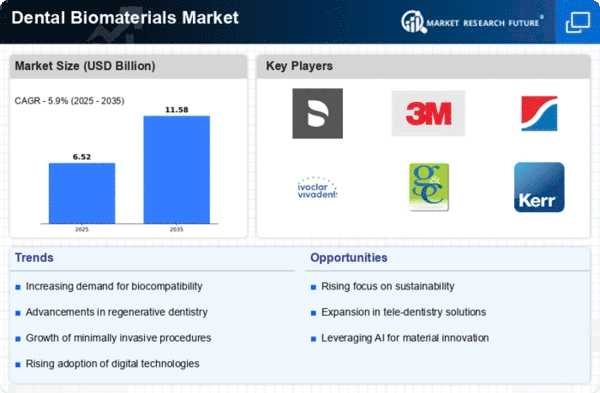
As per MRFR analysis, the Dental Biomaterials Market Size was estimated at 6.16 USD Billion in 2024. The Dental Biomaterials industry is projected to grow from 6.53 in 2025 to 11.58 by 2035, exhibiting a compound annual growth rate (CAGR) of 5.9% during the forecast period 2025 - 2035.

Key Market Trends & Highlights

The Dental Biomaterials Market is poised for substantial growth driven by technological advancements and evolving consumer preferences.

  • Sustainability in dental materials is becoming a focal point as practitioners and patients increasingly prioritize eco-friendly options. Digital dentistry integration is transforming traditional practices, enhancing efficiency and patient outcomes across North America. Personalized dental solutions are gaining traction, particularly in the dental implants segment, which remains the largest market segment. Rising demand for aesthetic dentistry and increasing awareness of oral health are key drivers propelling market expansion, especially in the Asia-Pacific region.

Market Size & Forecast

2024 Market Size 6.16 (USD Billion)
2035 Market Size 11.58 (USD Billion)
CAGR (2025 - 2035) 5.9%
Largest Regional Market Share in 2024 North America

Major Players

Dentsply Sirona (US), 3M (US), Henry Schein (US), Ivoclar Vivadent (LI), GC Corporation (JP), Kerr Corporation (US), Straumann (CH), Nobel Biocare (CH), Bisco Dental Products (US)

Market Trends

The Dental Biomaterials Market is currently experiencing a dynamic evolution, driven by advancements in technology and increasing demand for innovative dental solutions. The integration of biocompatible materials in dental procedures has gained traction, as practitioners seek to enhance patient outcomes and improve the longevity of dental restorations. This market appears to be influenced by a growing awareness of oral health, prompting both consumers and professionals to prioritize high-quality materials that ensure safety and efficacy. Furthermore, the rise of minimally invasive techniques is reshaping the landscape, as dental professionals adopt materials that facilitate quicker recovery and reduced discomfort for patients. In addition, the Dental Biomaterials Market seems to be characterized by a surge in research and development activities. Companies are investing in the creation of novel biomaterials that exhibit superior properties, such as enhanced strength, aesthetic appeal, and antimicrobial characteristics. This trend indicates a shift towards personalized dental care, where materials are tailored to meet the specific needs of individual patients. As the market continues to expand, collaboration between dental professionals, researchers, and manufacturers is likely to play a crucial role in driving innovation and ensuring the availability of cutting-edge solutions for dental applications.

Sustainability in Dental Materials

There is a noticeable trend towards the use of sustainable and eco-friendly materials in the Dental Biomaterials Market. As environmental concerns grow, manufacturers are exploring biodegradable options that minimize ecological impact while maintaining performance standards. This shift not only addresses consumer preferences but also aligns with broader industry goals of reducing waste and promoting sustainability.

Digital Dentistry Integration

The integration of digital technologies into dental practices is transforming the Dental Biomaterials Market. Innovations such as computer-aided design and manufacturing are enhancing precision in the creation of dental restorations. This trend suggests a move towards more efficient workflows and improved patient experiences, as digital solutions streamline processes and reduce turnaround times.

Personalized Dental Solutions

The demand for personalized dental solutions is on the rise within the Dental Biomaterials Market. Patients increasingly seek treatments tailored to their unique needs, prompting manufacturers to develop customizable biomaterials. This trend indicates a shift towards individualized care, where materials are designed to enhance compatibility and effectiveness for specific patient profiles.

Dental Biomaterials Market Market Drivers

Market Growth Projections

The Global Dental Biomaterials Market Industry is projected to experience substantial growth over the next decade. With a market value expected to reach 3.57 USD Billion in 2024 and further expand to 7.8 USD Billion by 2035, the industry is on a promising trajectory. This growth is underpinned by a compound annual growth rate of 7.36% from 2025 to 2035, indicating a robust demand for dental biomaterials. Factors such as technological advancements, increasing awareness of oral health, and a growing geriatric population contribute to this upward trend. The market dynamics suggest a vibrant future for dental biomaterials.

Increasing Geriatric Population

The Global Dental Biomaterials Market Industry is poised for growth due to the increasing geriatric population worldwide. As individuals age, they often experience dental issues that require restorative treatments, including implants and dentures. The demand for biomaterials that cater to this demographic is rising, as older adults seek solutions that enhance their quality of life. This demographic shift is expected to drive market expansion, with a projected compound annual growth rate of 7.36% from 2025 to 2035. Consequently, manufacturers are likely to focus on developing materials specifically designed for the unique needs of older patients.

Growing Awareness of Oral Health

The Global Dental Biomaterials Market Industry benefits from a growing awareness of oral health among consumers. Educational initiatives and public health campaigns emphasize the importance of maintaining good oral hygiene, leading to increased dental visits and procedures. This heightened awareness encourages individuals to invest in preventive and restorative dental care, thereby boosting the demand for various biomaterials. As consumers become more informed about the options available, the market is likely to see a rise in the adoption of advanced materials that offer better performance and longevity. This trend suggests a positive outlook for the industry in the coming years.

Rising Demand for Aesthetic Dentistry

The Global Dental Biomaterials Market Industry experiences a notable surge in demand for aesthetic dentistry. Patients increasingly seek procedures that enhance their smiles, driving the adoption of biomaterials such as ceramics and composites. These materials not only provide functional benefits but also improve the aesthetic appeal of dental restorations. As a result, the market is projected to reach 3.57 USD Billion in 2024, reflecting the growing consumer preference for visually pleasing dental solutions. This trend indicates a shift towards more personalized dental care, where aesthetics play a crucial role in treatment decisions.

Regulatory Support and Standards Development

Regulatory support plays a crucial role in shaping the Global Dental Biomaterials Market Industry. Governments and health organizations are increasingly establishing standards and guidelines for the use of dental biomaterials, ensuring safety and efficacy. This regulatory framework fosters innovation and encourages manufacturers to invest in research and development. As a result, the market is likely to witness the introduction of new and improved biomaterials that meet stringent safety requirements. Such developments not only enhance consumer confidence but also contribute to market growth, as dental professionals are more inclined to adopt materials that comply with established standards.

Technological Advancements in Dental Materials

Technological innovations significantly influence the Global Dental Biomaterials Market Industry. Advances in material science have led to the development of superior biomaterials that offer enhanced properties such as biocompatibility, strength, and durability. For instance, the introduction of 3D printing technology allows for the precise fabrication of dental implants and prosthetics, improving patient outcomes. These advancements not only streamline the production process but also reduce costs, making dental treatments more accessible. As the industry evolves, it is likely that these technologies will further propel market growth, contributing to an anticipated market value of 7.8 USD Billion by 2035.

Market Segment Insights

By Application: Dental Implants (Largest) vs. Bone Grafts (Fastest-Growing)

The Dental Biomaterials Market exhibits a diverse distribution among key segment values, with Dental Implants holding the largest share due to their integral role in <a href="https://www.marketresearchfuture.com/reports/restorative-dentistry-market-67722" target="_blank" title="restorative dentistry">restorative dentistry</a>. This segment's dominance is attributed to the increasing prevalence of dental conditions and the rising demand for aesthetic dental solutions. Bone Grafts, while representing a smaller share, are recognized for their rapid growth as advancements in surgical techniques and material science have enhanced their efficacy and applicability in various dental procedures.

Dental Implants (Dominant) vs. Bone Grafts (Emerging)

Dental Implants are considered the dominant force within the Dental Biomaterials Market, reflecting their established presence and significant utilization in restorative dentistry practices. Their characteristics include high durability, excellent biocompatibility, and the ability to restore functionality and aesthetics in patients with tooth loss. On the other hand, Bone Grafts are emerging as a critical component of the market, driven by innovations in synthetic materials and enhanced surgical methods. They are increasingly utilized in procedures that require the regeneration of bone tissue, showcasing their growing relevance in complex dental surgeries and increasing acceptance among dental professionals.

By Material Type: Ceramics (Largest) vs. Polymers (Fastest-Growing)

In the Dental Biomaterials Market, Ceramics hold the largest market share due to their superior aesthetic appeal and biocompatibility. They are widely used in crowns, bridges, and veneers, catering to both restorative and cosmetic dentistry. Polymers, while currently smaller in market share, are rapidly gaining traction among dental professionals for their versatility and lower costs. These materials are increasingly preferred for applications like temporary restorations and orthodontic devices due to their flexibility and ease of use.

Ceramics (Dominant) vs. Polymers (Emerging)

Ceramics represent the dominant segment in the Dental Biomaterials Market, known for their durability and excellent aesthetic qualities. Their ability to mimic the natural translucency of teeth makes them the preferred choice for permanent restorations. On the other hand, Polymers are an emerging segment characterized by their lightweight properties and adaptability for various dental applications. They are becoming integral in developing innovative dental products, especially for temporary restorations and orthodontic applications. The growing demand for cost-effective and efficient materials favors Polymers, indicating a significant shift towards their usage in future dental biomaterial developments.

By End Use: Dental Clinics (Largest) vs. Dental Laboratories (Fastest-Growing)

The dental biomaterials market exhibits a diverse distribution across various end-use segments, with dental clinics holding the largest share. Their prevalence is largely driven by the continuous demand for dental services, minimally invasive procedures, and increasing patient awareness about oral health. In contrast, dental laboratories are steadily gaining traction as the fastest-growing segment due to the rising volume of <a href="https://www.marketresearchfuture.com/reports/dental-prosthetics-market-2905" target="_blank" title="dental prosthetics">dental prosthetics</a> and the integration of advanced technologies such as CAD/CAM processes which enhance efficiency and precision. Additionally, hospitals, while significant, follow closely behind in terms of market share and growth potential, highlighting a competitive landscape in the dental sector.

End Use: Dental Clinics (Dominant) vs. Dental Laboratories (Emerging)

Dental clinics serve as the dominant end-use segment within the dental biomaterials market, driven by a constant flow of patients seeking restorative and cosmetic dental procedures. Clinics benefit from direct patient relationships and often utilize a wide range of biomaterials, including implants, composites, and bonding agents that cater to various dental needs. On the other hand, dental laboratories are emerging as a crucial player, propelled by innovations in technology and increased outsourcing from dental clinics. They focus on producing customized dental solutions, including crowns, bridges, and dentures, utilizing high-quality materials. As the demand for precision and rapid turnaround grows, dental laboratories are adapting quickly to market needs, highlighting their potential for significant growth in the coming years.

Get more detailed insights about Dental Biomaterials Market Research Report – Global Forecast till 2035

Regional Insights

North America : Market Leader in Dental Biomaterials

North America is poised to maintain its leadership in the dental biomaterials market, holding a significant share of 3.1 billion. The region's growth is driven by increasing dental procedures, rising awareness of oral health, and advancements in dental technology. Regulatory support and favorable reimbursement policies further catalyze market expansion, making it a hub for innovation and investment in dental solutions. The competitive landscape is robust, with key players like Dentsply Sirona, 3M, and Henry Schein leading the charge. The U.S. remains the largest market, supported by a well-established healthcare infrastructure and high consumer spending on dental care. Continuous R&D efforts and the presence of major manufacturers ensure North America's dominance in the global dental biomaterials market.

Europe : Emerging Market with Growth Potential

Europe's dental biomaterials market is valued at €2.0 billion, reflecting a growing demand for innovative dental solutions. Factors such as an aging population, increased dental awareness, and advancements in biomaterials technology are driving this growth. Regulatory frameworks in the EU promote high standards for dental products, ensuring safety and efficacy, which further boosts consumer confidence and market expansion. Leading countries in this region include Germany, France, and the UK, where significant investments in dental research and development are evident. Additionally, the italy dental biomaterials market is witnessing steady growth due to increased dental tourism and modernization of clinics in Italy. Major players like Straumann and Nobel Biocare are at the forefront, fostering a competitive and innovative ecosystem.

Asia-Pacific : Rapidly Growing Dental Sector

The Asia-Pacific dental biomaterials market, valued at $0.9 billion, is experiencing rapid growth driven by rising disposable incomes, increasing dental awareness, and expanding healthcare access. Countries like China and India are witnessing a surge in dental procedures, supported by government initiatives aimed at improving oral health. The china dental biomaterials market is expanding significantly due to strong domestic manufacturing capabilities and increasing adoption of advanced dental materials. Meanwhile, Japan continues to play a vital role with technological advancements in dental care. Key players such as GC Corporation and Kuraray Noritake Dental are actively contributing to innovation. The region’s dynamic landscape positions it as a major growth engine for the dental biomaterials market.

Middle East and Africa : Emerging Market with Untapped Potential

The Middle East and Africa region is gradually emerging in the Dental Biomaterials Market, with a market size of 0.16 in 2024. The growth is driven by increasing dental awareness, rising disposable incomes, and a growing population. However, challenges such as limited access to advanced dental care and regulatory hurdles remain. Governments are increasingly recognizing the importance of oral health, leading to initiatives aimed at improving dental services. Countries like South Africa and the UAE are at the forefront of this growth, with a mix of local and international companies entering the market. The presence of key players is still developing, but companies are focusing on establishing a foothold through strategic partnerships and investments. This region holds significant potential for growth as dental care becomes more prioritized in healthcare agendas.

Key Players and Competitive Insights

The Dental Biomaterials Market is characterized by a dynamic competitive landscape, driven by innovation, technological advancements, and increasing demand for dental procedures. Key players such as Dentsply Sirona (US), 3M (US), and Ivoclar Vivadent (LI) are strategically positioned to leverage these growth drivers. Dentsply Sirona (US) focuses on enhancing its product portfolio through continuous innovation, while 3M (US) emphasizes partnerships and collaborations to expand its market reach. Ivoclar Vivadent (LI) is investing in digital transformation to streamline operations and improve customer engagement. Collectively, these strategies contribute to a competitive environment that is increasingly focused on technological differentiation and customer-centric solutions.In terms of business tactics, companies are localizing manufacturing and optimizing supply chains to enhance efficiency and reduce costs. The market appears moderately fragmented, with several key players exerting influence over various segments. This fragmentation allows for niche players to thrive, while larger companies consolidate their positions through strategic acquisitions and partnerships.
In November Dentsply Sirona (US) announced the launch of a new line of bioactive dental materials designed to enhance patient outcomes. This strategic move is significant as it aligns with the growing trend towards biocompatibility and patient-centered care, potentially positioning the company as a leader in innovative dental solutions. The introduction of these materials may also strengthen Dentsply Sirona's competitive edge in a market increasingly focused on advanced biomaterials.
In October 3M (US) expanded its partnership with a leading dental technology firm to co-develop next-generation adhesive systems. This collaboration is indicative of 3M's commitment to innovation and reflects a broader trend of companies seeking synergies to enhance product offerings. By leveraging external expertise, 3M may accelerate its product development cycle and respond more effectively to market demands.
In September Ivoclar Vivadent (LI) acquired a digital dental solutions company, enhancing its capabilities in the digital workflow space. This acquisition is strategically important as it allows Ivoclar Vivadent to integrate advanced digital technologies into its existing product lines, thereby improving operational efficiency and customer service. The move underscores the increasing importance of digital solutions in the dental biomaterials sector.
As of December current competitive trends in the Dental Biomaterials Market include a pronounced shift towards digitalization, sustainability, and the integration of artificial intelligence (AI) in product development. Strategic alliances are becoming increasingly vital, as companies recognize the need to collaborate to stay competitive. Looking ahead, the competitive differentiation is likely to evolve from traditional price-based competition to a focus on innovation, technological advancements, and supply chain reliability. This shift suggests that companies that prioritize R&D and sustainable practices may gain a significant advantage in the marketplace.

Key Companies in the Dental Biomaterials Market include

Industry Developments

Recent developments in the Dental Biomaterials Market have showcased an impressive growth trajectory, especially with advancements in nanotechnology and biocompatible materials enhancing product performance. Major companies such as Kuraray Noritake Dental, Bisco, and Ivoclar Vivadent are expanding their portfolios, driven by an increasing demand for aesthetically pleasing and durable dental solutions.

In April 2025, Ivoclar Vivadent introduced IPS e.max ZirCAD Prime 2.0, a next-generation multilayer zirconia block that is optimal for posterior dental restorations. This block boasts high translucency and enhanced strength.

In March 2025, Dentsply Sirona introduced a chairside millable lithium silicate that is optimized for veneers and crowns, thereby expanding the Celtra Duo product line. This addition enhances the aesthetic and functional aspects of chairside solutions.

Future Outlook

Dental Biomaterials Market Future Outlook

The Dental Biomaterials Market is projected to grow at a 5.9% CAGR from 2025 to 2035, driven by technological advancements, increasing dental procedures, and rising consumer awareness.

New opportunities lie in:

  • <p>Development of bioactive glass materials for enhanced dental restorations. Expansion of digital dentistry solutions integrating biomaterials. Investment in sustainable biomaterials to meet eco-friendly consumer demands.</p>

By 2035, the Dental Biomaterials Market is expected to achieve substantial growth and innovation.

Market Segmentation

Dental Biomaterials Market End Use Outlook

  • Hospitals
  • Dental Clinics
  • Research Laboratories

Dental Biomaterials Market Application Outlook

  • Dental Implants
  • Bone Grafts
  • Restorative Dentistry
  • Orthodontics

Dental Biomaterials Market Material Type Outlook

  • Ceramics
  • Polymers
  • Metals
  • Composites

Report Scope

MARKET SIZE 2024 6.16(USD Billion)
MARKET SIZE 2025 6.53(USD Billion)
MARKET SIZE 2035 11.58(USD Billion)
COMPOUND ANNUAL GROWTH RATE (CAGR) 5.9% (2025 - 2035)
REPORT COVERAGE Revenue Forecast, Competitive Landscape, Growth Factors, and Trends
BASE YEAR 2024
Market Forecast Period 2025 - 2035
Historical Data 2019 - 2024
Market Forecast Units USD Billion
Key Companies Profiled Dentsply Sirona (US), 3M (US), Henry Schein (US), Ivoclar Vivadent (LI), GC Corporation (JP), Kerr Corporation (US), Straumann (CH), Nobel Biocare (CH), Bisco Dental Products (US)
Segments Covered Application, Material Type, End Use
Key Market Opportunities Advancements in biocompatible materials enhance treatment outcomes in the Dental Biomaterials Market.
Key Market Dynamics Rising demand for biocompatible materials drives innovation and competition in the Dental Biomaterials Market.
Countries Covered North America, Europe, APAC, South America, MEA

FAQs

What is the current valuation of the Dental Biomaterials Market as of 2024?

<p>The Dental Biomaterials Market was valued at 6.16 USD Billion in 2024.</p>

What is the projected market size for the Dental Biomaterials Market by 2035?

<p>The market is projected to reach 11.58 USD Billion by 2035.</p>

What is the expected CAGR for the Dental Biomaterials Market during the forecast period 2025 - 2035?

<p>The expected CAGR for the Dental Biomaterials Market during 2025 - 2035 is 5.9%.</p>

Which application segment is anticipated to grow the most in the Dental Biomaterials Market?

<p>The Dental Implants segment is expected to grow from 2.46 USD Billion in 2024 to 4.56 USD Billion by 2035.</p>

How does the Bone Grafts segment perform in terms of market valuation?

<p>The Bone Grafts segment was valued at 1.23 USD Billion in 2024 and is projected to reach 2.29 USD Billion by 2035.</p>

What are the leading materials used in the Dental Biomaterials Market?

<p>Ceramics, Polymers, Metals, and Composites are the primary materials, with Ceramics expected to grow from 1.84 USD Billion to 3.45 USD Billion by 2035.</p>

Which end-use segment shows significant growth potential in the Dental Biomaterials Market?

<p>The Dental Clinics segment is projected to increase from 2.48 USD Billion in 2024 to 4.66 USD Billion by 2035.</p>

Who are the key players in the Dental Biomaterials Market?

<p>Key players include Dentsply Sirona, 3M, Henry Schein, Straumann, and Nobel Biocare.</p>

What is the market performance of the Restorative Dentistry segment?

<p>The Restorative Dentistry segment was valued at 1.85 USD Billion in 2024 and is expected to grow to 3.45 USD Billion by 2035.</p>

How does the market for Orthodontics compare to other segments?

<p>The Orthodontics segment is projected to grow from 0.62 USD Billion in 2024 to 1.28 USD Billion by 2035, indicating a steady increase.</p>

  1. SECTION I: EXECUTIVE SUMMARY AND KEY HIGHLIGHTS |
    1. EXECUTIVE SUMMARY | |
      1. Market Overview | |
      2. Key Findings | |
      3. Market Segmentation | |
      4. Competitive Landscape | |
      5. Challenges and Opportunities | |
      6. Future Outlook 2
  2. SECTION II: SCOPING, METHODOLOGY AND MARKET STRUCTURE |
    1. MARKET INTRODUCTION | |
      1. Definition | |
      2. Scope of the study | | |
    2. RESEARCH METHODOLOGY | |
      1. Overview | |
      2. Data Mining | |
      3. Secondary Research | |
      4. Primary Research | | |
      5. Forecasting Model | |
      6. Market Size Estimation | | |
      7. Data Triangulation | |
      8. Validation 3
  3. SECTION III: QUALITATIVE ANALYSIS |
    1. MARKET DYNAMICS | |
      1. Overview | |
      2. Drivers | |
      3. Restraints | |
      4. Opportunities |
    2. MARKET FACTOR ANALYSIS | |
      1. Value chain Analysis | |
      2. Porter's Five Forces Analysis | | |
      3. COVID-19 Impact Analysis | | |
  4. SECTION IV: QUANTITATIVE ANALYSIS |
    1. Healthcare, BY Application (USD Billion) | |
      1. Dental Implants | |
      2. Bone Grafts | |
      3. Restorative Dentistry | |
      4. Orthodontics |
    2. Healthcare, BY Material Type (USD Billion) | |
      1. Ceramics | |
      2. Polymers | |
      3. Metals | |
      4. Composites |
    3. Healthcare, BY End Use (USD Billion) | |
      1. Dental Clinics | |
      2. Dental Laboratories | |
      3. Hospitals |
    4. Healthcare, BY Region (USD Billion) | |
      1. North America | | |
      2. Europe | | |
      3. APAC | | |
      4. South America | | |
      5. MEA | | |
  5. SECTION V: COMPETITIVE ANALYSIS |
    1. Competitive Landscape | |
      1. Overview | |
      2. Competitive Analysis | |
      3. Market share Analysis | |
      4. Major Growth Strategy in the Healthcare | |
      5. Competitive Benchmarking | |
      6. Leading Players in Terms of Number of Developments in the Healthcare | |
      7. Key developments and growth strategies | | |
      8. Major Players Financial Matrix | | |
    2. Company Profiles | |
      1. Dentsply Sirona (US) | | |
      2. 3M (US) | | |
      3. Henry Schein (US) | | |
      4. Straumann (CH) | | |
      5. Nobel Biocare (CH) | | |
      6. GC Corporation (JP) | | |
      7. Kuraray Noritake Dental (JP) | | |
      8. Ivoclar Vivadent (LI) | | |
      9. Coltene Holding (CH) | | |
    3. Appendix | |
      1. References | |
      2. Related Reports 6 LIST OF FIGURES |
    4. MARKET SYNOPSIS |
    5. NORTH AMERICA MARKET ANALYSIS |
    6. US MARKET ANALYSIS BY APPLICATION |
    7. US MARKET ANALYSIS BY MATERIAL TYPE |
    8. US MARKET ANALYSIS BY END USE |
    9. CANADA MARKET ANALYSIS BY APPLICATION |
    10. CANADA MARKET ANALYSIS BY MATERIAL TYPE |
    11. CANADA MARKET ANALYSIS BY END USE |
    12. EUROPE MARKET ANALYSIS |
    13. GERMANY MARKET ANALYSIS BY APPLICATION |
    14. GERMANY MARKET ANALYSIS BY MATERIAL TYPE |
    15. GERMANY MARKET ANALYSIS BY END USE |
    16. UK MARKET ANALYSIS BY APPLICATION |
    17. UK MARKET ANALYSIS BY MATERIAL TYPE |
    18. UK MARKET ANALYSIS BY END USE |
    19. FRANCE MARKET ANALYSIS BY APPLICATION |
    20. FRANCE MARKET ANALYSIS BY MATERIAL TYPE |
    21. FRANCE MARKET ANALYSIS BY END USE |
    22. RUSSIA MARKET ANALYSIS BY APPLICATION |
    23. RUSSIA MARKET ANALYSIS BY MATERIAL TYPE |
    24. RUSSIA MARKET ANALYSIS BY END USE |
    25. ITALY MARKET ANALYSIS BY APPLICATION |
    26. ITALY MARKET ANALYSIS BY MATERIAL TYPE |
    27. ITALY MARKET ANALYSIS BY END USE |
    28. SPAIN MARKET ANALYSIS BY APPLICATION |
    29. SPAIN MARKET ANALYSIS BY MATERIAL TYPE |
    30. SPAIN MARKET ANALYSIS BY END USE |
    31. REST OF EUROPE MARKET ANALYSIS BY APPLICATION |
    32. REST OF EUROPE MARKET ANALYSIS BY MATERIAL TYPE |
    33. REST OF EUROPE MARKET ANALYSIS BY END USE |
    34. APAC MARKET ANALYSIS |
    35. CHINA MARKET ANALYSIS BY APPLICATION |
    36. CHINA MARKET ANALYSIS BY MATERIAL TYPE |
    37. CHINA MARKET ANALYSIS BY END USE |
    38. INDIA MARKET ANALYSIS BY APPLICATION |
    39. INDIA MARKET ANALYSIS BY MATERIAL TYPE |
    40. INDIA MARKET ANALYSIS BY END USE |
    41. JAPAN MARKET ANALYSIS BY APPLICATION |
    42. JAPAN MARKET ANALYSIS BY MATERIAL TYPE |
    43. JAPAN MARKET ANALYSIS BY END USE |
    44. SOUTH KOREA MARKET ANALYSIS BY APPLICATION |
    45. SOUTH KOREA MARKET ANALYSIS BY MATERIAL TYPE |
    46. SOUTH KOREA MARKET ANALYSIS BY END USE |
    47. MALAYSIA MARKET ANALYSIS BY APPLICATION |
    48. MALAYSIA MARKET ANALYSIS BY MATERIAL TYPE |
    49. MALAYSIA MARKET ANALYSIS BY END USE |
    50. THAILAND MARKET ANALYSIS BY APPLICATION |
    51. THAILAND MARKET ANALYSIS BY MATERIAL TYPE |
    52. THAILAND MARKET ANALYSIS BY END USE |
    53. INDONESIA MARKET ANALYSIS BY APPLICATION |
    54. INDONESIA MARKET ANALYSIS BY MATERIAL TYPE |
    55. INDONESIA MARKET ANALYSIS BY END USE |
    56. REST OF APAC MARKET ANALYSIS BY APPLICATION |
    57. REST OF APAC MARKET ANALYSIS BY MATERIAL TYPE |
    58. REST OF APAC MARKET ANALYSIS BY END USE |
    59. SOUTH AMERICA MARKET ANALYSIS |
    60. BRAZIL MARKET ANALYSIS BY APPLICATION |
    61. BRAZIL MARKET ANALYSIS BY MATERIAL TYPE |
    62. BRAZIL MARKET ANALYSIS BY END USE |
    63. MEXICO MARKET ANALYSIS BY APPLICATION |
    64. MEXICO MARKET ANALYSIS BY MATERIAL TYPE |
    65. MEXICO MARKET ANALYSIS BY END USE |
    66. ARGENTINA MARKET ANALYSIS BY APPLICATION |
    67. ARGENTINA MARKET ANALYSIS BY MATERIAL TYPE |
    68. ARGENTINA MARKET ANALYSIS BY END USE |
    69. REST OF SOUTH AMERICA MARKET ANALYSIS BY APPLICATION |
    70. REST OF SOUTH AMERICA MARKET ANALYSIS BY MATERIAL TYPE |
    71. REST OF SOUTH AMERICA MARKET ANALYSIS BY END USE |
    72. MEA MARKET ANALYSIS |
    73. GCC COUNTRIES MARKET ANALYSIS BY APPLICATION |
    74. GCC COUNTRIES MARKET ANALYSIS BY MATERIAL TYPE |
    75. GCC COUNTRIES MARKET ANALYSIS BY END USE |
    76. SOUTH AFRICA MARKET ANALYSIS BY APPLICATION |
    77. SOUTH AFRICA MARKET ANALYSIS BY MATERIAL TYPE |
    78. SOUTH AFRICA MARKET ANALYSIS BY END USE |
    79. REST OF MEA MARKET ANALYSIS BY APPLICATION |
    80. REST OF MEA MARKET ANALYSIS BY MATERIAL TYPE |
    81. REST OF MEA MARKET ANALYSIS BY END USE |
    82. KEY BUYING CRITERIA OF HEALTHCARE |
    83. RESEARCH PROCESS OF MRFR |
    84. DRO ANALYSIS OF HEALTHCARE |
    85. DRIVERS IMPACT ANALYSIS: HEALTHCARE |
    86. RESTRAINTS IMPACT ANALYSIS: HEALTHCARE |
    87. SUPPLY / VALUE CHAIN: HEALTHCARE |
    88. HEALTHCARE, BY APPLICATION, 2024 (% SHARE) |
    89. HEALTHCARE, BY APPLICATION, 2024 TO 2035 (USD Billion) |
    90. HEALTHCARE, BY MATERIAL TYPE, 2024 (% SHARE) |
    91. HEALTHCARE, BY MATERIAL TYPE, 2024 TO 2035 (USD Billion) |
    92. HEALTHCARE, BY END USE, 2024 (% SHARE) |
    93. HEALTHCARE, BY END USE, 2024 TO 2035 (USD Billion) |
    94. BENCHMARKING OF MAJOR COMPETITORS 7 LIST OF TABLES |
    95. LIST OF ASSUMPTIONS | |
      1. |
    96. North America MARKET SIZE ESTIMATES; FORECAST | |
      1. BY APPLICATION, 2025-2035 (USD Billion) | |
      2. BY MATERIAL TYPE, 2025-2035 (USD Billion) | |
      3. BY END USE, 2025-2035 (USD Billion) |
    97. US MARKET SIZE ESTIMATES; FORECAST | |
      1. BY APPLICATION, 2025-2035 (USD Billion) | |
      2. BY MATERIAL TYPE, 2025-2035 (USD Billion) | |
      3. BY END USE, 2025-2035 (USD Billion) |
    98. Canada MARKET SIZE ESTIMATES; FORECAST | |
      1. BY APPLICATION, 2025-2035 (USD Billion) | |
      2. BY MATERIAL TYPE, 2025-2035 (USD Billion) | |
      3. BY END USE, 2025-2035 (USD Billion) |
    99. Europe MARKET SIZE ESTIMATES; FORECAST | |
      1. BY APPLICATION, 2025-2035 (USD Billion) | |
      2. BY MATERIAL TYPE, 2025-2035 (USD Billion) | |
      3. BY END USE, 2025-2035 (USD Billion) |
    100. Germany MARKET SIZE ESTIMATES; FORECAST | |
      1. BY APPLICATION, 2025-2035 (USD Billion) | |
      2. BY MATERIAL TYPE, 2025-2035 (USD Billion) | |
      3. BY END USE, 2025-2035 (USD Billion) |
    101. UK MARKET SIZE ESTIMATES; FORECAST | |
      1. BY APPLICATION, 2025-2035 (USD Billion) | |
      2. BY MATERIAL TYPE, 2025-2035 (USD Billion) | |
      3. BY END USE, 2025-2035 (USD Billion) |
    102. France MARKET SIZE ESTIMATES; FORECAST | |
      1. BY APPLICATION, 2025-2035 (USD Billion) | |
      2. BY MATERIAL TYPE, 2025-2035 (USD Billion) | |
      3. BY END USE, 2025-2035 (USD Billion) |
    103. Russia MARKET SIZE ESTIMATES; FORECAST | |
      1. BY APPLICATION, 2025-2035 (USD Billion) | |
      2. BY MATERIAL TYPE, 2025-2035 (USD Billion) | |
      3. BY END USE, 2025-2035 (USD Billion) |
    104. Italy MARKET SIZE ESTIMATES; FORECAST | |
      1. BY APPLICATION, 2025-2035 (USD Billion) | |
      2. BY MATERIAL TYPE, 2025-2035 (USD Billion) | |
      3. BY END USE, 2025-2035 (USD Billion) |
    105. Spain MARKET SIZE ESTIMATES; FORECAST | |
      1. BY APPLICATION, 2025-2035 (USD Billion) | |
      2. BY MATERIAL TYPE, 2025-2035 (USD Billion) | |
      3. BY END USE, 2025-2035 (USD Billion) |
    106. Rest of Europe MARKET SIZE ESTIMATES; FORECAST | |
      1. BY APPLICATION, 2025-2035 (USD Billion) | |
      2. BY MATERIAL TYPE, 2025-2035 (USD Billion) | |
      3. BY END USE, 2025-2035 (USD Billion) |
    107. APAC MARKET SIZE ESTIMATES; FORECAST | |
      1. BY APPLICATION, 2025-2035 (USD Billion) | |
      2. BY MATERIAL TYPE, 2025-2035 (USD Billion) | |
      3. BY END USE, 2025-2035 (USD Billion) |
    108. China MARKET SIZE ESTIMATES; FORECAST | |
      1. BY APPLICATION, 2025-2035 (USD Billion) | |
      2. BY MATERIAL TYPE, 2025-2035 (USD Billion) | |
      3. BY END USE, 2025-2035 (USD Billion) |
    109. India MARKET SIZE ESTIMATES; FORECAST | |
      1. BY APPLICATION, 2025-2035 (USD Billion) | |
      2. BY MATERIAL TYPE, 2025-2035 (USD Billion) | |
      3. BY END USE, 2025-2035 (USD Billion) |
    110. Japan MARKET SIZE ESTIMATES; FORECAST | |
      1. BY APPLICATION, 2025-2035 (USD Billion) | |
      2. BY MATERIAL TYPE, 2025-2035 (USD Billion) | |
      3. BY END USE, 2025-2035 (USD Billion) |
    111. South Korea MARKET SIZE ESTIMATES; FORECAST | |
      1. BY APPLICATION, 2025-2035 (USD Billion) | |
      2. BY MATERIAL TYPE, 2025-2035 (USD Billion) | |
      3. BY END USE, 2025-2035 (USD Billion) |
    112. Malaysia MARKET SIZE ESTIMATES; FORECAST | |
      1. BY APPLICATION, 2025-2035 (USD Billion) | |
      2. BY MATERIAL TYPE, 2025-2035 (USD Billion) | |
      3. BY END USE, 2025-2035 (USD Billion) |
    113. Thailand MARKET SIZE ESTIMATES; FORECAST | |
      1. BY APPLICATION, 2025-2035 (USD Billion) | |
      2. BY MATERIAL TYPE, 2025-2035 (USD Billion) | |
      3. BY END USE, 2025-2035 (USD Billion) |
    114. Indonesia MARKET SIZE ESTIMATES; FORECAST | |
      1. BY APPLICATION, 2025-2035 (USD Billion) | |
      2. BY MATERIAL TYPE, 2025-2035 (USD Billion) | |
      3. BY END USE, 2025-2035 (USD Billion) |
    115. Rest of APAC MARKET SIZE ESTIMATES; FORECAST | |
      1. BY APPLICATION, 2025-2035 (USD Billion) | |
      2. BY MATERIAL TYPE, 2025-2035 (USD Billion) | |
      3. BY END USE, 2025-2035 (USD Billion) |
    116. South America MARKET SIZE ESTIMATES; FORECAST | |
      1. BY APPLICATION, 2025-2035 (USD Billion) | |
      2. BY MATERIAL TYPE, 2025-2035 (USD Billion) | |
      3. BY END USE, 2025-2035 (USD Billion) |
    117. Brazil MARKET SIZE ESTIMATES; FORECAST | |
      1. BY APPLICATION, 2025-2035 (USD Billion) | |
      2. BY MATERIAL TYPE, 2025-2035 (USD Billion) | |
      3. BY END USE, 2025-2035 (USD Billion) |
    118. Mexico MARKET SIZE ESTIMATES; FORECAST | |
      1. BY APPLICATION, 2025-2035 (USD Billion) | |
      2. BY MATERIAL TYPE, 2025-2035 (USD Billion) | |
      3. BY END USE, 2025-2035 (USD Billion) |
    119. Argentina MARKET SIZE ESTIMATES; FORECAST | |
      1. BY APPLICATION, 2025-2035 (USD Billion) | |
      2. BY MATERIAL TYPE, 2025-2035 (USD Billion) | |
      3. BY END USE, 2025-2035 (USD Billion) |
    120. Rest of South America MARKET SIZE ESTIMATES; FORECAST | |
      1. BY APPLICATION, 2025-2035 (USD Billion) | |
      2. BY MATERIAL TYPE, 2025-2035 (USD Billion) | |
      3. BY END USE, 2025-2035 (USD Billion) |
    121. MEA MARKET SIZE ESTIMATES; FORECAST | |
      1. BY APPLICATION, 2025-2035 (USD Billion) | |
      2. BY MATERIAL TYPE, 2025-2035 (USD Billion) | |
      3. BY END USE, 2025-2035 (USD Billion) |
    122. GCC Countries MARKET SIZE ESTIMATES; FORECAST | |
      1. BY APPLICATION, 2025-2035 (USD Billion) | |
      2. BY MATERIAL TYPE, 2025-2035 (USD Billion) | |
      3. BY END USE, 2025-2035 (USD Billion) |
    123. South Africa MARKET SIZE ESTIMATES; FORECAST | |
      1. BY APPLICATION, 2025-2035 (USD Billion) | |
      2. BY MATERIAL TYPE, 2025-2035 (USD Billion) | |
      3. BY END USE, 2025-2035 (USD Billion) |
    124. Rest of MEA MARKET SIZE ESTIMATES; FORECAST | |
      1. BY APPLICATION, 2025-2035 (USD Billion) | |
      2. BY MATERIAL TYPE, 2025-2035 (USD Billion) | |
      3. BY END USE, 2025-2035 (USD Billion) |
    125. PRODUCT LAUNCH/PRODUCT DEVELOPMENT/APPROVAL | |
      1. |
    126. ACQUISITION/PARTNERSHIP | |

Healthcare Market Segmentation

Healthcare By Application (USD Billion, 2025-2035)

  • Dental Implants
  • Bone Grafts
  • Restorative Dentistry
  • Orthodontics

Healthcare By Material Type (USD Billion, 2025-2035)

  • Ceramics
  • Polymers
  • Metals
  • Composites

Healthcare By End Use (USD Billion, 2025-2035)

  • Dental Clinics
  • Dental Laboratories
  • Hospitals
Infographic

Free Sample Request

Kindly complete the form below to receive a free sample of this Report

Get Free Sample

Customer Strories

Compare Licence

×
Features License Type
Single User Multiuser License Enterprise User
Price $4,950 $5,950 $7,250
Maximum User Access Limit 1 User Upto 10 Users Unrestricted Access Throughout the Organization
Free Customization
Direct Access to Analyst
Deliverable Format
Platform Access
Discount on Next Purchase 10% 15% 15%
Printable Versions
%>