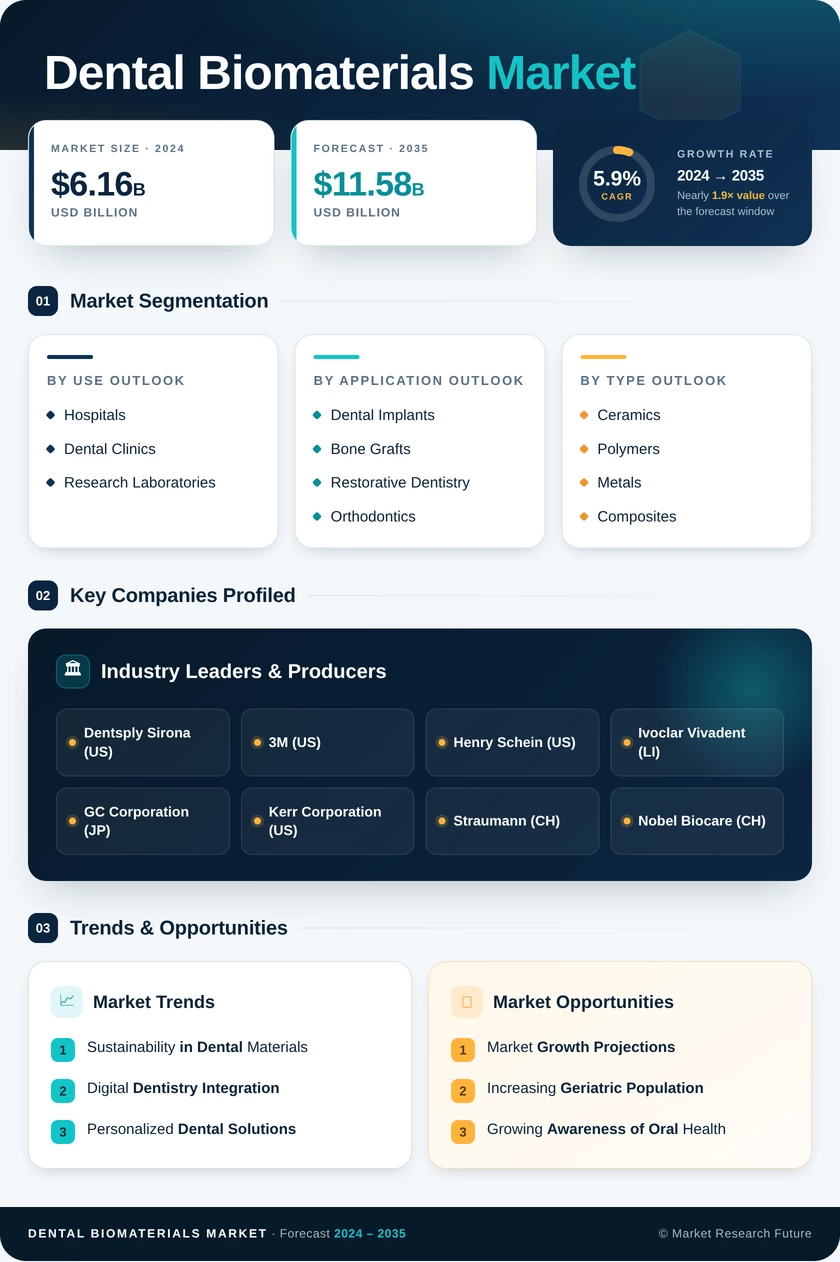
Dental Biomaterials Market (2026 - 2035)

ID: MRFR/HC/6057-HCR 110 Pages Vikita Thakur Last Updated: October 28, 2026
Dental Biomaterials Market Research Report By Material Type (Ceramics, Polymers, Metals, Composites), By Application (Dentistry Implants, Restorative Dentistry, Orthodontics, Endodontics), By End Use (Hospitals, Dental Clinics, Research Laboratories), By Product Form (Consumables, Equipment, Implants) and By Regional (North America, Europe, South America, Asia Pacific, Middle East and Africa) - Growth & Industry Forecast 2026 To 2035
Dental Biomaterials Market
Market Size
Forecast Period2026-2035
CAGR (2026-2035)6.72%
2025 Market SizeUSD 7.05 Billion
2035 Market SizeUSD 13.50 Billion
Key Players
Institut Straumann AG
Dentsply Sirona
Envista Holdings
Geistlich Pharma AG
Solventum
Ivoclar Vivadent
Opportunities
  • Implant Access Expansion in Emerging Asia
  • Material-as-a-Service and Workflow Data Platforms
  • Printed Permanent Restorations
  1. 1 Market Summary | |
  2. 2 Key Report Takeaways | |
    1. 2.1 By Material Type (Value) | |
    2. 2.2 By Application (Value) | |
    3. 2.3 By Product Category (Value) | |
    4. 2.4 By Barrier MembranesScaffolds & Hydrogels | |
    5. 2.5 By End User (Value) | |
    6. 2.6 By Region | |
  3. 3 Market Size and Forecast (2021–2035) | |
  4. 4 Driver Impact Analysis | |
    1. 4.1 Ageing Populations and Rising Edentulism | |
    2. 4.2 Implant Affordability and Procurement Reform | |
    3. 4.3 Chair-Side CAD/CAM and Digital Workflows | |
    4. 4.4 Amalgam Phase-Out and Metal-Free Demand | |
    5. 4.5 Advances in Regenerative Biomaterials | |
    6. 4.6 Expanding Public and Private Dental Coverage | |
  5. 5 Restraints Impact Analysis | |
    1. 5.1 High Procedure Cost and Limited Reimbursement | |
    2. 5.2 EU MDR Compliance Burden | |
    3. 5.3 Peri-Implantitis and Biocompatibility Concerns | |
    4. 5.4 Raw Material Price Volatility | |
    5. 5.5 Shortage of Trained Clinicians and Technicians | |
  6. 6 Opportunities | |
    1. 6.1 Implant Access Expansion in Emerging Asia | |
    2. 6.2 Material-as-a-Service and Workflow Data Platforms | |
    3. 6.3 Printed Permanent Restorations | |
    4. 6.4 Bioactive and Antibacterial Formulations | |
    5. 6.5 Amalgam Replacement in Public Programmes | |
  7. 7 Regional Market Share and Country-Level Analysis | |
    1. 7.1 North America | | |
      1. 7.1.1 United States | | |
      2. 7.1.2 Canada | | |
      3. 7.1.3 Mexico | |
    2. 7.2 Europe | | |
      1. 7.2.1 Germany | | |
      2. 7.2.2 United Kingdom | | |
      3. 7.2.3 France | | |
      4. 7.2.4 Italy | | |
      5. 7.2.5 Spain | | |
      6. 7.2.6 Rest of Europe | |
    3. 7.3 Asia-Pacific | | |
      1. 7.3.1 China | | |
      2. 7.3.2 Japan | | |
      3. 7.3.3 India | | |
      4. 7.3.4 South Korea | | |
      5. 7.3.5 Australia | | |
      6. 7.3.6 Rest of Asia Pacific | |
    4. 7.4 South America | | |
      1. 7.4.1 Brazil | | |
      2. 7.4.2 Argentina | | |
      3. 7.4.3 Rest of South America | |
    5. 7.5 Middle East & Africa | | |
      1. 7.5.1 GCC Countries | | |
      2. 7.5.2 South Africa | | |
      3. 7.5.3 Rest of Middle East and Africa | |
  8. 8 Future Outlook (2026–2035) | |
    1. 8.1 AI-Driven Digital Dentistry | |
    2. 8.2 Additive Manufacturing Goes Definitive | |
    3. 8.3 Convergence of Biologics and Biomaterials | |
    4. 8.4 Sustainability and Regulatory Tightening | |
  9. 9 Segmentation Analysis | |
    1. 9.1 By Material Type (Value) | | |
      1. 9.1.1 Metallic Biomaterials | | |
      2. 9.1.2 Ceramic Biomaterials | | |
      3. 9.1.3 Polymeric Biomaterials | | |
      4. 9.1.4 Metal-Ceramic Hybrids | | |
      5. 9.1.5 Natural / Bio-derived Materials | |
    2. 9.2 By Application (Value) | | |
      1. 9.2.1 Implantology | | |
      2. 9.2.2 Prosthodontics | | |
      3. 9.2.3 Orthodontics | | |
      4. 9.2.4 Regenerative Dentistry | | |
      5. 9.2.5 Periodontics | | |
      6. 9.2.6 Endodontics | |
    3. 9.3 By Product Category (Value) | | |
      1. 9.3.1 Dental Bone Graft Substitutes | |
    4. 9.4 By Barrier MembranesScaffolds & Hydrogels | | |
      1. 9.4.1 Barrier Membranes | | |
      2. 9.4.2 Scaffolds & Hydrogels | | |
      3. 9.4.3 Adhesives & Cements | | |
      4. 9.4.4 CAD/CAM Blocks & Discs | | |
      5. 9.4.5 Liners & Bases | |
    5. 9.5 By End User (Value) | | |
      1. 9.5.1 Dental Clinics | | |
      2. 9.5.2 Hospitals & Multi-Specialty Centers | | |
      3. 9.5.3 Dental Laboratories | | |
      4. 9.5.4 Academic & Research Institutes | |
  10. 10 Competitive Landscape | |
    1. 10.1 Market Concentration Analysis | |
    2. 10.2 Competitive Benchmarking Table | |
  11. 11 Recent News & Developments | |
  12. 12 Report Scope and Methodology | |
  13. 13 Detailed Sources and Citations | |
  14. 14 Frequently Asked Questions (FAQs) | | LIST OF TABLES | |
  15. TABLE 1 Global Market Snapshot – Key Metrics, 2025–2035 | |
  16. TABLE 2 Global Market Size & Forecast, by Revenue (USD Billion), 2021–2035 | |
  17. TABLE 3 Driver Impact Analysis, 2026–2035 | |
  18. TABLE 4 Restraints Impact Analysis, 2026–2035 | |
  19. TABLE 5 Regional Summary, by Region, 2025 | |
  20. TABLE 6 North America – Country-Level Analysis, 2025 | |
  21. TABLE 7 Europe – Country-Level Analysis, 2025 | |
  22. TABLE 8 Asia-Pacific – Country-Level Analysis, 2025 | |
  23. TABLE 9 South America – Country-Level Analysis, 2025 | |
  24. TABLE 10 Middle East & Africa – Country-Level Analysis, 2025 | |
  25. TABLE 11 Segmentation by Material Type (Value), 2025 | |
  26. TABLE 12 Segmentation by Application (Value), 2025 | |
  27. TABLE 13 Segmentation by Product Category (Value), 2025 | |
  28. TABLE 14 Segmentation by End User (Value), 2025 | |
  29. TABLE 15 Competitive Benchmarking Table, 2025 | |
  30. TABLE 16 Report Scope and Methodology | |
  31. TABLE 17 Detailed Sources and Citations | |
  32. TABLE 18 Segmentation Quick Reference | | LIST OF FIGURES | |
  33. FIGURE 1 Market Dynamics Overview – Drivers, Restraints and Opportunities | |
  34. FIGURE 2 Industry Value Chain Analysis | |
  35. FIGURE 3 Porter's Five Forces Analysis | |
  36. FIGURE 4 Global Market Size Trend, 2021–2035 (USD Billion) | |
  37. FIGURE 5 Market Share by Material Type, 2025 | |
  38. FIGURE 6 Market Share by Application, 2025 | |
  39. FIGURE 7 Product Category Revenue, 2025 | |
  40. FIGURE 8 Market Share by End User, 2025 | |
  41. FIGURE 9 Regional Market Share, 2025 | |
  42. FIGURE 10 Regional Growth Comparison, 2026–2035 | |
  43. FIGURE 11 Competitive Landscape – Estimated Revenue Share Ranges, 2025

Segmentation Quick Reference

DimensionSub-SegmentsDominant SegmentFastest Growing Segment
By Material Type (Value)Metallic Biomaterials, Ceramic Biomaterials, Polymeric Biomaterials, Metal-Ceramic Hybrids, Natural / Bio-derived MaterialsMetallic Biomaterials (41.0% share)Ceramic Biomaterials (8.0% CAGR)
By Application (Value)Implantology, Prosthodontics, Orthodontics, Regenerative Dentistry, Periodontics, EndodonticsImplantology (46.1% share)Regenerative Dentistry (8.2% CAGR)
By Product Category (Value)Dental Bone Graft SubstitutesDental Bone Graft Substitutes (USD 2.46 Billion)Dental Bone Graft Substitutes (sole tracked sub-segment)
By End User (Value)Dental Clinics, Hospitals & Multi-Specialty Centers, Dental Laboratories, Academic & Research InstitutesDental Clinics (54.8% share)Dental Laboratories (7.3% CAGR)
By RegionNorth America, Europe, Asia-Pacific, South America, Middle East & AfricaNorth America (37.5% share)Asia-Pacific (8.1% CAGR)

Market Segmentation Overview

By Material Type (Value)

Sub-SegmentKey Trend
Metallic BiomaterialsLaser-melted lattice titanium tuning stiffness toward cortical bone
Ceramic BiomaterialsMulti-layer zirconia enabling full-contour crowns without veneering
Polymeric BiomaterialsPrintable and bulk-fill resins replacing amalgam
Metal-Ceramic HybridsRetained for cost-sensitive long-span bridges
Natural / Bio-derived MaterialsCollagen membranes and xenografts paired with regenerative protocols

Metallic Biomaterials lead with a 41.0% share because titanium's fatigue resistance remains unmatched for implant fixtures and full-arch frameworks. Ceramic Biomaterials grow fastest at an 8.0% CAGR, as translucent zirconia satisfies patient demand for metal-free crowns and fits chair-side milling. Polymeric Biomaterials gain structurally from the European amalgam ban, while Metal-Ceramic Hybrids hold steady in price-driven prosthetic work.

By Application (Value)

Sub-SegmentKey Trend
ImplantologyBundled fixture, abutment, graft and membrane consumption per case
ProsthodonticsDigital crown and bridge fabrication
OrthodonticsAligner polymers and antibacterial anchorage screws
Regenerative DentistryGrowth-factor membranes and bioinspired scaffolds
PeriodonticsEnamel matrix derivatives for defect repair
EndodonticsBioceramic sealers and regenerative apexification

Implantology leads with a 46.1% share since each procedure draws on several material classes at once. Regenerative Dentistry grows fastest at an 8.2% CAGR because bioactive scaffolds and growth-factor membranes turn bone-deficient patients into implant candidates. Prosthodontics remains a large, stable base, and Endodontics is being revitalized by bioceramic sealers that help preserve natural teeth.

By Product Category (Value)

Sub-SegmentKey Trend
Dental Bone Graft SubstitutesShift from xenograft-only protocols toward bioactive synthetics and ready-to-use kits

Dental Bone Graft Substitutes generated USD 2.46 Billion in 2025, making them the dominant tracked product category. Within the category, xenografts and alloplasts lead volume, while bioactive-glass synthetics grow fastest on controlled resorption and angiogenic ion release. Implant volume gains from China's procurement reform lift graft consumption, though tender pricing limits value growth.

By End User (Value)

Sub-SegmentKey Trend
Dental ClinicsGeneral practitioners adopting implant placement and chair-side restorations
Hospitals & Multi-Specialty CentersComplex reconstruction and public-system implant cases
Dental LaboratoriesCentralized milling and 3D printing at scale
Academic & Research InstitutesClinical trials for regenerative products

Dental Clinics dominate with a 54.8% share as single-visit dentistry moves restorations and implant placement into everyday practice. Dental Laboratories grow fastest at a 7.3% CAGR, serving clinics that lack in-house mills and printers with high-volume digital production. Hospitals & Multi-Specialty Centers retain complex reconstructive cases, while Academic & Research Institutes shape early uptake of regenerative materials.


Download PDF ×

We do not share your information with anyone. However, we may send you emails based on your report interest from time to time. You may contact us at any time to opt-out.