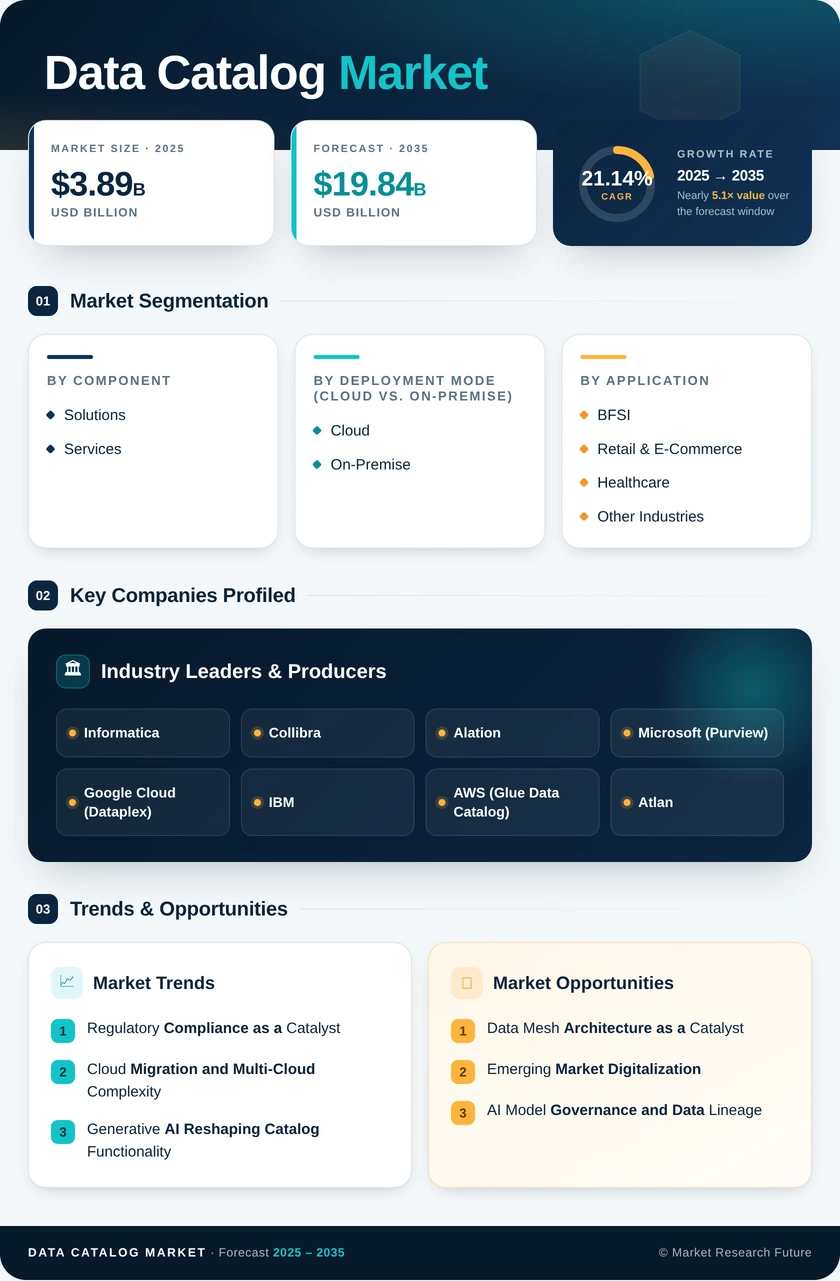
Segmentation Quick Reference
| Dimension | Sub-Segments | Dominant Segment | Fastest Growing Segment |
| By Component | Solutions, Data Catalog Markets | Solutions (76.4% share, 2025) | Data Catalog Markets (26.8% CAGR) |
| By Deployment Mode | Cloud, On-Premise | Cloud (85.8% share, 2025) | On-Premise (23.5% CAGR) |
| By End-User Industry | BFSI, Retail & E-Commerce, Data Catalog Market, Other Industries | BFSI (26.4% share, 2025) | Data Catalog Market (24.1% CAGR) |
| By Organization Size | Large Enterprises, SMEs | Large Enterprises (66.5% share, 2025) | SMEs (27.5% CAGR) |
| By Region | North America, Europe, Asia-Pacific, South America, Middle East & Africa | North America (44.9% share, 2025) | Asia-Pacific (25.4% CAGR) |
Market Segmentation Overview
By Component
| Sub-Segment | Key Trend |
| Solutions | AI-powered data discovery and tagging embedded natively into catalog platforms; consolidation of metadata ingestion, classification, search, and policy enforcement into unified interfaces |
| Data Catalog Markets | Rapid rise of managed catalog-as-a-service offerings and implementation consulting; growing demand for change management and stewardship training programs |
Solutions represent the revenue backbone of the Data Catalog Market, as enterprises consolidate metadata management, governance policy enforcement, and AI-driven classification into single-platform deployments. The services segment is accelerating as organizations — particularly SMEs — seek external expertise for enterprise data catalog for metadata management implementation, ongoing stewardship operations, and user adoption programs that shorten time-to-value.
By Deployment Mode
| Sub-Segment | Key Trend |
| Cloud | Multi-cloud governance demand driving SaaS catalog adoption; production-ready deployments achievable in under four weeks with elastic scaling |
| On-Premise | Persistent demand from defense, government, and financial institutions with strict data residency mandates; hybrid catalog architectures bridging legacy and modern infrastructure |
Cloud deployment dominates the Data Catalog Market as organizations prioritize rapid provisioning and automatic platform updates through SaaS consumption models. On-premise catalogs maintain relevance in regulated environments where data sovereignty requirements and legacy system integration necessitate hybrid approaches, and data catalog integration with BI and ETL tools must span both cloud-native and on-premise data estates.
By End-User Industry
| Sub-Segment | Key Trend |
| BFSI | Regulatory-driven adoption for Basel III/IV risk data aggregation, AML compliance, and operational resilience under DORA; granular data lineage visualization in data catalogs is now mandatory |
| Retail & E-Commerce | Customer data unification across channels; catalog-enabled personalization and privacy-compliant data sharing through clean rooms |
| Data Catalog Market | Clinical data interoperability mandates (21st Century Cures Act, HIPAA); growing use of data catalog for self-service analytics among research teams managing multi-site trial data |
| Other Industries | Manufacturing IoT data governance, energy sector asset metadata management, and telecom network data cataloging are driving adoption across non-core verticals |
BFSI leads vertical adoption because financial regulators globally now require traceable metadata infrastructure for risk reporting and anti-money-laundering compliance. Data Catalog Market is the fastest-growing end-user segment, propelled by interoperability mandates and the expanding use of AI-powered data discovery and tagging to classify clinical, genomic, and claims data at scale across distributed provider networks.
By Organization Size
| Sub-Segment | Key Trend |
| Large Enterprises | Complex, multi-domain data estates requiring federated catalog governance across business units; data mesh adoption driving decentralized catalog ownership models |
| SMEs | Low-code, cloud-native catalog platforms priced below USD 500/month, lowering adoption barriers; compliance pressure from supply-chain data sharing mandates extending catalog requirements downstream |
Large enterprises account for the majority of Data Catalog Market revenue today, driven by the need to govern sprawling data estates spanning hundreds of data sources and multiple cloud environments. SMEs represent the fastest-growing opportunity as enterprise data catalog for metadata management solutions become accessible through simplified deployment models, pre-configured industry templates, and subscription pricing that eliminates the need for dedicated data stewardship teams.

 Noah Malgeri
Co-Founder
Noah Malgeri
Co-Founder

 Peter Groot koerkamp
Account and Business Manager
Peter Groot koerkamp
Account and Business Manager

 Younghwan Choi
Senior Retail Manager
Younghwan Choi
Senior Retail Manager

 Mark Irwin
Management Consultant
Mark Irwin
Management Consultant

 Akif Moroglu
Strategy & Business Development Director
Akif Moroglu
Strategy & Business Development Director

 Guilherme Gomes Martins
Product Management Director
Guilherme Gomes Martins
Product Management Director

 Joseph Aguayo
Sales Operations & Pricing Manager
Joseph Aguayo
Sales Operations & Pricing Manager

 La Terria Dodd
Program Support Specialist
La Terria Dodd
Program Support Specialist

 Rob Kooiker
Group Product Manager HVAC & Fire Protection GMA
Rob Kooiker
Group Product Manager HVAC & Fire Protection GMA