
Request Free Sample ×

Kindly complete the form below to receive a free sample of this Report

* Please use a valid business email

Leading companies partner with us for data-driven Insights

clients tt-cursor
Hero Background
English
Chinese
French
Japanese
Korean
German
Spanish

Cybersecurity Market Share

ID: MRFR/ICT/0447-HCR
100 Pages
Apoorva Priyadarshi
March 2026

Cybersecurity Market Size, Share and Trends Analysis Research Report By Security Type (Network Security, Endpoint Security, Application Security, Cloud Security, Data Security), By Service Type (Consulting Services, Training and Education, Managed Security Services, Implementation Services, Support Services), By Deployment Type (On-premises, Cloud-based, Hybrid), By End Use (BFSI, Healthcare, Government, Retail, Telecommunications) and By Regional (North America, Europe, South America, Asia Pacific, Middle East and Africa) - Forecast to 2035

Share:
Download PDF ×

We do not share your information with anyone. However, we may send you emails based on your report interest from time to time. You may contact us at any time to opt-out.

Cyber Security Market Infographic
Purchase Options

Market Share

Cyber Security Market Share Analysis

The cyber security market is a dynamic and rapidly evolving industry driven by the threat image of the digital sector. In this competitive environment, market share positioning strategies play a key role in determining the success of cybersecurity companies. One common approach is differentiation, where firms try to differentiate their products or services from their competitors. This may include developing unique features, implementing the latest technologies or providing specialized solutions for specific industry needs. By standing out in a crowded market, companies can attract niche customers and gain a competitive advantage. Another important strategy is cost management, which includes the cheapest supplier in the market. This approach is particularly important in the cyber security sector, where cost-conscious customers are looking for efficient solutions without compromising on quality. Companies using this strategy focus on operational efficiencies, economies of scale and strategic partnerships to deliver cost-effective cyber security solutions. By offering competitive prices without compromising safety, these companies can gain significant market share and attract budget customers. Strategic alliances and partnerships also form a key part of the cybersecurity industry's market share. Cooperation with other technology companies, industry associations or government agencies can improve the company's capabilities and expand the market area. Such partnerships can lead to the development of comprehensive cybersecurity solutions that address a variety of threats. In addition, strategic alliances can help companies leverage each other's strengths, share resources, and jointly address complex cybersecurity challenges, ultimately strengthening their market position. Innovation is the cornerstone of success in the cyber security market. Companies that invest in research and development to stay ahead of new threats and technologies have a better chance of gaining market share. Continuous innovation enables companies to offer state-of-the-art solutions that appeal to customers looking for state-of-the-art cyber security measures. By demonstrating their commitment to staying ahead, these companies can establish themselves as market leaders and gain the trust of security-conscious customers. In addition, customer orientation is an important part of market share positioning. Understanding the unique needs of customers and providing customized solutions can foster long-term relationships and customer loyalty. Companies that prioritize customer satisfaction and support can build a positive reputation in the market, increasing market share through word of mouth recommendations and positive reviews. In addition, actively seeking customer feedback and adapting products or services based on customer input can improve a company's competitiveness. In the ever-changing cybersecurity threat landscape, adaptability and flexibility are critical. Companies that can quickly respond to emerging challenges and adapt their strategies accordingly have a better chance of success. This can include rapid product updates, integration of real-time threat intelligence and a proactive approach to cybersecurity trends. By demonstrating agility, companies can instill confidence in their customers and stakeholders, ultimately strengthening their market share.


Author
Author Profile
Apoorva Priyadarshi
Research Analyst

With 4+ years of experience in Market Intelligence and Strategic Research, Apoorv specializes in ICT, Semiconductor, and BFSI markets. Combining strong analytical capabilities with a deep understanding of technology-driven industries, he focuses on delivering data-driven insights that support strategic decision-making. With a background in technology and business research, Apoorv has contributed to numerous global market studies, competitive landscape analyses, and opportunity assessments across sectors such as semiconductors, digital banking, cybersecurity, and telecommunications.

Leave a Comment

FAQs

What is the current valuation of the Cybersecurity Market as of 2024?

<p>The Cybersecurity Market was valued at 151.57 USD Billion in 2024.</p>

What is the projected market size for the Cybersecurity Market by 2035?

<p>The market is projected to reach 495.62 USD Billion by 2035.</p>

What is the expected CAGR for the Cybersecurity Market during the forecast period 2025 - 2035?

<p>The expected CAGR for the Cybersecurity Market during 2025 - 2035 is 11.37%.</p>

Which segment of the Cybersecurity Market had the highest valuation in 2024?

<p>In 2024, Network Security had the highest valuation at 150.0 USD Billion.</p>

What are the projected valuations for Cloud Security by 2035?

<p>Cloud Security is projected to reach 60.0 USD Billion by 2035.</p>

Which service type is expected to grow the most in the Cybersecurity Market?

<p>Managed Security Services, valued at 150.0 USD Billion in 2024, is expected to grow significantly.</p>

What is the valuation range for Endpoint Security from 2024 to 2035?

<p>Endpoint Security is valued between 30.0 and 90.0 USD Billion in 2024 and is expected to grow by 2035.</p>

How does the valuation of On-premises deployment compare to Cloud-based deployment in 2024?

<p>In 2024, On-premises deployment was valued at 145.68 USD Billion, while Cloud-based deployment was valued at 210.84 USD Billion.</p>

Which end-use sector is projected to have the highest growth in the Cybersecurity Market?

<p>The BFSI sector, valued at 150.0 USD Billion in 2024, is projected to continue its strong growth.</p>

What are the key players currently leading the Cybersecurity Market?

<p>Key players in the Cybersecurity Market include Palo Alto Networks, Fortinet, Check Point Software, and Cisco Systems.</p>

Market Summary

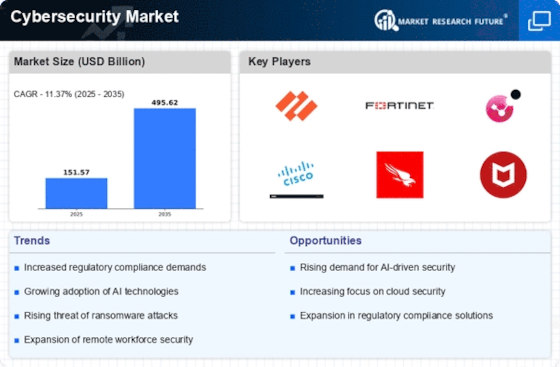
As per Market Research Future analysis, the Cybersecurity Market Size was estimated at 151.57 USD Billion in 2024. The Cybersecurity industry is projected to grow from 168.81 USD Billion in 2025 to 495.62 USD Billion by 2035, exhibiting a compound annual growth rate (CAGR) of 11.37% during the forecast period 2025 - 2035

Key Market Trends & Highlights

The Cybersecurity Market is experiencing robust growth driven by technological advancements and increasing cyber threats.

  • The rise of cloud security solutions is reshaping the cybersecurity landscape, particularly in the Asia-Pacific region. Regulatory compliance remains a critical focus for organizations, especially in North America, as they navigate complex legal frameworks. The integration of AI in cybersecurity is becoming increasingly prevalent, enhancing threat detection and response capabilities. The increase in cyber threats and the adoption of remote work policies are major drivers propelling market expansion.

Market Size & Forecast

2024 Market Size 151.57 (USD Billion)
2035 Market Size 495.62 (USD Billion)
CAGR (2025 - 2035) 11.37%
Largest Regional Market Share in 2024 North America

Major Players

<a title="Palo Alto Networks" href="https://www.paloaltonetworks.in/cyberpedia/cyber-security" target="_blank" rel="noopener">Palo Alto Networks</a> (US), Fortinet (US), Check Point Software (IL), Cisco Systems (US), CrowdStrike (US), McAfee (US), Symantec (US), <a title="Trend Micro" href="https://www.trendmicro.com/en_us/what-is/cybersecurity-platform.html" target="_blank" rel="noopener">Trend Micro</a> (JP), FireEye (US)

Market Trends

The Cybersecurity Market is currently experiencing a dynamic evolution, driven by the increasing complexity of cyber threats and the growing reliance on digital infrastructure across various sectors. Enterprises are increasingly implementing advanced cyber security measures such as zero-trust frameworks and continuous monitoring to strengthen their overall security posture. Organizations  are recognizing the necessity of robust security measures to protect sensitive data and maintain operational integrity. This report provides an introduction to cyber security, focusing on the role of computing security in protecting digital infrastructure. Cybersecurity, often referred to as cyber security, can be defined as the practice of safeguarding systems, networks, and data from unauthorized access and cyber threats.

Moreover, the integration of artificial intelligence and machine learning into cybersecurity frameworks is reshaping the industry. These technologies enable organizations to enhance threat detection and response capabilities, thereby improving overall security posture. Additionally, regulatory compliance requirements are becoming increasingly stringent, prompting organizations to invest in comprehensive cybersecurity measures. This trend indicates a shift towards a more holistic approach to security, where organizations not only focus on prevention but also on resilience and recovery. As the Cybersecurity Market continues to evolve, it is likely that innovation and collaboration will play pivotal roles in addressing emerging challenges and safeguarding digital assets.

The increasing frequency and sophistication of cybersecurity attacks, including various internet attacks types such as ransomware and phishing, continue to elevate the cyber security threat landscape globally. With accelerating digital transformation and regulatory mandates, cyber security remains in high demand, reinforcing sustained growth across the global cybersecurity market through 2035.

Rise of Cloud Security Solutions

The shift towards cloud computing is prompting a significant increase in the demand for cloud security solutions. Organizations are seeking to protect their data and applications hosted in the cloud, leading to the development of specialized security measures tailored for cloud environments. This trend reflects a broader recognition of the need for security that aligns with modern IT architectures. Organizations face significant cyber security risks, including data breaches and system vulnerabilities, which contribute to rising cybersecurity risks across critical industries such as BFSI and healthcare.

Focus on Regulatory Compliance

As data protection regulations become more stringent, organizations are prioritizing compliance as a critical aspect of their cybersecurity strategies. This focus on regulatory adherence is driving investments in technologies and services that ensure alignment with legal requirements, thereby reducing the risk of penalties and enhancing trust with stakeholders.

Integration of AI in Cybersecurity

The incorporation of artificial intelligence into cybersecurity practices is transforming how organizations approach threat detection and response. The terms cyber security or cybersecurity are used interchangeably in the industry, with cybersecurity increasingly recognized as a single-word standard. AI-driven solutions are enabling faster identification of vulnerabilities and more effective mitigation strategies, suggesting a future where automated systems play a central role in safeguarding digital environments. Advancements in cybersecurity technology are reshaping the industry, particularly through the integration of AI and automation. The convergence of technology and cyber security, including the adoption of generative AI in cybersecurity, is enabling faster threat detection and proactive risk mitigation.

Cyber Security Market Market Drivers

Increase in Cyber Threats

The Cybersecurity Market is experiencing a notable surge in demand due to the escalating frequency and sophistication of cyber threats. Organizations across various sectors are increasingly targeted by cybercriminals, leading to a heightened awareness of the need for robust cybersecurity measures. According to recent data, the number of reported cyber incidents has risen significantly, with ransomware attacks alone increasing by over 300% in the past year. This alarming trend compels businesses to invest in advanced cybersecurity solutions to protect sensitive data and maintain operational integrity. As a result, the Cybersecurity Market is projected to grow at a compound annual growth rate of approximately 10% over the next five years, reflecting the urgent need for enhanced security protocols.

Adoption of Remote Work Policies

The shift towards remote work has fundamentally altered the landscape of the Cybersecurity Market. As organizations embrace flexible work arrangements, the attack surface for cyber threats expands, necessitating the implementation of comprehensive cybersecurity strategies. Employees accessing corporate networks from various locations introduce vulnerabilities that cybercriminals are eager to exploit. Consequently, businesses are investing heavily in secure remote access solutions, such as virtual private networks (VPNs) and endpoint security measures. This trend is expected to drive the Cybersecurity Market, with estimates suggesting that the remote work segment could account for nearly 30% of total cybersecurity spending by 2026. Organizations are prioritizing investments in cybersecurity to safeguard their remote workforce and ensure business continuity.

Regulatory Compliance Requirements

The Cybersecurity Market is significantly influenced by the increasing emphasis on regulatory compliance across various sectors. Governments and regulatory bodies are enacting stringent data protection laws, compelling organizations to adopt comprehensive cybersecurity measures. Compliance with regulations such as the General Data Protection Regulation (GDPR) and the Health Insurance Portability and Accountability Act (HIPAA) necessitates substantial investments in cybersecurity infrastructure. Failure to comply can result in severe penalties, further motivating organizations to prioritize cybersecurity initiatives. As a result, the Cybersecurity Market is witnessing a surge in demand for compliance-focused solutions, with market analysts projecting that compliance-related cybersecurity spending will grow by approximately 15% annually over the next few years.

Integration of Advanced Technologies

The integration of advanced technologies is reshaping the Cybersecurity Market, as organizations seek innovative solutions to combat evolving cyber threats. Technologies such as artificial intelligence (AI), machine learning, and blockchain are being increasingly adopted to enhance threat detection and response capabilities. AI-driven cybersecurity solutions can analyze vast amounts of data in real-time, identifying anomalies and potential threats with unprecedented accuracy. This technological evolution is expected to propel the Cybersecurity Market, with forecasts indicating that AI-based cybersecurity solutions could account for over 40% of the market by 2027. Organizations are recognizing the necessity of leveraging advanced technologies to stay ahead of cybercriminals and protect their digital assets.

Growing Awareness of Cybersecurity Risks

The growing awareness of cybersecurity risks among businesses and consumers is a pivotal driver of the Cybersecurity Market. As high-profile data breaches and cyberattacks dominate headlines, stakeholders are becoming increasingly cognizant of the potential repercussions of inadequate cybersecurity measures. This heightened awareness is prompting organizations to prioritize cybersecurity investments, leading to a surge in demand for security solutions. Market data suggests that nearly 70% of businesses now consider cybersecurity a top priority, reflecting a cultural shift towards proactive risk management. Consequently, the Cybersecurity Market is expected to witness robust growth, as organizations strive to enhance their security posture and protect their reputations in an increasingly digital world.

Market Segment Insights

By Security Type: Network Security (Largest) vs. Cloud Security (Fastest-Growing)

<p>Network security remains the largest segment within the cybersecurity market, holding a substantial portion of the overall market share due to the critical need for protecting organizational infrastructure. Endpoint security follows this, focused primarily on defending endpoints like computers and mobile devices, while application security addresses vulnerabilities in software applications. Cloud security, increasingly vital with the rising adoption of cloud services, has also gained significant importance, alongside data security, which emphasizes protecting the integrity and confidentiality of information shared across various platforms.</p>

<p>Network Security (Dominant) vs. Cloud Security (Emerging)</p>

<p>Network security is characterized by its robust framework designed to defend networks from breaches and attacks, playing a crucial role in safeguarding sensitive data and maintaining operational continuity. As the dominant player, it encompasses solutions such as firewalls and intrusion detection systems. In contrast, cloud security represents an emerging force driven by the rapid shift of businesses to cloud-based infrastructures. This segment focuses on securing cloud-based data and applications against varied threats, motivated by the demand for flexibility and scalability. The increasing reliance on cloud technologies signifies the importance of cloud security, making it essential for organizations to adopt dual strategies focusing on both traditional and emerging security paradigms.</p>

By Service Type: Managed Security Services (Largest) vs. Training and Education (Fastest-Growing)

<p>In the Cybersecurity Market, the service type segment features a diverse array of offerings, with Managed Security Services (MSS) taking the lead in market share. It has become the preferred choice for organizations seeking to enhance their security posture efficiently. Following MSS, Consulting Services and Implementation Services account for significant shares as businesses continue to prioritize security assessments and technology deployments. Support Services also play a critical role, ensuring ongoing security maintenance.</p>

<p>Managed Security Services (Dominant) vs. Training and Education (Emerging)</p>

<p>Managed Security Services are at the forefront of the Cybersecurity Market, characterized by their comprehensive approach to threat response and security management for various organizations. As businesses increasingly migrate to cloud solutions and digital infrastructures, the demand for MSS continues to grow. In contrast, Training and Education services are emerging rapidly due to the escalating need for skilled cybersecurity professionals. These services focus on educating employees and IT staff on security best practices, as well as fostering awareness surrounding cyber threats, making them crucial for any organization's defense strategy. Both segments complement each other, highlighting the evolving landscape of cybersecurity.</p>

By Deployment Type: Cloud-based (Largest) vs. On-premises (Fastest-Growing)

<p>The deployment type segment of the cybersecurity market is characterized by a diverse distribution of solutions. As organizations increasingly prioritize flexibility and scalability, cloud-based cybersecurity solutions have emerged as the largest segment, capturing significant market share due to their ease of deployment and continuous updates. In contrast, the on-premises solutions appeal to sectors requiring stringent data control and compliance, making them an essential part of the market despite having a smaller portion of the share. Looking ahead, the growth trends in this segment are being influenced by several factors. The rapid adoption of digital transformation initiatives across industries has accelerated the demand for cloud-based cybersecurity services, which are often seen as more adaptive to modern security threats. Meanwhile, on-premises solutions are witnessing a resurgence, particularly in critical infrastructure sectors, as organizations seek to balance their need for advanced security with compliance mandates and data sovereignty requirements.</p>

<p>Cloud-based (Dominant) vs. On-premises (Emerging)</p>

<p>The cybersecurity landscape is currently dominated by cloud-based solutions, known for their scalability, ease of implementation, and continuous real-time updates. These solutions effectively address the growing complexities associated with cybersecurity threats in a fast-paced digital environment. On the other hand, on-premises solutions are emerging as a significant player, particularly in industries requiring stringent regulatory compliance and data governance. Despite being less adaptive than their cloud counterparts, these solutions provide organizations with heightened control over their data security posture, making them attractive for sectors such as finance and healthcare. Both deployment types serve critical roles, with cloud-based solutions leading the charge and on-premises solutions carving out their niche in compliance-driven sectors.</p>

By End Use: BFSI (Largest) vs. Healthcare (Fastest-Growing)

<p>The cybersecurity market for end use is notably dominated by the BFSI sector, which plays a pivotal role in shaping security standards due to its stringent regulatory requirements and high vulnerability to cyber threats. Healthcare follows closely, characterized by increasing digital health initiatives and the sensitive nature of patient data, highlighting its significant share in the market. Other sectors like Government, Retail, and Telecommunications also contribute to a competitive landscape, but they are comparatively smaller players in terms of market penetration and share.</p>

<p>BFSI: Dominant vs. Healthcare: Emerging</p>

<p>The BFSI sector is recognized for its robust cybersecurity investments, driven by regulatory obligations and the critical nature of safeguarding financial transactions and consumer information. Financial institutions invest heavily in advanced cybersecurity measures to maintain trust and comply with regulations. On the other hand, the healthcare sector is emerging rapidly due to the digitization of health records and the increasing incidence of cyber threats targeting healthcare data. This sector is adopting innovative cybersecurity solutions to protect sensitive patient information and ensure compliance with health regulations, making it one of the fastest-growing segments in the cybersecurity market.</p>

Get more detailed insights about Cybersecurity Market Research Report - Global Forecast to 2035

Regional Insights

North America : Cybersecurity Innovation Hub

North America remains the largest market for cybersecurity, holding approximately 45% of the global share. The region's growth is driven by increasing cyber threats, stringent regulations, and a robust technological infrastructure. The demand for advanced security solutions is further fueled by the rise of remote work and digital transformation initiatives across various sectors, including finance and healthcare sector. The United States is the dominant player in this market, with significant contributions from Canada. Key players such as Palo Alto Networks, Fortinet, and Cisco Systems are headquartered here, driving innovation and competition. The competitive landscape is characterized by continuous advancements in AI and machine learning technologies, enhancing threat detection and response capabilities. The presence of these industry leaders solidifies North America's position as a cybersecurity powerhouse.

Europe : Regulatory-Driven Market Growth

Europe is witnessing significant growth in the cybersecurity market, accounting for approximately 30% of the global share. The region's expansion is largely driven by stringent regulations such as the General Data Protection Regulation (GDPR) and the NIS Directive, which mandate robust cybersecurity measures across industries. The increasing frequency of cyberattacks has further catalyzed demand for comprehensive security solutions, making it a priority for governments and organizations alike. Leading countries in this region include the United Kingdom, Germany, and France, each contributing to the competitive landscape with a mix of local and international players. Companies like Check Point Software and Trend Micro are prominent, focusing on innovative solutions tailored to meet regulatory requirements. The European market is characterized by a collaborative approach, with public-private partnerships enhancing cybersecurity resilience across the continent.

Asia-Pacific : Emerging Cybersecurity Powerhouse

Asia-Pacific is rapidly emerging as a significant player in the cybersecurity market, holding approximately 20% of the global share. The region's growth is driven by increasing digitalization, rising cyber threats, and government initiatives aimed at enhancing cybersecurity infrastructure. Countries like China and India are leading this growth, with substantial investments in cybersecurity technologies and workforce development to combat evolving threats. The competitive landscape is diverse, with a mix of local and international players. Companies such as CrowdStrike and FireEye are expanding their presence in the region, focusing on tailored solutions for various industries. The demand for cloud security and endpoint protection is particularly high, as businesses seek to safeguard their digital assets in an increasingly interconnected world. The region's dynamic market is characterized by rapid technological advancements and a growing emphasis on cybersecurity awareness.

Middle East and Africa : Resource-Rich Cybersecurity Frontier

The Middle East and Africa region is increasingly recognizing the importance of cybersecurity, accounting for about 5% of the global cyber security market share. The growth is driven by rising cyber threats, government initiatives, and investments in digital transformation across various sectors. Countries like the UAE and South Africa are leading the charge, implementing national cybersecurity strategies to enhance resilience against cyberattacks. The competitive landscape is evolving, with both local and international players vying for market share. Companies such as McAfee and Symantec are establishing a foothold in the region, focusing on solutions tailored to meet the unique challenges faced by businesses. The emphasis on cybersecurity awareness and training is also growing, as organizations seek to build a skilled workforce capable of addressing emerging threats. The region's commitment to enhancing cybersecurity infrastructure is paving the way for future growth.

Key Players and Competitive Insights

The Cybersecurity Market is currently characterized by intense competition and rapid evolution, driven by increasing cyber threats and the growing need for robust security solutions across various sectors. Major players such as Palo Alto Networks (US), Fortinet (US), and CrowdStrike (US) are at the forefront, each adopting distinct strategies to enhance their market positioning. Palo Alto Networks (US) focuses on innovation through its advanced AI-driven security solutions, while Fortinet (US) emphasizes integrated security platforms that cater to diverse enterprise needs. CrowdStrike (US), on the other hand, leverages its cloud-native architecture to provide scalable and efficient security services, thereby shaping a competitive landscape that is increasingly reliant on technological advancement and strategic partnerships. The business tactics employed by these companies reflect a concerted effort to optimize operations and enhance service delivery. The Cybersecurity Market appears moderately fragmented, with a mix of established players and emerging startups. This structure allows for a dynamic interplay of competition, where key players influence market trends through strategic collaborations and technological innovations. Localizing manufacturing and optimizing supply chains are common tactics, enabling companies to respond swiftly to regional demands and regulatory requirements. In August 2025, Palo Alto Networks (US) announced a strategic partnership with a leading cloud service provider to enhance its security offerings for cloud environments. This collaboration is likely to bolster its market share by providing customers with integrated solutions that address the complexities of cloud security. Such partnerships not only expand service capabilities but also position Palo Alto Networks as a leader in the rapidly growing cloud security segment. In September 2025, Fortinet (US) launched a new suite of security solutions aimed at small and medium-sized enterprises (SMEs), reflecting a strategic pivot to capture a broader customer base. This move is significant as it addresses the unique security challenges faced by SMEs, which often lack the resources to implement comprehensive security measures. By tailoring solutions to this segment, Fortinet may enhance its competitive edge and drive revenue growth in an underserved market. In July 2025, CrowdStrike (US) expanded its global footprint by entering the Asia-Pacific market, establishing a regional headquarters in Singapore. This strategic expansion is indicative of the company's commitment to tapping into emerging markets where cybersecurity needs are rapidly increasing. By positioning itself in this region, CrowdStrike is likely to capitalize on the growing demand for advanced security solutions, thereby reinforcing its competitive stance. As of October 2025, the Cybersecurity Market is witnessing trends that emphasize digitalization, AI integration, and sustainability. Companies are increasingly forming strategic alliances to enhance their technological capabilities and market reach. The competitive differentiation is shifting from price-based strategies to a focus on innovation, technology, and supply chain reliability. This evolution suggests that future competition will hinge on the ability to deliver cutting-edge solutions that not only meet current security challenges but also anticipate future threats.

Key Companies in the Cyber Security Market include

Industry Developments

The Cybersecurity Market continues to experience significant developments, driven by an increase in cyber threats and growing reliance on digital infrastructure. In July 2023, Bae Systems announced its acquisition of a cybersecurity firm to enhance its defense capabilities. IBM, in August 2023, expanded its cybersecurity portfolio by integrating advanced AI solutions, enabling businesses to better detect and respond to threats. Additionally, Check Point Software Technologies has made notable advancements in threat intelligence, receiving recognition for its contributions to proactive cybersecurity measures.

Meanwhile, Palo Alto Networks reported a surge in demand for its cloud security solutions, reflecting the ongoing shift towards remote work and digital environments.

The market has seen growth in the valuations of major companies, with Fortinet reporting a notable increase in revenues in Q3 of 2023 attributed to its innovative security offerings. CyberArk has also expanded its market presence through strategic partnerships, allowing for enhanced identity security solutions. In recent years, organizations have prioritized investments in cybersecurity, with the market rapidly evolving to address sophisticated threats and data privacy concerns. The collective efforts of major companies in this sector highlight the critical importance of robust cybersecurity measures in safeguarding global digital ecosystems.

Future Outlook

Cyber Security Market Future Outlook

The Cybersecurity Market is projected to grow at 11.37% CAGR from 2025 to 2035, driven by increasing cyber threats, regulatory compliance, and digital transformation.

New opportunities lie in:

  • <p>Development of AI-driven threat detection systems Expansion of managed security service offerings Integration of cybersecurity solutions in IoT devices</p>

By 2035, the Cybersecurity Market is expected to be robust, reflecting substantial growth and innovation.

Market Segmentation

Cyber Security Market End Use Outlook

  • BFSI
  • Healthcare
  • Government
  • Retail
  • Telecommunications

Cyber Security Market Service Type Outlook

  • Consulting Services
  • Training and Education
  • Managed Security Services
  • Implementation Services
  • Support Services

Cyber Security Market Security Type Outlook

  • Network Security
  • Endpoint Security
  • Application Security
  • Cloud Security
  • Data Security

Cyber Security Market Deployment Type Outlook

  • On-premises
  • Cloud-based
  • Hybrid

Report Scope

MARKET SIZE 2024 151.57(USD Billion)
MARKET SIZE 2025 168.81(USD Billion)
MARKET SIZE 2035 495.62(USD Billion)
COMPOUND ANNUAL GROWTH RATE (CAGR) 11.37% (2025 - 2035)
REPORT COVERAGE Revenue Forecast, Competitive Landscape, Growth Factors, and Trends
BASE YEAR 2024
Market Forecast Period 2025 - 2035
Historical Data 2019 - 2024
Market Forecast Units USD Billion
Key Companies Profiled Palo Alto Networks (US), Fortinet (US), Check Point Software (IL), Cisco Systems (US), CrowdStrike (US), McAfee (US), Symantec (US), Trend Micro (JP), FireEye (US)
Segments Covered Security Type, Service Type, Deployment Type, End Use, Regional
Key Market Opportunities Integration of artificial intelligence in threat detection enhances resilience in the Cybersecurity Market.
Key Market Dynamics Rising cyber threats drive demand for advanced cybersecurity solutions, prompting rapid technological innovation and market consolidation.
Countries Covered North America, Europe, APAC, South America, MEA

FAQs

What is the current valuation of the Cybersecurity Market as of 2024?

<p>The Cybersecurity Market was valued at 151.57 USD Billion in 2024.</p>

What is the projected market size for the Cybersecurity Market by 2035?

<p>The market is projected to reach 495.62 USD Billion by 2035.</p>

What is the expected CAGR for the Cybersecurity Market during the forecast period 2025 - 2035?

<p>The expected CAGR for the Cybersecurity Market during 2025 - 2035 is 11.37%.</p>

Which segment of the Cybersecurity Market had the highest valuation in 2024?

<p>In 2024, Network Security had the highest valuation at 150.0 USD Billion.</p>

What are the projected valuations for Cloud Security by 2035?

<p>Cloud Security is projected to reach 60.0 USD Billion by 2035.</p>

Which service type is expected to grow the most in the Cybersecurity Market?

<p>Managed Security Services, valued at 150.0 USD Billion in 2024, is expected to grow significantly.</p>

What is the valuation range for Endpoint Security from 2024 to 2035?

<p>Endpoint Security is valued between 30.0 and 90.0 USD Billion in 2024 and is expected to grow by 2035.</p>

How does the valuation of On-premises deployment compare to Cloud-based deployment in 2024?

<p>In 2024, On-premises deployment was valued at 145.68 USD Billion, while Cloud-based deployment was valued at 210.84 USD Billion.</p>

Which end-use sector is projected to have the highest growth in the Cybersecurity Market?

<p>The BFSI sector, valued at 150.0 USD Billion in 2024, is projected to continue its strong growth.</p>

What are the key players currently leading the Cybersecurity Market?

<p>Key players in the Cybersecurity Market include Palo Alto Networks, Fortinet, Check Point Software, and Cisco Systems.</p>

  1. SECTION I: EXECUTIVE SUMMARY AND KEY HIGHLIGHTS
    1. | 1.1 EXECUTIVE SUMMARY
    2. | | 1.1.1 Market Overview
    3. | | 1.1.2 Key Findings
    4. | | 1.1.3 Market Segmentation
    5. | | 1.1.4 Competitive Landscape
    6. | | 1.1.5 Challenges and Opportunities
    7. | | 1.1.6 Future Outlook
  2. SECTION II: SCOPING, METHODOLOGY AND MARKET STRUCTURE
    1. | 2.1 MARKET INTRODUCTION
    2. | | 2.1.1 Definition
    3. | | 2.1.2 Scope of the study
    4. | | | 2.1.2.1 Research Objective
    5. | | | 2.1.2.2 Assumption
    6. | | | 2.1.2.3 Limitations
    7. | 2.2 RESEARCH METHODOLOGY
    8. | | 2.2.1 Overview
    9. | | 2.2.2 Data Mining
    10. | | 2.2.3 Secondary Research
    11. | | 2.2.4 Primary Research
    12. | | | 2.2.4.1 Primary Interviews and Information Gathering Process
    13. | | | 2.2.4.2 Breakdown of Primary Respondents
    14. | | 2.2.5 Forecasting Model
    15. | | 2.2.6 Market Size Estimation
    16. | | | 2.2.6.1 Bottom-Up Approach
    17. | | | 2.2.6.2 Top-Down Approach
    18. | | 2.2.7 Data Triangulation
    19. | | 2.2.8 Validation
  3. SECTION III: QUALITATIVE ANALYSIS
    1. | 3.1 MARKET DYNAMICS
    2. | | 3.1.1 Overview
    3. | | 3.1.2 Drivers
    4. | | 3.1.3 Restraints
    5. | | 3.1.4 Opportunities
    6. | 3.2 MARKET FACTOR ANALYSIS
    7. | | 3.2.1 Value chain Analysis
    8. | | 3.2.2 Porter's Five Forces Analysis
    9. | | | 3.2.2.1 Bargaining Power of Suppliers
    10. | | | 3.2.2.2 Bargaining Power of Buyers
    11. | | | 3.2.2.3 Threat of New Entrants
    12. | | | 3.2.2.4 Threat of Substitutes
    13. | | | 3.2.2.5 Intensity of Rivalry
    14. | | 3.2.3 COVID-19 Impact Analysis
    15. | | | 3.2.3.1 Market Impact Analysis
    16. | | | 3.2.3.2 Regional Impact
    17. | | | 3.2.3.3 Opportunity and Threat Analysis
  4. SECTION IV: QUANTITATIVE ANALYSIS
    1. | 4.1 Information and Communications Technology, BY Security Type (USD Billion)
    2. | | 4.1.1 Network Security
    3. | | 4.1.2 Endpoint Security
    4. | | 4.1.3 Application Security
    5. | | 4.1.4 Cloud Security
    6. | | 4.1.5 Data Security
    7. | 4.2 Information and Communications Technology, BY Service Type (USD Billion)
    8. | | 4.2.1 Consulting Services
    9. | | 4.2.2 Training and Education
    10. | | 4.2.3 Managed Security Services
    11. | | 4.2.4 Implementation Services
    12. | | 4.2.5 Support Services
    13. | 4.3 Information and Communications Technology, BY Deployment Type (USD Billion)
    14. | | 4.3.1 On-premises
    15. | | 4.3.2 Cloud-based
    16. | | 4.3.3 Hybrid
    17. | 4.4 Information and Communications Technology, BY End Use (USD Billion)
    18. | | 4.4.1 BFSI
    19. | | 4.4.2 Healthcare
    20. | | 4.4.3 Government
    21. | | 4.4.4 Retail
    22. | | 4.4.5 Telecommunications
    23. | 4.5 Information and Communications Technology, BY Region (USD Billion)
    24. | | 4.5.1 North America
    25. | | | 4.5.1.1 US
    26. | | | 4.5.1.2 Canada
    27. | | 4.5.2 Europe
    28. | | | 4.5.2.1 Germany
    29. | | | 4.5.2.2 UK
    30. | | | 4.5.2.3 France
    31. | | | 4.5.2.4 Russia
    32. | | | 4.5.2.5 Italy
    33. | | | 4.5.2.6 Spain
    34. | | | 4.5.2.7 Rest of Europe
    35. | | 4.5.3 APAC
    36. | | | 4.5.3.1 China
    37. | | | 4.5.3.2 India
    38. | | | 4.5.3.3 Japan
    39. | | | 4.5.3.4 South Korea
    40. | | | 4.5.3.5 Malaysia
    41. | | | 4.5.3.6 Thailand
    42. | | | 4.5.3.7 Indonesia
    43. | | | 4.5.3.8 Rest of APAC
    44. | | 4.5.4 South America
    45. | | | 4.5.4.1 Brazil
    46. | | | 4.5.4.2 Mexico
    47. | | | 4.5.4.3 Argentina
    48. | | | 4.5.4.4 Rest of South America
    49. | | 4.5.5 MEA
    50. | | | 4.5.5.1 GCC Countries
    51. | | | 4.5.5.2 South Africa
    52. | | | 4.5.5.3 Rest of MEA
  5. SECTION V: COMPETITIVE ANALYSIS
    1. | 5.1 Competitive Landscape
    2. | | 5.1.1 Overview
    3. | | 5.1.2 Competitive Analysis
    4. | | 5.1.3 Market share Analysis
    5. | | 5.1.4 Major Growth Strategy in the Information and Communications Technology
    6. | | 5.1.5 Competitive Benchmarking
    7. | | 5.1.6 Leading Players in Terms of Number of Developments in the Information and Communications Technology
    8. | | 5.1.7 Key developments and growth strategies
    9. | | | 5.1.7.1 New Product Launch/Service Deployment
    10. | | | 5.1.7.2 Merger & Acquisitions
    11. | | | 5.1.7.3 Joint Ventures
    12. | | 5.1.8 Major Players Financial Matrix
    13. | | | 5.1.8.1 Sales and Operating Income
    14. | | | 5.1.8.2 Major Players R&D Expenditure. 2023
    15. | 5.2 Company Profiles
    16. | | 5.2.1 Palo Alto Networks (US)
    17. | | | 5.2.1.1 Financial Overview
    18. | | | 5.2.1.2 Products Offered
    19. | | | 5.2.1.3 Key Developments
    20. | | | 5.2.1.4 SWOT Analysis
    21. | | | 5.2.1.5 Key Strategies
    22. | | 5.2.2 Fortinet (US)
    23. | | | 5.2.2.1 Financial Overview
    24. | | | 5.2.2.2 Products Offered
    25. | | | 5.2.2.3 Key Developments
    26. | | | 5.2.2.4 SWOT Analysis
    27. | | | 5.2.2.5 Key Strategies
    28. | | 5.2.3 Check Point Software (IL)
    29. | | | 5.2.3.1 Financial Overview
    30. | | | 5.2.3.2 Products Offered
    31. | | | 5.2.3.3 Key Developments
    32. | | | 5.2.3.4 SWOT Analysis
    33. | | | 5.2.3.5 Key Strategies
    34. | | 5.2.4 Cisco Systems (US)
    35. | | | 5.2.4.1 Financial Overview
    36. | | | 5.2.4.2 Products Offered
    37. | | | 5.2.4.3 Key Developments
    38. | | | 5.2.4.4 SWOT Analysis
    39. | | | 5.2.4.5 Key Strategies
    40. | | 5.2.5 CrowdStrike (US)
    41. | | | 5.2.5.1 Financial Overview
    42. | | | 5.2.5.2 Products Offered
    43. | | | 5.2.5.3 Key Developments
    44. | | | 5.2.5.4 SWOT Analysis
    45. | | | 5.2.5.5 Key Strategies
    46. | | 5.2.6 McAfee (US)
    47. | | | 5.2.6.1 Financial Overview
    48. | | | 5.2.6.2 Products Offered
    49. | | | 5.2.6.3 Key Developments
    50. | | | 5.2.6.4 SWOT Analysis
    51. | | | 5.2.6.5 Key Strategies
    52. | | 5.2.7 Symantec (US)
    53. | | | 5.2.7.1 Financial Overview
    54. | | | 5.2.7.2 Products Offered
    55. | | | 5.2.7.3 Key Developments
    56. | | | 5.2.7.4 SWOT Analysis
    57. | | | 5.2.7.5 Key Strategies
    58. | | 5.2.8 Trend Micro (JP)
    59. | | | 5.2.8.1 Financial Overview
    60. | | | 5.2.8.2 Products Offered
    61. | | | 5.2.8.3 Key Developments
    62. | | | 5.2.8.4 SWOT Analysis
    63. | | | 5.2.8.5 Key Strategies
    64. | | 5.2.9 FireEye (US)
    65. | | | 5.2.9.1 Financial Overview
    66. | | | 5.2.9.2 Products Offered
    67. | | | 5.2.9.3 Key Developments
    68. | | | 5.2.9.4 SWOT Analysis
    69. | | | 5.2.9.5 Key Strategies
    70. | 5.3 Appendix
    71. | | 5.3.1 References
    72. | | 5.3.2 Related Reports
  6. LIST OF FIGURES
    1. | 6.1 MARKET SYNOPSIS
    2. | 6.2 NORTH AMERICA MARKET ANALYSIS
    3. | 6.3 US MARKET ANALYSIS BY SECURITY TYPE
    4. | 6.4 US MARKET ANALYSIS BY SERVICE TYPE
    5. | 6.5 US MARKET ANALYSIS BY DEPLOYMENT TYPE
    6. | 6.6 US MARKET ANALYSIS BY END USE
    7. | 6.7 CANADA MARKET ANALYSIS BY SECURITY TYPE
    8. | 6.8 CANADA MARKET ANALYSIS BY SERVICE TYPE
    9. | 6.9 CANADA MARKET ANALYSIS BY DEPLOYMENT TYPE
    10. | 6.10 CANADA MARKET ANALYSIS BY END USE
    11. | 6.11 EUROPE MARKET ANALYSIS
    12. | 6.12 GERMANY MARKET ANALYSIS BY SECURITY TYPE
    13. | 6.13 GERMANY MARKET ANALYSIS BY SERVICE TYPE
    14. | 6.14 GERMANY MARKET ANALYSIS BY DEPLOYMENT TYPE
    15. | 6.15 GERMANY MARKET ANALYSIS BY END USE
    16. | 6.16 UK MARKET ANALYSIS BY SECURITY TYPE
    17. | 6.17 UK MARKET ANALYSIS BY SERVICE TYPE
    18. | 6.18 UK MARKET ANALYSIS BY DEPLOYMENT TYPE
    19. | 6.19 UK MARKET ANALYSIS BY END USE
    20. | 6.20 FRANCE MARKET ANALYSIS BY SECURITY TYPE
    21. | 6.21 FRANCE MARKET ANALYSIS BY SERVICE TYPE
    22. | 6.22 FRANCE MARKET ANALYSIS BY DEPLOYMENT TYPE
    23. | 6.23 FRANCE MARKET ANALYSIS BY END USE
    24. | 6.24 RUSSIA MARKET ANALYSIS BY SECURITY TYPE
    25. | 6.25 RUSSIA MARKET ANALYSIS BY SERVICE TYPE
    26. | 6.26 RUSSIA MARKET ANALYSIS BY DEPLOYMENT TYPE
    27. | 6.27 RUSSIA MARKET ANALYSIS BY END USE
    28. | 6.28 ITALY MARKET ANALYSIS BY SECURITY TYPE
    29. | 6.29 ITALY MARKET ANALYSIS BY SERVICE TYPE
    30. | 6.30 ITALY MARKET ANALYSIS BY DEPLOYMENT TYPE
    31. | 6.31 ITALY MARKET ANALYSIS BY END USE
    32. | 6.32 SPAIN MARKET ANALYSIS BY SECURITY TYPE
    33. | 6.33 SPAIN MARKET ANALYSIS BY SERVICE TYPE
    34. | 6.34 SPAIN MARKET ANALYSIS BY DEPLOYMENT TYPE
    35. | 6.35 SPAIN MARKET ANALYSIS BY END USE
    36. | 6.36 REST OF EUROPE MARKET ANALYSIS BY SECURITY TYPE
    37. | 6.37 REST OF EUROPE MARKET ANALYSIS BY SERVICE TYPE
    38. | 6.38 REST OF EUROPE MARKET ANALYSIS BY DEPLOYMENT TYPE
    39. | 6.39 REST OF EUROPE MARKET ANALYSIS BY END USE
    40. | 6.40 APAC MARKET ANALYSIS
    41. | 6.41 CHINA MARKET ANALYSIS BY SECURITY TYPE
    42. | 6.42 CHINA MARKET ANALYSIS BY SERVICE TYPE
    43. | 6.43 CHINA MARKET ANALYSIS BY DEPLOYMENT TYPE
    44. | 6.44 CHINA MARKET ANALYSIS BY END USE
    45. | 6.45 INDIA MARKET ANALYSIS BY SECURITY TYPE
    46. | 6.46 INDIA MARKET ANALYSIS BY SERVICE TYPE
    47. | 6.47 INDIA MARKET ANALYSIS BY DEPLOYMENT TYPE
    48. | 6.48 INDIA MARKET ANALYSIS BY END USE
    49. | 6.49 JAPAN MARKET ANALYSIS BY SECURITY TYPE
    50. | 6.50 JAPAN MARKET ANALYSIS BY SERVICE TYPE
    51. | 6.51 JAPAN MARKET ANALYSIS BY DEPLOYMENT TYPE
    52. | 6.52 JAPAN MARKET ANALYSIS BY END USE
    53. | 6.53 SOUTH KOREA MARKET ANALYSIS BY SECURITY TYPE
    54. | 6.54 SOUTH KOREA MARKET ANALYSIS BY SERVICE TYPE
    55. | 6.55 SOUTH KOREA MARKET ANALYSIS BY DEPLOYMENT TYPE
    56. | 6.56 SOUTH KOREA MARKET ANALYSIS BY END USE
    57. | 6.57 MALAYSIA MARKET ANALYSIS BY SECURITY TYPE
    58. | 6.58 MALAYSIA MARKET ANALYSIS BY SERVICE TYPE
    59. | 6.59 MALAYSIA MARKET ANALYSIS BY DEPLOYMENT TYPE
    60. | 6.60 MALAYSIA MARKET ANALYSIS BY END USE
    61. | 6.61 THAILAND MARKET ANALYSIS BY SECURITY TYPE
    62. | 6.62 THAILAND MARKET ANALYSIS BY SERVICE TYPE
    63. | 6.63 THAILAND MARKET ANALYSIS BY DEPLOYMENT TYPE
    64. | 6.64 THAILAND MARKET ANALYSIS BY END USE
    65. | 6.65 INDONESIA MARKET ANALYSIS BY SECURITY TYPE
    66. | 6.66 INDONESIA MARKET ANALYSIS BY SERVICE TYPE
    67. | 6.67 INDONESIA MARKET ANALYSIS BY DEPLOYMENT TYPE
    68. | 6.68 INDONESIA MARKET ANALYSIS BY END USE
    69. | 6.69 REST OF APAC MARKET ANALYSIS BY SECURITY TYPE
    70. | 6.70 REST OF APAC MARKET ANALYSIS BY SERVICE TYPE
    71. | 6.71 REST OF APAC MARKET ANALYSIS BY DEPLOYMENT TYPE
    72. | 6.72 REST OF APAC MARKET ANALYSIS BY END USE
    73. | 6.73 SOUTH AMERICA MARKET ANALYSIS
    74. | 6.74 BRAZIL MARKET ANALYSIS BY SECURITY TYPE
    75. | 6.75 BRAZIL MARKET ANALYSIS BY SERVICE TYPE
    76. | 6.76 BRAZIL MARKET ANALYSIS BY DEPLOYMENT TYPE
    77. | 6.77 BRAZIL MARKET ANALYSIS BY END USE
    78. | 6.78 MEXICO MARKET ANALYSIS BY SECURITY TYPE
    79. | 6.79 MEXICO MARKET ANALYSIS BY SERVICE TYPE
    80. | 6.80 MEXICO MARKET ANALYSIS BY DEPLOYMENT TYPE
    81. | 6.81 MEXICO MARKET ANALYSIS BY END USE
    82. | 6.82 ARGENTINA MARKET ANALYSIS BY SECURITY TYPE
    83. | 6.83 ARGENTINA MARKET ANALYSIS BY SERVICE TYPE
    84. | 6.84 ARGENTINA MARKET ANALYSIS BY DEPLOYMENT TYPE
    85. | 6.85 ARGENTINA MARKET ANALYSIS BY END USE
    86. | 6.86 REST OF SOUTH AMERICA MARKET ANALYSIS BY SECURITY TYPE
    87. | 6.87 REST OF SOUTH AMERICA MARKET ANALYSIS BY SERVICE TYPE
    88. | 6.88 REST OF SOUTH AMERICA MARKET ANALYSIS BY DEPLOYMENT TYPE
    89. | 6.89 REST OF SOUTH AMERICA MARKET ANALYSIS BY END USE
    90. | 6.90 MEA MARKET ANALYSIS
    91. | 6.91 GCC COUNTRIES MARKET ANALYSIS BY SECURITY TYPE
    92. | 6.92 GCC COUNTRIES MARKET ANALYSIS BY SERVICE TYPE
    93. | 6.93 GCC COUNTRIES MARKET ANALYSIS BY DEPLOYMENT TYPE
    94. | 6.94 GCC COUNTRIES MARKET ANALYSIS BY END USE
    95. | 6.95 SOUTH AFRICA MARKET ANALYSIS BY SECURITY TYPE
    96. | 6.96 SOUTH AFRICA MARKET ANALYSIS BY SERVICE TYPE
    97. | 6.97 SOUTH AFRICA MARKET ANALYSIS BY DEPLOYMENT TYPE
    98. | 6.98 SOUTH AFRICA MARKET ANALYSIS BY END USE
    99. | 6.99 REST OF MEA MARKET ANALYSIS BY SECURITY TYPE
    100. | 6.100 REST OF MEA MARKET ANALYSIS BY SERVICE TYPE
    101. | 6.101 REST OF MEA MARKET ANALYSIS BY DEPLOYMENT TYPE
    102. | 6.102 REST OF MEA MARKET ANALYSIS BY END USE
    103. | 6.103 KEY BUYING CRITERIA OF INFORMATION AND COMMUNICATIONS TECHNOLOGY
    104. | 6.104 RESEARCH PROCESS OF MRFR
    105. | 6.105 DRO ANALYSIS OF INFORMATION AND COMMUNICATIONS TECHNOLOGY
    106. | 6.106 DRIVERS IMPACT ANALYSIS: INFORMATION AND COMMUNICATIONS TECHNOLOGY
    107. | 6.107 RESTRAINTS IMPACT ANALYSIS: INFORMATION AND COMMUNICATIONS TECHNOLOGY
    108. | 6.108 SUPPLY / VALUE CHAIN: INFORMATION AND COMMUNICATIONS TECHNOLOGY
    109. | 6.109 INFORMATION AND COMMUNICATIONS TECHNOLOGY, BY SECURITY TYPE, 2024 (% SHARE)
    110. | 6.110 INFORMATION AND COMMUNICATIONS TECHNOLOGY, BY SECURITY TYPE, 2024 TO 2035 (USD Billion)
    111. | 6.111 INFORMATION AND COMMUNICATIONS TECHNOLOGY, BY SERVICE TYPE, 2024 (% SHARE)
    112. | 6.112 INFORMATION AND COMMUNICATIONS TECHNOLOGY, BY SERVICE TYPE, 2024 TO 2035 (USD Billion)
    113. | 6.113 INFORMATION AND COMMUNICATIONS TECHNOLOGY, BY DEPLOYMENT TYPE, 2024 (% SHARE)
    114. | 6.114 INFORMATION AND COMMUNICATIONS TECHNOLOGY, BY DEPLOYMENT TYPE, 2024 TO 2035 (USD Billion)
    115. | 6.115 INFORMATION AND COMMUNICATIONS TECHNOLOGY, BY END USE, 2024 (% SHARE)
    116. | 6.116 INFORMATION AND COMMUNICATIONS TECHNOLOGY, BY END USE, 2024 TO 2035 (USD Billion)
    117. | 6.117 BENCHMARKING OF MAJOR COMPETITORS
  7. LIST OF TABLES
    1. | 7.1 LIST OF ASSUMPTIONS
    2. | | 7.1.1
    3. | 7.2 North America MARKET SIZE ESTIMATES; FORECAST
    4. | | 7.2.1 BY SECURITY TYPE, 2025-2035 (USD Billion)
    5. | | 7.2.2 BY SERVICE TYPE, 2025-2035 (USD Billion)
    6. | | 7.2.3 BY DEPLOYMENT TYPE, 2025-2035 (USD Billion)
    7. | | 7.2.4 BY END USE, 2025-2035 (USD Billion)
    8. | 7.3 US MARKET SIZE ESTIMATES; FORECAST
    9. | | 7.3.1 BY SECURITY TYPE, 2025-2035 (USD Billion)
    10. | | 7.3.2 BY SERVICE TYPE, 2025-2035 (USD Billion)
    11. | | 7.3.3 BY DEPLOYMENT TYPE, 2025-2035 (USD Billion)
    12. | | 7.3.4 BY END USE, 2025-2035 (USD Billion)
    13. | 7.4 Canada MARKET SIZE ESTIMATES; FORECAST
    14. | | 7.4.1 BY SECURITY TYPE, 2025-2035 (USD Billion)
    15. | | 7.4.2 BY SERVICE TYPE, 2025-2035 (USD Billion)
    16. | | 7.4.3 BY DEPLOYMENT TYPE, 2025-2035 (USD Billion)
    17. | | 7.4.4 BY END USE, 2025-2035 (USD Billion)
    18. | 7.5 Europe MARKET SIZE ESTIMATES; FORECAST
    19. | | 7.5.1 BY SECURITY TYPE, 2025-2035 (USD Billion)
    20. | | 7.5.2 BY SERVICE TYPE, 2025-2035 (USD Billion)
    21. | | 7.5.3 BY DEPLOYMENT TYPE, 2025-2035 (USD Billion)
    22. | | 7.5.4 BY END USE, 2025-2035 (USD Billion)
    23. | 7.6 Germany MARKET SIZE ESTIMATES; FORECAST
    24. | | 7.6.1 BY SECURITY TYPE, 2025-2035 (USD Billion)
    25. | | 7.6.2 BY SERVICE TYPE, 2025-2035 (USD Billion)
    26. | | 7.6.3 BY DEPLOYMENT TYPE, 2025-2035 (USD Billion)
    27. | | 7.6.4 BY END USE, 2025-2035 (USD Billion)
    28. | 7.7 UK MARKET SIZE ESTIMATES; FORECAST
    29. | | 7.7.1 BY SECURITY TYPE, 2025-2035 (USD Billion)
    30. | | 7.7.2 BY SERVICE TYPE, 2025-2035 (USD Billion)
    31. | | 7.7.3 BY DEPLOYMENT TYPE, 2025-2035 (USD Billion)
    32. | | 7.7.4 BY END USE, 2025-2035 (USD Billion)
    33. | 7.8 France MARKET SIZE ESTIMATES; FORECAST
    34. | | 7.8.1 BY SECURITY TYPE, 2025-2035 (USD Billion)
    35. | | 7.8.2 BY SERVICE TYPE, 2025-2035 (USD Billion)
    36. | | 7.8.3 BY DEPLOYMENT TYPE, 2025-2035 (USD Billion)
    37. | | 7.8.4 BY END USE, 2025-2035 (USD Billion)
    38. | 7.9 Russia MARKET SIZE ESTIMATES; FORECAST
    39. | | 7.9.1 BY SECURITY TYPE, 2025-2035 (USD Billion)
    40. | | 7.9.2 BY SERVICE TYPE, 2025-2035 (USD Billion)
    41. | | 7.9.3 BY DEPLOYMENT TYPE, 2025-2035 (USD Billion)
    42. | | 7.9.4 BY END USE, 2025-2035 (USD Billion)
    43. | 7.10 Italy MARKET SIZE ESTIMATES; FORECAST
    44. | | 7.10.1 BY SECURITY TYPE, 2025-2035 (USD Billion)
    45. | | 7.10.2 BY SERVICE TYPE, 2025-2035 (USD Billion)
    46. | | 7.10.3 BY DEPLOYMENT TYPE, 2025-2035 (USD Billion)
    47. | | 7.10.4 BY END USE, 2025-2035 (USD Billion)
    48. | 7.11 Spain MARKET SIZE ESTIMATES; FORECAST
    49. | | 7.11.1 BY SECURITY TYPE, 2025-2035 (USD Billion)
    50. | | 7.11.2 BY SERVICE TYPE, 2025-2035 (USD Billion)
    51. | | 7.11.3 BY DEPLOYMENT TYPE, 2025-2035 (USD Billion)
    52. | | 7.11.4 BY END USE, 2025-2035 (USD Billion)
    53. | 7.12 Rest of Europe MARKET SIZE ESTIMATES; FORECAST
    54. | | 7.12.1 BY SECURITY TYPE, 2025-2035 (USD Billion)
    55. | | 7.12.2 BY SERVICE TYPE, 2025-2035 (USD Billion)
    56. | | 7.12.3 BY DEPLOYMENT TYPE, 2025-2035 (USD Billion)
    57. | | 7.12.4 BY END USE, 2025-2035 (USD Billion)
    58. | 7.13 APAC MARKET SIZE ESTIMATES; FORECAST
    59. | | 7.13.1 BY SECURITY TYPE, 2025-2035 (USD Billion)
    60. | | 7.13.2 BY SERVICE TYPE, 2025-2035 (USD Billion)
    61. | | 7.13.3 BY DEPLOYMENT TYPE, 2025-2035 (USD Billion)
    62. | | 7.13.4 BY END USE, 2025-2035 (USD Billion)
    63. | 7.14 China MARKET SIZE ESTIMATES; FORECAST
    64. | | 7.14.1 BY SECURITY TYPE, 2025-2035 (USD Billion)
    65. | | 7.14.2 BY SERVICE TYPE, 2025-2035 (USD Billion)
    66. | | 7.14.3 BY DEPLOYMENT TYPE, 2025-2035 (USD Billion)
    67. | | 7.14.4 BY END USE, 2025-2035 (USD Billion)
    68. | 7.15 India MARKET SIZE ESTIMATES; FORECAST
    69. | | 7.15.1 BY SECURITY TYPE, 2025-2035 (USD Billion)
    70. | | 7.15.2 BY SERVICE TYPE, 2025-2035 (USD Billion)
    71. | | 7.15.3 BY DEPLOYMENT TYPE, 2025-2035 (USD Billion)
    72. | | 7.15.4 BY END USE, 2025-2035 (USD Billion)
    73. | 7.16 Japan MARKET SIZE ESTIMATES; FORECAST
    74. | | 7.16.1 BY SECURITY TYPE, 2025-2035 (USD Billion)
    75. | | 7.16.2 BY SERVICE TYPE, 2025-2035 (USD Billion)
    76. | | 7.16.3 BY DEPLOYMENT TYPE, 2025-2035 (USD Billion)
    77. | | 7.16.4 BY END USE, 2025-2035 (USD Billion)
    78. | 7.17 South Korea MARKET SIZE ESTIMATES; FORECAST
    79. | | 7.17.1 BY SECURITY TYPE, 2025-2035 (USD Billion)
    80. | | 7.17.2 BY SERVICE TYPE, 2025-2035 (USD Billion)
    81. | | 7.17.3 BY DEPLOYMENT TYPE, 2025-2035 (USD Billion)
    82. | | 7.17.4 BY END USE, 2025-2035 (USD Billion)
    83. | 7.18 Malaysia MARKET SIZE ESTIMATES; FORECAST
    84. | | 7.18.1 BY SECURITY TYPE, 2025-2035 (USD Billion)
    85. | | 7.18.2 BY SERVICE TYPE, 2025-2035 (USD Billion)
    86. | | 7.18.3 BY DEPLOYMENT TYPE, 2025-2035 (USD Billion)
    87. | | 7.18.4 BY END USE, 2025-2035 (USD Billion)
    88. | 7.19 Thailand MARKET SIZE ESTIMATES; FORECAST
    89. | | 7.19.1 BY SECURITY TYPE, 2025-2035 (USD Billion)
    90. | | 7.19.2 BY SERVICE TYPE, 2025-2035 (USD Billion)
    91. | | 7.19.3 BY DEPLOYMENT TYPE, 2025-2035 (USD Billion)
    92. | | 7.19.4 BY END USE, 2025-2035 (USD Billion)
    93. | 7.20 Indonesia MARKET SIZE ESTIMATES; FORECAST
    94. | | 7.20.1 BY SECURITY TYPE, 2025-2035 (USD Billion)
    95. | | 7.20.2 BY SERVICE TYPE, 2025-2035 (USD Billion)
    96. | | 7.20.3 BY DEPLOYMENT TYPE, 2025-2035 (USD Billion)
    97. | | 7.20.4 BY END USE, 2025-2035 (USD Billion)
    98. | 7.21 Rest of APAC MARKET SIZE ESTIMATES; FORECAST
    99. | | 7.21.1 BY SECURITY TYPE, 2025-2035 (USD Billion)
    100. | | 7.21.2 BY SERVICE TYPE, 2025-2035 (USD Billion)
    101. | | 7.21.3 BY DEPLOYMENT TYPE, 2025-2035 (USD Billion)
    102. | | 7.21.4 BY END USE, 2025-2035 (USD Billion)
    103. | 7.22 South America MARKET SIZE ESTIMATES; FORECAST
    104. | | 7.22.1 BY SECURITY TYPE, 2025-2035 (USD Billion)
    105. | | 7.22.2 BY SERVICE TYPE, 2025-2035 (USD Billion)
    106. | | 7.22.3 BY DEPLOYMENT TYPE, 2025-2035 (USD Billion)
    107. | | 7.22.4 BY END USE, 2025-2035 (USD Billion)
    108. | 7.23 Brazil MARKET SIZE ESTIMATES; FORECAST
    109. | | 7.23.1 BY SECURITY TYPE, 2025-2035 (USD Billion)
    110. | | 7.23.2 BY SERVICE TYPE, 2025-2035 (USD Billion)
    111. | | 7.23.3 BY DEPLOYMENT TYPE, 2025-2035 (USD Billion)
    112. | | 7.23.4 BY END USE, 2025-2035 (USD Billion)
    113. | 7.24 Mexico MARKET SIZE ESTIMATES; FORECAST
    114. | | 7.24.1 BY SECURITY TYPE, 2025-2035 (USD Billion)
    115. | | 7.24.2 BY SERVICE TYPE, 2025-2035 (USD Billion)
    116. | | 7.24.3 BY DEPLOYMENT TYPE, 2025-2035 (USD Billion)
    117. | | 7.24.4 BY END USE, 2025-2035 (USD Billion)
    118. | 7.25 Argentina MARKET SIZE ESTIMATES; FORECAST
    119. | | 7.25.1 BY SECURITY TYPE, 2025-2035 (USD Billion)
    120. | | 7.25.2 BY SERVICE TYPE, 2025-2035 (USD Billion)
    121. | | 7.25.3 BY DEPLOYMENT TYPE, 2025-2035 (USD Billion)
    122. | | 7.25.4 BY END USE, 2025-2035 (USD Billion)
    123. | 7.26 Rest of South America MARKET SIZE ESTIMATES; FORECAST
    124. | | 7.26.1 BY SECURITY TYPE, 2025-2035 (USD Billion)
    125. | | 7.26.2 BY SERVICE TYPE, 2025-2035 (USD Billion)
    126. | | 7.26.3 BY DEPLOYMENT TYPE, 2025-2035 (USD Billion)
    127. | | 7.26.4 BY END USE, 2025-2035 (USD Billion)
    128. | 7.27 MEA MARKET SIZE ESTIMATES; FORECAST
    129. | | 7.27.1 BY SECURITY TYPE, 2025-2035 (USD Billion)
    130. | | 7.27.2 BY SERVICE TYPE, 2025-2035 (USD Billion)
    131. | | 7.27.3 BY DEPLOYMENT TYPE, 2025-2035 (USD Billion)
    132. | | 7.27.4 BY END USE, 2025-2035 (USD Billion)
    133. | 7.28 GCC Countries MARKET SIZE ESTIMATES; FORECAST
    134. | | 7.28.1 BY SECURITY TYPE, 2025-2035 (USD Billion)
    135. | | 7.28.2 BY SERVICE TYPE, 2025-2035 (USD Billion)
    136. | | 7.28.3 BY DEPLOYMENT TYPE, 2025-2035 (USD Billion)
    137. | | 7.28.4 BY END USE, 2025-2035 (USD Billion)
    138. | 7.29 South Africa MARKET SIZE ESTIMATES; FORECAST
    139. | | 7.29.1 BY SECURITY TYPE, 2025-2035 (USD Billion)
    140. | | 7.29.2 BY SERVICE TYPE, 2025-2035 (USD Billion)
    141. | | 7.29.3 BY DEPLOYMENT TYPE, 2025-2035 (USD Billion)
    142. | | 7.29.4 BY END USE, 2025-2035 (USD Billion)
    143. | 7.30 Rest of MEA MARKET SIZE ESTIMATES; FORECAST
    144. | | 7.30.1 BY SECURITY TYPE, 2025-2035 (USD Billion)
    145. | | 7.30.2 BY SERVICE TYPE, 2025-2035 (USD Billion)
    146. | | 7.30.3 BY DEPLOYMENT TYPE, 2025-2035 (USD Billion)
    147. | | 7.30.4 BY END USE, 2025-2035 (USD Billion)
    148. | 7.31 PRODUCT LAUNCH/PRODUCT DEVELOPMENT/APPROVAL
    149. | | 7.31.1
    150. | 7.32 ACQUISITION/PARTNERSHIP
    151. | | 7.32.1

Information and Communications Technology Market Segmentation

Information and Communications Technology By Security Type (USD Billion, 2025-2035)

  • Network Security
  • Endpoint Security
  • Application Security
  • Cloud Security
  • Data Security

Information and Communications Technology By Service Type (USD Billion, 2025-2035)

  • Consulting Services
  • Training and Education
  • Managed Security Services
  • Implementation Services
  • Support Services

Information and Communications Technology By Deployment Type (USD Billion, 2025-2035)

  • On-premises
  • Cloud-based
  • Hybrid

Information and Communications Technology By End Use (USD Billion, 2025-2035)

  • BFSI
  • Healthcare
  • Government
  • Retail
  • Telecommunications
Infographic

Free Sample Request

Kindly complete the form below to receive a free sample of this Report

Get Free Sample

Customer Strories

Compare Licence

×
Features License Type
Single User Multiuser License Enterprise User
Price $4,950 $5,950 $7,250
Maximum User Access Limit 1 User Upto 10 Users Unrestricted Access Throughout the Organization
Free Customization
Direct Access to Analyst
Deliverable Format
Platform Access
Discount on Next Purchase 10% 15% 15%
Printable Versions