Request Free Sample ×

Kindly complete the form below to receive a free sample of this Report

* Please use a valid business email

Leading companies partner with us for data-driven Insights

clients tt-cursor
Hero Background
English
Chinese
French
Japanese
Korean
German
Spanish

Cryogenic Freezers Market Share

ID: MRFR/HC/10244-HCR
128 Pages
Vikita Thakur
Last Updated: April 06, 2026

Cryogenic Freezers Market Research Report Information By Product Type (Tunnel Freezer, IQF Freezer, Immersion Freezer, Spiral Freezer, and Others), By Application (Corporate Laboratories, Hospitals and Blood Centers, Universities and Research Institutions, and Others), By End User (Food and Beverages, Medical and Healthcare, Pharmaceuticals, Chemicals, and Others), and By Region (North America, Europe, Asia-Pacific, and Rest Of The World) - Growth & Industry Forecast 2025 To 2035

Share:
Download PDF ×

We do not share your information with anyone. However, we may send you emails based on your report interest from time to time. You may contact us at any time to opt-out.

Cryogenic Freezers Market Infographic
Purchase Options

Market Share

Cryogenic Freezers Market Share Analysis

The Cryogenic Freezers Market, crucial for preserving biological samples and medical specimens at extremely low temperatures, requires strategic market positioning to meet the growing demand for advanced cryopreservation solutions. Companies in this specialized market employ diverse strategies to establish themselves as leaders in providing reliable and efficient cryogenic freezers. Without a doubt, recurring modernization in the core of the cooling technology is a key strategy. Companies concentrates on technological innovations in the creation of advanced cooling systems, for instance, liquid nitrogen, and ultra-cooled freezers; and this allows them to ensure the ideal preservation conditions. It is made possible by enhanced performance and reliability of machines since technological developments in cooling give companies preference in the market. As divergent uses of cryogenic freezers are understood, companies do the design modifications to customize. Blending specific demand drivers with this customized portfolio, the company took a rather specific approach to customer needs. Depending on the specific demand drivers, by offering freezers tailored for needs of biobanking, research laboratories or pharmaceutical storage, the company was to suit the variety of customers. Segregated room or spaces- Segregated as clean rooms minimizing the sound of working machinery from impacting on adjacent environments. Commonly three to five support zones for this activity are considered to be appropriate As the idea of sustainability becomes increasingly prominent, organizations purposefully purchase energy-efficient cryogenic freezers. Advancement of environmentally friendly technologies and highlighting decreased energy consumption follows the world trend towards various green variables. Not only does this method take into consideration environmental issues but it also places companies as socially responsible market leaders. The notion of after-sales support is significant in terms market positioning. Companies accomplish maintenance services, calibration and technical support in order to ascertain the most effective performance of their cryogenic freezers. A quality after-sales support encourages customer loyalty, leaving for future cooperation with clients. Adhering to the regulatory standards is paramount. The pursuit of regulatory compliance by companies and their willingness to maintain such high quality standards prove their seriousness concerning product safety and efficacy. To stay competitive in the Cryogenic Freezers Market, constant investment in research and development is vital. The companies that are committed to scientific research, discover new materials and move to optimize the performance and efficiency of any cryopreservation solutions sustain a leading position on the market. Investing in customer training programs is a strategic approach. Companies provide educational resources, training sessions, and workshops to ensure that end-users understand the proper use and maintenance of cryogenic freezers. Well-trained users contribute to the optimal performance of the equipment and enhance overall customer satisfaction.


Author
Author Profile
Vikita Thakur
Senior Research Analyst

She holds an experience of about 5+ years in market research and business consulting projects for sectors such as life sciences, medical devices, and healthcare IT. She possesses a robust background in data analysis, market estimation, competitive intelligence, pipeline analysis market trend identification, and consumer behavior insights. Her expertise lies in technical Sales support, client interaction and project management, designing and implementing market research studies, conducting competitive analysis, and synthesizing complex data into actionable recommendations that drive business growth.

Leave a Comment

FAQs

What is the projected market valuation of the Cryogenic Freezers Market by 2035?

<p>The Cryogenic Freezers Market is projected to reach a valuation of 2.388 USD Billion by 2035.</p>

What was the market valuation of the Cryogenic Freezers Market in 2024?

<p>In 2024, the Cryogenic Freezers Market was valued at 1.271 USD Billion.</p>

What is the expected CAGR for the Cryogenic Freezers Market during the forecast period 2025 - 2035?

<p>The expected CAGR for the Cryogenic Freezers Market during the forecast period 2025 - 2035 is 5.9%.</p>

Which product type segment is expected to show significant growth in the Cryogenic Freezers Market?

<p>The IQF Freezer segment, with a valuation range of 0.35 to 0.675 USD Billion, appears poised for notable growth.</p>

What applications are driving demand in the Cryogenic Freezers Market?

<p>Corporate laboratories and hospitals are key applications, with projected valuations of 0.4 to 0.8 USD Billion and 0.35 to 0.7 USD Billion, respectively.</p>

Which end-use industry is anticipated to contribute the most to the Cryogenic Freezers Market?

<p>The Medical and Healthcare industry is expected to contribute significantly, with a valuation range of 0.4 to 0.8 USD Billion.</p>

Who are the key players in the Cryogenic Freezers Market?

Key players include Thermo Fisher Scientific, Chart Industries, Linde, and Air Products and Chemicals, among others.

What is the valuation range for the Immersion Freezer product type?

The Immersion Freezer product type has a valuation range of 0.2 to 0.4 USD Billion.

How does the growth of the Cryogenic Freezers Market compare across different segments?

The Food and Beverages segment, valued between 0.35 and 0.65 USD Billion, indicates a competitive growth landscape compared to others.

What trends are influencing the Cryogenic Freezers Market in 2025?

Trends suggest a growing emphasis on advanced technologies and applications in medical and research sectors, driving market expansion.

Market Summary

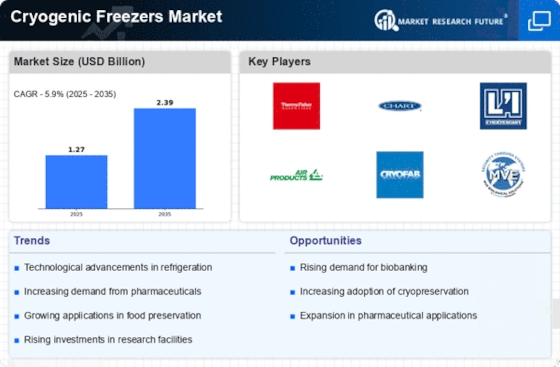
As per Market Research Future analysis, the Cryogenic Freezers Market Size was estimated at 1.271 USD Billion in 2024. The Cryogenic Freezers industry is projected to grow from 1.346 USD Billion in 2025 to 2.388 USD Billion by 2035, exhibiting a compound annual growth rate (CAGR) of 5.9% during the forecast period 2025 - 2035

Key Market Trends & Highlights

The Cryogenic Freezers Market is poised for substantial growth driven by technological advancements and increasing demand across various sectors.

  • Technological advancements in cryogenic freezers are enhancing efficiency and performance, thereby attracting diverse applications. North America remains the largest market, while the Asia-Pacific region is emerging as the fastest-growing area for cryogenic freezer adoption. The tunnel freezer segment holds the largest market share, whereas the IQF freezer segment is experiencing rapid growth due to its efficiency. Key market drivers include rising applications in biotechnology and an increased focus on vaccine development, particularly from corporate laboratories and hospitals.

Market Size & Forecast

2024 Market Size 1.271 (USD Billion)
2035 Market Size 2.388 (USD Billion)
CAGR (2025 - 2035) 5.9%
Largest Regional Market Share in 2024 North America

Major Players

<a href="https://www.thermofisher.com/search/browse/category/us/en/90106019">Thermo Fisher Scientific </a>(US), Chart Industries (US), Linde (DE), Air Products and Chemicals (US), Cryofab (US), MVE Biological Solutions (US), Helmer Scientific (US), Panasonic Healthcare (JP), Eppendorf (DE)

Market Trends

The cryogenic freezers market is currently experiencing a notable evolution, driven by advancements in technology and increasing demand across various sectors. These freezers, which operate at extremely low temperatures, are essential for preserving biological samples, pharmaceuticals, and other sensitive materials. The growing emphasis on research and development in the healthcare and biotechnology industries appears to be a significant factor propelling cryogenic freezers market trends and overall expansion. Furthermore, the rising need for effective storage solutions in laboratories and medical facilities suggests a robust future for this market segment.

In addition to technological advancements, environmental considerations are influencing the cryogenic freezers market analysis. Manufacturers are increasingly focusing on energy-efficient designs and sustainable practices to meet regulatory standards and consumer expectations. This shift towards eco-friendly solutions may enhance the appeal of cryogenic freezers, as organizations seek to minimize their carbon footprint while maintaining operational efficiency. Overall, the cryogenic freezers market seems poised for continued expansion, driven by innovation and a commitment to sustainability. The emerging plasma cryogenic freezers market is also gaining attention due to increasing demand for plasma storage in blood banks and healthcare institutions.

Technological Advancements

Recent innovations in cryogenic technology are enhancing the performance and efficiency of cryogenic freezers. These advancements may include improved insulation materials, advanced temperature control systems, and automation features that streamline operations. As a result, users can expect greater reliability and reduced energy consumption, positively impacting the overall cryogenic freezers market size over the forecast period.

Growing Demand in Healthcare

The healthcare sector's increasing reliance on cryogenic freezers for the storage of biological samples, vaccines, and pharmaceuticals is a prominent trend within the cryogenic freezers market. This demand is likely fueled by the expansion of biobanks and the need for effective preservation methods in clinical research, indicating a strong market potential. Growth in the plasma cryogenic freezers market is particularly notable in blood centers and hospitals.

Sustainability Initiatives

There is a noticeable shift towards sustainability within the cryogenic freezers market trends, as manufacturers prioritize eco-friendly designs and energy-efficient technologies. This trend reflects a broader commitment to environmental responsibility, which may resonate with consumers and organizations aiming to reduce their ecological impact while strengthening overall cryogenic freezers market share.

Cryogenic Freezers Market Market Drivers

Rising Applications in Biotechnology

The Cryogenic Freezers Market is witnessing an increase in applications within the biotechnology sector, which is a key driver of market growth. As biopharmaceutical companies expand their research and development activities, the need for reliable cryogenic storage solutions becomes paramount. Cryogenic freezers are essential for preserving cell lines, tissues, and other biological samples at ultra-low temperatures, which is critical for maintaining their viability. According to recent data, the biotechnology sector is projected to grow at a compound annual growth rate of over 7% in the coming years, further fueling demand for cryogenic storage solutions. This trend indicates a robust market potential for manufacturers and suppliers within the Cryogenic Freezers Market.

Expansion of the Pharmaceutical Sector

The Cryogenic Freezers Market is poised for growth due to the expansion of the pharmaceutical sector. As pharmaceutical companies scale their operations and diversify their product offerings, the need for advanced cryogenic storage solutions becomes increasingly critical. Cryogenic freezers are essential for the preservation of sensitive compounds, including biologics and gene therapies, which require stringent temperature controls. Recent data indicates that the pharmaceutical industry is projected to grow at a rate of approximately 6% annually, which is likely to drive demand for cryogenic freezers. This expansion presents a significant opportunity for stakeholders in the Cryogenic Freezers Market to capitalize on the growing needs of the pharmaceutical sector.

Increased Focus on Vaccine Development

The Cryogenic Freezers Market is significantly influenced by the heightened focus on vaccine development and storage. As pharmaceutical companies invest heavily in research to develop new vaccines, the requirement for effective cryogenic storage solutions has become more pronounced. Cryogenic freezers play a crucial role in preserving vaccines, particularly those that require ultra-low temperatures for stability. The market for vaccine storage solutions is expected to expand, with estimates suggesting a growth rate of approximately 8% annually. This trend not only underscores the importance of cryogenic technology in the healthcare sector but also positions the Cryogenic Freezers Market as a vital component in the global health infrastructure.

Growing Demand from Research Institutions

The Cryogenic Freezers Market is benefiting from the increasing demand from research institutions and laboratories. These entities require reliable cryogenic storage solutions for a variety of applications, including genetic research, material science, and environmental studies. The ability to store samples at ultra-low temperatures is essential for preserving the integrity of research materials. As funding for scientific research continues to rise, particularly in fields such as genomics and proteomics, the demand for cryogenic freezers is expected to grow correspondingly. This trend suggests a promising outlook for manufacturers in the Cryogenic Freezers Market, as they seek to meet the evolving needs of research institutions.

Technological Innovations in Cryogenic Freezers

The Cryogenic Freezers Market is experiencing a surge in technological innovations that enhance the efficiency and reliability of cryogenic storage solutions. Advanced insulation materials and improved refrigeration technologies are being developed, which not only reduce energy consumption but also extend the lifespan of stored biological materials. For instance, the introduction of automated monitoring systems allows for real-time tracking of temperature fluctuations, ensuring optimal conditions for sensitive samples. This trend is likely to attract investments, as stakeholders seek to leverage cutting-edge technologies to gain a competitive edge. Furthermore, the integration of IoT capabilities into cryogenic freezers is anticipated to facilitate better data management and operational efficiency, thereby driving growth in the Cryogenic Freezers Market.

Market Segment Insights

By Product Type: Tunnel Freezer (Largest) vs. IQF Freezer (Fastest-Growing)

In the Cryogenic Freezers Market, the distribution of market share among various product types indicates that the Tunnel Freezer holds the largest segment share, popular for its efficiency in large-scale operations. This is closely followed by the Individual Quick Freezer (IQF), which, while having a smaller share, is rapidly gaining traction due to its ability to preserve food quality and texture. Other product types such as Immersion, Spiral Freezers, and Others account for the remaining share, each offering unique advantages for specialized applications. As the market evolves, growth trends show a significant rise in demand for IQF Freezers, attributed to the increasing consumer preference for ready-to-eat and frozen foods. Additionally, the growing emphasis on food safety and quality preservation drives the adoption of various cryogenic freezer technologies. Innovations in freezing techniques and the rising food processing industry further enhance the attractiveness of these products, indicating a robust future for these segments.

Tunnel Freezer (Dominant) vs. IQF Freezer (Emerging)

The Tunnel Freezer segment stands out as the dominant force in the Cryogenic Freezers Market, primarily due to its extensive application in high-capacity freezing of various food products. This technology excels in continuous freezing processes and is favored by large-scale manufacturers looking for efficiency and reliability. On the other hand, the Individual Quick Freezer (IQF) is emerging as a key player, especially in the food retail sector. Known for its ability to freeze individual food items quickly without forming ice crystals, the IQF technology ensures the retention of taste, texture, and nutritional value. As consumer demand for high-quality frozen foods grows, both segments are poised for sustained relevance, with Tunnel Freezers offering bulk processing efficiency and IQF Freezers appealing to quality-conscious consumers.

By Application: Corporate Laboratories (Largest) vs. Hospitals and Blood Centers (Fastest-Growing)

The Cryogenic Freezers Market displays a diverse application distribution, with Corporate Laboratories holding the largest market share. This segment is favored for its crucial role in research and development, where preserving biological samples at ultra-low temperatures is vital. Following closely, Hospitals and Blood Centers are rapidly expanding their usage, aimed at enhancing the safe storage of blood and biological materials, thus making it a competitive segment within this market.

Corporate Laboratories (Dominant) vs. Hospitals and Blood Centers (Emerging)

Corporate Laboratories dominate the Cryogenic Freezers Market due to their extensive use of cryogenic technology for sample preservation and scientific research. These laboratories require reliable and efficient freezers to maintain the integrity of sensitive biological specimens. On the other hand, Hospitals and Blood Centers are emerging as a significant segment driven by the increasing demand for blood component storage. These facilities focus on ensuring the long-term viability of vital biological products, thus escalating the need for advanced cryogenic storage solutions. As health care providers strive to improve operational efficiencies and patient outcomes, the reliance on cryogenic freezers in these institutions is expected to grow considerably.

By End Use Industry: Food and Beverages (Largest) vs. Medical and Healthcare (Fastest-Growing)

The Cryogenic Freezers Market is characterized by distinct preferences across various end-use industries. The food and beverages segment holds the largest market share, driven by the rising need for preserving food quality and extending shelf life. Medical and healthcare, while currently smaller, is rapidly evolving, reflecting a growing awareness of cryopreservation techniques. Overall, pharmaceuticals and chemicals follow, showing steady demand as industries seek effective storage solutions for sensitive materials.

Food and Beverages: Dominant vs. Medical and Healthcare: Emerging

The food and beverages segment is the dominant player in the Cryogenic Freezers Market, driven by consumer demand for frozen products that maintain freshness and quality. This sector utilizes cryogenic technology to preserve items like fruits, vegetables, and meats at precise low temperatures, thus enhancing product longevity and safety. Meanwhile, the medical and healthcare segment represents an emerging opportunity, reflecting significant advancements in biotechnology and <a href="https://www.marketresearchfuture.com/reports/regenerative-medicine-market-2220">regenerative medicine</a>. The demand for cryopreservation of biological samples and tissue engineering fuels its growth, marking it as a vital area poised for expansion in the coming years.

Get more detailed insights about Cryogenic Freezers Market Research Report—Global Forecast till 2035

Regional Insights

North America : Innovation and Demand Surge

North America is the largest market for cryogenic freezers, holding approximately 45% of the global market share. The growth is driven by increasing demand from the healthcare and biotechnology sectors, alongside stringent regulations promoting advanced storage solutions. The region's focus on research and development, particularly in pharmaceuticals and life sciences, further fuels this demand. Regulatory bodies are also encouraging the adoption of cryogenic technologies to enhance preservation methods. The United States dominates the North American market, with key players like Thermo Fisher Scientific, Chart Industries, and Air Products and Chemicals leading the competitive landscape. Canada follows as the second-largest market, contributing significantly to the overall growth. The presence of established manufacturers and continuous innovation in cryogenic technologies position North America as a hub for advancements in this field.

Europe : Regulatory Framework and Growth

Europe is witnessing significant growth in the cryogenic freezers market, accounting for approximately 30% of the global share. The region's growth is propelled by stringent regulations aimed at ensuring safety and efficiency in medical and research applications. Countries like Germany and the UK are at the forefront, with increasing investments in healthcare infrastructure and biobanking initiatives driving demand for advanced cryogenic solutions. The European Union's regulations on biobanks and tissue storage further catalyze market expansion. Germany leads the European market, supported by key players such as Linde and Eppendorf, while the UK follows closely. The competitive landscape is characterized by a mix of established companies and innovative startups focusing on sustainable and efficient cryogenic technologies. The presence of robust research institutions also enhances the region's market dynamics, fostering collaboration and technological advancements.

Asia-Pacific : Rapid Growth and Adoption

Asia-Pacific is rapidly emerging as a significant player in the cryogenic freezers market, holding around 20% of the global market share. The region's growth is driven by increasing investments in healthcare and biotechnology, coupled with a rising demand for advanced storage solutions. Countries like China and Japan are leading this growth, supported by government initiatives aimed at enhancing research capabilities and healthcare infrastructure. The region's focus on innovation and technology adoption is further propelling market expansion. China is the largest market in the Asia-Pacific region, with a growing number of local manufacturers entering the market. Japan follows closely, with established companies like Panasonic Healthcare contributing to the competitive landscape. The presence of key players and a growing emphasis on research and development in cryogenic technologies position Asia-Pacific as a vital region for future growth in this sector.

Middle East and Africa : Emerging Market with Potential

The Middle East and Africa region is gradually emerging in the cryogenic freezers market, currently holding about 5% of the global share. The growth is primarily driven by increasing healthcare investments and a rising demand for advanced storage solutions in biobanking and pharmaceuticals. Countries like South Africa and the UAE are leading this growth, with government initiatives aimed at enhancing healthcare infrastructure and research capabilities. The region's potential for growth is significant, given the increasing focus on healthcare advancements. South Africa is the largest market in the region, supported by a growing number of healthcare facilities and research institutions. The UAE is also witnessing a rise in demand for cryogenic technologies, driven by investments in biotechnology and healthcare. The competitive landscape is characterized by a mix of local and international players, creating opportunities for collaboration and innovation in cryogenic solutions.

Key Players and Competitive Insights

Leading market players are investing heavily in research and development in order to expand their product lines, which will help the market of Cryogenic Freezers Market, grow even more. Market participants are also undertaking a variety of strategic activities to expand their global footprint, with important market developments including new product launches, contractual agreements, mergers and acquisitions, higher investments, and collaboration with other organizations. To expand and survive in a more competitive and rising market climate, Cryogenic Freezers industry must offer cost-effective items. Manufacturing locally to minimize operational costs is one of the key business tactics used by manufacturers in the global Cryogenic Freezers industry to benefit clients and increase the market sector. In recent years, the Cryogenic Freezers industry has offered some of the most significant advantages to medicine. Major players in the Cryogenic Freezers Market, including Thermo Fisher Scientific Inc., Panasonic Corporation, Chart Industries, Inc., Haier Group, DAIHAN Scientific, Froilabo, Arctiko, Taylor-Wharton, VRV Group, Aucma Co., Ltd., and Zhongke Meiling Cryogenics Company Limited, are attempting to increase market demand by investing in research and development operations. Engineering and industrial gas provider Linde plc (Linde). Industrial, process, and speciality gases are provided by it. producing well producing industrial gases including carbon dioxide, helium, hydrogen, electronic gases, and acetylene, the company also produces atmospheric gases like oxygen, nitrogen, and argon. Additionally, Linde provides a variety of gas production and processing services in addition to designing, engineering, and constructing machinery that produces gases for internal use. Healthcare, petroleum refining, manufacturing, food, beverage carbonation, fiber-optics, steel production, aerospace, chemicals and energy, electronics, and water treatment are just a few of the industries it supports. In APAC, EMEA, and the Americas, it runs cryogenic air separation plants, hydrogen plants, and carbon dioxide plants. In Guildford, Surrey, United Kingdom, Linde is headquartered. A contract between Linde plc and BASF was inked in February 2022. Linde Plc will provide steam and hydrogen to BASF as part of this agreement. The industrial and healthcare industries are served by Air Liquide SA (Air Liquide), a provider of gases, technologies, and services. Along with argon and other rare gases, the company also produces gases such as oxygen, nitrogen, and hydrogen. Customers in a variety of industries, including steel, food and pharmaceuticals, chemicals, electronics, automotive, and manufacturing, are served by this company's supply of these gases. The business also creates processing facilities and associated infrastructure. Skin disinfectants, antiseptics, and medical device disinfection products are offered by Air Liquide. The business distributes its goods via local facilities, tanker trucks, and cylinders. It operates in the Americas, Europe, Africa, the Middle East, and Asia-Pacific. Paris, Ile-de-France, France, serves as the headquarters of Air Liquide. Air Liquide joined forces with Airbus, Korean Air, and Incheon in February 2022 to create the first hydrogen consumption roadmap for the area surrounding Incheon Airport and to assist the growth of the hydrogen ecosystem.

Key Companies in the Cryogenic Freezers Market include

Industry Developments

January 2022 A contract for the development and delivery of a 24 MW green hydrogen plant was signed by Linde plc and Yara.

December 2021 Howden and Chart Industries worked together to deliver a cutting-edge hydrogen solution and integrate Howden's gas compression technology into Chart Industries' product portfolio.


Future Outlook

Cryogenic Freezers Market Future Outlook

The Cryogenic Freezers Market is projected to grow at a 5.9% CAGR from 2025 to 2035, driven by advancements in medical technology, increased demand for preservation, and expanding industrial applications.

New opportunities lie in:

  • <p>Development of energy-efficient cryogenic systems for reduced operational costs. Expansion into emerging markets with tailored product offerings. Integration of IoT technology for real-time monitoring and predictive maintenance.</p>

By 2035, the Cryogenic Freezers Market is expected to achieve robust growth, reflecting evolving industry needs.

Market Segmentation

Cryogenic Freezers Market Application Outlook

  • Corporate Laboratories
  • Hospitals and Blood Centers
  • Universities and Research Institutions
  • Others

Cryogenic Freezers Market Product Type Outlook

  • Tunnel Freezer
  • IQF Freezer
  • Immersion Freezer
  • Spiral Freezer
  • Others

Cryogenic Freezers Market End Use Industry Outlook

  • Food and Beverages
  • Medical and Healthcare
  • Pharmaceuticals
  • Chemicals
  • Others

Report Scope

MARKET SIZE 2024 1.271(USD Billion)
MARKET SIZE 2025 1.346(USD Billion)
MARKET SIZE 2035 2.388(USD Billion)
COMPOUND ANNUAL GROWTH RATE (CAGR) 5.9% (2025 - 2035)
REPORT COVERAGE Revenue Forecast, Competitive Landscape, Growth Factors, and Trends
BASE YEAR 2024
Market Forecast Period 2025 - 2035
Historical Data 2019 - 2024
Market Forecast Units USD Billion
Key Companies Profiled Thermo Fisher Scientific (US), Chart Industries (US), Linde (DE), Air Products and Chemicals (US), Cryofab (US), MVE Biological Solutions (US), Helmer Scientific (US), Panasonic Healthcare (JP), Eppendorf (DE)
Segments Covered Product Type, Application, End User, Region
Key Market Opportunities Advancements in cryogenic technology enhance preservation capabilities in the Cryogenic Freezers Market.
Key Market Dynamics Technological advancements and regulatory changes drive innovation and competition in the cryogenic freezers market.
Countries Covered North America, Europe, APAC, South America, MEA

FAQs

What is the projected market valuation of the Cryogenic Freezers Market by 2035?

<p>The Cryogenic Freezers Market is projected to reach a valuation of 2.388 USD Billion by 2035.</p>

What was the market valuation of the Cryogenic Freezers Market in 2024?

<p>In 2024, the Cryogenic Freezers Market was valued at 1.271 USD Billion.</p>

What is the expected CAGR for the Cryogenic Freezers Market during the forecast period 2025 - 2035?

<p>The expected CAGR for the Cryogenic Freezers Market during the forecast period 2025 - 2035 is 5.9%.</p>

Which product type segment is expected to show significant growth in the Cryogenic Freezers Market?

<p>The IQF Freezer segment, with a valuation range of 0.35 to 0.675 USD Billion, appears poised for notable growth.</p>

What applications are driving demand in the Cryogenic Freezers Market?

<p>Corporate laboratories and hospitals are key applications, with projected valuations of 0.4 to 0.8 USD Billion and 0.35 to 0.7 USD Billion, respectively.</p>

Which end-use industry is anticipated to contribute the most to the Cryogenic Freezers Market?

<p>The Medical and Healthcare industry is expected to contribute significantly, with a valuation range of 0.4 to 0.8 USD Billion.</p>

Who are the key players in the Cryogenic Freezers Market?

Key players include Thermo Fisher Scientific, Chart Industries, Linde, and Air Products and Chemicals, among others.

What is the valuation range for the Immersion Freezer product type?

The Immersion Freezer product type has a valuation range of 0.2 to 0.4 USD Billion.

How does the growth of the Cryogenic Freezers Market compare across different segments?

The Food and Beverages segment, valued between 0.35 and 0.65 USD Billion, indicates a competitive growth landscape compared to others.

What trends are influencing the Cryogenic Freezers Market in 2025?

Trends suggest a growing emphasis on advanced technologies and applications in medical and research sectors, driving market expansion.

  1. SECTION I: EXECUTIVE SUMMARY AND KEY HIGHLIGHTS
    1. | 1.1 EXECUTIVE SUMMARY
    2. | | 1.1.1 Market Overview
    3. | | 1.1.2 Key Findings
    4. | | 1.1.3 Market Segmentation
    5. | | 1.1.4 Competitive Landscape
    6. | | 1.1.5 Challenges and Opportunities
    7. | | 1.1.6 Future Outlook
  2. SECTION II: SCOPING, METHODOLOGY AND MARKET STRUCTURE
    1. | 2.1 MARKET INTRODUCTION
    2. | | 2.1.1 Definition
    3. | | 2.1.2 Scope of the study
    4. | | | 2.1.2.1 Research Objective
    5. | | | 2.1.2.2 Assumption
    6. | | | 2.1.2.3 Limitations
    7. | 2.2 RESEARCH METHODOLOGY
    8. | | 2.2.1 Overview
    9. | | 2.2.2 Data Mining
    10. | | 2.2.3 Secondary Research
    11. | | 2.2.4 Primary Research
    12. | | | 2.2.4.1 Primary Interviews and Information Gathering Process
    13. | | | 2.2.4.2 Breakdown of Primary Respondents
    14. | | 2.2.5 Forecasting Model
    15. | | 2.2.6 Market Size Estimation
    16. | | | 2.2.6.1 Bottom-Up Approach
    17. | | | 2.2.6.2 Top-Down Approach
    18. | | 2.2.7 Data Triangulation
    19. | | 2.2.8 Validation
  3. SECTION III: QUALITATIVE ANALYSIS
    1. | 3.1 MARKET DYNAMICS
    2. | | 3.1.1 Overview
    3. | | 3.1.2 Drivers
    4. | | 3.1.3 Restraints
    5. | | 3.1.4 Opportunities
    6. | 3.2 MARKET FACTOR ANALYSIS
    7. | | 3.2.1 Value chain Analysis
    8. | | 3.2.2 Porter's Five Forces Analysis
    9. | | | 3.2.2.1 Bargaining Power of Suppliers
    10. | | | 3.2.2.2 Bargaining Power of Buyers
    11. | | | 3.2.2.3 Threat of New Entrants
    12. | | | 3.2.2.4 Threat of Substitutes
    13. | | | 3.2.2.5 Intensity of Rivalry
    14. | | 3.2.3 COVID-19 Impact Analysis
    15. | | | 3.2.3.1 Market Impact Analysis
    16. | | | 3.2.3.2 Regional Impact
    17. | | | 3.2.3.3 Opportunity and Threat Analysis
  4. SECTION IV: QUANTITATIVE ANALYSIS
    1. | 4.1 Healthcare, BY Product Type (USD Billion)
    2. | | 4.1.1 Tunnel Freezer
    3. | | 4.1.2 IQF Freezer
    4. | | 4.1.3 Immersion Freezer
    5. | | 4.1.4 Spiral Freezer
    6. | | 4.1.5 Others
    7. | 4.2 Healthcare, BY Application (USD Billion)
    8. | | 4.2.1 Corporate Laboratories
    9. | | 4.2.2 Hospitals and Blood Centers
    10. | | 4.2.3 Universities and Research Institutions
    11. | | 4.2.4 Others
    12. | 4.3 Healthcare, BY End Use Industry (USD Billion)
    13. | | 4.3.1 Food and Beverages
    14. | | 4.3.2 Medical and Healthcare
    15. | | 4.3.3 Pharmaceuticals
    16. | | 4.3.4 Chemicals
    17. | | 4.3.5 Others
    18. | 4.4 Healthcare, BY Region (USD Billion)
    19. | | 4.4.1 North America
    20. | | | 4.4.1.1 US
    21. | | | 4.4.1.2 Canada
    22. | | 4.4.2 Europe
    23. | | | 4.4.2.1 Germany
    24. | | | 4.4.2.2 UK
    25. | | | 4.4.2.3 France
    26. | | | 4.4.2.4 Russia
    27. | | | 4.4.2.5 Italy
    28. | | | 4.4.2.6 Spain
    29. | | | 4.4.2.7 Rest of Europe
    30. | | 4.4.3 APAC
    31. | | | 4.4.3.1 China
    32. | | | 4.4.3.2 India
    33. | | | 4.4.3.3 Japan
    34. | | | 4.4.3.4 South Korea
    35. | | | 4.4.3.5 Malaysia
    36. | | | 4.4.3.6 Thailand
    37. | | | 4.4.3.7 Indonesia
    38. | | | 4.4.3.8 Rest of APAC
    39. | | 4.4.4 South America
    40. | | | 4.4.4.1 Brazil
    41. | | | 4.4.4.2 Mexico
    42. | | | 4.4.4.3 Argentina
    43. | | | 4.4.4.4 Rest of South America
    44. | | 4.4.5 MEA
    45. | | | 4.4.5.1 GCC Countries
    46. | | | 4.4.5.2 South Africa
    47. | | | 4.4.5.3 Rest of MEA
  5. SECTION V: COMPETITIVE ANALYSIS
    1. | 5.1 Competitive Landscape
    2. | | 5.1.1 Overview
    3. | | 5.1.2 Competitive Analysis
    4. | | 5.1.3 Market share Analysis
    5. | | 5.1.4 Major Growth Strategy in the Healthcare
    6. | | 5.1.5 Competitive Benchmarking
    7. | | 5.1.6 Leading Players in Terms of Number of Developments in the Healthcare
    8. | | 5.1.7 Key developments and growth strategies
    9. | | | 5.1.7.1 New Product Launch/Service Deployment
    10. | | | 5.1.7.2 Merger & Acquisitions
    11. | | | 5.1.7.3 Joint Ventures
    12. | | 5.1.8 Major Players Financial Matrix
    13. | | | 5.1.8.1 Sales and Operating Income
    14. | | | 5.1.8.2 Major Players R&D Expenditure. 2023
    15. | 5.2 Company Profiles
    16. | | 5.2.1 Thermo Fisher Scientific (US)
    17. | | | 5.2.1.1 Financial Overview
    18. | | | 5.2.1.2 Products Offered
    19. | | | 5.2.1.3 Key Developments
    20. | | | 5.2.1.4 SWOT Analysis
    21. | | | 5.2.1.5 Key Strategies
    22. | | 5.2.2 Chart Industries (US)
    23. | | | 5.2.2.1 Financial Overview
    24. | | | 5.2.2.2 Products Offered
    25. | | | 5.2.2.3 Key Developments
    26. | | | 5.2.2.4 SWOT Analysis
    27. | | | 5.2.2.5 Key Strategies
    28. | | 5.2.3 Linde (DE)
    29. | | | 5.2.3.1 Financial Overview
    30. | | | 5.2.3.2 Products Offered
    31. | | | 5.2.3.3 Key Developments
    32. | | | 5.2.3.4 SWOT Analysis
    33. | | | 5.2.3.5 Key Strategies
    34. | | 5.2.4 Air Products and Chemicals (US)
    35. | | | 5.2.4.1 Financial Overview
    36. | | | 5.2.4.2 Products Offered
    37. | | | 5.2.4.3 Key Developments
    38. | | | 5.2.4.4 SWOT Analysis
    39. | | | 5.2.4.5 Key Strategies
    40. | | 5.2.5 Cryofab (US)
    41. | | | 5.2.5.1 Financial Overview
    42. | | | 5.2.5.2 Products Offered
    43. | | | 5.2.5.3 Key Developments
    44. | | | 5.2.5.4 SWOT Analysis
    45. | | | 5.2.5.5 Key Strategies
    46. | | 5.2.6 MVE Biological Solutions (US)
    47. | | | 5.2.6.1 Financial Overview
    48. | | | 5.2.6.2 Products Offered
    49. | | | 5.2.6.3 Key Developments
    50. | | | 5.2.6.4 SWOT Analysis
    51. | | | 5.2.6.5 Key Strategies
    52. | | 5.2.7 Helmer Scientific (US)
    53. | | | 5.2.7.1 Financial Overview
    54. | | | 5.2.7.2 Products Offered
    55. | | | 5.2.7.3 Key Developments
    56. | | | 5.2.7.4 SWOT Analysis
    57. | | | 5.2.7.5 Key Strategies
    58. | | 5.2.8 Panasonic Healthcare (JP)
    59. | | | 5.2.8.1 Financial Overview
    60. | | | 5.2.8.2 Products Offered
    61. | | | 5.2.8.3 Key Developments
    62. | | | 5.2.8.4 SWOT Analysis
    63. | | | 5.2.8.5 Key Strategies
    64. | | 5.2.9 Eppendorf (DE)
    65. | | | 5.2.9.1 Financial Overview
    66. | | | 5.2.9.2 Products Offered
    67. | | | 5.2.9.3 Key Developments
    68. | | | 5.2.9.4 SWOT Analysis
    69. | | | 5.2.9.5 Key Strategies
    70. | 5.3 Appendix
    71. | | 5.3.1 References
    72. | | 5.3.2 Related Reports
  6. LIST OF FIGURES
    1. | 6.1 MARKET SYNOPSIS
    2. | 6.2 NORTH AMERICA MARKET ANALYSIS
    3. | 6.3 US MARKET ANALYSIS BY PRODUCT TYPE
    4. | 6.4 US MARKET ANALYSIS BY APPLICATION
    5. | 6.5 US MARKET ANALYSIS BY END USE INDUSTRY
    6. | 6.6 CANADA MARKET ANALYSIS BY PRODUCT TYPE
    7. | 6.7 CANADA MARKET ANALYSIS BY APPLICATION
    8. | 6.8 CANADA MARKET ANALYSIS BY END USE INDUSTRY
    9. | 6.9 EUROPE MARKET ANALYSIS
    10. | 6.10 GERMANY MARKET ANALYSIS BY PRODUCT TYPE
    11. | 6.11 GERMANY MARKET ANALYSIS BY APPLICATION
    12. | 6.12 GERMANY MARKET ANALYSIS BY END USE INDUSTRY
    13. | 6.13 UK MARKET ANALYSIS BY PRODUCT TYPE
    14. | 6.14 UK MARKET ANALYSIS BY APPLICATION
    15. | 6.15 UK MARKET ANALYSIS BY END USE INDUSTRY
    16. | 6.16 FRANCE MARKET ANALYSIS BY PRODUCT TYPE
    17. | 6.17 FRANCE MARKET ANALYSIS BY APPLICATION
    18. | 6.18 FRANCE MARKET ANALYSIS BY END USE INDUSTRY
    19. | 6.19 RUSSIA MARKET ANALYSIS BY PRODUCT TYPE
    20. | 6.20 RUSSIA MARKET ANALYSIS BY APPLICATION
    21. | 6.21 RUSSIA MARKET ANALYSIS BY END USE INDUSTRY
    22. | 6.22 ITALY MARKET ANALYSIS BY PRODUCT TYPE
    23. | 6.23 ITALY MARKET ANALYSIS BY APPLICATION
    24. | 6.24 ITALY MARKET ANALYSIS BY END USE INDUSTRY
    25. | 6.25 SPAIN MARKET ANALYSIS BY PRODUCT TYPE
    26. | 6.26 SPAIN MARKET ANALYSIS BY APPLICATION
    27. | 6.27 SPAIN MARKET ANALYSIS BY END USE INDUSTRY
    28. | 6.28 REST OF EUROPE MARKET ANALYSIS BY PRODUCT TYPE
    29. | 6.29 REST OF EUROPE MARKET ANALYSIS BY APPLICATION
    30. | 6.30 REST OF EUROPE MARKET ANALYSIS BY END USE INDUSTRY
    31. | 6.31 APAC MARKET ANALYSIS
    32. | 6.32 CHINA MARKET ANALYSIS BY PRODUCT TYPE
    33. | 6.33 CHINA MARKET ANALYSIS BY APPLICATION
    34. | 6.34 CHINA MARKET ANALYSIS BY END USE INDUSTRY
    35. | 6.35 INDIA MARKET ANALYSIS BY PRODUCT TYPE
    36. | 6.36 INDIA MARKET ANALYSIS BY APPLICATION
    37. | 6.37 INDIA MARKET ANALYSIS BY END USE INDUSTRY
    38. | 6.38 JAPAN MARKET ANALYSIS BY PRODUCT TYPE
    39. | 6.39 JAPAN MARKET ANALYSIS BY APPLICATION
    40. | 6.40 JAPAN MARKET ANALYSIS BY END USE INDUSTRY
    41. | 6.41 SOUTH KOREA MARKET ANALYSIS BY PRODUCT TYPE
    42. | 6.42 SOUTH KOREA MARKET ANALYSIS BY APPLICATION
    43. | 6.43 SOUTH KOREA MARKET ANALYSIS BY END USE INDUSTRY
    44. | 6.44 MALAYSIA MARKET ANALYSIS BY PRODUCT TYPE
    45. | 6.45 MALAYSIA MARKET ANALYSIS BY APPLICATION
    46. | 6.46 MALAYSIA MARKET ANALYSIS BY END USE INDUSTRY
    47. | 6.47 THAILAND MARKET ANALYSIS BY PRODUCT TYPE
    48. | 6.48 THAILAND MARKET ANALYSIS BY APPLICATION
    49. | 6.49 THAILAND MARKET ANALYSIS BY END USE INDUSTRY
    50. | 6.50 INDONESIA MARKET ANALYSIS BY PRODUCT TYPE
    51. | 6.51 INDONESIA MARKET ANALYSIS BY APPLICATION
    52. | 6.52 INDONESIA MARKET ANALYSIS BY END USE INDUSTRY
    53. | 6.53 REST OF APAC MARKET ANALYSIS BY PRODUCT TYPE
    54. | 6.54 REST OF APAC MARKET ANALYSIS BY APPLICATION
    55. | 6.55 REST OF APAC MARKET ANALYSIS BY END USE INDUSTRY
    56. | 6.56 SOUTH AMERICA MARKET ANALYSIS
    57. | 6.57 BRAZIL MARKET ANALYSIS BY PRODUCT TYPE
    58. | 6.58 BRAZIL MARKET ANALYSIS BY APPLICATION
    59. | 6.59 BRAZIL MARKET ANALYSIS BY END USE INDUSTRY
    60. | 6.60 MEXICO MARKET ANALYSIS BY PRODUCT TYPE
    61. | 6.61 MEXICO MARKET ANALYSIS BY APPLICATION
    62. | 6.62 MEXICO MARKET ANALYSIS BY END USE INDUSTRY
    63. | 6.63 ARGENTINA MARKET ANALYSIS BY PRODUCT TYPE
    64. | 6.64 ARGENTINA MARKET ANALYSIS BY APPLICATION
    65. | 6.65 ARGENTINA MARKET ANALYSIS BY END USE INDUSTRY
    66. | 6.66 REST OF SOUTH AMERICA MARKET ANALYSIS BY PRODUCT TYPE
    67. | 6.67 REST OF SOUTH AMERICA MARKET ANALYSIS BY APPLICATION
    68. | 6.68 REST OF SOUTH AMERICA MARKET ANALYSIS BY END USE INDUSTRY
    69. | 6.69 MEA MARKET ANALYSIS
    70. | 6.70 GCC COUNTRIES MARKET ANALYSIS BY PRODUCT TYPE
    71. | 6.71 GCC COUNTRIES MARKET ANALYSIS BY APPLICATION
    72. | 6.72 GCC COUNTRIES MARKET ANALYSIS BY END USE INDUSTRY
    73. | 6.73 SOUTH AFRICA MARKET ANALYSIS BY PRODUCT TYPE
    74. | 6.74 SOUTH AFRICA MARKET ANALYSIS BY APPLICATION
    75. | 6.75 SOUTH AFRICA MARKET ANALYSIS BY END USE INDUSTRY
    76. | 6.76 REST OF MEA MARKET ANALYSIS BY PRODUCT TYPE
    77. | 6.77 REST OF MEA MARKET ANALYSIS BY APPLICATION
    78. | 6.78 REST OF MEA MARKET ANALYSIS BY END USE INDUSTRY
    79. | 6.79 KEY BUYING CRITERIA OF HEALTHCARE
    80. | 6.80 RESEARCH PROCESS OF MRFR
    81. | 6.81 DRO ANALYSIS OF HEALTHCARE
    82. | 6.82 DRIVERS IMPACT ANALYSIS: HEALTHCARE
    83. | 6.83 RESTRAINTS IMPACT ANALYSIS: HEALTHCARE
    84. | 6.84 SUPPLY / VALUE CHAIN: HEALTHCARE
    85. | 6.85 HEALTHCARE, BY PRODUCT TYPE, 2024 (% SHARE)
    86. | 6.86 HEALTHCARE, BY PRODUCT TYPE, 2024 TO 2035 (USD Billion)
    87. | 6.87 HEALTHCARE, BY APPLICATION, 2024 (% SHARE)
    88. | 6.88 HEALTHCARE, BY APPLICATION, 2024 TO 2035 (USD Billion)
    89. | 6.89 HEALTHCARE, BY END USE INDUSTRY, 2024 (% SHARE)
    90. | 6.90 HEALTHCARE, BY END USE INDUSTRY, 2024 TO 2035 (USD Billion)
    91. | 6.91 BENCHMARKING OF MAJOR COMPETITORS
  7. LIST OF TABLES
    1. | 7.1 LIST OF ASSUMPTIONS
    2. | | 7.1.1
    3. | 7.2 North America MARKET SIZE ESTIMATES; FORECAST
    4. | | 7.2.1 BY PRODUCT TYPE, 2025-2035 (USD Billion)
    5. | | 7.2.2 BY APPLICATION, 2025-2035 (USD Billion)
    6. | | 7.2.3 BY END USE INDUSTRY, 2025-2035 (USD Billion)
    7. | 7.3 US MARKET SIZE ESTIMATES; FORECAST
    8. | | 7.3.1 BY PRODUCT TYPE, 2025-2035 (USD Billion)
    9. | | 7.3.2 BY APPLICATION, 2025-2035 (USD Billion)
    10. | | 7.3.3 BY END USE INDUSTRY, 2025-2035 (USD Billion)
    11. | 7.4 Canada MARKET SIZE ESTIMATES; FORECAST
    12. | | 7.4.1 BY PRODUCT TYPE, 2025-2035 (USD Billion)
    13. | | 7.4.2 BY APPLICATION, 2025-2035 (USD Billion)
    14. | | 7.4.3 BY END USE INDUSTRY, 2025-2035 (USD Billion)
    15. | 7.5 Europe MARKET SIZE ESTIMATES; FORECAST
    16. | | 7.5.1 BY PRODUCT TYPE, 2025-2035 (USD Billion)
    17. | | 7.5.2 BY APPLICATION, 2025-2035 (USD Billion)
    18. | | 7.5.3 BY END USE INDUSTRY, 2025-2035 (USD Billion)
    19. | 7.6 Germany MARKET SIZE ESTIMATES; FORECAST
    20. | | 7.6.1 BY PRODUCT TYPE, 2025-2035 (USD Billion)
    21. | | 7.6.2 BY APPLICATION, 2025-2035 (USD Billion)
    22. | | 7.6.3 BY END USE INDUSTRY, 2025-2035 (USD Billion)
    23. | 7.7 UK MARKET SIZE ESTIMATES; FORECAST
    24. | | 7.7.1 BY PRODUCT TYPE, 2025-2035 (USD Billion)
    25. | | 7.7.2 BY APPLICATION, 2025-2035 (USD Billion)
    26. | | 7.7.3 BY END USE INDUSTRY, 2025-2035 (USD Billion)
    27. | 7.8 France MARKET SIZE ESTIMATES; FORECAST
    28. | | 7.8.1 BY PRODUCT TYPE, 2025-2035 (USD Billion)
    29. | | 7.8.2 BY APPLICATION, 2025-2035 (USD Billion)
    30. | | 7.8.3 BY END USE INDUSTRY, 2025-2035 (USD Billion)
    31. | 7.9 Russia MARKET SIZE ESTIMATES; FORECAST
    32. | | 7.9.1 BY PRODUCT TYPE, 2025-2035 (USD Billion)
    33. | | 7.9.2 BY APPLICATION, 2025-2035 (USD Billion)
    34. | | 7.9.3 BY END USE INDUSTRY, 2025-2035 (USD Billion)
    35. | 7.10 Italy MARKET SIZE ESTIMATES; FORECAST
    36. | | 7.10.1 BY PRODUCT TYPE, 2025-2035 (USD Billion)
    37. | | 7.10.2 BY APPLICATION, 2025-2035 (USD Billion)
    38. | | 7.10.3 BY END USE INDUSTRY, 2025-2035 (USD Billion)
    39. | 7.11 Spain MARKET SIZE ESTIMATES; FORECAST
    40. | | 7.11.1 BY PRODUCT TYPE, 2025-2035 (USD Billion)
    41. | | 7.11.2 BY APPLICATION, 2025-2035 (USD Billion)
    42. | | 7.11.3 BY END USE INDUSTRY, 2025-2035 (USD Billion)
    43. | 7.12 Rest of Europe MARKET SIZE ESTIMATES; FORECAST
    44. | | 7.12.1 BY PRODUCT TYPE, 2025-2035 (USD Billion)
    45. | | 7.12.2 BY APPLICATION, 2025-2035 (USD Billion)
    46. | | 7.12.3 BY END USE INDUSTRY, 2025-2035 (USD Billion)
    47. | 7.13 APAC MARKET SIZE ESTIMATES; FORECAST
    48. | | 7.13.1 BY PRODUCT TYPE, 2025-2035 (USD Billion)
    49. | | 7.13.2 BY APPLICATION, 2025-2035 (USD Billion)
    50. | | 7.13.3 BY END USE INDUSTRY, 2025-2035 (USD Billion)
    51. | 7.14 China MARKET SIZE ESTIMATES; FORECAST
    52. | | 7.14.1 BY PRODUCT TYPE, 2025-2035 (USD Billion)
    53. | | 7.14.2 BY APPLICATION, 2025-2035 (USD Billion)
    54. | | 7.14.3 BY END USE INDUSTRY, 2025-2035 (USD Billion)
    55. | 7.15 India MARKET SIZE ESTIMATES; FORECAST
    56. | | 7.15.1 BY PRODUCT TYPE, 2025-2035 (USD Billion)
    57. | | 7.15.2 BY APPLICATION, 2025-2035 (USD Billion)
    58. | | 7.15.3 BY END USE INDUSTRY, 2025-2035 (USD Billion)
    59. | 7.16 Japan MARKET SIZE ESTIMATES; FORECAST
    60. | | 7.16.1 BY PRODUCT TYPE, 2025-2035 (USD Billion)
    61. | | 7.16.2 BY APPLICATION, 2025-2035 (USD Billion)
    62. | | 7.16.3 BY END USE INDUSTRY, 2025-2035 (USD Billion)
    63. | 7.17 South Korea MARKET SIZE ESTIMATES; FORECAST
    64. | | 7.17.1 BY PRODUCT TYPE, 2025-2035 (USD Billion)
    65. | | 7.17.2 BY APPLICATION, 2025-2035 (USD Billion)
    66. | | 7.17.3 BY END USE INDUSTRY, 2025-2035 (USD Billion)
    67. | 7.18 Malaysia MARKET SIZE ESTIMATES; FORECAST
    68. | | 7.18.1 BY PRODUCT TYPE, 2025-2035 (USD Billion)
    69. | | 7.18.2 BY APPLICATION, 2025-2035 (USD Billion)
    70. | | 7.18.3 BY END USE INDUSTRY, 2025-2035 (USD Billion)
    71. | 7.19 Thailand MARKET SIZE ESTIMATES; FORECAST
    72. | | 7.19.1 BY PRODUCT TYPE, 2025-2035 (USD Billion)
    73. | | 7.19.2 BY APPLICATION, 2025-2035 (USD Billion)
    74. | | 7.19.3 BY END USE INDUSTRY, 2025-2035 (USD Billion)
    75. | 7.20 Indonesia MARKET SIZE ESTIMATES; FORECAST
    76. | | 7.20.1 BY PRODUCT TYPE, 2025-2035 (USD Billion)
    77. | | 7.20.2 BY APPLICATION, 2025-2035 (USD Billion)
    78. | | 7.20.3 BY END USE INDUSTRY, 2025-2035 (USD Billion)
    79. | 7.21 Rest of APAC MARKET SIZE ESTIMATES; FORECAST
    80. | | 7.21.1 BY PRODUCT TYPE, 2025-2035 (USD Billion)
    81. | | 7.21.2 BY APPLICATION, 2025-2035 (USD Billion)
    82. | | 7.21.3 BY END USE INDUSTRY, 2025-2035 (USD Billion)
    83. | 7.22 South America MARKET SIZE ESTIMATES; FORECAST
    84. | | 7.22.1 BY PRODUCT TYPE, 2025-2035 (USD Billion)
    85. | | 7.22.2 BY APPLICATION, 2025-2035 (USD Billion)
    86. | | 7.22.3 BY END USE INDUSTRY, 2025-2035 (USD Billion)
    87. | 7.23 Brazil MARKET SIZE ESTIMATES; FORECAST
    88. | | 7.23.1 BY PRODUCT TYPE, 2025-2035 (USD Billion)
    89. | | 7.23.2 BY APPLICATION, 2025-2035 (USD Billion)
    90. | | 7.23.3 BY END USE INDUSTRY, 2025-2035 (USD Billion)
    91. | 7.24 Mexico MARKET SIZE ESTIMATES; FORECAST
    92. | | 7.24.1 BY PRODUCT TYPE, 2025-2035 (USD Billion)
    93. | | 7.24.2 BY APPLICATION, 2025-2035 (USD Billion)
    94. | | 7.24.3 BY END USE INDUSTRY, 2025-2035 (USD Billion)
    95. | 7.25 Argentina MARKET SIZE ESTIMATES; FORECAST
    96. | | 7.25.1 BY PRODUCT TYPE, 2025-2035 (USD Billion)
    97. | | 7.25.2 BY APPLICATION, 2025-2035 (USD Billion)
    98. | | 7.25.3 BY END USE INDUSTRY, 2025-2035 (USD Billion)
    99. | 7.26 Rest of South America MARKET SIZE ESTIMATES; FORECAST
    100. | | 7.26.1 BY PRODUCT TYPE, 2025-2035 (USD Billion)
    101. | | 7.26.2 BY APPLICATION, 2025-2035 (USD Billion)
    102. | | 7.26.3 BY END USE INDUSTRY, 2025-2035 (USD Billion)
    103. | 7.27 MEA MARKET SIZE ESTIMATES; FORECAST
    104. | | 7.27.1 BY PRODUCT TYPE, 2025-2035 (USD Billion)
    105. | | 7.27.2 BY APPLICATION, 2025-2035 (USD Billion)
    106. | | 7.27.3 BY END USE INDUSTRY, 2025-2035 (USD Billion)
    107. | 7.28 GCC Countries MARKET SIZE ESTIMATES; FORECAST
    108. | | 7.28.1 BY PRODUCT TYPE, 2025-2035 (USD Billion)
    109. | | 7.28.2 BY APPLICATION, 2025-2035 (USD Billion)
    110. | | 7.28.3 BY END USE INDUSTRY, 2025-2035 (USD Billion)
    111. | 7.29 South Africa MARKET SIZE ESTIMATES; FORECAST
    112. | | 7.29.1 BY PRODUCT TYPE, 2025-2035 (USD Billion)
    113. | | 7.29.2 BY APPLICATION, 2025-2035 (USD Billion)
    114. | | 7.29.3 BY END USE INDUSTRY, 2025-2035 (USD Billion)
    115. | 7.30 Rest of MEA MARKET SIZE ESTIMATES; FORECAST
    116. | | 7.30.1 BY PRODUCT TYPE, 2025-2035 (USD Billion)
    117. | | 7.30.2 BY APPLICATION, 2025-2035 (USD Billion)
    118. | | 7.30.3 BY END USE INDUSTRY, 2025-2035 (USD Billion)
    119. | 7.31 PRODUCT LAUNCH/PRODUCT DEVELOPMENT/APPROVAL
    120. | | 7.31.1
    121. | 7.32 ACQUISITION/PARTNERSHIP
    122. | | 7.32.1

Healthcare Market Segmentation

Healthcare By Product Type (USD Billion, 2025-2035)

  • Tunnel Freezer
  • IQF Freezer
  • Immersion Freezer
  • Spiral Freezer
  • Others

Healthcare By Application (USD Billion, 2025-2035)

  • Corporate Laboratories
  • Hospitals and Blood Centers
  • Universities and Research Institutions
  • Others

Healthcare By End Use Industry (USD Billion, 2025-2035)

  • Food and Beverages
  • Medical and Healthcare
  • Pharmaceuticals
  • Chemicals
  • Others
Infographic

Free Sample Request

Kindly complete the form below to receive a free sample of this Report

Get Free Sample

Customer Strories

Compare Licence

×
Features License Type
Single User Multiuser License Enterprise User
Price $4,950 $5,950 $7,250
Maximum User Access Limit 1 User Upto 10 Users Unrestricted Access Throughout the Organization
Free Customization
Direct Access to Analyst
Deliverable Format
Platform Access
Discount on Next Purchase 10% 15% 15%
Printable Versions