
Request Free Sample ×

Kindly complete the form below to receive a free sample of this Report

* Please use a valid business email

Leading companies partner with us for data-driven Insights

clients tt-cursor
Hero Background
English
Chinese
French
Japanese
Korean
German
Spanish

Crane Market Size

ID: MRFR/PCM/2158-CR
111 Pages
Snehal Singh
October 2019

Crane Market Research Report Information By Type (Industrial Cranes, Offshore Cranes, Port Cranes, and Others), By Application (Construction, Mining, Oil & Gas, Shipping & Port and Others), And By Region (North America, Europe, Asia-Pacific, And Rest Of The World) - Forecast Till 2035

Share:
Download PDF ×

We do not share your information with anyone. However, we may send you emails based on your report interest from time to time. You may contact us at any time to opt-out.

Crane Market Infographic
Purchase Options

Crane Size

Crane Market Growth Projections and Opportunities

The global crane market is influenced by several factors, including government support for construction and the expansion of the mining industry. However, the market might face challenges due to fluctuating raw material prices. The global crane market is expected to grow at a Compound Annual Growth Rate (CAGR) of 4.96% during the forecast period. The market is categorized based on type, application, and region. In terms of type, it includes industrial cranes, offshore cranes, port cranes, and others. The industrial cranes segment held the largest market share of 64.01% in 2018, with a value of USD 20,177.0 million. It is anticipated to grow at a CAGR of 5.21% during the forecast period. The industrial cranes segment is further divided into mobile cranes, all-terrain cranes, rough terrain cranes, crawler cranes, telescopic cranes, and others. Among these, the mobile cranes segment dominated the market with a share of 27.01% in 2018, valued at USD 5,449.6 million, and is expected to grow at a CAGR of 6.80% during the forecast period.

In terms of application, the market is segmented into construction, mining, oil & gas, shipping & port, and others. The construction segment held the largest market share of 34.82% in 2018, with a market value of USD 10,975.3 million, and is projected to grow at a CAGR of 5.49% during the forecast period. Geographically, Asia-Pacific accounted for the largest market share of 36.45% in 2018, with a value of USD 11,489.4 million. The region is expected to grow at a CAGR of 5.83% during the forecast period. The global crane market's growth is driven by the demand for construction activities and the expansion of the mining industry. Government initiatives supporting infrastructure development contribute to the market's positive outlook. However, the market may face challenges due to the unpredictable prices of raw materials, impacting overall growth during the forecast period. The industrial cranes segment, especially mobile cranes, is a significant contributor to the market, driven by its versatile applications. The construction sector, being a major user of cranes, holds a substantial market share, with a positive growth projection. Asia-Pacific, with its robust construction and industrial activities, leads the global crane market and is expected to maintain its dominance in the coming years.

Crane Market Size Graph
Author
Author Profile
Snehal Singh
Manager - Research

High acumen in analyzing complex macro & micro markets with more than 6 years of work experience in the field of market research. By implementing her analytical skills in forecasting and estimation into market research reports, she has expertise in Packaging, Construction, and Equipment domains. She handles a team size of 20-25 resources and ensures smooth running of the projects, associated marketing activities, and client servicing.

Leave a Comment

FAQs

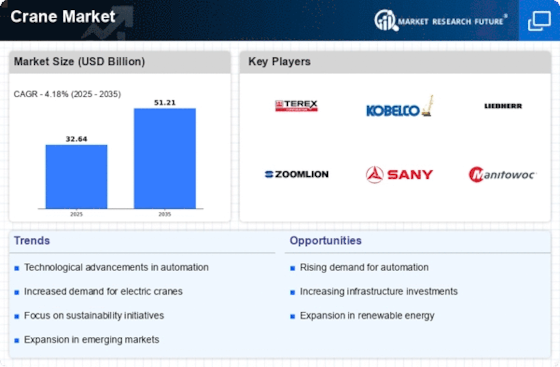
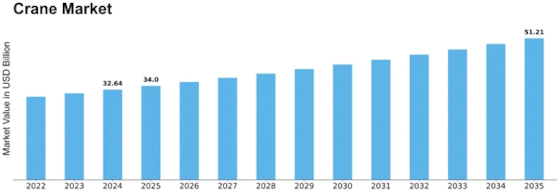
What is the current valuation of the Crane Market as of 2024?

<p>The Crane Market was valued at 32.64 USD Billion in 2024.</p>

What is the projected market valuation for the Crane Market in 2035?

<p>The Crane Market is projected to reach a valuation of 51.21 USD Billion by 2035.</p>

What is the expected CAGR for the Crane Market during the forecast period 2025 - 2035?

<p>The expected CAGR for the Crane Market during the forecast period 2025 - 2035 is 4.18%.</p>

Which segments are included in the Crane Market analysis?

<p>The Crane Market analysis includes segments such as Industrial Cranes, Offshore Cranes, Port Cranes, and others.</p>

What was the valuation of Industrial Cranes in 2024?

<p>The valuation of Industrial Cranes was 10.0 USD Billion in 2024 and is expected to grow to 15.0 USD Billion.</p>

How does the Offshore Cranes segment perform in terms of valuation?

<p>The Offshore Cranes segment had a valuation of 8.0 USD Billion in 2024, with a projected increase to 12.0 USD Billion.</p>

What are the key applications of cranes in the market?

<p>Key applications of cranes in the market include Construction, Mining, Oil & Gas, and Shipping & Port.</p>

What was the valuation of the Construction application in 2024?

<p>The Construction application was valued at 12.0 USD Billion in 2024, with expectations to rise to 19.0 USD Billion.</p>

Who are the leading players in the Crane Market?

<p>Leading players in the Crane Market include Terex Corporation, Kobelco Cranes, Liebherr Group, and others.</p>

What is the projected growth for the Port Cranes segment?

<p>The Port Cranes segment was valued at 9.0 USD Billion in 2024 and is projected to grow to 14.0 USD Billion.</p>

Market Summary

As per Market Research Future analysis, the Crane Market Size was estimated at 37.8 USD Billion in 2024. The Crane industry is projected to grow from 39.6 USD Billion in 2025 to 63.3 USD Billion by 2035, exhibiting a compound annual growth rate (CAGR) of 4.8% during the forecast period 2025 - 2035

Key Market Trends & Highlights

The Crane Market is poised for growth driven by technological advancements and sustainability initiatives.

  • Technological advancements are enhancing the efficiency and safety of cranes across various applications. The North American region remains the largest market, while the Asia-Pacific region is experiencing rapid growth. Industrial cranes dominate the market, whereas offshore cranes are emerging as the fastest-growing segment. Infrastructure development and a focus on sustainability are key drivers propelling market expansion.

Market Size & Forecast

2024 Market Size 32.64 (USD Billion)
2035 Market Size 63.3 (USD Billion)
CAGR (2025 - 2035) 4.8%
Largest Regional Market Share in 2024 Asia Pacific

Major Players

Terex Corporation, Kobelco Cranes, Liebherr Group, Zoomlion Heavy Industry Science and Technology Co., SANY Group Co., Ltd., Manitowoc Company, Inc., Hitachi Sumitomo Heavy Industries Construction Crane Co., Ltd., XCMG Group, Hiab Oyj, Manitex International

Market Trends

The Crane Market is currently experiencing a dynamic evolution, driven by various factors that shape its landscape. The increasing demand for construction and infrastructure development across multiple regions appears to be a primary catalyst for growth. As urbanization accelerates, the need for efficient lifting solutions becomes more pronounced, leading to innovations in crane technology. Furthermore, the integration of advanced automation and digitalization in crane operations suggests a shift towards more efficient and safer lifting practices. This trend may enhance productivity while reducing operational costs, thereby attracting more stakeholders to the market. In addition to technological advancements, sustainability initiatives are gaining traction within the Crane Market. Companies are increasingly focusing on eco-friendly practices, which may involve the adoption of electric cranes and hybrid models. This shift not only aligns with global environmental goals but also responds to regulatory pressures for reduced emissions. As the market continues to adapt to these evolving demands, it is likely that the Crane Market will witness a diversification of product offerings, catering to a broader range of applications and customer preferences. Overall, the current trajectory indicates a robust and multifaceted market poised for continued growth and transformation.

Technological Advancements

The Crane Market is witnessing a surge in technological innovations, particularly in automation and digitalization. These advancements are enhancing operational efficiency and safety, allowing for more precise lifting and maneuvering capabilities. As companies invest in smart cranes equipped with sensors and data analytics, the potential for improved productivity becomes increasingly apparent.

Sustainability Focus

A growing emphasis on sustainability is reshaping the Crane Market. Manufacturers are exploring eco-friendly alternatives, such as electric and hybrid cranes, to meet environmental standards and reduce carbon footprints. This trend reflects a broader commitment to sustainable practices, appealing to environmentally conscious clients and aligning with global initiatives.

Diverse Applications

The Crane Market is expanding its reach across various sectors, including construction, manufacturing, and logistics. This diversification indicates a shift towards specialized cranes designed for specific tasks, enhancing their utility in different environments. As industries evolve, the demand for tailored lifting solutions is likely to increase, driving further innovation.

Crane Market Market Drivers

Regulatory Compliance

Regulatory frameworks governing safety and environmental standards are increasingly influencing the Crane Market. Stricter regulations require construction companies to utilize cranes that meet specific safety criteria, thereby driving demand for compliant equipment. For instance, the Occupational Safety and Health Administration (OSHA) has established guidelines that necessitate regular inspections and maintenance of cranes, compelling operators to invest in newer models that adhere to these standards. This regulatory landscape not only ensures worker safety but also promotes the use of advanced crane technologies that minimize environmental impact. As a result, the Crane Market is likely to see a surge in demand for cranes that comply with these regulations, fostering a safer and more sustainable construction environment.

Focus on Sustainability

The Crane Market is increasingly influenced by the global focus on sustainability and environmental responsibility. Construction companies are under pressure to adopt eco-friendly practices, leading to a growing demand for cranes that are energy-efficient and produce lower emissions. The rise of electric and hybrid cranes is a testament to this trend, as they offer a more sustainable alternative to traditional diesel-powered models. Furthermore, many companies are implementing green building practices, which often require specialized cranes for efficient material handling. This shift towards sustainability is not only beneficial for the environment but also aligns with the preferences of clients who prioritize eco-friendly construction methods. As a result, the Crane Market is likely to see a continued emphasis on sustainable practices, driving innovation and demand for greener crane solutions.

Technological Innovations

Technological advancements play a crucial role in shaping the Crane Market. Innovations such as telematics, automation, and advanced control systems enhance the efficiency and safety of crane operations. For example, the integration of IoT technology allows for real-time monitoring of crane performance, which can lead to reduced downtime and improved maintenance schedules. Furthermore, the introduction of electric and hybrid cranes is gaining traction, aligning with the industry's shift towards sustainability. As these technologies evolve, they are expected to drive the demand for modern cranes, with the market projected to reach a valuation of over 40 billion by 2026. This trend indicates a significant transformation in the Crane Market, as companies adopt smarter and more efficient lifting solutions.

Infrastructure Development

The ongoing expansion of infrastructure projects worldwide is a primary driver for the Crane Market. Governments and private entities are investing heavily in the construction of roads, bridges, and buildings, which necessitates the use of cranes for efficient material handling and lifting. For instance, the construction sector is projected to grow at a compound annual growth rate of approximately 5.5%, indicating a robust demand for cranes. This growth is further fueled by urbanization trends, as more people migrate to cities, necessitating the development of residential and commercial spaces. Consequently, the Crane Market is likely to experience increased demand as construction companies seek advanced lifting solutions to meet project timelines and safety standards.

Rising Demand in Emerging Markets

Emerging markets are witnessing a surge in construction activities, which is significantly impacting the Crane Market. Countries in Asia and Africa are experiencing rapid urbanization and industrialization, leading to increased investments in infrastructure projects. For instance, the Asian Development Bank has projected that Asia alone will require approximately 26 trillion in infrastructure investments by 2030. This demand is likely to drive the need for cranes, as construction companies seek reliable lifting solutions to support large-scale projects. Additionally, the growing middle class in these regions is contributing to the demand for residential and commercial buildings, further propelling the Crane Market. As these markets continue to develop, the demand for cranes is expected to rise correspondingly.

Market Segment Insights

By Type: Industrial Cranes (Largest) vs. Offshore Cranes (Fastest-Growing)

<p>The crane market is primarily segmented into Industrial Cranes, Offshore Cranes, Port Cranes, and Others. Among these, Industrial Cranes hold the largest market share due to their extensive use in manufacturing and heavy industries. Port Cranes follow as integral components of port operations, while Offshore Cranes are gaining momentum due to increased offshore activities in the oil and renewable energy sectors. Together, these segments reflect the diverse applications and demand for cranes across various industries. Growth trends indicate that Offshore Cranes are emerging as the fastest-growing segment, driven by the rise in offshore construction projects and technological advancements that enhance operational efficiency. Furthermore, the transition to renewable energy sources heightens the need for specialized cranes in wind farm installations and offshore platforms. This shift signifies a growing market as companies pivot towards sustainability and energy diversification efforts.</p>

<p>Industrial Cranes (Dominant) vs. Port Cranes (Emerging)</p>

<p>Industrial Cranes are known for their versatility and robust performance across a range of manufacturing sectors, including automotive and construction. They are designed to handle heavy loads efficiently, making them a staple in industrial operations. In contrast, Port Cranes serve a specific function, crucial for loading and unloading cargo at shipping docks. As global trade increases, Port Cranes are becoming vital for enhancing logistical efficiencies. The development of high-tech port cranes equipped with automation features is indicative of their emerging status in the market. While Industrial Cranes dominate the market due to their widespread application, the evolution of Port Cranes reflects a growing need for specialized equipment tailored to bolstering port operations.</p>

By Application: Construction (Largest) vs. Shipping & Port (Fastest-Growing)

<p>In the Crane Market, the Application segment sees a significant distribution of market share across various industries. Construction stands out as the largest segment, driven by ongoing infrastructure projects and urbanization trends around the globe. Meanwhile, the Shipping & Port sector has emerged as a rapidly growing segment, spurred on by increasing global trade and the need for efficient logistics solutions to handle larger cargo volumes.</p>

<p>Mining: Traditional (Dominant) vs. Oil & Gas (Emerging)</p>

<p>Within the Application segment, both Mining and Oil & Gas play critical roles in driving crane demand. Mining, characterized by its traditional practices, remains the dominant force, relying on robust heavy machinery to facilitate extraction processes. Conversely, the Oil & Gas sector is emerging, fueled by advancements in drilling technologies and the need for specialized cranes to operate in challenging environments. These sectors together contribute to an evolving landscape in the Crane Market, highlighting the necessity for versatile machinery that meets the specific demands of each application.</p>

Get more detailed insights about Crane Market Research Report - Global Forecast till 2035

Regional Insights

North America : Construction Powerhouse

North America is witnessing robust growth in the crane market, driven by increasing infrastructure investments and a booming construction sector. The region holds approximately 35% of the global market share, making it the largest market for cranes. Regulatory support for infrastructure projects and a focus on modernization are key growth drivers. The demand for advanced cranes, particularly in urban development and renewable energy projects, is on the rise. The United States is the leading country in this region, with significant contributions from Canada. Major players like Terex Corporation and Manitowoc Company are prominent in the market, offering innovative solutions. The competitive landscape is characterized by technological advancements and strategic partnerships, ensuring a dynamic environment for growth and development.

Europe : Innovation and Sustainability

Europe is experiencing a transformation in the crane market, driven by sustainability initiatives and technological advancements. The region accounts for approximately 30% of the global market share, making it the second-largest market. Regulatory frameworks promoting green construction practices and energy-efficient machinery are significant catalysts for growth. The demand for cranes in renewable energy projects, particularly wind and solar, is increasing, reflecting a shift towards sustainable construction. Germany and the United Kingdom are the leading countries in this market, with a strong presence of key players like Liebherr Group and Kobelco Cranes. The competitive landscape is marked by innovation, with companies investing in smart technologies and automation. This focus on sustainability and efficiency is reshaping the market, positioning Europe as a leader in crane technology and environmental responsibility.

Asia-Pacific : Emerging Market Dynamics

The Asia-Pacific region is rapidly emerging as a significant player in the crane market, driven by urbanization and infrastructure development. This region holds approximately 25% of the global market share, with countries like China and India leading the charge. Government initiatives to enhance infrastructure and urban development are key growth drivers, alongside increasing investments in construction and mining sectors. The demand for advanced cranes is expected to rise as projects become more complex and require specialized equipment. China is the largest market in this region, with major companies like Zoomlion and SANY Group dominating the landscape. India is also witnessing substantial growth, with increasing investments in infrastructure projects. The competitive environment is characterized by a mix of local and international players, fostering innovation and technological advancements to meet the growing demand for cranes in various sectors.

Middle East and Africa : Resource-Rich Opportunities

The Middle East and Africa region is poised for growth in the crane market, driven by resource extraction and infrastructure development. This region holds approximately 10% of the global market share, with significant investments in construction and mining sectors. Regulatory support for infrastructure projects and a focus on economic diversification are key growth drivers. The demand for cranes is expected to increase as countries invest in large-scale projects, particularly in the Gulf Cooperation Council (GCC) countries. The United Arab Emirates and South Africa are leading countries in this market, with a growing presence of key players like XCMG Group and Hitachi Sumitomo. The competitive landscape is evolving, with local companies expanding their capabilities and international firms entering the market. This dynamic environment presents opportunities for innovation and collaboration in the crane sector.

Key Players and Competitive Insights

Major market players are spending a lot of money on R&D to increase their product lines, which will help the Crane Market grow even more. Market participants are also taking a range of strategic initiatives to grow their worldwide footprint, including new product launches, contractual agreements, mergers and acquisitions, increased investments, and collaboration with other organizations. Competitors in the Crane industry must offer cost-effective items to expand and survive in an increasingly competitive and rising market environment.
One of the primary business strategies adopted by manufacturers in the Crane industry to benefit clients and expand the Crane Market sector is to manufacture locally to reduce operating costs. In recent years, Crane Market has provided medicine with some of the most significant benefits.
Hyva is one of the world’s leading providers of innovative and highly efficient transport solutions for the commercial vehicle and environmental service industries.
In August Hyva introduced a new line of stiff boom cranes at its Yangzhou location, in China. The three new models, namely HST14 E4, HST12 E4, and HST8 E4 have launched alongside other crane accessories and models. This consistent development of cutting-edge products by key players in China is a crucial factor that is set to fuel the market. This approval has further broadened the growth opportunity for the Crane industry.
Also, XCMG is a Chinese multinational state-owned heavy machinery manufacturing company with headquarters in Xuzhou, Jiangsu.
In November XCMG launched 10 new electric machines including XCA60EV, the world's first plug-in hybrid crane at BAUMA 2022.

Key Companies in the Crane Market include

Industry Developments

January 2022 saw Bay Crane Market’s announcement of its acquisition of Gatwood Crane Market Rental Service to better address their customers. This acquisition would also aid in expanding the company's presence across several key markets with the addition of Gatwood’s experienced team.

Dwarkesh Transport Corporation received India's first crawler crane with a lifting capacity of 800 tons from Sany India in January 2022. The Indian-made SCX1000A is a safety-equipped and uniquely designed crawler crane which will be utilized by Dwarkesh for wind turbine erection purposes. Such other launches of products are being driven similarly, and deliveries are expected to increase steadily within India.

Sumitomo Heavy Industries Construction Cranes Co., Ltd. (HSC), a well-known Japanese heavy equipment manufacturer, launched two new models – SCX1000HD-3 and SCX1800A-3, the latest examples of crawler cranes, in January 2022.

In Germany-based multinational equipment manufacturer Liebherr announced that it had sold over 80 new units of maritime mobile harbor cranes during 2021, which led to record sales compared to the previous years. The firm intends to revolutionize port handling by manufacturing advanced electric motors. It is also seeking to maintain its leadership position in this sector by developing CO2-neutral drive technology.

Future Outlook

Crane Market Future Outlook

The Crane Market is projected to grow at a 4.8% CAGR from 2025 to 2035, driven by infrastructure development, technological advancements, and increased demand for efficient lifting solutions.

New opportunities lie in:

  • <p>Expansion into renewable energy sector with specialized cranes Development of smart cranes with IoT integration Partnerships for urban construction projects in emerging markets</p>

By 2035, the Crane Market is expected to achieve robust growth, reflecting evolving industry demands.

Market Segmentation

Crane Market Type Outlook

  • Industrial Cranes
  • Offshore Cranes
  • Port Cranes
  • Others

Crane Market Application Outlook

  • Construction
  • Mining
  • Oil & Gas
  • Shipping & Port
  • Others

Report Scope

MARKET SIZE 2024 37.8 (USD Billion)
MARKET SIZE 2025 39.6 (USD Billion)
MARKET SIZE 2035 63.3 (USD Billion)
COMPOUND ANNUAL GROWTH RATE (CAGR) 4.8% (2025 - 2035)
REPORT COVERAGE Revenue Forecast, Competitive Landscape, Growth Factors, and Trends
BASE YEAR 2024
Market Forecast Period 2025 - 2035
Historical Data 2019 - 2024
Market Forecast Units USD Billion
Key Companies Profiled Terex Corporation, Kobelco Cranes, Liebherr Group, Zoomlion Heavy Industry Science and Technology Co., SANY Group Co., Ltd., Manitowoc Company, Inc., Hitachi Sumitomo Heavy Industries Construction Crane Co., Ltd., XCMG Group, Hiab Oyj, Manitex International
Segments Covered Type, Application, Region
Key Market Opportunities Integration of advanced automation and telematics in Crane Market enhances operational efficiency and safety.
Key Market Dynamics Technological advancements and regulatory changes drive innovation and competition in the crane market.
Countries Covered North America, Europe, APAC, South America, MEA

FAQs

What is the current valuation of the Crane Market as of 2024?

<p>The Crane Market was valued at 32.64 USD Billion in 2024.</p>

What is the projected market valuation for the Crane Market in 2035?

<p>The Crane Market is projected to reach a valuation of 51.21 USD Billion by 2035.</p>

What is the expected CAGR for the Crane Market during the forecast period 2025 - 2035?

<p>The expected CAGR for the Crane Market during the forecast period 2025 - 2035 is 4.18%.</p>

Which segments are included in the Crane Market analysis?

<p>The Crane Market analysis includes segments such as Industrial Cranes, Offshore Cranes, Port Cranes, and others.</p>

What was the valuation of Industrial Cranes in 2024?

<p>The valuation of Industrial Cranes was 10.0 USD Billion in 2024 and is expected to grow to 15.0 USD Billion.</p>

How does the Offshore Cranes segment perform in terms of valuation?

<p>The Offshore Cranes segment had a valuation of 8.0 USD Billion in 2024, with a projected increase to 12.0 USD Billion.</p>

What are the key applications of cranes in the market?

<p>Key applications of cranes in the market include Construction, Mining, Oil & Gas, and Shipping & Port.</p>

What was the valuation of the Construction application in 2024?

<p>The Construction application was valued at 12.0 USD Billion in 2024, with expectations to rise to 19.0 USD Billion.</p>

Who are the leading players in the Crane Market?

<p>Leading players in the Crane Market include Terex Corporation, Kobelco Cranes, Liebherr Group, and others.</p>

What is the projected growth for the Port Cranes segment?

<p>The Port Cranes segment was valued at 9.0 USD Billion in 2024 and is projected to grow to 14.0 USD Billion.</p>

  1. SECTION I: EXECUTIVE SUMMARY AND KEY HIGHLIGHTS
    1. | 1.1 EXECUTIVE SUMMARY
    2. | | 1.1.1 Market Overview
    3. | | 1.1.2 Key Findings
    4. | | 1.1.3 Market Segmentation
    5. | | 1.1.4 Competitive Landscape
    6. | | 1.1.5 Challenges and Opportunities
    7. | | 1.1.6 Future Outlook
  2. SECTION II: SCOPING, METHODOLOGY AND MARKET STRUCTURE
    1. | 2.1 MARKET INTRODUCTION
    2. | | 2.1.1 Definition
    3. | | 2.1.2 Scope of the study
    4. | | | 2.1.2.1 Research Objective
    5. | | | 2.1.2.2 Assumption
    6. | | | 2.1.2.3 Limitations
    7. | 2.2 RESEARCH METHODOLOGY
    8. | | 2.2.1 Overview
    9. | | 2.2.2 Data Mining
    10. | | 2.2.3 Secondary Research
    11. | | 2.2.4 Primary Research
    12. | | | 2.2.4.1 Primary Interviews and Information Gathering Process
    13. | | | 2.2.4.2 Breakdown of Primary Respondents
    14. | | 2.2.5 Forecasting Model
    15. | | 2.2.6 Market Size Estimation
    16. | | | 2.2.6.1 Bottom-Up Approach
    17. | | | 2.2.6.2 Top-Down Approach
    18. | | 2.2.7 Data Triangulation
    19. | | 2.2.8 Validation
  3. SECTION III: QUALITATIVE ANALYSIS
    1. | 3.1 MARKET DYNAMICS
    2. | | 3.1.1 Overview
    3. | | 3.1.2 Drivers
    4. | | 3.1.3 Restraints
    5. | | 3.1.4 Opportunities
    6. | 3.2 MARKET FACTOR ANALYSIS
    7. | | 3.2.1 Value chain Analysis
    8. | | 3.2.2 Porter's Five Forces Analysis
    9. | | | 3.2.2.1 Bargaining Power of Suppliers
    10. | | | 3.2.2.2 Bargaining Power of Buyers
    11. | | | 3.2.2.3 Threat of New Entrants
    12. | | | 3.2.2.4 Threat of Substitutes
    13. | | | 3.2.2.5 Intensity of Rivalry
    14. | | 3.2.3 COVID-19 Impact Analysis
    15. | | | 3.2.3.1 Market Impact Analysis
    16. | | | 3.2.3.2 Regional Impact
    17. | | | 3.2.3.3 Opportunity and Threat Analysis
  4. SECTION IV: QUANTITATIVE ANALYSIS
    1. | 4.1 Packaging & Transport, BY Type (USD Billion)
    2. | | 4.1.1 Industrial Cranes
    3. | | 4.1.2 Offshore Cranes
    4. | | 4.1.3 Port Cranes
    5. | | 4.1.4 Others
    6. | 4.2 Packaging & Transport, BY Application (USD Billion)
    7. | | 4.2.1 Construction
    8. | | 4.2.2 Mining
    9. | | 4.2.3 Oil & Gas
    10. | | 4.2.4 Shipping & Port
    11. | | 4.2.5 Others
    12. | 4.3 Packaging & Transport, BY Region (USD Billion)
    13. | | 4.3.1 North America
    14. | | | 4.3.1.1 US
    15. | | | 4.3.1.2 Canada
    16. | | 4.3.2 Europe
    17. | | | 4.3.2.1 Germany
    18. | | | 4.3.2.2 UK
    19. | | | 4.3.2.3 France
    20. | | | 4.3.2.4 Russia
    21. | | | 4.3.2.5 Italy
    22. | | | 4.3.2.6 Spain
    23. | | | 4.3.2.7 Rest of Europe
    24. | | 4.3.3 APAC
    25. | | | 4.3.3.1 China
    26. | | | 4.3.3.2 India
    27. | | | 4.3.3.3 Japan
    28. | | | 4.3.3.4 South Korea
    29. | | | 4.3.3.5 Malaysia
    30. | | | 4.3.3.6 Thailand
    31. | | | 4.3.3.7 Indonesia
    32. | | | 4.3.3.8 Rest of APAC
    33. | | 4.3.4 South America
    34. | | | 4.3.4.1 Brazil
    35. | | | 4.3.4.2 Mexico
    36. | | | 4.3.4.3 Argentina
    37. | | | 4.3.4.4 Rest of South America
    38. | | 4.3.5 MEA
    39. | | | 4.3.5.1 GCC Countries
    40. | | | 4.3.5.2 South Africa
    41. | | | 4.3.5.3 Rest of MEA
  5. SECTION V: COMPETITIVE ANALYSIS
    1. | 5.1 Competitive Landscape
    2. | | 5.1.1 Overview
    3. | | 5.1.2 Competitive Analysis
    4. | | 5.1.3 Market share Analysis
    5. | | 5.1.4 Major Growth Strategy in the Packaging & Transport
    6. | | 5.1.5 Competitive Benchmarking
    7. | | 5.1.6 Leading Players in Terms of Number of Developments in the Packaging & Transport
    8. | | 5.1.7 Key developments and growth strategies
    9. | | | 5.1.7.1 New Product Launch/Service Deployment
    10. | | | 5.1.7.2 Merger & Acquisitions
    11. | | | 5.1.7.3 Joint Ventures
    12. | | 5.1.8 Major Players Financial Matrix
    13. | | | 5.1.8.1 Sales and Operating Income
    14. | | | 5.1.8.2 Major Players R&D Expenditure. 2023
    15. | 5.2 Company Profiles
    16. | | 5.2.1 Terex Corporation (US)
    17. | | | 5.2.1.1 Financial Overview
    18. | | | 5.2.1.2 Products Offered
    19. | | | 5.2.1.3 Key Developments
    20. | | | 5.2.1.4 SWOT Analysis
    21. | | | 5.2.1.5 Key Strategies
    22. | | 5.2.2 Kobelco Cranes (JP)
    23. | | | 5.2.2.1 Financial Overview
    24. | | | 5.2.2.2 Products Offered
    25. | | | 5.2.2.3 Key Developments
    26. | | | 5.2.2.4 SWOT Analysis
    27. | | | 5.2.2.5 Key Strategies
    28. | | 5.2.3 Liebherr Group (DE)
    29. | | | 5.2.3.1 Financial Overview
    30. | | | 5.2.3.2 Products Offered
    31. | | | 5.2.3.3 Key Developments
    32. | | | 5.2.3.4 SWOT Analysis
    33. | | | 5.2.3.5 Key Strategies
    34. | | 5.2.4 Zoomlion Heavy Industry Science and Technology Co., Ltd. (CN)
    35. | | | 5.2.4.1 Financial Overview
    36. | | | 5.2.4.2 Products Offered
    37. | | | 5.2.4.3 Key Developments
    38. | | | 5.2.4.4 SWOT Analysis
    39. | | | 5.2.4.5 Key Strategies
    40. | | 5.2.5 SANY Group Co., Ltd. (CN)
    41. | | | 5.2.5.1 Financial Overview
    42. | | | 5.2.5.2 Products Offered
    43. | | | 5.2.5.3 Key Developments
    44. | | | 5.2.5.4 SWOT Analysis
    45. | | | 5.2.5.5 Key Strategies
    46. | | 5.2.6 Manitowoc Company, Inc. (US)
    47. | | | 5.2.6.1 Financial Overview
    48. | | | 5.2.6.2 Products Offered
    49. | | | 5.2.6.3 Key Developments
    50. | | | 5.2.6.4 SWOT Analysis
    51. | | | 5.2.6.5 Key Strategies
    52. | | 5.2.7 XCMG Group (CN)
    53. | | | 5.2.7.1 Financial Overview
    54. | | | 5.2.7.2 Products Offered
    55. | | | 5.2.7.3 Key Developments
    56. | | | 5.2.7.4 SWOT Analysis
    57. | | | 5.2.7.5 Key Strategies
    58. | | 5.2.8 Hitachi Sumitomo Heavy Industries Construction Crane Co., Ltd. (JP)
    59. | | | 5.2.8.1 Financial Overview
    60. | | | 5.2.8.2 Products Offered
    61. | | | 5.2.8.3 Key Developments
    62. | | | 5.2.8.4 SWOT Analysis
    63. | | | 5.2.8.5 Key Strategies
    64. | 5.3 Appendix
    65. | | 5.3.1 References
    66. | | 5.3.2 Related Reports
  6. LIST OF FIGURES
    1. | 6.1 MARKET SYNOPSIS
    2. | 6.2 NORTH AMERICA MARKET ANALYSIS
    3. | 6.3 US MARKET ANALYSIS BY TYPE
    4. | 6.4 US MARKET ANALYSIS BY APPLICATION
    5. | 6.5 CANADA MARKET ANALYSIS BY TYPE
    6. | 6.6 CANADA MARKET ANALYSIS BY APPLICATION
    7. | 6.7 EUROPE MARKET ANALYSIS
    8. | 6.8 GERMANY MARKET ANALYSIS BY TYPE
    9. | 6.9 GERMANY MARKET ANALYSIS BY APPLICATION
    10. | 6.10 UK MARKET ANALYSIS BY TYPE
    11. | 6.11 UK MARKET ANALYSIS BY APPLICATION
    12. | 6.12 FRANCE MARKET ANALYSIS BY TYPE
    13. | 6.13 FRANCE MARKET ANALYSIS BY APPLICATION
    14. | 6.14 RUSSIA MARKET ANALYSIS BY TYPE
    15. | 6.15 RUSSIA MARKET ANALYSIS BY APPLICATION
    16. | 6.16 ITALY MARKET ANALYSIS BY TYPE
    17. | 6.17 ITALY MARKET ANALYSIS BY APPLICATION
    18. | 6.18 SPAIN MARKET ANALYSIS BY TYPE
    19. | 6.19 SPAIN MARKET ANALYSIS BY APPLICATION
    20. | 6.20 REST OF EUROPE MARKET ANALYSIS BY TYPE
    21. | 6.21 REST OF EUROPE MARKET ANALYSIS BY APPLICATION
    22. | 6.22 APAC MARKET ANALYSIS
    23. | 6.23 CHINA MARKET ANALYSIS BY TYPE
    24. | 6.24 CHINA MARKET ANALYSIS BY APPLICATION
    25. | 6.25 INDIA MARKET ANALYSIS BY TYPE
    26. | 6.26 INDIA MARKET ANALYSIS BY APPLICATION
    27. | 6.27 JAPAN MARKET ANALYSIS BY TYPE
    28. | 6.28 JAPAN MARKET ANALYSIS BY APPLICATION
    29. | 6.29 SOUTH KOREA MARKET ANALYSIS BY TYPE
    30. | 6.30 SOUTH KOREA MARKET ANALYSIS BY APPLICATION
    31. | 6.31 MALAYSIA MARKET ANALYSIS BY TYPE
    32. | 6.32 MALAYSIA MARKET ANALYSIS BY APPLICATION
    33. | 6.33 THAILAND MARKET ANALYSIS BY TYPE
    34. | 6.34 THAILAND MARKET ANALYSIS BY APPLICATION
    35. | 6.35 INDONESIA MARKET ANALYSIS BY TYPE
    36. | 6.36 INDONESIA MARKET ANALYSIS BY APPLICATION
    37. | 6.37 REST OF APAC MARKET ANALYSIS BY TYPE
    38. | 6.38 REST OF APAC MARKET ANALYSIS BY APPLICATION
    39. | 6.39 SOUTH AMERICA MARKET ANALYSIS
    40. | 6.40 BRAZIL MARKET ANALYSIS BY TYPE
    41. | 6.41 BRAZIL MARKET ANALYSIS BY APPLICATION
    42. | 6.42 MEXICO MARKET ANALYSIS BY TYPE
    43. | 6.43 MEXICO MARKET ANALYSIS BY APPLICATION
    44. | 6.44 ARGENTINA MARKET ANALYSIS BY TYPE
    45. | 6.45 ARGENTINA MARKET ANALYSIS BY APPLICATION
    46. | 6.46 REST OF SOUTH AMERICA MARKET ANALYSIS BY TYPE
    47. | 6.47 REST OF SOUTH AMERICA MARKET ANALYSIS BY APPLICATION
    48. | 6.48 MEA MARKET ANALYSIS
    49. | 6.49 GCC COUNTRIES MARKET ANALYSIS BY TYPE
    50. | 6.50 GCC COUNTRIES MARKET ANALYSIS BY APPLICATION
    51. | 6.51 SOUTH AFRICA MARKET ANALYSIS BY TYPE
    52. | 6.52 SOUTH AFRICA MARKET ANALYSIS BY APPLICATION
    53. | 6.53 REST OF MEA MARKET ANALYSIS BY TYPE
    54. | 6.54 REST OF MEA MARKET ANALYSIS BY APPLICATION
    55. | 6.55 KEY BUYING CRITERIA OF PACKAGING & TRANSPORT
    56. | 6.56 RESEARCH PROCESS OF MRFR
    57. | 6.57 DRO ANALYSIS OF PACKAGING & TRANSPORT
    58. | 6.58 DRIVERS IMPACT ANALYSIS: PACKAGING & TRANSPORT
    59. | 6.59 RESTRAINTS IMPACT ANALYSIS: PACKAGING & TRANSPORT
    60. | 6.60 SUPPLY / VALUE CHAIN: PACKAGING & TRANSPORT
    61. | 6.61 PACKAGING & TRANSPORT, BY TYPE, 2024 (% SHARE)
    62. | 6.62 PACKAGING & TRANSPORT, BY TYPE, 2024 TO 2035 (USD Billion)
    63. | 6.63 PACKAGING & TRANSPORT, BY APPLICATION, 2024 (% SHARE)
    64. | 6.64 PACKAGING & TRANSPORT, BY APPLICATION, 2024 TO 2035 (USD Billion)
    65. | 6.65 BENCHMARKING OF MAJOR COMPETITORS
  7. LIST OF TABLES
    1. | 7.1 LIST OF ASSUMPTIONS
    2. | | 7.1.1
    3. | 7.2 North America MARKET SIZE ESTIMATES; FORECAST
    4. | | 7.2.1 BY TYPE, 2025-2035 (USD Billion)
    5. | | 7.2.2 BY APPLICATION, 2025-2035 (USD Billion)
    6. | 7.3 US MARKET SIZE ESTIMATES; FORECAST
    7. | | 7.3.1 BY TYPE, 2025-2035 (USD Billion)
    8. | | 7.3.2 BY APPLICATION, 2025-2035 (USD Billion)
    9. | 7.4 Canada MARKET SIZE ESTIMATES; FORECAST
    10. | | 7.4.1 BY TYPE, 2025-2035 (USD Billion)
    11. | | 7.4.2 BY APPLICATION, 2025-2035 (USD Billion)
    12. | 7.5 Europe MARKET SIZE ESTIMATES; FORECAST
    13. | | 7.5.1 BY TYPE, 2025-2035 (USD Billion)
    14. | | 7.5.2 BY APPLICATION, 2025-2035 (USD Billion)
    15. | 7.6 Germany MARKET SIZE ESTIMATES; FORECAST
    16. | | 7.6.1 BY TYPE, 2025-2035 (USD Billion)
    17. | | 7.6.2 BY APPLICATION, 2025-2035 (USD Billion)
    18. | 7.7 UK MARKET SIZE ESTIMATES; FORECAST
    19. | | 7.7.1 BY TYPE, 2025-2035 (USD Billion)
    20. | | 7.7.2 BY APPLICATION, 2025-2035 (USD Billion)
    21. | 7.8 France MARKET SIZE ESTIMATES; FORECAST
    22. | | 7.8.1 BY TYPE, 2025-2035 (USD Billion)
    23. | | 7.8.2 BY APPLICATION, 2025-2035 (USD Billion)
    24. | 7.9 Russia MARKET SIZE ESTIMATES; FORECAST
    25. | | 7.9.1 BY TYPE, 2025-2035 (USD Billion)
    26. | | 7.9.2 BY APPLICATION, 2025-2035 (USD Billion)
    27. | 7.10 Italy MARKET SIZE ESTIMATES; FORECAST
    28. | | 7.10.1 BY TYPE, 2025-2035 (USD Billion)
    29. | | 7.10.2 BY APPLICATION, 2025-2035 (USD Billion)
    30. | 7.11 Spain MARKET SIZE ESTIMATES; FORECAST
    31. | | 7.11.1 BY TYPE, 2025-2035 (USD Billion)
    32. | | 7.11.2 BY APPLICATION, 2025-2035 (USD Billion)
    33. | 7.12 Rest of Europe MARKET SIZE ESTIMATES; FORECAST
    34. | | 7.12.1 BY TYPE, 2025-2035 (USD Billion)
    35. | | 7.12.2 BY APPLICATION, 2025-2035 (USD Billion)
    36. | 7.13 APAC MARKET SIZE ESTIMATES; FORECAST
    37. | | 7.13.1 BY TYPE, 2025-2035 (USD Billion)
    38. | | 7.13.2 BY APPLICATION, 2025-2035 (USD Billion)
    39. | 7.14 China MARKET SIZE ESTIMATES; FORECAST
    40. | | 7.14.1 BY TYPE, 2025-2035 (USD Billion)
    41. | | 7.14.2 BY APPLICATION, 2025-2035 (USD Billion)
    42. | 7.15 India MARKET SIZE ESTIMATES; FORECAST
    43. | | 7.15.1 BY TYPE, 2025-2035 (USD Billion)
    44. | | 7.15.2 BY APPLICATION, 2025-2035 (USD Billion)
    45. | 7.16 Japan MARKET SIZE ESTIMATES; FORECAST
    46. | | 7.16.1 BY TYPE, 2025-2035 (USD Billion)
    47. | | 7.16.2 BY APPLICATION, 2025-2035 (USD Billion)
    48. | 7.17 South Korea MARKET SIZE ESTIMATES; FORECAST
    49. | | 7.17.1 BY TYPE, 2025-2035 (USD Billion)
    50. | | 7.17.2 BY APPLICATION, 2025-2035 (USD Billion)
    51. | 7.18 Malaysia MARKET SIZE ESTIMATES; FORECAST
    52. | | 7.18.1 BY TYPE, 2025-2035 (USD Billion)
    53. | | 7.18.2 BY APPLICATION, 2025-2035 (USD Billion)
    54. | 7.19 Thailand MARKET SIZE ESTIMATES; FORECAST
    55. | | 7.19.1 BY TYPE, 2025-2035 (USD Billion)
    56. | | 7.19.2 BY APPLICATION, 2025-2035 (USD Billion)
    57. | 7.20 Indonesia MARKET SIZE ESTIMATES; FORECAST
    58. | | 7.20.1 BY TYPE, 2025-2035 (USD Billion)
    59. | | 7.20.2 BY APPLICATION, 2025-2035 (USD Billion)
    60. | 7.21 Rest of APAC MARKET SIZE ESTIMATES; FORECAST
    61. | | 7.21.1 BY TYPE, 2025-2035 (USD Billion)
    62. | | 7.21.2 BY APPLICATION, 2025-2035 (USD Billion)
    63. | 7.22 South America MARKET SIZE ESTIMATES; FORECAST
    64. | | 7.22.1 BY TYPE, 2025-2035 (USD Billion)
    65. | | 7.22.2 BY APPLICATION, 2025-2035 (USD Billion)
    66. | 7.23 Brazil MARKET SIZE ESTIMATES; FORECAST
    67. | | 7.23.1 BY TYPE, 2025-2035 (USD Billion)
    68. | | 7.23.2 BY APPLICATION, 2025-2035 (USD Billion)
    69. | 7.24 Mexico MARKET SIZE ESTIMATES; FORECAST
    70. | | 7.24.1 BY TYPE, 2025-2035 (USD Billion)
    71. | | 7.24.2 BY APPLICATION, 2025-2035 (USD Billion)
    72. | 7.25 Argentina MARKET SIZE ESTIMATES; FORECAST
    73. | | 7.25.1 BY TYPE, 2025-2035 (USD Billion)
    74. | | 7.25.2 BY APPLICATION, 2025-2035 (USD Billion)
    75. | 7.26 Rest of South America MARKET SIZE ESTIMATES; FORECAST
    76. | | 7.26.1 BY TYPE, 2025-2035 (USD Billion)
    77. | | 7.26.2 BY APPLICATION, 2025-2035 (USD Billion)
    78. | 7.27 MEA MARKET SIZE ESTIMATES; FORECAST
    79. | | 7.27.1 BY TYPE, 2025-2035 (USD Billion)
    80. | | 7.27.2 BY APPLICATION, 2025-2035 (USD Billion)
    81. | 7.28 GCC Countries MARKET SIZE ESTIMATES; FORECAST
    82. | | 7.28.1 BY TYPE, 2025-2035 (USD Billion)
    83. | | 7.28.2 BY APPLICATION, 2025-2035 (USD Billion)
    84. | 7.29 South Africa MARKET SIZE ESTIMATES; FORECAST
    85. | | 7.29.1 BY TYPE, 2025-2035 (USD Billion)
    86. | | 7.29.2 BY APPLICATION, 2025-2035 (USD Billion)
    87. | 7.30 Rest of MEA MARKET SIZE ESTIMATES; FORECAST
    88. | | 7.30.1 BY TYPE, 2025-2035 (USD Billion)
    89. | | 7.30.2 BY APPLICATION, 2025-2035 (USD Billion)
    90. | 7.31 PRODUCT LAUNCH/PRODUCT DEVELOPMENT/APPROVAL
    91. | | 7.31.1
    92. | 7.32 ACQUISITION/PARTNERSHIP
    93. | | 7.32.1

Packaging & Transport Market Segmentation

Packaging & Transport By Type (USD Billion, 2025-2035)

  • Industrial Cranes
  • Offshore Cranes
  • Port Cranes
  • Others

Packaging & Transport By Application (USD Billion, 2025-2035)

  • Construction
  • Mining
  • Oil & Gas
  • Shipping & Port
  • Others
Infographic

Free Sample Request

Kindly complete the form below to receive a free sample of this Report

Get Free Sample

Customer Strories

Compare Licence

×
Features License Type
Single User Multiuser License Enterprise User
Price $4,950 $5,950 $7,250
Maximum User Access Limit 1 User Upto 10 Users Unrestricted Access Throughout the Organization
Free Customization
Direct Access to Analyst
Deliverable Format
Platform Access
Discount on Next Purchase 10% 15% 15%
Printable Versions
%>