×
Hero Background
English
Chinese
French
Japanese
Korean
German
Spanish

Crab Market Analysis

ID: MRFR/FnB/10006-HCR
200 Pages
Snehal Singh
October 2025

Crab Market Research Report By Type (Soft Shell Crab, Hard Shell Crab, King Crab, Dungeness Crab), By Source (Wild Caught, Farmed, Aquaculture), By Form (Live, Chilled, Frozen, Canned), By Distribution Channel (Supermarkets, Online Retail, Fish Markets, Specialty Stores), and By Regional (North America, Europe, South America, Asia Pacific, Middle East and Africa) - Forecast to 2035

Share:
Download PDF ×

We do not share your information with anyone. However, we may send you emails based on your report interest from time to time. You may contact us at any time to opt-out.

Crab Market Infographic
Purchase Options

Market Analysis

In-depth Analysis of Crab Market Industry Landscape

The dynamics of the crab market exhibit a complicated interplay of things that collectively influence its boom and fluctuations. One of the number one drivers propelling this marketplace is the growing worldwide demand for seafood, in which crab holds a vast location because of its delicacy and dietary cost. Consumers' growing awareness of the fitness benefits associated with seafood consumption, consisting of high protein content and omega-three fatty acids, contributes to the steady demand for crab. Consumer options play a pivotal function in shaping the marketplace dynamics of the crab enterprise. As dietary developments evolve, there is an excellent shift towards healthier and sustainable food picks. This shift is contemplated in the demand for responsibly sourced and eco-friendly crab merchandise. Consumers are looking for more facts about the sourcing and manufacturing techniques of crab to make knowledgeable alternatives, impacting the marketplace's usual trajectory. Regulatory frameworks governing the seafood industry drastically influence the market dynamics of crabs. Stringent guidelines associated with fishing quotas, sustainability practices, and food safety requirements have an immediate impact on how crab is sourced, processed, and traded. Market dynamics are, in addition, shaped by the competitive panorama of the crab market, which incorporates both home and international gamers. The marketplace's competitiveness is evident in corporations' efforts to diversify their product portfolios, increase distribution channels, and interact in strategic partnerships. Consumer schooling is a critical element influencing marketplace dynamics, specifically regarding the sustainable and accountable intake of crab. Efforts by industry stakeholders to raise focus on the importance of keeping crab habitats, adhering to ethical fishing practices, and assisting sustainable aquaculture contribute to shaping patron perceptions and choices. A knowledgeable customer base is more likely to drive demand for crab products that align with their values and options. The international nature of the crab market approaches its miles prompted by international change dynamics, geopolitical factors, and cultural options. The marketplace is attentive to shifts in worldwide delivery and demand, with exchange guidelines, price lists, and international relations impacting the accessibility and pricing of crab products in extraordinary regions. Additionally, cultural preferences for crab dishes and cooking strategies vary throughout international locations, influencing consumption styles and marketplace dynamics.

Author
Snehal Singh
Assistant Manager - Research

High acumen in analyzing complex macro & micro markets with more than 6 years of work experience in the field of market research. By implementing her analytical skills in forecasting and estimation into market research reports, she has expertise in Packaging, Construction, and Equipment domains. She handles a team size of 20-25 resources and ensures smooth running of the projects, associated marketing activities, and client servicing.

Leave a Comment

FAQs

What is the current valuation of the Crab Market as of 2024?

The overall market valuation of the Crab Market was 12.2 USD Billion in 2024.

Market Summary

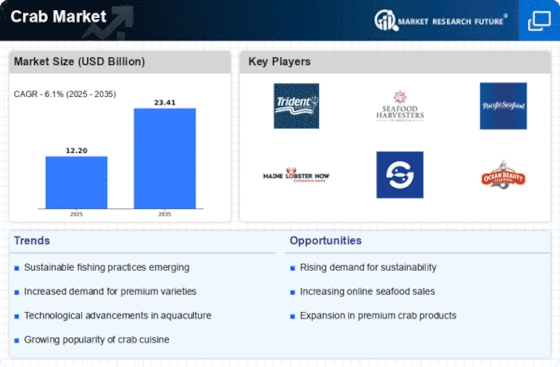
As per MRFR analysis, the Crab Market Size was estimated at 12.2 USD Billion in 2024. The Crab industry is projected to grow from 12.94 USD Billion in 2025 to 23.41 USD Billion by 2035, exhibiting a compound annual growth rate (CAGR) of 6.1 during the forecast period 2025 - 2035.

Key Market Trends & Highlights

The crab market is experiencing a dynamic shift towards sustainability and gourmet dining, driven by evolving consumer preferences.

  • The North American crab market remains the largest, characterized by a strong demand for Dungeness crab. In the Asia-Pacific region, the crab market is the fastest-growing, with increasing interest in King crab. Sustainability initiatives and technological advancements in aquaculture are shaping market dynamics. Rising health consciousness and culinary trends are driving the growth of both wild caught and aquaculture segments.

Market Size & Forecast

2024 Market Size 12.2 (USD Billion)
2035 Market Size 23.41 (USD Billion)
CAGR (2025 - 2035) 6.1%
Largest Regional Market Share in 2024 Asia Pacific

Major Players

<p><a href="https://www.tridentseafoods.com/">Trident Seafoods (US)</a>, Seafood Harvesters of America (US), Pacific Seafood (US), Maine Lobster Now (US), Stavis Seafoods (US), Ocean Beauty Seafoods (US), Aqua Star (US), Blue Star Foods (US), Bumble Bee Foods (US)</p>

Market Trends

The Crab Market is currently experiencing a dynamic phase characterized by evolving consumer preferences and increasing demand for sustainable seafood options. As awareness regarding environmental issues grows, consumers are gravitating towards responsibly sourced crab products. This shift is prompting suppliers to adopt more sustainable fishing practices, which may enhance the market's overall appeal. Additionally, the rise of gourmet dining experiences is influencing the Crab Market, as chefs and restaurants seek high-quality, unique crab varieties to attract discerning customers. This trend could potentially lead to a diversification of offerings, catering to a broader range of culinary tastes. Moreover, the Crab Market is witnessing a surge in online sales channels, driven by the convenience of e-commerce. Consumers are increasingly purchasing crab products through digital platforms, which may provide access to a wider selection and better pricing. This trend suggests that traditional retail channels may need to adapt to the changing landscape to remain competitive. Overall, the Crab Market appears poised for growth, with sustainability, culinary innovation, and digital transformation shaping its future trajectory.

Sustainability Focus

The Crab Market is increasingly prioritizing sustainable practices, as consumers demand responsibly sourced seafood. This trend encourages suppliers to implement eco-friendly fishing methods, potentially enhancing the market's reputation.

Gourmet Dining Influence

The rise of gourmet dining experiences is impacting the Crab Market, as chefs seek unique and high-quality crab varieties. This trend may lead to a broader range of offerings, appealing to diverse culinary preferences.

E-commerce Expansion

The Crab Market is experiencing growth in online sales channels, driven by consumer convenience. This shift suggests that traditional retail may need to adapt to maintain competitiveness in the evolving landscape.

Crab Market Market Drivers

Sustainability Initiatives

The Crab Market is increasingly influenced by sustainability initiatives aimed at preserving marine ecosystems. As consumers become more environmentally conscious, there is a growing demand for sustainably sourced crab products. This shift is reflected in the implementation of stricter fishing regulations and certifications, such as the Marine Stewardship Council (MSC) label. In 2025, it is estimated that sustainably sourced crab could account for over 30% of total market sales. This trend not only appeals to eco-conscious consumers but also encourages producers to adopt responsible fishing practices, thereby enhancing the overall reputation of the Crab Market.

Rising Health Consciousness

Rising health consciousness among consumers is driving demand for crab products, as they are perceived as a healthy source of protein. The Crab Market benefits from the increasing awareness of the nutritional value of crab, which is low in fat and high in essential nutrients such as omega-3 fatty acids. In 2025, it is projected that the demand for crab meat will rise by approximately 10%, particularly among health-focused consumers. This trend is further supported by the growing popularity of seafood in diets, as more individuals seek alternatives to red meat. Consequently, the Crab Market is likely to experience a surge in sales as it aligns with health trends.

E-commerce Growth and Online Sales

The rapid growth of e-commerce is transforming the Crab Market by providing consumers with convenient access to a variety of crab products. Online platforms are increasingly becoming a preferred shopping method, allowing consumers to purchase fresh and frozen crab directly from suppliers. In 2025, it is estimated that online sales of crab products will account for nearly 20% of total market revenue. This trend is particularly appealing to younger consumers who value convenience and variety. As e-commerce continues to expand, it is likely to reshape distribution channels within the Crab Market, fostering competition and innovation among suppliers.

Culinary Trends and Gourmet Experiences

Culinary trends emphasizing gourmet dining experiences are significantly impacting the Crab Market. As consumers increasingly seek unique and high-quality dining options, crab dishes are gaining prominence in upscale restaurants and gourmet food markets. The rise of food influencers and social media platforms has further amplified this trend, showcasing crab as a delicacy that appeals to food enthusiasts. In 2025, it is anticipated that the premium segment of the crab market will grow by 15%, driven by the demand for innovative recipes and dining experiences. This shift not only enhances the market's appeal but also encourages chefs to experiment with crab in diverse culinary applications.

Technological Advancements in Aquaculture

Technological advancements in aquaculture are reshaping the Crab Market by improving production efficiency and sustainability. Innovations such as recirculating aquaculture systems (RAS) and selective breeding techniques are enabling crab farmers to increase yield while minimizing environmental impact. In recent years, the aquaculture sector has seen a growth rate of approximately 5% annually, with projections indicating that this trend will continue. As these technologies become more accessible, they are likely to enhance the competitiveness of farmed crab against wild-caught varieties, thereby influencing consumer preferences and market dynamics.

Market Segment Insights

By Type: Dungeness Crab Market (Largest) vs. King Crab Market (Fastest-Growing)

<p>The crab market is characterized by a diverse range of types, with Dungeness Crab Market taking the lead in market share due to its popularity in various culinary applications. Following closely are Hard Shell Crab Market and Soft Shell Crab Market, which cater to different consumer preferences and seasonal availability. King Crab Market, although less prevalent, has carved out a significant niche and is preferred for special occasions, driving its market demand distinctively. As for growth trends, King Crab Market is attracting considerable attention as consumers increasingly seek premium seafood options for upscale dining experiences. The rise in gourmet kitchens and consumer willingness to pay a premium for high-quality products is contributing to King Crab Market's rapid growth rate. In contrast, Dungeness Crab Market continues to thrive due to its solid demand in both retail and foodservice sectors, supported by ongoing consumer interest in sustainable and locally sourced seafood.</p>

<p>Dungeness Crab Market (Dominant) vs. Soft Shell Crab Market (Emerging)</p>

<p>Dungeness Crab Market remains the dominant type in the crab market, recognized for its sweet, tender meat and versatility in culinary uses. This crab variety thrives in coastal waters, making it readily available for both domestic consumption and export. In recent years, its reputation has been bolstered by growing consumer awareness of sustainability practices in crab fishing. On the other hand, Soft Shell Crab Market is emerging as a popular choice for its unique texture and preparation style, appealing to culinary adventurers seeking novel dining experiences. As awareness of this delicacy increases, its demand is projected to rise, supported by restaurant menus showcasing this seasonal treat.</p>

By Source: Wild Caught (Largest) vs. Aquaculture (Fastest-Growing)

<p>The Crab Market is characterized by a diverse sourcing strategy, with 'Wild Caught' crabs comprising the largest segment. This traditional method, which includes catching crabs from their natural habitats, holds a significant share of the market due to consumer preference for wild-caught products, which are perceived to have superior taste and quality. On the other hand, 'Farmed' and 'Aquaculture' segments are gaining traction, driven by sustainability concerns and the increasing demand for year-round supply, impacting the distribution among these segments.</p>

<p>Wild Caught (Dominant) vs. Aquaculture (Emerging)</p>

<p>Wild Caught crabs are viewed as the premium segment of the market, known for their natural flavors and textures that consumers seek. This method relies heavily on seasonal availability and fishing regulations, which can influence supply. Conversely, Aquaculture represents an emerging segment driven by technological advancements and sustainability practices. This method of farming crabs in controlled environments not only provides a consistent product year-round but is also viewed favorably by environmentally conscious consumers, helping to alleviate the pressure on wild crab populations.</p>

By Form: Live (Largest) vs. Chilled (Fastest-Growing)

<p>The Crab Market is diversely segmented into four primary categories: Live, Chilled, Frozen, and Canned. Among these, Live crabs hold the largest market share, driven by consumer preference for freshness and the culinary applications of live seafood. Chilled crabs, on the other hand, are gaining traction, appealing to consumers seeking convenience without sacrificing freshness. The Chilled segment is particularly popular in regions with busy <a href="https://www.marketresearchfuture.com/reports/food-service-market-11595">food service</a> operations, indicating a significant shift towards less perishable options. Additionally, Frozen and Canned segments serve niche markets, with Frozen often preferred for its long shelf life, while Canned remains a traditional choice for preservation and portability.</p>

<p>Live (Dominant) vs. Frozen (Emerging)</p>

<p>The Live crab segment remains dominant in the market, largely due to its appeal in gourmet and fine dining settings where freshness is a critical selling point. Live crabs are often sourced directly from coastal areas, ensuring minimal time from ocean to plate, which enhances their market desirability. In contrast, the Frozen segment is emerging as a practical alternative, especially among wholesalers and retailers seeking to balance quality with supply chain logistics. Frozen crabs retain much of their taste and texture when properly processed, making them attractive for consumers who need flexibility in meal preparation. As the demand for both live and frozen crabs continues to grow, they cater to different consumer needs and preferences.</p>

By Distribution Channel: Supermarkets (Largest) vs. Online Retail (Fastest-Growing)

<p>The distribution of crabs in the market is notably influenced by various channels. Supermarkets hold a dominant share in the crab market, thanks to their expansive reach and ability to offer a variety of products under one roof. This convenience attracts a broad customer base, contributing substantially to their sales. Online retail, while currently smaller in share, is experiencing significant growth as consumers increasingly prefer the ease of purchasing fresh seafood via digital platforms, leading to enhanced demand.</p>

<p>Supermarkets (Dominant) vs. Online Retail (Emerging)</p>

<p>Supermarkets are the dominant players in the crab distribution scene, leveraging volume sales and a well-established supply chain to provide consumers with consistent and convenient access to a diverse range of crab products. Their strong marketing and promotional strategies further bolster their position, making them the go-to source for many consumers. In contrast, online retail is fast emerging as a strong contender, capitalizing on the changing shopping behaviors and preferences, primarily driven by millennials and tech-savvy consumers. The ease of ordering fresh seafood from home and the growing emphasis on home delivery services contribute to online retail's rapid rise in the market.</p>

Get more detailed insights about Crab Market Research Report-Global Forecast till 2035

Regional Insights

North America : Leading Market for Crab Market

North America is the largest market for crab, holding approximately 45% of the global share, driven by high consumer demand and a robust seafood industry. The region benefits from advanced fishing technologies and sustainable practices, supported by regulatory frameworks that promote responsible harvesting. The U.S. is the primary contributor, with Canada also playing a significant role in production and export, particularly in the Alaskan crab segment. The competitive landscape is characterized by major players such as Trident Seafoods, Pacific Seafood, and Bumble Bee Foods, which dominate the market with their extensive distribution networks and product offerings. The presence of these key players ensures a steady supply of high-quality crab products, catering to both domestic and international markets. The focus on sustainability and traceability is also shaping consumer preferences, further solidifying North America's position in the crab market.

Europe : Emerging Market Trends

Europe is witnessing a growing demand for crab, accounting for approximately 30% of the global market share. The region's growth is fueled by increasing consumer interest in seafood, particularly in countries like the UK, Germany, and France. Regulatory initiatives aimed at sustainable fishing practices are also driving market dynamics, ensuring the long-term viability of crab stocks and promoting eco-friendly consumption. Leading countries in the European crab market include the UK and Norway, which are known for their high-quality crab products. The competitive landscape features both local and international players, with a focus on premium offerings. Companies are increasingly investing in sustainable sourcing and innovative processing techniques to meet consumer demands. The presence of organizations like the Marine Stewardship Council further supports the market's commitment to sustainability and responsible fishing practices.

Asia-Pacific : Rapidly Growing Seafood Sector

The Asia-Pacific region is emerging as a significant player in the crab market, holding around 20% of the global share. The growth is driven by rising disposable incomes, changing dietary preferences, and a growing middle class that is increasingly consuming seafood. Countries like China and Japan are leading the demand, supported by favorable trade policies and investments in aquaculture to enhance production capabilities. China is the largest market in the region, with a strong focus on both domestic consumption and export. The competitive landscape is marked by a mix of local and international players, with companies investing in technology to improve harvesting and processing efficiency. The region's diverse culinary traditions also contribute to the increasing popularity of crab dishes, further boosting market growth. The emphasis on quality and sustainability is becoming more pronounced as consumers become more discerning about their seafood choices.

Middle East and Africa : Untapped Market Potential

The Middle East and Africa region is gradually developing its crab market, currently holding about 5% of the global share. The growth potential is significant, driven by increasing seafood consumption and a rising interest in diverse culinary experiences. Countries like South Africa and the UAE are beginning to explore crab as a viable seafood option, supported by initiatives to enhance local fisheries and aquaculture practices. The competitive landscape is still in its infancy, with local players beginning to emerge alongside international companies looking to tap into this market. The focus is on sustainable practices and quality assurance to meet the growing demand. As awareness of the health benefits of seafood increases, the region is expected to see a gradual rise in crab consumption, paving the way for future growth opportunities in the market.

Key Players and Competitive Insights

The Crab Market is currently characterized by a dynamic competitive landscape, driven by increasing consumer demand for seafood, sustainability initiatives, and technological advancements in supply chain management. Key players such as Trident Seafoods (US), Pacific Seafood (US), and Bumble Bee Foods (US) are strategically positioning themselves through innovation and regional expansion. Trident Seafoods (US) focuses on sustainable fishing practices, which not only enhances its brand reputation but also aligns with growing consumer preferences for environmentally responsible products. Meanwhile, Pacific Seafood (US) emphasizes digital transformation, leveraging technology to optimize its operations and improve customer engagement. Collectively, these strategies contribute to a competitive environment that is increasingly focused on sustainability and technological integration.

In terms of business tactics, companies are localizing manufacturing and optimizing supply chains to enhance efficiency and reduce costs. The Crab Market appears moderately fragmented, with several key players exerting influence over various segments. This fragmentation allows for niche players to thrive, while larger companies leverage their scale to dominate market share. The collective influence of these key players shapes the market structure, fostering a competitive atmosphere where innovation and operational excellence are paramount.

In August 2025, Trident Seafoods (US) announced a partnership with a leading technology firm to develop an AI-driven supply chain management system. This strategic move is likely to enhance operational efficiency and reduce waste, positioning Trident as a leader in sustainable seafood practices. The integration of AI into their supply chain could significantly improve forecasting accuracy and inventory management, ultimately benefiting both the company and its customers.

In September 2025, Pacific Seafood (US) launched a new line of crab products that are certified by the Marine Stewardship Council (MSC). This initiative not only underscores the company's commitment to sustainability but also caters to the increasing consumer demand for responsibly sourced seafood. By obtaining MSC certification, Pacific Seafood enhances its marketability and differentiates itself in a competitive landscape where sustainability is becoming a key purchasing criterion.

In October 2025, Bumble Bee Foods (US) unveiled a new marketing campaign aimed at promoting its crab products as a healthy and sustainable choice for consumers. This campaign is expected to resonate with health-conscious consumers and those concerned about environmental impacts. By focusing on health benefits and sustainability, Bumble Bee Foods is likely to strengthen its brand positioning and attract a broader customer base.

As of October 2025, the Crab Market is witnessing trends that emphasize digitalization, sustainability, and the integration of advanced technologies such as AI. Strategic alliances among key players are shaping the competitive landscape, fostering innovation and collaboration. The shift from price-based competition to a focus on technological advancement and supply chain reliability is evident. Companies that prioritize these aspects are likely to gain a competitive edge, as consumers increasingly seek quality and sustainability in their seafood choices.

Key Companies in the Crab Market market include

Industry Developments

To promote the invasive European green crab as a gastronomic remedy for ecological harm in New England, Connecticut restaurants took part in Green Crab Market Week (June 20–29, 2025).With the goal of reclassifying green crabs from bait to food and empowering local fishermen by increasing culinary demand, the campaign, which was organized by GreenCrab Market.org, included meals at establishments including The Shipwright’s Daughter and To The Gills seafood store.

Amid diminishing salmon and Dungeness crab seasons, U.S. market squid, not crab, became a crucial source of revenue for Monterey Bay fishermen in June 2025. Despite a 25% reduction in squid pricing due to taxes on Chinese exports, local chefs and processors started turning to domestic consumption.To further market transparency, Undercurrent News stated in January 2025 that it will be adding coverage of Golden King Crab Market (Alaska and Russia) and Santolla Crab Market (Argentina and Chile) to its weekly wholesale price reporting for crab products in the United States.

Despite export losses due to U.S. sanctions, Russia's VARPE claimed in January 2025 that domestic crab consumption had increased by about 20% by the end of 2024, or around 8,000 metric tons, because to improved consumer packaging, tastings, and marketing initiatives.Increased pricing transparency, shifting species dependency, culinary-driven invasive species management, and domestic market expansion in reaction to trade interruptions are all examples of these trends, which reflect changing market dynamics.

Future Outlook

Crab Market Future Outlook

<p>The Crab Market is projected to grow at a 6.1% CAGR from 2024 to 2035, driven by rising consumer demand, sustainable fishing practices, and technological advancements in aquaculture.</p>

New opportunities lie in:

  • <p>Expansion of e-commerce platforms for direct-to-consumer sales.</p><p>Investment in sustainable aquaculture technologies to enhance yield.</p><p>Development of premium crab products targeting gourmet markets.</p>

<p>By 2035, the Crab Market is expected to solidify its position as a lucrative sector with diverse growth avenues.</p>

Market Segmentation

Crab Market Form Outlook

  • Live
  • Chilled
  • Frozen
  • Canned

Crab Market Type Outlook

  • Soft Shell Crab
  • Hard Shell Crab
  • King Crab
  • Dungeness Crab

Crab Market Source Outlook

  • Wild Caught
  • Farmed
  • Aquaculture

Crab Market Distribution Channel Outlook

  • Supermarkets
  • Online Retail
  • Fish Markets
  • Specialty Stores

Report Scope

MARKET SIZE 202412.2(USD Billion)
MARKET SIZE 202512.94(USD Billion)
MARKET SIZE 203523.41(USD Billion)
COMPOUND ANNUAL GROWTH RATE (CAGR)6.1% (2024 - 2035)
REPORT COVERAGERevenue Forecast, Competitive Landscape, Growth Factors, and Trends
BASE YEAR2024
Market Forecast Period2025 - 2035
Historical Data2019 - 2024
Market Forecast UnitsUSD Billion
Key Companies ProfiledMarket analysis in progress
Segments CoveredMarket segmentation analysis in progress
Key Market OpportunitiesGrowing demand for sustainable seafood options enhances opportunities in the Crab Market.
Key Market DynamicsRising consumer demand for sustainable seafood drives innovation and competition in the crab market.
Countries CoveredNorth America, Europe, APAC, South America, MEA

FAQs

What is the current valuation of the Crab Market as of 2024?

The overall market valuation of the Crab Market was 12.2 USD Billion in 2024.

  1. SECTION I: EXECUTIVE SUMMARY AND KEY HIGHLIGHTS
    1. EXECUTIVE SUMMARY
      1. Market Overview
      2. Key Findings
      3. Market Segmentation
      4. Competitive Landscape
      5. Challenges and Opportunities
      6. Future Outlook
  2. SECTION II: SCOPING, METHODOLOGY AND MARKET STRUCTURE
    1. MARKET INTRODUCTION
      1. Definition
      2. Scope of the study
    2. RESEARCH METHODOLOGY
      1. Overview
      2. Data Mining
      3. Secondary Research
      4. Primary Research
      5. Forecasting Model
      6. Market Size Estimation
      7. Data Triangulation
      8. Validation
  3. SECTION III: QUALITATIVE ANALYSIS
    1. MARKET DYNAMICS
      1. Overview
      2. Drivers
      3. Restraints
      4. Opportunities
    2. MARKET FACTOR ANALYSIS
      1. Value chain Analysis
      2. Porter's Five Forces Analysis
      3. COVID-19 Impact Analysis
  4. SECTION IV: QUANTITATIVE ANALYSIS
    1. Food, Beverages & Nutrition, BY Type (USD Billion)
      1. Soft Shell Crab
      2. Hard Shell Crab
      3. King Crab
      4. Dungeness Crab
    2. Food, Beverages & Nutrition, BY Source (USD Billion)
      1. Wild Caught
      2. Farmed
      3. Aquaculture
    3. Food, Beverages & Nutrition, BY Form (USD Billion)
      1. Live
      2. Chilled
      3. Frozen
      4. Canned
    4. Food, Beverages & Nutrition, BY Distribution Channel (USD Billion)
      1. Supermarkets
      2. Online Retail
      3. Fish Markets
      4. Specialty Stores
    5. Food, Beverages & Nutrition, BY Region (USD Billion)
      1. North America
      2. Europe
      3. APAC
      4. South America
      5. MEA
  5. SECTION V: COMPETITIVE ANALYSIS
    1. Competitive Landscape
      1. Overview
      2. Competitive Analysis
      3. Market share Analysis
      4. Major Growth Strategy in the Food, Beverages & Nutrition
      5. Competitive Benchmarking
      6. Leading Players in Terms of Number of Developments in the Food, Beverages & Nutrition
      7. Key developments and growth strategies
      8. Major Players Financial Matrix
    2. Company Profiles
      1. Trident Seafoods (US)
      2. Seafood Harvesters of America (US)
      3. Pacific Seafood (US)
      4. Maine Lobster Now (US)
      5. Stavis Seafoods (US)
      6. Ocean Beauty Seafoods (US)
      7. Aqua Star (US)
      8. Blue Star Foods (US)
      9. Bumble Bee Foods (US)
    3. Appendix
      1. References
      2. Related Reports
  6. LIST OF FIGURES
    1. MARKET SYNOPSIS
    2. NORTH AMERICA MARKET ANALYSIS
    3. US MARKET ANALYSIS BY TYPE
    4. US MARKET ANALYSIS BY SOURCE
    5. US MARKET ANALYSIS BY FORM
    6. US MARKET ANALYSIS BY DISTRIBUTION CHANNEL
    7. CANADA MARKET ANALYSIS BY TYPE
    8. CANADA MARKET ANALYSIS BY SOURCE
    9. CANADA MARKET ANALYSIS BY FORM
    10. CANADA MARKET ANALYSIS BY DISTRIBUTION CHANNEL
    11. EUROPE MARKET ANALYSIS
    12. GERMANY MARKET ANALYSIS BY TYPE
    13. GERMANY MARKET ANALYSIS BY SOURCE
    14. GERMANY MARKET ANALYSIS BY FORM
    15. GERMANY MARKET ANALYSIS BY DISTRIBUTION CHANNEL
    16. UK MARKET ANALYSIS BY TYPE
    17. UK MARKET ANALYSIS BY SOURCE
    18. UK MARKET ANALYSIS BY FORM
    19. UK MARKET ANALYSIS BY DISTRIBUTION CHANNEL
    20. FRANCE MARKET ANALYSIS BY TYPE
    21. FRANCE MARKET ANALYSIS BY SOURCE
    22. FRANCE MARKET ANALYSIS BY FORM
    23. FRANCE MARKET ANALYSIS BY DISTRIBUTION CHANNEL
    24. RUSSIA MARKET ANALYSIS BY TYPE
    25. RUSSIA MARKET ANALYSIS BY SOURCE
    26. RUSSIA MARKET ANALYSIS BY FORM
    27. RUSSIA MARKET ANALYSIS BY DISTRIBUTION CHANNEL
    28. ITALY MARKET ANALYSIS BY TYPE
    29. ITALY MARKET ANALYSIS BY SOURCE
    30. ITALY MARKET ANALYSIS BY FORM
    31. ITALY MARKET ANALYSIS BY DISTRIBUTION CHANNEL
    32. SPAIN MARKET ANALYSIS BY TYPE
    33. SPAIN MARKET ANALYSIS BY SOURCE
    34. SPAIN MARKET ANALYSIS BY FORM
    35. SPAIN MARKET ANALYSIS BY DISTRIBUTION CHANNEL
    36. REST OF EUROPE MARKET ANALYSIS BY TYPE
    37. REST OF EUROPE MARKET ANALYSIS BY SOURCE
    38. REST OF EUROPE MARKET ANALYSIS BY FORM
    39. REST OF EUROPE MARKET ANALYSIS BY DISTRIBUTION CHANNEL
    40. APAC MARKET ANALYSIS
    41. CHINA MARKET ANALYSIS BY TYPE
    42. CHINA MARKET ANALYSIS BY SOURCE
    43. CHINA MARKET ANALYSIS BY FORM
    44. CHINA MARKET ANALYSIS BY DISTRIBUTION CHANNEL
    45. INDIA MARKET ANALYSIS BY TYPE
    46. INDIA MARKET ANALYSIS BY SOURCE
    47. INDIA MARKET ANALYSIS BY FORM
    48. INDIA MARKET ANALYSIS BY DISTRIBUTION CHANNEL
    49. JAPAN MARKET ANALYSIS BY TYPE
    50. JAPAN MARKET ANALYSIS BY SOURCE
    51. JAPAN MARKET ANALYSIS BY FORM
    52. JAPAN MARKET ANALYSIS BY DISTRIBUTION CHANNEL
    53. SOUTH KOREA MARKET ANALYSIS BY TYPE
    54. SOUTH KOREA MARKET ANALYSIS BY SOURCE
    55. SOUTH KOREA MARKET ANALYSIS BY FORM
    56. SOUTH KOREA MARKET ANALYSIS BY DISTRIBUTION CHANNEL
    57. MALAYSIA MARKET ANALYSIS BY TYPE
    58. MALAYSIA MARKET ANALYSIS BY SOURCE
    59. MALAYSIA MARKET ANALYSIS BY FORM
    60. MALAYSIA MARKET ANALYSIS BY DISTRIBUTION CHANNEL
    61. THAILAND MARKET ANALYSIS BY TYPE
    62. THAILAND MARKET ANALYSIS BY SOURCE
    63. THAILAND MARKET ANALYSIS BY FORM
    64. THAILAND MARKET ANALYSIS BY DISTRIBUTION CHANNEL
    65. INDONESIA MARKET ANALYSIS BY TYPE
    66. INDONESIA MARKET ANALYSIS BY SOURCE
    67. INDONESIA MARKET ANALYSIS BY FORM
    68. INDONESIA MARKET ANALYSIS BY DISTRIBUTION CHANNEL
    69. REST OF APAC MARKET ANALYSIS BY TYPE
    70. REST OF APAC MARKET ANALYSIS BY SOURCE
    71. REST OF APAC MARKET ANALYSIS BY FORM
    72. REST OF APAC MARKET ANALYSIS BY DISTRIBUTION CHANNEL
    73. SOUTH AMERICA MARKET ANALYSIS
    74. BRAZIL MARKET ANALYSIS BY TYPE
    75. BRAZIL MARKET ANALYSIS BY SOURCE
    76. BRAZIL MARKET ANALYSIS BY FORM
    77. BRAZIL MARKET ANALYSIS BY DISTRIBUTION CHANNEL
    78. MEXICO MARKET ANALYSIS BY TYPE
    79. MEXICO MARKET ANALYSIS BY SOURCE
    80. MEXICO MARKET ANALYSIS BY FORM
    81. MEXICO MARKET ANALYSIS BY DISTRIBUTION CHANNEL
    82. ARGENTINA MARKET ANALYSIS BY TYPE
    83. ARGENTINA MARKET ANALYSIS BY SOURCE
    84. ARGENTINA MARKET ANALYSIS BY FORM
    85. ARGENTINA MARKET ANALYSIS BY DISTRIBUTION CHANNEL
    86. REST OF SOUTH AMERICA MARKET ANALYSIS BY TYPE
    87. REST OF SOUTH AMERICA MARKET ANALYSIS BY SOURCE
    88. REST OF SOUTH AMERICA MARKET ANALYSIS BY FORM
    89. REST OF SOUTH AMERICA MARKET ANALYSIS BY DISTRIBUTION CHANNEL
    90. MEA MARKET ANALYSIS
    91. GCC COUNTRIES MARKET ANALYSIS BY TYPE
    92. GCC COUNTRIES MARKET ANALYSIS BY SOURCE
    93. GCC COUNTRIES MARKET ANALYSIS BY FORM
    94. GCC COUNTRIES MARKET ANALYSIS BY DISTRIBUTION CHANNEL
    95. SOUTH AFRICA MARKET ANALYSIS BY TYPE
    96. SOUTH AFRICA MARKET ANALYSIS BY SOURCE
    97. SOUTH AFRICA MARKET ANALYSIS BY FORM
    98. SOUTH AFRICA MARKET ANALYSIS BY DISTRIBUTION CHANNEL
    99. REST OF MEA MARKET ANALYSIS BY TYPE
    100. REST OF MEA MARKET ANALYSIS BY SOURCE
    101. REST OF MEA MARKET ANALYSIS BY FORM
    102. REST OF MEA MARKET ANALYSIS BY DISTRIBUTION CHANNEL
    103. KEY BUYING CRITERIA OF FOOD, BEVERAGES & NUTRITION
    104. RESEARCH PROCESS OF MRFR
    105. DRO ANALYSIS OF FOOD, BEVERAGES & NUTRITION
    106. DRIVERS IMPACT ANALYSIS: FOOD, BEVERAGES & NUTRITION
    107. RESTRAINTS IMPACT ANALYSIS: FOOD, BEVERAGES & NUTRITION
    108. SUPPLY / VALUE CHAIN: FOOD, BEVERAGES & NUTRITION
    109. FOOD, BEVERAGES & NUTRITION, BY TYPE, 2024 (% SHARE)
    110. FOOD, BEVERAGES & NUTRITION, BY TYPE, 2024 TO 2035 (USD Billion)
    111. FOOD, BEVERAGES & NUTRITION, BY SOURCE, 2024 (% SHARE)
    112. FOOD, BEVERAGES & NUTRITION, BY SOURCE, 2024 TO 2035 (USD Billion)
    113. FOOD, BEVERAGES & NUTRITION, BY FORM, 2024 (% SHARE)
    114. FOOD, BEVERAGES & NUTRITION, BY FORM, 2024 TO 2035 (USD Billion)
    115. FOOD, BEVERAGES & NUTRITION, BY DISTRIBUTION CHANNEL, 2024 (% SHARE)
    116. FOOD, BEVERAGES & NUTRITION, BY DISTRIBUTION CHANNEL, 2024 TO 2035 (USD Billion)
    117. BENCHMARKING OF MAJOR COMPETITORS
  7. LIST OF TABLES
    1. LIST OF ASSUMPTIONS
    2. North America MARKET SIZE ESTIMATES; FORECAST
      1. BY TYPE, 2025-2035 (USD Billion)
      2. BY SOURCE, 2025-2035 (USD Billion)
      3. BY FORM, 2025-2035 (USD Billion)
      4. BY DISTRIBUTION CHANNEL, 2025-2035 (USD Billion)
    3. US MARKET SIZE ESTIMATES; FORECAST
      1. BY TYPE, 2025-2035 (USD Billion)
      2. BY SOURCE, 2025-2035 (USD Billion)
      3. BY FORM, 2025-2035 (USD Billion)
      4. BY DISTRIBUTION CHANNEL, 2025-2035 (USD Billion)
    4. Canada MARKET SIZE ESTIMATES; FORECAST
      1. BY TYPE, 2025-2035 (USD Billion)
      2. BY SOURCE, 2025-2035 (USD Billion)
      3. BY FORM, 2025-2035 (USD Billion)
      4. BY DISTRIBUTION CHANNEL, 2025-2035 (USD Billion)
    5. Europe MARKET SIZE ESTIMATES; FORECAST
      1. BY TYPE, 2025-2035 (USD Billion)
      2. BY SOURCE, 2025-2035 (USD Billion)
      3. BY FORM, 2025-2035 (USD Billion)
      4. BY DISTRIBUTION CHANNEL, 2025-2035 (USD Billion)
    6. Germany MARKET SIZE ESTIMATES; FORECAST
      1. BY TYPE, 2025-2035 (USD Billion)
      2. BY SOURCE, 2025-2035 (USD Billion)
      3. BY FORM, 2025-2035 (USD Billion)
      4. BY DISTRIBUTION CHANNEL, 2025-2035 (USD Billion)
    7. UK MARKET SIZE ESTIMATES; FORECAST
      1. BY TYPE, 2025-2035 (USD Billion)
      2. BY SOURCE, 2025-2035 (USD Billion)
      3. BY FORM, 2025-2035 (USD Billion)
      4. BY DISTRIBUTION CHANNEL, 2025-2035 (USD Billion)
    8. France MARKET SIZE ESTIMATES; FORECAST
      1. BY TYPE, 2025-2035 (USD Billion)
      2. BY SOURCE, 2025-2035 (USD Billion)
      3. BY FORM, 2025-2035 (USD Billion)
      4. BY DISTRIBUTION CHANNEL, 2025-2035 (USD Billion)
    9. Russia MARKET SIZE ESTIMATES; FORECAST
      1. BY TYPE, 2025-2035 (USD Billion)
      2. BY SOURCE, 2025-2035 (USD Billion)
      3. BY FORM, 2025-2035 (USD Billion)
      4. BY DISTRIBUTION CHANNEL, 2025-2035 (USD Billion)
    10. Italy MARKET SIZE ESTIMATES; FORECAST
      1. BY TYPE, 2025-2035 (USD Billion)
      2. BY SOURCE, 2025-2035 (USD Billion)
      3. BY FORM, 2025-2035 (USD Billion)
      4. BY DISTRIBUTION CHANNEL, 2025-2035 (USD Billion)
    11. Spain MARKET SIZE ESTIMATES; FORECAST
      1. BY TYPE, 2025-2035 (USD Billion)
      2. BY SOURCE, 2025-2035 (USD Billion)
      3. BY FORM, 2025-2035 (USD Billion)
      4. BY DISTRIBUTION CHANNEL, 2025-2035 (USD Billion)
    12. Rest of Europe MARKET SIZE ESTIMATES; FORECAST
      1. BY TYPE, 2025-2035 (USD Billion)
      2. BY SOURCE, 2025-2035 (USD Billion)
      3. BY FORM, 2025-2035 (USD Billion)
      4. BY DISTRIBUTION CHANNEL, 2025-2035 (USD Billion)
    13. APAC MARKET SIZE ESTIMATES; FORECAST
      1. BY TYPE, 2025-2035 (USD Billion)
      2. BY SOURCE, 2025-2035 (USD Billion)
      3. BY FORM, 2025-2035 (USD Billion)
      4. BY DISTRIBUTION CHANNEL, 2025-2035 (USD Billion)
    14. China MARKET SIZE ESTIMATES; FORECAST
      1. BY TYPE, 2025-2035 (USD Billion)
      2. BY SOURCE, 2025-2035 (USD Billion)
      3. BY FORM, 2025-2035 (USD Billion)
      4. BY DISTRIBUTION CHANNEL, 2025-2035 (USD Billion)
    15. India MARKET SIZE ESTIMATES; FORECAST
      1. BY TYPE, 2025-2035 (USD Billion)
      2. BY SOURCE, 2025-2035 (USD Billion)
      3. BY FORM, 2025-2035 (USD Billion)
      4. BY DISTRIBUTION CHANNEL, 2025-2035 (USD Billion)
    16. Japan MARKET SIZE ESTIMATES; FORECAST
      1. BY TYPE, 2025-2035 (USD Billion)
      2. BY SOURCE, 2025-2035 (USD Billion)
      3. BY FORM, 2025-2035 (USD Billion)
      4. BY DISTRIBUTION CHANNEL, 2025-2035 (USD Billion)
    17. South Korea MARKET SIZE ESTIMATES; FORECAST
      1. BY TYPE, 2025-2035 (USD Billion)
      2. BY SOURCE, 2025-2035 (USD Billion)
      3. BY FORM, 2025-2035 (USD Billion)
      4. BY DISTRIBUTION CHANNEL, 2025-2035 (USD Billion)
    18. Malaysia MARKET SIZE ESTIMATES; FORECAST
      1. BY TYPE, 2025-2035 (USD Billion)
      2. BY SOURCE, 2025-2035 (USD Billion)
      3. BY FORM, 2025-2035 (USD Billion)
      4. BY DISTRIBUTION CHANNEL, 2025-2035 (USD Billion)
    19. Thailand MARKET SIZE ESTIMATES; FORECAST
      1. BY TYPE, 2025-2035 (USD Billion)
      2. BY SOURCE, 2025-2035 (USD Billion)
      3. BY FORM, 2025-2035 (USD Billion)
      4. BY DISTRIBUTION CHANNEL, 2025-2035 (USD Billion)
    20. Indonesia MARKET SIZE ESTIMATES; FORECAST
      1. BY TYPE, 2025-2035 (USD Billion)
      2. BY SOURCE, 2025-2035 (USD Billion)
      3. BY FORM, 2025-2035 (USD Billion)
      4. BY DISTRIBUTION CHANNEL, 2025-2035 (USD Billion)
    21. Rest of APAC MARKET SIZE ESTIMATES; FORECAST
      1. BY TYPE, 2025-2035 (USD Billion)
      2. BY SOURCE, 2025-2035 (USD Billion)
      3. BY FORM, 2025-2035 (USD Billion)
      4. BY DISTRIBUTION CHANNEL, 2025-2035 (USD Billion)
    22. South America MARKET SIZE ESTIMATES; FORECAST
      1. BY TYPE, 2025-2035 (USD Billion)
      2. BY SOURCE, 2025-2035 (USD Billion)
      3. BY FORM, 2025-2035 (USD Billion)
      4. BY DISTRIBUTION CHANNEL, 2025-2035 (USD Billion)
    23. Brazil MARKET SIZE ESTIMATES; FORECAST
      1. BY TYPE, 2025-2035 (USD Billion)
      2. BY SOURCE, 2025-2035 (USD Billion)
      3. BY FORM, 2025-2035 (USD Billion)
      4. BY DISTRIBUTION CHANNEL, 2025-2035 (USD Billion)
    24. Mexico MARKET SIZE ESTIMATES; FORECAST
      1. BY TYPE, 2025-2035 (USD Billion)
      2. BY SOURCE, 2025-2035 (USD Billion)
      3. BY FORM, 2025-2035 (USD Billion)
      4. BY DISTRIBUTION CHANNEL, 2025-2035 (USD Billion)
    25. Argentina MARKET SIZE ESTIMATES; FORECAST
      1. BY TYPE, 2025-2035 (USD Billion)
      2. BY SOURCE, 2025-2035 (USD Billion)
      3. BY FORM, 2025-2035 (USD Billion)
      4. BY DISTRIBUTION CHANNEL, 2025-2035 (USD Billion)
    26. Rest of South America MARKET SIZE ESTIMATES; FORECAST
      1. BY TYPE, 2025-2035 (USD Billion)
      2. BY SOURCE, 2025-2035 (USD Billion)
      3. BY FORM, 2025-2035 (USD Billion)
      4. BY DISTRIBUTION CHANNEL, 2025-2035 (USD Billion)
    27. MEA MARKET SIZE ESTIMATES; FORECAST
      1. BY TYPE, 2025-2035 (USD Billion)
      2. BY SOURCE, 2025-2035 (USD Billion)
      3. BY FORM, 2025-2035 (USD Billion)
      4. BY DISTRIBUTION CHANNEL, 2025-2035 (USD Billion)
    28. GCC Countries MARKET SIZE ESTIMATES; FORECAST
      1. BY TYPE, 2025-2035 (USD Billion)
      2. BY SOURCE, 2025-2035 (USD Billion)
      3. BY FORM, 2025-2035 (USD Billion)
      4. BY DISTRIBUTION CHANNEL, 2025-2035 (USD Billion)
    29. South Africa MARKET SIZE ESTIMATES; FORECAST
      1. BY TYPE, 2025-2035 (USD Billion)
      2. BY SOURCE, 2025-2035 (USD Billion)
      3. BY FORM, 2025-2035 (USD Billion)
      4. BY DISTRIBUTION CHANNEL, 2025-2035 (USD Billion)
    30. Rest of MEA MARKET SIZE ESTIMATES; FORECAST
      1. BY TYPE, 2025-2035 (USD Billion)
      2. BY SOURCE, 2025-2035 (USD Billion)
      3. BY FORM, 2025-2035 (USD Billion)
      4. BY DISTRIBUTION CHANNEL, 2025-2035 (USD Billion)
    31. PRODUCT LAUNCH/PRODUCT DEVELOPMENT/APPROVAL
    32. ACQUISITION/PARTNERSHIP

Crab Market Segmentation

Crab Market By Type (USD Billion, 2019-2035)

Soft Shell Crab

Hard Shell Crab

King Crab

Dungeness Crab

Crab Market By Source (USD Billion, 2019-2035)

Wild Caught

Farmed

Aquaculture

Crab Market By Form (USD Billion, 2019-2035)

Live

Chilled

Frozen

Canned

Crab Market By Distribution Channel (USD Billion, 2019-2035)

Supermarkets

Online Retail

Fish Markets

Specialty Stores

Crab Market By Regional (USD Billion, 2019-2035)

North America

Europe

South America

Asia Pacific

Middle East and Africa

Crab Market Regional Outlook (USD Billion, 2019-2035)

North America Outlook (USD Billion, 2019-2035)

North America Crab Market by Type

Soft Shell Crab

Hard Shell Crab

King Crab

Dungeness Crab

North America Crab Market by Source Type

Wild Caught

Farmed

Aquaculture

North America Crab Market by Form Type

Live

Chilled

Frozen

Canned

North America Crab Market by Distribution Channel Type

Supermarkets

Online Retail

Fish Markets

Specialty Stores

North America Crab Market by Regional Type

US

Canada

US Outlook (USD Billion, 2019-2035)

US Crab Market by Type

Soft Shell Crab

Hard Shell Crab

King Crab

Dungeness Crab

US Crab Market by Source Type

Wild Caught

Farmed

Aquaculture

US Crab Market by Form Type

Live

Chilled

Frozen

Canned

US Crab Market by Distribution Channel Type

Supermarkets

Online Retail

Fish Markets

Specialty Stores

CANADA Outlook (USD Billion, 2019-2035)

CANADA Crab Market by Type

Soft Shell Crab

Hard Shell Crab

King Crab

Dungeness Crab

CANADA Crab Market by Source Type

Wild Caught

Farmed

Aquaculture

CANADA Crab Market by Form Type

Live

Chilled

Frozen

Canned

CANADA Crab Market by Distribution Channel Type

Supermarkets

Online Retail

Fish Markets

Specialty Stores

Europe Outlook (USD Billion, 2019-2035)

Europe Crab Market by Type

Soft Shell Crab

Hard Shell Crab

King Crab

Dungeness Crab

Europe Crab Market by Source Type

Wild Caught

Farmed

Aquaculture

Europe Crab Market by Form Type

Live

Chilled

Frozen

Canned

Europe Crab Market by Distribution Channel Type

Supermarkets

Online Retail

Fish Markets

Specialty Stores

Europe Crab Market by Regional Type

Germany

UK

France

Russia

Italy

Spain

Rest of Europe

GERMANY Outlook (USD Billion, 2019-2035)

GERMANY Crab Market by Type

Soft Shell Crab

Hard Shell Crab

King Crab

Dungeness Crab

GERMANY Crab Market by Source Type

Wild Caught

Farmed

Aquaculture

GERMANY Crab Market by Form Type

Live

Chilled

Frozen

Canned

GERMANY Crab Market by Distribution Channel Type

Supermarkets

Online Retail

Fish Markets

Specialty Stores

UK Outlook (USD Billion, 2019-2035)

UK Crab Market by Type

Soft Shell Crab

Hard Shell Crab

King Crab

Dungeness Crab

UK Crab Market by Source Type

Wild Caught

Farmed

Aquaculture

UK Crab Market by Form Type

Live

Chilled

Frozen

Canned

UK Crab Market by Distribution Channel Type

Supermarkets

Online Retail

Fish Markets

Specialty Stores

FRANCE Outlook (USD Billion, 2019-2035)

FRANCE Crab Market by Type

Soft Shell Crab

Hard Shell Crab

King Crab

Dungeness Crab

FRANCE Crab Market by Source Type

Wild Caught

Farmed

Aquaculture

FRANCE Crab Market by Form Type

Live

Chilled

Frozen

Canned

FRANCE Crab Market by Distribution Channel Type

Supermarkets

Online Retail

Fish Markets

Specialty Stores

RUSSIA Outlook (USD Billion, 2019-2035)

RUSSIA Crab Market by Type

Soft Shell Crab

Hard Shell Crab

King Crab

Dungeness Crab

RUSSIA Crab Market by Source Type

Wild Caught

Farmed

Aquaculture

RUSSIA Crab Market by Form Type

Live

Chilled

Frozen

Canned

RUSSIA Crab Market by Distribution Channel Type

Supermarkets

Online Retail

Fish Markets

Specialty Stores

ITALY Outlook (USD Billion, 2019-2035)

ITALY Crab Market by Type

Soft Shell Crab

Hard Shell Crab

King Crab

Dungeness Crab

ITALY Crab Market by Source Type

Wild Caught

Farmed

Aquaculture

ITALY Crab Market by Form Type

Live

Chilled

Frozen

Canned

ITALY Crab Market by Distribution Channel Type

Supermarkets

Online Retail

Fish Markets

Specialty Stores

SPAIN Outlook (USD Billion, 2019-2035)

SPAIN Crab Market by Type

Soft Shell Crab

Hard Shell Crab

King Crab

Dungeness Crab

SPAIN Crab Market by Source Type

Wild Caught

Farmed

Aquaculture

SPAIN Crab Market by Form Type

Live

Chilled

Frozen

Canned

SPAIN Crab Market by Distribution Channel Type

Supermarkets

Online Retail

Fish Markets

Specialty Stores

REST OF EUROPE Outlook (USD Billion, 2019-2035)

REST OF EUROPE Crab Market by Type

Soft Shell Crab

Hard Shell Crab

King Crab

Dungeness Crab

REST OF EUROPE Crab Market by Source Type

Wild Caught

Farmed

Aquaculture

REST OF EUROPE Crab Market by Form Type

Live

Chilled

Frozen

Canned

REST OF EUROPE Crab Market by Distribution Channel Type

Supermarkets

Online Retail

Fish Markets

Specialty Stores

APAC Outlook (USD Billion, 2019-2035)

APAC Crab Market by Type

Soft Shell Crab

Hard Shell Crab

King Crab

Dungeness Crab

APAC Crab Market by Source Type

Wild Caught

Farmed

Aquaculture

APAC Crab Market by Form Type

Live

Chilled

Frozen

Canned

APAC Crab Market by Distribution Channel Type

Supermarkets

Online Retail

Fish Markets

Specialty Stores

APAC Crab Market by Regional Type

China

India

Japan

South Korea

Malaysia

Thailand

Indonesia

Rest of APAC

CHINA Outlook (USD Billion, 2019-2035)

CHINA Crab Market by Type

Soft Shell Crab

Hard Shell Crab

King Crab

Dungeness Crab

CHINA Crab Market by Source Type

Wild Caught

Farmed

Aquaculture

CHINA Crab Market by Form Type

Live

Chilled

Frozen

Canned

CHINA Crab Market by Distribution Channel Type

Supermarkets

Online Retail

Fish Markets

Specialty Stores

INDIA Outlook (USD Billion, 2019-2035)

INDIA Crab Market by Type

Soft Shell Crab

Hard Shell Crab

King Crab

Dungeness Crab

INDIA Crab Market by Source Type

Wild Caught

Farmed

Aquaculture

INDIA Crab Market by Form Type

Live

Chilled

Frozen

Canned

INDIA Crab Market by Distribution Channel Type

Supermarkets

Online Retail

Fish Markets

Specialty Stores

JAPAN Outlook (USD Billion, 2019-2035)

JAPAN Crab Market by Type

Soft Shell Crab

Hard Shell Crab

King Crab

Dungeness Crab

JAPAN Crab Market by Source Type

Wild Caught

Farmed

Aquaculture

JAPAN Crab Market by Form Type

Live

Chilled

Frozen

Canned

JAPAN Crab Market by Distribution Channel Type

Supermarkets

Online Retail

Fish Markets

Specialty Stores

SOUTH KOREA Outlook (USD Billion, 2019-2035)

SOUTH KOREA Crab Market by Type

Soft Shell Crab

Hard Shell Crab

King Crab

Dungeness Crab

SOUTH KOREA Crab Market by Source Type

Wild Caught

Farmed

Aquaculture

SOUTH KOREA Crab Market by Form Type

Live

Chilled

Frozen

Canned

SOUTH KOREA Crab Market by Distribution Channel Type

Supermarkets

Online Retail

Fish Markets

Specialty Stores

MALAYSIA Outlook (USD Billion, 2019-2035)

MALAYSIA Crab Market by Type

Soft Shell Crab

Hard Shell Crab

King Crab

Dungeness Crab

MALAYSIA Crab Market by Source Type

Wild Caught

Farmed

Aquaculture

MALAYSIA Crab Market by Form Type

Live

Chilled

Frozen

Canned

MALAYSIA Crab Market by Distribution Channel Type

Supermarkets

Online Retail

Fish Markets

Specialty Stores

THAILAND Outlook (USD Billion, 2019-2035)

THAILAND Crab Market by Type

Soft Shell Crab

Hard Shell Crab

King Crab

Dungeness Crab

THAILAND Crab Market by Source Type

Wild Caught

Farmed

Aquaculture

THAILAND Crab Market by Form Type

Live

Chilled

Frozen

Canned

THAILAND Crab Market by Distribution Channel Type

Supermarkets

Online Retail

Fish Markets

Specialty Stores

INDONESIA Outlook (USD Billion, 2019-2035)

INDONESIA Crab Market by Type

Soft Shell Crab

Hard Shell Crab

King Crab

Dungeness Crab

INDONESIA Crab Market by Source Type

Wild Caught

Farmed

Aquaculture

INDONESIA Crab Market by Form Type

Live

Chilled

Frozen

Canned

INDONESIA Crab Market by Distribution Channel Type

Supermarkets

Online Retail

Fish Markets

Specialty Stores

REST OF APAC Outlook (USD Billion, 2019-2035)

REST OF APAC Crab Market by Type

Soft Shell Crab

Hard Shell Crab

King Crab

Dungeness Crab

REST OF APAC Crab Market by Source Type

Wild Caught

Farmed

Aquaculture

REST OF APAC Crab Market by Form Type

Live

Chilled

Frozen

Canned

REST OF APAC Crab Market by Distribution Channel Type

Supermarkets

Online Retail

Fish Markets

Specialty Stores

South America Outlook (USD Billion, 2019-2035)

South America Crab Market by Type

Soft Shell Crab

Hard Shell Crab

King Crab

Dungeness Crab

South America Crab Market by Source Type

Wild Caught

Farmed

Aquaculture

South America Crab Market by Form Type

Live

Chilled

Frozen

Canned

South America Crab Market by Distribution Channel Type

Supermarkets

Online Retail

Fish Markets

Specialty Stores

South America Crab Market by Regional Type

Brazil

Mexico

Argentina

Rest of South America

BRAZIL Outlook (USD Billion, 2019-2035)

BRAZIL Crab Market by Type

Soft Shell Crab

Hard Shell Crab

King Crab

Dungeness Crab

BRAZIL Crab Market by Source Type

Wild Caught

Farmed

Aquaculture

BRAZIL Crab Market by Form Type

Live

Chilled

Frozen

Canned

BRAZIL Crab Market by Distribution Channel Type

Supermarkets

Online Retail

Fish Markets

Specialty Stores

MEXICO Outlook (USD Billion, 2019-2035)

MEXICO Crab Market by Type

Soft Shell Crab

Hard Shell Crab

King Crab

Dungeness Crab

MEXICO Crab Market by Source Type

Wild Caught

Farmed

Aquaculture

MEXICO Crab Market by Form Type

Live

Chilled

Frozen

Canned

MEXICO Crab Market by Distribution Channel Type

Supermarkets

Online Retail

Fish Markets

Specialty Stores

ARGENTINA Outlook (USD Billion, 2019-2035)

ARGENTINA Crab Market by Type

Soft Shell Crab

Hard Shell Crab

King Crab

Dungeness Crab

ARGENTINA Crab Market by Source Type

Wild Caught

Farmed

Aquaculture

ARGENTINA Crab Market by Form Type

Live

Chilled

Frozen

Canned

ARGENTINA Crab Market by Distribution Channel Type

Supermarkets

Online Retail

Fish Markets

Specialty Stores

REST OF SOUTH AMERICA Outlook (USD Billion, 2019-2035)

REST OF SOUTH AMERICA Crab Market by Type

Soft Shell Crab

Hard Shell Crab

King Crab

Dungeness Crab

REST OF SOUTH AMERICA Crab Market by Source Type

Wild Caught

Farmed

Aquaculture

REST OF SOUTH AMERICA Crab Market by Form Type

Live

Chilled

Frozen

Canned

REST OF SOUTH AMERICA Crab Market by Distribution Channel Type

Supermarkets

Online Retail

Fish Markets

Specialty Stores

MEA Outlook (USD Billion, 2019-2035)

MEA Crab Market by Type

Soft Shell Crab

Hard Shell Crab

King Crab

Dungeness Crab

MEA Crab Market by Source Type

Wild Caught

Farmed

Aquaculture

MEA Crab Market by Form Type

Live

Chilled

Frozen

Canned

MEA Crab Market by Distribution Channel Type

Supermarkets

Online Retail

Fish Markets

Specialty Stores

MEA Crab Market by Regional Type

GCC Countries

South Africa

Rest of MEA

GCC COUNTRIES Outlook (USD Billion, 2019-2035)

GCC COUNTRIES Crab Market by Type

Soft Shell Crab

Hard Shell Crab

King Crab

Dungeness Crab

GCC COUNTRIES Crab Market by Source Type

Wild Caught

Farmed

Aquaculture

GCC COUNTRIES Crab Market by Form Type

Live

Chilled

Frozen

Canned

GCC COUNTRIES Crab Market by Distribution Channel Type

Supermarkets

Online Retail

Fish Markets

Specialty Stores

SOUTH AFRICA Outlook (USD Billion, 2019-2035)

SOUTH AFRICA Crab Market by Type

Soft Shell Crab

Hard Shell Crab

King Crab

Dungeness Crab

SOUTH AFRICA Crab Market by Source Type

Wild Caught

Farmed

Aquaculture

SOUTH AFRICA Crab Market by Form Type

Live

Chilled

Frozen

Canned

SOUTH AFRICA Crab Market by Distribution Channel Type

Supermarkets

Online Retail

Fish Markets

Specialty Stores

REST OF MEA Outlook (USD Billion, 2019-2035)

REST OF MEA Crab Market by Type

Soft Shell Crab

Hard Shell Crab

King Crab

Dungeness Crab

REST OF MEA Crab Market by Source Type

Wild Caught

Farmed

Aquaculture

REST OF MEA Crab Market by Form Type

Live

Chilled

Frozen

Canned

REST OF MEA Crab Market by Distribution Channel Type

Supermarkets

Online Retail

Fish Markets

Specialty Stores


Infographic

Free Sample Request

Kindly complete the form below to receive a free sample of this Report

Get Free Sample

Customer Strories

Compare Licence

×
Features License Type
Single User Multiuser License Enterprise User
Price $4,950 $5,950 $7,250
Maximum User Access Limit 1 User Upto 10 Users Unrestricted Access Throughout the Organization
Free Customization
Direct Access to Analyst
Deliverable Format
Platform Access
Discount on Next Purchase 10% 15% 15%
Printable Versions