Request Free Sample ×

Kindly complete the form below to receive a free sample of this Report

* Please use a valid business email

Leading companies partner with us for data-driven Insights

clients tt-cursor
Hero Background
English
Chinese
French
Japanese
Korean
German
Spanish

Cosmetics Personal Care Ingredients Market Analysis

ID: MRFR/CnM/2602-CR
135 Pages
Anshula Mandaokar
August 2023

Cosmetics and Personal Care Ingredients Market Research Report Information By Type (Formaldehyde, Glycerols, Titanium Dioxide, Isopropyls, Alcohols, Dimethicone, Sodium LaurylSulphate, Parabens, Tocopherols, Benzones, Oleochemical, Surfactants, Polymer, Botanical Extracts), By Application (Emulsifiers, Stabilizer, Preservatives, Thickeners, Moisturizers, Emollient, Others), By End-Use (Skincare, Haircare, Fragrance, Bath & Shower, Others) And By Region (North America, Europe, Asia-Pacific, And Rest Of The World) – Market Forecast Till 2035

Share:
Download PDF ×

We do not share your information with anyone. However, we may send you emails based on your report interest from time to time. You may contact us at any time to opt-out.

Cosmetics Personal Care Ingredients Market Infographic
Purchase Options

Market Analysis

In-depth Analysis of Cosmetics Personal Care Ingredients Market Industry Landscape

The cosmetics and personal care ingredients market operates within a dynamic environment influenced by various factors that shape its growth and evolution. Cosmetics and personal care ingredients refer to a wide range of raw materials and chemicals used in the formulation of beauty and personal care products such as skincare, haircare, makeup, and fragrances. One of the primary drivers of market dynamics is the increasing consumer demand for beauty and personal care products. With rising disposable incomes, urbanization, and changing lifestyles, consumers are increasingly prioritizing personal grooming, hygiene, and self-care, driving demand for innovative and high-quality cosmetic and personal care products. As a result, the demand for cosmetic and personal care ingredients is expected to grow, fueling market expansion.

Technological advancements play a crucial role in shaping the competitive landscape of the cosmetics and personal care ingredients market. Innovations in ingredient formulations, extraction techniques, and delivery systems enable manufacturers to develop new and improved ingredients that offer enhanced performance, safety, and sensory attributes. Advanced ingredients such as botanical extracts, peptides, vitamins, and surfactants are continuously being optimized to address specific skin and haircare needs, such as hydration, anti-aging, and UV protection. Moreover, the integration of biotechnology, nanotechnology, and green chemistry enables the development of sustainable and eco-friendly ingredients that meet consumer demand for natural and organic products.

Market dynamics in the cosmetics and personal care ingredients industry are also influenced by economic factors such as consumer spending, retail trends, and global economic conditions. Economic growth and rising disposable incomes drive consumer spending on beauty and personal care products, leading to increased demand for cosmetic and personal care ingredients. Conversely, economic downturns or recessions may lead to reduced consumer spending on non-essential items, affecting sales of cosmetics and personal care ingredients. Moreover, currency fluctuations, trade tariffs, and geopolitical tensions can impact global supply chains and pricing dynamics in the cosmetics and personal care ingredients market.

Environmental regulations and sustainability concerns are increasingly shaping the dynamics of the cosmetics and personal care ingredients market. The beauty and personal care industry have come under scrutiny for its environmental impact, including plastic pollution, deforestation, and water consumption. As a result, governments and regulatory bodies are implementing stricter regulations to reduce environmental footprint and promote sustainable practices in the industry. Cosmetic and personal care ingredient manufacturers are responding to these regulations by developing eco-friendly and biodegradable ingredients, sourcing raw materials responsibly, and reducing packaging waste. Moreover, there is a growing demand for ingredients that are free from harmful chemicals, cruelty-free, and ethically sourced, driving innovation and market growth in sustainable ingredient solutions.

Customer preferences and industry trends also influence market dynamics in the cosmetics and personal care ingredients sector. End-users, including cosmetic formulators, skincare brands, and haircare manufacturers, are increasingly seeking ingredients that offer unique benefits, efficacy, and sensory experiences. Industry trends such as clean beauty, wellness, and customization are driving the demand for natural, organic, and personalized ingredients that cater to individual needs and preferences. Furthermore, the shift towards digital marketing, influencer-driven trends, and social media engagement is creating new opportunities for ingredient manufacturers to promote their products and connect with consumers directly.

The competitive dynamics within the cosmetics and personal care ingredients market are characterized by intense rivalry among key players competing for market share and profitability. Market participants range from large multinational ingredient suppliers to smaller specialty manufacturers and distributors. Strategies such as product innovation, portfolio expansion, and strategic partnerships are commonly employed by companies to differentiate their offerings and gain a competitive edge. Additionally, quality assurance, regulatory compliance, and technical support are essential for companies to maintain customer trust and meet market demand in a highly competitive environment.


Author
Author Profile
Anshula Mandaokar
Team Lead - Research

Anshula Mandaokar holds an academic degree in Chemical Engineering and has been contributing to the field for more than 5 years. She has expertise in Market Research and Business Consulting and serves as a Team Lead for a reputed Market Research firm under the Chemicals and Materials domain spectrum. She has worked on multiple projects, generating explicit results in a quick turnaround time. Her understanding of data interpretation justifies her role as a leader.

Leave a Comment

FAQs

What is the current valuation of the Cosmetics and Personal Care Ingredients Market?

<p>As of 2024, the market valuation was 10.18 USD Billion.</p>

What is the projected market size for the Cosmetics and Personal Care Ingredients Market by 2035?

<p>The market is projected to reach 17.49 USD Billion by 2035.</p>

What is the expected CAGR for the Cosmetics and Personal Care Ingredients Market during the forecast period 2025 - 2035?

<p>The expected CAGR for the market during this period is 5.04%.</p>

Which companies are considered key players in the Cosmetics and Personal Care Ingredients Market?

<p>Key players include L'Oreal, Unilever, Procter & Gamble, Estée Lauder, and Coty.</p>

What segment of the market is projected to have the highest growth in terms of valuation?

<p>The Moisturizers segment is projected to grow from 2.0 to 3.2 USD Billion by 2035.</p>

How does the valuation of the Skincare segment compare to other segments in 2024?

<p>In 2024, the Skincare segment was valued at 3.5 USD Billion, making it the largest segment.</p>

What is the projected valuation for the Emulsifiers segment by 2035?

The Emulsifiers segment is projected to grow from 1.52 to 2.54 USD Billion by 2035.

What role do botanical extracts play in the Cosmetics and Personal Care Ingredients Market?

Botanical Extracts are expected to grow from 0.6 to 1.0 USD Billion by 2035, indicating their increasing importance.

What is the expected growth for the Haircare segment from 2024 to 2035?

The Haircare segment is projected to increase from 2.5 to 4.0 USD Billion by 2035.

How do preservatives contribute to the overall market growth?

Preservatives are expected to grow from 1.0 to 1.7 USD Billion by 2035, reflecting their essential role in product formulation.

Market Summary

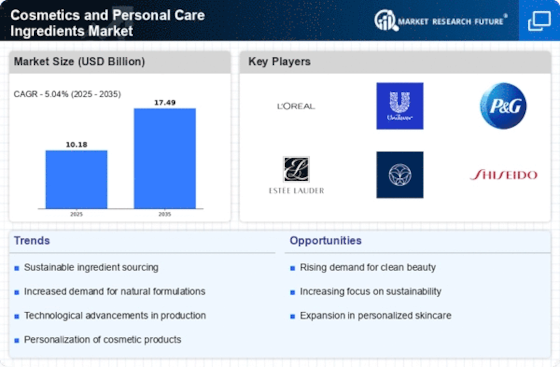
As per Market Research Future analysis, the Cosmetics and Personal Care Ingredients Market was estimated at 10.18 USD Billion in 2024. The market is projected to grow from 10.69 USD Billion in 2025 to 17.49 USD Billion by 2035, exhibiting a compound annual growth rate (CAGR) of 5.04% during the forecast period 2025 - 2035

Key Market Trends & Highlights

The Cosmetics and Personal Care Ingredients Market is experiencing a transformative shift towards sustainability and innovation.

  • Sustainability and eco-friendly ingredients are becoming increasingly prioritized by consumers in North America, the largest market.
  • The Asia-Pacific region is witnessing rapid growth, driven by a rising middle class and increasing disposable income.
  • Alcohols remain the largest segment, while dimethicone is emerging as the fastest-growing ingredient in the market.
  • The growing demand for natural ingredients and technological advancements in formulation are key drivers propelling market expansion.

Market Size & Forecast

2024 Market Size 10.18 (USD Billion)
2035 Market Size 17.49 (USD Billion)
CAGR (2025 - 2035) 5.04%
Largest Regional Market Share in 2024 North America

Major Players

L'Oreal (FR), Unilever (GB), Procter & Gamble (US), Estée Lauder (US), Coty (US), Shiseido (JP), Beiersdorf (DE), Revlon (US), Avon (GB), Mary Kay (US)

Market Trends

The Cosmetics and Personal Care Ingredients Market is currently experiencing a dynamic evolution, driven by shifting consumer preferences and increasing awareness regarding ingredient safety and sustainability. As consumers become more discerning, there is a noticeable demand for transparency in product formulations. This trend is prompting manufacturers to disclose ingredient sources and adopt cleaner, greener alternatives. Additionally, the rise of social media and influencer culture is shaping purchasing decisions, as consumers seek products that align with their values and lifestyle choices. This evolving landscape suggests that brands must adapt to remain competitive, focusing on innovation and ethical practices. Moreover, the market is witnessing a growing inclination towards multifunctional ingredients that offer multiple benefits in a single formulation. This trend reflects a desire for efficiency and convenience among consumers, who are increasingly looking for products that simplify their beauty routines. As a result, companies are investing in research and development to create advanced formulations that cater to these preferences. The Cosmetics and Personal Care Ingredients Market appears poised for continued growth, with an emphasis on sustainability, transparency, and multifunctionality shaping its future trajectory.

Sustainability and Eco-Friendly Ingredients

There is a marked shift towards sustainable and eco-friendly ingredients within the Cosmetics and Personal Care Ingredients Market. Consumers are increasingly prioritizing products that minimize environmental impact, leading brands to explore natural and biodegradable alternatives. This trend not only addresses ecological concerns but also aligns with the growing demand for ethical sourcing and production practices.

Transparency and Clean Labeling

Transparency in ingredient sourcing and formulation is becoming a critical factor for consumers in the Cosmetics and Personal Care Ingredients Market. Brands are responding by adopting clean labeling practices, which involve clear communication about ingredient origins and benefits. This trend reflects a broader consumer desire for trust and accountability in the products they choose.

Rise of Multifunctional Products

The demand for multifunctional products is gaining momentum in the Cosmetics and Personal Care Ingredients Market. Consumers are seeking formulations that provide multiple benefits, such as hydration, sun protection, and anti-aging properties, all in one product. This trend indicates a shift towards efficiency, as individuals look to streamline their beauty routines without compromising on effectiveness.

Cosmetics Personal Care Ingredients Market Market Drivers

Increasing Focus on Personalization

Personalization is emerging as a key driver in the Cosmetics and Personal Care Ingredients Market. Consumers are increasingly seeking products tailored to their individual needs, preferences, and skin types. This trend is prompting brands to invest in research and development to create customizable formulations. Data suggests that personalized beauty products are expected to capture a significant share of the market, with projections indicating a growth rate of around 15% in this segment over the next few years. The rise of digital technologies, such as AI and data analytics, facilitates the customization process, allowing brands to offer unique solutions to consumers. This focus on personalization not only enhances customer satisfaction but also fosters brand loyalty, thereby influencing the overall dynamics of the Cosmetics and Personal Care Ingredients Market.

Growing Demand for Natural Ingredients

The Cosmetics and Personal Care Ingredients Market is witnessing a pronounced shift towards natural and organic ingredients. Consumers increasingly prefer products that are free from synthetic chemicals, which has led to a surge in the demand for plant-based and naturally derived components. According to recent data, the market for natural cosmetics is projected to grow at a compound annual growth rate of approximately 10% over the next five years. This trend is driven by heightened awareness of the potential adverse effects of synthetic ingredients on health and the environment. As a result, manufacturers are reformulating their products to incorporate more natural ingredients, thereby aligning with consumer preferences and regulatory standards. This growing inclination towards natural formulations is likely to reshape the competitive landscape of the Cosmetics and Personal Care Ingredients Market.

Rise of E-commerce and Digital Marketing

The rise of e-commerce is transforming the Cosmetics and Personal Care Ingredients Market. With the increasing penetration of the internet and mobile devices, consumers are more inclined to purchase beauty products online. This shift is prompting brands to enhance their digital marketing strategies and invest in online platforms to reach a broader audience. Data indicates that online sales of cosmetics and personal care products are expected to grow significantly, with projections suggesting a growth rate of over 20% in the next few years. E-commerce not only provides convenience but also allows for personalized shopping experiences through targeted marketing and recommendations. This trend is likely to reshape consumer purchasing behavior and influence the overall dynamics of the Cosmetics and Personal Care Ingredients Market.

Technological Advancements in Formulation

Technological innovations are playing a pivotal role in the Cosmetics and Personal Care Ingredients Market. Advances in formulation technologies, such as encapsulation and nanotechnology, enable the development of more effective and stable products. These technologies allow for the delivery of active ingredients in a more efficient manner, enhancing product performance and consumer satisfaction. For instance, encapsulated ingredients can provide sustained release, improving the efficacy of skincare products. The market is expected to see a rise in the adoption of such advanced technologies, which could potentially lead to the introduction of novel products that cater to specific consumer needs. This trend indicates a shift towards more sophisticated formulations that not only meet but exceed consumer expectations in the Cosmetics and Personal Care Ingredients Market.

Regulatory Compliance and Safety Standards

The Cosmetics and Personal Care Ingredients Market is increasingly influenced by stringent regulatory frameworks and safety standards. Governments and regulatory bodies are implementing more rigorous guidelines to ensure consumer safety and product efficacy. This has led to a heightened emphasis on ingredient transparency and safety assessments. Companies are now required to conduct thorough testing and provide detailed information about their ingredients, which can impact product formulation and marketing strategies. As a result, manufacturers are investing in compliance measures and reformulating products to meet these standards. This focus on regulatory compliance not only protects consumers but also enhances the credibility of brands within the Cosmetics and Personal Care Ingredients Market, potentially leading to increased consumer trust and market growth.

Market Segment Insights

By Type: Alcohols (Largest) vs. Dimethicone (Fastest-Growing)

<p>In the Cosmetics and Personal Care Ingredients Market, the type segment is dominated by alcohols, which have consistently captured a significant share due to their versatility and effectiveness as solvents and preservatives. Other segments such as formaldehyde, glycerols, and titanium dioxide also hold substantial market shares, but do not match the market presence of alcohols. Additionally, emerging ingredients like botanical extracts and polymers are becoming popular among consumers looking for natural and effective alternatives, contributing to dynamic shifts in the segment's market share distribution.</p>

<p>Alcohols (Dominant) vs. Dimethicone (Emerging)</p>

<p>Alcohols serve crucial roles in cosmetics and personal care products, acting primarily as solvents that enhance formulations’ effectiveness. Their widespread application can be seen in a variety of products, from skincare to hair care. On the other hand, dimethicone, a type of silicone, is emerging rapidly within the market, primarily due to its smoothing properties and ability to create a protective barrier on the skin. This growth is driven by a surge in demand for high-performance cosmetic products. While alcohols maintain their dominance as traditional ingredients, dimethicone is becoming a favored choice among manufacturers aiming to cater to modern consumer preferences for smooth, luxurious textures.</p>

By Application: Moisturizers (Largest) vs. Emollients (Fastest-Growing)

<p>In the Cosmetics and Personal Care Ingredients Market, the application segment is characterized by a varied distribution of product types, including emulsifiers, stabilizers, preservatives, thickeners, moisturizers, emollients, and others. Among these, moisturizers hold the largest market share, reflecting their critical role in formulations aimed at enhancing skin hydration and overall appearance. Emollients, on the other hand, are emerging rapidly, driven by increasing consumer preference for products that provide long-lasting hydration and improve skin texture, marking a significant shift in formulation strategies.</p>

<p>Moisturizers: Dominant vs. Emollients: Emerging</p>

<p>Moisturizers are the dominant ingredient in the Cosmetics and Personal Care Ingredients Market, known for their essential role in maintaining skin hydration and elasticity. These ingredients are formulated to enhance product performance and user satisfaction, thus fostering brand loyalty among consumers. On the contrary, emollients are categorized as emerging ingredients, gaining traction due to their effectiveness in preventing moisture loss and their multifunctional properties that allow them to enhance texture and skin feel in formulations. Their rapid adoption is fueled by consumer trends leaning toward natural and multifunctional products, creating opportunities for innovative formulations that cater to diverse beauty needs.</p>

By End-Use: Skincare (Largest) vs. Fragrance (Fastest-Growing)

<p>In the Cosmetics and Personal Care Ingredients Market, the end-use segment showcases a diverse landscape with skincare leading the market share significantly. Skincare products have established themselves as essential items in personal care routines, which bolsters their dominant position. In contrast, fragrance products have registered substantial growth recently, appealing to consumers seeking personal expression and luxury, marking them as a crucial segment in the evolving market dynamics.</p>

<p>Skincare (Dominant) vs. Fragrance (Emerging)</p>

<p>Skincare is characterized by its extensive range of products aimed at enhancing and maintaining skin health, including moisturizers, sunscreens, and anti-aging formulas. Its dominant market position is fueled by an increasing trend towards wellness and self-care, with consumers prioritizing skin health. On the other hand, the fragrance segment is emerging rapidly, driven by a rise in personal grooming and luxury products. It caters to diverse consumer preferences, from niche artisanal fragrances to mainstream options, enhancing its appeal across different demographic groups. The growth in fragrance can also be attributed to innovative marketing strategies that resonate with a younger audience, making it a vibrant and evolving segment.</p>

Get more detailed insights about Cosmetics and Personal Care Ingredients Market Report - Forecast till 2035

Regional Insights

North America : Market Leader in Innovation

North America is the largest market for cosmetics and personal care ingredients, holding approximately 35% of the global market share. The region's growth is driven by increasing consumer demand for organic and natural products, alongside stringent regulatory standards that ensure product safety and efficacy. The rise of e-commerce and social media marketing has further accelerated market expansion, making it a hub for innovation and trends. The United States is the dominant player in this region, with major companies like Procter & Gamble, Estée Lauder, and Coty leading the competitive landscape. Canada also contributes significantly, focusing on sustainable and eco-friendly products. The presence of key players fosters a dynamic market environment, encouraging continuous product development and consumer engagement.

Europe : Regulatory Framework and Trends

Europe is the second-largest market for cosmetics and personal care ingredients, accounting for around 30% of the global market share. The region is characterized by a strong regulatory framework that emphasizes safety and sustainability, driving demand for eco-friendly and organic products. The European Union's regulations on cosmetic ingredients and labeling have catalyzed innovation, pushing brands to adopt cleaner formulations and sustainable practices. Leading countries in this region include Germany, France, and the United Kingdom, with companies like L'Oreal and Unilever at the forefront. The competitive landscape is marked by a mix of established brands and emerging startups focusing on niche markets. The emphasis on sustainability and ethical sourcing is reshaping consumer preferences, making Europe a trendsetter in the global cosmetics industry.

Asia-Pacific : Emerging Market Potential

Asia-Pacific is an emerging powerhouse in the cosmetics and personal care ingredients market, holding approximately 25% of the global market share. The region's growth is fueled by rising disposable incomes, urbanization, and a growing middle class that is increasingly investing in personal care. Additionally, the influence of social media and beauty trends from countries like South Korea and Japan is driving demand for innovative products and diverse offerings. China and Japan are the leading countries in this region, with significant contributions from India and South Korea. The competitive landscape is vibrant, featuring both global giants and local brands that cater to specific consumer needs. The presence of key players like Shiseido and Beiersdorf enhances market dynamics, fostering a culture of innovation and rapid product development.

Middle East and Africa : Untapped Market Opportunities

The Middle East and Africa represent a resource-rich frontier for the cosmetics and personal care ingredients market, holding about 10% of the global market share. The region is witnessing a surge in demand for personal care products driven by increasing urbanization, a young population, and rising disposable incomes. Regulatory frameworks are evolving, promoting product safety and quality, which is essential for market growth. Leading countries include South Africa, the UAE, and Nigeria, where local and international brands are competing for market share. The presence of key players like Avon and Mary Kay is notable, as they adapt their offerings to meet regional preferences. The competitive landscape is characterized by a mix of traditional and modern retail channels, enhancing accessibility for consumers.

Key Players and Competitive Insights

Leading market players are investing heavily in research and development to expand their product lines, which will help the Cosmetics and Personal Care Ingredients market grow even more. Market participants are also undertaking various strategic activities to expand their footprint, with important market developments including new product launches, contractual agreements, mergers and acquisitions, higher investments, and collaboration with other organizations. To expand and survive in a more competitive and rising market climate, the Cosmetics and Personal Care Ingredients industry must offer cost-effective items.Manufacturing locally to minimize operational costs is one of the key business tactics manufacturers use in the Cosmetics and Personal Care Ingredients industry to benefit clients and increase the market sector. The Cosmetics and Personal Care Ingredients industry has offered some of the most significant advantages in recent years.Major players in the Cosmetics and Personal Care Ingredients market, including DongmingJujin Chemical Co., Ltd., Ittihad International Chemicals Trading LLC (IICT), SABIC, Reza Chemical Industries (RCI) (REZA Investment Company Ltd.), Artec Chemical Company Limited, Chemanol and DOGOIDE Group., and others, are attempting to increase market demand by investing in research and development operations. BASF SE, an initialism, and portmanteau for its original name BadischeAnilin- und Soda-Fabrik, is a European multinational company and the largest chemical producer in the world. Its headquarters are in Ludwigshafen, Germany.BASF SE introduced a new production line at the Kaohsiung site in Taiwan to double the production of Uvinul a Plus, an ingredient used for UVA (UV longest wavelength) protection. It is used in various sun and skin care formulations. The production line was introduced to meet the rising consumer demand in the Asia Pacific market. The Dow Jones Industrial Average, Dow Jones, or simply the Dow, is a stock market index of 30 prominent companies listed on stock exchanges in the United States. The DJIA is one of the oldest and most followed equity indexes.Dow showcased sustainable beauty formulation and ACULYN rheology modifiers. This product reduces carbon footprint and is very easy to use.

Key Companies in the Cosmetics Personal Care Ingredients Market include

Industry Developments

  • Q2 2024: BASF opens new personal care ingredients plant in Shanghai BASF inaugurated a new manufacturing facility in Shanghai dedicated to producing ingredients for the cosmetics and personal care industry, aiming to meet growing demand in the Asia-Pacific region.
  • Q2 2024: L'Oréal acquires biotech startup Debut for $200 million to boost sustainable ingredient innovation L'Oréal announced the acquisition of Debut, a California-based biotech company specializing in sustainable cosmetic ingredients, to accelerate its development of bio-based personal care products.
  • Q3 2024: Evonik launches new ceramide-based ingredient for sensitive skin care Evonik introduced a new ceramide ingredient designed for sensitive skin applications, expanding its portfolio of specialty personal care ingredients.
  • Q1 2024: Ashland announces partnership with Givaudan to co-develop natural personal care ingredients Ashland and Givaudan entered a strategic partnership to jointly develop and commercialize new natural ingredients for the cosmetics and personal care market.
  • Q2 2024: Unilever opens new R&D center for personal care ingredients in the UK Unilever opened a new research and development center in the UK focused on innovating sustainable and high-performance ingredients for its personal care brands.
  • Q3 2024: Croda appoints new CEO to drive growth in personal care ingredients segment Croda International announced the appointment of a new CEO, with a stated focus on expanding the company's presence in the global personal care ingredients market.
  • Q1 2025: DSM-Firmenich launches plant-based UV filter for sun care products DSM-Firmenich introduced a new plant-based UV filter ingredient, targeting the growing demand for natural and sustainable sun care solutions.
  • Q2 2025: Symrise acquires minority stake in biotech firm Clara Foods to access novel personal care ingredients Symrise acquired a minority stake in Clara Foods, a biotech company developing animal-free proteins and specialty ingredients for the cosmetics and personal care industry.
  • Q2 2025: Clariant opens new innovation center for personal care ingredients in Singapore Clariant inaugurated a new innovation center in Singapore to accelerate the development of advanced ingredients for the cosmetics and personal care sector.
  • Q1 2025: Solvay receives EU regulatory approval for new biodegradable surfactant for personal care Solvay announced it has received regulatory approval from the European Union for its new biodegradable surfactant, designed for use in personal care formulations.
  • Q3 2024: IFF launches upcycled ingredient line for sustainable beauty products International Flavors & Fragrances (IFF) launched a new line of upcycled ingredients aimed at meeting the rising demand for sustainable and eco-friendly beauty and personal care products.
  • Q2 2024: L'Oréal and Geno announce partnership to develop bio-based cosmetic ingredients L'Oréal and Geno entered a multi-year partnership to co-develop and scale up the production of bio-based ingredients for use in L'Oréal's personal care and beauty products.

Future Outlook

Cosmetics Personal Care Ingredients Market Future Outlook

The Cosmetics and Personal Care Ingredients Market is projected to grow at a 5.04% CAGR from 2025 to 2035, driven by innovation, sustainability, and consumer demand for natural ingredients.

New opportunities lie in:

  • Development of biodegradable packaging solutions for cosmetic products.
  • Investment in AI-driven personalized skincare formulations.
  • Expansion of e-commerce platforms for niche ingredient sourcing.

By 2035, the market is expected to be robust, reflecting evolving consumer preferences and technological advancements.

Market Segmentation

Cosmetics Personal Care Ingredients Market Type Outlook

  • Formaldehyde
  • Glycerols
  • Titanium Dioxide
  • Isopropyls
  • Alcohols
  • Dimethicone
  • Sodium Lauryl Sulphate
  • Parabens
  • Tocopherols
  • Benzones
  • Oleochemical
  • Surfactants
  • Polymer
  • Botanical Extracts
  • Others

Cosmetics Personal Care Ingredients Market End-Use Outlook

  • Skincare
  • Haircare
  • Fragrance
  • Bath & Shower
  • Others

Cosmetics Personal Care Ingredients Market Application Outlook

  • Emulsifiers
  • Stabilizers
  • Preservatives
  • Thickeners
  • Moisturizers
  • Emollients
  • Others

Report Scope

MARKET SIZE 2024 10.18(USD Billion)
MARKET SIZE 2025 10.69(USD Billion)
MARKET SIZE 2035 17.49(USD Billion)
COMPOUND ANNUAL GROWTH RATE (CAGR) 5.04% (2025 - 2035)
REPORT COVERAGE Revenue Forecast, Competitive Landscape, Growth Factors, and Trends
BASE YEAR 2024
Market Forecast Period 2025 - 2035
Historical Data 2019 - 2024
Market Forecast Units USD Billion
Key Companies Profiled L'Oreal (FR), Unilever (GB), Procter & Gamble (US), Estée Lauder (US), Coty (US), Shiseido (JP), Beiersdorf (DE), Revlon (US), Avon (GB), Mary Kay (US)
Segments Covered Type, Application, End-Use, Region
Key Market Opportunities Growing demand for sustainable and natural ingredients in the Cosmetics and Personal Care Ingredients Market.
Key Market Dynamics Rising consumer demand for natural ingredients drives innovation and regulatory scrutiny in the Cosmetics and Personal Care Ingredients Market.
Countries Covered North America, Europe, APAC, South America, MEA

FAQs

What is the current valuation of the Cosmetics and Personal Care Ingredients Market?

<p>As of 2024, the market valuation was 10.18 USD Billion.</p>

What is the projected market size for the Cosmetics and Personal Care Ingredients Market by 2035?

<p>The market is projected to reach 17.49 USD Billion by 2035.</p>

What is the expected CAGR for the Cosmetics and Personal Care Ingredients Market during the forecast period 2025 - 2035?

<p>The expected CAGR for the market during this period is 5.04%.</p>

Which companies are considered key players in the Cosmetics and Personal Care Ingredients Market?

<p>Key players include L'Oreal, Unilever, Procter & Gamble, Estée Lauder, and Coty.</p>

What segment of the market is projected to have the highest growth in terms of valuation?

<p>The Moisturizers segment is projected to grow from 2.0 to 3.2 USD Billion by 2035.</p>

How does the valuation of the Skincare segment compare to other segments in 2024?

<p>In 2024, the Skincare segment was valued at 3.5 USD Billion, making it the largest segment.</p>

What is the projected valuation for the Emulsifiers segment by 2035?

The Emulsifiers segment is projected to grow from 1.52 to 2.54 USD Billion by 2035.

What role do botanical extracts play in the Cosmetics and Personal Care Ingredients Market?

Botanical Extracts are expected to grow from 0.6 to 1.0 USD Billion by 2035, indicating their increasing importance.

What is the expected growth for the Haircare segment from 2024 to 2035?

The Haircare segment is projected to increase from 2.5 to 4.0 USD Billion by 2035.

How do preservatives contribute to the overall market growth?

Preservatives are expected to grow from 1.0 to 1.7 USD Billion by 2035, reflecting their essential role in product formulation.

  1. SECTION I: EXECUTIVE SUMMARY AND KEY HIGHLIGHTS
    1. | 1.1 EXECUTIVE SUMMARY
    2. | | 1.1.1 Market Overview
    3. | | 1.1.2 Key Findings
    4. | | 1.1.3 Market Segmentation
    5. | | 1.1.4 Competitive Landscape
    6. | | 1.1.5 Challenges and Opportunities
    7. | | 1.1.6 Future Outlook
  2. SECTION II: SCOPING, METHODOLOGY AND MARKET STRUCTURE
    1. | 2.1 MARKET INTRODUCTION
    2. | | 2.1.1 Definition
    3. | | 2.1.2 Scope of the study
    4. | | | 2.1.2.1 Research Objective
    5. | | | 2.1.2.2 Assumption
    6. | | | 2.1.2.3 Limitations
    7. | 2.2 RESEARCH METHODOLOGY
    8. | | 2.2.1 Overview
    9. | | 2.2.2 Data Mining
    10. | | 2.2.3 Secondary Research
    11. | | 2.2.4 Primary Research
    12. | | | 2.2.4.1 Primary Interviews and Information Gathering Process
    13. | | | 2.2.4.2 Breakdown of Primary Respondents
    14. | | 2.2.5 Forecasting Model
    15. | | 2.2.6 Market Size Estimation
    16. | | | 2.2.6.1 Bottom-Up Approach
    17. | | | 2.2.6.2 Top-Down Approach
    18. | | 2.2.7 Data Triangulation
    19. | | 2.2.8 Validation
  3. SECTION III: QUALITATIVE ANALYSIS
    1. | 3.1 MARKET DYNAMICS
    2. | | 3.1.1 Overview
    3. | | 3.1.2 Drivers
    4. | | 3.1.3 Restraints
    5. | | 3.1.4 Opportunities
    6. | 3.2 MARKET FACTOR ANALYSIS
    7. | | 3.2.1 Value chain Analysis
    8. | | 3.2.2 Porter's Five Forces Analysis
    9. | | | 3.2.2.1 Bargaining Power of Suppliers
    10. | | | 3.2.2.2 Bargaining Power of Buyers
    11. | | | 3.2.2.3 Threat of New Entrants
    12. | | | 3.2.2.4 Threat of Substitutes
    13. | | | 3.2.2.5 Intensity of Rivalry
    14. | | 3.2.3 COVID-19 Impact Analysis
    15. | | | 3.2.3.1 Market Impact Analysis
    16. | | | 3.2.3.2 Regional Impact
    17. | | | 3.2.3.3 Opportunity and Threat Analysis
  4. SECTION IV: QUANTITATIVE ANALYSIS
    1. | 4.1 Chemicals and Materials, BY Type (USD Billion)
    2. | | 4.1.1 Formaldehyde
    3. | | 4.1.2 Glycerols
    4. | | 4.1.3 Titanium Dioxide
    5. | | 4.1.4 Isopropyls
    6. | | 4.1.5 Alcohols
    7. | | 4.1.6 Dimethicone
    8. | | 4.1.7 Sodium Lauryl Sulphate
    9. | | 4.1.8 Parabens
    10. | | 4.1.9 Tocopherols
    11. | | 4.1.10 Benzones
    12. | | 4.1.11 Oleochemical
    13. | | 4.1.12 Surfactants
    14. | | 4.1.13 Polymer
    15. | | 4.1.14 Botanical Extracts
    16. | | 4.1.15 Others
    17. | 4.2 Chemicals and Materials, BY Application (USD Billion)
    18. | | 4.2.1 Emulsifiers
    19. | | 4.2.2 Stabilizers
    20. | | 4.2.3 Preservatives
    21. | | 4.2.4 Thickeners
    22. | | 4.2.5 Moisturizers
    23. | | 4.2.6 Emollients
    24. | | 4.2.7 Others
    25. | 4.3 Chemicals and Materials, BY End-Use (USD Billion)
    26. | | 4.3.1 Skincare
    27. | | 4.3.2 Haircare
    28. | | 4.3.3 Fragrance
    29. | | 4.3.4 Bath & Shower
    30. | | 4.3.5 Others
    31. | 4.4 Chemicals and Materials, BY Region (USD Billion)
    32. | | 4.4.1 North America
    33. | | | 4.4.1.1 US
    34. | | | 4.4.1.2 Canada
    35. | | 4.4.2 Europe
    36. | | | 4.4.2.1 Germany
    37. | | | 4.4.2.2 UK
    38. | | | 4.4.2.3 France
    39. | | | 4.4.2.4 Russia
    40. | | | 4.4.2.5 Italy
    41. | | | 4.4.2.6 Spain
    42. | | | 4.4.2.7 Rest of Europe
    43. | | 4.4.3 APAC
    44. | | | 4.4.3.1 China
    45. | | | 4.4.3.2 India
    46. | | | 4.4.3.3 Japan
    47. | | | 4.4.3.4 South Korea
    48. | | | 4.4.3.5 Malaysia
    49. | | | 4.4.3.6 Thailand
    50. | | | 4.4.3.7 Indonesia
    51. | | | 4.4.3.8 Rest of APAC
    52. | | 4.4.4 South America
    53. | | | 4.4.4.1 Brazil
    54. | | | 4.4.4.2 Mexico
    55. | | | 4.4.4.3 Argentina
    56. | | | 4.4.4.4 Rest of South America
    57. | | 4.4.5 MEA
    58. | | | 4.4.5.1 GCC Countries
    59. | | | 4.4.5.2 South Africa
    60. | | | 4.4.5.3 Rest of MEA
  5. SECTION V: COMPETITIVE ANALYSIS
    1. | 5.1 Competitive Landscape
    2. | | 5.1.1 Overview
    3. | | 5.1.2 Competitive Analysis
    4. | | 5.1.3 Market share Analysis
    5. | | 5.1.4 Major Growth Strategy in the Chemicals and Materials
    6. | | 5.1.5 Competitive Benchmarking
    7. | | 5.1.6 Leading Players in Terms of Number of Developments in the Chemicals and Materials
    8. | | 5.1.7 Key developments and growth strategies
    9. | | | 5.1.7.1 New Product Launch/Service Deployment
    10. | | | 5.1.7.2 Merger & Acquisitions
    11. | | | 5.1.7.3 Joint Ventures
    12. | | 5.1.8 Major Players Financial Matrix
    13. | | | 5.1.8.1 Sales and Operating Income
    14. | | | 5.1.8.2 Major Players R&D Expenditure. 2023
    15. | 5.2 Company Profiles
    16. | | 5.2.1 L'Oreal (FR)
    17. | | | 5.2.1.1 Financial Overview
    18. | | | 5.2.1.2 Products Offered
    19. | | | 5.2.1.3 Key Developments
    20. | | | 5.2.1.4 SWOT Analysis
    21. | | | 5.2.1.5 Key Strategies
    22. | | 5.2.2 Unilever (GB)
    23. | | | 5.2.2.1 Financial Overview
    24. | | | 5.2.2.2 Products Offered
    25. | | | 5.2.2.3 Key Developments
    26. | | | 5.2.2.4 SWOT Analysis
    27. | | | 5.2.2.5 Key Strategies
    28. | | 5.2.3 Procter & Gamble (US)
    29. | | | 5.2.3.1 Financial Overview
    30. | | | 5.2.3.2 Products Offered
    31. | | | 5.2.3.3 Key Developments
    32. | | | 5.2.3.4 SWOT Analysis
    33. | | | 5.2.3.5 Key Strategies
    34. | | 5.2.4 Estée Lauder (US)
    35. | | | 5.2.4.1 Financial Overview
    36. | | | 5.2.4.2 Products Offered
    37. | | | 5.2.4.3 Key Developments
    38. | | | 5.2.4.4 SWOT Analysis
    39. | | | 5.2.4.5 Key Strategies
    40. | | 5.2.5 Coty (US)
    41. | | | 5.2.5.1 Financial Overview
    42. | | | 5.2.5.2 Products Offered
    43. | | | 5.2.5.3 Key Developments
    44. | | | 5.2.5.4 SWOT Analysis
    45. | | | 5.2.5.5 Key Strategies
    46. | | 5.2.6 Shiseido (JP)
    47. | | | 5.2.6.1 Financial Overview
    48. | | | 5.2.6.2 Products Offered
    49. | | | 5.2.6.3 Key Developments
    50. | | | 5.2.6.4 SWOT Analysis
    51. | | | 5.2.6.5 Key Strategies
    52. | | 5.2.7 Beiersdorf (DE)
    53. | | | 5.2.7.1 Financial Overview
    54. | | | 5.2.7.2 Products Offered
    55. | | | 5.2.7.3 Key Developments
    56. | | | 5.2.7.4 SWOT Analysis
    57. | | | 5.2.7.5 Key Strategies
    58. | | 5.2.8 Revlon (US)
    59. | | | 5.2.8.1 Financial Overview
    60. | | | 5.2.8.2 Products Offered
    61. | | | 5.2.8.3 Key Developments
    62. | | | 5.2.8.4 SWOT Analysis
    63. | | | 5.2.8.5 Key Strategies
    64. | | 5.2.9 Avon (GB)
    65. | | | 5.2.9.1 Financial Overview
    66. | | | 5.2.9.2 Products Offered
    67. | | | 5.2.9.3 Key Developments
    68. | | | 5.2.9.4 SWOT Analysis
    69. | | | 5.2.9.5 Key Strategies
    70. | | 5.2.10 Mary Kay (US)
    71. | | | 5.2.10.1 Financial Overview
    72. | | | 5.2.10.2 Products Offered
    73. | | | 5.2.10.3 Key Developments
    74. | | | 5.2.10.4 SWOT Analysis
    75. | | | 5.2.10.5 Key Strategies
    76. | 5.3 Appendix
    77. | | 5.3.1 References
    78. | | 5.3.2 Related Reports
  6. LIST OF FIGURES
    1. | 6.1 MARKET SYNOPSIS
    2. | 6.2 NORTH AMERICA MARKET ANALYSIS
    3. | 6.3 US MARKET ANALYSIS BY TYPE
    4. | 6.4 US MARKET ANALYSIS BY APPLICATION
    5. | 6.5 US MARKET ANALYSIS BY END-USE
    6. | 6.6 CANADA MARKET ANALYSIS BY TYPE
    7. | 6.7 CANADA MARKET ANALYSIS BY APPLICATION
    8. | 6.8 CANADA MARKET ANALYSIS BY END-USE
    9. | 6.9 EUROPE MARKET ANALYSIS
    10. | 6.10 GERMANY MARKET ANALYSIS BY TYPE
    11. | 6.11 GERMANY MARKET ANALYSIS BY APPLICATION
    12. | 6.12 GERMANY MARKET ANALYSIS BY END-USE
    13. | 6.13 UK MARKET ANALYSIS BY TYPE
    14. | 6.14 UK MARKET ANALYSIS BY APPLICATION
    15. | 6.15 UK MARKET ANALYSIS BY END-USE
    16. | 6.16 FRANCE MARKET ANALYSIS BY TYPE
    17. | 6.17 FRANCE MARKET ANALYSIS BY APPLICATION
    18. | 6.18 FRANCE MARKET ANALYSIS BY END-USE
    19. | 6.19 RUSSIA MARKET ANALYSIS BY TYPE
    20. | 6.20 RUSSIA MARKET ANALYSIS BY APPLICATION
    21. | 6.21 RUSSIA MARKET ANALYSIS BY END-USE
    22. | 6.22 ITALY MARKET ANALYSIS BY TYPE
    23. | 6.23 ITALY MARKET ANALYSIS BY APPLICATION
    24. | 6.24 ITALY MARKET ANALYSIS BY END-USE
    25. | 6.25 SPAIN MARKET ANALYSIS BY TYPE
    26. | 6.26 SPAIN MARKET ANALYSIS BY APPLICATION
    27. | 6.27 SPAIN MARKET ANALYSIS BY END-USE
    28. | 6.28 REST OF EUROPE MARKET ANALYSIS BY TYPE
    29. | 6.29 REST OF EUROPE MARKET ANALYSIS BY APPLICATION
    30. | 6.30 REST OF EUROPE MARKET ANALYSIS BY END-USE
    31. | 6.31 APAC MARKET ANALYSIS
    32. | 6.32 CHINA MARKET ANALYSIS BY TYPE
    33. | 6.33 CHINA MARKET ANALYSIS BY APPLICATION
    34. | 6.34 CHINA MARKET ANALYSIS BY END-USE
    35. | 6.35 INDIA MARKET ANALYSIS BY TYPE
    36. | 6.36 INDIA MARKET ANALYSIS BY APPLICATION
    37. | 6.37 INDIA MARKET ANALYSIS BY END-USE
    38. | 6.38 JAPAN MARKET ANALYSIS BY TYPE
    39. | 6.39 JAPAN MARKET ANALYSIS BY APPLICATION
    40. | 6.40 JAPAN MARKET ANALYSIS BY END-USE
    41. | 6.41 SOUTH KOREA MARKET ANALYSIS BY TYPE
    42. | 6.42 SOUTH KOREA MARKET ANALYSIS BY APPLICATION
    43. | 6.43 SOUTH KOREA MARKET ANALYSIS BY END-USE
    44. | 6.44 MALAYSIA MARKET ANALYSIS BY TYPE
    45. | 6.45 MALAYSIA MARKET ANALYSIS BY APPLICATION
    46. | 6.46 MALAYSIA MARKET ANALYSIS BY END-USE
    47. | 6.47 THAILAND MARKET ANALYSIS BY TYPE
    48. | 6.48 THAILAND MARKET ANALYSIS BY APPLICATION
    49. | 6.49 THAILAND MARKET ANALYSIS BY END-USE
    50. | 6.50 INDONESIA MARKET ANALYSIS BY TYPE
    51. | 6.51 INDONESIA MARKET ANALYSIS BY APPLICATION
    52. | 6.52 INDONESIA MARKET ANALYSIS BY END-USE
    53. | 6.53 REST OF APAC MARKET ANALYSIS BY TYPE
    54. | 6.54 REST OF APAC MARKET ANALYSIS BY APPLICATION
    55. | 6.55 REST OF APAC MARKET ANALYSIS BY END-USE
    56. | 6.56 SOUTH AMERICA MARKET ANALYSIS
    57. | 6.57 BRAZIL MARKET ANALYSIS BY TYPE
    58. | 6.58 BRAZIL MARKET ANALYSIS BY APPLICATION
    59. | 6.59 BRAZIL MARKET ANALYSIS BY END-USE
    60. | 6.60 MEXICO MARKET ANALYSIS BY TYPE
    61. | 6.61 MEXICO MARKET ANALYSIS BY APPLICATION
    62. | 6.62 MEXICO MARKET ANALYSIS BY END-USE
    63. | 6.63 ARGENTINA MARKET ANALYSIS BY TYPE
    64. | 6.64 ARGENTINA MARKET ANALYSIS BY APPLICATION
    65. | 6.65 ARGENTINA MARKET ANALYSIS BY END-USE
    66. | 6.66 REST OF SOUTH AMERICA MARKET ANALYSIS BY TYPE
    67. | 6.67 REST OF SOUTH AMERICA MARKET ANALYSIS BY APPLICATION
    68. | 6.68 REST OF SOUTH AMERICA MARKET ANALYSIS BY END-USE
    69. | 6.69 MEA MARKET ANALYSIS
    70. | 6.70 GCC COUNTRIES MARKET ANALYSIS BY TYPE
    71. | 6.71 GCC COUNTRIES MARKET ANALYSIS BY APPLICATION
    72. | 6.72 GCC COUNTRIES MARKET ANALYSIS BY END-USE
    73. | 6.73 SOUTH AFRICA MARKET ANALYSIS BY TYPE
    74. | 6.74 SOUTH AFRICA MARKET ANALYSIS BY APPLICATION
    75. | 6.75 SOUTH AFRICA MARKET ANALYSIS BY END-USE
    76. | 6.76 REST OF MEA MARKET ANALYSIS BY TYPE
    77. | 6.77 REST OF MEA MARKET ANALYSIS BY APPLICATION
    78. | 6.78 REST OF MEA MARKET ANALYSIS BY END-USE
    79. | 6.79 KEY BUYING CRITERIA OF CHEMICALS AND MATERIALS
    80. | 6.80 RESEARCH PROCESS OF MRFR
    81. | 6.81 DRO ANALYSIS OF CHEMICALS AND MATERIALS
    82. | 6.82 DRIVERS IMPACT ANALYSIS: CHEMICALS AND MATERIALS
    83. | 6.83 RESTRAINTS IMPACT ANALYSIS: CHEMICALS AND MATERIALS
    84. | 6.84 SUPPLY / VALUE CHAIN: CHEMICALS AND MATERIALS
    85. | 6.85 CHEMICALS AND MATERIALS, BY TYPE, 2024 (% SHARE)
    86. | 6.86 CHEMICALS AND MATERIALS, BY TYPE, 2024 TO 2035 (USD Billion)
    87. | 6.87 CHEMICALS AND MATERIALS, BY APPLICATION, 2024 (% SHARE)
    88. | 6.88 CHEMICALS AND MATERIALS, BY APPLICATION, 2024 TO 2035 (USD Billion)
    89. | 6.89 CHEMICALS AND MATERIALS, BY END-USE, 2024 (% SHARE)
    90. | 6.90 CHEMICALS AND MATERIALS, BY END-USE, 2024 TO 2035 (USD Billion)
    91. | 6.91 BENCHMARKING OF MAJOR COMPETITORS
  7. LIST OF TABLES
    1. | 7.1 LIST OF ASSUMPTIONS
    2. | | 7.1.1
    3. | 7.2 North America MARKET SIZE ESTIMATES; FORECAST
    4. | | 7.2.1 BY TYPE, 2025-2035 (USD Billion)
    5. | | 7.2.2 BY APPLICATION, 2025-2035 (USD Billion)
    6. | | 7.2.3 BY END-USE, 2025-2035 (USD Billion)
    7. | 7.3 US MARKET SIZE ESTIMATES; FORECAST
    8. | | 7.3.1 BY TYPE, 2025-2035 (USD Billion)
    9. | | 7.3.2 BY APPLICATION, 2025-2035 (USD Billion)
    10. | | 7.3.3 BY END-USE, 2025-2035 (USD Billion)
    11. | 7.4 Canada MARKET SIZE ESTIMATES; FORECAST
    12. | | 7.4.1 BY TYPE, 2025-2035 (USD Billion)
    13. | | 7.4.2 BY APPLICATION, 2025-2035 (USD Billion)
    14. | | 7.4.3 BY END-USE, 2025-2035 (USD Billion)
    15. | 7.5 Europe MARKET SIZE ESTIMATES; FORECAST
    16. | | 7.5.1 BY TYPE, 2025-2035 (USD Billion)
    17. | | 7.5.2 BY APPLICATION, 2025-2035 (USD Billion)
    18. | | 7.5.3 BY END-USE, 2025-2035 (USD Billion)
    19. | 7.6 Germany MARKET SIZE ESTIMATES; FORECAST
    20. | | 7.6.1 BY TYPE, 2025-2035 (USD Billion)
    21. | | 7.6.2 BY APPLICATION, 2025-2035 (USD Billion)
    22. | | 7.6.3 BY END-USE, 2025-2035 (USD Billion)
    23. | 7.7 UK MARKET SIZE ESTIMATES; FORECAST
    24. | | 7.7.1 BY TYPE, 2025-2035 (USD Billion)
    25. | | 7.7.2 BY APPLICATION, 2025-2035 (USD Billion)
    26. | | 7.7.3 BY END-USE, 2025-2035 (USD Billion)
    27. | 7.8 France MARKET SIZE ESTIMATES; FORECAST
    28. | | 7.8.1 BY TYPE, 2025-2035 (USD Billion)
    29. | | 7.8.2 BY APPLICATION, 2025-2035 (USD Billion)
    30. | | 7.8.3 BY END-USE, 2025-2035 (USD Billion)
    31. | 7.9 Russia MARKET SIZE ESTIMATES; FORECAST
    32. | | 7.9.1 BY TYPE, 2025-2035 (USD Billion)
    33. | | 7.9.2 BY APPLICATION, 2025-2035 (USD Billion)
    34. | | 7.9.3 BY END-USE, 2025-2035 (USD Billion)
    35. | 7.10 Italy MARKET SIZE ESTIMATES; FORECAST
    36. | | 7.10.1 BY TYPE, 2025-2035 (USD Billion)
    37. | | 7.10.2 BY APPLICATION, 2025-2035 (USD Billion)
    38. | | 7.10.3 BY END-USE, 2025-2035 (USD Billion)
    39. | 7.11 Spain MARKET SIZE ESTIMATES; FORECAST
    40. | | 7.11.1 BY TYPE, 2025-2035 (USD Billion)
    41. | | 7.11.2 BY APPLICATION, 2025-2035 (USD Billion)
    42. | | 7.11.3 BY END-USE, 2025-2035 (USD Billion)
    43. | 7.12 Rest of Europe MARKET SIZE ESTIMATES; FORECAST
    44. | | 7.12.1 BY TYPE, 2025-2035 (USD Billion)
    45. | | 7.12.2 BY APPLICATION, 2025-2035 (USD Billion)
    46. | | 7.12.3 BY END-USE, 2025-2035 (USD Billion)
    47. | 7.13 APAC MARKET SIZE ESTIMATES; FORECAST
    48. | | 7.13.1 BY TYPE, 2025-2035 (USD Billion)
    49. | | 7.13.2 BY APPLICATION, 2025-2035 (USD Billion)
    50. | | 7.13.3 BY END-USE, 2025-2035 (USD Billion)
    51. | 7.14 China MARKET SIZE ESTIMATES; FORECAST
    52. | | 7.14.1 BY TYPE, 2025-2035 (USD Billion)
    53. | | 7.14.2 BY APPLICATION, 2025-2035 (USD Billion)
    54. | | 7.14.3 BY END-USE, 2025-2035 (USD Billion)
    55. | 7.15 India MARKET SIZE ESTIMATES; FORECAST
    56. | | 7.15.1 BY TYPE, 2025-2035 (USD Billion)
    57. | | 7.15.2 BY APPLICATION, 2025-2035 (USD Billion)
    58. | | 7.15.3 BY END-USE, 2025-2035 (USD Billion)
    59. | 7.16 Japan MARKET SIZE ESTIMATES; FORECAST
    60. | | 7.16.1 BY TYPE, 2025-2035 (USD Billion)
    61. | | 7.16.2 BY APPLICATION, 2025-2035 (USD Billion)
    62. | | 7.16.3 BY END-USE, 2025-2035 (USD Billion)
    63. | 7.17 South Korea MARKET SIZE ESTIMATES; FORECAST
    64. | | 7.17.1 BY TYPE, 2025-2035 (USD Billion)
    65. | | 7.17.2 BY APPLICATION, 2025-2035 (USD Billion)
    66. | | 7.17.3 BY END-USE, 2025-2035 (USD Billion)
    67. | 7.18 Malaysia MARKET SIZE ESTIMATES; FORECAST
    68. | | 7.18.1 BY TYPE, 2025-2035 (USD Billion)
    69. | | 7.18.2 BY APPLICATION, 2025-2035 (USD Billion)
    70. | | 7.18.3 BY END-USE, 2025-2035 (USD Billion)
    71. | 7.19 Thailand MARKET SIZE ESTIMATES; FORECAST
    72. | | 7.19.1 BY TYPE, 2025-2035 (USD Billion)
    73. | | 7.19.2 BY APPLICATION, 2025-2035 (USD Billion)
    74. | | 7.19.3 BY END-USE, 2025-2035 (USD Billion)
    75. | 7.20 Indonesia MARKET SIZE ESTIMATES; FORECAST
    76. | | 7.20.1 BY TYPE, 2025-2035 (USD Billion)
    77. | | 7.20.2 BY APPLICATION, 2025-2035 (USD Billion)
    78. | | 7.20.3 BY END-USE, 2025-2035 (USD Billion)
    79. | 7.21 Rest of APAC MARKET SIZE ESTIMATES; FORECAST
    80. | | 7.21.1 BY TYPE, 2025-2035 (USD Billion)
    81. | | 7.21.2 BY APPLICATION, 2025-2035 (USD Billion)
    82. | | 7.21.3 BY END-USE, 2025-2035 (USD Billion)
    83. | 7.22 South America MARKET SIZE ESTIMATES; FORECAST
    84. | | 7.22.1 BY TYPE, 2025-2035 (USD Billion)
    85. | | 7.22.2 BY APPLICATION, 2025-2035 (USD Billion)
    86. | | 7.22.3 BY END-USE, 2025-2035 (USD Billion)
    87. | 7.23 Brazil MARKET SIZE ESTIMATES; FORECAST
    88. | | 7.23.1 BY TYPE, 2025-2035 (USD Billion)
    89. | | 7.23.2 BY APPLICATION, 2025-2035 (USD Billion)
    90. | | 7.23.3 BY END-USE, 2025-2035 (USD Billion)
    91. | 7.24 Mexico MARKET SIZE ESTIMATES; FORECAST
    92. | | 7.24.1 BY TYPE, 2025-2035 (USD Billion)
    93. | | 7.24.2 BY APPLICATION, 2025-2035 (USD Billion)
    94. | | 7.24.3 BY END-USE, 2025-2035 (USD Billion)
    95. | 7.25 Argentina MARKET SIZE ESTIMATES; FORECAST
    96. | | 7.25.1 BY TYPE, 2025-2035 (USD Billion)
    97. | | 7.25.2 BY APPLICATION, 2025-2035 (USD Billion)
    98. | | 7.25.3 BY END-USE, 2025-2035 (USD Billion)
    99. | 7.26 Rest of South America MARKET SIZE ESTIMATES; FORECAST
    100. | | 7.26.1 BY TYPE, 2025-2035 (USD Billion)
    101. | | 7.26.2 BY APPLICATION, 2025-2035 (USD Billion)
    102. | | 7.26.3 BY END-USE, 2025-2035 (USD Billion)
    103. | 7.27 MEA MARKET SIZE ESTIMATES; FORECAST
    104. | | 7.27.1 BY TYPE, 2025-2035 (USD Billion)
    105. | | 7.27.2 BY APPLICATION, 2025-2035 (USD Billion)
    106. | | 7.27.3 BY END-USE, 2025-2035 (USD Billion)
    107. | 7.28 GCC Countries MARKET SIZE ESTIMATES; FORECAST
    108. | | 7.28.1 BY TYPE, 2025-2035 (USD Billion)
    109. | | 7.28.2 BY APPLICATION, 2025-2035 (USD Billion)
    110. | | 7.28.3 BY END-USE, 2025-2035 (USD Billion)
    111. | 7.29 South Africa MARKET SIZE ESTIMATES; FORECAST
    112. | | 7.29.1 BY TYPE, 2025-2035 (USD Billion)
    113. | | 7.29.2 BY APPLICATION, 2025-2035 (USD Billion)
    114. | | 7.29.3 BY END-USE, 2025-2035 (USD Billion)
    115. | 7.30 Rest of MEA MARKET SIZE ESTIMATES; FORECAST
    116. | | 7.30.1 BY TYPE, 2025-2035 (USD Billion)
    117. | | 7.30.2 BY APPLICATION, 2025-2035 (USD Billion)
    118. | | 7.30.3 BY END-USE, 2025-2035 (USD Billion)
    119. | 7.31 PRODUCT LAUNCH/PRODUCT DEVELOPMENT/APPROVAL
    120. | | 7.31.1
    121. | 7.32 ACQUISITION/PARTNERSHIP
    122. | | 7.32.1

Chemicals and Materials Market Segmentation

Chemicals and Materials By Type (USD Billion, 2025-2035)

  • Formaldehyde
  • Glycerols
  • Titanium Dioxide
  • Isopropyls
  • Alcohols
  • Dimethicone
  • Sodium Lauryl Sulphate
  • Parabens
  • Tocopherols
  • Benzones
  • Oleochemical
  • Surfactants
  • Polymer
  • Botanical Extracts
  • Others

Chemicals and Materials By Application (USD Billion, 2025-2035)

  • Emulsifiers
  • Stabilizers
  • Preservatives
  • Thickeners
  • Moisturizers
  • Emollients
  • Others

Chemicals and Materials By End-Use (USD Billion, 2025-2035)

  • Skincare
  • Haircare
  • Fragrance
  • Bath & Shower
  • Others
Infographic

Free Sample Request

Kindly complete the form below to receive a free sample of this Report

Get Free Sample

Customer Strories

Compare Licence

×
Features License Type
Single User Multiuser License Enterprise User
Price $4,950 $5,950 $7,250
Maximum User Access Limit 1 User Upto 10 Users Unrestricted Access Throughout the Organization
Free Customization
Direct Access to Analyst
Deliverable Format
Platform Access
Discount on Next Purchase 10% 15% 15%
Printable Versions