
Request Free Sample
×


Corporate Wellness Market Share
ID: MRFR/HC/5498-CR
110 Pages
Last Updated: April 17, 2026
Corporate Wellness Market Research Report: Size, Share, Trend Analysis By Service Type (Fitness Programs, Stress Management, Health Risk Assessments, Nutrition Programs, Employee Assistance Programs), By End Users (Large Enterprises, Small and Medium Enterprises, Government Agencies, Educational Institutions), By Delivery Mode (On-Site Wellness Programs, Virtual Wellness Solutions, Hybrid Programs), By Health Focus (Mental Health, Physical Health, Nutritional Health) and By Regional (North America, Europe, South America, Asia Pacific, Middle East and Africa) - Growth Outlook & Industry Forecast 2025 To 2035
Author

FAQs
What is the current valuation of the Corporate Wellness Market as of 2024?
<p>The Corporate Wellness Market was valued at 88.8 USD Billion in 2024.</p>
What is the projected market size for the market by 2035?
The market is projected to reach 236.66 USD Billion by 2035.
What is the expected CAGR for the Corporate Wellness Market during the forecast period 2025 - 2035?
<p>The expected CAGR for the Corporate Wellness Market during 2025 - 2035 is 9.32%.</p>
Which program type has the highest valuation in the market?
Fitness Programs have the highest valuation, ranging from 25.0 to 70.0 USD Billion.
What are the key players in the Corporate Wellness Market?
<p>Key players include Wellness Corporate Solutions, Virgin Pulse, LifeDojo, and Cerner Corporation, among others.</p>
How do onsite services compare to telehealth services in terms of market valuation?
<p>Onsite Services are valued between 20.0 and 54.0 USD Billion, whereas Telehealth Services range from 15.0 to 40.0 USD Billion.</p>
What is the valuation range for mental health programs in the Corporate Wellness Market?
<p>Mental Health Programs are valued between 15.0 and 40.0 USD Billion.</p>
Which target audience segment has the highest market valuation?
<p>Employees represent the highest target audience segment, with a valuation range of 35.0 to 95.0 USD Billion.</p>
What is the valuation range for financial wellness in the Corporate Wellness Market?
<p>Financial Wellness is valued between 10.0 and 30.0 USD Billion.</p>
What is the projected growth trend for wellness challenges in the market?
Wellness Challenges are projected to grow, with a valuation range of 18.8 to 46.66 USD Billion.
Market Summary
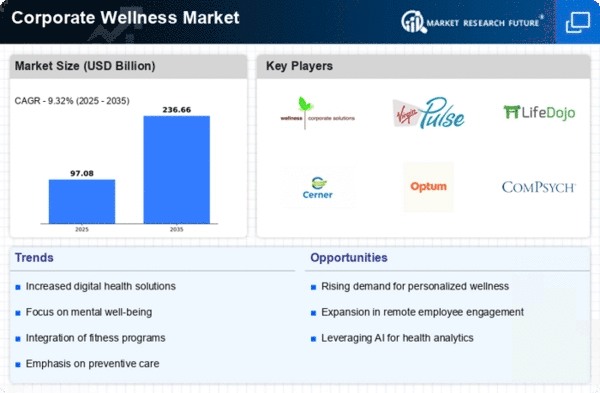
April 01, 2026- According to Market Research Future analysis, the Corporate Wellness Market Size was valued at USD 88.8 Billion in 2024 & the market is projected to grow from USD 97.08 Billion in 2025 to USD 236.66 Billion by 2035, registering a CAGR of 9.32% during the forecast period 2025–2035. North America led the market with over 45% share, generating around USD 39.96 billion in revenue. Corporate wellness market growth is driven by rising workplace stress, increasing chronic disease prevalence, and employer focus on productivity. Organizations are investing in preventive health programs, boosting employee engagement, reducing absenteeism, and enhancing overall workforce performance through structured wellness initiatives globally.
WHO reports noncommunicable diseases account for 74% of global deaths, while CDC estimates productivity losses from absenteeism cost employers over USD 225 billion annually, reinforcing strong demand for workplace wellness programs improving employee health outcomes and organizational efficiency.
Key Market Trends & Highlights
The Corporate Wellness Market is experiencing a dynamic shift towards personalized and technology-driven solutions.
- North America dominates with over 45% share due to high healthcare spending and strong adoption of preventive wellness programs. Europe holds 25% share with USD 22.20 billion market size, driven by mental health awareness and regulatory workplace wellness support. Chronic diseases account for 74% of global deaths (WHO), accelerating employer investment in workplace wellness and preventive health programs. Mental health conditions cost nearly USD 1 trillion annually (WHO), boosting demand for corporate wellness and stress management solutions.
Market Size & Forecast
| 2024 Market Size | 88.8 (USD Billion) |
| 2035 Market Size | 236.66 (USD Billion) |
| CAGR (2025 - 2035) | 9.32% |
| Largest Regional Market Share in 2024 | North America |
Major Players
Companies such as Corporate Health and Wellness Companies: Wellness Corporate Solutions (US), Virgin Pulse (US), LifeDojo (US), Cerner Corporation (US), <a title="Optum" href="https://business.optum.com/en/health-benefits/prevention-well-being/workplace.html" target="_blank" rel="noopener">Optum</a> (US), <a title="ComPsych Corporation" href="https://www.compsych.com/services/mental-health-and-well-being-programs/" target="_blank" rel="noopener">ComPsych Corporation</a> (US), Healthify (US), Kaiser Permanente (US), Bupa Global (GB), Aetna (US) are some of the major participants in the global market.
Market Trends
The Corporate Wellness Market is currently experiencing a notable evolution, driven by an increasing recognition of the importance of employee well-being across the broader wellness industry. Organizations are increasingly investing in comprehensive corporate wellbeing programsthat encompass physical, mental, and emotional health. This shift appears to stem from a growing understanding that a healthy workforce can lead to enhanced productivity, reduced absenteeism, and improved employee morale.
As a result, many corporate wellness companies and workplace wellness companies are developing innovative offerings that help organizations create supportive environments and implement effective corporate wellness solutions tailored to diverse employee needs. Moreover, the market seems to be influenced by technological advancements that facilitate the delivery of wellness initiatives.
Research from the Harvard Business Review suggests that every USD 1 invested in employee wellness programs can generate approximately USD 3.27 in reduced healthcare costs and USD 2.73 in reduced absenteeism costs, reinforcing the growing business case for corporate wellness investments.
Digital platforms and mobile applications are becoming integral components of modern corporate wellbeing programs enabling employees to conveniently engage in health-related activities and track progress.This trend indicates a potential shift towards personalized wellness experiences, where data-driven insights guide program development. As organizations continue to prioritize health and well-being, the Corporate Wellness Market is poised for further growth, reflecting a broader societal commitment to holistic health practices.
Personalized Wellness Programs
There is a growing emphasis on tailoring wellness initiatives to meet the specific needs of employees. Organizations are increasingly recognizing that one-size-fits-all approaches may not be effective. By offering personalized wellness programs, companies can address individual health goals and preferences, thereby enhancing engagement and participation.
IHME estimates that over 50% of global disease burden is linked to modifiable risk factors, encouraging tailored interventions, while WHO highlights personalized prevention strategies significantly improve health outcomes, driving adoption of customized corporate wellness programs for better employee engagement and measurable productivity improvements.
Integration of Technology
The incorporation of technology into wellness initiatives is becoming more pronounced. Companies are leveraging digital platforms, mobile applications, and wearable medical devices to facilitate health tracking and promote healthy behaviors. This trend suggests a shift towards a more interactive and accessible approach to corporate wellness.
PAHO reports digital health adoption surged by over 60% post-pandemic, with wearable devices and mobile health platforms improving real-time monitoring, while ECDC emphasizes digital tools enhance preventive care efficiency, supporting widespread integration of technology-driven wellness programs across corporate environments globally.
Focus on Mental Health
There is an increasing awareness of the importance of mental health in the workplace. Organizations are prioritizing mental well-being by implementing programs that provide support and resources for employees. This focus on mental health indicates a broader understanding of overall wellness and its impact on productivity.
According to the World Health Organization, depression and anxiety disorders cost the global economy approximately USD 1 trillion annually in lost productivity. The organization also reports that for every USD 1 invested in treatment for common mental disorders, there is a return of about USD 4 in improved health and productivity. These findings highlight why employers are increasingly integrating mental health support and counseling services into workplace wellness programs.
Corporate Wellness Market Market Drivers
Rising Health Awareness
The Global Corporate Wellness Market experiences a notable surge in demand driven by increasing health awareness among employees. Organizations recognize that a healthy workforce translates to enhanced productivity and reduced healthcare costs.
As a result, companies are investing in wellness programs that promote physical fitness, mental well-being, and preventive healthcare. This trend is reflected in the projected market value of 64.2 USD Billion in 2024, indicating a robust commitment to employee health. Furthermore, as awareness continues to grow, the industry is likely to evolve, incorporating innovative wellness solutions tailored to diverse employee needs.
Market Segment Insights
By Program Type: Health Risk Assessment (Largest) vs. Wellness Challenges (Fastest-Growing)
In the Corporate Wellness Market, the segment distribution reveals that Health Risk Assessment is the largest contributor, with a 34% share, playing a crucial role in helping businesses analyze employee health metrics and design targeted well-being initiatives. Complementing this, Fitness Programs and Nutrition Programs also hold significant shares, providing organizations with structured solutions to promote healthier lifestyles among employees. However, Mental Health Programs and Wellness Challenges are gaining traction due to the rising emphasis on mental well-being and engagement tactics in corporate settings.
Health Risk Assessment (Dominant) vs. Wellness Challenges (Emerging)
Health Risk Assessment stands out as a dominant program type in corporate wellness, leveraging data to inform organizations about their employees' health status and risks. This proactive approach enables tailored wellness solutions that address specific health needs and challenges, fostering a culture of well-being. On the other hand, Wellness Challenges are emerging as an essential strategy to engage employees in wellness activities, driving participation and enthusiasm. These programs often incorporate gamification elements to motivate employees and create a sense of community, enhancing overall engagement in corporate wellness initiatives.
By Service Type: Onsite Services (Largest) vs. Telehealth Services (Fastest-Growing)
The service type segment is diverse, comprising Onsite Services, Telehealth Services, Mobile Applications, Workshops and Seminars, and Consulting Services. Onsite Services currently lead the Corporate Wellness Market with a 36% share, capturing a substantial portion of the overall service segment. Telehealth Services, however, is witnessing rapid adoption, particularly in a post-pandemic environment, where flexibility and remote access to healthcare have become paramount to wellness initiatives within organizations.
Onsite Services: Dominant vs. Telehealth Services: Emerging
Onsite Services remains the dominant force in the Corporate Wellness Market, providing direct, face-to-face interaction that fosters strong engagement with employees. This service type encompasses various wellness programs delivered within the workplace, promoting a culture of health and well-being. Meanwhile, Telehealth Services have emerged as a vital alternative, driven by increasing demand for convenient and efficient healthcare solutions. The ability to access health resources remotely has made Telehealth Services particularly appealing, especially among younger employees who value technology-driven solutions. This shift towards digital wellness platforms is expected to continue, offering organizations versatile choices to support their workforce's health needs.
By Target Audience: Employees (Largest) vs. Management (Fastest-Growing)
The target audience is segmented primarily into Employees, Management, Human Resources, Occupational Health Professionals, and Insurance Providers. Employees constitute the largest Corporate Wellness Market share at 52%, as their engagement in wellness programs directly influences overall organizational health. In contrast, Management is recognized as the fastest-growing segment, expanding rapidly as organizations prioritize wellness initiatives that enhance productivity and employee satisfaction.
Employees: Dominant vs. Management: Emerging
Employees are the dominant segment in the market, as their participation in wellness programs drives overall program effectiveness and organizational health metrics. Engaged employees not only benefit from improved personal health but also contribute positively to workplace culture and productivity. On the other hand, Management is emerging as a significant player in this space, reflecting a growing recognition of the importance of proactive wellness strategies. As leaders adapt to changing workforce dynamics, their role in implementing and sponsoring wellness initiatives becomes crucial, paving the way for enhanced employee engagement and organizational success.
By Wellness Focus: Physical Wellness (Largest) vs. Mental Wellness (Fastest-Growing)
The Corporate Wellness Market is increasingly recognizing the importance of various wellness focuses. Among these, Physical Wellness holds the largest share, driven by organizations prioritizing fitness programs and physical health initiatives. By fostering a culture that encourages physical activity, businesses aim to reduce healthcare costs and improve employee productivity. Meanwhile, Mental Wellness is emerging rapidly, reflecting growing awareness around mental health challenges in the workplace, with organizations integrating programs designed to support mental wellbeing.
Physical Wellness: Dominant vs. Mental Wellness: Emerging
Physical Wellness remains the dominant focus in corporate wellness programs, characterized by a robust array of fitness initiatives, health screenings, and active lifestyle encouragement tailored to improve employee health. This segment often includes gym memberships, wellness challenges, and ergonomic workplace designs to promote physical activity. Conversely, Mental Wellness is emerging as a critical component of overall corporate wellness, emphasizing awareness, support, and strategies to mitigate stress and promote mental resilience. As organizations recognize the importance of mental health, they are implementing various programs including counseling, mindfulness training, and stress management workshops to enhance employee wellbeing.
Get more detailed insights about Corporate Wellness Market Research Report - Forecast till 2035
Regional Insights
North America : Market Leader in Wellness Solutions
North America leads in the Corporate Wellness Market Size, accounting for over 45% of the global revenue in 2024. The growth is driven by increasing health awareness among employees, rising healthcare costs, and a shift towards preventive care. Regulatory support, including tax incentives for wellness programs, further fuels demand.
Companies are increasingly investing in comprehensive wellness solutions to enhance employee productivity and reduce absenteeism. The competitive landscape is robust, with key players like Wellness Corporate Solutions, Virgin Pulse, and Optum dominating the market.
The U.S. is the primary contributor, supported by a strong infrastructure for health services and technology. Organizations are leveraging data analytics to tailor wellness programs, ensuring higher engagement and effectiveness. This focus on personalized wellness solutions is expected to sustain growth in the region.
Europe : Emerging Market with Growth Potential
Europe Corporate Wellness Market size was valued at USD 22.20 Billion in 2024, making it the second-largest regional market with a 25% share. The growth is propelled by increasing awareness of mental health, regulatory frameworks promoting employee well-being, and a cultural shift towards work-life balance.
Governments are implementing policies that encourage businesses to invest in wellness programs, which is expected to drive market expansion significantly. Leading countries like the UK, Germany, and France are at the forefront, with a growing number of companies adopting wellness initiatives. The competitive landscape features players such as Bupa Global and Aetna, who are innovating to meet diverse employee needs. The emphasis on mental health and holistic wellness solutions is reshaping the market, making it a key area for investment and development.
Asia-Pacific : Rapidly Growing Wellness Sector
The Asia-Pacific region is witnessing a burgeoning Corporate Wellness Market, representing 15.0% of the global share. Factors such as rising disposable incomes, increasing health awareness, and a growing emphasis on employee productivity are driving this growth. Governments are also recognizing the importance of workplace wellness, leading to supportive policies and initiatives that encourage corporate investment in health programs.
Countries like Australia, Japan, and China are leading the charge, with a mix of local and international players entering the market. Companies are focusing on digital wellness solutions, leveraging technology to enhance employee engagement. The competitive landscape is evolving, with firms like LifeDojo and Cerner Corporation making significant inroads, indicating a promising future for corporate wellness in the region.
Middle East and Africa : Emerging Market with Untapped Potential
The Middle East and Africa region is in the early stages of developing its Corporate Wellness Market, currently holding a modest 3.8% share. The growth is driven by increasing awareness of health issues, rising healthcare costs, and a growing emphasis on employee well-being. Governments are beginning to recognize the importance of workplace wellness, leading to initiatives that encourage businesses to adopt health programs.
Countries like South Africa and the UAE are at the forefront, with a growing number of organizations exploring wellness solutions. The competitive landscape is still developing, with local and international players starting to enter the market. As awareness and demand for wellness programs increase, this region presents significant opportunities for growth and investment in corporate wellness initiatives.
Key Players and Competitive Insights
The Corporate Wellness Market is currently characterized by a dynamic competitive landscape, driven by an increasing emphasis on employee health and well-being. Key players are actively engaging in strategies that prioritize innovation, digital transformation, and strategic partnerships. For instance, in November 2025, Virgin Pulse (US) announced a collaboration with a leading technology firm to enhance its digital health platform, aiming to provide more personalized wellness solutions.
This move reflects a broader trend among companies to leverage technology in delivering tailored wellness programs, thereby enhancing employee engagement and satisfaction. Similarly, Optum (US) has been focusing on integrating advanced analytics into its wellness offerings, which allows for more effective tracking of health outcomes and employee participation. The market structure appears moderately fragmented, with numerous players vying for market share.
This fragmentation is indicative of the diverse needs of organizations seeking wellness solutions tailored to their specific workforce demographics. Companies are increasingly localizing their offerings to better align with regional health trends and cultural preferences. For example, in October 2025, ComPsych Corporation (US) expanded its services in the Asia-Pacific region, adapting its mental health programs to meet local needs, which may enhance its competitive positioning in that market.
In September 2025, Cerner Corporation (US) launched a new suite of wellness tools designed to integrate seamlessly with existing healthcare systems. This strategic initiative is significant as it positions Cerner to capitalize on the growing demand for integrated health solutions, potentially increasing its market share among organizations looking for comprehensive wellness programs. The integration of wellness tools with healthcare data systems could lead to improved health outcomes and reduced costs for employers.
In August 2025, Healthify (US) secured a partnership with a major insurance provider to offer its wellness solutions to a broader audience. This partnership is likely to enhance Healthify's visibility and accessibility, allowing it to tap into new customer segments. The strategic alliance underscores the importance of collaboration in the Corporate Wellness Market, as companies seek to expand their reach and improve service delivery through partnerships.
As of December 2025, the market is witnessing trends that emphasize digitalization, sustainability, and the integration of artificial intelligence (AI) into wellness programs. Companies are increasingly forming strategic alliances to enhance their service offerings and improve operational efficiencies. The competitive differentiation is shifting from traditional price-based competition to a focus on innovation, technology, and the reliability of supply chains. This evolution suggests that organizations prioritizing cutting-edge solutions and sustainable practices are likely to thrive in the increasingly competitive landscape.
Key Companies in the Corporate Wellness Market include






Industry Developments
DEC 2025 - Employers are investing more in wellness platforms focused on mental health, lifestyle management, and chronic-disease prevention. Hybrid workplace models have increased demand for virtual wellness programs and personalized health analytics. Vendors are introducing AI-based monitoring tools that provide real-time insights into employee health trends. Partnerships between insurers and wellness-platform providers are also expanding, enabling broader access to preventive-care services.
The Corporate Wellness Market has been witnessing significant developments recently. In August 2023, HealthFitness launched a comprehensive wellness program aimed at enhancing workplace productivity and employee engagement. Concurrently, Optum introduced a new mental health initiative designed to support employees' well-being, reflecting a growing trend towards holistic health solutions. Kaiser Permanente, in July 2023, expanded its corporate wellness offerings to include personalized health assessments aimed at increasing preventive care among employees.
Marino Wellness announced its strategic partnership with Cerner Corporation in June 2023, focusing on integrating technology to optimize wellness program delivery. Virgin Pulse, WellSteps, and EXOS have all reported notable increases in the adoption of their platforms, indicating a surge in demand for wellness solutions as companies prioritize employee health post-pandemic. Notably, in May 2023, LifeWorks acquired ComPsych, further consolidating its position in the market.
Additionally, Sonic Boom Wellness and Wellness Coaches have seen growth in their client base, attributed to the ongoing shift towards remote and hybrid work environments. Overall, the market continues to expand as companies recognize the critical role wellness plays in maintaining a healthy and productive workforce.
Future Outlook
Corporate Wellness Market Future Outlook
The Corporate Wellness Market size is projected to reach USD 236.66 Billion by 2035, growing at a CAGR of 9.32%, driven by increasing health awareness, technological advancements, and employer investment in employee well-being.
New opportunities lie in:
- <p>Integration of AI-driven health analytics platforms Expansion of virtual wellness coaching services Development of customized corporate fitness programs</p>
By 2035, the Corporate Wellness Market is expected to be robust, reflecting substantial growth and innovation.
Market Segmentation
Corporate Wellness Market Program Type Outlook
- Health Risk Assessment
- Fitness Programs
- Mental Health Programs
- Nutritional Programs
- Wellness Challenges
Corporate Wellness Market Service Type Outlook
- Onsite Services
- Telehealth Services
- Consulting Services
- Digital Wellness Platforms
- Employee Assistance Programs
Corporate Wellness Market Wellness Focus Outlook
- Physical Wellness
- Mental Wellness
- Nutritional Wellness
- Financial Wellness
- Social Wellness
Corporate Wellness Market Target Audience Outlook
- Small Enterprises
- Medium Enterprises
- Large Corporations
- Non-Profit Organizations
- Government Agencies
Report Scope
| MARKET SIZE 2024 | 88.8(USD Billion) |
| MARKET SIZE 2025 | 97.08(USD Billion) |
| MARKET SIZE 2035 | 236.66(USD Billion) |
| COMPOUND ANNUAL GROWTH RATE (CAGR) | 9.32% (2025 - 2035) |
| REPORT COVERAGE | Revenue Forecast, Competitive Landscape, Growth Factors, and Trends |
| BASE YEAR | 2024 |
| Market Forecast Period | 2025 - 2035 |
| Historical Data | 2019 - 2024 |
| Market Forecast Units | USD Billion |
| Key Companies Profiled | Wellness Corporate Solutions (US), Virgin Pulse (US), LifeDojo (US), Cerner Corporation (US), Optum (US), ComPsych Corporation (US), Healthify (US), Kaiser Permanente (US), Bupa Global (GB), Aetna (US) |
| Segments Covered | Program Type, Service Type, Target Audience, Wellness Focus |
| Key Market Opportunities | Integration of digital health solutions enhances employee engagement in the market. |
| Key Market Dynamics | Rising emphasis on employee mental health drives innovation and investment in corporate wellness solutions across various industries. |
| Countries Covered | North America, Europe, APAC, South America, MEA |
FAQs
What is the current valuation of the Corporate Wellness Market as of 2024?
<p>The Corporate Wellness Market was valued at 88.8 USD Billion in 2024.</p>
What is the projected market size for the market by 2035?
The market is projected to reach 236.66 USD Billion by 2035.
What is the expected CAGR for the Corporate Wellness Market during the forecast period 2025 - 2035?
<p>The expected CAGR for the Corporate Wellness Market during 2025 - 2035 is 9.32%.</p>
Which program type has the highest valuation in the market?
Fitness Programs have the highest valuation, ranging from 25.0 to 70.0 USD Billion.
What are the key players in the Corporate Wellness Market?
<p>Key players include Wellness Corporate Solutions, Virgin Pulse, LifeDojo, and Cerner Corporation, among others.</p>
How do onsite services compare to telehealth services in terms of market valuation?
<p>Onsite Services are valued between 20.0 and 54.0 USD Billion, whereas Telehealth Services range from 15.0 to 40.0 USD Billion.</p>
What is the valuation range for mental health programs in the Corporate Wellness Market?
<p>Mental Health Programs are valued between 15.0 and 40.0 USD Billion.</p>
Which target audience segment has the highest market valuation?
<p>Employees represent the highest target audience segment, with a valuation range of 35.0 to 95.0 USD Billion.</p>
What is the valuation range for financial wellness in the Corporate Wellness Market?
<p>Financial Wellness is valued between 10.0 and 30.0 USD Billion.</p>
What is the projected growth trend for wellness challenges in the market?
Wellness Challenges are projected to grow, with a valuation range of 18.8 to 46.66 USD Billion.
-
SECTION I: EXECUTIVE SUMMARY AND KEY HIGHLIGHTS |
-
EXECUTIVE SUMMARY | |
- Market Overview | |
- Key Findings | |
- Market Segmentation | |
- Competitive Landscape | |
- Challenges and Opportunities | |
- Future Outlook 2
-
EXECUTIVE SUMMARY | |
-
SECTION II: SCOPING, METHODOLOGY AND MARKET STRUCTURE |
-
MARKET INTRODUCTION | |
- Definition | |
- Scope of the study | | |
-
RESEARCH METHODOLOGY | |
- Overview | |
- Data Mining | |
- Secondary Research | |
- Primary Research | | |
- Forecasting Model | |
- Market Size Estimation | | |
- Data Triangulation | |
- Validation 3
-
MARKET INTRODUCTION | |
-
SECTION III: QUALITATIVE ANALYSIS |
-
MARKET DYNAMICS | |
- Overview | |
- Drivers | |
- Restraints | |
- Opportunities |
-
MARKET FACTOR ANALYSIS | |
- Value chain Analysis | |
- Porter's Five Forces Analysis | | |
- COVID-19 Impact Analysis | | |
-
MARKET DYNAMICS | |
-
SECTION IV: QUANTITATIVE ANALYSIS |
-
Healthcare, BY Program Type (USD Billion) | |
- Health Risk Assessment | |
- Fitness Programs | |
- Nutrition Programs | |
- Mental Health Programs | |
- Wellness Challenges |
-
Healthcare, BY Service Type (USD Billion) | |
- Onsite Services | |
- Telehealth Services | |
- Mobile Applications | |
- Workshops and Seminars | |
- Consulting Services |
-
Healthcare, BY Target Audience (USD Billion) | |
- Employees | |
- Management | |
- Human Resources | |
- Occupational Health Professionals | |
- Insurance Providers |
-
Healthcare, BY Wellness Focus (USD Billion) | |
- Physical Wellness | |
- Mental Wellness | |
- Nutritional Wellness | |
- Financial Wellness | |
- Social Wellness |
-
Healthcare, BY Region (USD Billion) | |
- North America | | |
- Europe | | |
- APAC | | |
- South America | | |
- MEA | | |
-
Healthcare, BY Program Type (USD Billion) | |
-
SECTION V: COMPETITIVE ANALYSIS |
-
Competitive Landscape | |
- Overview | |
- Competitive Analysis | |
- Market share Analysis | |
- Major Growth Strategy in the Healthcare | |
- Competitive Benchmarking | |
- Leading Players in Terms of Number of Developments in the Healthcare | |
- Key developments and growth strategies | | |
- Major Players Financial Matrix | | |
-
Company Profiles | |
- Wellness Corporate Solutions (US) | | |
- Virgin Pulse (US) | | |
- LifeDojo (US) | | |
- Cerner Corporation (US) | | |
- Optum (US) | | |
- ComPsych Corporation (US) | | |
- Healthify (US) | | |
- Kaiser Permanente (US) | | |
- Bend Health (US) | | |
-
Appendix | |
- References | |
- Related Reports 6 LIST OF FIGURES |
- MARKET SYNOPSIS |
- NORTH AMERICA MARKET ANALYSIS |
- US MARKET ANALYSIS BY PROGRAM TYPE |
- US MARKET ANALYSIS BY SERVICE TYPE |
- US MARKET ANALYSIS BY TARGET AUDIENCE |
- US MARKET ANALYSIS BY WELLNESS FOCUS |
- CANADA MARKET ANALYSIS BY PROGRAM TYPE |
- CANADA MARKET ANALYSIS BY SERVICE TYPE |
- CANADA MARKET ANALYSIS BY TARGET AUDIENCE |
- CANADA MARKET ANALYSIS BY WELLNESS FOCUS |
- EUROPE MARKET ANALYSIS |
- GERMANY MARKET ANALYSIS BY PROGRAM TYPE |
- GERMANY MARKET ANALYSIS BY SERVICE TYPE |
- GERMANY MARKET ANALYSIS BY TARGET AUDIENCE |
- GERMANY MARKET ANALYSIS BY WELLNESS FOCUS |
- UK MARKET ANALYSIS BY PROGRAM TYPE |
- UK MARKET ANALYSIS BY SERVICE TYPE |
- UK MARKET ANALYSIS BY TARGET AUDIENCE |
- UK MARKET ANALYSIS BY WELLNESS FOCUS |
- FRANCE MARKET ANALYSIS BY PROGRAM TYPE |
- FRANCE MARKET ANALYSIS BY SERVICE TYPE |
- FRANCE MARKET ANALYSIS BY TARGET AUDIENCE |
- FRANCE MARKET ANALYSIS BY WELLNESS FOCUS |
- RUSSIA MARKET ANALYSIS BY PROGRAM TYPE |
- RUSSIA MARKET ANALYSIS BY SERVICE TYPE |
- RUSSIA MARKET ANALYSIS BY TARGET AUDIENCE |
- RUSSIA MARKET ANALYSIS BY WELLNESS FOCUS |
- ITALY MARKET ANALYSIS BY PROGRAM TYPE |
- ITALY MARKET ANALYSIS BY SERVICE TYPE |
- ITALY MARKET ANALYSIS BY TARGET AUDIENCE |
- ITALY MARKET ANALYSIS BY WELLNESS FOCUS |
- SPAIN MARKET ANALYSIS BY PROGRAM TYPE |
- SPAIN MARKET ANALYSIS BY SERVICE TYPE |
- SPAIN MARKET ANALYSIS BY TARGET AUDIENCE |
- SPAIN MARKET ANALYSIS BY WELLNESS FOCUS |
- REST OF EUROPE MARKET ANALYSIS BY PROGRAM TYPE |
- REST OF EUROPE MARKET ANALYSIS BY SERVICE TYPE |
- REST OF EUROPE MARKET ANALYSIS BY TARGET AUDIENCE |
- REST OF EUROPE MARKET ANALYSIS BY WELLNESS FOCUS |
- APAC MARKET ANALYSIS |
- CHINA MARKET ANALYSIS BY PROGRAM TYPE |
- CHINA MARKET ANALYSIS BY SERVICE TYPE |
- CHINA MARKET ANALYSIS BY TARGET AUDIENCE |
- CHINA MARKET ANALYSIS BY WELLNESS FOCUS |
- INDIA MARKET ANALYSIS BY PROGRAM TYPE |
- INDIA MARKET ANALYSIS BY SERVICE TYPE |
- INDIA MARKET ANALYSIS BY TARGET AUDIENCE |
- INDIA MARKET ANALYSIS BY WELLNESS FOCUS |
- JAPAN MARKET ANALYSIS BY PROGRAM TYPE |
- JAPAN MARKET ANALYSIS BY SERVICE TYPE |
- JAPAN MARKET ANALYSIS BY TARGET AUDIENCE |
- JAPAN MARKET ANALYSIS BY WELLNESS FOCUS |
- SOUTH KOREA MARKET ANALYSIS BY PROGRAM TYPE |
- SOUTH KOREA MARKET ANALYSIS BY SERVICE TYPE |
- SOUTH KOREA MARKET ANALYSIS BY TARGET AUDIENCE |
- SOUTH KOREA MARKET ANALYSIS BY WELLNESS FOCUS |
- MALAYSIA MARKET ANALYSIS BY PROGRAM TYPE |
- MALAYSIA MARKET ANALYSIS BY SERVICE TYPE |
- MALAYSIA MARKET ANALYSIS BY TARGET AUDIENCE |
- MALAYSIA MARKET ANALYSIS BY WELLNESS FOCUS |
- THAILAND MARKET ANALYSIS BY PROGRAM TYPE |
- THAILAND MARKET ANALYSIS BY SERVICE TYPE |
- THAILAND MARKET ANALYSIS BY TARGET AUDIENCE |
- THAILAND MARKET ANALYSIS BY WELLNESS FOCUS |
- INDONESIA MARKET ANALYSIS BY PROGRAM TYPE |
- INDONESIA MARKET ANALYSIS BY SERVICE TYPE |
- INDONESIA MARKET ANALYSIS BY TARGET AUDIENCE |
- INDONESIA MARKET ANALYSIS BY WELLNESS FOCUS |
- REST OF APAC MARKET ANALYSIS BY PROGRAM TYPE |
- REST OF APAC MARKET ANALYSIS BY SERVICE TYPE |
- REST OF APAC MARKET ANALYSIS BY TARGET AUDIENCE |
- REST OF APAC MARKET ANALYSIS BY WELLNESS FOCUS |
- SOUTH AMERICA MARKET ANALYSIS |
- BRAZIL MARKET ANALYSIS BY PROGRAM TYPE |
- BRAZIL MARKET ANALYSIS BY SERVICE TYPE |
- BRAZIL MARKET ANALYSIS BY TARGET AUDIENCE |
- BRAZIL MARKET ANALYSIS BY WELLNESS FOCUS |
- MEXICO MARKET ANALYSIS BY PROGRAM TYPE |
- MEXICO MARKET ANALYSIS BY SERVICE TYPE |
- MEXICO MARKET ANALYSIS BY TARGET AUDIENCE |
- MEXICO MARKET ANALYSIS BY WELLNESS FOCUS |
- ARGENTINA MARKET ANALYSIS BY PROGRAM TYPE |
- ARGENTINA MARKET ANALYSIS BY SERVICE TYPE |
- ARGENTINA MARKET ANALYSIS BY TARGET AUDIENCE |
- ARGENTINA MARKET ANALYSIS BY WELLNESS FOCUS |
- REST OF SOUTH AMERICA MARKET ANALYSIS BY PROGRAM TYPE |
- REST OF SOUTH AMERICA MARKET ANALYSIS BY SERVICE TYPE |
- REST OF SOUTH AMERICA MARKET ANALYSIS BY TARGET AUDIENCE |
- REST OF SOUTH AMERICA MARKET ANALYSIS BY WELLNESS FOCUS |
- MEA MARKET ANALYSIS |
- GCC COUNTRIES MARKET ANALYSIS BY PROGRAM TYPE |
- GCC COUNTRIES MARKET ANALYSIS BY SERVICE TYPE |
- GCC COUNTRIES MARKET ANALYSIS BY TARGET AUDIENCE |
- GCC COUNTRIES MARKET ANALYSIS BY WELLNESS FOCUS |
- SOUTH AFRICA MARKET ANALYSIS BY PROGRAM TYPE |
- SOUTH AFRICA MARKET ANALYSIS BY SERVICE TYPE |
- SOUTH AFRICA MARKET ANALYSIS BY TARGET AUDIENCE |
- SOUTH AFRICA MARKET ANALYSIS BY WELLNESS FOCUS |
- REST OF MEA MARKET ANALYSIS BY PROGRAM TYPE |
- REST OF MEA MARKET ANALYSIS BY SERVICE TYPE |
- REST OF MEA MARKET ANALYSIS BY TARGET AUDIENCE |
- REST OF MEA MARKET ANALYSIS BY WELLNESS FOCUS |
- KEY BUYING CRITERIA OF HEALTHCARE |
- RESEARCH PROCESS OF MRFR |
- DRO ANALYSIS OF HEALTHCARE |
- DRIVERS IMPACT ANALYSIS: HEALTHCARE |
- RESTRAINTS IMPACT ANALYSIS: HEALTHCARE |
- SUPPLY / VALUE CHAIN: HEALTHCARE |
- HEALTHCARE, BY PROGRAM TYPE, 2024 (% SHARE) |
- HEALTHCARE, BY PROGRAM TYPE, 2024 TO 2035 (USD Billion) |
- HEALTHCARE, BY SERVICE TYPE, 2024 (% SHARE) |
- HEALTHCARE, BY SERVICE TYPE, 2024 TO 2035 (USD Billion) |
- HEALTHCARE, BY TARGET AUDIENCE, 2024 (% SHARE) |
- HEALTHCARE, BY TARGET AUDIENCE, 2024 TO 2035 (USD Billion) |
- HEALTHCARE, BY WELLNESS FOCUS, 2024 (% SHARE) |
- HEALTHCARE, BY WELLNESS FOCUS, 2024 TO 2035 (USD Billion) |
- BENCHMARKING OF MAJOR COMPETITORS 7 LIST OF TABLES |
-
LIST OF ASSUMPTIONS | |
- |
-
North America MARKET SIZE ESTIMATES; FORECAST | |
- BY PROGRAM TYPE, 2025-2035 (USD Billion) | |
- BY SERVICE TYPE, 2025-2035 (USD Billion) | |
- BY TARGET AUDIENCE, 2025-2035 (USD Billion) | |
- BY WELLNESS FOCUS, 2025-2035 (USD Billion) |
-
US MARKET SIZE ESTIMATES; FORECAST | |
- BY PROGRAM TYPE, 2025-2035 (USD Billion) | |
- BY SERVICE TYPE, 2025-2035 (USD Billion) | |
- BY TARGET AUDIENCE, 2025-2035 (USD Billion) | |
- BY WELLNESS FOCUS, 2025-2035 (USD Billion) |
-
Canada MARKET SIZE ESTIMATES; FORECAST | |
- BY PROGRAM TYPE, 2025-2035 (USD Billion) | |
- BY SERVICE TYPE, 2025-2035 (USD Billion) | |
- BY TARGET AUDIENCE, 2025-2035 (USD Billion) | |
- BY WELLNESS FOCUS, 2025-2035 (USD Billion) |
-
Europe MARKET SIZE ESTIMATES; FORECAST | |
- BY PROGRAM TYPE, 2025-2035 (USD Billion) | |
- BY SERVICE TYPE, 2025-2035 (USD Billion) | |
- BY TARGET AUDIENCE, 2025-2035 (USD Billion) | |
- BY WELLNESS FOCUS, 2025-2035 (USD Billion) |
-
Germany MARKET SIZE ESTIMATES; FORECAST | |
- BY PROGRAM TYPE, 2025-2035 (USD Billion) | |
- BY SERVICE TYPE, 2025-2035 (USD Billion) | |
- BY TARGET AUDIENCE, 2025-2035 (USD Billion) | |
- BY WELLNESS FOCUS, 2025-2035 (USD Billion) |
-
UK MARKET SIZE ESTIMATES; FORECAST | |
- BY PROGRAM TYPE, 2025-2035 (USD Billion) | |
- BY SERVICE TYPE, 2025-2035 (USD Billion) | |
- BY TARGET AUDIENCE, 2025-2035 (USD Billion) | |
- BY WELLNESS FOCUS, 2025-2035 (USD Billion) |
-
France MARKET SIZE ESTIMATES; FORECAST | |
- BY PROGRAM TYPE, 2025-2035 (USD Billion) | |
- BY SERVICE TYPE, 2025-2035 (USD Billion) | |
- BY TARGET AUDIENCE, 2025-2035 (USD Billion) | |
- BY WELLNESS FOCUS, 2025-2035 (USD Billion) |
-
Russia MARKET SIZE ESTIMATES; FORECAST | |
- BY PROGRAM TYPE, 2025-2035 (USD Billion) | |
- BY SERVICE TYPE, 2025-2035 (USD Billion) | |
- BY TARGET AUDIENCE, 2025-2035 (USD Billion) | |
- BY WELLNESS FOCUS, 2025-2035 (USD Billion) |
-
Italy MARKET SIZE ESTIMATES; FORECAST | |
- BY PROGRAM TYPE, 2025-2035 (USD Billion) | |
- BY SERVICE TYPE, 2025-2035 (USD Billion) | |
- BY TARGET AUDIENCE, 2025-2035 (USD Billion) | |
- BY WELLNESS FOCUS, 2025-2035 (USD Billion) |
-
Spain MARKET SIZE ESTIMATES; FORECAST | |
- BY PROGRAM TYPE, 2025-2035 (USD Billion) | |
- BY SERVICE TYPE, 2025-2035 (USD Billion) | |
- BY TARGET AUDIENCE, 2025-2035 (USD Billion) | |
- BY WELLNESS FOCUS, 2025-2035 (USD Billion) |
-
Rest of Europe MARKET SIZE ESTIMATES; FORECAST | |
- BY PROGRAM TYPE, 2025-2035 (USD Billion) | |
- BY SERVICE TYPE, 2025-2035 (USD Billion) | |
- BY TARGET AUDIENCE, 2025-2035 (USD Billion) | |
- BY WELLNESS FOCUS, 2025-2035 (USD Billion) |
-
APAC MARKET SIZE ESTIMATES; FORECAST | |
- BY PROGRAM TYPE, 2025-2035 (USD Billion) | |
- BY SERVICE TYPE, 2025-2035 (USD Billion) | |
- BY TARGET AUDIENCE, 2025-2035 (USD Billion) | |
- BY WELLNESS FOCUS, 2025-2035 (USD Billion) |
-
China MARKET SIZE ESTIMATES; FORECAST | |
- BY PROGRAM TYPE, 2025-2035 (USD Billion) | |
- BY SERVICE TYPE, 2025-2035 (USD Billion) | |
- BY TARGET AUDIENCE, 2025-2035 (USD Billion) | |
- BY WELLNESS FOCUS, 2025-2035 (USD Billion) |
-
India MARKET SIZE ESTIMATES; FORECAST | |
- BY PROGRAM TYPE, 2025-2035 (USD Billion) | |
- BY SERVICE TYPE, 2025-2035 (USD Billion) | |
- BY TARGET AUDIENCE, 2025-2035 (USD Billion) | |
- BY WELLNESS FOCUS, 2025-2035 (USD Billion) |
-
Japan MARKET SIZE ESTIMATES; FORECAST | |
- BY PROGRAM TYPE, 2025-2035 (USD Billion) | |
- BY SERVICE TYPE, 2025-2035 (USD Billion) | |
- BY TARGET AUDIENCE, 2025-2035 (USD Billion) | |
- BY WELLNESS FOCUS, 2025-2035 (USD Billion) |
-
South Korea MARKET SIZE ESTIMATES; FORECAST | |
- BY PROGRAM TYPE, 2025-2035 (USD Billion) | |
- BY SERVICE TYPE, 2025-2035 (USD Billion) | |
- BY TARGET AUDIENCE, 2025-2035 (USD Billion) | |
- BY WELLNESS FOCUS, 2025-2035 (USD Billion) |
-
Malaysia MARKET SIZE ESTIMATES; FORECAST | |
- BY PROGRAM TYPE, 2025-2035 (USD Billion) | |
- BY SERVICE TYPE, 2025-2035 (USD Billion) | |
- BY TARGET AUDIENCE, 2025-2035 (USD Billion) | |
- BY WELLNESS FOCUS, 2025-2035 (USD Billion) |
-
Thailand MARKET SIZE ESTIMATES; FORECAST | |
- BY PROGRAM TYPE, 2025-2035 (USD Billion) | |
- BY SERVICE TYPE, 2025-2035 (USD Billion) | |
- BY TARGET AUDIENCE, 2025-2035 (USD Billion) | |
- BY WELLNESS FOCUS, 2025-2035 (USD Billion) |
-
Indonesia MARKET SIZE ESTIMATES; FORECAST | |
- BY PROGRAM TYPE, 2025-2035 (USD Billion) | |
- BY SERVICE TYPE, 2025-2035 (USD Billion) | |
- BY TARGET AUDIENCE, 2025-2035 (USD Billion) | |
- BY WELLNESS FOCUS, 2025-2035 (USD Billion) |
-
Rest of APAC MARKET SIZE ESTIMATES; FORECAST | |
- BY PROGRAM TYPE, 2025-2035 (USD Billion) | |
- BY SERVICE TYPE, 2025-2035 (USD Billion) | |
- BY TARGET AUDIENCE, 2025-2035 (USD Billion) | |
- BY WELLNESS FOCUS, 2025-2035 (USD Billion) |
-
South America MARKET SIZE ESTIMATES; FORECAST | |
- BY PROGRAM TYPE, 2025-2035 (USD Billion) | |
- BY SERVICE TYPE, 2025-2035 (USD Billion) | |
- BY TARGET AUDIENCE, 2025-2035 (USD Billion) | |
- BY WELLNESS FOCUS, 2025-2035 (USD Billion) |
-
Brazil MARKET SIZE ESTIMATES; FORECAST | |
- BY PROGRAM TYPE, 2025-2035 (USD Billion) | |
- BY SERVICE TYPE, 2025-2035 (USD Billion) | |
- BY TARGET AUDIENCE, 2025-2035 (USD Billion) | |
- BY WELLNESS FOCUS, 2025-2035 (USD Billion) |
-
Mexico MARKET SIZE ESTIMATES; FORECAST | |
- BY PROGRAM TYPE, 2025-2035 (USD Billion) | |
- BY SERVICE TYPE, 2025-2035 (USD Billion) | |
- BY TARGET AUDIENCE, 2025-2035 (USD Billion) | |
- BY WELLNESS FOCUS, 2025-2035 (USD Billion) |
-
Argentina MARKET SIZE ESTIMATES; FORECAST | |
- BY PROGRAM TYPE, 2025-2035 (USD Billion) | |
- BY SERVICE TYPE, 2025-2035 (USD Billion) | |
- BY TARGET AUDIENCE, 2025-2035 (USD Billion) | |
- BY WELLNESS FOCUS, 2025-2035 (USD Billion) |
-
Rest of South America MARKET SIZE ESTIMATES; FORECAST | |
- BY PROGRAM TYPE, 2025-2035 (USD Billion) | |
- BY SERVICE TYPE, 2025-2035 (USD Billion) | |
- BY TARGET AUDIENCE, 2025-2035 (USD Billion) | |
- BY WELLNESS FOCUS, 2025-2035 (USD Billion) |
-
MEA MARKET SIZE ESTIMATES; FORECAST | |
- BY PROGRAM TYPE, 2025-2035 (USD Billion) | |
- BY SERVICE TYPE, 2025-2035 (USD Billion) | |
- BY TARGET AUDIENCE, 2025-2035 (USD Billion) | |
- BY WELLNESS FOCUS, 2025-2035 (USD Billion) |
-
GCC Countries MARKET SIZE ESTIMATES; FORECAST | |
- BY PROGRAM TYPE, 2025-2035 (USD Billion) | |
- BY SERVICE TYPE, 2025-2035 (USD Billion) | |
- BY TARGET AUDIENCE, 2025-2035 (USD Billion) | |
- BY WELLNESS FOCUS, 2025-2035 (USD Billion) |
-
South Africa MARKET SIZE ESTIMATES; FORECAST | |
- BY PROGRAM TYPE, 2025-2035 (USD Billion) | |
- BY SERVICE TYPE, 2025-2035 (USD Billion) | |
- BY TARGET AUDIENCE, 2025-2035 (USD Billion) | |
- BY WELLNESS FOCUS, 2025-2035 (USD Billion) |
-
Rest of MEA MARKET SIZE ESTIMATES; FORECAST | |
- BY PROGRAM TYPE, 2025-2035 (USD Billion) | |
- BY SERVICE TYPE, 2025-2035 (USD Billion) | |
- BY TARGET AUDIENCE, 2025-2035 (USD Billion) | |
- BY WELLNESS FOCUS, 2025-2035 (USD Billion) |
-
PRODUCT LAUNCH/PRODUCT DEVELOPMENT/APPROVAL | |
- |
- ACQUISITION/PARTNERSHIP | |
-
Competitive Landscape | |
Healthcare Market Segmentation
Healthcare By Program Type (USD Billion, 2025-2035)
- Health Risk Assessment
- Fitness Programs
- Nutrition Programs
- Mental Health Programs
- Wellness Challenges
Healthcare By Service Type (USD Billion, 2025-2035)
- Onsite Services
- Telehealth Services
- Mobile Applications
- Workshops and Seminars
- Consulting Services
Healthcare By Target Audience (USD Billion, 2025-2035)
- Employees
- Management
- Human Resources
- Occupational Health Professionals
- Insurance Providers
Healthcare By Wellness Focus (USD Billion, 2025-2035)
- Physical Wellness
- Mental Wellness
- Nutritional Wellness
- Financial Wellness
- Social Wellness

Free Sample Request
Kindly complete the form below to receive a free sample of this Report
Customer Strories
Customer Stories

“This is really good guys. Excellent work on a tight deadline. I will continue to use you going forward and recommend you to others. Nice job”

Noah Malgeri
Co-Founder

“Thanks. It’s been a pleasure working with you, please use me as reference with any other Intel employees.”

Joseph Aguayo
Sales Operations & Pricing Manager

“Thanks for sending the report it gives us a good global view of the Betaïne market.”

Peter Groot koerkamp
Account and Business Manager

“Thank you, this will be very helpful for OQS.”

La Terria Dodd
Program Support Specialist

“We found the report very insightful! we found your research firm very helpful. I'm sending this email to secure our future business.”

Younghwan Choi
Senior Retail Manager

“I am very pleased with how market segments have been defined in a relevant way for my purposes (such as "Portable Freezers & refrigerators" and "last-mile"). In general the report is well structured. Thanks very much for your efforts.”

Mark Irwin
Management Consultant

“I have been reading the first document or the study, ,the Global HVAC and FP market report 2021 till 2026. Must say, good info! I have not gone in depth at all parts, but got a good indication of the data inside!”

Rob Kooiker
Group Product Manager HVAC & Fire Protection GMA

“We got the report in time, we really thank you for your support in this process. I also thank to all of your team as they did a great job.”

Akif Moroglu
Strategy & Business Development Director

Case Study
Aerospace & Defense
Leave a Comment