
Request Free Sample ×

Kindly complete the form below to receive a free sample of this Report

* Please use a valid business email

Leading companies partner with us for data-driven Insights

clients tt-cursor
Hero Background
English
Chinese
French
Japanese
Korean
German
Spanish

Conversational AI Market Size

ID: MRFR/ICT/6441-HCR
111 Pages
Ankit Gupta
March 2026

Conversational Artificial Intelligence (AI) Market Size, Share and Research Report: By Application (Customer Support, Virtual Assistants, Chatbots, Speech Recognition), By Deployment Model (On-Premises, Cloud-Based, Hybrid), By Technology (Natural Language Processing, Machine Learning, Speech Recognition), By End Use (BFSI, Healthcare, Retail, Telecommunication) and By Regional (North America, Europe, South America, Asia Pacific, Middle East and Africa) - Industry Forecast to 2035

Share:
Download PDF ×

We do not share your information with anyone. However, we may send you emails based on your report interest from time to time. You may contact us at any time to opt-out.

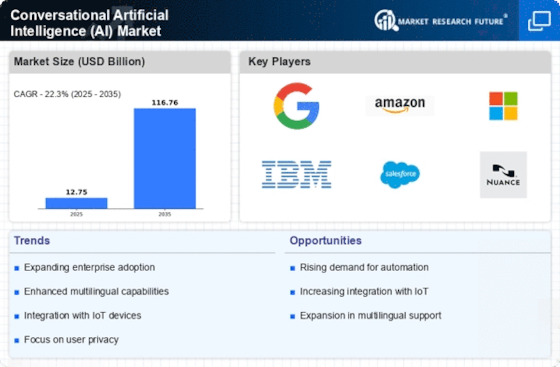
Conversational AI Market Infographic
Purchase Options

Conversational Ai Size

Conversational AI Market Growth Projections and Opportunities

A multitude of factors are at play influencing the development and growth path of conversational AI. One fundamental market factor is the increasing demand for enhanced customer experiences. As customer satisfaction becomes a priority for businesses in all industries, Conversational AI solutions are an integral part of ensuring real-time and personalized interactions. Driven by the desire for timely assistance, fast response times and comfortable experience corporations turn to AI-driven chatbots or intelligent virtual assistants. Moreover, the increase in digital channels is a key factor contributing to market growth for Conversational AI technology.

Now that online platforms, mobile applications and social media are on the rise in a big way businesses want to be able to position themselves across all kinds of communications channels. Conversational AI provides multi-channel engagement, helping organizations connect with customers on the media of their choice. The importance of this adaptability is as a way to meet users in their own environment, whether it's on the website or through messaging apps and social media. That contributes to an omnichannel communication model. The development of natural language processing (NLP) technologies is another major factor shaping the Conversational AI market. NLP abilities endow AI systems with the ability to understand and process natural human language, making interactions more fulfilling.

Along with the development of NLP (Natural Language Processing), Conversational AI technology can understand long and complicated queries, extract meaning from unstructured data sources, and respond in as natural a manner this is possible. This technological development is accelerating the production of better and more advanced Conversational AI applications. Also, even more important is the greater integration of AI into business processes and workflows. Companies know that Conversational AI has the ability to automate processes, simplify procedures and boost productivity. For example, in customer service, sales or internal communication, a Conversational AI is used to take over low-added value and repetitive processes. This frees up human resources so they can devote themselves to more complex tasks that create higher added value. This efficiency gain is a very influential factor encouraging widespread adoption of Conversational AI in many industries. Scalability and flexibility of Conversational AI solutions also affect market factors. Businesses seek platforms that can easily scale to accommodate growing user interactions and adapt to changing requirements.
Conversational AI Market Size Graph
Author
Author Profile
Ankit Gupta
Team Lead - Research

Ankit Gupta is a seasoned market intelligence and strategic research professional with over six plus years of experience in the ICT and Semiconductor industries. With academic roots in Telecom, Marketing, and Electronics, he blends technical insight with business strategy. Ankit has led 200+ projects, including work for Fortune 500 clients like Microsoft and Rio Tinto, covering market sizing, tech forecasting, and go-to-market strategies. Known for bridging engineering and enterprise decision-making, his insights support growth, innovation, and investment planning across diverse technology markets.

Leave a Comment

FAQs

What is the current valuation of the Conversational Artificial Intelligence (AI) Market?

<p>The market valuation reached 12.75 USD Billion in 2024.</p>

What is the projected market size for the Conversational AI Market by 2035?

<p>The market is expected to grow to 116.76 USD Billion by 2035.</p>

What is the expected CAGR for the Conversational AI Market during the forecast period?

<p>The market is anticipated to experience a CAGR of 22.3% from 2025 to 2035.</p>

Which companies are considered key players in the Conversational AI Market?

<p>Key players include Google, Amazon, Microsoft, IBM, Salesforce, Nuance Communications, SAP, Baidu, Alibaba, and Cognigy.</p>

What are the main application segments within the Conversational AI Market?

<p>The primary application segments are Customer Support, Virtual Assistants, Chatbots, and Speech Recognition.</p>

How does the deployment model impact the Conversational AI Market?

<p>The market is segmented into On-Premises, Cloud-Based, and Hybrid models, with Cloud-Based expected to dominate.</p>

What technologies drive the Conversational AI Market?

<p>Natural Language Processing, Machine Learning, and Speech Recognition are the key technologies driving market growth.</p>

Which industries are the largest end-users of Conversational AI?

<p>The BFSI, Healthcare, Retail, and Telecommunication sectors are the largest end-users of Conversational AI.</p>

What was the market size for Chatbots in 2024?

<p>The market size for Chatbots was 4.0 USD Billion in 2024.</p>

What is the projected growth for Speech Recognition technology in the Conversational AI Market?

<p>Speech Recognition technology is projected to grow to 48.26 USD Billion by 2035.</p>

Market Summary

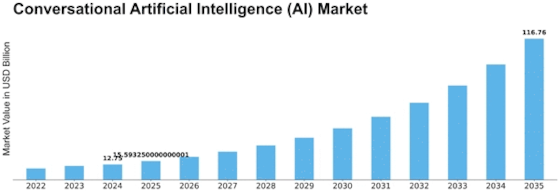
As per Market Research Future analysis, the Conversational Artificial Intelligence (AI) Market Size was estimated at 12.75 USD Billion in 2024. The Conversational Artificial Intelligence industry is projected to grow from 15.59 USD Billion in 2025 to 116.76 USD Billion by 2035, exhibiting a compound annual growth rate (CAGR) of 22.3% during the forecast period 2025 - 2035

Key Market Trends & Highlights

The Conversational Artificial Intelligence (AI) Market is poised for substantial growth driven by technological advancements and evolving consumer needs.

  • North America remains the largest market for conversational AI, showcasing robust demand across various sectors. The Asia-Pacific region is emerging as the fastest-growing market, fueled by rapid digital transformation and increased internet penetration. Chatbots dominate the market as the largest segment, while speech recognition technology is gaining traction as the fastest-growing segment. Rising demand for customer support automation and advancements in natural language processing are key drivers propelling market expansion.

Market Size & Forecast

2024 Market Size 12.75 (USD Billion)
2035 Market Size 116.76 (USD Billion)
CAGR (2025 - 2035) 22.3%
Largest Regional Market Share in 2024 North America

Major Players

Google (US), Amazon (US), <a href="https://blogs.windows.com/windowsexperience/2025/12/09/windows-pc-gaming-in-2025-handheld-innovation-arm-progress-and-directx-advances/">Microsoft</a> (US), IBM (US), Salesforce (US), Nuance Communications (US), SAP (DE), Baidu (CN), Alibaba (CN), <a href="https://www.insidermonkey.com/blog/analysts-say-nices-cloud-targets-look-aggressive-1666007/?amp=1">Cognigy</a> (DE)

Market Trends

The Conversational Artificial Intelligence (AI) Market is currently experiencing a transformative phase, characterized by rapid advancements in technology and increasing adoption across various sectors. Organizations are increasingly recognizing the potential of conversational AI to enhance customer engagement, streamline operations, and improve overall efficiency. This market encompasses a wide range of applications, including chatbots, virtual assistants, and voice recognition systems, which are being integrated into customer service, healthcare, and e-commerce, among other industries. As businesses strive to meet the evolving expectations of consumers, the demand for sophisticated conversational AI solutions continues to grow, indicating a shift towards more personalized and interactive user experiences. Moreover, the ongoing development of natural language processing and machine learning technologies is likely to further propel the Conversational Artificial Intelligence (AI) Market. Companies are investing in research and development to create more intuitive and context-aware systems that can understand and respond to user queries with greater accuracy. This trend suggests a future where conversational AI not only assists users but also anticipates their needs, thereby fostering deeper connections between brands and consumers. As the market evolves, it appears that ethical considerations and data privacy will also play a crucial role in shaping the landscape of conversational AI, as stakeholders seek to balance innovation with responsible practices.

Integration with IoT Devices

The integration of conversational AI with Internet of Things (IoT) devices is becoming increasingly prevalent. This trend allows users to interact with smart home devices, wearables, and other connected technologies through natural language, enhancing user convenience and accessibility. As more households adopt IoT solutions, the demand for conversational interfaces that facilitate seamless communication is likely to rise.

Focus on Multilingual Capabilities

There is a growing emphasis on developing multilingual capabilities within conversational AI systems. This trend reflects the need for businesses to cater to diverse customer bases across different regions. By enabling systems to understand and respond in multiple languages, organizations can enhance user satisfaction and expand their market reach, thereby fostering inclusivity.

Enhanced Personalization through AI

The drive for enhanced personalization in user interactions is shaping the future of the Conversational Artificial Intelligence (AI) Market. Companies are leveraging advanced algorithms to analyze user data and preferences, allowing conversational AI systems to deliver tailored responses and recommendations. This trend not only improves user engagement but also builds brand loyalty by creating more meaningful interactions.

Conversational AI Market Market Drivers

Growing Need for Data-Driven Insights

The growing need for data-driven insights is a crucial driver in the Conversational Artificial Intelligence (AI) Market. Organizations are increasingly leveraging AI to analyze customer interactions and derive actionable insights. This data-centric approach enables businesses to tailor their offerings and improve customer engagement strategies. The market for AI analytics is projected to grow significantly, with estimates suggesting it could reach USD 40 billion by 2025. As companies recognize the value of harnessing conversational data to inform decision-making, the demand for AI-driven analytics tools is likely to rise. This trend not only enhances operational efficiency but also positions organizations to better meet customer needs, thereby fostering growth in the Conversational Artificial Intelligence (AI) Market.

Advancements in Natural Language Processing

Advancements in Natural Language Processing (NLP) technology are significantly influencing the Conversational Artificial Intelligence (AI) Market. Enhanced NLP capabilities enable AI systems to understand and respond to human language with greater accuracy and context. This has led to a surge in the deployment of conversational agents across various sectors, including healthcare, finance, and retail. The NLP market is expected to grow at a compound annual growth rate of 20% through 2025, indicating a robust demand for sophisticated conversational interfaces. As organizations strive to improve user engagement and streamline communication, the role of NLP in conversational AI becomes increasingly critical. This evolution not only enhances user experience but also propels the growth trajectory of the Conversational Artificial Intelligence (AI) Market.

Expansion of E-commerce and Digital Services

The expansion of e-commerce and digital services is a driving force in the Conversational Artificial Intelligence (AI) Market. As online shopping continues to gain traction, businesses are increasingly adopting conversational AI to enhance customer interactions and streamline the purchasing process. The e-commerce sector is projected to reach USD 6.5 trillion by 2023, underscoring the importance of effective customer engagement strategies. Conversational AI Market solutions, such as chatbots and virtual assistants, play a vital role in guiding customers through their shopping journey, answering queries, and providing personalized recommendations. This integration not only improves customer satisfaction but also drives sales, thereby contributing to the overall growth of the Conversational Artificial Intelligence (AI) Market.

Rising Demand for Customer Support Automation

The increasing demand for customer support automation is a pivotal driver in the Conversational Artificial Intelligence (AI) Market. Businesses are increasingly adopting AI-driven chatbots and virtual assistants to enhance customer service efficiency. According to recent data, the market for AI in customer service is projected to reach USD 1.3 billion by 2025. This trend is fueled by the need for 24/7 support and the ability to handle multiple inquiries simultaneously, which traditional methods struggle to achieve. As companies seek to improve customer satisfaction and reduce operational costs, the integration of conversational AI solutions becomes essential. This shift not only streamlines operations but also allows for a more personalized customer experience, thereby driving growth in the Conversational Artificial Intelligence (AI) Market.

Increased Adoption of Voice-Activated Assistants

The increased adoption of voice-activated assistants is a notable driver in the Conversational Artificial Intelligence (AI) Market. With the proliferation of smart devices and home automation systems, consumers are increasingly utilizing voice commands for various tasks. Research indicates that the voice recognition market is anticipated to reach USD 27 billion by 2026, reflecting a growing preference for hands-free interaction. This trend is reshaping how businesses engage with customers, as voice-activated AI solutions offer a more intuitive and accessible means of communication. As organizations recognize the potential of voice technology to enhance user experience and operational efficiency, investment in conversational AI solutions is likely to escalate, further stimulating growth in the Conversational Artificial Intelligence (AI) Market.

Market Segment Insights

By Application: Chatbots (Largest) vs. Speech Recognition (Fastest-Growing)

The application segment of the Conversational Artificial Intelligence (AI) market is primarily dominated by Chatbots, which hold the largest share due to their widespread implementation in customer service and support functions. Meanwhile, Customer Support and Virtual Assistants follow closely, showcasing significant importance in enhancing user experience and engagement. Speech Recognition is emerging, reflecting a growing interest driven by advancements in voice technology.

Chatbots (Dominant) vs. Speech Recognition (Emerging)

Chatbots have established themselves as a dominant force in the Conversational AI Market landscape, primarily due to their ability to automate interactions and provide quick responses to user inquiries. This segment benefits from extensive use in various industries, streamlining operations and reducing wait times for customers. In contrast, Speech Recognition is an emerging segment characterized by its potential to revolutionize user interaction through voice commands and virtual assistants. As technology progresses, Speech Recognition is gaining traction, driven by the need for hands-free interaction and advancements in machine learning. Together, these segments embody the evolving nature of customer interactions within the Conversational AI Market.

By Deployment Model: Cloud-Based (Largest) vs. On-Premises (Fastest-Growing)

The deployment model segment in the Conversational AI Market showcases a remarkable variation in market share among its different deployment types. Cloud-based solutions dominate the market, responding to an increasing demand for flexibility and scalability among businesses. On-Premises models, while holding a smaller share, are experiencing significant growth, particularly amongst industries requiring stringent data security and control. Hybrid models are also gaining traction as they combine the benefits of both deployment types, appealing to organizations with diverse needs. Growth trends within the deployment model segment are primarily driven by the rising adoption of cloud technologies and AI integration across various sectors. Businesses are increasingly opting for Cloud-Based solutions due to their cost-efficient nature and ease of access. The accelerated digital transformation and remote work practices have further enhanced the appeal of Cloud-Based models. In contrast, On-Premises solutions are fast becoming the choice for enterprises prioritizing data sovereignty and privacy, fostering the fastest growth within the segment.

Cloud-Based (Dominant) vs. On-Premises (Emerging)

Cloud-Based deployment is characterized by its flexibility, scalability, and cost-efficiency, making it the dominant choice for organizations looking to implement Conversational AI Market solutions. This model allows businesses to leverage advanced AI capabilities without the burden of maintaining complex infrastructure. Conversely, the On-Premises model is emerging as a preferred option for enterprises that prioritize control and compliance, especially in sectors like finance and healthcare. Despite its smaller market share, the On-Premises segment is witnessing rapid growth as businesses recognize the need for personalized deployment tailored to specific security requirements.

By Technology: Natural Language Processing (Largest) vs. Machine Learning (Fastest-Growing)

In the Conversational Artificial Intelligence (AI) market, Natural Language Processing (NLP) holds the largest share due to its critical role in understanding and generating human language. NLP technologies are extensively utilized in various applications, including chatbots, virtual assistants, and customer service, leading to a robust demand. On the other hand, Machine Learning (ML) is gaining traction as businesses increasingly leverage data-driven insights to enhance user interactions and develop smarter conversational agents. This segment is rapidly expanding, supported by advancements in algorithms and big data analytics.

Technology: NLP (Dominant) vs. ML (Emerging)

Natural Language Processing (NLP) is the dominant force in the Conversational AI Market, facilitating seamless interaction between machines and humans. Its widespread applicability ranges from voice-activated assistants to sentiment analysis tools, reflecting its versatility. NLP's strength lies in its ability to comprehend context and derive meaning from human language, enabling it to cater to diverse industries. In contrast, Machine Learning (ML) is emerging as a transformative technology that empowers conversational agents to learn and adapt from user interactions. By analyzing patterns in data, ML enhances the predictive capabilities of AI systems, making conversations more engaging and personalized. This balance of established dominance by NLP and the innovative potential of ML represents the dynamic landscape of Conversational AI Market.

By End Use: BFSI (Largest) vs. Healthcare (Fastest-Growing)

The Conversational AI Market for end use segments reveals that the BFSI sector holds the largest share, driven by its demand for enhanced customer service and streamlined operations. This segment is characterized by significant investments in AI technologies to facilitate transactions, inquiries, and support services, thus optimizing customer engagement and experience. On the other hand, the healthcare segment is rapidly gaining traction, characterized by its increasing adoption rates of AI solutions for patient interaction and data management, reflecting a shift towards digital transformation in healthcare delivery.

BFSI: (Dominant) vs. Healthcare (Emerging)

The BFSI sector stands out as the dominant player within the Conversational AI Market, leveraging AI technologies to manage customer interactions, compliance inquiries, and 24/7 support. This dominance stems from the sector's longstanding commitment to improving customer experiences and minimizing operational costs through automation. Conversely, the healthcare sector exemplifies an emerging market segment, where AI applications are being increasingly integrated into patient care, appointment scheduling, and telehealth services. The rapid evolution in healthcare needs, prompted by rising patient expectations and a push for operational efficiency, positions the healthcare segment for significant growth, highlighting its potential to match or surpass BFSI in the future.

Get more detailed insights about Conversational Artificial Intelligence (AI) Market Research Report - Global Forecast to 2035

Regional Insights

The Global Conversational Artificial Intelligence (AI) Market demonstrates substantial growth across various regions, reflecting its expanding adoption in diverse sectors. In 2024, the North America region holds a majority with a market valuation of 4.0 USD Billion and is projected to reach 14.6 USD Billion by 2035. This significant growth is propelled by advanced technology infrastructure and a strong emphasis on customer engagement solutions.

Europe follows with a valuation of 2.8 USD Billion in 2024, scaling up to 10.03 USD Billion by 2035, driven by increasing digital transformation initiatives.The APAC region is also gaining traction, with a market size of 2.0 USD Billion in 2024, expected to grow to 7.3 USD Billion by 2035, as businesses increasingly invest in AI to enhance operational efficiency. Meanwhile, South America shows a comparatively modest market value of 0.7 USD Billion in 2024, increasing to 2.8 USD Billion by 2035, indicating emerging opportunities in this region.

The Middle East and Africa (MEA) segment, valued at 0.31 USD Billion in 2024, is anticipated to grow to 0.97 USD Billion by 2035, reflecting the slow yet steady adoption of AI technologies.The varied growth rates across these regions highlight the differences in technological maturity and market needs, impacting the Global Conversational Artificial Intelligence (AI) Market statistics and offering numerous opportunities for growth and innovation.

Fig 3: Conversational Artificial Intelligence (AI) Market Regional Insights

Key Players and Competitive Insights

The Global Conversational Artificial Intelligence (AI) Market is characterized by rapid growth and innovation as businesses increasingly leverage these technologies to enhance customer engagement and operational efficiency. With advancements in natural language processing, machine learning, and voice recognition, various industries are adopting conversational AI solutions for applications ranging from chatbot development to virtual assistants in customer service. The competitive landscape is marked by a mix of established players and emerging startups, each vying for a share of the burgeoning demand for AI-driven conversational solutions.
Companies operating in this space are focusing on differentiation through enhanced user experiences, superior technology integration, and flexible deployment options, building a diverse ecosystem to cater to various customer needs and preferences.Amazon has solidified its position in the Global Conversational Artificial Intelligence (AI) Market through its innovative solutions and extensive ecosystem. The company capitalizes on its Amazon Web Services platform, providing robust cloud-based AI tools that empower businesses to create conversational applications tailored to their audience. The strength of Amazon lies in its vast resource base, which allows for continuous development and enhancement of its AI offerings. 
Furthermore, Amazon’s commitment to leveraging machine learning and data analytics enables it to provide personalized and context-aware interactions, making its conversational tools highly effective. The company's strategic focus on user-centric design and accessibility from multiple devices bolsters its market presence, allowing for easy integration into existing systems and a broad reach into various sectors.IBM has also established a strong foothold in the Global Conversational Artificial Intelligence (AI) Market, driven by its advanced AI solutions such as Watson, which provides comprehensive capabilities for businesses looking to implement conversational interfaces.
IBM's strengths lie in its extensive expertise in artificial intelligence and its strong reputation in enterprise-level solutions. The company's focus on integrating natural language processing with business workflows facilitates seamless adoption of conversational AI across different industries. Additionally, through various strategic mergers and acquisitions, IBM has expanded its capabilities and market reach, enhancing its service portfolio in the conversational AI space. By investing in research and development, IBM consistently brings new features and functionalities to its products, reinforcing its leadership position in the global market and ensuring that its offerings remain competitive and aligned with evolving customer needs.

Key Companies in the Conversational AI Market include

Industry Developments

In recent months, the Global Conversational Artificial Intelligence (AI) Market has witnessed significant developments. In September 2023, Microsoft announced enhancements to its Azure AI platform, focusing on increasing the customization of AI-driven chatbots for businesses. Concurrently, Salesforce unveiled new features in its Einstein AI, allowing deeper integration into customer relationship management. In October 2023, Amazon launched improvement features in Alexa for Business, enhancing the user experience in corporate environments. Notably, in July 2023, IBM expanded its partnership with SAP to develop AI-driven applications that streamline enterprise processes.

Also, in August 2023, LivePerson announced its acquisition of a smaller tech firm specializing in Natural Language Processing, aiming to enhance its interactive voice response capabilities. Growth in valuations for companies like Google and Nuance Communications continues to demonstrate a robust market demand for AI solutions, elevating competition and innovation within the global sector. Over the past few years, the market has expanded significantly, driven by increased digital transformation initiatives worldwide. The focus remains on enhancing user experience and operational efficiency across various industries, further solidifying the importance of conversational AI in the global economy.

Future Outlook

Conversational AI Market Future Outlook

The Conversational AI Market is projected to grow at a 22.3% CAGR from 2025 to 2035, driven by advancements in natural language processing, increased automation, and rising demand for customer engagement solutions.

New opportunities lie in:

  • Integration of AI-driven chatbots in e-commerce platforms
  • Development of multilingual support systems for global customer service
  • Implementation of AI analytics tools for personalized user experiences

By 2035, the Conversational AI Market is expected to be a pivotal component of digital transformation strategies.

Market Segmentation

Conversational AI Market End Use Outlook

  • BFSI
  • Healthcare
  • Retail
  • Telecommunication

Conversational AI Market Technology Outlook

  • Natural Language Processing
  • Machine Learning
  • Speech Recognition

Conversational AI Market Application Outlook

  • Customer Support
  • Virtual Assistants
  • Chatbots
  • Speech Recognition

Conversational AI Market Deployment Model Outlook

  • On-Premises
  • Cloud-Based
  • Hybrid

Report Scope

MARKET SIZE 2024 12.75(USD Billion)
MARKET SIZE 2025 15.59(USD Billion)
MARKET SIZE 2035 116.76(USD Billion)
COMPOUND ANNUAL GROWTH RATE (CAGR) 22.3% (2025 - 2035)
REPORT COVERAGE Revenue Forecast, Competitive Landscape, Growth Factors, and Trends
BASE YEAR 2024
Market Forecast Period 2025 - 2035
Historical Data 2019 - 2024
Market Forecast Units USD Billion
Key Companies Profiled Google (US), Amazon (US), Microsoft (US), IBM (US), Salesforce (US), Nuance Communications (US), SAP (DE), Baidu (CN), Alibaba (CN), Cognigy (DE)
Segments Covered Application, Deployment Model, Technology, End Use, Regional
Key Market Opportunities Integration of advanced natural language processing enhances user engagement in the Conversational Artificial Intelligence (AI) Market.
Key Market Dynamics Rising demand for personalized customer interactions drives innovation in Conversational Artificial Intelligence technologies and applications.
Countries Covered North America, Europe, APAC, South America, MEA

FAQs

What is the current valuation of the Conversational Artificial Intelligence (AI) Market?

<p>The market valuation reached 12.75 USD Billion in 2024.</p>

What is the projected market size for the Conversational AI Market by 2035?

<p>The market is expected to grow to 116.76 USD Billion by 2035.</p>

What is the expected CAGR for the Conversational AI Market during the forecast period?

<p>The market is anticipated to experience a CAGR of 22.3% from 2025 to 2035.</p>

Which companies are considered key players in the Conversational AI Market?

<p>Key players include Google, Amazon, Microsoft, IBM, Salesforce, Nuance Communications, SAP, Baidu, Alibaba, and Cognigy.</p>

What are the main application segments within the Conversational AI Market?

<p>The primary application segments are Customer Support, Virtual Assistants, Chatbots, and Speech Recognition.</p>

How does the deployment model impact the Conversational AI Market?

<p>The market is segmented into On-Premises, Cloud-Based, and Hybrid models, with Cloud-Based expected to dominate.</p>

What technologies drive the Conversational AI Market?

<p>Natural Language Processing, Machine Learning, and Speech Recognition are the key technologies driving market growth.</p>

Which industries are the largest end-users of Conversational AI?

<p>The BFSI, Healthcare, Retail, and Telecommunication sectors are the largest end-users of Conversational AI.</p>

What was the market size for Chatbots in 2024?

<p>The market size for Chatbots was 4.0 USD Billion in 2024.</p>

What is the projected growth for Speech Recognition technology in the Conversational AI Market?

<p>Speech Recognition technology is projected to grow to 48.26 USD Billion by 2035.</p>

  1. SECTION I: EXECUTIVE SUMMARY AND KEY HIGHLIGHTS
    1. | 1.1 EXECUTIVE SUMMARY
    2. | | 1.1.1 Market Overview
    3. | | 1.1.2 Key Findings
    4. | | 1.1.3 Market Segmentation
    5. | | 1.1.4 Competitive Landscape
    6. | | 1.1.5 Challenges and Opportunities
    7. | | 1.1.6 Future Outlook
  2. SECTION II: SCOPING, METHODOLOGY AND MARKET STRUCTURE
    1. | 2.1 MARKET INTRODUCTION
    2. | | 2.1.1 Definition
    3. | | 2.1.2 Scope of the study
    4. | | | 2.1.2.1 Research Objective
    5. | | | 2.1.2.2 Assumption
    6. | | | 2.1.2.3 Limitations
    7. | 2.2 RESEARCH METHODOLOGY
    8. | | 2.2.1 Overview
    9. | | 2.2.2 Data Mining
    10. | | 2.2.3 Secondary Research
    11. | | 2.2.4 Primary Research
    12. | | | 2.2.4.1 Primary Interviews and Information Gathering Process
    13. | | | 2.2.4.2 Breakdown of Primary Respondents
    14. | | 2.2.5 Forecasting Model
    15. | | 2.2.6 Market Size Estimation
    16. | | | 2.2.6.1 Bottom-Up Approach
    17. | | | 2.2.6.2 Top-Down Approach
    18. | | 2.2.7 Data Triangulation
    19. | | 2.2.8 Validation
  3. SECTION III: QUALITATIVE ANALYSIS
    1. | 3.1 MARKET DYNAMICS
    2. | | 3.1.1 Overview
    3. | | 3.1.2 Drivers
    4. | | 3.1.3 Restraints
    5. | | 3.1.4 Opportunities
    6. | 3.2 MARKET FACTOR ANALYSIS
    7. | | 3.2.1 Value chain Analysis
    8. | | 3.2.2 Porter's Five Forces Analysis
    9. | | | 3.2.2.1 Bargaining Power of Suppliers
    10. | | | 3.2.2.2 Bargaining Power of Buyers
    11. | | | 3.2.2.3 Threat of New Entrants
    12. | | | 3.2.2.4 Threat of Substitutes
    13. | | | 3.2.2.5 Intensity of Rivalry
    14. | | 3.2.3 COVID-19 Impact Analysis
    15. | | | 3.2.3.1 Market Impact Analysis
    16. | | | 3.2.3.2 Regional Impact
    17. | | | 3.2.3.3 Opportunity and Threat Analysis
  4. SECTION IV: QUANTITATIVE ANALYSIS
    1. | 4.1 Information and Communications Technology, BY Application (USD Billion)
    2. | | 4.1.1 Customer Support
    3. | | 4.1.2 Virtual Assistants
    4. | | 4.1.3 Chatbots
    5. | | 4.1.4 Speech Recognition
    6. | 4.2 Information and Communications Technology, BY Deployment Model (USD Billion)
    7. | | 4.2.1 On-Premises
    8. | | 4.2.2 Cloud-Based
    9. | | 4.2.3 Hybrid
    10. | 4.3 Information and Communications Technology, BY Technology (USD Billion)
    11. | | 4.3.1 Natural Language Processing
    12. | | 4.3.2 Machine Learning
    13. | | 4.3.3 Speech Recognition
    14. | 4.4 Information and Communications Technology, BY End Use (USD Billion)
    15. | | 4.4.1 BFSI
    16. | | 4.4.2 Healthcare
    17. | | 4.4.3 Retail
    18. | | 4.4.4 Telecommunication
    19. | 4.5 Information and Communications Technology, BY Region (USD Billion)
    20. | | 4.5.1 North America
    21. | | | 4.5.1.1 US
    22. | | | 4.5.1.2 Canada
    23. | | 4.5.2 Europe
    24. | | | 4.5.2.1 Germany
    25. | | | 4.5.2.2 UK
    26. | | | 4.5.2.3 France
    27. | | | 4.5.2.4 Russia
    28. | | | 4.5.2.5 Italy
    29. | | | 4.5.2.6 Spain
    30. | | | 4.5.2.7 Rest of Europe
    31. | | 4.5.3 APAC
    32. | | | 4.5.3.1 China
    33. | | | 4.5.3.2 India
    34. | | | 4.5.3.3 Japan
    35. | | | 4.5.3.4 South Korea
    36. | | | 4.5.3.5 Malaysia
    37. | | | 4.5.3.6 Thailand
    38. | | | 4.5.3.7 Indonesia
    39. | | | 4.5.3.8 Rest of APAC
    40. | | 4.5.4 South America
    41. | | | 4.5.4.1 Brazil
    42. | | | 4.5.4.2 Mexico
    43. | | | 4.5.4.3 Argentina
    44. | | | 4.5.4.4 Rest of South America
    45. | | 4.5.5 MEA
    46. | | | 4.5.5.1 GCC Countries
    47. | | | 4.5.5.2 South Africa
    48. | | | 4.5.5.3 Rest of MEA
  5. SECTION V: COMPETITIVE ANALYSIS
    1. | 5.1 Competitive Landscape
    2. | | 5.1.1 Overview
    3. | | 5.1.2 Competitive Analysis
    4. | | 5.1.3 Market share Analysis
    5. | | 5.1.4 Major Growth Strategy in the Information and Communications Technology
    6. | | 5.1.5 Competitive Benchmarking
    7. | | 5.1.6 Leading Players in Terms of Number of Developments in the Information and Communications Technology
    8. | | 5.1.7 Key developments and growth strategies
    9. | | | 5.1.7.1 New Product Launch/Service Deployment
    10. | | | 5.1.7.2 Merger & Acquisitions
    11. | | | 5.1.7.3 Joint Ventures
    12. | | 5.1.8 Major Players Financial Matrix
    13. | | | 5.1.8.1 Sales and Operating Income
    14. | | | 5.1.8.2 Major Players R&D Expenditure. 2023
    15. | 5.2 Company Profiles
    16. | | 5.2.1 Google (US)
    17. | | | 5.2.1.1 Financial Overview
    18. | | | 5.2.1.2 Products Offered
    19. | | | 5.2.1.3 Key Developments
    20. | | | 5.2.1.4 SWOT Analysis
    21. | | | 5.2.1.5 Key Strategies
    22. | | 5.2.2 Amazon (US)
    23. | | | 5.2.2.1 Financial Overview
    24. | | | 5.2.2.2 Products Offered
    25. | | | 5.2.2.3 Key Developments
    26. | | | 5.2.2.4 SWOT Analysis
    27. | | | 5.2.2.5 Key Strategies
    28. | | 5.2.3 Microsoft (US)
    29. | | | 5.2.3.1 Financial Overview
    30. | | | 5.2.3.2 Products Offered
    31. | | | 5.2.3.3 Key Developments
    32. | | | 5.2.3.4 SWOT Analysis
    33. | | | 5.2.3.5 Key Strategies
    34. | | 5.2.4 IBM (US)
    35. | | | 5.2.4.1 Financial Overview
    36. | | | 5.2.4.2 Products Offered
    37. | | | 5.2.4.3 Key Developments
    38. | | | 5.2.4.4 SWOT Analysis
    39. | | | 5.2.4.5 Key Strategies
    40. | | 5.2.5 Salesforce (US)
    41. | | | 5.2.5.1 Financial Overview
    42. | | | 5.2.5.2 Products Offered
    43. | | | 5.2.5.3 Key Developments
    44. | | | 5.2.5.4 SWOT Analysis
    45. | | | 5.2.5.5 Key Strategies
    46. | | 5.2.6 Nuance Communications (US)
    47. | | | 5.2.6.1 Financial Overview
    48. | | | 5.2.6.2 Products Offered
    49. | | | 5.2.6.3 Key Developments
    50. | | | 5.2.6.4 SWOT Analysis
    51. | | | 5.2.6.5 Key Strategies
    52. | | 5.2.7 SAP (DE)
    53. | | | 5.2.7.1 Financial Overview
    54. | | | 5.2.7.2 Products Offered
    55. | | | 5.2.7.3 Key Developments
    56. | | | 5.2.7.4 SWOT Analysis
    57. | | | 5.2.7.5 Key Strategies
    58. | | 5.2.8 Baidu (CN)
    59. | | | 5.2.8.1 Financial Overview
    60. | | | 5.2.8.2 Products Offered
    61. | | | 5.2.8.3 Key Developments
    62. | | | 5.2.8.4 SWOT Analysis
    63. | | | 5.2.8.5 Key Strategies
    64. | | 5.2.9 Alibaba (CN)
    65. | | | 5.2.9.1 Financial Overview
    66. | | | 5.2.9.2 Products Offered
    67. | | | 5.2.9.3 Key Developments
    68. | | | 5.2.9.4 SWOT Analysis
    69. | | | 5.2.9.5 Key Strategies
    70. | | 5.2.10 Cognigy (DE)
    71. | | | 5.2.10.1 Financial Overview
    72. | | | 5.2.10.2 Products Offered
    73. | | | 5.2.10.3 Key Developments
    74. | | | 5.2.10.4 SWOT Analysis
    75. | | | 5.2.10.5 Key Strategies
    76. | 5.3 Appendix
    77. | | 5.3.1 References
    78. | | 5.3.2 Related Reports
  6. LIST OF FIGURES
    1. | 6.1 MARKET SYNOPSIS
    2. | 6.2 NORTH AMERICA MARKET ANALYSIS
    3. | 6.3 US MARKET ANALYSIS BY APPLICATION
    4. | 6.4 US MARKET ANALYSIS BY DEPLOYMENT MODEL
    5. | 6.5 US MARKET ANALYSIS BY TECHNOLOGY
    6. | 6.6 US MARKET ANALYSIS BY END USE
    7. | 6.7 CANADA MARKET ANALYSIS BY APPLICATION
    8. | 6.8 CANADA MARKET ANALYSIS BY DEPLOYMENT MODEL
    9. | 6.9 CANADA MARKET ANALYSIS BY TECHNOLOGY
    10. | 6.10 CANADA MARKET ANALYSIS BY END USE
    11. | 6.11 EUROPE MARKET ANALYSIS
    12. | 6.12 GERMANY MARKET ANALYSIS BY APPLICATION
    13. | 6.13 GERMANY MARKET ANALYSIS BY DEPLOYMENT MODEL
    14. | 6.14 GERMANY MARKET ANALYSIS BY TECHNOLOGY
    15. | 6.15 GERMANY MARKET ANALYSIS BY END USE
    16. | 6.16 UK MARKET ANALYSIS BY APPLICATION
    17. | 6.17 UK MARKET ANALYSIS BY DEPLOYMENT MODEL
    18. | 6.18 UK MARKET ANALYSIS BY TECHNOLOGY
    19. | 6.19 UK MARKET ANALYSIS BY END USE
    20. | 6.20 FRANCE MARKET ANALYSIS BY APPLICATION
    21. | 6.21 FRANCE MARKET ANALYSIS BY DEPLOYMENT MODEL
    22. | 6.22 FRANCE MARKET ANALYSIS BY TECHNOLOGY
    23. | 6.23 FRANCE MARKET ANALYSIS BY END USE
    24. | 6.24 RUSSIA MARKET ANALYSIS BY APPLICATION
    25. | 6.25 RUSSIA MARKET ANALYSIS BY DEPLOYMENT MODEL
    26. | 6.26 RUSSIA MARKET ANALYSIS BY TECHNOLOGY
    27. | 6.27 RUSSIA MARKET ANALYSIS BY END USE
    28. | 6.28 ITALY MARKET ANALYSIS BY APPLICATION
    29. | 6.29 ITALY MARKET ANALYSIS BY DEPLOYMENT MODEL
    30. | 6.30 ITALY MARKET ANALYSIS BY TECHNOLOGY
    31. | 6.31 ITALY MARKET ANALYSIS BY END USE
    32. | 6.32 SPAIN MARKET ANALYSIS BY APPLICATION
    33. | 6.33 SPAIN MARKET ANALYSIS BY DEPLOYMENT MODEL
    34. | 6.34 SPAIN MARKET ANALYSIS BY TECHNOLOGY
    35. | 6.35 SPAIN MARKET ANALYSIS BY END USE
    36. | 6.36 REST OF EUROPE MARKET ANALYSIS BY APPLICATION
    37. | 6.37 REST OF EUROPE MARKET ANALYSIS BY DEPLOYMENT MODEL
    38. | 6.38 REST OF EUROPE MARKET ANALYSIS BY TECHNOLOGY
    39. | 6.39 REST OF EUROPE MARKET ANALYSIS BY END USE
    40. | 6.40 APAC MARKET ANALYSIS
    41. | 6.41 CHINA MARKET ANALYSIS BY APPLICATION
    42. | 6.42 CHINA MARKET ANALYSIS BY DEPLOYMENT MODEL
    43. | 6.43 CHINA MARKET ANALYSIS BY TECHNOLOGY
    44. | 6.44 CHINA MARKET ANALYSIS BY END USE
    45. | 6.45 INDIA MARKET ANALYSIS BY APPLICATION
    46. | 6.46 INDIA MARKET ANALYSIS BY DEPLOYMENT MODEL
    47. | 6.47 INDIA MARKET ANALYSIS BY TECHNOLOGY
    48. | 6.48 INDIA MARKET ANALYSIS BY END USE
    49. | 6.49 JAPAN MARKET ANALYSIS BY APPLICATION
    50. | 6.50 JAPAN MARKET ANALYSIS BY DEPLOYMENT MODEL
    51. | 6.51 JAPAN MARKET ANALYSIS BY TECHNOLOGY
    52. | 6.52 JAPAN MARKET ANALYSIS BY END USE
    53. | 6.53 SOUTH KOREA MARKET ANALYSIS BY APPLICATION
    54. | 6.54 SOUTH KOREA MARKET ANALYSIS BY DEPLOYMENT MODEL
    55. | 6.55 SOUTH KOREA MARKET ANALYSIS BY TECHNOLOGY
    56. | 6.56 SOUTH KOREA MARKET ANALYSIS BY END USE
    57. | 6.57 MALAYSIA MARKET ANALYSIS BY APPLICATION
    58. | 6.58 MALAYSIA MARKET ANALYSIS BY DEPLOYMENT MODEL
    59. | 6.59 MALAYSIA MARKET ANALYSIS BY TECHNOLOGY
    60. | 6.60 MALAYSIA MARKET ANALYSIS BY END USE
    61. | 6.61 THAILAND MARKET ANALYSIS BY APPLICATION
    62. | 6.62 THAILAND MARKET ANALYSIS BY DEPLOYMENT MODEL
    63. | 6.63 THAILAND MARKET ANALYSIS BY TECHNOLOGY
    64. | 6.64 THAILAND MARKET ANALYSIS BY END USE
    65. | 6.65 INDONESIA MARKET ANALYSIS BY APPLICATION
    66. | 6.66 INDONESIA MARKET ANALYSIS BY DEPLOYMENT MODEL
    67. | 6.67 INDONESIA MARKET ANALYSIS BY TECHNOLOGY
    68. | 6.68 INDONESIA MARKET ANALYSIS BY END USE
    69. | 6.69 REST OF APAC MARKET ANALYSIS BY APPLICATION
    70. | 6.70 REST OF APAC MARKET ANALYSIS BY DEPLOYMENT MODEL
    71. | 6.71 REST OF APAC MARKET ANALYSIS BY TECHNOLOGY
    72. | 6.72 REST OF APAC MARKET ANALYSIS BY END USE
    73. | 6.73 SOUTH AMERICA MARKET ANALYSIS
    74. | 6.74 BRAZIL MARKET ANALYSIS BY APPLICATION
    75. | 6.75 BRAZIL MARKET ANALYSIS BY DEPLOYMENT MODEL
    76. | 6.76 BRAZIL MARKET ANALYSIS BY TECHNOLOGY
    77. | 6.77 BRAZIL MARKET ANALYSIS BY END USE
    78. | 6.78 MEXICO MARKET ANALYSIS BY APPLICATION
    79. | 6.79 MEXICO MARKET ANALYSIS BY DEPLOYMENT MODEL
    80. | 6.80 MEXICO MARKET ANALYSIS BY TECHNOLOGY
    81. | 6.81 MEXICO MARKET ANALYSIS BY END USE
    82. | 6.82 ARGENTINA MARKET ANALYSIS BY APPLICATION
    83. | 6.83 ARGENTINA MARKET ANALYSIS BY DEPLOYMENT MODEL
    84. | 6.84 ARGENTINA MARKET ANALYSIS BY TECHNOLOGY
    85. | 6.85 ARGENTINA MARKET ANALYSIS BY END USE
    86. | 6.86 REST OF SOUTH AMERICA MARKET ANALYSIS BY APPLICATION
    87. | 6.87 REST OF SOUTH AMERICA MARKET ANALYSIS BY DEPLOYMENT MODEL
    88. | 6.88 REST OF SOUTH AMERICA MARKET ANALYSIS BY TECHNOLOGY
    89. | 6.89 REST OF SOUTH AMERICA MARKET ANALYSIS BY END USE
    90. | 6.90 MEA MARKET ANALYSIS
    91. | 6.91 GCC COUNTRIES MARKET ANALYSIS BY APPLICATION
    92. | 6.92 GCC COUNTRIES MARKET ANALYSIS BY DEPLOYMENT MODEL
    93. | 6.93 GCC COUNTRIES MARKET ANALYSIS BY TECHNOLOGY
    94. | 6.94 GCC COUNTRIES MARKET ANALYSIS BY END USE
    95. | 6.95 SOUTH AFRICA MARKET ANALYSIS BY APPLICATION
    96. | 6.96 SOUTH AFRICA MARKET ANALYSIS BY DEPLOYMENT MODEL
    97. | 6.97 SOUTH AFRICA MARKET ANALYSIS BY TECHNOLOGY
    98. | 6.98 SOUTH AFRICA MARKET ANALYSIS BY END USE
    99. | 6.99 REST OF MEA MARKET ANALYSIS BY APPLICATION
    100. | 6.100 REST OF MEA MARKET ANALYSIS BY DEPLOYMENT MODEL
    101. | 6.101 REST OF MEA MARKET ANALYSIS BY TECHNOLOGY
    102. | 6.102 REST OF MEA MARKET ANALYSIS BY END USE
    103. | 6.103 KEY BUYING CRITERIA OF INFORMATION AND COMMUNICATIONS TECHNOLOGY
    104. | 6.104 RESEARCH PROCESS OF MRFR
    105. | 6.105 DRO ANALYSIS OF INFORMATION AND COMMUNICATIONS TECHNOLOGY
    106. | 6.106 DRIVERS IMPACT ANALYSIS: INFORMATION AND COMMUNICATIONS TECHNOLOGY
    107. | 6.107 RESTRAINTS IMPACT ANALYSIS: INFORMATION AND COMMUNICATIONS TECHNOLOGY
    108. | 6.108 SUPPLY / VALUE CHAIN: INFORMATION AND COMMUNICATIONS TECHNOLOGY
    109. | 6.109 INFORMATION AND COMMUNICATIONS TECHNOLOGY, BY APPLICATION, 2024 (% SHARE)
    110. | 6.110 INFORMATION AND COMMUNICATIONS TECHNOLOGY, BY APPLICATION, 2024 TO 2035 (USD Billion)
    111. | 6.111 INFORMATION AND COMMUNICATIONS TECHNOLOGY, BY DEPLOYMENT MODEL, 2024 (% SHARE)
    112. | 6.112 INFORMATION AND COMMUNICATIONS TECHNOLOGY, BY DEPLOYMENT MODEL, 2024 TO 2035 (USD Billion)
    113. | 6.113 INFORMATION AND COMMUNICATIONS TECHNOLOGY, BY TECHNOLOGY, 2024 (% SHARE)
    114. | 6.114 INFORMATION AND COMMUNICATIONS TECHNOLOGY, BY TECHNOLOGY, 2024 TO 2035 (USD Billion)
    115. | 6.115 INFORMATION AND COMMUNICATIONS TECHNOLOGY, BY END USE, 2024 (% SHARE)
    116. | 6.116 INFORMATION AND COMMUNICATIONS TECHNOLOGY, BY END USE, 2024 TO 2035 (USD Billion)
    117. | 6.117 BENCHMARKING OF MAJOR COMPETITORS
  7. LIST OF TABLES
    1. | 7.1 LIST OF ASSUMPTIONS
    2. | | 7.1.1
    3. | 7.2 North America MARKET SIZE ESTIMATES; FORECAST
    4. | | 7.2.1 BY APPLICATION, 2025-2035 (USD Billion)
    5. | | 7.2.2 BY DEPLOYMENT MODEL, 2025-2035 (USD Billion)
    6. | | 7.2.3 BY TECHNOLOGY, 2025-2035 (USD Billion)
    7. | | 7.2.4 BY END USE, 2025-2035 (USD Billion)
    8. | 7.3 US MARKET SIZE ESTIMATES; FORECAST
    9. | | 7.3.1 BY APPLICATION, 2025-2035 (USD Billion)
    10. | | 7.3.2 BY DEPLOYMENT MODEL, 2025-2035 (USD Billion)
    11. | | 7.3.3 BY TECHNOLOGY, 2025-2035 (USD Billion)
    12. | | 7.3.4 BY END USE, 2025-2035 (USD Billion)
    13. | 7.4 Canada MARKET SIZE ESTIMATES; FORECAST
    14. | | 7.4.1 BY APPLICATION, 2025-2035 (USD Billion)
    15. | | 7.4.2 BY DEPLOYMENT MODEL, 2025-2035 (USD Billion)
    16. | | 7.4.3 BY TECHNOLOGY, 2025-2035 (USD Billion)
    17. | | 7.4.4 BY END USE, 2025-2035 (USD Billion)
    18. | 7.5 Europe MARKET SIZE ESTIMATES; FORECAST
    19. | | 7.5.1 BY APPLICATION, 2025-2035 (USD Billion)
    20. | | 7.5.2 BY DEPLOYMENT MODEL, 2025-2035 (USD Billion)
    21. | | 7.5.3 BY TECHNOLOGY, 2025-2035 (USD Billion)
    22. | | 7.5.4 BY END USE, 2025-2035 (USD Billion)
    23. | 7.6 Germany MARKET SIZE ESTIMATES; FORECAST
    24. | | 7.6.1 BY APPLICATION, 2025-2035 (USD Billion)
    25. | | 7.6.2 BY DEPLOYMENT MODEL, 2025-2035 (USD Billion)
    26. | | 7.6.3 BY TECHNOLOGY, 2025-2035 (USD Billion)
    27. | | 7.6.4 BY END USE, 2025-2035 (USD Billion)
    28. | 7.7 UK MARKET SIZE ESTIMATES; FORECAST
    29. | | 7.7.1 BY APPLICATION, 2025-2035 (USD Billion)
    30. | | 7.7.2 BY DEPLOYMENT MODEL, 2025-2035 (USD Billion)
    31. | | 7.7.3 BY TECHNOLOGY, 2025-2035 (USD Billion)
    32. | | 7.7.4 BY END USE, 2025-2035 (USD Billion)
    33. | 7.8 France MARKET SIZE ESTIMATES; FORECAST
    34. | | 7.8.1 BY APPLICATION, 2025-2035 (USD Billion)
    35. | | 7.8.2 BY DEPLOYMENT MODEL, 2025-2035 (USD Billion)
    36. | | 7.8.3 BY TECHNOLOGY, 2025-2035 (USD Billion)
    37. | | 7.8.4 BY END USE, 2025-2035 (USD Billion)
    38. | 7.9 Russia MARKET SIZE ESTIMATES; FORECAST
    39. | | 7.9.1 BY APPLICATION, 2025-2035 (USD Billion)
    40. | | 7.9.2 BY DEPLOYMENT MODEL, 2025-2035 (USD Billion)
    41. | | 7.9.3 BY TECHNOLOGY, 2025-2035 (USD Billion)
    42. | | 7.9.4 BY END USE, 2025-2035 (USD Billion)
    43. | 7.10 Italy MARKET SIZE ESTIMATES; FORECAST
    44. | | 7.10.1 BY APPLICATION, 2025-2035 (USD Billion)
    45. | | 7.10.2 BY DEPLOYMENT MODEL, 2025-2035 (USD Billion)
    46. | | 7.10.3 BY TECHNOLOGY, 2025-2035 (USD Billion)
    47. | | 7.10.4 BY END USE, 2025-2035 (USD Billion)
    48. | 7.11 Spain MARKET SIZE ESTIMATES; FORECAST
    49. | | 7.11.1 BY APPLICATION, 2025-2035 (USD Billion)
    50. | | 7.11.2 BY DEPLOYMENT MODEL, 2025-2035 (USD Billion)
    51. | | 7.11.3 BY TECHNOLOGY, 2025-2035 (USD Billion)
    52. | | 7.11.4 BY END USE, 2025-2035 (USD Billion)
    53. | 7.12 Rest of Europe MARKET SIZE ESTIMATES; FORECAST
    54. | | 7.12.1 BY APPLICATION, 2025-2035 (USD Billion)
    55. | | 7.12.2 BY DEPLOYMENT MODEL, 2025-2035 (USD Billion)
    56. | | 7.12.3 BY TECHNOLOGY, 2025-2035 (USD Billion)
    57. | | 7.12.4 BY END USE, 2025-2035 (USD Billion)
    58. | 7.13 APAC MARKET SIZE ESTIMATES; FORECAST
    59. | | 7.13.1 BY APPLICATION, 2025-2035 (USD Billion)
    60. | | 7.13.2 BY DEPLOYMENT MODEL, 2025-2035 (USD Billion)
    61. | | 7.13.3 BY TECHNOLOGY, 2025-2035 (USD Billion)
    62. | | 7.13.4 BY END USE, 2025-2035 (USD Billion)
    63. | 7.14 China MARKET SIZE ESTIMATES; FORECAST
    64. | | 7.14.1 BY APPLICATION, 2025-2035 (USD Billion)
    65. | | 7.14.2 BY DEPLOYMENT MODEL, 2025-2035 (USD Billion)
    66. | | 7.14.3 BY TECHNOLOGY, 2025-2035 (USD Billion)
    67. | | 7.14.4 BY END USE, 2025-2035 (USD Billion)
    68. | 7.15 India MARKET SIZE ESTIMATES; FORECAST
    69. | | 7.15.1 BY APPLICATION, 2025-2035 (USD Billion)
    70. | | 7.15.2 BY DEPLOYMENT MODEL, 2025-2035 (USD Billion)
    71. | | 7.15.3 BY TECHNOLOGY, 2025-2035 (USD Billion)
    72. | | 7.15.4 BY END USE, 2025-2035 (USD Billion)
    73. | 7.16 Japan MARKET SIZE ESTIMATES; FORECAST
    74. | | 7.16.1 BY APPLICATION, 2025-2035 (USD Billion)
    75. | | 7.16.2 BY DEPLOYMENT MODEL, 2025-2035 (USD Billion)
    76. | | 7.16.3 BY TECHNOLOGY, 2025-2035 (USD Billion)
    77. | | 7.16.4 BY END USE, 2025-2035 (USD Billion)
    78. | 7.17 South Korea MARKET SIZE ESTIMATES; FORECAST
    79. | | 7.17.1 BY APPLICATION, 2025-2035 (USD Billion)
    80. | | 7.17.2 BY DEPLOYMENT MODEL, 2025-2035 (USD Billion)
    81. | | 7.17.3 BY TECHNOLOGY, 2025-2035 (USD Billion)
    82. | | 7.17.4 BY END USE, 2025-2035 (USD Billion)
    83. | 7.18 Malaysia MARKET SIZE ESTIMATES; FORECAST
    84. | | 7.18.1 BY APPLICATION, 2025-2035 (USD Billion)
    85. | | 7.18.2 BY DEPLOYMENT MODEL, 2025-2035 (USD Billion)
    86. | | 7.18.3 BY TECHNOLOGY, 2025-2035 (USD Billion)
    87. | | 7.18.4 BY END USE, 2025-2035 (USD Billion)
    88. | 7.19 Thailand MARKET SIZE ESTIMATES; FORECAST
    89. | | 7.19.1 BY APPLICATION, 2025-2035 (USD Billion)
    90. | | 7.19.2 BY DEPLOYMENT MODEL, 2025-2035 (USD Billion)
    91. | | 7.19.3 BY TECHNOLOGY, 2025-2035 (USD Billion)
    92. | | 7.19.4 BY END USE, 2025-2035 (USD Billion)
    93. | 7.20 Indonesia MARKET SIZE ESTIMATES; FORECAST
    94. | | 7.20.1 BY APPLICATION, 2025-2035 (USD Billion)
    95. | | 7.20.2 BY DEPLOYMENT MODEL, 2025-2035 (USD Billion)
    96. | | 7.20.3 BY TECHNOLOGY, 2025-2035 (USD Billion)
    97. | | 7.20.4 BY END USE, 2025-2035 (USD Billion)
    98. | 7.21 Rest of APAC MARKET SIZE ESTIMATES; FORECAST
    99. | | 7.21.1 BY APPLICATION, 2025-2035 (USD Billion)
    100. | | 7.21.2 BY DEPLOYMENT MODEL, 2025-2035 (USD Billion)
    101. | | 7.21.3 BY TECHNOLOGY, 2025-2035 (USD Billion)
    102. | | 7.21.4 BY END USE, 2025-2035 (USD Billion)
    103. | 7.22 South America MARKET SIZE ESTIMATES; FORECAST
    104. | | 7.22.1 BY APPLICATION, 2025-2035 (USD Billion)
    105. | | 7.22.2 BY DEPLOYMENT MODEL, 2025-2035 (USD Billion)
    106. | | 7.22.3 BY TECHNOLOGY, 2025-2035 (USD Billion)
    107. | | 7.22.4 BY END USE, 2025-2035 (USD Billion)
    108. | 7.23 Brazil MARKET SIZE ESTIMATES; FORECAST
    109. | | 7.23.1 BY APPLICATION, 2025-2035 (USD Billion)
    110. | | 7.23.2 BY DEPLOYMENT MODEL, 2025-2035 (USD Billion)
    111. | | 7.23.3 BY TECHNOLOGY, 2025-2035 (USD Billion)
    112. | | 7.23.4 BY END USE, 2025-2035 (USD Billion)
    113. | 7.24 Mexico MARKET SIZE ESTIMATES; FORECAST
    114. | | 7.24.1 BY APPLICATION, 2025-2035 (USD Billion)
    115. | | 7.24.2 BY DEPLOYMENT MODEL, 2025-2035 (USD Billion)
    116. | | 7.24.3 BY TECHNOLOGY, 2025-2035 (USD Billion)
    117. | | 7.24.4 BY END USE, 2025-2035 (USD Billion)
    118. | 7.25 Argentina MARKET SIZE ESTIMATES; FORECAST
    119. | | 7.25.1 BY APPLICATION, 2025-2035 (USD Billion)
    120. | | 7.25.2 BY DEPLOYMENT MODEL, 2025-2035 (USD Billion)
    121. | | 7.25.3 BY TECHNOLOGY, 2025-2035 (USD Billion)
    122. | | 7.25.4 BY END USE, 2025-2035 (USD Billion)
    123. | 7.26 Rest of South America MARKET SIZE ESTIMATES; FORECAST
    124. | | 7.26.1 BY APPLICATION, 2025-2035 (USD Billion)
    125. | | 7.26.2 BY DEPLOYMENT MODEL, 2025-2035 (USD Billion)
    126. | | 7.26.3 BY TECHNOLOGY, 2025-2035 (USD Billion)
    127. | | 7.26.4 BY END USE, 2025-2035 (USD Billion)
    128. | 7.27 MEA MARKET SIZE ESTIMATES; FORECAST
    129. | | 7.27.1 BY APPLICATION, 2025-2035 (USD Billion)
    130. | | 7.27.2 BY DEPLOYMENT MODEL, 2025-2035 (USD Billion)
    131. | | 7.27.3 BY TECHNOLOGY, 2025-2035 (USD Billion)
    132. | | 7.27.4 BY END USE, 2025-2035 (USD Billion)
    133. | 7.28 GCC Countries MARKET SIZE ESTIMATES; FORECAST
    134. | | 7.28.1 BY APPLICATION, 2025-2035 (USD Billion)
    135. | | 7.28.2 BY DEPLOYMENT MODEL, 2025-2035 (USD Billion)
    136. | | 7.28.3 BY TECHNOLOGY, 2025-2035 (USD Billion)
    137. | | 7.28.4 BY END USE, 2025-2035 (USD Billion)
    138. | 7.29 South Africa MARKET SIZE ESTIMATES; FORECAST
    139. | | 7.29.1 BY APPLICATION, 2025-2035 (USD Billion)
    140. | | 7.29.2 BY DEPLOYMENT MODEL, 2025-2035 (USD Billion)
    141. | | 7.29.3 BY TECHNOLOGY, 2025-2035 (USD Billion)
    142. | | 7.29.4 BY END USE, 2025-2035 (USD Billion)
    143. | 7.30 Rest of MEA MARKET SIZE ESTIMATES; FORECAST
    144. | | 7.30.1 BY APPLICATION, 2025-2035 (USD Billion)
    145. | | 7.30.2 BY DEPLOYMENT MODEL, 2025-2035 (USD Billion)
    146. | | 7.30.3 BY TECHNOLOGY, 2025-2035 (USD Billion)
    147. | | 7.30.4 BY END USE, 2025-2035 (USD Billion)
    148. | 7.31 PRODUCT LAUNCH/PRODUCT DEVELOPMENT/APPROVAL
    149. | | 7.31.1
    150. | 7.32 ACQUISITION/PARTNERSHIP
    151. | | 7.32.1

Information and Communications Technology Market Segmentation

Information and Communications Technology By Application (USD Billion, 2025-2035)

  • Customer Support
  • Virtual Assistants
  • Chatbots
  • Speech Recognition

Information and Communications Technology By Deployment Model (USD Billion, 2025-2035)

  • On-Premises
  • Cloud-Based
  • Hybrid

Information and Communications Technology By Technology (USD Billion, 2025-2035)

  • Natural Language Processing
  • Machine Learning
  • Speech Recognition

Information and Communications Technology By End Use (USD Billion, 2025-2035)

  • BFSI
  • Healthcare
  • Retail
  • Telecommunication
Infographic

Free Sample Request

Kindly complete the form below to receive a free sample of this Report

Get Free Sample

Customer Strories

Compare Licence

×
Features License Type
Single User Multiuser License Enterprise User
Price $4,950 $5,950 $7,250
Maximum User Access Limit 1 User Upto 10 Users Unrestricted Access Throughout the Organization
Free Customization
Direct Access to Analyst
Deliverable Format
Platform Access
Discount on Next Purchase 10% 15% 15%
Printable Versions