Request Free Sample ×

Kindly complete the form below to receive a free sample of this Report

* Please use a valid business email

Leading companies partner with us for data-driven Insights

clients tt-cursor
Hero Background

Membrane Chromatography Market

ID: MRFR/HC/8866-HCR
138 Pages
Vikita Thakur
April 2026

Membrane Chromatography Market Research Report Information By Product (Consumables, Accessories), By End User (CROs, Pharmaceutical and Biopharmaceutical Companies, Others), By Technique (Ion Exchange Membrane Chromatography, Affinity Membrane Chromatography, Hydrophobic Interaction Membrane Chromatography), And By Region (North America, Europe, Asia-Pacific, And Rest Of The World) –Market Forecast Till 2035

Share:
Download PDF ×

We do not share your information with anyone. However, we may send you emails based on your report interest from time to time. You may contact us at any time to opt-out.

Membrane Chromatography Market Infographic
Purchase Options

Membrane Chromatography Market Summary

As per MRFR analysis, the Membrane Chromatography Market Size was estimated at 140.16 USD Million in 2024. The Membrane Chromatography industry is projected to grow from 163.71 USD Million in 2025 to 773.72 USD Million by 2035, exhibiting a compound annual growth rate (CAGR) of 16.8% during the forecast period 2025 - 2035.

Key Market Trends & Highlights

The Membrane Chromatography Market is poised for substantial growth driven by technological advancements and increasing demand for biopharmaceuticals.

  • North America remains the largest market for membrane chromatography, driven by its established biopharmaceutical industry.
  • Asia-Pacific is emerging as the fastest-growing region, fueled by rapid advancements in biotechnology and pharmaceuticals.
  • The protein purification segment holds the largest share, while monoclonal antibody production is witnessing the fastest growth in demand.
  • Key market drivers include the increasing adoption of membrane chromatography in bioprocessing and the growing focus on cost-effectiveness and high-purity products.

Market Size & Forecast

2024 Market Size 140.16 (USD Million)
2035 Market Size 773.72 (USD Million)
CAGR (2025 - 2035) 16.8%

Major Players

Merck KGaA (DE), GE Healthcare (US), Pall Corporation (US), Sartorius AG (DE), Repligen Corporation (US), Danaher Corporation (US), Thermo Fisher Scientific (US), Asahi Kasei Corporation (JP)

Our Impact
Enabled $4.3B Revenue Impact for Fortune 500 and Leading Multinationals
Partnering with 2000+ Global Organizations Each Year
30K+ Citations by Top-Tier Firms in the Industry

Membrane Chromatography Market Trends

The Membrane Chromatography Market is currently experiencing a notable transformation, driven by advancements in biopharmaceutical manufacturing and the increasing demand for purification processes. This technology offers several advantages, including enhanced resolution, reduced processing times, and lower operational costs. As industries seek more efficient methods for separating biomolecules, membrane chromatography is emerging as a preferred choice. The growing emphasis on bioprocessing and the need for high-purity products are likely to propel the adoption of this technology across various sectors, including pharmaceuticals, biotechnology, and food and beverage. Moreover, the Membrane Chromatography Market is witnessing a shift towards automation and integration with other purification techniques. This trend appears to be fueled by the need for streamlined operations and improved scalability. Companies are increasingly investing in research and development to innovate and enhance membrane materials, which could lead to better performance and wider applications. As the market evolves, it seems poised to play a crucial role in meeting the demands of modern manufacturing processes, particularly in the context of biopharmaceuticals and other high-value products.

Rising Demand for Biopharmaceuticals

The Membrane Chromatography Market is likely to benefit from the increasing demand for biopharmaceuticals. As the healthcare sector continues to expand, the need for efficient purification methods for therapeutic proteins and monoclonal antibodies is becoming more pronounced. This trend suggests that membrane chromatography will play a vital role in ensuring the quality and efficacy of biopharmaceutical products.

Technological Advancements in Membrane Materials

Recent innovations in membrane materials are expected to enhance the performance of membrane chromatography systems. These advancements may lead to improved selectivity and capacity, making the technology more appealing for various applications. As manufacturers focus on developing next-generation membranes, the market could see a surge in adoption across different industries.

Integration with Automation Technologies

The integration of membrane chromatography with automation technologies appears to be a growing trend. This development may streamline purification processes, reduce human error, and increase overall efficiency. As companies seek to optimize their operations, the combination of membrane chromatography and automation could become a standard practice in the industry.

Membrane Chromatography Market Drivers

Expansion of Emerging Markets

Emerging markets are playing a pivotal role in the growth of the Global Membrane Chromatography Market Industry. Countries in Asia-Pacific and Latin America are witnessing rapid industrialization and an increase in biopharmaceutical production. This expansion is driving demand for advanced purification technologies, including membrane chromatography. As these regions invest in healthcare infrastructure and biotechnology, the market is expected to flourish. The anticipated growth trajectory suggests that by 2035, the market could reach 0.77 USD Billion, reflecting the increasing adoption of membrane chromatography in these developing economies.

Rising Demand for Biopharmaceuticals

The Global Membrane Chromatography Market Industry is experiencing a surge in demand driven by the biopharmaceutical sector. As the industry continues to expand, the need for efficient purification processes becomes paramount. Membrane chromatography offers a streamlined approach to separating biomolecules, which is essential for the production of therapeutic proteins and monoclonal antibodies. In 2024, the market is valued at 0.14 USD Billion, reflecting the growing reliance on advanced purification technologies. This trend is expected to accelerate as biopharmaceutical sales are projected to reach unprecedented levels, thereby propelling the membrane chromatography market forward.

Increasing Focus on Process Optimization

The Global Membrane Chromatography Market Industry is witnessing a heightened focus on process optimization within various sectors, particularly in pharmaceuticals and biotechnology. Companies are increasingly adopting membrane chromatography due to its ability to enhance yield and reduce processing times. This optimization is crucial as organizations strive to meet regulatory requirements while maintaining product quality. The anticipated compound annual growth rate (CAGR) of 16.78% from 2025 to 2035 underscores the industry's potential for growth, driven by the need for more efficient and cost-effective purification methods.

Growing Environmental Concerns and Sustainability

Environmental sustainability is becoming a critical driver for the Global Membrane Chromatography Market Industry. As industries face increasing pressure to adopt greener practices, membrane chromatography presents a viable solution due to its lower solvent consumption and waste generation compared to traditional methods. This shift towards sustainable practices is not only beneficial for the environment but also aligns with regulatory trends favoring eco-friendly technologies. As organizations prioritize sustainability, the adoption of membrane chromatography is likely to increase, further contributing to market growth and innovation.

Technological Advancements in Membrane Technology

Innovations in membrane technology are significantly influencing the Global Membrane Chromatography Market Industry. Recent advancements have led to the development of membranes with enhanced selectivity and permeability, which improve the efficiency of separation processes. These technological enhancements not only reduce operational costs but also increase throughput, making them attractive to manufacturers. As companies invest in research and development, the market is poised for growth, with projections indicating a value of 0.77 USD Billion by 2035. This evolution in membrane technology is likely to attract new players and foster competition within the industry.

Market Segment Insights

By Application: Protein Purification (Largest) vs. Vaccine Production (Fastest-Growing)

The Membrane Chromatography Market shows a diverse application landscape, with Protein Purification dominating the market share. This segment has established itself as an indispensable method in biotechnology for isolating proteins from complex mixtures. Following closely is the Vaccine Production segment, rapidly gaining traction due to the increasing demand for novel vaccines and immunotherapies amid global health crises. The prominence of Protein Purification reflects the longstanding need in pharmaceuticals, while the burgeoning interest in Vaccine Production signifies a shift towards proactive health measures.

Protein Purification (Dominant) vs. Monoclonal Antibody Production (Emerging)

Protein Purification stands out as the dominant force within the Membrane Chromatography Market, driven by its critical role in the pharmaceutical industry for purifying therapeutic proteins and ensuring the quality of biologics. With mature technology and wide acceptance among researchers, it remains a cornerstone for biopharmaceutical processes. Comparatively, Monoclonal Antibody Production is an emerging segment, propelled by advancements in antibody therapeutics. The democratization of healthcare technologies and increasing investments into antibody therapies underscore its growth potential, though it still relies heavily on established methods like Protein Purification for efficient separation and refinement of products.

By End Use: Pharmaceuticals (Largest) vs. Biotechnology (Fastest-Growing)

The membrane chromatography market exhibits a varied distribution of market share across its end-use segments. The pharmaceuticals sector dominates this landscape, leveraging membrane technology for applications such as drug purification and biopharmaceutical productions. In contrast, the biotechnology sector, while smaller, is witnessing rapid growth driven by increased investments in biopharmaceutical processes, enhanced research and development activities, and a surge in monoclonal antibodies production, positioning it as a critical player in the market.

Pharmaceuticals (Dominant) vs. Biotechnology (Emerging)

Pharmaceuticals represent the dominant segment in the membrane chromatography market, showcasing robust growth due to the ongoing need for efficient drug purification processes and regulatory compliance ensuring product quality. This sector capitalizes on advanced membrane technology to optimize production and reduce operational costs. In comparison, biotechnology is marked as an emerging segment, propelled by innovations in bioprocessing and the increasing use of membrane chromatography for the purification of complex biological molecules, such as proteins and nucleic acids. The synergy between growing biotechnological applications and the development of advanced membrane materials heralds significant opportunities for biotechnology within the membrane chromatography sphere.

By Membrane Type: Ultrafiltration Membranes (Largest) vs. Microfiltration Membranes (Fastest-Growing)

The membrane chromatography market showcases a diverse range of membrane types, with ultrafiltration membranes commanding the largest market share due to their superior efficiency in separating biomolecules. Microfiltration membranes are emerging quickly, showing substantial growth as industries embrace more efficient filtration techniques. These membranes are essential in various applications, including pharmaceuticals, biotechnology, and food processing, leading to their notable market performance. In terms of growth trends, the demand for microfiltration membranes is rapidly increasing, propelled by the need for advanced filtration solutions. Factors contributing to this trend include technological advancements and rising applications in areas such as water treatment and bioprocessing. As industries seek eco-friendly and cost-effective filtration methods, the membrane chromatography market is expected to evolve significantly in the coming years.

Ultrafiltration Membranes (Dominant) vs. Reverse Osmosis Membranes (Emerging)

Ultrafiltration membranes play a dominant role in the membrane chromatography market, valued for their ability to selectively separate substances and retain larger particles while allowing smaller molecules to pass through. They are particularly effective in applications such as serum processing and protein purification, providing high throughput and low operational costs. Conversely, reverse osmosis membranes are emerging as essential tools for water purification and desalination, leveraging their ability to remove ions and larger particles. While ultrafiltration membranes are preferred in many biological applications due to their efficiency and reliability, reverse osmosis continues to gain traction in sectors where water purity is paramount, translating into a competitive landscape where both segments strive for innovation.

By Technique: Affinity Chromatography (Largest) vs. Ion Exchange Chromatography (Fastest-Growing)

In the Membrane Chromatography Market, Affinity Chromatography stands out as the largest segment, commanding a significant share of the market. This dominance can be attributed to its high selectivity and efficiency in purifying proteins and other biomolecules. Ion Exchange Chromatography, on the other hand, is quickly gaining traction, benefiting from its adaptability in separating charged molecules, which is increasingly important in bioprocessing and pharmaceuticals. Growth in this segment is driven by the rising demand for monoclonal antibodies and other biologics, which require precise purification techniques. Moreover, advancements in technology and increasing investments in biopharmaceutical research contribute to the rapid expansion of Ion Exchange Chromatography. The market is poised for sustained growth as researchers seek reliable and efficient methods for the purification of complex biomolecular mixtures.

Affinity Chromatography (Dominant) vs. Mixed-Mode Chromatography (Emerging)

Affinity Chromatography is recognized as the dominant technique in the Membrane Chromatography Market due to its unparalleled ability to selectively capture target biomolecules using specific ligands. This method ensures high purity and yield, making it essential for the production of therapeutic proteins and other high-value products. In contrast, Mixed-Mode Chromatography is emerging as a versatile alternative that combines multiple modes of action to enhance separation efficiency. This technique is gaining popularity for its capacity to handle diverse sample types, providing greater flexibility in purification processes. As biomanufacturers increasingly seek methods that offer both efficiency and efficacy, Mixed-Mode Chromatography's adaptability positions it as a key player for the future.

By Material: Polymeric Membranes (Largest) vs. Ceramic Membranes (Fastest-Growing)

In the membrane chromatography market, the distribution of market share among material segments reveals a clear leader: polymeric membranes dominate due to their versatility and cost-effectiveness. They are widely adopted in various bioprocessing applications, providing high throughput and efficient protein purification. In contrast, ceramic membranes, while currently comprising a smaller market share, are gaining traction rapidly, driven by their robustness and superior performance in extreme conditions. Growth trends within this segment are propelled by technological advancements and increasing demand for high-purity products. The healthcare and biotechnology sectors are particularly influential, as they seek more reliable and efficient separation processes. The rising need for biopharmaceuticals is stimulating innovations in ceramic membrane technologies, positioning them as a potential market leader in the future.

Membrane Type: Polymeric (Dominant) vs. Ceramic (Emerging)

Polymeric membranes are characterized by their flexibility, affordability, and suitability for a wide range of applications, which positions them as a dominant force in the membrane chromatography market. Their ability to provide effective separation in various bioprocessing environments makes them a preferred choice for many manufacturers. However, the emerging ceramic membranes are recognized for their durability and chemical resistance, making them ideal for applications requiring stringent purity standards. This positions ceramic membranes as a valuable alternative for demanding situations, further fueled by advancements in material science that continue to enhance their performance. As industries seek better efficiency and reliability in purification processes, the competition between these materials is expected to intensify.

Get more detailed insights about Membrane Chromatography Market

Regional Insights

North America : Market Leader in Innovation

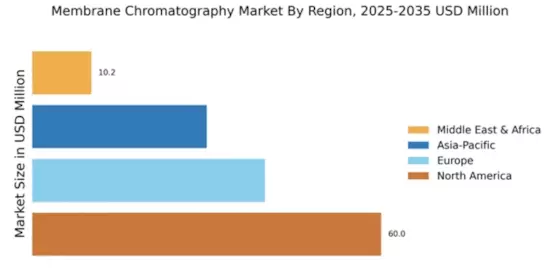
North America holds a commanding 60.0% share of the membrane chromatography market, driven by robust demand in biopharmaceuticals and biotechnology sectors. The region benefits from significant investments in R&D, coupled with favorable regulatory frameworks that encourage innovation. The increasing focus on monoclonal antibodies and vaccines further propels market growth, supported by government initiatives aimed at enhancing healthcare technologies. The United States is the primary contributor, hosting major players like GE Healthcare and Thermo Fisher Scientific. The competitive landscape is characterized by a mix of established firms and emerging startups, all vying for market share. The presence of advanced manufacturing facilities and a skilled workforce enhances the region's attractiveness for membrane chromatography solutions, ensuring continued leadership in the global market.

Europe : Emerging Regulatory Frameworks

Europe accounts for a substantial 40.0% of the membrane chromatography market, fueled by stringent regulatory requirements and a growing emphasis on quality assurance in biopharmaceutical production. The region's commitment to innovation is evident in its support for advanced manufacturing technologies, which are essential for meeting the increasing demand for biologics and biosimilars. Regulatory bodies are actively promoting the adoption of membrane chromatography as a key technology in purification processes. Germany and the UK are leading countries in this market, with significant contributions from companies like Merck KGaA and Sartorius AG. The competitive landscape is marked by collaborations and partnerships aimed at enhancing product offerings. The presence of a well-established healthcare infrastructure and a focus on sustainability further bolster the region's market position, making it a vital player in the global membrane chromatography landscape.

Asia-Pacific : Rapid Growth and Adoption

Asia-Pacific represents a growing segment of the membrane chromatography market, holding a 30.0% share. The region is witnessing rapid industrialization and an increasing focus on biopharmaceutical manufacturing, driven by rising healthcare demands and government initiatives to enhance healthcare infrastructure. The growing prevalence of chronic diseases is also pushing the need for advanced purification technologies, including membrane chromatography, to ensure product quality and safety. China and Japan are at the forefront, with significant investments from local and international players like Asahi Kasei Corporation. The competitive landscape is evolving, with a mix of established companies and new entrants striving to capture market share. The region's diverse healthcare needs and expanding biopharmaceutical sector present ample opportunities for growth, positioning Asia-Pacific as a key player in the global market.

Middle East and Africa : Emerging Market Dynamics

The Middle East and Africa (MEA) region accounts for 10.16% of the membrane chromatography market, characterized by emerging healthcare investments and a growing focus on biopharmaceuticals. The region is gradually adopting advanced purification technologies, driven by increasing healthcare demands and government initiatives aimed at improving healthcare access. The rising prevalence of diseases necessitates the implementation of efficient manufacturing processes, including membrane chromatography, to enhance product quality. Countries like South Africa and the UAE are leading the charge, with investments in healthcare infrastructure and biopharmaceutical production. The competitive landscape is still developing, with opportunities for both local and international players to establish a foothold. As the region continues to evolve, the demand for membrane chromatography solutions is expected to rise, driven by the need for innovative healthcare solutions.

Membrane Chromatography Market Regional Image

Key Players and Competitive Insights

The Membrane Chromatography Market is currently characterized by a dynamic competitive landscape, driven by increasing demand for biopharmaceuticals and the need for efficient purification processes. Key players such as Merck KGaA (DE), GE Healthcare (US), and Pall Corporation (US) are strategically positioned to leverage their technological advancements and extensive product portfolios. Merck KGaA (DE) focuses on innovation, particularly in developing next-generation membrane technologies, while GE Healthcare (US) emphasizes partnerships to enhance its service offerings. Pall Corporation (US) is actively pursuing regional expansion to tap into emerging markets, thereby shaping a competitive environment that is increasingly collaborative yet fiercely competitive.In terms of business tactics, companies are localizing manufacturing to reduce lead times and optimize supply chains, which is crucial in a market that is moderately fragmented. The competitive structure is influenced by the collective actions of these key players, who are not only enhancing their operational efficiencies but also responding to the evolving needs of the market. This collective influence fosters a landscape where agility and responsiveness are paramount, allowing companies to adapt to changing customer demands swiftly.
In November Merck KGaA (DE) announced the launch of a new line of membrane chromatography products designed specifically for the purification of monoclonal antibodies. This strategic move is significant as it aligns with the growing trend towards personalized medicine, positioning the company to capture a larger share of the biopharmaceutical market. The introduction of these products is expected to enhance operational efficiencies for clients, thereby solidifying Merck's competitive edge.
In October GE Healthcare (US) entered into a strategic partnership with a leading biotechnology firm to co-develop advanced membrane filtration solutions. This collaboration is indicative of GE's commitment to innovation and reflects a broader trend of companies seeking synergies to enhance their technological capabilities. By pooling resources and expertise, GE Healthcare aims to accelerate the development of next-generation solutions that meet the stringent demands of the biopharmaceutical industry.

In September Pall Corporation (US) expanded its manufacturing capabilities in Asia, aiming to meet the rising demand for membrane chromatography products in the region. This expansion is crucial as it not only enhances Pall's production capacity but also reduces shipping times and costs, thereby improving overall supply chain efficiency. Such strategic actions are likely to bolster Pall's market position and responsiveness to regional market dynamics.
As of December the Membrane Chromatography Market is witnessing trends that emphasize digitalization, sustainability, and the integration of AI technologies. Companies are increasingly forming strategic alliances to enhance their competitive positioning, reflecting a shift towards collaborative innovation. The competitive differentiation is evolving from traditional price-based competition to a focus on technological advancements and supply chain reliability. This transition suggests that future success in the market will hinge on the ability to innovate and adapt to the rapidly changing landscape.

Key Companies in the Membrane Chromatography Market include

Industry Developments

  • Q2 2024: Boehringer Ingelheim Biopharmaceuticals China successfully passes pre-approval inspections by EMA and FDA Boehringer Ingelheim announced that its biopharmaceutical manufacturing facility in China passed pre-approval inspections by both the European Medicines Agency and the U.S. Food and Drug Administration, supporting the company's expansion in advanced purification technologies including membrane chromatography.

Future Outlook

Membrane Chromatography Market Future Outlook

The Membrane Chromatography Market is poised for growth at a 16.8% CAGR from 2025 to 2035, driven by increasing demand for biopharmaceuticals and advancements in separation technologies.

New opportunities lie in:

  • Development of high-throughput membrane systems for bioprocessing applications. Integration of membrane chromatography with continuous manufacturing processes. Expansion into emerging markets with tailored membrane solutions for local industries.

By 2035, the Membrane Chromatography Market is expected to achieve substantial growth, reflecting its critical role in bioprocessing.

Market Segmentation

Membrane Chromatography Market End Use Outlook

  • Pharmaceuticals
  • Biotechnology
  • Food and Beverage
  • Environmental Testing

Membrane Chromatography Market Technique Outlook

  • Affinity Chromatography
  • Ion Exchange Chromatography
  • Size Exclusion Chromatography
  • Mixed-Mode Chromatography

Membrane Chromatography Market Application Outlook

  • Protein Purification
  • Monoclonal Antibody Production
  • Vaccine Production
  • Enzyme Purification

Membrane Chromatography Market Membrane Type Outlook

  • Microfiltration Membranes
  • Ultrafiltration Membranes
  • Nanofiltration Membranes
  • Reverse Osmosis Membranes

Report Scope

MARKET SIZE 2024 140.16(USD Million)
MARKET SIZE 2025 163.71(USD Million)
MARKET SIZE 2035 773.72(USD Million)
COMPOUND ANNUAL GROWTH RATE (CAGR) 16.8% (2025 - 2035)
REPORT COVERAGE Revenue Forecast, Competitive Landscape, Growth Factors, and Trends
BASE YEAR 2024
Market Forecast Period 2025 - 2035
Historical Data 2019 - 2024
Market Forecast Units USD Million
Key Companies Profiled Merck KGaA (DE), GE Healthcare (US), Pall Corporation (US), Sartorius AG (DE), Repligen Corporation (US), Danaher Corporation (US), Thermo Fisher Scientific (US), Asahi Kasei Corporation (JP)
Segments Covered Application, End Use, Membrane Type, Technique
Key Market Opportunities Advancements in biopharmaceutical purification processes drive growth in the Membrane Chromatography Market.
Key Market Dynamics Rising demand for biopharmaceuticals drives innovation and competition in the membrane chromatography market.
Countries Covered North America, Europe, APAC, South America, MEA

Market Highlights

Author
Author
Author Profile
Vikita Thakur LinkedIn
Senior Research Analyst
She holds an experience of about 5+ years in market research and business consulting projects for sectors such as life sciences, medical devices, and healthcare IT. She possesses a robust background in data analysis, market estimation, competitive intelligence, pipeline analysis market trend identification, and consumer behavior insights. Her expertise lies in technical Sales support, client interaction and project management, designing and implementing market research studies, conducting competitive analysis, and synthesizing complex data into actionable recommendations that drive business growth.
Co-Author
Co-Author Profile
Kinjoll Dey LinkedIn
Senior Research Analyst
He is an extremely curious individual currently working in Healthcare and Medical Devices Domain. Kinjoll is comfortably versed in data centric research backed by healthcare educational background. He leverages extensive data mining and analytics tools such as Primary and Secondary Research, Statistical Analysis, Machine Learning, Data Modelling. His key role also involves Technical Sales Support, Client Interaction and Project management within the Healthcare team. Lastly, he showcases extensive affinity towards learning new skills and remain fascinated in implementing them.
Leave a Comment

FAQs

What is the projected market valuation of the Membrane Chromatography Market by 2035?

The Membrane Chromatography Market is projected to reach a valuation of 773.72 USD Million by 2035.

What was the market valuation of the Membrane Chromatography Market in 2024?

In 2024, the overall market valuation was 140.16 USD Million.

What is the expected CAGR for the Membrane Chromatography Market during the forecast period 2025 - 2035?

The expected CAGR for the Membrane Chromatography Market during the forecast period 2025 - 2035 is 16.8%.

Which application segment is anticipated to have the highest valuation by 2035?

The Monoclonal Antibody Production segment is anticipated to reach a valuation of 300.0 USD Million by 2035.

What are the key players in the Membrane Chromatography Market?

Key players in the Membrane Chromatography Market include Merck KGaA, GE Healthcare, Pall Corporation, and Sartorius AG.

How does the Pharmaceuticals end-use segment perform in terms of market valuation?

The Pharmaceuticals end-use segment was valued at 56.06 USD Million in 2024 and is expected to grow to 309.0 USD Million by 2035.

What is the market valuation for Reverse Osmosis Membranes in 2035?

The market valuation for Reverse Osmosis Membranes is projected to reach 323.72 USD Million by 2035.

Which membrane type is expected to show significant growth during the forecast period?

Ultrafiltration Membranes are expected to show significant growth, with a projected valuation of 200.0 USD Million by 2035.

What is the anticipated market size for Mixed-Mode Chromatography by 2035?

The Mixed-Mode Chromatography segment is anticipated to reach a market size of 298.72 USD Million by 2035.

What is the expected performance of Polymeric Membranes in the Membrane Chromatography Market?

Polymeric Membranes are expected to grow from 70.08 USD Million in 2024 to 392.0 USD Million by 2035.
Download Free Sample

Kindly complete the form below to receive a free sample of this Report

Compare Licence

×
Features License Type
Single User Multiuser License Enterprise User
Price $4,950 $5,950 $7,250
Maximum User Access Limit 1 User Upto 10 Users Unrestricted Access Throughout the Organization
Free Customization
Direct Access to Analyst
Deliverable Format
Platform Access
Discount on Next Purchase 10% 15% 15%
Printable Versions