Request Free Sample ×

Kindly complete the form below to receive a free sample of this Report

* Please use a valid business email

Leading companies partner with us for data-driven Insights

clients tt-cursor
Hero Background
English
Chinese
French
Japanese
Korean
German
Spanish

Compression Therapy Market Trends

ID: MRFR/Pharma/5719-HCR
90 Pages
Rahul Gotadki
Last Updated: April 08, 2026

Compression Therapy Market Research Report: Size, Share, Trend Analysis By Product Type (Compression Garments, Compression Bandages, Compression Pumps, Compression Hosiery), By Applications (Chronic Venous Insufficiency, Lymphedema, Sports Injuries, Post-Surgical Recovery), By End Users (Hospitals, Ambulatory Surgical Centers, Home Care Settings, Rehabilitation Centers), By Distribution Channel (Online Pharmacies, Retail Pharmacies, Hospital Pharmacies, Medical Supply Stores) and By Regional (North America, Europe, South America, Asia Pacific, Middle East and Africa) - Growth Outlook & Industry Forecast 2025 To 2035

Share:
Download PDF ×

We do not share your information with anyone. However, we may send you emails based on your report interest from time to time. You may contact us at any time to opt-out.

Compression Therapy Market Infographic
Purchase Options

Market Trends

Key Emerging Trends in the Compression Therapy Market

The electric bike market in India has been experiencing considerable growth in recent years. With growing worries about pollution and the rising price of gas, humans are increasingly turning to electric bikes as a cleaner and more cost-effective mode of transportation. This has led to a surge in demand for electric bikes throughout the u. S ., with each home and global manufacturer coming into the marketplace to capitalize on this developing trend. One of the key market traits inside the Indian electric bike market is the growing reputation of electric scooters. These compact and clean-to-use motors have grown to be a desired preference for city commuters searching out a handy and eco-friendly mode of transportation. With the authorities's push closer to electric-powered mobility and the availability of diverse incentives and subsidies, the demand for electric-powered scooters has been on the rise. Furthermore, the electric bike market in India is witnessing a surge in innovation and technological advancements. Manufacturers are constantly striving to improve the design, overall performance, and functions of their electric bikes to cater to the numerous needs of clients. This has led to the introduction of clever electric bikes ready with superior connectivity capabilities, in addition to electric bikes with swappable batteries for introduced comfort. In addition, the Indian electric bike marketplace is also experiencing a shift towards sustainable and eco-friendly manufacturing practices. With the increasing emphasis on environmental conservation, manufacturers are incorporating sustainable materials and manufacturing techniques into their electric bike production. This has not only helped in lowering the carbon footprint of electric bikes but has also resonated nicely with environmentally aware purchasers. Furthermore, the Indian electric bike marketplace is also witnessing a growing interest in electric bike sharing and condo offerings. With the increasing urbanization and the need for sustainable urban mobility answers, electric bike-sharing applications have received traction in several towns throughout the U.S.A. This trend is anticipated to similarly contribute to the increase of the electric bike market in India, as more humans are uncovered to the ease and blessings of electric bikes through these sharing services. In conclusion, the Indian electric bike marketplace is experiencing considerable growth and transformation, pushed by changing purchaser options, technological improvements, and government tasks. With the increasing demand for green and fee-effective transportation solutions, the electric bike market in India is poised for additional expansion in the coming years.


Author
Author Profile
Rahul Gotadki
Research Manager

He holds an experience of about 9+ years in Market Research and Business Consulting, working under the spectrum of Life Sciences and Healthcare domains. Rahul conceptualizes and implements a scalable business strategy and provides strategic leadership to the clients. His expertise lies in market estimation, competitive intelligence, pipeline analysis, customer assessment, etc.

Leave a Comment

FAQs

What is the current valuation of the Compression Therapy Market?

<p>As of 2024, the Compression Therapy Market was valued at approximately 3900.55 USD Million.</p>

What is the projected market size for the Compression Therapy Market by 2035?

<p>The market is expected to reach a valuation of around 6970.91 USD Million by 2035.</p>

What is the expected CAGR for the market during the forecast period?

The anticipated CAGR for the market from 2025 to 2035 is 5.42%.

Which application segment had the highest valuation in 2024?

<p>In 2024, the Venous Ulcer Treatment segment was valued at 950.0 USD Million, making it the highest among application segments.</p>

What are the projected values for Lymphedema Management by 2035?

<p>The Lymphedema Management segment is projected to reach approximately 1390.0 USD Million by 2035.</p>

Which product type is expected to show significant growth in the Compression Therapy Market?

<p>Compression Stockings, valued at 800.0 USD Million in 2024, are expected to grow to around 1500.0 USD Million by 2035.</p>

What is the market valuation for Home Care Settings in 2024?

<p>In 2024, the Home Care Settings segment was valued at 780.11 USD Million.</p>

Which key players are leading the Compression Therapy Market?

<p>Key players in the market include Essity, Medi, BSN medical, 3M, and Sigvaris, among others.</p>

What is the projected market value for Compression Bandages by 2035?

<p>The Compression Bandages segment is expected to reach approximately 1100.0 USD Million by 2035.</p>

How does the market for Athletic Recovery compare to other segments?

<p>The Athletic Recovery segment was valued at 699.0 USD Million in 2024 and is projected to grow to about 1180.0 USD Million by 2035.</p>

Market Summary

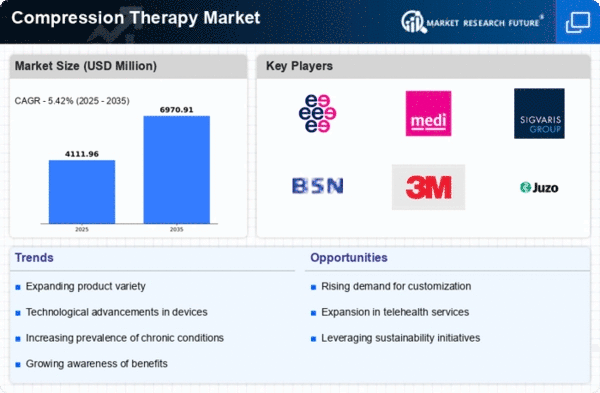
According to Market Research Future analysis, the Compression Therapy Market Size was valued at USD 3900.55 Million in 2024 & the market is projected to grow from USD 4111.97 Million in 2025 to USD 6970.91 Million by 2035, registering a CAGR of 5.42% during the forecast period 2025–2035. North America led the market with over 49.99% share, generating around USD 1950 million in revenue.
 
The market is driven by rising prevalence of chronic venous disorders and increasing adoption of non-invasive treatment solutions. Growing awareness, improved product innovations, and expanding elderly population are enhancing demand for effective, long-term management of circulatory and lymphatic conditions globally. 
 

  • According to WHO, cardiovascular diseases cause nearly 17.9 million deaths annually, while IHME estimates over 1.7 billion people suffer from musculoskeletal and circulatory conditions, highlighting strong demand for compression therapy solutions that improve blood flow, reduce swelling, and enhance patient quality of life.

Key Market Trends & Highlights

The Compression Therapy Market is experiencing robust growth driven by technological advancements and increasing awareness of chronic conditions.

  • North America holds 49.99%+ share, driven by 695,000 annual cardiovascular deaths and strong reimbursement policies. Europe valued at USD 1200M in 2024, accounting for 30.76% share, supported by rising chronic disease burden. Aging population projected to reach 1.6 billion by 2050, increasing prevalence of venous and circulatory disorders. Compression garments dominate with 48% share, supported by comfort, versatility, and effectiveness in chronic condition management.

Market Size & Forecast

2024 Market Size 3900.55 (USD Million)
2035 Market Size 6970.91 (USD Million)
CAGR (2025 - 2035) 5.42%
Largest Regional Market Share in 2024 North America

Major Players

Companies such as Essity (SE), Medi (DE), <a href="https://www.sigvaris.com/en-us/expertise/basics/compression-therapy">Sigvaris</a> (CH), <a href="https://www.bandagesplus.com/manufacturer/bsn-jobst" target="_blank" rel="noopener">BSN medical</a> (DE), 3M (US), Juzo (DE), Lohmann &amp; Rauscher (DE), Tactile Medical (US), Kangaroo (US) are some of the major participants in the global market.

Market Trends

The Compression Therapy Market is currently experiencing a notable evolution, driven by a confluence of factors that appear to enhance its growth trajectory. Increasing awareness regarding the benefits of compression therapy in managing various medical conditions, such as venous disorders and lymphedema, seems to be a primary catalyst. 

Additionally, advancements in technology and product innovation are likely to play a pivotal role in shaping the market landscape. Manufacturers are focusing on developing more effective and user-friendly devices, which may lead to greater adoption among healthcare professionals and patients alike. 

Furthermore, the rising geriatric population, which often requires specialized care, could further bolster demand for compression therapy solutions. The market appears to be influenced by a growing emphasis on preventive healthcare. As individuals become more proactive about their health, the utilization of compression therapy for preventive measures is likely to gain traction. This shift in focus may encourage healthcare providers to incorporate compression therapy into standard treatment protocols. 

Additionally, the expansion of distribution channels, including online platforms, is expected to enhance accessibility for consumers. Overall, the Compression Therapy Market is poised for continued growth, driven by a combination of technological advancements, increased awareness, and evolving healthcare practices.

Technological Advancements

Recent innovations in materials and design are enhancing the functionality of compression garments. These advancements may lead to improved comfort and effectiveness, making products more appealing to consumers.

  • WHO reports that chronic diseases account for 74% of global deaths, totaling 41 million annually, increasing demand for advanced therapeutic solutions. Innovations in medical textiles and wearable devices are improving patient adherence and treatment outcomes, while ECDC highlights growing adoption of modern medical technologies across Europe enhancing device effectiveness.

Increased Awareness

There is a growing recognition of the health benefits associated with compression therapy. This heightened awareness is likely driving demand among both healthcare professionals and patients.

  • PAHO states that cardiovascular diseases account for approximately 2 million deaths annually in the Americas, while WHO emphasizes that early intervention can reduce complications by up to 30%. Rising awareness among patients and healthcare providers is driving adoption of preventive therapies like compression therapy for improved vascular health outcomes.

Demographic Shifts

The aging population is contributing to a rise in conditions that require compression therapy. As the demographic landscape evolves, the market may see increased demand for related products.

  • UNFPA reports that the global population aged 65+ is projected to reach 1.6 billion by 2050, up from 761 million in 2021, significantly increasing chronic disease prevalence. Aging populations are more susceptible to venous disorders, driving demand for compression therapy products and long-term care solutions worldwide.

Compression Therapy Market Market Drivers

Market Growth Projections

The Global Compression Therapy Market is projected to experience substantial growth over the next decade. With a market value of 3.48 USD Billion in 2024, it is expected to reach approximately 5.6 USD Billion by 2035. 
 
This growth trajectory suggests a compound annual growth rate of 4.42% from 2025 to 2035. Factors contributing to this growth include the rising prevalence of chronic venous disorders, technological advancements in compression devices, and an increasing geriatric population. These dynamics indicate a robust and expanding market, reflecting the growing importance of compression therapy in healthcare.

Increasing Geriatric Population

The aging global population is a significant driver of the Global Compression Therapy Market. Older adults are more susceptible to conditions requiring compression therapy, such as edema and venous insufficiency. As the demographic shift continues, healthcare systems worldwide are adapting to meet the needs of this population. 
 
The increasing demand for compression therapy solutions tailored for older patients is likely to stimulate market growth. This trend aligns with the projected compound annual growth rate of 4.42% from 2025 to 2035, indicating a sustained increase in market value as the geriatric population expands.

Expansion of Healthcare Infrastructure

The expansion of healthcare infrastructure, particularly in developing regions, is a critical driver for the Global Compression Therapy Market. Improved access to healthcare facilities and services is facilitating the diagnosis and treatment of conditions that benefit from compression therapy. 
 
As healthcare systems evolve and invest in advanced medical technologies, the availability of compression therapy products is likely to increase. This trend is expected to support the market's growth trajectory, aligning with the anticipated compound annual growth rate of 4.42% from 2025 to 2035, as more patients gain access to necessary treatments.

Growing Awareness of Preventive Healthcare

There is a notable increase in awareness regarding preventive healthcare measures, which is positively influencing the Global Compression Therapy Market. Patients and healthcare providers are increasingly recognizing the benefits of compression therapy not only for treating existing conditions but also for preventing complications related to venous disorders. 
 
Educational initiatives and campaigns aimed at promoting the importance of early intervention are likely to enhance market penetration. This growing awareness is expected to contribute to the market's expansion, supporting the forecasted growth from 3.48 USD Billion in 2024 to 5.6 USD Billion by 2035.

Rising Prevalence of Chronic Venous Disorders

The Global Compression Therapy Market is experiencing growth due to the increasing prevalence of chronic venous disorders such as varicose veins and chronic venous insufficiency. These conditions affect millions globally, leading to a heightened demand for effective treatment options. 
 
Compression therapy is recognized as a primary intervention for managing these disorders, which is likely to drive market expansion. As of 2024, the market is valued at approximately 3.48 USD Billion, and this figure is expected to rise significantly as awareness and diagnosis of venous disorders improve, indicating a robust growth trajectory for the industry.

Technological Advancements in Compression Devices

Technological innovations in compression therapy devices are propelling the Global Compression Therapy Market forward. Enhanced features such as programmable pressure settings, smart textiles, and wearable technology are making compression therapy more effective and user-friendly. 
 
These advancements not only improve patient compliance but also expand the range of applications for compression therapy, including post-surgical recovery and sports medicine. As the industry evolves, the integration of technology is likely to attract a broader consumer base, contributing to the projected market growth from 3.48 USD Billion in 2024 to an estimated 5.6 USD Billion by 2035.

Market Segment Insights

By Application: Lymphedema Management (Largest) vs. Athletic Recovery (Fastest-Growing)

Lymphedema management holds the largest share in the compression therapy market at 36% among the application segments, followed closely by venous ulcer treatment and deep vein thrombosis prevention. Post-Surgical Recovery and Athletic Recovery are also significant segments, but they represent smaller portions of the overall market. The diverse range of conditions treated by compression therapy ensures a balanced distribution, with Lymphedema Management dominating due to the rising awareness of lymphatic disorders. The growth trends in this market segment are primarily driven by an increasing incidence of lymphedema and chronic venous disorders, coupled with a growing aging population. Moreover, advancements in healing technologies and greater awareness surrounding the benefits of compression therapy are contributing to the rapid growth of segments like Athletic Recovery, making it one of the fastest-growing applications in this market.

Lymphedema Management (Dominant) vs. Post-Surgical Recovery (Emerging)

Lymphedema Management is the dominant segment in the market, reflecting a strong demand for effective treatment solutions for lymphatic disorders. Patients suffering from lymphedema benefit significantly from compression devices, which help in reducing swelling and improving quality of life. On the other hand, Post-Surgical Recovery represents an emerging segment, as patients increasingly seek rehabilitation solutions to accelerate their recovery process. The advancement of compression technologies tailored specifically for post-surgery care is leading to a growing market presence. Both segments are crucial to the overall growth of the market, with Lymphedema Management serving as the cornerstone while Post-Surgical Recovery is expected to see robust increases in adoption.

By Product Type: Compression Garments (Largest) vs. Compression Pumps (Fastest-Growing)

The segment distribution reveals that compression garments hold the largest share in the compression therapy market at 48%, due to their widespread acceptance and effectiveness in managing conditions such as lymphedema and post-surgery recovery. They dominate the market due to their comfortable wear and versatility, making them a preferred choice among healthcare providers and patients alike. On the other hand, Compression Pumps are identified as the fastest-growing segment, driven by advancements in technology and increasing awareness of the benefits of pneumatic compression therapy. Their ability to provide effective treatment for chronic venous insufficiency is boosting their adoption in both clinical and home settings, thus propelling market growth in this category.

Compression Garments (Dominant) vs. Compression Bandages (Emerging)

Compression Garments are recognized as the dominant product type in the market, crafted to deliver consistent pressure across the body to improve circulation. They come in various styles and applications, which enhance patient compliance and effectiveness. As a well-established category, their usage spans across multiple conditions, reinforcing their market position. In contrast, Compression Bandages are an emerging product type characterized by their flexibility and ease of application. They are particularly favored for acute injuries and post-operative care, offering targeted compression where needed. While they currently hold a smaller market share compared to garments, their unique attributes and increasing utilization in both clinical and sports rehabilitation settings position them for growth and wider market acceptance.

By End User: Hospitals (Largest) vs. Home Care Settings (Fastest-Growing)

In the Compression Therapy Market, hospitals constitute the largest share of the end-user segment, accounting for 51%, significantly outpacing other settings due to their comprehensive medical infrastructure and higher patient volumes. Clinics and rehabilitation centers also play vital roles, but they hold smaller market shares compared to hospitals. Home care settings are gaining traction, driven by the increasing preference for at-home treatments and patient convenience, which positions them as emerging players in this space.

Hospitals (Dominant) vs. Home Care Settings (Emerging)

Hospitals lead the market, featuring advanced facilities and a wide array of therapeutic options, catering to a large volume of patients requiring specialized compression therapy. Their robust infrastructure enables the provision of tailored treatment plans, making them a dominant force. In contrast, home care settings represent an emerging segment, driven by the aging population and growing health consciousness among patients. They provide flexibility, comfort, and cost-effectiveness, as patients increasingly opt for home-based solutions rather than traditional hospital visits. This shift demonstrates the evolving landscape of healthcare, where convenience and personalized care are becoming paramount.

By Distribution Channel: Online Retail (Largest) vs. Pharmacies (Fastest-Growing)

The Compression Therapy Market demonstrates varied distribution across different channels, with online retail claiming the largest share at 44%. It has transformed the way consumers access compression therapy products, driven by the convenience of online shopping and the growing preference for e-commerce over traditional outlets. Pharmacies, on the other hand, represent a rapidly expanding segment, taking advantage of established healthcare infrastructure and convenient access for consumers seeking immediate solutions.

Online Retail (Dominant) vs. Medical Supply Stores (Emerging)

Online retail stands out as the dominant distribution channel for compression therapy products. It caters to a tech-savvy demographic looking for ease of purchase and greater variety. Medical supply stores are emerging as a significant player, targeting consumers who value specialized products and expert advice. While the online market thrives on convenience, medical supply stores leverage personalized customer service and product knowledge. Together, these channels offer complementary strengths in meeting consumer needs. The rise of telemedicine and increased health awareness are driving both segments, creating a robust marketplace for compression therapy solutions.

Get more detailed insights about Compression Therapy Market Research Report – Forecast till 2035

Regional Insights

North America : Market Leader in Compression Therapy

North America leads in the Compression Therapy Market size, accounting for over 49.99% of the global revenue in 2024. The growth is driven by an increasing prevalence of chronic venous diseases and a rising aging population. Regulatory support, including reimbursement policies for compression therapy products, further fuels demand. 

  • CDC reports that approximately 6 in 10 adults in the U.S. have at least one chronic disease, while 4 in 10 have two or more conditions. Additionally, cardiovascular diseases cause nearly 695,000 deaths annually, increasing demand for compression therapy in managing circulatory disorders.

The United States stands out as the leading country, with major players like 3M and Essity driving innovation and competition. The presence of established companies ensures a robust supply chain and product availability. The availability of a biotech job in USA hubs like Boston and San Francisco is increasingly tied to expertise in next-generation modalities, such as antibody-drug conjugates and cell therapies.

Additionally, the market is characterized by strategic partnerships and collaborations among key players, enhancing product offerings and market reach. This competitive landscape positions North America as a hub for compression therapy advancements.

Europe : Emerging Market with Growth Potential

Europe Compression Therapy Market size was valued at USD 1200 million in 2024, making it the second-largest regional market with a 30.76% share, reflecting a growing demand driven by an increase in lifestyle-related health issues and an aging population. Regulatory frameworks in the EU promote high standards for medical devices, ensuring safety and efficacy. The market is also supported by initiatives aimed at improving healthcare access and affordability, which are crucial for expanding the reach of compression therapy solutions across diverse demographics.

  • ECDC reports chronic diseases account for nearly 80% of deaths in Europe, while WHO estimates over 3.7 million new cancer cases annually in the region. Increasing healthcare access initiatives and medical device regulations are enhancing adoption of compression therapy solutions across European healthcare systems.

Leading countries in this region include Germany, France, and the UK, where established healthcare systems facilitate the adoption of advanced compression products. Key players like Medi and Sigvaris are actively innovating to meet the evolving needs of patients. The competitive landscape is characterized by a mix of local and international companies, fostering a dynamic environment for growth and collaboration. "The European market is witnessing a significant shift towards preventive healthcare solutions, including compression therapy," European Commission report, European Commission.

Asia-Pacific : Rapidly Growing Market Opportunities

The Asia-Pacific region, with a market size of $1200.0M, is experiencing rapid growth in the Compression Therapy Market. This surge is attributed to increasing healthcare expenditures, rising awareness of chronic diseases, and a growing elderly population. Governments are implementing policies to enhance healthcare infrastructure, which is crucial for the distribution and accessibility of compression therapy products. The region's diverse demographics also present unique opportunities for tailored solutions.

Countries like China, Japan, and India are leading the charge, with significant investments in healthcare technology and innovation. The competitive landscape features both established players and emerging companies, creating a vibrant market. Key players such as Lohmann & Rauscher and Juzo are expanding their presence, focusing on product development and strategic partnerships to capture market share. The region's potential for growth is immense, driven by a combination of economic development and increasing health awareness.

Middle East and Africa : Untapped Market with Growth Potential

The Middle East & Africa Compression Therapy Market, valued at $550.55M, is still in its nascent stages but shows promising growth potential. Factors such as increasing healthcare investments and a rising prevalence of chronic diseases are driving demand for compression therapy solutions. Regulatory bodies are beginning to establish frameworks that support the introduction of innovative medical devices, which is essential for market growth. The region's diverse healthcare needs also create opportunities for customized solutions.

Leading countries in this region include South Africa and the UAE, where healthcare infrastructure is improving. The competitive landscape is characterized by a mix of local and international players, with companies like BSN Medical and Kangaroo making significant inroads. As awareness of the benefits of compression therapy grows, the market is expected to expand, driven by both public and private sector initiatives. "The healthcare sector in the Middle East is evolving rapidly, with a focus on enhancing patient care through innovative solutions," World Health Organization report, World Health Organization.

Key Players and Competitive Insights

The Compression Therapy Market is currently characterized by a dynamic competitive landscape, driven by increasing awareness of chronic venous diseases and the growing prevalence of conditions requiring compression therapy. Leading manufacturers are prioritizing ergonomic designs in legs compression wear to ensure consistent pressure application while improving patient compliance through enhanced material breathability. 
Companies like Compression Therapy Services Inc. are dominating the  post-acute care space, plays a vital role in coordinating long-term lymphedema management between physicians and home-care settings. On the other hand, to differentiate themselves from Tactile Medical competitors, many firms are investing heavily in clinical trials to prove the superior efficacy of their proprietary sequential gradient patterns.
Key players such as Essity (SE), Medi (DE), and 3M (US) are strategically positioned to leverage innovation and regional expansion to enhance their market presence. Essity (SE) focuses on sustainability and product innovation, while Medi (DE) emphasizes technological advancements in their product offerings. 3M (US) is known for its robust supply chain and strategic partnerships, which collectively shape a competitive environment that is increasingly focused on quality and efficacy.
The market structure appears moderately fragmented, with several players vying for market share through localized manufacturing and optimized supply chains. This fragmentation allows for a diverse range of products and solutions, catering to various consumer needs. The collective influence of these key players fosters a competitive atmosphere where innovation and customer-centric strategies are paramount.
In November 2025, Medi (DE) announced the launch of a new line of smart compression garments that integrate wearable technology to monitor patient compliance and provide real-time feedback. This strategic move not only enhances patient engagement but also positions Medi (DE) as a leader in the integration of technology within compression therapy, potentially setting a new standard in the industry.
In October 2025, 3M (US) expanded its manufacturing capabilities in Europe by investing €10 million in a new facility dedicated to producing advanced compression therapy products. This expansion is significant as it not only increases production capacity but also reduces lead times, thereby enhancing supply chain reliability and responsiveness to market demands.
In September 2025, Essity (SE) entered into a strategic partnership with a leading telehealth provider to offer integrated solutions for patients requiring compression therapy. This collaboration is indicative of a broader trend towards digital health solutions, allowing for improved patient monitoring and adherence to treatment protocols, which could lead to better health outcomes and increased customer loyalty.
As of December 2025, the Compression Therapy Market is witnessing trends such as digitalization, sustainability, and the integration of artificial intelligence in product development. Strategic alliances are increasingly shaping the competitive landscape, enabling companies to pool resources and expertise. Looking ahead, competitive differentiation is likely to evolve from traditional price-based competition to a focus on innovation, technology integration, and supply chain reliability, reflecting a shift towards more sophisticated and patient-centered solutions.

Key Companies in the Compression Therapy Market include

Industry Developments

Recent developments in the Compression Therapy Market have seen significant growth, driven by increasing awareness of chronic conditions such as diabetes and venous diseases. The competitive landscape for biocomputing companies is shifting toward those that can offer integrated platforms combining hardware-accelerated processing with proprietary AI-driven genomic analysis. 

Companies like Cardinal Health, Essity, and BSN Medical are expanding their product offerings to cater to the rising demand for effective compression solutions. In July 2023, DJO Global launched an advanced line of pneumatic compression devices aimed at enhancing recovery outcomes for patients post-surgery.

Additionally, in August 2023, Smith and Nephew acquired a technology company that specializes in innovative wound care solutions, thus enhancing their compression therapy portfolio. Current affairs indicate a focus on integrating technology in compression products; for example, Medtronic's recent investment in connected health solutions aims to improve patient compliance and reporting.

Furthermore, the market demonstrates a healthy competitive landscape, with continuous product innovations and strategic partnerships. The growth potential is further underscored by the increasing prevalence of lifestyle diseases globally, compelling manufacturers to invest in Research and Development. Notably, the regulatory environments in countries are becoming more favorable, promoting the adoption and reimbursement policies for compression therapies that aid in better patient management.

Future Outlook

Compression Therapy Market Future Outlook

The Compression Therapy Market size is projected to reach USD 6970.91 Million by 2035, growing at a CAGR of 5.42%, driven by increasing awareness of chronic venous diseases and advancements in technology.

New opportunities lie in:

  • <p>Expansion of telehealth services for remote patient monitoring Development of customizable compression garments for niche markets Partnerships with healthcare providers for integrated care solutions</p>

By 2035, the Compression Therapy Market is expected to achieve substantial growth, reflecting evolving healthcare needs.

Market Segmentation

Compression Therapy Market End User Outlook

  • Hospitals
  • Clinics
  • Home Care Settings
  • Rehabilitation Centers
  • Athletic Facilities

Compression Therapy Market Application Outlook

  • Lymphedema Management
  • Venous Ulcer Treatment
  • Deep Vein Thrombosis Prevention
  • Post-Surgical Recovery
  • Athletic Recovery

Compression Therapy Market Product Type Outlook

  • Compression Garments
  • Compression Bandages
  • Compression Pumps
  • Compression Stockings
  • Compression Sleeves

Compression Therapy Market Distribution Channel Outlook

  • Online Retail
  • Pharmacies
  • Medical Supply Stores
  • Direct Sales
  • Hospitals

Report Scope

MARKET SIZE 2024 3900.55(USD Million)
MARKET SIZE 2025 4111.97(USD Million)
MARKET SIZE 2035 6970.91(USD Million)
COMPOUND ANNUAL GROWTH RATE (CAGR) 5.42% (2025 - 2035)
REPORT COVERAGE Revenue Forecast, Competitive Landscape, Growth Factors, and Trends
BASE YEAR 2024
Market Forecast Period 2025 - 2035
Historical Data 2019 - 2024
Market Forecast Units USD Million
Key Companies Profiled Essity (SE), Medi (DE), Sigvaris (CH), BSN medical (DE), 3M (US), Juzo (DE), Lohmann & Rauscher (DE), Tactile Medical (US), Kangaroo (US)
Segments Covered Application, Product Type, End User, Distribution Channel
Key Market Opportunities Integration of smart technology in the market enhances patient compliance and treatment efficacy.
Key Market Dynamics Rising demand for innovative compression therapy solutions drives competitive dynamics and regulatory adaptations in the market.
Countries Covered North America, Europe, APAC, South America, MEA

FAQs

What is the current valuation of the Compression Therapy Market?

<p>As of 2024, the Compression Therapy Market was valued at approximately 3900.55 USD Million.</p>

What is the projected market size for the Compression Therapy Market by 2035?

<p>The market is expected to reach a valuation of around 6970.91 USD Million by 2035.</p>

What is the expected CAGR for the market during the forecast period?

The anticipated CAGR for the market from 2025 to 2035 is 5.42%.

Which application segment had the highest valuation in 2024?

<p>In 2024, the Venous Ulcer Treatment segment was valued at 950.0 USD Million, making it the highest among application segments.</p>

What are the projected values for Lymphedema Management by 2035?

<p>The Lymphedema Management segment is projected to reach approximately 1390.0 USD Million by 2035.</p>

Which product type is expected to show significant growth in the Compression Therapy Market?

<p>Compression Stockings, valued at 800.0 USD Million in 2024, are expected to grow to around 1500.0 USD Million by 2035.</p>

What is the market valuation for Home Care Settings in 2024?

<p>In 2024, the Home Care Settings segment was valued at 780.11 USD Million.</p>

Which key players are leading the Compression Therapy Market?

<p>Key players in the market include Essity, Medi, BSN medical, 3M, and Sigvaris, among others.</p>

What is the projected market value for Compression Bandages by 2035?

<p>The Compression Bandages segment is expected to reach approximately 1100.0 USD Million by 2035.</p>

How does the market for Athletic Recovery compare to other segments?

<p>The Athletic Recovery segment was valued at 699.0 USD Million in 2024 and is projected to grow to about 1180.0 USD Million by 2035.</p>

  1. SECTION I: EXECUTIVE SUMMARY AND KEY HIGHLIGHTS |
    1. EXECUTIVE SUMMARY | |
      1. Market Overview | |
      2. Key Findings | |
      3. Market Segmentation | |
      4. Competitive Landscape | |
      5. Challenges and Opportunities | |
      6. Future Outlook 2
  2. SECTION II: SCOPING, METHODOLOGY AND MARKET STRUCTURE |
    1. MARKET INTRODUCTION | |
      1. Definition | |
      2. Scope of the study | | |
    2. RESEARCH METHODOLOGY | |
      1. Overview | |
      2. Data Mining | |
      3. Secondary Research | |
      4. Primary Research | | |
      5. Forecasting Model | |
      6. Market Size Estimation | | |
      7. Data Triangulation | |
      8. Validation 3
  3. SECTION III: QUALITATIVE ANALYSIS |
    1. MARKET DYNAMICS | |
      1. Overview | |
      2. Drivers | |
      3. Restraints | |
      4. Opportunities |
    2. MARKET FACTOR ANALYSIS | |
      1. Value chain Analysis | |
      2. Porter's Five Forces Analysis | | |
      3. COVID-19 Impact Analysis | | |
  4. SECTION IV: QUANTITATIVE ANALYSIS |
    1. Healthcare, BY Application (USD Million) | |
      1. Lymphedema Management | |
      2. Venous Ulcer Treatment | |
      3. Deep Vein Thrombosis Prevention | |
      4. Post-Surgical Recovery | |
      5. Athletic Recovery |
    2. Healthcare, BY Product Type (USD Million) | |
      1. Compression Garments | |
      2. Compression Bandages | |
      3. Compression Pumps | |
      4. Compression Stockings | |
      5. Compression Sleeves |
    3. Healthcare, BY End User (USD Million) | |
      1. Hospitals | |
      2. Clinics | |
      3. Home Care Settings | |
      4. Rehabilitation Centers | |
      5. Athletic Facilities |
    4. Healthcare, BY Region (USD Million) | |
      1. North America | | |
      2. Europe | | |
      3. APAC | | |
      4. South America | | |
      5. MEA | | |
  5. SECTION V: COMPETITIVE ANALYSIS |
    1. Competitive Landscape | |
      1. Overview | |
      2. Competitive Analysis | |
      3. Market share Analysis | |
      4. Major Growth Strategy in the Healthcare | |
      5. Competitive Benchmarking | |
      6. Leading Players in Terms of Number of Developments in the Healthcare | |
      7. Key developments and growth strategies | | |
      8. Major Players Financial Matrix | | |
    2. Company Profiles | |
      1. Essity (SE) | | |
      2. Medi (DE) | | |
      3. BSN medical (DE) | | |
      4. 3M (US) | | |
      5. Sigvaris (CH) | | |
      6. Juzo (DE) | | |
      7. Lohmann & Rauscher (DE) | | |
      8. Tensoplast (IT) | | |
      9. Sofradim (FR) | | |
    3. Appendix | |
      1. References | |
      2. Related Reports 6 LIST OF FIGURES |
    4. MARKET SYNOPSIS |
    5. NORTH AMERICA MARKET ANALYSIS |
    6. US MARKET ANALYSIS BY APPLICATION |
    7. US MARKET ANALYSIS BY PRODUCT TYPE |
    8. US MARKET ANALYSIS BY END USER |
    9. CANADA MARKET ANALYSIS BY APPLICATION |
    10. CANADA MARKET ANALYSIS BY PRODUCT TYPE |
    11. CANADA MARKET ANALYSIS BY END USER |
    12. EUROPE MARKET ANALYSIS |
    13. GERMANY MARKET ANALYSIS BY APPLICATION |
    14. GERMANY MARKET ANALYSIS BY PRODUCT TYPE |
    15. GERMANY MARKET ANALYSIS BY END USER |
    16. UK MARKET ANALYSIS BY APPLICATION |
    17. UK MARKET ANALYSIS BY PRODUCT TYPE |
    18. UK MARKET ANALYSIS BY END USER |
    19. FRANCE MARKET ANALYSIS BY APPLICATION |
    20. FRANCE MARKET ANALYSIS BY PRODUCT TYPE |
    21. FRANCE MARKET ANALYSIS BY END USER |
    22. RUSSIA MARKET ANALYSIS BY APPLICATION |
    23. RUSSIA MARKET ANALYSIS BY PRODUCT TYPE |
    24. RUSSIA MARKET ANALYSIS BY END USER |
    25. ITALY MARKET ANALYSIS BY APPLICATION |
    26. ITALY MARKET ANALYSIS BY PRODUCT TYPE |
    27. ITALY MARKET ANALYSIS BY END USER |
    28. SPAIN MARKET ANALYSIS BY APPLICATION |
    29. SPAIN MARKET ANALYSIS BY PRODUCT TYPE |
    30. SPAIN MARKET ANALYSIS BY END USER |
    31. REST OF EUROPE MARKET ANALYSIS BY APPLICATION |
    32. REST OF EUROPE MARKET ANALYSIS BY PRODUCT TYPE |
    33. REST OF EUROPE MARKET ANALYSIS BY END USER |
    34. APAC MARKET ANALYSIS |
    35. CHINA MARKET ANALYSIS BY APPLICATION |
    36. CHINA MARKET ANALYSIS BY PRODUCT TYPE |
    37. CHINA MARKET ANALYSIS BY END USER |
    38. INDIA MARKET ANALYSIS BY APPLICATION |
    39. INDIA MARKET ANALYSIS BY PRODUCT TYPE |
    40. INDIA MARKET ANALYSIS BY END USER |
    41. JAPAN MARKET ANALYSIS BY APPLICATION |
    42. JAPAN MARKET ANALYSIS BY PRODUCT TYPE |
    43. JAPAN MARKET ANALYSIS BY END USER |
    44. SOUTH KOREA MARKET ANALYSIS BY APPLICATION |
    45. SOUTH KOREA MARKET ANALYSIS BY PRODUCT TYPE |
    46. SOUTH KOREA MARKET ANALYSIS BY END USER |
    47. MALAYSIA MARKET ANALYSIS BY APPLICATION |
    48. MALAYSIA MARKET ANALYSIS BY PRODUCT TYPE |
    49. MALAYSIA MARKET ANALYSIS BY END USER |
    50. THAILAND MARKET ANALYSIS BY APPLICATION |
    51. THAILAND MARKET ANALYSIS BY PRODUCT TYPE |
    52. THAILAND MARKET ANALYSIS BY END USER |
    53. INDONESIA MARKET ANALYSIS BY APPLICATION |
    54. INDONESIA MARKET ANALYSIS BY PRODUCT TYPE |
    55. INDONESIA MARKET ANALYSIS BY END USER |
    56. REST OF APAC MARKET ANALYSIS BY APPLICATION |
    57. REST OF APAC MARKET ANALYSIS BY PRODUCT TYPE |
    58. REST OF APAC MARKET ANALYSIS BY END USER |
    59. SOUTH AMERICA MARKET ANALYSIS |
    60. BRAZIL MARKET ANALYSIS BY APPLICATION |
    61. BRAZIL MARKET ANALYSIS BY PRODUCT TYPE |
    62. BRAZIL MARKET ANALYSIS BY END USER |
    63. MEXICO MARKET ANALYSIS BY APPLICATION |
    64. MEXICO MARKET ANALYSIS BY PRODUCT TYPE |
    65. MEXICO MARKET ANALYSIS BY END USER |
    66. ARGENTINA MARKET ANALYSIS BY APPLICATION |
    67. ARGENTINA MARKET ANALYSIS BY PRODUCT TYPE |
    68. ARGENTINA MARKET ANALYSIS BY END USER |
    69. REST OF SOUTH AMERICA MARKET ANALYSIS BY APPLICATION |
    70. REST OF SOUTH AMERICA MARKET ANALYSIS BY PRODUCT TYPE |
    71. REST OF SOUTH AMERICA MARKET ANALYSIS BY END USER |
    72. MEA MARKET ANALYSIS |
    73. GCC COUNTRIES MARKET ANALYSIS BY APPLICATION |
    74. GCC COUNTRIES MARKET ANALYSIS BY PRODUCT TYPE |
    75. GCC COUNTRIES MARKET ANALYSIS BY END USER |
    76. SOUTH AFRICA MARKET ANALYSIS BY APPLICATION |
    77. SOUTH AFRICA MARKET ANALYSIS BY PRODUCT TYPE |
    78. SOUTH AFRICA MARKET ANALYSIS BY END USER |
    79. REST OF MEA MARKET ANALYSIS BY APPLICATION |
    80. REST OF MEA MARKET ANALYSIS BY PRODUCT TYPE |
    81. REST OF MEA MARKET ANALYSIS BY END USER |
    82. KEY BUYING CRITERIA OF HEALTHCARE |
    83. RESEARCH PROCESS OF MRFR |
    84. DRO ANALYSIS OF HEALTHCARE |
    85. DRIVERS IMPACT ANALYSIS: HEALTHCARE |
    86. RESTRAINTS IMPACT ANALYSIS: HEALTHCARE |
    87. SUPPLY / VALUE CHAIN: HEALTHCARE |
    88. HEALTHCARE, BY APPLICATION, 2024 (% SHARE) |
    89. HEALTHCARE, BY APPLICATION, 2024 TO 2035 (USD Million) |
    90. HEALTHCARE, BY PRODUCT TYPE, 2024 (% SHARE) |
    91. HEALTHCARE, BY PRODUCT TYPE, 2024 TO 2035 (USD Million) |
    92. HEALTHCARE, BY END USER, 2024 (% SHARE) |
    93. HEALTHCARE, BY END USER, 2024 TO 2035 (USD Million) |
    94. BENCHMARKING OF MAJOR COMPETITORS 7 LIST OF TABLES |
    95. LIST OF ASSUMPTIONS | |
      1. |
    96. North America MARKET SIZE ESTIMATES; FORECAST | |
      1. BY APPLICATION, 2025-2035 (USD Million) | |
      2. BY PRODUCT TYPE, 2025-2035 (USD Million) | |
      3. BY END USER, 2025-2035 (USD Million) |
    97. US MARKET SIZE ESTIMATES; FORECAST | |
      1. BY APPLICATION, 2025-2035 (USD Million) | |
      2. BY PRODUCT TYPE, 2025-2035 (USD Million) | |
      3. BY END USER, 2025-2035 (USD Million) |
    98. Canada MARKET SIZE ESTIMATES; FORECAST | |
      1. BY APPLICATION, 2025-2035 (USD Million) | |
      2. BY PRODUCT TYPE, 2025-2035 (USD Million) | |
      3. BY END USER, 2025-2035 (USD Million) |
    99. Europe MARKET SIZE ESTIMATES; FORECAST | |
      1. BY APPLICATION, 2025-2035 (USD Million) | |
      2. BY PRODUCT TYPE, 2025-2035 (USD Million) | |
      3. BY END USER, 2025-2035 (USD Million) |
    100. Germany MARKET SIZE ESTIMATES; FORECAST | |
      1. BY APPLICATION, 2025-2035 (USD Million) | |
      2. BY PRODUCT TYPE, 2025-2035 (USD Million) | |
      3. BY END USER, 2025-2035 (USD Million) |
    101. UK MARKET SIZE ESTIMATES; FORECAST | |
      1. BY APPLICATION, 2025-2035 (USD Million) | |
      2. BY PRODUCT TYPE, 2025-2035 (USD Million) | |
      3. BY END USER, 2025-2035 (USD Million) |
    102. France MARKET SIZE ESTIMATES; FORECAST | |
      1. BY APPLICATION, 2025-2035 (USD Million) | |
      2. BY PRODUCT TYPE, 2025-2035 (USD Million) | |
      3. BY END USER, 2025-2035 (USD Million) |
    103. Russia MARKET SIZE ESTIMATES; FORECAST | |
      1. BY APPLICATION, 2025-2035 (USD Million) | |
      2. BY PRODUCT TYPE, 2025-2035 (USD Million) | |
      3. BY END USER, 2025-2035 (USD Million) |
    104. Italy MARKET SIZE ESTIMATES; FORECAST | |
      1. BY APPLICATION, 2025-2035 (USD Million) | |
      2. BY PRODUCT TYPE, 2025-2035 (USD Million) | |
      3. BY END USER, 2025-2035 (USD Million) |
    105. Spain MARKET SIZE ESTIMATES; FORECAST | |
      1. BY APPLICATION, 2025-2035 (USD Million) | |
      2. BY PRODUCT TYPE, 2025-2035 (USD Million) | |
      3. BY END USER, 2025-2035 (USD Million) |
    106. Rest of Europe MARKET SIZE ESTIMATES; FORECAST | |
      1. BY APPLICATION, 2025-2035 (USD Million) | |
      2. BY PRODUCT TYPE, 2025-2035 (USD Million) | |
      3. BY END USER, 2025-2035 (USD Million) |
    107. APAC MARKET SIZE ESTIMATES; FORECAST | |
      1. BY APPLICATION, 2025-2035 (USD Million) | |
      2. BY PRODUCT TYPE, 2025-2035 (USD Million) | |
      3. BY END USER, 2025-2035 (USD Million) |
    108. China MARKET SIZE ESTIMATES; FORECAST | |
      1. BY APPLICATION, 2025-2035 (USD Million) | |
      2. BY PRODUCT TYPE, 2025-2035 (USD Million) | |
      3. BY END USER, 2025-2035 (USD Million) |
    109. India MARKET SIZE ESTIMATES; FORECAST | |
      1. BY APPLICATION, 2025-2035 (USD Million) | |
      2. BY PRODUCT TYPE, 2025-2035 (USD Million) | |
      3. BY END USER, 2025-2035 (USD Million) |
    110. Japan MARKET SIZE ESTIMATES; FORECAST | |
      1. BY APPLICATION, 2025-2035 (USD Million) | |
      2. BY PRODUCT TYPE, 2025-2035 (USD Million) | |
      3. BY END USER, 2025-2035 (USD Million) |
    111. South Korea MARKET SIZE ESTIMATES; FORECAST | |
      1. BY APPLICATION, 2025-2035 (USD Million) | |
      2. BY PRODUCT TYPE, 2025-2035 (USD Million) | |
      3. BY END USER, 2025-2035 (USD Million) |
    112. Malaysia MARKET SIZE ESTIMATES; FORECAST | |
      1. BY APPLICATION, 2025-2035 (USD Million) | |
      2. BY PRODUCT TYPE, 2025-2035 (USD Million) | |
      3. BY END USER, 2025-2035 (USD Million) |
    113. Thailand MARKET SIZE ESTIMATES; FORECAST | |
      1. BY APPLICATION, 2025-2035 (USD Million) | |
      2. BY PRODUCT TYPE, 2025-2035 (USD Million) | |
      3. BY END USER, 2025-2035 (USD Million) |
    114. Indonesia MARKET SIZE ESTIMATES; FORECAST | |
      1. BY APPLICATION, 2025-2035 (USD Million) | |
      2. BY PRODUCT TYPE, 2025-2035 (USD Million) | |
      3. BY END USER, 2025-2035 (USD Million) |
    115. Rest of APAC MARKET SIZE ESTIMATES; FORECAST | |
      1. BY APPLICATION, 2025-2035 (USD Million) | |
      2. BY PRODUCT TYPE, 2025-2035 (USD Million) | |
      3. BY END USER, 2025-2035 (USD Million) |
    116. South America MARKET SIZE ESTIMATES; FORECAST | |
      1. BY APPLICATION, 2025-2035 (USD Million) | |
      2. BY PRODUCT TYPE, 2025-2035 (USD Million) | |
      3. BY END USER, 2025-2035 (USD Million) |
    117. Brazil MARKET SIZE ESTIMATES; FORECAST | |
      1. BY APPLICATION, 2025-2035 (USD Million) | |
      2. BY PRODUCT TYPE, 2025-2035 (USD Million) | |
      3. BY END USER, 2025-2035 (USD Million) |
    118. Mexico MARKET SIZE ESTIMATES; FORECAST | |
      1. BY APPLICATION, 2025-2035 (USD Million) | |
      2. BY PRODUCT TYPE, 2025-2035 (USD Million) | |
      3. BY END USER, 2025-2035 (USD Million) |
    119. Argentina MARKET SIZE ESTIMATES; FORECAST | |
      1. BY APPLICATION, 2025-2035 (USD Million) | |
      2. BY PRODUCT TYPE, 2025-2035 (USD Million) | |
      3. BY END USER, 2025-2035 (USD Million) |
    120. Rest of South America MARKET SIZE ESTIMATES; FORECAST | |
      1. BY APPLICATION, 2025-2035 (USD Million) | |
      2. BY PRODUCT TYPE, 2025-2035 (USD Million) | |
      3. BY END USER, 2025-2035 (USD Million) |
    121. MEA MARKET SIZE ESTIMATES; FORECAST | |
      1. BY APPLICATION, 2025-2035 (USD Million) | |
      2. BY PRODUCT TYPE, 2025-2035 (USD Million) | |
      3. BY END USER, 2025-2035 (USD Million) |
    122. GCC Countries MARKET SIZE ESTIMATES; FORECAST | |
      1. BY APPLICATION, 2025-2035 (USD Million) | |
      2. BY PRODUCT TYPE, 2025-2035 (USD Million) | |
      3. BY END USER, 2025-2035 (USD Million) |
    123. South Africa MARKET SIZE ESTIMATES; FORECAST | |
      1. BY APPLICATION, 2025-2035 (USD Million) | |
      2. BY PRODUCT TYPE, 2025-2035 (USD Million) | |
      3. BY END USER, 2025-2035 (USD Million) |
    124. Rest of MEA MARKET SIZE ESTIMATES; FORECAST | |
      1. BY APPLICATION, 2025-2035 (USD Million) | |
      2. BY PRODUCT TYPE, 2025-2035 (USD Million) | |
      3. BY END USER, 2025-2035 (USD Million) |
    125. PRODUCT LAUNCH/PRODUCT DEVELOPMENT/APPROVAL | |
      1. |
    126. ACQUISITION/PARTNERSHIP | |

Healthcare Market Segmentation

Healthcare By Application (USD Million, 2025-2035)

  • Lymphedema Management
  • Venous Ulcer Treatment
  • Deep Vein Thrombosis Prevention
  • Post-Surgical Recovery
  • Athletic Recovery

Healthcare By Product Type (USD Million, 2025-2035)

  • Compression Garments
  • Compression Bandages
  • Compression Pumps
  • Compression Stockings
  • Compression Sleeves

Healthcare By End User (USD Million, 2025-2035)

  • Hospitals
  • Clinics
  • Home Care Settings
  • Rehabilitation Centers
  • Athletic Facilities
Infographic

Free Sample Request

Kindly complete the form below to receive a free sample of this Report

Get Free Sample

Customer Strories

Compare Licence

×
Features License Type
Single User Multiuser License Enterprise User
Price $4,950 $5,950 $7,250
Maximum User Access Limit 1 User Upto 10 Users Unrestricted Access Throughout the Organization
Free Customization
Direct Access to Analyst
Deliverable Format
Platform Access
Discount on Next Purchase 10% 15% 15%
Printable Versions