
×
Request Free Sample ×

Kindly complete the form below to receive a free sample of this Report

* Please use a valid business email

Leading companies partner with us for data-driven Insights

clients tt-cursor
Hero Background
English
Chinese
French
Japanese
Korean
German
Spanish

Commodity Chemicals Market Trends

ID: MRFR/CnM/10074-HCR
111 Pages
Anshula Mandaokar
February 2026

Commodity Chemicals Market Research Report Information By Product (Ester, Ether, Amine, Alcohol, Aliphatic Hydrocarbon, Aromatic Hydrocarbon, Chlorinated Solvents, Ketones, Fatty Chemicals, Chelating Agents), By End-Use (Plastics & Rubber, Electronics & IT, Food & Beverages, Pharmaceuticals & Personal Care, Building & Construction, Automotive, Agriculture, Mining, Oil & Gas, Household Industrial and Institutional (HI & I)) And By Region (North America, Europe, Asia-Pacific, And Rest Of The World) – Market Forecast Till 2035

Share:
Download PDF ×

We do not share your information with anyone. However, we may send you emails based on your report interest from time to time. You may contact us at any time to opt-out.

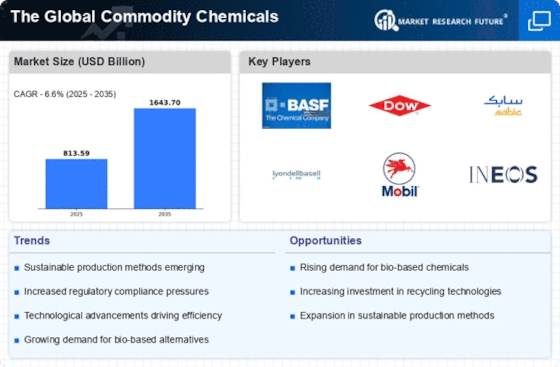
Commodity Chemicals Market Infographic
Purchase Options

Market Trends

Key Emerging Trends in the Commodity Chemicals Market

The global chemical industry has seen a number of major trends within its Commodity Chemicals Market. There have been significant shifts in demand for key chemicals, which are foundational to various sectors as economies continue to change. One such development has been a move towards greater sustainability. Commodity chemical players with environmental concerns now search for eco-friendly measures while they engage themselves in doing business. Additionally, technological advancements play a crucial role in influencing market trends of commodity chemicals. The sector is undergoing digitalization through the incorporation of high-end technologies such as artificial intelligence (AI), machine learning (ML), and automation, among others, which not only increase production efficiency but also improve predictability maintenance and use fewer resources, thereby lowering overall costs. Another notable trend is the focus on principles of the circular economy concept; companies want to minimize waste generated during production activities that produce commodity chemicals while maximizing the recycling of materials used herein. This transition into circular economy efforts blends with overall global attempts at creating more sustainable and ethical industrial environment systems across the world, respectively. Furthermore, these practices boost resource effectiveness and resilience when supply chains face disruption, among other setbacks globally. On the other hand, globalization continues to be one driver that shapes markets of commodity chemicals. This industry is now characterized by increased interconnectivity between markets across national borders, and therefore, companies are expanding their geographic presence. Consequently, this globalization has raised competitive forces in the market, and thus, enterprises must adopt new strategies so as to survive there. Additionally, this internationalized commodity chemicals market has opened doors for collaborations and partnerships among regional firms, hence promoting technology transfer through mutual learning. Regulation frameworks and geopolitics are also important factors that determine the dynamics of the commodity chemicals market. Strict environmental regulations influence the production processes and product formulations within the sector. As a result, corporations invest in cleaner technologies and sustainable practices since they have to adhere to these laws. There are also geopolitical tensions as well as trade policies that can affect the supply chain or/and even access to markets for certain types of commodities like chemical products, leading to strategic adjustments from major industry players.
Author
Anshula Mandaokar
Team Lead - Research

Anshula Mandaokar holds an academic degree in Chemical Engineering and has been contributing to the field for more than 5 years. She has expertise in Market Research and Business Consulting and serves as a Team Lead for a reputed Market Research firm under the Chemicals and Materials domain spectrum. She has worked on multiple projects, generating explicit results in a quick turnaround time. Her understanding of data interpretation justifies her role as a leader.

Leave a Comment

FAQs

What is the current valuation of The Global Commodity Chemicals?

<p>The overall market valuation reached 813.59 USD Billion in 2024.</p>

What is the projected market size for The Global Commodity Chemicals by 2035?

<p>The market is expected to grow to 1643.7 USD Billion by 2035.</p>

What is the expected CAGR for The Global Commodity Chemicals during the forecast period?

<p>The expected CAGR for the market from 2025 to 2035 is 6.6%.</p>

Which companies are considered key players in The Global Commodity Chemicals?

<p>Key players include BASF SE, Dow Inc., SABIC, LyondellBasell Industries, and ExxonMobil Chemical.</p>

What are the major product segments in The Global Commodity Chemicals?

<p>Major product segments include Alcohol, Ester, Ether, and Aromatic Hydrocarbon, among others.</p>

How does the valuation of the Alcohol segment compare to others?

<p>The Alcohol segment was valued at 90.0 to 180.0 USD Billion, indicating its substantial market presence.</p>

What is the valuation range for the Plastics & Rubber segment?

The Plastics &amp; Rubber segment is valued between 162.72 and 335.0 USD Billion.

What end-use sectors are driving demand in The Global Commodity Chemicals?

End-use sectors include Automotive, Pharmaceuticals &amp; Personal Care, and Food &amp; Beverages, among others.

How does the market size of the Electronics & IT sector compare to the Agriculture sector?

The Electronics &amp; IT sector is valued at 81.8 to 170.0 USD Billion, while the Agriculture sector ranges from 54.54 to 110.0 USD Billion.

What potential growth opportunities exist within The Global Commodity Chemicals?

Growth opportunities may arise from increasing demand in sectors like Building &amp; Construction and Automotive, projected to grow significantly by 2035.

Market Summary

As per Market Research Future analysis, The Global Commodity Chemicals Market Size was estimated at 792 USD Billion in 2024. The commodity chemicals industry is projected to grow from 826.1 USD Billion in 2025 to 1,258.5 USD Billion by 2035, exhibiting a compound annual growth rate (CAGR) of 4.3% during the forecast period 2025 - 2035

Key Market Trends & Highlights

The Global Commodity Chemicals Market is poised for growth driven by sustainability and technological advancements.

  • North America remains the largest market for commodity chemicals, driven by robust industrial activity and innovation. Asia-Pacific is emerging as the fastest-growing region, fueled by increasing demand from various end-user industries. Alcohols dominate the market as the largest segment, while esters are rapidly gaining traction as the fastest-growing segment. Rising demand from end-user industries and a growing focus on sustainability are key drivers propelling market expansion.

Market Size & Forecast

2024 Market Size 792 (USD Billion)
2035 Market Size 1,258.5 (USD Billion)
CAGR (2025 - 2035) 4.3%
Largest Regional Market Share in 2024 North America

Major Players

BASF SE (DE), Dow Inc. (US), SABIC (SA), LyondellBasell Industries N.V. (NL), ExxonMobil Chemical (US), Ineos Group Limited (GB), Mitsubishi Chemical Corporation (JP), Formosa Plastics Corporation (TW), Eastman Chemical Company (US)

Market Trends

The Global Commodity Chemicals Market is currently experiencing a dynamic evolution, driven by various factors that influence production, consumption, and innovation. The increasing demand for sustainable and eco-friendly products appears to be reshaping the landscape, as manufacturers strive to align with environmental regulations and consumer preferences. This shift towards sustainability is prompting companies to invest in research and development, focusing on bio-based chemicals and alternative feedstocks. Furthermore, the integration of advanced technologies, such as automation and digitalization, seems to enhance operational efficiency and reduce costs, thereby fostering competitiveness in the market. In addition, The Global Commodity Chemicals Market is witnessing a notable trend towards circular economy practices. This approach emphasizes the importance of recycling and reusing materials, which not only conserves resources but also minimizes waste. As industries increasingly adopt circular principles, collaboration among stakeholders, including suppliers, manufacturers, and consumers, is likely to intensify. Overall, the market appears poised for growth, driven by innovation, sustainability, and collaborative efforts that may redefine traditional chemical production and consumption patterns.

Sustainability Initiatives

The focus on sustainability within The Global Commodity Chemicals Market is becoming more pronounced. Companies are increasingly adopting eco-friendly practices, which include the development of bio-based chemicals and the reduction of carbon footprints. This trend reflects a broader societal shift towards environmental responsibility, influencing both production methods and consumer choices.

Technological Advancements

Technological innovation plays a crucial role in shaping The Global Commodity Chemicals Market. The integration of automation and digital technologies is enhancing production efficiency and enabling real-time data analysis. These advancements not only streamline operations but also facilitate better decision-making, positioning companies to respond swiftly to market demands.

Circular Economy Practices

The adoption of circular economy principles is gaining traction within The Global Commodity Chemicals Market. This approach emphasizes recycling and reusing materials, thereby reducing waste and conserving resources. As industries embrace these practices, collaboration among various stakeholders is likely to increase, fostering a more sustainable chemical production ecosystem.

Commodity Chemicals Market Market Drivers

Expansion of Emerging Markets

The expansion of emerging markets is a crucial driver for The Global Commodity Chemicals Industry. Countries in Asia-Pacific, Latin America, and Africa are experiencing rapid industrialization and urbanization, leading to increased demand for commodity chemicals. For instance, the Asia-Pacific region is expected to account for over 50% of The Global Commodity Chemicals Market by 2025, driven by robust economic growth and rising consumer spending. This trend presents significant opportunities for chemical manufacturers to tap into new markets and diversify their customer base. As these regions continue to develop, the demand for various chemicals, including fertilizers, plastics, and solvents, is likely to surge, further propelling market growth.

Rising Demand from End-User Industries

The increasing demand from various end-user industries such as automotive, construction, and consumer goods is a primary driver for The Global Commodity Chemicals Industry. As these sectors expand, they require a steady supply of commodity chemicals for manufacturing processes. For instance, the automotive industry is projected to grow at a compound annual growth rate of approximately 4.5% over the next few years, which will likely boost the demand for chemicals like polyethylene and polypropylene. Additionally, the construction sector's growth, driven by urbanization and infrastructure development, further propels the need for commodity chemicals. This trend indicates a robust market potential, as the interplay between industrial growth and chemical supply chains becomes increasingly critical.

Regulatory Support for Chemical Production

Regulatory frameworks that support chemical production and innovation are pivotal for The Global Commodity Chemicals Industry. Governments worldwide are implementing policies that encourage sustainable practices and the use of eco-friendly chemicals. For example, regulations promoting the use of bio-based chemicals are gaining traction, which could lead to a shift in production methods. The market for bio-based chemicals is expected to reach USD 20 billion by 2026, reflecting a growing preference for sustainable alternatives. This regulatory support not only fosters innovation but also enhances the competitiveness of the chemical industry, as companies adapt to meet new standards and consumer expectations.

Growing Focus on Sustainability and Green Chemistry

The increasing emphasis on sustainability and green chemistry practices is reshaping The Global Commodity Chemicals Industry. Companies are increasingly adopting sustainable practices to minimize their environmental footprint and meet consumer demand for eco-friendly products. The market for green chemicals is projected to grow significantly, with estimates suggesting a value of USD 150 billion by 2025. This shift towards sustainability is prompting manufacturers to invest in research and development of biodegradable and renewable chemicals. As a result, the industry is likely to witness a transformation in product offerings, aligning with global sustainability goals and consumer preferences.

Technological Innovations in Chemical Manufacturing

Technological advancements in chemical manufacturing processes are transforming The Global Commodity Chemicals Industry. Innovations such as automation, artificial intelligence, and advanced analytics are streamlining production, reducing costs, and improving efficiency. For instance, the adoption of AI in supply chain management can optimize inventory levels and reduce waste, potentially leading to a 20% decrease in operational costs. Furthermore, advancements in catalytic processes are enabling the production of higher-quality chemicals with lower environmental impact. These technological innovations not only enhance productivity but also position companies to respond more effectively to market demands and sustainability goals.

Market Segment Insights

By Product: Alcohol (Largest) vs. Ester (Fastest-Growing)

In The Global Commodity Chemicals Market, the Product segment encompasses various chemical compounds, with Alcohols holding the largest market share among them. These versatile compounds find extensive applications across industries such as pharmaceuticals, cosmetics, and food production, establishing their dominance in the sector. Ester, while not leading in market share, is emerging as the fastest-growing category, fueled by increasing demand for biodegradable options and their use in the manufacturing of fragrances and flavors.

Alcohol (Dominant) vs. Ester (Emerging)

Alcohol, recognized for its multifaceted applications, serves critical roles in solvents, cleaners, and as a feedstock in chemical synthesis. The rising trend towards natural and eco-friendly products is shifting focus towards Ester production, which is gaining traction due to its biodegradable nature and suitability in personal care and food industries. Meanwhile, Esters, characterized by their low toxicity and advantageous properties, are witnessing robust demand driven by shifts in consumer preferences and regulatory support for sustainable chemicals, positioning them as an emerging force in the market.

By End-Use: Plastics & Rubber (Largest) vs. Pharmaceuticals & Personal Care (Fastest-Growing)

The Global Commodity Chemicals Market exhibits a diverse landscape of end-use segments, with Plastics &amp; Rubber retaining the largest share. This segment's dominance is driven by the ubiquitous demand for plastic materials across various industries, including automotive, construction, and packaging. Meanwhile, Pharmaceuticals &amp; Personal Care is emerging as the fastest-growing category, fueled by increasing health awareness and the rising need for personal care products, reflecting a shift in consumer preferences towards health-oriented solutions. As the market evolves, end-use segments are experiencing distinct growth trends influenced by technological advancements and regulatory changes. The Plastics &amp; Rubber sector benefits from continuous innovation in bio-based and recycled materials, whereas Pharmaceuticals &amp; Personal Care is propelled by the integration of sustainability practices and the rapid development of new drugs and formulations. These dynamics underscore the diverse competitive landscape and shifting consumer demands in the commodity chemicals sector.

Plastics &amp; Rubber (Dominant) vs. Pharmaceuticals &amp; Personal Care (Emerging)

Plastics &amp; Rubber stands as the dominant force in The Global Commodity Chemicals Market, fueled by its essential role in various applications such as packaging, automotive components, and consumer goods. This segment's strength lies in its versatility, cost-effectiveness, and ongoing innovations that focus on sustainability and enhanced performance. In contrast, Pharmaceuticals &amp; Personal Care is emerging as a significant player, characterized by robust growth potential due to the increasing emphasis on health and wellness. The surge in demand for pharmaceuticals and personal care products, coupled with an aging population and heightened consumer awareness of health issues, positions this segment for sustained growth. Additionally, advancements in biochemicals and a shift towards natural ingredients define the evolving landscape of this segment.

Get more detailed insights about Commodity Chemicals Market Research Report—Global Forecast till 2035

Regional Insights

North America : Innovation and Sustainability Leader

North America is the largest market for commodity chemicals, holding approximately 40% of the global share. The region's growth is driven by robust demand from the automotive, construction, and consumer goods sectors, alongside a strong focus on sustainability and innovation. Regulatory support for green chemistry and environmental compliance is also a significant catalyst for market expansion. The United States is the leading country in this region, with major players like Dow Inc. and ExxonMobil Chemical dominating the landscape. Canada and Mexico also contribute to the market, with increasing investments in chemical manufacturing. The competitive environment is characterized by a mix of established firms and emerging startups focusing on sustainable practices and advanced technologies.

Europe : Regulatory Framework and Innovation

Europe is the second-largest market for commodity chemicals, accounting for around 30% of the global market share. The region's growth is propelled by stringent environmental regulations and a strong emphasis on sustainability. The European Green Deal and REACH regulations are pivotal in shaping market dynamics, encouraging innovation in eco-friendly chemical production. Germany, France, and the Netherlands are key players in this market, with Germany being the largest contributor. Major companies like BASF SE and LyondellBasell Industries are at the forefront, investing heavily in research and development. The competitive landscape is marked by a shift towards bio-based chemicals and circular economy practices, enhancing the region's global competitiveness.

Asia-Pacific : Emerging Markets and Rapid Growth

Asia-Pacific is witnessing rapid growth in the commodity chemicals market, holding approximately 25% of the global share. The region's expansion is driven by increasing industrialization, urbanization, and rising demand from sectors such as packaging, automotive, and electronics. Countries like China and India are significant contributors, supported by favorable government policies and investments in infrastructure. China is the largest market in this region, with major companies like SABIC and Mitsubishi Chemical Corporation leading the charge. India is also emerging as a key player, with a growing number of domestic firms entering the market. The competitive landscape is characterized by a mix of multinational corporations and local enterprises, focusing on innovation and sustainability to meet evolving consumer demands.

Middle East and Africa : Resource-Rich and Growing Demand

The Middle East and Africa region is increasingly becoming a significant player in The Global Commodity Chemicals Market, holding about 5% of the market share. The growth is primarily driven by abundant natural resources, particularly in oil and gas, which serve as feedstock for chemical production. Countries like Saudi Arabia and the UAE are leading the charge, with investments in petrochemical complexes and infrastructure development. Saudi Arabia is the largest market in this region, with companies like SABIC dominating the landscape. The competitive environment is evolving, with new entrants focusing on diversifying product offerings and enhancing sustainability practices. The region's strategic location also facilitates trade, making it a vital hub for chemical exports.

Key Players and Competitive Insights

Leading market players are investing heavily in research and development in order to expand their product lines, which will help the commodity chemicals market, grow even more. Market participants are also undertaking a variety of strategic activities to expand their global footprint, with important market developments including new product launches, contractual agreements, mergers and acquisitions, higher investments, and collaboration with other organizations. To expand and survive in a more competitive and rising market climate, the commodity chemicals industry must offer cost-effective items.
Manufacturing locally to minimize operational costs is one of the key business tactics used by manufacturers in the global commodity chemicals industry to benefit clients and increase the market sector. In recent years, the commodity chemicals industry has offered some of the most significant advantages to medicine. Major players in the commodity chemicals market attempting to increase market demand by investing in research and development operations include BASF SE, Bayer Group, AkzoNobel N.V., The Dow Chemical Company, LyondellBasell Industries Holdings B.V., E.I. DuPont de Nemours and Company, Mitsui Chemicals, Braskem SA, PPG Industries, and Eastman Chemical Company.
A material science business, Dow Inc. is based. Through its fully owned subsidiary, The Dow Chemical Co (TDCC), the company conducts business. The product line of the company consists of silicones, industrial intermediates, silicone coatings, and plastics. The business caters to clients in the packaging, infrastructure, mobility, and consumer care sectors with a variety of goods and services. In addition to home and personal care, adhesives and sealants, durable goods, coatings, food, and specialty packaging, Dow's products are used in a variety of industries.
In August Dow Chemical Company reported investing in the US Gulf Coast's methyl acrylate industry.
The new 50 kiloton nameplate capacity of methyl acrylate, scheduled to go online in the first half of 2022, will be manufactured at St.Charles Operations in Louisiana, United States, and will enable worldwide growth with an emphasis on meeting North American demand.
BASF SE is a chemical business. It manufactures, markets, and sells chemicals, polymers, crop protection products, and performance items. The company's product line includes solvents, adhesives, surfactants, electronic chemicals, fuel additives, food additives, fungicides, pigments, paints, and herbicides. The company works with a wide range of industries, including those related to building, woodworking, agriculture, paints and coatings, transportation, home care, electronics and electrical, nutrition, and chemicals. In partnership with international customers, partners, and researchers, BASF carries out R&D.
In December 2020, select polyetheramine products will have new prices in the United States and Canada starting on January 1, 2021, or as long as current contracts allow. The amine products from BASF are utilised in a wide range of applications as highly effective curing agents, such as coatings and sealing compounds for the wind energy and electrical industries, as well as composites, adhesives, and floors.

Key Companies in the Commodity Chemicals Market include

Industry Developments

In September 2023, Peregrine Hydrogen announced the completion of its oversubscribed seed round of 7.8 million dollars. Bidra heads this round by participating alongside Builders, Gates Frontier, Presidio Ventures, RiSC Capital, and Schox. Peregrine is expecting this money to further enhance and commercialize its patented technology and expand into the commodity chemical markets. In April 2021, Evonik Industries AG reported that it is looking into the utilization of high-performance PEEK polymer VESTAKEEP, which is used as an implant polymer in the medical field, to develop efficient structural prosthesis systems.

The firm is taking the expertise of medical specialists from the well-known Center for Knee and Hip Replacement Massachusetts General Hospital in the USA. If the innovation succeeds, the operational lifetime of VESTAKEEP-based joint prostheses may be significantly improved, making recurring surgery or multiple days of pain therapy less necessary. In January 2021, BASF Polymer Chemicals began raising prices on certain polyetheramine products in the U.S. and, Canada and Canada as had been announced earlier in December 2020.

According to BASF representatives, such products are marketed for multiple applications as effective curing agents marketed widely for the segments in coatings and sealing compounds for wind energy and electrical applications as well as in composites, adhesives and flooring. BASF is a multi-industry company engaged in providing solutions to the automotive, construction, agricultural as well as consumer sectors. The focus of the company is on developing new sustainable solutions for its clients without compromising on the environment.

In November 2020, Cabot Corporation confirmed capacity growth in carbon black production in Cilegon, Indonesia, with the addition of an initial output of around 80,000 metric tons per year, which will be expected to be finished during 2021. Cabot has a clear vision of providing top-notch quality products like carbon blacks, special chemicals and advanced materials.

Future Outlook

Commodity Chemicals Market Future Outlook

The Global Commodity Chemicals Market is projected to grow at a 4.3% CAGR from 2025 to 2035, driven by increasing demand for sustainable solutions and technological advancements.

New opportunities lie in:

  • <p>Investment in bio-based chemical production facilities. Development of advanced recycling technologies for chemical feedstocks. Expansion into emerging markets with tailored product offerings.</p>

By 2035, the market is expected to achieve robust growth, positioning itself as a leader in sustainable chemical solutions.

Market Segmentation

Commodity Chemicals Market End-Use Outlook

  • Plastics & Rubber
  • Electronics & IT
  • Food & Beverages
  • Pharmaceuticals & Personal Care
  • Building & Construction
  • Automotive
  • Agriculture
  • Mining
  • Oil & Gas
  • Household Industrial and Institutional (HI & I)
  • Others

Commodity Chemicals Market Product Outlook

  • Ester
  • Ether
  • Amine
  • Alcohol
  • Aliphatic Hydrocarbon
  • Aromatic Hydrocarbon
  • Chlorinated Solvents
  • Ketones
  • Fatty Chemicals
  • Chelating Agents
  • Others

Report Scope

MARKET SIZE 2024 792 (USD Billion)
MARKET SIZE 2025 826.1 (USD Billion)
MARKET SIZE 2035 1,258.5 (USD Billion)
COMPOUND ANNUAL GROWTH RATE (CAGR) 4.3% (2025 - 2035)
REPORT COVERAGE Revenue Forecast, Competitive Landscape, Growth Factors, and Trends
BASE YEAR 2024
Market Forecast Period 2025 - 2035
Historical Data 2019 - 2024
Market Forecast Units USD Billion
Key Companies Profiled BASF SE (DE), Dow Inc. (US), SABIC (SA), LyondellBasell Industries N.V. (NL), ExxonMobil Chemical (US), Ineos Group Limited (GB), Mitsubishi Chemical Corporation (JP), Formosa Plastics Corporation (TW), Eastman Chemical Company (US)
Segments Covered Product, End-Use, Region
Key Market Opportunities Adoption of sustainable production methods drives innovation in The Global Commodity Chemicals.
Key Market Dynamics Rising demand for sustainable chemicals drives innovation and regulatory adaptations across the commodity chemicals landscape.
Countries Covered North America, Europe, APAC, South America, MEA

FAQs

What is the current valuation of The Global Commodity Chemicals?

<p>The overall market valuation reached 813.59 USD Billion in 2024.</p>

What is the projected market size for The Global Commodity Chemicals by 2035?

<p>The market is expected to grow to 1643.7 USD Billion by 2035.</p>

What is the expected CAGR for The Global Commodity Chemicals during the forecast period?

<p>The expected CAGR for the market from 2025 to 2035 is 6.6%.</p>

Which companies are considered key players in The Global Commodity Chemicals?

<p>Key players include BASF SE, Dow Inc., SABIC, LyondellBasell Industries, and ExxonMobil Chemical.</p>

What are the major product segments in The Global Commodity Chemicals?

<p>Major product segments include Alcohol, Ester, Ether, and Aromatic Hydrocarbon, among others.</p>

How does the valuation of the Alcohol segment compare to others?

<p>The Alcohol segment was valued at 90.0 to 180.0 USD Billion, indicating its substantial market presence.</p>

What is the valuation range for the Plastics & Rubber segment?

The Plastics &amp; Rubber segment is valued between 162.72 and 335.0 USD Billion.

What end-use sectors are driving demand in The Global Commodity Chemicals?

End-use sectors include Automotive, Pharmaceuticals &amp; Personal Care, and Food &amp; Beverages, among others.

How does the market size of the Electronics & IT sector compare to the Agriculture sector?

The Electronics &amp; IT sector is valued at 81.8 to 170.0 USD Billion, while the Agriculture sector ranges from 54.54 to 110.0 USD Billion.

What potential growth opportunities exist within The Global Commodity Chemicals?

Growth opportunities may arise from increasing demand in sectors like Building &amp; Construction and Automotive, projected to grow significantly by 2035.

  1. SECTION I: EXECUTIVE SUMMARY AND KEY HIGHLIGHTS
    1. | 1.1 EXECUTIVE SUMMARY
    2. | | 1.1.1 Market Overview
    3. | | 1.1.2 Key Findings
    4. | | 1.1.3 Market Segmentation
    5. | | 1.1.4 Competitive Landscape
    6. | | 1.1.5 Challenges and Opportunities
    7. | | 1.1.6 Future Outlook
  2. SECTION II: SCOPING, METHODOLOGY AND MARKET STRUCTURE
    1. | 2.1 MARKET INTRODUCTION
    2. | | 2.1.1 Definition
    3. | | 2.1.2 Scope of the study
    4. | | | 2.1.2.1 Research Objective
    5. | | | 2.1.2.2 Assumption
    6. | | | 2.1.2.3 Limitations
    7. | 2.2 RESEARCH METHODOLOGY
    8. | | 2.2.1 Overview
    9. | | 2.2.2 Data Mining
    10. | | 2.2.3 Secondary Research
    11. | | 2.2.4 Primary Research
    12. | | | 2.2.4.1 Primary Interviews and Information Gathering Process
    13. | | | 2.2.4.2 Breakdown of Primary Respondents
    14. | | 2.2.5 Forecasting Model
    15. | | 2.2.6 Market Size Estimation
    16. | | | 2.2.6.1 Bottom-Up Approach
    17. | | | 2.2.6.2 Top-Down Approach
    18. | | 2.2.7 Data Triangulation
    19. | | 2.2.8 Validation
  3. SECTION III: QUALITATIVE ANALYSIS
    1. | 3.1 MARKET DYNAMICS
    2. | | 3.1.1 Overview
    3. | | 3.1.2 Drivers
    4. | | 3.1.3 Restraints
    5. | | 3.1.4 Opportunities
    6. | 3.2 MARKET FACTOR ANALYSIS
    7. | | 3.2.1 Value chain Analysis
    8. | | 3.2.2 Porter's Five Forces Analysis
    9. | | | 3.2.2.1 Bargaining Power of Suppliers
    10. | | | 3.2.2.2 Bargaining Power of Buyers
    11. | | | 3.2.2.3 Threat of New Entrants
    12. | | | 3.2.2.4 Threat of Substitutes
    13. | | | 3.2.2.5 Intensity of Rivalry
    14. | | 3.2.3 COVID-19 Impact Analysis
    15. | | | 3.2.3.1 Market Impact Analysis
    16. | | | 3.2.3.2 Regional Impact
    17. | | | 3.2.3.3 Opportunity and Threat Analysis
  4. SECTION IV: QUANTITATIVE ANALYSIS
    1. | 4.1 Chemicals and Materials, BY Product (USD Billion)
    2. | | 4.1.1 Ester
    3. | | 4.1.2 Ether
    4. | | 4.1.3 Amine
    5. | | 4.1.4 Alcohol
    6. | | 4.1.5 Aliphatic Hydrocarbon
    7. | | 4.1.6 Aromatic Hydrocarbon
    8. | | 4.1.7 Chlorinated Solvents
    9. | | 4.1.8 Ketones
    10. | | 4.1.9 Fatty Chemicals
    11. | | 4.1.10 Chelating Agents
    12. | | 4.1.11 Others
    13. | 4.2 Chemicals and Materials, BY End-Use (USD Billion)
    14. | | 4.2.1 Plastics & Rubber
    15. | | 4.2.2 Electronics & IT
    16. | | 4.2.3 Food & Beverages
    17. | | 4.2.4 Pharmaceuticals & Personal Care
    18. | | 4.2.5 Building & Construction
    19. | | 4.2.6 Automotive
    20. | | 4.2.7 Agriculture
    21. | | 4.2.8 Mining
    22. | | 4.2.9 Oil & Gas
    23. | | 4.2.10 Household Industrial and Institutional (HI & I)
    24. | | 4.2.11 Others
    25. | 4.3 Chemicals and Materials, BY Region (USD Billion)
    26. | | 4.3.1 North America
    27. | | | 4.3.1.1 US
    28. | | | 4.3.1.2 Canada
    29. | | 4.3.2 Europe
    30. | | | 4.3.2.1 Germany
    31. | | | 4.3.2.2 UK
    32. | | | 4.3.2.3 France
    33. | | | 4.3.2.4 Russia
    34. | | | 4.3.2.5 Italy
    35. | | | 4.3.2.6 Spain
    36. | | | 4.3.2.7 Rest of Europe
    37. | | 4.3.3 APAC
    38. | | | 4.3.3.1 China
    39. | | | 4.3.3.2 India
    40. | | | 4.3.3.3 Japan
    41. | | | 4.3.3.4 South Korea
    42. | | | 4.3.3.5 Malaysia
    43. | | | 4.3.3.6 Thailand
    44. | | | 4.3.3.7 Indonesia
    45. | | | 4.3.3.8 Rest of APAC
    46. | | 4.3.4 South America
    47. | | | 4.3.4.1 Brazil
    48. | | | 4.3.4.2 Mexico
    49. | | | 4.3.4.3 Argentina
    50. | | | 4.3.4.4 Rest of South America
    51. | | 4.3.5 MEA
    52. | | | 4.3.5.1 GCC Countries
    53. | | | 4.3.5.2 South Africa
    54. | | | 4.3.5.3 Rest of MEA
  5. SECTION V: COMPETITIVE ANALYSIS
    1. | 5.1 Competitive Landscape
    2. | | 5.1.1 Overview
    3. | | 5.1.2 Competitive Analysis
    4. | | 5.1.3 Market share Analysis
    5. | | 5.1.4 Major Growth Strategy in the Chemicals and Materials
    6. | | 5.1.5 Competitive Benchmarking
    7. | | 5.1.6 Leading Players in Terms of Number of Developments in the Chemicals and Materials
    8. | | 5.1.7 Key developments and growth strategies
    9. | | | 5.1.7.1 New Product Launch/Service Deployment
    10. | | | 5.1.7.2 Merger & Acquisitions
    11. | | | 5.1.7.3 Joint Ventures
    12. | | 5.1.8 Major Players Financial Matrix
    13. | | | 5.1.8.1 Sales and Operating Income
    14. | | | 5.1.8.2 Major Players R&D Expenditure. 2023
    15. | 5.2 Company Profiles
    16. | | 5.2.1 BASF SE (DE)
    17. | | | 5.2.1.1 Financial Overview
    18. | | | 5.2.1.2 Products Offered
    19. | | | 5.2.1.3 Key Developments
    20. | | | 5.2.1.4 SWOT Analysis
    21. | | | 5.2.1.5 Key Strategies
    22. | | 5.2.2 Dow Inc. (US)
    23. | | | 5.2.2.1 Financial Overview
    24. | | | 5.2.2.2 Products Offered
    25. | | | 5.2.2.3 Key Developments
    26. | | | 5.2.2.4 SWOT Analysis
    27. | | | 5.2.2.5 Key Strategies
    28. | | 5.2.3 SABIC (SA)
    29. | | | 5.2.3.1 Financial Overview
    30. | | | 5.2.3.2 Products Offered
    31. | | | 5.2.3.3 Key Developments
    32. | | | 5.2.3.4 SWOT Analysis
    33. | | | 5.2.3.5 Key Strategies
    34. | | 5.2.4 LyondellBasell Industries N.V. (NL)
    35. | | | 5.2.4.1 Financial Overview
    36. | | | 5.2.4.2 Products Offered
    37. | | | 5.2.4.3 Key Developments
    38. | | | 5.2.4.4 SWOT Analysis
    39. | | | 5.2.4.5 Key Strategies
    40. | | 5.2.5 ExxonMobil Chemical (US)
    41. | | | 5.2.5.1 Financial Overview
    42. | | | 5.2.5.2 Products Offered
    43. | | | 5.2.5.3 Key Developments
    44. | | | 5.2.5.4 SWOT Analysis
    45. | | | 5.2.5.5 Key Strategies
    46. | | 5.2.6 Ineos Group Limited (GB)
    47. | | | 5.2.6.1 Financial Overview
    48. | | | 5.2.6.2 Products Offered
    49. | | | 5.2.6.3 Key Developments
    50. | | | 5.2.6.4 SWOT Analysis
    51. | | | 5.2.6.5 Key Strategies
    52. | | 5.2.7 Mitsubishi Chemical Corporation (JP)
    53. | | | 5.2.7.1 Financial Overview
    54. | | | 5.2.7.2 Products Offered
    55. | | | 5.2.7.3 Key Developments
    56. | | | 5.2.7.4 SWOT Analysis
    57. | | | 5.2.7.5 Key Strategies
    58. | | 5.2.8 Formosa Plastics Corporation (TW)
    59. | | | 5.2.8.1 Financial Overview
    60. | | | 5.2.8.2 Products Offered
    61. | | | 5.2.8.3 Key Developments
    62. | | | 5.2.8.4 SWOT Analysis
    63. | | | 5.2.8.5 Key Strategies
    64. | | 5.2.9 Eastman Chemical Company (US)
    65. | | | 5.2.9.1 Financial Overview
    66. | | | 5.2.9.2 Products Offered
    67. | | | 5.2.9.3 Key Developments
    68. | | | 5.2.9.4 SWOT Analysis
    69. | | | 5.2.9.5 Key Strategies
    70. | 5.3 Appendix
    71. | | 5.3.1 References
    72. | | 5.3.2 Related Reports
  6. LIST OF FIGURES
    1. | 6.1 MARKET SYNOPSIS
    2. | 6.2 NORTH AMERICA MARKET ANALYSIS
    3. | 6.3 US MARKET ANALYSIS BY PRODUCT
    4. | 6.4 US MARKET ANALYSIS BY END-USE
    5. | 6.5 CANADA MARKET ANALYSIS BY PRODUCT
    6. | 6.6 CANADA MARKET ANALYSIS BY END-USE
    7. | 6.7 EUROPE MARKET ANALYSIS
    8. | 6.8 GERMANY MARKET ANALYSIS BY PRODUCT
    9. | 6.9 GERMANY MARKET ANALYSIS BY END-USE
    10. | 6.10 UK MARKET ANALYSIS BY PRODUCT
    11. | 6.11 UK MARKET ANALYSIS BY END-USE
    12. | 6.12 FRANCE MARKET ANALYSIS BY PRODUCT
    13. | 6.13 FRANCE MARKET ANALYSIS BY END-USE
    14. | 6.14 RUSSIA MARKET ANALYSIS BY PRODUCT
    15. | 6.15 RUSSIA MARKET ANALYSIS BY END-USE
    16. | 6.16 ITALY MARKET ANALYSIS BY PRODUCT
    17. | 6.17 ITALY MARKET ANALYSIS BY END-USE
    18. | 6.18 SPAIN MARKET ANALYSIS BY PRODUCT
    19. | 6.19 SPAIN MARKET ANALYSIS BY END-USE
    20. | 6.20 REST OF EUROPE MARKET ANALYSIS BY PRODUCT
    21. | 6.21 REST OF EUROPE MARKET ANALYSIS BY END-USE
    22. | 6.22 APAC MARKET ANALYSIS
    23. | 6.23 CHINA MARKET ANALYSIS BY PRODUCT
    24. | 6.24 CHINA MARKET ANALYSIS BY END-USE
    25. | 6.25 INDIA MARKET ANALYSIS BY PRODUCT
    26. | 6.26 INDIA MARKET ANALYSIS BY END-USE
    27. | 6.27 JAPAN MARKET ANALYSIS BY PRODUCT
    28. | 6.28 JAPAN MARKET ANALYSIS BY END-USE
    29. | 6.29 SOUTH KOREA MARKET ANALYSIS BY PRODUCT
    30. | 6.30 SOUTH KOREA MARKET ANALYSIS BY END-USE
    31. | 6.31 MALAYSIA MARKET ANALYSIS BY PRODUCT
    32. | 6.32 MALAYSIA MARKET ANALYSIS BY END-USE
    33. | 6.33 THAILAND MARKET ANALYSIS BY PRODUCT
    34. | 6.34 THAILAND MARKET ANALYSIS BY END-USE
    35. | 6.35 INDONESIA MARKET ANALYSIS BY PRODUCT
    36. | 6.36 INDONESIA MARKET ANALYSIS BY END-USE
    37. | 6.37 REST OF APAC MARKET ANALYSIS BY PRODUCT
    38. | 6.38 REST OF APAC MARKET ANALYSIS BY END-USE
    39. | 6.39 SOUTH AMERICA MARKET ANALYSIS
    40. | 6.40 BRAZIL MARKET ANALYSIS BY PRODUCT
    41. | 6.41 BRAZIL MARKET ANALYSIS BY END-USE
    42. | 6.42 MEXICO MARKET ANALYSIS BY PRODUCT
    43. | 6.43 MEXICO MARKET ANALYSIS BY END-USE
    44. | 6.44 ARGENTINA MARKET ANALYSIS BY PRODUCT
    45. | 6.45 ARGENTINA MARKET ANALYSIS BY END-USE
    46. | 6.46 REST OF SOUTH AMERICA MARKET ANALYSIS BY PRODUCT
    47. | 6.47 REST OF SOUTH AMERICA MARKET ANALYSIS BY END-USE
    48. | 6.48 MEA MARKET ANALYSIS
    49. | 6.49 GCC COUNTRIES MARKET ANALYSIS BY PRODUCT
    50. | 6.50 GCC COUNTRIES MARKET ANALYSIS BY END-USE
    51. | 6.51 SOUTH AFRICA MARKET ANALYSIS BY PRODUCT
    52. | 6.52 SOUTH AFRICA MARKET ANALYSIS BY END-USE
    53. | 6.53 REST OF MEA MARKET ANALYSIS BY PRODUCT
    54. | 6.54 REST OF MEA MARKET ANALYSIS BY END-USE
    55. | 6.55 KEY BUYING CRITERIA OF CHEMICALS AND MATERIALS
    56. | 6.56 RESEARCH PROCESS OF MRFR
    57. | 6.57 DRO ANALYSIS OF CHEMICALS AND MATERIALS
    58. | 6.58 DRIVERS IMPACT ANALYSIS: CHEMICALS AND MATERIALS
    59. | 6.59 RESTRAINTS IMPACT ANALYSIS: CHEMICALS AND MATERIALS
    60. | 6.60 SUPPLY / VALUE CHAIN: CHEMICALS AND MATERIALS
    61. | 6.61 CHEMICALS AND MATERIALS, BY PRODUCT, 2024 (% SHARE)
    62. | 6.62 CHEMICALS AND MATERIALS, BY PRODUCT, 2024 TO 2035 (USD Billion)
    63. | 6.63 CHEMICALS AND MATERIALS, BY END-USE, 2024 (% SHARE)
    64. | 6.64 CHEMICALS AND MATERIALS, BY END-USE, 2024 TO 2035 (USD Billion)
    65. | 6.65 BENCHMARKING OF MAJOR COMPETITORS
  7. LIST OF TABLES
    1. | 7.1 LIST OF ASSUMPTIONS
    2. | | 7.1.1
    3. | 7.2 North America MARKET SIZE ESTIMATES; FORECAST
    4. | | 7.2.1 BY PRODUCT, 2025-2035 (USD Billion)
    5. | | 7.2.2 BY END-USE, 2025-2035 (USD Billion)
    6. | 7.3 US MARKET SIZE ESTIMATES; FORECAST
    7. | | 7.3.1 BY PRODUCT, 2025-2035 (USD Billion)
    8. | | 7.3.2 BY END-USE, 2025-2035 (USD Billion)
    9. | 7.4 Canada MARKET SIZE ESTIMATES; FORECAST
    10. | | 7.4.1 BY PRODUCT, 2025-2035 (USD Billion)
    11. | | 7.4.2 BY END-USE, 2025-2035 (USD Billion)
    12. | 7.5 Europe MARKET SIZE ESTIMATES; FORECAST
    13. | | 7.5.1 BY PRODUCT, 2025-2035 (USD Billion)
    14. | | 7.5.2 BY END-USE, 2025-2035 (USD Billion)
    15. | 7.6 Germany MARKET SIZE ESTIMATES; FORECAST
    16. | | 7.6.1 BY PRODUCT, 2025-2035 (USD Billion)
    17. | | 7.6.2 BY END-USE, 2025-2035 (USD Billion)
    18. | 7.7 UK MARKET SIZE ESTIMATES; FORECAST
    19. | | 7.7.1 BY PRODUCT, 2025-2035 (USD Billion)
    20. | | 7.7.2 BY END-USE, 2025-2035 (USD Billion)
    21. | 7.8 France MARKET SIZE ESTIMATES; FORECAST
    22. | | 7.8.1 BY PRODUCT, 2025-2035 (USD Billion)
    23. | | 7.8.2 BY END-USE, 2025-2035 (USD Billion)
    24. | 7.9 Russia MARKET SIZE ESTIMATES; FORECAST
    25. | | 7.9.1 BY PRODUCT, 2025-2035 (USD Billion)
    26. | | 7.9.2 BY END-USE, 2025-2035 (USD Billion)
    27. | 7.10 Italy MARKET SIZE ESTIMATES; FORECAST
    28. | | 7.10.1 BY PRODUCT, 2025-2035 (USD Billion)
    29. | | 7.10.2 BY END-USE, 2025-2035 (USD Billion)
    30. | 7.11 Spain MARKET SIZE ESTIMATES; FORECAST
    31. | | 7.11.1 BY PRODUCT, 2025-2035 (USD Billion)
    32. | | 7.11.2 BY END-USE, 2025-2035 (USD Billion)
    33. | 7.12 Rest of Europe MARKET SIZE ESTIMATES; FORECAST
    34. | | 7.12.1 BY PRODUCT, 2025-2035 (USD Billion)
    35. | | 7.12.2 BY END-USE, 2025-2035 (USD Billion)
    36. | 7.13 APAC MARKET SIZE ESTIMATES; FORECAST
    37. | | 7.13.1 BY PRODUCT, 2025-2035 (USD Billion)
    38. | | 7.13.2 BY END-USE, 2025-2035 (USD Billion)
    39. | 7.14 China MARKET SIZE ESTIMATES; FORECAST
    40. | | 7.14.1 BY PRODUCT, 2025-2035 (USD Billion)
    41. | | 7.14.2 BY END-USE, 2025-2035 (USD Billion)
    42. | 7.15 India MARKET SIZE ESTIMATES; FORECAST
    43. | | 7.15.1 BY PRODUCT, 2025-2035 (USD Billion)
    44. | | 7.15.2 BY END-USE, 2025-2035 (USD Billion)
    45. | 7.16 Japan MARKET SIZE ESTIMATES; FORECAST
    46. | | 7.16.1 BY PRODUCT, 2025-2035 (USD Billion)
    47. | | 7.16.2 BY END-USE, 2025-2035 (USD Billion)
    48. | 7.17 South Korea MARKET SIZE ESTIMATES; FORECAST
    49. | | 7.17.1 BY PRODUCT, 2025-2035 (USD Billion)
    50. | | 7.17.2 BY END-USE, 2025-2035 (USD Billion)
    51. | 7.18 Malaysia MARKET SIZE ESTIMATES; FORECAST
    52. | | 7.18.1 BY PRODUCT, 2025-2035 (USD Billion)
    53. | | 7.18.2 BY END-USE, 2025-2035 (USD Billion)
    54. | 7.19 Thailand MARKET SIZE ESTIMATES; FORECAST
    55. | | 7.19.1 BY PRODUCT, 2025-2035 (USD Billion)
    56. | | 7.19.2 BY END-USE, 2025-2035 (USD Billion)
    57. | 7.20 Indonesia MARKET SIZE ESTIMATES; FORECAST
    58. | | 7.20.1 BY PRODUCT, 2025-2035 (USD Billion)
    59. | | 7.20.2 BY END-USE, 2025-2035 (USD Billion)
    60. | 7.21 Rest of APAC MARKET SIZE ESTIMATES; FORECAST
    61. | | 7.21.1 BY PRODUCT, 2025-2035 (USD Billion)
    62. | | 7.21.2 BY END-USE, 2025-2035 (USD Billion)
    63. | 7.22 South America MARKET SIZE ESTIMATES; FORECAST
    64. | | 7.22.1 BY PRODUCT, 2025-2035 (USD Billion)
    65. | | 7.22.2 BY END-USE, 2025-2035 (USD Billion)
    66. | 7.23 Brazil MARKET SIZE ESTIMATES; FORECAST
    67. | | 7.23.1 BY PRODUCT, 2025-2035 (USD Billion)
    68. | | 7.23.2 BY END-USE, 2025-2035 (USD Billion)
    69. | 7.24 Mexico MARKET SIZE ESTIMATES; FORECAST
    70. | | 7.24.1 BY PRODUCT, 2025-2035 (USD Billion)
    71. | | 7.24.2 BY END-USE, 2025-2035 (USD Billion)
    72. | 7.25 Argentina MARKET SIZE ESTIMATES; FORECAST
    73. | | 7.25.1 BY PRODUCT, 2025-2035 (USD Billion)
    74. | | 7.25.2 BY END-USE, 2025-2035 (USD Billion)
    75. | 7.26 Rest of South America MARKET SIZE ESTIMATES; FORECAST
    76. | | 7.26.1 BY PRODUCT, 2025-2035 (USD Billion)
    77. | | 7.26.2 BY END-USE, 2025-2035 (USD Billion)
    78. | 7.27 MEA MARKET SIZE ESTIMATES; FORECAST
    79. | | 7.27.1 BY PRODUCT, 2025-2035 (USD Billion)
    80. | | 7.27.2 BY END-USE, 2025-2035 (USD Billion)
    81. | 7.28 GCC Countries MARKET SIZE ESTIMATES; FORECAST
    82. | | 7.28.1 BY PRODUCT, 2025-2035 (USD Billion)
    83. | | 7.28.2 BY END-USE, 2025-2035 (USD Billion)
    84. | 7.29 South Africa MARKET SIZE ESTIMATES; FORECAST
    85. | | 7.29.1 BY PRODUCT, 2025-2035 (USD Billion)
    86. | | 7.29.2 BY END-USE, 2025-2035 (USD Billion)
    87. | 7.30 Rest of MEA MARKET SIZE ESTIMATES; FORECAST
    88. | | 7.30.1 BY PRODUCT, 2025-2035 (USD Billion)
    89. | | 7.30.2 BY END-USE, 2025-2035 (USD Billion)
    90. | 7.31 PRODUCT LAUNCH/PRODUCT DEVELOPMENT/APPROVAL
    91. | | 7.31.1
    92. | 7.32 ACQUISITION/PARTNERSHIP
    93. | | 7.32.1

Chemicals and Materials Market Segmentation

Chemicals and Materials By Product (USD Billion, 2025-2035)

  • Ester
  • Ether
  • Amine
  • Alcohol
  • Aliphatic Hydrocarbon
  • Aromatic Hydrocarbon
  • Chlorinated Solvents
  • Ketones
  • Fatty Chemicals
  • Chelating Agents
  • Others

Chemicals and Materials By End-Use (USD Billion, 2025-2035)

  • Plastics & Rubber
  • Electronics & IT
  • Food & Beverages
  • Pharmaceuticals & Personal Care
  • Building & Construction
  • Automotive
  • Agriculture
  • Mining
  • Oil & Gas
  • Household Industrial and Institutional (HI & I)
  • Others
Infographic

Free Sample Request

Kindly complete the form below to receive a free sample of this Report

Get Free Sample

Customer Strories

Compare Licence

×
Features License Type
Single User Multiuser License Enterprise User
Price $4,950 $5,950 $7,250
Maximum User Access Limit 1 User Upto 10 Users Unrestricted Access Throughout the Organization
Free Customization
Direct Access to Analyst
Deliverable Format
Platform Access
Discount on Next Purchase 10% 15% 15%
Printable Versions