Request Free Sample ×

Kindly complete the form below to receive a free sample of this Report

* Please use a valid business email

Leading companies partner with us for data-driven Insights

clients tt-cursor
Hero Background
English
Chinese
French
Japanese
Korean
German
Spanish

Command Control Systems Market Size

ID: MRFR/AD/8043-HCR
174 Pages
Abbas Raut
April 2026

Command and Control Systems Market Size, Share, Industry Trend & Analysis Research Report Information By Component (Solution, Service), By Application (Government & Defense, Commercial), By Installation (Deployable Command Centers, Fixed Command Centers), By Platform (Land, Space, Airborne, Maritime) And By Region (North America, Europe, Asia-Pacific, And Rest Of The World) – Forecast Till 2035

Share:
Download PDF ×

We do not share your information with anyone. However, we may send you emails based on your report interest from time to time. You may contact us at any time to opt-out.

Command Control Systems Market Infographic
Purchase Options

Command Control Systems Size

Market Size Snapshot

Year Value
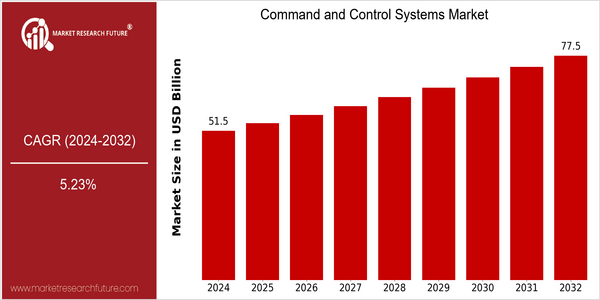
2024 USD 51.516 Billion
2032 USD 77.5 Billion
CAGR (2024-2032) 5.23 %

Note – Market size depicts the revenue generated over the financial year

In the past the command and control system market has grown steadily, with a market value of $ 51.162 billion in 2024, and an expected market value of $ 77.3 billion in 2032. This growth trend is characterized by a CAGR of 5.23% during the forecast period. The growing complexity of military operations, and the growing demand for improved situational awareness and decision-making, are the main driving forces for the growth of the market. Furthermore, technological innovations such as artificial intelligence, machine learning, and the Internet of Things are revolutionizing command and control systems, enabling them to handle and process data more efficiently, and provide real-time analysis. And the main players in the market, such as Lockheed Martin, Northrop Grumman, and Raytheon, are constantly investing in the development of new products and solutions and entering into strategic alliances to enhance their product portfolios. In this way, recent collaborations on the integration of artificial intelligence into command and control systems are expected to improve the efficiency of military operations and the response to critical situations. With the increasing defense budgets, the demand for advanced command and control systems is likely to remain high, thereby strengthening the growth trend of the market in the coming years.
home-ubuntu-www-mrf_ne_design-batch-5-cp-command-and-control-systems-market size

Regional Market Size

Regional Deep Dive

The command and control systems market is characterized by rapid technological advancements and the increasing demand for integrated solutions in various sectors, such as defense, security, and transport. In each region, the market has its own characteristics, which are mainly influenced by the geopolitical, regulatory, and economic environment. The need for increased situational awareness and better decision-making capabilities, and the integration of new technologies such as artificial intelligence and big data, are the key drivers for the market. The market is mainly driven by the need for national security and disaster response capabilities.

Europe

  • The European Union has launched the European Defence Fund, which allocates significant resources to developing advanced command and control technologies, fostering collaboration among member states and defense contractors.
  • Countries like the UK and France are focusing on joint military exercises that utilize advanced command and control systems, highlighting the importance of interoperability among NATO allies in response to evolving security threats.

Asia Pacific

  • China's rapid military modernization includes significant investments in command and control systems, with the establishment of the Integrated Command and Control System (ICCS) to enhance military coordination and response capabilities.
  • India's Defence Research and Development Organisation (DRDO) is developing indigenous command and control systems to support its armed forces, reflecting a broader trend of self-reliance in defense technology across the region.

Latin America

  • Countries like Brazil and Colombia are enhancing their command and control capabilities to address internal security challenges, with investments in technology aimed at improving law enforcement and emergency response.
  • The region is witnessing a growing trend towards public-private partnerships in developing command and control systems, as governments seek to leverage private sector innovation to enhance public safety.

North America

  • The U.S. Department of Defense has been investing heavily in modernizing its command and control systems, with initiatives like the Joint All-Domain Command and Control (JADC2) program aimed at integrating data across all military branches.
  • In recent years, the security of command and control systems has become the focus of the regulatory environment. This has led to increased collaboration between private companies such as Raytheon and government agencies in order to ensure the resilience of such systems against cyber-attacks.

Middle East And Africa

  • The Gulf Cooperation Council (GCC) countries are increasingly investing in command and control systems to enhance their defense capabilities, with projects like the Integrated Air and Missile Defense System being a focal point for regional security.
  • The rise of non-state actors and asymmetric warfare in the region has prompted governments to adopt advanced command and control systems to improve situational awareness and response times in crisis situations.

Did You Know?

“Did you know that the global command and control systems market is increasingly integrating artificial intelligence, with predictions that AI-driven analytics will significantly enhance decision-making processes in military and civilian applications?” — Market Research Future

Segmental Market Size

In the field of command and control systems, the company plays a key role in the understanding of the situation and the decisions to be made in various industries, such as defense, transport, and emergency response. This field is currently experiencing strong growth due to the growing demand for integrated systems that increase efficiency and response speed. The complexity of security threats is increasing, and the need for real-time data processing to support critical decision-making is growing. The implementation of command and control systems has already reached a high level of maturity, as shown by the advanced systems of the United States Department of Defense for military operations and by the use of command and control systems by cities such as New York for emergency response. The most important applications are military operations, disaster response, and traffic control. The trend towards smart cities and the development of machine learning and artificial intelligence will accelerate the growth of this field as companies seek to use these tools to improve their operational capabilities.

Future Outlook

From 2024 to 2032, the Command and Control systems market is expected to grow at a CAGR of 5.23%. This growth is based on the increasing demand for advanced situational awareness and decision-making capabilities in various sectors, such as defense, public safety, and critical infrastructure. In addition, the increasing need for efficiency and responsiveness in organizations will lead to the growing adoption of integrated command and control systems, which will lead to a more connected and data-driven operational environment. The integration of artificial intelligence, machine learning, and the Internet of Things will revolutionize the command and control systems. These technologies will allow the processing and analysis of data in real time, which will lead to faster and more accurate decisions. In addition, the growing emphasis on cybersecurity and the need for reliable communication networks will also boost the market. Also, the increasing use of mobile command centers and the trend towards cloud-based solutions will have a major impact on the future of the market. By 2032, penetration rates are expected to reach over 60% in the most important sectors.

Command Control Systems Market Size Graph
Author
Author Profile
Abbas Raut
Research Analyst

Abbas Raut is a Senior Research Analyst with 5+ years of experience delivering data-driven insights and strategic recommendations across the Automotive and Aerospace & Defense sectors. He specializes in emerging technologies, industry value chains, and global market dynamics shaping the future of mobility and defense. In automotive, Abbas has led studies on EVs, charging stations, BMS, superchargers, and more, guiding stakeholders through electrification and regulatory shifts. In Aerospace & Defense, he has analyzed markets for military electronics, drones, radars, and electronic warfare solutions, supporting procurement and investment strategies. With expertise in market sizing, forecasting, benchmarking, and technology adoption, Abbas is known for transforming complex datasets into actionable insights that drive strategy, innovation, and growth.

Leave a Comment

FAQs

What is the current valuation of the Command and Control Systems Market?

<p>The market valuation was 51.52 USD Billion in 2024.</p>

What is the projected market size for the Command and Control Systems Market by 2035?

<p>The market is projected to reach 90.28 USD Billion by 2035.</p>

What is the expected CAGR for the Command and Control Systems Market during the forecast period 2025 - 2035?

<p>The expected CAGR is 5.23% during the forecast period.</p>

Which companies are considered key players in the Command and Control Systems Market?

<p>Key players include Northrop Grumman, Raytheon Technologies, Lockheed Martin, and Thales Group.</p>

What are the main components of the Command and Control Systems Market?

<p>The main components are solutions, valued between 30.0 and 50.0 USD Billion, and services, valued between 21.52 and 40.28 USD Billion.</p>

How is the Command and Control Systems Market segmented by application?

The market is segmented into Government &amp; Defense, valued between 30.0 and 50.0 USD Billion, and Commercial, valued between 21.52 and 40.28 USD Billion.

What are the installation types in the Command and Control Systems Market?

Installation types include Deployable Command Centers, valued between 20.0 and 35.0 USD Billion, and Fixed Command Centers, valued between 31.52 and 55.28 USD Billion.

What platforms are included in the Command and Control Systems Market?

Platforms include Land, Space, Airborne, and Maritime, with valuations ranging from 9.52 to 35.0 USD Billion.

How does the Command and Control Systems Market performance vary by platform?

Land platforms are valued between 20.0 and 35.0 USD Billion, while Space platforms are valued between 10.0 and 15.0 USD Billion.

What trends are influencing the growth of the Command and Control Systems Market?

Trends include increasing demand for advanced solutions in Government &amp; Defense applications, driving market growth.

Market Summary

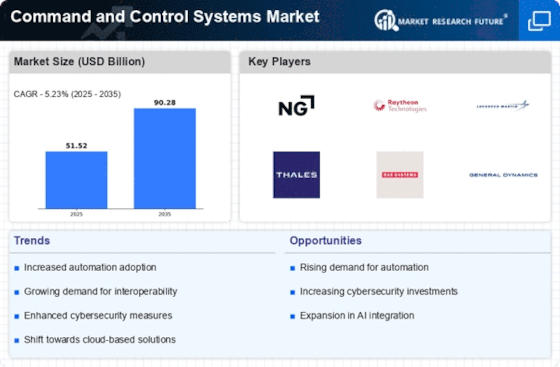
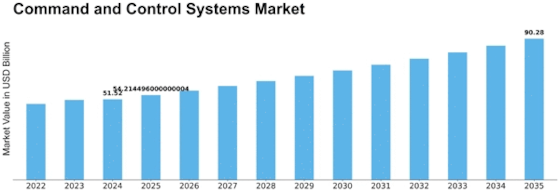
As per Market Research Future analysis, the Command and Control Systems Market Size was estimated at 51.52 USD Billion in 2024. The Command and Control Systems industry is projected to grow from 54.21 USD Billion in 2025 to 90.28 USD Billion by 2035, exhibiting a compound annual growth rate (CAGR) of 5.23% during the forecast period 2025 - 2035

Key Market Trends & Highlights

The Command and Control Systems Market is poised for substantial growth driven by technological advancements and increasing defense expenditures.

  • North America remains the largest market for Command and Control Systems, driven by robust defense budgets and technological innovation.
  • The Asia-Pacific region is emerging as the fastest-growing market, reflecting a surge in military modernization efforts and regional security concerns.
  • The Solution segment dominates the market, while the Service segment is experiencing rapid growth due to increasing demand for managed services and support.
  • Key market drivers include the integration of advanced technologies and a heightened focus on cybersecurity, which are essential for enhancing operational effectiveness.

Market Size & Forecast

2024 Market Size 51.52 (USD Billion)
2035 Market Size 90.28 (USD Billion)
CAGR (2025 - 2035) 5.23%
Largest Regional Market Share in 2024 North America

Major Players

Northrop Grumman (US), Raytheon Technologies (US), Lockheed Martin (US), Thales Group (FR), BAE Systems (GB), General Dynamics (US), Leonardo S.p.A. (IT), Hewlett Packard Enterprise (US), L3Harris Technologies (US)

Market Trends

The Command and Control Systems Market is currently experiencing a transformative phase, driven by advancements in technology and the increasing need for efficient management of operations across various sectors. Organizations are increasingly recognizing the value of integrated systems that facilitate real-time decision-making and enhance situational awareness. This shift is evident in both military and civilian applications, where the demand for robust command and control solutions is on the rise. As a result, stakeholders are investing in innovative technologies that promise to streamline processes and improve overall effectiveness. Moreover, the market landscape is evolving with the integration of artificial intelligence and machine learning, which appear to enhance the capabilities of traditional command and control systems. These technologies enable predictive analytics and automated responses, potentially leading to more agile and responsive operations. Additionally, the growing emphasis on cybersecurity is shaping the development of these systems, as organizations seek to protect sensitive information and ensure operational continuity. Overall, the Command and Control Systems Market is poised for growth, driven by technological advancements and an increasing focus on operational efficiency.

Integration of Advanced Technologies

The Command and Control Systems Market is witnessing a trend towards the integration of advanced technologies such as artificial intelligence and machine learning. These innovations are enhancing the capabilities of existing systems, allowing for improved data analysis and decision-making processes.

Focus on Cybersecurity

As the reliance on command and control systems increases, so does the emphasis on cybersecurity. Organizations are prioritizing the protection of sensitive data and operational integrity, leading to the development of more secure systems that can withstand potential threats.

Real-time Data Utilization

There is a growing trend towards the utilization of real-time data in command and control systems. This shift enables organizations to make informed decisions quickly, improving responsiveness and operational efficiency across various sectors.

Command Control Systems Market Market Drivers

Focus on Cybersecurity

In an era where cyber threats are escalating, the Command and Control Systems Market is placing a heightened emphasis on cybersecurity measures. Organizations are investing in secure communication channels and robust encryption protocols to safeguard sensitive data and maintain operational integrity. The increasing frequency of cyberattacks on critical infrastructure has prompted governments and private entities to prioritize cybersecurity in their command and control systems. This focus is reflected in market data, which indicates that cybersecurity solutions within this sector are expected to witness a growth rate of approximately 15% annually. As a result, the demand for command and control systems that incorporate advanced cybersecurity features is likely to rise, ensuring resilience against potential threats.

Increased Defense Spending

The Command and Control Systems Market is benefiting from increased defense spending across various nations. Governments are recognizing the importance of modernizing their military capabilities, which includes investing in advanced command and control systems. This trend is particularly pronounced in regions facing geopolitical tensions, where enhanced situational awareness and rapid response capabilities are paramount. Recent data indicates that defense budgets are expected to rise by an average of 5% annually, with a significant portion allocated to upgrading command and control infrastructure. This influx of funding is likely to drive innovation and development within the market, as manufacturers strive to meet the evolving needs of defense agencies.

Real-time Data Utilization

The ability to utilize real-time data is becoming a cornerstone of the Command and Control Systems Market. Organizations are increasingly relying on instantaneous data feeds to make informed decisions during critical operations. This trend is particularly evident in military applications, where timely intelligence can significantly impact mission success. The market is witnessing a surge in demand for systems that can process and analyze vast amounts of data in real-time, enabling operators to respond swiftly to evolving situations. According to recent estimates, the segment focusing on real-time data processing is projected to grow at a rate of 12% over the next five years. This growth underscores the necessity for command and control systems that can effectively harness real-time information to enhance situational awareness.

Growing Demand for Interoperability

The Command and Control Systems Market is witnessing a growing demand for interoperability among various systems and platforms. As military and emergency response operations become increasingly complex, the ability to integrate different command and control systems is essential for effective coordination. This trend is driven by the need for seamless communication between various agencies and units, which can significantly enhance operational efficiency. Market analysis suggests that the interoperability segment is expected to grow at a rate of 11% over the next few years, as organizations seek solutions that facilitate collaboration across diverse platforms. This demand for interoperability is likely to shape the future of command and control systems, pushing manufacturers to develop more adaptable and integrative solutions.

Integration of Advanced Technologies

The Command and Control Systems Market is experiencing a notable shift towards the integration of advanced technologies such as artificial intelligence, machine learning, and big data analytics. These technologies enhance decision-making processes by providing real-time insights and predictive analytics. For instance, the incorporation of AI algorithms allows for improved threat detection and response times, which is crucial in military and emergency management applications. As organizations increasingly recognize the value of these technologies, the market is projected to grow significantly, with estimates suggesting a compound annual growth rate of over 10% in the coming years. This trend indicates a robust demand for sophisticated command and control systems that can leverage these advancements to optimize operational efficiency.

Market Segment Insights

By Component: Solution (Largest) vs. Service (Fastest-Growing)

The Command and Control Systems Market segments into 'Solution' and 'Service', with Solutions holding the largest share. This segment includes software and hardware solutions that integrate various systems to facilitate command and control processes. Solutions are widely adopted across various industries, from defense to telecommunications, due to their critical role in enhancing operational efficiency and decision-making ability. In contrast, the Service segment is recognized as the fastest-growing aspect within this market. Services include consulting, maintenance, and support offerings that enhance the functionality of existing systems. As technological advancements accelerate, the demand for expert services to implement and manage these complexities is surging as organizations seek to optimize their command and control systems.

Components: Solution (Dominant) vs. Service (Emerging)

In the Command and Control Systems Market, Solutions are the dominant force, providing essential tools necessary for effective operations across various sectors. These solutions involve integrated systems that allow for real-time data processing and command oversight. With advancements in artificial intelligence and machine learning, the capabilities of these solutions continue to expand. Conversely, the Service segment is emerging rapidly, offering specialized support such as system integration, training, and predictive maintenance. This growth is fueled by the increasing complexity of systems and the need for ongoing assistance to ensure optimal performance. While Solutions remain the backbone of command and control, Services are quickly becoming indispensable, aiding organizations in keeping pace with evolving technological demands.

By Application: Government & Defense (Largest) vs. Commercial (Fastest-Growing)

In the Command and Control Systems Market, the Government & Defense sector holds the majority share, driven by initiatives to enhance national security and defense capabilities. Conversely, the Commercial segment is gaining significant traction, benefitting from the increasing adoption of advanced technologies that improve operational efficiency, particularly in logistics and public safety operations. This division illustrates a clear dichotomy, where defense-related applications continue to dominate, while commercial applications make rapid strides, indicating a shift towards integrated technology solutions.

Application: Government & Defense (Dominant) vs. Commercial (Emerging)

The Government & Defense segment is characterized by high investment levels and stringent requirements for reliability and security. This dominant segment typically features customized solutions tailored for military operations, intelligence, and crisis management. In contrast, the Commercial sector is emerging with innovative solutions aimed at enhancing productivity and decision-making processes. Driven by advancements in cloud computing and data analytics, the sector is quickly integrating command and control systems into wider operational frameworks, fostering efficiency and responsiveness. These characteristics differ significantly from Government & Defense applications, as the commercial segment remains agile and adaptable to changing market needs.

By Installation: Deployable Command Centers (Largest) vs. Fixed Command Centers (Fastest-Growing)

In the Command and Control Systems Market, Deployable Command Centers hold the largest market share, proving their essential role in flexible tactical operations. These mobile units enable rapid deployment and are especially crucial in dynamic environments. Conversely, Fixed Command Centers are emerging as the fastest-growing segment, driven by the increasing demand for permanent, secure command facilities that provide stable operational capabilities while addressing strategic needs.

Deployable Command Centers (Dominant) vs. Fixed Command Centers (Emerging)

Deployable Command Centers are designed for mobility and immediate deployment in various military and emergency scenarios, allowing for a responsive command structure. Their dominance in the market stems from their versatility and adaptability. On the other hand, Fixed Command Centers represent a growing trend towards establishing permanent installation solutions that ensure enhanced security and operational efficiency. These centers benefit from advancements in infrastructure technology, facilitating robust communications and data processing capabilities, making them indispensable for long-term strategic operations.

By Platform: Land (Largest) vs. Airborne (Fastest-Growing)

In the Command and Control Systems Market, the platform segment is largely dominated by the land-based systems, which occupy the majority share due to their extensive applications in military operations and critical infrastructure protection. The land platform is favored for its versatility, with capabilities ranging from tactical command posts to integrated battlefield management, ensuring seamless operations across various terrains and scenarios. On the other hand, the airborne platform segment is experiencing rapid growth, driven by technological advancements in UAVs (Unmanned Aerial Vehicles) and increasing demand for aerial surveillance and reconnaissance capabilities.

Land (Dominant) vs. Airborne (Emerging)

The Land platform in the Command and Control Systems Market represents a well-established pillar of operational capability, providing comprehensive situational awareness and control on the ground. Its dominance can be attributed to the integration of advanced communication systems and real-time data analytics, enabling better decision-making and resource management. Conversely, the Airborne platform is emerging as a significant force, propelled by advancements in drone technology and increased military investments in intelligence, surveillance, and reconnaissance (ISR). With its growing applications in various operational theatres, the Airborne segment is on the cutting edge of innovation, offering capabilities that complement and enhance traditional land systems.

Get more detailed insights about Command and Control Systems Market Research Report - Global Forecast till 2035

Regional Insights

  • Command and Control Systems Regional Insights

By Region, the study provides market insights into North America, Europe, Asia-Pacific and Rest of the World. The North America Command and Control Systems market area will dominate this market.  This is due to its significant investments in commercial and defense initiatives between big corporations and the government to develop command and control systems.

Further, the major countries studied in the market report are The U.S., Canada, German, France, the UK, Italy, Spain, China, Japan, India, Australia, South Korea, and Brazil.

Figure 2:  COMMAND AND CONTROL SYSTEMS MARKET SHARE BY REGION 2022 (%)

Source Secondary Research, Primary Research, Market Research Future Database and Analyst Review

The Asia-Pacific  Command and Control Systems Market is expected to grow at the fastest CAGR from 2023 to 2032. Asia-Pacific nations, led by China, India, Japan, South and North Korea, devote a sizable budget for military control and commercial applications. Moreover, China Command and Control Systems market held the largest market share, and the India Command and Control Systems market was the fastest growing market in the Asia-Pacific region.

Europe Command and Control Systems market accounts for the second-largest market share. Western European nations like Germany, France, the UK, Spain, and Italy dominate the market. Further, the German Command and Control Systems market held the largest market share, and the UK Command and Control Systems market was the fastest-growing market in the European region

Key Players and Competitive Insights

Leading market players are investing heavily in research and development in order to expand their product lines, which will help the Command and Control Systems market, grow even more. Market participants are also undertaking a variety of strategic activities to expand their  footprint, with important market developments including new product launches, contractual agreements, mergers and acquisitions, higher investments, and collaboration with other organizations. To expand and survive in a more competitive and rising market climate, the Command and Control Systems industry must offer cost-effective items.Manufacturing locally to minimize operational costs is one of the key business tactics used by manufacturers in the  Command and Control Systems industry to benefit clients and increase the market sector. In recent years, the Command and Control Systems industry has offered some of the most significant advantages to medicine.Major players in the Command and Control Systems market attempting to increase market demand by investing in research and development operations are  BAE Systems Plc (UK), Elbit Systems Ltd (Israel), General Dynamics Corporation (US), L3harris Technologies (US), Leonardo Spa (Italy), Lockheed Martin Corporation (US), Northrop Grumman Corporation (US), Raytheon Company (US), Rheinmetall AG (Germany), Thales Group (France).BAE System’s Tactical Command and Control enhances the composite picture between deployed vehicles, dismounted personnel, and deployed headquarters while improving the capacity to transmit operational information. Operational success depends on monitoring activities in real-time, reacting, and planning at the proper level and tempo. Own force tracking of both vehicles and particular dismounted soldiers along the command chain is made possible by tactical command and control (TC2). By doing this, TC2 ensures that important information can be transmitted between Command HQ and deployed and dismounted units to increase operational agility, tempo, and overall mission success.General Dynamics Corporation is a division of the American defense and aerospace firm. General Dynamics Mission solutions integrate secure information and communication solutions. The main products manufactured by General Dynamics Mission Systems are secure communications networks, radios, and satellite technologies for the defence, cyber, public safety, and intelligence communities. General Dynamics Advanced Information Systems supplied systems development, integration, and operations support for mission-related systems. A pioneer in the integration of secure communications, information systems, and technology was General Dynamics C4 Systems.

Key Companies in the Command Control Systems Market include

Industry Developments

  • Q2 2024: BAE Systems wins $318 million U.S. Army contract for next-generation command and control systems BAE Systems secured a $318 million contract from the U.S. Army to deliver advanced command and control systems aimed at improving battlefield situational awareness and decision-making capabilities.
  • Q2 2024: Lockheed Martin launches new C2 digital platform for integrated air and missile defense Lockheed Martin announced the launch of its next-generation digital command and control (C2) platform designed to integrate air and missile defense systems for allied military customers.
  • Q2 2024: Thales acquires cybersecurity firm Excellium to bolster command and control offerings Thales completed the acquisition of Excellium, a European cybersecurity company, to enhance its command and control systems with advanced cyber defense capabilities.
  • Q3 2024: Northrop Grumman awarded $235 million contract for NATO command and control modernization Northrop Grumman received a $235 million contract to modernize NATO's command and control infrastructure, focusing on interoperability and secure communications.
  • Q3 2024: Elbit Systems partners with Rheinmetall for European C2 system deployment Elbit Systems and Rheinmetall announced a strategic partnership to deploy advanced command and control systems for European defense forces, targeting multi-domain operations.
  • Q4 2024: General Dynamics opens new command and control systems facility in Huntsville, Alabama General Dynamics officially opened a new manufacturing and R&D facility dedicated to the production of advanced command and control systems for U.S. and allied defense customers.
  • Q4 2024: Saab wins $120 million contract to supply C2 systems to Australian Defence Force Saab secured a $120 million contract to deliver next-generation command and control systems to the Australian Defence Force, supporting joint operations and real-time data integration.
  • Q1 2025: Raytheon Technologies unveils AI-powered command and control suite for defense applications Raytheon Technologies launched a new suite of AI-powered command and control solutions designed to accelerate decision-making and threat response for military customers.
  • Q1 2025: Leonardo announces $200 million investment in new C2 research center in Italy Leonardo revealed plans to invest $200 million in a new research and development center focused on next-generation command and control technologies in Rome, Italy.
  • Q2 2025: Indra secures Spanish Ministry of Defense contract for battlefield C2 system upgrade Indra was awarded a contract by the Spanish Ministry of Defense to upgrade battlefield command and control systems, enhancing interoperability and cyber resilience.
  • Q2 2025: L3Harris Technologies acquires C2 software firm Adaptive Methods L3Harris Technologies completed the acquisition of Adaptive Methods, a U.S.-based C2 software developer, to expand its portfolio of integrated command and control solutions.
  • Q2 2025: Israel Aerospace Industries wins major contract for Asia-Pacific C2 system deployment Israel Aerospace Industries secured a significant contract to deploy advanced command and control systems for a major Asia-Pacific defense customer, supporting multi-domain operations.

Future Outlook

Command Control Systems Market Future Outlook

The Command and Control Systems Market is projected to grow at a 5.23% CAGR from 2025 to 2035, driven by advancements in technology, increasing defense budgets, and the need for enhanced situational awareness.

New opportunities lie in:

  • Integration of AI-driven analytics for real-time decision-making
  • Development of mobile command centers for rapid deployment
  • Expansion into cybersecurity solutions for command systems

By 2035, the market is expected to be robust, reflecting substantial growth and innovation.

Market Segmentation

Command Control Systems Market Platform Outlook

  • Land
  • Space
  • Airborne
  • Maritime

Command Control Systems Market Component Outlook

  • Solution
  • Service

Command Control Systems Market Application Outlook

  • Government & Defense
  • Commercial

Command Control Systems Market Installation Outlook

  • Deployable Command Centers
  • Fixed Command Centers

Report Scope

MARKET SIZE 2024 51.52(USD Billion)
MARKET SIZE 2025 54.21(USD Billion)
MARKET SIZE 2035 90.28(USD Billion)
COMPOUND ANNUAL GROWTH RATE (CAGR) 5.23% (2025 - 2035)
REPORT COVERAGE Revenue Forecast, Competitive Landscape, Growth Factors, and Trends
BASE YEAR 2024
Market Forecast Period 2025 - 2035
Historical Data 2019 - 2024
Market Forecast Units USD Billion
Key Companies Profiled Northrop Grumman (US), Raytheon Technologies (US), Lockheed Martin (US), Thales Group (FR), BAE Systems (GB), General Dynamics (US), Leonardo S.p.A. (IT), Hewlett Packard Enterprise (US), L3Harris Technologies (US)
Segments Covered Component, Application, Installation, Platform, Region
Key Market Opportunities Integration of artificial intelligence enhances decision-making capabilities in the Command and Control Systems Market.
Key Market Dynamics Rising demand for advanced analytics and artificial intelligence in Command and Control Systems drives market innovation and competition.
Countries Covered North America, Europe, APAC, South America, MEA

FAQs

What is the current valuation of the Command and Control Systems Market?

<p>The market valuation was 51.52 USD Billion in 2024.</p>

What is the projected market size for the Command and Control Systems Market by 2035?

<p>The market is projected to reach 90.28 USD Billion by 2035.</p>

What is the expected CAGR for the Command and Control Systems Market during the forecast period 2025 - 2035?

<p>The expected CAGR is 5.23% during the forecast period.</p>

Which companies are considered key players in the Command and Control Systems Market?

<p>Key players include Northrop Grumman, Raytheon Technologies, Lockheed Martin, and Thales Group.</p>

What are the main components of the Command and Control Systems Market?

<p>The main components are solutions, valued between 30.0 and 50.0 USD Billion, and services, valued between 21.52 and 40.28 USD Billion.</p>

How is the Command and Control Systems Market segmented by application?

The market is segmented into Government &amp; Defense, valued between 30.0 and 50.0 USD Billion, and Commercial, valued between 21.52 and 40.28 USD Billion.

What are the installation types in the Command and Control Systems Market?

Installation types include Deployable Command Centers, valued between 20.0 and 35.0 USD Billion, and Fixed Command Centers, valued between 31.52 and 55.28 USD Billion.

What platforms are included in the Command and Control Systems Market?

Platforms include Land, Space, Airborne, and Maritime, with valuations ranging from 9.52 to 35.0 USD Billion.

How does the Command and Control Systems Market performance vary by platform?

Land platforms are valued between 20.0 and 35.0 USD Billion, while Space platforms are valued between 10.0 and 15.0 USD Billion.

What trends are influencing the growth of the Command and Control Systems Market?

Trends include increasing demand for advanced solutions in Government &amp; Defense applications, driving market growth.

  1. SECTION I: EXECUTIVE SUMMARY AND KEY HIGHLIGHTS
    1. | 1.1 EXECUTIVE SUMMARY
    2. | | 1.1.1 Market Overview
    3. | | 1.1.2 Key Findings
    4. | | 1.1.3 Market Segmentation
    5. | | 1.1.4 Competitive Landscape
    6. | | 1.1.5 Challenges and Opportunities
    7. | | 1.1.6 Future Outlook
  2. SECTION II: SCOPING, METHODOLOGY AND MARKET STRUCTURE
    1. | 2.1 MARKET INTRODUCTION
    2. | | 2.1.1 Definition
    3. | | 2.1.2 Scope of the study
    4. | | | 2.1.2.1 Research Objective
    5. | | | 2.1.2.2 Assumption
    6. | | | 2.1.2.3 Limitations
    7. | 2.2 RESEARCH METHODOLOGY
    8. | | 2.2.1 Overview
    9. | | 2.2.2 Data Mining
    10. | | 2.2.3 Secondary Research
    11. | | 2.2.4 Primary Research
    12. | | | 2.2.4.1 Primary Interviews and Information Gathering Process
    13. | | | 2.2.4.2 Breakdown of Primary Respondents
    14. | | 2.2.5 Forecasting Model
    15. | | 2.2.6 Market Size Estimation
    16. | | | 2.2.6.1 Bottom-Up Approach
    17. | | | 2.2.6.2 Top-Down Approach
    18. | | 2.2.7 Data Triangulation
    19. | | 2.2.8 Validation
  3. SECTION III: QUALITATIVE ANALYSIS
    1. | 3.1 MARKET DYNAMICS
    2. | | 3.1.1 Overview
    3. | | 3.1.2 Drivers
    4. | | 3.1.3 Restraints
    5. | | 3.1.4 Opportunities
    6. | 3.2 MARKET FACTOR ANALYSIS
    7. | | 3.2.1 Value chain Analysis
    8. | | 3.2.2 Porter's Five Forces Analysis
    9. | | | 3.2.2.1 Bargaining Power of Suppliers
    10. | | | 3.2.2.2 Bargaining Power of Buyers
    11. | | | 3.2.2.3 Threat of New Entrants
    12. | | | 3.2.2.4 Threat of Substitutes
    13. | | | 3.2.2.5 Intensity of Rivalry
    14. | | 3.2.3 COVID-19 Impact Analysis
    15. | | | 3.2.3.1 Market Impact Analysis
    16. | | | 3.2.3.2 Regional Impact
    17. | | | 3.2.3.3 Opportunity and Threat Analysis
  4. SECTION IV: QUANTITATIVE ANALYSIS
    1. | 4.1 Aerospace & Defense, BY Component (USD Billion)
    2. | | 4.1.1 Solution
    3. | | 4.1.2 Service
    4. | 4.2 Aerospace & Defense, BY Application (USD Billion)
    5. | | 4.2.1 Government & Defense
    6. | | 4.2.2 Commercial
    7. | 4.3 Aerospace & Defense, BY Installation (USD Billion)
    8. | | 4.3.1 Deployable Command Centers
    9. | | 4.3.2 Fixed Command Centers
    10. | 4.4 Aerospace & Defense, BY Platform (USD Billion)
    11. | | 4.4.1 Land
    12. | | 4.4.2 Space
    13. | | 4.4.3 Airborne
    14. | | 4.4.4 Maritime
    15. | 4.5 Aerospace & Defense, BY Region (USD Billion)
    16. | | 4.5.1 North America
    17. | | | 4.5.1.1 US
    18. | | | 4.5.1.2 Canada
    19. | | 4.5.2 Europe
    20. | | | 4.5.2.1 Germany
    21. | | | 4.5.2.2 UK
    22. | | | 4.5.2.3 France
    23. | | | 4.5.2.4 Russia
    24. | | | 4.5.2.5 Italy
    25. | | | 4.5.2.6 Spain
    26. | | | 4.5.2.7 Rest of Europe
    27. | | 4.5.3 APAC
    28. | | | 4.5.3.1 China
    29. | | | 4.5.3.2 India
    30. | | | 4.5.3.3 Japan
    31. | | | 4.5.3.4 South Korea
    32. | | | 4.5.3.5 Malaysia
    33. | | | 4.5.3.6 Thailand
    34. | | | 4.5.3.7 Indonesia
    35. | | | 4.5.3.8 Rest of APAC
    36. | | 4.5.4 South America
    37. | | | 4.5.4.1 Brazil
    38. | | | 4.5.4.2 Mexico
    39. | | | 4.5.4.3 Argentina
    40. | | | 4.5.4.4 Rest of South America
    41. | | 4.5.5 MEA
    42. | | | 4.5.5.1 GCC Countries
    43. | | | 4.5.5.2 South Africa
    44. | | | 4.5.5.3 Rest of MEA
  5. SECTION V: COMPETITIVE ANALYSIS
    1. | 5.1 Competitive Landscape
    2. | | 5.1.1 Overview
    3. | | 5.1.2 Competitive Analysis
    4. | | 5.1.3 Market share Analysis
    5. | | 5.1.4 Major Growth Strategy in the Aerospace & Defense
    6. | | 5.1.5 Competitive Benchmarking
    7. | | 5.1.6 Leading Players in Terms of Number of Developments in the Aerospace & Defense
    8. | | 5.1.7 Key developments and growth strategies
    9. | | | 5.1.7.1 New Product Launch/Service Deployment
    10. | | | 5.1.7.2 Merger & Acquisitions
    11. | | | 5.1.7.3 Joint Ventures
    12. | | 5.1.8 Major Players Financial Matrix
    13. | | | 5.1.8.1 Sales and Operating Income
    14. | | | 5.1.8.2 Major Players R&D Expenditure. 2023
    15. | 5.2 Company Profiles
    16. | | 5.2.1 Northrop Grumman (US)
    17. | | | 5.2.1.1 Financial Overview
    18. | | | 5.2.1.2 Products Offered
    19. | | | 5.2.1.3 Key Developments
    20. | | | 5.2.1.4 SWOT Analysis
    21. | | | 5.2.1.5 Key Strategies
    22. | | 5.2.2 Raytheon Technologies (US)
    23. | | | 5.2.2.1 Financial Overview
    24. | | | 5.2.2.2 Products Offered
    25. | | | 5.2.2.3 Key Developments
    26. | | | 5.2.2.4 SWOT Analysis
    27. | | | 5.2.2.5 Key Strategies
    28. | | 5.2.3 Lockheed Martin (US)
    29. | | | 5.2.3.1 Financial Overview
    30. | | | 5.2.3.2 Products Offered
    31. | | | 5.2.3.3 Key Developments
    32. | | | 5.2.3.4 SWOT Analysis
    33. | | | 5.2.3.5 Key Strategies
    34. | | 5.2.4 Thales Group (FR)
    35. | | | 5.2.4.1 Financial Overview
    36. | | | 5.2.4.2 Products Offered
    37. | | | 5.2.4.3 Key Developments
    38. | | | 5.2.4.4 SWOT Analysis
    39. | | | 5.2.4.5 Key Strategies
    40. | | 5.2.5 BAE Systems (GB)
    41. | | | 5.2.5.1 Financial Overview
    42. | | | 5.2.5.2 Products Offered
    43. | | | 5.2.5.3 Key Developments
    44. | | | 5.2.5.4 SWOT Analysis
    45. | | | 5.2.5.5 Key Strategies
    46. | | 5.2.6 General Dynamics (US)
    47. | | | 5.2.6.1 Financial Overview
    48. | | | 5.2.6.2 Products Offered
    49. | | | 5.2.6.3 Key Developments
    50. | | | 5.2.6.4 SWOT Analysis
    51. | | | 5.2.6.5 Key Strategies
    52. | | 5.2.7 Leonardo S.p.A. (IT)
    53. | | | 5.2.7.1 Financial Overview
    54. | | | 5.2.7.2 Products Offered
    55. | | | 5.2.7.3 Key Developments
    56. | | | 5.2.7.4 SWOT Analysis
    57. | | | 5.2.7.5 Key Strategies
    58. | | 5.2.8 Hewlett Packard Enterprise (US)
    59. | | | 5.2.8.1 Financial Overview
    60. | | | 5.2.8.2 Products Offered
    61. | | | 5.2.8.3 Key Developments
    62. | | | 5.2.8.4 SWOT Analysis
    63. | | | 5.2.8.5 Key Strategies
    64. | | 5.2.9 L3Harris Technologies (US)
    65. | | | 5.2.9.1 Financial Overview
    66. | | | 5.2.9.2 Products Offered
    67. | | | 5.2.9.3 Key Developments
    68. | | | 5.2.9.4 SWOT Analysis
    69. | | | 5.2.9.5 Key Strategies
    70. | 5.3 Appendix
    71. | | 5.3.1 References
    72. | | 5.3.2 Related Reports
  6. LIST OF FIGURES
    1. | 6.1 MARKET SYNOPSIS
    2. | 6.2 NORTH AMERICA MARKET ANALYSIS
    3. | 6.3 US MARKET ANALYSIS BY COMPONENT
    4. | 6.4 US MARKET ANALYSIS BY APPLICATION
    5. | 6.5 US MARKET ANALYSIS BY INSTALLATION
    6. | 6.6 US MARKET ANALYSIS BY PLATFORM
    7. | 6.7 CANADA MARKET ANALYSIS BY COMPONENT
    8. | 6.8 CANADA MARKET ANALYSIS BY APPLICATION
    9. | 6.9 CANADA MARKET ANALYSIS BY INSTALLATION
    10. | 6.10 CANADA MARKET ANALYSIS BY PLATFORM
    11. | 6.11 EUROPE MARKET ANALYSIS
    12. | 6.12 GERMANY MARKET ANALYSIS BY COMPONENT
    13. | 6.13 GERMANY MARKET ANALYSIS BY APPLICATION
    14. | 6.14 GERMANY MARKET ANALYSIS BY INSTALLATION
    15. | 6.15 GERMANY MARKET ANALYSIS BY PLATFORM
    16. | 6.16 UK MARKET ANALYSIS BY COMPONENT
    17. | 6.17 UK MARKET ANALYSIS BY APPLICATION
    18. | 6.18 UK MARKET ANALYSIS BY INSTALLATION
    19. | 6.19 UK MARKET ANALYSIS BY PLATFORM
    20. | 6.20 FRANCE MARKET ANALYSIS BY COMPONENT
    21. | 6.21 FRANCE MARKET ANALYSIS BY APPLICATION
    22. | 6.22 FRANCE MARKET ANALYSIS BY INSTALLATION
    23. | 6.23 FRANCE MARKET ANALYSIS BY PLATFORM
    24. | 6.24 RUSSIA MARKET ANALYSIS BY COMPONENT
    25. | 6.25 RUSSIA MARKET ANALYSIS BY APPLICATION
    26. | 6.26 RUSSIA MARKET ANALYSIS BY INSTALLATION
    27. | 6.27 RUSSIA MARKET ANALYSIS BY PLATFORM
    28. | 6.28 ITALY MARKET ANALYSIS BY COMPONENT
    29. | 6.29 ITALY MARKET ANALYSIS BY APPLICATION
    30. | 6.30 ITALY MARKET ANALYSIS BY INSTALLATION
    31. | 6.31 ITALY MARKET ANALYSIS BY PLATFORM
    32. | 6.32 SPAIN MARKET ANALYSIS BY COMPONENT
    33. | 6.33 SPAIN MARKET ANALYSIS BY APPLICATION
    34. | 6.34 SPAIN MARKET ANALYSIS BY INSTALLATION
    35. | 6.35 SPAIN MARKET ANALYSIS BY PLATFORM
    36. | 6.36 REST OF EUROPE MARKET ANALYSIS BY COMPONENT
    37. | 6.37 REST OF EUROPE MARKET ANALYSIS BY APPLICATION
    38. | 6.38 REST OF EUROPE MARKET ANALYSIS BY INSTALLATION
    39. | 6.39 REST OF EUROPE MARKET ANALYSIS BY PLATFORM
    40. | 6.40 APAC MARKET ANALYSIS
    41. | 6.41 CHINA MARKET ANALYSIS BY COMPONENT
    42. | 6.42 CHINA MARKET ANALYSIS BY APPLICATION
    43. | 6.43 CHINA MARKET ANALYSIS BY INSTALLATION
    44. | 6.44 CHINA MARKET ANALYSIS BY PLATFORM
    45. | 6.45 INDIA MARKET ANALYSIS BY COMPONENT
    46. | 6.46 INDIA MARKET ANALYSIS BY APPLICATION
    47. | 6.47 INDIA MARKET ANALYSIS BY INSTALLATION
    48. | 6.48 INDIA MARKET ANALYSIS BY PLATFORM
    49. | 6.49 JAPAN MARKET ANALYSIS BY COMPONENT
    50. | 6.50 JAPAN MARKET ANALYSIS BY APPLICATION
    51. | 6.51 JAPAN MARKET ANALYSIS BY INSTALLATION
    52. | 6.52 JAPAN MARKET ANALYSIS BY PLATFORM
    53. | 6.53 SOUTH KOREA MARKET ANALYSIS BY COMPONENT
    54. | 6.54 SOUTH KOREA MARKET ANALYSIS BY APPLICATION
    55. | 6.55 SOUTH KOREA MARKET ANALYSIS BY INSTALLATION
    56. | 6.56 SOUTH KOREA MARKET ANALYSIS BY PLATFORM
    57. | 6.57 MALAYSIA MARKET ANALYSIS BY COMPONENT
    58. | 6.58 MALAYSIA MARKET ANALYSIS BY APPLICATION
    59. | 6.59 MALAYSIA MARKET ANALYSIS BY INSTALLATION
    60. | 6.60 MALAYSIA MARKET ANALYSIS BY PLATFORM
    61. | 6.61 THAILAND MARKET ANALYSIS BY COMPONENT
    62. | 6.62 THAILAND MARKET ANALYSIS BY APPLICATION
    63. | 6.63 THAILAND MARKET ANALYSIS BY INSTALLATION
    64. | 6.64 THAILAND MARKET ANALYSIS BY PLATFORM
    65. | 6.65 INDONESIA MARKET ANALYSIS BY COMPONENT
    66. | 6.66 INDONESIA MARKET ANALYSIS BY APPLICATION
    67. | 6.67 INDONESIA MARKET ANALYSIS BY INSTALLATION
    68. | 6.68 INDONESIA MARKET ANALYSIS BY PLATFORM
    69. | 6.69 REST OF APAC MARKET ANALYSIS BY COMPONENT
    70. | 6.70 REST OF APAC MARKET ANALYSIS BY APPLICATION
    71. | 6.71 REST OF APAC MARKET ANALYSIS BY INSTALLATION
    72. | 6.72 REST OF APAC MARKET ANALYSIS BY PLATFORM
    73. | 6.73 SOUTH AMERICA MARKET ANALYSIS
    74. | 6.74 BRAZIL MARKET ANALYSIS BY COMPONENT
    75. | 6.75 BRAZIL MARKET ANALYSIS BY APPLICATION
    76. | 6.76 BRAZIL MARKET ANALYSIS BY INSTALLATION
    77. | 6.77 BRAZIL MARKET ANALYSIS BY PLATFORM
    78. | 6.78 MEXICO MARKET ANALYSIS BY COMPONENT
    79. | 6.79 MEXICO MARKET ANALYSIS BY APPLICATION
    80. | 6.80 MEXICO MARKET ANALYSIS BY INSTALLATION
    81. | 6.81 MEXICO MARKET ANALYSIS BY PLATFORM
    82. | 6.82 ARGENTINA MARKET ANALYSIS BY COMPONENT
    83. | 6.83 ARGENTINA MARKET ANALYSIS BY APPLICATION
    84. | 6.84 ARGENTINA MARKET ANALYSIS BY INSTALLATION
    85. | 6.85 ARGENTINA MARKET ANALYSIS BY PLATFORM
    86. | 6.86 REST OF SOUTH AMERICA MARKET ANALYSIS BY COMPONENT
    87. | 6.87 REST OF SOUTH AMERICA MARKET ANALYSIS BY APPLICATION
    88. | 6.88 REST OF SOUTH AMERICA MARKET ANALYSIS BY INSTALLATION
    89. | 6.89 REST OF SOUTH AMERICA MARKET ANALYSIS BY PLATFORM
    90. | 6.90 MEA MARKET ANALYSIS
    91. | 6.91 GCC COUNTRIES MARKET ANALYSIS BY COMPONENT
    92. | 6.92 GCC COUNTRIES MARKET ANALYSIS BY APPLICATION
    93. | 6.93 GCC COUNTRIES MARKET ANALYSIS BY INSTALLATION
    94. | 6.94 GCC COUNTRIES MARKET ANALYSIS BY PLATFORM
    95. | 6.95 SOUTH AFRICA MARKET ANALYSIS BY COMPONENT
    96. | 6.96 SOUTH AFRICA MARKET ANALYSIS BY APPLICATION
    97. | 6.97 SOUTH AFRICA MARKET ANALYSIS BY INSTALLATION
    98. | 6.98 SOUTH AFRICA MARKET ANALYSIS BY PLATFORM
    99. | 6.99 REST OF MEA MARKET ANALYSIS BY COMPONENT
    100. | 6.100 REST OF MEA MARKET ANALYSIS BY APPLICATION
    101. | 6.101 REST OF MEA MARKET ANALYSIS BY INSTALLATION
    102. | 6.102 REST OF MEA MARKET ANALYSIS BY PLATFORM
    103. | 6.103 KEY BUYING CRITERIA OF AEROSPACE & DEFENSE
    104. | 6.104 RESEARCH PROCESS OF MRFR
    105. | 6.105 DRO ANALYSIS OF AEROSPACE & DEFENSE
    106. | 6.106 DRIVERS IMPACT ANALYSIS: AEROSPACE & DEFENSE
    107. | 6.107 RESTRAINTS IMPACT ANALYSIS: AEROSPACE & DEFENSE
    108. | 6.108 SUPPLY / VALUE CHAIN: AEROSPACE & DEFENSE
    109. | 6.109 AEROSPACE & DEFENSE, BY COMPONENT, 2024 (% SHARE)
    110. | 6.110 AEROSPACE & DEFENSE, BY COMPONENT, 2024 TO 2035 (USD Billion)
    111. | 6.111 AEROSPACE & DEFENSE, BY APPLICATION, 2024 (% SHARE)
    112. | 6.112 AEROSPACE & DEFENSE, BY APPLICATION, 2024 TO 2035 (USD Billion)
    113. | 6.113 AEROSPACE & DEFENSE, BY INSTALLATION, 2024 (% SHARE)
    114. | 6.114 AEROSPACE & DEFENSE, BY INSTALLATION, 2024 TO 2035 (USD Billion)
    115. | 6.115 AEROSPACE & DEFENSE, BY PLATFORM, 2024 (% SHARE)
    116. | 6.116 AEROSPACE & DEFENSE, BY PLATFORM, 2024 TO 2035 (USD Billion)
    117. | 6.117 BENCHMARKING OF MAJOR COMPETITORS
  7. LIST OF TABLES
    1. | 7.1 LIST OF ASSUMPTIONS
    2. | | 7.1.1
    3. | 7.2 North America MARKET SIZE ESTIMATES; FORECAST
    4. | | 7.2.1 BY COMPONENT, 2025-2035 (USD Billion)
    5. | | 7.2.2 BY APPLICATION, 2025-2035 (USD Billion)
    6. | | 7.2.3 BY INSTALLATION, 2025-2035 (USD Billion)
    7. | | 7.2.4 BY PLATFORM, 2025-2035 (USD Billion)
    8. | 7.3 US MARKET SIZE ESTIMATES; FORECAST
    9. | | 7.3.1 BY COMPONENT, 2025-2035 (USD Billion)
    10. | | 7.3.2 BY APPLICATION, 2025-2035 (USD Billion)
    11. | | 7.3.3 BY INSTALLATION, 2025-2035 (USD Billion)
    12. | | 7.3.4 BY PLATFORM, 2025-2035 (USD Billion)
    13. | 7.4 Canada MARKET SIZE ESTIMATES; FORECAST
    14. | | 7.4.1 BY COMPONENT, 2025-2035 (USD Billion)
    15. | | 7.4.2 BY APPLICATION, 2025-2035 (USD Billion)
    16. | | 7.4.3 BY INSTALLATION, 2025-2035 (USD Billion)
    17. | | 7.4.4 BY PLATFORM, 2025-2035 (USD Billion)
    18. | 7.5 Europe MARKET SIZE ESTIMATES; FORECAST
    19. | | 7.5.1 BY COMPONENT, 2025-2035 (USD Billion)
    20. | | 7.5.2 BY APPLICATION, 2025-2035 (USD Billion)
    21. | | 7.5.3 BY INSTALLATION, 2025-2035 (USD Billion)
    22. | | 7.5.4 BY PLATFORM, 2025-2035 (USD Billion)
    23. | 7.6 Germany MARKET SIZE ESTIMATES; FORECAST
    24. | | 7.6.1 BY COMPONENT, 2025-2035 (USD Billion)
    25. | | 7.6.2 BY APPLICATION, 2025-2035 (USD Billion)
    26. | | 7.6.3 BY INSTALLATION, 2025-2035 (USD Billion)
    27. | | 7.6.4 BY PLATFORM, 2025-2035 (USD Billion)
    28. | 7.7 UK MARKET SIZE ESTIMATES; FORECAST
    29. | | 7.7.1 BY COMPONENT, 2025-2035 (USD Billion)
    30. | | 7.7.2 BY APPLICATION, 2025-2035 (USD Billion)
    31. | | 7.7.3 BY INSTALLATION, 2025-2035 (USD Billion)
    32. | | 7.7.4 BY PLATFORM, 2025-2035 (USD Billion)
    33. | 7.8 France MARKET SIZE ESTIMATES; FORECAST
    34. | | 7.8.1 BY COMPONENT, 2025-2035 (USD Billion)
    35. | | 7.8.2 BY APPLICATION, 2025-2035 (USD Billion)
    36. | | 7.8.3 BY INSTALLATION, 2025-2035 (USD Billion)
    37. | | 7.8.4 BY PLATFORM, 2025-2035 (USD Billion)
    38. | 7.9 Russia MARKET SIZE ESTIMATES; FORECAST
    39. | | 7.9.1 BY COMPONENT, 2025-2035 (USD Billion)
    40. | | 7.9.2 BY APPLICATION, 2025-2035 (USD Billion)
    41. | | 7.9.3 BY INSTALLATION, 2025-2035 (USD Billion)
    42. | | 7.9.4 BY PLATFORM, 2025-2035 (USD Billion)
    43. | 7.10 Italy MARKET SIZE ESTIMATES; FORECAST
    44. | | 7.10.1 BY COMPONENT, 2025-2035 (USD Billion)
    45. | | 7.10.2 BY APPLICATION, 2025-2035 (USD Billion)
    46. | | 7.10.3 BY INSTALLATION, 2025-2035 (USD Billion)
    47. | | 7.10.4 BY PLATFORM, 2025-2035 (USD Billion)
    48. | 7.11 Spain MARKET SIZE ESTIMATES; FORECAST
    49. | | 7.11.1 BY COMPONENT, 2025-2035 (USD Billion)
    50. | | 7.11.2 BY APPLICATION, 2025-2035 (USD Billion)
    51. | | 7.11.3 BY INSTALLATION, 2025-2035 (USD Billion)
    52. | | 7.11.4 BY PLATFORM, 2025-2035 (USD Billion)
    53. | 7.12 Rest of Europe MARKET SIZE ESTIMATES; FORECAST
    54. | | 7.12.1 BY COMPONENT, 2025-2035 (USD Billion)
    55. | | 7.12.2 BY APPLICATION, 2025-2035 (USD Billion)
    56. | | 7.12.3 BY INSTALLATION, 2025-2035 (USD Billion)
    57. | | 7.12.4 BY PLATFORM, 2025-2035 (USD Billion)
    58. | 7.13 APAC MARKET SIZE ESTIMATES; FORECAST
    59. | | 7.13.1 BY COMPONENT, 2025-2035 (USD Billion)
    60. | | 7.13.2 BY APPLICATION, 2025-2035 (USD Billion)
    61. | | 7.13.3 BY INSTALLATION, 2025-2035 (USD Billion)
    62. | | 7.13.4 BY PLATFORM, 2025-2035 (USD Billion)
    63. | 7.14 China MARKET SIZE ESTIMATES; FORECAST
    64. | | 7.14.1 BY COMPONENT, 2025-2035 (USD Billion)
    65. | | 7.14.2 BY APPLICATION, 2025-2035 (USD Billion)
    66. | | 7.14.3 BY INSTALLATION, 2025-2035 (USD Billion)
    67. | | 7.14.4 BY PLATFORM, 2025-2035 (USD Billion)
    68. | 7.15 India MARKET SIZE ESTIMATES; FORECAST
    69. | | 7.15.1 BY COMPONENT, 2025-2035 (USD Billion)
    70. | | 7.15.2 BY APPLICATION, 2025-2035 (USD Billion)
    71. | | 7.15.3 BY INSTALLATION, 2025-2035 (USD Billion)
    72. | | 7.15.4 BY PLATFORM, 2025-2035 (USD Billion)
    73. | 7.16 Japan MARKET SIZE ESTIMATES; FORECAST
    74. | | 7.16.1 BY COMPONENT, 2025-2035 (USD Billion)
    75. | | 7.16.2 BY APPLICATION, 2025-2035 (USD Billion)
    76. | | 7.16.3 BY INSTALLATION, 2025-2035 (USD Billion)
    77. | | 7.16.4 BY PLATFORM, 2025-2035 (USD Billion)
    78. | 7.17 South Korea MARKET SIZE ESTIMATES; FORECAST
    79. | | 7.17.1 BY COMPONENT, 2025-2035 (USD Billion)
    80. | | 7.17.2 BY APPLICATION, 2025-2035 (USD Billion)
    81. | | 7.17.3 BY INSTALLATION, 2025-2035 (USD Billion)
    82. | | 7.17.4 BY PLATFORM, 2025-2035 (USD Billion)
    83. | 7.18 Malaysia MARKET SIZE ESTIMATES; FORECAST
    84. | | 7.18.1 BY COMPONENT, 2025-2035 (USD Billion)
    85. | | 7.18.2 BY APPLICATION, 2025-2035 (USD Billion)
    86. | | 7.18.3 BY INSTALLATION, 2025-2035 (USD Billion)
    87. | | 7.18.4 BY PLATFORM, 2025-2035 (USD Billion)
    88. | 7.19 Thailand MARKET SIZE ESTIMATES; FORECAST
    89. | | 7.19.1 BY COMPONENT, 2025-2035 (USD Billion)
    90. | | 7.19.2 BY APPLICATION, 2025-2035 (USD Billion)
    91. | | 7.19.3 BY INSTALLATION, 2025-2035 (USD Billion)
    92. | | 7.19.4 BY PLATFORM, 2025-2035 (USD Billion)
    93. | 7.20 Indonesia MARKET SIZE ESTIMATES; FORECAST
    94. | | 7.20.1 BY COMPONENT, 2025-2035 (USD Billion)
    95. | | 7.20.2 BY APPLICATION, 2025-2035 (USD Billion)
    96. | | 7.20.3 BY INSTALLATION, 2025-2035 (USD Billion)
    97. | | 7.20.4 BY PLATFORM, 2025-2035 (USD Billion)
    98. | 7.21 Rest of APAC MARKET SIZE ESTIMATES; FORECAST
    99. | | 7.21.1 BY COMPONENT, 2025-2035 (USD Billion)
    100. | | 7.21.2 BY APPLICATION, 2025-2035 (USD Billion)
    101. | | 7.21.3 BY INSTALLATION, 2025-2035 (USD Billion)
    102. | | 7.21.4 BY PLATFORM, 2025-2035 (USD Billion)
    103. | 7.22 South America MARKET SIZE ESTIMATES; FORECAST
    104. | | 7.22.1 BY COMPONENT, 2025-2035 (USD Billion)
    105. | | 7.22.2 BY APPLICATION, 2025-2035 (USD Billion)
    106. | | 7.22.3 BY INSTALLATION, 2025-2035 (USD Billion)
    107. | | 7.22.4 BY PLATFORM, 2025-2035 (USD Billion)
    108. | 7.23 Brazil MARKET SIZE ESTIMATES; FORECAST
    109. | | 7.23.1 BY COMPONENT, 2025-2035 (USD Billion)
    110. | | 7.23.2 BY APPLICATION, 2025-2035 (USD Billion)
    111. | | 7.23.3 BY INSTALLATION, 2025-2035 (USD Billion)
    112. | | 7.23.4 BY PLATFORM, 2025-2035 (USD Billion)
    113. | 7.24 Mexico MARKET SIZE ESTIMATES; FORECAST
    114. | | 7.24.1 BY COMPONENT, 2025-2035 (USD Billion)
    115. | | 7.24.2 BY APPLICATION, 2025-2035 (USD Billion)
    116. | | 7.24.3 BY INSTALLATION, 2025-2035 (USD Billion)
    117. | | 7.24.4 BY PLATFORM, 2025-2035 (USD Billion)
    118. | 7.25 Argentina MARKET SIZE ESTIMATES; FORECAST
    119. | | 7.25.1 BY COMPONENT, 2025-2035 (USD Billion)
    120. | | 7.25.2 BY APPLICATION, 2025-2035 (USD Billion)
    121. | | 7.25.3 BY INSTALLATION, 2025-2035 (USD Billion)
    122. | | 7.25.4 BY PLATFORM, 2025-2035 (USD Billion)
    123. | 7.26 Rest of South America MARKET SIZE ESTIMATES; FORECAST
    124. | | 7.26.1 BY COMPONENT, 2025-2035 (USD Billion)
    125. | | 7.26.2 BY APPLICATION, 2025-2035 (USD Billion)
    126. | | 7.26.3 BY INSTALLATION, 2025-2035 (USD Billion)
    127. | | 7.26.4 BY PLATFORM, 2025-2035 (USD Billion)
    128. | 7.27 MEA MARKET SIZE ESTIMATES; FORECAST
    129. | | 7.27.1 BY COMPONENT, 2025-2035 (USD Billion)
    130. | | 7.27.2 BY APPLICATION, 2025-2035 (USD Billion)
    131. | | 7.27.3 BY INSTALLATION, 2025-2035 (USD Billion)
    132. | | 7.27.4 BY PLATFORM, 2025-2035 (USD Billion)
    133. | 7.28 GCC Countries MARKET SIZE ESTIMATES; FORECAST
    134. | | 7.28.1 BY COMPONENT, 2025-2035 (USD Billion)
    135. | | 7.28.2 BY APPLICATION, 2025-2035 (USD Billion)
    136. | | 7.28.3 BY INSTALLATION, 2025-2035 (USD Billion)
    137. | | 7.28.4 BY PLATFORM, 2025-2035 (USD Billion)
    138. | 7.29 South Africa MARKET SIZE ESTIMATES; FORECAST
    139. | | 7.29.1 BY COMPONENT, 2025-2035 (USD Billion)
    140. | | 7.29.2 BY APPLICATION, 2025-2035 (USD Billion)
    141. | | 7.29.3 BY INSTALLATION, 2025-2035 (USD Billion)
    142. | | 7.29.4 BY PLATFORM, 2025-2035 (USD Billion)
    143. | 7.30 Rest of MEA MARKET SIZE ESTIMATES; FORECAST
    144. | | 7.30.1 BY COMPONENT, 2025-2035 (USD Billion)
    145. | | 7.30.2 BY APPLICATION, 2025-2035 (USD Billion)
    146. | | 7.30.3 BY INSTALLATION, 2025-2035 (USD Billion)
    147. | | 7.30.4 BY PLATFORM, 2025-2035 (USD Billion)
    148. | 7.31 PRODUCT LAUNCH/PRODUCT DEVELOPMENT/APPROVAL
    149. | | 7.31.1
    150. | 7.32 ACQUISITION/PARTNERSHIP
    151. | | 7.32.1

Aerospace & Defense Market Segmentation

Aerospace & Defense By Component (USD Billion, 2025-2035)

  • Solution
  • Service

Aerospace & Defense By Application (USD Billion, 2025-2035)

  • Government & Defense
  • Commercial

Aerospace & Defense By Installation (USD Billion, 2025-2035)

  • Deployable Command Centers
  • Fixed Command Centers

Aerospace & Defense By Platform (USD Billion, 2025-2035)

  • Land
  • Space
  • Airborne
  • Maritime
Infographic

Free Sample Request

Kindly complete the form below to receive a free sample of this Report

Get Free Sample

Customer Strories

Compare Licence

×
Features License Type
Single User Multiuser License Enterprise User
Price $4,950 $5,950 $7,250
Maximum User Access Limit 1 User Upto 10 Users Unrestricted Access Throughout the Organization
Free Customization
Direct Access to Analyst
Deliverable Format
Platform Access
Discount on Next Purchase 10% 15% 15%
Printable Versions