Request Free Sample ×

Kindly complete the form below to receive a free sample of this Report

* Please use a valid business email

Leading companies partner with us for data-driven Insights

clients tt-cursor
Hero Background
English
Chinese
French
Japanese
Korean
German
Spanish

Collimating Lens Market Analysis

ID: MRFR/SEM/5831-CR
200 Pages
Ankit Gupta
Last Updated: March 30, 2026

Collimating Lens Market Size, Share and Research Report By Light Source (LED, Laser, Xenon Lamp, Infrared Light, RGB), Material (Molded Glass, Molded Plastic, Others), Wavelength (Less Than-1000 Nm, 1001-1500 Nm, 1501-2000 Nm, 2001Nm And Above), End User (Automobile, Medical, Lidar, Light And Display Measurement, Spectroscopy, Interferometry, Others), and By Region (North America, Europe, Asia-Pacific, Middle East & Africa, and South America) - Indudtry Forecast till 2035

Share:
Download PDF ×

We do not share your information with anyone. However, we may send you emails based on your report interest from time to time. You may contact us at any time to opt-out.

Collimating Lens Market Infographic
Purchase Options

Market Analysis

In-depth Analysis of Collimating Lens Market Industry Landscape

Aspheric lenses play a crucial role in various applications by effectively eliminating spherical aberrations. Their unique design sets them apart from conventional spherical lenses, allowing for enhanced optical performance and superior image quality. Unlike traditional spherical lenses, which have a single radius of curvature defining their surface, aspheric lenses boast a distinctive shape that contributes to improved performance. In the manufacturing process of conventional spherical lenses, large tools are employed to grind and polish the curvature of the surface. However, this method is limited in addressing spherical aberrations. On the other hand, aspheric lenses come into play when precise collimation or focusing of light is required. These lenses, particularly those with aspherical surfaces used in high-power industrial fiber and direct diode laser systems, outperform their spherical counterparts. The key advantage of aspherical optics lies in their ability to reduce spherical aberration, resulting in smaller, more uniform, and deeper spots. In contrast, spherical lens systems necessitate additional components to tackle aberration issues, leading to increased flare, color alterations, reduced contrast, and a heavier, larger lens. Aspherical lenses, by virtue of their unique design, produce images with improved contrast and vibrant colors without the need for extra lens elements. One notable benefit of using aspheric lenses is the simplicity and lightness they bring to optical systems. Systems incorporating these lenses are more compact, reducing both weight and complexity. The streamlined design of aspheric lenses eliminates the need for extra components, leading to lighter and simpler optical systems. This characteristic is particularly valuable in applications where weight and size constraints are critical factors. Optical designers leverage the unique qualities of aspheric lenses to create small, lightweight optical systems. The reduced weight and simplified design not only enhance performance but also streamline the assembly process. Fewer alignment steps and less assembly time contribute to the overall efficiency of optical systems built with aspheric lenses. The distinctive shape and superior optical performance of aspheric lenses make them indispensable in various applications where spherical aberrations need to be addressed. Their ability to reduce aberrations, produce high-contrast images, and simplify optical system design positions them as valuable components in industries requiring precision and efficiency. Aspheric lenses continue to play a pivotal role in advancing optical technologies, offering solutions that contribute to improved image quality and streamlined optical systems.


Author
Author Profile
Ankit Gupta
Team Lead - Research

Ankit Gupta is a seasoned market intelligence and strategic research professional with over six plus years of experience in the ICT and Semiconductor industries. With academic roots in Telecom, Marketing, and Electronics, he blends technical insight with business strategy. Ankit has led 200+ projects, including work for Fortune 500 clients like Microsoft and Rio Tinto, covering market sizing, tech forecasting, and go-to-market strategies. Known for bridging engineering and enterprise decision-making, his insights support growth, innovation, and investment planning across diverse technology markets.

Leave a Comment

FAQs

What is the projected market valuation for the Collimating Lens Market in 2035?

<p>The projected market valuation for the Collimating Lens Market in 2035 is 562.46 USD Million.</p>

What was the overall market valuation of the Collimating Lens Market in 2024?

<p>The overall market valuation of the Collimating Lens Market in 2024 was 303.4 USD Million.</p>

What is the expected CAGR for the Collimating Lens Market during the forecast period 2025 - 2035?

<p>The expected CAGR for the Collimating Lens Market during the forecast period 2025 - 2035 is 5.77%.</p>

Which companies are considered key players in the Collimating Lens Market?

<p>Key players in the Collimating Lens Market include Thorlabs, Edmund Optics, Newport Corporation, and others.</p>

What are the primary segments of the Collimating Lens Market based on light sources?

<p>The primary segments based on light sources include LED, Laser, Xenon Lamp, Infrared Light, and RGB.</p>

What was the valuation range for the LED segment in the Collimating Lens Market?

The valuation range for the LED segment in the Collimating Lens Market was between 90.0 and 170.0 USD Million.

How does the molded glass segment perform in terms of market valuation?

The molded glass segment had a valuation range of 121.36 to 224.99 USD Million.

What end-user applications are driving the demand for collimating lenses?

End-user applications driving demand include Automobile, Medical, Lidar, and Spectroscopy.

What is the valuation range for the medical segment in the Collimating Lens Market?

The valuation range for the medical segment in the Collimating Lens Market is between 45.51 and 85.0 USD Million.

What wavelength segments are included in the Collimating Lens Market analysis?

Wavelength segments include Less Than-1000 Nm, 1001-1500 Nm, 1501-2000 Nm, and 2001 Nm And Above.

Market Summary

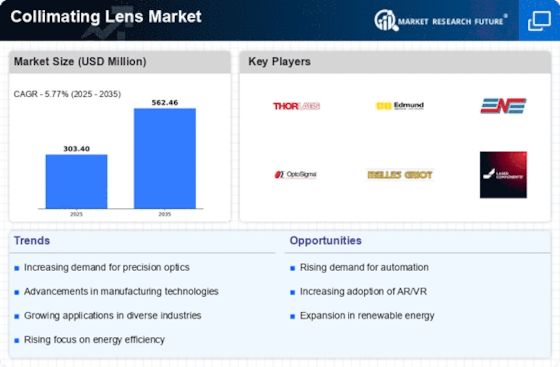
As per Market Research Future analysis, the Collimating Lens Market Size was estimated at 303.4 USD Million in 2024. The Collimating Lens industry is projected to grow from USD 320.91 Million in 2025 to USD 562.46 Million by 2035, exhibiting a compound annual growth rate (CAGR) of 5.77% during the forecast period 2025 - 2035

Key Market Trends & Highlights

The Collimating Lens Market is poised for substantial growth driven by technological advancements and increasing applications across various sectors.

  • Technological advancements are propelling the development of more efficient collimating lenses, particularly in North America. The demand for collimating lenses in telecommunications is surging, reflecting the region's status as the largest market. In the Asia-Pacific region, the market for laser collimating lenses is expanding rapidly, indicating a shift towards faster-growing segments. Rising adoption of laser technologies and increased investment in research and development are key drivers fueling market growth.

Market Size & Forecast

2024 Market Size 303.4 (USD Million)
2035 Market Size 562.46 (USD Million)
CAGR (2025 - 2035) 5.77%
Largest Regional Market Share in 2024 Asia Pacific

Major Players

Thorlabs (US), Edmund Optics (US), Newport Corporation (US), OptoSigma (JP), Melles Griot (US), Laser Components (DE), Sill Optics (DE), Linos (DE), Optical Surfaces (GB)

Market Trends

The Collimating Lens Market is currently experiencing a dynamic evolution, driven by advancements in optical technologies and increasing applications across various sectors. The demand for high-precision optical components is on the rise, particularly in industries such as telecommunications, medical devices, and defense. The collimating lens market is experiencing steady growth, driven by increasing demand for precise beam shaping and light alignment across optics, photonics, and laser-based applications. As these sectors continue to innovate, the need for efficient light management solutions becomes paramount. This trend suggests a growing emphasis on the development of specialized collimating lenses that can enhance performance and reliability in diverse applications. Comprehensive collimating lens market analysis highlights rising adoption in telecommunications, industrial laser systems, medical devices, and scientific instrumentation. Key collimating lens market trends include advancements in optical materials, miniaturization of lens assemblies, and improved performance in high-power and high-precision applications.

Moreover, the integration of collimating lenses in emerging technologies, such as augmented reality and laser-based systems, indicates a potential shift in market dynamics. Manufacturers are likely focusing on creating lenses that not only meet current specifications but also adapt to future technological advancements. The emphasis on sustainability and energy efficiency may further influence product development, as stakeholders seek environmentally friendly materials and processes. Overall, the Collimating Lens Market appears poised for substantial growth, with opportunities for innovation and expansion across multiple industries.

Technological Advancements

The Collimating Lens Market is witnessing rapid technological advancements, particularly in the design and manufacturing processes. Innovations in materials and coatings are enhancing the performance of collimating lenses, allowing for improved light transmission and reduced aberrations. This trend is likely to drive the development of more sophisticated optical systems, catering to the needs of various applications.

Increased Demand in Telecommunications

The telecommunications sector is increasingly relying on collimating lenses to optimize signal transmission and reception. As the demand for high-speed data transfer continues to grow, the need for efficient optical components becomes critical. This trend suggests that manufacturers may focus on creating lenses specifically tailored for telecommunications applications, potentially leading to new product lines.

Sustainability Initiatives

There is a noticeable shift towards sustainability within the Collimating Lens Market, as manufacturers explore eco-friendly materials and production methods. This trend indicates a growing awareness of environmental impacts and a commitment to reducing carbon footprints. Companies may invest in research to develop sustainable alternatives, aligning with global efforts to promote greener technologies.

Collimating Lens Market Market Drivers

Expansion of Consumer Electronics

The expansion of the consumer electronics sector is another significant driver for the Collimating Lens Market. With the proliferation of devices such as smartphones, tablets, and smart home products, the demand for high-quality optical components has surged. Collimating lenses play a crucial role in enhancing the performance of cameras and display technologies, which are integral to these devices. Market data indicates that the consumer electronics industry is expected to witness a growth rate of around 4% annually, further fueling the need for efficient optical solutions. As manufacturers focus on improving image quality and device functionality, the Collimating Lens Market is likely to experience increased demand, prompting innovation and development in lens design and manufacturing processes.

Rising Adoption of Laser Technologies

The increasing adoption of laser technologies across various sectors is a primary driver for the Collimating Lens Market. Lasers are extensively utilized in applications such as manufacturing, medical devices, and telecommunications. The demand for high-precision optical components, including collimating lenses, is expected to rise as industries seek to enhance efficiency and accuracy. According to recent data, the laser market is projected to grow at a compound annual growth rate of approximately 5.5% over the next few years. This growth is likely to stimulate the need for advanced collimating lenses, which are essential for directing laser beams with minimal divergence. As a result, the Collimating Lens Market is positioned to benefit significantly from this trend, as manufacturers strive to meet the evolving requirements of laser applications.

Growth in Medical Imaging Applications

The growth in medical imaging applications is a vital driver for the Collimating Lens Market. Technologies such as endoscopy, optical coherence tomography, and various imaging modalities rely heavily on high-quality optical components to ensure accurate diagnostics and treatment. The medical imaging market is anticipated to expand at a rate of approximately 6% per year, driven by advancements in healthcare technology and an aging population. As healthcare providers seek to enhance imaging capabilities, the demand for specialized collimating lenses that improve image clarity and precision is likely to rise. This trend presents a substantial opportunity for the Collimating Lens Market, as manufacturers develop tailored solutions to meet the specific needs of medical applications.

Emerging Applications in Automotive Sector

Emerging applications in the automotive sector are increasingly driving the Collimating Lens Market. With the rise of advanced driver-assistance systems (ADAS) and autonomous vehicles, the need for high-quality optical components has become paramount. Collimating lenses are essential for various applications, including LiDAR systems and camera-based sensors, which are integral to enhancing vehicle safety and navigation. The automotive optics market is expected to grow at a rate of around 5% annually, reflecting the industry's shift towards more sophisticated technologies. As automotive manufacturers prioritize safety and efficiency, the demand for reliable collimating lenses is likely to increase, presenting a significant opportunity for the Collimating Lens Market to expand its reach and influence.

Increased Investment in Research and Development

Increased investment in research and development across various industries is a notable driver for the Collimating Lens Market. Organizations are allocating more resources to innovate and improve optical technologies, which directly impacts the demand for high-performance collimating lenses. This trend is particularly evident in sectors such as aerospace, defense, and telecommunications, where precision optics are critical. Data suggests that R&D spending in these sectors is projected to grow by approximately 7% annually, indicating a robust commitment to advancing optical technologies. As companies strive to develop cutting-edge solutions, the Collimating Lens Market is likely to benefit from enhanced product offerings and increased demand for specialized lenses that meet rigorous performance standards.

Market Segment Insights

By Light Source: LED (Largest) vs. Laser (Fastest-Growing)

The Collimating Lens Market exhibits a diverse distribution of light source technologies, with LED technology commanding the largest market share due to its energy efficiency and longevity. Laser sources are rising rapidly, capturing interest as they become more prevalent in various applications, particularly in precision and industrial settings, though the share remains lower than LEDs currently. Looking ahead, the growth in the collimating lens segment is propelled by advancements in LED technology and the increasing demand for laser systems in high-performance applications. Consumers are drawn to the brightness, energy savings, and performance improvements provided by LED solutions, while lasers are gaining traction in sectors that require accuracy and efficiency, marking an exciting trend as both technologies evolve and expand their reach.

LED (Dominant) vs. Laser (Emerging)

LED technology has established itself as the dominant player in the light source segment of the Collimating Lens Market, largely due to its high efficiency, reduced energy consumption, and long lifespan. This makes it an attractive option for many applications, including general lighting, automotive, and electronics, where long-term operation is key. In contrast, Laser technology is viewed as an emerging contender, particularly in niche markets such as medical and industrial applications. Lasers offer unique benefits, such as high precision and the ability to generate focused beams of light, appealing to specialized industries. As demand continues to grow for high-performance and energy-efficient lighting solutions, both LED and Laser technologies are expected to play pivotal roles, each catering to specific market needs.

By Material: Molded Glass (Largest) vs. Molded Plastic (Fastest-Growing)

In the Collimating Lens Market, the segment distribution shows that Molded Glass holds the largest share due to its superior optical qualities and durability. This material is preferred for applications demanding high precision and performance, making it a staple in industries like automotive and aerospace. In contrast, <a href="https://www.marketresearchfuture.com/reports/molded-plastic-market-6395" target="_blank" title="molded plastic">Molded Plastic</a>, while currently smaller in overall share, is rapidly gaining traction, attributed to its lightweight properties and cost-effectiveness, fitting well with the evolving needs of various sectors.

Molded Glass (Dominant) vs. Molded Plastic (Emerging)

Molded Glass is recognized as the dominant material in the Collimating Lens Market due to its exceptional light transmission and resilience to environmental factors. Its applications span across highly specialized areas such as military optics and advanced lighting systems. On the other hand, Molded Plastic is emerging as a significant contender, appealing to manufacturers looking for economical solutions without compromising on quality. Its advantages include lower weight, ease of manufacturing, and flexibility in design, appealing to industries like consumer electronics and healthcare. The growth of Molded Plastic reflects a market trend towards lightweight and cost-effective alternatives.

By Wavelength: Less Than-1000 Nm (Largest) vs. 1001-1500 Nm (Fastest-Growing)

The Collimating Lens Market showcases a diverse segmentation based on wavelength, with the 'Less Than-1000 Nm' segment standing out as the largest contributor to market share. This segment dominates the landscape due to its wide applicability in various optical systems, making it a reliable choice for high-performance applications. Conversely, the '1001-1500 Nm' segment is recognized as the fastest-growing, attracting significant interest due to advances in technology and increasing demand for longer wavelength applications in multiple industries.

Wavelength: Less Than-1000 Nm (Dominant) vs. 1001-1500 Nm (Emerging)

The 'Less Than-1000 Nm' segment of the Collimating Lens Market is characterized by its established presence and high demand across sectors such as telecommunications, imaging, and laser technologies. Its robust applications in critical high-precision fields highlight its dominance. Meanwhile, the '1001-1500 Nm' segment is rapidly emerging, fueled by technological advancements and an increased focus on infrared applications. This segment is anticipated to play a vital role in innovative developments, especially in areas requiring enhanced optical performance and efficiency.

By End User: Automobile (Largest) vs. Medical (Fastest-Growing)

In the Collimating Lens Market, the end user segment is diverse, with significant contributions from the automobile and medical sectors. The automobile industry holds the largest share, leveraging collimating lenses for advanced lighting and optical applications in vehicles. Meanwhile, the medical sector is rapidly expanding, utilizing these lenses in various diagnostic and therapeutic equipment. As technological advancements continue, both sectors showcase unique demands and trends, influencing market dynamics.

Automobile: Dominant vs. Medical: Emerging

The automobile sector stands out as a dominant player in the Collimating Lens Market due to its extensive use in headlights and advanced driver-assistance systems (ADAS). The demand for high-performance lighting solutions drives continuous innovations in lens design and materials. In contrast, the medical sector, while currently smaller, is emerging rapidly as a significant user of collimating lenses in applications such as endoscopy and laser surgery. The increasing focus on precision and improved patient outcomes in medical technologies enhances the growth potential of collimating lenses in this field, as manufacturers seek to integrate more advanced optical solutions into their products.

Get more detailed insights about Collimating Lens Market Research Report – Forecast till 2035

Regional Insights

North America : Innovation and Market Leadership

North America is the largest market for collimating lenses, holding approximately 45% of the global share. The region benefits from a robust technological infrastructure, significant investments in R&D, and a growing demand for advanced optical systems in sectors like telecommunications and healthcare. Regulatory support for innovation and quality standards further drives market growth, making it a key player in the global landscape. The United States leads the North American market, with major companies like Thorlabs, Edmund Optics, and Newport Corporation driving competition. These firms are known for their cutting-edge technologies and extensive product portfolios. The presence of established players fosters a competitive environment, encouraging innovation and enhancing product offerings to meet diverse customer needs.

Europe : Emerging Market with Strong Regulations

Europe is the second-largest market for collimating lenses, accounting for around 30% of the global market share. The region's growth is propelled by stringent regulations that ensure high-quality optical products, alongside increasing demand from industries such as automotive and aerospace. The European Union's focus on innovation and sustainability also acts as a catalyst for market expansion, encouraging companies to adopt advanced technologies. Germany, the UK, and France are the leading countries in this market, with key players like Laser Components and Sill Optics contributing significantly. The competitive landscape is characterized by a mix of established firms and innovative startups, fostering a dynamic environment. The presence of research institutions and collaborations further enhances the region's capabilities in optical technologies.

Asia-Pacific : Rapid Growth and Technological Advancements

Asia-Pacific is witnessing rapid growth in the collimating lens market, driven by increasing industrialization and technological advancements. The region holds approximately 20% of the global market share, with countries like Japan and China leading the charge. The demand for high-precision optical components in sectors such as electronics and manufacturing is a significant growth driver, supported by favorable government policies promoting innovation and technology adoption. Japan is home to key players like OptoSigma, which enhances the competitive landscape with its advanced product offerings. China is also emerging as a significant market, with a growing number of local manufacturers entering the field. The region's focus on research and development, coupled with a skilled workforce, positions it as a formidable player in The Collimating Lens Market.

Middle East and Africa : Untapped Potential and Growth Opportunities

The Middle East and Africa region represents an emerging market for collimating lenses, holding about 5% of the global share. The growth is primarily driven by increasing investments in infrastructure and technology, particularly in sectors like telecommunications and healthcare. However, challenges such as limited local manufacturing capabilities and regulatory hurdles can impede faster growth. Governments are increasingly recognizing the importance of optical technologies, which may lead to supportive policies in the future. Countries like South Africa and the UAE are at the forefront of this market, with a growing number of companies exploring opportunities in optical technologies. The competitive landscape is still developing, with both local and international players vying for market share. As the region continues to invest in technology and infrastructure, the potential for growth in the collimating lens market remains significant.

Key Players and Competitive Insights

The Collimating Lens Market is currently characterized by a dynamic competitive landscape, driven by technological advancements and increasing demand across various sectors, including telecommunications, medical devices, and industrial applications. Key players such as Thorlabs (US), Edmund Optics (US), and Newport Corporation (US) are strategically positioned to leverage their extensive product portfolios and innovative capabilities. Thorlabs (US) focuses on expanding its optical component offerings, while Edmund Optics (US) emphasizes customization and customer-centric solutions. Newport Corporation (US) appears to be enhancing its market presence through strategic partnerships and collaborations, which collectively shape a competitive environment that is increasingly reliant on innovation and customer engagement. 
In terms of business tactics, companies are increasingly localizing manufacturing to reduce lead times and enhance supply chain efficiency. The market structure is moderately fragmented, with several players vying for market share, yet the influence of major companies remains substantial. This competitive structure allows for a diverse range of products and services, catering to various customer needs while fostering innovation through competition. Growth in the fiber optics collimating lens market is supported by expanding deployment of fiber optic communication systems, data centers, and optical sensing technologies.
In August 2025, Thorlabs (US) announced the launch of a new line of high-performance collimating lenses designed specifically for laser applications. This strategic move not only enhances their product portfolio but also positions Thorlabs (US) as a leader in the high-precision optics segment. The introduction of these lenses is expected to meet the growing demand for advanced optical solutions in research and industrial applications, thereby solidifying their market position. The collimating capillary lens market is gaining traction in specialized applications such as X-ray optics, analytical instrumentation, and advanced research environments requiring high-precision beam control.
In September 2025, Edmund Optics (US) unveiled a new customization service that allows customers to tailor collimating lenses to their specific requirements. This initiative reflects a strategic focus on customer-centricity and innovation, enabling the company to differentiate itself in a competitive market. By offering bespoke solutions, Edmund Optics (US) is likely to attract a broader customer base, enhancing its competitive edge.
In July 2025, Newport Corporation (US) entered into a strategic partnership with a leading technology firm to develop next-generation optical systems. This collaboration is indicative of Newport's commitment to innovation and technological advancement. By aligning with a technology partner, Newport Corporation (US) aims to integrate cutting-edge technologies into its product offerings, potentially leading to enhanced performance and new market opportunities.

As of October 2025, the Collimating Lens Market is witnessing trends such as digitalization, sustainability, and the integration of artificial intelligence in product development. Strategic alliances are increasingly shaping the competitive landscape, allowing companies to pool resources and expertise. Looking ahead, competitive differentiation is likely to evolve from traditional price-based competition to a focus on innovation, technological advancements, and supply chain reliability. This shift underscores the importance of agility and responsiveness in meeting the evolving demands of the market.

Key Companies in the Collimating Lens Market include

Industry Developments

  • Q1 2024: Thorlabs Launches New AI-Optimized Collimating Lens Market Series for Fiber Optics and Laser Systems Thorlabs announced the release of a new series of high-precision collimating lenses featuring AI-powered optical alignment, targeting fiber optics and advanced laser applications.
  • Q2 2024: Edmund Optics Introduces Customizable Aspheric Collimating Lenses with High-Efficiency Coatings Edmund Optics launched a new product line of customizable aspheric collimating lenses designed for improved beam shaping and efficiency in industrial and medical imaging systems.
  • Q2 2024: Excelitas Technologies Unveils Collimating Lenses for Next-Generation LiDAR and Medical Imaging Excelitas Technologies announced new collimating lens products optimized for LiDAR systems in autonomous vehicles and high-resolution medical imaging devices.
  • Q3 2024: IPG Photonics Launches High-Power Fiber Laser Collimating Optics with AI-Driven Wavelength Optimization IPG Photonics introduced a new line of collimating optics for fiber lasers, featuring AI-driven wavelength optimization for enhanced precision in industrial laser applications.
  • Q3 2024: Optikos Corporation Debuts AI-Powered Collimation Testing and Calibration Services Optikos Corporation announced new services for AI-powered collimating lens testing and calibration, aimed at improving performance and reliability for optical manufacturers.
  • Q4 2024: Thorlabs Opens New Manufacturing Facility for Advanced Collimating Lens Market Production Thorlabs inaugurated a new facility dedicated to the production of advanced collimating lenses, expanding its manufacturing capacity to meet growing global demand.
  • Q1 2025: Edmund Optics Announces Strategic Partnership with Leading Photonics Firm for Collimating Lens Market Innovation Edmund Optics entered a partnership with a major photonics company to co-develop next-generation collimating lenses for emerging applications in AR/VR and autonomous vehicles.
  • Q1 2025: Excelitas Technologies Wins Major Contract to Supply Collimating Lenses for European Automotive LiDAR Project Excelitas Technologies secured a contract to provide collimating lenses for a large-scale European automotive LiDAR initiative, supporting the rollout of advanced driver-assistance systems.
  • Q2 2025: IPG Photonics Expands Collimating Lens Market Portfolio with New Precision Beam Delivery Systems IPG Photonics expanded its product portfolio with new collimating lens solutions designed for precision beam delivery in industrial and medical laser systems.
  • Q2 2025: Optikos Corporation Appoints New Chief Technology Officer to Lead Collimating Lens Market R&D Optikos Corporation announced the appointment of a new CTO to spearhead research and development in collimating lens technology and optical metrology.
  • Q3 2025: Thorlabs Secures Funding for Expansion of Collimating Lens Market R&D Programs Thorlabs received new funding to accelerate research and development of advanced collimating lens technologies for next-generation photonics applications.
  • Q3 2025: Edmund Optics Launches Miniaturized Collimating Lens Market Solutions for Wearable Devices Edmund Optics introduced a new line of miniaturized collimating lenses designed for integration into wearable devices and compact optical systems.

Future Outlook

Collimating Lens Market Future Outlook

The Collimating Lens Market is projected to grow at a 5.77% CAGR from 2025 to 2035, driven by advancements in optical technologies and increasing demand in various applications.

New opportunities lie in:

  • <p>Development of high-efficiency LED collimating lenses for energy-saving applications. Expansion into emerging markets with tailored optical solutions. Partnerships with tech firms for integrated optical systems in <a href="https://www.marketresearchfuture.com/reports/consumer-electronics-market-66318" target="_blank" title="consumer electronics">consumer electronics</a>.</p>

By 2035, the Collimating Lens Market is expected to achieve robust growth and innovation.

Market Segmentation

Collimating Lens Market End User Outlook

  • Automobile
  • Medical
  • Lidar
  • Light And Display Measurement
  • Spectroscopy
  • Interferometry
  • Others

Collimating Lens Market Material Outlook

  • Molded Glass
  • Molded Plastic
  • Others

Collimating Lens Market Wavelength Outlook

  • Less Than-1000 Nm
  • 1001-1500 Nm
  • 1501-2000 Nm
  • 2001 Nm And Above

Collimating Lens Market Light Source Outlook

  • LED
  • Laser
  • Xenon Lamp
  • Infrared Light
  • RGB

Report Scope

MARKET SIZE 2024 303.4(USD Million)
MARKET SIZE 2025 320.91(USD Million)
MARKET SIZE 2035 562.46(USD Million)
COMPOUND ANNUAL GROWTH RATE (CAGR) 5.77% (2025 - 2035)
REPORT COVERAGE Revenue Forecast, Competitive Landscape, Growth Factors, and Trends
BASE YEAR 2024
Market Forecast Period 2025 - 2035
Historical Data 2019 - 2024
Market Forecast Units USD Million
Key Companies Profiled Thorlabs (US), Edmund Optics (US), Newport Corporation (US), OptoSigma (JP), Melles Griot (US), Laser Components (DE), Sill Optics (DE), Linos (DE), Optical Surfaces (GB)
Segments Covered Light Source, Region
Key Market Opportunities Advancements in optical technologies drive demand in the Collimating Lens Market for diverse applications.
Key Market Dynamics Technological advancements drive demand for collimating lenses in diverse applications, enhancing optical performance and efficiency.
Countries Covered North America, Europe, APAC, South America, MEA

FAQs

What is the projected market valuation for the Collimating Lens Market in 2035?

<p>The projected market valuation for the Collimating Lens Market in 2035 is 562.46 USD Million.</p>

What was the overall market valuation of the Collimating Lens Market in 2024?

<p>The overall market valuation of the Collimating Lens Market in 2024 was 303.4 USD Million.</p>

What is the expected CAGR for the Collimating Lens Market during the forecast period 2025 - 2035?

<p>The expected CAGR for the Collimating Lens Market during the forecast period 2025 - 2035 is 5.77%.</p>

Which companies are considered key players in the Collimating Lens Market?

<p>Key players in the Collimating Lens Market include Thorlabs, Edmund Optics, Newport Corporation, and others.</p>

What are the primary segments of the Collimating Lens Market based on light sources?

<p>The primary segments based on light sources include LED, Laser, Xenon Lamp, Infrared Light, and RGB.</p>

What was the valuation range for the LED segment in the Collimating Lens Market?

The valuation range for the LED segment in the Collimating Lens Market was between 90.0 and 170.0 USD Million.

How does the molded glass segment perform in terms of market valuation?

The molded glass segment had a valuation range of 121.36 to 224.99 USD Million.

What end-user applications are driving the demand for collimating lenses?

End-user applications driving demand include Automobile, Medical, Lidar, and Spectroscopy.

What is the valuation range for the medical segment in the Collimating Lens Market?

The valuation range for the medical segment in the Collimating Lens Market is between 45.51 and 85.0 USD Million.

What wavelength segments are included in the Collimating Lens Market analysis?

Wavelength segments include Less Than-1000 Nm, 1001-1500 Nm, 1501-2000 Nm, and 2001 Nm And Above.

  1. SECTION I: EXECUTIVE SUMMARY AND KEY HIGHLIGHTS
    1. | 1.1 EXECUTIVE SUMMARY
    2. | | 1.1.1 Market Overview
    3. | | 1.1.2 Key Findings
    4. | | 1.1.3 Market Segmentation
    5. | | 1.1.4 Competitive Landscape
    6. | | 1.1.5 Challenges and Opportunities
    7. | | 1.1.6 Future Outlook
  2. SECTION II: SCOPING, METHODOLOGY AND MARKET STRUCTURE
    1. | 2.1 MARKET INTRODUCTION
    2. | | 2.1.1 Definition
    3. | | 2.1.2 Scope of the study
    4. | | | 2.1.2.1 Research Objective
    5. | | | 2.1.2.2 Assumption
    6. | | | 2.1.2.3 Limitations
    7. | 2.2 RESEARCH METHODOLOGY
    8. | | 2.2.1 Overview
    9. | | 2.2.2 Data Mining
    10. | | 2.2.3 Secondary Research
    11. | | 2.2.4 Primary Research
    12. | | | 2.2.4.1 Primary Interviews and Information Gathering Process
    13. | | | 2.2.4.2 Breakdown of Primary Respondents
    14. | | 2.2.5 Forecasting Model
    15. | | 2.2.6 Market Size Estimation
    16. | | | 2.2.6.1 Bottom-Up Approach
    17. | | | 2.2.6.2 Top-Down Approach
    18. | | 2.2.7 Data Triangulation
    19. | | 2.2.8 Validation
  3. SECTION III: QUALITATIVE ANALYSIS
    1. | 3.1 MARKET DYNAMICS
    2. | | 3.1.1 Overview
    3. | | 3.1.2 Drivers
    4. | | 3.1.3 Restraints
    5. | | 3.1.4 Opportunities
    6. | 3.2 MARKET FACTOR ANALYSIS
    7. | | 3.2.1 Value chain Analysis
    8. | | 3.2.2 Porter's Five Forces Analysis
    9. | | | 3.2.2.1 Bargaining Power of Suppliers
    10. | | | 3.2.2.2 Bargaining Power of Buyers
    11. | | | 3.2.2.3 Threat of New Entrants
    12. | | | 3.2.2.4 Threat of Substitutes
    13. | | | 3.2.2.5 Intensity of Rivalry
    14. | | 3.2.3 COVID-19 Impact Analysis
    15. | | | 3.2.3.1 Market Impact Analysis
    16. | | | 3.2.3.2 Regional Impact
    17. | | | 3.2.3.3 Opportunity and Threat Analysis
  4. SECTION IV: QUANTITATIVE ANALYSIS
    1. | 4.1 Semiconductor & Electronics, BY Light Source (USD Million)
    2. | | 4.1.1 LED
    3. | | 4.1.2 Laser
    4. | | 4.1.3 Xenon Lamp
    5. | | 4.1.4 Infrared Light
    6. | | 4.1.5 RGB
    7. | 4.2 Semiconductor & Electronics, BY Material (USD Million)
    8. | | 4.2.1 Molded Glass
    9. | | 4.2.2 Molded Plastic
    10. | | 4.2.3 Others
    11. | 4.3 Semiconductor & Electronics, BY Wavelength (USD Million)
    12. | | 4.3.1 Less Than-1000 Nm
    13. | | 4.3.2 1001-1500 Nm
    14. | | 4.3.3 1501-2000 Nm
    15. | | 4.3.4 2001 Nm And Above
    16. | 4.4 Semiconductor & Electronics, BY End User (USD Million)
    17. | | 4.4.1 Automobile
    18. | | 4.4.2 Medical
    19. | | 4.4.3 Lidar
    20. | | 4.4.4 Light And Display Measurement
    21. | | 4.4.5 Spectroscopy
    22. | | 4.4.6 Interferometry
    23. | | 4.4.7 Others
    24. | 4.5 Semiconductor & Electronics, BY Region (USD Million)
    25. | | 4.5.1 North America
    26. | | | 4.5.1.1 US
    27. | | | 4.5.1.2 Canada
    28. | | 4.5.2 Europe
    29. | | | 4.5.2.1 Germany
    30. | | | 4.5.2.2 UK
    31. | | | 4.5.2.3 France
    32. | | | 4.5.2.4 Russia
    33. | | | 4.5.2.5 Italy
    34. | | | 4.5.2.6 Spain
    35. | | | 4.5.2.7 Rest of Europe
    36. | | 4.5.3 APAC
    37. | | | 4.5.3.1 China
    38. | | | 4.5.3.2 India
    39. | | | 4.5.3.3 Japan
    40. | | | 4.5.3.4 South Korea
    41. | | | 4.5.3.5 Malaysia
    42. | | | 4.5.3.6 Thailand
    43. | | | 4.5.3.7 Indonesia
    44. | | | 4.5.3.8 Rest of APAC
    45. | | 4.5.4 South America
    46. | | | 4.5.4.1 Brazil
    47. | | | 4.5.4.2 Mexico
    48. | | | 4.5.4.3 Argentina
    49. | | | 4.5.4.4 Rest of South America
    50. | | 4.5.5 MEA
    51. | | | 4.5.5.1 GCC Countries
    52. | | | 4.5.5.2 South Africa
    53. | | | 4.5.5.3 Rest of MEA
  5. SECTION V: COMPETITIVE ANALYSIS
    1. | 5.1 Competitive Landscape
    2. | | 5.1.1 Overview
    3. | | 5.1.2 Competitive Analysis
    4. | | 5.1.3 Market share Analysis
    5. | | 5.1.4 Major Growth Strategy in the Semiconductor & Electronics
    6. | | 5.1.5 Competitive Benchmarking
    7. | | 5.1.6 Leading Players in Terms of Number of Developments in the Semiconductor & Electronics
    8. | | 5.1.7 Key developments and growth strategies
    9. | | | 5.1.7.1 New Product Launch/Service Deployment
    10. | | | 5.1.7.2 Merger & Acquisitions
    11. | | | 5.1.7.3 Joint Ventures
    12. | | 5.1.8 Major Players Financial Matrix
    13. | | | 5.1.8.1 Sales and Operating Income
    14. | | | 5.1.8.2 Major Players R&D Expenditure. 2023
    15. | 5.2 Company Profiles
    16. | | 5.2.1 Thorlabs (US)
    17. | | | 5.2.1.1 Financial Overview
    18. | | | 5.2.1.2 Products Offered
    19. | | | 5.2.1.3 Key Developments
    20. | | | 5.2.1.4 SWOT Analysis
    21. | | | 5.2.1.5 Key Strategies
    22. | | 5.2.2 Edmund Optics (US)
    23. | | | 5.2.2.1 Financial Overview
    24. | | | 5.2.2.2 Products Offered
    25. | | | 5.2.2.3 Key Developments
    26. | | | 5.2.2.4 SWOT Analysis
    27. | | | 5.2.2.5 Key Strategies
    28. | | 5.2.3 Newport Corporation (US)
    29. | | | 5.2.3.1 Financial Overview
    30. | | | 5.2.3.2 Products Offered
    31. | | | 5.2.3.3 Key Developments
    32. | | | 5.2.3.4 SWOT Analysis
    33. | | | 5.2.3.5 Key Strategies
    34. | | 5.2.4 OptoSigma (JP)
    35. | | | 5.2.4.1 Financial Overview
    36. | | | 5.2.4.2 Products Offered
    37. | | | 5.2.4.3 Key Developments
    38. | | | 5.2.4.4 SWOT Analysis
    39. | | | 5.2.4.5 Key Strategies
    40. | | 5.2.5 Melles Griot (US)
    41. | | | 5.2.5.1 Financial Overview
    42. | | | 5.2.5.2 Products Offered
    43. | | | 5.2.5.3 Key Developments
    44. | | | 5.2.5.4 SWOT Analysis
    45. | | | 5.2.5.5 Key Strategies
    46. | | 5.2.6 Laser Components (DE)
    47. | | | 5.2.6.1 Financial Overview
    48. | | | 5.2.6.2 Products Offered
    49. | | | 5.2.6.3 Key Developments
    50. | | | 5.2.6.4 SWOT Analysis
    51. | | | 5.2.6.5 Key Strategies
    52. | | 5.2.7 Sill Optics (DE)
    53. | | | 5.2.7.1 Financial Overview
    54. | | | 5.2.7.2 Products Offered
    55. | | | 5.2.7.3 Key Developments
    56. | | | 5.2.7.4 SWOT Analysis
    57. | | | 5.2.7.5 Key Strategies
    58. | | 5.2.8 Linos (DE)
    59. | | | 5.2.8.1 Financial Overview
    60. | | | 5.2.8.2 Products Offered
    61. | | | 5.2.8.3 Key Developments
    62. | | | 5.2.8.4 SWOT Analysis
    63. | | | 5.2.8.5 Key Strategies
    64. | | 5.2.9 Optical Surfaces (GB)
    65. | | | 5.2.9.1 Financial Overview
    66. | | | 5.2.9.2 Products Offered
    67. | | | 5.2.9.3 Key Developments
    68. | | | 5.2.9.4 SWOT Analysis
    69. | | | 5.2.9.5 Key Strategies
    70. | 5.3 Appendix
    71. | | 5.3.1 References
    72. | | 5.3.2 Related Reports
  6. LIST OF FIGURES
    1. | 6.1 MARKET SYNOPSIS
    2. | 6.2 NORTH AMERICA MARKET ANALYSIS
    3. | 6.3 US MARKET ANALYSIS BY LIGHT SOURCE
    4. | 6.4 US MARKET ANALYSIS BY MATERIAL
    5. | 6.5 US MARKET ANALYSIS BY WAVELENGTH
    6. | 6.6 US MARKET ANALYSIS BY END USER
    7. | 6.7 CANADA MARKET ANALYSIS BY LIGHT SOURCE
    8. | 6.8 CANADA MARKET ANALYSIS BY MATERIAL
    9. | 6.9 CANADA MARKET ANALYSIS BY WAVELENGTH
    10. | 6.10 CANADA MARKET ANALYSIS BY END USER
    11. | 6.11 EUROPE MARKET ANALYSIS
    12. | 6.12 GERMANY MARKET ANALYSIS BY LIGHT SOURCE
    13. | 6.13 GERMANY MARKET ANALYSIS BY MATERIAL
    14. | 6.14 GERMANY MARKET ANALYSIS BY WAVELENGTH
    15. | 6.15 GERMANY MARKET ANALYSIS BY END USER
    16. | 6.16 UK MARKET ANALYSIS BY LIGHT SOURCE
    17. | 6.17 UK MARKET ANALYSIS BY MATERIAL
    18. | 6.18 UK MARKET ANALYSIS BY WAVELENGTH
    19. | 6.19 UK MARKET ANALYSIS BY END USER
    20. | 6.20 FRANCE MARKET ANALYSIS BY LIGHT SOURCE
    21. | 6.21 FRANCE MARKET ANALYSIS BY MATERIAL
    22. | 6.22 FRANCE MARKET ANALYSIS BY WAVELENGTH
    23. | 6.23 FRANCE MARKET ANALYSIS BY END USER
    24. | 6.24 RUSSIA MARKET ANALYSIS BY LIGHT SOURCE
    25. | 6.25 RUSSIA MARKET ANALYSIS BY MATERIAL
    26. | 6.26 RUSSIA MARKET ANALYSIS BY WAVELENGTH
    27. | 6.27 RUSSIA MARKET ANALYSIS BY END USER
    28. | 6.28 ITALY MARKET ANALYSIS BY LIGHT SOURCE
    29. | 6.29 ITALY MARKET ANALYSIS BY MATERIAL
    30. | 6.30 ITALY MARKET ANALYSIS BY WAVELENGTH
    31. | 6.31 ITALY MARKET ANALYSIS BY END USER
    32. | 6.32 SPAIN MARKET ANALYSIS BY LIGHT SOURCE
    33. | 6.33 SPAIN MARKET ANALYSIS BY MATERIAL
    34. | 6.34 SPAIN MARKET ANALYSIS BY WAVELENGTH
    35. | 6.35 SPAIN MARKET ANALYSIS BY END USER
    36. | 6.36 REST OF EUROPE MARKET ANALYSIS BY LIGHT SOURCE
    37. | 6.37 REST OF EUROPE MARKET ANALYSIS BY MATERIAL
    38. | 6.38 REST OF EUROPE MARKET ANALYSIS BY WAVELENGTH
    39. | 6.39 REST OF EUROPE MARKET ANALYSIS BY END USER
    40. | 6.40 APAC MARKET ANALYSIS
    41. | 6.41 CHINA MARKET ANALYSIS BY LIGHT SOURCE
    42. | 6.42 CHINA MARKET ANALYSIS BY MATERIAL
    43. | 6.43 CHINA MARKET ANALYSIS BY WAVELENGTH
    44. | 6.44 CHINA MARKET ANALYSIS BY END USER
    45. | 6.45 INDIA MARKET ANALYSIS BY LIGHT SOURCE
    46. | 6.46 INDIA MARKET ANALYSIS BY MATERIAL
    47. | 6.47 INDIA MARKET ANALYSIS BY WAVELENGTH
    48. | 6.48 INDIA MARKET ANALYSIS BY END USER
    49. | 6.49 JAPAN MARKET ANALYSIS BY LIGHT SOURCE
    50. | 6.50 JAPAN MARKET ANALYSIS BY MATERIAL
    51. | 6.51 JAPAN MARKET ANALYSIS BY WAVELENGTH
    52. | 6.52 JAPAN MARKET ANALYSIS BY END USER
    53. | 6.53 SOUTH KOREA MARKET ANALYSIS BY LIGHT SOURCE
    54. | 6.54 SOUTH KOREA MARKET ANALYSIS BY MATERIAL
    55. | 6.55 SOUTH KOREA MARKET ANALYSIS BY WAVELENGTH
    56. | 6.56 SOUTH KOREA MARKET ANALYSIS BY END USER
    57. | 6.57 MALAYSIA MARKET ANALYSIS BY LIGHT SOURCE
    58. | 6.58 MALAYSIA MARKET ANALYSIS BY MATERIAL
    59. | 6.59 MALAYSIA MARKET ANALYSIS BY WAVELENGTH
    60. | 6.60 MALAYSIA MARKET ANALYSIS BY END USER
    61. | 6.61 THAILAND MARKET ANALYSIS BY LIGHT SOURCE
    62. | 6.62 THAILAND MARKET ANALYSIS BY MATERIAL
    63. | 6.63 THAILAND MARKET ANALYSIS BY WAVELENGTH
    64. | 6.64 THAILAND MARKET ANALYSIS BY END USER
    65. | 6.65 INDONESIA MARKET ANALYSIS BY LIGHT SOURCE
    66. | 6.66 INDONESIA MARKET ANALYSIS BY MATERIAL
    67. | 6.67 INDONESIA MARKET ANALYSIS BY WAVELENGTH
    68. | 6.68 INDONESIA MARKET ANALYSIS BY END USER
    69. | 6.69 REST OF APAC MARKET ANALYSIS BY LIGHT SOURCE
    70. | 6.70 REST OF APAC MARKET ANALYSIS BY MATERIAL
    71. | 6.71 REST OF APAC MARKET ANALYSIS BY WAVELENGTH
    72. | 6.72 REST OF APAC MARKET ANALYSIS BY END USER
    73. | 6.73 SOUTH AMERICA MARKET ANALYSIS
    74. | 6.74 BRAZIL MARKET ANALYSIS BY LIGHT SOURCE
    75. | 6.75 BRAZIL MARKET ANALYSIS BY MATERIAL
    76. | 6.76 BRAZIL MARKET ANALYSIS BY WAVELENGTH
    77. | 6.77 BRAZIL MARKET ANALYSIS BY END USER
    78. | 6.78 MEXICO MARKET ANALYSIS BY LIGHT SOURCE
    79. | 6.79 MEXICO MARKET ANALYSIS BY MATERIAL
    80. | 6.80 MEXICO MARKET ANALYSIS BY WAVELENGTH
    81. | 6.81 MEXICO MARKET ANALYSIS BY END USER
    82. | 6.82 ARGENTINA MARKET ANALYSIS BY LIGHT SOURCE
    83. | 6.83 ARGENTINA MARKET ANALYSIS BY MATERIAL
    84. | 6.84 ARGENTINA MARKET ANALYSIS BY WAVELENGTH
    85. | 6.85 ARGENTINA MARKET ANALYSIS BY END USER
    86. | 6.86 REST OF SOUTH AMERICA MARKET ANALYSIS BY LIGHT SOURCE
    87. | 6.87 REST OF SOUTH AMERICA MARKET ANALYSIS BY MATERIAL
    88. | 6.88 REST OF SOUTH AMERICA MARKET ANALYSIS BY WAVELENGTH
    89. | 6.89 REST OF SOUTH AMERICA MARKET ANALYSIS BY END USER
    90. | 6.90 MEA MARKET ANALYSIS
    91. | 6.91 GCC COUNTRIES MARKET ANALYSIS BY LIGHT SOURCE
    92. | 6.92 GCC COUNTRIES MARKET ANALYSIS BY MATERIAL
    93. | 6.93 GCC COUNTRIES MARKET ANALYSIS BY WAVELENGTH
    94. | 6.94 GCC COUNTRIES MARKET ANALYSIS BY END USER
    95. | 6.95 SOUTH AFRICA MARKET ANALYSIS BY LIGHT SOURCE
    96. | 6.96 SOUTH AFRICA MARKET ANALYSIS BY MATERIAL
    97. | 6.97 SOUTH AFRICA MARKET ANALYSIS BY WAVELENGTH
    98. | 6.98 SOUTH AFRICA MARKET ANALYSIS BY END USER
    99. | 6.99 REST OF MEA MARKET ANALYSIS BY LIGHT SOURCE
    100. | 6.100 REST OF MEA MARKET ANALYSIS BY MATERIAL
    101. | 6.101 REST OF MEA MARKET ANALYSIS BY WAVELENGTH
    102. | 6.102 REST OF MEA MARKET ANALYSIS BY END USER
    103. | 6.103 KEY BUYING CRITERIA OF SEMICONDUCTOR & ELECTRONICS
    104. | 6.104 RESEARCH PROCESS OF MRFR
    105. | 6.105 DRO ANALYSIS OF SEMICONDUCTOR & ELECTRONICS
    106. | 6.106 DRIVERS IMPACT ANALYSIS: SEMICONDUCTOR & ELECTRONICS
    107. | 6.107 RESTRAINTS IMPACT ANALYSIS: SEMICONDUCTOR & ELECTRONICS
    108. | 6.108 SUPPLY / VALUE CHAIN: SEMICONDUCTOR & ELECTRONICS
    109. | 6.109 SEMICONDUCTOR & ELECTRONICS, BY LIGHT SOURCE, 2024 (% SHARE)
    110. | 6.110 SEMICONDUCTOR & ELECTRONICS, BY LIGHT SOURCE, 2024 TO 2035 (USD Million)
    111. | 6.111 SEMICONDUCTOR & ELECTRONICS, BY MATERIAL, 2024 (% SHARE)
    112. | 6.112 SEMICONDUCTOR & ELECTRONICS, BY MATERIAL, 2024 TO 2035 (USD Million)
    113. | 6.113 SEMICONDUCTOR & ELECTRONICS, BY WAVELENGTH, 2024 (% SHARE)
    114. | 6.114 SEMICONDUCTOR & ELECTRONICS, BY WAVELENGTH, 2024 TO 2035 (USD Million)
    115. | 6.115 SEMICONDUCTOR & ELECTRONICS, BY END USER, 2024 (% SHARE)
    116. | 6.116 SEMICONDUCTOR & ELECTRONICS, BY END USER, 2024 TO 2035 (USD Million)
    117. | 6.117 BENCHMARKING OF MAJOR COMPETITORS
  7. LIST OF TABLES
    1. | 7.1 LIST OF ASSUMPTIONS
    2. | | 7.1.1
    3. | 7.2 North America MARKET SIZE ESTIMATES; FORECAST
    4. | | 7.2.1 BY LIGHT SOURCE, 2025-2035 (USD Million)
    5. | | 7.2.2 BY MATERIAL, 2025-2035 (USD Million)
    6. | | 7.2.3 BY WAVELENGTH, 2025-2035 (USD Million)
    7. | | 7.2.4 BY END USER, 2025-2035 (USD Million)
    8. | 7.3 US MARKET SIZE ESTIMATES; FORECAST
    9. | | 7.3.1 BY LIGHT SOURCE, 2025-2035 (USD Million)
    10. | | 7.3.2 BY MATERIAL, 2025-2035 (USD Million)
    11. | | 7.3.3 BY WAVELENGTH, 2025-2035 (USD Million)
    12. | | 7.3.4 BY END USER, 2025-2035 (USD Million)
    13. | 7.4 Canada MARKET SIZE ESTIMATES; FORECAST
    14. | | 7.4.1 BY LIGHT SOURCE, 2025-2035 (USD Million)
    15. | | 7.4.2 BY MATERIAL, 2025-2035 (USD Million)
    16. | | 7.4.3 BY WAVELENGTH, 2025-2035 (USD Million)
    17. | | 7.4.4 BY END USER, 2025-2035 (USD Million)
    18. | 7.5 Europe MARKET SIZE ESTIMATES; FORECAST
    19. | | 7.5.1 BY LIGHT SOURCE, 2025-2035 (USD Million)
    20. | | 7.5.2 BY MATERIAL, 2025-2035 (USD Million)
    21. | | 7.5.3 BY WAVELENGTH, 2025-2035 (USD Million)
    22. | | 7.5.4 BY END USER, 2025-2035 (USD Million)
    23. | 7.6 Germany MARKET SIZE ESTIMATES; FORECAST
    24. | | 7.6.1 BY LIGHT SOURCE, 2025-2035 (USD Million)
    25. | | 7.6.2 BY MATERIAL, 2025-2035 (USD Million)
    26. | | 7.6.3 BY WAVELENGTH, 2025-2035 (USD Million)
    27. | | 7.6.4 BY END USER, 2025-2035 (USD Million)
    28. | 7.7 UK MARKET SIZE ESTIMATES; FORECAST
    29. | | 7.7.1 BY LIGHT SOURCE, 2025-2035 (USD Million)
    30. | | 7.7.2 BY MATERIAL, 2025-2035 (USD Million)
    31. | | 7.7.3 BY WAVELENGTH, 2025-2035 (USD Million)
    32. | | 7.7.4 BY END USER, 2025-2035 (USD Million)
    33. | 7.8 France MARKET SIZE ESTIMATES; FORECAST
    34. | | 7.8.1 BY LIGHT SOURCE, 2025-2035 (USD Million)
    35. | | 7.8.2 BY MATERIAL, 2025-2035 (USD Million)
    36. | | 7.8.3 BY WAVELENGTH, 2025-2035 (USD Million)
    37. | | 7.8.4 BY END USER, 2025-2035 (USD Million)
    38. | 7.9 Russia MARKET SIZE ESTIMATES; FORECAST
    39. | | 7.9.1 BY LIGHT SOURCE, 2025-2035 (USD Million)
    40. | | 7.9.2 BY MATERIAL, 2025-2035 (USD Million)
    41. | | 7.9.3 BY WAVELENGTH, 2025-2035 (USD Million)
    42. | | 7.9.4 BY END USER, 2025-2035 (USD Million)
    43. | 7.10 Italy MARKET SIZE ESTIMATES; FORECAST
    44. | | 7.10.1 BY LIGHT SOURCE, 2025-2035 (USD Million)
    45. | | 7.10.2 BY MATERIAL, 2025-2035 (USD Million)
    46. | | 7.10.3 BY WAVELENGTH, 2025-2035 (USD Million)
    47. | | 7.10.4 BY END USER, 2025-2035 (USD Million)
    48. | 7.11 Spain MARKET SIZE ESTIMATES; FORECAST
    49. | | 7.11.1 BY LIGHT SOURCE, 2025-2035 (USD Million)
    50. | | 7.11.2 BY MATERIAL, 2025-2035 (USD Million)
    51. | | 7.11.3 BY WAVELENGTH, 2025-2035 (USD Million)
    52. | | 7.11.4 BY END USER, 2025-2035 (USD Million)
    53. | 7.12 Rest of Europe MARKET SIZE ESTIMATES; FORECAST
    54. | | 7.12.1 BY LIGHT SOURCE, 2025-2035 (USD Million)
    55. | | 7.12.2 BY MATERIAL, 2025-2035 (USD Million)
    56. | | 7.12.3 BY WAVELENGTH, 2025-2035 (USD Million)
    57. | | 7.12.4 BY END USER, 2025-2035 (USD Million)
    58. | 7.13 APAC MARKET SIZE ESTIMATES; FORECAST
    59. | | 7.13.1 BY LIGHT SOURCE, 2025-2035 (USD Million)
    60. | | 7.13.2 BY MATERIAL, 2025-2035 (USD Million)
    61. | | 7.13.3 BY WAVELENGTH, 2025-2035 (USD Million)
    62. | | 7.13.4 BY END USER, 2025-2035 (USD Million)
    63. | 7.14 China MARKET SIZE ESTIMATES; FORECAST
    64. | | 7.14.1 BY LIGHT SOURCE, 2025-2035 (USD Million)
    65. | | 7.14.2 BY MATERIAL, 2025-2035 (USD Million)
    66. | | 7.14.3 BY WAVELENGTH, 2025-2035 (USD Million)
    67. | | 7.14.4 BY END USER, 2025-2035 (USD Million)
    68. | 7.15 India MARKET SIZE ESTIMATES; FORECAST
    69. | | 7.15.1 BY LIGHT SOURCE, 2025-2035 (USD Million)
    70. | | 7.15.2 BY MATERIAL, 2025-2035 (USD Million)
    71. | | 7.15.3 BY WAVELENGTH, 2025-2035 (USD Million)
    72. | | 7.15.4 BY END USER, 2025-2035 (USD Million)
    73. | 7.16 Japan MARKET SIZE ESTIMATES; FORECAST
    74. | | 7.16.1 BY LIGHT SOURCE, 2025-2035 (USD Million)
    75. | | 7.16.2 BY MATERIAL, 2025-2035 (USD Million)
    76. | | 7.16.3 BY WAVELENGTH, 2025-2035 (USD Million)
    77. | | 7.16.4 BY END USER, 2025-2035 (USD Million)
    78. | 7.17 South Korea MARKET SIZE ESTIMATES; FORECAST
    79. | | 7.17.1 BY LIGHT SOURCE, 2025-2035 (USD Million)
    80. | | 7.17.2 BY MATERIAL, 2025-2035 (USD Million)
    81. | | 7.17.3 BY WAVELENGTH, 2025-2035 (USD Million)
    82. | | 7.17.4 BY END USER, 2025-2035 (USD Million)
    83. | 7.18 Malaysia MARKET SIZE ESTIMATES; FORECAST
    84. | | 7.18.1 BY LIGHT SOURCE, 2025-2035 (USD Million)
    85. | | 7.18.2 BY MATERIAL, 2025-2035 (USD Million)
    86. | | 7.18.3 BY WAVELENGTH, 2025-2035 (USD Million)
    87. | | 7.18.4 BY END USER, 2025-2035 (USD Million)
    88. | 7.19 Thailand MARKET SIZE ESTIMATES; FORECAST
    89. | | 7.19.1 BY LIGHT SOURCE, 2025-2035 (USD Million)
    90. | | 7.19.2 BY MATERIAL, 2025-2035 (USD Million)
    91. | | 7.19.3 BY WAVELENGTH, 2025-2035 (USD Million)
    92. | | 7.19.4 BY END USER, 2025-2035 (USD Million)
    93. | 7.20 Indonesia MARKET SIZE ESTIMATES; FORECAST
    94. | | 7.20.1 BY LIGHT SOURCE, 2025-2035 (USD Million)
    95. | | 7.20.2 BY MATERIAL, 2025-2035 (USD Million)
    96. | | 7.20.3 BY WAVELENGTH, 2025-2035 (USD Million)
    97. | | 7.20.4 BY END USER, 2025-2035 (USD Million)
    98. | 7.21 Rest of APAC MARKET SIZE ESTIMATES; FORECAST
    99. | | 7.21.1 BY LIGHT SOURCE, 2025-2035 (USD Million)
    100. | | 7.21.2 BY MATERIAL, 2025-2035 (USD Million)
    101. | | 7.21.3 BY WAVELENGTH, 2025-2035 (USD Million)
    102. | | 7.21.4 BY END USER, 2025-2035 (USD Million)
    103. | 7.22 South America MARKET SIZE ESTIMATES; FORECAST
    104. | | 7.22.1 BY LIGHT SOURCE, 2025-2035 (USD Million)
    105. | | 7.22.2 BY MATERIAL, 2025-2035 (USD Million)
    106. | | 7.22.3 BY WAVELENGTH, 2025-2035 (USD Million)
    107. | | 7.22.4 BY END USER, 2025-2035 (USD Million)
    108. | 7.23 Brazil MARKET SIZE ESTIMATES; FORECAST
    109. | | 7.23.1 BY LIGHT SOURCE, 2025-2035 (USD Million)
    110. | | 7.23.2 BY MATERIAL, 2025-2035 (USD Million)
    111. | | 7.23.3 BY WAVELENGTH, 2025-2035 (USD Million)
    112. | | 7.23.4 BY END USER, 2025-2035 (USD Million)
    113. | 7.24 Mexico MARKET SIZE ESTIMATES; FORECAST
    114. | | 7.24.1 BY LIGHT SOURCE, 2025-2035 (USD Million)
    115. | | 7.24.2 BY MATERIAL, 2025-2035 (USD Million)
    116. | | 7.24.3 BY WAVELENGTH, 2025-2035 (USD Million)
    117. | | 7.24.4 BY END USER, 2025-2035 (USD Million)
    118. | 7.25 Argentina MARKET SIZE ESTIMATES; FORECAST
    119. | | 7.25.1 BY LIGHT SOURCE, 2025-2035 (USD Million)
    120. | | 7.25.2 BY MATERIAL, 2025-2035 (USD Million)
    121. | | 7.25.3 BY WAVELENGTH, 2025-2035 (USD Million)
    122. | | 7.25.4 BY END USER, 2025-2035 (USD Million)
    123. | 7.26 Rest of South America MARKET SIZE ESTIMATES; FORECAST
    124. | | 7.26.1 BY LIGHT SOURCE, 2025-2035 (USD Million)
    125. | | 7.26.2 BY MATERIAL, 2025-2035 (USD Million)
    126. | | 7.26.3 BY WAVELENGTH, 2025-2035 (USD Million)
    127. | | 7.26.4 BY END USER, 2025-2035 (USD Million)
    128. | 7.27 MEA MARKET SIZE ESTIMATES; FORECAST
    129. | | 7.27.1 BY LIGHT SOURCE, 2025-2035 (USD Million)
    130. | | 7.27.2 BY MATERIAL, 2025-2035 (USD Million)
    131. | | 7.27.3 BY WAVELENGTH, 2025-2035 (USD Million)
    132. | | 7.27.4 BY END USER, 2025-2035 (USD Million)
    133. | 7.28 GCC Countries MARKET SIZE ESTIMATES; FORECAST
    134. | | 7.28.1 BY LIGHT SOURCE, 2025-2035 (USD Million)
    135. | | 7.28.2 BY MATERIAL, 2025-2035 (USD Million)
    136. | | 7.28.3 BY WAVELENGTH, 2025-2035 (USD Million)
    137. | | 7.28.4 BY END USER, 2025-2035 (USD Million)
    138. | 7.29 South Africa MARKET SIZE ESTIMATES; FORECAST
    139. | | 7.29.1 BY LIGHT SOURCE, 2025-2035 (USD Million)
    140. | | 7.29.2 BY MATERIAL, 2025-2035 (USD Million)
    141. | | 7.29.3 BY WAVELENGTH, 2025-2035 (USD Million)
    142. | | 7.29.4 BY END USER, 2025-2035 (USD Million)
    143. | 7.30 Rest of MEA MARKET SIZE ESTIMATES; FORECAST
    144. | | 7.30.1 BY LIGHT SOURCE, 2025-2035 (USD Million)
    145. | | 7.30.2 BY MATERIAL, 2025-2035 (USD Million)
    146. | | 7.30.3 BY WAVELENGTH, 2025-2035 (USD Million)
    147. | | 7.30.4 BY END USER, 2025-2035 (USD Million)
    148. | 7.31 PRODUCT LAUNCH/PRODUCT DEVELOPMENT/APPROVAL
    149. | | 7.31.1
    150. | 7.32 ACQUISITION/PARTNERSHIP
    151. | | 7.32.1

Semiconductor & Electronics Market Segmentation

Semiconductor & Electronics By Light Source (USD Million, 2025-2035)

  • LED
  • Laser
  • Xenon Lamp
  • Infrared Light
  • RGB

Semiconductor & Electronics By Material (USD Million, 2025-2035)

  • Molded Glass
  • Molded Plastic
  • Others

Semiconductor & Electronics By Wavelength (USD Million, 2025-2035)

  • Less Than-1000 Nm
  • 1001-1500 Nm
  • 1501-2000 Nm
  • 2001 Nm And Above

Semiconductor & Electronics By End User (USD Million, 2025-2035)

  • Automobile
  • Medical
  • Lidar
  • Light And Display Measurement
  • Spectroscopy
  • Interferometry
  • Others
Infographic

Free Sample Request

Kindly complete the form below to receive a free sample of this Report

Get Free Sample

Customer Strories

Compare Licence

×
Features License Type
Single User Multiuser License Enterprise User
Price $4,950 $5,950 $7,250
Maximum User Access Limit 1 User Upto 10 Users Unrestricted Access Throughout the Organization
Free Customization
Direct Access to Analyst
Deliverable Format
Platform Access
Discount on Next Purchase 10% 15% 15%
Printable Versions